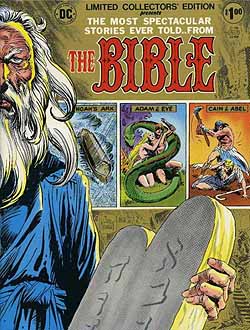
The Bible (DC Limited Collectors Edition C-36)

DC Limited Collectors Edition C-36

By Sheldon Mayer & Nestor Redondo, designed/edited by Joe Kubert (DC Comics/National Periodical Publications)
No ISBN:

This isn’t exactly a book or graphic novel but as the artist I want to highlight isn’t a fan-favourite in America or England (a fact I find utterly inexplicable) collections featuring his incredible artwork are few and far between.

Nestor Redondo was born in 1928 at Candon, Ilocas Sur in the American Territory of the Philippines. Like so many others he was influenced by the US comic-strips such as Tarzan, Superman, Buck Rogers and Flash Gordon which were immensely popular in the entertainment-starved Pacific Achipelago. Drawing from an early age Nestor emulated his brother Virgilio who already worked as a comics artist for the cheap magazines of the young country. The Philippines became a commonwealth in 1935, and achieved full-independence from the USA in 1946, but maintained close cultural links to America.

His parents pushed him into architecture but within a year he had returned to comics. A superb artist, he far outshone Virgilio – and everybody else – in the cottage industry. His brother switched to writing and the brothers teamed up to produce some of the best strips the Islands had ever seen, the most notable and best regarded being Mars Ravelo’s ‘Darna’.

Capable of astounding quality at an incredible rate, by the early 1950s Nestor was drawing for many comics simultaneously. Titles such as Pilipino Komiks, Tagalog Klasiks, Hiwaga Komiks and Espesial Komiks were fortnightly and he usually worked on two or three series at a time, pencils and inks. He also produced many of the covers.

In 1953 he produced an adaptation of the MGM film Quo Vadis for Ace Publications’ Tagalong Klasiks #91-92. Written by Clodualdo Del Mundo, it was serialized to promote the movie in the country, but MGM were so impressed by the art-job that they offered 24 year old Nestor a US job and residency, but he declined, thinking himself too young to leave home yet. If you’re interested, you can see the surviving artwork by Googling “Nestor Redondo’s Quo Vadis”, and you should because it’s frankly incredible.

Ace was the country’s biggest comics publisher, but by the early 1960s they were in dire financial straits. In 1963 Nestor, Tony Caravana, Alfredo Alcala, Jim Fernandez, Amado Castrillo and brother Virgilio set up their own company CRAF Publications, Inc., but the times were against them (and publishers everywhere).

About this time America came calling again, but in the form of DC and Marvel Comics. By 1972 US based Tony DeZuniga had introduced a wave of Philippino artists to US editors, and Nestor produced short horror tales for House of Mystery, House of Secrets, The Phantom Stranger, Secrets of Sinister House, Witching Hour, The Unexpected, Weird War Tales, fill-ins for Marvel’s Man-Thing, an astonishingly beautiful run on Rima the Jungle Girl #1-7 (an loose adaptation of W H Hudson’s seminal 1904 novel Green Mansions) and replaced Berni Wrightson as the artist on Swamp Thing. He also worked on Lois Lane and Tarzan.

In 1973 he produced adaptations including Dracula and Dr. Jekyll and Mr. Hyde for Vincent Fago’s Pendulum Press Illustrated Classics. These were later reprinted as Marvel Classics Comics. In later years he would move to Marvel where he inked and eventually fully illustrated Savage Sword of Conan.

During that DC period he was tapped to draw an adaptation of King Arthur which DC killed before it was completed (once again some pages survive and the internet is your friend if you want to see them). He also illustrated issue C-36 of the tabloid sized Limited Collectors Edition.

Another ambitious project that was never completed, The Bible was written by Sheldon Mayer and designed/edited by Joe Kubert. A deeply religious man, Redondo had already produced the serial Mga Kasaysayang Buhat sa Bibliya (Tales from the Bible) for the Philippine’s Superyor Komiks between 1969-1970 as well as creating an on-the-job training scheme for young creators there. Over the years he contributed to various Christian comics, including Marx, Lenin, Mao and Christ, published in 1977 by Open Doors, Aida-Zee and Behold 3-D, produced in the 1990s by Nate Butler Studio. He was also a panelist for the first Christian comics panel discussion of Comic-Con International, in 1992.

Stories from the Bible have been a part of US comics since the earliest days of the industry, but they have never been so beautifully illustrated as in this book. Included here are The Creation, The Garden of Eden, Cain and Abel, The Generations of Adam, Noah and the Flood, The Tower of Babel, The Story of Abraham and Sodom and Gomorrah.

Also included are single page information features Digging into the Past, School Days in Bible Times, The Ziggurat and Soldiers in the Time of Abraham all illustrated by Kubert, but the true star is the passionate beauty of Redondo’s, lush, glorious art.

Redondo worked as an animation designer for Marvel Studios in the 1990s. He wrote On Realistic Illustration – a teaching session for the 1st International Christian Comics Training Conference in Tagaytay, the Philippines, in January 1996, but sadly, died before he was able to deliver it.

Whatever your beliefs – and to be honest I don’t really care – you wouldn’t be reading this unless comics meant something to you. On that basis alone, this is work that you simply cannot be unmoved by and truly should be aware of. Even if there isn’t a comprehensive collection of his work – yet – this single work will stand as a lasting tribute to the unparalleled talent of Nestor Redondo.

© 1975 National Periodical Publications, Inc. All Rights Reserved.

Hamid of Aleppo

Hamid of Aleppo
Hamid of Aleppo

By Clive King and Giovanetti (Macmillan)
No ISBN Library of Congress catalog card number: 57-11517

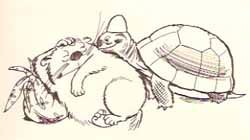
Pericle Luigi Giovanetti was a huge star in the cartoon firmament in the years following World War II, and a prolific one who appealed to fans of all ages. Born in 1916 in Basel, he launched Max in Punch in April 1953. Max is a small, round furry creature most likened to a hamster, whose wordless pantomimes were both cute and whimsical and trenchantly self-deprecating. Don’t ask me how a beautifully rendered little puff-ball could stand for pride and pomposity punctured, but he did. It was also blissfully free of mawkish sentimentality, a funny animal for adults.

Max was syndicated across the world, and celebrities the likes of Charles (‘Peanuts‘) Schulz were huge fans. The British Navy and even the Swiss Air Force impressed the ambiguous little hairball as mascot and figurehead. There were four collections between 1954 and 1961: Max, Max Presents, Nothing But Max and The Penguin Max.

For all his trenchant ability to convey meaning without uttering a sound, Max’s origins – and indeed species – was a subject of much dispute in the four corners of the globe so this delightful children’s book written by Clive King and copiously, wonderfully illustrated by Giovanetti is a godsend to zoologists and lovers of great storytelling everywhere. Long out of print it recounts the peripatetic wanderings of Max’s Great-Grandfather Hamid who lived in a hole in a hill in the desert region of Aleppo.

At least he did under the wanderlust seized him and he went in search of adventure, friends and the secret of his own identity. An irresistible and charming tale from a period where whimsy was a desirable treasure, this meanders along doling out equal amounts of exoticism and mystery from the mystic East – which wouldn’t go far amiss in today’s troubled and intolerant times.

A sheer delight, this isn’t the easiest book to find – ‘though it should be – so if you’re burning to discover Hamid – and Max’s – close kept secret I’ll reveal it here. If you don’t want to know look away now.
Max and Hamid are Syrian Golden Hamsters!

© 1958 The Macmillan Company. All Rights Reserved.

Footrot Flats Book 3

Footrot Flats Book 3

By Murray Ball (Titan Books)
ISBN: 978-1-85286-398-2

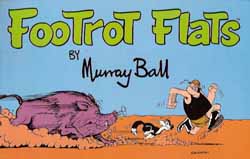
Footrot Flats is one of the all-time classic humour strips and beloved the world over. It was created by New Zealand cartoonist Murray Ball in 1975 on his return to the North Island after many years travelling the globe drawing for everybody from Punch to the Labour Weekly via both DC Thomson and IPC/Fleetway.

Taking up farming, he never put down his pens and brushes, but turned his clearly frustrating experiences into a twenty-year odyssey of mud, charm, weather, hysteria, endurance, stark wit and tear-jerking sentiment. He captured the joy and magic of agriculture with a blend of fearsome candour and total surrealism which captivated millions (he was also sometimes a wee bit sarcastic and ironic).

The drama unfolds via Dog – a dog – and relates the life of Regular Bloke Wal, eking out a living on his small-holding (400 acres of swamp between Ureweras and the Sea with sheep, cows, a bull, goats, ducks, bugs, cats, geese and the occasional visiting relative) just trying to get by. He loves sport, has a girl-friend and would love an easy life… if only the flamin’ stock would do what it’s told.

The third volume introduced still more weird characters and as Ball hit his creative stride his brilliant cartooning reached new heights of manic zaniness. Wal’s prickly little niece Janice – known to all as “Pongo” – became a regular and the strip expanded from thrice weekly to a full seven days, which meant some episodes here are expanded from 3 or 4 panels to as many as 8 with the inclusion of Sunday Pages. Some of these are all too-rare huge single-panel gags taking up the whole page and showing the artist’s facility with zany, action-packed comedy set-pieces and his sheer cartoon inventiveness.

Footrot Flats was one of the most successfully syndicated strips in the world. It ran in newspapers on four continents until 1994 when Ball retired it, citing reasons as varied as the death of his own dog and the state of New Zealand politics. Books of new material continued until 2000, resulting in 27 daily strip collections, 8 volumes of Sunday pages, and 5 pocket books, plus ancillary publications. There was a stage musical, a theme park and a truly superb animated film Footrot Flats: The Dog’s Tail Tale.

Dry, surreal and wonderfully self-deprecating, the humour comes from the perfectly realised characters, human and otherwise, the tough life of a bachelor farmer and especially the country itself. The art is utterly captivating; expansive, efficient, exciting and just plain funny. I’m reviewing the 1991 Titan Books edition, but the same material is readily available from a number of publishers and retailers. If you want to give the Dog a go, your favourite search engine will be your own friend faithful unto death…

Go on. Fetch!

© 1991 Diogenes Designs Ltd. All Rights Reserved.

Deadpool: The Circle Chase & Sins of the Past

A BRITISH EDITION RELEASED BY PANINI UK LTD

Deadpool
Deadpool

By various (Marvel/Panini UK)
ISBN: 987-1-905239-84-9

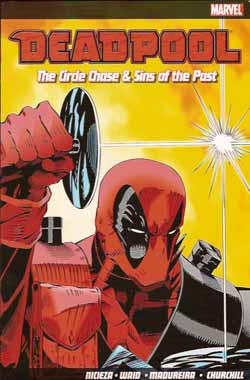
With the Wolverine movie looming and rumours of a spin-off for featured bad-guy Deadpool this timely collection of the unkillable assassin’s first two miniseries was inevitable and will hopefully lead to collections of the sterling run by scripter Joe Kelly that followed these tales. That’s not to disparage the fine efforts of Fabian Nicieza and Joe Madureira or Mark Waid, Ian Churchill, Lee Weeks, Ken Lashley and assorted inkers Mark Farmer, Harry Candelario, Jason Minor, Bob McLeod, Bob LaRosa and Tom Wegryzn, however.

What does it say about our industry that bloodthirsty – if stylish – killers and mercenaries make for such popular antagonists? Well, they certainly lead more interesting lives than your average plumber. Deadpool is Wade Wilson (and yes he is a thinly disguised knockoff of DC’s Slade Wilson AKA Terminator: Get over it – DC did) a hired killer and survivor of a genetics experiment that has left him capable of regenerating from any wound.

The wisecracking high-tech “merc with a mouth” was created by Rob Liefeld and Fabian Nicieza and first appeared in New Mutants #97, another product of the Canadian project that created Wolverine and the second Weapon X. He got his first shot at stardom with The Circle Chase miniseries in 1993.

This fast-paced if cluttered thriller sees Wade pursuing an ultimate weapon as one of a large crowd of mutants and ne’er-do-wells trying to secure the fabled legacy of arms dealer and fugitive from the future Mr. Tolliver. Among the other worthies after the boodle are Black Tom and the Juggernaut, the aforementioned Weapon X, shape-shifter Copycat and a host of half-cyborg loons with odd names like Commcast and Slayback. If you can swallow any nausea associated with the dreadful trappings of this low point in Marvel’s tempestuous history, there is a sharp little thriller underneath.

The second story (from 1994) revolves around Black Tom and Juggernaut. During the previous yarn it was revealed that the Irish arch-villain was slowly turning into a tree. Desperate to save his life they manipulate Wilson by exploiting the mercenary’s relationship with Siryn (a sonic mutant and Tom’s niece). Believing that Deadpool’s regenerating factor holds a cure, the villains cause a bucket-load of carnage at a time when Wade Wilson is at his lowest ebb. Fast paced, action-packed and full of mutant guest stars, this is a shallow but hugely immensely readable piece of eye-candy.

When the movie breaks, everyone is going to be an expert on Deadpool. Get this now and you’ll be one step ahead of the pack.

© 1993, 1994, 2008 Marvel Characters, Inc. All Rights Reserved.

Silver Surfer: Homecoming

Homecoming
Homecoming

A MARVEL GRAPHIC NOVEL
By Jim Starlin, Bill Reinhold & Linda Lessman (Marvel)
ISBN: 0- 87135-855-7

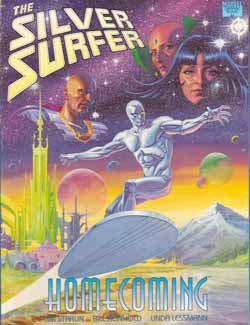
The Silver Surfer was a popular star of Marvel’s Graphic Novel line, his elevated pedigree and the nature and location of his adventures obviously offering an appealing number of opportunities to many creators. This tale from 1991 teams “Mr. Cosmic Storyline” Jim Starlin with the hugely undervalued Bill Reinhold to tell a rather lacklustre saga of granted wishes and thwarted dreams.

Norrin Radd allowed himself to be transformed into the Silver Surfer to save his homeworld Zenn-La from planet-devouring cosmic entity Galactus. His eventual emancipation never gave him the opportunity to permanently return to his place of birth, nor settle down with his lost love Shalla Bal, whom he had forsaken for a life of service to the Great Destroyer. Years later whilst on his solitary wanderings he finds Zenn-La missing; removed from reality by a galactic hyper-being.

Coming to the rescue the Surfer discovers not a tyrant but a benefactor who is preserving many words from the horrors of a violent universe, and decides to remain in this paradise. Unfortunately this dream come true is only for the invited…

An interesting premise, and well-handled visually, Homecoming nevertheless falls short of its aim due to a heavy-handed script that lacks any real punch or insight. Another one best left for the dedicated fan and collectors, I’m afraid.

© 1991 Marvel Entertainment Group/Marvel Characters, Inc. All Rights Reserved.

Showcase Presents: Adam Strange

Showcase: Adam Strange

By Gardner Fox, Mike Sekowsky, Carmine Infantino & various (DC Comics)
ISBN: 978-1-4012-1313-8

For many of us the Silver Age of comics is the ideal era. Varnished by nostalgia (because that’s when most of us caught this crazy childhood bug), the clean-cut, uncomplicated optimism of the late 1950s and early 1960s produced captivating heroes and villains who were still far less terrifying than the Cold War baddies which troubled the grown-ups. The sheer talent and professionalism of the creators working in that too-briefly revitalised comics world resulted in triumph after triumph which brightened our young lives and still glow today with quality and achievement.

One of the most compelling stars of those days was an ordinary Earthman who regularly travelled to another world for spectacular adventures, armed with nothing more than a ray-gun, a jetpack and his own ingenuity. His name was Adam Strange, and like so many of that era’s triumphs he was the brainchild of Julius Schwartz and his close team of creative stars.

Showcase was a try-out comic designed to launch new series and concepts with minimal commitment of publishing resources. If a new character sold well initially a regular series would follow. The process had already worked with great success. Frogmen, Flash, Challengers of the Unknown and Lois Lane had all won their own titles or feature spots and Editorial Director Irwin Donenfeld now wanted his two Showcase editors to create science fiction heroes to capitalise on the twin zeitgeists of the Space Race and the popular fascination with movie monsters and aliens.

Jack Schiff came up with the futuristic crime fighter Space Ranger (who debuted in issues #15-16) and Schwartz went to Gardner Fox, Mike Sekowsky and Bernard Sachs to craft the saga of a modern-day explorer in the most uncharted territory yet imagined.

Showcase #17 (cover-dated November-December 1958) launched ‘Adventures on Other Worlds’, and told of an archaeologist who, whilst fleeing from enraged natives in Peru, jumps a 25 ft chasm only to be hit by a stray teleport beam from a planet orbiting Alpha Centauri. He materialises in another world, filled with giant plants and monsters and is rescued by a beautiful woman named Alanna who teaches him her language.

‘Secret of the Eternal City!’ reveals that Rann is a planet recovering from an atomic war, and the beam was in fact a simple flare, one of many sent in an attempt to communicate with other races. In the four years (speed of light, right? As You Know, Bob… Alpha Centauri is about 4.3 light-years from Sol) the Zeta-Flare travelled through space cosmic radiation converted it into a teleportation beam. Until the radiation drains from his body Strange would be a very willing prisoner on a fantastic new world.

And an incredibly unlucky one apparently, as no sooner has Adam started acclimatising than an alien race named The Eternals invade, seeking a mineral that will grant them immortality. His courage and sharp wits enable him to defeat the invaders only to have the radiation finally fade, drawing him home before the adoring Alanna can administer a hero’s reward. And thus was established the principles of this beguiling series. Adam would intercept a Zeta-beam hoping for some time with his alien sweetheart only to be confronted with a planet-menacing crisis.

The very next of these, ‘The Planet and the Pendulum’ saw him obtain the crimson spacesuit and weaponry that became his distinctive trademark in a tale of alien invaders which also introduced the subplot of Rann’s warring city-states, all desperate to progress and all at different stages of recovery and development. This tale also appeared in Showcase #17.

The next issue featured the self-explanatory ‘Invaders from the Atom Universe’ and ‘The Dozen Dooms of Adam Strange’ wherein the hero must outwit the dictator of Dys who planned to invade Alanna’s city of Rannagar. With this story Sachs was replaced by Joe Giella as inker, although he would return as soon as #19’s Gil Kane cover, the first to feature the title ‘Adam Strange’ over the unwieldy ‘Adventures on Other Worlds’.

‘Challenge of the Star-Hunter’ and ‘Mystery of the Mental Menace’ are classic puzzle tales where the Earthman must outwit a shape-changing alien and an all-powerful energy-being. These were the last in Showcase (cover-dated March-April1959), as with the August issue Adam Strange took over the lead spot and cover of the anthology comic Mystery in Space.

As well as a new home, the series also found a new artist. Carmine Infantino, who had worked such magic with The Flash, applied his clean, classical line and superb design sense to create a stark, pristine, sleekly beautiful universe that was spellbinding in its cool but deeply humanistic manner, and genuinely thrilling in its imaginative wonders. MIS #53 began an immaculate run of exotic high adventures with ‘Menace of the Robot Raiders!’ by Fox, Infantino and Sachs, followed in glorious succession by ‘Invaders of the Underground World’ and ‘The Beast from the Runaway World!’

With #56 Murphy Anderson became the semi-regular inker, and his precision brush and pen made the art a thing of unparalleled beauty. ‘The Menace of the Super-Atom’ and ‘Mystery of the Giant Footprints’ are sheer visual poetry, but even ‘Chariot in the Sky’, ‘The Duel of the Two Adam Stranges’ (MIS #58 and #59, inked by Giella) and ‘The Attack of the Tentacle World’, ‘Threat of the Tornado Tyrant’ and ‘Beast with the Sizzling Blue Eyes’ (MIS #60-62, inked by Sachs) were – and still are – streets ahead of the competition in terms of thrills, spectacle and imagination.

Anderson returned with #63, which introduced some much-needed recurring villains who employed ‘The Weapon That Swallowed Men!’, #64’s chilling ‘The Radio-active Menace!’ and, ending this volume, ‘The Mechanical Masters of Rann’, all superb short-story marvels that appealed to their young readers’ every sense – especially that burgeoning sense of wonder.

The far-flung fantasy continued with ‘Space Island of Peril’ by Gardner Fox, Carmine Infantino and Joe Giella, a duel with an alien super-being who planned to throw Rann into its sun, followed in #67 by the sly ‘Challenge of the Giant Fireflies’ when Adam’s adopted home is menaced by thrill-seeking creatures who live on the surface of our sun.

Murphy Anderson returned as inker-in-residence for ‘The Fadeaway Doom’ wherein Rannian General Kaskor made a unique attempt to seize power by co-opting the Zeta Beam itself. ‘Menace of the Aqua-ray Weapon!’ had a race from Rann’s primeval past return to take possession of their old world, whilst #70 saw ‘The Vengeance of the Dust Devil’ threaten not just Rann but also Earth itself.

‘The Challenge of the Crystal Conquerors’ (inked by Giella) was a sharp game of bluff and double-bluff with the planet at stake but #72 was a radical departure from the tried and true formula. ‘The Multiple Menace Weapon’ found Adam diverted to Rann in the year 101,961AD to save his descendents before dealing with the threat to his own time and place. This was followed by the action-packed mystery thriller ‘The Invisible Raiders of Rann!’

The puzzles continued with #74’s complex thriller ‘The Spaceman who Fought Himself!’, inked by back-for-good Murphy Anderson, leading to MIS #75 and a legendary team-up with the freshly-minted Justice League of America against the despicable Kanjar Ro in ‘Planet that came to a Standstill’, indisputably one of the best tales of DC’s Silver Age and a key moment in the development of cross-series continuity.

After that 25 page extravaganza it was back to 14 pages for #76’s ‘Challenge of the Rival Starman!’ as Adam became the involuntary tutor and stalking-horse for an alien hero. ‘Ray-Gun in the Sky!’ is an invasion mystery which invited readers to solve the puzzle before our hero did, and ‘Shadow People of the Eclipse’ pitted the Earthman against a bored alien thrill-seeker. Issue #79’s ‘The Metal Conqueror of Rann’ saw Adam fighting a more personal battle to bring Alanna back from the brink of death, and ‘The Deadly Shadows of Adam Strange’ saw an old enemy return to wreak a bizarre personal revenge on the Champion of Rann.

MIS #81 tested our hero to his limits as the lost dictator who caused Rann’s devastating atomic war returned after a thousand years to threaten both of Adam’s beloved home-planets in ‘the Cloud-Creature that Menaced Two Worlds’, and a terrestrial criminal’s scheme to conquer our world was thwarted as a result of Adam stopping ‘World War on Earth and Rann!’. Issue #83 pitted him against the desperate ‘Emotion Master of Space!’ and this first volume concludes with the return of a truly relentless foe as Jakarta the Dust-Devil shrugs off ‘the Powerless Weapons of Adam Strange!’

For me, Adam Strange, more than any other character, epitomises the Silver Age of Comics. Witty, sophisticated, gloriously illustrated and fantastically imaginative: And always the woman named Alanna, beautiful, but somehow unattainable. The happy-ever-after was always just in reach, but only after one last adventure…

These thrillers from a distant time still hold great appeal and power for the wide-eyed and far-seeing. The sheer value of the huge black-and-white “phonebook” format makes a universe of wonder and excitement supremely accessible for the extraordinary exploits of Adam Strange: by far and away some of the best written and drawn science fiction comics ever produced. Whether for nostalgia’s sake, for your own entertainment or even to get your own impressionable ones properly indoctrinated, you really need these books on your shelves.

© 1958-1963, 2007 DC Comics. All Rights Reserved.

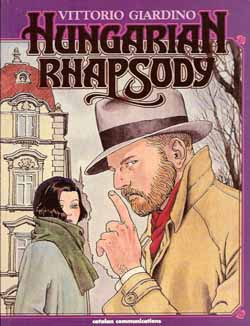
Hungarian Rhapsody

Hungarian Rhapsody
Hungarian Rhapsody

By Vittorio Giardino (Catalan Communications)
ISBN: 0-87416-033-2

After ten years, Italian graphic novelist Vittorio Giardino recently completed a trilogy of albums featuring his reluctant spy Max Fridman (transliterated into Max Friedman for the English speaking world), who was called back to the “Great Game” in the years of uneasy peace just before the outbreak of World War II.

No Pasarán! Volume 3 completed a tale of Republican Spain in the dying days of the Civil War which revealed many clues into the life of a diffident and unassuming hero who has charmed and enthralled word-wide audiences since the early 1980s, so in the earnest hope that this landmark will convince current publisher NBM (or anybody) to re-release the earlier books that are out of print I’m going to review them here over the next few months. If I make an impatient convert out of anyone, fear not. All but No Pasarán! Volume 1 are available from assorted internet retailers at reasonable prices and NBM do have copies of most of the other albums.

Born on Christmas Eve 1946 Vittorio Giardino was an electrician who switched careers at age 30. He worked for a number of comics magazines initially and his first collection Pax Romana was released in 1978. He has worked, slowly but consistently, on both feature characters such as the detective Sam Pezzo, the saucy Winsor McKay homage Little Ego and the cold-war drama Jonas Fink as well as general fiction tales producing over 35 albums to date.

In 1982 he began the tale of a quiet, bearded fellow recalled by the Deuxieme Bureau (the French Secret Service) to investigate the slaughter of almost every agent in the cosmopolitan paradise of Budapest. The series ran in four parts in the magazine Orient Express before being collected as Rhapsodie Hongroise – Giardino’s thirteenth book and in no way unlucky for him.

Friedman is a troubled, cautious man with a daughter he adores and a troubled past that somehow stems from undisclosed experiences in the Spanish Civil War where he fought as a Republican in the International Brigades against Franco’s Nationalists. Yet he is convinced – call it blackmailed – to leave his home in Switzerland and investigate the plague of assassinations.

Friedman is a hero in the mold of John le Carré’s George Smiley: a methodical thinker and the very antithesis of such combat supermen as James Bond or Napoleon Solo. Arriving in Budapest he prods and pokes about, swiftly becoming the target of not just the mysterious killers but seemingly every faction in a city crammed full of spies of every type and description from Soviet agitators to Nazi plotters. In a city of stunning, if decadent beauty where East meets West, Friedman finds that like the spy-game itself nobody and nothing can be trusted…

Somebody somewhere has a master-plan but who it is and what it is..? That’s a mystery that could get even the most careful man killed…

Giardino is a powerfully subtle writer who lets tone and nuance carry a tale and his captivating art, a semi-representational derivation of Hergé’s ligne claire or clean line makes the lovingly rendered locations as much a character in this smart, gripping drama as any of the stylishly familiar operatives of a dark, doomed world on the brink of holocaust.

Max Friedman is one of espionage literature’s greatest characters. Giardino’s work is like honey for the eyes and mind. Hungarian Rhapsody is a graphic novel any fan of comics or the Intelligence Game should know.

© 1986 Vittorio Giardino. All Rights Reserved.

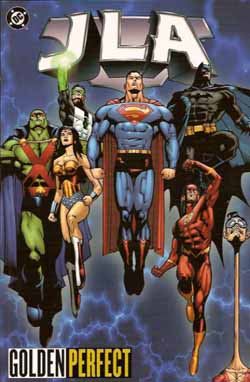
JLA Vol 10: Golden Perfect

JLA: Golden Perfect
JLA: Golden Perfect

By Joe Kelly, Doug Mankhe & Tom Nguyen (DC Comics)
ISBN13: 978-1-84023-609-5

Joe Kelly’s run on the World’s Greatest Superheroes has some notable highs and lows. This slim volume collecting issues # 61-65 of the monthly comicbook happily falls into the former category. The title comes from the three-part tale that forms the bulk of the book, but before that the wonderment kicks off with the stand-alone tale ‘Two-Minute Warning’, one of the best “day-in-the-life” type stories I’ve ever seen, with sharp dialogue, spectacular art and a novel format that elevates it beyond the many other attempts to show what everyday means for such god-like beings.

‘Golden Perfect’ is a tale which examines the nature of Truth itself. When Wonder Woman leads the team to the hidden kingdom of Jarhanpur to rescue a baby from a life of hereditary slavery she encounters a despot whose philosophy counters her belief in objective or absolute truth. The dispute shatters her magical golden lasso of Hestia…

Soon however this defeat has astounding repercussions for the entire universe. The broken lasso has destroyed objective truth completely. What people believe becomes the only arbiter of Reality. The moon is made of green cheese, the world is flat, Earth is the centre of the universe… As it all unravels a devastated Wonder Woman must find a way to reconcile her beliefs within the new Reality while the team battle desperately to keep the cosmos alive.

A dynamic end-of-everything tale that challenges the mind as well as stirring the blood, the patented Kelly one-liners, especially from Plastic Man, leaven the tension and heighten the enjoyment in this cracking little epic.

Ending the volume is ‘Bouncing Baby Boy’, a wistful and funny team-up of the mismatched Batman and Plastic Man. This small story looks at the sad side of the eternal clown, seen through the “cold and emotionless” eyes of the Dark Knight, and provides a welcome change from the Big Stories that are increasingly all Super-team books consist of.

Golden Perfect is well written and superbly illustrated, but not a typical JLA collection: It’s much, much better than that…

© 2002 DC Comics. All Rights Reserved.

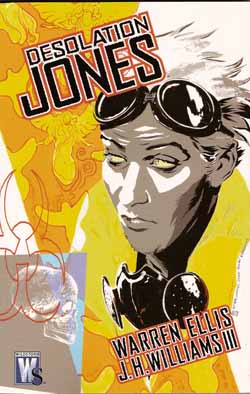
Desolation Jones: Made in England

Desolation Jones
Desolation Jones

By Warren Ellis & JH Williams III (WildStorm)
ISBN 1-84576-400-5

Los Angeles is a dump and a dumping ground. Personal opinions aside, that’s the premise of this deep, dark espionage thriller from comics wunderscribe Warren Ellis. When MI6 screw-up Michael Jones is no longer capable of doing his job he’s offered a comfy testing job as his ticket out. No-one in their right mind should ever trust security service types but that’s the point – the burnt out, alcoholic agent just wasn’t.

After years of unspeakable atrocities ostensibly intended to create better operatives up to and including the bizarre and inexplicable Desolation Test, the ravaged remains of Michael Jones is consigned to the reservation provided by the West’s Intelligence Agencies for retired, rejected and discarded agents plus all the experiments that didn’t measure up: Los Angeles, USA.

There they can live out their lives as they see fit, but they can never, ever leave the city. There’s no pension scheme but the dregs can do whatever they need to make a living as long as it’s within the city limits.

Jones is a mess, both physically and mentally. He can’t drink, won’t sleep and takes too many drugs. He avoids daylight, regularly hallucinates and is numb to all sensation and emotion. In “the Community” he freelances as a private eye-come-fixer, sorting out problems that can’t be resolved by legitimate methods.

In this first compilation (collecting issues #1-6 of the occasional WildStorm comicbook) that problem is a retired NSA spook who’s being blackmailed by new members of the Community who have stolen the Holy Grail of pornography. The ravaged Colonel Nigh wants Hitler’s homemade porno back and will do anything to get it. Unfortunately so will the other filthy rich deviants who populate Tinseltown.

But something isn’t right. Jones may not feel but something deeper is hiding behind all the subterfuge and depravity…

Sardonic and rather bleak, this caustic caper on the nasty side of the espionage genre is a thriller with plenty of twists and a solid mystery to intrigue the most jaded reader. The content is strictly adults only – by that I mean that the subtext of duty, love and honour are assaults on the traditions of the hero-spy in as brutal a manner as the sex and violence underscore the dark side of the American Dream-town. This is a story for cynical adults not horny kids with appropriate IDs. Great stuff beautifully executed by Ellis and magically illustrated by JH Williams III.

Compilation © 2006 Warren Ellis & JH Williams III. All Rights Reserved.

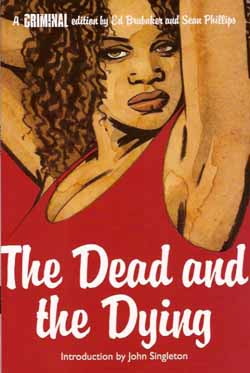
Criminal Book 3: The Dead and the Dying

The Dead and the Dying

By Ed Brubaker & Sean Phillips (Titan Books)
ISBN13: 978-1-84856-151-9

The third captivating collection of Brubaker and Phillips’s addictive modern Noir thriller (see Criminal: Coward ISBN: 1-84576-610-5 and Criminal: Lawless ISBN13: 978-1-84576-611-5) takes an unexpected turn by travelling back to the 1970s and recounting via three interconnected stories the history of the dark characters who inhabit those first two books.

Collecting volume 2, issues #1-3, of the comic book series, we meet the son of a black gangster who teamed with white Wise Guy Walter Hyde to take over the city’s rackets in 1954. Hyde became the Big Man and Clevon Brown became his invisible second. After all, there’s only so much progress even bad guys will let a black man enjoy in 1950s America.

1972 and Hyde’s kid Sebastian is making his way in his dad’s business but Jake Brown has chosen another route. They grew up friends but Jake chose boxing as a way to out, leaving the rackets to Hyde. Their closeness was soured over a woman but his once-friend still drags him back to the gutters whenever he needs a favour. And then one day he sees her: The girl who got between them.

The return of Danica Briggs turns an uncomfortable détente into a stupid, dangerous war and once the dust starts flying it’s hard to predict who’ll be left standing when it settles…

1972 and the second chapter finds a revenge-hungry Danica involved with returning Vietnam vet Teeg Lawless in a plan to steal from the Hyde’s. But when Lawless discovers just who he’s robbed he knows his method of making amends must be spectacular if he and his two baby boys are to live. His bloody mission to return the money and punish his confederates ensures his fearsome reputation for decades to come…

1972: Danica Briggs is making her way back to the city where her life ended. She wants money. She wants revenge. She wants to see Sebastian and Jake again. She wants it all to end…

‘Second Chance in Hell’, ‘A Wolf Among Wolves’ and ‘Female of the Species’ tell three tragic stories which combine into a brutal, foredoomed spiral of hopelessness which only violence can end. Oddly reminiscent of Christopher Nolan’s film Memento the story unfolds by taking us further back into each character’s past with each beginning but, nihilistically, at no stage does there ever appear to be a instant when a different path taken could have saved anyone. These trapped souls are doomed from the moment they met…

Dark, brutal and fearfully compelling, these tales of the other side of society are an irresistible view of raw humanity. These are stories that can’t be ignored… so don’t.

© 2008 Ed Brubaker & Sean Phillips. All Rights Reserved.