By Brian K. Vaughan & various (DC Comics)
ISBN: 987-1-84576-720-4
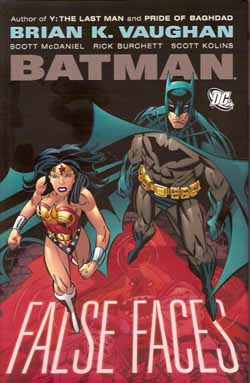
Like most “overnight successes†writer Brian K. Vaughan actually plugged away for those requisite few years before hitting it big with series such as Ex Machina and Y: The Last Man and original works such as the magnificent Pride of Baghdad (ISBN: 1-84576-242-8).
This collection purports to be a Batman compendium (better sales potential, I’d imagine) but is in fact a general gathering of DC universe material by Mister Vaughan in his formative days. First up is a three-part tale from Batman #588-590, illustrated by Scott McDaniel & Karl Story, starring the Dark Knight’s underworld alter-ego Matches Malone. ‘Close Before Striking’ is very readable psycho-drama revealing the true origin of the underworld alias whilst taking the reader on a traumatic excursion into the dark side of undercover work. This is followed by the delightfully dark and whimsical ‘Mimsy Were the Borogoves’. With art by Rich Burchett and John Lowe this stand-alone story features a deeply demented encounter with The Mad Hatter, and is undoubtedly the best thing in the book.
There’s only a tenuous Batman link in the next tale, which originally saw print as Wonder Woman #160-161. ‘A Piece of You’, drawn by Scott Kolins with inks from Dan Panosian and Drew Geraci, finds shape-changing Bat-villain Clayface attacking the Amazing Amazon when he discovers her origin. As she was formed from Magic Clay he reasons that he can absorb her – and her magical abilities – into his own mass. And stone me; he’s right! Action-packed and tongue in cheek, this daft but readable thriller also guest stars Donna Troy, Nightwing and Robin.
Somewhat messily the tome ends with a mere snippet from Batman: Gotham City Secret Files #1 which introduced new villain The Skeleton, and then promptly forgot all about him. ‘Skullduggery’ is illustrated by Marcos Martin and Mark Pennington, and although competent, rather lets down a very enjoyable trawl through the genre work of one of the best new writers in comics. If you enjoy superhero tales or are a Vaughan aficionado please don’t let this slight defect deter you from a great slice of comic book fun.
By Les Lilley & Anthony Hutchings (Millbank Books)
ISBN: 978-0-95198-980-7
I’m always banging on about how British creators have been slighted and cursed with anonymity in our industry so I’m going to use this review to shine a light on one of the most egregious examples of that practise. Leslie Alfred Joseph Lilley was born in Dartford in 1924. After Navy service in World War II he joined the burgeoning pool of demobbed servicemen selling cartoons to the news trade. At a time when publications were toiling under paper restrictions, “pocket cartoons†were ubiquitous as column breaks in text-heavy papers (a practise pioneered by Osbert Lancaster). As the restrictions eased periodical magazines returned and flourished. Digests and magazines could expect to publish upwards of 40 gags and panels per week and many artists found them a vital source of income.
Lilley was never the world’s best artist, and as the newspapers adopted the US model for strip continuities, he moved from pencil to typewriter and became one of the most prolific scripters of cartoons and strips in Britain. With Ian Scott he formed an agency for cartoon scripting and began a lifelong career as writer, promoter and ambassador for the narrative arts. He founded the Cartoonists Club of Great Britain and was president of the Federation of European Cartoonist’s Organisations. He was instrumental – with Frank Bellamy – in creating the Society for Strip Illustration (which became the Comics Creators Guild in 1993).
Among his many works were the strips Jane, Choochi and Twink, Tiffany Jones, Scarth and hundreds of others. For IPC comics he wrote The Tin Teacher, Fiends and Neighbours, Son of Sherlock and much, much more, as well as an uncountable number of single panel gags. He also wrote entire Christmas annuals (128 pages of mirth and mayhem every Christmas!) for Wham! and Pow!
In 1964 he and Scott produced the scripts for the legendary BBC television series Vision On, and later ATV’s Golden Shot, and many others. Latterly he wrote Robbin’ Hood and Christopher Columbus for the Mail on Sunday; this last drawn by the award-winning cartoonist Anthony Hutchings.
Columbus was produced in 1992 to celebrate the 500th anniversary of the epic voyage of discovery and is a gently comedic situation-spoof with plenty of laughs, a dash of satire and a great deal of heart. It’s a strip in the Grand British Tradition designed to raise a chuckle amongst everyday folk and does it very well indeed.
Credit never paid bills and modern creators have a much better time being noticed and acclaimed, even if the job opportunities are less than the industry heyday. Les Lilley died in 1998 so he got to see the changes occur, and in the long run the best way to celebrate a cartoonist’s work is to read it; and so you should.
After Infinite Crisis DC re-set the time-line of all their publications to begin One Year Later: This allowed them to retool their characters as necessary, provided a jumping on point for new converts and also provided lots of narrative wiggle-room.
DC’s ambitious weekly miniseries came to a barnstorming conclusion with the final revelations of the “Lost Yearâ€. It also spawned a tie-in miniseries as events between issues #49 and #50 escalated into a Global super-powered conflict (for which you’ll need to read DC: World War III – ISBN: 978-1-84576-653-5) before all the dust finally settled. And after 52 another epic series, Countdown, immediately began…
As with the other books (52: Volumes 1, 2 & 3 – ISBN: 1-84576-552-4, ISBN: 978-1-84576-553-8 and ISBN: 978-1-84576-604-7 — see previous reviews), I’m not going to give away any plot points because you really need to see it all for yourselves. Suffice to say that if you have any interest in super-hero sagas you will love this, and if you don’t, you won’t.
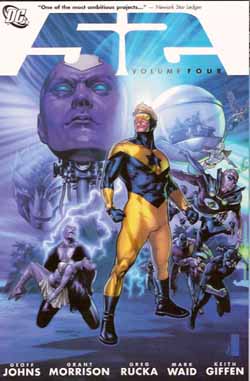
This volume collects issues #40-52 of the weekly serial and as the various strands starring Supernova, Infinity Incorporated, and The Question resolve, Black Adam’s tragic situation leads him to declare war on the world. Ralph Dibney’s final fate is revealed and a new Wonder Woman debuts. Starfire and Adam Strange finally return to Earth as the Mad Scientists of Oolong Island reap the just rewards for their manic inventiveness.
And finally Booster Gold and Rip Hunter discover the fateful secret of “52â€, just in time to save all of creation into the bargain.
Written by Geoff Johns, Grant Morrison, Greg Rucka and Mark Waid, with breakdowns by Keith Giffen, 52 volume 4 is drawn by Eddy Barrows, Chris Batista, Joe Bennett, Giuseppe Camuncoli, Jamal Igle, Dan Jurgens, Justiniano, Mile McKone, Patrick Olliffe and Darick Robertson with inks by Eddy Barrows, Belardino Brabo, Drew Geraci, Dan Green, Jack Jadson, Andy Lanning, Patrick Olliffe, Rodney Ramos, Norm Rapmund, Darick Robertson, Lorenzo Ruggiero and Walden Wong. The colouring is by David Baron, Hi-Fi, Pete Pantazis and Alex Sinclair, lettering by Jared K. Fletcher, Rob Leigh and Ken Lopez, and the original comic covers are by J. G. Jones and Sinclair.
Love or hate mainstream American comic-books, 52 is a truly remarkable achievement, chockfull of wit and inventiveness, clever touches and lots of solid jumping-on points for new readers and returnees. If you can handle the multiplicity of plot-lines this is a series that will reward and astound.
By Frank Bellamy, with Steve Kite, Graham Bleathman, D M Stokes & Keith Page, edited and compiled by Alan Fennel (Special Edition produced by Ted Smart for The Book People)
No ISBN:
There’s never an excuse to ignore a book with Frank Bellamy artwork in it so I’m here to tantalise all you internet shoppers and Jumble Sale hoppers with a rare book that seems to pop up quite often and which no fan can afford to miss.
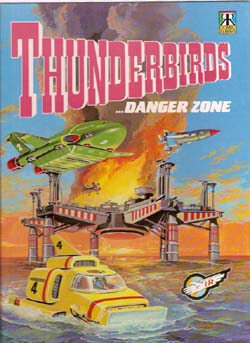
When Fleetway revived their Gerry Anderson franchise in the early 1990s the comics featured artwork from TV21 supplemented with new and original material from another generation of fans and creators. Thunderbirds was far and away the biggest hit, resulting in five collections in slim graphic albums between 1991-1993. Some of that material was also re-collected for a limited edition hardback that had superb production values and a generous page count.
This volume contains the usual beloved assortment of cutaways, photos and profile features, plus earnest and entertaining strips from Keith Page (‘Terror in New York City’), D M Stokes (’30 Minutes after Noon!’) and the excellent Steve Kite (‘The Uninvited’ and ‘City of Fire’) taken primarily from Thunderbirds…: In Action and Danger Zone.
But as usual the real gold is the phenomenal and unparalleled work of Frank Bellamy, whose fantastic design, drawing and painted colour (which holds up rather well here, despite the limitations of modern print technology to accommodate the subtleties of the photo-gravure process) steals the show – and usually one’s breath away!
His five tales reprinted here are ‘The Trapped Spy’, ‘Operation Earthquake’, ‘Tracy Island Exposed’, ‘Brains is Dead’, and the unforgettable alien invader story ‘Visitor From Space’, with one of the most memorable monsters in comics history stealing the show on every page.
The work of Bellamy and his successors are a cherished highpoint of British comic-making. Even though it might be fun to hunt out these lost treasures surely there must a publisher somewhere willing to place these gems in a setting they deserve – a definitive high-quality collected edition?
I’m assuming that all of us here love comics (otherwise why are you here? Did you think I was talking about stand-up comedians?) and that we’ve all had the same unpleasant experience of trying to justify that passion to somebody. Excluding your partner (who is actually right – the living room floor is not the place to leave your D*&$£! funny-books) most people have an entrenched and erroneous view of strip art, meaning that at some time you have tried to dissuade them from that opinion.
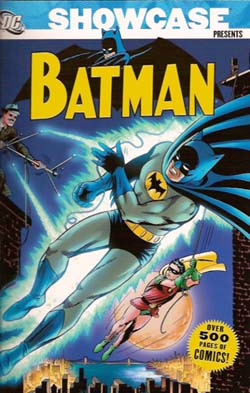
If so this collection might be the book you want to use the next time that confrontation occurs. Collected here in pristine black-and-white are tales that redesigned the Dynamic Duo and set them up for global Stardom – and fearful castigation from fans – as the template for the Batman TV show of the 1960s. It should be noted however that the producers and researchers did get their initial glimmerings from the comics stories of the era preceding the “New Look Batman†as well as the original movie serial of the 1940s.
So what have we here? At the end of 1963, Julius Schwartz had revived much of DC’s line -and the entire industry – with his modernization of the Superhero, and was asked to work his magic with the Caped Crusader. Bringing his usual team of creators with him, he stripped down the core-concept, bringing a modern take to the capture of criminals, downplaying all the Aliens, outlandish villains and daft transformation tales, even overseeing a streamlining/rationalisation of the art style itself.
The most apparent change to us kids was a yellow circle around the Bat-symbol, but more importantly the stories themselves changed. A subtle menace had re-entered the comfortable and abstract world of Gotham City. The revolution began with Detective Comics #327 (cover-dated May 1964) and was formalised in the first tale in Batman #164 (June 1964). ‘The Mystery of the Menacing Mask!’ was written by John Broome and pencilled by Carmine Infantino; a baffling “Howdunnit?†that was long on action and peril, which underlined the renewed intention to emphasise the “Detective†part of the title for the foreseeable future. To ram the point home a new back-up feature was introduced, “The Stretchable Sleuth†Elongated Man. This comic was to be a brain-teaser from now on.
In Batman, action and adventure were paramount. ‘Two-Way Gem Caper!’ pitted Batman and Robin against a slick criminal named Dabblo, but the villain wasn’t the star of this tale. Almost as an aside, a new Batcave and Wayne Manor were introduced plus a sleek, new compact Batmobile, more sports car than super-tank. This story was written by Ed “France†Herron and drawn by Bob Kane with Joe Giella inking the contents of both Batman and Detective in a bid to generate a recognisable uniformity to the stories. A new semi-regular feature also debuted that issue. The Mystery Analysts of Gotham City was a club of Detectives and Crime-writers who met to talk about their cases. Somehow it always resulted in an adventure such as ‘Batman’s Great Face-Saving Feat!’ (also the work of Herron, Kane and Giella).
‘Gotham Gang Line-Up!’ completed the transformation of Batman. Written by Bill Finger and pencilled by Bob Kane, the mediocre crime-caper from Detective #328 is remarkable for the plot-twist wherein faithful butler Alfred sacrifices his life to save the heroes, and Dick Grayson’s aunt Harriet moves into the mansion. From this point the adventures fall into a pattern of top-of-the-line comic tales punctuated by utterly exceptional tales of drama, mystery and action. These would continue until the TV show’s success became so great that it actually began to inform the kind of story in the comics themselves.
This cheap’n’cheerful Showcase Presents… compendium collects all the Batman and Robin yarns from Detective Comics #327-342 and Batman 164-174 (38 stories in all) written by Broome, Herron, Finger and Gardner Fox, with pencil art by Bob Kane, Infantino and Sheldon Moldoff. The inks are by Joe Giella, Sid Greene and Murphy Anderson.
Other story highpoints include ‘Castle with Wall-To-Wall Danger!’ (Detective #329), the eerie ‘Man Who Quit the Human Race!’ (Batman #165), ‘Museum of Mixed-Up Men’ (Detective #331 and guest-starring the Elongated Man), ‘Zero Hour for Earth!’ (Batman #167) and the captivating sci-fi chiller ‘Deep-Freeze Menace!’ (from Detective #337). If you’re a fan of costumed villains The Riddler, Penguin and Joker all make appearances, and it was during this time that the miniseries-within-a-series concept was pioneered as the mysterious Outsider struck at Batman again and again through a succession of subordinates.
No matter how much we might squeal and foam about it, to a huge portion of the world Batman is always going to be the “Zap! Pow!†caped buffoon of the 1960s television show. It really was that popular. But if you can make a potential convert sit-down, shut up and actually read these wonderful adventures for all (reasonable) ages, you might find that the old adage “Quality will out†still holds true. And if you’re actually a fan who hasn’t read this classic stuff, you have an absolute treat in store…
By Jerry Ordway (DC Comics)
ISBN: 1-56389-085-2 (Hardback) ISBN13: 978-1-56389-153-3 (Softcover)
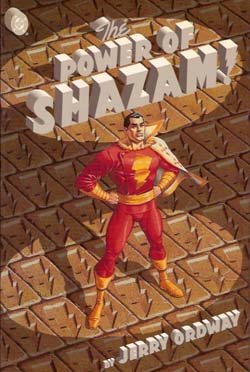
Since DC acquired the rights to the Golden Age Captain Marvel (as published by Fawcett from 1940-1953) there have been many enjoyable and effective treatments of the characters. But until last year’s Shazam!: The Monster Society of Evil (ISBN: 978-1-84576-389-3) none had captured the exuberance and charm of the originals and certainly none had come close to the popularity that had once threatened Superman’s, nor the sheer quality of the endeavour. Jerry Ordway’s 1994 re-imagining of the concept came awfully close, though…
Billy Batson is a little boy living on the streets. His archaeologist parents left him with his uncle Ebenezer when they went on a dig to Egypt. They never returned and he was thrown out as his uncle stole his inheritance. No one knows where his baby sister is…
Sleeping in a storm drain, selling newspapers for cash, the indomitable kid is pretty street-savvy, but when the mysterious shadowy stranger bids him follow into an eerie subway he somehow knows it’s okay to comply. When he meets the wizard Shazam and gains the powers of the ancient Gods and Heroes he knows he has the opportunity to make things right at last. But he isn’t aware of just what depths of evil corporate vulture Thaddeus Sivanna is capable, nor the role that Black Adam played in the fate of his parents…
This superb and mesmerising retelling was an original graphic novel that led to the most successful comic-book revival that Captain Marvel has yet experienced. The characters refitted in that series are more or less the same ones currently seen in DC comics such as Countdown. The pulp adventure atmosphere conjured up by Ordway in conjunction with his sumptuous art and spectacular design make for a captivating experience, and the artist’ s writing has never been more approachable and beguiling. This is a wonderful book for fans of adventure as well as “costumed drama†junkies.
By Jean de Brunhoff (Egmont)
ISBN: 978-1-4052-3822-9
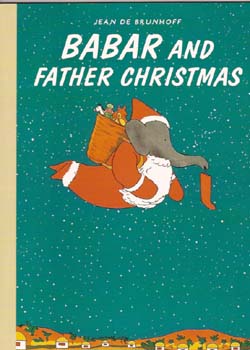
In this final translation – to date – of Jean de Brunhoff’s immortal and so very urbane elephant (released in 1941 as Babar et le père Noël), the patient parent undertakes an arduous expedition to bring joy to his children and his people.
One day Zephir the monkey tells Babar’s children Pom, Flora and Alexander, and of course Cousin Arthur, about the fabulous Father Christmas who brings presents to children in the world of Men. Captivated, they decide to invite the venerable gentleman to visit them, but after a very long time with no reply, they become despondent. Devoted Babar decides to find Father Christmas and personally invite him to the Land of the Elephants…
Produced at a time when the World desperately needed something bright, cheerful and filled with hope, this last tale from de Brunhoff (the franchise was revived after WWII by his son Laurent, who produced ten more books between 1948 and 1966) is a fabulously inventive and escapist adventure brimming with simple charm and clever, enchanting artwork. Europhiles will also be delighted to discover that the North Pole is merely a forwarding address and his real home is where it’s always been – in the cold, snowy mountains of Bohemia.
Great Children’s Books are at once plentiful and scarce. There are many, but definitely never enough. This deceptively engaging series has weathered the test of time and has earned a place on your shelves and in your hearts.
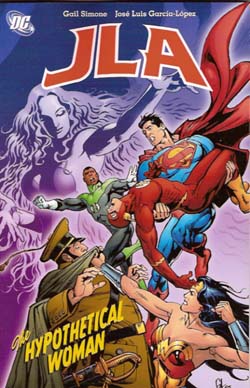
By stepping beyond their usual police role the League are susceptible to politics’ oldest power-play. The defrocked dictator uses their actions against them to create a coalition among many equally-dubious regimes. Fearful that the superheroes may be turned upon them next, these nations put the vengeful General Tuzic in charge of all their metahuman and Special Resources.
What follows is a charged and telling drama as the counter-attack of the General threatens the entire world with plague and conquest and that even before his deployment of the uniquely powerful Hypothetical Woman…
Simone has a superb grasp of the dynamics of superhero storytelling and a wonderful ear for dialogue. Coupled with Garcia López’s astounding drawing the result is an old-fashioned “goodies-and baddies†delight. Fans of the form can take comfort that the Good Old Days aren’t quite over yet!
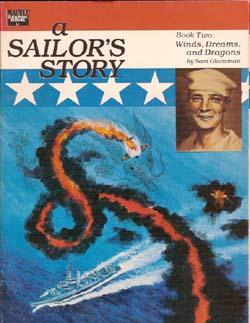
Sam Glanzman produced comic magic for decades in an underplayed, effective and matter-of-fact manner. For many years this hugely neglected talent has been making great narrative art without flash or dazzle, gaining fans among the cognoscenti yet largely unnoticed by the mainstream fans, but in 1987 he produced an autobiographical graphic novel that made quite a few waves.
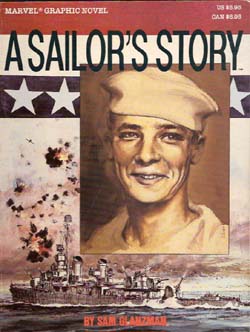
A Sailor’s Story (ISBN: 0- 87135-298-2) captivatingly related his experiences as a young man aboard the American Destroyer U.S.S. Stevens in a no-nonsense, highly entertaining tale, and broke new ground in the progress of the graphic novel as a medium for artistic expression. It also reached a lot of buyers who wouldn’t be caught dead with a copy of Spider-Man or Conan…
This sequel returns to the Pacific at the height of World War II, and by clever use of narrative devices such as Ship’s Travel Logs incorporated into the page designs, and diagrams and cutaways as part of the text, manages to instil an even more documentary atmosphere into this wonderfully human-scale drama. This is used to create a foreboding sense of dread as the crew encounters and learns to live with the then-unknown terror weapon of suicide-pilots who would become a household name to us: Kamikaze!
Combining the folksy, informative charm of the first volume with the “hurry-up-and-wait†tension of modern warfare, and delivered in an increasingly bold and innovative graphic style, Wind, Dreams and Dragons is one of the best explorations ever produced of sea-combat as seen through the eyes of the ordinary seaman. I pray some right-thinking publisher re-releases this – and its companion predecessor – as soon as possible…
Inexplicably, many superb creators who dedicate a lifetime to producing a volume of work are never rewarded for their efforts. Probably the most shamefully neglected of these hidden stars – at least in the American comicbook industry – is Sam Glanzman. With a solid, unique and rough-hewn style he has worked since the 1940s on a variety of titles for a number of companies, mostly on anthology material for fantasy, mystery, war and adventure anthologies, but also on the occasional serial characters such as Willy Schulz, Hercules and Tarzan for Charlton, Kona for Dell, and The Haunted Tank and U.S.S. Stevens for DC.
It is this last series of guardedly-autobiographical tales, derived from his tour of duty on that eponymous American Destroyer in World War II, which formed the precedent for the superb pictorial autobiography I’m discussing here. And if anybody from DC is reading this, those U.S.S. Stevens strips are so-very-long overdue for the trade paperback treatment, too!
In 1987 editor Larry Hama made the bold decision to publish Glanzman’s simple, matter-of-fact account of his days as a young man aboard a Pacific Fleet Destroyer as part of Marvel’s original Graphic Novel imprint. The spectacular result was a high point in American sequential narrative and even spawned a second volume (A Sailor’s Story II: Wind, Dreams and Dragons: ISBN: 0- 87135-556-6).
Glanzman is a natural storyteller, with the ability to make dry fact entrancing and everyday events compelling. With his gritty art style and powerful sense of colour he weaves memory into magic. His depiction of ship-board life is informative and authentic, and his decision to down-play action and concentrate on character is brave and tremendously effective. He also knows how to make a reader laugh and cry, and when.
A Sailor’s Story is a moving and obviously heartfelt paean to lost days and lost people, a war story that glorifies life, not death, by a creator who loved the experience and loves his art-form. When you read this superb book you will too.