House

House

By Josh Simmons (Fantagraphics Books)
ISBN: 978-1-56097-855-8

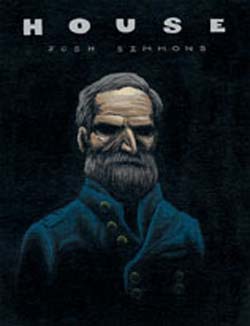
A young man walks through the woods, until he sees a ramshackle old house. Outside he meets two young women and they strike up a conversation. Filled with high spirits they decide to explore the dilapidated old mansion.

The place is a wreck. As they cautiously move deeper into the vast manse the boy and blonde girl feel an attraction. When they discover that the back of the house has collapsed and is under water, forming an inviting pool, all three all dive in and play in the water.

In a submerged room the boy and the blonde share a kiss. The dark girl knows something has happened, that all the relationships have shifted. With a new tension they continue to explore, but nothing feels innocent now. And then the staircase collapses…

Josh Simmons has set himself a daunting task. This entire tale is told without words. Settings, scenario and character are established and the narrative undertaken purely by making pictures and by manipulating light and dark and panel and space.

The manner in which an idyll becomes a terrifying, crushing, tragic nightmare is powerful, seductive and truly overwhelming in its delivery. Simmons has succeeded in crafting a true graphic narrative, a thrilling story in a manner and with a force that no other medium could.

Silent, compelling, wonderful: This is a book no serious reader should ignore and no budding creator should miss.

© 2007 Josh Simmons. All Rights Reserved.

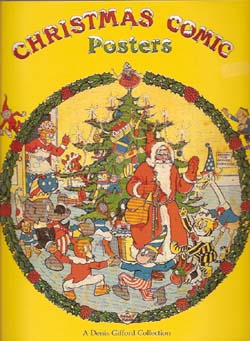
Christmas Comic Posters

Christmas Comic Posters

A Denis Gifford Collection (H.C. Blossom)
ISBN: 1-872532-57-8

In a country so rich with children’s literature, and so blessed with sentimental old creators and publishers, the various holidays of the year have always been excellently commemorated in our comic publications. Britain also had a huge advantage over its transatlantic cousins in that our industry was for most of that history operated on a weekly schedule.

That might seem an odd distinction to make, but the power of topicality added huge excitement and effect to “Bumper Christmas Editions” which were always on sale mere days before the Big Event, rather than as much as three weeks either side, as in US monthly or even bi-monthly titles.

This collection of cover images, culled from the prodigious personal collection of cartoonist and comics historian Denis Gifford, reprints 45 unbelievably evocative and nostalgic pictorial classics from the X-Mas Numbers of such comics as Funny Folks, Sparkler, Tiny Tots, Puck, Knockout, Beano, Dandy, Tiny Tim’s Weekly, Comic Cuts and many other hallowed British icons, all published between 1897 and 1941.

The text is limited to the barest historical paragraphs here as the whole point is to rejoice if not wallow in the feelings the creators worked so diligently to instil. So why not marvel at the artistic genius of such luminaries as Percy Cocking, Jack Greenall, Hugh McNeill, James Crichton, Reg Carter, Roy Wilson, Freddie Crompton, John Jukes, Wilfred Haughton, Ray Bailey, Herbert Foxwell, Walter Bell, William Wakefield, George Jones, Authur White, Tom Wilkinson, WF Thomas, George Davey, H. O’Niell, Ralph Hodgson, Will Spurrier, Frank Holland, John Phillips Stafford and all those other talented artists whose names are lost to us now.

If you want a good old fashioned Yuletide, this is what needs to go on your list. And remember, shop early to avoid disappointment.

Text and compilation © 1991 Denis Gifford.

The Adventures of Jo, Zette & Jocko

MR. PUMP’S LEGACY
Part 1 of THE STRATOSHIP H.22
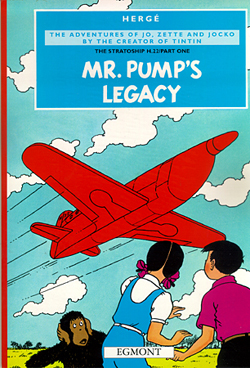
The Adventures of Jo, Zette & Jocko

By Hergé, translated by Leslie Lonsdale-Cooper & Michael Turner (Egmont UK)
ISBN 13: 978-1-4052-1245-8

George Remi, world famous as Hergé, had a long creative connection to Catholicism. He had created Tintin at the behest of the Abbot Norbert Wallez, editor of the Catholic newspaper Le XXe Siécle, before moving on to such strips as the mischievous ‘Quick and Flupke’, ‘Tim the Squirrel in the Far West’, ‘The Amiable Mr. Mops’, ‘Tom and Millie’ and ‘Popol Out West’, all while continuing the globe-trotting adventures of the dauntless boy reporter and his faithful dog.

In 1935, between working on The Blue Lotus and The Broken Ear he was approached by Father Courtois, the director of the French weekly newspaper Coeurs Vaillants (‘Valiant Hearts’). The paper already carried Tintin, but Courtois also wanted a strip that would depict the solid family values and situations that the seemingly orphaned boy reporter was devoid of. He also presumably wanted something less subversive than the mischievous, trouble-making working-class boy rascals ‘Quick and Flupke’.

He needed a set of characters that would typify a good, normal family: A working father, a housewife and mother, young boy, a sister, even a pet. Apparently inspired by a toy monkey called Jocko, Hergé devised the family Legrand. Jacques was an engineer, and his son Jo and daughter Zette were average kids; bright, brave, honest, smart and yet still playful. Mother stayed home, cooking and being concerned a lot, and they had a small, feisty monkey for a pet – although I suspect as Jocko was tailless, he might have been a baby chimpanzee, which “As Any Fule Kno” is actually a species of ape.

The first adventure was ‘The Secret Ray’ which is not currently available in English. A ripping yarn of scientific bandits, gangsters, mad professors, robots and, regrettably, some rather ethnically unsound incidences of cannibal savages, this is very much a product of its time in too many respects. Although Hergé came to deeply regret (and wherever possible amend) his many early uses of that era’s racial stereotyping, the island dwelling natives in Le “Manitoba” Ne Répond Plus and L’ Éruption Du Karamako (which first ran in Coeurs Vaillants from January 19th 1936 to June 1937) will now always be controversial.

It’s a true pity that such masterful and joyous work has to be viewed with caution, read strictly in context and be ascribed subtext and values that simply weren’t intended, merely because the medium is pictorial and its meaning passively acquired rather than textual, and which can therefore only be decoded by the conscious effort of reading. I also wonder how much was a quiet, sensitive artist led by an aggressively proselytising, missionary Church’s doctrine and policy… How much Church opposition was there to Mussolini’s invasion of Ethiopia in October 1935 for example? And don’t get me started on Nazi Germany and the Vatican…

‘Mr. Pump’s Legacy’ is much less culturally and commercially troublesome. When septuagenarian millionaire-technocrat, speed-fiend (that’s velocity, not pharmacology) and adrenalin junkie John Archibald Pump, the “American Collar-Stud King” dies in a car crash (at 155 mph, so he probably went surprised but happy) he leaves a ten million dollar prize: The first person or persons to fly non-stop between New York and Paris at an average speed of 1000 kilometres per hour will secure said cash. But if nobody wins within one year the money will revert to his ne’er-do-well nephews.

The contest captures world imagination in the Age of Speed, and many try for the prize, including S.A.F.C.A., the aeronautical company that Jacques Legrand works for. Very soon both the engineer and his family become the targets of skulduggery and sabotage as his groundbreaking design gradually becomes a beautiful flying machine. Assaults, poison-pen letters and threats, murder attempts, blackmail and even kidnapping, nothing can stop the project whilst the canny Jo and Zette are there to foil them. Even when the completed plane is targeted by an aerial bombardment, the resourceful children have a solution. Starting the plane, they fly away from the bomber, but become lost in the night and clouds.

With their fuel almost exhausted they spot a tiny island in a vast sea and manage to land the plane safely. How can they return the ship in time to win the Prize? Without food, water, fuel or any idea where they are, can they survive long enough to be found?

Combining all-ages thrills and slap-stick comedy with magical art and superb designs, the masterful Hergé, a creator rapidly reaching the peak of his powers, has produced in this cliff-hanging volume of adventure a lost classic, and one worthy of much greater public attention. With Christmas looming it could be the best £6.99 you’ll spend this year…

© 1951, 1979, 2007 Editions Casterman, Paris& Tournai. All Rights Reserved.
English text © 1987, 2005 Egmont UK Limited. All Rights Reserved.

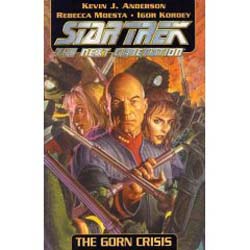
Star Trek: The Next Generation — The Gorn Crisis

Star Trek: The Next Generation — The Gorn Crisis

By Kevin J. Anderson, Rebecca Moesta & Igor Kordey (WildStorm)
ISBN 1-56389-754-7

The Star Trek franchise has had many comic book homes. This effort published by DC/WildStorm is set during the period when Deep Space 9 was being broadcast and tangentially informs the seasons-long storyline that featured an intergalactic war between the Federation and its Alpha Quadrant allies on one side and the J’em Haddar warriors of The Dominion on the other.

The Gorn are an aggressive civilisation of Reptiles who appeared in an episode of the original 1960s TV show. It was an adaptation of a classic SF short story by Fred Brown entitled “Arena”, in which Captain Kirk and his Gorn opposite number are selected by a super-advanced race to represent their species in a duel for galactic supremacy. The loser race would be curbed to avoid horrendous and bloody space-war.

A century later the Federation is at war with the Dominion and desperate for allies. Jean-Luc Picard has been dispatched to the Gorn planet to broker an alliance, but the USS Enterprise arrives just as the reptile’s Warrior Caste stages a bloody coup and launches an all-out attack on neighbouring worlds. The way in which Picard, Riker, and all the Next Generation stalwarts act to quell the uprising won’t just dictate how the humans and reptiles will co-exist in the future, it might well decide if they exist at all…

Although not to everybody’s taste, and despite a certain rough hesitancy in Igor Kordey’s fully painted artwork, not to mention a somewhat perfunctory script, this tale does rattle along in the manner Star Trek fans would hope for, and even casual readers will come away with a sense of expectation fulfilled.

© 2000 Paramount Pictures. All rights reserved.

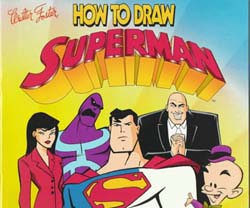
How to Draw Superman

How to Draw Superman

By Ty Templeton, John Delaney and Ron Boyd (Walter Foster Publishing)
ISBN 978-1-5601-0327-1

Although the 1990s Superman cartoon show never got the airplay it deserved in Britain, it remains a highpoint in the character’s long, long animation history, second only to the astounding and groundbreaking seventeen shorts produced by the Max Fleischer Studio in the 1940s. These modern visualisations became the norm, extending to both the Justice League and Legion of Super Heroes animation series that followed.

The broad stylisation also worked in two dimensions in the spin-off comic-book produced by DC (itself a series well worthy of and long overdue for trade paperback release), so this lovely slim “How To” book from Ty Templeton, John Delaney and Ron Boyd is doubly a package to pore through and learn from.

Brilliant colour and clear concise instructions, covering the undeniable basics that every artist of any age will need to master, such as perspective and basic anatomy, plus a detailed step-by-step breakdown and model sheet for every major character and villain make this an indispensable aid and a fun read for the aspiring Artist of Tomorrow.

™ & © 1998 DC Comics. All Rights Reserved.

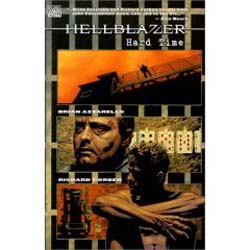
Hellblazer: Hard Time

Hellblazer: Hard Time

By Brian Azzarello & Richard Corben (Vertigo)
ISBN 1-84023-255-2

John Constantine is many things: Magician, con-man, world-saver, hero, villain, thief. He’s a chain-smoker who’s tricked the doctors and the Devil, but can’t ever seem to keep a friend. Not as friends and usually not even alive. He’s walked through a world of death and horror, leaving a clear trail of bloody footprints.

So when he ends up in a grim high security jail in the USA, nobody’s surprised. But in a universe of deadly men and extreme factionalism nothing can cow him and nobody can divine his intentions.

The brutal cage-behaviour of deadly men with nothing to lose is as nothing to the subtle horror of John Constantine unleashed and teaching scum what intimidation and punishment really means…

Brian Azzarello and alternative comics legend Richard Corben plumb the darkest depths of humanity in this savage prison drama, blending mystery, thriller and horror genres and presenting a compelling example of just how nasty a comic-book can get.

Superb storytelling, but not for the faint-hearted, easily shocked or under-aged.

© 2001 DC Comics. All Rights Reserved.

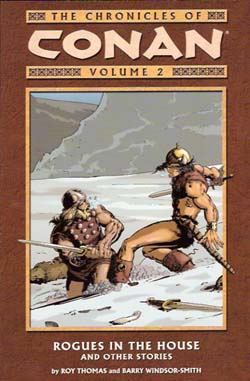
Chronicles of Conan vol 2: Rogues in the House

Chronicles of Conan vol 2: Rogues in the House

By Roy Thomas & Barry Windsor-Smith (Dark Horse Books)
ISBN: 1-84023-785-6

The second Dark Horse collection of Marvel’s 1970’s Conan epics covers a period when the character had taken the comics world by storm, and features two creators riding the crest of a creative wave. Reprinting issues #9-13 and #16 of the monthly comic-book this volume opens with ‘Garden of Fear’, adapted by Thomas and Smith, with inks by Sal Buscema from the short story by Robert E. Howard, a battle with an antediluvian survivor in a lost valley.

Returning to the big city, our hero must ‘Beware the Wrath of Anu!’, another Howard tale, as is the eponymous ‘Rogues in the House’, an early masterpiece of action and intrigue. ‘Dweller in the Dark’ is an all original yarn of monsters and maidens, notable because artist Barry Smith inked his own pencils, and indications of his detailed fine-line illustrative style can be seen for the first time. Fantasy author John Jakes plotted ‘Web of the Spider-God’, a sardonic tale of the desert scripted by Thomas and inked by Buscema.

Chronologically, a two part team-up guest-starring Michael Moorcock’s Elric of Melniboné should follow but that’s held in abeyance and this book concludes with ‘The Frost Giant’s Daughter’, a haunting, racy tale written by Howard and originally adapted in black and white for Savage Tales #1.

This was an early attempt to enter the more adult magazine market, and when the story was reprinted in Conan #16, Smith’s art had to be censored to obscure some female body parts that youngsters might be corrupted by. Even so it’s still a beautiful pencil and ink job by Smith. It was also supposedly his last as he quit the series with that issue.

These re-mastered issues are a superb way to enjoy some of American comics’ most influential – and enjoyable moments. They should have a place on your bookshelf.

©1971-1972, 2003 Conan Properties International, LLC. All Rights Reserved.

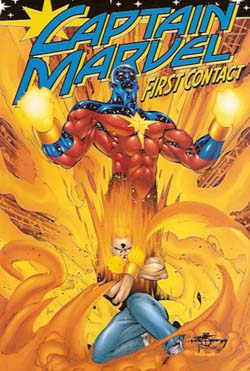
Captain Marvel: First Contact

Captain Marvel: First Contact

By Peter David, ChrissCross & various (Marvel Comics)
ISBN 0-7851-0791-6

This character has one of the most convoluted back stories in comics so if you are unfamiliar with him this might be a tad confusing for a first exposure, but light, fun super-hero comics are rare, so it is worth considering.

Captain Marvel was a soldier for a pan-galactic civilisation called the Kree. He was dispatched to Earth on a reconnaissance mission after the Fantastic Four destroyed a robotic Kree Sentinel left on Earth thousands of years previously. Adopting an Earth identity he spied on mankind but became increasingly disenchanted by Kree Imperialism and “went native”, becoming one of Earth’s greatest heroes.

Due to a cosmic accident his atoms were merged with professional sidekick Rick Jones. Only one of them could occupy space in our universe at a time, whilst the other was suspended in the anti-matter dimension called the Negative Zone. By striking together the “Nega” wristbands they each wore one could trade atoms with the other and live part of a single existence. Eventually they escaped their fate and separated. After saving the world and the universe a few times Captain Marvel died.

After his death his lover used his genetic material to create a son, named Genis (or sometimes Legacy) and he ultimately acquired the Negabands and inherited the title. He also found himself bonded to the cosmically unlucky Jones in the same situation his father had to endure – switching atoms and leading half a life. This incarnation devolves directly out of Avengers Forever (ISBN: 0-7851-0756-8) and reprints issues #0 and 1-6 of the third volume of the monthly comic – I said it was confusing, right? Now read on…

Bonded together, Jones and Genis are currently back on Earth and trying to reach an accommodation but the “Cosmically-Aware” hero is battling menaces and monsters that no-one can see, and the resultant collateral destruction is making the wrong sort of headlines. Either that or Genis is delusional and a menace himself…

There are guest appearances by The Hulk, Moondragon, Drax the Destroyer, and the Micronauts in a light-hearted and very funny string of adventures from Peter David, ChrissCross, Ron Lim, James Fry, Walden Wong, Mark McKenna and Nelson Decastro, and although this really is a treat for long-time fans with a good grounding in Marvel Minutiae, the determined neophyte might be rewarded with a hearty laugh and some angst-free thrills.

This volume includes a brief recap-cum-scorecard section so newbies might feel it’s worth a shot…

© 1999, 2000 2001 Marvel Characters, Inc. All Rights Reserved.

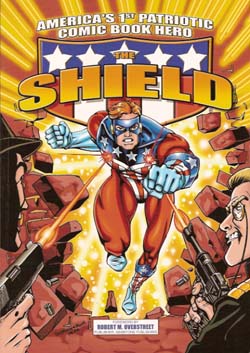
The Shield

AMERICA’S 1ST PATRIOTIC HERO

The Shield

By Irving Norvick, Harry Shorten & various (Archie Comics)
ISBN 1-879794-08-X

In the dawning days of the comic book business, just after Superman and Batman had ushered in a new genre of storytelling, many publishers jumped onto the bandwagon and made their own bids for cash and glory. Many thrived and many more didn’t, remembered only as trivia by sad blokes like me. Some few made it to an amorphous middle-ground: Not forgotten, but certainly not household names either…

The Shield was an FBI scientist named Joe Higgins who wore a suit which gave him enhanced strength, speed and durability, which he used to battle America’s enemies in the days before the USA entered World War II. Latterly he also devised a Shield Formula that increased his powers. Beginning with the first issue of Pep Comics (January 1940) he battled spies, saboteurs, subversive organisations and every threat to American security and well-being, and was a minor sensation. He is credited with being the industry’s very first Patriotic Hero, predating Marvel’s iconic Captain America in the “wearing the Flag” field.

Collected here in this Golden-Age fan-boy’s dream are the lead stories from Pep Comics #1-5 and the three adventures from the spin-off Shield-Wizard Comics #1 (Summer 1940). Raw, primitive and a little juvenile perhaps, but these are still unadorned, glorious romps from the industry’s exuberant, uncomplicated dawning days: Plain-and-simple fun-packed thrills from the gravely under-appreciated Irving Novick, Harry Shorten and others whose names are now lost to history.

Despite not being to everyone’s taste these guilty pleasures are worth a look for any dyed-in-the-woollen-tights super-hero freak and a rapturous tribute to a less complicated time.

© 1940, 2002 Archie Publications In. All Rights Reserved.

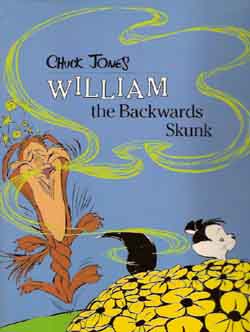
William the Backwards Skunk

William the Backwards Skunk

By Chuck Jones (Crown Publishers Inc.)
ISBN: 0-517-56063-1

There have been a few modern geniuses who wield a pencil and paintbrush. We tend not to notice them in the world of comics, which I suppose would explain why so many of our contemporary artists work in animation these days. I don’t know if Charles Martin Jones ever worked in comics – or even if he ever wanted to – but as ‘Chuck’ he produced some of the greatest and funniest animated cartoons the world has ever seen.

During WWII he worked with Theodore Geisel – who left cartooning for a career in kid’s books and found fame as Dr. Seuss – on a series of educational cartoons for the US Army featuring ‘Private Snafu’. That relationship would eventually lead to the animated TV classic How the Grinch Stole Christmas.

And in 1986 Chuck Jones produced this picture-book for the very young. William is a skunk with a little problem. The Usual Skunk not only has that potent chemical weapon we all know and dread, but they also have a beautiful bold stripe on their backs so as to give any big animal sneaking up on them a fair chance to change their minds. Sadly, William’s stripe is on his front, which causes problems for every animal in the forest.

This charming little fable about cooperation is a sweet delight and the art is utterly joyous. This is a man who knows “Cute” and how to milk it, and more importantly, when to lampoon it. His critters positively drip with Attitude, and any child’s delight could only be marred if the adult reading this aloud is unable to stifle their own knowing chortles.

Jones’ work informed generations of kids and creators in comics as well as cartoons. His legacy can be found in titles as varied as Dell’s Looney Tunes and Merrie Melodies, Bugs Bunny and Daffy Duck to the current Kids WB comic-books including the current incarnation of Looney Tunes.

Get this book and you could be carrying on that tradition to the next generation.

© 1986 Chuck Jones Enterprises. All rights reserved.