DC/Top Cow: Crossovers

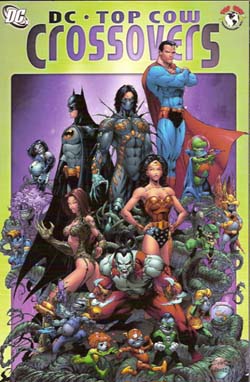
DC/Top Cow: Crossovers

By various (DC Comics)
ISBN13: 978-1-84576-585-9

Most comics these days – at least from the larger publishers – have artwork of good to great quality. It’s no surprise, as there are a lot of artists, new and experienced, chasing relatively few jobs. Unfortunately it’s not so easy to drive up the quality of writing, and often people who can draw are just assumed to have the equivalent skills necessary to tell a tale well.

A sobering case-in-point is this collection of tales combining the biggest-guns of the oldest surviving comic book empire and one of the newest successes, which originally saw print as The Darkness/Batman, JLA/Witchblade, The Darkness/Superman #1-2 and JLA/Cyberforce between released in 1999 and 2005 and in which plot and character were continually sacrificed to the sales potential of empty fights and posturing.

The Darkness is Jackie Estacado, a Mafia hit man who has complete control of a supernatural force that manifests as demons who carry out his every wish and command. He’s in Gotham City to expand the Organisation’s power-base. And of course, Batman is not going to let him. Irrespective of Estacado’s self-doubts and avowed desire to change, there is no way on Earth an obsessive like Batman would allow him to leave without being sure that he would never kill again. But he does…

This is the responsibility of a huge cast of contributors including scripters Scott Lobdell and Jeph Loeb and artists Marc Silvestri, Dave Finch, Clarence Lansang, Joe Weems V, Danny Miki, Victor Llamas, Batt and Livesay but despite looking glitzy this is rushed and vacuous fare.

Written by Len Kaminski and illustrated by Mark Pajarillo and Walden Wong, JLA/Witchblade is a tale of Sara Pezzini, a New York cop bonded against her will to a supernatural, semi-sentient ultimate weapon. The Witchblade is as much her prisoner as her tool but when it escapes her control and possesses Wonder Woman, not even the Justice League can stop it from destroying the Universe.

Still looking for new territory Jackie Estacado hits Metropolis (are they really telling us that Superman’s home-town is more tempting than any other US city? Seriously?) where he starts killing mobsters, causing a gang-war. The second-rate threats of Metallo and Lois and Jimmy as hostages (because that’s never happened before) are enough to convince the Man of Steel to join forces with The Darkness and once again the mass-murderer gets off with a warning to leave town. The Darkness/Superman is written by Ron Marz with art by Tyler Kirkham and Matt “Batt” Banning, who should know better: I certainly do.

JLA/Cyberforce by Joe Kelly, Doug Mahnke and Norm Rapmund is by far the best of these unlikely team-ups. Here a team of cybernetically augmented individuals, once corporate mercenaries, wander the world looking for their lost leader, now possessed by an awesome alien force and a foe of all life. Their search leads them to a lost tomb deep below Budapest where the dead walk again, a threat certain to catch the attention of the Justice League.

This is a tale with some thought behind it for the fans of both series, a credible use of the characters and even some welcome and plausible character interaction. It’s nice to know that some one still recognises the value of a Story as well as a Property.

There will always be inter-company team-up comics as long as there’s more than one publisher. Let us hope future commercial exploitations realise the difference between comic strip art and comic strip-mining. One for collection completists only I fear.

© 1999, 2000, 2005, 2007 DC Comics. All Rights Reserved.

Justice, Volume 3

Justice, Volume 3

By Jim Krueger, Alex Ross & Doug Braithwaite (DC Comics)
ISBN13: 978-1-84576-630-6

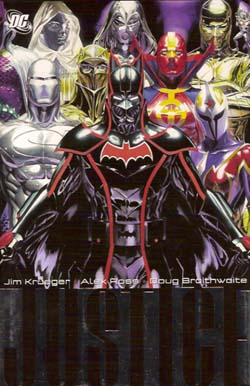
The Big Finale to the epic battle between the Super Powers of the DC universe reveals the dastardly master-plan of Lex Luthor and the alien computer intelligence Brainiac as the resurgent heroes – each clad in personalised Battle Armour (Gotta Collect ‘Em All!) – go into concerted action to save the world not just from the depredations of the desperate villains but also the now real imminent threat of nuclear destruction.

Thrilling and sumptuously fulfilling it should nevertheless have been with us a lot sooner in this overlong and meanderingly padded tale that comes so close to being great comics but instead looks like a wish list for a toy-factory or DC Direct.

I truly understand that it’s a tough commercial world and that lots of fans love the toys, gadgets, statues and what-nots that are part-and-parcel of modern comics publishing. I just worry that when peripherals begin to dictate the content of your product then you have a product that’s no longer able to sustain itself.

In this case that translates into three superb creators spending a lot of time getting it almost right, but failing to make the kind of magic that inspired them to get into the business in the first place… and surely that’s a long term goal comics can’t afford to lose or forsake?

© 2007 DC Comics. All Rights Reserved.

Justice, Volume 2

Justice, Volume 2

By Jim Krueger, Alex Ross & Doug Braithwaite (DC Comics)
ISBN13: 978-1-84576-444-9

Warning: This is the middle part of one long story. It has no beginning and it doesn’t end here.

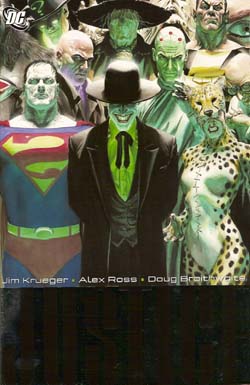
With the superheroes compromised and defeated, the lesser heroes of the DC Universe come into play as the triumphant villains divvy up their spoils. As the forces of good begin their fight back it becomes increasingly clear that Lex Luthor and Brainiac have their own agenda, and that it doesn’t include their erstwhile allies and pawns. Also, the supremely insane Joker is loose and he’s very unhappy about being excluded from the alliance of villains…

Once again this volume includes additional artwork, illustrated fact-files on the huge cast of characters and some of Doug Braithwaite’s pencilled pages before Alex Ross applied colours. Justice was originally published as a twelve issue maxi-series (this volume collects issue #5-8).

Visually spectacular, in story-terms this overly complex and convoluted tale falls far short of the halcyon material it references, possibly because the target audience is assumed to be too mature for the clear-cut simplicity of those child-friendly days and tales. There’s also a little too much of the Toys, Action Figures and Collectables catalogue about the whole affair, for my liking.

© 2006 DC Comics. All Rights Reserved.

Justice, Volume 1

Justice, Volume 1

By Jim Krueger, Alex Ross & Doug Braithwaite (DC Comics)
ISBN13: 978-1-84576-350-3

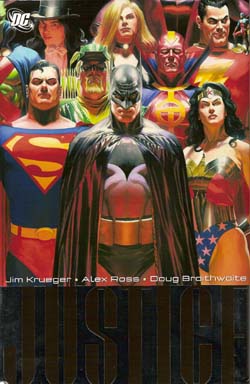
Set outside of regular DC continuity (which is much easier to do since 52 and Countdown I suppose) this tale begins with dreams of Nuclear Armageddon and the failure of Earth’s heroes to save the world. These dreams plague many of Earth’s super-villains, and overcoming a natural distrust of each other they unite under Lex Luthor to finally overcome their arch-enemies.

Not only do they hunt down and deal with Superman, Batman, Aquaman, Wonder Woman and the rest of the Justice League, but they also begin a public charm offensive, whilst changing the world in ways the heroes never have. As the deserts are made to bloom, the crippled cured and the hungry fed, the world is oblivious to the fact that their erstwhile heroes are being brutally murdered…

This first volume also contains additional artwork, illustrated fact-files on the huge cast of characters and some of Doug Braithwaite’s pencilled pages before Alex Ross applied his magic brushes.

Ross’s faux-realist painting style has carved him a unique place in modern comics and led to a number of high-profile successes. This latest project, a twelve issue maxi-series (this volume collects issue #1-4), is a tribute to the big Goodies Vs. Baddies sagas of his own childhood, both in 1970s DC Comics and also the animated Super-Friends and Challenge of the Super-Friends TV shows.

Although a beautiful and visually compelling series it could have greatly benefited from a little of the clear, clean simplicity of those long-ago stories. And while I’m kvetching, I can’t see any benefit to the faithful readership, let alone any new fans, to collect the series into three expensive hardback editions when it could comfortably and handily fit into one. If we keep treating product as artefact we’ll stop being a popular or mass medium and become just another clique market like Collector Plates or Toby Jugs…

© 2006 DC Comics. All Rights Reserved

Essential Captain America, Vol 1

Essential Captain America, Vol 1

By Stan Lee, Jack Kirby, & various (Marvel)
ISBN 0-7851-0740-1

During the Marvel Renaissance of the early 1960’s Stan Lee and Jack Kirby tried the same tactic that had worked so tellingly for DC Comics, but with mixed results. Julie Schwartz had incredible success with his revised versions of the company’s Golden Age greats, so it seemed natural to try and revive the characters that had dominated Timely/Atlas in those halcyon days. A new Human Torch had premiered as part of the revolutionary Fantastic Four, and in the fourth issue of that title the Sub-Mariner resurfaced after a twenty year amnesiac hiatus (everyone concerned had apparently forgotten the first abortive attempt to revive their superhero line in the mid 1950s).

The Torch was promptly given his own solo feature in Strange Tales from issue #101 (see Essential Human Torch vol.1, ISBN 0-7851-1309-6) and in #114 the flaming teen fought an acrobat pretending to be Captain America. The real thing promptly surfaced in Avengers #4 and after a captivating and centre-stage hogging run in that title was granted his own series as half of the “split-book” Tales of Suspense with #59 (cover-dated November 1964).

That initial outing ‘Captain America’, scripted by Stan Lee and illustrated by the staggeringly perfect team of Jack Kirby and Chic Stone is a simple fight tale as an army of thugs invades Avengers Mansion since only the one without superpowers is at home, and the next issue held more of the same, when ‘The Army of Assassins Strikes!’. ‘The Strength of the Sumo!’ was insufficient when Cap invaded Viet Nam to rescue a lost US airman and Cap took on an entire prison to thwart a ‘Break-out in Cell Block 10!’

After these gloriously simplistic romps the series took an abrupt turn and began telling tales set in World War II. ‘The Origin of Captain America’, by Lee, Kirby and Frank Ray (AKA Giacoia) recounted how physical wreck Steve Rogers was selected to be the guinea pig for a new super-soldier serum only to have the scientist responsible die in his arms, cut down by a Nazi bullet.

Now forever unique he was given the task of becoming a fighting symbol and guardian of America, based as a regular soldier in a boot camp. It was there he was unmasked by Camp Mascot Bucky Barnes, who blackmailed the hero into making the boy his sidekick. The next issue (Tales of Suspense #64) kicked off a string of spectacular thrillers as the heroes defeated the spies Sando and Omar in ‘Among Us, Wreckers Dwell!’ and Chic Stone returned – as did Cap’s greatest foe – for the next tale ‘The Red Skull Strikes!’

‘The Fantastic Origin of the Red Skull!’ saw the series swing into high gear as sub-plots and characterisation were added to the all-out action and spectacle. ‘Lest Tyranny Triumph!’ and ‘The Sentinel and the Spy!’ (both inked by Giacoia) combined espionage and mad science in a plot to murder Winston Churchill, and the heroic duo stayed in England for ‘Midnight in Greymoor Castle!’ (with art by Dick Ayers over Kirby’s layouts – which are very rough pencils that break down the story elements on a page) and the second part ‘If This be Treason!’ had Golden Age and Buck Rogers artist George Tuska perform the same function. The final part (and the last wartime adventure) was ‘When You Lie Down with Dogs…!’ which added Joe Sinnott inks to the mix for a rousing conclusion to this frantic tale of traitors, madmen and terror weapons.

It was back to the present for Tales of Suspense #72 and Lee, Kirby and Tuska revealed that Cap had been telling war stories to his fellow Avengers for the last nine months. ‘The Sleeper Shall Awake!’ began a classic adventure as a Nazi super-robot activates twenty years after Germany’s defeat to exact a world-shattering vengeance. Continuing in ‘Where Walks the Sleeper!’ and concluding in ‘The Final Sleep!’ this masterpiece of tension and suspense perfectly demonstrated the indomitable nature of this perfect American hero.

Dick Ayers returned with John Tartaglione inking ‘30 Minutes to Live!’ which introduced both the Batroc the Leaper and a mysterious girl who would eventually become Cap’s long-term girl-friend, S.H.I.E.L.D. agent Sharon Carter, in a taut 2-part countdown to disaster ending with ‘The Gladiator, The Girl and the Glory’, illustrated by John Romita (Senior). This was the first tale which had no artistic input from Jack Kirby, but he laid out the next issue (TOS #77) for Romita and Giacoia. ‘If a Hostage Should Die!’ again returned to WWII and hinted a both a lost romance and a tragedy to come.

‘Them!’ returned Kirby to full pencils and Giacoia to the regular ink spot as Cap teamed with Nick Fury in the first of the Star-Spangled Avenger’s many adventures as a (more-or-less) Agent of S.H.I.E.L.D. It was followed by ‘The Red Skull Lives!’ as his arch nemesis returned from the grave to menace the Free World again. He was initially aided by the subversive technology group AIM, but stole their ultimate weapon in ‘He Who Holds the Cosmic Cube!’ (inked by Don Heck) and ‘The Red Skull Supreme!’

‘The Maddening Mystery of the Inconceivable Adaptoid!’ pitted Cap against AIM’s artificial life-form, capable of becoming an exact duplicate of its victim in a tale of psychological warfare. ‘Enter… The Tumbler!’ (inked by Ayers) and ‘The Super-Adaptoid!’ completed an epic of breathtaking action that further cemented the links between the various Marvel comics, building a shared continuity would carry the company to market dominance in a few short years.

‘The Blitzkrieg of Batroc!’ and ‘The Secret!’ returned to the earliest all-action, overwhelming odds yarns and ‘Wanted: Captain America’ (by Roy Thomas, Jack Sparling and Joe Sinnott) was a lacklustre interval involving a frame-up before Gil Kane had his first run on the character with ‘If Bucky Lives…!’, ‘Back From the Dead!’, ‘…And Men Shall Call Him Traitor!’ and ‘The Last Defeat!’ (TOS #88-91, these last two inked by Sinnott) in a superb drama of blackmail and betrayal starring the Red Skull.

Kirby and Sinnott were back for ‘Before My Eyes Nick Fury Died!’, ‘Into the Jaws of… Aim!’ and ‘If This Be… Modok!’ as the hero fought a giant brain-being manufactured purely for killing. ‘A Time to Die… A Time to Live’ and ‘To Be Reborn!’ has the hero retire and reveal his secret identity, only to jump straight back into the saddle with S.H.I.E.L.D. for #97’s ‘And So It Begins…’ a four part tale that finished in issue #100, with which number Tales of Suspense became simply Captain America. Guest starring the Black Panther, it told of the return of long-dead Baron Zemo and an orbiting Death Ray.

‘The Claws of the Panther!’ was inked by both Sinnott and the great Syd Shores, who became the regular inker with ‘The Man Who Lived Twice!’, whilst that premier hundredth issue (how weird is that?) used the extra page length to retell the origin before concluding a superb thriller with ‘This Monster Unmasked!’

Captain America #101-102 saw the return of the Red Skull and another awesome Nazi revenge weapon in ‘When Wakes The Sleeper!’ and ‘The Sleeper Strikes!’.

This volume concludes with an extra adventure from his actual war career. ‘Captain America and the Terror That Was Devil’s Island’ is from Captain America Comics #10, 1941, written by Stan Lee and illustrated by Joe Simon.

These are tales of dauntless courage and unmatchable adventure, fast paced and superbly illustrated, which rightly returned Captain America to the heights that his Golden Age compatriots the Human Torch and the Sub-Mariner never regained. They are pure escapist magic. Great, great stuff for the eternally young at heart.

© 1941, 1964, 1965, 1966, 1967, 1968, 2000, 2007 Marvel Characters, Inc. All Rights Reserved.

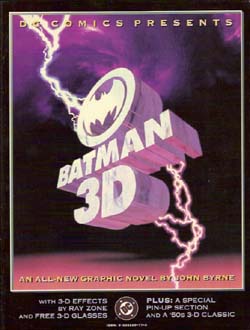
Batman 3D

Batman 3D
Batman 3D

By John Byrne & various: 3-D process by Ray Zone (DC Comics)
ISBN: 0-930289-77-3

The comic-book 3-D process was invented by Joe Kubert and Norman Maurer in 1953 and fed into the wider craze in movies. It resulted in some pretty spectacular comic-books but died out pretty quickly, although it still persists and periodically resurfaces. I’ve worked on a couple of 3-D projects in my other life as an advertising free-lancer, and can honestly say it’s harder than it looks to get right, but when you do it’s utterly mind-boggling.

Having said that and acknowledging that it’s a way of enhancing the visual impact of comics it’s always gratifying when the actual story works too. This forgotten tome from 1990 is a nice example, and is only the second time John Byrne wrote Batman, and is his first full art job on the character. ‘Ego Trip’ features a solid old-fashioned murder-mystery, a helter-skelter chase, dynamic action and a deadly competition between The Joker, The Penguin, The Riddler and Two-Face with Gotham City as their playground.

Although the dialogue is a little stiff, this is still a very readable Batventure for fans of all ages with many tributes to all the best iconic features of the strip and a measured understanding of what the stereoscopic process can add. There’s also a reprint of ‘Robot Robbers’ (with art attributed to Curt Swan and Sheldon Moldoff) which originally appeared in Batman #42 in 1947. It was one of four tales turned into 3D strips for Batman Adventures in Amazing 3D Action during that first boom period in 1953, and re-released in 1966 at the height of the TV Batmania craze. It’s a wonderful science crime romp well worth reliving.

This book also features eleven 3D pin-ups from name-artists commemorating the iconic nature and history of the Caped Crusader. Alex Toth draws the hero in his autogyro from 1939, Bret Blevins and Al Williamson define the Batcave, and both Dave Gibbons and Barry Windsor-Smith give us their unique interpretations of The Joker. George Pérez draws the 1950’s Catwoman, Art Adams handles The Penguin and Mike Zeck produces Two-Face. Jerry Ordway teams Batman and Superman, Jim Aparo illustrates Rā’s Al GhÅ«l, Mike Mignola captures Man-Bat and Klaus Janson shows us the Batman of Today.

This is great little book and even if 3D is currently not in vogue, stories and art of this quality shouldn’t be ignored or forgotten.

© 1947, 1953, 1966, 1990 DC Comics. All Rights Reserved.

Paper Dolls from the Comics

Paper Dolls from the Comics

Compiled and written by Trina Robbins (Eclipse Books)
ISBN: 0-913035-20-3

The newspaper comic strip was a powerful and ubiquitous tool used to raise circulation and promote customer loyalty in the first half of the twentieth century, and as well as laughs, thrills and escapism creators often added games, cut-out collectibles and paper toys to their output in their efforts to succeed. The common belief was that young children and girls loved this kind of “dress-up” play, but I suspect many young men also joined in the fun.

One of the most popular and effective – even to this day (and don’t take my word for it, crank up that search engine and see for yourself), was the addition of favourite characters in their underwear, with fashions you could dress them in – and even design your own outfits for.

This practise graduated from the strips to comic books, and every title from Sugar and Spike to Millie the Model had their own paper-doll pages. Even my quite smart and utterly sensible wife is not immune to the seditious allure of these things.

Feminist cartoonist and comic historian Trina Robbins produced this slim and entertaining book to commemorate the subject (and we’re well overdue for a bigger, longer, updated edition) reproducing some of America’s greatest strip characters by some of the industry’s top creators.

So grab those scissors – don’t run! – and revel in the modes and fashions of Alley Oop, Winnie Winkle, Dixie Dugan, Brenda Star, Dick Tracy, Flyin’ Jenny, Torchy Brown, Mopsy, Boots, Smilin’ Jack, Jane Arden, both Terry and the Dragon Lady from Terry and the Pirates, Miss Fury, The Gumps and Katy Keene. It’s so oddly seductive… yet strangely satisfying…

Text © 1987 Trina Robbins. All Images © 1987, 2007 their respective holders.

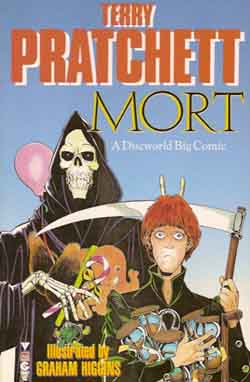
Mort: A Discworld Big Comic

Mort: A Discworld Big Comic

By Terry Pratchett & Graham Higgins (VG Graphics/Gollancz)
ISBN: 0-575-05699-1

Us old codgers have always maintained that a good comic needs a good artist and this superb adaptation of Terry Pratchett’s fourth Discworld novel proves that point. The Discworld is a flat planet supported on the backs of four elephants standing on the back of a giant turtle swimming across the universe. Magic works there and the people are much too much like us. This, of course, makes it an ideal location for spleen-venting, satire, slapstick and social commentary…

Scripted by the author and brilliantly illustrated by Graham Higgins it tells a complex and darkly witty tale of Death (big grim chap, carries a scythe) and the hapless, literal-minded, sort-of-useless young goof Mort, whom he hires as his apprentice.

Of course that’s not all there is to it, with sub-plots including an orphaned princess and her dangerously ambitious guardian, Death’s vacation, the daughter he adopted and the mystery of his most peculiar servant Albert to season a very impressive spin on a very familiar myth.

Higgin’s light, dry touch adds volumes of texture to the mix and the leaden slavishness of the first graphic adaptation (The Colour of Magic – ISBN: 0-552-13945-9) is utterly forgotten in a superb mix of Pratchett’s acerbic dialogue and the artist’s deft sense of timing and comedy pacing, which is most reminiscent of Hunt Emerson.

If you have to have adaptations of great novels this is how it should be done.

Text © 1994 Terry and Lyn Pratchett. Illustrations © 1994 Graham Higgins. All Rights

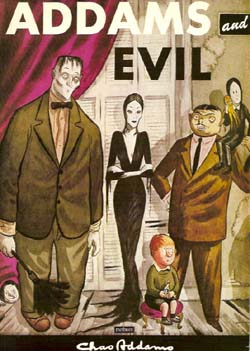
Addams and Evil

Addams and Evil

By Charles Addams (Methuen)
ISBN 0-413-55370-1

Charles Addams was a cartoonist who made his real life as extraordinary as his dark, mordantly funny drawings. Whether he manufactured his biography to enhance his value to feature writers or was genuinely a warped and wickedly wacky individual is irrelevant, (although it makes for great reading: Once again the internet awaits the siren call of your search engine…).

What is important is that in all the years he drew and painted those creepily sardonic, and macabre gags and illustrations for The New Yorker, Colliers, TV Guide and others (from 1932 onwards, but regularly and consistently from 1938 until his death) he managed to enthral his audience with a devilish mind and a soft, gentle approach that made him a household name long before television turned his characters into a hit and generated a juvenile craze for monsters and grotesques that lasts to this day.

This volume is a reissue of his second collection of cartoons, first published in 1947, and semi-occasionally ever since. Although his works are long overdue for a definitive collected edition, many of his books (eleven volumes of drawings and a biography) are still readily available and should you not be as familiar with his actual cartoons as with their big and small screen descendents you really owe it to yourself to see the uncensored brilliance of one of America’s greatest humorists.

© 1940-1947 the New Yorker Magazine, Inc. In Canada © 1947 Charles Addams.

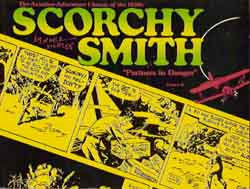
Scorchy Smith: Partners in Danger

Scorchy Smith: Partners in Danger

By Noel Sickles (Nostalgia Press)
ISBN: 0-87897-029-0

Noel Sickles had a very short and barely acknowledged career as a newspaper cartoonist. He worked as a jobbing illustrator in the features department of the Associated Press – an organisation that provided cheap high-quality filler material such as cartoons, ads, comic strips, recipes, horoscopes, puzzles: All the pages that local newspapers needed but couldn’t afford to produce themselves.

In 1934 he took over the inexplicably popular aviation strip Scorchy Smith from John Terry, who had contracted a terminal illness. The publisher’s required him to emulate Terry’s style, which he did until the artist’s death, when he was invited to make the strip his own. A driven experimenter, he replaced the scratchy cross-hatched and feathered method of Terry with a moody impressionism that used volume, solid blacks and a careful manipulation of light sources to tell his tales. He also made backgrounds and scenery an integral part of the story-telling process.

A very straight adventure series, Smith is a stout hearted, valiant Knight of the Skies, complete with trusty sidekick, ‘Heinie’, flying about and Doing Good. That’s it.

Sickles famously never worked to a plan when writing the strip, he just made it up as he went along to avoid boring himself. (For an extended exploration of his process read R C Harvey’s Meanwhile… a superb biography of Sickles’s friend and studio-mate Milton Caniff published by Fantagraphics Books ISBN: 978-1-56097-782-7).

Stories abound that the two collaborated often. Certainly Caniff admitted to helping out with deadlines and story-polishing but the bold visuals were always the product of a driven and dedicated seeker of artistic truths. The Chiaroscurist style developed by Sickles was adopted by Caniff, although he largely eschewed the lavish use of photo-mechanical dot-screens that Sickles used to create a different flavour of Black in his monochrome masterpieces.

Reprinted in this slim tome are three of the thrillers from that brief period. ‘Lafarge’s Gold’ (10th October 1935-January 30th 1936), ‘New York, N. Y.’ (January 31st 1936-March 18th 1936) and ‘Desert Escape’ (March 19th 1936- August 14th 1936) come from the very end of Sickles’s strip career, with a pretty girl swindled out of a goldmine, big-city conmen, and Tuaregs and the Foreign Legion providing the admittedly lacklustre narrative maguffins. But the bravura vivacity and artistic flair employed by Sickles to tell the tales elevate these B-Movie plots into breathtaking high art drama by the sheer magnificence of the drawing and design.

Noel Sickles left the restricted and drudge-work world of newspaper strips in 1936 for the greater challenge of higher education and eventually settled into the more appreciative and challenging magazine illustration field, making new fans in the Saturday Evening Post, Life and Readers Digest. His few months in narrative story-telling changed our entire industry, not so much with what he did but by the way he did it and who he shared his discoveries with. He is an unsung immortal, and his brief output deserves a commemorative, retrospective collection more than any other creator that I can think of. Until then lost gems like this will have to suffice.

© 1936 The A. P.