
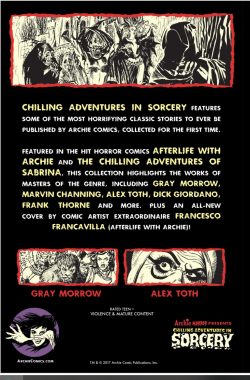
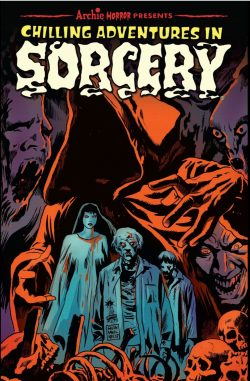
By Harry Doyle, Gray Morrow, Marvin Channing, Don Glut, Steve Skeates, Mary Skrenes, Carol Seuling, Phil Seuling, Larry Hama, Bob Holland, Stan Goldberg, Vicente Alcazar, Dick Giordano, Carlos Pino, Dan DeCarlo, Howard Chaykin, Alex Toth, Bruce Jones, Ed Davis, Frank Thorne & various (Archie Comics)
ISBN: 978-1-62738-990-7 (TPB/Digital edition)
This book includes Discriminatory Content produced in less enlightened times.
Win’s Christmas Gift Recommendation: Shockingly Wicked Chronicle of Chills… 9/10
For 85 years Archie Comics have been synonymous with safe, wholesome good fun, but the company has always been a surprisingly subversive one. Family friendly – and not – iterations of superheroes, spooky chills, sci fi thrills and genre yarns have always been as much a part of the publisher’s portfolio as the romantic comedy capers of America’s cleanest-cut teens.
As you probably know, eponymous Archie Andrews has been around since 1941, but the publisher has other family-friendly feature players – like Sabrina the Teenage Witch or Josie and the Pussycats – in their stable, almost as well known – and just as prone to radical reinterpretation. To keep all that accumulated attention riveted, the company always looked to modern trends with which to expand upon their archetypal storytelling brief. A recent revival in horror across all media thus resulted in a few supernatural sidebar titles such as Afterlife with Archie and Jughead: The Hunger…
Moreover, in times past the publisher cross-fertilised their pantheon through unlikely team-ups such as Archie Meets the Punisher, Archie Vs Sharknado and Archie Vs Predator, whilst every type of fashion fad and youth culture sensation was invariably accommodated into and explored within the pages of regular titles. Thus, following-up the stunning success of aforementioned zombie apocalypse Afterlife with Archie, they took another brazenly controversial step, and radically reinvented their saccharine-sweet TV teen witch in an astoundingly sophisticated way with Chilling Adventures of Sabrina. That was done by playwright, screenwriter and comics scribe Roberto Aguirre-Sacasa (The Mystery Plays, 4: Marvel Knights Fantastic Four, Stephen King’s The Stand and Afterlife with Archie) who pitched the idea to re-imagine the saucy sorceress in terms of Rosemary’s Baby and The Exorcist.
Archie Comics was no stranger to such material. In the 1970s the company had formed sub-imprint Red Circle for anthology terror tales during a previous supernatural boom time, before gradually converting the line to superhero features as the decade progressed and a fad faded. They even had resident witch-girl Sabrina narrating Chilling Tales of Sorcery for the first two issues. The title dropped subhead …As Told by Sabrina… for #3, and with #6 (cover-dated April 1974) became Red Circle Sorcery until folding with February 1975’s #11.
In a great example of circularity, a newly-wicked 21st century Sabrina featured snippets from the ’70’s anthology, sparking this edgy compilation of lost classics in a spiffy monochrome collection. Following a fervent Introduction by letterer and fright-fan Jack Morelli, a volley of vintage terrors open with Chilling Tales of Sorcery… as Told by Sabrina #1 (September 1972): a rather standard anthology of short thrillers with twist-endings, little different from those manufactured by DC, Marvel, Gold Key or Charlton at the time, as crafted by Archie’s on-staff comedy creators.
Frank Doyle & Stan Goldberg’s ‘Behold the Beast’ revealed the fate of a misunderstood and malformed lad, before ‘The Boy Who Cried Vampire’ (Doyle & Dan DeCarlo) dealt out ironic justice to a pesky kid and ‘Assignment in Fear’ (Doyle & DeCarlo) saw a teacher with a secret sort out a class bully in horrific style…
Anonymous prose yarn ‘A Real Hot Talent’ got under the skin of a juvenile fire-starter after which Doyle & DeCarlo returned to exhibit ‘Quick Justice’ in an art gallery before Doyle & Goldberg reveal how ‘Curiosity Kills’ in a story of an accursed inheritance.
Issue #2 opened with Doyle & Goldberg’s ‘The Ultimate Cure’ wherein a waiting bride’s tragic misapprehension destroyed her man and her sanity, whilst text tale ‘Look Upon Your Legacy’ recapitulated the dangers of an over-active imagination. Pictorial perils resumed with ‘Sonny’s World’ (Doyle & Dan DeCarlo) as a little brat learns how to make reality his plaything, and ‘The Measure of a Monster’ Doyle & Goldberg) sees mad science unleash a colossal creature and (almost) find a safe conclusion. The same creators thereafter outline the fate of a jewel-obsessed lass succumbing to ‘The Cameo’s Curse’…
A total shift in style and tone (like from Goosebumps to Carrie) began with #3 (October 1973) as writer/artist Gray Morrow came aboard, personally crafting or supervising far more mature fare closer to Warren’s adult horror magazines than contemporary newsstand standards such as House of Mystery, Ghostly Haunts or Boris Karloff Tales of Mystery.
Dwight Graydon “Gray” Morrow was born in Fort Wayne, Indiana in 1934 and studied at the Chicago Academy of Fine Arts. After army service he moved to New York City in 1955 and began a steady career contributing strips, covers and illustrations to Atlas Comics (pre-Marvel), Cracked, Classics Illustrated, numerous children’s books and pulps like Galaxy.
A master of graphic realism, his art and stories graced countless comics books, magazines like Space: 1999 and alternative vehicles such as Wally Wood’s Witzend. Morrow freelanced for dozens of companies; he co-created DC’s El Diablo & Marvel’s Man-Thing, revamped Archie’s Black Hood into a gritty urban avenger (during his tenure at Red Circle), as well as drawing newspaper iterations of Tarzan & Buck Rogers. Morrow won numerous awards – including 3 Hugos – over a long and extremely far-reaching artistic life. He died in 2001.
His influence on Chilling Adventures in Sorcery was instantaneous. With the imprint retitled Red Circle Comics for the third (almost all-Morrow) issue, the new boss introduced a growing band of fresh writers and master artists, as the title unleashed a wave of terror tales that owed much to movies and TV of the period.
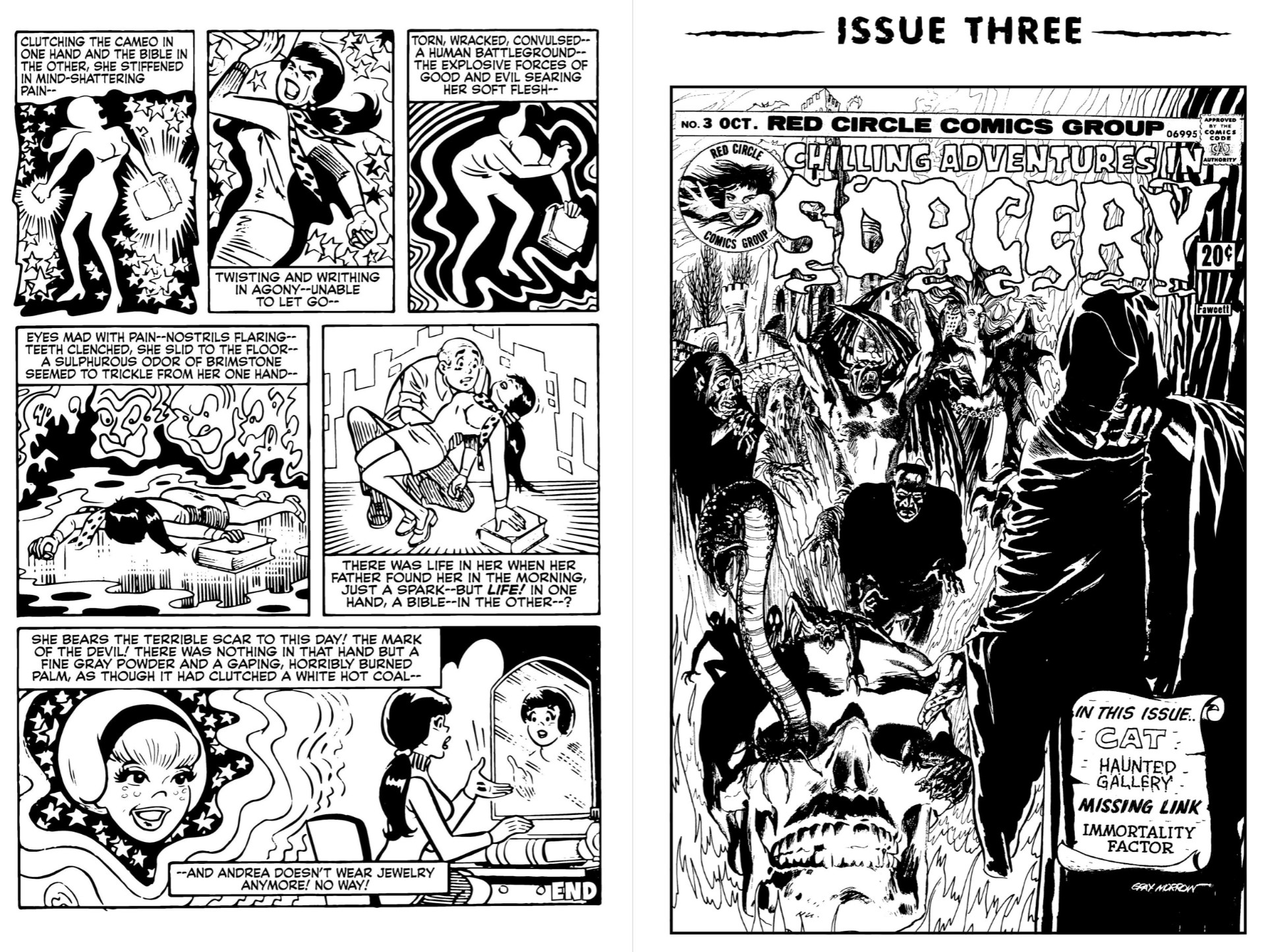
It began with ‘…Cat’ (written, drawn & lettered by Morrow) wherein a ruthless, misogynistic society burglar targets the wrong gem-bedecked senorita and lives to regret it forever. After text thriller ‘A Stab in the Dark’ – exposing a plot to murder by witchcraft – a diversion into EC-tinged science fiction finds a time traveller accidentally become an evolutionary ‘Missing Link!’, whilst a bereaved man investigates the death of a sister and discovers a new ‘Immortality Factor’ is anything but.
An embezzler pays the price for betrayal in ‘Haunted Gallery’ before the issue closes with fact-page ‘Essays into the Supernatural’ – a featurette by Phil Seuling & Morrow exploring timeless rituals of magic and the use of ‘Familiars’…
Due to his prestige and sheer artistic quality, Morrow could call upon a lot of high-end associates to fill pages, as #4 (December 1973) introduced internationally famous Spanish master of mood Vicente Alcazar (Jonah Hex, Commando Picture Library, Star Trek, Space: 1999) who began his association by writing & illustrating ‘Suicide… Maybe’, a saga of Faustian tragedy wherein a lifelong failure makes a fool’s bargain and discovers politics is the Devil’s playground…
Text vignette ‘Loophole’ also explores such contracts before Don Glut & Dick Giordano highlight the ‘Horripilate Host’ whose TV show excesses lead to infernal doom, after which Morrow adds a sinister tweak to the legend of Midas when a greedy creep gains the legendary ‘Golden Touch!’ The power of a Hebrew Golem deals poetic justice to a modern oppressor in ‘A Thousand Pounds of Clay’ (Glut & Alcazar) before the issue ends on another fictive factoid as ‘Essays into the Supernatural’ finds Morrow exploring truths and fictions of ‘The Witch’…
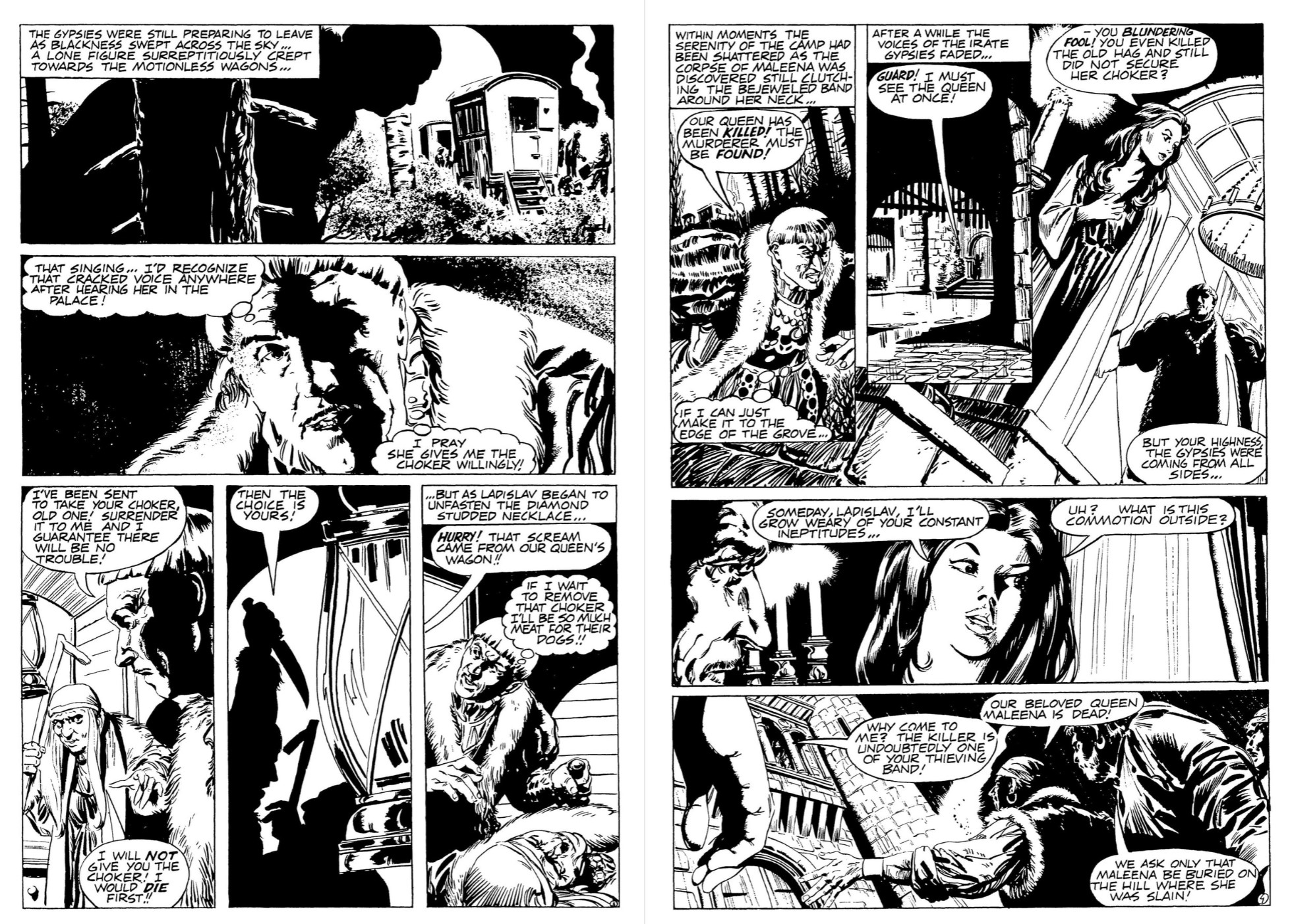
Cover-dated February 1974, #5 opens with a vivid pastiche of Arabian adventure courtesy of writers Morrow & Larry Hama. Limned by Alcazar ‘The Two Thieves of Baghdad’ exposes the fatal flaw of overconfidence before the all-Alcazar ‘Esme’ details the fate of a hit-&-run victim whose vision is horrifically enhanced by her accident. Morrow brings his lifelong affinity for baroque, barbaric science fantasy to the creepy epic ‘Barometer Falling…’ after which Alcazar’s ‘The Choker is Wild’ reveals the shocking history of blood-drinking sovereign Queen Maleena and ‘Essays into the Supernatural’ featurette (by Seuling & Morrow) catalogues the totemic value of ‘Dragons’.
In Red Circle Sorcery #6 (April) Steve Skeates, Mary Skrenes & Morrow open with ‘Warrior’s Dream’ as a lusty barbarian finally pays the price for all that wenching and, following Marvin Channing & Morrow’s ‘Essays into the Supernatural’ page detailing legends of ‘The Werewolf’, a conjuring upstart is destroyed by a sagacious warlock in ‘Out of Practice’ by Seuling & Ed Davis.
British comics stalwart Carlos Pino was Alcazar’s studio partner for years (they often collaborated as “CarVic”) but here solos in Channing’s tale of vengeance-by-witchcraft ‘Death Goes to a Sales Convention!’, before Carol Seuling & Howard Chaykin go full medieval in ‘The Patience of a Cat’ – an epic saga of demonic manipulation and feline retribution…
Illustrated by Morrow, futuristic sensory-inundation tech is the driving force in T. Casey Brennan’s extended prose mystery ‘Black Fog’ – after which Channing & Alcazar dole out just deserts to a serial womaniser in ‘Face of Love – Face of Death’ to close the issue.
RCS #7 commences with Skeates & Pino’s ‘A Twist in Time’ as an ancient wizard is drawn into Fate’s plan to punish a modern-day murderer before Channing & Morrow explore legends of ‘The Dibbuk’ in another gripping ‘Essays into the Supernatural’ featurette. Then Channing & Alcazar memorably reveal the dangers of owning ‘The Knife of Jack the Ripper’…
Channing scripts a rare but welcome artistic exploit by Bruce Jones when ‘The Rivals’ follows two kids from mid-western poverty to dizzying heights prior to their grim, witchcraft-assisted ends, after which Brennan & Alcazar detail the frustrating fate of ‘The Benefactor’ nobody will listen to…
Closing the chronological portion, ‘Essays into the Supernatural’ offers Morrow’s lowdown on ‘Possession and Exorcism’ which happily leads not to the end, but instead to a selection of Bonus Stories from later issues.
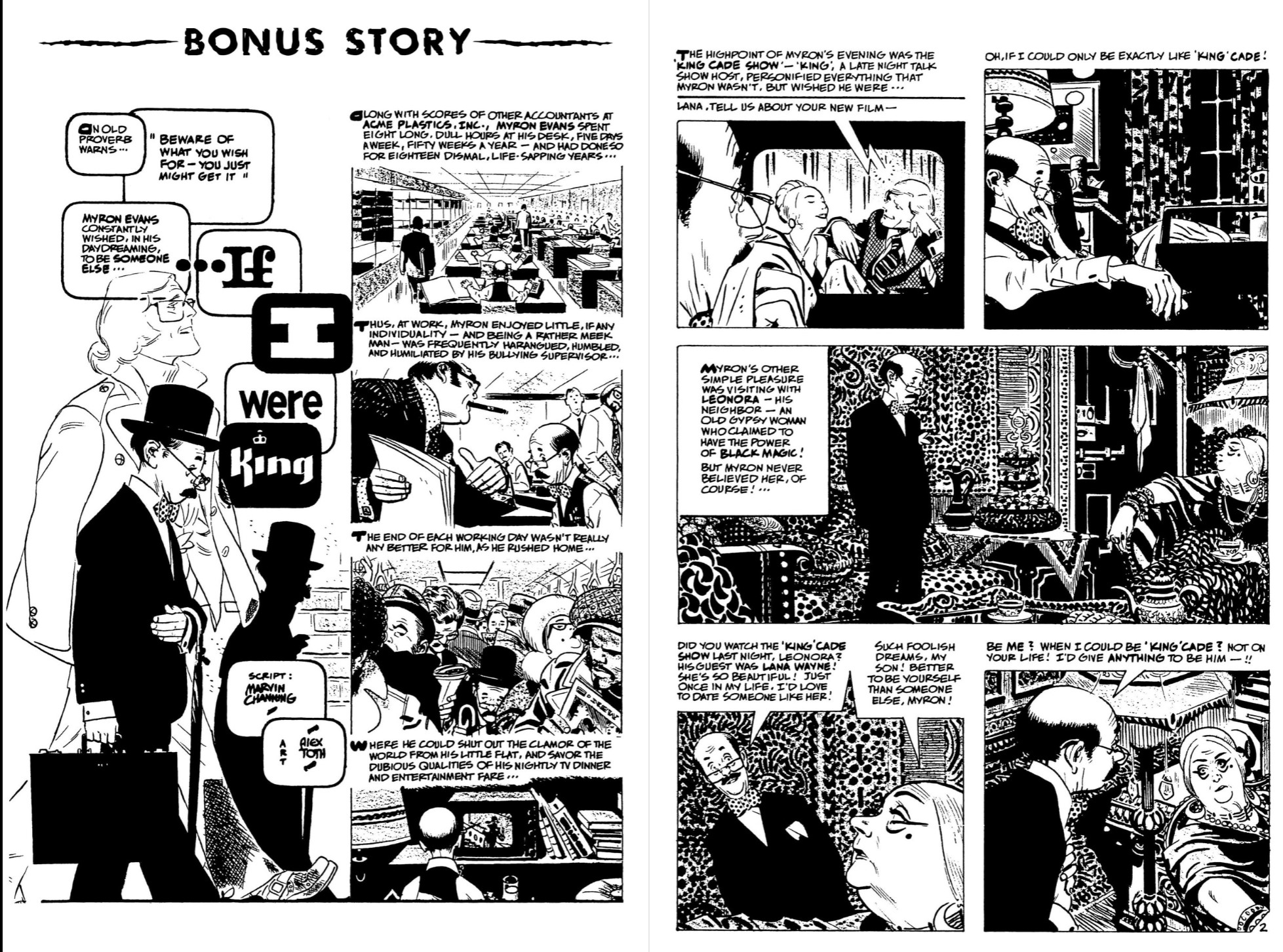
From #9 (October 1974) comes ‘…If I Were King’ by Channing & magnificent Alex Toth, as a meek nobody gets his greatest wish fulfilled – with the usual regrets – before #8 (August 1974) offers a compelling ‘Essays into the Supernatural’ featurette by Channing & Frank Thorne, exposing the tricks of pesky ‘Poltergeists’ and contains closure via illustrated calligraphic ode ‘The Spectre’ by Bob Holland & Morrow.
The company’s 21st century resurgence on TV and in comics generated a variety of alternate iterations of the timeless pantheons and this no-frills terror tome is the perfect complement to those aforementioned horror-haunted titles.
Please don’t be put off by the black-&-white reproduction: these tales are crafted by masters of line art and tonal values whose efforts actually benefit from the subtraction of the cheap colour used in the original releases. These are superb voyages into the bizarre unknown that no lover of dark fiction should miss.
© 2017 Archie Comic Publications, Inc. All rights reserved.