
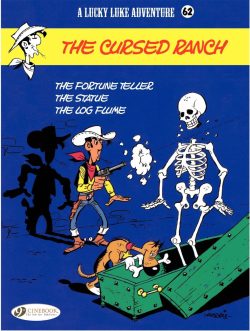
By Morris with M. Janvier, scripted by Xavier Fauche & Jean Léturgie & C. Guylouis; coloured by Studio Leonardo and translated by Jerome Saincantin (Cinebook)
ISBN: 978-1-84918-320-8 (Album PB), 978-1-84918-693-3 (Digital edition)
This book includes Discriminatory Content produced in less enlightened times. This book also contains Discriminatory Content added for comedic effect.
Time for another Anniversary shindig, non?
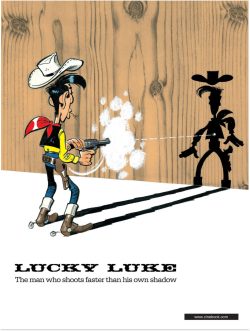
Lucky Luke is a rangy, good-natured, “lonesome cowboy” able to “draw faster than his own shadow”. Doughty, dashing, dependable Lucky is an implacably placid do-gooder roaming the mythical Old West, having light-hearted adventures with his wonder horse Jolly Jumper whilst interacting with a host of historical and/or fictionally famous figures of the genre.
It’s Jolly & Lucky’s 80th birthday this year and their continued exploits have made the gentle gunslinger one of the bestselling comic characters in Europe, encompassing 84 albums, with numerous spin-off books and series comprising more than 300 million albums in at least 31 languages thus far. That has all generated a mega-mesa of merchandise: posters, toys, games, apparel, animated cartoons, TV shows and live-action movies.
Lucky was dreamed up by western-loving Belgian-born animator, illustrator and cartoonist Maurice de Bévère AKA “Morris”. His sagebrush star debuted in the summer of 1946, initially in mid-summer issues of Le Journal de Spirou sans title or banner logo, and only in French-language editions of the multinational kids comic. The Lone Rider’s official launch was the autumn of that year in Christmas Annual L’Almanach Spirou 1947, before opening his first official serial in the pan-regional, multilingual weekly edition cover-dated December 7th 1946.
After a relatively slow start for such a fast gun, Lucky’s global dominance came via Morris’ decades-long collaboration with superstar scripter René Goscinny. The official partnership spanned Rails on the Prairie (August 25th 1955) to The Ballad Of The Daltons And Other Stories in 1986, during which time the sixgun straight-shooter switched teams, transferring to Goscinny’s own magazine Pilote with The Stagecoach in 1967, augmented by many guest appearances all over the European publishing scene after that.
Goscinny co-crafted 45 albums before his death in 1977, after which Morris continued singly and with new literary pardners, ultimately founding a posse of legacy creators including Lo Hartog van Banda, Achdé & Laurent Gerra, Xavier Fauche, Jean Léturgie, Benacquista & Pennac, Jacques Pessis and more, all taking their own shots at the venerable vigilante. Morris continued in declining degrees until his own death in 2001, having drawn fully 70 adventures, plus numerous sidebar and spin-off whimsical western tales.
His grande idée draws less on western history than movie mythology, but our hero regularly met actual historical figures as well as famous fictional folk in tales culled from classic cowboy lore and lensed through uniquely European notions and interpretations. Our star is never averse to being a figure of political change and Weapon of Mass Satire, as well as spoofing his own antecedents whilst wallowing in movie schtick to trigger delicious drives down memory lane in the eternal game of cowberks and imbeciles…
In 1986 Le Ranch Maudit was the 56h European Lucky album: a pleasant assemblage of short sharp silly yarns, that collectively – as The Cursed Ranch – became Cinebook’s 62nd English-language outing of hijacked history, scattershot satire and horselaugh hijinks. Morris always drew from a deep, shared well of cinematic motifs, gilded with authenticity and tempered with veracity as required. Here, with assistant Michel Janvier (Rantanplan, Lucky Luke, François Cevert, Michel Vaillant) lightening his artistic load, gags and scenarios are supplied by prolific scripters Xavier Fauche & Jean Léturgie as well as occasional contributor C. Guylouis, but the wide-eyed wry western wonderment is in no way diminished…
It opens with a fond film tribute to genres other than “shoot-‘em-ups” as eponymous lead ‘The Cursed Ranch’ blends horror tropes with sagebrush standards and slapstick silliness. Scripted by Claude Guylouis – a writing team pseudonymously composed of Claude Klotz (AKA Patrick Cauvin), Guy Vidal & Jean-Louis Robert – it details how, in January 1861, the horrific stench of unwanted oil deposits (!) drive folks from their homes in Whitney before permeating the entire region. One of the many to flee the toxic stink is elderly spinster Miss Pasiphaë Bluemarket who swiftly departs for fresher climes for the sake of her “boys”. The town matriarch is quite a character, and easily circumvents all obstacles to take with her three exceedingly well-mannered and well-bred full grown plains buffalo she has adopted…
The rail journey is largely without incident and when they all alight at Smithville, local land agent Chris Lee has just the property she needs. Oddly though, whenever she introduces herself as the new resident of The Bates Ranch townsfolk scream and faint. Miss Bluemarket is not worried. She’s far more concerned about the way local hunting addict Mad Bison Bob is eying her precious boys…
On meeting exceedingly polite fellow newcomer Lucky Luke, Miss Bluemarket accepts his offer to investigate her new home and soon both experience a sustained assault on her refined senses, with uncanny phenomena and walking spectres stalking the corridors. Thankfully, Lucky is no stranger to bizarre happenings or crooked set-ups and swiftly solves the spooky enigma…
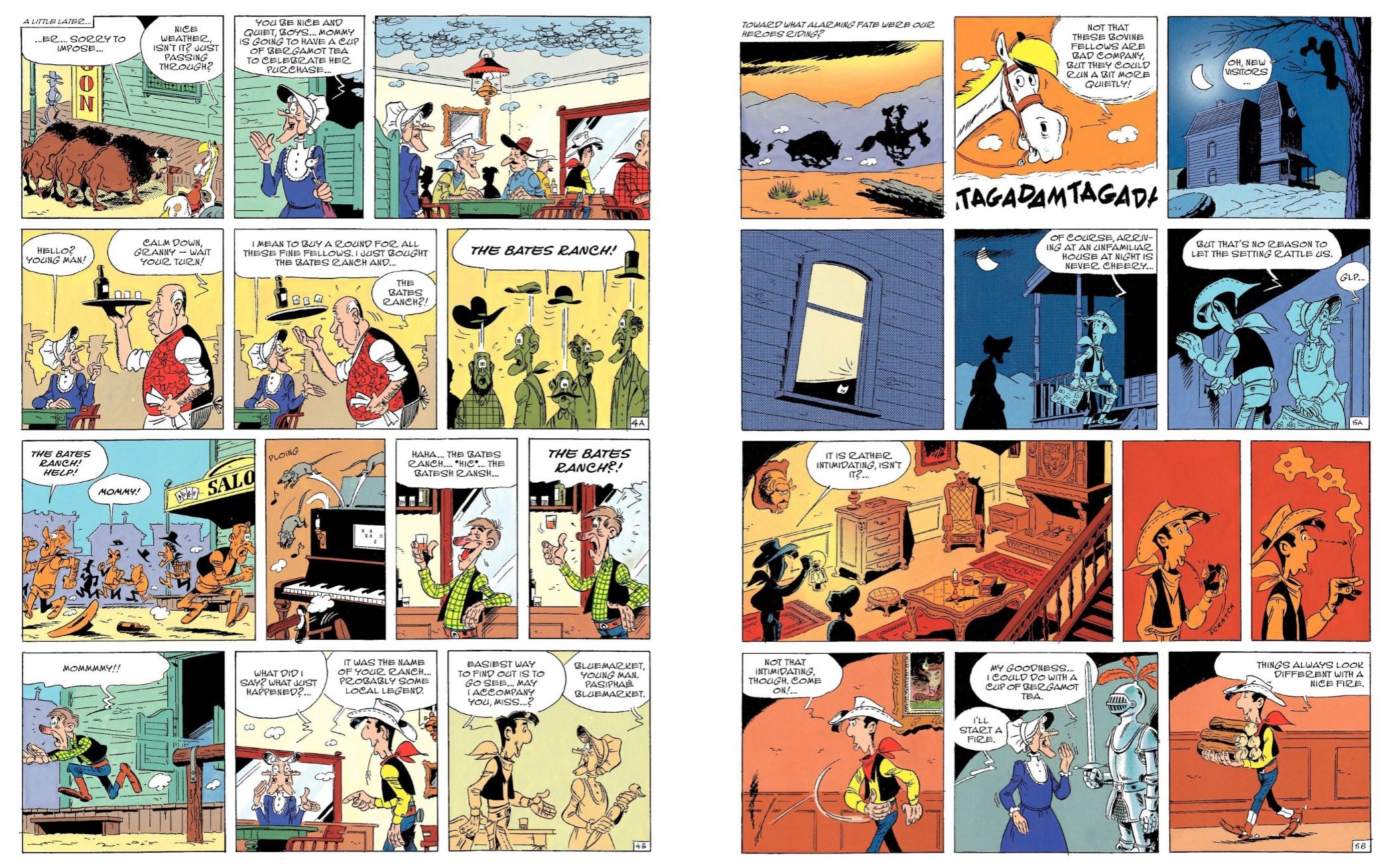
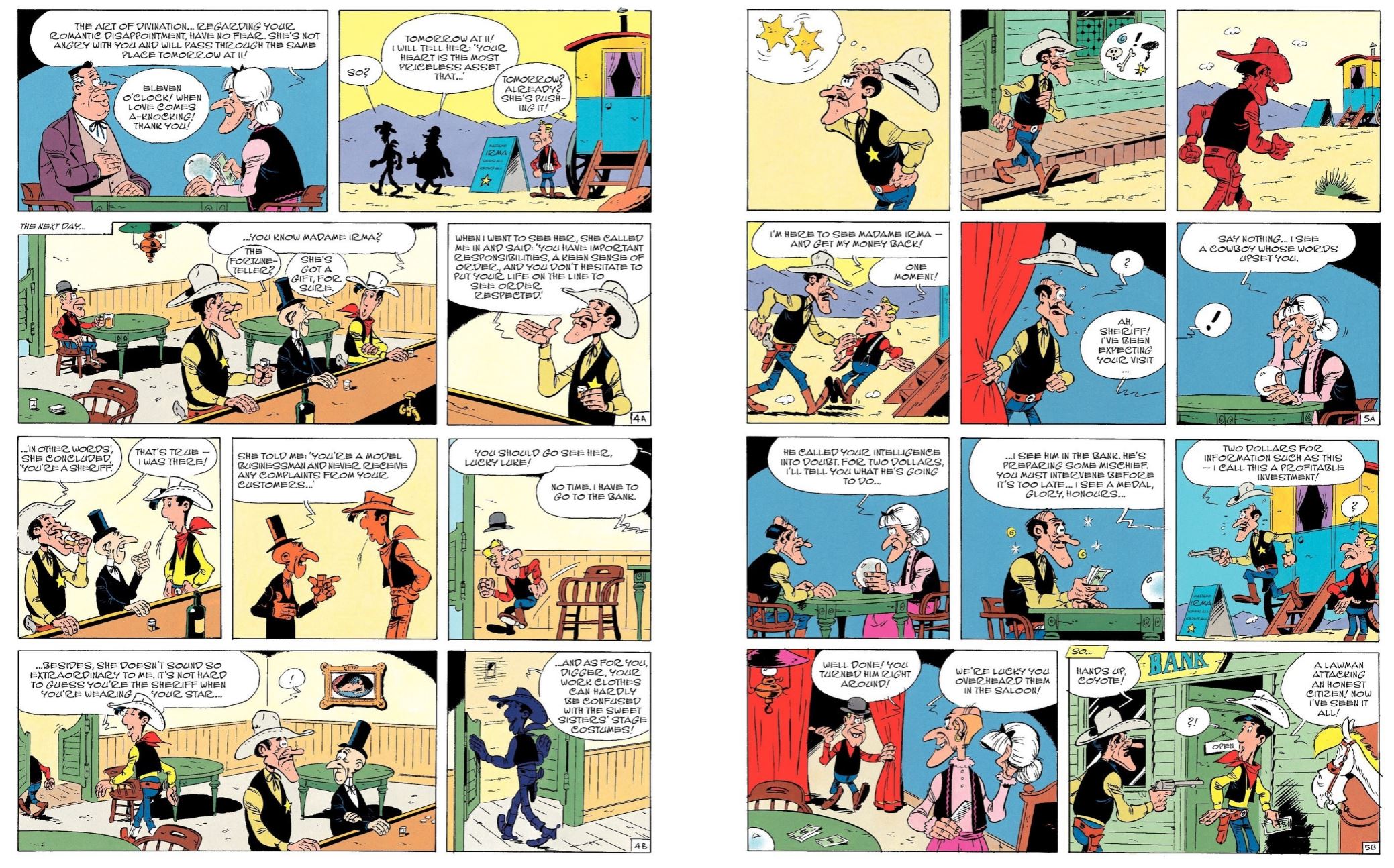
Stuffed with cinema cameos (Hitchcock, Christopher Lee, John Alexander and more) and sly references to film classics from Psycho to Arsenic and Old Lace, this rollicking romp is offset by a more traditional tale of crime & punishment. Written by Xavier Fauche (Lucky Luke, Rantanplan, Marsupilami, Percevan) & Jean Léturgie (Lucky Luke, Rantanplan, Kid Lucky, Percevan, Gastoon, Space Cake) ‘The Fortune-Teller’ observes our hero amazed at how “wandering gypsy” Madame Irma has beguiled and bamboozled a town apparently filled with fools and idiots, before setting out to free them from cunning conmen fleecing everyone from the banker to the sheriff…
Claude Guylouis pens savage satire next as ‘The Statue’ finds Lucky & Jolly in the Dakota badlands where bland, blank Mount Rushmore is simply crying out for some sort of statue to be carved into it. After Lucky cleans up nearby Hitch City, grateful locals want avaricious travelling sculptor Michaelangelo Jr. to immortalise their new hero in stone, but arrogant overbearing landowner MCallister thinks it should be him on the side of a mountain…
Via his vile servant Sadiquito he hires the infamous Daltons to stop the process and takes many more malign steps to subvert and suborn the artist. Lucky doesn’t want a statue at all, and isn’t disappointed when fate takes a hand and makes fools of everybody…
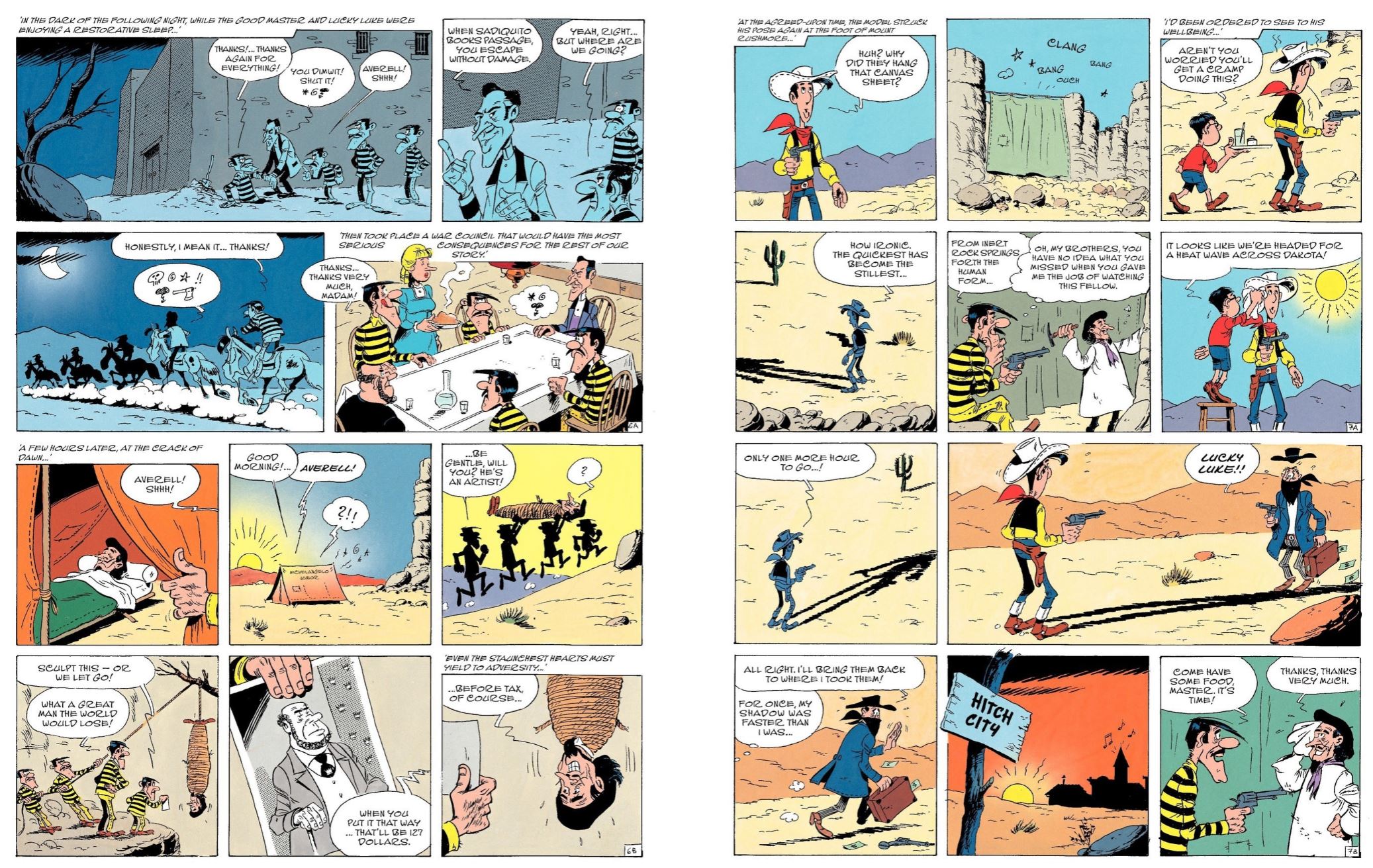
The frantic fun closes with a wild ride as Léturgie scripts ‘The Log Flume’ wherein Luke & Jolly meet forward-thinking lumberjack Clement Ellsworth. He has devised a way to speed up the laborious, costly process of transporting felled trees to carpenters and manufacturers… Typically, his efforts are being sabotaged by greedy land baron and monopoly capitalist Mr. Butterfield who wants to shut the experiment down and seize Ellsworth’s patent. However, all his acts of sabotage are no match for Lucky’s wits and Jolly Jumper’s agility…
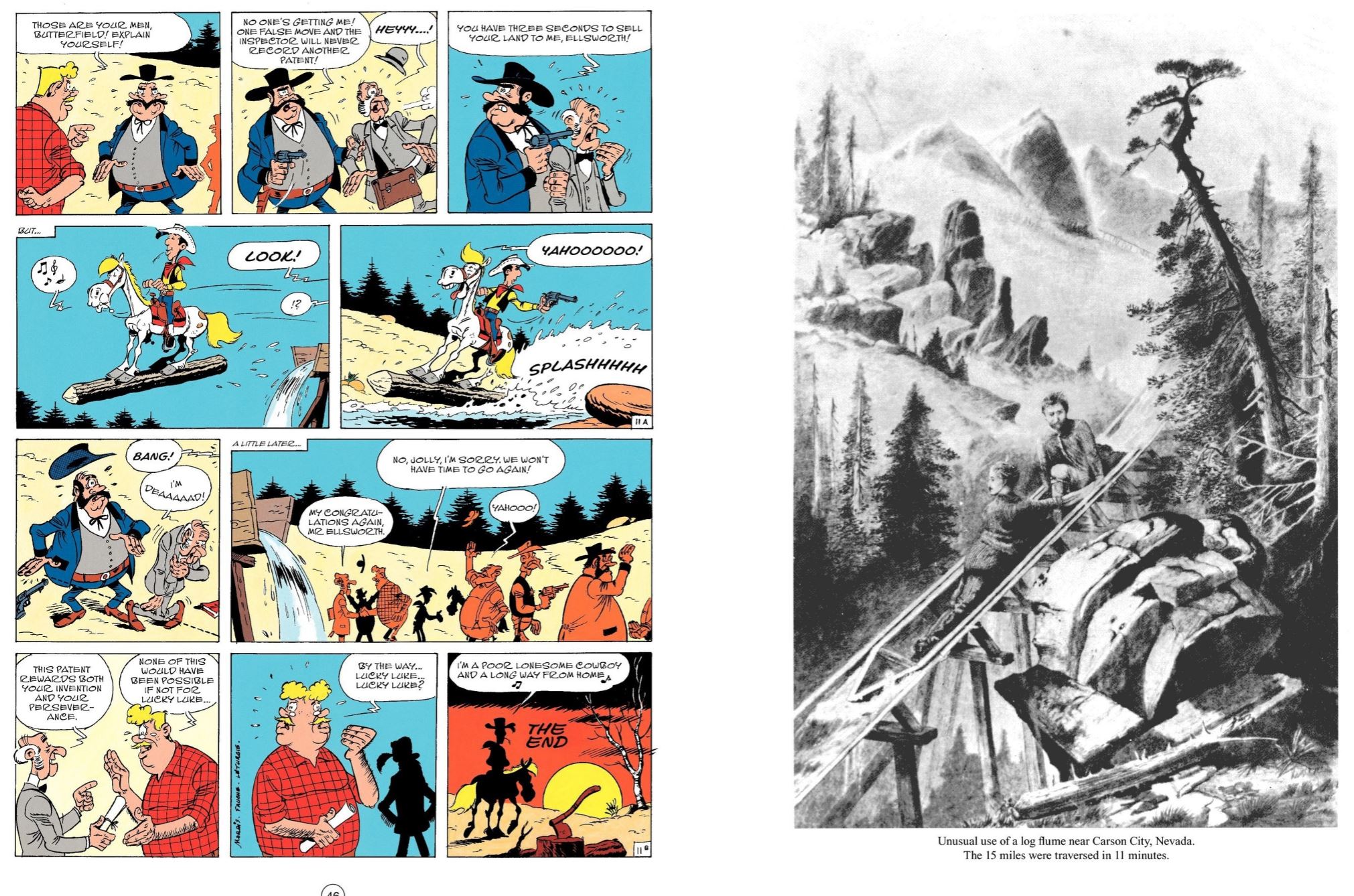
Topped off with an anonymous contemporary print of the era depicting “Unusual use of a log flume near Carson City Nevada” these done-in-one exploits of an indomitable hero offer grand joys in the traditional western way, superbly executed by master storytellers, and form a brilliant introduction to a unique genre for moderns and kids who might have missed out on the romantic allure of the Wild West that never was…
© Dargaud Editeur Paris 1986 by Morris, Guylouis, Fauche & Léturgie. © Lucky Comics. English translation © 2016 Cinebook Ltd.