Essential Human Torch Vol 1

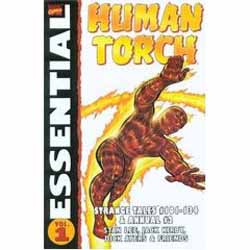
Essential Human Torch

By Stan Lee, Jack Kirby, Dick Ayers & various (Marvel)
ISBN 0-7851-1309-6

Hot on the heels (I’m so sorry, I simply couldn’t help myself) of the runaway success of Fantastic Four, Stan Lee spun the most colourful and youngest member of the team into his own series, hoping to recapture the glory of the 1940s when the Human Torch was one of the company’s “Big Three” superstars.

Within a year of FF #1, the monster anthology title Strange Tales became the home for the hot headed hero (I just can’t stop!). In issue #101, cover dated October 1962, young Johnny Storm started his ancillary solo career with a mediocre script and stunning artwork as he promptly thrashed the Red spy called the Destroyer. Jack Kirby would pencil the first adventures, inked by Dick Ayers, which were scripted by Larry Lieber, over plots by his brother Stan.

An odd inconsistency did crop up here. Although public figures in the Fantastic Four, Johnny and his sister Sue lived part-time in the rural New York hamlet of Glenville. Although they know and admire her as the glamorous Invisible Girl, the populace seem oblivious to the fact that her brother is the equally famous Torch. Many daft pages of Johnny protecting his secret identity would ensue before the situation was brilliantly resolved.

Although something of a hit-or-miss proposition, this strip was the origin point for many of Marvel’s greatest villains. The first of these appears in the very next tale ‘Prisoner of the Wizard’ by the same creative team, who remained together to produce the classic ‘Prisoner of the 5th Dimension’, the not so great ‘Paste-Pot Pete!’, and ‘Return of the Wizard’.

As Kirby took a brief leave of the strip, and Ayers assumed full art duties ‘The Threat of the Torrid Twosome’ revealed that the entire town knew the Torch’s secret but were just playing along to keep him happy. This first hint of tongue-in-cheek whimsy presaged an increasing lightness of touch that would come to characterise the Marvel style as much as the infighting between team-mates. The villainous Acrobat would return in another milestone in issue #114.

Issue #107 would be Lieber’s last as Ayers drew a splendid punch-up with the Sub-Mariner in a tale reminiscent of the Golden Age battles of their publishing forebears. Veteran writer Robert ‘Berns’ Bernstein scripted the next two, frankly daft, yarns over Lee plots, but the saving grace of both ‘The Painter of a Thousand Perils!’(ST #108) and ‘The Sorcerer and Pandora’s Box’ (ST #109) was the brief return of Jack Kirby to the pencilling. H.E. Huntley (Ernie Hart) typed the words for Dick Ayers to illustrate when the Wizard and Paste-Pot Pete teamed up, (as they eventually would again as the FF’s evil counterparts the Frightful Four). In the next issue the Torch made short work of the Asbestos Man (oh, the tragedy of simpler times).

With the exception of the all-star team-up from Strange Tales Annual #2, featuring a terrific romp guest-starring Spider-Man, by Lee, Kirby and Steve Ditko, and the aforementioned issue #114, the next few issues are relatively minor efforts. Jerry Siegel, writing as Joe Carter, introduces the Eel in ‘The Living Bomb’ and The Plantman in ‘The Coming of the Plantman’, before Lee takes over as scripter with ST #115’s ‘The Sandman Strikes!’.

The Puppet Master was the villain in #116, which guest-starred the Thing, with George Roussos inking Ayers in his own secret identity of George Bell; The Eel returned in #117, and in #118 the Wizard had another go at the flaming Kid, and the Thing and Reed Richards besides. A first brush with Marvel’s soon to be core readership came in #119 where ‘The Torch Goes Wild!’ due to a “Commie Agent” called the Rabble Rouser who mesmerises decent college students, making them surly and rebellious.

Why was Strange Tales #114 so important? It featured the return of another Golden Age hero – or at least an impersonation of him by the insidious Acrobat — was written by Stan Lee and illustrated by Jack Kirby and Dick Ayers. Here’s a quote from the last panel.
“You guessed it! This story was really a test! To see if you too would like Captain America to Return! As usual, your letters will give us the answer!” I wonder how that all turned out?

Kirby was also on hand for #120 as ‘The Torch Meets Iceman!’, a terrific action extravaganza that pretty much ended the glory days of this strip. From then on, despite all the gimmicks the Bullpen could muster, a slow decline set in as the quirky back-up strip Doctor Strange grew in popularity – and cover space.

Issue #121 brought back the Plantman, issues #122 and #129 featured the woefully lame ‘Terrible Trio’ and #123 saw ‘The Birth of the Beetle!’. The ever-present Thing became an official co-star when they battled the re-designed Paste-Pot Pete, who only needed to change his name to The Trapster to be finally taken seriously. In ST #125 the heroes fought the Sub-Mariner once more, and then handled the Puppet Master and the Mad Thinker in #126. They quickly worked out the identity of ‘The Mystery Villain’ in #127 but had a little more difficulty with ‘Quicksilver and the Scarlet Witch’ in #128.

Pop culture reeled with #130 in ‘Meet the Beatles’ (some sort of pop group, not villains – and they actually didn’t) although the brilliant Bob Powell did take over the art chores, with inking from Chic Stone. Ayers returned to ink #131, the dire ‘Bouncing Ball of Doom!’, and Larry Ivie wrote a capable thriller in ‘The Sinister Space Trap!’.

Lee returned for the last two tales ‘The Terrible Toys’ and ‘The Challenge of… The Watcher!’ (ST #133 and #134) but it was clear that his mind was elsewhere, most likely the new Nick Fury, Agent of S.H.I.E.L.D. strip that would replace the Torch and thing in Strange Tales #135.

It is interesting to note that as the parent Fantastic Four title grew in scope and quality this feature diminished. Perhaps there is something to be said for concentrating one’s efforts or not overexposing your stars. What was originally a spin-off for the younger audience faded as Marvel found its voice and its marketplace, although there would be periodic efforts to reinvigorate the Torch.

The historic value sadly does supersede the quality of most of these strange tales, but there’s still a good deal that’s great about this series.

© 1962, 1963, 1964, 1965, 2003, 2007 Marvel Characters, Inc. All Rights Reserved.
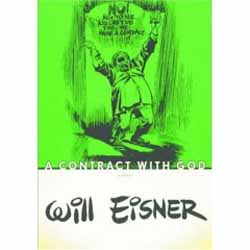
A Contract With God

A Contract With God

By Will Eisner
Most recently published by W.W. Norton & Co. ISBN: 0-3933-2804-X
Other editions are readily available

If Jack Kirby is the American comic strip’s most influential artist, Will Eisner is undoubtedly its most venerated and exceptional storyteller. Contemporaries originating from strikingly similar Jewish backgrounds, each used comic arts to escape from their own tenements, achieving varying degrees of acclaim and success, and eventually settling upon a theme to colour all their later works. For Kirby it was the Cosmos, what Man would find there, and how humanity would transcend its origins in The Ultimate Outward Escape.

Will Eisner went Home, went Back and went Inward.

In 1978 he published (under the Poorhouse Press imprint of Baronet Publishing) A Contract With God and Other Tenement Stories, a collection of four original short stories in comics form. All the tales centre around 55 Dropsie Avenue, a typical 1930’s Bronx tenement, housing poor Jewish and immigrant families.

In the eponymous lead tale we discover how and why Rabbi Frimme Hersh renounces the signed agreement he made with his Creator after escaping the Tsar’s pogroms and fleeing to America and of his bizarre fate.

The Street Singer uses shades of O. Henry to examine ambition and desperation, while there are chillingly contemporary (by which I mean Last Week, not this decade) themes and overtones on view in the tragically unjust tale of The Super, before the volume concludes with Cookalein (the Yiddish term for a sort of Jewish self-catering working holiday).

In those impoverished days the families (sans fathers) fled the sweltering inner city heat of New York City for the cooler August climes of the Catskills Mountains (what’s become known as the “Borscht Belt”). In that heady freedom lives were changed forever and Eisner examines a broad cast of poor characters with rich aspirations in a memorably bittersweet tale.

Will Eisner was a consummate creator, honing his skills not just on the legendary Spirit but with years of educational and promotional material. In A Contract With God he moved into – and some might argue actually invented – the genre of truly sophisticated, mature comics. The themes and investigations here and in his successive graphic works rank with John Steinbeck and F. Scott Fitzgerald in the use of fiction as documentary exploration of their respective social experience.

If I’ve been deliberately vague in the facts of stories contained herein, you’ll thank me when you read this book. And you really, really must.

© 1978, 2004. Will Eisner.

Epicurus the Sage

Epicurus the Sage 

By William Messner-Loebs & Sam Kieth (Piranha Press/DC Comics/Warner Books)
ISBN: 1-4012-0028-1

When DC created their special projects imprint “Piranha” in the late 1980’s, both the work produced and the reaction to it was mixed. It has long been a Holy Grail of the industry to produce comics for people who don’t read comics and notwithstanding the inherent logical flaw it is generally a good ambition to have. However, the delivery of such is always problematic. Is the problem resistance to the medium? Use radical art styles, unusual typography and non-comics talent to tell your stories and you get some intriguing results but risk still not reaching a new audience whilst alienating the readers you already have.

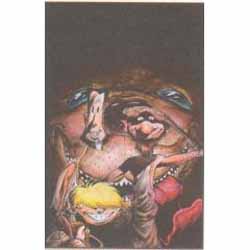
Writer Messner-Loebs and illustrator Sam Kieth approached the problem from another angle. Epicurus looks like a comic. It reads like a comic. All that really differs is the treatment of the subject matter. Set in classical Greece the stories relate the cynical yet screwball adventures of the Philosopher who advocated moderation in all things, amidst a woefully misrepresented culture, and one knee-deep in intrusive and arbitrary deities with the collective morals of drunken Yuppies at a football derby.

Gods, sex and magic have been mainstays of the industry for generations but the humour of the writing reaches out to the mature side of our inner child, whilst embracing the inescapable desire of every man and woman for a good healthy horse laugh every now and then. Also, it never hurts to assume that your readers are as smart as you are. Sam Kieth’s lush and earthy drawings add weight to the wackiness and utilises his penchant for cartoonish surrealism to stunning effect.

These stories have appeared in a number of publishing formats over the years, and although they’re apparently out of print at the moment (but still readily available through such online outlets as Amazon and the better comic shops) such funny, witty, adorable books are well overdue for republication. More importantly, we would all be Blessed by the Gods if the creators could be cajoled into concocting new tales to warm our hearts and hearths.

© 1989, 1991, 2003 William Messner-Loebs & Sam Kieth. All rights reserved.

Dan Dare: The Man from Nowhere

Dan Dare: The Man from Nowhere 

By Frank Hampson & Don Harley (Titan Books)
ISBN 10: 1-84576-412-9 ISBN 13: 9781845764128

The frantic pace of adventure never slows for the heroic and indomitable Dan Dare. When an alien spacecraft crashes into the Pacific Ocean, Dare, Digby, aquanaut Lex O’Malley, and Flamer Spry must face unbelievable new challenges in a new but equally unforgiving environment to rescue the outlandish passengers.

But that’s only the start. The interstellar refugees have come seeking assistance in a faster-than-light ship, from Cryptos, five light-years distant! Undertaking a heroic odyssey Colonel Dare and his comrades battle bizarre space monsters and terrible hardships before becoming embroiled in a dreadful war between the Cryptosians and the unstoppable, genocidal Phant warriors of the wandering planet Phantos.

This historic adventure ran from 13th May 1955 until November 25th of that year, and the shorter than usual run comprises the main tale in this volume. It was not however the end of the story. The epic continued and concluded as Rogue Planet, collected in the next Dan Dare book (ISBN: 1-84576-413-7), so you might want to pick up both at the same time.

But that’s not the end of this edition’s reprinted treats. In addition to the ever-informative text feature (a glorious Frank Hampson sketchbook) there are three short, complete, fully painted yarns taken from some of the Dan Dare and Eagle Annuals. ‘Mars 1997’ is a thrilling tale of interplanetary rescue, ‘The Robocrabs’ deals with an attempted invasion of Earth, and ‘Operation Silence’ is a Christmas story featuring a host of past friends and foes, including the malevolent Mekon.

Dare is as much a part of heroic Britain as King Arthur, Robin Hood or Richard the Lionheart. Moreover, these tales are undiluted by time or mis-repetition. What you see is original, genuine and pure. Pure entertainment, pure joy.

© 2007 Dan Dare Corporation Ltd. All Rights Reserved.

Wildcat: Anarchists Against Bombs

Wildcat: Anarchists Against Bombs

By Donald Rooum (Freedom Press)
ISBN: 1-904491-01-4

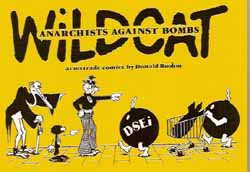
The sixth volume of cartoonist and Anarchist legend Donald Rooum’s collected strips from the paper Freedom is out after too long an interval and all the power and vitriol of his deceptively gentle gaze and accessible penmanship are now directed at the Arms Industry and the dubious political processes that equate freeing the victims of brutal oppression with blowing them up before their oppressor can get around to doing it themselves.

This is another superb book of a smart, incisive cartoon strip that never forgets that you have to be funny as well as sharp if you want to get your message to stick.

We should cluster-bomb Westminster and all fifty states (I’m assuming of course that it will still be 50 by the time you read this) of the USA with copies of this book.

© 2003 Donald Rooum. All Rights Reserved.

Wildcat

Wildcat

By Donald Rooum, with an introduction by Philip Sansom (Freedom Press)
ISBN: 0-900384-30-1

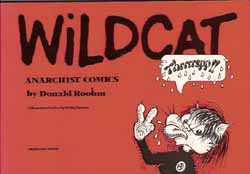
Donald Rooum has been a force in comics, in education and in the Anarchist movement for longer than I’ve been alive. As well as teaching generations of creative people and producing some of the most gently powerful and trenchant political cartooning of the last half century he has actually been instrumental in the downfall of corrupt policemen and the changing of English Law. Don’t take my word for it, look it up. It’s still a free country. When you have checked then you’ll know who to thank.

The eponymous Wildcat is a strident, impatient and unstoppable feline who has spent decades on the pages of Freedom magazine, puncturing pomposity, inviting debate – also abruptly ending it – and educating the willing in the ways the world works.

In this first collection of Donald’s strips we get a history lesson or two and some views of alternative politics all delivered in a gentle, charming yet telling manner. The jokes don’t forget to be funny and more importantly, there are no blind spots. Anarchists are as good a target as any Establishment or Vested Interest, when the aim is to skewer pomposity, injustice or stupidity.

So just remember, Anarchism is about taking responsibility, not taking charge. I’m trusting you to get your own copy of this book, and to read it.

© 1964, 1967, 1975, 1980-1985, 2007 Donald Rooum. All Rights Reserved.
Introduction © Philip Sansom.

Walo Hamlet

Walo Hamlet 

By Hsi Kao, illustrated by Sun Pin, Li Hou-mi & Feng Chih-chung (Foreign Language Press, Peking)
No ISBN

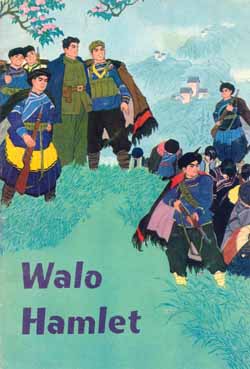
Set in the period immediately following the victory of the Moaist forces in China, this startlingly engaging slice of graphic propaganda tells of the ultimate defeat of the Slave-Owning class in the sheltered Liangshan Mountains of Szechuan Province and the eventual coming together of the people under a new, Democratic system.

I’m not going to comment on the obvious political overtones – indeed, bias – of this story, but concentrate on the quality of the piece as an artefact of graphic narrative. I will however reiterate my long-held belief that the wedding of powerful words and beautiful pictures is an almost irresistible tool for disseminating ideas. Any force that wishes to capture hearts and minds should be wary of this. Perhaps distressingly, many such forces are.

Although most of China was semi-colonial and Feudal prior to 1950, the Liangshan Mountains region, ancestral home of the Yi People and an area of minority ethnicity, held to a slave-owning system, with landed nobles actually owning the peasants who worked that land. Even after Mao’s victory, this region remained unstable and disputed until 1956. This allegorical tale relates the battle for independence of the small village of Walo.

In 1945 this village had rebelled, but after initial victory they were re-enslaved by their previous owner. In 1950 the victorious People’s Liberation Army secured regional autonomy and tried to reconcile the Yi and their deposed masters, but the latter proved to be duplicitous and plotted to undo the democratic reforms.

Depicted as a classic heroic struggle between the evil Louhunglaha and his former chattels Latieh, Wuniu, Yipo and Mukuo, this is a thrilling picture story of chases and battles, beautifully illustrated in strong black and white brush strokes, where the goodies win and the baddies are defeated.

The craftsmanship of this tale is impeccable and if you are prepared to acknowledge different ideologies as readily as we comic fans embrace different species, religions, mythologies, histories or physical laws, you might have a whale of time with this little beauty.

© Foreign Language Press, Peking 1977. All Rights Reserved.

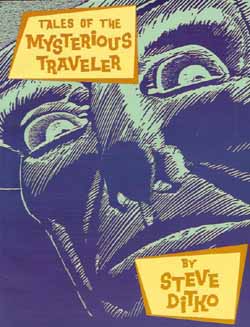
Tales of the Mysterious Traveler

Tales of the Mysterious Traveler 

By Steve Ditko (Eclipse Books)
ISBN: 0-913035-83-1

Before his time at Marvel young Steve Ditko perfected his craft doing short stories for Charlton Comics. The short complete tale was once the sole staple of the comic book profession, when the plan was to deliver as much variety as possible to the reader. Sadly that particular discipline is all but lost to modern comic creators.

Apparently the title came from a radio show which Charlton licensed, and the lead character certainly acts more as voyeur or host than active participant, speaking to “camera” and asking the reader for opinion and judgement as he presents a selection of funny, sad, scary and wondrous human interest yarns all tinged with a hint of the weird and supernatural, and all rendered unforgettable by the sheer genius of Ditko’s storytelling mastery and his full, lavish brushwork. I have many of these stories in the comic versions, but the crisp black and white art reproduced here puts them to shame. This art is gorgeous!

I suspect, but don’t know, that Joe Gill scripted most of these stories, although if anyone has any information I’d be delighted to hear from you. This glorious little gem should be permanently in print and used as a primer for any artist who wants a career in comics.

© 1990 Robyn Snyder. Tales of the Mysterious Traveler is ™ Sword in the Stone Productions.

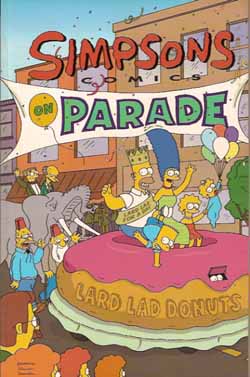
Simpsons Comics on Parade

Simpsons Comics on Parade 

By Various (Titan Books)
ISBN: 1-85286-955-0

This Simpsons collection reprints issues #24 – 27 of the monthly comic aimed at younger fans of the hit TV series. Nonetheless there is very little evidence of toning down or simplification in these edgy, barbed spoofs and gag strips, produced by a talented if not well-known crew of jobbing professionals.

Concocting the madness and mayhem herein contained are Peter Alexander, Jamie Angell, Tim Bavington, Jackie Behan, Jeanine Crowell Black, Shaun Cashman, Terry Delegeane, Jeff Filgo, Scott M. Gimple, Stephanie Gladden, Todd J. Greenwald, Rob Hammersley, Carl Harmon, Tim Harkins, Nathan Kane, Tim Maile, Bill Morrison, Phil Ortiz, Chris Simmons, Mary Trainor, Doug Tuber and Chris Ungar wrangled by the ubiquitous Matt Groening.

The US Presidential Race and Media manipulation get a banana-fingered mauling in ‘Send in the Clowns’ and the regular spoof comic book section features a selection from the truly imaginary ‘Li’l Homey’, as the young Homer pastiches Home Alone. ‘Marge Attacks’ sees the long-suffering matriarch become a TV personality when she tries to stamp out obnoxious TV chat shows. Itchy and Scratchy make baseball a bloodsport in the wordless short feature ‘Game Called Because Of Pain’, a strip from their own (non-existent) comic. The volume is also peppered with short one or two page gag strips featuring the show’s truly disturbing cast of regulars.

Side Show Bob stars in ‘Get off the Bus’, as his attempt to do a good deed goes calamitously awry, and Captain McCallister (the weird bearded fisherman-guy) tells a salty – and definitely fishy – Tale of the Briny Deep. But the undisputed star of this book is the wonderful ‘They Fixed Homer’s Brain!’, an hysterical and touching pastiche of Daniel Keyes Flowers for Algernon, wherein Homer volunteers for a radical experiment to increase his intelligence – for a cash reward naturally – only to find a brief and tragic new rapport with Lisa (the Smart One). All the best comedy is touched by sadness and this is a lovely little example of that maxim. It’s also the funniest strip in the entire book with both wit and gross-out gags that could make a statue smirk.

Like the show, this strip just keeps getting better and more daring. In the 1950s and 1960s we used the Carl Barks Duck strips as a benchmark for all-ages comic entertainment. The Simpsons has the potential to become the modern equivalent.

© 1996, 1998 Bongo Entertainment, Inc. All rights reserved.

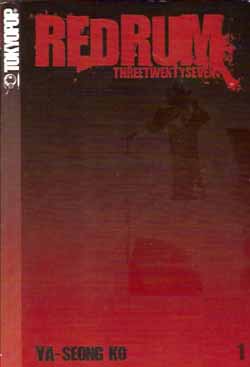
Redrum 327 Volume 1

Redrum 327 Volume 1 

By Ya-Seong Ko (TokyoPop)
ISBN 1-59816-506-2

Part of the influx of Korean comic product into the Japanese market, this is a take on teen-slasher murder-mysteries, although the story-pacing might seem a little slow for western sensibilities.

Seven young college students, ostensibly mere acquaintances, dash off for a week-end getaway at a remote mountain chalet, only to find the place something of a disappointment. To pass the time they begin to tell each other ghost stories, and as the evening progresses they inadvertently let slip secrets about themselves and each other. Things become even more fraught when they find themselves cut off. And then the bodies start to turn up…

Slow and brooding, this is a work of style over content, although the device of stories within stories, so effective in such classic movies as Tales From the Crypt or Twilight Zone has lost none of its power. It is also used strategically here to escape the closed story environment without diluting the tension-building claustrophobia. The artwork is restrained and benefits from being in black and white.

The only bad news is that the book ends on a cliffhanger, so you might want to wait for the next volume before you give yourself the creeps.

© 2003 Ya-Seong Ko/DAIWON C.I. Inc. All Rights Reserved.
English text © 2006 TOKYOPOP Inc.