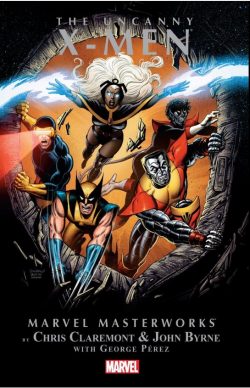
Uncanny X-Men Marvel Masterworks volume 4


By Chris Claremont, John Byrne, Terry Austin, George Pérez & various (Marvel)
ISBN: 978-0-7851-1630-1 (HB) 978-0-7851-5869-1 (TPB)

In the autumn of 1963, The X-Men #1 introduced Scott (Cyclops) Summers, Bobby (Iceman) Drake, Warren (Angel) Worthington, Jean (Marvel Girl) Grey and Hank (The Beast) McCoy: very special students of Professor Charles Xavier.

The teacher was a wheelchair-bound telepath dedicated to brokering peace and integration between the masses of humanity and the emergent off-shoot race of mutants dubbed Homo superior; considered by many who knew him as a living saint.

After nearly eight years of eccentrically spectacular adventures the mutant misfits virtually disappeared at the beginning of 1970 during another periodic downturn in superhero comics sales. Just like in the closing years of the 1940s, mystery men faded away as supernatural mysteries and traditional genre themes once more dominated the world’s entertainment fields…

Although the title was revived at the end of the year as a cheap reprint vehicle, the missing mutants were reduced to guest-stars and bit-players throughout the Marvel universe and the Beast was refashioned as a monster fit for the global uptick in scary stories until Len Wein & Dave Cockrum revived and reordered the Mutant mystique with a brand-new team in Giant Size X-Men #1 in 1975.

To old foes-turned-friends Banshee and Sunfire was added one-shot Hulk hunter Wolverine, and all-original creations Kurt Wagner, a demonic German teleporter codenamed Nightcrawler, African weather “goddess” Ororo Monroe AKA Storm, Russian farmboy Peter Rasputin, who transformed at will into a living steel Colossus, and bitter, disillusioned Apache superman John Proudstar who was cajoled into joining the makeshift squad as Thunderbird.

The revision was an instantaneous and unstoppable hit, with Wein’s editorial assistant Chris Claremont writing the series from the second story onwards. The Uncanny X-Men reclaimed their own comicbook with #94 and it quickly became the company’s most popular – and high quality – title.

Cockrum was succeeded by John Byrne and as the team roster shifted and changed the series rose to even greater heights, culminating in the landmark (and with this tome, imminently ensuing) Dark Phoenix storyline which saw the death of arguably the book’s most beloved and imaginative character.

In the aftermath team leader Cyclops left but the epic cosmic saga also seemed to fracture the epochal working relationship of Claremont and Byrne. Within months of publication they went their separate ways: Claremont staying with the mutants whilst Byrne moved on to establish his own reputation as a writer on series such as Alpha Flight, Incredible Hulk and especially his revolutionised and freshly-groundbreaking Fantastic Four…

After Apache warrior Thunderbird became the team’s first fatality, the survivors slowly bonded, becoming an infallible fighting unit under the brusque and draconian supervision of Cyclops.

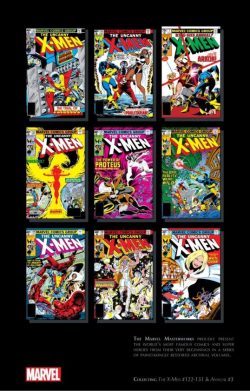
This Fabulous fourth compilation (available in luxurious hardcover, trade paperback and eBook editions) is perfect for newbies, neophytes and even old lags nervous about reading such splendid yarns on fragile but extremely valuable newsprint paper. It celebrates the unstoppable march to market dominance through the pivotal early stories: specifically, X-Men #122-131 plus the X-Men Annual #3 of the decidedly “All-New, All-Different” – spanning June 1979 to March 1980.

The drama resumes with Byrne producing light breakdowns and regular inker Terry Austin stepping up to produce full art finishes for issue #122’s ‘Cry for the Children!’ as the long-missing heroes finally return to the Xavier School only to find their home boarded up and deserted.

Months previously, following a catastrophic battle against Magneto in which Beast and Phoenix believed themselves the only survivors, heartbroken Professor X had grieved for his fallen pupils and left Earth to be with his fiancée Empress Lilandra of the far-flung extragalactic Shi’ar Imperium. In the interim, Jean Grey – reborn as the cosmic-powered Phoenix – went globetrotting to bury her woes and is currently in Scotland, unaware that she has been targeted by one of the team’s oldest enemies for a cruel assault.

As the weary team slowly settle in at the mansion again, they try to resume their previous routines but psychological stress testing shows Russian teen Colossus is having second thoughts about deserting his family and country…

In New York, Storm has at last taken the time to trace her roots, visiting the old home of her American dad, only to find it now a disgusting junkie squat filled with doped-up, feral kids who viciously attack her…

Stabbed and bleeding, she lashes out and only the sudden arrival of hero for hire Luke Cage and his friend Misty Knight (coincidentally Jean’s Manhattan room-mate) prevents a tragedy. None of them are remotely aware that they have been targeted by the world’s most outrageous hit-man…

With Byrne back in full penciller mode, Uncanny X-Men #123 includes a cameo from Spider-Man as jolly psycho-killer Arcade proceeds to pick off the oblivious mutants and run them through his fatal funfair Murder World in ‘Listen… Stop Me if You’ve Heard It… But This One Will Kill You!’: subjecting the abductees to perils mechanical and psychological.

The former prove understandably ineffectual but family guilt and cunning conditioning soon transform the already homesick and despondent Colossus into a vengeful mind-slave dubbed The Proletarian, determined to smash his former comrades in concluding chapter ‘He Only Laughs When I Hurt!’ Happily, his inner child and the assorted heroes’ gifts and training prove too much for the maniacal killer clown…

X-Men Annual #3 then offers a fantastic interlude as extradimensional barbarian warlord Arkon the Magnificent returns to Earth courtesy of Claremont, George Pérez & Austin. ‘A Fire in the Sky!’ sees him again seeking to save his unstable world of Polemachus from eternal darkness. Last time the Avenger Thor provided the lightning necessary to illuminate his world, but with the Asgardian unavailable, Arkon decides Storm will do. He never learned how to ask, though, and his violent abduction of his target provokes a furious response from the X-Men…

With Byrne doing the drawing, Jean re-enters the picture in #125, when her stay with biologist Moira MacTaggert leads to the release of a long-secret family shame in ‘There’s Something Awful on Muir Island!’ Throughout her long holiday, Phoenix has been gradually weakened and psychically seduced by a psionic predator: groomed for a life of refined cruelty and debauchery by a man calling himself Jason Wyngarde, whose intention is to create a callous and wicked “Black Queen” for the mysterious organisation known as the Hellfire Club…

At the other end of the galaxy, Charles Xavier reviews records of how Phoenix once reconstructed the entire fragmenting universe and is gripped with terror at the thought of all that power in the hands of one frail human personality, whilst in his former home the Beast checks a tripped alarm and discovers his long-mourned friends are all alive.

The reunited heroes’ first thought is to tell Jean the incredible news, but no sooner is a transatlantic call connected than a scream echoes out and the line goes dead…

Issue #126 resumes frantic hours later as the X-Men approach Muir Island in their supersonic jet. With all contact lost and no telepath aboard, Cyclops assumes the worst and the squad infiltrate in battle formation, only to find a withered corpse and badly shaken comrades Lorna Dane, Havok, Madrox, Moira and Jean slowly recovering from a psionic assault.

In ‘How Sharper Than a Serpent’s Tooth…!’ Dr. MacTaggert bitterly reveals the attacker is a psychic bodysnatcher imprisoned on Muir for years. He’s also her son…

Rapidly burning out one of Madrox’s duplicate bodies, the monster has already reached the mainland, but as the mutants disperse to hunt him down Jean is hampered by a torrent of seductive mirages projected by the smugly confidant Wyngarde, allowing the predatory Proteus to ambush the X-Men and try to possess Wolverine.

It is his first mistake. Metal has an inimical effect on the formless horror and the feral fury’s Adamantium skeleton forces him to flee his victim in screaming agony. It is then the creature unleashes his most terrifying power: warping reality to drive Wolverine and Nightcrawler to the brink of madness. Only the late-arriving Storm prevents their immediate demise but soon she too is at the edge of destruction…

‘The Quality of Hatred!’ finds the badly shaken team undergoing desperate “tough-love” remedies from Cyclops to regain their combat readiness whilst Moira tries to make up for her dangerous sentimentality by putting a bullet into her deadly offspring.

Frustrated by the idealistic Cyclops but having divined the path Proteus is taking, she then heads for Edinburgh and an unpleasant reunion with her former husband: brute, bully, Member of Parliament and father of most merciless monster the world has yet produced…

As Jean finally shrugs off her distractions and telepathically homes in on Proteus, the team swing into action a little too late: the sinister son has possessed his scurrilous sire and created an unstoppable synthesis of world-warping abomination…

With Edinburgh and perhaps the entire world roiling and rebelling as science goes mad, X-Men #128 sees the valiant champions strike back to spectacularly triumph in ‘The Action of the Tiger!’ after which ‘God Spare the Child…’ sees another happy reunion as the heroes (all but the now retired Banshee) discover Charles Xavier awaiting them when they reach Westchester.

Jean is increasingly slipping into visions of a former life as a spoiled, cruel child of privilege, contrasting sharply with her renewed love for Scott, but the home atmosphere is troubled by another discordant factor. Xavier is intent on resuming the training of the team, haughtily oblivious that this group are grizzled, seasoned veterans of combat, rather than the callow teenagers he first tutored.

Elsewhere a cabal of mutants and millionaires plot. Black King Sebastian Shaw, White Queen Emma Frost and the rest of the Hellfire Club hierarchy know Wyngarde is an ambitious and presumptuous upstart, but the possibility of subverting the Phoenix to their world-dominating agenda is irresistible…

When two new mutants manifest, Xavier splits the team to contact both, taking Storm, Wolverine and Colossus to Chicago and meeting the nervous parents of naive 13-year old Kitty Pryde who has just realised that along with all the other problems of puberty, she can now fall through floors and walk through walls…

However, no sooner does Professor Xavier offer to admit her to his select and prestigious private school than they are all attacked by war-suited mercenaries and shipped by Emma Frost to the Hellfire Club. Only Kitty escapes, but instead of running she stows away on the transport; terrified but intent on saving the day…

The other mutant neophyte debuts in X-Men #130 as Cyclops, Phoenix and Nightcrawler head to Manhattan’s club district to track down a disco singer dubbed ‘Dazzler’ unaware that they too have been targeted for capture. However little Kitty’s attempts to free the captives at the Hellfire base forces the villains to tip their hand early and with the assistance of Dazzler Alison Blair – a musical mutant who converts sound to devastating light effects – the second mercenary capture team is defeated…

The drama concludes for now in #131 where Kitty is forced to frantically ‘Run for Your Life!’ – fortunately straight into the arms of the remaining X-Men. Soon the plucky lass – after an understandable period of terror, confusion and kvetching – leads an incursion into the lair of the White Queen to free Wolverine, Colossus and Xavier as Frost faces off in a deadly psionic showdown with a Phoenix far less kind and caring than ever before…

For many fans these tales – and those in the next volume – comprise the definitive X-Men look and feel: some of the greatest stories Marvel ever published; entertaining, groundbreaking and painfully intoxicating. These adventures are an invaluable grounding in contemporary fights ‘n’ tights fiction no fan or casual reader can afford to ignore.
© 1979, 1980, 2014 Marvel Characters, Inc. All rights reserved.
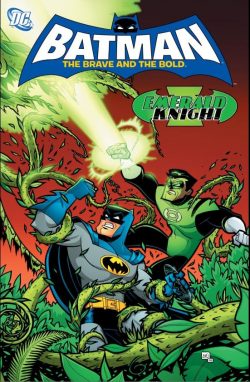
Batman: The Brave and the Bold: Emerald Knight


By Landry Q. Walker, Sholly Fisch, Adam Schlagman, Robert Pope, Eric Jones, Carlo Barberi & various (DC Comics)
ISBN: 978-1-4012-3143-9 (TPB)

The Brave and the Bold premiered in 1955 as an anthology adventure comic featuring short complete tales about a variety of period heroes: a format which mirrored that era’s filmic fascination with flamboyant if fanciful historical dramas. Devised and written by Bob Kanigher, issue #1 led with Roman epic Golden Gladiator, medieval mystery-man The Silent Knight and Joe Kubert’s now legendary Viking Prince. Soon the Gladiator was alternated with Robin Hood, but the adventure theme carried the title until the end of the decade when the burgeoning costumed character revival saw B&B transform into a try-out vehicle like Showcase.

Used to premiere concepts and characters such as Task Force X: The Suicide Squad, Cave Carson, Hawkman and Strange Sports Stories as well as the epochal Justice League of America, the comic soldiered on until issue #50 when it provided another innovative new direction which once again truly caught the public’s imagination.

That issue paired two superheroes – Green Arrow and Martian Manhunter – in a one-off team-up, and was followed by other ones: Aquaman and Hawkman in #51, WWII “Battle Stars” Sgt. Rock, Captain Cloud, Mme. Marie & the Haunted Tank in #52 and Atom & Flash in #53.

The next team-up – Robin, Aqualad and Kid Flash – quickly evolved into Teen Titans and after Metal Men/the Atom and Flash/Martian Manhunter appeared, a new hero debuted in #57-58: Metamorpho, the Element Man.

From then it was back to the increasingly popular superhero pairings with #59, and although no one realised it at the time, that particular conjunction – Batman with Green Lantern – would be particularly significant….

After a return engagement for the Teen Titans, two issues spotlighting Earth-2 champions Starman and Black Canary and Earth-1’s Wonder Woman with Supergirl, an indication of things to come came when Batman duelled hero/villain Eclipso in #64: an early acknowledgement of the brewing TV-induced mania mere months away.

Within two issues (following Flash/Doom Patrol and Metamorpho/Metal Men), B&B #67 saw the Caped Crusader take de facto control of the title and the lion’s share of the team-ups. With the late exception of #72 and 73 (Spectre/Flash and Aquaman/Atom) the comic was henceforth a place where Batman invited the rest of company’s heroic pantheon to come and play…

Decades later, the Batman Animated TV series masterminded by Bruce Timm and Paul Dini in the 1990s revolutionised the Dark Knight and subsequently led to some of the absolute best comicbook adventures in his seventy-year publishing history with the creation of the spin-off print title…

With constant funnybook iterations and tie-ins to a succession of TV cartoon series, Batman has remained popular and a sublime introducer of kids to the magical world of the printed page. One fun-filled incarnation was Batman: The Brave and the Bold, which gloriously celebrated the team up in both its all-ages small-screen and comicbook spin-off.

Shamelessly and magically plundering decades of continuity arcana in a profusion of alliances between the Dark Knight and DC’s other heroic creations, the show was supplemented by a cool kid’s periodical full of fun, verve and swashbuckling dash, cunningly crafted to appeal as much to the parents and grandparents as those fresh-faced neophyte kids…

This stellar trade paperback and digital collection re-presents issues #13, 14, 16, 18, 19 and 21 in an immensely entertaining package suitable for newcomers, fans and aficionados of all ages originally released between March and November 2010. Best of all, although not necessary to the reader’s enjoyment, a passing familiarity with the TV episodes will enhance the overall experience…

Following the format of the TV show, each tale opens with a brief vignette adventure before telling a longer tale. Issue #13 sees the Caped Crimebuster break a leg while working with Angel O’Day and Sam Simeon (the astonishingly daft but wonderful Angel & The Ape) and laid up for main feature ‘Night of the Batmen’ (by Sholly Fisch, Robert Pope & Scott McRae) as an army of (uninvited and unwelcome) heroic comrades – including Green Arrow, Plastic Man, Aquaman and Shazam!-powered Captain Marvel among others – impersonate the Dark Knight to keep Gotham safe from fiends such as Bane, Killer Croc, Penguin, Deadshot and Catwoman. However, when the Joker joins the party, it results in the real deal ending his recuperation early…

Crafted by Landry Q. Walker & Eric Jones, the next yarn opens with Bats and Plastic Man tackling the Scarecrow before the Gotham Gangbuster meets the Huntress. She is having trouble with a costumed crazy with a nasty obsession and ends up briefly ‘Captured by Mr. Camera!’…

The same creative crew return for #16 as a battle with the Teen Titans against Nocturna hatches a sinister sub-plot in ‘Egg Hunt! or: The Evil of Egg Head!’ as the ovoid mastermind revives antediluvian elder god Y’ggphu Soggoth (offering a guilty treat for old fans of truly naff supervillains) and Batman needs the aid of Wonder Woman to scramble the scheme…

Batman: The Brave and the Bold #18 alters the format slightly with a brace of linked tales from Walker & Jones. ‘Life on Mars’ features Batman and Martian Manhunter J’onn J’onzz defeating the human extermination plans of super-psionic shapeshifting White Martian Ma’alefa’ak before a strangely off-kilter Dark Knight calls in mystic master Doctor Fate to diagnose and treat a case of possession in follow-up thriller ‘All in the Mind’…

The last two yarns collected here both co-star Hal Jordan and other stalwarts of the Green Lantern Corps. From #19 and by Adam Schlagman, Carlo Barberi & Terry Beatty, ‘Emerald Knight’ details how the ring-slinger is captured by ultimate tech pirate Cyborg Superman and robotic Manhunters. Unable to prevail alone, Jordan temporarily bequeaths his power to Batman who lead his comrades in the Corps to victory, after which a brief interlude battling dinosaur gangsters beside the Lady Blackhawks leads to the Gotham Guardian and the fully-restored Jordan uniting to defeat ‘The Menace Known as Robert’. Another Walker & Jones production, this depicts the calamitous threat of a primordial alien horror invading Earth and the terrifying lengths Batman will go to save the world…

Despite being ostensibly aimed at TV-addicted kids, these mini-sagas are also wonderful, traditional comics thrillers no self-respecting fun-fan should miss: accessible, well-rendered yarns for the broadest range of excitement-seeking readers. This is a fabulously fun rollercoaster ride and confirms the now-seamless link between animated features and comicbooks. After all, it’s just adventure entertainment in the end; really unmissable entertainment…

What more do you need to know?
© 2010, 2011 DC Comics. All Rights Reserved.

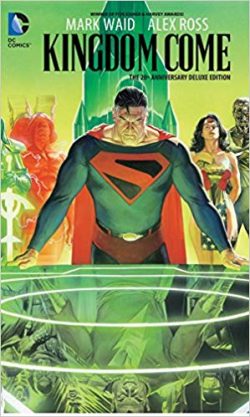
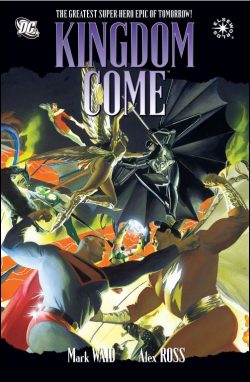
Kingdom Come


By Mark Waid & Alex Ross, with Todd Klein & various (DC Comics)
ISBN: 978-1-4012-6082-8 (20th Anniversary HB) 978-1-4012-2034-1 (TPB

In the mid-1960s a teenaged Jim Shooter wrote a couple of stories about the Legion of Super-Heroes set some years into the team’s own future. Those stories of the adult Legionnaires revealed hints of things to come that shackled the series’ plotting and continuity for decades as eager, obsessed fans (by which I mean all of us) waited for the predicted characters to be introduced, presaged relationships to be consummated and heroes to die.

By being so utterly impressive and similarly affecting, Kingdom Come accidentally repeated the trick decades later, subsequently painting the entire post Crisis on Infinite Earths DC Universe into the same creative corner until one of the company’s periodic continuity reboots…

Envisaged and designed by artist Alex Ross as DC’s answer to epic groundbreaking Marvels, Kingdom Come was originally released as a 4-issue Prestige Format miniseries in 1996 to rapturous acclaim and numerous awards and accolades. Although set in the future and an “imaginary story” released under DC’s Elseworlds imprint, it almost immediately began to affect the company’s mainstream continuity.

Set approximately twenty years into the future, the grandiose saga details a tragic failure and subsequent loss of Faith for Superman and how his attempt to redeem himself almost leads to an even greater and ultimate apocalypse.

The events are seen through the eyes and actions of Dantean witness Norman McCay, an aging cleric co-opted by Divine Agent of Wrath the Spectre after the pastor officiates at the last rites of dying superhero Wesley Dodds. As the Sandman, Dodds was cursed for decades with precognitive dreams which compelled him to act as an agent of justice.

Opening chapter ‘Strange Visitor’ reveals a world where metahumans have proliferated to ubiquitous proportions: a sub-culture of constant, violent clashes between the latest generation of costumed villains and vigilantes, all unheeding and uncaring of the collateral damage they daily inflict on the mere mortals around and in all ways beneath them.

The shaken preacher sees a final crisis coming, but feels helpless until the darkly angelic Spectre comes to him. Taken on a bewildering voyage of unfolding events, McCay is to act as the ghost’s human perspective whilst the Spirit of Vengeance prepares to pass final judgement on Humanity.

First stop is the secluded hideaway where farmer Kal-El has hidden himself since the ghastly events which compelled him to retire from the Good Fight and the eyes of the World. The Man of Steel was already feeling like a dinosaur when newer, harsher, morally ambiguous mystery-men began to appear. After the Joker murdered the entire Daily Planet staff and hard-line new hero Magog executed him in the street, the public applauded the deed. Heartbroken and appalled, Superman simply disappeared for a decade. His legendary colleagues also felt the march of unwelcome progress and similarly dropped from sight.

With Earth left to the mercies of dangerously irresponsible new vigilantes, civil unrest soon escalated. The younger heroes displayed poor judgement and no restraint, with the result that within a decade the entire planet had become a chaotic arena for metahuman duels.

Civilisation was fragmenting. Flash and Batman retreated to their home cities and made them secure, crime-free solitary fortresses. Green Lantern built an emerald castle in the sky, turning his eyes away from Earth and towards the deep black fastnesses of space. Hawkman retreated to the wilderness, Aquaman to his sub-sea kingdom whilst Wonder Woman retired to her hidden paradise. She did not leave until Armageddon came one step closer…

When Magog and his Justice Battalion battled the Parasite in St. Louis, the result was a nuclear accident which destroyed all of Kansas and much of Iowa, Missouri and Nebraska. Overnight the world faced starvation as America’s breadbasket turned into a toxic wasteland. Now with McCay and the Spectre invisibly observing, Princess Diana convinces the bereft Kal-El to return and save the world on his own terms…

In ‘Truth and Justice’ a resurgent Justice League led by Superman begins a campaign of unilateral action to clean up the mess civilisation has become: renditioning “heroes” and “villains” alike, imprisoning every dangerous element of super-humanity and telling governments how to behave, blithely unaware that they are hastening a global catastrophe of Biblical proportions as the Spectre invisibly gathers the facts for his apocalyptic judgement.

In the ensuing chaos, crippled warrior Bruce Wayne rejects Superman’s paternalistic, doctrinaire crusade and allies himself with mortal humanity’s libertarian elite – Ted (Blue Beetle) Kord, Dinah (Black Canary) Lance and Oliver (Green Arrow) Queen – to resist what can only be considered a grab for world domination by the meta-human minority. As the helpless McCay watches in horror, Wayne’s group makes its own plans; another dangerous thread in a tapestry of calamity…

At first Superman’s plans seem blessed to succeed, with many erstwhile threats flocking to his banner and his doctrinaire rules of discipline, but as ever there are self-serving villains with their own agendas. Lex Luthor organises a cabal of like-minded compatriots – Vandal Savage, Catwoman, Riddler, Kobra and Ibn Al Xu’ffasch (Son of the Demon Ra’s Al Ghul) – into a “Mankind Liberation Front”.

With Shazam-empowered Captain Marvel as their slave, this group are determined the super-freaks shall not win. Their cause is greatly advanced once Wayne’s clique joins them…

‘Up in the Sky’ sees events spiral into a deadly storm as McCay, still wracked by his visions of Armageddon, is shown the Gulag where all recalcitrant metahumans have been dumped. He also witnesses how it will fail, learns from restless spirit Deadman that the Spectre is the literal Angel of Death and watches with growing helplessness as Luthor’s plan to usurp control from the army of Superman leads to a shocking confrontation, betrayal and a deadly countdown to the End of Days…

The deadly drama culminates in a staggering battle of superpowers, last moment salvation and a second chance for humanity in a calamitous world-shaking ‘Never-Ending Battle’…

Thanks to McCay’s simple humanity, the world gets another chance and this edition follows up with an epilogue ‘One Year Later’ which end this ponderous epic on a note of renewed hope…

This edition – available as a 20th Anniversary deluxe hardback, a standard trade paperback and in digital formats – comes with an introduction by author and former DC scribe Elliot S. Maggin, assorted cover reproductions and art-pieces, an illustrated checklist of the vast cast list plus a plethora of creative notes and sketches in the ‘Apocrypha’ section, and even hints at lost glories in ‘Evolution’: notes, photos and drawings for a restored scene that never made it into the miniseries.

Epic, engaging and operatically spectacular, Kingdom Come is a milestone of the DC Universe and remains to this day a solid slice of superior superhero entertainment, worthy of your undivided attention.
© 1996, 2008, 2016 DC Comics. All Rights Reserved.

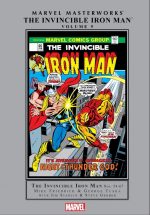
Iron Man Marvel Masterworks volume 9


By Mike Friedrich, Jim Starlin, Steve Gerber, Bill Everett, George Tuska, P. Craig Russell, & various (Marvel)
ISBN: 978-0-7851-9190-2 (HB)

Arch-technocrat and supreme survivor Tony Stark has changed his profile many times since his debut in Tales of Suspense #39 (March 1963) when, whilst a VIP visitor in Vietnam observing the efficacy of the munitions he had designed, the inventor was critically wounded and captured by sinister, savage Communists.

Put to work building weapons with the dubious promise of medical assistance on completion, Stark instead created the first Iron Man suit to keep himself alive and deliver him from his oppressors. From there it was a simple jump to full time superheroics as a modern Knight in Shining Armour…

First conceived in the wake of the Cuban Missile Crisis at a time when Western economies were booming and “Commie-bashing” was an American national obsession, the emergence of a new and shining young Thomas Edison, using Yankee ingenuity, wealth and invention to safeguard the Land of the Free and better the World, seemed an obvious development. Combining the then-sacrosanct faith that technology and business in unison could solve any problem, with the universal imagery of noble knights battling evil, Stark – the Invincible Iron Man – seemed an infallibly successful proposition.

Of course, whilst he was the acceptable face of 1960s Capitalism – a glamorous millionaire industrialist/scientist and a benevolent all-conquering hero when clad in the super-scientific armour of his alter-ego – the turbulent tone of the 1970s soon relegated his suave, “can-do” image to the dustbin of history.

With ecological disaster and social catastrophe from the myriad abuses of big business the new zeitgeists of the young, the Golden Avenger and Stark International were soon confronting a few tricky questions from the increasingly politically savvy readership.

With glamour, money and fancy gadgetry not quite so cool anymore the questing voices of a new generation of writers began posing uncomfortable questions in the pages of a series that was once the bastion of militarised America …

This grand and gleaming chronological compendium – available in hardback and digital editions – navigates that transitional period; reprinting Iron Man #54-67 (January 1973 to April 1974) and offering tone and context for the times comes courtesy of main writer Mike Friedrich’s Introduction.

Issue #54 found Stark in California and drawn into what became one of Marvel’s most successful crossover epics. ‘Sub-Mariner: Target for Death!’ debuted pitiless alien researcher Madame MacEvil – later re-branded during the Thanos Saga as Moondragon after this opening salvo – a bald, sexy siren who manipulated Iron Man into attacking the Prince of Atlantis in a spectacular bout with the bonus of additional art from the legendary Bill Everett supplementing the efforts of Friedrich, George Tuska & Vince Colletta…

The Thanos story moved into full gear in Iron Man #55, as Friedrich scripted illustrator Jim Starlin’s opening gambit ‘Beware The… Blood Brothers!’ introducing haunted humanoid powerhouse Drax the Destroyer, trapped by extraterrestrial invader Thanos under the Nevada desert and in dire need of rescue…

(This was all merely a prelude to the full saga which appeared in Captain Marvel #25-33, Marvel Feature #12 and Avengers #125, and has been collected in such compilations as The Life of Captain Marvel and others.)

Iron Man #56 was a literally magical palate-cleanser, as Steve Gerber joined Starlin & Mike Esposito to tell the satirically hilariously tragedy of ‘Rasputin’s Revenge’, wherein a street corner doom-prophet accidentally gains the power to fulfil his prognostications but still falls sadly short of engineering the apocalypse…

It was back to business as usual with Gerber, Tuska, Esposito & Frank Giacoia in #57 as a devastating ‘Strike!’ hits troubled Stark Industries, engineered by an insidious old enemy who inevitably overplays his be-ringed hand in concluding episode ‘Mandarin and the Unicorn: Double-Death!’ (with Friedrich returning to script Gerber’s plot) after which ‘A Madness in Motown!’ sees Stark battling the revenge-maddened anti-capitalist Firebrand whilst unknowingly falling for the torrid terrorist’s sister Roxie Gilbert.

Another 2-part clash follows – this time against a deadly technology-thief – which began with ‘Cry Marauder!’ after a masked malcontent steals Stark’s experimental space shuttle, culminating in ‘Death Knells over Detroit!’ as the purloined prototype is unerringly aimed like a monstrous missile into the heart of Motor City, leaving a crippled Iron Man only seconds to save the day…

Don’t fret folks; it all turned out alright in the end…

With Mike Friedrich scripting, the action stays in Detroit where Stark is inspecting one of his factories until former Maggia assassin ‘Whiplash Returns!’ (illustrated by P. Craig Russell, Esposito, Giacoia & John Romita Sr.). The crazed killer is raging for revenge and especially ticked off that his girlfriend has been made his boss…

An extended epic began in #63 with ‘Enter: Dr. Spectrum’, illustrated by Tuska & Esposito. Here, as Stark relentlessly – and fruitlessly – romantically pursues pacifist dissident Roxie Gilbert in Detroit, obnoxious Ugandan financier and diplomat Dr. Kinji Obatu visits the Long Island plant and is attacked by a gang of masked thugs.

The assault is repelled thanks to the timely assistance of stand-in Iron Man Eddie March, who is promptly offered a bodyguard job by the creepy ambassador and invited to accompany him to a meeting with Stark in “Motor City”.

On arrival, photonic fiend Dr. Spectrum ambushes the inventor, before being driven off by the Armoured Avenger after a titanic and costly struggle. A far more serious problem emerges later when old friend Happy Hogan accuses Tony of having an affair with his wife Pepper…

Spectrum strikes again in the next issue, with a similar lack of success, before Happy blows his top and takes a swing at Stark, but that confrontation is curtailed when a gigantic monster kidnaps the just-arrived Obatu in ‘Rokk Cometh!’ When the beast targets Roxie, the exhausted Iron Man intervenes but is too drained to resist the relentless Spectrum…

Issue #65 exposes ‘The Cutting Edge of Death!’ when the Golden Avenger learns the true parasitical nature of Spectrum’s Power Prism as it transfers itself from the wilfully disobedient villain Obatu to the worn-out hero.

Its glee is short lived though, as the possessed Iron Man is challenged by recently arrived comrade Thor, resulting in a blockbusting ‘Battle Royal!’ which only ends after the Thunderer crushes the crystal conqueror to discovered the dying man inside the armour is neither Stark nor Obatu…

As a consequence of that climactic clash of myth and mechanism, IM #67 sees the impostor Iron Man temporarily mutated by Stark’s medical miracle machine the Cobalt Enervator into a rampaging monster in ‘Return of the Freak!’ but no sooner do the genuine Armoured Avenger and surgeon Don Blake (who we all know was Thor back then) stop and save the berserk victim than Stark is drawn into another conflict in South East Asia…

To Be Continued…

With this volume (which also offers a stunning original art gallery of pages and covers by Tuska, Everett, Starlin, Romita and Gil Kane), Marvel completely entrenched itself in the camp of the young and the restless who experienced at first hand and every day the social upheaval America was undergoing.

Their rebellious teen sensibility and increased political conscience permeated the company’s publications as their core audience moved beyond Flower Power protests towards a generation of acutely aware activists. Future tales would increasingly bring reformed capitalist Stark into many unexpected and outrageous situations…

But that’s the meat of another review, as this engrossing graphic novel is done. From our distant vantage point the polemical energy and impact might be dissipated, but the sheer quality of the comics and the cool thrill of the eternal aspiration of man in perfect partnership with magic metal remains.

These Fights ‘n’ Tights classics are amongst the most underrated but impressive tales of the period and are well worth your time, consideration and cold hard cash…
© 1973, 1974, 2017 Marvel Characters, Inc. All rights reserved.
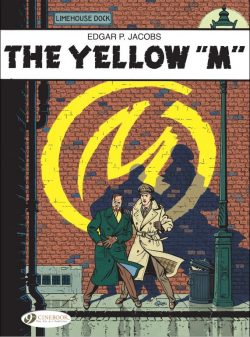
The Adventures of Blake and Mortimer: The Yellow “M”


By Edgar P. Jacobs, translated by Clarence E. Holland (Cinebook)
ISBN: 978-1-905460-21-2

Master storyteller Edgar P. Jacobs pitted his distinguished duo of Scientific Adventurers Captain Francis Blake and Professor Philip Mortimer against a wide variety of perils and menaces in stunning action thrillers which merged science fiction, detective mysteries and supernatural thrillers in the same timeless and universally engaging Ligne Claire style which had done so much to make intrepid boy reporter Tintin a global sensation.

The strip debuted in Le Journal de Tintin #1 (26th September 1946): an anthology comic with editions in Belgium, France and Holland. The new anthology was edited by Hergé, with his eponymous star ably supplemented by a host of new heroes and features…

Le Marque Jaune was the third astounding exploit of the peerless pair, originally serialised from August 6th 1953 to November 3rd 1954, before being collected as the sixth drama-drenched album in 1956.

This moody stand-alone extravaganza was the first in the modern Cinebook sequence with the True Brits for once on home soil as they struggle to solve an eerie mystery and capture an apparently superhuman criminal…

The tale begins a few days before Christmas on a night raining cats and dogs. The guards at the Tower of London are dutifully going about their appointed tasks when a sudden power cut douses all the lights.

By the time Beefeaters and Yeomen can find alternative lighting the damage is done. The Jewel Room is ransacked, the Imperial Crown missing and the wall is defaced: emblazoned with a large letter M in a bold circle of yellow chalk.

The shocking travesty is but the latest in an outrageous series of incredible crimes by a mysterious malefactor the newspapers have taken to calling The Yellow M…

Incensed and humiliated by the latest outrage, the Home Office assigns MI6 to the case and their top man Blake is seconded to assist Chief Inspector Glenn Kendall of Scotland Yard. So serious is the matter that Blake instantly cables his old comrade Professor Mortimer, dragging the bellicose boffin back from a well-deserved vacation in Scotland.

London is ablaze with rumour and speculation about the super-bandit. The crafty old warhorses adjourn to the Centaur Club in Piccadilly to discuss events, but as they settle in for a chinwag, Mortimer gets a fleeting impression that they are being spied upon…

Suddenly they are interrupted by four fellow members also hotly debating the case. Sir Hugh Calvin is a judge at the Central Criminal Court; Leslie Macomber edits the Daily Mail and Professor Robert Vernay is a prominent figure in the British Medical Association. They are all hotly disputing Dr Jonathan Septimus – of the Psychiatric Institute – who propounds a theory that the phantom felon is a prime example of his pet theory of “The Evil Influence of Cellular Development”…

The enlarged group continues the verbal back-and-forth into the small hours, and when they finally break up Vernay follows his habit of walking home. He does not make it. The police find only his hat and a chalked letter in a circle…

The flamboyant rogue seems to be everywhere. When Blake and Mortimer interview Macomber, Calvin and the terrified Septimus next day, the invisible enigma somehow gets close enough to leave his mark on the MI6 officer’s coat, before sending a mocking cable warning the Mail’s Editor that more and worse is coming…

That night Macomber is abducted from his office in plain view of his staff and Kendall is found in a dazed state after failing to protect Judge Calvin from a mystery intruder…

Septimus concludes that he is next and convinces Blake to get him out of London. The pair board a train for Suffolk with a complement of detectives, but even these precautions are not enough. The psychiatrist is impossibly plucked from the Express before it is wrecked in a horrific collision with another train.

In London, cerebral Mortimer has been researching another angle with the assistance of Daily Mail archivist Mr. Stone. The veteran investigator has found a decades-old link between the missing men…

It all revolves around a controversial medical text entitled “The Mega Wave” and a scandalous court case, but when the Professor tries to secure a copy of the incredibly rare volume from the British Museum Library, he is confounded by the Yellow M who invisibly purloins the last known copy in existence…

That evening Mortimer shares his thoughts with the returned Blake, unaware that his house has been bugged. Hours later, a mysterious cloaked intruder breaks in but has a fit after passing some of Mortimer’s Egyptian souvenirs. The noise arouses the household and the masked burglar is confronted by Blake, Mortimer and burly manservant Nasir. Incredibly, the villain defeats them all with incredible strength and electrical shocks, even shrugging off bullets when they shoot him…

Exploding through a second story window, the M laughs maniacally as they continue futilely firing before running off into the London night. In their shock the adventurers return to the drawing room and trip over the intruder’s listening devices…

Later, the recovered Kendall visits just as a package arrives. It contains an anonymous note from someone wishing to share information and directs Blake to a late-night rendezvous at Limehouse Dock. The message also contains a desperate note from the missing Septimus begging Blake to comply…

Well aware that it’s a trap and over Mortimer’s strenuous protests, Blake and Kendall lay plans to turn the meeting to their advantage. Left at home, the Professor is surprised by a late visit from Stone. The remarkably efficient researcher has found a copy of The Mega Wave and rushed over to show Mortimer.

As Blake manfully braves the foggy waterfront and walks into deadly danger, Mortimer is reading the tome, deducing who is behind the plot and perhaps even how the malign miracles are pulled off…

In Limehouse, the empty commercial buildings become a spectacular battleground as Blake and the police confront the masked man. The villain easily holds them all at bay with incredible feats of speed and strength, before breaking out of the supposedly impenetrable blue cordon and escaping.

However, in his destructive flight he tumbles into the frantic Mortimer who is dashing to warn his old friend. Changing tack, the boffin gives chase, doggedly following the superhuman enigma through parks and sewers. Eventually the pursuit leads underground and he finds himself in a hidden basement laboratory being assaulted by mind-control devices devised by the sinister mastermind actually behind the entire campaign of vengeance and terror…

As the smirking villain gives an exultant speech of explanation, triumph and justification, Mortimer sees the fate of the abducted men and meets the human guinea pig who has been terrorising London at the behest of a madman. It is the very last person he ever expected to see again, but even as he reels in shock, Blake and Kendall are on his trail, thanks to the efforts of an avaricious cabbie with a good memory for faces…

As Christmas Day dawns, Blake and Kendall lead a raid on the hidden citadel to rescue Mortimer, but the wily savant has already taken dramatic steps to secure his own release and defeat his insane, implacable opponent…

Fast-paced, action-packed, wry and magnificently eerie, this fabulously retro weird science thriller is an intoxicating moody mystery and a sheer delight for lovers of fantastic fiction. Blake & Mortimer are the graphic personification of the Bulldog Spirit and worthy successors to the likes of Sherlock Holmes, Allan Quatermain, Professor Challenger, Richard Hannay and all the other valiant stalwarts of lost Albion: All valiant champions with direct connections to and allegiance beyond shallow national boundaries…

In 1986 this story was reformatted and repackaged in a super-sized English translation, the last of six volumes with additional material (mostly covers from the weekly Tintin added to the story as eye-catching splash pages): part of a European push to win some of the lucrative Tintin and Asterix market here. They failed to find an audience and there were no more translations until January 2007 when Cinebook released this tome to far greater approval and much success. We’re now at 25 translated volumes and counting…

Gripping and fantastic in the truest tradition of pulp sci-fi and Boy’s Own Adventures, Blake and Mortimer are the very epitome of dogged heroic determination; always delivering grand, old-fashioned Blood-&-Thunder thrills and spills in timeless fashion and with astonishing visual punch. Any kid able to suspend modern mores and cultural disbelief (call it alternate earth history or bakelite-punk if you want) will experience the adventure of their lives… and so will their children.

This Cinebook edition – available in paperback album and digital formats – also includes a selection of colour cover sketches and roughs, plus a biographical feature and chronological publication chart of Jacobs’ and his successors’ efforts.
Original editions © Editions Blake & Mortimer/Studio Jacobs (Dargaud-Lombard s.a.) 1987 by E.P. Jacobs. All rights reserved. English translation © 2007 Cinebook Ltd.

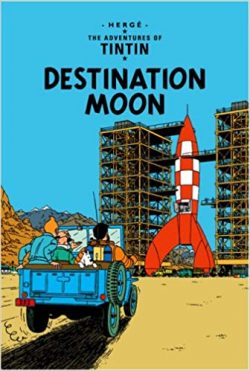
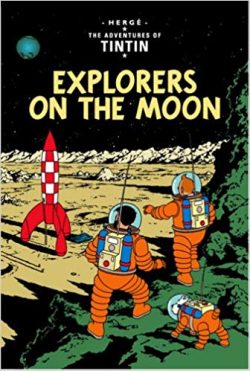
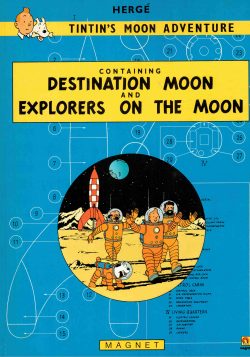
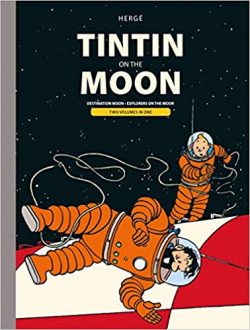
Adventures of Tintin: Destination Moon and Explorers on the Moon


By Hergé, Bob De Moors and others, translated by Leslie Lonsdale-Cooper & Michael Turner (Egmont UK)
ISBN: 978-1-40520-815-4 (HB Destination) 978-1-40520-627-3 (TPB Destination)
ISBN: 978-1-40520-816-1 (HB Explorers) 978-1-40520-628-0 (TPB Explorers)
As Tintin’s Moon Adventure (Magnet/Methuen) ISBN: 978-0-41696-710-4 (TPB)
Forthcoming – Tintin on the Moon (Egmont) ISBN: 978-1405295901 (HB)

Georges Prosper Remi, known all over the world as Hergé, created an incontrovertible masterpiece of graphic literature with his tales of a plucky boy reporter and his entourage of iconic associates.

Singly, and later with assistants including Edgar P. Jacobs, Bob de Moor and other supreme stylists of the select Hergé Studio, he created 23 splendid volumes (originally produced in brief instalments for a variety of periodicals) that have grown beyond their popular culture roots and attained the status of High Art.

On leaving school in 1925, he worked for the conservative Catholic newspaper Le Vingtiéme Siécle where he fell under the influence of its Svengali-esque editor Abbot Norbert Wallez. A devoted boy-scout, a year later Remi produced his first strip series The Adventures of Totor for monthly Boy Scouts of Belgium magazine, and by 1928 was in charge of producing the contents of the newspaper’s weekly children’s supplement Le Petit Vingtiéme.

He was illustrating The Adventures of Flup, Nénesse, Poussette and Cochonette, written by the staff sports reporter when Wallez asked Remi to create a new adventure series. Perhaps a young reporter who roamed the world, doing good whilst displaying solid Catholic values and virtues?

The rest is history…

Some of that history is quite dark: During the Nazi Occupation of Belgium, Le Vingtiéme Siécle was closed down and Hergé was compelled to move his popular strip to daily newspaper Le Soir (Brussels’ most prominent French-language periodical, and thus appropriated and controlled by the Nazis).

He diligently toiled on for the duration, but following Belgium’s liberation was accused of collaboration and even being a Nazi sympathiser. It took the intervention of Belgian Resistance war-hero Raymond Leblanc to dispel the cloud over Hergé, which he did by simply vouching for the cartoonist and by providing cash to create a new magazine – Le Journal de Tintin – which Leblanc published and managed. The anthology comic swiftly achieved a weekly circulation in the hundreds of thousands and allowed the artist and his team to remaster past tales: excising material dictated by and unwillingly added to ideologically shade the war time adventures as well as generally improving and updating great tales that were about to become a global phenomenon.

With World War II over and his reputation restored, Hergé entered the most successful period of his artistic career. He had mastered his storytelling craft, possessed a dedicated audience eager for his every effort and was finally able to say exactly what he wanted in his work, free from fear or censure.

In 1949 he returned to unfinished yarn Tintin au pays de l’or noir; abandoned when the Nazis invaded Belgium. The story had been commissioned by Le Vingtiéme Siécle, running from 28th September 1939 until 8th May 1940 when the paper was closed down. Set on the eve of a European war, the plot revolved around Tintin hunting seditionists and saboteurs sabotaging oil supplies in the Middle East. Before being convinced to update and complete the tale as Land of Black Gold, Hergé briefly toyed with the notion of taking his cast into space…

Collected albums Objectif Lune and On a marché sur la Lune were huge hits after the initial serialisation in Le Journal de Tintin from 30th March 1950 to 7th September 1950 and – after what must have been an intolerable wait for readers – from 29th October 1952 to 29th December 1953.

The tale was produced after discussions between Hergé and his friends Bernard Heuvelmans (scientist, author and father of pseudo-science Cryptozoology) and Jacques Van Melkebeke (AKA George Jacquet: strip scripter, painter, journalist and a frequent if unacknowledged contributor to the Tintin canon). The sci fi epic that became a 2-volume masterpiece first made the leap to English in 1959.

On a personal note: I first read Destination Moon in 1964, in a huge hardcover album edition (as they all were in the 1960s) and was blown completely away. I’m happy to say that except for the smaller pages – and there’s never a substitute for “Big-ness” – this taut thriller and its magnificent, mind-boggling sequel are still in a class of their own in the annals of science fiction comic strips…

Moreover, during the 1980s the entire tale was (repeatedly) released in a combined tome as Tintin’s Moon Adventure: an utterly inescapable piece of publishing common sense that is finally being repeated this summer in a new hardback album from Methuen…

Our tale begins with our indomitable boy reporter and Captain Haddock returning to ancestral pile Marlinspike Hall only to discover that brilliant but “difficult” savant Professor Cuthbert Calculus has disappeared. When an enigmatic telegram arrives, the puzzled pair are off once again to Syldavia (as seen in King Ottokar’s Sceptre) and a rendezvous with the missing boffin…

Although suspicious, Tintin soon finds that the secrecy is for sound reasons. In Syldavia, Calculus and an international team of researchers and technologists are completing a grand project to put a man on the Moon! In a turbulent race against time and amidst a huge and all-encompassing security clampdown, the scheme nears completion, but Tintin and Haddock’s arrival coincides with a worrying increase in espionage activity.

An enemy nation or agency is determined to steal the secrets of Calculus’s groundbreaking atomic motor at any cost, and it takes all Tintin’s ingenuity to keep ahead of the villains. The arrival of detectives Thompson and Thomson adds nothing to the aura of anxiety but their bumbling investigations and Calculus’ brief bout of concussion-induced amnesia do provide some of the funniest moments in comics history…

As devious incidents and occurrences of sabotage increase in intensity and frequency, it becomes clear that there may be a traitor inside the project itself, but at last the moment arrives and Tintin, Haddock, Calculus, technologist Dr. Frank Wolff – and Snowy – blast off for the Moon!

Cold, clinical and superbly underplayed, Destination Moon is completely unlike the flash-and-dazzle razzamatazz of British and American tales from that period – or since. It is as if the burgeoning Cold War mentality of the era has infected even Tintin’s bright clean world. Once again, the pressure of work and Hergé’s troubled private life resulted in a breakdown and a hiatus in the strip – but this time some of that darkness transferred to the material – although it only seems to have added to the overall effect of claustrophobia and paranoia. Even the comedy set-pieces are more manic and explosive: This is possibly the most mature of all Tintin’s exploits…

Presumably to offset the pressures of creation to weekly deadlines, the master founded Studio Hergé on 6th April 1950: a public company to produce the adventures of Tintin as well other features, with Bob De Moor enthroned as chief apprentice.

He became a vital component of Tintin’s gradual domination of the book market, frequently despatched on visual fact-finding missions. De Moor revised the backgrounds of The Black Island for a British edition, and repeated the task for the definitive 1971 release of Land of Black Gold. An invaluable and permanent addition to the production team, De Moor supervised while filling in backgrounds and, most notably, rendering the unforgettable eerie and magnificent Lunar landscapes that feature here.

If the first book is an exercise in tension and suspense, Explorers on the Moon is sheer bravura spectacle. En route to Luna the explorers discover that the idiot detectives have accidentally stowed away, and along with Captain Haddock’s illicit whisky and the effects of freefall, provide brilliant comedy routines to balance the eerie isolation and dramatic dangers of the journey.

Against all odds the lunanauts land and make astounding scientific discoveries, but must cut short their adventures due to the imminent threat of suffocation caused by the introduction of the extra passengers on the fantastic atomic moon rocket…

Moreover, lurking in the shadows, there is still the very real threat of a murderous traitor to be dealt with…

This so-modern yarn is a high point in the series, blending heroism and drama with genuine moments of irresistible emotion and side-splitting comedy. The absolute best of the bunch in my humble opinion, and still one of the most realistic and accurately depicted space comics ever produced. If you only ever read one Hergé saga it simply must be this translunar Adventure of Tintin.
Destination Moon: artwork © 1953, 1959, 1981 Editions Casterman, Paris & Tournai. Text © 1959 Egmont UK Limited. All Rights Reserved. Explorers on the Moon: artwork © 1954, 1959, 1982 Editions Casterman, Paris & Tournai. Text © 1959 Egmont UK Limited. All Rights Reserved.

A new combined compilation – Tintin on the Moon – will be released on June 27th 2019 and is available for pre-order now

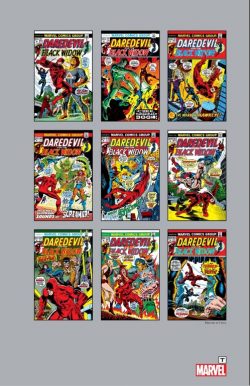
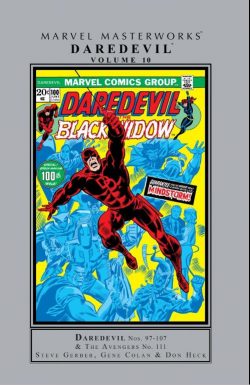
Daredevil Marvel Masterworks volume 10


By Gerry Conway, Steve Gerber, Chris Claremont, Steve Englehart, Gene Colan, Don Heck, Sam Kweskin, Rich Buckler, Jim Starlin, Bob Brown & various (Marvel)
ISBN: 978-0-7851-9917-5 (HB)

Matt Murdock is a blind lawyer whose remaining senses hyper-compensate, making him an astonishing acrobat, formidable fighter and a living lie-detector. Very much a second-string hero for most of his early years, Daredevil was nonetheless a striking and popular one, due in large part to the captivatingly humanistic art of Gene Colan. He fought gangsters, a variety of super-villains and even the occasional monster or alien invasion. He quipped and wise-cracked his way through life and life-threatening combat, utterly unlike the grim, moody, quasi-religious metaphor he latterly became.

After spending years in a disastrous on-again, off-again relationship with his secretary Karen Page, Murdock took up with former client and Russian émigré Natasha Romanoff, the infamous and notorious spy dubbed The Black Widow.

She was railroaded and framed for murder and prosecuted by Matt’s best friend and law partner Foggy Nelson before the blind legal eagle cleared her. Subsequently leaving New York with her for the wild wacky and West Coast, Matt joined prestigious law firm Broderick & Sloan but adventure, disaster and intrigue seemed capable of finding the Sightless Swashbuckler anywhere…

In these tales from the pivotal era of relevancy, social awareness and increasing political polarisation, the Man Without Fear was also growing into the judicial conscience of a generation…

This dynamic collection (available in sturdy hardback and handy digital formats) re-presents Daredevil #97-107, covering March 1973-January 1974 and also includes Avengers #111, wherein twin storylines converged and concluded.

The Marvel Magic recommences following an overview from commentator, biographer and documentarian Jon B. Cooke whose Introduction ‘Look Back in Angar’ adds crucial context to the rapid turnover of creative staff at this juncture.

With DD and the Widow firmly ensconced in San Francisco, Steve Gerber took over scripting with DD #97 (from Conway’s plots and illustrated by Gene Colan & inker Ernie Chan/Chua) for ‘He Who Saves’ as a street acrobat suffers a calamitous accident and is subsequently mutated by sinister hidden forces into proto-godling the Dark Messiah.

The already unstoppable Agent of Change is joined by three equally awesome Disciples of Doom in #98’s on the streets in ‘Let There be… Death!’, but even though physically overmatched, the heroic couple’s psychological warfare proves fatally effective in ending the crisis, if not ferreting out the real villains…

Daredevil and the Black Widow #99 featured ‘The Mark of Hawkeye!’ by now-autonomous Gerber, with Sam Kweskin & Syd Shores providing the pictures, which finds Natasha Romanoff’s old boyfriend turning up determined to reclaim her…

The caveman tactics lead to the Archer’s sound and well-deserved thrashing and result in a quick jump into Avengers #111. Crafted by Steve Englehart, Don Heck & Mike Esposito, ‘With Two Beside Them!’ sees the West Coast vigilantes join a ragtag and much-depleted team of heroes to rescue a number of X-Men and Avengers enslaved by the malevolent Magneto.

Dumped by Natasha and returning alone to the City by the Bay and for his anniversary issue, Daredevil agonisingly relives his origins and danger-drenched life in ‘Mind Storm!’ (Gerber, Colan & John Tartaglione) just as a savage and embittered psionic terrorist launched a series of mind-mangling assaults on the populace, culminating one month later in a shattering showdown between the blind hero and Angar the Screamer as well as a shaky reconciliation with the Widow in ‘Vengeance in the Sky with Diamonds!’, illustrated by Rich Buckler & Frank Giacoia.

Scripted by Chris Claremont, and limned by Syd Shores & Frank Giacoia ‘Stilt-Man Stalks the City’ finds Hornhead hunting psychedelic assassin Angar, which accidentally brings him into conflict with a merciless and similarly displaced old foe. The skyscraping scoundrel has kidnapped the daughter of an inventor in order to extort enhanced weaponry out of the traumatised tinkerer but isn’t expecting interference from his oldest adversary or his utterly ruthless Russian paramour….

No sooner have DD and the Widow ended the miscreant’s rampage than #103 sees a team-up with Spider-Man as a merciless cyborg attacks the odd couple while they pose for roving photojournalist Peter Parker in ‘…Then Came Ramrod!’ by new regular team Gerber, Heck & Sal Trapani.

The barely-human brute is after files in Murdock’s safe and hints of a hidden master, but ultimately his blockbusting strength is of little use against the far faster veteran heroes…

Even as the distracted Murdock realises that his own boss is sabotaging the attorney’s cases, the mystery manipulator is hiring warped mercenary Sergei Kravinoff to make Daredevil ‘Prey of the Hunter!’

Matt’s priorities change when Kraven abducts Natasha, and even after the hero rescues her, the Hunter explosively returns to defeat them both, throwing the swashbuckler to his death…

Daredevil #105 sees the Widow brutally avenging her man’s murder, but Murdock is far from dead, having being teleported from the jaws of doom by a ‘Menace from the Moons of Saturn!’ (inked by Don Perlin)…

In a short sequence pencilled by Jim Starlin, earthborn Priestess of Titan Moondragon is introduced, revealing how she has been dispatched to Earth to counter the schemes of death-worshipping proto-god Thanos. She also inadvertently discloses how she has allied with a respected man of power and authority, providing him with a variety of augmented agents such as Dark Messiah, Ramrod and Angar…

Gerber, Heck & Trapani bring the expansive extended epic closer to culmination as the manipulator is unmasked in ‘Life Be Not Proud!’… but not before the wily plotter redeploys all his past minions, shoots his misguided ally Moondragon, usurps a Titanian ultimate weapon and unleashes a life-leeching horror dubbed Terrex upon the world.

With all Earth endangered, DD, the Widow and guest-star Captain Marvel are forced to pull out all the stops to defeat the threat, and only then after a last-minute defection by the worst of their enemies and a desperate ‘Blind Man’s Bluff!’ courtesy of Gerber, Bob Brown & Sal Buscema.

This supremely enticing volume also offers extra treats: the promotional cover for #100, and John Romita & Michael Esposito’s original art for the cover of issues #105. As the social upheaval of this period receded, the impressively earnest material was replaced by fabulous fantasy tales which strongly suggested the true potential of Daredevil was in reach. These beautifully illustrated yarns may still occasionally jar with their heartfelt stridency and sometimes dated attitudes, but the narrative energy and sheer exuberant excitement of such classic adventures are graphic joys no action fan will care to miss. And the next volume heads even further into uncharted territory…
© 1973, 1974, 2016 Marvel Characters, Inc. All rights reserved.
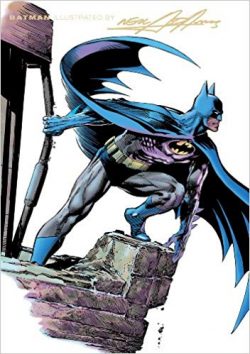
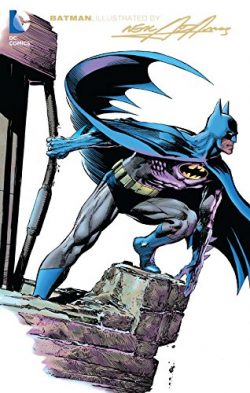
Batman: Illustrated by Neal Adams volume 3


By Neal Adams with Dennis O’Neil, Frank Robbins, Len Wein, Dick Giordano & various (DC Comics)
ISBN: 978-1-4012-4075-2 (TPB)

It’s Batman’s anniversary year. What are you reading?

As the 1960s began Neal Adams was a young illustrator who had worked in advertising and ghosted some newspaper strips whilst trying to break into comics. Whilst pursuing a career in advertising and “real art” he did a few comics pages for Archie Comics and subsequently became one of the youngest artists to co-create and illustrate major licensed newspaper strip Ben Casey (based on a popular TV medical drama series).

That comics fascination never faded, however, and Adams drifted back to National/DC, doing a few covers as inker or penciller before eventually finding himself at the vanguard of a revolution in pictorial storytelling…

He made such a mark that DC recently chose to reprint every piece of work Adams ever did for them into a series of commemorative collections. This is the last of three superb tomes (available in a variety of formats including last minute delivery eBook) starring the “Darknight Detective” as he was dubbed back then, and featuring every cover, story and issue in original publication order.

This particular package celebrates the covers and pertinent contents of Batman #232, 234-241, 243-246, 251, 255, Batman Annual #14, Batman Black & White # 4, The Brave and the Bold #99, Detective Comics #412-422, 439, 600, Heroes Against Hunger, Limited Collectors’ Edition C-25, C-51, C-59, Robin #1, Saga of Ra’s Al Ghul #4, World’s Finest Comics # 211, 244-246, 258; cumulatively embracing June 1971 to September 1996.

Following Adams’ liberally illustrated Foreword and key collaborator Denny O’Neil’s recollections describing their work process in his Introduction, the comics gold begins.

Throughout this period Adams remained one of the industry’s top cover artists, generating a stunning succession of mesmerising images on most Bat-related titles (and plenty of other comics). Those are listed here in chronological release order…

Behind a macabre eye catcher, Batman #232 (June 1971) took the hero to new heights as former kidnap victim Talia returns and we learn more of her as O’Neil & Adams – with inking as usual from Dick Giordano – introduce her father: immortal eco-terrorist Râ’s Al GhÅ«l.

A whirlwind adventure which became one of the signature highpoints of the entire Batman canon, ‘Daughter of the Demon’ is a timeless globe-girdling mystery yarn drawing the increasingly grim hero from Gotham’s concrete canyons to the Himalayas in search of hostages Robin and Talia, purportedly captured by forces inimical to both Batman and the mysterious figure who claims to be working in secret to save the world…

Ra’s was a contemporary, more acceptable visual embodiment of the classic inscrutable ultimate foreign devil (as typified in a less forgiving age as the “Yellow Peril” or Dr. Fu Manchu). This kind of alien archetype permeates popular fiction and is still an astonishingly powerful villain-symbol, although the character’s Arabian origins – neutral at the time – seem to uncomfortably embody a different kind of ethnic bogeyman in today’s post 9/11, ISIS-infested world.

The concept of a villain who has the best interests of the planet at heart is not a new one, but Ra’s Al Ghul, whose avowed intent is to reduce teeming humanity to viable levels and save the world from our poison, hit a chord in the 1970s – a period where ecological issues first came to the attention of the young. It was a rare kid who didn’t find a note of sense in what “the Demon’s Head” planned. The spectacular tale ended with a shocking pronouncement of what Ra’s intended for Gotham’s Guardian…

The chilling covers for Detective Comics #412 and 413 (this was the peak of the revival in supernatural comics, after all), leads to Batman #234 which featured the stellar return of one of the hero’s most tragic foes.

As comics became increasingly more anodyne in the 1950s, psychologically warped, physically actualised schizophrenic Two-Face was quietly retired from Batman’s roster of rogues, but with ‘Half an Evil’ (O’Neil, Adams & Giordano), he resurfaced at the forefront of grimmer, grittier stories.

When a string of bizarre and brutal robberies afflicts the city, the baffled Batman has to use all his ingenuity to discern the reasoning and discover the identity of a ruthless hidden mastermind in time to thwart a diabolical scheme…

Covers for Detective #414-417 Batman #235-236 lead into another much-reprinted classic. ‘Night of the Reaper!’ – by the usual suspect from Batman #237 – is one of the most revered tales of the era: a harrowing Halloween epic which finds Robin working with his old mentor to solve a string of barbarous killings, only to uncover a pitifully deranged perpetrator as much sinned-against as sinner…

The fronts for Detective# 418-422, The Brave and the Bold #99, Batman #238-241 and World’s Finest Comics # 211 bring us to Batman #243 (August) as the long-brewing war between Batman and Ra’s Al Ghul reaches Def Con 3: a single extended saga taken out of normal DC continuity and depicting the final confrontation between two opposing ideals.

Not included here are the non-Adams episodes from Batman #240 and 242 (although they are available in many other collections). In them, the Darknight Detective abandoned his civilian identity by faking Bruce Wayne’s death and gathered a small team of specialist allies – comprising criminal alternate-identity Matches Malone, scientific advisor Dr. Harris Blaine and Ra’s’ top assassin Ling – suborned to the side of the angels by his own superstitious code of honour and sworn to destroy the Demon forever.

O’Neil, Adams & Giordano reunited for Batman #243 which sees the team – plus latecomer Molly Post – invade the Demon’s Swiss citadel moments after their intended target dies. Nobody suspects the ageless villain’s resources include ‘The Lazarus Pit’ which can revive the dead…

The fateful finale came in #244, wherein ‘The Demon Lives Again!’ Sadly, despite all his supernal gifts and forces, Ra’s cannot escape the climactic vengeance of his implacable foe in dream-team O’Neil, Adams & Giordano’s compulsive climax. With the job done, a short addendum in #245 resolves ‘The Bruce Wayne Murder Case!’, restoring the billionaire to his rightful place in Gotham’s social whirl…

The all-Adams cover to Batman #246 (October 1972) leads to another graphic landmark. ‘The Joker’s Five-Way Revenge’ comes from Batman #251 (September 1973 by Dennis O’Neil & Neal Adams) and finally ended forever the zany, “camp” taint of the TV show by re-branding the characters and returning to the original 1930s concept of a grim and driven Dark Avenger chasing an insane avatar of pure evil.

Such a hero needs truly deadly villains and – by reinstating the psychotically unpredictable Killer Clown who scared the short pants off readers in the Golden Age – this single-issue yarn set the bar very, very high. A true milestone that utterly redefined the Joker for the modern age: the story sees the Mirthful Maniac stalking his old gang, determined to eradicate them all with the hard-pressed Gotham Guardian desperately playing catch-up. As the crooks die in all manner of Byzantine and bizarre ways, Batman realises his arch-foe has gone irrevocably off the deep end….

Terrifying and beautiful, for many fans this is the definitive Batman/Joker story, but signalled Adam’s graduation to other jobs and away from regular bat-missions. Before that departure, however, the cover to Detective #439 (February/March 1974) and one last thriller awaited.

Scripted by Len Wein and inked by Giordano, ‘Moon of the Wolf’ from Batman #255 (March/April 1974) pits the ultimate human hero against a tragic former sportsman mutated into a truly supernatural lupine killer and enslaved by old enemy Professor Milo…

From Limited Collectors’ Edition C-25 comes a pin-up before a rare example of the artist’s commercial comics work appears. Adams produced art for a series of comics adventures starring various Marvel and DC heroes – as well as screen icons such as Star Trek and Planet of the Apes – for Power Records’ line of Book and Records sets. These offered a vinyl recording of a story accompanied by a fully illustrated comic tale. The Batman offerings began with ‘Trumping the Joker’ in Stacked Cards (PR-27, 1975 and written & illustrated by Adams) was followed a year later, by PR-30 (Adams, Frank Robbins and Giordano) wherein ‘Robin Meets Man-Bat’. The all-ages tales are accompanied by a house ad for the DC stars available in Power Records’ unique packages.

Still a huge draw as a cover artist, between 1977-1996 Adams generated Bat-related frontages for World’s Finest Comics # 244-246 & 258, Limited Collectors’ Edition C-51 (a wraparound reprinting the “Bride of the Demon” saga) and C-59 (‘Batman’s Strangest Cases’), the Heroes Against Hunger benefit comic, a pin-up in Detective Comics #600, covers for Saga of Ra’s Al Ghul #4 (another wraparound), Batman Annual #14, and pin-ups for Robin #1 and Batman Black & White # 4.

The history of Batman is inescapably linked to and shaped by Neal Adams’ efforts, and captivating secrets of creation are revealed in the stunning Neal Adams Sketchbook section (featuring comic art, ads, storyboards and conceptualisations for a Batman amusement park) which closes this compelling and irresistible tome (still readily available in trade paperback and digital editions).

With the game-changing classics in this volume, Batman finally returned to the commercial and critical top flight he had enjoyed in the 1940s reviving and expanding upon his original conception as a remorseless, relentless avenger of injustice. The next few years would see the hero rise to unparalleled heights of quality so stay tuned: the very best is just around the corner… that dark, dark corner…
© 1971, 1972, 1973, 1974, 1975, 1976, 1977, 1978, 1979, 1986, 1988, 1989, 1990, 1991, 2005, 2015 DC Comics. All Rights Reserved.

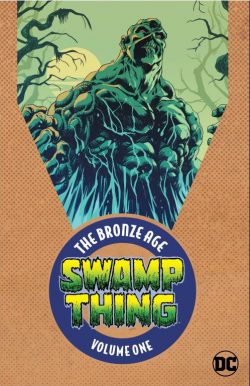
Swamp Thing: The Bronze Age Volume One


By Len Wein & Bernie Wrightson, Nestor Redondo; with Michael Wm. Kaluta & various (DC Comics)
ISBN: 978-1-4012-8440-4 (TPB)

The first fan-sensation of the modern age – now officially enshrined as the Bronze Age – of American comicbooks – Swamp Thing has powerful popular fiction antecedents and in 1972 was seemingly a concept whose time had come again. Prime evidence was the fact that Marvel were also working on a man-into-mucky, muddy mess character at the very same time.

Both Swampy and the Man-Thing were thematic revisions of Theodore Sturgeon’s classic novella It and bore strong resemblances to an immensely popular Hillman Comics character dubbed The Heap. He/it slurped through the back of Airboy Comics (née Air Fighters Comics) from1943. My fan-boy radar suspects Roy Thomas’ marsh-monster the Glob (debuting in Incredible Hulk #121 from November 1969 and promptly returning in #129, June 1970) either inspired both DC and Marvel’s creative teams, or was part of that same zeitgeist. It should also be remembered that Skywald (a very minor player with big aspirations) released a black-&-white magazine in their Warren Comics knock-off line entitled The Heap in the Autumn of 1971.

For whatever reason, by the end of the 1960s superhero comics had started another steep sales decline, once again succumbing to a genre boom and horror/mystery resurgence: a sea-change augmented by a swift rewriting of the specific terms of the Comics Code Authority. At DC, With EC veteran Joe Orlando as editor, House of Mystery and sister title House of Secrets returned to short story anthology formats and gothic mystery scenarios, taking a lead from such TV successes as Twilight Zone and Rod Serling’s Night Gallery.

Referencing the sardonic narrator/storyteller format of EC horror titles, Orlando created Cain and Abel to shepherd readers through brief, sting-in-the-tail yarns produced by the best creators, new and old, that the company could hire. Artists Neal Adams, Mike Kaluta, and especially Bernie Wrightson produced their best work for these titles, and the vast range of successors the horror boom generated at DC.

The twelfth anthology issue of the resurrected House of Secrets cemented the genre into place as the industry leader. There writer Len Wein & Wrightson produced a throwaway gothic thriller set at the turn of the 19th century, wherein gentleman scientist Alex Olsen is murdered by his best friend and his body dumped in a swamp. Years later, his beloved bride – now the unsuspecting wife of the murderer – is stalked by a shambling, disgusting beast that seems to be composed of mud and muck…

This epic trade paperback and digital compilation gathers material from House of Secrets #92, and the contents of Swamp Thing #1-13 (cumulatively covering June/July 1971 to November/December 1974) and perfectly encapsulates the changing face and taste of the times, opening here with that so-pivotal gothic vignette…

‘Swamp Thing’ cover-featured in HoS #92 (June-July 1971), and struck an immediate chord with the buying public. The issue was the best-selling DC comic of that month, and reader response was fervent and persistent.

By all accounts, the only reason there wasn’t an immediate sequel or spin-off was that the creative team didn’t want to produce one. Eventually however, bowing to interminable pressure, and with the sensible idea of transplanting the concept to contemporary America, the first issue of Swamp Thing appeared on newsstands in the Spring of 1972. It was an unqualified hit and an instant classic.

Wein and Wrightson produced ten issues together, crafting an extended, multi-chaptered tale of justice/vengeance and a quest for answers that was at once philosophically typical of the time and a prototype for the story-arc and mini-series formats that dominate today’s comics production. They also used each issue/chapter to pay tribute to a specific sub-genre of timeless horror story whilst advancing the major plot…

Here, the saga resumes with a fresh origin as ‘Dark Genesis’ finds Alec and Linda Holland deep in the Louisiana Bayou, working on a bio-restorative formula that will revolutionise global farming. Working in isolation, they are protected by Secret Service agent Matt Cable, when representatives of an organisation called the Conclave demand that they sell their research to them – or else.

Obviously, the patriotic pair refuse, and the die is cast. The lab is bombed and Linda dies instantly but Alec, showered with his own formula and blazing like a torch, hurtles to a watery grave in the swamp. He does not die…

Transformed by the formula (and remember, please, that this is prior to Alan Moore’s landmark re-imagining of the character) Holland is transformed into a gigantic man-shaped monster, immensely strong, unable to speak, and seemingly composed of living plant matter. Holland’s brain still functions however, and he vacillates between finding his wife’s killers and curing his own monstrous condition. Cable, misinterpreting the evidence, also wants revenge, but he thinks that the monster is the cause of death of his two charges…

Over the next nine issues, Swamp Thing travelled the world, encountering the darkest outbreaks of classic supernature and the insatiable greed of human monsters.

The first was black sorcerer Anton Arcane and his artificial homunculi The Un-Men (eventually the grotesque stars of their own Vertigo series), in ‘The Man Who Wanted Forever.’ The wizard transported Holland to his Balkan castle and sought to mystically trade places with the stupendous swamp beast. The temptation proved too great, but when the restored scientist realised the cost, he violently recanted…

The next issue introduced Abigail Arcane and her tragic Frankenstein-influenced father ‘The Patchwork Man’ in a classic case of monster misunderstanding, which results in her joining free agent Cable in stalking the mossy misanthrope. As Holland makes his torturous way back to the USA, hunters and hunted are waylaid and encounter a Scottish werewolf in ‘Monster on the Moors!’ before at last returning to America and finding ‘The Last of the Ravenwind Witches!’ as well as even more mob-handed human intolerance…

In the wilds of Vermont, he encounters Paradise on Earth, courtesy of an old clockmaker but when the idyll is turned into ‘A Clockwork Horror’ by the voracious Conclave, his torment is transformed into sheer rage, leading to one of the most evocative and revered team-ups of the 1970s.

Swamp Thing #7’s ‘Night of the Bat’ featured the final showdown with the remorseless robber-barons of The Conclave in their Gotham City HQ: a landmark collaboration with the resurgent Batman, himself finally recovering from the hyper-exploitation of the “Campy” TV show era.

Wrightson’s rendering of the superhero through the lens of a horror artist inspired a whole generation of aspiring comics professionals and firmly set the Caped Crusader to rest, replaced with a grim and moody Dark Knight.

Somewhat at a loss after the end of his quest (Swamp Thing came out bi-monthly, so the tale had taken well over a year to tell – unprecedented at a time when most comics still had two or more complete stories per issue), the Moss Monster shambled aimlessly through America’s hinterlands encountering a Lovecraftian horror in the New England town of Perdition. ‘The Lurker in Tunnel 13!’ After dealing with eldritch cancer god M’Naagalah, Holland (as well as Abigail and Cable) were drawn into a US military cover-up involving a marooned and benevolent alien in ‘The Stalker from Beyond!’ which benefitted from supplemental inking by Michael Kaluta before the classic run concluded with #10’s ‘The Man Who Would Not Die!’: a tale of ghostly retribution amidst the graves of unquiet plantation slaves with unliving atrocity Anton Arcane making his first of many demonic returns…

The issue was plotted by Wrightson and marked his swansong on the title: the next chapter in the Swamp Thing saga was still dictated by Wein but the miraculously gifted hands of Nestor Redondo: possible the only artist who could have matched the visual intensity of the feature’s visual originator.

Nestor Redondo was born in 1928 at Candon, Ilocas Sur in the American Territory of the Philippines. Like so many others he was influenced by US comic-strips such as Tarzan, Superman, Buck Rogers and Flash Gordon which were immensely popular in the entertainment-starved Pacific Archipelago.

Drawing from an early age Nestor emulated his brother Virgilio – who already worked as a comics artist for the cheap magazines of the young country. The Philippines became a commonwealth in 1935, and achieved full-independence from the USA in 1946, but maintained close cultural links to America.

His parents pushed him into architecture but within a year Nestor had returned to comics. A superb artist, he far outshone Virgilio – and everybody else – in the cottage industry. His brother switched to writing and the brothers teamed up to produce some of the best strips the Islands had ever seen, the most notable and best regarded being Mars Ravelo’s ‘Darna’.

Capable of astounding quality at an incredible rate of speed, by the early 1950s Nestor was drawing for many comics simultaneously. Titles such as Pilipino Komiks, Tagalog Klasiks, Hiwaga Komiks and Espesial Komiks were fortnightly and he usually worked on two or three series simultaneously, pencils and inks. He also produced many of the covers.

In 1953 he crafted an adaptation of MGM film Quo Vadis for Ace Publications’ Tagalong Klasiks #91-92. Written by Clodualdo Del Mundo, it was serialized to promote the movie in country, but MGM were so impressed by the art-job they offered 24-year old Nestor a US job and residency. He declined, thinking himself too young to leave home yet.

If you’re interested, you can see the surviving artwork by Googling “Nestor Redondo’s Quo Vadis”, and you should because it’s frankly incredible.

Ace was the country’s biggest comics publisher, but by the early 1960s they were in dire financial straits. In 1963 Nestor, Tony Caravana, Alfredo Alcala, Jim Fernandez, Amado Castrillo and brother Virgilio set up their own company CRAF Publications, Inc., but the times were against them (and publishers everywhere). About this time, America came calling again, but in the form of DC and Marvel Comics. By 1972, US based Tony DeZuñiga had introduced a wave of Filipino artists to US editors, and Nestor produced short horror tales for House of Mystery, House of Secrets, Phantom Stranger, Secrets of Sinister House, Witching Hour, The Unexpected, Weird War Tales, fill-ins for Marvel’s Man-Thing, an astonishingly beautiful run on Rima the Jungle Girl (a loose adaptation of W H Hudson’s seminal 1904 novel Green Mansions) before being tapped to take over as illustrator on Swamp Thing. He also worked on Lois Lane and Tarzan and in 1973 produced adaptations including Dracula and Dr. Jekyll and Mr. Hyde for Vincent Fago’s Pendulum Press Illustrated Classics: later reprinted as Marvel Classics Comics.

In later years he moved to Marvel where he inked and eventually fully illustrated Savage Sword of Conan.

During that DC period he was tapped to draw an adaptation of King Arthur which DC killed before it was completed (once again some pages survive and the internet is your friend if you want to see them) and illustrated issue C-36 of the tabloid sized Limited Collectors’ Edition: The Bible. (please link)

Sporting a Luis Dominguez cover, Swamp Thing #11 was cover-dated July/August 1974 and sees the monster back at last in his Bayou home, with Cable and Abigail close on his root-riddled heels. When mutant beasts and ‘The Conqueror Worms!’ attack his human pursuers, Holland rushes to the rescue and the relationship between hunters and prey alters forever…

The carnivorous Worms have suborned crazed survivalist Professor Zachary Nail and taken captives and when their secret plans are exposed war breaks out for possession of Earth…

In the aftermath, Swamp Thing is sucked into an arcane time-loop locked on constantly-killed and perpetually-resurrecting Milo Mobius …until Holland finds a way to break the circle of ‘The Eternity Man’

This initial collection then concludes with Cable, Abigail and new recruit Bolt instigating ‘The Leviathan Conspiracy’ to liberate the Federally imprisoned Swamp Thing and put him beyond the reach of government scientists forever…

A genuine landmark of the art form, these stories are also superb examples of old-fashioned comics wonderment, from a less cynical and sophisticated age, but with a passion and intensity that cannot be matched. And, ooh, that artwork…

If you love comics you must have his buried treasure.
© 1971, 1972, 1973, 1974, 2018 DC Comics. All Rights Reserved.

Superman/Shazam!: First Thunder


By Judd Winick, Joshua Middleton & various (DC Comics)
ISBN: 978-1-4012-0923-0 (TPB)

At their most impressive, superhero comics combine all the gravitas of mythology with all the sheer child-like fun and exuberance of a first rollercoaster ride. A perfect example of this is a 4-issue miniseries from November – February of 2006 collected as Superman/Shazam!: First Thunder.

One of the most venerated and loved characters in American comics, (the original) Captain Marvel was created by Bill Parker and Charles Clarence Beck as part of the wave of opportunistic creativity that followed the successful launch of Superman in 1938. Although there were many similarities in the early years, the Fawcett character moved solidly and steadily into the area of light entertainment and even comedy, whilst as the 1940s progressed the Man of Steel increasingly left whimsy behind in favour of action and drama.

At the height of his popularity the World’s Mightiest Mortal outsold the Man of Steel by a wide margin (even published twice monthly), but as the Furious Forties closed tastes changed, sales slowed and Fawcett saw the way the wind was blowing. They settled a long-running copyright infringement case instigated by DC/National in 1940 and the Big Red Cheese vanished – as did so many superheroes – becoming little more than a fond memory for older fans.

As America lived through another superhero boom-and-bust from 1956-1968, the 1970s dawned with a shrinking industry and a wide variety of comics genres servicing a base that was increasingly founded on collector/fans and not casual or impulse buys. DC Comics needed sales and were prepared to look for them in unusual places.

After the settlement with Fawcett in 1953 they had secured the rights to Captain Marvel and Family, and even though the name itself had been taken up by Marvel Comics (via a circuitous and quirky robotic character published by Carl Burgos and M.F. Publications in 1967) decided to tap into that discriminating older, nostalgia-fuelled fan-base, even as the entire entertainment world began looking back in time for fresh entertainments such as The Waltons, Little House on the Prairie (or even Bonnie and Clyde)…

In 1973, riding that burgeoning wave of nostalgia, DC brought back the entire beloved cast of the Captain Marvel strips: restored to their own kinder, weirder universe. To circumvent an intellectual property clash, they entitled the new comic book Shazam!; the trigger phrase used by a huge family of Marvels to transform to and from mortal form and a word that had already entered the American language due to the success of the franchise the first time around.

You know what comics fans are like: they had been arguing for decades – and still do – over who was best (for which read “who would win if they fought?”) out of Superman or Captain Marvel. Thus, though excised from the regular DCU and stuck on a parallel universe, the old commercial rivals met and clashed a number of times, but until the landmark Crisis on Infinite Earths subsumed all those myriad worlds into one overarching continuity, the most powerful heroes in existence maintained the status of “equal but separate”.

In that new reality everything happened in one cosmos and Captain Marvel was fully rebooted and integrated. The basics remained untouched: homeless orphan and good kid Billy Batson is selected by an ancient wizard to be given the powers of six gods and heroes to battle injustice. Bestowed with the ability to transform from scrawny precocious kid to brawny (adult) hero by speaking aloud the wizard’s acronymic name – invoking the powers of legendary patrons Solomon, Hercules, Atlas, Zeus, Achilles and Mercury, the idealistic lad can now right all wrongs as “the World’s Mightiest Mortal!”

After twenty years in this iteration, Captain Marvel’s early days were re-explored in this canny, big-hearted thriller which reveals the details of the first shared case of paragons of power.

Written by Judd Winick and illustrated by Joshua Middleton in a painterly style gloriously reminiscent of the old Fleischer Studio Superman cartoons, this magical treat is chronologically set just after Superman: Man of Steel volume 1 and The Power of Shazam! original graphic novel, and opens with ‘A Face in the Crowd’ as a new hero begins saving lives in West Coast metropolitan colossus Fawcett City, whilst a continent eastwards in Metropolis, Superman stumbles onto a museum robbery and is surprisingly beaten by thieves employing magic. The robbers belong to a cult – the Temple of Bagdan – and are on a nationwide spree to collect ancient Russian relics for some sinister master-plan…

In Fawcett, Marvel destroys giant robots attacking a new solar powered construction site designed by Doctor Bruce Gordon, unexpectedly inspiring the enmity of billionaire industrialist Thaddeus Sivana. Although the owner of the Solar Center project, Sivana has huge petrochemical interests and only intended his eco-friendly enterprise as a tax shelter. He certainly has no intention of supplying cheap, clean energy to the proles of “his” city…

In a makeshift shelter, homeless Billy Batson talks his day over with Scoot Cooper, another hard-luck kid and the only person who knows his secret, even as Sivana “negotiates” with his hated East Coast rival Lex Luthor. The arrogant Metropolis financier has experience with super-powered meddlers and resources to combat their interference. It’s time to make a deal with a devil…

Later when the Bagdan cultists raid Fawcett’s McKeon History Museum, Marvel is waiting for them but is also overmatched by the magical Mallus Trolls employed by the thieves. At least until Superman shows up…

The team-up explodes into action in ‘Odd Couples’ with the heroes battling together, discovering their similarities and major differences even as, in Metropolis, Luthor sells Sivana the answer to all his superhero problems: an exemplary operative dubbed Spec…

The cultists have again escaped however, and are in the final stage of their plan. Having secured the mystic paraphernalia to summon consummate evil they then force disturbed kidnap victim Timothy Barnes to become host to six infernal fiends. Sabbac is the antithesis of Shazam’s agent: a supernatural super-being sponsored by devil-lords Satan, Aym, Belial, Beeelzebub, Asmodeus and Createis in the way the ancient gods and heroes empower Captain Marvel, and now he is free to wreak havoc and destruction upon the world…

To make matters worse, at that very moment Bruce Gordon succumbs to his own twilight curse at the Solar Centre as a lunar eclipse allows the diabolical Spirit of Vengeance to escape from his fleshy prison…

‘Titans’ finds Captain Marvel furious battling his dark counterpart as Superman struggles against not only evil spirit Eclipso but also his possessed army of innocents enslaved by the dark destroyer’s black diamond. When Sivana secretly funded the cultists, he intended their tool to simply destroy Gordon and his power plant, but now events have spiralled beyond anyone’s control. Even as the hated heroes inadvertently fix both of Sivana’s awry schemes, Spec is hunting through Fawcett. Soon his astounding abilities have ferreted out Billy Batson’s secret and arranged a permanent solution…

The drama roars to a terrific conclusion in ‘Men and Boys! Gods and Thunder!’ as a paramilitary hit squad attempts to gun down the merely human Billy but only hits his best friend instead, leaving Sivana to face the wrath of a lonely, bitter 10-year old boy, amok and enraged with righteous fury in the body of one of the most powerful creatures in the universe…

In the awesome aftermath, Superman decides to deal with the shell-shocked Marvel in a way that will change both of their lives forever…

Still readily available in trade paperback and digital form – and sporting such extras as a roughs and sketches, cover process guide and cover gallery – this is a big, bold, old fashioned comicbook romp full of big fights, dastardly villains, giant monsters, big robots and lasting camaraderie that will delight all lovers of Fights ‘n’ Tights fiction, and whilst not a breakthrough classic like Watchmen or The Dark Knight Returns, is an equally mythic retelling of superhero mythology which ranks amongst the very best of the genre.

They should make a movie out of it…
© 2006 DC Comics. All Rights Reserved.