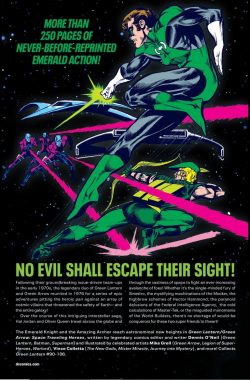
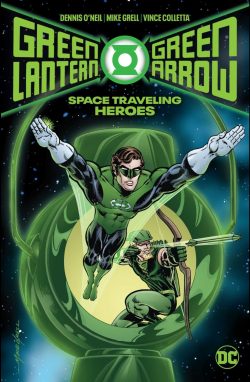
Green Lantern/Green Arrow: Space Traveling Heroes


By Denny O’Neil, Frank McGinty, Elliot S! Maggin, Mike Grell, Alex Saviuk, Vince Colletta & various (DC Comics)
ISBN: 978-1401295530 (HB)

After their hugely successful revival and reworking of The Flash, DC were keen to build on a resurgent superhero trend. Showcase #22 hit newsstands at the same time as the fourth issue of the new Flash comic book (#108) and once again the guiding lights were Editor Julie Schwartz and writer John Broome. Assigned as illustrator was action ace Gil Kane – usually inked by Joe Giella – and the issue revealed a Space Age reconfiguration of the Golden Age superhero with magic replaced by super-science.

Hal Jordan was a young test pilot in California when an alien policeman crashed his spaceship on Earth. Mortally wounded, Abin Sur commanded his power ring – a device for materialising thoughts – to seek out a replacement officer, honest and without fear.

Scanning the planet, it selected Jordan and brought him to the crash site. The dying alien bequeaths his ring, lantern-shaped Battery of Power and professional vocation to the astonished Earthman.

Having established characters, scenario and narrative thrust of a series that would become the spine of all DC continuity, the editors were confident of their ground. Unlike the years-long, practically glacial debut of The Flash, the next two Showcase issues carried the new costumed champion to even greater exploits, and six months later Green Lantern #1 was released.

In this iteration the Emerald Gladiators are a universal police force (Jordan’s “beat” is Space Sector 2814), and over many traumatic years, he grew into one of the greatest members of the serried band of law-enforcers. The Green Lantern Corps has safeguarded the cosmos from all evil and disaster for billions of years, policing countless sentient beings under the severe but benevolent auspices of immortal super-beings who consider themselves the Guardians of the Universe.

These undying patrons of Order were one of the first races to evolve and dwelt in sublime, emotionless security and tranquillity on the world of Oa at the very centre of creation.

Green Lanterns are chosen for their capacity to overcome fear and are equipped with a ring that creates solid constructs out of emerald light. The miracle weapon is fuelled by the strength of the user’s willpower, making it – in the right hands – one of the mightiest tools imaginable…

For eons, a single individual from each of the 3600 sectors of known space was selected to patrol his, her or its own beat, but being cautious and meticulous masters, the Guardians laid contingency plans as appointing designated reserve officers.

The series a ran for a decade before changing tastes pushed it into radical territory as a soap box for social injustice and environmental issues. The “relevancy period” generated landmark groundbreaking tales from Denny O’Neil & Neal Adams that revolutionised the industry, whilst registering such poor sales that the book was cancelled and the twinned heroes (a cost-cutting concept had seen GL paired with liberal firebrand Green Arrow as a walking, rip-roaring conscious for the conservative ring-wielder) unceremoniously shipped into the back of another comic book – the marginally more successful Flash.

The Flash #217-246 saw the transition from Adams to new art sensation Mike Grell: a run that precipitated the viridian vigilantes back into their own title. With the emphasis shifting back to crime, adventure and space opera, Green Lantern was again popular enough for his own book and he naturally brought the boisterous bowman along for the ride….

Collecting Green Lantern #90-106 (August/September 1976-July 1978) this hardback and digital compendium sees them (mostly) return to the starry firmament for cosmic duties beginning with #90 (August/September 1976) as ‘Those who Worship Evil’s Might’ – by Denny O’Neil & Mike Grell – finds the Green Gladiators investigating a starship buried in the Las Vegas desert for countless years. When it disgorges an ancient evil the heroes also meet the freshly awakened officers of a force used by the Guardians of the Universe before green rings were invented…

Issue #91 depicts the return of arch-nemesis Sinestro who inflicts ‘The Revenge of the Renegade’ upon his foes after taking over a poverty-stricken third world monarchy. When the tables are turned, he flees into space and across dimensions, arriving with the green team on a primitive world in dire need of champions legendarily saved via ‘The Legend of the Green Arrow’ (inked by Robert “Bob” Smith).

Inked by Terry Austin, #93’s ‘War Against The World-Builders’ finds aliens abducting homeless people to build a colony world. As GL interrupts his Thanksgiving dinner to play saviour, however, his lover Carol Ferris, Black Canary and Green Arrow are ambushed by government spooks and the archer is abducted. Rogue agents need him to kill someone and believe they have the perfect inducement in #94’s ‘Lure for an Assassin’ (Austin & Dick Giordano inks) but didn’t count on his ingenuity and the return of substitute GL John Stewart, culminating in a political scandal barely averted in concluding chapter ‘Terminal for a Tragedy’ with Vince Colletta signing on as regular inker.

Bouncing back to the big black yonder, #96’s ‘How Can an Immortal Die?‘ sees the reappearance of alien Lantern Katma Tui, crashing to Earth and bringing warning of a terrible threat that has infiltrated the Guardians. Rushing rashly to the rescue, Jordan battles his comrades and patrons to solve and defuse ‘The Mystery of the Mocker’ in a spectacular romp that marks the series’ restoration to monthly status.

The plan doesn’t end well and #98 finds the mind monster loose on Earth and tormenting Black Canary with visions of the dead in ‘Listen to the Mocking Bird’. Tracing the abominable mocker Ffa’rzz to an antediluvian and impossibly distant space station, Jordan Katma Tui, the Arrow and enigmatic space critter Itty infiltrate the monolith and face constant nightmare as they realise ‘We Are on the Edge of the Ultimate Ending!’ Thankfully, devious plotter Ollie Queen has a plan to save everything…

Double-sized Green Lantern/Green Arrow #100 carried a January 1978 cover-date and two tales, beginning with O’Neil, Alex Saviuk & Colletta’s ‘Rider of the Air Waves’ which expanded the Jordan family by introducing a distant cousin. Also called Hal Jordan, this kid had inherited his father Larry‘s title as Air Wave (a Golden Age Great using the power of radio to crush crooks) but got trapped in energy form by debuting dastard Master-Tek. It didn’t take long to sort things out and find little Hal a tutor after which Elliot S! Maggin, Grell & Colletta took Ollie, the Canary and former sidekick Roy “Speedy” Harper back to Star City in ‘Beware the Blazing Inferno!’ the task of stopping a ring of bombers opened old wounds however, and the archer again opted to try fixing things from within by running for Mayor…

Frank McGinty, Saviuk & Colletta deconstructed ‘The Big Braintrust Boom’ in #101 as freewheeling trucker Hal – the elder – Jordan uncovers a mind-bending, potentially world-dominating cult run by old enemies Hector Hammond and Bill Baggett, before O’Neil, Saviuk & Colletta reveal a cunning alien plot to shanghai humans as batteries in ‘Sign Up… and See the Universe’ which intensifies into a full blown invasion in #103’s ‘Earth – Asylum for an Alien’ with David Hunt stepping in to ink. Happily our heroes are up to the challenge, but when a valued comrade suddenly dies the consequences are not just tragic but simply catastrophic in #104’s ‘Proof of the Peril’ by O’Neil, Saviuk, Colletta. Even this is not the end, however, as the bizarre events herald the vengeful assault of old enemy Sonar in follow-up yarn ‘Thunder Doom’leading to a close call with an all-consuming atrocity and revelatory conclusion  ‘Panic… in High Places and Low’ by O’Neil, Grell & Bruce Patterson in last inclusion #106.

Although still laced with satire and political barbs, this tome sees challenging tales of rebellion give way to plot-driven sagas of wit and courage, packed with a less shining, less optimistic sense of wonder albeit still bristling with high-octane action. Here are evergreen adventures that confirmed the end of the Silver Age of Comics and the birth of something new. Illustrated by some of the most revered names in the business, the exploits in this volume closed one chapter in the life of Green Lantern and opened the doors to today’s sleek and stellar sentinels of the stars.
© 1976, 1977, 1978, 2020 DC Comics. All Rights Reserved.
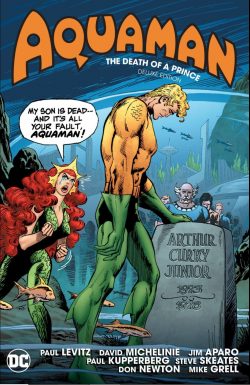
Aquaman: The Death of a Prince Deluxe Edition


By Paul Levitz, David Michelinie, Paul Kupperberg, Steve Skeates, Martin Pasko, Gerry Conway, Mike Grell, Jim Aparo, Don Newton, Carl Potts, Juan Ortiz & various (DC Comics)
ISBN: 978-1-7795-0095-3 (HB)

Aquaman is one of that hallowed handful of costumed champions to survive the superhero collapse at the end of the Golden Age. For most of that time he was a rather nondescript and genial guy who – when not rescuing fish and people from sub-sea disasters – solved maritime crimes and mysteries.

The Sea King was created by Mort Weisinger & Paul Norris, debuting in More Fun Comics #73 (November 1941) in the wake of and in response to Timely Comics’ antihero Namor the Sub-Mariner. Strictly a second stringer for most of his career, Aquaman nevertheless swam on beyond many stronger features; illustrated by Norris, Louis Cazaneuve, Charles Paris, and latterly Ramona Fradon who drew almost every adventure from 1951 to 1961.

When Showcase #4 rekindled the public’s taste for costumed crimefighters with the advent of a new Flash in 1956, National/DC updated its band of superhero survivors, especially Green Arrow and the Subsea Sentinel.

As the sixties opened, Aquaman was a back-up feature in Detective Comics and World’s Finest Comics, but made his big leap following a team up with Hawkman in Brave and the Bold # 51 and his own try-out run in Showcase #30-33. After two decades of continuous nautical service, the marine marvel was at last awarded his own comic book (cover-dated January/February 1962).

With his own title and soon featuring in groundbreaking must-see cartoon show The Superman/Aquaman Hour of Adventure, our Finned Fury seemed destined for super-stardom, but despite increasingly bold and innovative tales presented with stunning art, his title was cancelled as the decade closed. Towards the end, outrageously outlandish crime and sci fi yarns gave way to grittily hard-edged epics steered by revolutionary editor Dick Giordano and hot new talents Steve Skeates & Jim Aparo that might arguably be the first sallies of comic books’ landmark socially conscious “relevancy” period…

This compelling follow-up compilation features material released after a 3 year hiatus following cancellation in 1971. Offering potent dramas heralding a new era of costumed capers primarily from a fresh generation of creators, it gathers material from Adventure Comics #435-437, 441-455 and Aquaman volume 1 #57-63 (spanning September/October 1974 to August- September 1978) and is available in hardback and digital formats,.

Way back in Aquaman #18, (December 1964 and not included here) the marine marvel – also called Arthur Curry – met extradimensional princess Mera, who became ‘The Wife of Aquaman’ in one of the first superhero weddings of the Silver Age. Talk about instant responsibilities…

In quick-smart time along came a little Aquababy – eventually and occasionally called Arthur Jr. – and the undersea nuclear family became a given constant for years…

We open with revelatory Introduction ‘Confessions’ from scripter, editor and publisher Paul Levitz, and a fact-filled pin-up of ‘The Aquafamily’ by Gerry Conway & Jim Aparo, first seen in Adventure Comics #444. Then it’s drama all the way with #435’s ‘As the Undersea city Sleeps’ by Steve Skeates & Mike Grell, offering a quick reintroduction with the Atlantean monarch battling a mysterious subsea sleeping plague caused by old enemy Black Manta. After that, ‘The King is Dead; Long Live the King’ (#436) sees the monarch uncover a rash of robot duplicates infiltrating the city and summoning massive monsters before #437 finds Levitz & Grell setting the scene for larger events to come with Aquaman undertaking many mini-missions on ‘A Quiet Day in Atlantis’…

Cover-dated September/October 1975, Adventure Comics #441 opens extended epic “The Sea King in Exile” with ‘The Pirate who Plundered Atlantis’ by Levitz, David Michelinie and triumphantly returning Jim Aparo detailing how an invasion by modern-day undersea buccaneers is repelled by the Sea King and Mera, tragically unaware of a longer game in play…

More pieces fall into place when NATO General Horgan warns that a hijacked nuclear materials transporter is going to be sunk – over Atlantean farms – to prevent terrorists using the cargo for dirty bombs. That’s when Aquaman takes charge in ‘H is for Holocaust’ – by Levitz & Aparo – after which the Sea Lord stays topside to crush ‘The Dolphin Connection’(Levitz, Michelinie & Aparo) when old enemy The Fisherman trains cetaceans to deliver drugs to the French underworld. All the surface duty does not play well in Atlantis, however, and a grass roots (kelp roots?) political movement makes startling inroads in its demands to elect a new stay-at-home ruler…

The unthinkable happens in Adventure 444 as Levitz, Gerry Conway & Aparo show Aquaman blackmailed into stealing an Atlantean superweapon by his villainous brother Ocean Master before being smoothly ousted and replaced by new king Karshon in ‘And Death before Dishonor’…

Exiled and setting up home in the old “Aquacave”, Arthur, Mera and the toddler determine to make the best of their new life, but are soon abducted by ‘Toxxin’s Raiders’ (Michelinie & Aparo): subsea primitives who need a true champion to destroy the beast haunting their village. It’s a huge mistake all around…

The Sea Exile then learns that ‘The Manta-Ray Means Murder!’ (Levitz, Martin Pasko & Aparo) as Aqualad and Aquagirl– currently busting surface-world  smugglers – are attacked by Black Manta, simultaneously exposing a deadly plot just as their mentor arrives to lower the boom and uncover the villain is gun-running to Atlantis…

Issue 447 sees Levitz, Pasko & Aparo detail a ‘Prelude to Armageddon” as Aquaman tracks Manta’s shipments and falls foul of the Fisherman, unaware of a silent partner dictating the flow of events. Full disclosure and a classic conclusion come in ‘Crown, Crisis and Cataclysm’ (Levitz & Aparo) as master manipulator Karshon is revealed as a deadly former Green Lantern foe who turns assured victory into crushing defeat through sheer overconfidence…

Reuniting Skeates & Aparo, Adventure Comics #449 features ‘The Menace of the Marine Marauder’ as a surface science criminal usurps the Sea Sentinel’s telepathic power to control sea creatures. Plundering shipping – specifically a crucially needed vaccine – until Aquaman and Mera step up, he’s just an interlude before Michelinie & Aparo detail ‘The Watery War of the Weather Wizard’ in #450, with the Flash rogue becoming the latest larcenous loon to underestimate the King of the Seas.

…And in the background, Aqualad is lured away by a seeming madman claiming the junior sea crusader stole his son and sets out on a personal quest that will change his life forever…

Issue #451 reveals ‘The Secret of the Sinister Abyss’ as Arthur Jr. is inexplicably abducted by faithful octopus companion Topo and swiftly-pursuing Aquaman stumbles into another sea bed civilisation – the Idylists -  and a rapidly regenerating new iteration of extraterrestrial terror Starro the Conqueror.

On defeating the starfish clone, Aquaman talks to the pacifist sea-voyagers it imperilled and learns they are seeking a lost brother who can be their champion: his partner Aqualad…

Big things were happening for the Sea King as his Adventure tenure was giving way to a resurrected solo title. Issue #452’s ‘Dark Destiny, Deadly Dreams’ (Michelinie & Aparo) sees Aquaman and the Idylists confronting the occupiers of the pacifist city and discovering Black Manta is offering it as a homeland and refuge for lost and hopeless surface men…

His methods are far from altruistic and his only successful convert to water-breathing – Cal Durham – has serious doubts, but Manta won’t be deterred. and when he captures them and Aqualad, he forces them to fight each other to the death to save Arthur Jr.

It doesn’t work and the boy dies…

The tragedy catapults the hero back into his own revived comic book with Aquaman volume 1 #57 (August/September 1977) where Michelinie & Aparo’s ‘A Life for a Life’ follows his vengeful wake to a brutal – but not final – clash with Manta, hurtful estrangement from Aqualad and a new scheme involving the Fisherman and latest abductee General Horgan…

Anthological Adventure Comics #453 (September/October 1977) overlapped the renewed bi-monthly with a solo sidekick feature as Paul Kupperberg, Carl Potts & Joe Rubinstein asked ‘Aqualad, Who is Thy Father?’ Believing himself an orphan his entire life, the youthful warrior is strident in his demands to learn of the Idylist who sired him, but is setting himself up for even more betrayal and heartbreak before Aquaman #58 sees Michelinie & Aparo peer ‘Through a Past, Darkly’ to review Aquaman’s origins as the Fisherman strikes at the lighthouse where the Sea King was reared. The tale is backed up by Mera short ‘Return to Disaster’ (Kupperberg, Juan Ortiz & Vince Colletta) as the distraught mother learns her son is not quite dead and travels to her home dimension Xebel in search of a remedy but finding instead only chaos and tyranny…

Adventure Comics #454 (November/December 1977) finds Aqualad paying for ‘Sins of the Father’ as Kupperberg, Potts & Dick Giordano reveal not why but who killed his progenitor Thar, before Aquaman #59 (December 1977-January 1978) rings in a new year with ‘Prey Perilous’ by Michelinie & Aparo. Here Fisherman and The Scavenger clash over a sunken spy ship’s secrets and Aquaman endures unwanted NATO interference before justice is done, whilst in the back Mera battles dictator Leron over ‘The Kingdom of Doom’ (Kupperberg, Ortiz & Colletta).

The Adventure Comics run ends with #455 (January/February 1978) as Kupperberg, Potts & Giordano use ‘Legacy’ to give  Aqualad his answers and line up all the disparate plotlines for Aquaman #60.

Crafted by Michelinie and stunning new illustrator Don Newton (with inks by veteran John Celardo) ‘Scavenger, Ravager, Plunderer, Thief’ brings together the NATO elements and assorted supervillains as hidden mastermind and potential global overlord Kobra reveals his latest deadly scheme whilst Mera crosses ‘The Edge of Nowhere’ (Kupperberg, Ortiz & Colletta) when she learns all her efforts have been for nothing…

Issue #61 guest stars Batman and Green Lantern as Michelinie, Newton & Bob McLeod expose ‘The Armageddon Conspiracy’ as the true contents of that sunken spy ship threaten all life on Earth and Aquaman shows his real power and nature…

After a stellar run and powerful groundbreaking stories, the series abruptly ended, once again a victim of economics as comic books again endured a mass sales downturn. However, it all ended on an emotional high as Aquaman #62 sees Kupperberg, Newton & McLeod deliver ‘And the Walls Came Tumbling Down’ with bereaved Mera and Arthur savagely separating over their son’s murder and the Sea King taking out his feelings on handy wannabe supervillain Seaquake as he attempts to make his rep by tectonically trashing Atlantis. A painful reconciliation with Mera is then threatened in final issue #63 as Ocean Master strikes again, compelling Aqualad to also hastily forgive, forget and rejoin the fold for one last clash in ‘My Brother’s Keeper’ by Michelinie, Newton & David Hunt.

This a superb treasury of lost wonders, packed with stellar stories sublimely illustrated by comics masters worthy of far more attention than they’ve received. Surely, there’s no better time than now to balance those scales, adventure fans…
© 1974, 1975, 1976, 1977, 1978, 2020 DC Comics. All Rights Reserved.
Marvel Two-in-One Marvel Masterworks volume 5


By Mark Gruenwald, Ralph Macchio, Bill Mantlo, Jo Duffy, John Byrne, Peter B. Gillis, Steven Grant, Marv Wolfman, Allyn Brodsky, David Michelinie, George Pérez, Chic Stone, Alan Kupperberg, Frank Miller, Jim Craig& various (Marvel)
ISBN: 978-1-3029-2220-7 (HB)

It’s the anniversary of the Fantastic Four this year and we couldn’t let it go without celebrating the team’s most iconic member…

Above all else, Marvel has always been about team-ups. The concept of team-up books – an established star pairing, or battling (often both) with less well-selling company characters – was not new when Marvel awarded their most popular hero the same deal DC had with Batman in The Brave and the Bold. Although confident in their new title, they wisely left options open by allocating an occasional substitute lead in the Human Torch.

In those long-ago days, editors were acutely conscious of potential over-exposure – and since super-heroes were actually in a decline they may well have been right.

Nevertheless, after the runaway success of Spider-Man‘s guest vehicle Marvel Team-Up, the House of Ideas carried on the trend with a series starring bashful, blue-eyed Ben Grimm – the Fantastic Four‘s most popular star. They began with a brace of test runs in Marvel Feature #11-12 before awarding him his own team-up title, with this fifth classy compendium gathering in hardback or digital editions the contents of Marvel Two-In-One #47-60, MTIO Annuals #2-3 and Avengers Annual #4, covering January 1979-February 1980. Preceded by a comprehensive and informative reminiscence in Ralph Macchio’s Introduction, the action begins a true golden age for the title.

The innate problem with team-up tales was always a lack of continuity – something Marvel always prided itself upon – and which writer/editor Marv Wolfman had sought to address during his tenure through the simple expedient of having stories link-up through evolving, overarching plots which took Ben from place to place and from guest to guest.

Arguably the very best of these closes this volume; the vast-scaled, supremely convoluted saga known as “The Project Pegasus Saga”…

Although the company’s glory-days were undoubtedly the era of Lee, Kirby & Ditko leading through to the Adams, Buscema(s), Englehart, Gerber, Steranko and Windsor-Smith “Second Wave”, a lot of superb material came out the middle years when Marvel was transforming from inspirational small business to corporate heavyweight.

This is not said to demean or denigrate the many fine creators who worked on the tide of titles published after that heady opening period, but only to indicate that after that time a certain revolutionary spontaneity was markedly absent from the line.

It should also be remembered that this was not deliberate. Every creator does the best job he/she can: posterity and critical response is the only arbiter of what is classic and what is simply one more comicbook. Certainly high sales don’t necessarily define a masterpiece – unless you’re a publisher…

Nevertheless, every so often everyone involved in a particular tale seems to catch fire at the same time and magic occurred. Before that, though, a gradual increase in overall quality begins after perpetual gadflies The Yancy Street Gangheadlined in MT-I-O #47 as ‘Happy Deathday, Mister Grimm!’ (Bill Mantlo & Chic Stone) saw a cybernetic tyrant take over Ben’s old neighbourhood. The invasion concluded – once awesome alien energy powerhouse Jack of Hearts joined the fight – with ‘My Master, Machinesmith!’ in #48 by Mantlo, Stone & Tex Blaisdell.

Mary Jo Duffy, Alan Kupperberg & Gene Day piled on spooky laughs in #49 as the ‘Curse of Crawl-Inswood’ found Doctor Strange manipulating Ben into helping crush a paranormal incursion in a quaint and quiet seaside resort…

Anniversary issue #50 was everything a special issue should be. ‘Remembrance of Things Past’ by Byrne & Joe Sinnott took a powerful and poignant look at the Thing’s history as a monster outcast and posited a few what-might-have-beens…

Following another failure by Reed Richards to cure Ben’s rocky condition, The Thing steals the chemical and travels into his own past, determined to use the remedy on his younger, less mutated self, but his bitter, brooding, brittle earlier incarnation is hardly prepared to listen to another monster and inevitably, catastrophic combat ensues…

Issue #51 was even better. ‘Full House… Dragons High!’ by Peter Gillis, up-&-coming artist Frank Miller & Bob McLeod, details how a weekly poker session at Avengers Mansion is interrupted by rogue US General Pollock, who again tries to conquer America with stolen technology. Happily, Ben and Nick Fury finds Ms. Marvel (not today’s teenager Kamala Khan but Carol Danvers – the current Captain Marvel), Wonder Man and the Beast better combat comrades than Poker opponents…

A note of sinister paranoia creeps in with Marvel Two-In-One #52 in ‘A Little Knight Music!’ (by Steven Grant, Jim Craig & Marcos), as the mysterious Moon Knight joins the Thing to stop CIA Psy-Ops master Crossfire from brainwashing the city’s superheroes into killing each other…

Marvel Two-In-One Annual #4 then provides an old-fashioned, world-busting blockbuster as ‘A Mission of Gravity!’(plotted by Allyn Brodsky, scripted by David Michelinie and illustrated by Jim Craig, Bob Budiansky & Bruce Patterson) brings the Thing and Inhuman monarch Black Bolt together to stop unstable maniac Graviton turning into a black hole and taking the world with him…

That disaster averted, the Thing hits that aforementioned high note in the self-contained mini-saga which partnered him with a succession of Marvel’s quirkiest B-listers and newcomers…

Project Pegasus had debuted in Marvel T-I-O #42-43: a federal research station tasked with investigating new and alternative energy sources and a sensible place to dump super-powered baddies when they’ve been trounced. Ten issues later writers Mark Gruenwald & Ralph Macchio flexed their creative muscles with a 6-issue epic seeing Ben return to Pegasus just as a sinister scheme by a mysterious mastermind to eradicate the facility goes into full effect.

Scripted by Mark Gruenwald & Macchio, it begins as ‘The Inner War!’ (illustrated by Byrne & Joe Sinnott) sees Ben visiting his educationally and emotionally challenged ward Wundarr – who had been left at the secret base after exposure to a reality-warping Cosmic Cube.

Ben meets light-powered security chief Quasar – who technically debuts here, although he was first seen as Marvel Boy in Captain America – only to stumble into a treacherous plot to sabotage the facility…

The consequent clash is augmented by a handy schematic of The Federal research station designated the Potential EnergyGroup/Alternate Sources/United States that will prove invaluable as the saga unfolds.

The tension mounts in ‘Blood and Bionics’ as a reprogrammed Deathlok cyborg stalks the base until the Thing and Quasar crush it. Elsewhere, Ben’s old sparring partner Thundra is recruited by a team of super-powered women wrestlers (I know what you’re thinking, but trust me, it works) with a secret and nefarious sideline…

One of the resident scientists at Pegasus is Bill Foster – who had a brief costumed career as Black Goliath – and he resumes adventuring with a new/old name just in time to help tackle freshly-liberated atomic monster Nuklo in ‘Giants in the Earth’. Sadly, the traitor who let the infantile walking atomic inferno out is still undiscovered and, in the darkest part of the Project, something strange is whispering to the comatose Wundarr…

George Pérez & Gene Day took over as illustrators from #56 as Thundra and her new friends invade in ‘The Deadlier of the Species!’ but even their blistering assault is merely a feint for the real threat and soon a final countdown to disaster is in effect. Doomsday begins ‘When Walks Wundarr!’ and, in his mesmerised wake, a horde of energy-projecting villains incarcerated in the research facility break free…

With chaos everywhere the traitor triggers an extra-dimensional catastrophe, intent on destroying Pegasus ‘To the Nth Power!’, but as a living singularity tries to suck the entire institution into infinity, the end of everything is countered by the ascension of a new kind of hero as The Aquarian debuts to save the day…

Released as one of Marvel’s earliest trade paperback collections, the high-tension bombastic action of The Project Pegasus Saga rattles along without the appearance of any major stars – a daring move for a team-up title but one which greatly enhanced the power and depth of The Thing.

Moreover, by concentrating on rebooting moribund characters such as Deathlok and Giant-Man whilst launching fresh faces Quasar and The Aquarian instead of looking for ill-fitting, big-name sales-boosters, the story truly proves the old adage about there being no bad characters…

Another sound decision was the use of Byrne & Sinnott for the first half and Pérez & the late, great Gene Day to finish off the tale. Both pencillers were in their early ascendancy here and the artistic energy just jumps off the pages.

Publishing schedules wait for no one, however, and the landmark epic is immediately followed by a rather lesser yarn as Marv Wolfman, Macchio, Chic Stone & Al Gordon depict ‘Trial and Error!’ in #59 as Ben and the Human Torch play matchmaker for a dopey dreamer, after which #60 balances the thrills with fun and frolics with Ben and impish ET Impossible Man in hilarious combat with three of Marvel’s earliest bad guys….

Augmented by original art and covers by Pérez; Macchio’s essay ‘Project Prelude’ from that early Marvel collection and its wraparound cover by Ron Frenz; covers from reprint title The Adventures of the Thing (by Sam Keith and Joe Quesada) and biographies for the legion of creators contained herein, this tome of tales from Marvel’s Middle Period are admittedly of variable quality. They are, however, offset by truly timeless classics, still as captivating today as they ever were. Most fans of Costumed Dramas will find little to complain about and there’s lots of fun to be found for young and old readers. So why not lower your critical guard and have an honest blast of pure warts ‘n’ all comics craziness? You’ll almost certainly grow to like it…
© 2020 MARVEL.

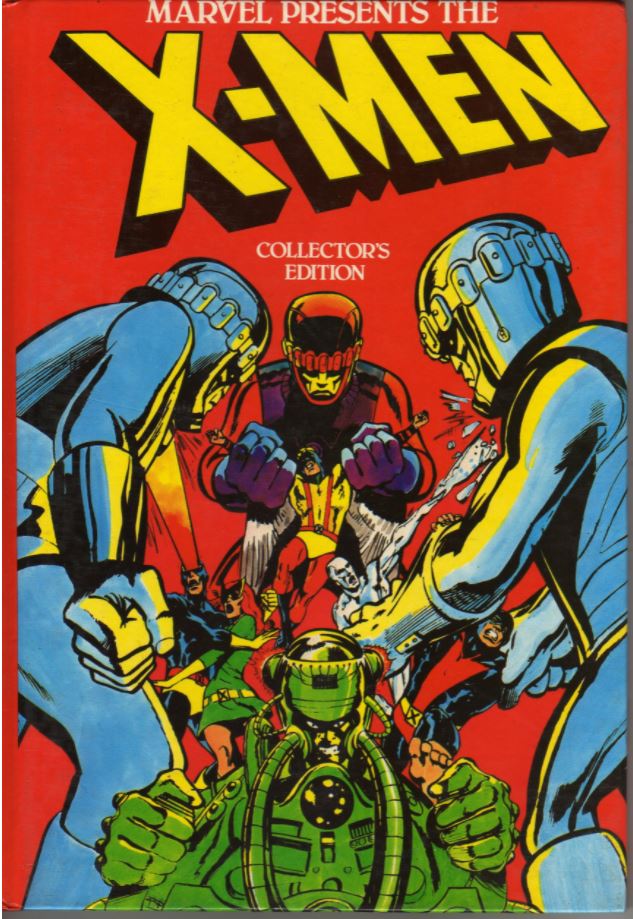
Marvel Presents The X-Men Collector’s Edition (1982 Annual)


By Roy Thomas, Neal Adams, Tom Palmer & various (Grandreams/Marvel Comics International)
ISBN: 0-86227-038-3 (HB Annual)

When Stan Lee stormed the American comic-book industry in the early 1960s, his greatest weapon wasn’t the compact and brilliant talent pool available nor even the proverbial idea whose time had come, but rather his canny hucksterism and grasp of marketing and promotion. DC, Dell/Gold Key and Charlton all had limited overseas licenses (usually in black-and-white reprint anthologies) but Lee went further, reselling Marvel’s revolutionary early efforts all over the world.

In Britain, the material appeared in Class Comics and reformatted in weeklies like Pow!, Wham!, Smash! and even the venerable Eagle. There were also two almost wholly Marvel-ised papers, Fantastic and Terrific, which ran from 1967 to 1968 with only one UK originated strip in each. These slick format comics mimicked Marvel’s US “split-books” and originally featured three key Marvel properties in each. However, appearing every seven days quickly exhausted the company’s back catalogue.

After years of guesting in other publications, Marvel secured their own UK Annuals at the end of the 1960s through the publishing arm of World Distributors and – after launching their own British-based subsidiary – began a line of hardback premium reprints which made Christmas a special treat for growing Marvelites across the Kingdom and the House of Ideas a mainstay of the Yuletide season…

This particular oddment stems from 1982: a slim, sleekly repackaged but brutally trimmed down tome abridging a classic but somewhat tale from the end of the Silver Age: specifically, X-Men volume 1, #56-59, courtesy of Roy Thomas, Neal Adams & Tom Palmer.

It begins by asking ‘What is… the Power?’ and reveals an uncanny connection between the villainous Living Pharaoh and emergent mutant Alex Summers younger brother of team leader Cyclops.

By imprisoning Alex the Egyptian mastermind transforms into a colossal Living Monolith, but when he breaks free the terrified boy’s mutant energies are unleashed with catastrophic results. Savagely edited together with issue #57 the story jumps to reveal the team’s most relentless adversaries have returned and a public witch-hunt prompts the mutant-hunting Sentinels to capture X-Men and other Homo superior across the globe.

Chapter 2, ‘Mission: Murder!’ ramps up the tension as the toll of fallen mutants increases, with Iceman, the Pharaoh, Angel and Mesmero all falling to the murderous mechanoids, but when their human controller discovers an unsuspected secret the automatons strike out on their own…

With most mutants in the Marvel universe captured, Cyclops, Marvel Girl and Beast are reduced to a suicidal frontal assault, pulling off a spectacular victory, but only at great cost…

Gone are the text stories, quizzes and game pages which traditionally padded out most British Christmas books, replaced with cover-to-cover superhero action produced by the House of Ideas at the very peak of its creativity. Moreover, it’s in full colour throughout – an almost unheard-of largesse at the time.

More a sign of changing attitudes than a celebration of good old days, this is still a quirky nostalgic treat for all concerned.
© MARVEL COMICS INTERNATIONAL LTD. All rights reserved

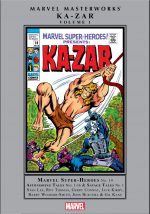
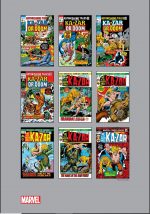
Ka-Zar Marvel Masterworks volume 1


By Arnold Drake, Steve Parkhouse, Stan Lee, Roy Thomas, Gerry Conway, Gary Friedrich, Len Wein, Mike Friedrich, George Tuska, Barry Windsor-Smith, Herb Trimpe, John Buscema, Gil Kane, Neal Adams, Rich Buckler, Dan Adkins & various (Marvel)
ISBN: 978-0-7851-5957-5 (HB)

Win’s Christmas Gift Recommendation: A Fabulous Feast of Fantastic Forest Fun and Fury… 9/10

Beginning as a Tarzan tribute act relocated to a lost world in a sub-polar realm of swamp-men and dinosaurs, Ka-Zar eventually evolved into one of Marvel’s more complex – if variable – characters. Wealthy heir to one of Britain’s oldest noble families, his best friend is Zabu the sabretooth tiger, his wife is feisty environmental-crusader Shanna the She-Devil and his brother is a homicidal super-scientific bandit. Kevin Reginald, Lord Plunder is perpetually torn between the clean life-or-death simplicity of the jungle and the bewildering constant compromises of modern civilisation.

The primordial paragon is arguably Marvel’s oldest star, having begun life as a prose pulp star, boasting three issues of his own magazine between October 1936 and June 1937. They were authored by Bob Byrd – a pseudonym for publisher Martin Goodman or one of a fleet of writers on staff – who latterly had him shoehorned into his speculative new-fangled comic book venture Marvel Comics #1 (October 1939), beside The Angel (another pulp line graduate), Masked Raider, Human Torch and Sub-Mariner…

In 1965, when he reappeared all rowdy and renovated in X-Men #10, it was clear the uncrowned Sovereign of the Savage Land was destined for bigger and better things, but for years all we got was guest shots as a misunderstood foe du jour for Daredevil, Sub-Mariner, Spider-Man, and the Hulk.

Eventually in 1969 he got his shot at a solo saga in Marvel Super-Heroes and later that year – after Roy Thomas & Neal Adams used him so effectively in their X-Men run (#62-63) – he was awarded a giant-sized solo title reprinting all his previous appearances but strangely offering all-new stories of Hercules and the Angel. That same month, his first regular series began in a new split book entitled Astonishing Tales…

Gathering material from Marvel Super-Heroes #19; Savage Tales volume 1 #1 and Astonishing Tales #1-16, spanning March 1969 to February 1973, this initial hardback and digital volume traces Lord Plunder’s path from misjudged superhero to barbaric fantasy star. Following a revelatory Introduction by Roy Thomas, we plunge straight in to ‘My Father, My Enemy’ from Marvel Super-Heroes #19 March 1969. Scripted by Arnold Drake and Steve Parkhouse with art from George Tuska & Sid Greene it gathers scraps from previous stories to forge an origin for Ka-Zar the Jungle Master!, revealing a murky web of deceit and intrigue as Kevin Plunder quits British High Society in search of the truth about the father who apparently abandoned him and his unsavoury super-villain brother Parnival years earlier in search of a lost continent and mystery anti-metal.

At the behest of Parnival – AKA The Plunderer – Ka-Zar’s return to his spiritual home soon descends into a brutal clash with tribesmen of the Golden People safeguarding the menacing mineral and another painful half-victory for the his scurrilous sibling…

August 1970 saw the launch of Astonishing Tales with the Jungle Lord sharing space with Latverian Liege Doctor Doom. Stan Lee, Jack Kirby & Sam Grainger displayed ‘The Power of Ka-Zar!’ as crazed “sportsman” Kraven the Hunter sets his sights on Zabu’s pelt. A successful ambush in Antarctica sees the toothy tiger trapped and dragged back to “civilisation”. However, his human brother survives the assault and grimly follows the villain, leading to ‘Frenzy on the Fortieth Floor!’ as the second issue sees our hero – retitled Ka-Zar, Lord of the Jungle! – track his prey to Manhattan and score a stunning rescue and victory. Thomas replaced Lee here, but gave way to Gerry Conway, with Barry (Windsor) Smith joining Grainger to detail the hero’s first meeting with living god Garokk the Petrified Man urgently demanding his help in getting ‘Back to the Savage Land!’ where his ambitious Queen Priestess Zaladane has begun a war of conquest against the many tribes of the hidden continent. After sharing his all-too human origins and connection to the primordial domain, the constantly-mutating stranger is brought home just in time to become ‘The Sun God!’ in thought and deed as well as appearance; going on a destructive ‘Rampage!’ (inked by Frank Giacoia) and forcing harsh choices from Ka-Zar and his comrade Tongah of the Fall People…

AT #6 sees a stunning art job from Smith & Bill Everett as Conway’s ‘Ware the Winds of Death!’ pits the war’s survivors against reawakened alien god Damon, returned after centuries to destroy the world that took his lover Lelania, even as in faraway England a mysterious woman seeks to warn Lord Plunder of impending doom…

Thomas returns to script with Herb Trimpe illustrating concluding chapter ‘Deluge!’ as Damon is repelled – but only at tragic cost to Tongah – before Edgar Rice Burroughs’ Caspak and Caprona (with hints of Romeo and Juliet) tales inform #8’s ‘The Battle of New Britannia!’ by Thomas, Gary Friedrich, Trimpe & Tom Sutton, as Ka-Zar and Zabu explore a new region of the vast under-ice region, discovering warring colonies populated by the remnants of British and German soldiers still fighting WWII. Into this mass mess of monsters, man-apes and secret pacts and lies, parachutes the mystery girl from England, a formidable force who will eventually be superspy/Avenger Bobbi “Mockingbird” Morse…

Astonishing Tales #8 was an experiment with increased page count and included an origin tale by Len Wein, George Tuska & Mike Esposito. ‘This Badge Bedeviled!’ reveals how twins Damian and Joshua Link – one a cop, the other a crook – are changed by an abortive experiment. The result was that they could combine their physicality and abilities into one body as Gemini, but sadly only one personality could dominate…

The next issue was normal-sized but now only Ka-Zar was in situ, retitled Ka-Zar, Lord of the Hidden Jungle. Moreover, thanks to scheduling problems it was as a fill-in: a pure barbarian fantasy in the manner of Conan. ‘The Legend of the Lizard Men!’ by Lee & John Buscema pitted the outraged savage against a conquering witch-queen enslaving tribes and hiding a big secret…

The ongoing storyline continues and concludes with #10 (February 1972) as Thomas, Conway, Windsor-Smith & Sal Buscema usher in a minor Götterdämmerung with an horrific secret exposed in ‘To End in Flame!’

A newish direction beckons as #11’s ‘A Day of Tigers!’ revisits, clarifies and expands upon Ka-Zar’s origin in superb tale by Thomas, Gil Kane & Giacoia detailing how a young boy lost in Savage Land forms a primal bond with a sabretooth tiger, gains a lifelong enemy in Maa-Gor the Man-Ape becomes unwilling custodian to the most dangerous element on Earth…

Astonishing Tales #12 abruptly relocates the entire cast to Florida for ‘Terror Stalks the Everglades!’ with Thomas, John Buscema & Dan Adkins recasting the Jungle King as a consultant for S.H.I.E.L.D. assisting aging biologist Dr. WilmaCalvin – who just happens to be Morse’s mentor – in tracking down missing scientist Ted Sallis…

What Ka-Zar doesn’t know is that the project all of them are working on is the recreation of the super-soldier serum that created Captain America and what nobody living knows is that Sallis succeeded. However, when Advanced Idea Mechanic agents tried to steal it, Sallis injected himself and the chemicals reacted with the swamp’s magical energies to create a mindless shambling monster.

Readers are clued in thanks to an unused interlude intended for Savage Tales #2, with Wein & Neal Adams providing a chilling recap sequence detailing the macabre Man-Thing‘s previous relationship with Calvin, before we slip back to now with AIM attacking and trapping Ka-Zar with the bog-beast…

AT #13 sees Thomas, J. Buscema, Rich Buckler & Adkins expand the mystery as the Jungle Lord escapes the ‘Man-Thing!’ to focus on the real monsters, subsequently routing out a traitor and defeating AIM… for now…

Scheduling continued to be tricky and #14 featured Lee & John Buscema’s ‘The Night of the Looter’: a bowdlerised, colourised version of a rather racy thriller first seen in Savage Tales #1 wherein Ka-Zar scorns the temptations and dodges the perils brought by destructive treasure hunters from civilisation invading his hidden home, before continuity returned with #15 as Mike Friedrich, Kane & Sutton ask ‘And Who Will Call Him Savage?’

Increasingly enamoured of Barbra Morse, Ka-Zar opts to give the modern world another go, but quickly comes to despise the greed, the dirt, the greed, the callous brutality and the sheer greed of petty people, especially after encountering the drug crisis first hand and clashing with dope peddler The Pusher…

When his vile schemes almost end Wilma Calvin’s life, Ka-Zar goes wild in ‘To Stalk a City!’ (Friedrich, Buckler & Chic Stone) rampaging through the concrete jungle of New York City and delivering a king’s justice in an edgy action packed conclusion.

Also included here is the original, unedited monochrome version of Lee & Buscema’s ‘The Night of the Looter’ as seen in May 1971’s Savage Tales (volume 1 #1) lush with grey-tone washes with some gratuitous female nudity to keep readers attention high. Also on display is a pertinent text ‘Bullpen Bulletins’ page, and house ads, and the covers from aforementioned 1970 reprint series Ka-Zar volume 1, #1-3, rendered by Marie Severin and John Romita (Sr.)

Boldly bombastic, brilliantly escapist and crafted by some of the biggest and best in comics, these wild rides and riotous romps are timeless fun from the borderlands of Marvel’s endless universe: a fabulous excursion in to forgotten worlds you’ll want to treasure forever…
© 2017 Marvel Characters, Inc. All rights reserved.

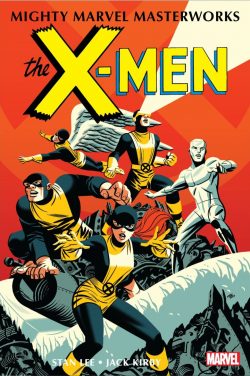
Mighty Marvel  Masterworks The X-Men volume 1: The Strangest Super-Heroes of All


By Stan Lee & Jack Kirby & various (Marvel)
ISBN: 978-1-3029-2980-0 (TPB)

Win’s Christmas Gift Recommendation: Utterly X-traordinary Entertainment… 10/10

These stories are timeless and have been gathered many times before so I’m once more digressing to talk about format first. The Mighty Marvel Masterworks line has been designed with economy in mind. Classic tales of Marvel’s key creators and characters re-presented in chronological order have been a staple since the 1990s, but always in lavish, expensive hardback collectors editions. These new books are far cheaper, on lower quality paper and – crucially – are smaller, about the dimensions of a paperback book. Your eyesight might be failing and your hands too big and shaky, but at 152 x 227mm, they’re perfect for kids. If you opt for the digital editions, that’s no issue at all…

Way back in 1963 things really took off for the budding Marvel Comics as Stan Lee & Jack Kirby expanded their diminutive line of action titles, putting a bunch of relatively new super-heroes (including hot-off-the-presses Iron Man) together as The Avengers; launching a decidedly different war comic in Sgt. Fury and his Howling Commandos and creating a group of alienated heroic teenagers who gathered together to fight a rather specific, previously unperceived threat to humanity.

Those halcyon days are revisited in this splendid trade paperback and eBook compilation: gathering from September 1963 to March 1965, the contents of X-Men #1-10.

Issue #1 introduced Cyclops, Iceman, Angel and the Beast: extremely special students of Professor Charles Xavier, a wheelchair-bound telepath dedicated to brokering peace and integration between the masses of humanity and the emergent off-shoot race of mutants dubbed Homo Superior. The story opens as the students welcome their newest classmate, Jean Grey, aka Marvel Girl: a young woman with the ability to move objects with her mind.

No sooner has the Professor explained their mission than an actual Evil Mutant – Magneto – singlehandedly takes over American missile base Cape Citadel. A seemingly unbeatable threat, the master of magnetism is nonetheless driven off in under 15 minutes by the young heroes on their first mission …

It doesn’t sound like much, but the gritty dynamic power of Kirby’s art, solidly inked by veteran Paul Reinman, imparted a raw energy to the tale which carried the bi-monthly book irresistibly forward. With issue #2, a Federal connection was established in the form of FBI Special Agent Fred Duncan, who requests the teen team’s assistance in capturing a mutant threatening to steal US military secrets in ‘No One Can Stop the Vanisher!’.

These days, young heroes are ten-a-penny, but it should be noted that these kids were among Marvel’s first juvenile super-doers (unless you count Spider-Man or Human Torch Johnny Storm) since the end of the Golden Age, so it’s perhaps unsurprising that in this tale of a terrifying teleporter the outmatched youngsters needed a little adult supervision…

Issue #3’s ‘Beware of the Blob!’ displays a rare lapse of judgement when proselytising Professor X invites a sideshow freak into the team, only to be rebuffed by the felonious mutant. Impervious to mortal harm, The Blob incites his carnival cronies to attack the hidden heroes before they can come after him, and once again it’s up to teacher to save the day…

With X-Men #4 (March 1964) a thematic sea-change occurs as Magneto returns, heading ‘The Brotherhood of Evil Mutants!’ Intent on conquering a South American country and establishing a political powerbase, he ruthlessly dominates Mastermind, Toad, Quicksilver and the Scarlet Witch: all very much his unwilling thralls in the bombastic struggle that follows. From then on, the callow champions-in-training are the prey of many malevolent mutants…

‘Trapped: One X-Man!’ in issue #5 sees early results in that covert hunt as Angel is abducted to Magneto’s orbiting satellite base Asteroid M, and only a desperate battle at the edge of space eventually saves him…

‘Sub-Mariner Joins the Evil Mutants!’ is a self-explanatory tale of gripping intensity elevated to magical levels of artistic quality as superb Chic Stone replaced Reinman as inker for the rest of Kirby’s tenure. The issue also incorporates a stunning ‘Special Pin-up page’ starring “Cyclops”.

Genuine narrative progress is made with ‘The Return of the Blob!’ as their mentor leaves on a secret mission, but not before appointing Cyclops acting team leader. Comedy relief comes as Lee & Kirby introduce Beast and Iceman to the Beatnik-inspired “youth scene” whilst the high action quotient is maintained courtesy of a troubled teaming of the Blob and Magneto’s malign brood…

Another and very different invulnerable mutant debuted in ‘Unus the Untouchable!’: a wrestler with an invisible force field who attempts to enlist in the Brotherhood by offering to bring them an X-Man. Also notable is the first real incident of “anti-mutant hysteria” (a shaded reference to civil rights struggle being waged in America at that time) after a mob attacks Beast. The theme that would become the cornerstone of the X-Men mythos. The issue ends with a ‘Special Pin-up page’ featuring ‘The Beast’.

X-Men #9 (January 1965) is the first true masterpiece of this celebrated title. ‘Enter, the Avengers!’ reunites the mutants with Professor X in the wilds of Balkan Europe, as lethal, lurking Lucifer seeks to destroy Earth with a super-bomb, subsequently manipulating the teens into an all-out battle with the World’s Mightiest heroes. This month’s extra treat is a‘Marvel Masterwork Pin-up’ of ‘Marvel Girl’

This is still a perfect Marvel comic story today, as is its follow-up ‘The Coming of Ka-Zar!’: an incredible excursion to Antarctica, featuring the discovery of the Antediluvian Savage Land and the modern incarnation of one of Marvel/Timely’s oldest heroes. Kazar the Great was a pulp Tarzan knock-off who migrated to the comics page, with in October/November 1939’s Marvel Comics #1.

Dinosaurs, lost cities, spectacular locations, mystery and all-out action: it doesn’t get better than this…

Sadly, this would be King Kirby’s penultimate outing with the “strangest teens of all time”…

To Be Continued…

Supplemented by a house ad and gloriously unused cover for X-Men #10 by Kirby & Stone, these quirky tales are a million miles removed from today’s angst-ridden, breast-beating, cripplingly convoluted X-brand, and in many ways are all the better for it. Superbly rendered, highly readable adventures are never unwelcome or out of favour, and it must be remembered that everything here informs so very much of the mutant monolith. These are tales for dedicated fans and rawest converts alike  Everyone should have these stories.
© 2021 MARVEL

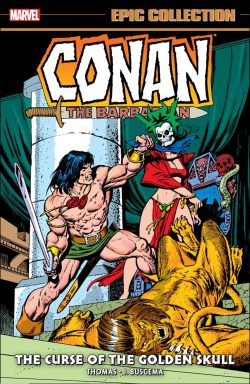
Conan the Barbarian Epic Collection volume 3 1973-1974: The Curse of the Golden Skull


By Roy Thomas, John Buscema, Neal Adams, Rich Buckler, Ernie Chan & various (Marvel)
ISBN: 978-1-3029-2655-7 (TPB)

Win’s Christmas Gift Recommendation: Savagely Sensational Sagas for All Seasons… 8/10

During the 1970’s the American comic book industry opened up after more than 15 years of calcified publishing practises in response to the censorious, self-inflicted Comics Code Authority: created to police product after the industry suffered its very own McCarthy-style 1950s Witch-hunt.

One of the first genres revisited was Horror/Mystery comics and from that sprang translated pulp star Conan the Cimmerian; initially crafted by Roy Thomas & Barry Windsor-Smith. Despite some early teething problems – including being cancelled and reinstated in the same month – the comic adventures of Robert E. Howard’s wandering warrior quickly became as big a success as the revived prose paperbacks which had heralded a world resurgence in tales of fantasy and the supernatural.

After decades away, the brawny brute recently returned to the Aegis of Marvel, who’s first bite of the cherry was retroactively subtitled “the Original Marvel Years” due to the character’s sojourn with other publishers and intellectual properties rights holders.

This third compendium of action fantasy reprints Conan the Barbarian #27-42 plus material from the first Annual and spans June1973 to May 1973 – a period when he was becoming the darling of the Comics world and when artist John Buscema made the hero his very own.

Story content was evermore redolent of pulp-oriented episodic action – much of it based on Thomas’ adaptations of Howard’s (and sometimes, other writers) “heroic” rather than fantasy fiction. Also on show is the inking of long-time Conan illustrator Ernie Chan, using at this time for reasons unimportant now the pen-name “Ernie Chua”.

First up is ‘Blood of Bel-Hissar’: a tight, taut tale of banditry, treacherous hill-chieftains and jinxed gems set in the aftermath of the recently ended War of the Tarim, followed by a gripping jungle-set horror story. ‘Moon of Zembabwei’sees the Cimmerian battling rival thief Thutmekri, witch-dancers and a golden monster ape before ‘Two Against Turan’has the sell-sword joining the army of Howard’s analogue of an Arabic super-state (and how prescient was that?).

Effete and ineffectual King Yildiz – father of Conan’s greatest human enemy, Yezdigerd – features in a tale displaying all of the barbarian’s most compelling qualities as he rescues agitator and new drinking buddy Ormraxes from the city’s torturers: a mistake that almost costs him his life…

Closely following is ‘Hand of Nergal’: another mystic adventure and one not taken directly from a Howard original, although it is derived from a Lin Carter novelette based on Howard’s notes. When Yildiz’s legions clash with the armies of a rebel satrap, sole survivor Conan is eventually pitted against the sorcery-possessed revolutionary and trapped at ground-zero of a clash between elder gods/demons…

Sporting a stunning Windsor-Smith cover, Conan the Barbarian Annual #1 was a reprint vehicle. It’s represented here by the aforementioned pic and text feature ‘The Hyborian Page’ before we head back to the monthly mag where #31 sees Thomas, Buscema & Chan at their brutal best. ‘Shadow in the Tomb’ has become an iconic Conan scenario due to the movies, but it’s a fairly standard monster and mayhem yarn where the allure of sudden wealth awakens something old, arcane and angry…

Further deviating from the prose canon, what follows is a 3-chapter epic based on the novel Flame Winds by Norvell W. Page – author of most of the 1930s pulp adventures of The Spider – with Thomas substituting Conan for wandering crusader Prester John, and setting the tale in Howard’s fabulous and fabled analogue of ancient China: ‘Khitai’.

Beginning in ‘Flame Winds of Lost Khitai’ with the unwelcome Barbarian caught in a war between the seven ruling sorcerers of the city of Wan Tengri, expanding ferociously into urban unrest and eldritch carnage in ‘Death and 7 Wizards’ and cataclysmically concluding with Conan confronting ‘The Temptress in the Tower of Flame!’ and overturning millennia of oppressive civilisation, this roaring romp deals out politics, magic and greed for Conan to overcome before he decides the Orient is not for him…

Heading towards the middle east with aggravating new flunky Bortai, he is driven by desert raiders into trackless wastes to discover a shattered abandoned city. A skeleton grasping an azure gem should be warning enough, but greed overwhelms common sense and before long ‘The Hell-Spawn of Kara-Shehr’ is loosed on the Barbarian and those who still pursue him. That yarn was freely adapted from Howard’s The Fires of Assurbanipal, but ‘Beware the Hykranians Bearing Gifts…’ is all-original: finding Conan finally back in Aghraphur and reporting to King Yildiz, just in time to save the impotentate from mystic assassination, after which Neal Adams steps in to spectacularly limn ‘The Curse of the Golden Skull’ with Conan and new comrade Juma captured by a mad wizard keen on creating a dynasty with the princess they’re bodyguarding.

His Lemurian arts and monsters eventually prove no match for brawny thews and determination after which Buscema and Chan return for Thomas’ spin on Howard’s The House of Arabu. ‘The Warrior and the Were-Woman’, sees the barbarian involved in petty palace politics and targeted by the mate of a monster he recently despatched, and is followed by epic all-original yarn ‘Dragon from the Inland Sea’ wherein Conan sets out to rescue a sacrificial maid from a very determined, very big lizard: a tale with mythological antecedents graced with Buscema inking his own pencils …

Chan is back in in #40 inking Rich Buckler’s pinch-hitter pencilling on ‘The Fiend from the Forgotten City’. Plotted by Michael Resnick, it sadly suffers a notable lack of panache and verve but still provides a solid tale of treachery and tomb-raiders, after which Buscema, Chan & Thomas reunite for new tale ‘The Garden of Death and Life’, as the nomadic mercenary lands in a nameless desert village sustained by a monstrous predatory tree…

We close for now on the ‘Night of the Gargoyle’ – adapted from Howard’s The Purple Heart of Erlik – bringing the action to a halt to a close on a spooky note as Conan returns to thieving and attracts the extremely unwanted attention of mystic adept Lun-Faar and his menagerie of horrors…

These classic tales are burnished by more behind the scenes extras such as a picture feature on the 1974 Conan commemorative coin and Marvel Value Stamp, plus contemporary house ads, 4 Buscema pencil pages and a previous Omnibus Collection cover by Dale Keown & Jason Keith.

Stirring, evocative, and deeply satisfying on a primal level, this is one of the best volumes in a superb series of a paragon of adventurers. What more does any red-blooded, action-starved fan need to know?
© 2021 Conan Properties International, LLC (“CPI”)

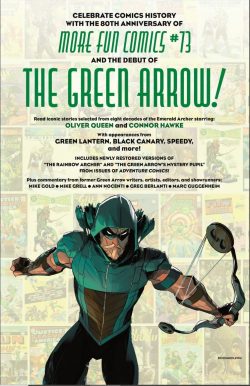
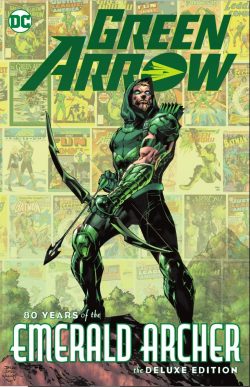
Green Arrow: 80 Years of the Emerald Archer – The Deluxe Edition


By Mort Weisinger, Ed Herron, Denny O’Neil, Mike Grell, Chuck Dixon, Grant Morrison, Kevin Smith, Brad Meltzer, Judd Winick, Jeff Lemire, Marc Guggenheim, Benjamin Percy, George Papp, Lee Elias, Neal Adams, Jim Aparo, Rodolfo Damaggio, Oscar Jimenez, Phil Hester, Scott McDaniel, Cliff Chiang, Denys Cowan, Joe Bennett,Otto Schmidt & various (DC Comics)
ISBN: 978-1-7795-0914-7 (HB)

Win’s Christmas Gift Recommendation: Superb All-Ages Entertainment and Adventure… 9/10

Green Arrow is one of DC’s Golden All-Stars. He’s been a company fixture – in many instances for no discernible reason – more or less continually since his 1941 debut in More Fun Comics #73. Many Happy Returns, Emerald Archer!

In those distant heady days, origins weren’t as important as image or storytelling, so creators Mort Weisinger & George Papp never bothered. The first inkling of formative motivations came in More Fun Comics #89 (March 1943) wherein Joe Samachson & Cliff Young detailed ‘The Birth of the Battling Bowman‘ (and a tip of the feathered hat to Scott McCullar for bringing the tale to my belated attention).

With the secret revealed, it was promptly ignored for years, leaving later workmen France “Ed” Herron, Jack Kirby and his wife Roz to fill in the blanks again with ‘The Green Arrow’s First Case’ at the start of the Silver Age superhero revival. It appeared in Adventure Comics #256, coved-dated January 1959. This time the story stuck, becoming – with numerous tweaks over successive years – the basis of the modern Amazing Archer on page and screen.

This hardback and digital celebration offers another quick survey of the Battling Bowman’s epic career, gathering material from More Fun Comics #73, Adventure Comics #246, 259, Green Lantern/Green Arrow #85-86, Green Arrow: The Longbow Hunters #1, Green Arrow volume 2 #100-101, JLA ‘8-9, Green Arrow volume 3 #1, 17, 75, Green Arrow and Black Canary #4, Secret Origins volume 3 #4, Arrow Season 2.5 #1, Green Arrow: Rebirth #1 and opens with the first of a series of brief prose ruminations ad reminiscences. Former editor Mike Gold details the heritage and legacy of ‘The Octogenarian Green Arrow’ before we meet the stars in November 1941’s More Fun Comics#73 solving the ‘Case of the Namesake Murders’ (Weisinger & Papp). Skipping unchanged to March 1958 and Adventure Comics #246, Herron & Papp detail how a counterfeiter redesigns himself as toxophilist terrorist ‘The Rainbow Archer’ whilst issue #259 (April 1959 by an anonymous author and Lee Elias) introduces ‘The Green Arrow’s Mystery Pupil’: exposing ulterior and sinister motives for his studies…

The turbulent 1960s saw Oliver Queen utterly reinvented. Deprived of his fortune he became a strident advocate of liberal issues in a bold experiment which created a fad for socially relevant, ecologically aware, mature stories which spread throughout DC’s costumed hero comics and beyond; totally revolutionising the industry and nigh-radicalising many readers.

Tapping relatively youthful superstars-in-waiting Denny O’Neil & Neal Adams to produce the revolutionary fare, editor Julie Schwartz watched in fascinated disbelief as the resultant thirteen groundbreaking, landmark issues captured the tone of the times, garnering critical praise, awards and valuable publicity from the outside world, whilst simultaneously registering such poor sales that the series was cancelled anyway: the heroes unceremoniously packed off to the back of marginally less-endangered comic book The Flash.

America at his time was a bubbling cauldron of social turmoil and experimentation. Everyone and everything were challenged on principle, and O’Neil & Adams utterly redefined super-heroism with “Issues”-driven stories transforming complacent establishment masked boy-scouts into uncertain, questioning champions and strident explorers of the enigma of America.

Probably the most notably of the run was 2-part saga ‘Snowbirds Don’t Fly’ and ‘They Say It’ll Kill Me…But They Won’t Say When!’ in Green Lantern/Green Arrow #85-86 (September – November 1972???)

Depiction of drug abuse had been strictly proscribed in comic books since the advent of the Comics Code Authority, but by 1971 the elephant in the room was too big to ignore and both Marvel and DC addressed the issue in startlingly powerful tales that opened Pandora’s dirty box forever. When the Green Gladiators are drawn into conflict with a vicious heroin-smuggling gang, Oliver Queen is horrified to discover his own sidekick had become an addict…

This sordid, nasty tale did more than merely preach or condemn, but actively sought to explain why young people turned to drugs, just what the consequences could be and even hinted at solutions older people and parents might not want to consider. It might all seem a little naïve now, but the earnest drive to do something and the sheer dark power and visual elan of the story still deliver a stunning punch…

Following Mike Grell writing about ‘My Favorite Hero’ comes the first chapter of the tale he crafted to radically reinvent the Archer for the post-Vietnam generation: setting out a new path that would quickly lead to the hero becoming a major player at long last and, ultimately, a 21st century TV sensation.

Green Arrow is one of the very few superheroes to be continuously published (more or less) since the Golden Age. On first look, the combination of Batman and Robin Hood seems to have very little going for him, but he has always managed to keep himself in vogue and in sight.

Probably the most telling of his many, many makeovers came in 1987, when – hot on the heels of Frank Miller’s The Dark Knight Returns – Grell was given the green light to make the Emerald Archer the star of DC’s second Prestige Format Mini-Series.

Grell was considered a major creator at the time, having practically saved the company with his Edgar Rice Burroughs inspired fantasy series Warlord. He had illustrated many of GA’s most recent tales (in Green Lantern/Green Arrow, Action Comics and elsewhere), and was a firm fan-favourite after well-received runs on Legion of Super-Heroes, Aquaman, Phantom Stranger, Batman and others. During the early 1980s, he had also worked on the prestigious Tarzan newspaper strip and created successful genre series Starslayer and Jon Sable, Freelance for pioneering indie publisher First Comics.

By the middle of the grim ‘n’ gritty Eighties, it was certainly time for another overhaul. Exploding arrows yes, maybe even net or rope arrows, but arrows with boxing gloves on them just don’t work (trust me – I know this from experience!). Moreover, for his 1960s makeover, the hero had evolved into a tempestuous, social reformer using his gifts to battle for the little guy. Now, in a new era of corrupt government, drug cartels and serial killers, this emerald survivor adapted again and thrived once more.

The plot was brilliantly logical and controversial, concerning the superhero’s mid-life crisis. Weary and aging, Oliver Queen relocates to Seattle, struggling to come to terms with the fact that since his former sidekick Speedy is now a dad, he is technically a grandfather. With long-time ‘significant other’ Dinah Lance/Black Canary, he starts simplifying his life, but the drive to fight injustice hasn’t dimmed for either of them.

As she goes undercover to stamp out a pervasive drug ring, the Arrow hunts the hunt for a psycho-killer dubbed “The Seattle Slasher”. Tracking a prolific beast slaughtering prostitutes, he learns of a second, cross-country slayer murdering people with arrows – the “Robin-Hood Killer”…

Eschewing his gaudy costume and gimmicks, Queen is an urban hunter stalking unglamorous hidden monsters, but stumbles into a complex mystery leading back to WWII, involving the Yakuza, CIA, corporate America and even Viet Nam war secrets that eventually change the course of the Archer’s life…

Intricate and effortless, the plot weaves around the destabilized champion, Dinah and new character Shado: exploring and echoing themes of vengeance and family in a subtle blending of three stories that are in fact one, delivering a shocking punch even now. This yarn, its narrative quality and sophistication, is arguably the first truly mature superhero yarn in the DCU.

Grell produced a gripping, mystery adventure pushing all the right buttons, conveyed by artwork – in collaboration with Lurene Haynes & Julia Lacquement – that was and remains a revelation. Beautifully demure yet edgily sharp when required, these painterly visuals and watercolour tones perfectly complement a terse, sparse script, and compelling ride.

It’s shame you’ll need another book to see the body and end of this snapping dragon…

The miniseries led to a lengthy and noteworthy run but – as ever – fashions changed and Oliver’s run apparently ended forever in Green Arrow volume 2 #100-101 (September & October 1995).

‘The Trap’ and ‘Run of the Arrow’ – by Chuck Dixon, Jim Aparo, Rodolfo DaMaggio, Gerry Fernandez & Robert Campanella  saw a weary, radicalised aging hero make the ultimate sacrifice to save Metropolis from eco-terrorist Hyraxwhilst his new-found, ashram-trained son Connor Hawke reluctantly assumed his legacy. The Buddhist-trained martial artist reluctantly took up his estranged father’s role and mission and was impressive enough to be summoned to the moon for a try-out in the  reinvented Justice League.

Grant Morrison, Oscar Jimenez, Chip Wallace, Hanibal Rodriguez supervised the secret son’s invitation to join the bright and shiny, no-nonsense team in August and September 1997’s JLA #8-9, with Jimenez & Wallace rendering ‘Imaginary Stories’ as mind-bending villain The Key attempts to conquer the universe by trapping individual Leaguers in perfect dreams, before the art was augmented by Anibal Rodriguez for the tense conclusion ‘Elseworlds’ This sees the Zen Archer saving the day in his own unique style…

Recent scribe Anne Nocenti describes ‘Hitting the Ground Running’ about her tenure on the Emerald Archer before we cover the return of the irascible original Oliver Queen as seen in Green Arrow volume 3 #1 from April 2001. This revival, by unconventional Kevin Smith (yes, Silent Bob!) and the wonderful art-team of Phil Hester & Ande Parks, brings him back from Heaven in the most refreshing manner I’ve seen in nearly five decades of comic reading. . ‘Quiver: Chapter One: The Queen is Dead (Long Live the Queen)’ starts a gloriously enjoyable refining of Green Arrow embracing the fundamental daftness of superhero comics to revitalise them. Replete with guest-stars, jam-packed with action and intrigue and wallowing in fun thanks to the sly, snappy dialogue of Smith, this is a costume-drama in a thousand and I’m certainly not going to spoil your fun by giving away any details. Just revel in the smart combination of the old and the new to create the best yet…

The renewed energy and impetus caried on building as Green Arrow volume 3 #17, November 2002 – ‘The Archer’s Tale: Chapter Two: Grays of Shade’ by Brad Meltzer, Hester & Parks – highlighted a long-overdue reconciliation between the Arrow and Speedy, triggered by the mistimed activation of a contingency plan to hide all their secrets in the event of the hero’s death, after which Green Arrow volume 3 #75 (August 2007) sees ‘Jericho, Conclusion: And the Walls Came Tumbling Down’ by Judd Winick, Scott McDaniel Andy Owens. Here the now-much extended Arrow family unite to save Star City from Deathstroke the Terminator‘s deranged vengeance scheme and witness a marriage proposal everybody knew was inevitable…

Writer, Producer and Director Greg Berlanti discusses ‘Arrow: Origins’ before Green Arrow and Black Canary #4 (March 2008) depicts Judd Winick & Cliff Chiang’s ‘Dead Again, Conclusion: Please Play Where Daddy Can See You.’Detailing the loss of a beloved “team-arrow” member, it as powerful downbeat tale about duty and repercussions that segues neatly into a new motivational start for Oliver, created as part of the New 52 company-wide reboot.

For Secret Origins volume 3 #4 (September 2014) Jeff Lemire, Denys Cowan & Bill Sienkiewicz detailed what makes a hero in ‘Secret Origins: Green Arrow’ whilst essay ‘I’m Not Batman, Dammit’ by Oliver Queen (as told to Mark Guggenheim)’ uses a faux interview to tell some real truths before we enjoy the fruits of the hero’s TV success.

Like any proper comics to screen venture, the show generated a comic book extending the on-screen adventures and here Arrow Season 2.5 #1 (December 2014) sees Guggenheim, Joe Bennett, Jack Jadson & Craig Yeung craft a tense, terse thriller in ‘Blood: Descent’ with the Arrow vigilante’s team save their city from airborne death and settle in for the fight against a new Brother Blood after which the on-point action ends with a return to basics and the end of the New 52 experiment in ‘Rebirth’ by Benjamin Percy & Otto Schmidt. Returning to Seattle, middle age and liberal crusading, the one-shot Green Arrow: Rebirth #1 (August 2016) details a first meeting with Black Canary and the hunt for urban predators “the Underground Men” abducting and selling the city’s poor into slavery…

Capped off with ‘Cover Highlights’ from the Golden, Silver, Bronze, Dark and Modern Ages, pencil art by Jim Lee and full ‘Biographies’ of the army of creators crafting green dreams over 8 decades, this is a striking reminder of the tenacity of the heroic principle and an uncomplicated core concept. Ideal Fights ‘n’ Tights fun for all…
© 1941, 1958, 1959, 1971, 1987, 1995, 1997, 2001, 2002, 2007, 2008, 2014, 2016, 2021 DC Comics. All Rights Reserved.
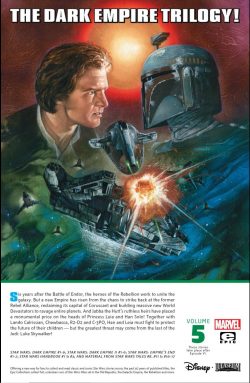
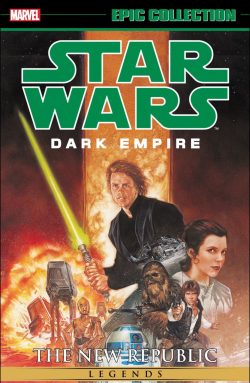
Star Wars – The New Republic Epic Collection volume 5: Dark Empire


By Tom Veitch, Peet Janes, Scott Allie, Jason Hall, Henry Gilroy, Joe Casey, Cam Kennedy, Jim Baikie, Paul Lee, Brian Horton, John McCrea, Dario Brizuela, Francisco Paronzini, Arthur Adams, Edvin Biuković, Steve Crespo, Rodolfo DaMaggio, Doug Mahnke, John Nadeau, Jordi Ensign, Stan Manoukian, Vince Roucher, Isaac Buckminster Owens, Dusty Abell, Jim Royal, Jan Duursema, Pop Mhan, Andrew Robinson & various (Marvel)
ISBN: 978-1-3029-2698-4 (TPB)

Win’s Christmas Gift Recommendation: Epic Entertainment and Adventure… 9/10

I’m sure we’re all familiar with the mythology of Star Wars. What you might not know is that the first sight future fanatics got of its breathtakingly expansive continuity and the mythology-in-the-making way back in 1977 was the premier issue of the Marvel comic book adaptation. It hit shelves two weeks before the film launched in cinemas, setting the scene for a legion of kids and beginning a mini-phenomenon which encompassed the initial movie trilogy and expanded those already vast imaginative horizons.

Marvel had an illustrious run with the franchise – nine years’ worth of comics, specials and paperback collections – before the option was left to die. Comic book exploits were reinstated in 1991 by Dark Horse Comics who built on the film legacy with numerous superb titles and tales until Disney acquired the rights to Star Wars in 2012. Around the same time, the home of Donald & Mickey also bought Marvel Comics and before long the original magic was being rekindled…

When Marvel relaunched the enterprise, they included not just a core title but also solo books for the lead stars. Moreover, rather than ignore what had passed between their two bites of the cherry, Disney/Marvel began reissuing the Dark Horse material too. Amongst the very best of it was a tryptic of miniseries released as one grand adventure under their Star Wars Legend imprint.

Scripted primarily by Tom Veitch, this fifth paperback/digital Epic Collection gathers Star Wars: Dark Empire #1-6; Dark Empire II #1-6; Empire’s End #1-2, plus material from Star Wars Tales #8, 11, 16, 17 and Star Wars Handbook volume one: X-Wing Rogue Squadron & Star Wars Handbook volume three: Dark Empire: originally seen between December 1991 and September 2003.

Set after the movie Return of the Jedi and now relegated conceptually to an alternate universe in light of later cinematic releases, Dark Horse kicked off its Star Wars franchise with a supremely moody, action-packed thriller. Illustrator Cam Kennedy (reuniting with scripter Veitch after previously collaborating on the excellent and peculiar Light and Darkness War), rendered the alien universe and familiar characters in his own unique and magnificent manner, delivering quirky but reassuringly authentic settings and scenarios for a space opera romp that satisfyingly captures the feel and pace of the cinema versions, whilst building on the canon for Force-starved fanatics everywhere.

Star Wars: Dark Empire opened in December 1991 with ‘The Destiny of a Jedi’: unfolding about ten years after the Battle of Endor and the death and redemption of Darth Vader. Although the Emperor is gone, the war continues. The militaristic remnants of the Empire are still battling for every inch of the galaxy. The New Republic is desperately hard-pressed. Han Solo and his wife Leia, although new parents, are as deeply involved as ever, and Luke Skywalker is pushed to ever-more desperate measures as he attempts to destroy the pervasive unleashed evil corrupting the universe. His solution to rebalance the Force is to revive and rebuild the fabled Jedi Knights…

A mysterious new leader employing ingenious new super-weapons is winning the war for the Empire in ‘Devastator of Worlds’ and the heroes must separate to succeed. The Alliance is being picked off world by world and as ‘The Battle for Calamari’ rages, Han and Leia pursue the strategic aspects of the conflict resulting in a ‘Confrontation on the Smugglers Moon’ whilst Luke heads directly to the source and succumbs to the Dark Side when a dead foe returns thanks to he horrors of cloning in ‘Emperor Reborn’.

‘The Fate of a Galaxy’ is decided with closing 6th issue (October 1992) with Leia’s newly conceived child destined to become the greatest threat the galaxy has ever faced…

Can the heroes reunite to avert the tragedy before all is lost?

No need to guess as December 1994 saw the start of sequel series Star Wars: Dark Empire II with ‘Operation Shadow Hand’.

Veitch & Kennedy returned in a blaze of glory after the runaway success of Dark Empire with a superb continuation featuring the further battles of Luke, Leia, Han Solo and all the other movie favourites…

Deprived of clone bodies he was incubating to ensure a return to physicality, the ghost of Emperor Palpatine is intent on possessing the unborn child in Leia’s belly even as his Dark Side lieutenants struggle to become his successor. The Empire’s last infrastructure remnants are producing more diabolical planet-killing weapons to terrorise and subdue the battered, war-weary galaxy and the monster expects success thanks to his last resort weapon: Seven Dark Jedi fanatically executing his contingency plans, whilst his nemesis Skywalker pursues a cosmic wild goose chase sparked by Jedi database the Holochron. It has set him in pursuit of scattered Jedi survivors who might have escaped the purge…

‘Duel on Nar Shaddaa’, ‘World of the Ancient Sith’ and ‘Battle on Byss’ unite old favourites with new Star Warriors – such as Ysanna tribe adepts Rayf and Jem – in a desperate struggle for survival even as reborn, young Palpatine readies ‘The Galaxy Weapon’ to deliver total victory.

Han and Leia have been hiding their Force-rich twins Jacen and Jaina from the Emperor for years, but are now fearful that their imminent third child will be the spectral horror’s new target for possession. When news comes that Palpatine has eradicated the entire Alliance leadership, Luke and his new Jedi disciples arrive in time to rally the last survivors in a last-ditch attempt to push back the swiftly-closing ‘Hand of Darkness’ (#6, May 1995). Tragically, the Dark Jedi are hot on their trail and a deadly confrontation looms…

This big bombastic blockbuster rockets along, packed with tension and invention, with action aplenty and spectacular set pieces for the fans – although it might be a tad bewildering if your Star Wars IQ is limited.

The trilogy concluded later that year in Star Wars: Empire’s End (October & November 1995) with Jim Baikie replacing Kennedy as artist for a much shorter adventure wrapping up all the plot-threads in a fittingly spectacular fashion. Issue #1’s ‘Triumph of the Empire’ sees the regrowth and expansion of a new rebel alliance and next generation of Jedi Knights when Palpatine discovers his clone-body is breaking down. The ‘Rage of the Emperor’ compels him to attempt a precipitous possession of new-born Anakin Solo leading to one final, sacrifice soaked confrontation…

Accompanying the colossal star-shaking events are a tranche of short stories taken from anthological series Star Wars Tales, beginning with ‘Tall Tales’ by Scott Allie, Paul Lee & Brian Horton from #11 (March 2002). Here, gossip among patrons in a cantina about a ship called the Millennium Falcon leads to another brawl by some very familiar strangers, after which ‘The Other’ (#16, June 2003 by Jason Hall & John McCrea) sees Luke and Leia on Coruscant, debating her future and provoking some awful memories of when they were constantly at war…

Star Wars Tales #8 (June 2001 by Henry Gilroy & Dario Brizuela & Francisco Paronzini) shares ‘The Secret Tales of Luke’s Hand’ as 4-year old Anakin Solo hears bedtime stories of his uncle’s prosthetic paw before Joe Casey & Francisco Paronzini expose ‘Phantom Menaces’ (#17, September 2003) when Ambassador Luke Skywalker encounters a seemingly spectral Sith Lord haunting a candidate planet of the New Republic …

After all that, true Jedi adepts and prospective Padawans can enhance their SWIQ through studying a veritable avalanche of new friends and foes whilst also reacquainting themselves with old favourites in data-drenched Star Wars Handbook volume one: X-Wing Rogue Squadron by Peet Janes, Arthur Adams, Edvin Biuković, Steve Crespo, Rodolfo DaMaggio, Doug Mahnke, John Nadeau, Jordi Ensign, Stan Manoukian, Vince Roucher and Star Wars Handbook volume three: Dark Empire by Janes, Nadeau, Ensign, Isaac Buckminster Owens, Dusty Abell, Jim Royal, Jan Duursema, Pop Mhan & Andrew Robinson.

These catalogues detail everybody and everything from Wedge Antilles and Boba Fett to World Devastators and the Jedi Holocron and segue efficiently into a trove of extras including a gallery of covers – movie photos and painted works from Dave Dorman, Ashley Wood, Kia Asamiya, John Nadeau – plus previous collection covers by Dorman, Mark Zug and Tsuneo Sanda.

There’s also Dark Empire painted promo art, character roughs and equipment sketches, and pencilled pages all by Cam Kennedy; text End-pieces and Introductions from the original comics as well as art Prints and Plates by Kennedy and Dorman.

Exceptional fun, in strong stories with beautiful pictures, this is an utter delight for devotees of a galaxy not so very far, far away and anyone hungry for good old fashioned action entertainment.
STAR WARS and related text and illustrations are trademarks and/or copyrights in the United States and other countries of Lucasfilm Ltd. and/or its affiliates. © & ™ Lucasfilm Ltd. All rights reserved.

Mighty Marvel Masterworks – The Amazing Spider-Man: With Great Power…


By Stan Lee & Steve Ditko, with Jack Kirby & various (Marvel)
ISBN: 978-1-3029-2977-0 (PB)

Win’s Christmas Gift Recommendation: An Immaculate Confection… 10/10

As any fule kno, Spider-Man turns 60 in 2022. In advance of that, here’s a little preliminary stocking-stuffer to start next year’s party early. I’m celebrating it here and now… and in a rather controversial new format.

These stories are timeless and have been gathered many times before so I’m digressing to talk about format first. The Mighty Marvel Masterworks line has been designed with economy in mind. Classic tales of Marvel’s key creators and characters re-presented in chronological order have been a staple since the 1990s, but always in lavish, expensive hardback collectors editions. These new books are far cheaper, on lower quality paper and – crucially – are smaller, about the dimensions of a paperback book. Your eyesight might be failing and your hands too big and shaky, but at 152 x 227mm, they’re perfect for kids. If you opt for the digital editions, that’s no issue at all…

Marvel is often termed “the House that Jack Built” and King Kirby’s contributions are undeniable and inescapable in the creation of a new kind of comic book storytelling, but there was another unique visionary toiling at Atlas-Comics-as-was, one whose creativity and even philosophy seemed diametrically opposed to the bludgeoning power, vast imaginative scope and clean, broad lines of Kirby’s ever-expanding search for the external and infinite.

Steve Ditko was quiet and unassuming, voluntarily diffident to the point of invisibility, but his work was both subtle and striking: innovative and meticulously polished. Always questing for detail, he ever explored the man within. He saw heroism and humour and ultimate evil all contained within the frail but noble confines of humanity. His drawing could be oddly disquieting… and, when he wanted, decidedly creepy.

Crafting extremely well-received monster and mystery tales for and with Stan Lee, Ditko had been rewarded with his own title. Amazing Adventures/Amazing Adult Fantasy featured a subtler brand of yarn than Rampaging Aliens and Furry Underpants Monsters: an ilk which, though individually entertaining, had been slowly losing traction in the world of comics ever since National/DC had successfully reintroduced costumed heroes.

Lee & Kirby had responded with Fantastic Four and the ahead-of-its-time Incredible Hulk but there was no indication of the renaissance ahead when officially just-cancelled Amazing Fantasy featured a brand new and rather eerie adventure character.

This compelling and economical full-colour paperback/digital compilation re-presents that auspicious tale from Amazing Fantasy #15 and Amazing Spider-Man #1-10, (spanning cover-dates August 1962-March 1964): allowing newcomers and veteran readers to relive some of the greatest moments in sequential narrative.

The initial burst of wonderment came and concluded in 11 captivating pages. ‘Spider-Man!’ offers the parable of Peter Parker: a smart but alienated kid bitten by a radioactive spider on a high school science trip. Discovering he’s developed arachnid abilities – which he augments with his own ingenuity and engineering genius – Peter does what any lonely, geeky nerd would do when given such a gift… he tries to cash in for girls, fame and money.

Creating a costume to hide his identity in case he makes a fool of himself, Parker becomes a minor celebrity – and a vain, self-important one. To his eternal regret, when a thief flees past him, he doesn’t lift a finger to stop the thug, and days later returns home to find that his Uncle Ben has been murdered.

Crazy for vengeance, Parker stalks the assailant who made his beloved Aunt May a widow and killed the only father he had ever known, only to find that it is the felon he couldn’t be bothered with. Since his social irresponsibility led to the death of the man who raised him, the boy swears to always use his powers to help others…

It wasn’t a new story, but the setting was familiar to every kid reading it and the artwork was downright spooky. This wasn’t the gleaming high-tech world of moon-rockets, mammoth monsters and flying cars… this stuff could happen to anybody…

Amazing Fantasy #15 came out the same month as Tales to Astonish #35 – the first to feature the Astonishing Ant-Man in costume, but it was the last issue of Ditko’s Amazing playground. In this volume you’ll find the ‘Fan Page – Important Announcement from the Editor!’ that completely misled fans as to what would happen next…

However, the tragic last-ditch tale struck a chord with the public and by year’s end a new comic book superstar was ready to launch in his own title, with Ditko eager to show what he could do with his first returning character since the demise of Charlton’s Captain Atom…

Holding on to the “Amazing” prefix to jog reader’s memories, the bi-monthly Amazing Spider-Man #1 arrived with a March 1963 cover-date and two complete stories. It also prominently featured the Fantastic Four and took the readership by storm. The opening tale, again simply entitled ‘Spider-Man!’, recapitulated the origin whilst adding a brilliant twist to the conventional mix…

By now the wall-crawling hero was feared and reviled by the general public thanks mostly to J. Jonah Jameson, a newspaper magnate who pilloried the adventurer from spite and for profit. With time-honoured comic book irony, Spider-Man then had to save Jameson’s astronaut son John from a defective space capsule in extremely low orbit…

Second yarn ‘Vs the Chameleon!’ finds the cash-strapped kid trying to force his way onto the roster – and payroll – of the FF whilst elsewhere a spy perfectly impersonates the webspinner to steal military secrets. This is a stunning example of the high-strung, antagonistic cameos and crossovers that so energised the jaded kids of the early 1960s. Heroes just didn’t act like that and they certainly didn’t speak directly to the fans as in the editorial ‘A Personal Message from Spider-Man’ page reprinted here…

With #2, our new champion began a meteoric rise in quality and innovative storytelling. ‘Duel to the Death with the Vulture!’ catches Parker chasing a flying thief as much for profit as justice. Desperate to help his aunt make ends meet, Spider-Man starts taking photos of his cases to sell to Jameson’s Daily Bugle, making the gadfly his sole means of support.

Matching his deft comedy and moody soap-operatic melodrama, Ditko’s action sequences were imaginative and magnificently visceral, with odd angle shots and quirky, mis-balanced poses adding a vertiginous sense of unease to fight scenes. But crime wasn’t the only threat to the world and Spider-Man was just as (un)comfortable battling “aliens” in ‘The Uncanny Threat of the Terrible Tinkerer!’

Amazing Spider-Man #3 introduced possibly the apprentice hero’s greatest enemy in ‘Versus Doctor Octopus’: a full-length saga wherein a dedicated scientist survives an atomic accident only to find his self-designed mechanical tentacles have permanently grafted to his body. Power-mad, Otto Octavius initially thrashes Spider-Man, sending the lad into a depression until an impromptu pep-talk from Human Torch Johnny Storm galvanises Spider-Man to one of his greatest victories. Rounding out the tense drama is a stunning ‘Special Surprise Bonus Spider-Man Pin-up Page!’…

‘Nothing Can Stop… the Sandman!’ was another instant classic wherein a common thug who gains the power to transform to sand – another pesky nuclear snafu – invades Parker’s school, and must be stopped at all costs, whilst #5 finds the webspinner ‘Marked for Destruction by Dr. Doom!’ – not so much winning as surviving his battle against the deadliest man on Earth.

Presumably he didn’t mind too much, as this marked the series’ transition from bi-monthly to monthly status. Here Parker’s social nemesis, jock bully Flash Thompson, first displays depths beyond the usual in contemporary comic books, beginning one of the most enduring love/hate buddy relationships in popular literature…

Sometime mentor Dr. Curtis Connors debuts in #6 when Spidey comes ‘Face-to-face with… The Lizard!’ with the wallcrawler fighting far from the concrete canyons and comfort zone of New York – specifically in the murky Florida Everglades. Parker was back in the Big Apple for #7 to breathtakingly tackle ‘The Return of the Vulture’ in a full-length masterpiece.

Fun and puckish hi-jinks were a signature feature of the series, as was Parker’s budding romance with “older woman” Betty Brant – Jameson’s secretary/PA at the Daily Bugle. Youthful exuberance was the underlying drive in #8′s lead tale‘The Living Brain!’ wherein an ambulatory robot calculator threatens to expose Spider-Man’s secret identity before running amok at beleaguered Midtown High, just as Parker is finally beating the stuffings out of school bully Flash.

This 17-page triumph is accompanied by ‘Spiderman Tackles the Torch!’: a 6-page vignette drawn by Jack Kirby and inked by Ditko, wherein a boisterous wall-crawler gate-crashes a beach party thrown by the flaming hero’s girlfriend… with suitably explosive consequences.

Amazing Spider-Man #9 is a qualitative step-up in dramatic terms, as Aunt May is revealed to be chronically ill – adding to Parker’s financial woes – with the action supplied by ‘The Man Called Electro!’ – an accidental super-criminal with grand aspirations.

The wallcrawler was always a loner, never far from the streets and small-scale-crime, and with this tale – wherein he also quells a prison riot single handed – Ditko’s preference for tales of human-scaled lawbreakers starts to show through: a predilection confirmed in #10’s ‘The Enforcers!’

This is a classy mystery with a masked mastermind known as the Big Man using a position of trust at the Bugle to organise all New York mobs into one unbeatable army against decency.

Longer plot-strands are also introduced as Betty mysteriously vanishes, although most fans remember this one for the spectacularly climactic 7-page fight scene in an underworld chop-shop that has still never been beaten for action-choreography.

And more and even better is yet to come…

The jumbo-economy selection is supplemented by an early 1960s monochrome promotional pin-up, unused covers, and house ads – including one from Fantastic Four #14 (May 1963) that announced the company’s new branding and name… the Marvel Comics Group!

These immortal epics are something no fan can be without, and will make the ideal gift for any curious newcomer.

Happy birthday Spidey and many, many more please…
© 2021 MARVEL