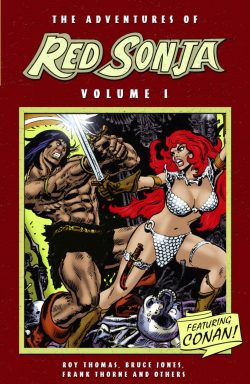
The Adventures of Red Sonja volume 1


By Roy Thomas, Bruce Jones, Frank Thorne, Dick Giordano, Esteban Maroto, Neal Adams, Ernie Chan & various (Dynamite Entertainment)
ISBN: 978-1-93330-507-3 (TPB/Digital edition)

Once upon a time, busty women expertly wielding swords and kicking butt were rarer than politicians and business leaders who respected personal boundaries. Then – for an inexplicably long time – it seemed no lady’s ensemble was complete without a favourite pig-sticker and accompanying armour accessories. That phenomenon eventually settled into women who fight kitted out and tooled up and those who battled unfeasibly underdressed and usually in gear that looked like it really chafed…

If you’d like more fascinating insights on this state of affairs in entertainment arenas you should also check out Jill Bearup’s Just Stab Me Now and/or her YouTube commentaries and lectures on safely and convincingly fighting with sharp objects, heavy implements and a sanguine attitude…

Meanwhile back in comics, you can probably trace the trend for combative, unsuitably cuirassed or chest plated cuties (just stab ME any time now!) to one breakthrough character. Although Diana Prince/Wonder Woman, Valkyrie, Asgardian goddess Sif and even Modesty Blaise all used bladed weapons on a daily basis, none of them ever racked up the kill quotient you’d expect or believe of women in battle until ‘The Song of Red Sonja’ (Conan the Barbarian #23, February 1973).

Drawn, inked and coloured by Barry Windsor-Smith with Roy Thomas scripting, the fragment of a larger epic introduced a dark-eyed hellion to the world. The tale became one of the most popular and reprinted stories of the decade, winning that year’s Academy of Comic Book Arts Awards in the Best Individual Story (Dramatic) category.

Although based on Robert E. Howard’s Russian war-woman Red Sonya of Rogatine (as seen in the 16th century-set thriller The Shadow of the Vulture, with a smidgen of Dark Agnes de Chastillon thrown into the mix) the comic book Red Sonja is very much Thomas’ brainchild.

In his Introduction here – ‘A Fond Look Back at Big Red’ – he shares many secrets of her convoluted genesis, development and achievements as part of the first (of three) archival collection (available in trade paperback and digital editions) of her Marvel appearances. Originally released at a time when accepted editorial wisdom declared comics starring women didn’t sell, Marvel Feature (volume 2) was launched to capitalise on a groundswell of popular interest stemming from Sonja’s ongoing guest shots in Conan stories. This first compilation collects issues #1-7 (November 1975-November 1976) and opens with a then scarce-seen reprint…

Sonja graduated from cameo queen to her first solo role in a short eponymous tale scripted by Thomas and illustrated by Esteban Maroto, Neal Adams & Ernie Chan, tucked into the premiere issue of monochrome mature-reader magazine Savage Sword of Conan – cover-dated August 1974. Colourised by Jose Villarrubia and edited to remove the racier bits, it filled out the premier general distribution Marvel Feature, and revealed in sumptuous style how the wandering woman mercenary undertook a mission for King Ghannif of Pah-Dishah. That task led to her momentous first meeting with Conan and her successful completion of the mission; which was supposed to pay off with the potentate’s most treasured gift. When that reward turned out to be a position as his next wife, Sonja’s response was swift, sharp and so very memorable…

That captivating catch-up yarn leads here to ‘The Temple of Abomination’ (Thomas & Dick Giordano) as the restless sell-sword stumbles upon a lost church dedicated to debauched antediluvian gods and saves a dying priest of Mitra from further torture at the paws of monstrous beast-men…

MF #2 delivered the last key component of Red Sonja’s ascendancy as Frank Thorne (June 16th 1930-March 7th 2021) signed on as illustrator. One of the most individualistic talents in American comics, he began his career in 1948, drawing romances for Standard Comics with the legendary Alex Toth before graduating to better paid newspaper strips. Thorne illustrated Perry Mason for King Features Syndicate and at Dell/Gold Key drew Flash Gordon, Jungle Jim and The Green Hornet, as well as the first years of seminal sci-fi classic Mighty Samson.

At DC he produced compelling work on Tomahawk and Son of Tomahawk before being hired by Thomas at Marvel to illustrate (belated) breakthrough strip Red Sonja. Forever-after connected with feisty, earthy, highly sexualised women, in 1978 Thorne created outrageously bawdy (some say vulgar) swordswoman Ghita of Alizarr for Warren’s adult science fantasy anthology 1984/1994 and a succession of adult satirical strips like Moonshine McJugs for Playboy and Danger Rangerette for The National Lampoon. He won the National Cartoonists Award for Comic Books, an Inkpot Award, a Playboy Editorial Award and countless international honorariums over his astoundingly long career. Throughout his controversial career, steadfast supportive wife Marilyn worked beside him. Their 69-year marriage ended when they both died on same day – March 7th 2021.

Applying his loose, vigorous style and frenetic design sense to a meticulously plotted script from Bruce Jones, Thorne hit the ground running with ‘Blood of the Hunter’ wherein Sonja tricks formidable rival Rejak the Tracker out of an enigmatic golden key. She has also unsuspectingly unleashed a whirlwind or torment as the hunter remorselessly stalks Sonja, butchering everyone she befriends and driving her to the brink of death before their final confrontation…

Marvel Feature #3 reveals the secret of the key after Sonja takes some very bad advice from an old wise-woman and reawakens a colossal death-engine from an earlier age in ‘Balek Lives!’ before endless meanderings bring her to a village terrorised by a mythological threat. However, when she looks into the ‘Eyes of the Gorgon’ she discovers the most merciless monsters are merely human. That same lesson is repeated when ‘The Bear God Walks’ but – after joining a profitable bounty hunt for a marauding beast – Sonja and her new comrades soon find that fake horrors can inadvertently summon up real ones…

With #6, Thomas returned as scripter and set up a crossover with Conan and then-paramour Bêlit: pirate queen of the Black Coast. Although the concomitant issues of Conan the Barbarian (#66-68) aren’t reproduced here, the story is constructed in such a way that most readers won’t notice anything amiss…

Thus, ‘Beware the Sacred Sons of Set’ sees Sonja – after routing a pack of jackal-headed humanoid assailants – commissioned by Karanthes, High Priest of the Ibis God, to secure a magical page torn from mystic grimoire the Iron-Bound Book of Skelos in demon-haunted Stygia. She’s barely aware of an unending war between ancient deities, or that old colleague and rival Conan of Cimmeria is similarly seeking the arcane artefact…

After clashing repeatedly with her rivals and defeating numerous beasts and terrors, Sonja believes she has gained the upper hand in ‘The Battle of the Barbarians’, but there is more at stake than any doughty warrior can imagine…

To Be Continued…

Augmented by a colour-remastered cover gallery by Gil Kane and Thorne, this is a bold and bombastic furiously fun fiesta for fantasy action fans of all ages, genders or persuasions.

RED SONJA® and related logos, characters, names and distinctive likenesses thereof are trademarks of Red Sonja Corporation unless otherwise noted. All Rights Reserved.

The Cabbie volume 1


By Marti, with an introduction by Art Spiegelman (Fantagraphics Books)
ISBN: 978-1-60699-4504 (HB/Fantagraphics) 978-0874160420 (Album PB Catalan Communications)

Although out of print since 1987, in 2011 Fantagraphics rescued from relative obscurity one of the darkest yet most grimly illuminating classics of European cartooning in this remastered and augmented reissue of The Cabbie: a stylish, nightmarish psycho-sexual noir thriller that has as much seedy kick now as it had when first translated by Catalan Communications…

Now as the macabre maestro has died, my conscience prompts me to pay for neglecting such wonderful comics and it’s only right we should pause to revisit his greatest achievement. Maybe some publisher will endeavour to bring some of his other dark wonders – like Doctor Vertigo, Propaganda Moderna, crime fantasy-thriller Calvario Hills, Cien dibujos por la libertad de Prensa or Terrorista – to a wider international audience.

Marti Riera Ferrer (1955 – 19th January 2024) was born in Barcelona during the heyday of fascist rule. He studied at the Massana School of Arts and Crafts where his efforts coincided with the Generalissimo’s death, and from 1975 to 1979 a liberalisation saw “Marti” creating comics for alterative magazines like Rock COMIC and Star.

From its launch in 1979 he also began contributing to apocalyptic iconoclast El Vibora: short stories and series such as Tony Nuevaola and – with Rodolfo – Lola Lista contra los Nada. These efforts brought international interest and Marti began appearing in Raw and Drawn & Quarterly. Il TaxistaThe Cabbie – began in 1982 and he episodically added to the canon over succeeding years, and although semi-retired from the early Nineties he continued generating other material at his own pace for the magazine Makoki and Tobalina. These tales varied from erotic fiction to general illustrated fare.

Dick Tracy is one of the most well-known strips on Earth and the super-cop’s contributions to the art form are many and indisputable. They occurred over many decades and the medium of graphic narrative grew up with it. Imagine the effect instant exposure – or overexposure – to such an uncompromising, bombastic, iconic property on the artists of a nation where free-expression and creative autonomy was suppressed for generations. That’s what happened when the death of General Franco (who had held Spain in a fascistic time-warp from his victory in April 1939 until his death in November 1975) opened up and liberalised all aspects of Spanish life. When Marti saw the strip he was changed for life…

As Art Spiegelman says in his introduction, “decades of political and social repression gave way to a glorious eruption of creativity that allowed a full-fledged counterculture to come to life at just about the same time that America’s “Love Generation” gave way to what Tom Wolfe labelled the “Me Generation.””

How odd yet fitting then that an American symbol of “The Establishment” so enchanted and captivated young cartoonist Marti Riera that he assimilated every line and nuance to create a bleak, stripped-down and extremely angry homage detailing the tribulations of a seedy, desperate taxi-driver trapped in an abruptly vanished past and prey to a world at once free and dangerous, ungoverned and chaotic…

Driving around the seediest part of town our hero picks up a high-rolling gambler who’s just won big, but the driver’s night goes horribly wrong when a knife-wielding thief hijacks the cab and robs his passenger. Luckily, the Cabbie can handle himself and he quickly, brutally subdues the thug.

Our protagonist is a decent, hard-working man who lives with his ailing mother, humouring her talk of a mysterious inheritance, and allowing her to keep the embalmed cadaver of his father in the spare bedroom, but he’s tragically unaware that his citizen’s arrest will have terrible repercussions for them both. When the son of the thief he captured is released from prison, the ingrate immediately begins a grim campaign of retribution against the Cabbie that creates a maelstrom of tragedy, degradation and despair.

This is a harsh, uncompromising tale of escalating crime and uncaring punishments: blackly cynical, existentially scary and populated with a cast of battered, desolate characters of increasingly degenerate desperation. Even the monsters are victims, but for all that The Cabbie is an incredibly compelling drama with strong allegorical overtones and brutally mesmerizing visuals.

Any mature devotee of comics should be conversant with Marti’s superb work, and with a second volume out there and the hope of digital editions (One bloody Day!), hopefully we soon all will be…
The Cabbie (Taxista) © 2011 Marti. Introduction © 2011 Art Spiegelman. This edition © 2011 Fantagraphics Books.

Conan the Barbarian Epic Collection volume 4: Queen of the Black Coast (1974-1976)


By Roy Thomas, Fred Blosser, John Buscema, Mike Ploog, Tim Conrad & various (MARVEL)
ISBN: 1-84576-137-5 (TPB/Digital edition)

In the 1970’s, America’s comic book industry opened up after more than 15 years of calcified publishing practises promulgated by the censorious, self-inflicted Comics Code Authority: a self-imposed oversight organisation created to police product after the industry suffered its very own McCarthy-style 1950s Witch-hunt. The first genre revisited during the literary liberation was Horror/Mystery, and from those changes sprang migrated pulp star Conan.

Sword & Sorcery stories had been undergoing a prose revival in the paperback marketplace since the release of softcover editions of Lord of the Rings in 1954 and, in the 1960s, revivals of the fantasies of Edgar Rice Burroughs, Otis Adelbert Kline, Fritz Lieber and others were making huge inroads into buying patterns across the world. The old masters had also been augmented by many modern writers. Michael Moorcock, Lin Carter and others kick-started their prose careers with contemporary versions of man against mage against monsters. The undisputed overlord of the genre was Robert E. Howard with his 1930s pulp masterpiece Conan of Cimmeria.

Gold Key had notionally opened the field in 1964 with cult hit Mighty Samson, followed by Clawfang the Barbarian’ in Thrill-O-Rama #2 in 1966. Both steely warriors dwelt in post-apocalyptic techno-wildernesses, but in 1969 DC dabbled with previously code-proscribed mysticism as Nightmaster in Showcase #82 -84, following the example of CCA-exempt Warren anthologies Creepy, Eerie and Vampirella. Marvel tested the waters with barbarian villain/Conan prototype Arkon the Magnificent in Avengers #76 (April 1970) and the same month went all-out with short supernatural thriller ‘The Sword and the Sorcerers’ in their own watered-down horror anthology Chamber of Darkness #4.

Written by Roy Thomas and drawn by fresh-faced Barry Smith (a recent Marvel find who was just breaking out of the company’s still-prevalent Kirby house-style) the tale introduced Starr the Slayer who also bore no small resemblance to the Barbarian-in-waiting…

Conan the Barbarian debuted with an October 1970 cover-date and – despite early teething problems, including being cancelled and reinstated in the same month – these strip adventures of Howard’s primal hero were as big a success as the prose yarns they adapted. Conan became a huge hit: a blockbuster brand that prompted new prose tales, movies, TV series, cartoon shows, a newspaper strip and all the other paraphernalia of global superstardom.

However, times changed, sales declined and in 2003 the property found a different comics publisher, before – after decades away – in 2019 the brawny brute returned to the aegis of Marvel.

Their first bite of the cherry was retroactively subtitled “the Original Marvel Years” due to the character’s sojourn with Dark Horse Comics and other intellectual rights holders with this fourth compendium – spanning cover-dates August 1974 to February 1976 – reprinting Conan the Barbarian #43-59 plus a tale from Savage Sword of Conan #1. It highlights a period when the burly brute was very much the darling of the Comics universe and when artist John Buscema made the hero his very own.

Adaptor Thomas had resolved to follow the character’s narrative timeline as laid out by Howard and successors such as L. Sprague de Camp and Lin Carter, expanded and padded out with other adaptions of REH and his contemporaries and – almost as a last resort – all-new adventures. Thus, content was evermore redolent of pulp-oriented episodic action rather than traditional fantasy fiction.

As we hurtle back in time approximately 12,000 years to a forgotten age of wonders, and – following the now traditional map of ‘The Hyborean Age of Conan’ plus accompanying mandatory establishing quote, the saga resumes with a riotous romp from Savage Sword of Conan #1 (August 1974).

The series had broken many moulds, including being able to sustain not just a general audience but also appropriate for Marvel’s monochrome magazine division, offering more explicitly violent and risqué fare for supposedly more mature readers. For this market he debuted in Savage Tales #1 (1971) before winning his own magazine residency. Savage Sword of Conan launched in August 1974, running 235 issues until its cancellation in July 1995. Throughout its life SSoC offered powerful stories, features on all things RE Howard and some of the most incredible artwork ever to grace comics pages. The antediluvian experience opens with #1’s lead yarn. Thomas, John Buscema & Pablo Marcos’ ‘Curse of the Undead-Man’ was adapted from Howard’s short story Mistress of Death with Conan meeting old comrade Red Sonja amongst the fleshpots of “The Maul” in Zamora’s City of Thieves before falling foul of sorcerer Costranno: a mage for whom being chopped to mincemeat is only a minor inconvenience but who still strenuously objected to being robbed and murdered…

A sequence of self-contained tales resumes in the colour newsstand Conan the Barbarian #43 (October 1974) as Thomas continues to follow Howard and de Camp’s roadmap. The saga begins with the warriors’ rapid escape from Zamora, relentlessly pursued by bounty hunters. Trouble finds them when they are taken by bat-monsters to a ‘Tower of Blood’ (inked by Erni Chan nee Chua) where the husky lout is forcibly “admired” by ancient queen-with-a-secret Uathacht and threatened by her sorcerer brother Morophla. The mage has been hiding from Conan’s sworn foe Thoth Amon for simply ages and has revolting plans for both warriors which go appallingly awry in #44’s ‘Of Flame and the Fiend!’ (collaboratively inked by “The Crusty Bunkers”). Exposed as less than human the siblings inflict a ghastly burden on Conan but aren’t sage enough to escape his and Sonja’s inevitable vengeance…

An eerily memorable change-of-pace tragedy sees the shaken and morbidly morose barbarian befriend a foredoomed bard in ‘The Last Ballad of Laza-Lanti’: agreeing to take the troubled troubadour to his place of origin and encountering yet again the horrors that lurk in the Hyborian age…

The next half year comprises a protracted and loving adaptation of prose pulp yarn Kothar and the Conjurer’s Curse, originally penned by the prolific and justifiably legendary Gardner F. Fox (if anybody deserves the title of Elder God of comic books it must be He!). Here our cantankerous Cimmerian is once again embroiled in war between wizards and wades through imperilled maidens and gore galore in equal amounts, beginning with ‘The Curse of the Conjurer!’ as inked by Joe Sinnott. When the wanderer is coerced by magician Merdoramon into delivering a protective amulet to embattled Regent Themas Herklar of Phalkar, the simple mission to safeguard the ruler from his own treacherous court wizards soon proves riddled with undisclosed peril and duplicity.

En route he saves supposed witch Stefanya from burning at the stake and is diverted by her need to have him rescue her master Zoqquanor. Although a “good wizard”, the mage had linked her life force to his own and she needs to ensure his future safety. That proves tricky when they pull the comatose conjuror from his shattered castle and awaken crystal homunculus Shokkoth, and gets even harder in the Dan Adkins inked ‘Goblins in the Moonlight!’ (#47) as a R&R stopover in seemingly sedate ruins sparks an attack by more supernatural horrors…

The issue also provided a text feature on ‘Conan’s Parents’ illustrated by Tim Conrad, before the quest resumes in #48 where ‘The Rats Dance at Ravengard!’ Dick Giordano & Adkins inks) as a formative episode from Conan’s youth – with Priestess of the Wild Ursla – leads to a close shave with local warlord Torkal Moh, near death-by-rats and answers to many of the obscure machinations in play, thanks to Ursla’s latterday kinswoman Lupalina the Wolf Mistress

With the aid of the ‘Wolf-Woman!’ Conan rescues Stefanya – revealed as a crucial pawn in the region’s politics – and topples Torkal Moh, but retrieving the Amulet in #50 unleashes ‘The Dweller in the Pool!’ whose subsequent dispatch by the Cimmerian triggers civil war, the downfall of the Phalkar’s resident magicians and the horror they served and the restoration of a long lost princess in concluding chapter ‘Man Born of Demon!’

Cover-dated July 1975 and stunningly crafted by Thomas, Buscema and Tom Palmer, Conan The Barbarian #52 signalled a turning point in the Cimmerian’s life as he signs on to fight a war with old Corinthian associate Murilo (from Conan #11): now leading a mercenary army of Condottieri dubbed the Crimson Company. He can always use a proven warrior, and also takes under his wing a street urchin/acrobat called Tara of Hanumar whom Conan had saved from an unfair fight…

Re-outfitting the almost-naked wanderer in arms and armour (and clothes!), Murilo’s band are headed to Ronnoco in anticipation of a war between states but the march almost ends in disaster when the mercenaries accidentally awaken an interred horror from antiquity in ‘The Altar and the Scorpion!’ Thanks to Conan the horror from the age of King Kull is defeated, but as the survivors depart they are unaware that a second terror was aroused… and now follows…

Frank Spinger embellished #53 as the Crimson Company reach their client city but are attacked by those inside. When the costly misunderstanding is rectified, Conan has made another enemy after displaying his feelings to arrogant autocrat Prince Vanni who ordered the assault on his comrades and refuses to allow any mercenaries inside walled city of Ronnoco.

King Belzamo is at least more diplomatic as he outlines the causes of the war with rival city-states Carnolla and Pergona and demands his hirelings’ first action: kidnapping the princess Yvonna of Pergona so she can be made to wed Vanni. However, defeating her terrifying bodyguards the ‘Brothers of the Blade!’ proves harder than anticipated and unknown to all, a dark hungry shadow is slowly consuming everything it its path…

Palmer returns in #54 as teen sole survivor Yusef brings a warning of the hungry shadow leading to Conan, Tara and Yusef ordered away to consult ‘The Oracle of Ophir!’ Their reconnaissance and information gathering is hampered by myriad mystic deterrents that culminate in the brawny barbarian battling his own deadly doppelganger and only getting away with highly suspect vague proclamations by guile not force. The party arrives back at Ronnoco (in #55) to find ‘A Shadow on the Land!’ and untold horror besieging the city, prompting Conan to go AWOL and return to the site of a previous victory. His hunch proves correct and he unleashes the one thing the shadow cannot consume, bring an abrupt universally unsatisfactory end to the war – and their pay – through political compromise and economic pragmatism…

Pausing for breath and the Jack Kirby & Joe Sinnott cover for November 1975’s Giant-Size Conan #5 (a reprint vehicle teaming our hero with Michael Moorcock’s doomed king Elric and not included here) Conan, Tara and Yusef quit the Crimson company and in CTB #56 discover ‘The Strange High Tower in the Mist!’ Inked by Pablo Marcos, the tale finds the trio bewildered by a keep apparently populated by oblivious silent ghosts and a bat monster, but seeing in not always believing…

Still sticking to Howard’s roadmap, Thomas and illustrator Mike (Ghost Rider, Man-Thing, Werewolf By Night, Monster of Frankenstein, Weirdworld, Planet of the Apes) Ploog detail an ‘Incident in Argos!’ for #57 that acts as a prelude to a momentous stage in Conan’s life. Falling foul of stupid laws, city guards and sanctimonious judges, the barbarian and his teen charges face jail and punitive amputation until Conan goes wild. Separated, they escape individually just in time for the Cimmerian to reach the long-awaited beginning of Howard’s great love story…

Pulp novelette Queen of the Black Coast was published in the May 1934 Weird Tales, obliquely told of Conan’s time as infamous pirate “Amra”: plundering the coasts of Kush (prehistoric Africa) beside his first great love. The brief but tragic tale of bold buccaneer Bêlit would be expanded over the next few years in an epic storyline that ran to #100 of the monthly comic and officially launched with Conan The Barbarian #58.

Here Thomas, Buscema & Steve Gan launched Queen of the Black Coast!’ as the frantic Cimmerian fugitive finds safe harbour on an outward bound Argossean trading ship caught in a surging tide. Despite barely and extremely publicly escaping a fusillade of guards’ spears, the Northborn outlaw befriends entrepreneurial Captain Tito – himself a regular loser when faced with Argos’ corrupt lawmakers and taxmen – and settles into the mariner’s life.

After visiting many fabulous ports and exotic wild places, Conan’s life changes again when the ship encounters the most feared vessel afloat. When the fighting is done only Conan remains, having made a devil’s feast of the attacking pirates. Even he cannot beat this horde of Kushite warriors but as he prepares to die fighting, the white queen of these black pillagers grants him his life. When some pirates complain, Conan is allowed to earn his place by fighting the objectors and soon settles in… as Bêlit’s prize…

This volume concludes with Thomas, Buscema & Gan’s spellbinding origin yarn as #59 reveals in the words of shaman mentor/guardian N’yaga how the woman remade herself in ‘The Ballad of Bêlit!’. Conan hears how a Shemite child whose seafaring father was king of Asgalun until murdered by Stygians who placed her uncle on the vacant throne. He marvels at her life, growing up among barbarous tribesmen of the Silver Isles where she was trained in warrior arts to best any man. With amazement the Cimmerian learns how, by facing and mastering supernal horrors and using them to destroy a jealous chieftain, the war maiden became – in the eyes of the tribes – the earthly daughter of their Death Goddess Derketa, sworn to take her vengeance on Stygians and all who deal with them…

… And Conan also realises that he loves Bêlit beyond all else, even if she may not be human…

To Be Continued…

With covers by Boris Vallejo, Gil Kane, Dan Adkins, Neal Adams, John Romita, Tom Palmer, Dick Giordano, Jack Kirby, Joe Sinnott, Vince Colletta, this dark love story is also burnished by behind the scenes extras such as a more detailed map of ‘The Hyborean Age of Conan’ and world, taken from 1978’s Conan the Barbarian Marvel Treasury Edition #19 whilst #4 of the same name provides stunningly beautiful front & back covers by Barry Windsor-Smith, and text article ‘An Informal History of the Thomas/Smith Conan’.

There’s also Windsor-Smith’s watercolour Conan image and illustrated page (May) from the 1975 Mighty Marvel Calendar plus House ads, plus original Buscema unused cover art and pencil pages with equivalent inked version from Savage Sword of Conan #1. There are even pre and post CCA moderated images of Bêlit and Conan…

Stirring, evocative, cathartic and thrilling, these yarns are deeply satisfying on a primal level, and this is one of the best volumes in a superb series starring a paragon of adventure heroes. This is classic pulp/comic action in all its unashamed exuberance: an honestly guilty pleasure for old time fans and newbies of all persuasion. What more does any red-blooded, action-starved fan need to know?
© 2021 Conan Properties International, LLC (“CPI”)

Showcase Presents The Losers volume 1


By Robert Kanigher, Russ Heath, Joe Kubert, Ross Andru & Mike Esposito, John Severin, Ken Barr & various (DC Comics)
ISBN: 978-1-4012-3437-9 (TPB)

Team-ups are a valuable and all-but-inescapable comics standby, and war stories have always thrived by calling together strange bedfellows – none more so than this splendid composite: another woefully neglected series in today’s graphic novels marketplace. The Losers were an elite unit of US soldiers formed by amalgamating three previous war series together. Gunner and Sarge (later supplemented by the “Fighting Devil Dog” Pooch) were Pacific-based Marines, debuting in All-American Men of War #67, (March 1959) and running for 50 issues in Our Fighting Forces (#45-94, May 1959-August 1965). Captain Johnny Cloud was a native American fighter pilot who shot down his first bogie in All-American Men of War #82 (December 1960). The “Navaho Ace” flew solo until issue #115 (1966), and entered a brief limbo until the final component of the Land/Air/Sea unit was filled by Captain Storm. He was a disabled PT Boat skipper who fought on despite losing a leg and gaining a wooden prosthesis in his own eponymous 18-issue series from 1964 to 1967.

All three series were created by comic book warlord Robert Kanigher and had pretty much passed their individual use-by dates when they were seconded as guest-stars in a Haunted Tank tale (G.I. Combat #138 October 1969), but these “Losers” found a new resonance together in the “relevant”, disillusioned, cynical Vietnam years. The rather nihilistic, doom-laden antihero group assumed the lead spot in Our Fighting Forces #123 beginning a lengthy run of blistering yarns written by Kanigher and illustrated by such giants as Ken Barr, Russ Heath, Sam Glanzman, John Severin and Joe Kubert. With the tag-line “even when they win, they lose”, the team saw action all over the globe, winning critical acclaim and a far-too-small but passionate following. Although they official died during Crisis on Infinite Earths, their missions ran until OFF # 181 (October 1978) and this year marks their 55th Anniversary – or 65th for most of the individual stars.

This magnificent monochrome tome collects that introductory tale from the October 1969 G.I. Combat and the formative run of suicidal missions from Our Fighting Forces #123-150 (January /February 1970-August/September 1974). At that point comic book messiah Jack Kirby took over the series for a couple of years and made it, as always, uniquely his own. For that seminal set you must see Jack Kirby’s The Losers Omnibus (no, really, you must. That’s an order, Soljer…

Kanigher frequently used stories in established venues as a testing ground for new series ideas, and G.I. Combat #138 (October 1969) introduced one of his most successful. Illustrated by magnificent hyper-realist Russ Heath, ‘The Losers!’ saw the Armoured Cavalry heroes riding in The Haunted Tank encounter a sailor, two marines and grounded pilot Johnny Cloud: each individually and utterly demoralised after negligently losing all the men under their respective commands. Guilt-ridden and broken, the battered relics are re-inspired by tank commander Jeb Stuart who fans their sense of duty and desire for vengeance until the crushed survivors regain a measure of respect and fighting spirit by uniting in a combined suicide-mission to destroy a Nazi Radar tower…

By the end of 1969 Dirty Dozen knock-off Hunter’s Hellcats had outstayed their welcome in Our Fighting Forces and with #123 (January/February 1970) were evacuated in the epilogue ‘Exit Laughing’ which segued directly into ‘No Medals, No Graves’, illustrated by Scottish artist Ken Barr. His stunning work in paint and line had graced everything from Commando Picture Library covers, through Marvel, DC and Warren, to film, book and TV work and he continued the tale as Storm, Cloud, Gunner & Sarge sit in enforced, forgotten idleness until departing star Lieutenant Hunter recommends them for a dirty, dangerous job no sane military men would touch…

It appears Storm is a dead ringer for a British agent – even down to the wooden leg! – and the Brass need the washed-up sailor to impersonate their vital human resource. The only problem is that they want him to be captured, withstand Nazi torture for 48 hours and then break, delivering damaging disinformation about a vast commando raid that won’t be happening. The agent would do it himself but is actually dead…

And there was even work for his despondent companions as a disposable diversionary tactic added to corroborate the secrets Storm will hopefully betray after two agonising days…

Overcoming all expectation the “Born Losers” triumph and even get away intact, after which Ross Andru & Mike Esposito became the regular art team in #124 where ‘Losers Take All’ shows how even good luck is bad, after a mission to liberate the hostage king of a Nazi-subjugated nation sees them doing spectacular hard work before losing their prize to Johnny-come-lately regular soldiers…

In #125 ‘Daughters of Death’ sees the suicide squad initially fail to rescue a scientist’s children, only to blisteringly return and rectify their mistakes, However, by then the nervous tension has cracked the Professor’s mind, rendering him useless to the Allied cause. ‘A Lost Town’ opens with The Losers undergoing a Court Martial for desertion. Reviled for allowing the obliteration of a French village, they face execution until an old blind man and his two grandkids reveal what really happened in the hellish conflagration of Perdu, whilst in ‘Angels Over Hell’s Corner’, a brief encounter with a pretty WREN (Women’s Royal Navy Service) in Blitz-beleaguered Britain draws the unit into a star-crossed love story even death itself cannot thwart…

In a portmanteau tale disclosing more details of the events which created the squad, Our Fighting Forces #128 described the 7 11 War’ wherein a hot streak during a casual game of craps presages disastrous calamity for any unlucky bystander near to the Hard Luck Heroes, before Ride the Nightmare’ sees Cloud endure horrifying visions and crack up on a mission to liberate a captive rocket scientist. Then the team again become a living diversion in #130’s ‘Nameless Target’. By getting lost and hitting the wrong target, The Losers gift the Allies with their greatest victory to date…

John Severin inked Andru in OFF #131, in preparation to taking over full art chores, as ‘Half a Man’ hints at darker, grittier tales to come when Storm’s disability and guilty demons begin to overwhelm him. Considering himself a jinx, the sea dog attempts to sacrifice himself on a mission to Norway but has not counted on his own brutal will to survive. Back in London, Gunner & Sarge are temporarily reunited with ‘Pooch: the Winner’ (OFF #132 by Kanigher & Severin), prompting a fond if perilous recollection of a distant Pacific exploit against the Japanese. However, fearing their luck was contagious, the soldiers sadly decide the beloved “Fighting Devil Dog” is better off without them…

Dispatched to India in #133’s ‘Heads or Tails’, The Losers must assassinate the “the Unholy Three”: Japanese Generals responsible for untold slaughter amongst British and native populations. In sweltering deadly jungles, they only succeed thanks to the determined persistence and sacrifice of a Sikh child hiding a terrible secret. Our Fighting Forces #134 has them brutally fighting from shelled house to hedgerow in Europe until Gunner cracks. When even his partners can’t get him to pick up a gun again it takes the example of indomitable wounded soldiers to show him who ‘The Real Losers’ are…

OFF #135 began a compelling extended epic radically shaking up the team after ‘Death Picks a Loser’. Following an ill-considered fortune telling incident in London, the squad ship out to Norway to organise a resistance cell, despite efforts to again sideline one-legged Storm. They rendezvous with Pastor Tornsen and his daughter Ona and begin by mining the entire village of Helgren, determined to deny the Nazis a stable base of operations. Even after the Pastor sacrifices himself to allow villagers and Americans time to escape, the plan stumbles when the explosives fail to detonate and Storm, convinced he’s a liability, detonates the ordnance by hand. Finding only his wooden leg in flattened rubble, The Losers are further stunned when vengeful orphan Ona volunteers to take the tragic sailor’s place in the squad of Doomed Men…

The ice-bound retreat from Helgren stalls in #136 when she offers herself as a ‘Decoy for Death’, leading German tanks into a lethal ambush, after which Cloud solos in the Pacific: inspiring natives to resist the Japanese as a resurrected ‘God of the Losers’

Reunited in #138, the Bad Luck Brigade become ‘The Targets’ when sent to uncover the secret of a new Nazi naval weapon sinking Allied shipping. Once more using Ona as bait, they succeed in stunning fashion, but also pick up enigmatic intel regarding a crazy one-eyed, peg-legged marauder attacking both Enemy and Allied vessels off Norway…

Our Fighting Forces #139 introduced ‘The Pirate’, when a band of deadly reivers attack a convoy ship carrying The Losers and supplies to Norwegian resistance fighters. Barely escaping with their lives, the unit is then sent to steal a sample of top secret jet fuel but discover the Sea Devil has beaten them to it. Forced to bargain with the merciless mercenary for the prototype, they find themselves in financial and combat competition with an equally determined band of German troops who simply won’t take “nein” for an answer…

‘Lost… One Loser’ reveals Ona was with Storm at the end and is now plagued by survivor’s guilt nightmares. Almost convincing her comrades he still lives, the traumatised girl leads them on another Norway mission, again acting as a honey trap to get close to a German bigwig and secure incontrovertible proof Storm was dead when she picked up his battered, burned dog-tags…

Still troubled, Ona commandeers a plane and returns home to assassinate her Quisling uncle in #141’s ‘The Bad Penny’, only to be betrayed to the town’s German garrison and saved by the pirate who picks that moment to raid the occupied outpost. Even with other Losers in attendance, the Pirate’s rapacious rogues are ultimately triumphant but when the crippled corsair snatches Ona’s most treasured possession, that dingy dog-tag unlocks suppressed memories and Storm (this is comics: who else would it be?) remembers everything…

Answers to his impossible survival come briskly in OFF #142 as ‘½ a Man’ concentrates on the Captain’s struggle for reinstatement. Shipping out to the Far East on a commercial vessel, he’s followed by his concerned comrades whilst stumbling into an Arabian insurrection with three war-weary guardian angels discreetly dogging his heel…

Back with The Losers again in #143, Storm is soon involved in another continued saga as ‘Diamonds are for Never!’ finds the Fatalistic Five in Africa to stop an SS unit hijacking industrial diamonds for their failing war effort. However, even after liberating a captured mine, the team fail to get the gems when monkeys make off with the glittering prizes. Hot on their trail in ‘The Lost Mission’, the pursuers stumble onto a Nazi ambush of British soldiers and determine to take on their task – demolishing an impregnable riverside fortress…

Despite apparent success, the Squad are driven inland and are lost in the desert where they stumble into a French Foreign Legion outpost and join its last survivor in defending ‘A Flag for Losers’ from a merciless German horde and French traitors…

Still lost in the trackless wastes they survive ‘The Forever Walk!’ in #146, battling equally-parched Nazis for the last precious drops of water and losing one of their own to a terrifying sandstorm. ‘The Glory Road!’ then sees the sun-baked survivors encounter the last survivor of a German ambush, but British Major Cavendish is unable to differentiate between his early days as a star of patriotic films and grim reality. When a German patrol captures them all the mockery proves too much for the troubled martinet…

Again lost and without water, in #148 ‘The Last Charge’ sees The Losers save a desert princess and grant her warrior father the opportunity to fulfil a prophecy and die in glorious battle against the Nazi invaders, whilst #149 briefly reunites the squad with their long-missing former comrade before tragically separating again in ‘A Bullet for a Traitor!’

This fateful combat fury concludes with ‘Mark our Graves’ from #150 as The Losers link up with members of The Jewish Brigade (a special British Army unit) who all pay a steep price to uncover a secret Nazi supply dump. Although a superbly action-packed and deeply moving tale, it was an inauspicious end to the run and one which held no hint of the creative culture-shock that would explode onto the pages of the next instant issue when the God of American Comic Books blasted in to create a unique string of “Kirby Klassics”…

With covers by Joe Kubert, Frank Thorne and Neal Adams, this grimly efficient, superbly understated, beautifully rendered collection is a brilliant example of how war comics evolved in the 1970s, proving these stories still pack a TNT punch few other forms of entertainment can match. Surely by now there’s appetite for a revival and further volumes of this superb series?
© 1969, 1970, 1971, 1972, 1973, 1974, 2012 DC Comics. All Rights Reserved.

Sandman Mystery Theatre Book One


By Matt Wagner, Guy Davis, John Watkiss, R.G. Taylor, David Hornung & John Costanza & various (Vertigo)
ISBN: 978-1-4012-6327-0 (TPB/Digital edition)

Created by Bert Christman & Gardner F. Fox, The Sandman premiered in either Adventure Comics #40 July 1939 (two months after Batman debuted in Detective Comics #27) or two weeks earlier in New York World’s Fair Comics 1939, depending on which rather spotty distribution records can be believed.

Head and face utterly obscured by a gasmask and slouch hat; caped, business-suited millionaire adventurer Wesley Dodds was cut from the iconic masked mystery-man mould that had made pulp fictioneers The Lone Ranger, Green Hornet, The Shadow, The Spider and many more household names. Those dark red-handed heroes were also astonishing commercial successes in the early days of mass periodical publication…

Wielding a sleep-gas gun and haunting the night to battle a string of killers, crooks and spies, he was accompanied in the earliest comicbooks by his plucky paramour Dian Belmont, before gradually losing the readers’ interest and slipping from cover-spot to last feature in Adventure Comics, just as the cloaked pulp-hero avengers he emulated slipped from popularity in favour of more flamboyant fictional fare.

Possessing a certain indefinable style and charm but definitely no especial pizzazz, the feature was on the verge of being dropped when the Sandman abruptly switched to skin-tight yellow-&-purple and gained boy-sidekick Sandy the Golden Boy (Adventure Comics #69, December 1941, courtesy of Mort Weisinger & Paul Norris). All this, presumably to emulate the overwhelmingly successful Batman and Captain America models then reaping big dividends on newsstands.

It didn’t help much, but when Joe Simon & Jack Kirby came aboard with #72 it all changed. A semi-supernatural element and fascination with the world of dreams (revisited by S&K a decade later in their short-lived experimental suspense series The Strange World of Your Dreams) added moody conceptual punch to balance the kinetic fury of their art, as Sandman and Sandy became literally the stuff of nightmares to bizarre bandits and murderous mugs…

For what happened next you can check out the superb Simon & Kirby Sandman collection.

Time passed and in the late 1980s Neil Gaiman, Sam Keith & Mike Dringenberg took the property in a revolutionary new direction, eventually linking all the previous reboot elements into an overarching connective continuity under DC’s new “sophisticated suspense” imprint Vertigo. Within a few years the astounding success of the new Sandman prompted editorial powers-that-be to revisit the stylishly retro original character and look at him through more mature eyes. Iconoclastic creator Matt Wagner (Mage, Grendel, The Demon, Batman) teamed with artistic adept Guy Davis (Baker Street, B.P.R.D.) and colourist David Hornung to channel a grittier, grimier, far more viscerally authentic 1930s, where the haunted mystery man could pursue his lonely crusade with chilling verisimilitude.

The tone was darkly modernistic, with crime-busting played out in the dissolute dog-days of the Jazz Age and addressing controversial themes such as abuse, sexual depravity, corruption and racism; all presented against the rising tide of fascism sweeping the world then.

Consider this a warning: Sandman Mystery Theatre is not for kids.

This compendium collects the first three redefining story-arcs from issues #1-12 (April 1993 to March 1994) and commences after an absorbing introduction from veteran journalist, critic and pop culture historian Dave Marsh.

Each chapter preceded by its original evocative faux pulp photo cover created by Gavin Wilson and Hornung, the dark drama opens with The Tarantula, taking us to New York in 1938 where District Attorney Larry Belmont is having the Devil’s own time keeping his wild-child daughter out of trouble and out of the newspapers. Dian is gallivanting all over town every night with her spoiled rich friends: drinking, partying and associating with all the wrong people, but the prominent public servant has far larger problems too. One is a mysterious gas-masked figure he finds rifling his safe soon after Dian departs…

The intruder easily overpowers the DA with some kind of sleeping gas – which also makes you want to blurt every inconvenient truth – before disappearing, leaving Belmont to awaken with a headache and wondering if it was all a dream…

After a rowdy night carousing with scandalous BFF Catherine Van Der Meer and her latest (gangster) lover, Dian gets up with a similar hangover, but still agrees to attend one of father’s dreary public functions that evening. The elder Belmont is particularly keen that she meet a studious young man named Wesley Dodds, recently returned from years in the Orient to take over his deceased dad’s many business interests. Dodds seems genteel and effete, yet Dian finds there’s something oddly compelling about him. Moreover, he too seems to feel a connection…

The Gala breaks up early when the DA is informed of a sensational crime. Catherine Van Der Meer has been kidnapped by someone calling himself as The Tarantula

Across town, mob boss Albert Goldman meets with fellow gangsters from the West Coast and, as usual, his useless son Roger and drunken wife Miriam embarrass him. Daughter Celia is the only one he can depend on these days, but even her unwavering devotion seems increasingly divided. After another stormy scene, the conference ends early, and the visiting crimelords are appalled to find their usually diligent bodyguards soundly asleep in their limousines…

Even with Catherine kidnapped, Dian is determined to go out that night, but when Wesley arrives unexpectedly changes her mind, much to her father’s relief. The feeling doesn’t last long, however, after the police inform him the Tarantula has taken another woman…

When a hideously mutilated body is found, Dian inveigles herself into accompanying dear old Dad to Headquarters but is promptly excluded from the grisly “Man’s Business”. Left alone, she starts snooping in the offices and encounters a bizarre gas-masked figure poring through files. Before she can react, he dashes past her and escapes, leaving her to explain to the assorted useless lawmen cluttering up the place.

Furious and humiliated, Dian then insists that she officially identify Catherine and nobody can dissuade her. Shockingly, the savagely ruined body is not her best friend but yet another victim. Somewhere dark and hidden, Van Der Meer is being tortured, but the perpetrator has far more than macabre gratification in mind…

In the Goldman house, Celia is daily extending her control over darling devoted Daddy. They still share a very special secret, but these days she’s the one dictating where and when they indulge themselves…

With all the trauma in her life, Dian increasingly finds Wesley a comforting rock, but perhaps that view would change if she knew how he spends his nights. Dodds is tormented, plagued by bad dreams. Not his own nightmares, but rather somnolent screams of nameless victims and their cruel oppressors haunt his troubled slumbers. Worst of all, these dreams are unrelenting and somehow prophetic. What else can a decent man do then, but act to end such suffering?

In a seedy dive, uncompromising Police Lieutenant Burke comes off worst when he discovers the gas-mask lunatic grilling a suspect in “his” kidnapping case and again later when this “Sandman” is found at a factory where the vehicle used to transport victims is hidden.

Even so, the net is inexorably tightening on both Tarantula and the vigilante interfering in the investigation, but Burke doesn’t know who he most wants in his nice, dark interrogation room…

As the labyrinthine web of mystery and monstrosity unravels, tension mounts and the death toll climbs, but can The Sandman stop the torrent of depraved terror before the determined Dian finds herself swept up in all the blood and death?

Of course, he does but not without appalling consequences…

Scene and scenario suitably set, John Watkiss steps in to illuminate second saga The Face (issues #5-8). Attention switches to Chinatown in February of 1938, where Dian and her gal-pals scandalously dine and dish dirt… until Miss Belmont meets again an old lover.

Jimmy Shan once worked in her father’s office but now serves as lawyer and fixer for his own people amongst the teeming restaurants, gambling dens and bordellos of the oriental district. Dian would be horrified to see Jimmy – or Zhang Chai Lao as his Tong masters know him – consorting with unsavoury criminals, and would certainly not be considering reviving her scandalous out-of-hours relationship with him. All such frivolous thoughts vanish, however, when the diners vacate the restaurant and stumble upon a severed head: a warning that the ruling factions are about to go to war again in Chinatown. As usual, white police are utterly ineffectual against the closed ranks of the enclave…

Later at a swanky charity soiree to raise money for a school, Dian meets Jimmy again and agrees to a meeting. At the same shindig she later sees Wesley, and in the course of their small talk, Dodds reveals that he recognises Shan from somewhere.

…And in Chinatown, another beheading leads to greater tension between the Lee Feng and Hou Yibai Societies. When an enigmatic gas-masked stranger starts asking unavoidable questions, he finds both Tongs denying all knowledge of the killings…

As the grisly murder-toll mounts, The Sandman’s investigations lead to one inescapable conclusion: a third party is responsible. But who, and why? Before this drama closes, Dian will learn more hard truths about the world and the money-men who secretly run it…

Issues #9-12 (December 1993-March 1994) are illustrated by R.G. Taylor, plumbing the darkest depths of human depravity in the tale of ‘The Brute’. The friendship of Dian and Wesley slowly deepens and life seems less fraught in the city, but that ends as a hulking degenerate stalks the back-alleys, killing and brutalising prostitutes and their clients…

Dodds is also on the mind of boxing promoter and businessman Arthur Reisling who’s looking for a fresh financial partner in his global exploitations. The effete-seeming scholar is hard to convince, though, unlike Eddie Ramsey. He’s a poverty-stricken pugilist and single parent desperate to make enough money to pay for his daughter Emily’s TB medicine. Riesling’s offer to him is just as scurrilous but the broken-down pug doesn’t have the luxury of saying “no”…

Eventually, with Dian in tow, Wesley accepts a party invitation from the speculator and meets his dynasty of worthless, over-privileged children. None of them seem right or well-adjusted. Later, when Eddie tries to come clean by informing the authorities of Riesling’s illegal fight events, he’s attacked by the promoter’s thugs and saved by The Sandman – at least until the colossal mystery killer attacks them both and they’re forced to flee for their lives…

As Dodds returns home to recuperate, the punishing dreams escalate to mind-rending intensity. Eddie, meanwhile, is left with no safe option and takes to the streets with Emily. His decision will lead to revolting horror, total tragedy and utter heartbreak.

The Sandman returns to his covert surveillance, silently unearthing the depths of Reisling’s underworld activities and coincidentally exposing a turbulent, dysfunctional atmosphere in the magnate’s home life to match his criminal activities. In this house, corruption of every kind runs deep and wide, and the masked avenger decides it’s time to bring his findings to Dian’s father. This time, District Attorney Belmont is prepared to listen and to act…

As murders mount and Dodds’ dreams escalate in intensity, the strands of a bloody tapestry knot together and the appalling secret of the bestial killer’s connection to Reisling is exposed; only a detonation of expiating violence can restore order…

Stark, compelling and ferociously absorbing, these bleak thrillers depict a cruel but incisive assessment of good and evil no devotee of dark drama should miss, with the period perils accompanied by a gallery of the series’ original, groundbreaking comic book photo-covers and posters by Gavin Wilson, plus later collection covers and related art from Matt Wagner, Alex Toth and Kent Wilson.
© 1993, 1994, 1995, 2016 DC Comics. All Rights Reserved.

Ugly Mug #5, 6 & 7


By many and various aligned to The House of Harley, including Ed Pinsent, John Bagnall, Tom Baxter Tiffin, Marc Baines, Chris Reynolds, Savage Pencil, Jason Atomic, Patricia Gaignat, iestyn, Jim Barker, Masaman, Denny Derbyshire, Oxideguy, Vince Mancuso, Hal Weaver, Alberto Monteiro & various (House of Harley)
ISBN: N/A

Win’s Christmas Gift Recommendation: Wild Fun and the Epitome of Sheer Creativity Perfection… 8/10

Comics may be a billion dollar business these days, but at its core remains all about doing something creative and waiting for people to say “Oi! Come and look at this!”

At that charged and dynamic pictorial coalface are folk who would draw strips and cartoons even if the act carried the threat of exile or death penalty (so, missed a trick there, Soo-Ella Slaverman and Mr. not-so-Cleverly!): crafting and self-publishing the kind of word-wedded images the industry and art form continually renews and reinvents itself with.

Every year The House of Harley unleashes an annual (well duh!) anthology of short stories, posterworks, tableaux, diagrammatic diatribes – even further continued characters and serials – via the ranks of the British Small Press movement (it’s really more of a tendency these days but riveting nonetheless).The project also invites international guests, and it’s well past time you knew more about their splendid efforts.

Available at the moment for your delectation are a trio of tomes, with issue #5 being a horror themed treat including, amongst many, dark delights from Marc Baines, Chris Reynolds, Savage Pencil, Denny Derbyshire and Niall Richardson, an instalment of Ed Pinsent’s ‘Windy Wilberforce’ serial, John Bagnall’s ‘Father Gilderoy Investigates’, Tom Baxter Tiffin’s ‘Berserker’, Pinsent’s ‘R.S.D. Laing, Record Detective’ and some sinister self-help advice from Ess “Strange and Wonderful Creature” Hödlmoser.

City and Country in contention are compiled for #6, with Jim Barker (‘Cardboard Cities’) and Masaman (‘Japanese Graphix’), supplementing the old lags’ regular fare which here includes ‘Seb’ (by House of Harley), PCSO Dan, Dora the Art Restorer, more Windy Wilberforce et al…

This year’s model is a bonanza edition sporting an iestyn pettigrew wraparound cover, with a bumper crop of wonders addressing Karma and Chaos and dedicated to Chris Reynolds (1960-2023). Here lurk fantastic beasts from Pinsent, Bagnall’s crucial ‘How a Comic is Made’, Chris Reynolds’ fumetti ‘Batlight’, prophetic ‘Take the Children Out of Town’ (House of Harley) and epic exploration ‘Otherweirdly’ (Denny Derbyshire). These are backed up by briefer bits, graphic one-offs and episodes of extended exploits for ‘Mark E. Smith: Music Teacher’, Jason Atomic’s ‘King Kong Memories’ and ‘Respecto/Kanyok Hunting Fetish’ by Hal Weaver.

As jammed-packed with beguiling thrilling stuff as any British X-mas Annual of yore, these curated creations brim with surreal narrative force and come overloaded with wry and witty visual oomph, an example of the compulsion to leave our marks wherever we can.
All contents © their respective creators.

For all this and much more please check out: houseofharley.net/shop

Asterix and the Griffin (volume 39)


By Jean-Yves Ferri & Didier Conrad, coloured by Thierry Mébarki, translated by Adriana Hunter (Sphere)
ISBN: 978-0-7515-8398-4 (Album HB) eISBN: 978-0-7515-8397-7

Win’s Christmas Gift Recommendation: Seasonal Sensations with Gallic Chill… 9/10

Whoops! Missed one!

As we saw a few days ago, Asterix le Gaulois has been around, amazing and amusing the planet since 1959 and become part of the fabric of French life. His exploits have touched billions of people all around the world.

For five and a half decades and for almost all of that time his astounding adventures were the sole preserve of originators René Goscinny and/or Albert Uderzo.

After nearly 15 years dissemination as weekly serials before invariably collected into book-length compilations, in 1974 the 21st saga – Asterix and Caesar’s Gift – was the first to be released as a complete, original album prior to serialisation. Thereafter each new tome was an eagerly anticipated, impatiently awaited treat for legions of devotees. The eager anxiety hadn’t diminished any when Uderzo’s handpicked replacements – scripter Jean-Yves Ferri (Fables Autonomes, La Retour à la terre) and illustrator Didier Conrad (Les Innomables, L’Avatar, Le Piège Malais, Tatum) – settled into the creative role on his retirement in 2009.

Whether an action-packed comedic romp with sneaky, bullying baddies getting their just deserts or a sly satire for older-if-no-wiser heads, these new yarns are just as engrossing as the established canon. As you already know, half of the epics take place in exotic locales throughout the Ancient World, whilst the alternating rest are set in and around Uderzo’s adored Brittany where, circa 50 BC, a little hamlet of cantankerous, proudly defiant warriors and their families resist every effort of the mighty Roman Empire to complete the conquest of Gaul. This one’s solidly of the former variety as our major cast members make it all the way to “barbaricum”: literally beyond the known world…

Although divided by its Roman conquerors into provinces Celtica, Aquitania and Armorica, the very tip of the last-named region stubbornly refuses to be properly pacified. Utterly unable to overrun this last little bastion of Gallic insouciance, the otherwise supreme Roman overlords are reduced to a pointless policy of absolute containment – even though the irksome Gauls come and go as they please…

Thus, a tiny seaside hamlet is permanently hemmed in by heavily fortified garrisons Totorum, Aquarium, Laudanum and Compendium, filled with veteran fighters who would rather be anywhere else on earth than there. The residents couldn’t care less: daily defying, frustrating and often terrorising the world’s greatest military machine by going about their everyday affairs, bolstered by magic potion brewed by resident druid Getafix and the shrewd wits and strategic aplomb of diminutive dynamo Asterix… and his simplistic, supercharged best friend Obelix. And their dog…

In Rome, Julius Caesar is in need of a diversion for his sensation seeking subjects, so when geographer Cartographus claims to have discovered a fabled griffin, the Emperor funds a huge expedition to capture it via legions of soldiers and engineers. The beast resides far to the east in the icy Sarmatian wastes, but the scholar is convinced he can snare it as he has captured a Sarmatian Amazon woman to guide them. Terrifying and seductive, Kalashnikova only sees a chance to return home…

Meanwhile, the frozen lands under discussion have welcomed some familiar friends as Asterix, Obelix and canine wonder Dogmatix escort a very ill (no, no, it’s just a cold, really!) Getafix to the yurt of Fanciakuppov. That cheery shaman had visions of Roman invaders stealing his people’s sacred animal, so his old druid pal has brought a keg of magic potion to resist the incursion. There are, however, a couple of snags…

Firstly, the tribe is proudly matriarchal, with powerful warrior women doing all the fighting. They do it fantastically well, and don’t need help from foreigners – no matter how attractive they might be! – or magic. It’s a good thing too, as local conditions soon render the potion useless and Asterix has to rely on his brains and his giant pal’s innate brawn…

The big guy is quite distracted. Primarily by Dogmatix running away to become a wolf, but also by the obvious attentions of some of the amorous Amazons…

The Roman expedition is led by seasoned centurion Intrepidus, and Cartographus (who naturally has a secret agenda in play) has brought along famed venator (animal-fighting gladiator) Vainglorius, as a specialist to tame the griffin when they find it.

Army morale is low: the commanders squabble constantly, these lands are gloomy, frozen cold, steeped in legends and packed with people and things trying to kill them. Worst of all, when they should be building forts to secure their supply lines, the men are instead fighting each other for the right to guard the prisoner. Aloof, beautiful Kalashnikova disdains and discards them all… and they love it.

When the military monsters capture Fanciakuppov, he is forced to lead the smug raiders to the secret abode of the griffin, but thanks to the hit-&-run tactics of the Gaul-enhanced war women their numbers are so severely depleted, no one thinks they’ll make it back to sunnier climes…

The mission ends in spectacular failure but they do all get to see the fabulous beast before they die…

Packed with hilarious action, genuine chills, potent punning and cartooning delights, this tale provides plenty of pokes at fake news, current affairs, conspiracy theories, a certain global retail/delivery brand, and lands many wry jabs at all sides of the battle of the sexes and role of women in societies ancient and modern.

Asterix and the Griffin is a sure win and another triumphant addition to the magically mythic Gaulish oeuvre for laugh-seekers in general and all devotees of comics.
Original edition © 2021 Les Éditions Albert René. English translation: © 2021 Les Éditions Albert René. All rights reserved.

Doctor Who Graphic Novel #21: The Eye of Torment


By Scott Gray, Mike Collins, Jacqueline Rayner, Martin Geraghty, David A. Roach & various (Panini Books)
ISBN: 978-1-84653-673-1 (TPB)

Win’s Christmas Gift Recommendation: A Timely Seasonal Treat… 8/10

Today is the 60th Anniversary of Doctor Who. Here’s another Timey-Wimey treat to celebrate a unique TV and comics institution in a periodical manner …

We Brits love comic strips, adore “characters” and are addicted to celebrity. The history of our comics includes an astounding number of comedians, Variety stars and television actors: such disparate legends as Charlie Chaplin, Arthur Askey, Charlie Drake and so many more I’ve long forgotten and you’ve likely never heard of.

As much adored and adapted were actual shows like Ace of Wands, Timeslip, Supercar, The Clangers and countless more. If we watched or listened, an enterprising publisher made printed spectacles of them. Hugely popular anthology comics like Radio/Film Fun/TV Fun, Look-In, TV Comic, TV Tornado, and Countdown would translate light entertainment favourites into pictorial joy. It was a pretty poor star or show that couldn’t parley the day job into a licensed strip property…

Doctor Who debuted on black-&-white televisions across Britain on November 23rd 1963 with episode 1 of ‘An Unearthly Child’. Months later in 1964, TV Comic began a decades-long association, as issue #674 began ‘The Klepton Parasites’ – by an unknown author with the art attributed to illustrator Neville Main.

On 11th October 1979, Marvel’s UK subsidiary launched Doctor Who Weekly. Turning monthly in September 1980 (#44) it’s been with us – via various iterations – ever since: proving the Time Lord is a comic star of impressive pedigree, not to be trifled with.

Panini’s UK division ensured his comics immortality by collecting all strips of every Time Lord Regeneration in a series of graphic albums – although we’re still waiting for digital versions. Each time tome focused on a particular incarnation of the deathless wanderer, with this one gathering almost a year’s worth of stories plucked from the annals of history and the Terran cover dates August 2014 to August 2015. These yarns all feature The Twelfth Doctor as played by Peter Capaldi in a collection of full-colour episodes all given hues from James Offredi and letters by Roger Langridge.

It all kicks off with eponymous shocker ‘The Eye of Torment’ (Doctor Who Magazine #477-480, October-December 2014). Written by Scott Gray and drawn by Martin Geraghty – with inks from infallibly rewarding David A. Roach – it finds a newly-minted incarnation of the Time Lord and capable companion Clara Oswald fetch up inside a spaceship traversing the surface of the sun.

With inescapable flavours of Armando Iannucci’s 2020 comedy sci fi vehicleAvenue 5, the good ship Pollyanna is manned solely by women working for gigajazillionaire Rudy Zoom: a rich, over-achieving narcissist in love with his own legend. Surprisingly, he’s not the actual problem: that would a semi-sentient predatory alien infection imprisoned eons ago by Sol’s gravity. “The Umbra” mimic humanoid form: magnifying and feeding on despair. Once the horror broaches Pollyanna’s invulnerable hull, it/they start picking off the crew until the newcomers find a way to stop it/them and escape…

The epic yarn leads directly into the ‘The Instruments of War’ (DWM #481-483, January-March 2015) wherein writer/artist Mike Collins, ably assisted by Roach) deposit the time travellers in Earth’s Sahara just as German General Erwin Rommel is preparing to finish the Afrika campaign. Sadly, that’s when an agent of the Rutan Horde finally disinters a world-reshaping weapon long lost by their eternal arch-enemies The Sontarans…

Forced to ally with a few of the Sontaran clone-warriors, assorted Germans of various philosophies, righteously rebellious Tuaregs and the living enigma of an honourable warrior fighting for the wrong side, The Doctor and Clara are initially separated but soldier on to save everyone with a degree of success…

Skipping #484, we next arrive as south as we can get for some ‘Blood and Ice’ served up by Jacqueline Rayner, Geraghty & Roach, with actual schoolmarm Clara and the tall, rude one claiming to be Ofsted inspectors giving a college at the bottom of the world a cautious once-over. It’s 2048, the Antarctic Treaty protecting the polar continent from resource exploitation is about to expire and something strange is happening at Snowcap University: something Dr. Patricia Audley is very unhappy to acknowledge and a situation she is working very hard to remedy. However, even with fatal accidents, mutants appearing and students vanishing, both our heroes are a bit off their game. Fans will recall that on TV, Clara had been splintered into a million alternate versions scattered throughout the timestream and finding one of herself at Snowcap has truly unsettled her. The Doctor also has qualms: last time he was here it was a military base filled with cybermen and resulted in the death of his first generation (First Doctor William Hartnell, keep up, keep up!) and first re-generation…

The disorientation doesn’t stop them solving the riddle of the place, but not before a lot of people are dead or worse…

The dramas conclude in fine style and traditional form as a holding pattern allowing the TV Doctor’s debut to catch up with his print incarnation allows DWM #475-476 to deliver a Gallifreyan-adjacent sidebar saga from Gray, Collins, Roach, Offredi & Langridge. Set during London’s Great Exhibition of 1851 ‘The Crystal Throne’ is an untold adventure of “The Paternoster Gang” (Silurian Madame Vastra, her human wife Jenny Flint and their butler Sontaran Strax) who – with assorted associates – oppose weird terror, scurrilous sedition and deranged genetic meddler Lady Cornelia Basildon-Stone for rule of the British Empire. The battle at “The Crystal Palace” is made harder by their ruthless foe, who remakes men into insectoid monsters; employing stolen Silurian technology…

Supplemented with fascinating insights from all the creatives involved in each tale and augmented by tons of sketches and other pre-publishing artwork in the Commentary section, this is a splendid book for casual readers, a fine shelf addition for dedicated fans of the show and a perfect opportunity to cross-promote our particular art-form to anyone minded to give comics another go…
All Doctor Who material © BBCtv 2015. Doctor Who, the Tardis and all logos are trademarks of the British Broadcasting Corporation and are used under licence. All other material © 2017 its individual creators and owners. Published 2015 by Panini. All rights reserved.

Terror – The Horror Comic Art of Jayme Cortez (volume 1) & Macabras – The Horror Comic Art of Jayme Cortez (volume 2)


By Jayme Cortez, with Fabio Moraes & various, translated by Joe Williams (Korero Press)
ISBN: 978-1-912740-22-2 (PB Terror) & 978-1-912740-21-5 (PB Macabras)

Win’s Christmas Gift Recommendation: Whatever the Season, All Nights Are Dark … 8/10

Please pay careful attention: this art book contains stories and images of an explicit nature, specifically designed for adult consumption. Tomorrow I’ll write about something else – possibly more socially acceptable, with mindless violence and big explosions, so come back then if incredible art, a dedicated career and rectifying oversights is not to your liking.

We comic book guys tend to think we invented and run the medium and art form of graphic narrative, but – gasps in shock! – other countries have been doing the same or similar all along. Moreover, so very much of it is so very good…

Britain and the US have, over decades, employed a select few master craftsmen (and they were mostly men as far as I can see) and I’ve done my bit to point them your way, but until very recently we haven’t seen much of Brazil’s monolithic comics output. That changes here and now with a two-book collection highlighting the breathtakingly prolific career of Jaime Cortez Martins – AKA Jayme Cortez. He was born in Lisbon, Portugal on 8th September 1926 and his life changed at age six when he first saw imported American newspaper strips: particularly Alex Raymond’s Flash Gordon. Jaime’s first drawing was published when he was 11, and in 1944 he was apprenticed to children’s magazine O Mosquito under its art director Eduardo Texiera Coelho. The prodigy generated numerous groundbreaking strips before – having discovered the rich world of Brazilian comics – he emigrated to São Paulo to find great fame fortune and renown. Celebrated globally except in English-speaking countries, Cortez died in 1987.

For more biographic detail resort to the internet or best yet buy these books where editor/writer-compiler/art historian Fabio Moraes and appreciative guests such as Paul Gravett, and Paulo Montiero offer their own insights in Forewords and Intoductions. What’s really important is what follows: a magnificent treasury of a passionate creator’s output (albeit mostly his horror genre material) encompassing Brazil’s “golden age” of scary stories.

Cortez made himself master of countless artistic techniques and although there are ads and a few comic book stories included, these volumes primarily gather a mindboggling number of painted covers (as many as 4 per week!) in chronological order. Whether in colour or monochrome, these stunning retrospective compendia of gloriously designed and delineated imagery in a wealth of styles incorporate a staggering arsenal of artistic techniques – even photographic – to highlight a stunning and prolific career you and I were utterly unaware of.

Terror – The Horror Comic Art of Jayme Cortez properly opens with a comprehensive biographical essay ‘The Life of a Master Illustrator’ relating that dazzling career and offering candid photos, early works, magazine covers, strips and extracts, original artworks and commercial jobs before the serious stuff begins with his entire covers run for landmark publication O Terror Negro (The Black Terror).

This launched in September 1951 and ran until 1967, with Cortez generating the covers from #2 until the end and also the regular annual editions Almanaque de O Terror Negro. From January 1954 he added Sobrenatural to his commissions list: another 31 covers (plus another Annual) until September 1956 and (from February 1954 to July 1956) 35 more covers for Contos de Terror (Horror Tales), another Almanque and a brace of Frankenstein fronts. Throughout the book are many original art reproductions and dozens of reference photos the artist used as part of his process in bringing ghosts, ghouls, goblins, aliens, psycho-killers, devils, demons and witches to life, and making realistic the demise of countless maidens, wives and sundry other innocents…

Macabras – The Horror Comic Art of Jayme Cortez continues the gruesome gallery of dark delights by including some more of his beguiling strip work and another cartload of intoxicating covers. Following another context-packed biographical essay – ‘A Virtuoso of Illustration’The Portrait of Evil 1961 reprints and deconstructs what is considered Cortez’s signature sequential narrative masterpiece, before The Portrait of Evil 1973 does the same for the improved version the tireless quester produced when he returned to the subject in a more mature and philosophical frame of mind…

From there it’s a return to eye-catching images and bold typography in a welter of covers for his minor magazine efforts, beginning with 62 issues of Seleçóes de Terror (beginning in 1959 and going on until 1967), 28 for Histórias Macabras, 19 for Clássicos de Terror, an even dozen for Histórias Sinestras, as well as Histórias Do Alem (4), Super B?lso (3), Terror Magazine (3), and 10 for indie company Jotaesse.

Also on view are a chapter on the artist’s fascination with Edgar Allen Poe, a photo-essay on Creating a poster (for his other job working in films) and 14 chilling Black and White Illustrations to round out the fright fest.

This long-past-due celebration of a truly unique artistic pioneer is both compelling and shocking, and something no mature-minded devotee of graphic excellence should miss. Moreover, if the subject matter intrigues you, Korero also publish a stunning line of companion volumes of unknown (to you and me) art masters in their “Sex and Horror” collections: thus far highlighting the mastery of Emanuele Tagglietti, Alessandro Biffignandi, Fernando Carcupino, Roberto Molinio…

It’s never too late to be scared witless or stunned by magnificent comic art so let’s open our eyes and get a little international here.
First published in 2023 © Korero Press Limited. All rights reserved.

Doctor Who Graphic Novel 24: Emperor of the Daleks


By Dan Abnett, Paul Cornell, Warwick Gray, Richard Alan, John Ridgway, Lee Sullivan, Colin Andrew & various (Panini Books)
ISBN: 978-1-84653-807-0 (TPB)

Somewhere in time, it’s always that moment just before the TV got turned on and the Time Lord was born. This year is the 60th Anniversary of Doctor Who. Here’s another Timey-Wimey treat to celebrate a unique TV and comics institution in a periodical manner …

We Brits love comic strips, adore “characters” and are addicted to celebrity. The history of our comics includes an astounding number of comedians, Variety stars and television actors: such disparate legends as Charlie Chaplin, Arthur Askey, Charlie Drake and so many more I’ve long forgotten and you’ve likely never heard of.

As much adored and adapted were actual shows like Ace of Wands, Timeslip, Supercar, The Clangers and countless more. If we watched or listened, an enterprising publisher made printed spectacles of them. Hugely popular anthology comics like Radio/Film Fun/TV Fun, Look-In, TV Comic, TV Tornado, and Countdown regularly translated light entertainment favourites into pictorial joy. It was a pretty poor star or show that couldn’t parley the day job into a licensed strip property…

Doctor Who debuted on black-&-white televisions across Britain on November 23rd 1963 with episode 1 of ‘An Unearthly Child’. Months later in 1964, TV Comic began its decades-long association, as issue #674 began ‘The Klepton Parasites’ – by an unknown author with the art attributed to illustrator Neville Main.

On 11th October 1979, Marvel’s UK subsidiary launched Doctor Who Weekly. Turning monthly in September 1980 (#44) it’s been with us – via various iterations – ever since: proving the Time Lord is a comic star of impressive pedigree, not to be trifled with.

Panini’s UK division ensured his comics immortality by collecting all strips of every Time Lord Regeneration in a series of graphic albums – although we’re still waiting for digital versions. Each time tome focused on a particular incarnation of the deathless wanderer, with this one gathering stories plucked from the annals of history and the Terran recording dates November 1992 and July 1995. These yarns all feature Seventh Doctor Sylvester McCoy in a collection offering both monochrome and full-colour episodes. It all kicks off with sinister espionage thriller ‘Pureblood’ (from Doctor Who Magazine #193-196: November 1992 to January 1993) by writer Dan Abnett & artist Colin Andrew. Here the devious Time Lord and his formidable companion Benny save the last survivors of the Sontaran race from extinction at the hands of their immortal enemies the Rutan – despite hostage humans and a spy in the embattled clone-warriors’ midst. Why save a deadly enemy? Ah well, The Doctor has a rather convoluted plan…

The epic yarn leads directly into the ‘Flashback’ (Doctor Who Winter Special 1992, by Warwick Gray & John Ridgway) as we glimpse First Doctor (William Hartnell, keep up, keep up!) having a potentially universe- shattering falling out with his best friend: a proudly arrogant young Gallifreyan called Magnus (any guesses who he regenerates into?)

The main meat of this massive collection is eponymous epic ‘Emperor of the Daleks’ (DWM #197-202) reuniting the time meddler with his deadliest foe and their deadliest foe: Abslom Daak, a deranged maniac in love with a dead woman and determined to die gloriously exterminating Daleks…

Written by Paul Cornell and John Freeman with art from Lee Sullivan (and a chapter in full-colour courtesy of Marina Graham), the sprawling saga shows civil war between the murderous pepperpots’ creator Davros and their current supreme commander, with the Doctor (two of them, in fact) and a motley crew of allies stirring the bubbling mix and nudging the feuding megalomaniacs in a certain direction…

When the dust settles, Richard Alan & Sullivan provide a salutary epilogue in ‘Up Above the Gods’ (DWM#227, July 1995) as The Doctor explains his actions to Davros – or so, at least, the deluded devil believes…

Warwick Gray & Colin Andrew introduce a universe where The Doctor perished in his Third Regeneration: leading to a cross dimensional incursion by ours – plus Benny and Ace – to foil the ‘Final Genesis’ of Silurian/Sea Devil renegade Mortakk (from DWM #203-206) before full-colour fun returns in ‘Time & Time Again’ (#207, Cornell, Ridgway and hues-smith Paul Vyse) with all seven incarnations of the Gallivanting Gallifreyan in action to retrieve the Key to Time and stop the Black Guardian recreating the universe in his own vile image…

Abnett & Ridgeway return to the black & white days of 1840s Kent for ‘Cuckoo’ (#208-210) as Ace and Benny understandably revolt when The Doctor seeks to steal the limelight from the first woman palaeontologist Mary Anne Wesley. His motives are quite pure: what the young scientist has found is not a missing link in human evolution but something alien that its descendants are prepared to kill for…

The dramas conclude in fine style as Gray & Ridgway expose the ferocious spleen of the Doctor in full indignant mode when he is an ‘Uninvited Guest’ (DWM #211) delivering judgement and punishment to a soiree of indolent and callous timeless beings who enjoyed making sport and playing games with “lesser” creatures. They soon painfully learn that such valuations are all a matter of perspective…

Supplemented with commentaries by the original creators, this is a splendid book for casual readers, a fine shelf addition for dedicated fans of the show and a perfect opportunity to cross-promote our particular art-form to anyone minded to give comics another go…
All Doctor Who material © BBCtv 2014. Doctor Who, the Tardis and all logos are trademarks of the British Broadcasting Corporation and are used under licence. All other material © 2017 its individual creators and owners. Published 2017 by Panini. All rights reserved.