
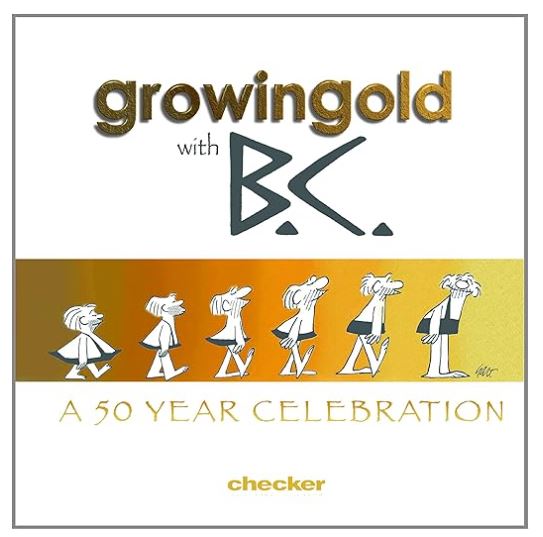
By Johnny Hart (Checker BPG)
ISBN: 978-1-905239-63-4 (HB) 978-1-933160-68-9 (PB/Digital edition)
This book includes Discriminatory Content produced in less enlightened times.
John Lewis Hart was born in Endicott, New York in 1931, and his first published cartoons appeared in military newspaper Stars and Stripes while he served with the US Air Force during the Korean War. On returning to Civvy Street in 1953, he sold a few gags to The Saturday Evening Post, Colliers Weekly and elsewhere, but had to earn a living as a general designer.
In 1958, for some inexplicable reason, caveman jokes were everywhere in magazines and comics (even latterly creeping onto TV and into movies). Despite all the dawn-age foofaraw, General Electric draughtsman and still-wannabe cartoonist Johnny Hart hadn’t sold a single one. He also desperately wanted to create a syndicated newspaper strip but couldn’t think of an idea.
And then one of his co-workers said why not do a strip feature one about Cavemen? Just like Alley Oop, but different…
Hart took a good look at the state of the world, and especially the people around him, and the wryly outrageous social commentarians supporting and harassing our hapless nebbish leading man B.C. quickly took shape…
The concept sold instantly to the New York Herald-Tribune Syndicate and the strip – starting today in 1958 – rapidly became a global hit, with the first of 41 collected editions (Hey! B.C.) released in 1959. In 1964 Hart started collaborating with fellow cartoonist Brant Parker on a new strip. The Wizard of Id also became a monster hit. The features won Hart an astounding hoard of awards over the years: making him one of only 4 American cartoonists to produce two strips appearing contiguously in more than 1000 newspapers.
Hart died of a stroke on April 7th 2007. He was working at his drawing board. Brant Parker passed away eight days later.
Hart became a devout Christian during the mid-1980s – something which increasingly and controversially manifested in later strips – but his urgent need to preach and share took a long time to impact the trenchant, whimsically surreal wit and primal byplay of his primordial playpen.
B.C. is a modern everyday kind of guy: a general purpose ordinary slob just getting by, but he has some odd and interesting friends breaking up the monotony of the pre-civilised world. These include self-proclaimed genius Peter, superstitious misogynist Wiley, proto-prime nerd Clumsy Carp, pre-human missing-link Grog, uber-sarcastic Curls and rakish lady-killer Thor.
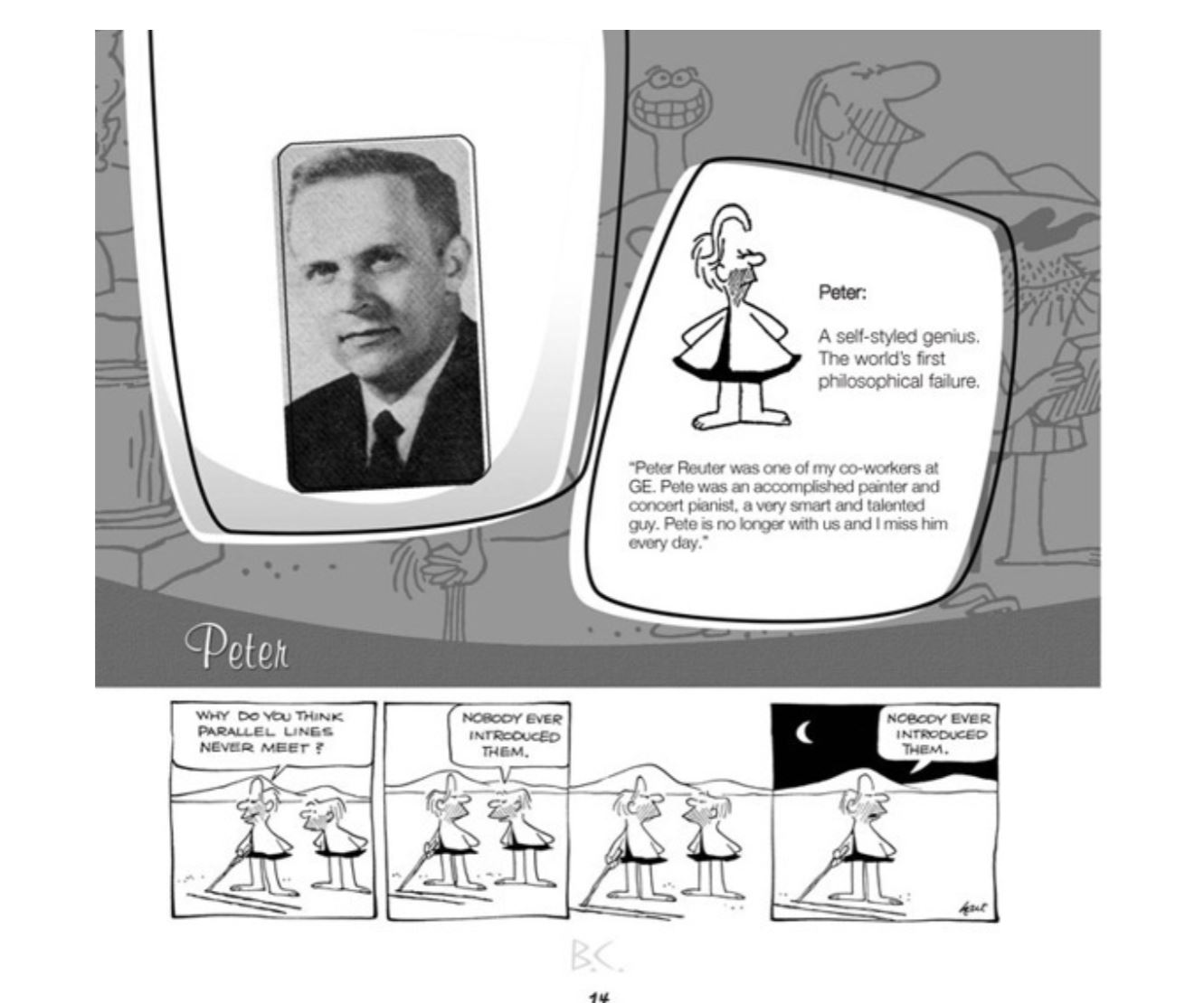
Apparently, all of them are based on actual people – life-long friends of Hart’s – and their candid reminiscences provide a charming and poignant insight into the life of one of the most revered and successful cartoonists of modern times.
Other materialised regulars include a variety of talking beasts and inanimate objects: chatty, snappy dinosaurs; ants and ant-eaters; clams, snakes; turtles; birds and an apteryx – but I’m guessing they never had analogues with day-jobs in Eisenhower’s America…
This magnificent tome – available in hardcover, paperback and digital editions – offers a decade-by-decade selection of the best and most memorable B.C. strips, supplemented by a listing of its many awards, and comes stuffed with photographs and observations. It is a most delightful commemoration of a truly great and very funny strip.
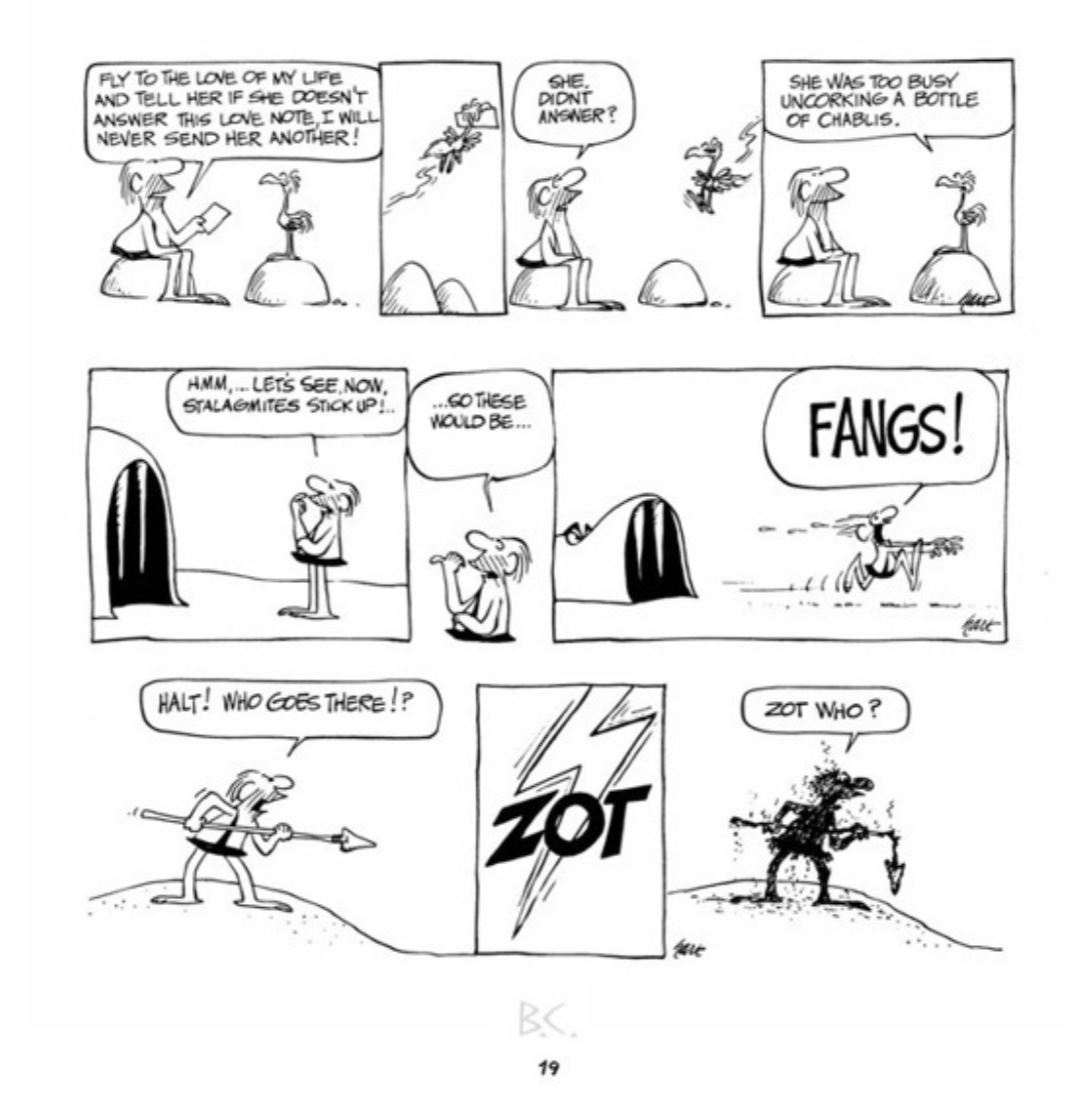
Hart died during the finishing stages of this book’s creation, making this the best way to celebrate his achievements. His legacy of brain-tickling, absurdist lunacy will never date, and creative anachronism has never been better used to raise a smile or an eyebrow in this lush collection of timely and timeless fun.
B.C. © 2007 Creators Syndicate Inc. B.C. © 1958-2006 John L. Hart Family Limited Partnership.
Today in 1914 writer Leo Dorman was born, as was fellow Superman stalwart Curt Swan in 1920. In 1929 Alejandro Jodorowsky came along, with today also greeting modern myth makers Nelson De Castro/“Nelson” in 1969 and Leah Williams in 1988.
Big day for strip launches too. As well as BC, we all started loving Richard F. Outcault’s The Yellow Kid in 1985, Lee Falk’s The Phantom in 1936 and Jack Williamson & Lee Elias’ Beyond Mars in 1952.