
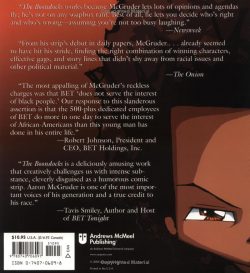
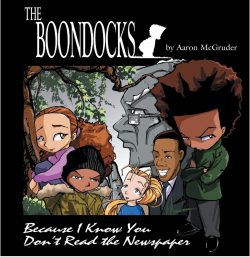
By Aaron McGruder (Andrews McMeel)
ISBN: 978-0-7407-0609-7 (TPB/Digital edition)
This book includes Discriminatory Content produced in less enlightened times. This book also includes Discriminatory Content included for satirical and comedic effect.
Unlike editorial cartooning, newspaper comic strips generally prospered by avoiding controversy. Other than a few notable exceptions – such as the mighty Doonesbury – daily and Sunday gag continuities aimed at keeping their readers amused and complacent.
Such was not the case with Aaron McGruder’s brilliant and so-much missed The Boondocks.
The strip ran from February 8th 1996 and officially ended – despite promises of a swift return – with the February 28th 2006 instalment. Episodes apparently popped up on social media for a month or so after that. You might have seen the adapted animated version on Cartoon Network’s Adult Swim some years ago…
The feature was created for pioneer online music website Hitlist.com and quickly began a print incarnation in Hip-Hop magazine The Source. On December 3rd, it started appearing in national periodical The Diamondback but, after an editorial bust-up, McGruder pulled the strip in March 1997. Nevertheless, it thrived as it was picked up by Universal Press Syndicate. Launched nationally, The Boondocks had over 300 client subscribers, reaching – and so often offending – millions of readers every day. Such was the content and set-up that the strip was regularly dropped by editors, and complaints from readers were pretty much constant.
What could possibly make a cartoon continuity such a lightning rod yet still have publishers so eager to keep it amongst their ever-dwindling stable of strip stars?
The Boondocks was always fast, funny, thought-provoking, funny, ferociously socially aware and created for a modern black readership. And Funny.
The series never sugar-coated anything – except obviously the utterly unacceptable curse of immodest language – whilst bringing contemporary issues of race to the table every day. This was a strip Afro-American readers wanted to peruse… even if they didn’t necessarily agree with what was being said and seen.
The narrative premise was deceptively sitcom-simple, but hid a potent surprise in its delivery. Huey Freeman is an incredibly smart, savvy and well-informed African American youngster. He spent his formative years on Chicago’s South Side, immersed in black history; philosophy of power; radical and alternative politics and “The Streets”. His little brother Riley is mired in Hip-Hop and the trappings of Gangsta Rap. Yet suddenly one day they are both whisked out of their comfort zone as their grandfather Robert assumes custody of them, and moves the whole family to whiter-than-white suburb Woodcrest in semi-rural Maryland.
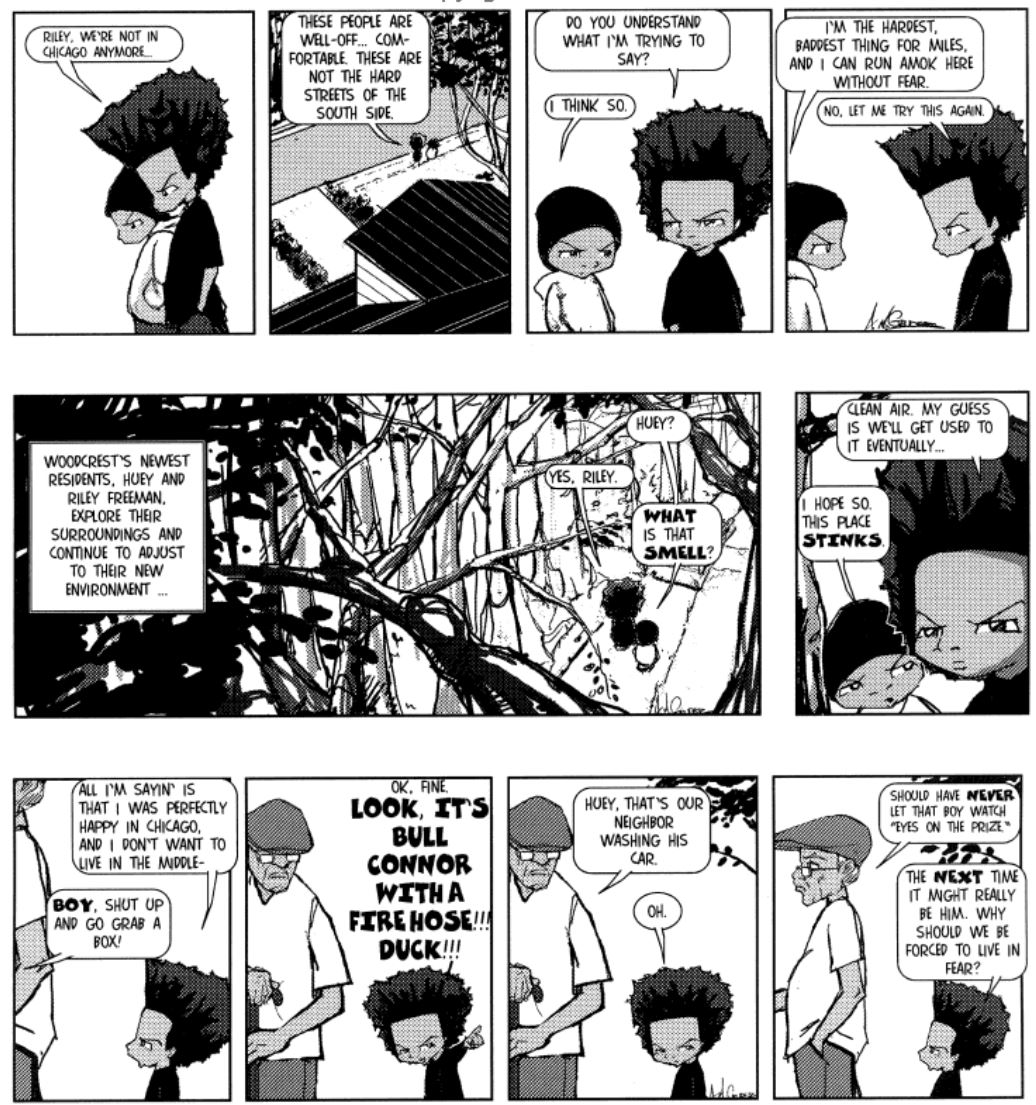
It’s mutual culture shock of epic proportions all both sides…
Huey (proudly boasting that he’s named for Black Panther co-founder Dr Huey Percy Newton) perpetually expounds radical rhetoric and points out hypocrisy of the well-meaning but inherently patronising all-Caucasian township, but saves equal amounts of hilarious disgust and venom for those overbearing, overhyped aspects of modern Black Culture he regards as stupid, demeaning or self-serving…
Riley mostly likes scaring them oh-so-polite white folks…
In this initial paperback monochrome collection (there’s also a Treasury edition with Sundays in full colour) we see material from April 19th 1999 to January 29th 2000, which includes a potent Foreword from Hip-Hop Activist and Media Assassin Harry Allen. He points out the way we’ve all managed to stop actual progress on issues of race by politely agreeing to not talk about them…
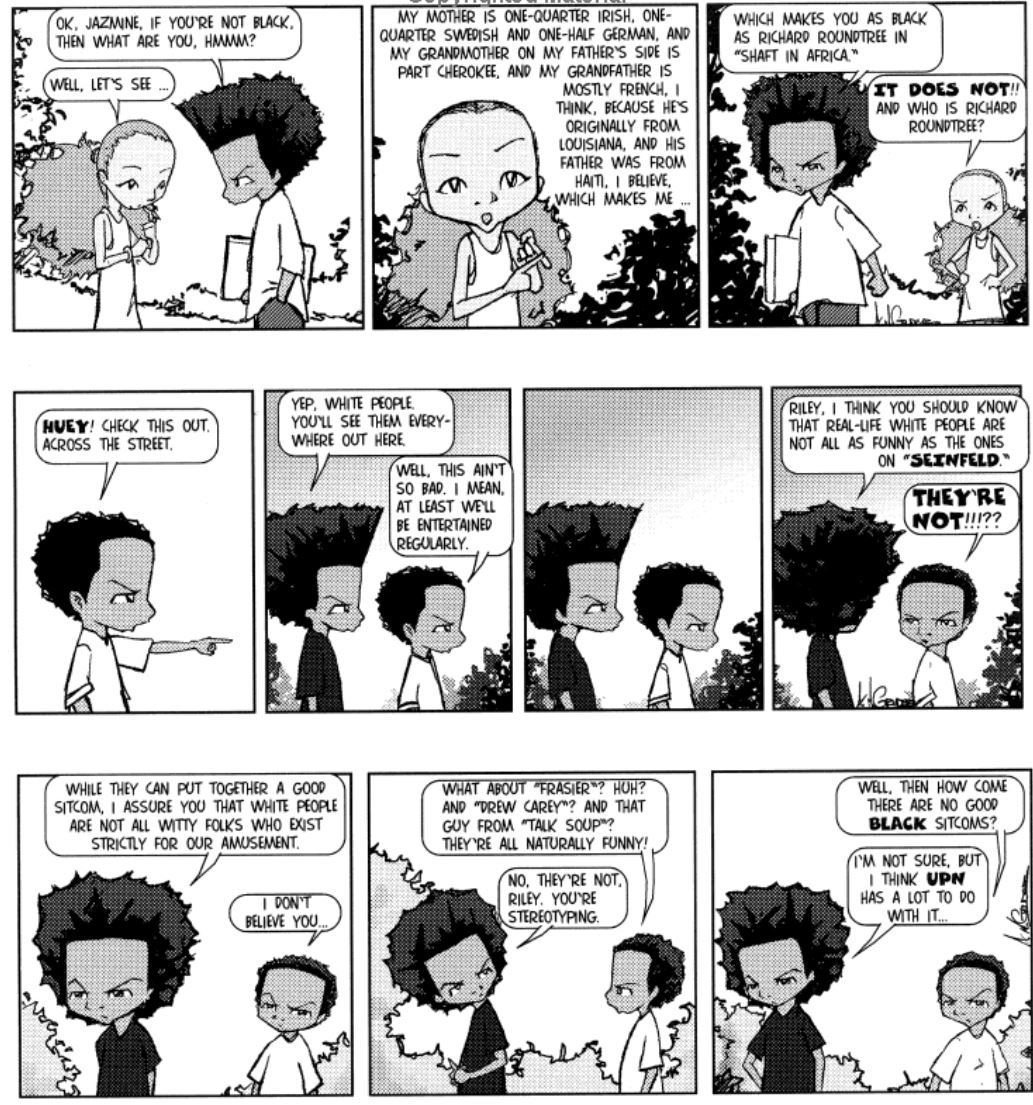
Property values start to wobble just a bit when Huey and Riley arrive in Woodcrest but at least disquiet is mutual. The place really freaks them out: the air is clean, there are no tagged walls or take-out stores, and old white people keep coming up to say hello. The first semblance of normality occurs when another new family moves in next door. Thomas and Sarah Dubois are woolly liberals: yuppy lawyers and Woodcrest’s first interracial couple, and – although she doesn’t understand any of the stuff Huey taunts her with – their daughter Jazmine is the suburb’s third black child… ever. She never thought of herself as any colour, but Huey is determined to raise her consciousness – when he’s not taking her establishment-conditioned dad to task on what colour he actually is…
Huey’s far less keen on the attentions of Cindy McPhearson, the little girl from school who has fully embraced TV’s version of Black Culture. She wants to meet – and be – Snoop Doggy Dogg. She hasn’t heard the term “Wigga” yet and Huey ain’t doing nothing but avoiding her: a tricky proposition as she sits behind him in class asking dumb questions.
The boys enrolling at Edgar J. Hoover Elementary School caused a few sleepless nights for Principal Williams but he cleverly borrowed a some videos (use google if you must, but it’s just an old way of having movies in your room) – Menace II Society, Shaft’s Big Score – to get him up to speed on the special needs of “inner city ghetto youth” and is confident his terrified teachers can handle any possible hurdles a variance in backgrounds might cause…
Don’t go away under the misapprehension that The Boondocks is a strident polemical diatribe, drowning in its own message. First and foremost, this is a strip about kids growing up, just like Bloom County, The Perishers, Peanuts or Calvin and Hobbes. Some of the most memorable riffs come from the boys’ reactions to the release of the Star Wars: Episode I (although admittedly, Jar Jar Binks gets a fully-deserved roasting for that alien/ethnic Minstrel performance), the worthlessness of high-priced merchandise and the insipid, anodyne street names. At least here, Riley and his paint spray cans can help out…
As the year progresses we also see outrageous takes on Halloween, Thanksgiving and Christmas as well as the boys’ investigation of the Santa Clause and Kwanza scenarios and their own hysterical Inner City, Keepin’ It Real alternative to all those manufactured holidays and causes…
Smart, addictive and still with a vast amount to say The Boondocks is a strip you need to see if you cherish speaking Wit as well as Truth to Power…
The Boondocks © 2000 by Aaron McGruder. All rights reserved.
Today in 1948 Spanish maestro José Luis García-López was born, as was equally polished superstar Brian Bolland in 1951. 1988 saw the passing of Swedish cartoonist, Journalist and strip maker Jan-Erik Garland.
In 1972 Tom Batiuk’s Funky Winkerbean began, whilst 1995 saw the end of Berkeley Breathed’s Outland after six gloriously bizarre years and, by most accounts, the last ever The Boondocks strip by Aaron McGruder in 2006.