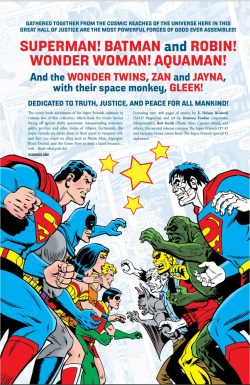
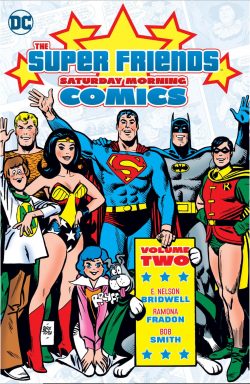
Super-Friends: Saturday Morning Comics volume 2


By E. Nelson Bridwell, Bob Rozakis, Martin Pasko, Bob Oksner, Ramona Fradon, Kurt Schaffenberger, Romeo Tanghal, Joe Staton, Bob Smith, Vince Colletta & Kim DeMulder with Alex Toth & various (DC Comics)
ISBN: 978-1-7795-0592-7 (HB/Digital edition)

Win’s Christmas Gift Recommendation: Absolute Entertainment Perfection… 9/10

Once upon a time comics were primarily created with kids in mind and, whilst I’d never advocate exclusively going back to those days, the modern industry has for the longest time sinned by not properly addressing the needs and tastes of younger fans these days. Happily, DC has latterly been rectifying the situation with a number of new and – most importantly for old geeks like me – remastered, repackaged age-appropriate gems from their vast back catalogue.

A superb case in point of all-ages comics done right is this massive tome. And don’t stress the title: it may celebrate the joys of past childhood shows but this is definitely a great big Sunday “settle back and luxuriate” treat…

The Super Friends: Saturday Morning Comics gathers comic book tales spun off from a popular Saturday Morning TV Cartoon show of the 1970s: one that – thanks to the canny craftsmanship and loving invention of primary scripter E. Nelson Bridwell – became an integral and unmissable component of the greater DC Universe, as a well a key supplier of fresh fodder to enhance its all-encompassing omniverse. So very many of his supporting characters became superstars in their own right and trappings such as the junior characters, villains and the Hall of Justice are now key components of today’s overarching continuity…

The Super Friends was also one of the most universally thrilling and satisfying superhero titles of the period for older fans: featuring the type of smart and witty, straightforward adventures people my age grew up with, produced during a period when the entire industry was increasingly losing itself in colossal continued storylines and bombastic, convoluted, soap opera melodrama.

It’s something all creators should have tattooed on their foreheads: sometimes all you really want is a smart plot well illustrated, sinister villains well-smacked, a solid resolution and early bed…

Under various guises, the TV show Super Friends ran from 1973 to 1986: a vehicle for established television-alumni Superman, Batman and Robin, Aquaman and Wonder Woman, supplemented by a succession of studio-originated kids as student crimebusters. The show also offered airtime to occasional guest stars from the DCU on a case by case basis. The animated show made a hugely successful transition to print as part of the publisher’s 1976 foray into “boutiqued” comics which saw titles with television connections cross-marketed as “DC TV Comics”.

Child-friendly Golden Age revival Shazam! – the Original Captain Marvel had been adapted into a popular live action series and its Saturday Morning silver screen stablemate The Secrets of Isis consequently reversed the process by becoming a comic book. With the additions of hit comedy show Welcome Back Kotter and animated blockbuster Super Friends’ four-colour format, DC had a neat little outreach imprimatur tailor-made to draw viewers into the magic word of funnybooks.

At least, that was the plan: with the exception of Super Friends, none of the titles lasted more than 10 issues…

This massive mega-extravaganza (the second of 2) gathers Super Friends #27-47, The Super Friends Special #1, The Best of DC: Blur Ribbon Digest #3, Limited Collectors’ Edition C-41 and Super Friends!: Truth Justice and Peace! (collectively spanning December 1979 to August 1981), ending the initial run whilst sharing material from assorted reprints and one-shots.

The majority of stories were by E. Nelson Bridwell & Ramona Fradon (Aquaman; Batman; Metamorpho the Element Man; The Brave and the Bold; Brenda Starr, Reporter). Bridwell (Secret Six; Inferior Five; Batman; Superman; The Flash; Batman and Robin newspaper strip; Legion of Super-Heroes; Captain Marvel/Shazam!) had been one of the art form’s earliest mega-fans, turning his hobby into a career in the 1950s.

He was justly renowned as DC’s Keeper of Lore and Continuity Cop – thanks to an astoundingly encyclopaedic knowledge of publishing minutiae and ability to instantly recall every damn thing about anything! Thankfully, he was also an ingenious and supremely witty writer. Fradon was a pioneering artist who also got her start in the 1950s, graced with a uniquely smooth and accessible style. She became one of comics’ earliest (acknowledged!) female artists and was a fan-favourite for generations.

Neither Bridwell or Fradon considered working at the junior end of the market as in any way less important or prestigious than the auteur/adult drama sector just starting to manifest in the American industry…

When Super Friends first aired, the costumed champions were mentors to two kids and their pet: tasked with training the next generation of superheroes. Without warning or explanation, Wendy, Marvin and Wonderdog were replaced for the second television season by alien shapeshifters Zan and Jayna and their elastic-tailed space monkey Gleek. In the comics – with more room to extrapolate and far more consideration for the fans – Bridwell turned the cast change into an extended epic.

When two siblings from distant planet Exor – a girl able to transform into animals and a boy who can become any form of water from steam to ice – came to Earth with an urgent warning they saved the world and were marooned here.

Their integration became an ongoing plot strand with the adults (and Robin) not only training Zan and Jayna, but also jointly acclimating them and introducing them into human society…

This concluding compilation of thrilling fun resumes with The Super Friends #27 and ‘The Spacemen Who Stole Atlantis!’ (Bridwell, Fradon & inker Bob Smith) sees domed undersea city Poseidonis stolen away by ruthlessly curious alien scientists who had not factored in Earth’s greatest defenders.

Inked by Vince Colletta, the next issue detailed a ‘Masquerade of Madness!’ in a Halloween yarn packed with guest stars (including Etrigan the Demon, Solomon Grundy, Man-Bat, Swamp Thing and Jimmy “wolfboy” Olsen) as mystic malcontent Felix Faust crashes a costume ball, trapping attendees in their outfits until Bruce Wayne hands over a certain magical gem… And that’s when the other – untransformed – Super Friends step in…

Another extraterrestrial invasion by colonising invaders seeking to evict humanity manifests in #29, with the new bosses wielding technology that seems to make all resistance futile. However, Wonder Woman and the Wonder Twins find a work-around meaning the war can be won by the heroes making themselves ‘Invisible Defenders of Earth!’

The issue also offers an adventure of the Wonder Twins, who now have secret identities and live in the home of guardian Professor Carter Nichols – Bruce Wayne’s science advisor/time travel expert who debuted in Batman #24, August 1944.

Here Bridwell, Kurt Schaffenberger & Smith establish the ‘Scholars from the Stars’ as transfer students at Gotham Central High, but John and Joanna Fleming are soon being stalked by curious classmates eager to learn all they can about the strange newcomers…

Nichols plays a major role in #30 as Fradon-illustrated ‘Gorilla Warfare Against the Humans!’ sees the heroes battle super-primate Grodd and his ally Giganta as they deploy their new tech to transform men into apes…

Guest stars were always a big draw and #31’s ‘How to Trap an Orchid!’ (inked by Colletta) saw DC’s most enigmatic hero targeted and framed by a ruthless enemy and helped by the Friends before Schaffenberger pencilled and Smith inked #32’s ‘The Scarecrow Fights with Fear!’ as the Tyrant of Terror afflicts the heroes with crippling weaponised personal phobias that only teamwork and determination can overcome

Fradon & Colletta combine for ‘The Secret of the Stolen Solitaire!’ as obsessive old enemy Menagerie Man returns, still using trained animals to commit spectacular robberies. His schemes are derailed when Jayna becomes a famously extinct creature and is “captured”, leading the heroes and visiting VIP Hawkman to his lair and the Winged Wonder’s captive sidekick Big Red

With #34, two stories per issue became the norm, leading with Bridwell, Fradon & Colletta’s ‘The Creature That Slept a Million Years!’, in which a hibernating beast awakened on Earth causes inadvertent chaos, balanced by ‘The Boss and the Beast’ as John and Joanna Fleming help their favourite teacher by saving her husband from a crooked boss fitting him up for a life of crime…

Romeo Tanghal & Smith illustrate full-length spectacle ‘Circus of the Super-Stars’ as the Super Friends and their showbiz impersonators trade places to outwit crooks targeting a massive charity event, before #36 bifurcates with a brace of tales limned by Tanghal & Colletta. First up is ‘Warhead Strikes at Gotham’ with Plastic Man and Woozy Winks tracking a war-mongering maniac and overlapping with the Super Friends battle to stop a paramilitary criminal force, after which The Wonder Twins visit a museum in their school personas and discover the shocking truth about ‘The Dinosaur Demon!’

Fradon & Colletta depict #37’s ‘Bad Weather for Supergirl!’ as the Kryptonian Crime-crusher (in her then-current day job as teacher) brings a class to Gotham just as the Weather Wizard goes on a rampage. Kara’s problem is not the villain’s outrages but that her kids seem far more impressed by the late-arriving superteam than their own hometown hero…

Drama is balanced by rampant fantasy in support story ‘The Giant Who Shrunk Ireland!’, with Bridwell’s creation Jack O’Lantern using his magical gifts to save the Celtic fairy realms from an awakened Fomorean Giant.

Jack was one of a number of international heroes Bridwell and Fradon devised, who grew in popularity and were eventually retrofitted into a team dubbed the Global Guardians. Another debuted in a solo spot at the back of #38, after ‘The Fate of the Phantom Super Friends’ (art by Fradon & Colletta), which saw alien tyrant Grax recruit and arm Earth gangsters to take revenge on his enemies. Then Bob Oksner & DeMulder illustrate ‘The Seraph’s Day of Atonement’ as Bridwell relocates his Israeli holy warrior to a new Jewish settlement in disputed territory just in time to save it from bandits pretending to be Arab terrorists. When, in his righteous anger, he goes too far in punishing the evildoers, he faces divine consequences…

Another former foe resurfaces in #39 with a sinister scheme to create hyper-evolved clones of the only being he trusts… himself. However, ‘The ‘Future’ Son of Overlord!’ (Fradon & Colletta) proves insufficient to the demands and the demise of “Futurio” only results in Overlord cruelly retrenching, after which the human-seeming Wonder Twins discover nightclubs are another place crazy crime can occur in ‘The Boogie Mania Will Get You’ (Tanghal & Collett)…

Inked by Kim DeMulder, #40’s lead tale ‘Menace of the Mixed-Up Senses!’ pits the heroes against a vindictive scientist creating disasters by scrambling perceptions, before Jack O’Lantern returns to teach a smooth-talking conman a life lesson in ‘Blarney for Sale!’ (Bridwell, Tanghal & DeMulder)

Bob Rozakis joins Fradon & Colletta in detailing ‘The Toyman’s Tricky Thefts!’ as the veteran villain attacks a Christmas toy convention as prelude to his true diabolical plan, whilst the rear guard of #41 witnesses Oksner write & illustrate ‘Dry Earth… Stolen Waters’ as The Seraph foils an industrial spy stealing the secrets of an experimental desalination device…

In Seasonal Special #42, Bridwell, Tanghal & Colletta debut Brazilian hero Beatriz Da Costa (AKA Green Fury, Green Flame and/or Fire) who joins the Wayne Foundation just in time to help the Super Friends defeat a vegetation-controlling villain in ‘How Green Was My Gotham!’ and still leave room for the Wonder Twins to enjoy ‘A Christmas with Everything!’ in a heartwarming tale of family and little miracles…

Overlord tries again in #43, unleashing ‘Futurio Times Ten!’ to destroy the collegiate heroes, (and Green Fury) but fails when the over-evolved clone develops an unholy fascination with potential mate Wonder Woman, after which Plastic Man bounces back in ‘Mouth-Trap!’ by Pasko, Staton & Smith, taking down thieving shock jock Lou Kwashus – AKA Chatterbox

Issue #44 leads with Bridwell, Tanghal & Colletta’s ‘Peril of the Forgotten Identities!’ as a menace from the Wonder Twins’ homeworld warps the memories of the team leaving Zan, Jayna & Beatriz to save the day. As counterpoint, Jack O’Lantern then solves a snag in the (super)natural order by ensuring ‘The Death-Cry of the Banshee!’ is heard by the right person…

The “International Heroes” who would become Global Guardians (Rising Sun, Bushmaster, Olympian, Wild Huntsman, Godiva and Little Mermaid) were formally gathered by immortal wizard Doctor Mist in #45 and united with the Super Friends to defeat ‘The Man Who Collected Villains!’

Another classic by Bridwell, Tanghal & Colletta, it pits the merged squads against uber-baddie The Conqueror and his personal Doom Legion – Hector Hammond, Kanjar Ro, Queen Bee, Sinestro, Time Trapper and World-Beater – in a brutal clash that concludes in the next issue.

Before that though, courtesy of Pasko, Staton & Smith, Plastic Man & Woozy discover ‘One of Our Barbarians Is Missing!’ and must halt the rampage of a temporarily-deranged movie swordsman being manipulated by devious crooks…

The frantic Fights ‘n’ Tights clash then results in ‘The Conqueror’s Greatest Conquest!’ (Bridwell, Tanghal & Colletta) – and ultimate downfall before The Seraph battles an ‘Echo of Evil’ and the ghosts of Masada (look it up) in an all-Oksner thriller.

The comic book Super Friends ended with #47: a 25-page epic by Bridwell, Tanghal & Colletta detailing the origin of Green Fury, a plane of animal spirits and ‘The Demons from the Green Hell!’ whose actions sought to unmake the world until the team stepped up…

Times and tastes were changing and it would be years until superheroes – and not toy tie-ins – for kids were a viable option again: when once again TV led that march with breakthrough adaptations of Batman, Superman and Justice League Animated Series…

Here and now, this epic collation closes with series designer Alex Toth’s 1976 cover for Limited Collectors’ Edition C-41 and The Best of DC: Blur Ribbon Digest #3 (January-February 1980) cover by José Luis García-López & Bob Smith. Also on view is Ross Andru & Dick Giordano’s cover from The Super Friends Special #1 1981 and Toth’s frontage from the 2003 Super Friends!: Truth Justice and Peace! trade paperback collection.

Sublimely resplendent in the rich flavours and simple joys of DC’s Silver Age boom, and with covers by Fradon, Smith, Schaffenberger, Tanghal, & Colletta, this concluding compendium is superbly entertaining, masterfully crafted and utterly engaging. It offers stories of pure comics gold to delight children and adults in equal proportion. Truly generational in appeal, they are probably the closest thing to an American answer to the magic of Tintin or Asterix and no family home should be without this tome.
© 1976, 1979, 1980, 1981, 2003, 2020 DC Comics, Inc. All Rights Reserved.

Sugar and Spike Archives volume 1


By Sheldon Mayer (DC Comics)
ISBN: 978-1-4012-3112-5 (HB)

Win’s Christmas Gift Recommendation: Utter Entertainment Perfection… 10/10

I actually intended this for a forthcoming week of kid-friendly books in the New Year but on re-reading this gloriously whimsical and hilariously absurdist tome I came to the conclusion that just like its scintillating and ultra-impatient co-star, I am quite impatient and don’t like to share with just anybody, so this is for Right Now …and probably just for the parents, ok?

And just so we’re clear, miss Sugar Plumm predates Miss Piggy by DECADES and is marginally scarier! Okay? Good, now go on, and let the kids see it too if you want…

Sheldon Mayer (April 1, 1917 – December 21, 1991) is arguably the most important man in American comic book history. A writer and cartoonist, he was also the editorial guiding light behinds dozens of major features at All American Publishing, with a hand in the creation of Wonder Woman, The Flash, Hawkman, Green Lantern, Justice Society and many more.

He mentored young creators like Carmine Infantino and Joe Kubert and his creative opinions as assistant to Max Gaines and others dictated the way the entire industry unfolded.

Back in 1935, he was a writer, artist and eventually editorial assistant to Major Malcolm Wheeler-Nicholson at embattled and failing outfit National Allied Publications. In 1938, Mayer was credited with rescuing from the trash can a weird strip about a strongman in tights and a cape. He apparently loved the feature – by two kids named Siegel and Shuster – and pushed until Harry Donenfeld put it in his new anthology Action Comics. That worked out pretty well in the end…

Above all else, Mayer was an inveterate and incurable cartoonist. In 1936, at Dell Comics he created semi-autobiographical boy cartoonist Scribbly, and when “Shelly” joined Gaines at AA he brought that comical kid with him. When the superhero craze truly kicked off, Mayer added one to the strip. Ma Hunkel was Scribbly’s fearsome landlady, and when crime and ne’er-do-wells plagued her neighbourhood, she tackled the problem by making a costume from kitchen scraps and pots to patrol her inner city district as the mighty, mysterious Red Tornado

In 1948, Mayer surrendered his editorial position to devote himself to drawing and storytelling. He had already spearheaded AA/DC’s move into funny animal features four years previously, in new or converted titles Funny Stuff (Summer 1944), Animal Antics (March 1946) and Funny Folks (April 1946). Cover-dated June 1945, Leading Comics (former home of the Seven Soldiers of Victory) was the first to drop superheroes, becoming an anthropomorphic mainstay with #15.

Mayer’s mirth mountain included the return of Scribbly; exploring the burgeoning teen scene in Leave it to Binky and Buzzy, and generating all-ages whimsy and hilarity in dozens of strips like Doodles Duck, Peter Porkchop, Nutsy Squirrel, Dodo and the Frog and The Three Mouseketeers. In 1956, he created the most charming and adorable comics concept ever published… Sugar and Spike.

The series was an all-Mayer affair that ran 98 issues – until his eyesight failed and he stopped drawing. Undaunted, he carried on as a writer: scripting anthological horror tales for Adventure Comics and sundry DC mystery titles like House of Mystery and Forbidden Tales of Dark Mansion. He also created Black Orchid, revived DC’s 1950s iteration of Rudolf the Red Nosed Reindeer and – following eye surgery – resumed drawing Sugar and Spike for international syndication.

Some of those stories were reprinted in DC digests The Best of DC, and in 1992, a commemorative 99th issue of Sugar and Spike: released as part of the DC Silver Age Classics series. As usual, I’m revelling in nostalgic joys here whilst whining like a baby and opining for DC to commission a full archival revival in print and digitally…

The concept is beautifully simple and evergreen and as a sign of the regard DC held Mayer in, he was allowed to sign his work: an honour only Siegel & Shuster, Bob Kane and Charles Moulton enjoyed at that time.

In in ordinary domestic America, there are two neighbouring families; each with a toddler. Those little kids get up to all sorts of mischief, much of it quite destructive. These kids are like all baby beings – able to clearly communicate with every other infant in creation – but not adults. The premise constantly generates captivating magic as the bright kids daily discover, categorise and classify their world: posit their own soundly rationalistic explanations for the grown-ups’ weird behaviours and fascinating toys and foods (or anything else they can put in their mouths…). Naturally, the adults think the babytalk babble is cute, but surely it’s nothing but charming nonsense?

Preceded by a revelatory Introduction from Comics historian Bill Schelly the wonderment opens right on the cover which introduces Sugar Plumm and Cecil “Spike” Wilson and sets up a regularly recurring gag: although friends and neighbours, the toddlers’ parents have differing approaches to child rearing. Whenever the kids discuss these discrepancies and attempt to capitalise on the parents’ latest tactic (this was the great era of baby advice gurus like Dr. Benjamin Spock), it’s usually Spike who suffers for it…

That premiere issue opens with ‘Sugar and Spike!’ as the Plumm family move in and quickly introduce themselves and their new daughter to the Wilsons. The kids get on like a house on fire, chatting away like old pals, even though it’s the first baby Spike has ever seen and he can’t form proper words yet…

He’s just discovered a universal truth: although everything has to learn its own language, all babies are born able to communicate with each other…

Soon he’s showing the fascinating new creature with the hair tail all the fun places in his house, like daddy’s basement workshop where all the loud fast toys and paint tins are, and despite the resultant chaos triggering the first of many spats between the adults a friendship for the ages is born…

‘Thumbs Up!’ then builds on the front-cover gag as the infants compare notes on how their parents react to thumb-sucking, unaware that there’s more than one baby-care book and varying opinions can produce wildly varying adult responses…

Mayer was well aware that his young readership needed lots of participatory stimulation and worked hard on activity pages such as ‘Write Your Own Comic Page’, wherein kids could fill in blank word balloons of a strip and colour it in afterwards, before ‘Busy Corners’ introduces Sugar’s Uncle Charley. He’s a motorcycle cop and her favourite adult, partly because he rides that bizarre “put-put” thing and partly because he always brings fun (for which read “inappropriate”) toys, but mostly because Uncle Charley never really grew up. Spike is initially jealous but soon warms to the big guy… just before his antics result in both babies and Charley being sent to stand in the corner again…

‘Free Wheeling’ then sees the tots work out the best – but not correct – way to use a wheelbarrow and invent an indoor sport based on golf that has immense destructive potential in ‘The Big Question’, after which their discovery of ‘The Yak-Yak Box’ leads to telephonic disaster. The debut issue then closes with a back-up starring older kid ‘Littul Snoony’, whose dabbling with a junior chemistry set leads to manic misunderstanding…

Sugar and Spike #2 (cover-dated June/July 1956) opens with mystery yarn ‘Photo Finish’ as the plucky lad attacks another baby photographer hired to snap little miss Plumm. The parents can’t understand why cameras terrify Sugar or why Spike always gallantly attacks the lens-jockeys, but that’s because they can’t understand the little lady’s tale of woe about a snake-ejecting trick box during an earlier photoshoot…

Understandable frustration at big people’s inability to understand baby talk boils over during ‘The Return of Uncle Charley’ who comes bearing a water-spurting fire truck and gets them stuck in the corner again, after which ‘Spike at Home’ and ‘Sugar at Home’ prove that the cooperative kids can cause chaos all on their own, before ‘The Big Toy Mystery’ details their discovery of vehicular fun – and folly – after Spike gets a tricycle…

Mayer was always aware that the newspaper comic strip was a powerful and ubiquitous tool used to raise circulation and promote customer loyalty in the 20th century, and as well as laughs, thrills and escapism creators often added games, cut-out collectibles and paper toys to their output. The common belief was that youngsters – especially girls – loved this kind of “dress-up” play, but I suspect many young men also joined in. One of the most popular and perennially effective was beloved characters in their underwear, plus assorted outfits to clothe them in. Many features took the process further by inviting readers to contribute designs.

This practise graduated from the strips to comic books, and Sugar and Spike employed paper-doll pages for its entire run, beginning with a set of cut-out ‘Pint-Size Pin-ups’ (the kids in diapers and six readers’ ensembles from summer dresses to a Davy Crockett suit), after which the kids go to a swish department store where Sugar teaches her “doll-boy” ‘How to Play Loozum’. This issue closes with a ‘Do It Yourself Comic Page!’ where all the characters are faceless and readers can either draw their own or cut and paste from a selection of expressions graciously provided…

For #3, Spike is given a marble by some older kids, but his love for it triggers calamity when it’s eaten by a vacuum cleaner and Sugar makes the monster give back ‘The Shiny Round Roller’, after which ‘Spike Discovers the Ocean!’ and is quickly convinced that it hates him…

More ‘Pint-Size Pin-ups’ lead to a minor masterpiece as the boy is taken to his first restaurant and befriends the main course in ‘Lobsters Away!’ His screams lead to the Wilsons taking the baby crustacean home, where Spike and Sugar resolve to return “Alice” to her home in the ocean…

Activity page ‘You Be the Editor!!’ presents a scrambled strip to put in order – and colour in – before the issue closes with a “kootchy-coo!” monster invading the Wilson home. Happily, Sugar has encountered a “Nanty” before and her ‘Anti-Aunty’ tactics include roping in Uncle Charley to drive the beast away…

Cover-dated October/November, S&S #4 introduced another major theme and recurring gag: the babies’ gradual capitulation to nature and maturation, as epitomised by learning – to say, if not understand – new grown-up words. ‘Who’s Sorry Now?’ sees Spike in the corner when Sugar teaches him a term that makes adults forgive everything. However, when they hear someone apparently abusing the magic term, their vengeance is both fearsome and bizarre…

The tots’ discovery of a ‘New Gadget’ results in utter chaos and necessary redecoration before ‘One Sunday Afternoon’ finds Pa Wilson failing to self-assemble a new garden hammock thanks to their assistance. Staying with recreation, the ‘Water Babies’ are dumped on their dads, and enjoy a fishing trip that borders on the surreal and uncanny…

Sugar and Spike #5 (December 1956-January 1957) opens with the infants attending ‘The Birthday Party’ of an older kid, and utterly misunderstanding the notion of GIVING OTHER PEOPLE presents. This hilarious romp introduced mean bully Clarence: a spoiled older boy continually outwitted by the toddlers over the years.

Insomnia informs ‘The Early Birds’ as the tiny tots go walkabout whilst the parents enjoy the sleep of the exhausted, and Spike ponders ‘Grampa’s Problem’ – a sly observation on the indignities of old age – before more ‘Pint-Size Pin-ups’ anticipate ‘The Mystery of the Funny Runner’ with our curious kids questioning how older kids have wheels on their feet…

They seek to imitate firefighters in ‘To the Rescue’ with unwelcome results before the copy closes with a backyard clean-up that reveals ‘A Place for Everything’ isn’t literal when looking for somewhere to put fallen leaves…

Charm manifests in almost lethal amounts in #6 as the veteran infants meet and bring up to speed a newborn in ‘The New Baby’, and another developmental milestone is reached on ‘The Trip’ as both tots stay with Spike’s grandparents for their first Christmas. That witty wonderment is augmented by a ‘How To Make Sugar and Spike Dancing Dolls’ and more gloriously adorable ‘Pint-Size Pin-ups’, before ‘Winter Sunday’ sees the downside of shovelling snow off sidewalks with curious toddlers joining in and ‘Cats? Meowch!’ explores the hazards of finger painting with anchovy paste. This issue then folds with Spike and Sugar addressing consumerism in combat with all the mod cons (that was “Modern Conveniences” if you’re post Millennial) in ‘Baby vs. Machine’

By #7 (April/May 1957) Mayer was regularly using fashions contributed by readers, as here in opening yarn ‘Mud Mud Mud!’ when the moms try to split up the kids and Mrs Wilson bribes the local older boys to include Spike in their war games. When their messy roughness provokes a tantrum, Sugar comes to his rescue with shocking consequences but not as much as what happens when the misbehaving tots catch their moms consulting ‘The Magic Book’ that seems to dictate what punishments they get…

The mayhem of Spike’s ‘First Haircut’ came from a plot sent in by two readers, one of whom also designed outfits for another ‘Pint-Size Pin-ups’ section, whilst Mayer can claim full credit for Spike’s close encounter with ‘The Don’t-Touch Thing’ and almost sending his dad to jail from the passenger seat in motorcar moment ‘Three-Wheel Driver’

Issue #8’s mixes crockery carnage and childish misdemeanours with high concept as the kids give the adults ‘Speech Lessons’ in an attempt to make their moms properly communicate in clearcut babytalk and ‘Uncle Charley Strikes Again’ with another magnificently inappropriate toy for Sugar before a double helping of ‘Pint-Size Pin-ups’ leads to another failed experiment when Sugar ensures that ‘The Tick-Tock Won’t Tick-Tock Now!’

Grandpa then finds a way to replace a hobbyhorse in ‘Ride ‘Em Cowboy’, and we close with more animal antics in ‘Trip to the Zoo’

Sugar and Spike #9 saw the title shift to a monthly frequency: opening with ‘Double Trouble’ as the infants investigate a strangely familiar couple inside the big glass toy, whilst their wear & tear on  toys is tackled by daddy – AKA ‘The Fix-It Machine’, and – after two more ‘Pint-Size Pin-ups’‘Horse Sense’ traces the troubles caused by their first trip to an amusement park where the nippers naturally “liberate” a baby-talking little pony…

Another ‘Write Your Own Comic Page’ then leads to a breakthrough in counting in ‘Spike Learns Big Business’

This sublime collection concludes with #10 (cover-dated September 1957) beginning with ‘The Big Word Mystery’ as the troublesome toddler parrots a grown-up sound that makes adults go crazy, after which the kids learn that pulling ‘The Magic String’ makes day-time go away.

One last brace of ‘Pint-Size Pin-ups’ leads to another seaside jaunt where the parents go ‘Beach Nuts’ after the kids go AWOL and – once safely home – ‘More Adventures with the Yak-Yak Box’ when Spike tries in vain to rescue the random toddler who answered whilst he was playing with the very-forbidden telephone…

These are wonderful, whimsical stories from a time when comics were a major entertainment medium and the only mass market accessible to kids. Thanks to the gifts of Sheldon Mayer, these yarns remain some of the most beguiling and hilarious ever crafted – just ask the numerous countries the feature was syndicated to – and absolutely MUST be brought back for kids of every vintage to enjoy.
© 1956, 1957, 2011 DC Comics. All Rights Reserved.

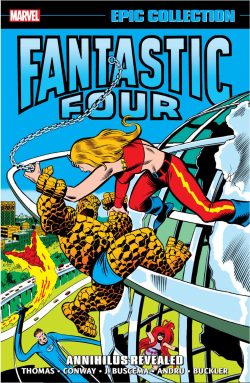
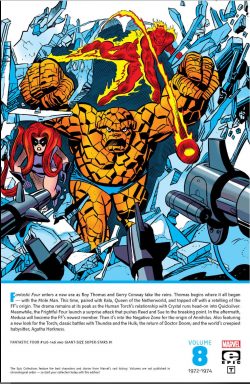
Fantastic Four Epic Collection volume 8: Annihilus Revealed 1974-1974


By Roy Thomas, Gerry Conway, John Buscema, Ross Andru, Ramona Fradon, Rich Buckler, Joe Sinnott, Frank Giacoia & various (MARVEL)
ISBN 978-1-3029-3359-3 (TPB/Digital edition)

Win’s Christmas Gift Recommendation: Fantastic Festive Fun… 8/10

Cautiously bi-monthly and cover-dated November 1961, Fantastic Four #1 (by Stan Lee, Jack Kirby, George Klein & Christopher Rule) was raw and crude even by the ailing company’s standards: but it seethed with rough, passionate and uncontrolled excitement. Thrill-hungry kids pounced on its dynamic storytelling and caught a wave of change starting to build in America. It and succeeding issues changed comics forever.

As seen in the groundbreaking premier issue, maverick scientist Reed Richards, his fiancée Sue Storm, their close friend Ben Grimm and Sue’s bratty teenaged brother survived an ill-starred private space-shot after Cosmic Rays penetrated their ship’s inadequate shielding.

All permanently mutated: Richards’ body became elastic, Sue became (even more) invisible, and Johnny Storm burst into living flame whilst tragic Ben shockingly devolved into a shambling, rocky freak. After the initial revulsion and trauma passed, they solemnly agreed to use their abilities to benefit mankind. Thus was born The Fantastic Four.

Throughout the 1960s it was indisputably the key title and most consistently groundbreaking series of Marvel’s ever-unfolding web of cosmic creation: a forge for new concepts and characters. Kirby was in his creative prime: continually unleashing his vast imagination on plot after spectacular plot, whilst Lee scripted some of the most passionate superhero sagas ever seen.

Both were on an unstoppable roll, at the height of their powers and full of the confidence only success brings, with The King particularly eager to see how far the genre and the medium could be pushed… which is rather ironic since it was the company’s reticence to give the artist creative freedom which led to Kirby’s jumping ship to National/DC in the first place…

And then, he was gone…

With this collection of “The World’s Greatest Comics Magazine” a new style was confirmed. Without Kirby’s soaring imagination the rollercoaster of mind-bending High Concepts had given way to more traditional tales of characters in conflict, with soap-opera leanings and super-villain-dominated Fights ‘n’ Tights dramas.

This cunning compilation re-presents Fantastic Four #126-146 and Giant-Size Super-Stars #1: collectively covering September 1972 to May 1974, which saw Roy Thomas assume the role of writer/editor. He began by revisiting the classic origin and first clash with The Mole Man from FF #1. Illustrated by John Buscema & Joe Sinnott, ‘The Way it Began!’ was all mere prelude for what was to follow…

The reverie prompts the Thing to invade the sub-surface despot’s realm in search of a cure for the blindness which afflicts his girlfriend Alicia Masters in ‘Where the Sun Dares Not Shine!’ and all too soon the embattled brute is embroiled in a three-way war between Mole Man, KalaEmpress of the Netherworld and immortal dictator Tyrannus. When his comrades go after Ben, they are duped into attacking him in ‘Death in a Dark and Lonely Place!’

Having barely survived the three-way war, the exhausted team return to their Baxter Building HQ just in time for lovesick, heartsore Johnny to leave for the hidden kingdom of Attilan and explosively confront lost love – and Inhuman Princess – Crystal.

Tragically as he leaves, ‘The Frightful Four… Plus One!’ sees the Thing ambushed by The Sandman, Wizard and Trapster, beside their newest and almost uncontrollable ally… super-strong amazon Thundra.

Happily, Crystal’s sister Medusa is there to pitch in as the clash escalates, spreading to ‘Battleground: The Baxter Building!’ wherein infant Franklin Richards begins exhibiting terrifying abilities. Always and literally left holding the baby and fed up with her husband’s neglect, Susan finally leaves Reed, whilst in the Himalayas, Johnny has forced his way to Crystal’s side only to find his worst nightmares realised…

Fantastic Four #131 describes a ‘Revolt in Paradise!’ (illustrated by Ross Andru & Sinnott) as Crystal, her new fiancé Quicksilver, and the rest of the Inhumans are attacked by their genetically-bred and programmed slave-race the Alpha Primitives. At first it seems that insane usurper Maximus is again responsible for the strife, but a deeper secret lurks behind the deadly danger of ‘Omega! The Ultimate Enemy!’, and only when the rest of the FF arrive does Reed ferret it out…

FF #133 celebrated the holiday season with plenty of fireworks in ‘Thundra at Dawn!’ as the mysterious “Femizon” returns to battle Ben once more, courtesy of incoming scripter Gerry Conway, guest penciller Ramona Fradon & Sinnott, after which ‘A Dragon Stalks the Sky!’ in #134 (Conway, Buscema & Sinnott) finds Reed, Johnny, Ben and Medusa fighting forgotten super-rich foe Gregory Gideon and his latest acquisition Dragon Man: a bombastic battle which concludes in a struggle to possess ‘The Eternity Machine’

The secret of that reality-warping device is revealed in a two-part thriller as cosmic entity Shaper of Worlds creates a horrific paranoid pastiche of 1950s America: re-running the conflicts between rebellious youth and doctrinaire, paternalistic authority in ‘Rock Around the Cosmos!’ and the surreal conclusion ‘Rumble on Planet 3’ which also tapped into the then-ongoing struggles of the Civil Rights movement…

In amongst the sub-plots, the never-ending stress had forced Sue Richards away from her husband but their son’s rapidly-growing, undiagnosed cosmic powers and problems were pulling them reluctantly back together…

Mr. Fantastic was not taking the separation well and #138 finds him left in an increasingly depressive state when old comrade Wyatt Wingfoot comes looking for assistance against impossible, unimaginable disasters. ‘Madness is… The Miracle Man!’ began a period when rocky everyman Ben Grimm became de facto star of the Fantastic Four and here he, the Torch and Medusa travel to Wingfoot’s tribal lands in Oklahoma to battle a cheesy hypnotist first encountered in their third adventure…

Now, however, thanks to the charlatan’s subsequent studies under mystic Cheemuzwa medicine men, the maniac actually can reshape reality with a thought…

The battle concluded in ‘Target: Tomorrow!’ with the villain able to control matter but not himself spiralling frantically out of control, with our heroes struggling indomitably on until the Miracle Man makes a fatal, world-threatening error…

Reed’s travails take a darker turn in Fantastic Four # 140 as ‘Annihilus Revealed!’ finds the insectoid tyrant king of dying antimatter universe the Negative Zone kidnapping the ever-more powerful Franklin as a prelude to invading the Baxter Building in search of new worlds to ravage.

In triumph, the bug horror discloses his incredible origin to the helpless Wingfoot before dragging all his enemies back to his subspace hell to engineer ‘The End of the Fantastic Four!’ However, even though the beaten heroes counterattack and gain an unlikely victory, Annihilus’ prior tampering with Franklin triggers a cosmic catastrophe. As his limitless power spikes out of control, his tormented father is compelled to blast the boy, shutting down his mutant brain …and everything else.

Appalled at the callous cold calculations needed to put his own son into a coma, Johnny and Ben join Sue in deserting the grief-stricken Mr. Fantastic and declaring their heroic partnership defunct.

With only ruthlessly pragmatic Medusa remaining, FF #142 sees shell-shocked Richards with ‘No Friend Beside Him!’ (as Conway and inker Sinnott were joined by new artist Rich Buckler, whose faithful pastiche of Jack Kirby produced a wave of favourable nostalgia in fans then and now) whilst the Thing follows long-time girlfriend Alicia Masters to central Europe.

She has been lured to the Balkans with promises of a medical breakthrough that can cure her blindness, but once Ben arrives, they are promptly attacked by a sinister supernatural horror named Darkoth the Death-Demon

Back in the USA, Johnny and Wyatt Wingfoot head for Metro College to see their old sports coach Sam Thorne on his way to an Alumni reunion. Reed is another attendee, despondently dragged there by Medusa, but nobody expects that weird foreign kid who had been expelled so long ago to turn up, leading to ‘The Terrible Triumph of Doctor Doom!’ (inked by Frank Giacoia)…

The Iron Dictator was never one to forgive a slight, real or imagined, and as he gloatingly reveals himself to be the creator of Darkoth and jailer of the Thing, Victor von Doom further boasts to his captives of his latest scheme… to utterly eradicate human free will.

Typically, though, the tyrant hasn’t considered how his death-demon might react to the news that he is sham. Outraged the puppet rebels and the monster’s ‘Attack!’ (#144 by Buckler & Sinnott) results in a cataclysmic clash and Doom’s defeat…

Back together but still disunited, the FF part company again in #145, with Johnny accompanying Medusa to the Himalayan citadel of Attilan – hidden city of the Inhumans – only to be brought down by a lost race of ice people and forced to endure a ‘Nightmare in the Snow!’ (illustrated by Andru & Sinnott). Here, snow troglodytes’ plans to make Earth into an ice-ball only they can inhabit go bizarrely awry as the Thing joins the frozen heroes. When a dissident faction trained by a Buddhist monk also pitch in, the conclusion is a happy ending all round in ‘Doomsday: 200 Below!’

This was period of great experimentation and expansion at Marvel, with new formats and lines launching seemingly continuously. Giant-Size Super-Stars #1 (May 1974) was a forerunner in a line of supplementary, double-length titles starring the company’s most popular stars.

In this initial exploratory outing – the title became Giant-Size Fantastic Four with the second quarterly release – Conway, Buckler & Sinnott crafted ‘The Mind of the Monster!’: a shattering reprise of earlier titanic team-up triumphs beginning when Bruce Banner came calling upon the FF, still seeking a cure for his mean green alter ego. Unfortunately, the Thing is overly sympathetic, and in his self-loathing foolishly allows the fugitive physicist to modify one of Reed’s devices…

Unfortunately, meddling with the Psi-Amplifier switches their minds, leaving the Rampaging Hulk trapped and furiously running amok in the Thing’s body whilst Ben/Hulk struggles to stop him.

The situation plummets into more chaos when trans-dimensional Femizon Thundra pitches in, mistakenly believing she is helping her intended main squeeze Ben battle a big green monster, with violence intensifying to the max when Reed, Johnny and Medusa get involved in second chapter ‘Someone’s Been Sleeping in My Head’

Ultimately it takes everybody and a cunning plan to set the world to rights in the spectacular, full-throated conclusion ‘…And in This Corner: The Incredible Hulk!’

Following a bunch of editorial extras from the special, a few last treats complement the covers throughout (by Buscema, Gil Kane, Giacoia, Buckler, Jim Steranko and John Romita). These include a selection of contemporary house ads, the cover of all-reprint Fantastic Four Annual #10 and extracts from F.O.O.M. #1 (Spring 1973): the Steranko cover, intro article ‘Once Upon a FOOM!’, contemporary bios of the Marvel Bullpen, a reproduction of the cover to FF#1 plus attendant article ‘When Titans Clash!’; a checklist of FF issues; a pin-up of FF #73; a Doctor Doom game, Thomas, Len Brown, Gil Kane & Wally Wood’s Fantastic Fear pastiche from Not Brand Echh; Kirby’s Doctor Doom cover from F.O.O.M. #4; ‘Quotations from Chairman Doom’; Charley Parker’s ‘Dr Foom’, and board game ‘Heavy Conflict!’

Also recovered are Buckler & Sinnott’s Thing cover from F.O.O.M. #5, more ‘Marvel Bullpen Profiles’, ‘Marvel’s Greatest Hero: The Thing’ plus uncorrected cover art for FF #130 & 131 and original art pages by Buscema, Buckler & Sinnott.

Although Kirby had taken the unmatched imagination and questing sense of wonder with him on his departure, the sheer range of beloved characters and concepts he had created with Stan Lee carried the series for years afterwards. So once writers who shared the originators’ sensibilities were crafting the stories a mini-renaissance began…

This period offers fans a tantalising taste of the glory days and these solid, honest and intriguing efforts will be welcomed by dedicated superhero fans and continuity freaks alike. They will also thrill and enthral the casual browser looking for an undemanding slice of graphic narrative excitement, so what’s stopping you?
© 2022 MARVEL.

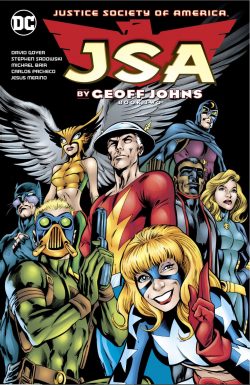
JSA by Geoff Johns Book Two


By Geoff Johns, David S. Goyer, Stephen Sadowski, Michael Bair, Carlos Pacheco, Jesus Merino, Phil Winslade, Mike Perkins, Steve Yeowell, Keith Champagne, Buzz, Rags Morales, Dave Meikis, Paul Neary, Rob Leigh, Javier Saltares, Ray Kryssing, Andrew Pepoy & various (DC Comics)
ISBN: 978-1-4012-8154-0 (TPB/Digital edition)

Win’s Christmas Gift Recommendation: Pure Perfection for Superhero Connoisseurs… 9/10

After the actual invention of the comic book superhero – for which read the creation of Superman in 1938 – the most significant event in the genre, and indeed industry’s progress, was the combination of individual sales-points into a group. Thus, what seems blindingly obvious to us with the benefit of four-colour hindsight was proven – a number of popular characters could multiply readership by combining forces and readerships. Plus of course, a whole bunch of superheroes is a lot cooler than just one – or even one and a sidekick.

The Justice Society of America was created in the third issue of All-Star Comics (Winter 1940/1941), an anthology title featuring established characters from various All-American Comics publications, by the simple expedient of having the heroes gather around a table and tell each other their latest adventure. From this low-key collaboration, it wasn’t long before the guys – and they were all white guys (except the original Red Tornado, who only pretended to be one) until Wonder Woman premiered in the eighth issue – regularly joined forces to defeat the greatest villains and social ills of their generation.

Within months the concept had spread far and wide…

And thus, the Justice Society of America is rightly revered as a true landmark in the development of comics and, when Julius Schwartz revived the superhero genre in the late 1950s, a key moment would come with the inevitable teaming of the reconfigured mystery men into a Justice League of America.

From there it wasn’t long until the original and genuine returned. Since then we’ve enjoyed many attempts to formally revive the team’s fortunes but it wasn’t until 1999, on the back of both the highly successful revamping of the JLA by Grant Morrison & Howard Porter and the seminal but critically favoured new Starman by Golden Age devotee James Robinson, that the multi-generational team found a concept and fan-base big enough to support them.

It didn’t hurt that the writers – all with strong Hollywood connections – adored the original concept, but also knew what mass-market action audiences liked. And now that the JSA have cracked the large and small screen markets, my cup – at least – truly runneth over…

Their highly successful revival began as the last survivors of the original team reconvened after losing most of their membership to old age, infirmity or enemy action. Following the death of founding comrade Wesley Dodds/The Sandman, Wildcat, Flash and Green Lantern/Sentinel united with youthful inheritors of the old team’s legacy. These included members’ children and former Infinity Inc members Atom Smasher, Obsidian and Hourman, Dodds’ sidekick Sand, Stargirl (then called Star Spangled Kid), the third Dr. Mid-Nite, Starman and Mister Terrific plus new Hawkgirl Kendra Saunders, Black Canary and Wonder Woman (in actuality, her mother Hippolyta who was an active Nazi crusher during WWII).They all united to rescue three babies; one of which became the next incarnation of magical hero Doctor Fate. Once they were successful most of the squad stuck together to continue the traditions and train a new generation of heroes…

Shortly thereafter, as old guard Flash, Sentinel and Wildcat assumed the role of mentors for both current and future champions, the multi-generational unit was attacked by demented super-human (and current Man of the Moment) Black Adam: a magically empowered superman, who usually harassed agents of do-gooding wizard Shazam!. The bombastic battle served to introduce more very far-reaching plot threads and led to a fearsome clash with a new iteration old enemy outfit the Injustice Society

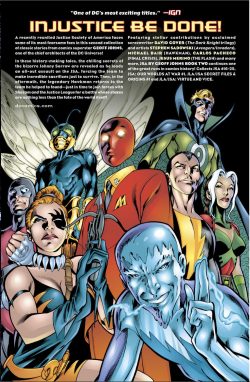
Officially concentrating on the efforts of Geoff Johns, this second volume re-presents in whole or in part Secret Origins of Super-Villains File 80-Page Giant #1, JSA #16-25, Our Worlds at War #1, JLA/JSA: Secret Files & Origins #1 and JLA/JSA: Virtue and Vice: bringing the revered, revived and very legendary Justice Society of America into DC’s modern pantheon and continuing the writer’s campaign to restore and re-induct all the classic stars by resurrecting the biggest name and most visually arresting of the originals – Hawkman.

It begins with a prelude from December 1999’s Secret Origins of Super-Villains File 80-Page Giant #1. Crafted by Johns & Goyer and illustrated by Phil Winslade & Mike Perkins, ‘Sorrow Ever More!’ sees demonically-tainted gang boss Johnny Sorrow break veteran villain Cameron Makent – AKA legacy JSA foe The Icicle – out of super penitentiary The Slab. The lachrymose liberator has connections with the original Icicle and expects the successor to join his war on modern heroes. He also knows an awful lot about the Makent family…

Major storyline Injustice be done opens with ‘Divide and Conquer’ (JSA #16, illustrated by Stephen Sadowski & Michael Bair) wherein an expanded Injustice Society – including Black Adam and in possession of the heroes’ most intimate secrets – ambushes them and fellow Golden Age champion Scarab whilst they’re off guard…

The blitz attack meets with significant success, and in ‘Cold Comfort’ mastermind Johnny Sorrow reveals his plans as the heroes begin their fight back, and we see his horrific origins in ‘Sorrow’s Story’ (with additional art Steve Yeowell), before the World goes to Hell with ‘Into the Labyrinth’ (extra inks by Keith Champagne) and the ghostly Spectre returns to save the day from Sorrow’s patron master The King of Tears.

And spectacularly fails…

The saga concludes in cataclysmic fashion with ‘Godspeed’ as Black Adam and Jakeem “J.J.” Thunder (heir of genie-wielding Johnny Thunder) join the team, but not before first Flash Jay Garrick is lost in time and space…

Compelling as it was, that entire saga was just a set-up for the eponymous ‘Return of Hawkman’ which I’ll get to after this necessary diversion…

One of the oldest and most revered heroes in comics, Hawkman premiered right behind Jay Garrick in Flash Comics #1 (January 1940). He was created by Gardner Fox & Dennis Neville, although the most celebrated artists to have drawn the Winged Wonder are Sheldon Moldoff and Joe Kubert, whilst young Robert Kanigher was justifiably proud of his later run as writer.

Carter Hall was a playboy archaeologist until he found a crystal knife that unlocked his memories. He knew that once he had been Prince Khufu of ancient Egypt, and that he and his lover Shayera had been murdered by High Priest Hath-Set. Moreover, with returned lives came the knowledge that his love and his killer were also nearby.

Using the restored knowledge of his past life, Hall fashioned a costume and flying harness, hunting his past and future murderer as the Hawkman. Inevitably triumphant, he and modern-day amour Shiera Saunders maintained their “Mystery-Man” roles: warring on modern crime and tyranny with weapons of the past.

Lost as the Golden Age ended, they were revived by Julie Schwartz’s crack creative cohort in the early 1960s (specifically Fox, Joe Kubert & Murphy Anderson) and – after a long career involving numerous revamps and retcons – “died” during the Zero Hour crisis.

Now in JSA #21 after the race of his life, lost Jay Garrick awakens in old Egypt: greeted by a pantheon of that era’s super champions. Nabu, the Lord of Order who created Doctor Fate, the original incarnation of Black Adam and Prince Khufu himself reveal the true origins of Hawkman whilst in the 21st century the JLA’s heavenly hero Zauriel informs the modern Hawkgirl just who and what she really is in ‘Guardian Angels’

The epic further unfolds as a major connection to the alien Hawkworld of Thanagar is clarified and explored in ‘Lost Friends’ and as Garrick returns to his home era, Hawkgirl is abducted to Thanagar by its last survivors, desperate to thwart the schemes of the insane death-demon Onimar Synn who has reduced the entire planet to a zombie charnel house.

As the JSA frantically follow their abducted member to distant Polaris in ‘Ascension’ Carter Hall makes his dramatic return from beyond and saves the day in ‘Icarus Fell’, before leading the team to magnificent victory in spectacular conclusion ‘Seven Devils

Illustrated by Buzz, Rags Morales, Sadowski, Bair, David Meikis and Paul Neary, this latest return not only led to Hawkman regaining his own title (more graphic novel magic to review ASAP) but also stands as one of the most cosmic and grand-scaled of all the JSA’s adventures.

The cosmic calamity continued as current DC Crossover Event “Worlds At War” – wherein an alien doomsday device/inimical manifested concept Imperiex almost destroyed the planet and unravelled the universe – tragically impacted the team. JSA: Our Worlds at War #1 saw the embattled planet calling on all its metahuman resources with Society members past, present – 28 in all – and simply affiliated gather as ‘The All-Stars’ (Johns, Javier Saltares & Ray Kryssing). Their mission is to take the war to Imperiex, assaulting its Jupiter-sized base-ship and even American President Lex Luthor is astounded by the result of the raid…

Billy Batson/Captain Marvel makes his troubled debut with the team via an introductory prelude in JLA/JSA: Secret Files & Origins #1 (January 2003). ‘The Day Before’, by Johns, Goyer, Sadowski & Andrew Pepoy, has the teen hero warned by his wizard mentor that an indiscernible threat menaces both teams of heroes. That conference leads directly into the last item on this agenda: JLA/JSA: Virtue and Vice (February 2003).

Once upon a time the Justice Society was Earth’s premiere super-team: formed to crush oppression and injustice while raising morale during World War II. When the Justice League debuted in 1960, their success led to the reintroduction of the originals – albeit now revealed to have worked on the alternate reality dubbed Earth-Two. After many years of annual team-ups, the heroes of both – and indeed other worlds – were merged in mega event Crisis on Infinite Earths.

A reordered history reduced the JSA to the role of elder statesmen of metahumanity and they became an organisation regularly saving the world whilst mentoring the next generation of superheroes.

Their inspired successors, the Justice League of America were currently the World’s Greatest Superheroes – and have all the characters who until very recently appeared on TV and in cartoons and movies. You now have all the background you need to read this superb Original Graphic Novel.

As they have done for years, the JLA and JSA have gotten together to celebrate Thanksgiving when suddenly alien conqueror Despero attacks them and the entire world by releasing the Seven Deadly Sins. These deadly demons promptly possess Batman, Power Girl, Mister Terrific, Dr. Fate, Green Lantern, Plastic Man and Captain Marvel (as today’s Shazam! was called back then)…

Can the remaining heroes defeat the Sins without killing their friends, and save humanity from total destruction at the hands of a hidden malign mastermind?

Of course they can; that’s the point. But seldom have they done it in such a spectacularly, well written and beautifully illustrated manner.

Crafted by Johns, Goyer, the much-missed Carlos Pacheco & Jesús Merino, this is the perfect conclusion to this sublime collection: a pure, iconic genre “Fights ‘n’ Tights bravura action romp that hits every target and pushes every button it should. If you love superhero comics, you will treasure this magnificent tale.

Complex and enthralling, these super shenanigans are the very best of their type: filled with wicked villains and shining, triumphant heroes, cosmic disaster and human tragedies, yet always leavening the doom and destruction with optimism and humour. Enticing, thrilling and stuffed with the biggest and best sort of superhero hijinks, if costume drama is your meat, this JSA compilation should be your prey…
© 1999, 2000, 2001, 2002, 2003, 2018 DC Comics. All Rights Reserved.

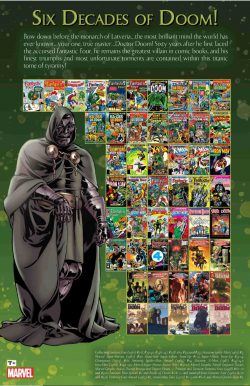
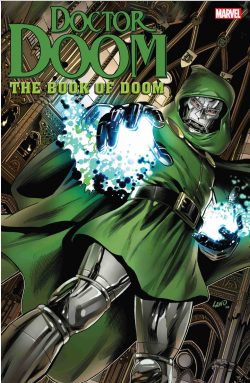
Doctor Doom: The Book of Doom Omnibus


By Stan Lee & Jack Kirby, Steve Ditko, Larry Lieber, Roy Thomas, Gerry Conway, Denny O’Neil, Chris Claremont, David Michelinie, John Byrne, Jim Shooter, Roger Stern, Walter Simonson, Mark Waid, Dwayne McDuffie& Ed Brubaker, Bob Layton, Tom DeFalco, Christopher Priest, Wally Wood, Gene Colan, Mike Sekowsky, Keith Giffen, Bob Hall, Frank Miller, Dave Cockrum, John Romita Jr., Mike Zeck, Mike Mignola, Mike Wieringo, Casey Jones & Pablo Raimondi, Frank Giacoia, George Tuska, John Buscema, Arthur Adams & Paolo Rivera, & many & various (Marvel)
ISBN: 978-1-3029-3420-0 (HB/Digital edition)

Win’s Christmas Gift Recommendation: One of Marvel’s Mightiest… 10/10

As a rule I’ve traditionally steered clear of reviewing the assorted Omnibus editions out there. For the longest time we felt that they were a bit elitist: phenomenally expensive and frequently only available in physical formats. The print version of this hardback book is 1336 pages and weighs 3.5 kilos – over 7½ pounds! – so if you’re old, infirm or have simply never developed any muscles because you’ve frittered away your life READING COMICS, that’s a big downside…

That’s all starting to change now, so here’s a review of the digital version – which is only as unwieldy as your preferred electronic reader of choice and cost me far less because of a discount sale…

Once upon a time, you hadn’t really made it as a Marvel superhero – or villain – until you’d clashed with Doctor Doom. Victor Von Doom is a troubled genius who escaped the oppression heaped on his Romani people via an ultimately catastrophic scholarship to America. Whilst there he succumbed to an intense rivalry with young Reed Richards, even then perhaps the most brilliant man alive.

The arrogant student performed unsanctioned experiments which went wrong and marred his perfect features, leading him down a path of super-science and sinister sorcery and fuelled his overwhelming hunger for ultimate power and total control. From the ashes of his failure, Von Doom rebuilt his life, returned to seize control of his Balkan homeland and become a danger to the world and the multiverse.

This truly king-sized and epically imperious compendium was released to celebrate the 60th anniversary of the Lord of Latveria, who debuted in Fantastic Four #5 April 1962. It gathers many of his greatest battles and other landmark moments of triumph and tragedy, and opens with a contextualising Introduction from Ralph Macchio before reprising the contents of Fantastic Four #5, 6, 39-40, 246-247, 258-260, 350, 352, 500; Amazing Spider-Man #5 & Annual #20; Marvel Super-Heroes #20; Giant-Size Super-Villain Team-Up #1-2 & Super-Villain Team-Up #13-14: Champions #16; Uncanny X-Men #145-147; Iron Man #149-150; Marvel Super-Heroes Secret Wars #10-12; Marvel Graphic Novel Emperor Doom; Marvel Graphic Novel Doctor Strange and Doctor Doom: Triumph and Torment; Fantastic Four (volume 2) #67-70; Fantastic Four Special (2005) #1 and Books of Doom #1-6, as well as material from Fantastic Four #236, 358 & Annual 2; Astonishing Tales #1-3, 6-8 and Marvel Double-Shot #2 collectively spanning July 1962-June 2006.

The drama begins as it must with that debut in Fantastic Four #5. At that time, aliens and especially monsters played a major part in earlier Marvel’s output. However, after a tentative start, Stan Lee & Jack Kirby’s recreation of super-heroes embraced the unique basics of the idiom: taking a full bite out of the Fights ‘n’ Tights apple by introducing the first full-blown, unrepentant super-villain to their budding Marvel Universe.

Admittedly the Mole Man had appeared in #1, but that tragic little gargoyle, for all his plans of world conquest, wouldn’t truly acquire the persona of a costumed foe until his more refined second appearance in FF #22.

‘Prisoners of Doctor Doom’ (inked by the sublimely slick and perfectly polished Joe Sinnott) had it all. An attack by a mysterious enemy from Mr. Fantastic’s past; super-science, magic, lost treasure, time-travel, even pirates. Ha-Haar, me ‘earties!

The tale is sheer comics magic and the creators knew they were on to a winner, as the deadly Doctor returned in the very next issue, teaming with the recently revived and recalcitrantly reluctant Sub-Mariner to attack our heroes as ‘The Deadly Duo!’ in the first Super-Villain Team-Up of the Marvel Age…

Prince Namor, the Sub-Mariner was the second super-star of the Timely Age of Comics – but only because he followed the cover-featured Human Torch in the running order of Marvel Mystery Comics #1 in 1939. He has had, however, the most impressive longevity of the company’s original “Big Three” – Torch, Subby and Captain America. The Marine Marvel was revived in 1962 in Fantastic Four #4; once again a conflicted noble villain, prominent in the company’s pantheon ever since.

Inked by Dick Ayers, FF #6 also introduced the concept of antiheroes as Namor was promptly betrayed by Doom and ended up saving the heroes from death in space: creating a truly complex dynamic with his fellow rogue monarch and the FF. The Master of Latveria’s inevitably betrayal colours the relationship of both kingly characters to this day…

Doom was frequent threat to the Fantastic Four, and was the first foe to break another unspoken rule by going after other heroes in the cohesive shared universe Lee & Kirby were building.

Cover dated October 1963, Amazing Spider-Man #5 found the webspinner ‘Marked for Destruction by Dr. Doom!’ – not so much winning as surviving his battle against the deadliest man on Earth. In this titanic comedy of errors the villain again sought super-powered pawns for his war against humanity, but seriously underestimated his juvenile opponent…

The one-dimensional evil genius was recast as a tragic figure forever shackled by his flaws thanks to the primary contents of Fantastic Four Annual #2 (September 1964) where Chic Stone inked ‘The Fantastic Origin of Doctor Doom!’

A short (12 page) scene-setter, it momentously detailed how brilliant “gypsy” youth Victor Von Doom remade himself into the most dangerous man in creation: ruthlessly overcoming obstacles such as ethnic oppression, crushing poverty and the shocking stigma of being the son of a sorceress. That past informed the present as the ultimate villain again attacks old friend Reed Richards and is left falsely believing he has achieved ‘The Final Victory of Dr. Doom!’ through guile, subterfuge and mind-control, but he has in fact suffered his most ignominious defeat. This clash also introduced a long-running plot thread connecting the Monstrous Monarch to time-travelling tyrant Rama Tut/Kang the Conqueror

Jumping forward to the summer of 1965 FF #39 (cover-dated June, with Frank Giacoia – as Frank Ray – inking) saw the team stripped of their powers and targeted by an enraged Doctor Doom in ‘A Blind Man Shall Lead Them!’ wherein sightless vigilante Daredevil stepped up and provided their only hope of staying alive.

The tale concluded in #40’s ‘The Battle of the Baxter Building’ with Vince Colletta inking a bombastic battle revealing the undeniable power, overwhelming pathos and indomitable heroism of the brutish Thing as – cruelly restored to his monstrous mutated form – he hands Doom the most humiliating defeat of his life…

Experimental try-out title Marvel Super-Heroes #20 (May 1969) awarded the villain his first full-length solo shot in ‘This Man… This Demon!’ Written by Larry Lieber & Roy Thomas, and illustrated by Lieber, Giacoia & Colletta, it restated Doom’s origins and revealed a youthful dalliance with an innocent Romani maid named Valeria. In the now, that failed relationship was exploited by demon alchemist Diablo who claimed to need an ally and partner but truly sought a slave. Doom dealt with the charlatan in typically effective style…

The metal-shod maniac profited from Marvel’s first big expansion and won his own solo-series (Astonishing Tales #1-8). It began with ‘Unto You is Born… the Doomsman!’ (July-August 1970) wherein Thomas & Wally Wood depicted the master manipulator’s daily struggle to maintain iron control over the Ruritanian kingdom of Latveria: building a super-robot to crush an incipient rebellion led by ousted Crown Prince Rudolfo and his mysterious sponsor.

However, the use of Victor von Doom’s lost love had the desired effect and the rebels almost succeeded in driving the tyrant from Doom Castle. In the attendant chaos the Doomsman device wandered away…

AT #2 declared ‘Revolution!’, proving Doom was not the only master of mechanoids as Rudolfo and the enigmatic Faceless One used the lost Doomsman to wreak havoc throughout Latveria, before the final assault in ‘Doom Must Die!’ (scripted by Lieber) saw all the tyrant’s enemies vanquished and the Monarch of Menace once more firmly in control…

Astonishing Tales #6 (June 1971, by Lieber, George Tuska & Mike Esposito) saw the Lord of Latveria invade African nation Wakanda in ‘The Tentacles of the Tyrant!’, resolved to seize its Vibranium, only to fall to the furious tenacity of its king and defender T’Challa the Black Panther in ‘…And If I be Called Traitor!’ (Gerry Conway, Gene Colan & Frank Giacoia).

A major plot and character strand was added for his final solo story in AT #8 (October 1971). ‘…Though Some Call it Magic!’ is a minor landmark entitled wherein Conway, Colan & Tom Palmer revealed the Devil Doctor’s darkest secret. On one night every year the ultimate villain duelled the rulers of Hell in the vain hope of liberating his mother’s soul. She had been a sorceress, and now burned in the inferno for the unholy powers she used in life, powers which her son also possesses.

Victor battled to free her from eternal torment and always failed: a tragic trial which punished both the living and the dead…

With this tormented tale even more depth and drama were added to the greatest villain in the Marvel universe. His residency ended without warning; Doom resumed his status as the MU’s premier antagonist until Giant-Sized Super-Villain Team-Up #1 (cover-dated March 1975): again bathing the Iron Dictator in a starring spotlight beside aggrieved acquaintance The Sub-Mariner. The special and its sequel led to significant series Super-Villain Team-Up and major crossovers in The Avengers and The Champions.

Giant-Sized Super-Villain Team-Up #1 detailed how Doom and Namor grudgingly reunited, in a framing sequence by Thomas, John Buscema & Sinnott interlaced with reprints of previous meetings.

In the intervening years since FF #6, Sub-Mariner had won and lost his own series, despite some very radical and attention-grabbing stunts. At the close, surface dwellers dumped nerve-gas into the sea, accidently but catastrophically altering Namor’s hybrid body, forcing him to wear a hydrating-suit to breathe. The same toxin had plunged the entire nation of Atlantis into a perpetual coma…

Here, in ‘Encounter at Land’s End!’, Prince Namor – alone and pushed to the brink of desperation – rescues Doom from a deadly plunge to Earth after the Iron Dictator’s latest defeat (at the hands of the FF and Silver Surfer) in an impressive and effective framing sequence bracketing two classic reprint tales (the aforementioned ‘This Man… This Demon!’ and ‘In the Darkness Dwells Doom!’ from Sub-Mariner #20 – and not included in this already too-heavy tome).

Sub-Mariner is in dire need of scientific wizardry to cure his sleeping kin and prepared to offer an alliance against mankind to get it. Initially refused and rebuked by Doom, Namor refuses to back down…

Following Thomas’ editorial ‘The Road to Land’s End’, Giant-Sized Super-Villain Team-Up #2 sees Doom reconsider the partnership deal in ‘To Bestride the World!’ (June 1975, by Thomas, Mike Sekowsky & Sam Grainger) after his own vast robot army rebels. The crisis is caused by the tyrant’s long-lost Doomsman droid – in its new guise of Andro – who returns and co-opts the mechanoids for a war against all organic life. As a result of the blistering battle and extensive carnage-wreaking, Namor and Doom triumph together and part as uneasy allies, only to regroup in the pages of Super-Villain Team-Up #1 (beginning August 1975) in a chaotic ongoing series…

SVTU #13 (August 1977) ended the sleeping Atlantis storyline as Doom finally fulfilled his oath, and resurrected the comatose mer-people, but only after a blistering sub-sea battle between Namor, amphibian arch-nemesis Krang and a Brobdingnagian sea beast in ‘When Walks the Warlord!’ courtesy of Bill Mantlo, Keith Giffen & Don Perlin).

With Atlantis and Namor restored, a new era began in Super-Villain Team-Up #14 (October 1977). ‘A World for the Winning!’, by Mantlo, Bob Hall, Perlin & Duffy Vohland found mutant villain Magneto tricked into a duel with Doom who was at that moment de facto master of the world after since seeding the planet’s atmosphere with mind-control gas. Ever the sportsman, the Lord of Latveria released Magneto from mental control, allowing him to liberate one other thrall and challenging them both to save the world from his ultimate dominance…

It was SVTU’s last issue and the story concluded in The Champions #16 (November 1977) as the Master of Magnetism and The Beast overcame all odds to save the day in ‘A World Lost!’ (Mantlo, Hall & Mike Esposito).

Despite appearing seemingly everywhere we pick up Doom three years later as Amazing Spider-Man Annual #14 (1980) sees Frank Miller & Tom Palmer perfectly recapture the moody mastery of Steve Ditko’s peak periods. That year’s summer offering was a frantic magical mystery masterpiece scripted by Denny O’Neil wherein Doctor Doom and extra-dimensional dark god Dread Dormammu attempt to unmake Reality by invoking the Arcane Armageddon of “The Bend Sinister”.

‘The Book of the Vishanti’ reveals how an unsuspecting dupe captures Doctor Strange for the malevolent allies, almost unleashing cosmic hell with only the wondrous wallcrawler left to literally save the world: a thrilling confection of magic and mayhem that deeply references and reverences the glory days of Ditko, by channelling the legendary first team-up of webspinner and wizard from Spidey’s second annual.

Gathering Uncanny X-Men #145-147 – spanning May to July 1981 – Chris Claremont, Dave Cockrum & Joe Rubinstein oversaw an extended clash of cultures with ‘Kidnapped!’ finding the mutant outcasts targeted by Doom. The assault was triggered through the machinations of deranged assassin Arcade, with half of the team – Storm, Colossus, Angel, Wolverine and Nightcrawler – invading the Diabolical Dictator’s castle whilst a substitute-squad consisting of Iceman, Polaris, Banshee and Havoc despatched to the latter maniac’s mechanised ‘Murderworld!’ to rescue innocent family and friends kidnapped as a preliminary to the plot…

Sadly, in the interim Doom triumphs over the invaders to his castle, but his act of entrapping claustrophobe Ororo backfires, triggering a ‘Rogue Storm!’ that threatens to erase the USA from the globe…

August and September 1981 heralded Iron Man #149-150, wherein David Michelinie, John Romita Jr. & Bob Layton crafted a time-travelling clash with Marvel’s deadliest villain. In ‘Doomquest!’ and ‘Knightmare’ the Armoured Avenger and Demon Doctor are trapped in the days of King Arthur and must unite to rebuild themselves and their tech as well as defeat evil Morgana Le Fey before they can return to their home time!

After achieving superstar status on The X-Men, writer/artist John Byrne moved on to carve out a one-man renaissance of the Fantastic Four, beginning with #232. He achieved his dream of relatively complete autonomy when assigned all the creative chores on Marvel’s flagship book and hit an early peak in #236’s ‘Terror in a Tiny Town’ (cover-dated November 1981).

His fifth issue was a 40-page epic crafted to celebrate the 20th anniversary of the team: reprising the classic origin and crafting a classic confrontation with both Doctor Doom and Puppet Master. It remains one of the very best non-Kirby tales of the entire canon.

The Lord of Latveria returned in a thematic sequel in Fantastic Four #246 & 247 (cover-dated September & October 1982) as ‘Too Many Dooms’ saw the Iron Tyrant escape incarceration to launch a retaliatory strike against all his enemies and reclaim his shattered but free kingdom in concluding chapter ‘This Land is Mine!’

Another extended Doom saga appeared in FF #258-260 (September – November 1983) beginning with ‘Interlude’ as the newly reinstalled ruler schools and programs his appointed heir Kristoff in statecraft and dominance whilst preparing his next strike against his American enemies. Recruiting cosmic marauder Terrax the Tamer, he launches that attack in ‘Choices’, only to apparently perish when the Silver Surfer joins the escalating battle ‘When Titans Clash!’

Regarded as dead and replaced by Kristoff as a legacy tyrant, Victor Von Doom became the star of Marvel Super Heroes Secret Wars: kickstarting the seemingly insatiable modern passion for vast, braided mega-crossover publishing events, which came about because of an impending action figures licensing deal with toy monolith Mattel.

Marvel Editor-in-Chief Jim Shooter, a great advocate of tales accessible to new, younger readers as well as the dedicated fan-base, apparently concocted the rather simplistic but engaging saga starring the House of Ideas’ top characters: building his tale around a torrent of unsolicited, inspirational mail from readers, all begging for one huge dust-up between all the heroes and villains…

The 12-issue Limited Series launched with a May 1984 cover-date and closed (April 1985) with a double-sized blockbusting battle that left many characters changed forever – or at least as “Forever” as comics get…

The premise was that all-powerful force The Beyonder abducted many Earth heroes and villains – and Galactus – in a quest to understand the emotion of desire. The enigmatic, almighty entity dumped the abducted on a purpose-built Battleworld created from and populated with fragments of other planets as a vast arena in which to prove which was better: “self-gratification or sacrifice”…

As crafted by Shooter, Mike Zeck & John Beatty, it saw Avengers, X-Men, FF, the Hulk, Spider-Man, Doom, Molecule Man, Ultron, Dr. Octopus, the Lizard, Enchantress, Absorbing Man, Kang the Conqueror, Wrecking Crew and Galactus teleported into the deep unknown…

After Doom fails to convince his fellow villains of the underlying threat, he tries to join the heroes before in exasperation, taking charge for himself…

Represented here by Secret Wars #10-12 (February-April 1985), ‘Death to the Beyonder!’ sees Doom makes his move, using a hastily constructed device to absorb all the omnipotent instigator’s power, using the stolen energies to rebuild himself and declare the Secret War over with Doom the sole victor…

In ‘…And Dust to Dust!’, he exults in the joys of becoming omnipotent, but the troubled new god finds it hard to hang on to lust for conquest, or even personal ambition after achieving all-consuming divinity, and his benign acts and vapid indolence betray a certain lack of drive and ambition…

With heroes and villains nervously awaiting the new supreme one’s next move, events take a subtly disturbing turn as a strange energy wisp begins to possess a succession of heroes, making its way ever closer to the Doom Deity…

The other heroes remain deep in conference, debating their response to the self-proclaimed but apparently benevolent saviour of the universe. At the moment they finally decide to oppose him they are all vaporised by a bolt of energy…

Of course it doesn’t end there as the resurgent Beyonder battles through heroic and villainous proxies to reclaim his purloined power and put everything to rights – sort of – in blockbusting finale ‘…Nothing to Fear!…’

Returned to mortal life, he appears here next as Emperor Doom (1987): an all-original graphic novel conceived by Mark Gruenwald, Michelinie and Shooter, scripted by Michelinie and illustrated by Bob Hall with additional inking by Keith Williams.

The plot itself is delightfully sly and simple: for once eschewing rash attacks against assembled superheroes, deadly dictator Doom has devised a scheme to dominate humanity through subtler means. Inviting Sub-Mariner to act as his agent, the master villain uses the sub-sea anti-hero to neutralise mechanical heroes and rivals prior to using a pheromone-based bio-weapon to make all organic beings utterly compliant to his will. Naturally, Doom then betrays his aquatic ally…

Meanwhile, energy being Wonder Man is undergoing a month-long isolation experiment to determine the nature of his abilities. When he exits the chamber, he discovers the entire planet has willingly, joyously accepted Doom as their natural and beloved ruler. Alone and desperate, the last Avenger must devise a method of saving the world from its contented subjugation…

Of course there’s another side to this story. Doom, ultimately utterly successful, has turned the planet into an orderly, antiseptic paradise: no war, no want, no sickness and no conflict, just happy productive citizens doing what they’re told. In this totalitarian triumph, all trains run on time and nobody is discontented. All Doom has to do is accept heartfelt cheers and do the daily paperwork.

Sadly, with the entire world an idealised clone of Switzerland, the Iron Despot is bored out of his mind…

So it’s with mixed emotion that Doom realises Wonder Man and a select band of newly liberated Avengers are coming for him, determined to free the world or die…

Tense and compelling this intriguingly low-key tale abandoned traditional all-out action for a far more reasoned and sinisterly realistic solution – disappointing and baffling a large number of fans at the time – but the clever premise and solution, understated illustration and wickedly tongue-in-cheek attitude remove this yarn from the ordinary Fights ‘n’ Tights milieu and elevate it to one of the most chillingly mature Avengers epics ever produced.

It’s followed by another OGN: Triumph and Torment by Roger Stern, Michael Mignola & Mark Badger.

This occult odd couple concoction is one of the very best Marvel Universe yarns; a powerful tale contrasting the origins of the two doctors to produce effective motivations for and deeper insights into both characters.

Stephen Strange was America’s greatest surgeon, a vain and arrogant man who cared nothing for the sick, except as a means to wealth and glory. When a drunken car-crash ended his career, Strange hit the skids until an overheard barroom tall tale led him to Tibet, an ancient magician, and eventual enlightenment through daily redemption. He battles otherworldly evil as Sorcerer Supreme and Master of the Mystic arts.

When a magical call goes out to all the World’s adepts, offering a granted wish to the victor in a contest of sorcery, both Doom and Strange are among those gathered. After mystic combat reduces the assemblage to the two doctors, Doom’s granted wish is to rescue his mother’s soul from Hell…

A classic quest saga, Triumph & Torment saw the twinned mages storming the Underworld in a mission of vain hope and warped mercy, battling the hordes of Mephisto and their own natures in a mesmerizing epic of power and pathos.

Stern was at his absolute writing peak here and the unlikely art team of Mignola and Badger defy any superlatives I could use. The art is simply magical, especially the mesmerising colouring, also courtesy of Mr Badger. It’s augmented here by Macchio’s Afterword to the original release.

Writer/artist Walt Simonson and inker Allen Milgrom then end years of confusion in ‘The More Things Change…! (Or… It’s the Real Thing…’ (Fantastic Four #350, cover-dated March 1991) as Doom, Kristoff and countless rogue Doombots all battle to decide who’s the real deal: a conflict mirrored by two overlapping iterations of the FF also deciding – far less lethally – who will stay in the official line up. With treachery and betrayal everywhere, the tale concludes in Fantastic Four #352 (May 1991) as ‘No Time Like the Present! (Or… It Ain’t Funny How Time Slips Away!’ sees both clashes coincide as time itself is sundered and the bureaucratic myrmidons of the Time Variance Authority step in…

Some crucial clarity into all that chaos comes in Fantastic Four #358 (November 1991) as Tom DeFalco & Arthur Adams provide ‘The Official Story’ (A Tale of Doom!)’ to reset reality and usher in a less confused cosmos…

A beautifully painted vignette from Marvel Double Shot #2 (February 2003 by Christopher Priest & Paolo Rivera), ‘Masks’ is a character piece revealing how a psychological assassin almost ends the tyranny of Doom before Fantastic Four (volume 3) #67-70 & (volume 1) #500 – cumulatively spanning May-September 2003 – sees the villain reinvent himself and almost win his eternal war against Reed Richards. This saga concluded the FF’s third volume before the series reverted to its original numbering with #500: capping a spectacular run by writer Mark Waid and illustrator Mike Wieringo, gloriously celebrating their “back-to-basics” approach which utterly rejuvenated the venerable property in 2003.

Key to that revival was a reassessment and reappraisal of their greatest foe as seen in ‘Under her Skin’ (#67, inked by Karl Kesel) wherein Doom abandons his technological gifts and inclinations, rejecting them for overwhelming sorcerous might to humiliate and destroy his greatest rival. All he must do is sacrifice his greatest love and only hope of redemption…

This terrifying glimpse into Doom’s past and shocking character study in obsession was but prologue to 4-part epic Unthinkable’ which opened one month later. Waid’s greatest gift is his ability to embed hilarious moments of comedy into tales of shattering terror and poignant drama, and it’s never better displayed than here when Marvel’s First Family suddenly find their daily antics and explorations ripped from them.

The method is straightforward enough: Doom attacks them through their children, using baby Valeria as a medium for eldritch exploitation and sending firstborn Franklin Richards to Hell as part payment to the demons to whom the debased doctor has sold the last dregs of his soul…

A supreme technologist, Richards had never truly accepted the concept of magic, but with Mystic Master Stephen Strange oddly unwilling to help, the reeling and powerless Mr. Fantastic nonetheless leads his team to Latveria for a showdown, still unable to grasp just how much his arch-foe has changed.

Invading the sovereign – if rogue – nation, the team fight the greatest battle of their lives and lose anyway. The normally quicksilver mind of Richards seems unable to deal with his new reality and the FF are locked away in prisons specifically and sadistically designed to torment them. As a sign of his utter disdain, Doom locks his broken rival in a colossal library of grimoires and mystic manuscripts, knowing the defeated, dogmatic scientist can never make use of what is there. Big mistake…

Before attacking the FF, Doom had ensorcelled Dr. Strange, but greatly underestimated the Sorcerer Supreme. Struggling to free himself, the mage established contact with Richards and began teaching the unbelieving ultra-rationalist the basics of magic…

By the time Doom discovers his danger, Reed has freed his comrades and daughter. In the catastrophic battle which ensues, the Iron Dictator replaces Franklin as the hostage of Hell, but not before, in one final act of malice, maiming Reed with searing mystic retaliation: melting half his face by means neither magic nor medicine can mend…

Although victorious, the Fantastic Four are far from winners. Doom’s assault upon the family has scarred them all, but none more so than Franklin, whose time in Hell left him deeply traumatised and near-catatonic.

Dwayne McDuffie, Casey Jones & Vince Russell then deliver a restrained psycho-drama in ‘My Dinner with Doom’ (Fantastic Four Special, February 2006). Here the rivals intellectually sparr: testing each other’s defences as the Latverian simultaneously seeks to wipe out all his lesser enemies.

The story portion of this book concludes as Ed Brubaker, Pablo Raimondi, Mark Farmer, Drew Hennessy & Robin Riggs revisit, in-fill, expand and apply mature modern nuance to Doom’s origins and life in Books of Doom #1-6 (January-June 2006) detailing again how a hounded boy became a wounded exile who overcame all obstacles – physical, emotional and ethical – to become supreme ruler of Latveria and menace to all mankind…

The comic classics are supplemented by a gallery of covers by Kirby – with Sinnott, Ayers, Wood & Giacoia; Ditko, Lieber, Colletta; Marie Severin, Bill Everett. John Buscema, John Verpoorten, Esposito, John Romita Sr., Herb Trimpe; Ron Wilson, Gil Kane, Giffen, Byrne, Terry Austin, Miller, Cockrum, John Romita Jr., Simonson, Zeck, Hall, Williams, Mignola, Paul Ryan, Joe Jusko, Wieringo, Kesel, Rivera and Leinil Francis Yu with even more to adore.

The graphic grimoire continues with a section of Doom pinups from Fantastic Four Annual #1 (1963, by Kirby), Amazing Spider-Man Annual #1(1964, by Ditko), Marvelmania Poster (1970, by Kirby) and Quotations from Chairman Doom 1984 (F.O.O.M. #4 Winter 1973, by Robert Cosgrove Kirby); Doom’s entry from the Official Handbook of the Marvel Universe Deluxe Edition (1985, by Gruenwald, Peter Sanderson, Byrne & Kirby), spoof ads from Marvel 1989: The Year in Review (by Mignola, Gregory Wright) plus a Marvel Masterwork Pin-up by Ron Frenz & Sinnott from Fantastic Four #358.

Dedicated art lovers can luxuriate in layouts, design sketches and unused art from Wieringo and the covers to The Villainy of Doctor Doom TPB (1999 by Kirby, Klaus Janson & Marie Javins) – plus Tom Brevoort’s Introduction to that tome – and earlier Doom depictions revisited in this big book.

These include covers to Marvel Masterworks Fantastic Four vol. 4 (Kirby & Dean White) and Fantastic Four Annual #7 (1969, Kirby & Sinnott); Spider-Man Classics #6 (Frenz & Austin, September 1993); Spider-Man Collectible Series #11 (Frenz & Milgrom, October 2006); X-Men Classic #49 & 51 (Steve Lightle, July & September 1990); Iron Man vs. Doctor Doom (Julie Bell, 1994); Greatest Villains of the Fantastic Four TPB (Vince Evans 1995), variant covers to Emperor Doom and Triumph and Torment, Fantastic Four #500 Directors Cut (2003 by Wieringo, Kesel & Richard Isanove.

Sheer comic enchantment, this a book no lover of the fantastic fiction can afford to ignore -just as long as they eat plenty of Spinach…
© 2022 MARVEL

The Phantom Sundays Archive volume 1 – Full-Size Newspaper Strips: 1939-1942


By Lee Falk & Ray Moore: introduction by Daniel Herman (Hermes Press)
ISBN: ?978-1-61345-081-9 (HB/Digital edition), ?978-1-61345-091-8 (Limited Edition)

Win’s Christmas Gift Recommendation: Landmark and Lovely Comics Adventure… 9/10

Born Leon Harrison Gross, Lee Falk created the Jungle Avenger at the request of his King Features Syndicate employers who were already making history, public headway and loads of money with his first strip sensation Mandrake the Magician. Although technically not the first ever costumed champion in comics, The Phantom became the prototype paladin to wear a skin-tight body-stocking and the first to have a mask with opaque eye-slits…

The Ghost Who Walks debuted on February 17th 1936 in an extended sequence pitting him against an ancient global confederation of pirates. Falk wrote and drew the daily strip for the first two weeks before handing over illustration to artist Ray Moore. The spectacular and hugely influential Sunday feature gathered here began in May 1939.

For such a long-lived, influential series, in terms of compendia or graphic collections, The Phantom has been quite poorly served in the English language market (except in the Antipodes, where he has always been accorded the status of a pop culture god).

Numerous companies have sought to collect strips from one of the longest continually running adventure serials in publishing history, but in no systematic or chronological order and never with any sustained success. That began to be rectified when archival specialists Hermes Press began offering curated collections…

This particular edition is a lovely and large landscape hardback (but also available in digital formats), displaying a complete full colour Sunday per page. Released in May 2015, it was printed on matt paper to mimic the original newsprint experience: 160 pages measuring 310 x 430 mm, and also in a Special Limited Edition of 1000 copies, should you require your reading matter to double as an antiquarian artefact…

It’s still readily available in digital form and – stuffed with sumptuous visual goodies like movie posters, comics covers and original art – Daniel Herman’s ‘Introduction: The Phantom’s First Foray into Color’ – tells all you need to know about the character, his creators, and predecessor/co-star before the vintage magic begins…

It opens with a recapped origin: showing how 400 years previously, a British sailor survived an attack by pirates, and – washing ashore on the African coast – swore on the skull of his father’s murderer to dedicate his life and that of his descendants to destroying all pirates and criminals. The Phantom fights crime and injustice from a base deep in the jungles of Bengali, and throughout Africa and Asia is known as the “Ghost Who Walks”…

His unchanging appearance and unswerving war against injustice led to his being considered an immortal avenger by the uneducated, credulous and wicked. Down the decades, one champion after another has fought and died in an unbroken family line, with the latest wearer of the mask indistinguishable from the first and proudly continuing the never-ending battle.

‘The League of Lost Men’ spanned May 28th to October 15th 1939, detailing how a gang of white thugs led by untutored brute Twitchy began teaching rural tribes the concept of the “protection racket”. With villagers killed and entire communities aflame, the Ghost took action just as white entomologist Professor Thrush and his beautiful, dutiful daughter Helen stumbled into the army of criminals whilst searching for skull-emblazoned Death’s Head moths…

With the scientists as hostages, the Phantom was reduced to playing a waiting game, but detective work revealed his enemies comprised hundreds of convicts escaped from a foundered prison ship. Gravely outnumbered, our hero and lupine assistant Devil (that’s a wolf. Yes, in Africa. Just go with it…) employ psychological warfare, using those skull moths and combat skills in a war of attrition bringing the legion to doom or reincarceration…

International espionage and environmental terrorism informed ‘The Precious Cargo of Colonel Winn’ (October 15th 1939 March 10th 1940) as the Phantom fails to save an aging British agent and takes over his identity and mission: delivering a crucial coded message to India. As a consequence he soundly scuppers a scheme to blow up a major dam, drown hundreds of people and kill millions more through thirst…

Every saga featured powerful, capable and remarkably attractive women as both heroes and villains, but Falk & Moore went a step further with ‘The Fire Goddess’ (March 17th – July 21st 1940). Restored to Africa, the hero faced mass uprisings and the end of “The Phantom’s Peace” when the Mesabi people took up their belligerent old religion. Some diligent investigation uncovered another get-rich-quick scheme by white crooks and an elderly Mesabi seer who jointly conned and compelled a beautiful red-haired nightclub dancer into being their personal war deity.

Once the Ghost finally liberated Manna Day from her captors and inflicted his brand of justice, he assumed he’d seen the last of her but she was back immediately as ‘The Beachcomber’ (July 28th – December 29th 1940) found her rescuing deranged hobo Whitey, slowly expiring on an African shoreline.

Befriending the degenerate, she uncovered a horrific tale of injustice as her fellow American revealed how he was a fugitive: perfectly framed for murder by his own lawyer. Manna decided it was a case for her masked friend…

After dragging Whitey across the continent to the fabled Skull Cave, she convinced the hero to head for the USA where “Kit Walker” made them extremely conspicuous in New York, drawing the attention of a slick murder-for-hire mob, assassinating powerful people and duping innocents into carrying the can – just as they had with Whitey…

Infiltrating the group, Walker uses his new position to save an honest Judge before deftly dismantling the killer corporation.

Heading home, he was barely out of the judge’s house before the next escapade began as he overheard plans of ‘The Saboteurs’ (January 5th February 23rd 1941) at a railway station. With Devil beside him, The Ghost Who Walks tumbled into an escalating sequence of stunning action set-pieces involving trains, planes, automobiles – even oil pipelines and roller coasters! – as he wiped out the seditious enemy agents.

The remainder of this initial outing features movie-length extravaganza ‘The Return of the Sky Band’ (running March 2nd 1941 to February 22nd 1942). The first clash had been The Phantom’s second published case (originally published in black-&-white Daily form from 9th November 1936 to April 10th 1937): pitting the Grim Ghost against merciless aviators plundering passenger planes and cargo flights.

His crusade against cloud bandits ruthlessly raiding passenger planes and airships throughout the orient only shattered the gang – comprised solely of women – after his manly charms inadvertently drove a fatal wedge between deranged and deadly commander The Baroness and her ambitious second in command Sala

Now as the hero reaches home, news comes of more air piracy and The Phantom volunteers his services to an embattled air clipper company. All too soon, he’s matching wits with Sala again, hunting the new Sky Band’s secret island base. And once again he ends up in jail accused of masterminding their crimes…

However, before he can escape police custody, the air pirates make a fatal error, allying with an enemy power. Very soon the women learn that they are far from the apex predators they consider themselves. When the Phantom escapes, he’s not sure if he’s shutting them down or saving them.

Sala’s deputy Margo has no doubts or qualms though, delivering their potential saviour to the enemy military, only to have the Ghost Who Walks wreak awful vengeance on their sailors as they flee in a submarine…

However, even with a secret invasion foiled and Sala and Margo arrested, the danger is not over, and their attempts to get away leads to a horrific act of sabotage as the enemy submariners also break free…

Only another unlikely alliance saves the day, and sees a return to relative stability in a world teetering on the edge of another global war…

To Be Continued…

Taken from America’s immediate pre-war period, these brief encounters are uncomplicated fare, full of lost kingdoms and savage tribes, very bad guys and fallen but still redeemable dames; but thrilling yet reassuring entertainment for all that. Finally rediscovered, these lost treasures are especially rewarding as the material is still fresh, entertaining and addictively compelling.

But, even if it were only of historical value (or just printed for Australians – who have long been manic devotees of the implacable champion) surely the Ghost Who Walks is worthy of a little of your time?
The Phantom® © 1939-1942 and 2015 King Features Syndicate, Inc. ® Hearst Holdings, Inc.; reprinted with permission. All rights reserved. Introduction © 2015 Daniel Herman.

Marzi volume 1: Little Carp


By Marzena Sowa & Sylvain Savoia, translated by Anjali Singh/Mediatoon Licensing (Europe Comics)
No ISBN: digital edition only ASIN: B07417JCN3

Win’s Christmas Gift Recommendation: Lyrical, Lovely, Laughter-Laced and Laudable… 10/10

It’s getting close to everyone’s most anticipated and ultimately disappointing festival time, and this year more than any other, the lead-up has been peppered with misery, anxiety, actual tragedy and terror. However, whatever your spiritual or official seasonal leanings – and None at All now officially counts as a denomination in the UK – the season for miracles and wonders always sparks our communal hope for something different and better so I’ve unearthed this lost delight to foster a little hope and joy…

As you’re surely aware by now, our Continental cousins are exceeding adept at exploring humanity’s softer and more introspective sides through the medium of comics, and this first tome in a sequence detailing the life of a little Polish girl growing up in an era of huge social change is a masterclass in emotive, evocative, vibrantly funny and ruthlessly sensitive storytelling to delight our senses by quietly affirming that people everywhere are basically the same…

Originally released in France in 2005 as Marzi, tome 1. Petite carpe this enthralling and charming episodic collation was the first of seven cartoon memoires by writer Marzena Sowa and her work/life partner Sylvain Savoia. They had met when she came to Paris from Poland as an exchange student, and he – a successful cartoonist and graphic novelist – soon realised the potential of her anecdotes as she spoke of growing up in a Soviet satellite nation at the tail end of the Cold War…

Their published collaborations were a hit in Europe and the story was first translated into English in 2011 for DC/Vertigo. At that time, media hype concentrated on the political aspects of her background, but if you can when reading this version, try to ignore that, just as the creators do.

It’s a shaping element and plot point, like boarding at Hogwarts or growing up in the Teen Titans, but never what the stories are about. This a tale of childhood and taking happiness wherever you find it, not a kids adventure like Emil and the Detectives or a historical horror story like The Diary of Anne Frank

Marzna Sowa was born in Stalowa Wola, Podkarpackia, Poland on April 8th 1979. She grew up mostly ordinary like all her friends and family, but after achieving maturity during some of the most eventful years of the 20th century, in 2001 changed her life path. She left the Jagiellonian University of Krakow for the University of Bordeaux to complete studies in Literature.

On meeting Sylvain Savoia, mutual attraction became a working partnership and the first autobiographical Marzi volume came in 2005. The last to date was released in 2017. Her other award-winning tales include N’embrassez pas qui voulez, (Don’t Kiss Who You Want, 2013, art by Sandrine Revel) and Tej nocy dzika paprotka, (with Berenika Kolomycka).

After further schooling to become a videographer, Sowa has moved into Cinema, writing screenplays and directing documentaries while continuing to script comics such as La Grande Métamorphose de Théo (2022, with Geoffrey Delinte) and La Petite Évasion (2022, with Dorothée de Monfreid).

Her first collaborator Sylvain Savoia was born in 1969 in Reims and initially studied at the Saint Luc Institute in Brussels. In 1993 he co-founded art workshop 510TTC and crafted his first comics – Reflets Perdus – from a script by Jean-David Morvan, before beginning their extended series Nomad. Later successes included Al’Togoat (2003), Les Esclaves oubliés de Tromelin and Henri Cartier-Bresson, Allemagne 1945, supplemented by poster making, advertising art and training manual illustration and design.

Since 2018 he has helmed educational series Le Fil de l’Histoire raconté par Ariane & Nino, and enjoyed further success with Sowa in Les esclaves oubliés de Tromelin and Petit Pays. In 2020 he was made a Knight of the Order of Arts and Letters.

It begins as Christmas looms. ‘Communism doesn’t kill your appetite’ introduces 7-year-old Marzi, who’s nervously gearing up for the big day. It’s not about presents, but the fact that very soon every flat in the apartment block everybody she knows live in will have a fish in the bath. There are always shortages and long queues at the housing estate store, but somehow the market always has a carp for every customer to make the season traditional and perfect…

Marzi is smart and observant but perhaps thinks too much. She’s also – to her excitably loud and frequently angry mum’s consternation – a very picky eater, only barely aware of the effort her dad must make to get the fish. Of course the daughter is grateful, but also deeply concerned about once again sharing their toilet/bathroom with the creature until they eat her…

The situation sparks deep thoughts about eating animals. Marzi is luckier than most of her friends as her Aunt Niusia lives on a farm and the family always have access to extra food. However, the child’s visits are always fraught with unnoticed pragmatic brutality. Marzi has met cows, pigs, turkeys, chickens, cats, dogs and other creatures and fully understands why mum says you shouldn’t give animals names, but it doesn’t stop her trying to form a bond with the fish in the bath…

We learn more of her life on ‘The Social Landing’ where Marzi and the other kids in the block congregate. State controlled housing is short on amenities and variety (there are only two kinds of apartment available – small or bigger) and no play facilities, so the kids cluster around the elevator on her floor (the fifth) and play games vertically. Their favourite is messing with the lift buttons so that the carriage stops at every floor and they also like ringing doorbells and running away. Marzi is great at the latter but hampered in the former as she’s afraid of using the grim grey box and will always use the stairs if she can…

She has a strong bond with Andrzej, Magda, both Anias and especially feisty Monika, who always leads at everything, like that time Ania (1) and Andrzej’s mother pierced all their ears (except Andrzej and baby Magda!) and Monika’s mum gave them all their first earrings…

‘A carpet for life’ charmingly reveals the Poles’ utter obsession with ornate rugs and floor coverings and ‘Sun in winter’ details queuing culture and the Kupon (coupon system) dictating the dissemination of goods and foodstuffs, as seen through the eyes of the child stamping her freezing feet beside dad in the never-decreasing line for oranges: offering insights into what Marzi will and won’t eat and what her formidable mother will do to ensure fair shares for all…

Although she’s still young, Marzi spends a goodly part of her day ‘At School’. The cooks there understand her and the hot breakfasts are far more palatable. There are games and books and singing too and only thing she doesn’t like is how the little kids drool all over the toys…

It was always cold in the Soviet Union, and ‘Skowierszyn’ shares the joys of snow and sledding and visiting grandma who gets fashion magazines from cousin Janusz who works abroad. These are supposedly for Niusia – who is also a skilled seamstress – but become a beautiful inspiration for Marzi to stretch her mind and clothe her adored plastic doll…

More queuing – meat this time – is highlighted on ‘The Night of Waiting’ with dad and Uncle Zdzich making military style preparations to ensure success, after which Marzi develops deep shame and some potentially lifelong hang-ups when ordered to join the party to secure toilet paper in ‘Some poetry in rolls’

Although dictatorial by diktat and “Communist” by command, Poland remained devoutly Catholic under Russian rule and we jump to the second most important event in the religious calendar for ‘A very wet Easter’ as Marzi and her folks head to rural Kamien to enjoy the festival with mum’s family. A hardworking, hard-drinking farming family dad cannot keep up with, their freer attitudes and lifestyle are a revelation to the child – as are the rather scary religious rituals they enjoy – but not as much as Marzi’s miraculous brush with death and subsequent notoriety after falling into a still frozen and exceedingly deep pond…

Dad works with Zdzich in the Huta Stalowa Wola, the city’s only factory, and that has its own perks, as seen in ‘All for one’ when every worker simultaneously takes the opportunity to buy a new fridge from the consignment just delivered, before his attempts at home entertainment give way to national fervour in ‘Our hero, the Pope!’ as Polish Pontiff John-Paul II makes his landmark visit. Of course the captivated adults never expected Marzi and her gang to recreate the event in their own inimitable irreverent manner, combining pomp and circumstance with a new block game involving the garbage chutes…

Although perhaps understandable, in the past many western observers have over-concentrated on the totalitarian regime (which is all but absent in this volume) and placed too heavy an emphasis on Soviet-spawned shortages, to the detriment of the real message here – that kids live in their own world and always try make the best of what they have.

Just imagine what British kids now will be writing about in 20 years when recalling their so-privileged childhoods of unnecessary privation, cold, and hunger in the soon-to-be nostalgia-ridden years of 2021 to 2024…

A skilfully shaped and gloriously enthralling paean to growing up in interesting times (and aren’t they all?), Little Carp is a celebration of independent thought: blending pranks in lifts and staircases, new fun with familial strangers and with doing the tedious stuff adults tell you to. Making fun where you can as your awareness deepens and a mature world is built by ever-expanding experience, and how we all grow up to be our parent in unbalanced doses of imitation and utter rejection…

The more observant amongst you might have noticed that my extended family is Polish and I have some actual experience of life under the Soviets back then. My many, many cousins experienced lives very like Marzi’s and endured the mixed Christmas delights of a big fish sharing your house before being reluctantly consumed, as well as all the other different but similar minor moments of growing up. If pushed, they might talk of shortages and restrictions, but they’d far rather discuss music or movies or football. And sex. They always want to know who’s doing who, but maybe that’s just my lot…

Everything else was just dull grown up stuff: boring, inescapable but sometimes delayable and just the way things were.

Marzi is definitely about independence and freedom, but it’s personal not national and inherently hopeful: the tale of a fish out of water learning to swim her own way. If you want polemical condemnation and supportive sympathy for your own prejudices, look somewhere else. Better yet, stick around and see how a delightful and unique individual lived her own best life…
© 2017 – DUPUIS – SOWA & SAVOIA. All rights reserved.

Algorithmic Reality


By Damian Bradfield & David Sánchez (NBM)
ISBN: 978-1-68112-306-6 (PB) eISBN: 978-1-68112-307-3

Win’s Christmas Gift Recommendation: You Better Watch Out, You Better Take Care… 9/10

In the modern world we are constantly watching and perpetually watched. We are society but society follows us everywhere even as it isolates us, and we cannot escape or avoid it. Are we unconscious or willing subjects of voyeuristic scrutiny or complacent participants in an increasingly intrusive overwatch culture that we really want but may not need?

This compelling graphic clarion cry wryly questions if that’s the randomly evolving progress of a wild system or somehow the gameplan of more sinister forces. Is unified technology, with all its benefits and instant gratifications the servant and builder of a truly integrated uniform and global society or just the newest means of a certain sort of predator (let’s call them “Tech-Barons”) making us all both cash cow and component consumer in a perpetually self-sustaining closed system – an internet battery farm where us chickens are both consumer AND product?

It’s clear that for many of us, our digital tools are now inescapable, essential, inimical and ultimately faithless and disloyal…

Comics are a nigh-universal, extremely powerful media that lend themselves to a host of topics and genres, but the area where it has always shone brightest is in its chimeric capacity for conveying complex arguments in a clear and compelling manner. Although daubing marks on a surface is possibly our oldest art form, the potential to ask questions, make stories and concisely communicate via that primal process remains infinitely adaptable to modern mores and as powerful as it ever was in exploring the unchanging basics of the human condition.

Narrative plus image – and the interactions such conjunctions can embrace – underpin all of our communal existence and form the primary source for how we view our distant forbears; especially as if employed by incisive, sensitive, uncompromising agents and interlocutors…

Here UK author, eminent digital pioneer, “tech exec” and lifelong comics fan Damien Bradfield posits in pictorial form some crucial and chilling questions about how and by whom, for what purpose and to what ends digital technologies have become such an inescapable and imperative force.

Casting a nervous yet knowing eye on the inept antisocial elites – Super-Rich mavericks spawned by manipulating Big Tech – Bradfield conjures up – via mordant, if not trenchant -incisiveness a sequence of ironically dystopian scenarios made chillingly clear and pervasively memorable by Spanish illustrator David Sánchez González.

Co-Founder of WeTransfer and its Chief Creative & Sustainability Officer, Damien Bradfield is also its Chief Strategy Officer, having created digital platform WePresent, co-founded digital design studio Present Plus, and formed illustration platform Kuvva. He owned an art gallery in Amsterdam and prior to all that worked for all the top advertising companies and Stella McCartney.

In 2019 he wrote The Trust Manifesto: What you Need to do to Create a Better Internet (discussing online privacy, trust and Big Data) and began by scoring a degree from the London School of Economics and Politics. You can regularly hear him on the Influence podcast…

Shaping thought and controlling information is also a deep concern for artist, designer and illustrator Sánchez: a solidly refined, intellectual draughtsman expert in restrained and understated imagery strongly influenced by Charles Burns, Daniel Clowes and Hergé. Among his most impressive and disturbing publications are Tú me has matado, No cambies nunca, La Muerte en los ojos and his illustrations for Robert Desnos’ El Destripador.

In Algorithmic Reality they combine to unleash sedately ironic speculations on where we are as a planet and where we’re going as a species in a range of wildly enchanting modern fables exploring our relationship with commerce, with particular emphasis on Short-termism, privacy, social media herd mentality, the tyranny of choice and information control. After all, isn’t Data the new fossil fuel: precious, invaluable, easily used, but so very dangerous when – not if – overexploited and misused?

Everyday tasks, major achievements, personal breakthrough and moments without merit jostle beside strange days and minor miracles in this tome, beginning with ‘Shoes’ as a visit to a store results in a sales assistant refusing to accept no sale as an outcome and doggedly stalking the failed purchaser, with confrontational encounters in the park, other stores and further inducements. By exploring how we’d react if a human vendor in the offline world behaved the same way as internet sales tools and bots do, the creators make a chilling point about pester power and the wisdom of making that first enquiry…

A search for ‘Insurance’ makes an equally distressing point about why a single simple sales transaction demands the surrender of so much apparently “necessary” extraneous personal detail just to secure a cheaper tariff after which ‘Shopping’ sees a one-off, first time buyer stumble into a sales emporium entirely patronised by shopping zombies programmed by repeated use of the system to make their needs accommodate the company’s demands…

A manifested nightmare for all collectors, ‘The Hoarder’ charts the inescapable downfall of an outlier and avowed social pervert who clings to physical objects rather than embracing digital experiences. His reluctance to abandon physical currency, books, vinyl records, polaroid photos and human interactions inevitably lead to Byron’s incarceration for “Data Avoidance” and “Health and Safety violations”…

Closing this packet of prophecy is ‘California Boomtowns Tour’, as an experience tourist takes the bus for a quick round up of all the Golden States’ boom-&-bust fads: accessing in person and a strictly curated abbreviated manner the desolate but so-picturesque remnants of gold mining, oil-drilling, Hollywood and pop music celebrity, computing and the property speculation that destroyed Silicon Valley, ending on the terrifying prospect of offworld expansion for the Next Big Things…

Being told that your personal electronics actually own you and incessantly work to make you targeted, monetizable fodder for attention-seeking, plutocratic weirdoes and faceless corporations is not new information, but seeing how masking that message works has never been more entertainingly handled than here. Bradfield and Sánchez deftly fudge and blur the line between offline and digital worlds: asking that readers look and think again.

Re-examining with wit and deadpan humour the addictive power of social media, enhanced and weaponised conformity, clandestine invasion of privacy and the appalling harmful potential of illicitly harvested, misused persona data, Algorithmic Reality demonstrates that there’s a such a thing as too much connectivity, and a little personal space is no bad thing…
Text and illustrations © 2021, 2022 Damian Bradfield and David Sánchez. All rights reserved. © 2022 NBM for the English translation.

Algorithmic Reality is scheduled for release on December 13th 2022 and is available for pre-order now. For more information and other great reads see http://www.nbmpub.com/. Most NBM books are available in digital formats…

Amazing Spider-Man Epic Collection volume 8: Man-Wolf at Midnight 1973-1975


By Gerry Conway Ross Andru, Gil Kane, John Romita, Paul Reinman & various (MARVEL)
ISBN: 978-1-3029-3350-0 (TPB/Digital edition)

Win’s Christmas Gift Recommendation: Astounding Arachnid Amazement… 9/10

Amazing Spider-Man was a comic book that matured with – or perhaps just slightly ahead of – its fan-base. This epic compendium of chronological webspinning wonderment sees the World’s Most Misunderstood Hero facing even greater and evermore complex challenges as he slowly recovers from the trauma of losing his true love and greatest enemy in the same horrific debacle…

Once original co-creator Stan Lee replaced himself with young author Gerry Conway, the scripts acquired a more contemporary tone (which of course often feels quite outdated from here in the 21st century): purportedly more in tune with the times whilst the emphatic use of soap opera subplots kept older readers glued to the series even when the bombastic battle sequences didn’t.

Moreover, as a sign of those times, a hint of cynical surrealism also began creeping in…

Thematically, there’s a decline in old-fashioned gangsterism and a growing dependence on outlandish villains. The long-established balance of costumed super-antagonists with thugs, hoods and mob-bosses was gradually tipping and a global resurgence in supernatural stories resulted in more monsters and uncanny happenings…

Nevertheless, the wallcrawler was still indisputably mainstream comics’ voice of youth and defined being a teen for readers of the 1970s: facing incredible hardships, fantastic foes and the most pedestrian and debilitating of frustrations.

For newcomers – or those just visiting thanks to the latest Spider-Man movies: Smart-but-alienated Peter Parker was bitten by a radioactive spider during a school trip. Discovering strange superhuman abilities which he augmented with his own natural chemistry, physics and engineering genius, the kid did what any lonely, geeky nerd would do with such newfound prowess: he tried to cash in for girls, fame and money.

Making a costume to hide his identity in case he made a fool of himself, Parker became a minor media celebrity – and a criminally vainglorious one. To his eternal regret, when a thief fled past him one night he didn’t lift a finger to stop him, only to find when he returned home that his guardian uncle Ben Parker had been murdered.

Crazed and vengeful, Peter hunted the assailant who’d made his beloved Aunt May a widow and killed the only father he had ever known. He discovered to his horror that it was the self-same felon he had neglected to stop. His irresponsibility had resulted in the death of the man who raised him, and the traumatised boy swore to forevermore use his powers to help others.

Since that night, the Wondrous Wallcrawler tirelessly battled miscreants, monsters and madmen, with a fickle, ungrateful public usually baying for his blood even as he perpetually saves them.

Now the high school nerd has grown up and gone to college. Because of his guilt-fuelled double-life he struggles there too – even developing a stress ulcer – but finds abiding love with cop’s daughter Gwen Stacy… until she is murdered by the Green Goblin. Now Parker must pick up the pieces of his life…

This stunning compilation reprints Amazing Spider-Man #124-142 and Giant-Size Super-Heroes #1: collectively covering cover-dates September 1973 to March 1975, affirming an era of astounding introspective drama and captivating creativity.

As previously stated, at this time horror was on the rise and the trend permeated all aspects of Marvel continuity. In #124, J. Jonah Jameson’s astronaut son John was revealed to have picked up a strange gem during a unofficial moonwalk which later transformed him into a lupine beast bearing ‘The Mark of the Man-Wolf!’ by Conway, Gil Kane & John Romita.

Deranged and deadly, the hairy horror stalks his own fiancée Kristine Saunders as well as his scandal-obsessed, newspaper-publisher father, with a gravely-traumatised, fighting-mad Spider-Man reacting in a far more brutal manner than ever before…

The conclusion marked the official debut of the title’s next star penciller as Ross Andru joined Conway and Romita to delineate the end of the Man-Wolf saga in ‘Wolfhunt!’: offering a particularly grisly cure for the ethereally-altered astronaut…

In #126, a new subplot bloomed as a marketing firm hires the astounded and unbelieving arachnid to build a “Spider-Mobile” (thanks to a budding toy-merchandising deal Marvel was then negotiating) whilst an old and extremely inept enemy returns as ‘The Kangaroo Bounces Back!’ (drawn by Andru and inked by Jim Mooney).

Short of cash and desperate, Spidey ropes in best frenemy Johnny (Human Torch) Storm to help assemble the anticipated automobile, but is totally unprepared for his Australian attacker since bouncing bounder has endured a rapid and ultimately unwelcome power upgrade from a rogue – and extremely deranged – doctor named Jonas Harrow

Meanwhile, in the apartment Peter still shares with Harry Osborn (son of the Green Goblin), his flatmate finally succumbs to the mental illness that has been sucking him down since the death of dear old Dad…

Peter’s frivolous party-loving friend Mary Jane Watson comes under the spotlight in #127 as ‘The Dark Wings of Death!’ – inked by Frank Giacoia & Dave Hunt – finds her targeted by a strangely familiar monster who believes she witnessed his last kill. The mystery concludes in ‘The Vulture Hangs High!’ wherein an incredible truth about the avian atavist is revealed. Moreover, portents of future catastrophe manifest as Parker’s biology tutor Professor Miles Warren warns that the scholarship student’s grades are slipping and his position is far from secure…

Conway, Andru, Giacoia & Hunt crafted a true landmark in comics history in Amazing Spider-Man #129 with ‘The Punisher Strikes Twice!’: introducing not only the renegade gunslinger but also nefarious manic mastermind The Jackal.

Although one of the industry’s biggest hits from the late 1980s onwards, compulsive vengeance-taker Frank Castle was always an unlikely and uncomfortable star for comic books. His methods are always excessively violent and usually permanent. It’s intriguing to note that unlike most heroes who debuted as villains (Black Widow, Hawkeye and Wolverine immediately come to mind) The Punisher actually became more immoral, anti-social and murderous, not less: the buying public simply shifted its communal perspective as the Punisher never toned down or cleaned up his act…

He was created by Conway, Romita Sr. and Andru; an understandably sanitised and muted response to popular prose anti-heroes like Don Pendleton’s Mack Bolan: the Executioner: the cutting edge of a bloody tide of fictive Viet Nam vets who all turned their training and talents to wiping out organised crime in the early 1970s.

In this short, sharp shocker the man with the skull on his chest is duped by his manipulative partner into hunting Spider-Man. Still a suspect in the death of Norman Osborn, the hero is easy to frame for the murder of the Punisher’s personal armourer and gunmaker…

A long-running mystery over Aunt May’s connection to Doctor Otto Octavius is at last addressed in #130 as ‘Betrayed!’ finds up-&-coming gang boss Hammerhead prodded and provoked by the Jackal, just as arch-rival Doctor Octopus resurfaces.

Distracted by his now-completed Spider-Mobile, the webslinger is slow to react …until he finally discovers why May Parker is so important to the villain, but by then she’s in the process of becoming Mrs. Otto Octavius…

Spider-Man is just about to bust up the wedding in ‘My Uncle… My Enemy?’ when Hammerhead beats him to it. As the three-way war escalates, the truth comes out. May has inexplicably inherited a desolate Canadian island which just happens to be teeming with uranium deposit, and its own Fast Breeder Atomic Reactor, which both Ock and Hammerhead want to secure as the means to becoming an independent nuclear power. When the rival rogues furiously clash, it’s all Peter can do to get May out before the entire place becomes an atomic inferno…

Illustrated by John Romita Sr., Paul Reinman & Tony Mortellaro, fresh moody mystery welcomes the weary Spider-Man back to New York after saving Aunt May from becoming a collateral casualty of atomic armageddon as he stumbles into ‘The Master Plan of the Molten Man!’ It begins when old school flame Liz Allen resurfaces needing help. Peter has no idea she is secretly trying to help her criminal stepbrother…

As a super-strong metal-skinned bandit Mark Raxton was only a minor inconvenience to the wallcrawler, but now his chemically induced condition has worsened and he is swiftly turning into an incandescent human fireball. However, by the time ‘The Molten Man Breaks Out!’ in #133 – illustrated by new regular creative team Andru and inkers Giacoia & Hunt – there’s nothing the hero can do but fight until one of them is dead…

Slightly adrift of publishing chronology, next comes a classic monster action yarn from Giant-Size Super-Heroes #1. With the monster boom in full swing, Marvel during this period flooded newsstands with horror-themed heroes and antiheroes and cannily teamed two of the Amazing Arachnid’s eeriest enemies in a double-length epic as ‘Man-Wolf at Midnight!’ – by Conway, Kane & Mike Esposito – finds John Jameson again gripped by murderous moon-madness. This time, however, the tormented former astronaut has been enthralled by Living Vampire Morbius and used to help that bloodsucker secure a possible cure for his own appalling condition in ‘When Strikes the Vampire!’

That dynamic dust-up led directly into a flurry of over-sized Giant-Size Spider-Man editions, but as none of them are included in this volume we return to Amazing Spider-Man #134 (July 1974) wherein the webspinner again crosses paths with The Punisher after a South American bandit – trained to be his oppressive regime’s Captain America before going freelance – attempts to pirate, pillage and ransom a Manhattan tour boat in ‘Danger is a Man Named… Tarantula!’ (Conway, Andru, Giacoia & Hunt).

Once again unwilling allies, the ethically-estranged duo dutifully dismantle the villain’s larcenous schemes leading to a ‘Shoot-Out in Central Park!’ but the real danger is building elsewhere as Parker’s roommate Harry Osborn accepts at last the infamous inheritance of his devilish, recently departed dad…

The compelling, long-brewing clash of former friends kicks off with completely crazy Harry attempting to blow up Peter and Mary Jane in ‘The Green Goblin Lives Again!’…

Privy to his best friend’s secrets, the maniac then targets all Parker’s loved ones, precipitating a desperate, deadly duel as ‘The Green Goblin Strikes!’ resulting in doom, destruction, shocking revelations and another tragedy for Peter to feel forever responsible for…

‘Madness Means… the Mindworm!’ finds a still-reeling Parker evicted from his apartment and relocating downmarket to Queens, just in time to encounter a macabre psychic parasite feeding off the denizens of the district.

Issue #139 then introduces a bludgeoning brute with a grudge against J. Jonah Jameson on the ‘Day of the Grizzly!’ When Spidey intervenes, he is soundly thrashed and handed over to the costumed crazy’s silent partner the Jackal who melodramatically reveals he knows the hero’s true identity…

Even though Peter escapes his diabolical trap in ‘And One Will Fall!’ the major maniac flees and remains at large…

A long-running comedy thread ends as the ridiculous Spider-Mobile ends up in the river, but the wallcrawler barely has time to care as an apparently dead enemy returns in #141’s ‘The Man’s Name Appears to be… Mysterio!’ Despite aggressively escalating psychological assaults and our hero questioning his own sanity, the mystery is smartly resolved in ‘Dead Man’s Bluff!’, wrapping up this transitional period in the life of Peter Parker and setting the scene for another shocking epic, life-changing encounter next time…

These narrative delights are supplemented by Romita’s cover, frontispiece, contents page and back cover from the 1974 debut tabloid edition Marvel Treasury Edition #1: The Spectacular Spider-Man as well as a faux Daily Bugle feature by Conway & Marie Severin; plus House ads; Kane page and cover layouts; the original Punisher design sketch by Romita and original art covers and interior pages by Kane, Romita &Andru.

Also on show are the Romita-rendered entry from Mighty Marvel Calendar for 1975, and a text & photo feature on the first live action Spider-Man film.

Blending cultural veracity with superb art, and making a dramatic virtue of the awkwardness, confusion and imputed powerlessness most of the readership experienced daily always resulted in an irresistibly intoxicating read, especially when delivered in addictive soap-styled instalments, but none of that would be relevant if Spider-Man’s stories weren’t so compellingly entertaining.

This action-packed collection relives many momentous periods in the wallcrawler’s astounding life and is one every Fights ‘n’ Tights fanatic must see…
© 2022 MARVEL.

Blue Beetle Jaime Reyes Book One


By Keith Giffen, John Rogers, Cully Hamner, Duncan Rouleau, Rafael Albuquerque, Cynthia Martin, Kevin West, Phil Moy, Jack Purcell, Casey Jones & various (DC Comics)
ISBN: 978-1-77951-506-3 (TPB/Digital edition)

Win’s Christmas Gift Recommendation: All Action Superhero fun and Thrills… 9/10

As the most recent incarnation of the venerable Blue Beetle brand makes the jump from comic book limbo and kids’ animation reruns into live action movie madness, here’s a recent re-release of the first dozen of the superb 36-issue run that began in 2006: one of the most light-hearted and compelling iterations of the Golden Age stalwart and still a pure joy to behold…

The Blue Beetle first appeared in Mystery Men Comics #1, published by Fox Comics and cover-dated August 1939. The eponymous lead character was created by Charles Nicholas (AKA Charles Wojtkowski): a pulp-styled mystery man who was a born nomad. Over the years and crafted by a Who’s Who of extremely talented creators, he was also inexplicably popular and hard to kill: surviving the failure of numerous publishers before ending up as a Charlton Comics property in the mid-1950s.

After releasing a few issues sporadically, the company eventually shelved him until the superhero revival of the early 1960s when young Roy Thomas revised and revived the character for a 10-issue run (June 1964, February 1966) reinventing cop/adventurer Dan Garrett as an archaeologist, educator and scientist who gained super-powers whenever he activated a magic scarab with the trigger phrase “Kaji Da!”

Later that year, Steve Ditko (with scripter Gary Friedrich) utterly recreated the Blue Beetle. Ted Kord was an earnest and brilliant young researcher who had been a student and friend of Professor Garrett. When his mentor seemingly died in action, Kord trained himself to replace him: a purely human inventor/combat acrobat, bolstered by ingenious technology. This latter version joined DC’s pantheon during Crisis on Infinite Earths, earning his own series and a quirky immortality partnering with Booster Gold in Justice League International and beyond…

Collecting Blue Beetle (volume 7) #1-12 spanning May 2006 – April 2007, this saga follows the hallowed formula of a teenager suddenly gifted with great powers, and reveals how some heroes are remade, not born…

At the height of the Infinite Crisis (Link please, June 18 2008), El Paso high-schooler Jaime Reyes found a strange blue jewel shaped like a bug. That night, as he slept, it attached itself to his back, transforming him into a bizarre insectoid warrior. Almost immediately, he was swept up in the chaos, joining Batman and other heroes in a climactic space battle.

As this series opens on ‘Blue Monday’ (written by Keith Giffen & John Rogers and limned by Cully Hamner), he’s come home to El Paso, Texas; terrified for staying out late on a school night, and is suddenly attacked by Green Lantern Guy Gardner. The situation rapidly escalates as his sentient bug armour reacts instinctively and manically to the emerald energy of the foe…

As the fight builds in intensity, by way of flashbacks we see Jaime’s life before everything changed: meeting best buds and fellow high school inmates Paco and Brenda – who were with him when he found the scarab that messed up his life – and bratty little sister Milagro as well as his wonderfully cool parents…

The battle ends as soon as Gardner realises he’s fighting a child, but as when he flies off, the Lantern drops a shocking bombshell: whatever is empowering the kid and manifesting his talking, weapons-infested bug suit, it ISN’T magic…

The mystery intensifies in ‘Can’t Go Home Again’ as more recovered memories detail early clashes with local super-gangbangers The Posse and hint at big changes in Jaime. In the present, Reyes is slowly making his way back to his house, terrified over how his folks will react to his disappearance last night. It’s far worse than he could have imagined and a real shock when he discovers that he’s actually been missing for a year…

Illustrated by Cynthia Martin & Philip Moy ‘The Past is Another Country’ sees Jaime demonstrate his new powers to his gobsmacked family, only to be (initially) rejected and abandoned. Whilst the Reyes clans come to terms with their “dead” son resurrected as a bug monster, the stunned lad road tests his new powers and tracks down his old friends.

A lot has changed: Paco is now part of the Posse and those outcast teens are locked in a deadly war with the minions of local organised crime-boss La Dama… who just happens to be Brenda’s legal guardian Tia Amparo

Cully Hamner returns in #4 as Giffen & Rogers detail how Jaime starts looking into previous Blue Beetles and owners of the scarab and becomes a ‘Person of Interest’ to cyber-hero Oracle/Barbara Gordon who tests him with a view to making him one of her Birds of Prey. That doesn’t end well and presages far worse as militaristic mystery man The Peacemaker hits town on the down-low, secretly seeking old comrade and associate “Blue”…

Delivered in two parts over #5 and 6, ‘Secrets’ is illustrated by Duncan Rouleau, Martin, Kevin West, Moy & Jack Purcell. It reveals how The Phantom Stranger arrives, also hoping to clear up the mystery of this new Blue Beetle. Seeking to ascertain the teen’s place in the hierarchy of “the New Age of Magic” is something many factions are working on, from The Posse to La Dama’s pet goon the Diviner. Chaos reigns as all the investigators converge and clash when a baby of great power is stolen and Jaime at last learns that sometimes you just have to step up and do the right thing…

Following a brutal confrontation with plenty of shocking revelations ‘Secrets Pt 1 of 2’ sees a sharp redefinition of allegiances and anew status quo that almost immediately founders when Peacemaker reveals what nobody seemed able to discern – the true nature of Jaime’s scarab…

John Rogers is sole scripter for BB #7 as ‘Brother’s Keeper’ offers a guest-star packed recap of Reyes’ career to date: filling in many blanks since the night the new Beetle helped save the world. Illustrated by Hamner & Casey Jones and with Giffen back on board, ‘Road Trip’ sees Jaime, Brenda and Peacemaker go looking for even more answers: beginning by consulting young cyber-geek Dan Garrett – a self-proclaimed expert on all previous Blue Beetles.

As the original hero’s granddaughter she also has a fair claim to being the rightful owner of the gem, but a potential squabble and their research is interrupted by the return of a monstrous hunchbacked maniac determined to destroy the “demonic” new hero.

Following that Roleau renders ‘Inside Man’, telling why Peacemaker has so-unwillingly involved himself in Jaime’s life just as Brenda finds herself in a world of trouble…

Living with her aunt – the magic-wielding, arch crime boss of El Paso – in a felonious clearing house for stolen super-technology and magical artifacts, it was only a matter of time before Brenda stumbled upon something really dangerous. Whisked to an far-distant world in ‘Should’ve Taken that Left Turn at Albuquerque…’ (with art from Hamner and Rafael Albuquerque!), her disappearance forces an uneasy truce between Jaime and La Dama so that the Beetle can rescue Brenda, consequently encountering a selection of New Gods and hungry aliens before successfully bringing her back in ‘The Guns of Forever’ (by Rogers & Albuquerque, and we end on a thematic cliffhanger with ‘Meet the New Boss’ as Beetle and Peacemaker investigate cattle mutilations, battle a giant bug monster and meet its owner – an extraterrestrial envoy from extragalactic trading empire The Reach. He also claims to be the creator of the scarab…

With a gallery of variant covers, sketches and character designs by Hamner, this is a welcome return for a great series: one of precious few comic books to combine action and adventure, with comedy and suspense perfectly leavened with fun and wit. Blue Beetle Jaime Reyes offers an innovative and wryly engaging saga impossible to resist, especially with the artistic endeavours of Hamner, Martin, Albuquerque, Rouleau and Jones making each page a visual treat. Even 17 years on, Blue Beetle remains a fresh and delightful joy, so why not bug out and Go Read This!
© 2006, 2007, 2022 DC Comics. All Rights Reserved.