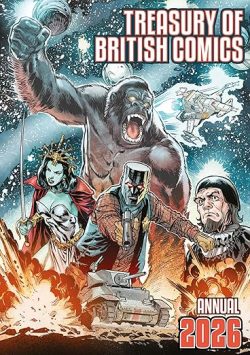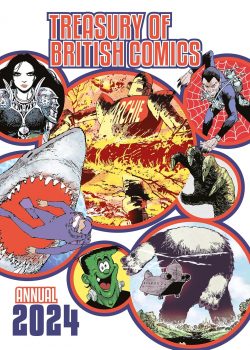
The Treasury of British Comics Annual 2025


By Paul Grist, Simon Furman, Leo Baxendale, Ian Rimmer, Donne Avenell, Tom Tully, Alec Worley, Steve Moore, John Smith, Simon Williams, John M. Burns, Mike Collins, Carlos Ezquerra, Mick McMahon, Mike Western, Frank Langford, Massimo Belardinelli, Anna Morozova, Ian Kennedy, Eric Bradbury, David Roach, Emily Roach, Andreas Butzbach & various (Rebellion Studios)
eISBN: 978-1-83786-498-0 (general edition); 978-183786-501-7 (Webshop Exclusive)

This book includes Discriminatory Content produced in less enlightened times.

Win’s Christmas Gift Recommendation: More True Brit Comics Class… 8/10

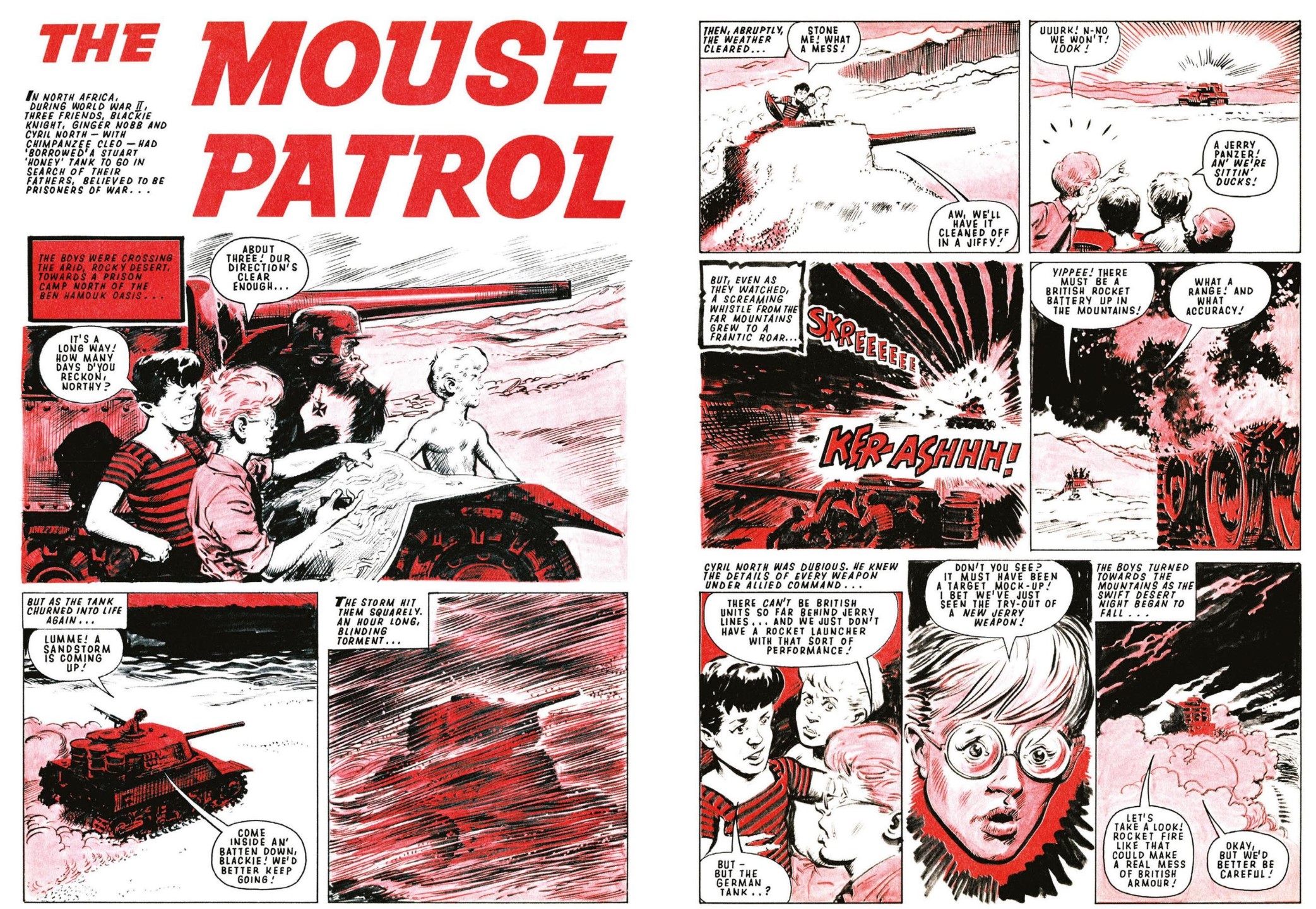
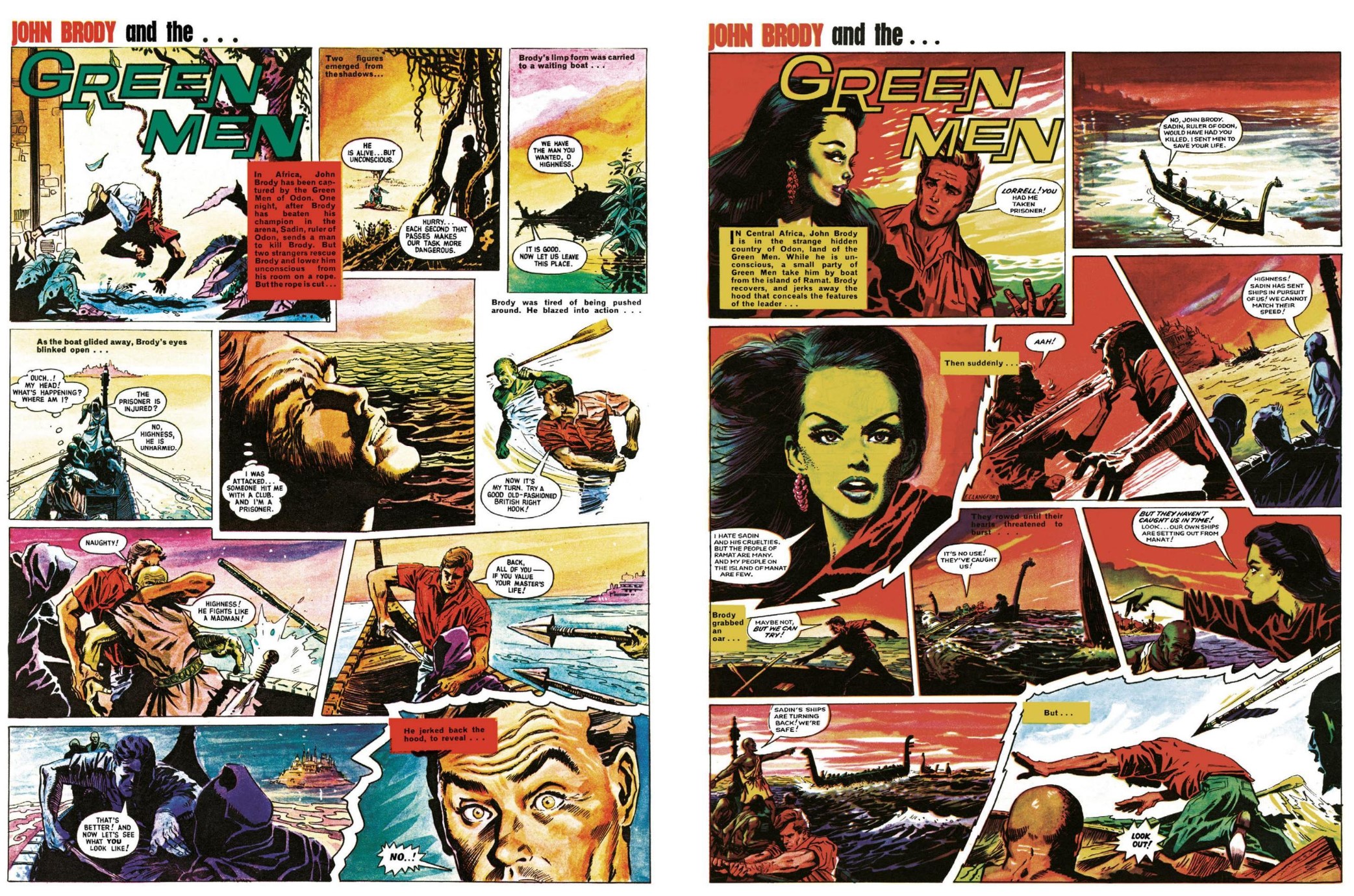
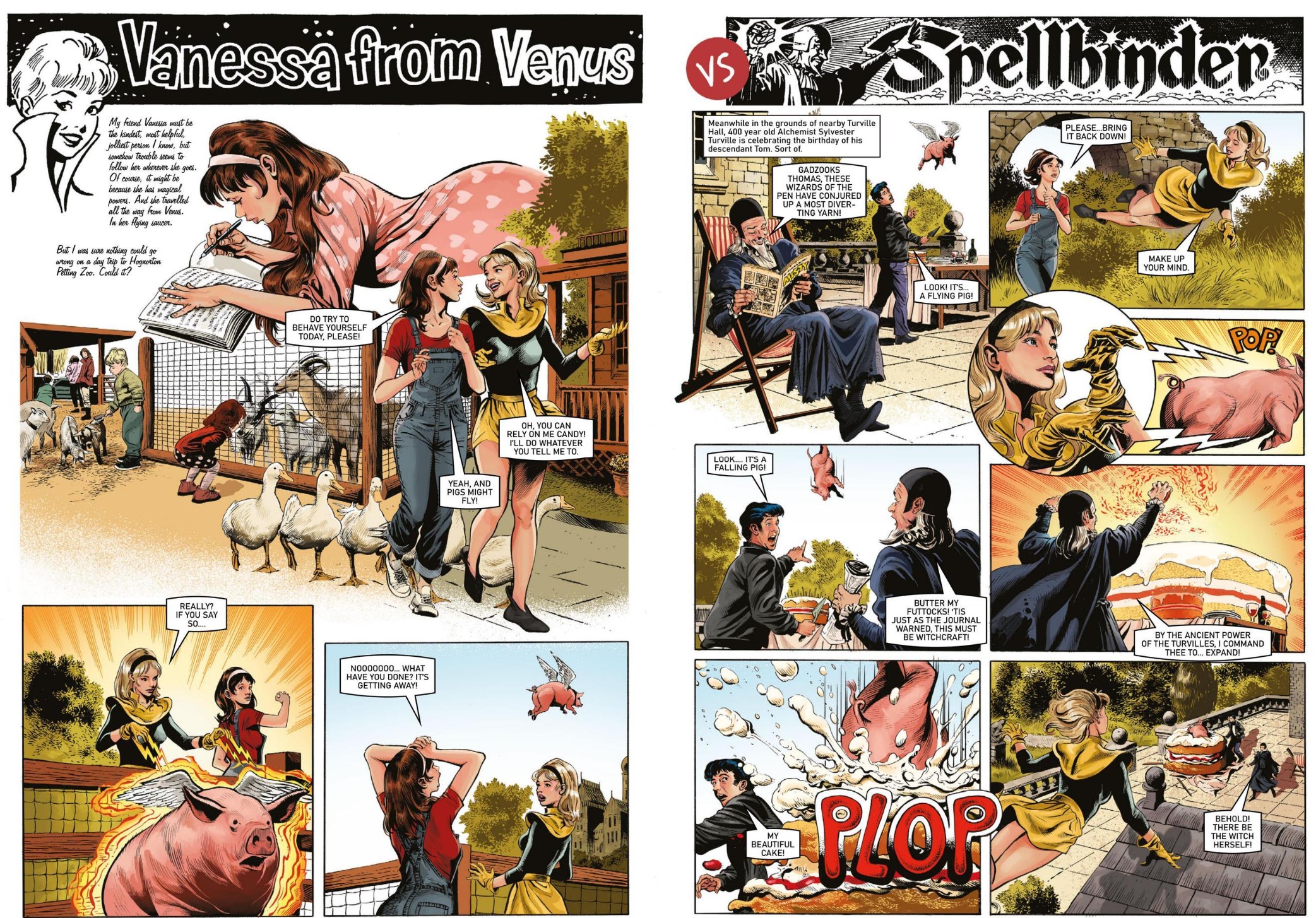
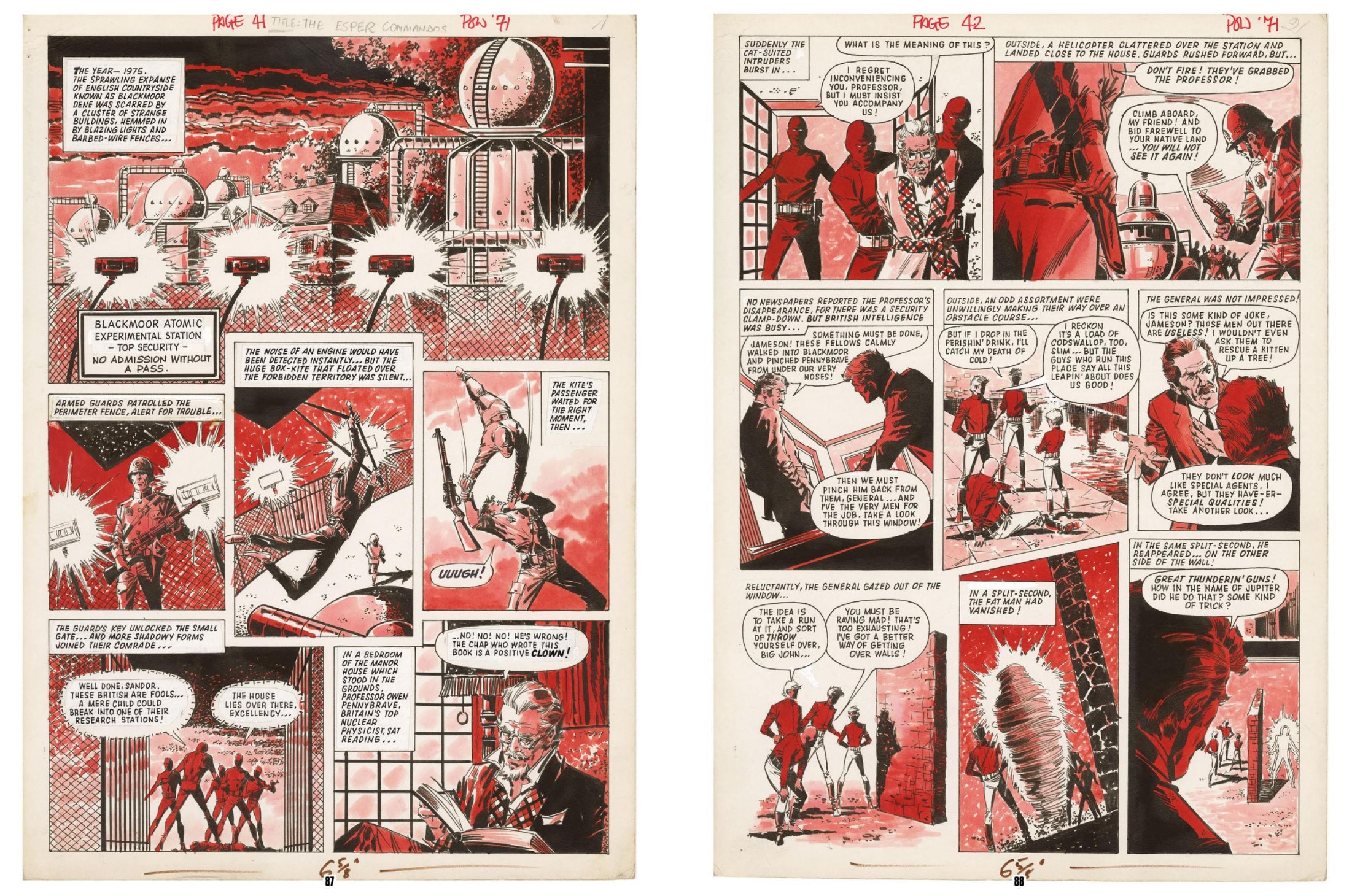
What you read up above is just as true for this second Annual Endeavour which emerged at the end of 2024. This time around, the new contributions are augmented by material from Tiger February 13th – May 8th 1965; Wham! February 27th 1965; Lion Annual 1972; The Buster Book of Scary Stories 1975; Valiant 21st August -16th October 1976; Valiant Annual 1976; Battle Annual 1979; Dan Dare Annual 1980; Action Annual 1982; Scream! Holiday Special 1985 and 2000 AD Presents Action!

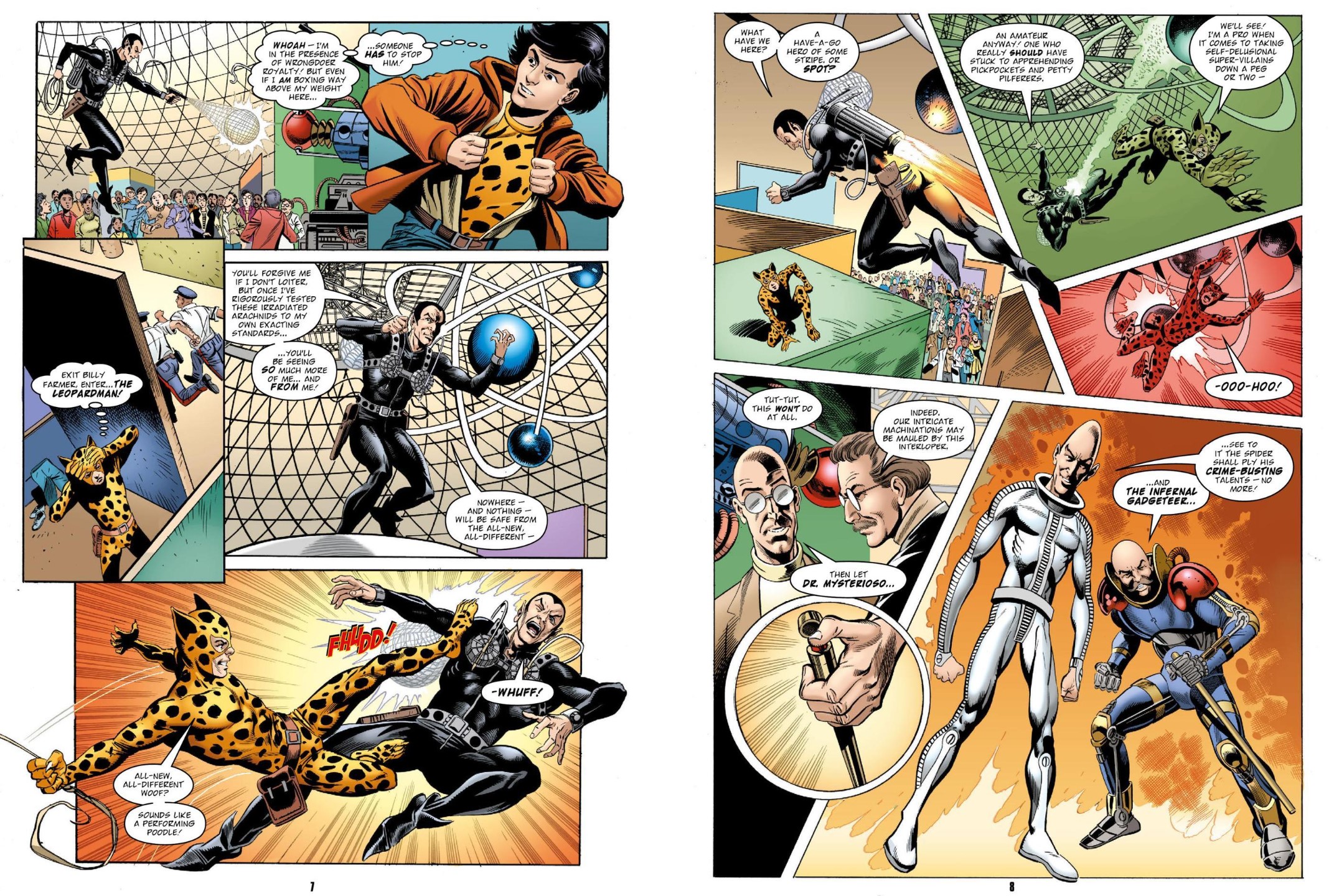
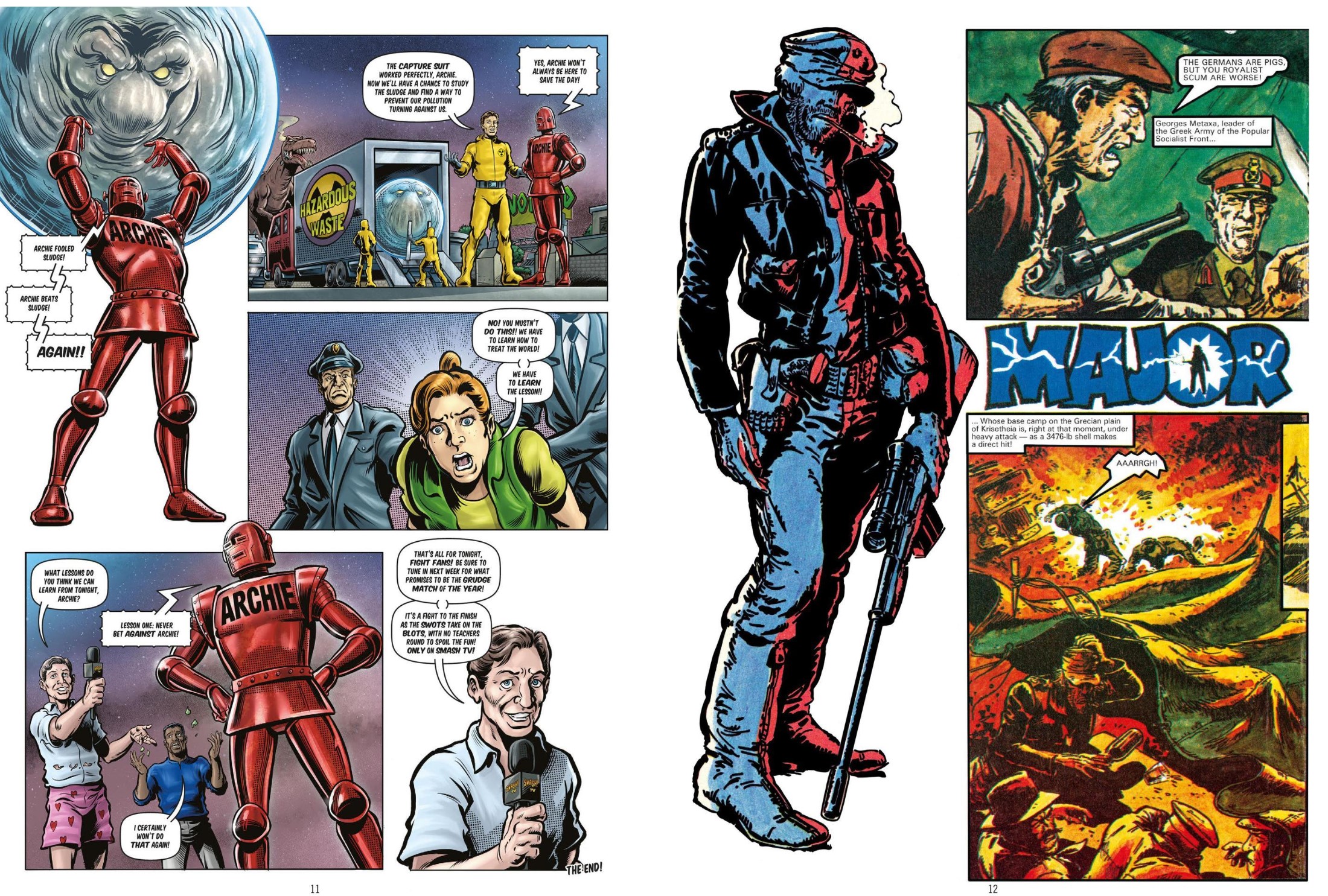
Kicking things off is a full-colour, all new rematch /grudge match as Paul Grist, Simon Willams, colourist Jason Cardy & letterer Leila Jess detail one more mighty mess up in ‘Robot Archie Vs The Sludge’ prior to that uncredited writer and Carlos Ezquerra revealing how battle-savvy rebel ‘Major Easy’ ferrets out traitors in Nazi-occupied Greec as seen in Battle Annual 1979.

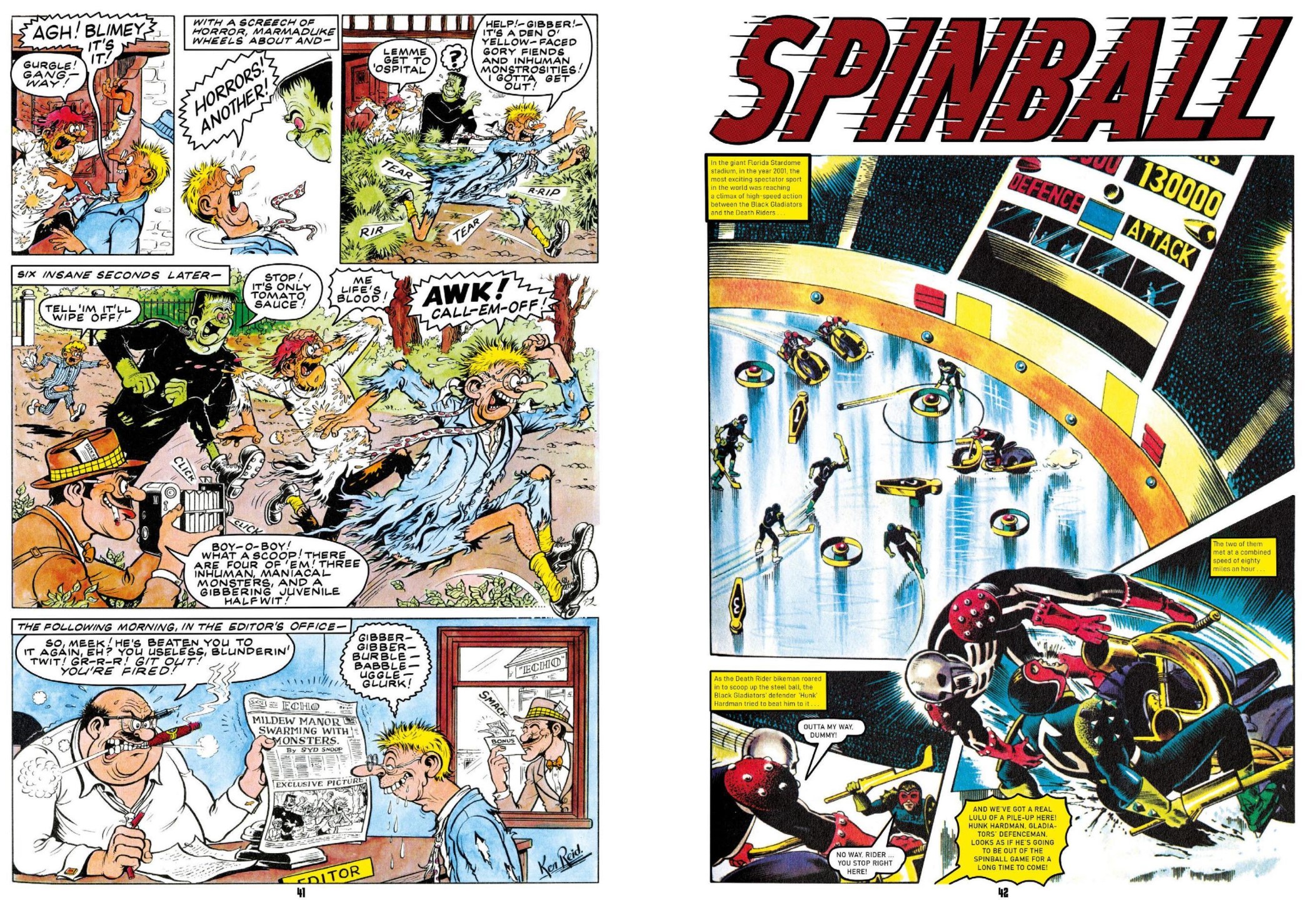
Long ago Scream! Holiday Special 1985 pointed out the problems with ‘New Neighbours’ courtesy of Ian Rimmer & Mike Western whilst anonymous & Mick McMahon expose the domestic stresses of ‘3000 AD The Traveller’, as first debated in Dan Dare Annual 1980 (which is apparently still a 2000 AD Production)…

Leo Baxendale’s anarchic spoof ‘Eagle Eye, Junior Spy – Doomsday School’ (Wham! February 27th 1965) segues into dark and dangerous (no really) football strip ‘Stryker’ (by Tom Tully & Ian Kennedy and running in Valiant 21st August to 16th October 1976) as really good player joins a naff team to discover how his brother died following an ugly on-pitch incident…

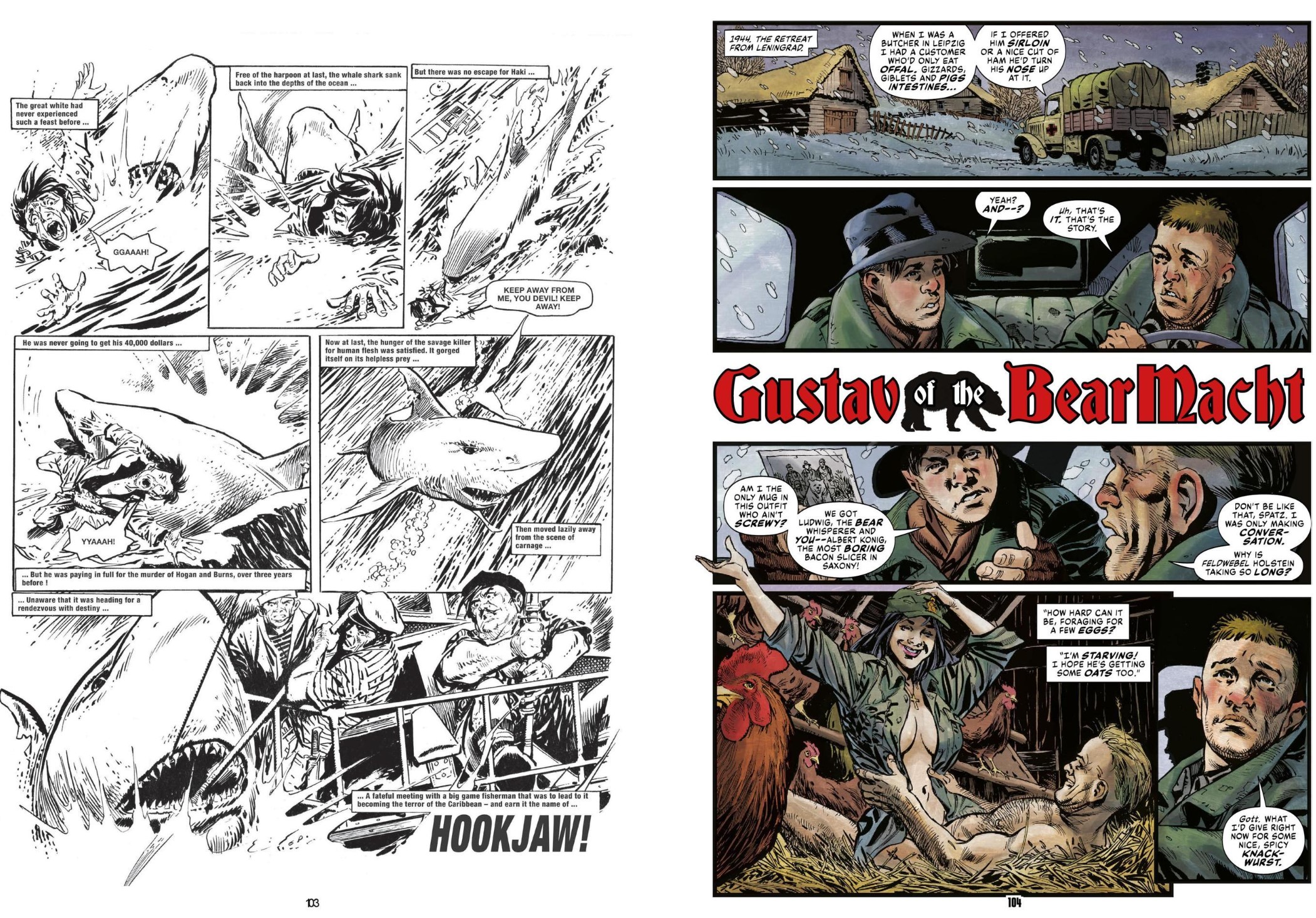
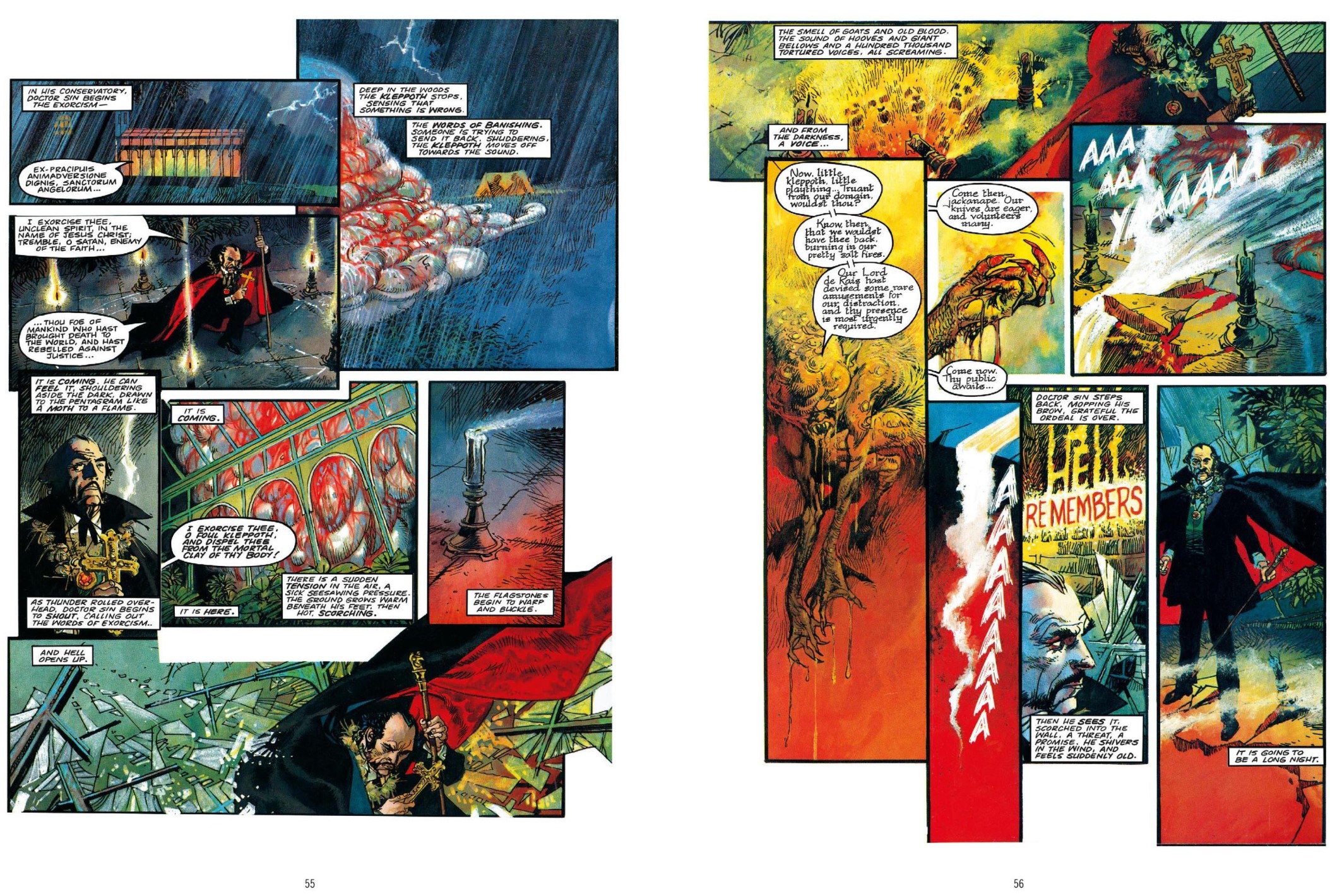
John Smith & John M. Burns were on fine form in 2000 AD Presents Action! as ‘Doctor Sin: The Strange Case of the Wyndham Demon’ sees the mystic troubleshooter drawn to a dark and deadly case of diabolical incursions after which Simon Furman, Mike Collins & letterer SquakeZz deliver an all-original adventure as ‘Kelly’s Eye Vs The White Eyes’ sees mystic ghost-breaker Cursitor Doom call in the invulnerable hero to end a threat to the entire multiverse caused by environmental mucking about…

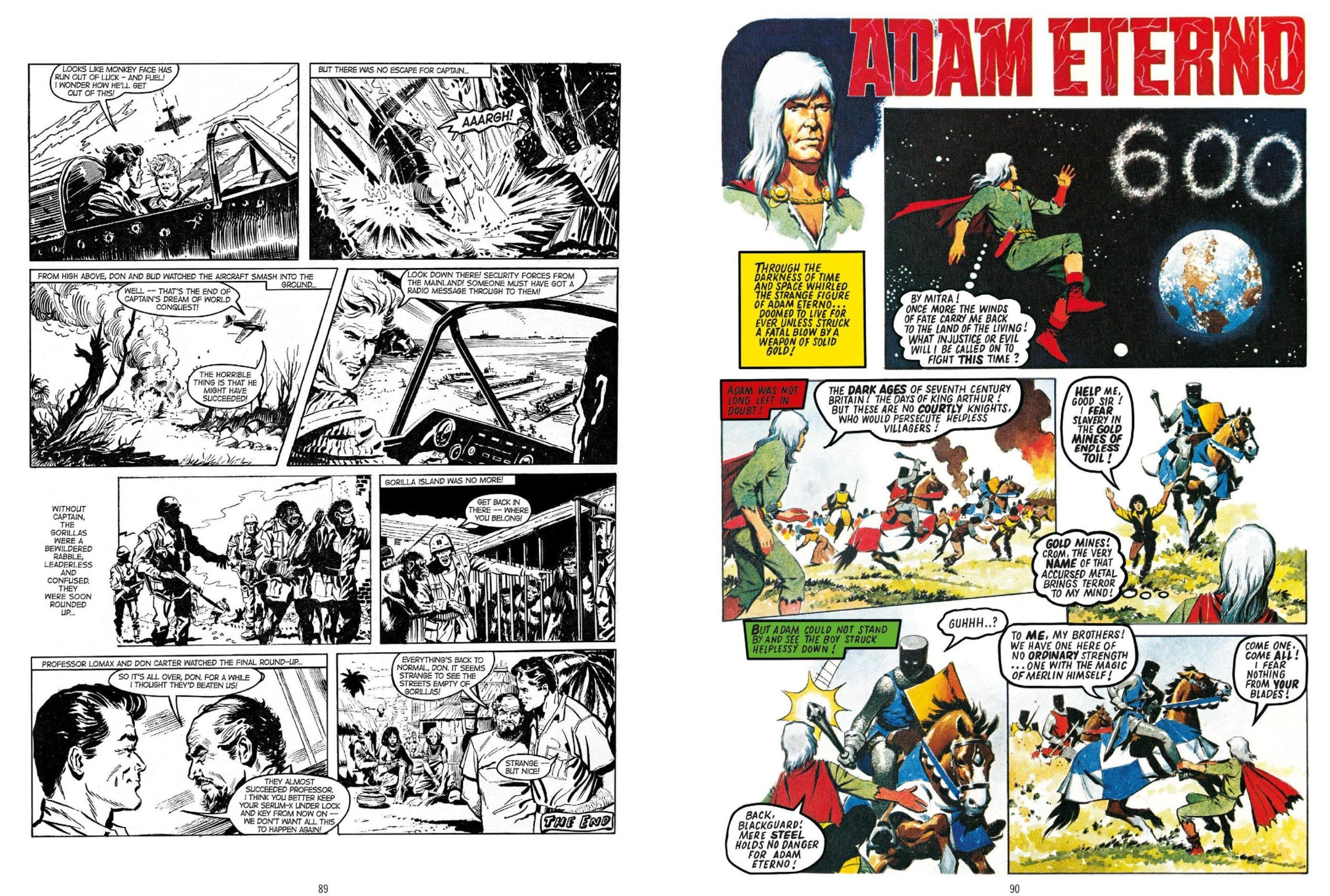
There’s more of the same, if a little earlier set, as anonymous & Frank Langford detail how animal experiments turn a lab chimp into a threat to all humanity after taking over ‘Gorilla Island’ as seen in Tiger from February 13th to May 8th 1965 – predating Planet of the Apes by three years! – after which possibly the same scripter (who can tell?) & Ian Kennedy cover how immortal time traveller ‘Adam Eterno’ exposes a slave-taker at Camelot’s Round Table, as seen in Valiant Annual 1976.

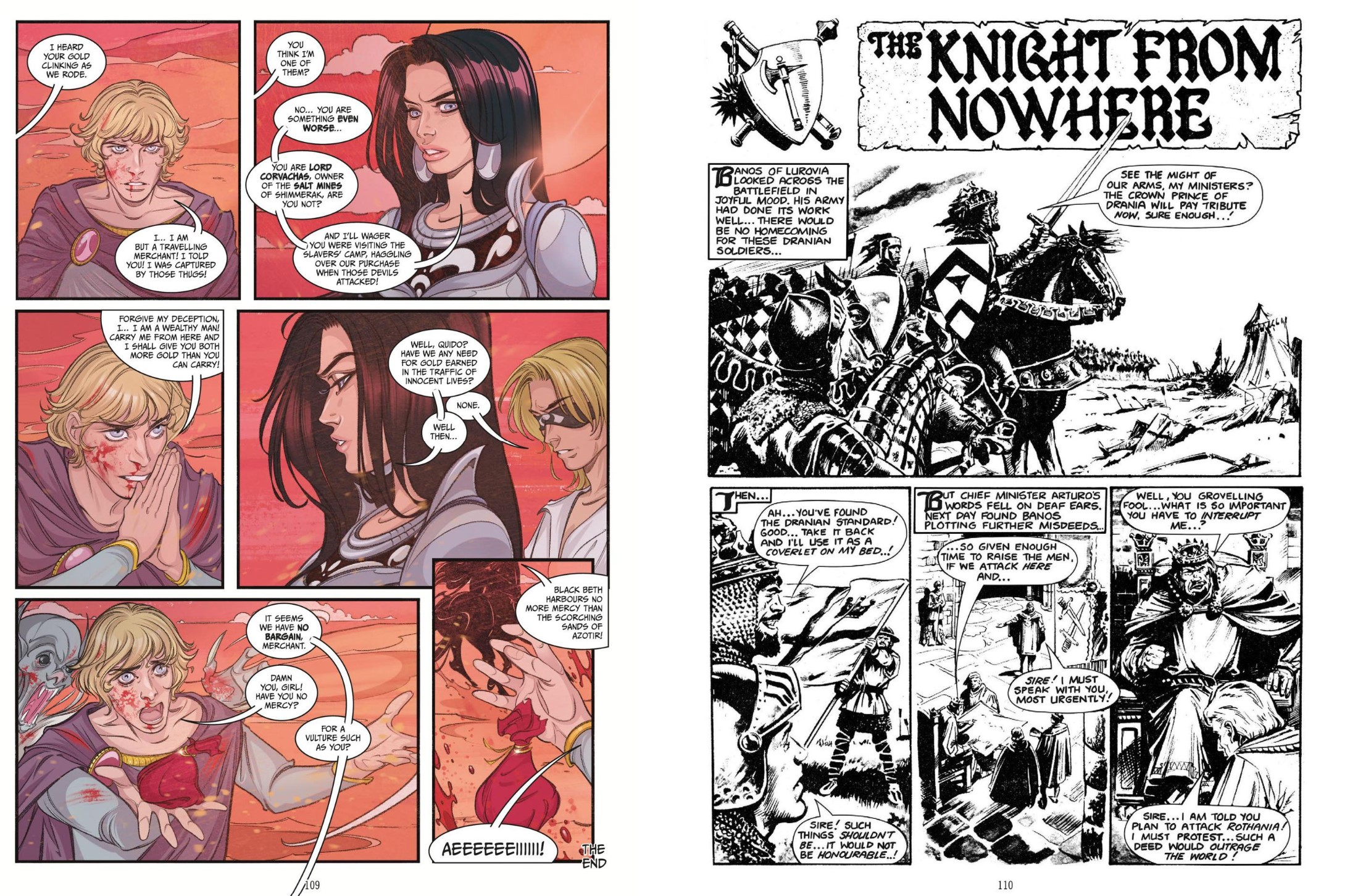
Donne Avenell & Massimo Belardinelli tell a tale of feudal Caped Crusader/Dark (green) Knight) ‘Flame O’ the Forest’ wherein the masked Saxon battles Norman injustice and oppression in a short romp from Lion Annual 1972 before final new addition ‘Black Beth: Vultures of Azotir’ sees Alec Worley, Anna Morozova, & Ozwald reaffirm the Warrior Sorceress’ undying battle against evil magic and wicked people, before Steve Moore & Eric Bradbury close the Christmas curtain with The Knight From Nowhere’: one last bout of sword-waving sagas and supernatural vengeance as originally seen The Buster Book of Scary Stories 1975

And that’s another pretty package of festive future-of-nostalgia fun done. Crucially, all these digital delights could be all yours right now, if not sooner…

Admit it. You’re tempted, right? And don’t YOU deserve some seasonal fun and thrills too?
© 1965, 1972, 1975, 1976, 1979, 1980, 1982, 1985, 1992 & 2024 Rebellion Publishing IP Ltd. All Rights Reserved.

Today in 1946 Vittorio Giardino was born. We just did his Max Fridman stuff so no help from here, just go scrolling. In 1947 Dutch wonder boy Joost Swarte was born and in 1959 Jean Roba’s Boule et Bill began in Le Journal de Spirou, and 10 years later Scottish writer Mark Millar was born.

On the downside, though, in 1986 today was Gardner F. Fox’s last day on Earth-1 and in 1992 Smurf-meister Peyo passed away leaving all far less blue…

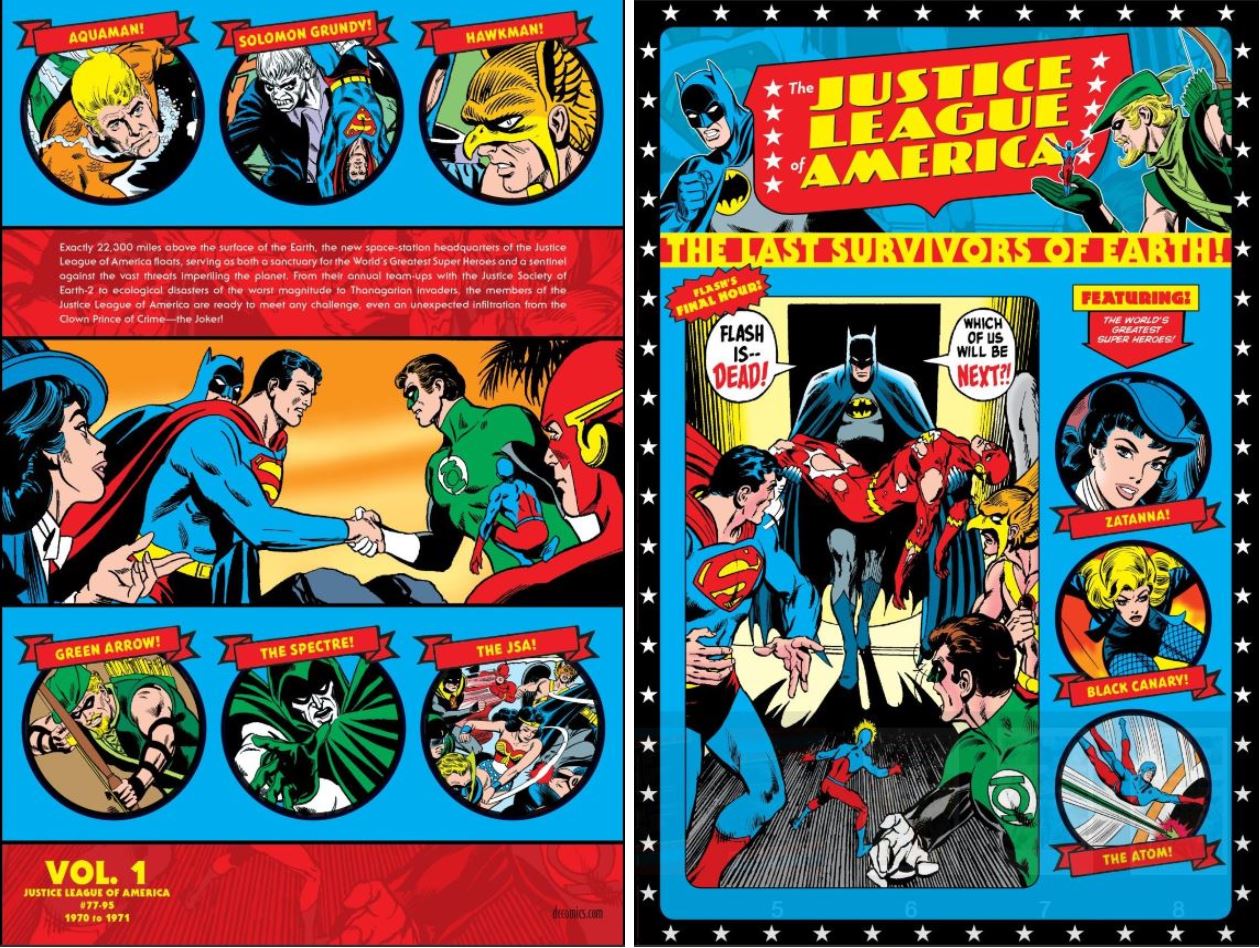
Justice League of America – The Last Survivors of Earth!


By Denny O’Neil, Mike Friedrich, Robert Kanigher, Dick Dillin, Neal Adams, Joe Giella, Murphy Anderson, Curt Swan, Dick Giordano & various (DC Comics)
ISBN: 978-1-4012-8920-1 (TPB/Digital edition)

This book includes Discriminatory Content produced in less enlightened times.

Win’s Christmas Gift Recommendation: Action, Imagination and Social Conscience: a True Xmas Tradition… 9/10

After the actual invention of the comic book superhero – for which read the Action Comics debut of Superman in 1938 – the most significant event in the industry’s progress was the combination of individual sales-points into a group. Thus, what seems blindingly obvious to us with the benefit of four-colour hindsight was proven: a number of popular characters could multiply readership by combining forces. Plus, of course, a mob of superheroes is just so much cooler than one… or one-and-a-half if there’s a sidekick involved…

And so, the debut of the Justice Society of America is rightly revered as a true landmark in the development of comic books, and when Julius Schwartz revived the superhero genre in the late 1950s, the turning point came with an inevitable union of his reconfigured mystery men. That moment came with #28 of The Brave and the Bold, a classical adventure title that had recently transformed into a try-out magazine like Showcase. Just before Christmas 1959 the ads began running. …Just Imagine! The mightiest heroes of our time… have banded together as the Justice League of America to stamp out the forces of evil wherever and whenever they appear!

The rest is history: the JLA captivated the youth of a nation, reinvigorated an industry and even inspired a small family concern into creating the Fantastic Four, thereby transforming the art-form itself. Following a spectacular rise, TV spin-offs brought international awareness which led to catastrophic overexposure: by 1968 the new superhero boom looked to be dying just as its predecessor had at the end of the 1940s.

Sales were down generally in the comics industry and costs were beginning to spiral, and more importantly “free” entertainment, in the form of television, was by now ensconced in even the poorest household. If you were a kid in the sixties, think on just how many brilliant cartoon shows were created in that decade, when artists like Alex Toth and Doug Wildey were working in West Coast animation studios. Moreover, comic book heroes were now appearing on the small screen. Superman, Aquaman, Batman, upstart Marvel’s heroes and even the Justice League of America were there every Saturday in your own living room…

It was also a time of great political and social upheaval. Change was everywhere and unrest even reached the corridors of DC. When a number of creators agitated for increased work benefits the request was not looked upon kindly. Many left the company for other outfits. Some quit the business altogether… and some were pushed out…

This fabulous compendium volume reflects the turmoil of those times as the original writer and penciller who had created every single adventure of the World’s Greatest Superheroes since their inception gave way to a new wave of scripters and a fresh if not young artist.

Richard Allen “Dick” Dillin (17th December 1928 – 1st March 1980) had started in the 1940s at Quality Comics on Blackhawk, Plastic Man and their war anthologies. An utterly reliable prolific draughtsman, he moved to DC when the company bought out Quality and spent over a decade drawing their Blackhawk. When Sekowsky left, he would draw every JLA issue for the next twelve years, as well as many other adventures of DC’s top characters – and even a wealth of horror stories when the company started scaring kids for money again…

Collecting issues #77-95 (cover-dates December 1969 to December 1971) and generously re-presenting the stirring covers of #85 & 93: giant all-reprint editions, this tome captures a culture in transition and visible change in the way DC stories were told, over a period when the market changed forever, and comics stopped being casual disposable mass-entertainment.

By the end of the period covered in this volume the publishers had undertaken the conceptual and commercial transition from a mass-market medium which slavishly followed trends and fashions to become a niche industry producing only what its dedicated fans wanted…

Without preamble the drama commences with the heroes’ confidence and worldview shattered after enigmatic political populist Joe Dough suborns and compromises their beloved teen mascot in ‘Snapper Carr… Super-Traitor!’ as crafted by Denny O’Neil, Dillin & Joe Giella, a coming-of-age yarn that changed the comfy, cosy superhero game forever.

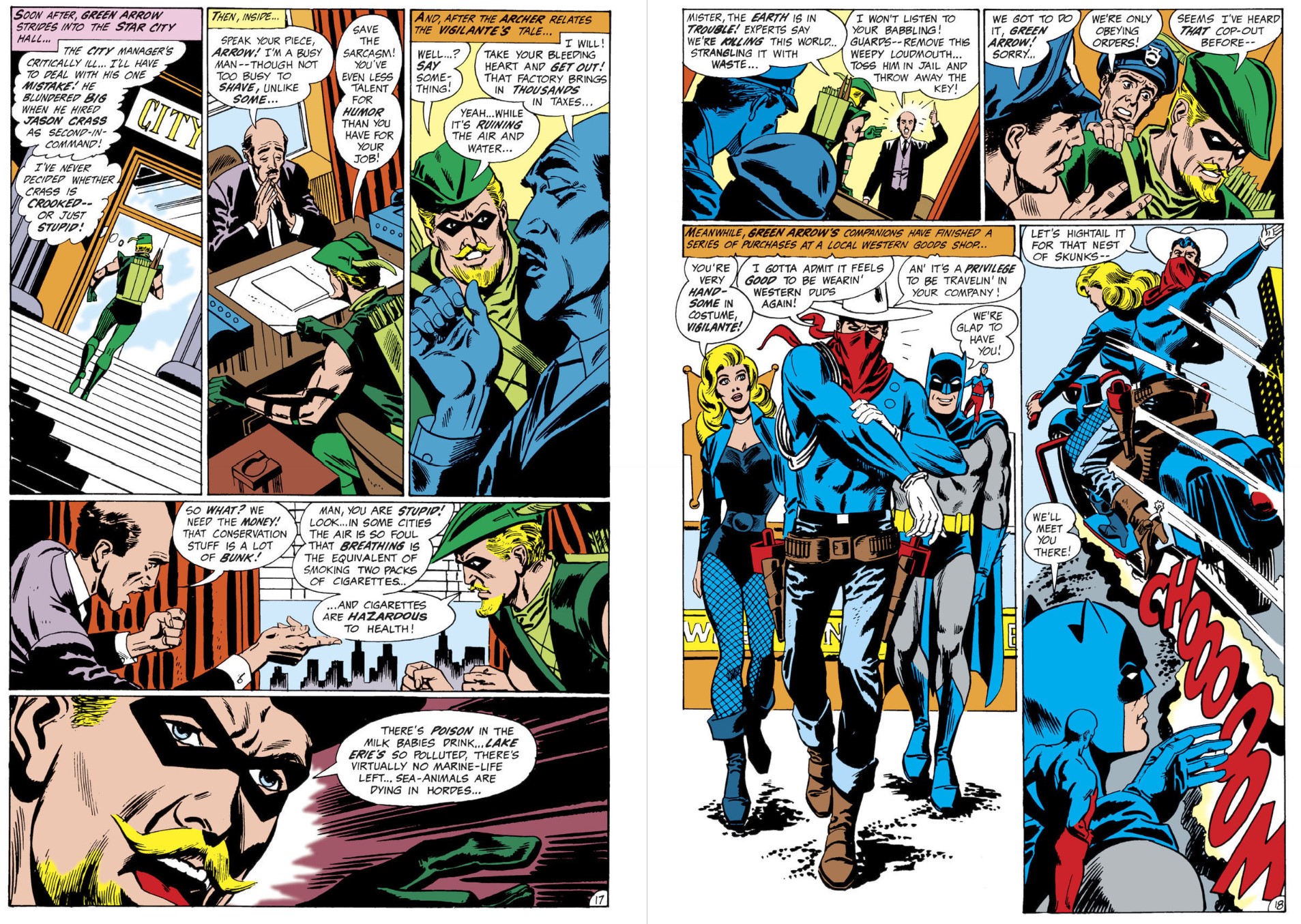
Greater social awareness parading through comics at this time manifested in the next epic 2-parter, which also revives another Golden Age Great (presumably to cash in on the mini-boom in screen Westerns). The Vigilante – a cowboy-themed superhero who battled bandits and badmen in a passel of DC titles from 1941-1954 – here alerts the team to ‘The Coming of the Doomsters!’ just in time to foil alien invaders who use pollution as their secret weapon. The vile plot concludes in ‘Come Slowly Death, Come Slyly!’ as the heroes stop the toxic baddies whilst subtly introducing young readers to potential ecological disasters in the making. This gave us plenty of time to offset greenhouse gases and end our dependence on fossil fuels and has given us the healthy planet we enjoy today…

Another landmark of this still-impressive tale was the introduction of the JLA Satellite, as the team moved from a hole in a mountain to a high-tech orbiting fortress. As they are moving in, ‘Night of the Soul-Stealer!’ sees Thanagarian Lorch Nor collecting heroic spirits in a magic box, but it is only prelude to an even greater threat as JLA #81 reveals his good intentions when the ‘Plague of the Galactic Jest-Master’ threatens to inflict a greater mind-crushing horror upon our entire universe…

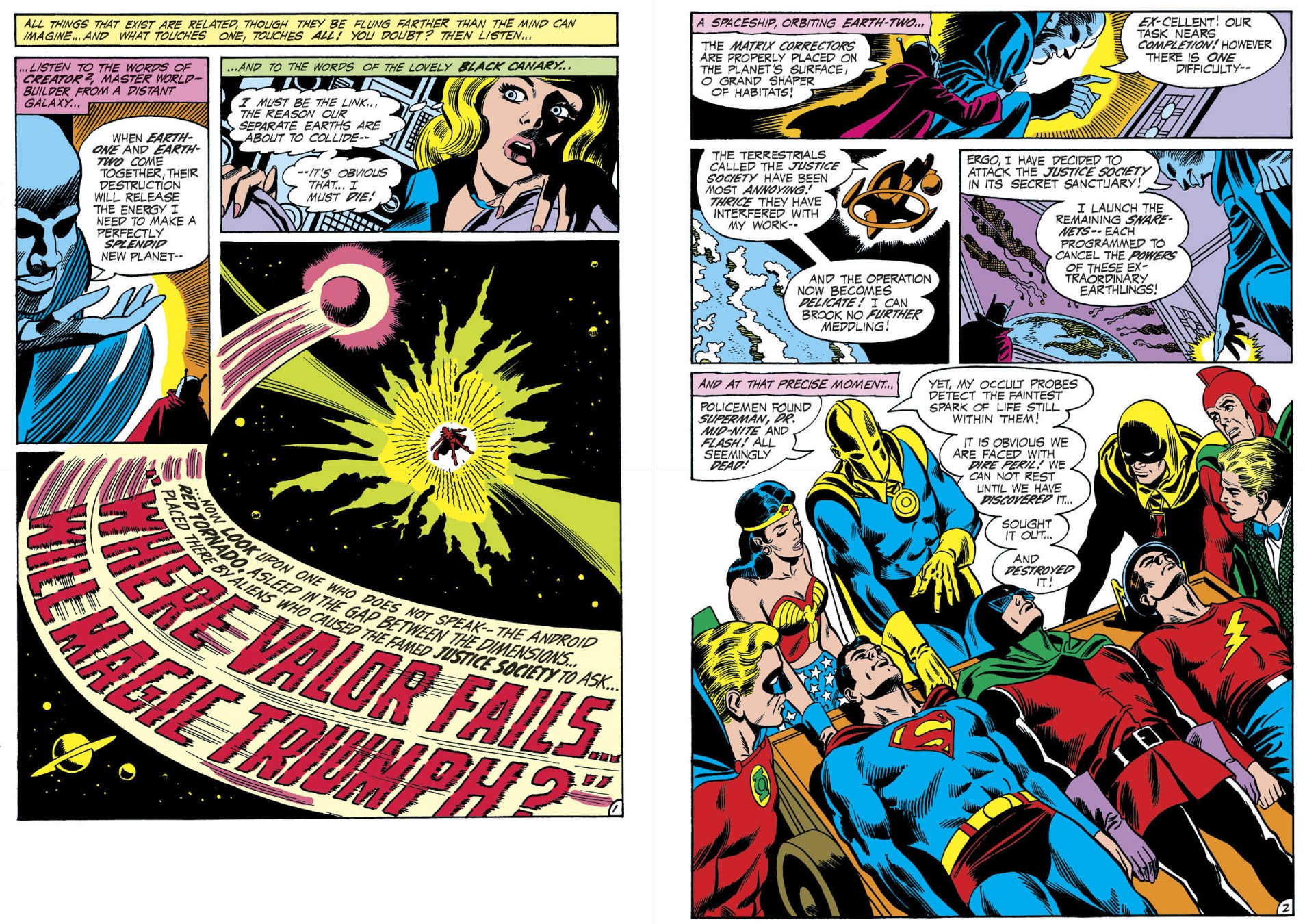
Next is another grand collaboration between JLA and the Justice Society of America as ruthless property speculators (is there any other kind?) from outer space seek to raze two separate Earths in ‘Peril of the Paired Planets’. Only the ultimate sacrifice of a true hero averts trans-dimensional disaster in climactic conclusion ‘Where Valor Fails… Will Magic Triumph?’

Justice League of America #84 (November 1970) hosted ‘The Devil in Paradise!’: a guest-script from veteran Robert Kanigher wherein a well-meaning but demented scientist builds his own Eden to escape Earth’s increasing savagery, before going off the deep end and attempting to cleanse the world and start civilisation afresh.

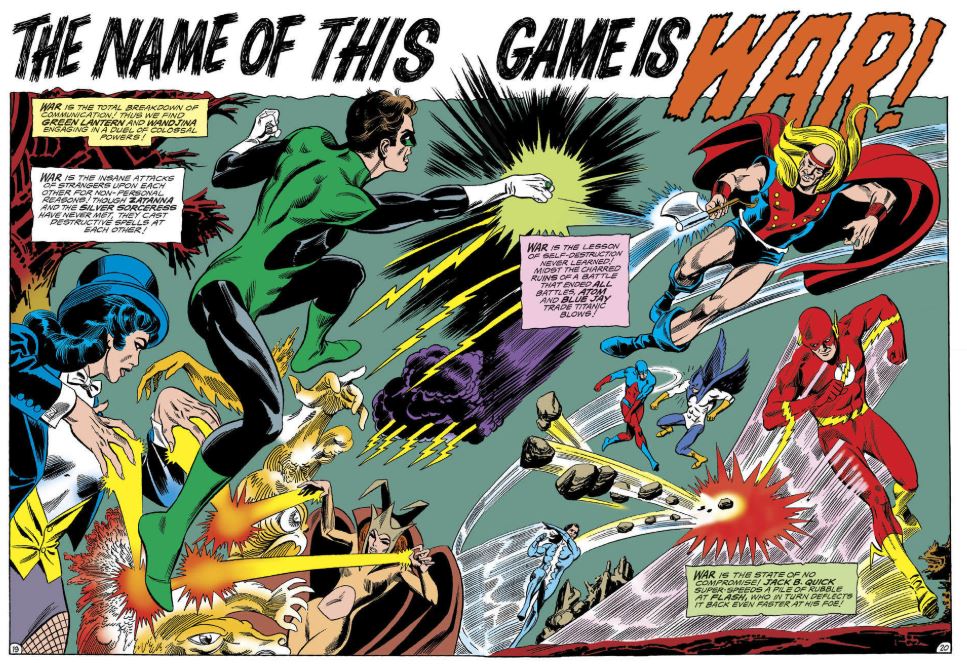
With superheroes on the outs the team was severely truncated too. JLA #86 confronted issues of overpopulation and impending global starvation as Mike Friedrich began a run of excellent eco-thrillers with ‘Earth’s Final Hour!’. Here crooked business entrepreneur (can I say “any other kind” again?) Theo Zappa tries to trade away Earth’s plankton (base of our entire food-chain) to a race of aliens with only Superman, Batman, Flash, Aquaman, Atom & Hawkman on hand to thwart him, whilst #87’s ‘Batman… King of the World!’ brings in occasional guest-star Zatanna and semi-retired Green Lantern Hal Jordan to tackle a deadly alien robot raider. This was a devious and barely veiled attack on Big Business and the Vietnam war, most renowned these days for introducing a group of alien superheroes mischievously based on Marvel’s Mighty Avengers.

The human spirit and enduring humanity are highlighted as ancient refugees from the lost city of Mu return to find us in charge of the planet they had abandoned millennia ago. ‘The Last Survivors of Earth!’ proves that even when superheroes are outmatched by scientifically-instigated global catastrophes, the simple patience, charity and self-confidence of ordinary folks can move mountains and save worlds…

‘The Most Dangerous Dreams of All!’ is one of the oddest tales in the JLA canon, with a thinly disguised Harlan Ellison psychically inserting himself into the consciousness of Superman and Batman to woo Black Canary with near-fatal repercussions, in a rather self-indulgent but intriguing examination of the creative process. Back on – and under – solid ground again for #90, ‘Plague of the Pale People!’ sees Aquaman’s submerged kingdom of Atlantis conquered by a primitive subsea tribe (the Saremites from Flash #109) using nerve gas negligently dumped in the ocean by the US military. In a mordant and powerful parable about lost faith and taking responsibility, the JLA must deal with problems much tougher than whomping monsters, repelling invaders and locking up bad guys…

JLA #91 (August 1971) heralds a hero-heavy first chapter in the annual JLA/JSA team-up with ‘Earth… the Monster-Maker!’ as the Supermen, Flashes, Green Lanterns, Hawkmen, Atoms & Robins of two Realities simultaneously and ineffectually battle an alien boy and his symbiotically-linked dog on two planets a universe apart. The result is meaningless carnage and imminent death until ‘Solomon Grundy… the One and Only!’ gives all concerned a life-saving lesson on togetherness and lateral thinking…

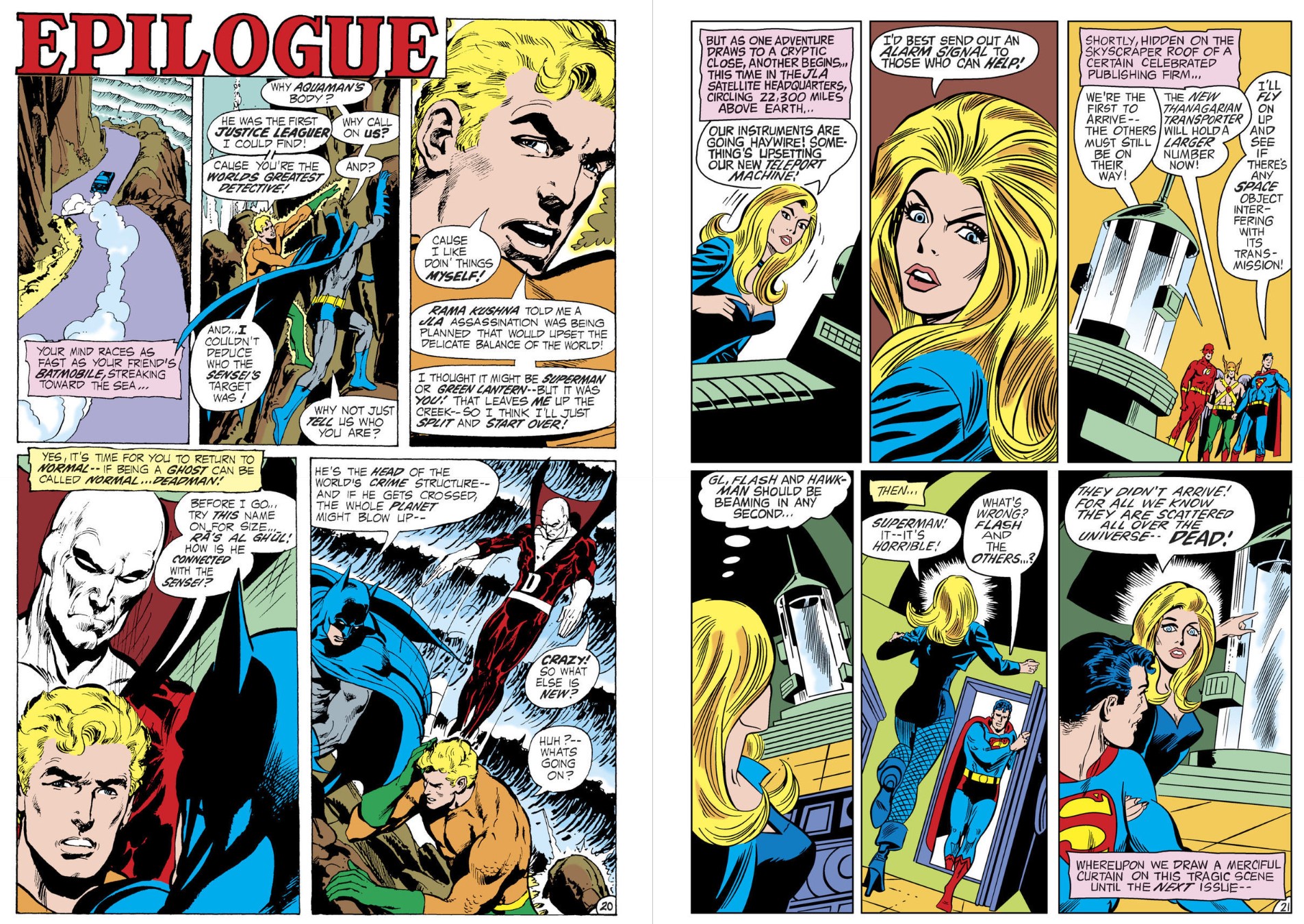
Following the cover of reprint giant #93, Neal Adams steps in to provide additional pencils for tense mystery ‘Where Strikes Demonfang?’ as ghostly guardian Deadman helps Batman, Aquaman & Green Arrow foil a murder mission by previously infallible archer Merlyn and the League of Assassins.

The issue and this tome end on a cliffhanger as Flash, Green Lantern & Hawkman are lost in a teleporter accident, leaving Batman, Black Canary, Green Arrow & Atom to fight ‘The Private War of Johnny Dune!’ wherein a disaffected African American freshly returned from Vietnam discovers the power and temptation of superpowers. Tragically, even the ability to control minds isn’t enough to change an unjust society 200 years in the making…

Augmented by stunning covers from Murphy Anderson, Curt Swan, Dick Giordano & Adams, these thoroughly wonderful thrillers mark an end and a beginning in comic book storytelling as whimsical adventure was replaced by inclusivity, social awareness and tacit acknowledgement that a smack in the mouth can’t solve all problems.

The audience was changing and the industry was forced to change with them. But underneath it all the drive to entertain remained strong and effective. Charm’s loss is drama’s gain and today’s readers might be surprised to discover just how much punch these tales had – and still have.

And for that you must get this book…
© 1969, 1970, 1971, 2019 DC Comics. All Rights Reserved.

Today in 1929, Dick Dillin was born. You can appreciate his lifetime of comics creation drawing everyone from Aquaman to Zatanna in everything from Blackhawk to World’s Finest Comics… and you should. Or you could just scroll up.

In Britain, Strongman’s Daughter Pansy Potter debuted in 1938, courtesy of Hugh McNeill and The Beano. Red Ryder co-creator Stephen Slesinger died today in 1953 and in 2006 ultra prolific comics phenomenon Joe Gill passed away. He co-created Captain Atom and most reprinted Charlton comics you’ve heard of. Why not track down Strange Suspense: The Steve Ditko Archives vol 1 for a taste?

Not Quite Last-Minute Presents: Goodnight Opus, The Last Basselope & Red Ranger Came Calling

By Berkeley Breathed (Little, Brown & Co.)

Win’s Christmas Gift Recommendation: To Be Read Every Christmas Until the Stars Grow Cold… 10/10 Each!

If – like me – you’re actually too busy to enjoy the season, or maybe poor, scared, fed up or otherwise disengaged, here’s a way to get it done and still derive some joy – absolutely astounding comics and cartoon wonder – all in one bunch!


Goodnight Opus

ISBN: 978-0-316-10853-9 (HB) 978-0-316-10599-6 (PB)

After a desperately brief and glittering career as a syndicated strip cartoonist and socio-political commentator (so often the very same function) Berkeley Breathed retired his award-winning Bloom County and Outland vehicles and became a writer and illustrator of children’s books. He lost none of his perception, wit or imagination, and actually got better as a narrative artist. He didn’t completely abandon his entrancing cast of characters and – as a happy ever after postscript – eventually revived them all for another go-round of satire and social advocacy. Yay!

This one is a story about the magic of storytelling and features universal innocent Opus the Penguin. One night, as she has done two hundred and nine times before, Granny starts to read the svelte yet uncool waterfowl his favourite bedtime book. But this night is different. Tonight, Opus’ mind wanders and he “departs the text”…

And so begins a riotous flight of Technicolor fantasy as sedate monochromatic images give way to a powerful, vibrant and surreal romp extending to the Milky Way and back, by way of animated monuments, the burned out Fairy of Sleep, and stopovers at some of the most exotic corners of the planet.

Less a story than an exuberant travelogue of Imagination, delivered in sharply lyrical rhyme, this is a book to trigger dreams and promote creativity. A perfect primer to explain how to wonder and wander…

Every kid, at any age, should have this.
© 1994 Berkeley Breathed. All Rights Reserved.


The Last Basselope – One Ferocious Story

ISBN: 978-0-316-10761-7 (HB) 978-0-590-47542-6 (PB)

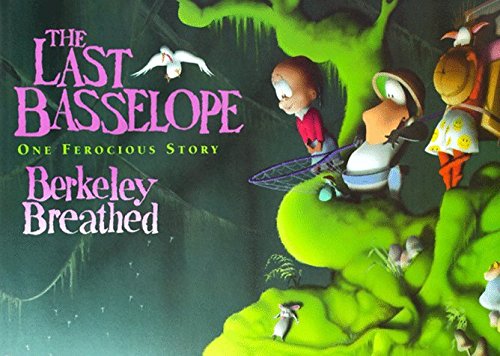
Berke Breathed is no one-trick-pony and has never been limited to one specific season or holiday. He can do fun and wonder all year round. Although not a proper Christmas story, this charming, tearfully funny tale is another joyous celebration of childhood realms and regions and how little adventures can become great big ones.

It stars his best-loved characters from Bloom County and Outland: jolly, unfulfilled Opus, Bill the Cat, Milquetoast the Housebug, Ronald-Anne (her mother named her for President Reagan – because he had done so much to advance the cause of Poor Black Women) and Rosebud, the eponymous, enigmatic Basselope of the title.

Opus is a dreamer of great dreams and frustrated explorer. In his unassuming, shy way he lusts for glory and the heady wine of immortality. As everybody knows, that can only be found by Discovering Something.

Anything will do. And in the pages of the latest National Geographic Enquirer he finds his dream waiting…

Organising a safari, our fish-fuelled fool heads for the woods in back of the house in search of the most elusive beast in history; every crypto-zoologist’s Holy Grail.

How he finds The Last Basselope and what he actually learns comprises a magical journey of intense discovery into the uncharted wilds of childhood’s imagination which reveals the strength, power and character of true friendship.

This beautifully illustrated, captivating and multi-layered fable is ideal for the eternally young at heart and all those still looking for a path back to their own wonder years.
© 1994 Berkeley Breathed. All Rights Reserved.


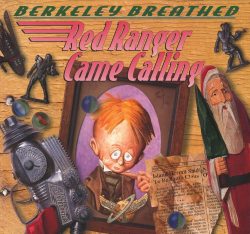
Red Ranger Came Calling – A Guaranteed True Christmas Story

ISBN: 978-0-61371-758-8 (HB) 978-0-31610-249-0 (PB)

We sneer at sentimentality these days but in the hands of a master storyteller it can be a weapon of crippling power. This glorious fable is purportedly one told every Christmas Eve to the author by his own father before being generously shared with us in mesmerising prose and captivating illustrations.

In 1939 young Red Breathed was well on the way to becoming a snotty, cynical wiseacre. Sent to spend the Holidays with his Aunt Vy, he mooches about all day with her old dog Amelia, while lusting as only a child can after an Official Buck Tweed Two-Speed Crime-Stopper Star Hopper bicycle.

Tweed, of course, is the famous movie serial star “Red Ranger of Mars” and the only thing capable of brightening the benighted life of the woeful, unfairly exiled child. Times are tough though, and Red knows his chances of getting that bike are nonexistent, but he just can’t stop himself hoping…

On his way home one day he sees an odd, pointy-eared little man heading for the ramshackle house of that reclusive old man Saunders. Since he’s a big kid now, Red knows there’s no Father Christmas and none of that hokey magic stuff is true, but even so finds himself sneaking up to the old house that Christmas Eve night…

This is a gloriously powerful tale fully capturing and emphasising the magic of belief and tragedy of realisation, and yet still ends with a Christmas miracle and a stunning surprise ending. Get this book for the kids, get this book for yourself, but get this book – and on pain of emotional death, don’t peek at the last page until the time is right!
© 1994 Berkeley Breathed. All Rights Reserved.

Today in 1892 artist Alfred Bestall was born. Anything else needful to know can be gleaned by visiting Rupert: A Celebration of Favourite Stories – 100 Years of Rupert Bear 1920-2020. In 1914 the day welcomed troubled genius Jack Cole who was responsible for manic innovation as packed into DC Finest: Plastic Man – The Origin of Plastic Man. It’s also – in 2011- the day we lost comic legend Joe Simon, co-creator of Captain America, Boy Commandos, Newsboy Legion and The Fly as well as inventor of Brother Power The Geek and other wild notions.

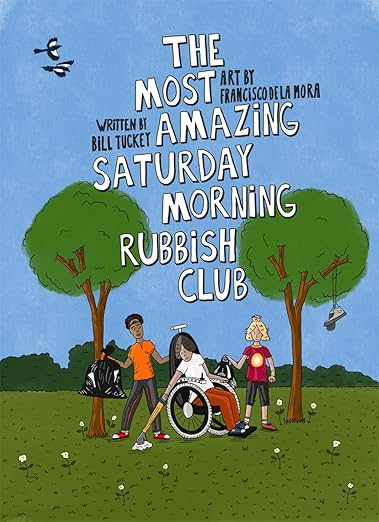
The Most Amazing Saturday Morning Rubbish Club


By Bill Tuckey & Francisco de la Mora (SelfMadeHero)
ISBN: 978-1-914224-36-2 (TPB)

Win’s Christmas Gift Recommendation: Family entertainment… 8/10

Are you old enough to remember, books, films and comics aimed at kids who would see players their own age finding a problem and sorting it out themselves? That’s what this fabulous yarn is, only here those plucky protagonists are all kids with conditions the world says renders them even more useless and in fact unable to act or think for themselves at all…

Writer (broadcaster, radio DJ, journalist, editor) Bill Tuckey & artist Francisco de la Mora (Frida Kahlo – Her Life, Her Work, Her Home please link to March 13th 2023) are both parents of children with special needs. Tuckey’s boys have ASD (Autism Spectrum Disorder) and de la Mora’s lad has PVL (Periventricular leukomalacia) and both creators have brought those experiences into a grand adventure that is also a signpost for how you should all behave around those of us that need a little forethought, patience and consideration…

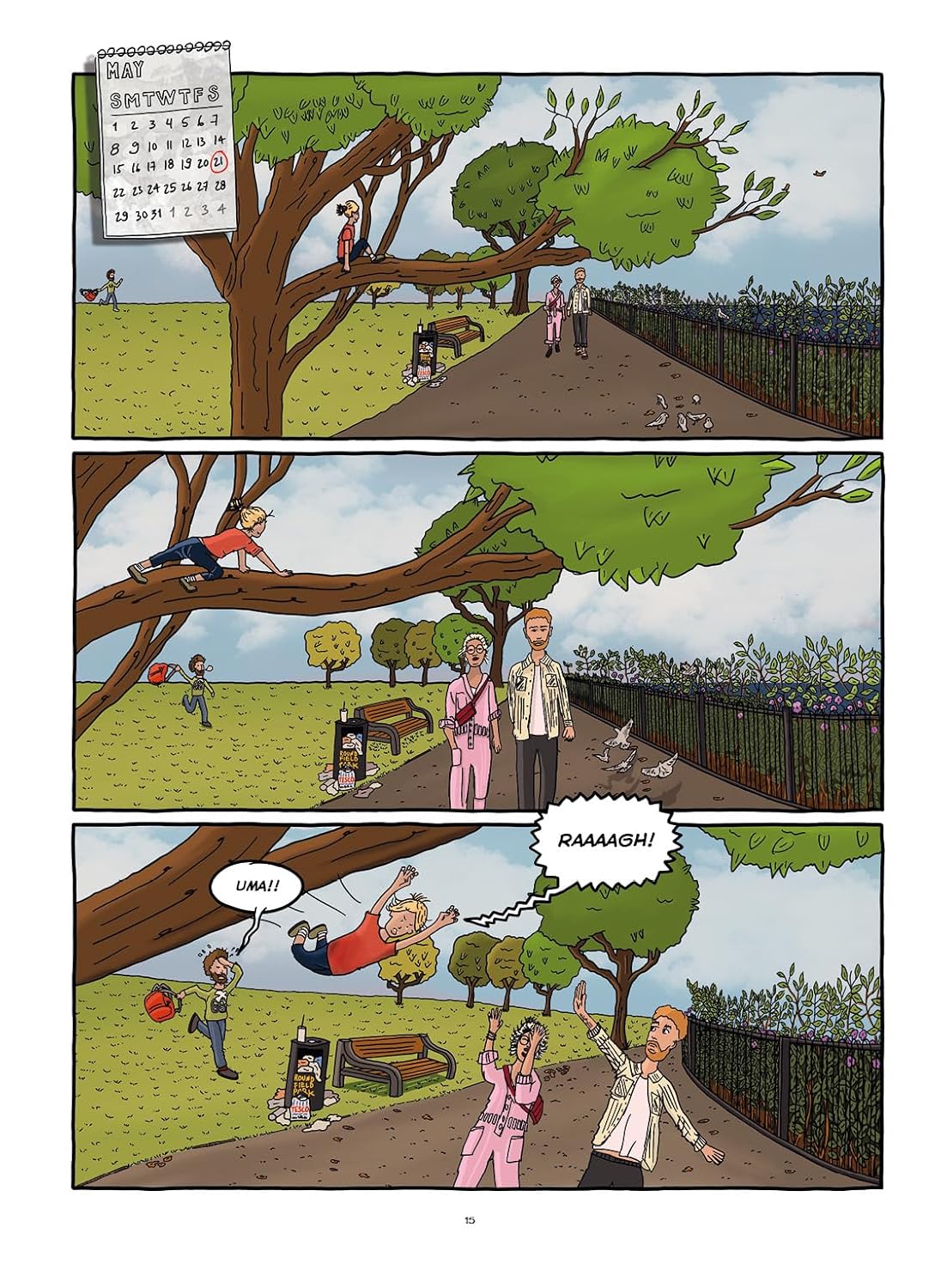
In a city district near a park, 11-year-olds Arthur Ballentine and Finn Gregory are already pals when they first encounter tireless fireball Uma Blanco. She’s 8 and has PVL. It leaves her with speech difficulties and cognitive deficits, but she always knows what she wants and runs rings around Arthur, who has ASD, and Finn, stuck in his wheelchair due to cerebral palsy.

They instantly unite over the way the insensitive folk (“the white people”) around them act and find purpose in the way their favourite space is becoming one huge litter trap. It’s just one aspect of the ongoing neglect slowly ruining the treasured urban green space. It’s getting less fun all the time now, as they learn from embattled park warden “the General”, lumbered with explaining why the latest council cuts mean the disabled toilets are closed from now on…

By June the kids are firm friends and resolved to do something. It begins with just picking up other people’s rubbish every Saturday, but builds before going into extreme overdrive once they discover a quiet, damaged man is living under the trees with a fox called Winchester. He’s buried himself in an underground hideout constructed secretly from other people’s cast offs…

And thus begins a quirky tale of renewal and unlikely friendships which charmingly lead to victory for the idealistic nippers, salvation for sad, strange wild engineer Richard (once the police stop being involved) and even a glorious storybook ending of sorts…

This is not polemic masquerading as entertainment. There’s a clever plot, compelling drama and a profound resolution in the offing. Of course there are plenty of incidents underlining how crap we are as society in taking care of our fellows, but it’s velvet-gloved in a welter of witty incidents and glorious characters studies of the kids and all the adults they impact and gradually convert to a better way of thinking and acting…

I don’t get to use the terms inspirational or heartwarming much when reviewing modern books and comics but when The Most Amazing Saturday Morning Rubbish Club inevitably becomes the next big British indie movie hit (like The Lady in the Van but closer to the kerb and bushes), I’ll be back to say I told you so and to plug the book all over again…
© 2025 Francisco de la Mora/Bill Tuckey. All rights reserved.

Today in 1911 Disney comics artist Paul Murray was born. We last saw his mastery in Walt Disney’s Donald Duck Volume 2: The Diabolical Duck Avenger. In 1950 Chris Claremont was born, and the magnificent Bob Haney died today in 2004. You don’t need me to tell you what they did and where to find their works.

Black Jesus volume 1


By Jimmy Blondell & David Krintzman, Nicholas Da Silva & Bigjack Studios (Brazil)  (Arcana)
ISBN: 978-1-897548-55-4 (TPB)

I’m always keen to spark a little controversy, so here’s an intriguing parable you probably missed when it launched in 2009 or the last time we plugged it. Moreover, remember as you proceed that even worse than being oppressed, deliberately deprived or “othered” is being denied your own existence…

Superheroes are often cited as a new mythology and occasionally comic books dabble with the idea that there’s not much difference between gods and metahumans. In a world where unnatural powers are common currency – at least in our fictions and entertainments and certain religions – what happens when a genuinely different being appears and acts in ways neither the guardians of society nor the laws of physics will tolerate?

Conceived and written by Jimmy Blondell & David Krintzman with art from Nicholas Da Silva (assisted by Brazil’s Bigjack Studios) this gripping thriller presents all the facets of an urban/horror/conspiracy thriller but don’t be fooled. There’s more going on here than first appears…

Chris is a young black man in New York City. He’s a bit weird, and not just because of the recurrent nasty visions of cruel hunters slaughtering animals in the Serengeti. Chris lives a peaceful life in a city where criminality, intolerance and hostility are everywhere, harming no one and caring for his pigeons in their rooftop roost.

He’s got friends, a part-time job and plenty of questions about the strange things that keep happening around him. Case in point: despite never practising, he can score a basket from anywhere on the court without even trying. It’s a trick that’s earned the respect of violent angry young men throughout the neighbourhood. When he’s not anywhere else the loner spends time breaking into Central Park Zoo to feed animals, or studying with scholarly Rabbi Goldberg, a man who knows more about the boy’s past than he’s letting on…

An already complex existence takes a frantic turn the day Chris pulls some kids out of a car sinking into the Park Lake. He had to walk across the water to get to them and footage of the rescue made the news everywhere. Thankfully, he kept his hoodie up and most viewers don’t know who he is. That’s not a problem for the devout leader of the Black Christian Gang whose agenda is to reclaim the Messiah for people of colour and destroy forever the myth of a blond, blue-eyed white Christ. He sets his many brothers in the BCG to finding the miracle worker at all costs…

So does black televangelist Reverend Carnivean, whose millions of worshippers, billions of dollars and soaring political ambitions can’t afford such obvious competition. Rather than true believers, he sets his moneymen, whores and assassins to finding the mystery man the media have dubbed Black Jesus…

That becomes even more urgent after a second tragedy strikes and witnesses at a charity gala all report seeing an anonymous young black waiter heal a woman mauled by a lion…

So begins the frantic race to control a potentially divine force or the next stage in human evolution: a trail peppered with bodies and shocking outrages. Of course, it doesn’t help that Chris himself has no idea what he truly is…

Understated and thoughtful, Black Jesus is a thriller about being born different (and yes, I do think that’s a metaphor for being black in America today, and as much so here too and France and…) and exploring dangerous ideas about the nature of divinity, poverty, status and belonging. It also has a strong shot at attempting to debunk the biggest and most divisive lie in politico-religious history.

The series was delving into some truly interesting corners before slumping into a hiatus triggered by the project being optioned as movie. Maybe when the film is finished, we can finally see how the comic would have progressed from the conclusion – but not ending – it reached…

Certainly not for everyone, but smart and compelling enough for you perhaps?

I mention just as an interesting aside here that I googled this book and their fancy-schmancy AI butted in on my digging to say it didn’t exist.

It does.

Check Good Reads, for example, and then buy a copy and read it
© 2009 by Black Jesus LLC. All rights reserved.

Today in 1904 pulps legend and Silver Age Superman, Batman & Legion of Super-Heroes writer Edmond was born. Thirty years later France and most of Europe welcomed the first issue of Disney vehicle Le Journal de Mickey.

In 1995 we grieved the loss of maestro Jesús Blasco whose The Steel Claw: The Cold Trail made devotees of many when we reviewed it.

Ethel Carnie Holdsworth’s This Slavery


Adapted by Scarlett & Sophie Rickard, edited by David Hine (SelfMadeHero)
ISBN: 978-1-91422-435-5 (TPB)

This book includes Discriminatory Content included for dramatic effect.

Published in 1925, and set in the cotton town of Great Harwood, near Blackburn at the Edwardian height of the Lancashire weaving industry, the prose This Slavery explored the ironclad imbalances of the feudal class structure the industry depended upon and did it in terms of a then-fashionable romance novel. It was dismissed in many quarters because of it. Its author Ethel Carnie Holdsworth (January 1st 1886 – December 28th 1962) was a poet, journalist, editor, educator, children’s author and novelist (with at least 10 books released in her lifetime, and whose fashionable gothic romances briefly outsold works by H.G. Wells!) and the first working class woman in Britain to have a book published – Miss Nobody in 1913.

Working class and self-made, she escaped the drudgery of her birth to become a socialist intellectual, foe of fascism, successful author and ardent campaigner. However, she was gradually and in her own lifetime erased from history and public consciousness – perhaps because this daring experiment was intended to reach beyond the intelligentsia on both sides of the cultural battlegrounds. Maybe – just perhaps – it happened because this story recognised that even though all workers were equal, female ones were supposed to be less equal than all the rest, before then challenging that apparently sacrosanct sacred cow and credo…

Divided into two Books, this saga is sparked by the aftermath of a fire at Barstock’s mill. This triggers another cycle of unemployment, privation and deaths for the weakest. Workers are paid a pittance and toil at the owners’ discretion with no salaried protections. Even skilled workers lives depend on the pennies weaving factories dole out whenever the owners need them to, and unemployment is common and frequent. Now, with their only livelihood destroyed with no sign of reopening, many men are leaving for more favourable climes. Of course, their wives and sweethearts must remain…

Hester and Rachel Martin live with their mother and grandmother, one a fierce and ferocious firebrand advocate of political and social change for all and the other a fair-faced, gifted musician in search of peace and security. Life for them is scrounging and performing for pennies or else perpetually borrowing to make do. When their granny dies, they don’t even have the money to bury her…

As their friends and lovers leave, existence becomes ever more onerous, and each achieves a shocking revelation regarding a woman’s place in the grand schemes, Thus each chooses a difficult way to survive…

The manner in which each “gets by” is moodily realised in grittily oppressive episodes beginning with ‘Chapter One: The Proposal’ and inexorably unfolding in a tapestry of tragedy comprising ‘The Denial’, ‘The Exile’, ‘The Struggle’, ‘The Secret’, ‘The Inevitable’, ‘The Undesirables’, ‘The Last Snap’ and ‘The Commitment’ all confirming that the war for freedom and equality is a three way battle: rich vs poor vs women…

As Hester and Rachel each make life-changing decisions, the illustration embraces and resonates with powerful natural forces of nature and darkness opposed to crushing streets, oppressive architecture and shining gleaming inescapable artificial light that emotionally ground down the workers – employed or otherwise. Moreover, as Book Two sees the situation escalate into inevitable mass violence, readers are not allowed to forget that police, “scab” workers, and the military always have paid work to do…
As the drama leads to an inevitable conclusion each sister rediscovers her true nature via ‘Chapter Ten: The Negotiations’, ‘The Strike’, ‘The Lost Opportunity’, ‘The Innocents’, ‘The Beasts of the Jungle’, ‘The Revelations’, ‘The Rebellion’, ‘The Decision’ and momentous moment ‘The Last Battle’

Like any inspirational tale espousing change, there is the hint of happy endings and brighter futures for all depicted in an ‘Epilogue’ with the entire story reinforced by a candid and thoughtful Afterword from adaptors Sophie & Scarlett Rickard (Mann’s Best Friend, A Blow Borne Quietly, The Ragged Trousered Philanthropists, No Surrender).

Righteously strident, passionately polemical and powerfully enraging, engaging, this never-more-timely tale of the eternal injustice and biologically apologist is superbly readable, dramatically enticing and should be compulsory viewing for all – as long as we don’t force anyone …

© 2025 SelfMadeHero. Text © 2025 Sophie Rickard. Artwork © 2025 Scarlett Rickard. All rights reserved.
Ethel Carnie Holdsworth’s This Slavery will be published on September 11th 2025 and is available for pre-order now.

Today in 1917, cartoonist/writer Frank Robbins was born. Among his many, many masterworks this character stands at the forefront.

Barefoot Gen volume 10: Never Give Up


By Keiji Nakazawa (Last Gasp)
ISBN: 978-0-86719-601-6 (TPB) 978-0-86719-840-9 (HB/School Edition)

Whilst we are all commemorating the 80th anniversary of VJ Day (the Americans hold theirs on September 2nd), it’s only appropriate to remember how that war ended and what victory and defeat meant to a world forever changed after the conclusion. In comics, that means Keiji Nakazawa and Hadashi no Gen. A standby of anti-nuclear movements since first release in 1983, new hardback editions combining two paperback editions per volume are underway and will be on sale from January 15th 2026 – if we manage to live that long. You could wait or even check out our past reviews or simply save your time & energy by buying the still-available 10 tank?bon set right now.

After many years of struggle the entire piecemeal epic semi-autobiographical saga was remastered as an unabridged and uncompromising 10-volume English-language translation by Last Gasp under the auspices of Project Gen: a multinational organisation dedicated to peace and the abolition of nuclear weapons. Constantly revised and refined by its creator until his death from lung cancer in December 2012, Barefoot Gen is the quintessential anti-war tract and plea to humanity for peace. The combined volumes are angry and uncompromising, and never forgive those who seek to perpetuate greed, mendacity and bloody-handed stupidity.

Hadashi no Gen was first seen in Japan in 1973, serialised in Gekkan Shōnen Janpu Jampu (Monthly Boys Jump) following an occasional 1972 series of stand-alone stories in various magazines which included Kuroi Ame ni Utarete (Struck by Black Rain) and Aru Hi Totsuzen (One Day, Suddenly).

The scattered tales eventually led Shonen Jump’s editor Tadasu Nagano to commission 45-page Ore wa Mita (I Saw It) for a Monthly Jump special devoted to autobiographical works. Nagano clearly recognised that the author – an actual survivor of the world’s first atomic atrocity – had much more to say which readers needed to see and commissioned the serial which has grown into this stunning landmark epic.

The tale was always controversial in a country which still generally prefers to ignore rather than confront past mistakes and indiscretions and, after 18 months, Hadashi no Gen was removed from Jump, transferring firstly to Shimin (Citizen), then Bunka Hyåron (Cultural Criticism), and Kyåiku Hyåron (Educational Criticism). Just like his indomitable hero, Keiji Nakazawa never gave up and his persistence led to a first Japanese book collection in 1975, translated by the newly-constituted Project Gen team into Russian, English and other languages including Norwegian, French, German, Italian, Portuguese, Swedish, Finnish, Indonesian, Tagalog and Esperanto.

Born in March 14th 1939 and changed forever on August 6th 1945, the hibakusha (“atom bomb survivor”) author first completed his account in 1985 and his telling testament of survival has since been adapted into live-action & anime films; operas; musicals and live television dramas; each spreading the message across every continent and all generations.

Today we’re looking again at the concluding volume which brings the story of irrepressible, ebullient Gen and his friends to a close. One last time we see the forceful vitality of a select band of bomb survivors pitted against the constant shadow of tragedy which implacably dogs them in the city slowly recovering from nuclear conflagration.

Here the indomitable idealistic individualist, having finally found a way to express his anger and effectively fight back against the idiocies and injustices of a world which lets Atom bombs fall but is seemingly incapable of learning from its mistakes, at last strikes back at the demagogues and monsters who still keep the bad old ways alive… even after their people suffered the most hideous of consequences…

Barefoot Gen: Never Give Up begins following an inspirational ‘Gen’s Message: A Plea for Nuclear Abolition’ by the Translators & Editors and – as previously – the other end of this monochrome paperback balances the essay with a biography of the author and invaluable data ‘About Project Gen’

The graphic manifesto resumes in March 1953 as Gen prepares for his school graduation ceremony, despite seldom attending that hidebound institution over the past few years. Fellow bomb orphans Ryuta and quietly stolid Musubi – who have shared Gen’s shabby shack for years – are also in high spirits. They have been constantly selling dresses made by radiation-scarred outcast Katsuko on Hiroshima’s rebuilt street corners, diligently saving the proceeds until she has enough money to open a shop. Now the manager of one of the big stores wants to buy all the clothes they can manufacture to sell in his fashionable venues…

At the Graduation Ceremony Gen once again loses his temper when the faculty begin memorialising the past and celebrating the failed regime of the empire. Later, his savage confrontation with teachers and visiting dignitaries sparks a minor student revolution. For many of the juvenile delinquents it’s also an opportunity to inflict some long-delayed retribution on the educational bullies who have oppressed and beaten them for years…

Encouragingly, however, not all parents and attending adults take the teachers’ side, and a potentially murderous confrontation is (rather violently) defused by Gen. The boy’s life then changes forever when he bumps into a young woman and is instantly smitten. His pursuit of Mitsuko will bring him into conflict with her brutal father, former employer and unrepentant war-lover Nakao who is now a highly successful businessman going places in the reconstructed city…

Gen has been studying with elderly artist Seiga Amano, learning the skills his own father would have passed on had he not died in 1945. The mentor/father-figure encourages his protégé to pursue Mitsuko… and it costs them both their jobs. However, the seeming setback is in fact liberating and before long the star-crossed youngsters are in a fevered euphoria of first love. So engaged is Gen that he is not there when stolid Musubi is targeted by a cruel Yakuza honeytrap who addicts him to drugs before fleecing him of all Katsuko’s hard-earned savings…

With a happy ending so close he can touch it, Gen is dragged back down to earth by a trio of tragedies which leave him near-broken and all alone. The legacies of the bombing have again cost him almost everything…

After a horrendous bout of death and vengeance-taking, Gen seems to have nothing to live for, but the despondent young man is saved by aged Amano who rekindles his spirit and wisely advises him to get out of Hiroshima and start his real life in the world beyond it…

Keiji Nakazawa’s broad cartoon art style has often been subject of heated discussion; his simplified Disney-esque rendering felt by some to be at odds with the subject matter, and perhaps diluting the impact of the message. I’d like to categorically refute that.

The style springs from his earliest influence, Osamu Tezuka, Father of Anime & God of Manga who began his career in 1946 and whose works – Shin Takarajima/New Treasure Island, Tetsuwan Atomu/Astro Boy and so many more – assuaged some of the grim realities of being hibakusha, providing escape, hope and even a career path to the young illustrator. Even at its most bleak and traumatic the epic never forgets to shade horror with humour and counterpoint crushing loss with fiery idealism and enthusiasm.

As such the clear line, solid black forms and abstracted visual motifs act as tolerable symbols for much of the horror in this parable. The art defuses but never dilutes the horror of the tragedy and its aftermath. The reader has to be brought through the tale to receive the message and for that purpose drawings are accurate, simplified and effective. The intent is not to repel (and to be honest, even as they are they’re still pretty hard to take) but to inform, to warn.

Shocking. Momentous. Bleak and violent but ultimately astoundingly uplifting, Nakazawa’s Barefoot Gen is without peer and its legacy will be pervasive and long-lasting. So now you’ve been warned, buy this old book. Buy the entire series. Buy the new editions as they come out. Tell everyone you know about it. Barefoot Gen is an indisputable classic and should be available to absolutely everyone.
© 2009 Keiji Nakazawa. All rights reserved.

They Called Us Enemy (Expanded edition)


By George Takei, Justin Eisinger, Steve Scott & Harmony Becker (Top Shelf Productions/IDW)
ISBN: 978-1-603094-70-2 (Expanded HB) eISBN 978-1-684068-82-1-
TPB ISBN: 978-1-603094-50-4

This book contains Discriminatory Content from less enlightened times included for historical and dramatic veracity.

Graphic biographies are still a relatively new form for English-language comics, but the wealth and variety of material already available is truly breathtaking and laudable. This so timely exemplary example is a subtly understated yet deeply moving chronicle exploring the events and repercussions of a truly shameful moment in US history, as recalled and relived by a global icon of popular culture. He also happens to be one of that embattled democracy’s most ardent advocates of diversity, justice and equality and top-level activist in the arenas of LGBTQ and Asian-American rights.

George Takei initially celebrated and commemorated his life in prose autobiography To the Stars, but here, in collaboration with writers Justin Eisinger & Steven Scott and illustrator Harmony Becker, the Hollywood star deftly shifted focus to explore in painful and revelatory detail the early years of his life: a formative period spent as a non-person confined without cause behind barbed wire in his own country.

Recounted as non-linear, non-chronological episodes, the history and self-serving actions of American leaders – like Lt. General John L. DeWitt or Los Angeles Mayor Fletcher Bowron, who systematically stripped all people of Japanese ethnicity of their rights, livelihoods, possessions and autonomy – are seen through the eyes of a small child. Those observations inevitably shaped the actor into a crusading defender of democratic principles of later life.

I’d love to say that’s simply a thing of the past, but kids are still being locked in cages and families split up. It’s apparently something we humans just can’t stop doing…

Following the attack on Pearl Harbor on December 7th 1941, on February 19th 1942, US President Franklin Delano Roosevelt signed Executive Order 9066, dividing the country into military zones and effectively declaring all American citizens of Japanese origins enemy aliens. This led to their internment for the duration of the war across 10 isolated camps between the West Coast and Mississippi river.

In surprisingly fond recollections of camp life, we share the notions of baffled children – George, brother Henry, sister Nancy Reiko and many new pals – and the lasting, post-war consequences of divisively authoritarian stunts such as legally-binding loyalty pledges de-fanged and counterpointed by modern day discussions and triumphant moments of past injustices finally addressed.

As well as exposing the true price of dog-whistle politics and human cost of bowing to baying demagogues we see here a shameful period of state-sanctioned, opportunistic profiteering and proud racism in a tale that is a testament to human endurance, perseverance and innate dignity. Amidst the stomach churning, mostly bloodless horror are moments of delightful warmth and genuine humour, bolstered by actions of unsung humanitarian heroes like Takei’s own parents and pioneering civil rights lawyer Wayne M. Collins. Their tireless fortitude and resistance to state-sanctioned oppression, along with the efforts of countless others, offers inspiration and hope for all suffering similar restraint and abuse while sadly proving that some battles may never end. Just look at any headline with the word seeker, refugee or asylum in it and the sheer cost of protecting migrants anywhere on Earth today…

Also offering touching afterword ‘Making History’ by Takei, Eisinger, Scott & Becker; a Takei family photo album; reproduced Civilian Exclusion orders, street maps of the internment camp and chilling “Final accountability rosters” for Camp Rohwer & Camp Tule Lake, this book includes a detailed look at the process of creating it, with candid team photos, script pages, roughs and layouts, as well as press and convention shots of George collecting the numerous awards for his efforts. At the close, there’s a feature on how the book has transitioned to becoming an educational standby, acknowledgements and the always welcome creator biographies.

They Called Us Enemy is a compelling, beguiling and harshly informative account of injustice and unchecked ignorance endured with plenty of points as pertinent now as they ever were.

In 2020 this expanded edition was released with 16 pages of extra material in both physical hardback and digital volume.
They Called Us Enemy Expanded Edition © 2020 George Takei. All Rights Reserved.

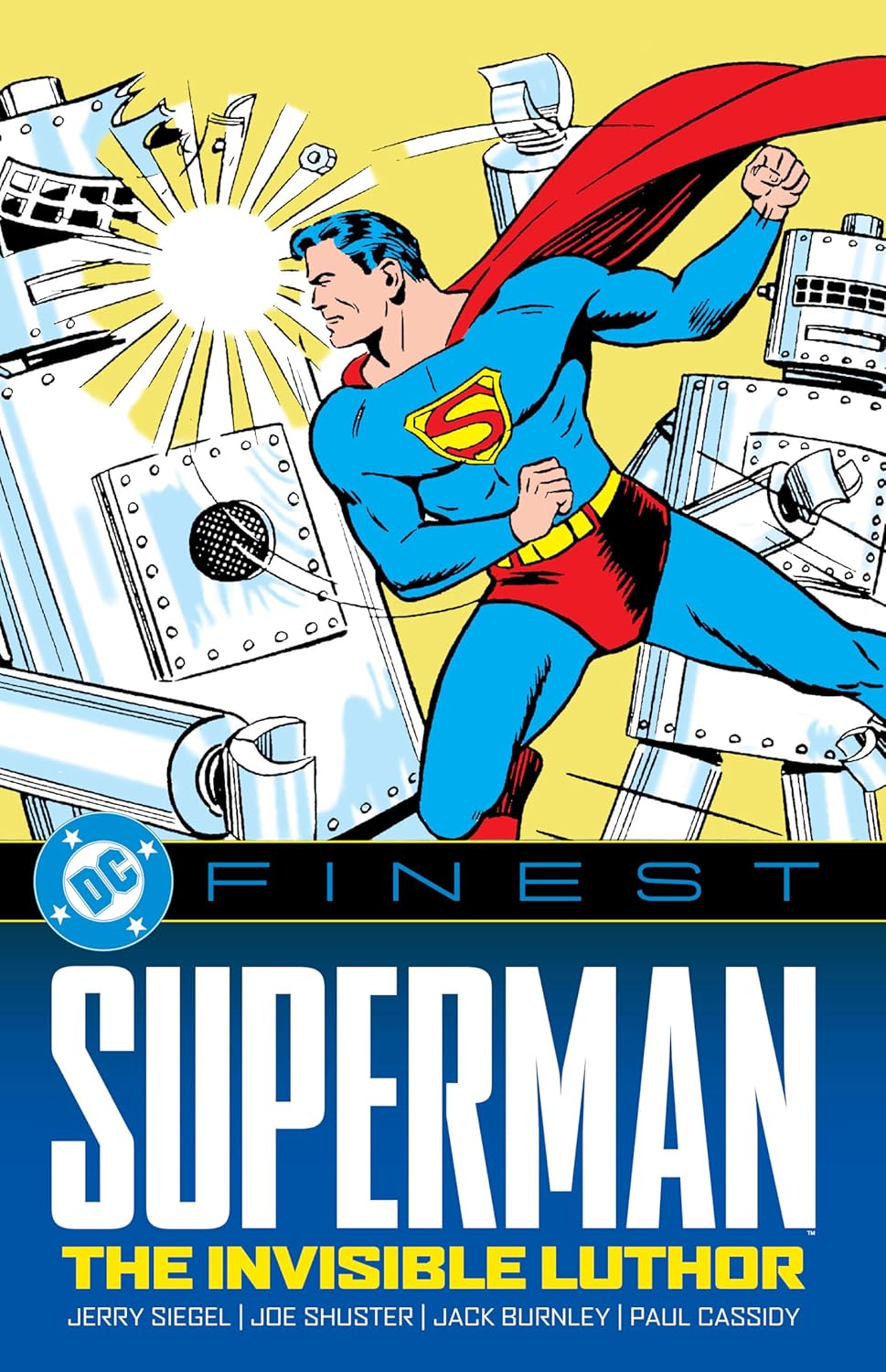
DC Finest: Superman – The First Superhero


By Jerry Siegel & Joe Shuster, Paul Cassidy, Paul Lauretta, Wayne Boring, Dennis Neville, Creig Flessel, Bernard Baily, Bob Kane, Leo O’Mealia, Jack Burnley, Fred Guardineer & various (DC Comics)
ISBN: 978-1-77952-833-9 (TPB)

This book includes Discriminatory Content produced in less enlightened times

Here’s another stunning and timely compilation comprising the best of vintage comics in another astounding and epic DC Finest edition. These full colour treasure troves are chronologically curated themed tomes highlighting past glories from the company that invented superheroes and so much more. Sadly, they’re not yet available digitally, as were the last decade’s Bronze, Silver and Golden Age collections, but we live in hope…

Just over 87 years ago, Superman rebooted planetary mythology and kickstarted the whole modern era of fantasy heroes. Outlandish, flamboyant, indomitable, infallible and unconquerable, he also saved a foundering industry by birthing an entirely new genre of storytelling: the Super Hero. Since April 18th 1938 (the generally agreed day copies of Action Comics #1 first went on sale) he has grown into a mighty presence in all aspects of art, culture and commerce, even as his natal comic book universe organically grew and expanded. Within three years of that debut, the intoxicating blend of eye-popping action and social wish-fulfilment that had hallmarked the early exploits of the Man of Tomorrow had grown: encompassing crime-busting, reforming dramas, science fiction, fantasy and even whimsical comedy. However, once the war in Europe and the East seized America’s communal consciousness, combat themes and patriotic imagery dominated most comic book covers, if not interiors.

In comic book terms alone Superman was soon a true master of the world, utterly changing the shape of the fledgling industry as easily as he could a mighty river. There was a popular newspaper strip, a thrice-weekly radio serial, games, toys, foreign and overseas syndication and as the decade turned, the Fleischer studio’s astounding animated cartoons.

Moreover, the quality of the source material was increasing with every four-colour release as the energy and enthusiasm of originators Jerry Siegel & Joe Shuster went on to inform and infect the burgeoning studio which grew around them to cope with the relentless demand.

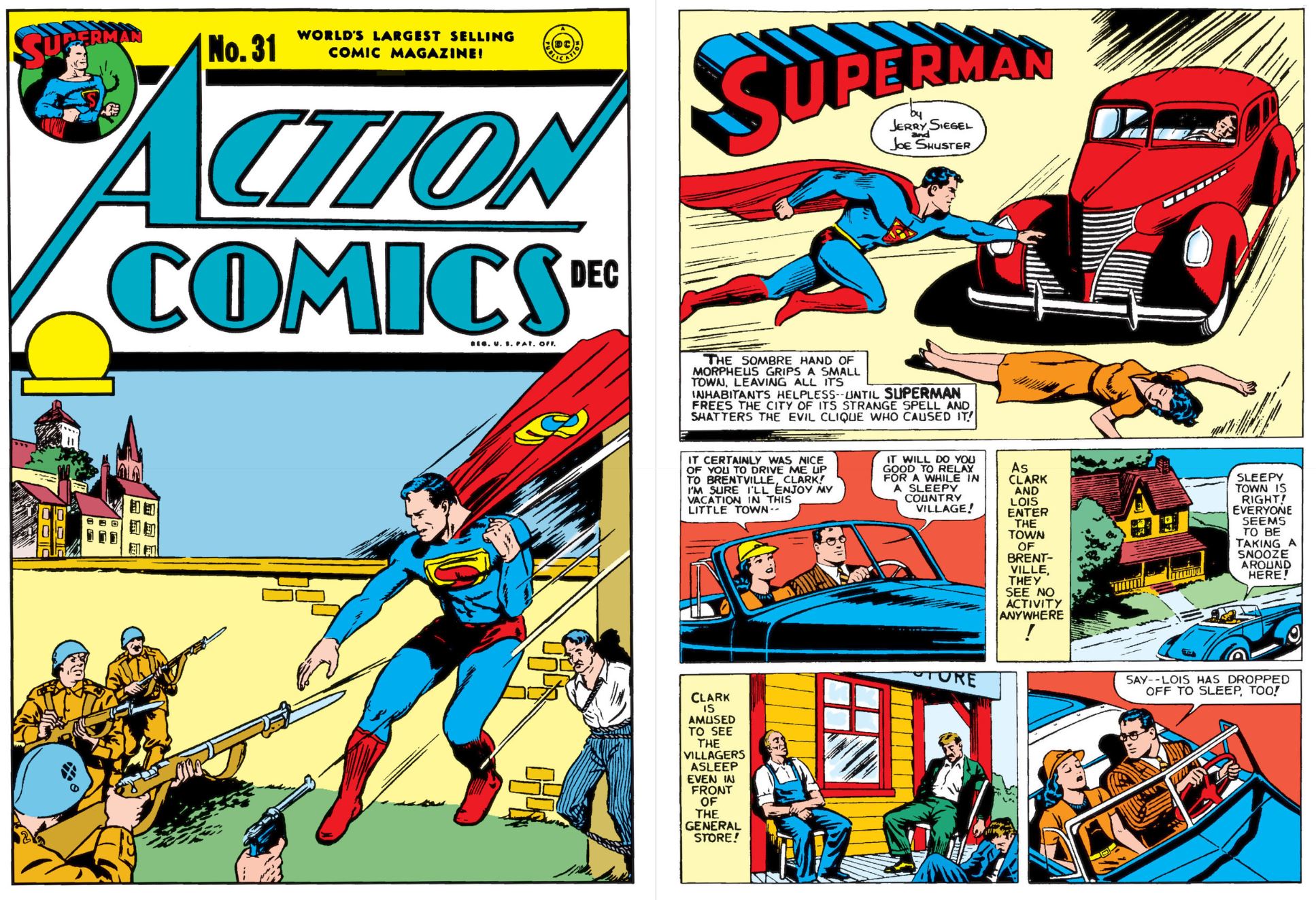
These tales have been reprinted many times, but this latest compilation might arguably be the best yet, offering the original stories in reading – if not strictly chronological publishing – order and spanning cover-dates June 1938 to December 1939. It features the groundbreaking sagas from Action Comics #1-25 and Superman #1-5, plus his pivotal first appearance in New York’s World Fair No. 1. Although most early tales were untitled, here, for everyone’s convenience, they have been given descriptive appellations by the editors.

Thus – after describing the foundling’s escape from exploding planet Krypton and offering a scientific rationale for his incredible abilities and astonishing powers in 9 panels – with absolutely no preamble the wonderment begins with Action #1’s primal thriller ‘Superman: Champion of the Oppressed!’ Here, an enigmatic oddly-clad caped crusader – who secretly masquerades by day as mild-mannered reporter Clark Kent – begins publicly averting numerous tragedies and righting injustices…

As well as saving an innocent woman from the Electric Chair and roughing up an abusive “wife beater”, the tireless paragon works over racketeer Butch Matson and consequently saves feisty colleague Lois Lane from abduction and worse at his hands. Then he exposes a lobbyist for the armaments industry bribing Senators on behalf of the greedy munitions interests fomenting the war in Europe…

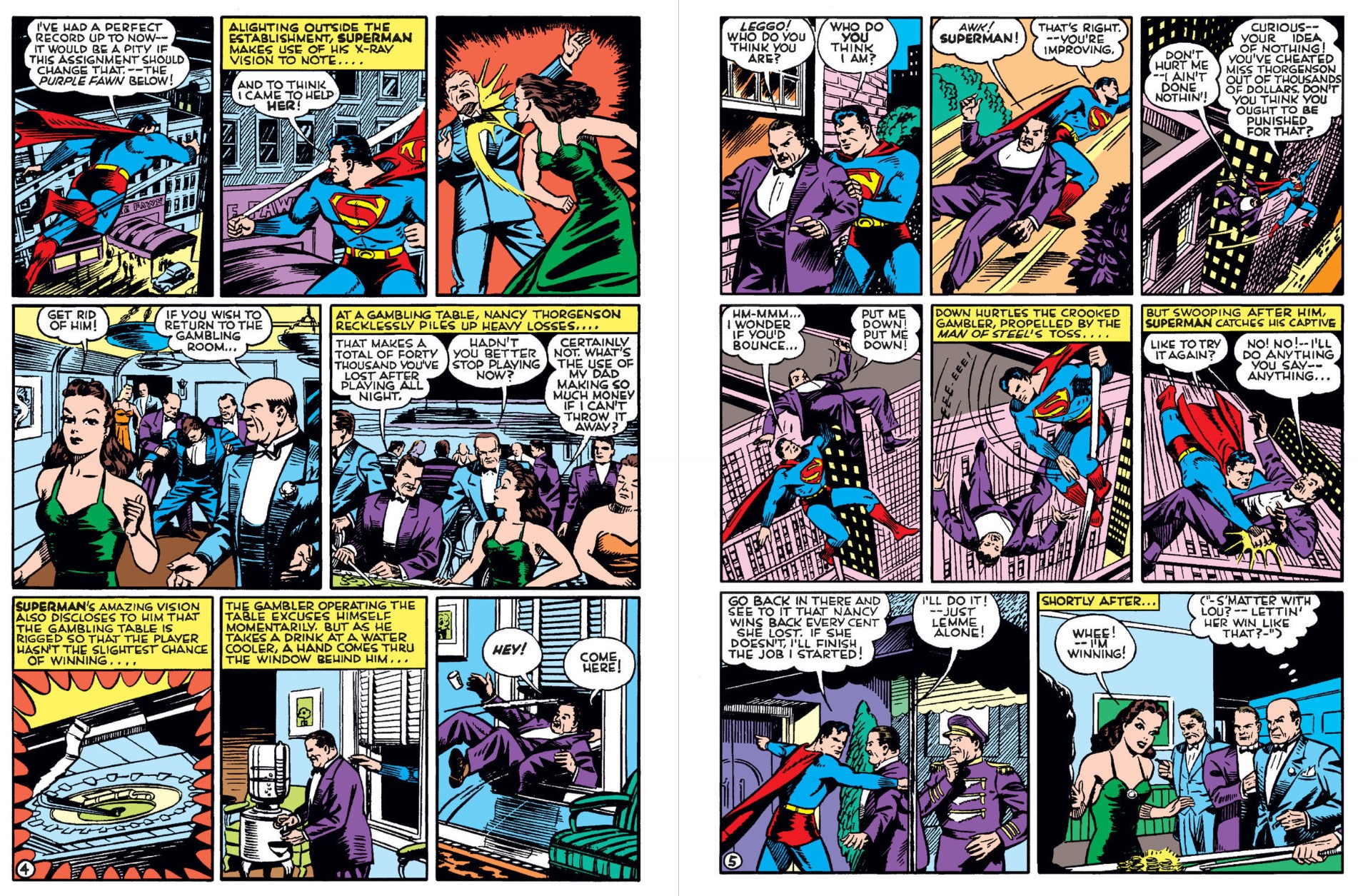
One month later Action #2 offered the next breathtaking instalment wherein the mercurial mysteryman travels to that benighted war-zone to spectacularly dampen down hostilities already in progress in ‘Revolution in San Monte Part 2’ before it’s back to the US where ‘The Blakely Mine Disaster’ finds the Man of Steel responding to a coal-mine cave-in and landing the blame squarely on corrupt corporate practises, before cleaning up gamblers ruthlessly fixing games and players in #4’s ‘Superman Plays Football’.

The Action Ace’s untapped physical potential is explored in AC #5 as ‘Superman and the Dam’ pits the human dynamo against the power of a devastating natural disaster, after which #6 sees canny chiseller Nick Williams attempting to monetise the hero – without asking first. ‘Superman’s Phony Manager’ (with Paul Lauretta adding inks to increasingly overworked Shuster’s art) even seeks to replace the real thing with a cheap knock-off, but quickly learns a most painful and memorable lesson in ethics…

Although Superman starred on the first cover, National’s cautious editors were initially dubious about the alien strongman’s lasting appeal and fell back upon more traditional genre scenes for the following issues (all by Leo E. O’Mealia and all included here). The Man of Tomorrow’s – and Joe Shuster’s – second cover graced Action Comics #7 (on sale from October 25th but cover-dated December 1938) and sparked a big jump in sales, even as the riotous romp inside revealed why ‘Superman Joins the Circus’ – with the mystery man crushing racketeers taking over the Big Top and illustrated by new kid Wayne Boring. Fred Guardineer produced genre covers for #8 & 9 whilst their interiors saw Siegel, Shuster & Lauretta’s ‘Superman in the Slums’ working to save young delinquents from a future life of crime and depravity before latterly detailing how city cops’ disastrous decision to stop the costumed vigilante’s unsanctioned interference plays out in the Boring-inked ‘Wanted: Superman’. That manhunt ended in an uncomfortable stalemate and ambiguous relationship with the authorities that endured for years…

Action Comics #7 had been one of the publisher’s highest-selling issues ever, so #10 again sported a stunning Shuster shot, whilst Siegel’s smart story ‘Superman Goes to Prison’ limned by Shuster, Lauretta & Boring struck another telling blow against institutionalised injustice and stacked odds, as the Man of Tomorrow infiltrated a penitentiary to expose the brutal horrors of State Chain Gangs. The next month saw a maritime cover by Guardineer whilst inside heartless conmen driving investors to penury and suicide rued the Metropolis Marvel intercession in ‘Superman and the “Black Gold” Swindle’ as illustrated by Paul Cassidy.

Guardineer’s spectacular cover of magician hero Zatara for issue #12 was a shared affair, incorporating another landmark as the Man of Steel was given a cameo badge declaring his presence inside each and every issue. Between those covers, Siegel, Shuster & Cassidy revealed how ‘Superman Declares War on Reckless Drivers’ – a hardhitting tale of joy-riders, cost-cutting automobile manufacturers, corrupt lawmakers and dodgy car salesmen who all feel the wrath of the human dynamo after a friend of Clark Kent dies in a hit-&-run incident…

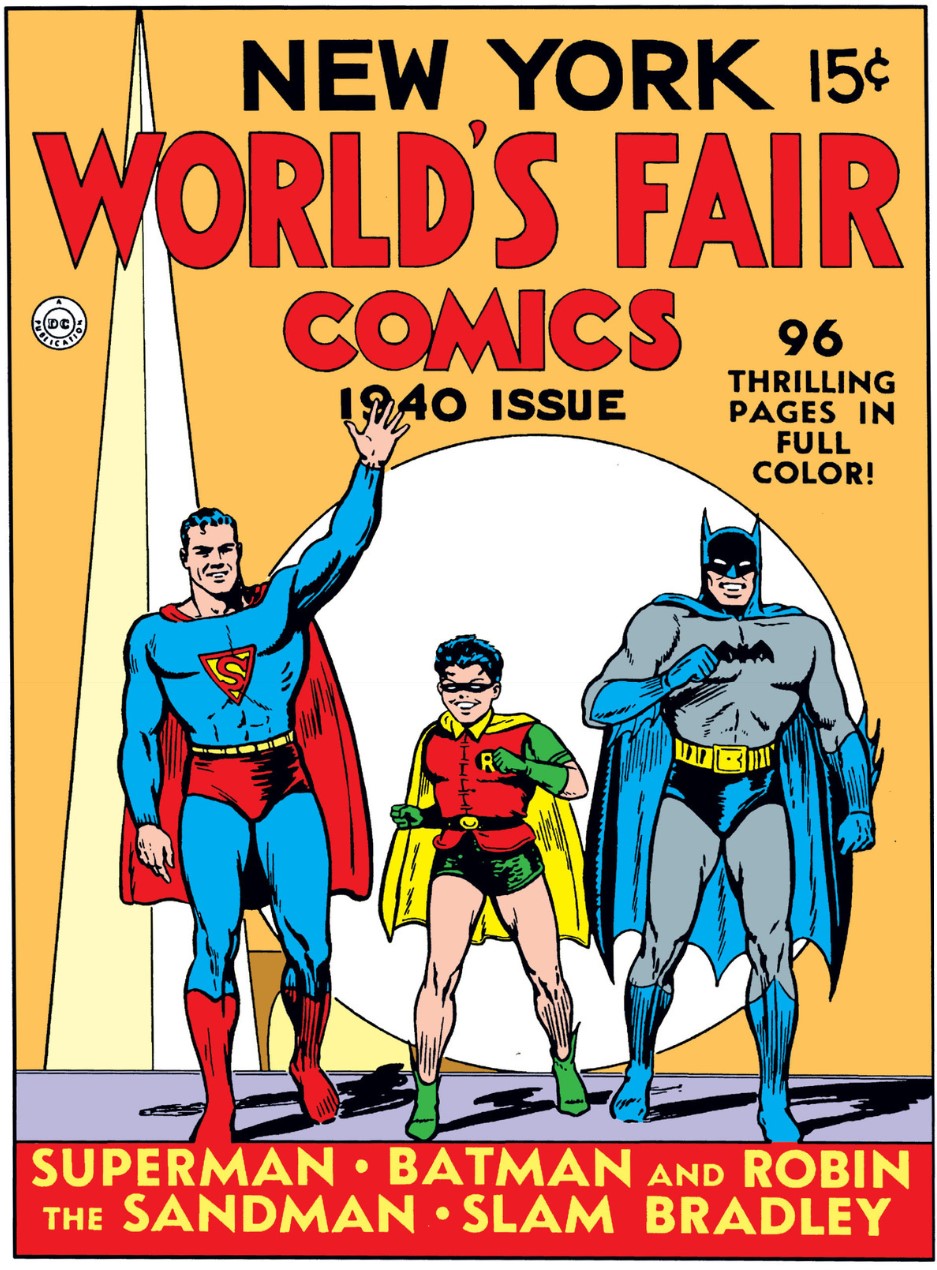
By now, the editors had realised Superman had propelled National Comics to the forefront of the new industry, and in 1939 the company won a license to create a commemorative comic book edition celebrating the opening of the New York World’s Fair. The Man of Tomorrow naturally topped the bill on the appropriately titled New York World’s Fair Comics at the forefront of such early DC four-colour stars as Zatara, Butch the Pup, Gingersnap and gas-masked vigilante The Sandman.

Following an inspirational cover by Sheldon Mayer, Siegel & Shuster’s ‘Superman at the World’s Fair’ describes how Lois and Clark are dispatched to cover the event, giving our hero an opportunity to contribute his own exhibit and bag a bunch of brutal bandits to boot…

Back in Action Comics #13 (June 1939 and another Shuster cover) the road-rage theme of the previous issue continued with Cassidy-rendered ‘Superman vs. the Cab Protective League’ as the tireless foe of felons faces murderous racketeers trying to take over the city’s taxi companies. The tale also introduces – in almost invisibly low key – The Man of Steel’s first recurring nemesis The Ultra-Humanite

Next follows a truncated version of Superman #1. This is because the industry’s first solo-starring comic book simply reprinted the earliest tales from Action, albeit supplemented with new and recovered material – which is all that’s featured at this point.

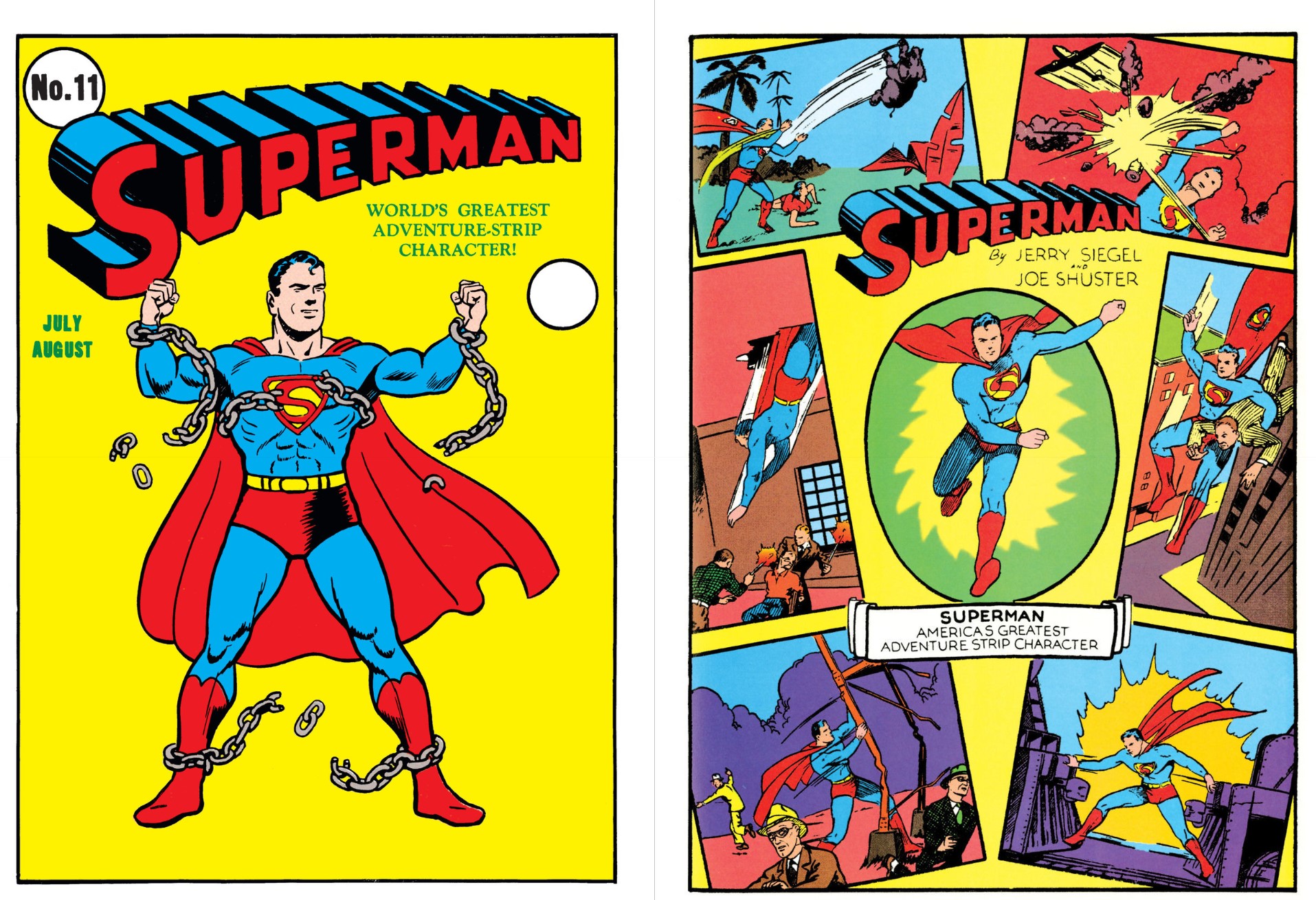
Behind the truly iconic and much recycled Shuster & O’Mealia cover, the first episode was at last printed in full as ‘Origin of Superman’, describing the alien foundling’s escape from doomed planet Krypton, his childhood with unnamed Earthling foster parents and eventual journey to the big city…

Also included in those 6 pages (cut from Action #1, and restored to the solo vehicle entitled ‘Prelude to ‘Superman, Champion of the Oppressed’) is the Man of Steel’s routing of a lynch mob and capture of the actual killer which preceded his spectacular saving of the accused murderess that started the legend. Rounding off the unseen treasures is the solo page ‘A Scientific Explanation of Superman’s Amazing Strength!’, a 2-page ‘Superman text story’, and ‘Meet the Creators’ – a biographical feature on Siegel & Shuster. The landmark closed with a pinup of Superman breaking chains by breathing out: an image the tuned in will recognise as the basis of DC Studios’ animation ident…

Sporting another Guardineer Zatara cover, Superman in Action #14 (as realised by Cassidy) featured the return of a manic, money-mad supergenius deranged scientist in ‘Superman Meets the Ultra-Humanite’ as the mercenary malcontent switches his incredible intellect from incessant graft, corruption and murder to an obsessive campaign to destroy the Man of Steel. Whilst Cassidy concentrated on interior epic ‘Superman on the High Seas’ – wherein the hero tackles subsea pirates and dry land gangsters – Guardineer then made some history as illustrator of an aquatic Superman cover for #15. He also produced the Foreign Legion cover on #16, wherein ‘Superman and the Numbers Racket’ by Siegel, Shuster & Cassidy sees the hero save an embezzler from suicide before wrecking another wicked gambling cabal.

Superman’s rise was meteoric and inexorable. He was the indisputable star of Action, with his own dedicated solo title. Moreover, a daily newspaper strip had begun on 16th January 1939, with a separate Sunday strip following from November 5th of that year. The fictive Man of Tomorrow was the actual Man of the Hour and was swiftly garnering millions of new fans. A thrice-weekly radio serial was in the offing, and would launch on February 12th 1940. With games, toys, and a growing international media presence, Superman was swiftly becoming everybody’s favourite hero…

Inked by Cassidy, overworked Siegel & Shuster’s second issue of Superman opened with ‘The Comeback of Larry Trent’ – a stirring human drama wherein the Action Ace clears the name of the broken heavyweight boxer, and coincidentally cleans all the scum out of the fight game, followed by ‘Superman’s Tips for Super-Health’, as ‘Superman Champions Universal Peace!’ depicts the hero once more tackling unscrupulous munitions manufacturers and crushing a gang who had stolen the world’s deadliest poison gas. The pictorial dramas end with ‘Superman and the Skyscrapers’ which finds newshound Kent investigating suspicious deaths in the construction industry, before committing his alter ego to conflict with mindless thugs and their fat-cat corporate boss, after which a contemporary ad and a ‘Superman Text Story’ bring the issue to a close…

Action #17 declared ‘The Return of the Ultra-Humanite’ in a vicious and bloody caper realised by Shuster & Cassidy, involving extortion and the wanton sinking of US ships, and featured their classic Super-cover as the Man of Steel was awarded all the odd-numbered issues for his attention-grabbing playground. That didn’t last long: after Guardineer’s final adventure cover – a bi-plane dog fight on #18, which fronted the Cassidy-limned ‘Superman’s Super-Campaign’ with both Kent and the Caped Kryptonian determinedly crushing a merciless blackmailer, Superman monopolised every cover from #19 onwards. That issue disclosed the peril of ‘Superman and the Purple Plague’ as the city reeled in the grip of a deadly epidemic created by Ultra-Humanite.

The truncated contents of Superman #3 offer only the first and last strips originally contained therein, as the other two were reprints of Action Comics #5 and 6. “The Superman Studio” was constantly expanding to meet spiralling demand and Dennis Nevillie inked Shuster on ‘Superman and the Runaway’ – a gripping, shockingly uncompromising exposé of corrupt orphanages, after which – following a cartoon briefing on ‘Attaining Super-Health: a Few Hints from Superman!’ – Lois finally goes out on a date with hapless Clark – but only because she needs to get close to a gang of murderous smugglers. Happily, Kent’s hidden alter ego is on hand to rescue her in bombastic gang-busting style in ‘Superman and the Jewel Smugglers’ by Shuster & Cassidy…

Cover dated January 1940 and on sale from November 24th 1939, Action Comics #20 notionally opened a new decade and, although Siegel & Shuster had very much settled into the character by now, the buzz of success still fired them, Innovation still sparked and crackled amidst the exuberance and drudgery of churning out more and more material. Moreover, Shuster’s eyesight was failing, demanding his sure signature touch be parcelled out parsimoniously and judiciouly. Collabotative creativity was the order of the day in the Superman Studio …

This conveyor belt process was absent in ‘Superman and the Screen Siren’ as Cassidy pencilled and inked a moving masterpiece wherein beautiful actress Delores Winters is revealed not as another sinister super-scientific megalomaniac but the latest tragic victim – and organic ambulatory hideout – of aged male menace Ultra-Humanite who perfected his greatest horror… brain transplant surgery!

This is followed with an immediate sequel from Shuster & Cassidy as “Delores” seeks to steal another scientist’s breakthrough and oblierate the Action Ace with ‘The Atomic Disintegrator’ before #22 loudly declares ‘Europe at War (Part One)’: a tense, thinly disguised call to arms to a still neutral USA. It too was a continued story – almost unheard of in those early days of funnybook publishing and spectacularly concluded in #23 with ‘Europe at War (Part Two)’.

Cover-dated Spring 1940, Superman #4 featured four big new adventures, and the debut of more creative stars in the making, beginning with a succession of futuristic assassination attempts in ‘Superman versus Luthor’ by omnipresent author Siegel, Shuster & Bernard (The Spectre) Baily. After an educational cartoon vignette on ‘Attaining Super-Strength’, the original Man of Might battles dinosaurs and bandits in ‘Luthor’s Undersea City’, by Shuster, Cassidy & Creig (The Sandman) Flessel, before saving the whole world from financial and literal carnage by ferreting out ‘The Economic Enemy’: a prophetic espionage yarn about commercial sabotage instigated by an unspecified foreign power and artistically crafted by Shuster, Cassidy and Bob Kane – yes, that Bob Kane…

The issue closed with a tale of gangsters intimidating Teamsters and union workers in Siegel, Shuster & Cassidy’s‘Terror in the Trucker’s Union’.

Simultaneously, in Action Comics #24,‘Carnahan’s Heir’ (Shuster & Cassidy) becomes Superman’s latest social reclamation project when the Metropolis Marvel promises to turn a drunken wastrel into a useful citizen, whilst in #25 Cassidy rendered the tale of ‘Amnesiac Robbers’ compelled to crime by an evil hypnotist, before this initial DC Finest compilation closes with the contents of Superman #5: a superb combination of human drama, crime and wickedly warped science augmented by a flurry of gag cartoons by the burgeoning Superman Studio.

As ever scripted throughout by Siegel, it begins with our crimebusting hero crushing ‘The Slot Machine Racket’ (Cassidy, Boring & Lauretta) before pausing to promote health and exercise, via feaurette ‘Super-Strength: Rules for Summer Living’. Without pausing for breath he then – couertsy of Cassidy – foils a rival newspaper’s ‘Campaign Against the Planet’. Limned by Shuster & Boring, the awesome, insidious threat of ‘Luthor’s Incense Machine’ is similarly scuttled, before finally Big Business chicanery is exposed and severly punished whilst a decent simple chemist is cleared of a felonius frame-up in Cassidy’s ‘The Wonder Drug Racket’.

Re-presenting the epochal run of raw, unpolished but viscerally vibrant stories by Siegel & Shuster and their merry band who collectively and until now largely anonymously set the funnybook world on fire, this chronicle compellingly recaptures the sheer thrill of those pioneering days. As fresh and absorbingly addictive now as they ever were, these endlessly re-readable epics perfectly display the savage intensity and sly wit of Siegel’s stories – which literally defined what being a Superhero means – whilst Shuster formulated the basic iconography for all others to follow.

The crude, rough, uncontrollable wish-fulfilling, cathartically exuberant exploits of The First Superhero reveals a righteous, superior champion of the helpless and outmatched dispensing summary justice equally to social malcontents, exploitative capitalists, thugs and ne’er-do-wells that initially captured the imagination of a generation. Although the gaudy burlesque of monsters and super-villains lay years ahead of Superman, these primitive, raw, captivating tales of corruption, disaster, moral deviancy and social injustice are just as engrossing and speak as powerfully of the tenor of the times then and now. Such Golden Age tales are priceless enjoyment. What comics fan could possibly resist them?
© 1938, 1939, 1940, 2025 DC Comics. All Rights Reserved.

Second Shift


By Kit Anderson (Avery Hill Publishing)
ISBN: 978-1-917355-20-9 (TPB)

The world has gone to crap and work sucks. This is the eternal verity wherever and whenever you are. Not much can be done about the world – except maybe make or find another one – but here’s a way to at least handle the work part of that equation…

Grand Master of short form graphic narratives – you can just call them comics if you want – Kit Anderson (Safer Places) originated in Boulder, Colorado but now lives near Zürich. Ceaselessly making graphic stories long before earning an MFA from The Center for Cartoon Studies in 2022 – Anderson’s earlier stuff – can be seen at Parsifal Press and The Rumpus and for greater elucidation and edification you could get check out Comics — Kit Anderson

Here Anderson dives deep into the contemporary by employing a future setting, exploring our increasingly uncertain/presumed/predicted fate in terms of the proverbial Human Condition – especially our self-destructive, double edged sword capacity to simultaneously doubt and trust – in a tale also exploring memory, imagination, inner worlds, nature, secrets, self-help solutions and isolation…

Pensive, genteel and quietly suspenseful, with action reduced to the participants’ downtime entertainment, Second Shift takes its emotional lead from contemplative classic science fiction movies like Silent Running and Soylent Green by tracing the revelations of live-in labourer Birdie Doran. At a time where human beings are pragmatically honed into useful components for megacorporations, she – like a few “lucky” others – toils for Terracorp, living on a hostile planet shepherding complex machines as they terraform the environment when not harvesting cometary material in mind-numbingly repetitive tasks that one day others will benefit from. It’s a living…

She spends her downtime in ‘Dropout’, indulging in the rich fantasy life provided and recommended by Company Exclusive DreamSpace: an engaging VR/AI environment replacing mundane travails with immersive escape routes (wizard’s worlds, haunted houses, cyber-realities, Knights & Ladies, alien mindscapes, fresh starts). Even when not suspended in economically sensible life stasis, Birdie hardly ever interacts with her human workers, like her brother Heck and standoffish Porter. Most of her conversations are with avatars of monitoring AI algorithm Station… and those are about work and her operating efficiency…

Toil and rest don’t leave much room for stimulating conversation and playing in the Station provided ‘Ruined Castle’ leaves Heck and Birdie increasingly bored and anxious. So, when he picks up an inexplicable ‘Signal’ Station cannot convince Heck to ignore it, and soon Birdie must trek out into the ever-changing icy wilds to fetch him back…

Her trudging trek eventually finds him staring at another – abandoned – station outpost, similar to but also utterly different to the cloying womb they live in. Unable to resist exploring, they discover wonders and eventually the VR menu of whoever worked there. What particularly grips then is something labelled “Wildlife”…

Torn over whether to report what they’ve found, and almost killed on their return journey by an inexplicable and highly suspicious event, the Dorans’ discovery increasingly divides whilst intellectually invigorating the siblings. Soon the shared secret is disrupting their efficiency and they clandestinely ‘Return’ to the lost outpost. It soon it becomes apparent that life for them has forever changed and nothing can stop what lies ahead…

Revelations and realisations come quietly but inescapably as the mystery intensifies in ‘Debris’, ‘Drop-In’ and ‘Payload’ before resolution arrives in ‘Museum Hall’, but can even enhanced awareness and growing knowledge help change this world? Whatever the outcome, it’s one only Birdie alone can achieve…

Beguiling, subversive, intensely absorbing and asking all the right questions on where the world or work is taking us – how do you feel about trading up to guaranteed food, lodging and being coddled and coshed by VR babysitters in return for surrendering liberty and your own opinions and questions? – Second Shift is socially-charged speculative fiction in the grand manner and a sublime, layered read you’ll return to over and again.
© Kit Anderson 2025. All rights reserved.