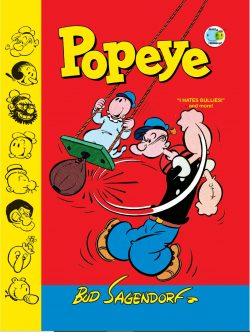
Popeye volume 1: Olive Oyl & Her Sweety (The E.C. Segar Popeye Sundays


By Elzie Crisler Segar with Sergio Ponchione, Cathy Malkasian & various(Fantagraphics Books)
ISBN: 978-1- 68396-462-9 (PB/digital edition)

Popeye popped up in the Thimble Theatre comic strip for January 17th 1929. The strip was an unassuming feature that debuted on 19th December 1919: one of many newspaper cartoon funnies to parody, burlesque and mimic the era’s silent  movies serials. Its more successful forebears included C.W. Kahles’ Hairbreadth Harry and Ed Wheelan’s Midget Movies / Minute Movies .

These all used a repertory company of characters to play out generic adventures firmly based on those expressive cinema antics. Thimble Theatre‘s cast included Nana and Cole Oyl, their gawky daughter Olive, diminutive-but-pushy son Castor, and Horace Hamgravy, Olive’s sappy, would-be beau.

The series ticked along for a decade, competent and unassuming, with Castor and Ham Gravy (as he became) tumbling through get-rich-quick schemes, fear-free adventures and simple gag situations until September 10th 1928, when explorer uncle Lubry Kent Oyl gave Castor a present from his latest exploration of Africa: a hand-reared Whiffle Hen – most fabulous of all birds. It was the start of something groundbreaking.

Whiffle Hens are troublesome, incredibly rare and possessed of fantastic powers, but after months of inspired hokum and slapsick shenanigans, Castor was resigned to Bernice – for that was the hen’s name – when a series of increasingly peculiar circumstances brought him into contention with the ruthless Mr. Fadewell, world’s greatest gambler and king of the gaming resort of ‘Dice Island’.

Bernice clearly affected writer/artist E.C. Segar, because his strip increasingly became a playground of frantic, compelling action and comedy during this period…

When Castor and Ham discovered that everybody wanted the Whiffle Hen because she could bestow infallible good luck, they sailed for Dice Island to win every penny from its lavish casinos. Sister Olive wanted to come along but the boys planned to leave her behind once their vessel was ready to sail. It was 16th January 1929…

The next day, in the 108th instalment of the saga, a bluff, irascible, ignorant, itinerant and exceeding ugly one-eyed old sailor was hired by the pair to man the boat they had rented, and the world was introduced to one of the most iconic and memorable characters ever conceived. By sheer, surly willpower, Popeye won the hearts and minds of readers: his no-nonsense, grumbling simplicity and dubious appeal enchanting the public until by the end of the tale, the walk-on had taken up full residency. He would eventually make the strip his own…

The Sailor Man even affably bulldozed his way onto the full-colour Sunday Pages which form the main course of this curated collection spanning 2nd March 1930 through February 28th  1932.

This paperback is the first of four that will contain the entire Segar Sunday canon and is designed to be stored in a forthcoming slipcase. Spiffy as that sounds, the wondrous stories are also available in digital editions if you want to think of ecology or mitigate age and muscle strain in your spinach-deprived muskles…

Since many papers only carried dailies or Sundays, not necessarily both, a system of differentiated storylines developed early in American publishing, and when Popeye finally made his belated appearance, he was already a fairly well-developed character.

Thus, Segar concentrated on more family-friendly gags – and eventually continued mini-sagas – and it was here that the Popeye/Olive Oyl modern romance began: a series of encounters full of bile, intransigence, repressed hostility, jealousy, mind games and passion which usually ended in raised voices and scintillating cartoon violence – and they are still as riotously funny now as then. Olive was well ahead of her time: the serendipitous stick insect knew her mind and always gave better than she got…

Preceding the vintage treats, this tome also offers some modern and very lovely laudatory comic strips in Sergio (DKW; Grotesque; Memorabilia) Ponchione’s ‘Have a Segar’ and Cathy (Percy Gloom; Eartha) Malkasian’s ‘Oomph – A Popeye Short’: each offering their unique interpretations of Segar’s now meta-real cast and how they changed the world…

When the wondrous weekly full-page instalments start we see Castor Oyl heading home at the heart of the Depression accompanied by Ham Gravy who is appalled to find a ghastly sailor man pitching woo at his (presumed) sweet patootie. When the rival suitors clash, it’s Olive who has the final word …and throws the last punch!

From there onwards, in done-in-one gag instalments an unlikely but enduring romance blossomed (withered, bloomed, withered some more, hit cold snaps and early harvests – you get the idea…) as Olive pursued her man and Popeye vacillated between ignoring her and moving mountains to impress her. As she always kept her options open, he spent a lot of time fighting off – literally – her other gentlemen callers…

A mercurial creature, the maiden miss Oyl spent a lot of her time trying to stop her beau’s battles – tricky, as he spent his time ashore as an extremely successful “sprize fighter” – but would batter mercilessly any floozy who cast cow eyes at the devil-may-care matelot…

In these early formative Sundays, we see how Castor becomes Popeye’s manager and how originally-philanthropic millionaire Mr. Kilph moves from eager backer to demented arch enemy, willing to pay any price to see Popeye pummelled. Opponents include husky two-fisted guys with names like Bearcat, Mr. Spar, Kid Sledge, Joe Barnacle, Kid Smack, Kid Jolt, The Bullet, Johnny Brawn, an actual giant dubbed Tinearo and even a trained gorilla (Kid Klutch), but none ever win and Kilph goes crazier and crazier…

Among many timeless supporting characters, mega moocher J. Wellington Wimpy debuts here as a lazy and corrupt ring referee in extended, trenchant and scathingly witty sequences about boxing. Rowdy, slapstick cartoon violence is at a premium – family values were different then – but Segar’s worldly, probing satire and Popeye’s beguiling (but relative) innocence and lack of experience keeps the entire affair in hilarious perspective whilst making him an unlikely and lovable waif, albeit one eternally at odds with cops and rich folk…

We see softer sides of the sailor-man as he repeatedly gives away multiple purses – and even houses – to widows and “orphinks”, and his rebellious core with numerous jail sentences self-commuted. Popeye always escapes, but – being scrupulously fair-minded – never fails to turn himself in when his latest escapade ends.

After a riot of fun, bonkers pugilism and mad love, this initial outing closes with the Sailor Man’s bold disclosure that the secret of his strength is spinach. Cue a riot at Rough-House‘s seedy diner…

Segar famously considered himself an inferior draughtsman – most of the world disagreed and still does – but his ability to weave a yarn was unquestioned, and grew to astounding and epic proportions in these strips.

Week after week he was creating the syllabary and graphic lexicon of a brand-new art-form: inventing narrative tricks and beats that generations of artists and writers would use in their own cartoon creations.

Popeye is fast approaching his centenary and well deserves his place as a world icon. How many comics characters are still enjoying new adventures 93 years after their first? These volumes are the perfect way to celebrate the genius and mastery of E.C. Segar and his brilliantly flawed superman. These are books that belong in every home and library.
This edition of Popeye Volume 1: Olive Oyl and Her Sweety is © 2021 Fantagraphics Books Inc. All Segar comics and drawings © 2021 King Features Syndicate. Inc./ ™Hearst Holdings, Inc. Strips provided by Bill Blackbeard and his San Francisco Academy of Comic Art, “Have a Segar!” © Sergio Ponchione. Translation © Jamie Richards. “Oomph” © Cathy Malkasian. All rights reserved.

Trent volume 3: When the Lamps are Lit


By Rodolphe & Léo with colour by Marie-Paule Alluard, translated by Jerome Saincantin (Cinebook)
ISBN: 978-1-84918-836-4 (Album PB)

I’m thinking about relationships and romance at the moment, and comics have always explored pair-bonds as a fundamental aspect of any genre they exploit. It’s not always about simple attainment of a dream either. Sometimes, failure and the loss of love is more powerful, rewarding and/or entertaining than “True Love Ways”. The attendant emotion certainly has generated some astoundingly moving fiction…

European comics audiences have long been fascinated with the mythologised American experience, whether it be the Big Sky Wild West or later eras of crime-riddled, gangster-fuelled dramas. They also have a vested historical interest in the northernmost parts of the New World which has resulted in some pretty cool graphic extravaganzas.

Léo is actually Brazilian artist and storymaker Luiz Eduardo de Oliveira Filho: born in Rio de Janeiro on December 13th, 1944. Attaining a degree in mechanical engineering from Puerto Alegre in 1968, he was a government employee for three years, until forced to flee the country because of his political views. While a military dictatorship ran Brazil, he lived in Chile and Argentina before illegally returning to his homeland in 1974. To survive, he worked as a designer/graphic artist in Sao Paulo and created his first comics art for O Bicho magazine.

In 1981 he migrated to Paris, seeking to pursue a career in Bande Dessinée, and found work with Pilote and L’Echo des Savanes as well as more advertising and graphics fare. The big break came when Jean-Claude Forest invited him to draw stories for Okapi which led to regular illustration work for Bayard Presse. In 1988 Léo began his long association with scripter and scenarist Rodolphe D. Jacquette – AKA Rodolphe.

His prolific, celebrated writing partner has been a giant of comics since the 1970s: a Literature graduate who transitioned from teaching and running libraries to creating poetry and writing criticism, novels, biographies, children’s stories and music journalism. In 1975, after meeting Jacques Lob, he expanded his portfolio to write for a vast number of artists and strip illustrators in magazines ranging from Pilote and Circus to À Suivre and Métal Hurlant. Amongst his most successful endeavours are Raffini (with Ferrandez) and L’Autre Monde (Florence Magnin) but his collaborations in all genres and age ranges are too numerous to list here.

In 1991 he began working with Léo on a period adventure series of the far north. Taciturn, introspective and fiercely driven Royal Canadian Mounted Police sergeant Philip Trent premiered in L’Homme Mort, forging a lonely path through the 19th century Dominion over eight tempestuous, hard-bitten albums between then and 2000. He also prompted the collaborators’ later fantasy classics Kenya (and its spin-offs), Centaurus and Porte de Brazenac.

Cast very much in the classic adventure mould perfected by Jack London and John Buchan, Trent is a man of few words, deep thoughts and unyielding principles who gets the job done whilst stifling emotional turmoil boiling deep within him, but is the very embodiment of the phrase “still waters run deep”…

As ‘Quand S’allument Les Lampes’, this third adventure comes from 1993, with the solitary man and his faithful hound “Dog” trudging into and through another snow-wrapped town (stunning rendered as always by Leo) to eventually make camp alone in the frozen woods beyond. His thoughts dwell on the warm loving families therein, and wander back, as they always will, to Agnes.

He had saved her – but not her brother – and was given a clear invitation that he had never acted upon. Now, under the cold stars, he makes a decision. Applying for leave, he travels to Providence with marriage in mind, but on arrival finds a dilapidated, empty house and learns that his Miss St. Yves had reached the same conclusion years ago… and with another man…

Shaken and crushed, he finds a saloon and picks up a whisky glass…

Weeks later, a penniless broken staggering shambles, he plagues the barkeeps of a nameless frontier railtown, pitied and despised by residents as they go about their business and try to avoid the rummy in the gutter.

Howling constantly with desolated loss, Trent’s only human connection is bar girl Mary Lou, but he is blind to her more than Christian interest. Wendley City is all bustle and terror. The railway will bring wealth – and is already reaping dividends – but it’s also drawn out human wolves. Seemingly invisible outlaws dubbed “the Coalmen” have targeted elderly residents for months, cruelly torturing and killing to extract the savings of the weakest townsfolk…

After another night of atrocity, an outraged posse manages to wound a suspect before losing him. The fugitive hides under the stoop drunken sot Trent is slumped on, and in gratitude offers the despised reprobate a job if he has the stomach for bad business and can sober up…

The final act contains a brutal denouement and reveals a cunning and extended undercover scheme to catch the Coalmen, but one that turned on the implacable Mountie’s honest despair and deadly near all-consuming brush with loss and loneliness…

Mission accomplished, the quiet man returns to duty and the wastelands he patrols to preserve the safety of the families he cannot find a way to join…

Another beguiling and introspective voyage of internal discovery, where environment and locales are as much lead characters as hero and foe, When the Lamps are Lit offers suspense, action, drama and poignant evocation in a compelling confection that will appeal to any fan of widescreen cinematic crime fiction or epic western drama.
Original edition © Dargaud Editeur Paris 1993 by Rodolphe & Léo. All rights reserved. English translation © 2017 Cinebook Ltd.

Showcase Presents Warlord


By Mike Grell, with Vince Colletta & various (DC Comics)
ISBN13: 978-1-4012-2473-8 (TPB)

Geez! Once you start thinking about what books you’d like to see on sale again, your brain just won’t let go…

During the troubled 1970s the American comics industry suffered one of the worst of its periodic downturns and publishers desperately cast about for anything to bolster the flagging sales of superhero comics.

By revising their self-imposed industry code of practice (administered by the Comics Code Authority) to allow supernatural and horror comics, publishers tapped into a global revival of interest in spiritualism and the supernatural, and – as a by-product – opened their doors to Sword-&-Sorcery as a viable genre, thanks primarily to Roy Thomas & Barry Windsor-Smith’s adaptation of R. E. Howard’s Conan the Barbarian.

DC launched a host of such titles into that budding market but, although individually interesting, nothing seemed to catch the public’s eye until issue #8 of the company’s latest try-out title First Issue Special.

In that issue popular new Legion of Super-Heroes, Aquaman and Green Lantern artist Mike Grell launched his pastiche, homage and tribute to Edgar Rice Burroughs’s works (particularly Pellucidar – At the Earth’s Core) which, after a rather shaky start (like Conan, the series was cancelled early in the run but rapidly reinstated) went on to become for a time DC’s most popular book.

Blending swords, sorcery and super-science with spectacular, visceral derring-do, the lost land of Skartaris was a venue expertly designed for adventure: stuffed with warriors, mythical creatures, dinosaurs and scantily-clad hotties. How could it possibly fail?

This stupendous monochrome compendium, gathers 1st Issue Special #8 (from November 1975) and Warlord #1-28 (January-February 1976 – December 1979), delivering wild wonder and breathtaking thrills from the outset.

The magic commences with ‘Land of Fear!’ as in 1969, U2 spy-pilot Colonel Travis Morgan is shot down whilst filming a secret Soviet base. The embattled aviator manages to fly his plane over the North Pole before ditching, expecting to land on frozen Tundra or pack-ice on the right side of the Iron Curtain.

Instead he finds himself inside the Earth, marooned in a vast, tropical jungle where the sun never sets. The incredible land is populated by creatures from every era of history and many that never made it into the science books. There are also cavemen, savages, lost races, mythical beasts, barbaric kingdoms and fabulous warrior-women.

Plunging head-on into the madness, the baffled airman saves an embattled princess from a hungry saurian before both are captured by soldiers. Taken to the city of Thera, Morgan is taught the language by his fellow captive Tara and makes an implacable enemy of the court wizard Deimos. After surviving an assassination  attempt the pair escape into the eternal noon of the land beneath the Earth.

Within months Morgan won his own-bimonthly title written, pencilled and inked by Grell. ‘This Savage World’ saw the lost airman and the Princess of Shamballah fall deeply in love, only to be separated by slavers who leave Morgan to die in #2’s ‘Arena of Death.’ Surviving a timeless period as a galley slave, Morgan, with Nubian warrior Machiste, lead an insurrection of Gladiators that escalates into full-scale revolution, earning him the title of The Warlord in the process.

However, after this issue the series vanished for months until the end of the year. Cover-dated October-November 1976, Warlord #3 debuted ‘War Gods of Skartaris’, as Morgan returned in all his gory glory, leading his army of liberation and hunting for Tara until he stumbles across his downed aircraft – now worshipped as a god by lizard-men but still packed with lots of 20th century ordnance…

Moreover, it had crashed into a temple that gave the first clues to the incredible secret of the lost land…

‘Duel of the Titans’ sees the Warlord’s army lay siege to Thera, where Deimos has seized power and holds Tara hostage. The mage’s sorcery is no match for high explosives and inevitably he loses his life to Morgan’s flashing blade.

Warlord #5 finds the reunited lovers heading for Tara’s home city Shamballah, discovering en route ‘The Secret of Skartaris!’ in a lost temple that hides millennia-old computer records revealing the entire land to be a lost colony of Atlantis, with much of the magic of the timeless region nothing more than advanced technology. When one such dormant device rockets Morgan away, Tara thinks her man is gone forever…

‘Home is a Four-Letter Word!’ sees the displaced aviator returned to the surface-world with eight years gone by since his crash: emerging from a lost outpost in the Andes where a multi-national excavation is being conducted in the ruins of Machu Pichu.

However, the dig scientists use Morgan’s dog-tags to contact his CIA superiors and rapidly-arriving, extremely suspicious spooks assume he defected all these years ago: especially since one of the archaeologists is soviet researcher Mariah Romanova. When the intransigent spies rouse a demonic watchdog Morgan’s only chance is to head back to Skartaris – with Mariah in tow…

Back in the temple, the day spent on Earth has somehow translated into an interminable time within it. Tara is long gone and Morgan elects to follow her trail to Shamballah. Stopping in the city of Kiro, Morgan and Mariah save his old comrade Machiste from the insidious horror of ‘The Iron Devil’, after which the trio voyage together: attacked by cyborg vampires from ‘The City in the Sky’ and braving ‘The Lair of the Snowbeast’ – wherein Morgan discovers a unique benefactor and a tragically brief love…

Warlord #10 offers the opening sally in a long-running saga as the ‘Tower of Fear’ has the trio aiding a maiden in distress and inadvertently restoring the underland’s greatest monster to life. ‘Trilogy’ in #11 features a triptych of vignettes to display conflicting aspects of the Warlord’s complex character, after which ‘The Hunter’ pits the wandering warriors against a manic, vengeful CIA agent who followed Morgan to Skartaris before ‘All Men Are Mine’ depicts the gravely wounded Warlord’s battle against the very personification of Death.

Issue #15,‘Holocaust’ (inked by Joe Rubinstein) marks the series’  advancement to a monthly schedule whilst finally reuniting Morgan and Tara in Shamballah. The obtuse warrior is stunned to see Mariah heartbroken by the couple’s joy, resulting in hers and Machiste’s incensed departure. The biggest shock, though, is Morgan’s  introduction to his son, Joshua… He doesn’t have much time to dwell, though, as the city starts to explosively self-destruct. …And while Morgan and Tara combat the crisis, undead Deimos strikes, abducting the baby…

Vince Colletta came aboard as regular inker with the beginning of ‘The Quest’ as Morgan and Tara hunt the revenant sorcerer, starting with ‘Visions in a Crimson Eye’; battling Deimos’ minions and rival magicians; encountering and surviving the desert-locked ‘Citadel of Death’ (which reveals some intriguing Skartaran history from the Age of the Wizard Kings) before being briefly distracted by alien invaders in ‘Bloodmoon’.

Scouring Skartaris, Tara and Morgan reunite with Mariah and Machiste in ‘Wolves of the Steppes’ after which the quartet brave Deimos’ fortress in ‘Battlecry’, just as the unliving savant begins experimenting on little Joshua, marrying recovered Atlantean science with his sinister sorceries…

The epic quest concluded in Warlord #21 with Morgan compelled to battle an enslaved adult Joshua in ‘Terminator’. When he kills his own son, the Warlord’s heart breaks and his love abandons him… but as ever, nothing is quite as it seems…

Shell-shocked, Morgan loses himself in drink and bloodletting, battling werewolves and worse in ‘The Beast in the Tower’; subterraneans and cannibals in ‘The Children of Ba’al’ and tragically trysting with a love that cannot last in ‘Song of Ligia’ before becoming a mercenary in ‘This Sword For Hire’ and making a new friend in unscrupulous but flamboyant thief Ashir.

Together they accept ‘The Challenge’ of winning ultimate knowledge and, as Deimos begins his next deadly assault, Morgan relives all his past lives (which include Lancelot, Jim Bowie and Crazy Horse) whilst experiencing first-hand the true story of ‘Atlantis Dying’…

The last inclusion in this compilation comprises two linked tales. In the first, Morgan crushes alien horrors in ‘The Curse of the Cobra Queen’ whilst long absent Tara, Mariah and Machiste are drawn into a time-warping encounter with the lost masters of ‘Wizard World’ – the opening salvo in another extended epic that you’ll have to wait for a second volume to enjoy…

The tricky concept of relativistic time and how it does or doesn’t seem to function in this Savage Paradise increasingly grated with many readers, but as Grell’s stated goal was to produce a perfect environment for yarn-spinning, not a science project, the picky pedant would be best advised to suck it up or stay away.

For we simple, thrill-seeking fantasy lovers, however, these are pure escapist tales of action and adventure, light on plot and angst but aggressively and enthusiastically jam-packed with action and wonder. These are timeless tales that will enthral, beguile and enchant. As the man himself constantly says “in Skartaris, always expect the unexpected”… even a long overdue revival of these reprint compendia…
© 1975, 1976, 1977, 1978, 1979, 2009 DC Comics. All Rights Reserved.

E.C. Segar’s Popeye volume 1: “I Yam What I Yam!”


By Elzie Crisler Segar (Fantagraphics Books)
ISBN: 978-1-56097-779-7 (HB)

HAPPY BIRTHDAY POPEYE!

The incredible Sailor-Man first shumbled onto the world stage in comic strip Thimble Theatre on January 17th 1929. Even though last year Fantagraphics began rereleasing this material in smaller less copious volumes – which I’ll also be reviewing – this initial colossal collection is probably my favourite vintage book ever and I mourn much that it’s out of print and unavailable digitally. I live in hope though…

Thimble Theatre was an unassuming comic strip which began on 19th December 1919; one of many newspaper features that parodied/burlesqued/mimicked the era’s (silent) movies. Its more successful forebears included C.W. Kahles’ Hairbreadth Harry and Ed Wheelan’s Midget Movies (later renamed Minute Movies).

These all used a repertory company of characters to play out generic adventures firmly based on those expressive cinema antics. Thimble Theatre‘s cast included Nana and Cole Oyl, their gawky daughter Olive, diminutive-but-pushy son Castor, and Horace Hamgravy, Olive’s sappy would-be beau.

The series ticked along for a decade, competent and unassuming, with Castor and Ham Gravy, as he became, tumbling through get-rich-quick schemes, gentle adventures and simple gag situations until September 10th 1928 (the first strip reprinted in this astonishingly lavish and beautiful collection), when explorer uncle Lubry Kent Oyl gave Castor a present from his latest exploration of Africa: a hand-reared Whiffle Hen – most fabulous of all birds. It was the start of something groundbreaking.

As eny fule kno Whiffle Hens are troublesome, incredibly rare and possessed of fantastic powers, but after months of inspired hokum and slapsick shenanigans, Castor was resigned to Bernice – for that was the hen’s name – when a series of increasingly peculiar circumstances brought him into contention with the ruthless Mr. Fadewell, world’s greatest gambler and king of the gaming resort of ‘Dice Island’.

Bernice clearly affected writer/artist E.C. Segar, because his strip increasingly became a playground of frantic, compelling action and comedy during this period…

When Castor and Ham discovered that everybody wanted the Whiffle Hen because she could bestow infallible good luck, they sailed for Dice Island to win every penny from its lavish casinos. Sister Olive wanted to come along but the boys planned to leave her behind once their vessel was ready to sail. It was 16th January 1929…

The next day, in the 108th instalment of the saga, a bluff, irascible, ignorant, itinerant and exceeding ugly one-eyed old sailor was hired by the pair to man the boat they had rented, and the world was introduced to one of the most iconic and memorable characters ever conceived. By sheer, surly willpower, Popeye won the hearts and minds of readers: his no-nonsense, grumbling simplicity and dubious appeal enchanting the public until by the end of the tale, the walk-on had taken up full residency. He would eventually make the strip his own…

The journey to Dice Island was a terrible one: Olive had stowed away, and Popeye – already doing the work of twelve men – did not like her. After many travails the power of Bernice succeeded and Castor bankrupted Dice Island, but as they sailed for home with their millions Fadewell and his murderous associate Snork hunted them across the oceans. Before long, Popeye settled their hash too, almost at the cost of his life…

Once home, their newfound wealth quickly led Castor, Ham and Olive into more trouble, with carpetbaggers, conmen and ne’er-do-wells constantly circling, and before long they lost all their money (a common occurrence for them), but one they thing they couldn’t lose was their sea-dog tag-along. The public – and Segar himself – were besotted with the unlovable, belligerent old goat. After an absence of 32 episodes Popeye shambled back on stage, and he stayed for good.

Although not yet the paramour of Olive, Popeye increasingly took Ham’s place as a foil for sharp-talking, pompous Castor Oyl, and before long they were all having adventures together. After escaping jail at the start of ‘The Black Barnacle’ (December 11th 1929) they found themselves aboard an empty ship and at the start of a golden age of comic strip magic…

Segar famously considered himself an inferior draughtsman – most of the world disagreed and still does – but his ability to weave a yarn was unquestioned, and it grew to astounding and epic proportions in these strips.

Day by day he was creating the syllabary and graphic lexicon of a brand-new art-form, inventing narrative tricks and beats that a generation of artists and writers would use in their own works, and he did it while being scary, thrilling and funny all at once.

‘The Black Barnacle’ introduced the dire menace of the hideous Sea-Hag – one of the greatest villains in fiction – and the scenes of her advancing in misty darkness upon our sleeping heroes are still the most effective I’ve seen in all my years…

This incredible tale leads seamlessly into diamond-stealing, kidnappings, spurned loves, an African excursion and the introduction of wealthy Mr. Kilph, whose do-gooding propensities lead Castor and Popeye into plenty of trouble, beginning with the eerie science fiction thriller ‘The Mystery of Brownstone Hill’ and the return of the nefarious Snork, who almost murders the salty old seadog a second time…

The black and white dailies section ends with ‘The Wilson Mystery’ as Castor and Popeye set up their own detective agency – something that would become a common strip convention and the perfect maguffin to keep adventurers tumbling along. Even Mickey Mouse donned metaphoric deerstalker and magnifying glass for much of his own strip service…

These superb and colossal hardcover albums (200 pages and 368 mm by 268 mm) are augmented with fascinating articles and essays; including testimonial remembrances from famous cartoonists – Jules Feiffer in this first volume – and accompanied by the relevant full colour Sunday pages from the same period.

Here then are the more gag-oriented complete tales from 2nd March 1930 through February 22nd 1931, including the “topper” Sappo.

A topper was a small mini-strip that was run above the main feature on a Sunday page. Some were connected to the main strip, but many were just extraneous filler. They were used so that individual editors could remove them if their particular periodical had non-standard page requirements. Originally entitled The 5:15, Sappo was a surreal domestic comedy gag strip created by Segar in 1924 which became peculiarly entwined with the Sunday Thimble Theatre as the 1930s unfolded – and it’s a strip long overdue for consideration on its own unique merits….

Since many papers only carried dailies or Sundays, not necessarily both, a system of differentiated storylines developed early in American publishing, and when Popeye finally made his belated appearance, he was already a fairly well-developed character. Thus, Segar concentrated on more family-friendly gags – and eventually continued mini-sagas – and it was here that the Popeye/Olive Oyl modern romance began: a series of encounters full of bile, intransigence, repressed hostility, jealousy and passion which usually ended in raised voices and scintillating cartoon violence – and they are still as riotously funny now as then.

We saw softer sides of the sailor-man and, when Castor and Mr. Kilph realised how good Popeye was at boxing, an extended, trenchant and scathingly witty sequence about the sport of prize-fighting began. Again, cartoon violence was at a premium – family values were different then – but Segar’s worldly, probing satire and Popeye’s beguiling (but relative) innocence and lack of experience kept the entire affair in hilarious perspective whilst making him an unlikely and lovable waif.

Popeye is fast approaching his centenary and still deserves his place as a world icon. How many comics characters are still enjoying new adventures 93 years after their first? These magnificent volumes are the perfect way to celebrate the genius and mastery of EC Segar and his brilliantly imperfect superman. These are books that every home and library should have.

© 2006 Fantagraphics Books Inc. All comics and drawings © 2006 King Features Inc. All rights reserved.

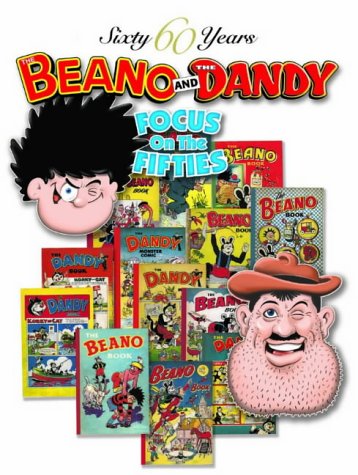
Beano and Dandy Gift Book 2022- Arty Farty!


By Dudley D. Watkins, Allan Morley, Reg Carter, Davy Law, Bill Holroyd, Leo Baxendale, Ken Reid, Eric Roberts, James Crichton, Paddy Brennan, and many & various (DC Thomson & Co)
ISBN: 978-1-84535-856-3 (HB)

This splendidly oversized (225 x 300mm) 144 page hardback compilation rightly glories in the incredible wealth of ebullient creativity that paraded through the flimsy, colourful pages of The Beano and The Dandy during a particularly bleak and fraught period in British history… aren’t they all? Tragically, neither it nor its companion volumes are available digitally yet, but hope springs ever eternal…

Until it folded and was briefly reborn as a digital publication on 4th December 2012, The Dandy was the third-longest running comic in the world (behind Italy’s Il Giornalino – launched in 1924 – and America’s Detective Comics in March 1937).

Premiering on December 4th 1937, The Dandy broke the mould of its traditional British predecessors by using word balloons and captions rather than narrative blocks of text under sequential picture frames. A huge success, it was followed eight months – on July 30th 1938 – later by The Beano and together they utterly revolutionised the way children’s publications looked and, most importantly, how they were read.

Over decades the “terrible twins” spawned a bevy of unforgettable and beloved household names who delighted countless avid and devoted readers, and the unmissable end of year celebrations were graced with bumper bonanzas of the comics’ weekly stars in extended stories in magnificent hardback annuals.

This particularly tome is a collation of strips examining “Art” and a superb tribute to Celtic creativity, packed literally cover-to-cover with brilliant strips, with the mirth starting on the inside front with a rather psychedelic and fourth-wall rending confrontation between The Bash Street Kids and the ever-interventionist “Beano/Dandy artist” actually illustrated by David Sutherland, I suspect.

Sadly, as usual none of the writers are named and precious few of the artists, but I’ve offered a best guess as to whom we should thank, and of course would be so very happy if anybody could confirm or deny my suppositions…

When not in monochrome or full colour, DC Thomson titles were always extremely inventive in using their two-colour printing plate format. Way back when, most annuals and many comics were jazzed up by a wonderful “half-colour” process British publishers used to keep costs down. This was done by printing sections (“Signatures”) of the books with only two plates, such as Cyan (Blue) and Magenta (Red) or Yellow and Black. The sheer versatility and colour range provided was simply astounding…

This book shows that pagination skill over and over again in strips that exploit the print process and deftly subordinate it to the narratives. What splendid fellows their printers must have been to go to all that extra effort…

Here and now though, the picture-in-picture gag cover of Dandy Annual 1971 – a Korky the Cat visual pun by James Crichton or possibly Richard Nixon – segues into a monochrome Big Eggo strip from Reg Carter before indisputable key man Dudley D. Watkins shines in black, white and red with magical lad Peter Piper (from short-lived junior title The Magic Comic) animating pictures at an exhibition before Good King Coke (He’s Stoney Broke) seeks fame in a frame thanks to early art and orange tints from Eric Roberts.

Also from The Magic Comic comes Dolly Dimple – Not So Simple: a monochrome romp by Allan Morley that leads to an Orange section starting with Julius Sneezer the Sneezing Caesar (Morley); Lord Snooty, by the incredibly prolific Watkins, detailing an art heist from an early annual, after which Morley renders more magic with Sammy’s Super Rubberand posh poseur Swanky Lanky Liz – by Charles Holt – makes more enemies with a school painting competition…

Morley’s Old Ma Murphy the Strong-Arm School-Ma’rm gets away with what we’d deem child abuse in her art class before three Dennis the Menace strips from David Law prove that chaos is an art. They’re followed by a drawing lesson with Minnie the Minx (by Jim Petrie?) and a Law full colour Beryl the Peril strip he did for a Topper Annual with the girly menace trying her hand at photography before we enjoy some black, white and red poetry-appreciation piece from a Beano Book The Bash Street Kids extended episode by Sutherland. It precedes a classic Desperate Dan diversion where he paints the town – guess what hue? – and Korky’s Catty Dictionary by Robert Nixon.

A red-toned double bill of Roger the Dodger japes by Ken Reid neatly diverts to fantastic crime as an extended (orange-flavoured) Captain Woosh caper sees the wily jetpack bandit again outwitted by good-hearted errand boy Terry Ball in a stunning Dandy Annual exploit from Charles Grigg, after which Sutherland triumphs in a pan-toned (black, red, yellow and white) classic starring The Bash Steet Kids and Teacher…

Following colourful puzzle pages ‘Blank Looks’ and ‘You Can Draw Me!’, Law’s Dennis the Menace plays ‘Pranks with Paint!’ and shares ‘Drawings by Dennis’ before we all go green with Watkins’ Desperate Dan and enjoy ‘Arty-Crafty!’and ‘Crafty Arty!’ hijinks with perilous Beryl…

Winker Watson gets a fresh look – courtesy of Terry Bave, I believe – as the wily waif interrupts a school painting chore before Ken H. Harrison’s blue period sees Harry and his Hippo get the snapping bug before the Bash Street Dogs of Pup Parade (Nigel Parkinson?) get their portraits done and Bill Holroyd’s robot rascal Brassneck saves the school play – from surly teacher Mr. Snodgrass…

Minnie the Minx endures a multi-coloured assault from a mischievous Beano artist (Tom Paterson?) before Dennis regrets ‘Making his Mark’ as a prelude to more full colour fun from Bill Ritchie’s Baby Crockett and Gordon Bell’s Colonel Blink, before Pup Parade with the Bash Street Dogs resorts to orange tints for a kennel painting prank…

Advancing print technology finally catches up and the remainder of the collection is all full-colour, beginning with Neighbourhood Witch as a little sorceress gets too interested in the family tree, after which Ritchie’s love-starved Smittengoes to extraordinary lengths to find a girlfriend…

Harrison’s Lord Snooty makes no friends when he voluntarily takes up the trumpet, whilst Paterson’s Little Larry truly turns heads (away) with his candid snaps before Bully Beef and Chips (Wayne Thompson?) clash over painted portraits whilst Dennis decrees ‘It’s a Draw’ and The Bash Street Kids romp in extended mayhem looking for cash rewards in ‘A Load of Junk’…

Robot toy manipulator General Jumbo then gets some highly specialised new units to win a painting competition, before activity page ‘Be a Dandy Artist’ segues into a Korky curated museum visit before ‘Quick on the Draw with Ivy the Terrible’ (by Lew Stringer?) ends the tour with a far more accessible lesson learned.

As you leave the volume please be sure to enjoy Sutherland’s classic Beano Book 1971 cover and denouement of the frontispiece saga that opened this extravaganza, and don’t forget to tip your reviewer…

A marvel of nostalgia and timeless comics wonder, the true magic of this collection is the brilliant art and stories by a host of talents that have literally made Britons who they are today, and bravo to DC Thomson for letting them out to run amok once again.
© DCT Consumer Products (UK) 2021 Ltd.

The Dandy Book 1970


By Many & various (D.C. Thomson & Co.)
ISBN: 978-0-85116-008-5 (HB)

For generations of British fans Christmas means The Beano Book, The Broons, Oor Wullie and making every December 25th magical. There used to be many more DC Thomson titles, but the years have gradually winnowed them away. Thankfully, time means nothing here, so this year I’m concentrating on a another Thomson Christmas cracker that made me the man wot I am. As usual my knowledge of the creators involved is woefully inadequate but I’m going to hazard a few guesses anyway, in the hope that someone with better knowledge will correct me when I err.

The Dandy comic predated The Beano by eight months, utterly revolutionising the way children’s publications looked and – most importantly – how they were read. Over decades it produced a bevy of household names that delighted millions of households, with end of year celebrations being bumper bonanzas of the weekly stars in magnificent bumper hardback annuals.

Premiering on December 4th December 1937, The Dandy broke the mould of its hidebound British predecessors by using word balloons and captions rather than narrative blocks of text under the sequential picture frames. A colossal success, it was followed on July 30th 1938 by The Beano and together they completely changed children’s publications. Dandy was the third longest running comic in the world (behind Italy’s Il Giornalino – launched in 1924 – and America’s Detective Comics in March 1937).

Over the decades the “terrible twins” spawned countless cartoon stars of unforgettable and beloved household names who delighted generations of avid and devoted readers…

The fun-filled action begins on the inside front cover as seasoned star Korky the Cat (by Charles Grigg?) set the ball rolling as he dodges the rozzers after a spot of illicit angling. As was traditional at this time, he also performed similar service at the far end – there falling foul of his own meagre engineering skills after building a triple decker “cartie” (think of the Red Bull Soapbox Challenge but sans the manic testosterone overload…)

These annuals were traditionally produced in the wonderful “half-colour” that many British publishers used to keep costs down whilst bringing a little spark into our drab and gloomy young lives. This was done by printing sections of the books with two plates, such as blue/Cyan and red/Magenta. The versatility and palette range provided was astounding. Even now this technique screams “Holidays” to me and my contemporaries, and this volume uses the technique to stunning effect.

D.C. Thomson were also extremely adept at combining anarchic, clownish comedy with solid fantasy adventure tales such as opening comedy thriller ‘King of the Sawdust Ring’ (limned by Paddy Brennan) wherein circus boy Billy King has to recapture an escaped lion and save his pet deer when a parade through town goes badly wrong…

As seen here, these picture thrillers usually came in the old-fashioned captioned format, with blocks of typeset text rather than lettered word balloons. Drama gives way to daft destruction as cowboy superman Desperate Dan (by Dudley D. Watkins) gets lost in fog, whilst another Korky the Cat short wreaks havoc in an ironmonger’s shop before his picture puzzle ‘Twig the Twins!’ – by the always-magnificent Eric Roberts – tests mind and eye.

The Smasher was a lad cut from the same mould as Dennis the Menace and in the episodes here (by Hugh Morren) he carves a characteristic swathe of anarchic destruction, even if his first encounter proves he’s not the toughest lad in town…

Drawn by Ron Spencer, pint-sized Dinah Mite proves she has no need of martial arts training after which hard-pressed squaddie Corporal Clott (by Dennis the Menace originator Davy Law or possibly his successor David Sutherland) disrupts the Army Camp sports day and accidentally and painfully boosts surly Colonel Grumbly to undreamed of heights.

Drawn by Jimmy Hughes, Bully Beef and Chips invariably proved that a weedy underdog’s brain always trumped brutal brawn, as here where little Chips orchestrates a well-deserved water-pistol drubbing…

Eric Roberts does triple-duty this year with puzzles, schoolboy grifter Winker Watson and perennial bath-dodger Dirty Dick who here plays chalk-based pranks on the police, after which Winker Watson’s Dandy Doodles baffle and bemuse before crafty Korky is outsmarted by a peg-legged sailor…

Another package of light-hearted drama then ensues courtesy of schoolboy Charley Brand and his robotic pal ‘Brassneck’– by the fabulous Bill Holroyd – who are largely innocent spectators as Christmas Day devolves into a toy and snowball brawl for all the adults in the street, after which Desperate Dan learns the cost of his well-meaning but excessive generosity and Dinah Mite discovers another benefit to small size and big muscles at a football match…

Bully Beef and Chips then clash whilst fishing which segues into a tale of The Island of Monsters (drawn by Q-Bikes artist Andrew Hutton?): a thrilling castaway series with two boys marooned on a tropical paradise where all the animals are incredibly enlarged. This time, the lads witness the results of human pirates underestimating the power and ferocity of giant gulls, beetles, bees and grasshoppers…

Next ‘Dirty Dick’s Picture Puzzle’ tests our brains before Korky’s superstitious nature pays off in a fish supper and our little Dick pops back, finally meeting his match in an escaped zoo chimp in a grubby but great strip by (perhaps) Tom Williams.

Whilst a great deal of material was based on school as seen by pupils, George Martin’s ‘Greedy Pigg’ featured a voracious teacher always attempting to confiscate and scoff his pupils’ snacks. Here he abandons kids’ tuck boxes to extend his appetite to encompass the pantries and larders of adults and even a wandering tramp gets what he deserves…

Dinah Mite then returns to train her new gang to the peak of punishing fitness, after which Desperate Dan’s heavy-footed antics wreck the skating pond and The Smasher takes three pages to ponder his job when he grows up.

Korky’s parrot declares war on the cat but comes to regret allying with the mice, whilst Corporal Clott successfully spoils target practice and Dirty Dick cleans up as golf caddy.

Jimmy Hughes’ geriatric delinquent Smarty Gran’pa mentors little kids in scrumping, pranking and dodging coppers whilst Corporal Clott wrecks record-keeping and penmanship before we return to drama as ‘Ricky’s Racer’ (probably by Brennan) sees a poor but proud kid master a found sledge: tearing up the icy landscape, making friends with a rich toff’s son and even foiling a burglary in a ripping yarn only DC Thomson could pull off…

A brutal training regime pays off in scoff for The Smasher’s new gang, before Bully Beef and Chips escalate a darts match into armoured warfare heralding classic comedy japes in a posh private school…

Winker Watson was always a triumph for artistic legend Eric Roberts, who here turns a visiting TV documentary crew into the spur for another string of victories against boarding school tyranny. Our devious mastermind easily humiliates the masters and treats his chums to a “slap-up feed” of the kind ‘Greedy Pigg’ constantly contrived to steal.

In a neat segue, George Martin’s voracious pie predator is led to his “just desserts” by toffee apples stuck on arrows before Robert returns with picture teaser ‘Winker Watson’s Class for Clever Dicks’ – combining comedy with brain testing scenarios before Dirty Dick encounters a military mascot and learns how the army deal with dust and disarray…

Korky’s flying lessons soon bring him into dispute with squadrons of geese, after which family favourite ‘Spunky and his Spider’ offers another delightfully rustic tale of an affable, truanting kid and his devoted, amiable apple-loving, giant antediluvian arachnid as limned by the fabulous Bill Holroyd. This time the eight-legged wonder helps school kids beat bullies trying to snatch the cash made from carol-singing…

Greedy Pigg’s appetite and lack of scruples scupper him again just as Desperate Dan’s snow balls make him lots of enemies whilst Bodger the Bookworm (by Shamus O’Doherty) uses some novel notions to retrieve a confiscated ball before the fun climaxes with the saga of Barefoot Bill (Hutton again?): a schoolboy whose gigantic feet and love of soccer forced him to learn to play sans footwear…

With Puzzle Answers and the aforementioned Korky endpapers wrapping up proceedings, let’s celebrate another tremendously fun book, with so much merriment on offer I can’t believe this book is over half a century old and still available through second hand outlets.

The only thing better would by curated archive reissues and digital editions…
© 1968 D.C. Thomson & Co., Ltd. All rights reserved.

The DANDY is a trademark of and © D. C. Thomson & Co. Ltd. 2006. Associated characters, text and artwork © D. C. Thomson & Co. Ltd. 2006. All rights reserved.

Hurricane Annual 1968


By Many & various (Fleetway)
No ISBN:

From the late 1950s and increasingly through the 1960s, Scotland’s DC Thomson steadily overtook their London-based competition – primarily monolithic comics publishing giant Amalgamated Press. Founded by Alfred Harmsworth at the beginning of the twentieth century, AP sought to regain lost ground, and the sheer variety of material the southerners unleashed as countermeasures offered incredible vistas in adventure and – thanks to the defection of Leo Baxendale and Ken Reid to the enemy – eventually found a wealth of anarchic comedy material to challenge the likes of the Bash Street Kids, Dennis the Menace, Minnie the Minx and their unruly kin.

During the latter end of that period the Batman TV show sent the entire world superhero-crazy. Amalgamated had almost finished absorbing all its local rivals – such as The Eagle‘s Hulton Press – to form Fleetway/Odhams/IPC and were about to incorporate American-styled superheroes into their heady brew of weekly thrills.

Once the biggest player in children’s comics, Amalgamated had stayed at the forefront of sales by latching onto every fad: keeping their material contemporary, if not strictly fresh. The all-consuming company began reprinting early Marvel Comics successes for a few years: feeding on the growing fashion for US style adventure which had largely supplanted the rather tired True-Blue Brit style of Dan Dare or DC Thompson’s Wolf of Kabul.

Even though sales of all British comics were generally – and in some cases, drastically -declining, the 1960s were a period of intense and impressive innovation with publishers embracing new sensibilities; constantly trying new types of character and tales. At this time Valiant and its stable-mate Lion were the Boys’ Adventure big guns (although nothing could touch DC Thomson’s Beano and Dandy in the comedy arena).

Hurricane was an impressive-looking upgrade that began during that period of expansion and counterattack, apparently conceived in response to DCT’s action weekly Hornet. It launched the week of February 29th 1964 and ran for 63 issues, but was revamped three times during that period before ultimately being merged into companion paper Tiger.

It carried a superbly varied roster of features in that time, including two (and a half) stars who survived its extinction. Racing driver Skid Solo and comedy superman Typhoon Tracy as well as Sgt Rock – Paratrooper… but not for so long for him…

There was heavy dependence on European and South American artists initially, among them Mario Capaldi, Nevio Zeccara, Georgio Trevisan, Renato Polese and Lino Landolfi, some of whom lasted into the Annuals. As with so many titles, although the comics might quickly fade, Christmas Annuals maintained a presence for years after and Hurricane seasonal specials were produced for every year from 1965 to 1974…

Following a tried-&-true formula, this book – published in 1967 – offers comics adventures, prose stories, fact-features, funnies and puzzles and kicks off with stunning full-colour fact feature strip ‘Lawmen and Badmen of the Wild West’.

Looking  like they’re painted by Reg Bunn or Tony Weare, these comics outline the lives and times of Wyatt Earp, Tom Smith, Black Bart, Sam Bass, Billy the Kid and Bat Masterson, before fully fictional western star Drago teaches a headstrong young cavalry officer the meaning of command in monochrome thriller ‘He Rides Alone’ – possibly illustrated by Polese.

Regular prose feature ‘The Worst Boy in the School’ (illustrated by Geoffrey Whittam?) follows a page of medical gags entitled ‘Take a dose of Chuckles!’ The long-running boarding school saga was enlivened by its star Duffy coming from Circus stock. Here the comedy, chaos and espionage excitement stems from a New Boy who’s convinced enemies of his father – a South American president – are trying to kidnap him. He’s not wrong…

Returning to monochrome strips, ‘Sgt. Rock – Special Air Service’ ferrets out Nazi infiltrators masquerading as American GIs before we switch back to fact for a photo-feature offering capacious coverage of modern British military might in ‘The Army Marches on its Wheels!’ whilst the comedy capers of ‘Rod the Odd Mod and ‘is old pal Percy Vere’ literally bring the house down when he gets the Hi Fi bug.

‘Casey and the Champ’ stars a veteran railroad man and his steam engine who here reveal in strip form the unlikely salvation of a played-out mining town as prelude to photo feature ‘Why Not Go by Balloon?’ before heading to 1804 where Regency prize-fighter Jim Trim stumbles upon a Napoleonic plot to conquer England in ‘Two Fists Against the World!’ (perhaps illustrated by Carlos Roume)…

Prose yarn ‘Carlos of the Wild Horses’ details the story of conquistadores imperilled by rebellious Aztecs and saved by the bond between the governor’s young son and a herd of mustangs and is followed by text fact-features ‘War Dogs’ – commemorating canines in combat – and ‘Atlantic Greyhounds’ explaining why the glory days of cruise liners had passed and why they could be built no bigger. Ah, the joys of schadenfreude and hindsight in action…

Next is a prose-&-photo precis current of movie release ‘The Train’(starring Burt Lancaster, but I’d never heard of it): a tale of Nazi collaboration and pursuit of transport of stolen art, followed by photo feature ‘When Nature Turns Nasty!’ before the incontestable star of Hurricane thunders in on a wave of colour illustration. ‘The Juggernaut from Planet Z’ is again despatched to aid his Earth chum Dr. Dan Morgan only to be overridden – and temporarily enslaved – by crazed would-be dictator General Zeb.

Sport next as ‘Hurry of the Hammers’ finds the football star in black-&-white and almost deprived of club and grounds by an unscrupulous new owner more interested in profit than the beautiful game. Historical factual strip ‘They Climbed… the Matterhorn’ then leads to a prose outing for the worst ship in the WWII navy. One again confounding the British Admiralty and escaping being broken up for parts in ‘HMS Outcast – Pride of the Fleet’ sees Geoff Campion’s unruly mob save the Pacific flotilla from destruction by the Japanese using ping pong balls and tomato sauce…

‘Typhoon Tracy’s Lucky Strike!’ finds the mighty moron in Alaska, battling bears, triggering a gold rush and helping an old friend stave off poverty, after which Giovanni Ticci employs duo-colour to limn a superbly light-hearted ‘Sword for Hire’ romp starring Cavalier soldier-of-fortune Hugo Dinwiddie who saves a fugitive king’s agent from capture even while acting as an unwilling substitute for a duellist.

Reverting to prose, ‘The Terrible Revenge of Dr. Parvo’ stars atomic accident survivors Ace Sutton and Flash Casey who use their journalistic skills and ability to walk through walls to stop a madman weaponizing weather, after which strip ‘Danger at Manakee Deep’ details a futuristic undersea habitat and resource factory endangered by greed and treachery.

‘Rodeo!’ traces the history of the sport with photos front the Calgary Stampede whilst monochrome strip ‘The Ragged Racer’ offers early environmental activism from its Wildman hero as he thwarts a circus’ scheme to destroy his mountainous animal preserve and gag page ‘It’s a Dog’s Laugh!’ brings us the text cover feature ‘R.A.F. to the Rescue’ outlining the history and activities of the coastal guardians.

The prose perseveres with adventure yarn ‘The Fiery Furnaces’ as two roving sportsmen accidentally dethrone a South American tyrant with delusions of grandeur (with illustrations by either Nevio Zaccara or Alfredo Giolitti) before ‘Rod the Odd Mod and ‘is old pal Percy Vere’ endure a calamitous bath night…

Sport was a major fascination of publishers at this time and ‘Soccer Special by The Ref’ opens an extended section of pictorial mini-features comprising ‘Famous Captains before they were Famous’, ‘Soccer Trophies Worth Winning’ and ‘Strange Things Happen in Soccer’ before we all ride off into the sunset, ending with comic strip masked cowboy ‘The Black Avenger’ who chases and then saves a “white magician” stirring up Indian tribes.

Eclectic, wide-ranging and always of majestically high quality, this blend of fact, fiction, fun and thrills is a splendid evocation of lost days of joy and wonder. We may not be making books like this anymore but at least they’re still relatively easy to track down. Of course, what’s really needed is for some sagacious publisher to start re-issuing them…
© Fleetway Publications Ltd., 1967

Ka-Zar Marvel Masterworks volume 1


By Arnold Drake, Steve Parkhouse, Stan Lee, Roy Thomas, Gerry Conway, Gary Friedrich, Len Wein, Mike Friedrich, George Tuska, Barry Windsor-Smith, Herb Trimpe, John Buscema, Gil Kane, Neal Adams, Rich Buckler, Dan Adkins & various (Marvel)
ISBN: 978-0-7851-5957-5 (HB)

Win’s Christmas Gift Recommendation: A Fabulous Feast of Fantastic Forest Fun and Fury… 9/10

Beginning as a Tarzan tribute act relocated to a lost world in a sub-polar realm of swamp-men and dinosaurs, Ka-Zar eventually evolved into one of Marvel’s more complex – if variable – characters. Wealthy heir to one of Britain’s oldest noble families, his best friend is Zabu the sabretooth tiger, his wife is feisty environmental-crusader Shanna the She-Devil and his brother is a homicidal super-scientific bandit. Kevin Reginald, Lord Plunder is perpetually torn between the clean life-or-death simplicity of the jungle and the bewildering constant compromises of modern civilisation.

The primordial paragon is arguably Marvel’s oldest star, having begun life as a prose pulp star, boasting three issues of his own magazine between October 1936 and June 1937. They were authored by Bob Byrd – a pseudonym for publisher Martin Goodman or one of a fleet of writers on staff – who latterly had him shoehorned into his speculative new-fangled comic book venture Marvel Comics #1 (October 1939), beside The Angel (another pulp line graduate), Masked Raider, Human Torch and Sub-Mariner…

In 1965, when he reappeared all rowdy and renovated in X-Men #10, it was clear the uncrowned Sovereign of the Savage Land was destined for bigger and better things, but for years all we got was guest shots as a misunderstood foe du jour for Daredevil, Sub-Mariner, Spider-Man, and the Hulk.

Eventually in 1969 he got his shot at a solo saga in Marvel Super-Heroes and later that year – after Roy Thomas & Neal Adams used him so effectively in their X-Men run (#62-63) – he was awarded a giant-sized solo title reprinting all his previous appearances but strangely offering all-new stories of Hercules and the Angel. That same month, his first regular series began in a new split book entitled Astonishing Tales…

Gathering material from Marvel Super-Heroes #19; Savage Tales volume 1 #1 and Astonishing Tales #1-16, spanning March 1969 to February 1973, this initial hardback and digital volume traces Lord Plunder’s path from misjudged superhero to barbaric fantasy star. Following a revelatory Introduction by Roy Thomas, we plunge straight in to ‘My Father, My Enemy’ from Marvel Super-Heroes #19 March 1969. Scripted by Arnold Drake and Steve Parkhouse with art from George Tuska & Sid Greene it gathers scraps from previous stories to forge an origin for Ka-Zar the Jungle Master!, revealing a murky web of deceit and intrigue as Kevin Plunder quits British High Society in search of the truth about the father who apparently abandoned him and his unsavoury super-villain brother Parnival years earlier in search of a lost continent and mystery anti-metal.

At the behest of Parnival – AKA The Plunderer – Ka-Zar’s return to his spiritual home soon descends into a brutal clash with tribesmen of the Golden People safeguarding the menacing mineral and another painful half-victory for the his scurrilous sibling…

August 1970 saw the launch of Astonishing Tales with the Jungle Lord sharing space with Latverian Liege Doctor Doom. Stan Lee, Jack Kirby & Sam Grainger displayed ‘The Power of Ka-Zar!’ as crazed “sportsman” Kraven the Hunter sets his sights on Zabu’s pelt. A successful ambush in Antarctica sees the toothy tiger trapped and dragged back to “civilisation”. However, his human brother survives the assault and grimly follows the villain, leading to ‘Frenzy on the Fortieth Floor!’ as the second issue sees our hero – retitled Ka-Zar, Lord of the Jungle! – track his prey to Manhattan and score a stunning rescue and victory. Thomas replaced Lee here, but gave way to Gerry Conway, with Barry (Windsor) Smith joining Grainger to detail the hero’s first meeting with living god Garokk the Petrified Man urgently demanding his help in getting ‘Back to the Savage Land!’ where his ambitious Queen Priestess Zaladane has begun a war of conquest against the many tribes of the hidden continent. After sharing his all-too human origins and connection to the primordial domain, the constantly-mutating stranger is brought home just in time to become ‘The Sun God!’ in thought and deed as well as appearance; going on a destructive ‘Rampage!’ (inked by Frank Giacoia) and forcing harsh choices from Ka-Zar and his comrade Tongah of the Fall People…

AT #6 sees a stunning art job from Smith & Bill Everett as Conway’s ‘Ware the Winds of Death!’ pits the war’s survivors against reawakened alien god Damon, returned after centuries to destroy the world that took his lover Lelania, even as in faraway England a mysterious woman seeks to warn Lord Plunder of impending doom…

Thomas returns to script with Herb Trimpe illustrating concluding chapter ‘Deluge!’ as Damon is repelled – but only at tragic cost to Tongah – before Edgar Rice Burroughs’ Caspak and Caprona (with hints of Romeo and Juliet) tales inform #8’s ‘The Battle of New Britannia!’ by Thomas, Gary Friedrich, Trimpe & Tom Sutton, as Ka-Zar and Zabu explore a new region of the vast under-ice region, discovering warring colonies populated by the remnants of British and German soldiers still fighting WWII. Into this mass mess of monsters, man-apes and secret pacts and lies, parachutes the mystery girl from England, a formidable force who will eventually be superspy/Avenger Bobbi “Mockingbird” Morse…

Astonishing Tales #8 was an experiment with increased page count and included an origin tale by Len Wein, George Tuska & Mike Esposito. ‘This Badge Bedeviled!’ reveals how twins Damian and Joshua Link – one a cop, the other a crook – are changed by an abortive experiment. The result was that they could combine their physicality and abilities into one body as Gemini, but sadly only one personality could dominate…

The next issue was normal-sized but now only Ka-Zar was in situ, retitled Ka-Zar, Lord of the Hidden Jungle. Moreover, thanks to scheduling problems it was as a fill-in: a pure barbarian fantasy in the manner of Conan. ‘The Legend of the Lizard Men!’ by Lee & John Buscema pitted the outraged savage against a conquering witch-queen enslaving tribes and hiding a big secret…

The ongoing storyline continues and concludes with #10 (February 1972) as Thomas, Conway, Windsor-Smith & Sal Buscema usher in a minor Götterdämmerung with an horrific secret exposed in ‘To End in Flame!’

A newish direction beckons as #11’s ‘A Day of Tigers!’ revisits, clarifies and expands upon Ka-Zar’s origin in superb tale by Thomas, Gil Kane & Giacoia detailing how a young boy lost in Savage Land forms a primal bond with a sabretooth tiger, gains a lifelong enemy in Maa-Gor the Man-Ape becomes unwilling custodian to the most dangerous element on Earth…

Astonishing Tales #12 abruptly relocates the entire cast to Florida for ‘Terror Stalks the Everglades!’ with Thomas, John Buscema & Dan Adkins recasting the Jungle King as a consultant for S.H.I.E.L.D. assisting aging biologist Dr. WilmaCalvin – who just happens to be Morse’s mentor – in tracking down missing scientist Ted Sallis…

What Ka-Zar doesn’t know is that the project all of them are working on is the recreation of the super-soldier serum that created Captain America and what nobody living knows is that Sallis succeeded. However, when Advanced Idea Mechanic agents tried to steal it, Sallis injected himself and the chemicals reacted with the swamp’s magical energies to create a mindless shambling monster.

Readers are clued in thanks to an unused interlude intended for Savage Tales #2, with Wein & Neal Adams providing a chilling recap sequence detailing the macabre Man-Thing‘s previous relationship with Calvin, before we slip back to now with AIM attacking and trapping Ka-Zar with the bog-beast…

AT #13 sees Thomas, J. Buscema, Rich Buckler & Adkins expand the mystery as the Jungle Lord escapes the ‘Man-Thing!’ to focus on the real monsters, subsequently routing out a traitor and defeating AIM… for now…

Scheduling continued to be tricky and #14 featured Lee & John Buscema’s ‘The Night of the Looter’: a bowdlerised, colourised version of a rather racy thriller first seen in Savage Tales #1 wherein Ka-Zar scorns the temptations and dodges the perils brought by destructive treasure hunters from civilisation invading his hidden home, before continuity returned with #15 as Mike Friedrich, Kane & Sutton ask ‘And Who Will Call Him Savage?’

Increasingly enamoured of Barbra Morse, Ka-Zar opts to give the modern world another go, but quickly comes to despise the greed, the dirt, the greed, the callous brutality and the sheer greed of petty people, especially after encountering the drug crisis first hand and clashing with dope peddler The Pusher…

When his vile schemes almost end Wilma Calvin’s life, Ka-Zar goes wild in ‘To Stalk a City!’ (Friedrich, Buckler & Chic Stone) rampaging through the concrete jungle of New York City and delivering a king’s justice in an edgy action packed conclusion.

Also included here is the original, unedited monochrome version of Lee & Buscema’s ‘The Night of the Looter’ as seen in May 1971’s Savage Tales (volume 1 #1) lush with grey-tone washes with some gratuitous female nudity to keep readers attention high. Also on display is a pertinent text ‘Bullpen Bulletins’ page, and house ads, and the covers from aforementioned 1970 reprint series Ka-Zar volume 1, #1-3, rendered by Marie Severin and John Romita (Sr.)

Boldly bombastic, brilliantly escapist and crafted by some of the biggest and best in comics, these wild rides and riotous romps are timeless fun from the borderlands of Marvel’s endless universe: a fabulous excursion in to forgotten worlds you’ll want to treasure forever…
© 2017 Marvel Characters, Inc. All rights reserved.

Walt Disney’s Donald Duck volume 5: “Christmas on Bear Mountain” by Carl Barks


By Carl Barks (Fantagraphics Books)
ISBN: 978-1-60699-697-3 (HB)

Win’s Christmas Gift Recommendation: The Utter Acme of All-Ages Entertainment… 10/10

Carl Barks was born in Merrill, Oregon in 1901, growing up in the rural areas of the West during some of the leanest times in American history. He tried his hand at many jobs before settling into the profession that chose him. His early life is well-documented elsewhere if you need detail, but briefly, Barks worked as a animator at Disney’s studio before quitting in 1942 to work in the new-fangled field of comic books.

With cartoon studio partner Jack Hannah (another occasional strip illustrator) Barks adapted a Bob Karp script for an animated cartoon short into the comic book Donald Duck Finds Pirate Gold. It was published as Dell Four Color Comics Series II #9 in October of that year and – although not his first published comics work – it was the story that shaped the rest of his career.

From then until his official retirement in the mid-1960s, Barks worked in self-imposed seclusion, writing and drawing and devising a vast array of adventure comedies, gags, yarns and covers that gelled into a Duck Universe of memorable and highly bankable characters. These included Gladstone Gander (1948), Gyro Gearloose (1952), Magica De Spell (1961) and the nefarious Beagle Boys (1951) to supplement Disney’s stable of cartoon actors. His greatest creation was undoubtedly the crusty, energetic, paternalistic, money-mad giga-gazillionaire Scrooge McDuck: the World’s wealthiest winged septuagenarian and the harassed, hard-pressed star of this show.

Whilst producing all that landmark material Barks was just a working guy, generating cover art, illustrating other people’s scripts when asked and contributing stories to the burgeoning canon of Duck Lore. After Gladstone Publishing began re-packaging Barks material – and a selection of other Disney strips – in the 1980s, he discovered the well-earned appreciation he never imagined existed…

So potent were his creations that they inevitably fed back into Disney’s animation output itself, even though his brilliant comic work was done for licensing company Dell/Gold Key, and not directly for the studio. The greatest tribute was undoubtedly the animated series Duck Tales: heavily based on his comics output.

Most notably, Barks was a fan of wholesome action, unsolved mysteries and epics of exploration, and this led to him perfecting the art and technique of the blockbuster tale: blending wit, history, plucky bravado and sheer wide-eyed wonder into rollicking rollercoaster romps that utterly captivated readers of every age and vintage. Without the Barks expeditions there would never have been an Indiana Jones…

Throughout his working life Barks was blissfully unaware that his work (uncredited by official policy as was all Disney’s cartoon and comicbook output), had been singled out by a rabid and discerning public as being by “the Good Duck Artist.” When some of his most dedicated fans finally tracked him down, his belated celebrity began.

In 2013 Fantagraphics Books began collecting Barks’ Duck stuff in wonderful, carefully curated archival volumes, tracing his output year-by-year in hardback tomes and digital editions that finally do justice to the quiet creator. These will eventually comprise the Complete Carl Barks Disney Library. The physical copies are sturdy and luxurious albums – 193 x 261 mm – that would grace any bookshelf, with volume 5 – Walt Disney’s Donald Duck: “Christmas on Bear Mountain” (for reasons irrelevant here) acting as debut release, re-presenting works from 1947 – albeit not in strictly chronological release order.

It begins eponymously with landmark introduction of Bark’s most enduring creation. Scrooge McDuck premiered in seasonal full-length Donald Duck yarn ‘Christmas on Bear Mountain’ (Four Color #178 December 1947): a mere disposable comedy foil to move along a simple tale of Seasonal woe and joy. Here a miserly relative seethed in opulent isolation, hating everybody and opting to share the gloom by tormenting his nephews Donald, Huey, Louie and Dewey by gifting them his mountain cabin for the Holidays. Scrooge schemed, intent on terrorising them in a bear costume, but fate had other ideas…

The old coot  was crusty, energetic, menacing, money-mad and yet oddly lovable – and thus far too potentially valuable to be misspent or thrown away. Undoubtedly, the greatest cartoon creation of the legendary and magnificent story showman Carl Barks, the Downy Dodecadillionaire returned often and eventually expanded to fill all available space in the tales from the scenic metropolis of Duckburg.

From the same issue a brace of one-page gags expose Donald’s views on car culture in ‘Fashion in Flight‘ and annoying people looking for directions in ‘Turn for the Worse’ before

‘Donald’s Posy Patch’ (Walt Disney’s Comics and Stories#80, May) turns into another painful and humiliating experience as the bellicose bird tries getting rich by growing blooms…

June’s WDC&S #81 finds him and the kids prospecting and running foul of the post-war arms and rocket-race in ‘Donald Mines his Own Business’ before Four Color #147 (May) takes them on an epic voyage of fantastic discovery to ‘Volcano Valley’ after accidentally buying an army surplus bomber…

Always looking for a quick buck, Donald and the kids turn to commercial charters: flying innocuous-seeming Major Pablo Mañana back to Central American beauty-spot Volcanovia, but they all have a devilishly difficult time getting out again. This yarn sets a solid pattern for Bark’s adventure/travelogue yarns in years to come, blending comedy, thrills, whimsy and social commentary into an irresistible treat…

WDC&S #82 (July) sees adult and juvenile ducks in an ever-escalating war over who’s the best conjuror in ‘Magical Misery’ and by the time Daisy Duck deals with them, Donald is ready for a day of peace and quiet. Sadly, ‘Ring Wrongs’(AKA ‘Vacation Time’ from August’s Walt Disney’s Comics and Stories #83 reveals that thanks to Huey, Louie and Dewey, he’s the target of a relentless wave of door-to-door salesmen and reacts with typical zest and vigour…

An inappropriate experiment in hypnosis transforms Donald (mentally) into a kangaroo and prompts an ‘Adventure Down Under’ (Four Color #159 August) with the eventually restored Drake and his nephews compelled to become ‘roo hunters to pay for return passage to Duckburg. They are mightily outmatched by Mournful Mary “Queen of the Kangaroos” until they meet some local aborigines and experience a change of heart.

Please be aware that – despite Bark’s careful research and diligent, sensitive storytelling – some modern folk might be upset by his depictions from over seven decades ago.

‘If the Hat Fits’ is a gag-page of chapeau japery from Four Color #147 (May), that precedes a medium-length tale describing Donald’s efforts to master dancing in ‘The Waltz Kings’ from WDC&S #84 (September) counterbalanced a month later by #85’s ‘The Masters of Melody’ wherein the boys struggle to learn to play musical instruments…

‘Donald Duck and the Ghost of the Grotto’ is an early masterpiece originating in Four Color #159 (August 1947), with Donald and the kids in the West Indies, running a kelp boat and harvesting seaweed from the abundant oceans.

After being temporarily stranded on an isolated reef, they discover monsters, a shipwrecked galleon, an ongoing abduction mystery dating back centuries and a particularly persistent phantom all blending into a supremely thrilling and beguiling mystery that has never dated…

WDC&S #86 exposes the rise and fall of ‘Fireman Donald’ whose smug hubris deprives him of a job he’s actually good at, after which ‘The Terrible Turkey’ from details the Duck’s frankly appalling efforts to secure a big bird for the Thanksgiving feast despite skyrocketing poultry prices…

Donald and Mickey Merry Christmas 1947 (cover-dated January 1948) sees the boys strive a little too late and much too hard to be ‘Three Good Little Ducks’ and ensure a wealth of swag on Christmas morning before one final single-pager sees kitchen confusion for Donald in ‘Machine Mix-up’ from Four Color #178 (December)…

With the visual verve done we move on to validation as ‘Story Notes’ provides erudite commentary for each Duck tale and Donald Ault relates ‘Carl Barks: Life Among the Ducks’ before ‘Biographies’ reveals why he and commentators Alberto Beccatini, Joseph Robert Cowles, Craig Fischer, Jared Gardner, Rich Kreiner, Ken Parille, Stefano Priarone, R, Fiore, Mattias Wivel are saying all those nice and informative things.

We then close with an examination of provenance as ‘Where Did These Duck Stories First Appear?’ explains the somewhat byzantine publishing schedules of Dell Comics.

Carl Barks was one of the greatest exponents of comic art the world has ever seen, and almost all his work featured Disney’s characters: reaching and affecting untold millions of readers across the world and he all too belatedly won far-reaching recognition. You might be late to the party but it’s never too soon to climb aboard the Barks Express.
Walt Disney’s Donald Duck “Christmas on Bear Mountain” © 2013 Disney Enterprises, Inc. All contents © 2013 Disney Enterprises, Inc. unless otherwise noted. All rights reserved.

Yakari volume 18: The Wall of Fire


By Derib & Job, coloured by Dominique and translated by Jerome Saincantin (Cinebook)
ISBN: 978-1-84918-591-2 (Album PB)

Win’s Christmas Gift Recommendation: Superb All-Ages Entertainment and Adventure… 9/10

Children’s magazine Le Crapaud à lunettes was founded in 1964 by Swiss journalist André Jobin who then wrote for it under the pseudonym Job. Three years later he hired fellow French-Swiss artist Claude de Ribaupierre AKA “Derib”. The illustrator had launched his own career as an assistant at Studio Peyo (home of Les Schtroumpfs), working on The Smurfs strips for venerable weekly Le Journal de Spirou. Together, they created the splendid Adventures of the Owl Pythagore before striking pure comics gold a few years later with their next collaboration.

Derib – equally au fait with enticing, comically dynamic “Marcinelle” cartoon style yarns and devastatingly compelling meta-realistic action illustrated action epics – went on to become one of the Continent’s most prolific and revered creators. It’s a crime that groundbreaking strips such as Celui-qui-est-né-deux-fois, Jo (the first comic ever published dealing with AIDS), Pour toi, Sandra and La Grande Saga Indienne) haven’t been translated into English yet, but we still patiently wait in hope and anticipation…

Many of Derib’s stunning works over the decades feature his cherished Western themes; magnificent geographical backdrops and epic landscapes. Yakari is considered by fans and critics to be the strip which first led him to deserved mega-stardom.

Debuting in 1969, Yakari follows the life of a young Oglala Lakota boy on the Great Plains and is set sometime after the introduction of horses by the Conquistadores but before the coming of modern Europeans.

The series – which has generated two separate animated TV series and a movie release last year – has achieved 40 albums thus far: a testament to the strip’s evergreen vitality and the brilliance of its creators, even though originator Job has moved on and Frenchman Joris Chamblain assumed the writer’s role in 2016.

Overflowing with gentle whimsy and heady compassion, young Yakari enjoys a largely bucolic existence: at one with nature and generally free from privation or strife. For the sake of our delectation, however, the ever-changing seasons are punctuated with the odd crisis, generally resolved without fuss, fame or fanfare by a little lad who is smart, brave… and can – thanks to a boon of his totem guide the Great Eagle converse with all animals …

Originally released in 1993, la barrière de feu was the 19th European album, but – as always with the best books – the content and set-up are both stunningly simple and effectively timeless, affording new readers total enjoyment with a minimum of familiarity or foreknowledge required…

This time, the little wonder is embroiled in uncharacteristically dark deeds as a raiding party led by Wild Mane results in the loss of all the horses – except valiant pony Little Thunder who not only escapes but also raises the alarm and rouses the sleeping tribe.

As the adults set out on foot to recover their steeds and reclaim their honour, little Yakari tracks his equine friend and is amazed to find Little Thunder is trailing his stolen herdmates. As he follows, the loquacious lad meets a flying squirrel who kindly offers to act as an advance scout…

While the grown-ups are stymied by their cunning quarry’s tactics, the tiny tree-hugger rapidly reunites the boy with his horse and the trio set off together after the thieves. All too soon they have located the raiders, but instead of useless heroic gestures they sagely seek out Yakari’s father and lead his team to the thieves.

Dauntingly, it’s a nomadic convocation of thousands, and a retaliatory raid seems impossible. Moreover, something is shadowing the stalkers themselves, ever unseen but even getting close enough to steal supplies while they’re being carried! The adults are seriously considering swallowing their shame and retreating, but Yakari cannot let go of the notion that something is smarter than he is…

Ultimately, with help from his bestial buddies, the mystery is solved and the boy meets a new friend: a wounded lynx. The beautiful, cunning creature shows the curious kid a new trick: a sticky black liquid that oozes out of the ground and is ideal for sealing wounds.

When the shaman sees it he recognises it for all its many properties, including a tendency to burn, which gives Yakari’s father an inspired idea for countering the raiders’ superior numbers and getting back the tribe’s most treasured possessions…

Exotically enticing, deviously educational and wildly entertaining, this boldly action-packed and splendidly spectacular yarn sees Yakari’s gifts not only used to benefit his people and animal friends but also with the full acknowledgement of the adults he’s previously been unknowingly slighted by. Is our boy finally on the path to being a man?

Once again, Derib & Job display their astounding and compelling narrative virtuosity in another glorious graphic tour de force capturing the appealing courage of our diminutive heroes, and a visually stunning, seductively smart saga to delight young and old alike.

Yakari is one of the most unfailingly absorbing all-ages strips ever conceived and should be in every home, right beside Tintin, Uncle Scrooge, Asterix and The Moomins.
Original edition © Derib + Job – Editions du Lombard (Dargaud- Lombard s. a.) 1993. All rights reserved. English translation 2020 © Cinebook Ltd.