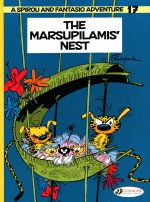
Spirou & Fantasio volume 12: Who Will Stop Cyanide?


By Tome & Janry translated by Jerome Saincantin (Cinebook)
ISBN: 978-1-84918-355-0

Spirou (which translates as both “squirrel” and “mischievous” in the Walloon language) was created by French cartoonist François Robert Velter under his nom-de-plume Rob-Vel. The inspirational invention came at the request of Belgian publisher Éditions Dupuis in direct response to the phenomenal success of Hergé’s Tintin for competing outfit Casterman.

Not long after, soon-to-be legendary weekly comic Spirou launched (on April 21st 1938) with Rob-Vel’s red-headed rascal as the lead of the anthology which bears his name to this day.

The eponymous star was originally a plucky bellboy/lift operator employed by the Moustique Hotel (a wry reference to the publisher’s premier periodical Le Moustique) whose improbable adventures with pet squirrel Spip gradually grew into high-flying, far-reaching and frequently surreal action-comedy dramas.

Spirou and his chums have spearheaded the magazine for most of its life, with a phalanx of truly impressive creators carrying on Velter’s work, beginning with his wife Blanche “Davine” Dumoulin who took over the strip when her husband enlisted in 1939. She was assisted by Belgian artist Luc Lafnet until 1943 when Dupuis purchased all rights to the property, after which comic-strip prodigy Joseph Gillain (“Jijé”) took the helm.

In 1946 Jijé’s assistant André Franquin assumed the creative reins, gradually sidelining the long-established brief, complete gag-vignettes in favour of epic adventure serials, introducing a wide and engaging cast of regulars and eventually creating phenomenally popular magic animal the Marsupilami to the mix.

Franquin continued crafting increasingly fantastic Spirou sagas until his abrupt resignation in 1969, and his tenure is remembered for the wealth of weird and wonderful players and villains he added to the cast. As well as comrade, rival and co-star Fantasio or perennial exotic arch-enemies such as Zorglub and Fantasio’s unsavoury cousin Zantafio, a particular useful favourite was crackpot inventor and modern-day Merlin of mushroom mechanics Pacôme Hégésippe Adélard Ladislas, the Count of Champignac (and sly tribute to an immortal be-whiskered druid dubbed Getafix…)

Franquin was succeeded by Jean-Claude Fournier who updated the feature over the course of nine stirring yarns tapping into the rebellious, relevant zeitgeist of the times: tales of environmental concern, nuclear energy, drug cartels and repressive regimes.

However, by the 1980s the series was looking a tad outdated and directionless. Three different creative teams then alternated on the feature, until it was at last revitalised by Philippe Vandevelde – writing as Tome – and artist Jean-Richard Geurts AKA Janry, who adapted, referenced and in all the best ways returned to the beloved Franquin era.

Their sterling efforts began with the tale under review here and quickly revived the floundering feature’s fortunes. They contributed fourteen more wonderful albums to the canon between 1984 and 1998, and allowed the venerable strip to diversify into parallel strands (Spirou’s Childhood/Little Spirou and guest-creator specials A Spirou Story By…).

Tome & Janry were followed on the core feature by Jean-David Morvan & José-Luis Munuera, and in 2010 Yoann & Vehlmann took over the never-ending procession of astounding escapades…

Cinebook have been publishing Spirou & Fantasio‘s exploits since 2009, alternating between Tome & Janry’s superb reinterpretations of Franquin and earlier triumphs by the great man himself. Who Will Stop Cyanide? is the twelfth English-language release and officially the cartoon crimebusters’ 35th collected collaborative caper; originally published continentally as Qui arrêtera Cyanure? in Spirou #2427-2448 in 1984 before being subsequently released as Tome & Janry’s third album a year later.

Funny, frenetically-paced and potently sinister when most appropriate, the tale leans heavily on science fiction paranoia and opens as photojournalist Fantasio tries to return a defective new camera. After some truly appalling customer service he is fobbed off with a bizarre bucket of bolts which seems to be a semi-sentient little robot that takes polaroid snaps…

The “screwball gizmo” is a mischief-maker with a mind of its own and finds a kindred spirit in Spirou’s pet squirrel Spip, but that doesn’t stop it making a cunning bid for freedom at the first opportunity. In hot pursuit, the adventuresome lads frantically trail the demented droid out to worryingly familiar territory: the far from peaceful hamlet of Champignac-in-the-Sticks. However, this time it’s not the mushroom-mad Count who’s behind an increasingly nerve-wracking situation…

Following a stern warning from the harassed Mayor – already well-acquainted with the kind of chaos that follows in Spiro and Fantasio’s wake – the jaunty journalists find the little gizmo at the dilapidated railway station. A furtive search through dank back rooms soon exposes an horrific scene: a beautiful woman tied to a chair and hooded.

The outraged heroes free the distressed damsel and are immediately attacked; both by her and a number of ordinary mechanical objects suddenly imbued with terrifying, violent animation…

After the former captive explosively escapes, the stunned lads meet dowdy Stationmaster Catenaire and hear an incredible story…

The little man is something of an unsung scientific tinkerer and when railway cutbacks left him with time on his hands he started dabbling in robotics. Firstly, he built the little droid – dubbed “Telesphore” – but eventually, craving a more exotic and comforting companion, moved on to formulate a comely android for his personal use.

Sadly, the Marilyn Monroe doppelganger he crafted gained instant sentience and an abiding abhorrence for humankind.

Calling herself Cyanide she played vicious jokes on people and even attacked them. When she started possessing machinery, Catenaire was forced to shut her down. Now, thanks to the gallant impulses of Spirou and Fantasio, she’s free and determined to make all meat-things pay…

And so unfolds a splendidly compelling and frantic game of cat-&-mouse as the lads chase the wicked automaton and she – thanks to the recent unwelcome advent of a huge fully-automated factory in the village – unleashes an army of mechanical monstrosities to crush them before expanding her horizons to encompass the village and eventually the rest of humanity…

Fast-paced and exuberant, Who Will Stop Cyanide? is a funny, thrilling rollercoaster romp easily accessible to readers of all ages and drawn with beguiling style and seductively wholesome élan. Catch it if you can…
Original edition © Dupuis, 1985 by Tome & Janry. All rights reserved. English translation 2017 © Cinebook Ltd.

Suicide Squad: The Silver Age


By Robert Kanigher, Howard Liss, Ross Andru & Mike Esposito, Gene Colan, Joe Kubert & various (DC Comics)
ISBN: 978-1-4012-6343-0

The War that Time Forgot was a strange series which saw paratroopers and tanks of the “Question Mark Patrol” dropped on Mystery Island from whence no American soldiers ever returned. Assorted crack GIs discovered why when the operation was suddenly overrun by pterosaurs, tyrannosaurs and worse…

However, the combat-&-carnosaur creation was actually a spin-off of an earlier concept which hadn’t quite caught on with the comics-buying public. That wasn’t a problem for Writer/Editor Kanigher: a man well-versed in judicious recycling and reinvention…

Back in 1955 he had devised and written anthology adventure comic The Brave and the Bold which featured short complete tales starring a variety of period heroes: a format mirroring that era’s filmic fascination with historical dramas.

Issue #1 led with Roman swords-&-sandals epic Golden Gladiator, medieval mystery-man The Silent Knight and Joe Kubert’s Viking Prince. Soon the Gladiator was side-lined by the company’s iteration of Robin Hood, but the high adventure theme carried the title until the end of the decade when the burgeoning superhero revival saw B&B transform into a try-out vehicle in the manner of the astounding successful Showcase.

Used to launch enterprising concepts and characters such as Cave Carson, Strange Sports Stories, Hawkman and the epochal Justice League of America, the title began its run of beta-tests in issue #25 (August/September 1959) with the fate-tempting Suicide Squad – code-named Task Force X by the US government to investigate uncanny mysteries and tackle unnatural threats.

The scary tales were all illustrated by Kanigher’s go-to team for fantastic fantasy Ross Andru & Mike Esposito and they clearly revelled at the chance to cut loose and show what they could do outside the staid whimsy of Wonder Woman and gritty realism of the war titles they usually handled…

The Brave and the Bold #25 introduced a quartet of merely human specialists – air ace war hero Colonel Rick Flag, combat medic Karin Grace and big-brained boffins Hugh Evans and Jess Price – all officially convened into a unit whose purpose was to tackle threats beyond conventional comprehension such as the interstellar phenomenon dubbed ‘The Three Waves of Doom!’

The quartet were built on a very shaky premise. All three men loved Karin. She only loved Rick but agreed to conceal her inclinations and sublimate her passions so Hugh and Jess would stay on the team of scientific death-cheaters…

In their first published exploit a cloud from outer space impacted Earth and created a super-heated tsunami which threated to broil America. With dashing derring-do, the trouble-shooters quenched the ambulatory heat wave only to have it spawn a colossal alien dragon emanating super-cold rays that could trigger a new ice age…

The only solution was to banish the beast back into space on a handy rocket headed for the sun, but sadly the ship need to be piloted…

Having heroically ended the invader, the team were back two months later as B&B #26 opened with an immediate continuation. ‘The Sun Curse’ saw our stranded astronauts struggling (in scenes eerily prescient and reminiscent of the Apollo 13 crisis a decade later) to return their ship to Earth. Uncannily, however, the trip bathes them in radiations which causes them to shrink to insect size…

Back on terra firma but now imperilled by everything around them, the team nonetheless manages to scuttle a proposed attack by a hostile totalitarian nation before regaining their regular stature…

A second, shorter tale then finds the quartet enjoying some downtime in Paris before the Metro is wrecked by an awakened dinosaur. Of course, the tourists are ready and able to stop the ‘Serpent in the Subway!’

In an entertainment era still dominated by monsters and aliens, with superheroes still only tentatively resurfacing, Task Force X were at the forefront of beastie-battles and their third and final try-out issue found them facing an evolutionary nightmare as a scientist vanished and the region around his lab was suddenly besieged by gigantic insects as well as a colossal reptilian humanoid the team dubbed ‘The Creature of Ghost Lake!’ (December 1959/January 1960). They destroyed the monster but never found the professor…

A rare failure for those excitingly experimental days, the Suicide Squad vanished after that triple try-out run, only to resurface months later for a second bite of the cherry…

The Brave and the Bold #37 (August/September 1961) opened with Karin displaying heretofore unsuspected psychic gifts and predicting an alien ‘Raid of the Dinosaurs!’ which pitted the team against hyper-intelligent saurian whilst ‘Threat of the Giant Eye!’ focussed on the retrieval of a downed military plane and lost super-weapon. The hunt took the Squad to an island of mythological mien where a living monocular monolith hunted people…

In #38 (October/November 1961) the team tackled the ‘Master of the Dinosaurs’ – an alien using Pteranodons to hunt like an Earthling would use falcons – after which the fabulous four fell afoul of extra-dimensional would-be conquerors but still had enough presence of mind and determination to defeat the ‘Menace of the Mirage People!’

B&B #39 (December 1961/January 1962) called “time” on Task Force X after ‘Prisoners of the Dinosaur Zoo!’ saw the team uncover an ancient extraterrestrial ark caching antediluvian flora and fauna and ‘Rain of Fire!’ found them crushing a macabre criminal entombing crime-busters in liquid metal. That was it for the Squad until 1986 when a new iteration of the concept was launched in the wake of Crisis on Infinite Earths.

Or was it? Superhero fans are notoriously clannish and insular so they might not have noticed how one creative powerhouse refused to take “no thanks” for an answer…

Robert Kanigher (1915-2002) was one of the most distinctive authorial voices in American comics, blending rugged realism with fantastic fantasy in his signature war comics, horror stories, superhero titles such as Wonder Woman, Lois Lane, Teen Titans, Hawkman, Metal Men, Batman and other genres too numerous to cover here. He also scripted ‘Mystery of the Human Thunderbolt’ – the very first story of the Silver Age – which introduced Barry Allen AKA the Flash to the hero-hungry kids of the World in 1956.

Kanigher sold his first stories and poetry in 1932 and wrote for the theatre, film and radio before joining the Fox Features shop where he created The Bouncer, Steel Sterling and The Web, whilst providing scripts for Blue Beetle and the original Captain Marvel.

In 1945, he settled at All-American Comics as both writer and editor, staying on when the company amalgamated with National Comics to become the forerunner of today’s DC. He wrote Flash and Hawkman, created Black Canary and Lady Cop, plus memorable villainous femme fatales Harlequin and Rose and Thorn. This last he reconstructed, during the relevancy era of the early 1970s, into a schizophrenic crime-busting female super-hero.

When mystery-men faded out at the end of the 1940s, Kanigher moved into espionage, adventure, westerns and war stories, becoming in 1952 writer/editor of the company’s combat titles: All-American War Stories, Star Spangled War Stories and Our Amy at War.

He created Our Fighting Forces in 1954 and added G.I. Combat to his burgeoning portfolio when Quality Comics sold their line of titles to DC in 1956, all the while working on Wonder Woman, Johnny Thunder, Rex the Wonder Dog, Silent Knight, Sea Devils, Viking Prince and a host of others.

Among his many epochal war series were Sgt. Rock, Enemy Ace, the Haunted Tank and The Losers as well as the visually addictive, irresistibly astonishing “Dogfaces and Dinosaurs” dramas sampled in the back of this stunning hardback collection…

Kanigher was a restlessly creative writer and even used the uncanny but formulaic adventure arena of The War that Time Forgot as a personal try-out venue for his many series concepts. The Flying Boots, G.I. Robot and many other teams and characters first appeared in the lush Pacific hellhole with wall-to-wall danger. Indisputably the big beasts were the stars, but occasionally (extra)ordinary G.I .Joes made enough of an impression to secure return engagements, too…

The War that Time Forgot debuted in Star Spangled War Stories #90 (April-May 1960) and ran until #137 (May 1968) skipping only three issues: #91, 93 and #126 (the last of which starred the United States Marine Corps simian Sergeant Gorilla – look it up: I’m neither kidding nor being metaphorical…).

Simply too good a concept to leave alone, this seamless, shameless blend of Sir Arthur Conan Doyle’s Lost World and Edgar Rice Burroughs’ Caprona stories (known alternatively as the Caspak Trilogy or “the Land That Time Forgot”) provided everything baby-boomer boys could dream of: giant lizards, humongous insects, fantastic adventures and two-fisted heroes with lots of guns…

In the summer of 1963, a fresh Suicide Squad debuted in Star Spangled War Stories #110 to investigate a ‘Tunnel of Terror’ into the lost land of giant monsters: this time though, a giant albino gorilla decided that mammals should stick together…

The huge hairy beast was also the star of ‘Return of the Dinosaur Killer!’ in #111 as the unnamed Squad leader and a wily boffin (visually based on Kanigher’s office associate Julie Schwartz) struggled to survive on the tropically reptilian atoll…

In SSWS #116 (August/September 1964) a duo of dedicated soldiers faced ice-bound beasts in ‘The Suicide Squad!’ – the big difference being that Morgan and Mace were more determined to kill each other than accomplish their mission…

‘Medal for a Dinosaur!’ in #117 bowed to the inevitable and introduced a (relatively) friendly and extremely cute baby pterodactyl to balance out Mace and Morgan’s barely suppressed animosity, after which ‘The Plane-Eater!’ in #118 found the army odd couple adrift in the Pacific and in deep danger until the little leather-winged guy turned up once more…

The Suicide Squad were getting equal billing by the time of #119’s ‘Gun Duel on Dinosaur Hill!’ (February/March 1965) as yet another group of men-without-hope battled reptilian horrors and each other to the death, after which the un-killable Morgan and Mace returned with Dino, the flying baby dinosaur, who found a new companion in handy hominid Caveboy before the whole unlikely ensemble struggled to survive against increasingly outlandish creatures in ‘The Tank Eater!’…

Issue #121 presented a diving drama when a UDT frogman won his Suicide Squad rep as a formidable fighter and ‘The Killer of Dinosaur Alley!’ Increasingly now, G.I. hardware and ordnance began to gain the upper hand over bulk, fang and claw…

Undisputed master of gritty fantasy art Joe Kubert added his pencil-and-brush magic to a tense and manic thriller featuring the return of the G.I. Robot in stunning battle bonanza ‘Titbit for a Tyrannosaurus!’ in #125 (February/March 1965), after which Andru & Esposito covered another Suicide Squad sea-saga in #127: ‘The Monster Who Sank a Navy!’

This eclectic collection then tumultuously terminates as scripter Howard Liss and visual veteran Gene Colan craft a masterfully moving human drama from issue #128 which was astoundingly improved by the inclusion of ravening reptiles in ‘The Million Dollar Medal!’ and the last tale in this volume).

Throughout this calamitous compilation of dark dilemmas, light-hearted romps and spectacular battle blockbusters the emphasis is always on foibles and fallibility; with human heroes unable to put aside long-held grudges, swallow pride or forgive trespasses even amidst the strangest and most terrifying moments of their lives, and this edgy humanity informs and elevates even the daftest of these wonderfully imaginative adventure yarns.

Classy, intense, insanely addictive and Just Plain Fun, the original Suicide Squad offers a kind of easy, no-commitment entertainment seldom seen these days and is a deliciously guilty pleasure for one and all…
© 1959, 1960, 1961, 1962, 1963, 1964, 1965, 1966, 2016 DC Comics. All Rights Reserved.
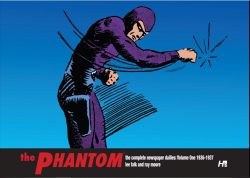
Captain Midnight Archives volume 2: Captain Midnight Saves the World!


By William Woolfolk, Leonard Frank, Dan Barry & various (Dark Horse Comics)
ISBN: 978-1-61655-243-5                  eISBN: 978-1-62115-921-6

Created by broadcast scripters Wilfred G. Moore and Robert M. Burtt, Captain Midnight began as a star of radio serials in the days when troubleshooting All-American aviators were the acme of adventure genre heroes. The Captain Midnight Program soldiered on from 1938 to 1940 until the Wander Company acquired the sponsorship rights to promote their top product: Ovaltine. From there on, national radio syndication led to a newspaper comic strip (by Erwin L. Hess, running from June 29th 1942 until the end of the decade); a movie serial (1942) and – later – two TV serials (1953 and 1954-1956) before being overdubbed, retitled and syndicated as “Jet Jackson, Flying Commando” well into the 1960s). There was also a mountain of now-legendary merchandise such as the infamous Captain Midnight Secret Decoder Ring…

And there was a comicbook franchise… one recently reinvigorated for 21st century audiences.

The hero’s basic origin related how after the Great War ended, pilot and inventor Captain Jim Albright returned home having earned the sobriquet “Captain Midnight” following a particularly harrowing mission that concluded successfully at the witching hour.

He then formed a paramilitary “Secret Squadron” of like-minded pilots to continue making the world a better place – often at the covert behest of the President – using guts and gadgets to foil spies, catch crooks and defend the helpless.

Captain Midnight truly hit his stride after Japan’s sneak attack on Pearl Harbor, becoming an early Home Front media sensation throughout the war years. However, his already fluid backstory and appearance underwent a radical makeover when he switched comicbook horses in midstream.

This stunningly engaging full-colour paperback collection (also available as an eBook) gathers a slew of science fiction-themed tales taken from the latter end of the Fawcett Comics run. Captain Midnight #48, 50, 52-56, 58, 60, 62, 64 and 66 spanned February 1947 – August 1948 and with times and tastes changing the venerable title folded with the next issue…

Following a fervent Introduction from Batton Lash discussing the career of the much-travelled, constantly evolving “Monarch of the Airways” and the telling differences between the radio, screen and comicbook iterations, the contents explosively unfold with a tragic dearth of credit and attributions. Much comic material from this era is criminally unattributed but regular writers known to be active on Midnight at this juncture included Bill Woolfolk and Otto Binder whilst artists included the unflagging Leonard Frank and young legends-to-be Leonard Starr and Dan Barry.

From issue #48 ‘Captain Midnight Visits the Golden Asteroid’ sees Albright and his mechanic Ichabod Mudd piloting their newly invented rocket-ship to investigate a new stellar body only to find that the astronomer who discovered it has an ulterior and nefarious motive for getting to the stellar wanderer.

Illustrated by Frank and from #50, ‘Captain Midnight Spikes the Sun Gun’ pitted the modern Edison against devilish Dr. Pyrrho who had found a way to inflict destructive heat on the already sweltering citizens of the American Southwest after which a return prospecting trip to our nearest neighbour uncovered ‘The Moon Creatures’ (Woolfolk) who aggressively resisted all attempts to colonise Luna…

With the solar system now a regular destination for exploration, Albright began an occasional series of sorties to the planets and picked up some new recurring foes. The first was a plundering barbarian from Pluto who raided Earth for its Uranium reserves in #52’s ‘Captain Midnight versus the Space Raider!’ (Binder & Frank).

The resultant chase and recovery took our hero to Mars and first contact with an unsuspected race also under threat of merciless assault by the murderous Jagga…

After driving the fiend off and recovering his ill-gotten gains, Midnight next encountered the ruthless Plutonian inflicting ‘Peril on Venus’ in #53. By sending him packing once again, the inventor consequently aided the long-lost last survivors of Atlantis in getting their failing colony onto an even keel in a world overrun by dinosaurs…

In #54 Midnight and Icky encountered yet another embattled civilisation on Ceres: a literally golden kingdom fending off Jagga’s bacterial onslaught and meteoroid bombardments. With the Air Aces’ assistance, the monster was finally driven off in ‘The Asteroid Battle’…

There’s a double dose of super-scientific spectacle in #55, beginning with Albright’s perhaps unwise invention of a monumental dirigible intended as ‘The Sky Airport’. When common thugs steal the mobile monolith and use it as a base for air raids on banks, the heartbroken genius is forced into desperate action to clear his conscience…

This is followed by another interplanetary incident when ‘Captain Midnight Finds the Lunar Lair’ and finally brings Jagga to justice in the form of a trial in Earth’s courts. Unequivocally guilty, the beast is sentenced to death by electrocution in #56’s ‘The Last Rites of Jagga’ (Frank art) but said execution proves to be a major mistake and Midnight is called upon to deliver the sentence in his own infallible scientific manner…

A new alien threat emerges in #58 ‘On the Planet of Peril’ when an unknown race reanimates Earth’s greatest villains and monsters…

A month later ‘Captain Midnight Battles the Ice Age’ found our interplanetary explorers on Neptune: changing that world’ climate to give its humanoid inhabitants a big step up the ladder to civilisation, whilst issue #60 saw the return of earthly arch-enemy Dr. Osmosis who terrified and tormented humanity with his explosive ‘Flying Saucers of Death’…

Captain Midnight #62 detailed the inventor’s efforts to save America’s ‘Farmers on the Moon’ from sabotage as Earth agricultural entrepreneur Jim Klaw sought to maintain his produce monopoly at all costs…

A new extraterrestrial enemy debuted in #64 as ‘Beyond the Sun’ (Frank) introduced shapeshifting tyrant Xog: a gaseous monster from Saturn who boarded America’s newest spaceships as step one in his plans for interplanetary domination. When Captain Midnight thwarted the scheme and rescued the hostage Terrans, the vile king swore vengeance…

It came in the final tale in this superbly retro rollercoaster of rocket-powered fun – from #66 with art by Frank – as Xog transforms Captain Midnight into sentient gas before invading Earth. Happily, even ‘Without a Body’ Albright was too much for the malign marauder and once more saved the day and the world…

With a stunning gallery of covers by Frank, Charles Tomsey, Dan Barry and Mac Raboy plus cool mini-features such as ‘Captain Midnight’s Air Lingo’, ‘US Army Aviation Badge Insignia’ and ‘Famous Planes’, this fabulous feast of fantasy is guaranteed to satisfy the nostalgic yearnings of every starry-eyed space cadet, whatever their age.
Captain Midnight Archives volume 2: Captain Midnight Saves the World! ® and ©Dark Horse Comics 2014. All rights reserved.

James Bondâ„¢ volume 1: VARGR


By Warren Ellis, Jason Masters, Guy Major & Simon Bowland (Dynamite Entertainment)
ISBN: 978-1-60690-901-0

James Bond is the ultimate secret agent. You all know that and have – thanks to the multi-media empire that has grown up around Ian Fleming’s masterful creation – your own vision of what he looks like and what he does. That’s what dictates how you respond to the latest movie, game or novel.

There are also some exceedingly enjoyable comicbook and newspaper strip versions detailing the further exploits of 007 which have never really found the appreciation they rightly deserve. This collection is just one of the most recent, compiling the first six issues of a regular comicbook series from licensing specialists Dynamite Entertainment and quite possibly one of the top ten Bond adventures ever seen in any medium…

Dumping the decades of gaudy paraphernalia that’s grown around the brand, writer Warren Ellis, illustrator Jason Masters, colourist Guy Major and letterer Simon Bowland have opted for a stripped-down, pared-back, no-nonsense iteration who is all business.

It begins after Bond’s return from a personal mission to Helsinki which culminated in the elimination of the assassin who recently killed 008. On returning to MI6, however, the infallible agent is carpeted by M.

With motions in progress to close the Double-O department, Bond is given a simple assignment: “dissuading” a small European drug dealer from distributing his latest recreational designer dope in the United Kingdom.

Of course, no job is ever simple…

The first snag is a new Home Office ruling depriving Bond of his gun whilst within British borders, but at least Q has few treats for him to use once he’s touched down on foreign soil…

Following an impromptu briefing on his contact – the Intel has come via a CIA informant used by old comrade Felix Leiter, so at least that’s reliable – Bond jets off for Berlin Station, only to narrowly escape being murdered by impossibly strong impostor-agent Dharma Reach as soon as he gets out of the airport…

Taking the near-miss in stride, 007 swiftly starts his surveillance by meeting the CIA’s asset, Serbian geneticist and medical pioneer Slaven Kurjak, who has been making astounding breakthroughs in both pharmaceuticals and powered prostheses.

The exceedingly eccentric doctor puts him on the trail of a minor local gang with a new method of processing cocaine, so Bond sets off on the trail of his new target, resolute but clearly suspicious…

Meanwhile in London, drug addicts begin exhibiting strange, horrific and ultimately fatal side-effects after their latest scores…

Kurjac obviously has his own agenda, but the methodical Bond opts to investigate this disquieting informant’s “information” first and is soon in the fight of his life after stumbling into a major drugs operation run by the huge Al-Zein cartel.

On returning – shaken, stirred but largely intact – to the MI6 office, he’s intercepted by Slaven’s most dangerous guinea pig Mr. Masters, moments after the chemically-corrupted killer has depopulated the entire Berlin Station. Attempts to lure Bond into a fresh trap have been anticipated, however, and 007 is more than ready when the killer makes his move. Masters’ agonised last words to Bond are “Vargr. Please. Vargr”…

A frustrating confrontation with Kurjac then reveals the shocking truth about the crazy doctor’s hideous plans for the tainted drugs on Britain’s streets, but ends with apparent defeat and Bond stuck in a seemingly inescapable death-trap…

Through his usual blend of ingenuity and inspired insanity Bond survives and returns to London for debriefing but is again ambushed by Dharma Reach. She inadvertently provides a clue to her boss’ whereabouts before explosively expiring…

With a clear target and destination – and determined to end the bloody shambles at any cost – Bond heads to Norway and a final confrontation with Kurjak. The resolution to the mystery of Vargr is cataclysmic and incomprehensibly bloody…

With a gallery of covers by Dom Reardon and 22 variants from Masters, Glenn Fabry, Francesco Francavilla, Gabriel Hardman, Jock, Stephen Mooney, Dan Panosian, Joe Jusko, Aaron Campbell, Timothy Lim, Dennis Calero, Robert Hack and Ben Oliver plus Concept Art from Masters featuring character designs and model sheets, this elegant espionage episode is fast, furious, dryly witty, superbly smart and impeccably stylish: in short, the perfect James Bond thriller.

Try it and see for yourselves…
© 2016 Ian Fleming Publications, Ltd. James Bond and 007 are ™ Danjaq LLC, used under license by Ian Fleming Publications, Ltd. All rights reserved.

Zorro: Matanzas


By Don McGregor, Mike Mayhew, Sam Parsons & John Costanza (Dynamite Entertainment)
ISBN: 978-1-60690-147-2

One the earliest masked heroes and still phenomenally popular throughout the world, “El Zorro, The Fox” was originally devised by jobbing writer Johnston McCulley in 1919 for a 5-part prose serial entitled ‘The Curse of Capistrano’. He debuted in All-Story Weekly for August 6th, running until 6th September. The part-work was subsequently published by Grossett & Dunlap in 1924 as The Mark of Zorro and further reissued in 1959 and 1998 by MacDonald & Co. and Tor respectively.

Famously, Hollywood royalty Douglas Fairbanks and Mary Pickford read the serial in All-Story on their honeymoon and immediately optioned the adventure as the first film release from their new production company/studio United Artists.

The Mark of Zorro was a global movie sensation in 1920 and for years after, and New York-based McCulley subsequently re-tailored his creation to match the so-different filmic incarnation. This Caped Crusader aptly fitted the burgeoning genre that would soon be peopled by the likes of The Shadow, Doc Savage and The Spider.

Rouben Mamoulian’s 1940 filmic remake of The Mark of Zorro further ingrained the Fox into the world’s psyche and, as the prose exploits continued in a variety of publications, Dell began a comicbook version in 1949.

When Walt Disney Studios began a hugely popular Zorro TV show in 1957 (78 half-hour episodes and four 60 minute specials before cancellation in 1961), the ongoing comicbook series was swiftly redesigned to capitalise on it. The media corporation began a decades-long strip incarnation of “their” version of the character in various quarters of the world.

This series and later iterations also resulted in comics and strips all over Europe from Disney and Marvel in the USA. During the 1990s, Topps Comics spearheaded Zorro’s return courtesy of Don McGregor & Mike Mayhew which led to a short-lived newspaper strip (illustrated by Thomas Yeates) and also incidentally and memorably introducing a salacious “bad-girl” sidekick in the unwisely-clad form of Lady Rawhide…

And there were more movies, this time with an actual Spaniard playing the lead role (Antonio Banderas, in case you were wondering…)

In 2008 Dynamite Entertainment reintroduced the Fox in new yarns by Matt Wagner and as part of the package excavated this lost tale from the Topps iteration: an unpublished adventure by McGregor & Mayhew, with colours by Sam Parsons and letters by industry veteran John Costanza.

Zorro: Mantanzas has a chequered history. Part of a longer storyline begun during McGregor & Mayhew’s run on the Topps Comic in the 1990s, the tale was only completed in 2010 for the Dynamite run and released as 4-issue miniseries before being collected as a trade paperback and later an eBook. For all that, however, the lost episode offers a passionate and sophisticated portrayal of the quintessential champion risking his own security and happiness to thwart a macabre and complex villain: a struggle rendered even more appealing by the magnificent illustration of Mayhew and Parsons.

For the uninitiated: Don Diego de la Vega is the foppish son of a grand house in old California when it was a Spanish Possession, who used the masked persona of Señor Zorro (the Fox) to right wrongs, defend the weak and oppressed – particularly the pitifully maltreated natives and Indians – and thwart the schemes of a succession of military leaders and the colonial Governor determined to milk the populace of the growing township of Los Angeles for all they had.

Whenever Zorro struck he left his mark – a letter “Z” carved into walls, doors, faces…

Diego has a whole support structure in place. Although in this iteration his stiff-necked Hildalgo father is unaware of his double life the secret hero has a number of assistants who do. The most important is Bernardo (a deaf-mute manservant) and Jose of the Cocopahs – a native chief who often acts as stableman, decoy and body-double for the Masked Avenger. Diego also occasionally employs a retired, reformed one-eyed pirate named Bardoso to act as his spy amongst townsfolk and outlaws…

The settlement is basking in unaccustomed liberty after Zorro’s overthrow of the military governor, unaware that their new Regency Administrator Lucien Machete is a sadistic fiend with a nasty line in prosthetic weapons nursing a rabid grudge against Zorro – the man who made his replacement limb necessary…

The villain has struck up a friendship with Diego’s father Don Alejandro; an increasingly frustrated grandee who finds his son’s unseemly and unmanly behaviour more and more inexplicable and intolerable.

Infuriatingly, Machete is not talking advantage of the familial rift as ploy; he just likes the old man whilst despising his foppish son, blithely oblivious that the soft poltroon is the black-clad avenger who has thwarted his previous malevolent depredations…

Zorro knows – but cannot prove – that Machete’s credentials are forged and his claims to act as the Spanish King’s official representative are false. The Fox urgently seeks to expose the impostor before whatever vile plot he fosters can be completed. Thus he cannot let anything distract him…

The drama unfolds after Don Alejandro and Lucien attend the Matanza: an annual festival where the young men show off their strength and manhood by ceremonially butchering cattle and other livestock in a gory display of horsemanship and bloodletting. Diego has naturally declined to attend or participate, preferring to surreptitiously watch Machete.

He is wise to do so, for the maniac has malicious plans to sabotage the event with a new addition to his arm’s arsenal…

Taking up position above the killing grounds, Zorro and Bernardo have a perfect position to observe proceedings but their keen surveillance is disrupted by a huge bear attracted to the site by the smell of blood.

Its attack is devastating and leaves the secret champions battling for their lives. By the time they can again turn their attention to the Matanza, Lucien has done his dirty work: good men are dead or maimed and an horrific stampede is underway. Moreover, in the chaos personal tragedy has struck at the De La Vega household and Machete seems to be getting away with murder again, whilst El Zorro is painted as the blackest of monsters…

A simple tell well-told and lavishly illustrated, Zorro: Matanzas is packed with spectacular action and diabolical intrigue in the grand manner and incidentally offers a potted origin and discreet peek at the fabulous subterranean citadel covertly crafted by Diego and Bernardo to facilitate the Fox’s war on injustice.

Although more incident than main feature, this is a blistering romp every lover of human-scaled adventure will adore…
Zorro®: Matanzas, Volume One © 2014 Zorro Productions, Inc. All rights Reserved.

Afrika


By Hermann (Dark Horse)
ISBN: 978-1-59582-844-6 (HC)                    eISBN: 978-1-62115-865-3

Hermann Huppen is a master of comics storytelling, blending gritty tales of human travail and personal crisis with astoundingly enticing illustration and seamless storytelling. His past masterpieces include Bernard Prince, Comanche, Jeremiah, Towers of Bois-Maury, Sarajevo-Tango, Station 16 and many others.

Far too little of his work exists in English translation but this brief yet potent contemporary excursion into the Heart of Darkness is undoubtedly one of his most evocative.

Delivered in an oversized full-colour hardback edition, stand-alone tale Afrika is set on a Tanzanian Wildlife preserve, tracing the final fate of irascible man of mystery Dario Ferrier.

This passionate and dedicated preserver of the continent’s most iconic animals is facing the prospect of outliving the magnificent creatures under his protection. All his team’s efforts mean nothing in the face of the constant depredations of well-funded poachers and the callous indifference of world governments.

Their slide into extinction is inexorable and the battle all but lost yet Dario carries on day after day, bolstered only by the passionate attentions of his woman Iseko and the determination of his comrades-in-arms. However even they are under constant pressure to abandon him…

When a headstrong but gullible European photo-journalist is foisted upon him, Dario sees the end in sight. Charlotte dogs his heels and challenges his cynical assumptions all across the veldt, but when she accidentally films atrocities and war-crimes perpetrated by unassailable people of wealth and authority, the stunned Europeans quickly find themselves the quarry in a pitiless hunt through the bush.

Sadly for the pursuers, however, they have no conception of how dangerous Dario truly is…

Determined to get Charlotte to safety, the world-weary guardian knows his own life is over: all he hopes for is to go out his way…

Plotted with deceptive subtlety, packed with visceral, uncompromising action and painted with breathtaking skill, this glorious tale is a phenomenal vision of modern infamy and the oldest of motivations.

Afrika is a truly perfect adventure comic.
© 2007 SAF Comics.

Wandering Island volume 1


By Kenji Tsuruta, translated by Dana Lewis (Dark Horse)
ISBN: 978-1-50670-079-3                  eISBN: 978-1-63008-771-5

Kenji Tsuruta was born in 1961 and studied optical science, intending to pursue a career in photography, but instead made the jump to narrative storytelling as manga artist, designer, book illustrator and anime creator.

A lifelong fan of “hard science” science fiction authors like Robert A. Heinlein and the comic works of Tetsuya Chiba and Yukinobu (Saber Tiger) Hoshino, after years of producing self-published dōjinshi whilst working as an assistant to established manga stars, the 25-year-old Tsuruta began selling his own works in 1986 when his short fantasy serial Hiroku te suteki na uchÅ« ja nai ka (‘What a Big Wonderful Universe It Is’) was published in Kodansha’s Weekly Morning magazine.

Soon after, he began Sprits of Wonder: a dazzling scientific romance of gently colliding worlds. It ran in both Weekly Morning and monthly magazine Afternoon between 1987 and 1996 before making the smooth transition to animated features and an award-winning TV series. Dark Horse Comics published the first translated episodes as a 5-issue monochrome miniseries in 1995-6.

After that the artist pretty much moved out of the manga business, instead concentrating on science fiction illustration and character design; a field of endeavour where he won many awards.

Then on July 13th 2010 Wandering Island debuted in Kodansha’s anthological Manga Box AMASIA before being serialised in Afternoon. The first collection was released in October 2011 and Dark Horse began their English language editions in July 2016.

The slow-moving, elegiac saga is Mr. Tsuruta’s first major narrative work since the turn of the century: a beguiling and enticing modern-day mystery set against a fascinating geological backdrop in a fascinating cultural backwater…

Like Great Britain, Japan is composed of a vast number of islands, many of them located in areas far beyond commercially viable air routes. To cater to those small communities, independent pilots act as postmen, delivery specialists and rapid freight-hauliers.

Freewheeling Mikura Amelia flies an old Fairey Swordfish on her rounds, enjoying a pretty idyllic life as she hops from cetacean research station to trading post to fishing village delivering whatever needs moving for whatever fee she can get.

She used to work with her grandfather Brian Amelia in the family Air Service, but now it’s just her and the cat Endeavour. Her parents moved back to civilisation after the old man died but Mikura loves the freedom of the skies and can’t let go of her grandfather’s great obsession…

Amongst his effects was an undelivered package with her name on it for delivery to Is. Electriciteit – which she translated as Electric Island. There are a few fables about the place, but most people think it’s a myth…

Mikura, however, armed with a keen mind, decades of detailed logs and a strange yearning, becomes as obsessed as her mentor with the mystery. Old Brian vanished trying to find the island, but his logs have entries written after he seemingly perished.

And then one day Mikura actually sees the perpetually shifting, cloud-cloaked atoll – complete with a small town – but cracks up trying to land there. She is rescued by a passing freighter but the frustration of being so close is agonising and unbearable…

She slowly heals and gets back to work and starts to doubt her own memories, but somehow cannot let go. Eventually she puzzles out its secret: Electric Island moves around the Pacific in a complex and convoluted three year cycle.

That only leads to more puzzles, especially after she learns of a friend of Brian’s who shared his fixation: her old English teacher who was actually a brilliant geophysicist…

Another quick trip and one last revelatory interview and at long last Mikura is flying off to a long-awaited rendezvous with the unknown…

To be Continued…

Accompanied by text feature ‘Notes on Wandering Island’, detailing the specifics of floating islands, the antecedents of the series and Tsuruta’s history, Wandering Island is a superbly welcoming introduction into what promises to be a sublime treat for every lover of untrammelled wonder…
© 2011 Kenji Tsuruta/Kodansha Ltd. All rights reserved.

Devil Dinosaur by Jack Kirby: The Complete Collection


By Jack Kirby, Mike Royer & various (Marvel)
ISBN: 978-0-7851-9037-0

Jack Kirby was – and still is – the most important single influence in the history of American comics. There are millions of words about what the man has done and meant, and you should read those if you are at all interested in our medium.

Off course I’m going to add my own two-bobs’-worth, pointing out what you probably already know: Kirby was a man of vast imagination who translated big concepts into astoundingly potent and accessible symbols for generations of fantasy fans. If you were exposed to Kirby as an impressionable kid you were his for life. To be honest, the same probably applies whatever age you jump aboard the “Kirby Express”…

For those of us who grew up with Jack, his are the images which furnish and clutter our interior mindsets. Close your eyes and think “robot” and the first thing that pops up is a Kirby creation. Every fantastic, futuristic city in our heads is crammed with his chunky, towering spires. Because of Jack we all know what the bodies beneath those stony-head statues on Easter Island look like, we are all viscerally aware that you can never trust great big aliens parading around in their underpants and, most importantly, we know how cavemen dressed and carnosaurs clashed…

In the late 1930s it took a remarkably short time for Kirby and his creative partner Joe Simon to become the wonder-kid dream-team of the new-born comicbook industry. Together they produced a year’s worth of the influential monthly Blue Bolt, rushed out Captain Marvel Adventures (#1) for overstretched Fawcett and, after Martin Goodman appointed Simon editor at Timely Comics, co-created a host of iconic characters such as Red Raven, the original Marvel Boy, Mercury, Hurricane, The Vision, Young Allies and of course million-selling mega-hit Captain America.

When Goodman failed to make good on his financial obligations, Simon & Kirby were snapped up by National/DC, who welcomed them with open arms and a fat chequebook. Bursting with ideas the staid company were never really comfortable with, the pair were initially an uneasy fit, and were given two moribund strips to play with until they found their creative feet: Sandman and Manhunter.

They turned both around virtually overnight and, once established and left to their own devices, switched to the “Kid Gang” genre they had pioneered at Timely. Joe and Jack created wartime sales sensation Boy Commandos and a Homefront iteration dubbed the Newsboy Legion before being called up to serve in the war they had been fighting on comicbook pages since 1940.

Once demobbed, they returned to a very different funnybook business and soon left National to create their own little empire…

Simon & Kirby heralded and ushered in the first American age of mature comics – not just by inventing the Romance genre, but with all manner of challenging modern material about real people in extraordinary situations – before seeing it all disappear again in less than eight years.

Their small stable of magazines – generated for the association of companies known as Prize, Crestwood, Pines, Essenkay and/or Mainline Comics – blossomed and as quickly wilted when the industry abruptly contracted throughout the 1950s.

After years of working for others, Simon & Kirby had finally established their own publishing house, producing comics for a far more sophisticated audience, only to find themselves in a sales downturn and awash in public hysteria generated by an anti-comicbook pogrom.

Hysterical censorship-fever spearheaded by US Senator Estes Kefauver and opportunistic pop psychologist Dr. Frederic Wertham led to witch-hunting Senate hearings. Caving in, publishers adopted a castrating straitjacket of draconian self-regulatory rules. Horror titles produced under the aegis and emblem of the Comics Code Authority were sanitised and anodyne affairs in terms of Shock and Gore, even though the market’s appetite for suspense and the uncanny was still high. Crime comics vanished and mature themes challenging an increasingly stratified and oppressive society were suppressed…

Simon quit the business for advertising, but Jack soldiered on, taking his skills and ideas to a number of safer, if less experimental, companies. As the panic abated, Kirby returned briefly to DC Comics where he worked on mystery tales and Green Arrow (at that time a mere back-up, page-filler in Adventure Comics and World’s Finest Comics) whilst concentrating on his long-dreamed-of newspaper strip Sky Masters of the Space Force.

During that period Kirby also re-packaged an original super-team concept that had been kicking around in his head since he and Joe Simon had closed their innovative, ill-timed ventures. At the end of 1956 Showcase #6 premiered the Challengers of the Unknown…

After three more test issues they won their own title with Kirby in command for the first eight. Then a legal dispute with Editor Jack Schiff exploded and the King was gone…

He found fresh fields and an equally hungry new partner in Stan Lee at the ailing Atlas Comics outfit (which had once been mighty Timely) and there created a revolution in superhero comics storytelling…

After a decade of never-ending innovation and crowd-pleasing wonderment, Kirby felt increasingly stifled. His efforts had transformed the little publisher into industry-pioneer Marvel but now felt trapped in a rut. Thus he moved back to DC for another burst of sheer imagination and pure invention.

Kirby always understood the fundamentals of pleasing his audience and strived diligently to combat the appalling state of prejudice about the comics medium – especially from industry insiders and professionals who despised the “kiddies world” they felt trapped in.

After his controversial, grandiose Fourth World titles were cancelled, Kirby looked for other concepts which would stimulate his own vast creativity yet still appeal to a market growing ever more fickle. His follow-ups included science fiction themed heroes Kamandi and OMAC, supernatural star The Demon, a run of war stories starring The Losers, and even a new Sandman co-created with old Joe Simon, but although the ideas kept coming (Atlas, Kobra, Dingbats of Danger Street), yet again editorial disputes ended up with him leaving for promises of more creative freedom elsewhere…

Jack Kirby’s return to Marvel in 1976 was much hyped at the time but again turned out to be controversial. His new works and creations (2001: A Space Odyssey, The Eternals, Machine Man, Devil Dinosaur,) found friends rapidly, but his return to earlier creations Captain America and Black Panther divided the fanbase.

Kirby was never slavishly wedded to tight continuity, and preferred, in many ways, to treat his stints on titles as another “Day One”: a policy increasing at odds with the close-continuity demanded by a strident faction of the readership…

Devil Dinosaur is possibly his most divisive creation: sheer anathema to those fans who scrupulously policed the Marvel Universe, perpetually seeking out infractions to the holy writ and demanding “does this fit in?” They were apparently blind to the unfettered, joyous freedom of imagination run wild, the majesty of pulse-pounding thrills and electrically galvanising BIG ART!

For 25 years I taught comics-creation skills and techniques to pre-schoolers through to college graduates and let me tell you, nothing caused more heated debate amongst the adults and generated greater sheer, open-eyed, awestruck glee from the kids.

It’s a monkey man, riding a big red dinosaur, fighting monsters and aliens, for Pete’s sake!

And that is the reason this collection is so welcome. Jack’s commitment to wholesome adventure, breakneck action and breathless wonderment combined with his absolute mastery of the comic page and unceasing quest for the Next Big Thrill make for a captivating read. His comics should be on every School Curriculum if we want youngsters to get into Graphic Narrative…

Collecting the entire 9-issue run from April to December 1978, this sleek paperback chronicle begins with ‘Devil Dinosaur and Moon-Boy’ as we are taken back to an unspecified time in Earth’s prehistory where various emergent species of hominids eke out a perilous existence beside the last of the great lizards and other primordial giants…

In that perilous world a wide-eyed innocent of the timid but clever Small Folk rescues a baby tyrannosaur from humanoid hunters known as the Killer-Folk. They have already slaughtered its mother and siblings with cunning snares and now torture the little lizard with blazing firebrands which turn its scorched hide a livid, blazing red…

Under the roaring light of a blazing volcano Moon Boy and Devil bond; becoming inseparable companions wandering the vast lush valley which is their home.

The scarlet saurian is no ordinary beast. Blessed with uncanny intelligence and unmatchable ferocity, it soon becomes an equal partner in a relationship never before seen in the world. That does not, however, prevent the duo becoming targets for the ambitious new chief of the Killer-Folk.

Arrogant Seven-Scars wants to be undisputed master of the valley and has devised a lethal scheme with deadly traps to destroy the red terror and its feeble pet…

Sadly for them, the Killer-Folks’ schemes ensnare trusting Moon Boy but his scaly brother is not fooled and ‘Devil’s War!’ soon proves who truly rules in the dawn age…

Issue #3 concentrates on the sheer variety of humanoid life as ‘Giant’ pits our heroes against a monumental man-thing frenziedly hunting for his missing offspring, after which terror descends upon all when bizarre and merciless strangers erupt out of an ‘Object from the Sky’…

We’d call them robotic aliens but the only certainty the assorted Earth creatures know is that the monsters are coldly hostile butchers. When the newcomers snatch up Moon Boy amongst their many specimens, the wily crimson colossus strikes up a tenuous alliance with Hill Folk survivors Stone-Hand and his aging mentor White Hairs before leading them in a terrifying ‘Journey to the Center of the Ants!’

Intent on using giant termites to invade the alien ship, the strange bedfellows encounter yet another frantic fugitive in the form of furious female ‘Eev!’; allowing Kirby to set up a telling biblical pastiche of the Garden of Eden…

After the termite-wave eradicates the invading metal ship, all that remains is a semi-autonomous computer system the natives deem a ‘Demon-Tree!’ The fancy-speaking thing seduces Stone-Hand, White Hairs and Eev into an idyllic preserve where it grants their every wish, but its increasingly harsh mandates soon make the hominids realise they are prisoners, not guests…

Happily, Devil and freshly-liberated Moon Boy are on hand to offer some destructive assistance…

Having gone back to their inquisitive wanderings, mammal and reptile soon find more peril when Devil is targeted by anthropoid ‘Dino-Riders!’ who want the mighty lizard for their greatest beast of burden. This time it’s Moon who does the saving, but only after convincing his meek Small Folk brethren to unite against their mutual beast-piloting oppressors…

The last issue is certainly the most intriguing as ‘The Witch and the Warp’ sees Devil fall into a naturally-occurring space-time fault seemingly controlled by a peculiar hag and her quirky disciple.

It takes all Moon Boy’s persuasiveness to get her to bring the beast home again, and even after the friends are reunited Devil has no way of relating the details of his shocking adventure in Nevada, circa 1978 AD…

With extras including a complete cover gallery by Kirby, and inkers Royer, Frank Giacoia, Dan Green, Joe Sinnott, Steve Leialoha, Walter Simonson and John Byrne, plus a selection of house ads, editorials by Kirby and ‘Dinosaur Dispatches’ letters columns from the period, this compilation is a dose of utter, uncomplicated comics magic: bold, brash, and completely compelling. How can you possibly resist the clarion call of sheer eccentric escapism?
© 1978, 2014 Marvel Characters, Inc. All rights reserved.

Captain Midnight Archives volume 1: Captain Midnight Battles the Nazis


By Dave Gormley, Leonard Frank, Carl Pfeufer, Dan Barry & various (Dark Horse Comics)
ISBN: 78-1-61655-242-8                    eISBN: 978-1-62115-884-4

Captain Midnight began his bombastic life as a radio serial star in the days when two-fisted, troubleshooting aviators were the acme of adventure genre heroes. Created by broadcast writers Wilfred G. Moore and Robert M. Burtt, the show was conceived by Chicago ad-men to promote Skelly Oil in the American Midwest.

The Captain Midnight Program soldiered on from 1938 to 1940 until the Wander Company acquired the sponsorship rights to promote their top product; Ovaltine. From there on, the sky was the limit: national radio syndication led to a newspaper comic strip (by Erwin L. Hess, running from June 29th 1942 until the end of the decade); a movie serial (1942) and – later – two TV serials (1953 and 1954-1956 but syndicated as “Jet Jackson, Flying Commando” well into the 1960s) plus a mountain of merchandise such as the legendary Captain Midnight Secret Decoder Ring…

There was also a comicbook franchise or – more accurately – two…

The basic premise was that after World War One ended, pilot and aviation inventor Captain Jim Albright returned home having earned the sobriquet “Captain Midnight” after a particularly harrowing mission that concluded successfully at the witching hour. He formed a paramilitary “Secret Squadron” of like-minded pilots and did good deeds -often at the covert behest of the President – using guts and gadgets to foil spies, catch crooks and defend the nation.

Captain Midnight really hit his stride after the sneak attack at Pearl Harbor, becoming an early Home Front media sensation of the war years. However, his already fluid backstory and appearance underwent a radical makeover when he switched comicbook horses in midstream.

This stunningly engaging full-colour hardback collection (also available as an eBook) gathers tantalising snippets from the vast comicbook canon of the “Sovereign of the Skies”, rather arbitrarily collected from Dell Comics anthologies The Funnies #59 (September 1941) and Popular Comics 76 & 78 (June and August 1942) as well as Fawcett Comics’ Captain Midnight #4-6, 9, 12, 31, 44, 47, 58 and 61, released between January 1943 and March 1948. The solo title was initially released fortnightly with #1 bearing a September 30th 1942 cover-date.

Much of this material is unattributed but amongst the regular writers were Joseph J. “Joe” Millard, Wilford Hamilton Fawcett, Bill Woolfolk and Otto Binder whilst artists included Jack Binder and his art stable, as well as the engagingly workmanlike Leonard Frank, Carl Pfeufer, Ken Bald, Jack Keller, Sheldon Moldoff and – latterly – young but constantly improving legends-to-be Leonard Starr and Dan Barry.

Following a fond appreciation and passionate reminiscences from David Scroggy in his effusive Introduction, the cartoon classics begin with an action-packed but confusing chapter from The Funnies #59. Here Dave Gormley depicts the Captain – still clad in regulation leather jacket, aviator flight cap and goggles – and his Secret Squadron in pursuit of nefarious archenemy Ivan Shark before Popular Comics #76 sees them battling to prevent the insidious Ivan’s airborne conquest of America.

Popular Comics #78 (with art by Bob Jenney) renews and continues that titanic struggle as Shark’s henchman Gardo rushes to his master with information that could destroy democracy forever…

When Fawcett took over the comicbook license in 1942 they gave Albright a stripped-down operation, flashier gimmicks and a rather striking superhero costume. They also abandoned continued serials in favour of short complete adventures as the Sky Sovereign added Nazi and Japanese villains to his macabre rogue’s gallery.

The initial Fawcett offering comes from Captain Midnight #4 (January 8th 1943) as the sabotaging ‘Gremlins of Graham Field’ – possibly illustrated by Frank? – are exposed as malevolent Nazi dwarves whilst #5 sees Albright and his ward Chuck Ramsay overseas in Alexandria proving that ‘The Beasts That Flew Like Birds’ (Carl Pfeufer) were not ancient vampires but far more insidious and dangerous modern monsters…

Plucky mechanic and comedy stooge Icky was one of three regular holdovers from the radio iteration of the Secret Squadron and he eventually won his own back-up strip and codename: Sergeant Twilight.

A brace of tales from #6, begins with ‘Presenting Ichabod Mudd, Cowboy!’ as the homely oaf accidentally outs a band of Nazis masquerading as cattle rustlers in Nevada, aiming to prevent the government feeding its troops, after which ‘Broadcast of Death’ sees more Nazis jamming crucial shortwave radio communications and morale-lifting programs until the Captain and his crew step in.

A trio of tales from Captain Midnight #9 (June 1943) opens with ‘Silent Wings of Destruction’ as the Monarch of the Skies tracks down undetectable planes bombing US war production plants and discovers an astounding Nazi aviation advancement.

In ‘Black Tornadoes’ a German inventor then unleashes all the fury of nature against the Midwest until the Captain tracks him down whilst Albright’s robotic ‘Samson the Mechanical Man’ proves a major breakthrough after uncovering enemy agents in the lab…

Three more classics come from #12 (September 1943) as ‘The Puzzle of the Flying Houses’ finds spies using cloud-cover and dwelling-shaped zeppelins to photograph military secrets whilst ‘Buy War Bonds!’ offers a breathtaking ad from the period before ‘The Sinister Angels’ suborning South American peasants and fomenting rebellion are ultimately exposed by our heroes as craftily disguised enemy agents.

A big jump to Captain Midnight #31 (April 1945) opens post-war proceedings with ‘Sgt. Twilight’s Flying School’ as lovably bumbling goof Icky is gulled into teaching a gang of wily thugs how to commit seemingly impossible crimes with aircraft… before finally wising up and lowering the boom…

Issue #44 (September 1946) heralds the resurrection of a deadly foe as ‘Return of the Shark’ sees the villain copying Albright’s latest invention to facilitate robbing planes in mid-air before a literally mad scientist forces Captain Midnight to participate in a deadly ‘Invention Duel to the Death’…

December 1946’s CM #47 tangentially addresses the growing interest in horror material with ‘Fangs of the Werewolf’ (Frank art) as Midnight hunts an amnesiac GI in the US Sector of newly-partitioned Germany and encounters maniacal Nazi holdout Storm von Cloud who plans a wave of terror with his sinister Werewolf Corps of commandos.

As the 1940s drew to a close technological advancement, science fiction and crime became the most popular topics for action tales, and from #58 (December 1947) ‘Test Tunnel’ uses all those elements to great effect as Shark discovers Midnight’s true identity and lays a lethal trap in Albright’s latest plane-proving system…

Wrapping up this glorious grab-bag of Golden Age goodies is a tale of dogged endurance as ‘Captain Midnight Masters Glacier Peak’ (#61, March 1948; credited to Leonard Starr, but it looks like Dan Barry to me) sees Albright embroiled in a brutal struggle between rival Arctic expeditions to claim acclaim and vast riches at the top of the world…

With an eye-popping gallery of covers by Gormley, Binder, Mac Raboy and Frank, plus mesmerising period ads and mini-features such as ‘Captain Marvel Secret Messages’, ‘Captain Midnight’s Air Quiz’, ‘Captain Midnight’s Air Insignia’ and ‘Fawcett Comix Cards’ this is a superbly engaging feast of comics history and timeless thrills.
Captain Midnight Archives volume 1: Captain Midnight Battles the Nazis ® and ©Dark Horse Comics 2013. All rights reserved.

Abigail and the Snowman


By Roger Langridge, with Fred Stresing (Kaboom!)
ISBN: 978-1-60886-900-8 (PB)                     eISBN: 978-1-61398-571-7

Win’s Christmas Gift Recommendation: A New Seasonal Spectacle to Enjoy Over and Over Again… 10/10

Cartoonist Roger Langridge is a very talented man with a uniquely beguiling way of telling stories. He has mastered every aspect of the comics profession from lettering (Dr. Who) to writing (Thor: the Mighty Avenger) to illustration.

When he combines them (The Muppet Show Comic, Zoot!, Fred the Clown, Snarked), the approbation, accolades and glittering prizes such as Eisner and Harvey Awards can’t come fast enough.

He is also a bloody genius at making folk laugh…

Abigail and the Snowman started life as an all-ages comicbook miniseries before being gathered in one single sensational package just in time to become a Christmas favourite.

When nine-year-old Abigail and her father move to a British seaside town just before her birthday she’s not expecting much. Things have been tough lately. It’s just her and Dad now and he’s having job troubles whilst the prospect of starting a new school fills her with dread and resignation…

It goes just like she expected. Whilst the hard-pressed Man of the rented, box-filled House frantically scrabbles for work to make ends meet, she gets the cold shoulder from her new classmates at Shipton-On-Sea Primary School.

At least she’s still got imaginary friend/invisible dog Claude to play with and her dead mum to talk to…

And that’s when things get really strange as Abigail stumbles across a hulking, nattily-dressed and well-spoken Yeti hiding in the playground. He was kidnapped as a baby by a shady department of the government who want to abstract and duplicate the Abominable Snowmen’s ability to cloud men’s minds. He’s just escaped and been on the run for ages…

Thankfully Yetis can walk about unseen in the midst of men, but it quickly becomes apparent that the trick doesn’t work on humans who haven’t endured puberty yet…

Pretty soon the affable giant is a shared secret amongst the kids and weirdo newcomer Abigail is the most popular kid in school. Sadly, the Yeti – who happily adopts the name Claude – has been followed since his escape.

British Shadow Men equipped with special goggles to track him are hard on his hairy heels, and soon trace the snowman to Abigail’s bedroom where he’s comfortably hiding…

When the kid conspirators satisfactorily deal with them, however, the clandestine organisation calls in its biggest gun: a gung ho, total maniac dubbed Mr. Fix-It who never fails and considers collateral damage or civilian casualties as fringe benefits…

With the net closing in, it’s clear that Claude has to leave, but even as Abigail executes a heartbreaking and devilishly clever plan to sneak Claude out of the country and back to the Himalayas, the ruthless, relentless Ministry monster-hunter strikes and, despite the surprising assistance of a few former enemies, Claude has to find a new and lasting solution to all his problems…

Drenched in wit and warmth, this is a hilariously fun and fast-paced adventure romp, loaded with spectacle and action yet concealing plenty of twisty surprises to enthral young and old alike.

In an age of bonuses and extras this slim tome also offers a cover-&-variants gallery by Sonny Liew, Langridge and his faithful colourist Fred Stresing, plus a quartet of mostly monochrome mini-exploits of the shadowy Ministry Men in their alternative career as ‘The Zookeepers’ of the clandestine and fabulous Crypto-Zoo…

An utter delight from start to finish, this yarn is a perfect example of comics at its most welcoming, and don’t be surprised if it turns up as a movie or BBC TV special one of these days…
™ & © 2014, 2015 Roger Langridge. All rights reserved.