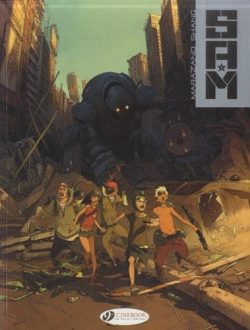
SAM volume 1: After Man


By Richard Marazano & Shang Xiao, translated by Jerome Saincantin (Cinebook)
ISBN: 978-1-84918-218-8 (Album PB)

Wow. People really love stories about robots. Well then, here’s another you might want to peruse…

Robots are a beloved theme of fiction, and many stories seem to work on the dichotomy of their innately innocent yet potentially deadly double nature. With elements of Terminator and A Boy and His Dog, here’s one that’s a cut above from French polymath (artist, critic, historian, astrophysicist, politician, and comics author) Richard Marazano (The Chimpanzee Complex; Cuervos; Zarathustra and much more) and Chinese artist, illustrator and animator Shang Xiao (Midsummer Park).

Told in four volumes, Après l’Homme details a heady tale of trust and survival between apparent natural enemies…

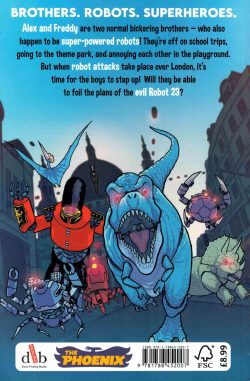
It’s just been the End of the World as We Know It, and in the scattered, shattered rubble of our technological advancements gangs of desperate kids forage for food, vitamins and ordnance to help them fend off the robots that have all but eradicated biological life.

Terse flashbacks reveal the armed rebellion of the mechanised realm and how the mostly subterranean youngsters scavenge and scrounge, with roaming mechs hunting them day and night. Tensions are high and emotions fraught, so if someone is a little bit different, negligent or disobedient – like dreamer Ian – it’s a problem for everybody…

Ella looks out for him as much as possible but Ian is destined for doom unless he shapes up…

Sadly, he instead takes a step in the other direction after one dusk raid to the surface sees him instants from annihilation when cornered by a towering killer robot.

Thankfully Russ disables it with his bazooka, but just for a moment there, Ian was sure he had experienced an emotional connection with the droid. It was like it chose not to kill him…

Increasingly obsessed, Ian cannot let the notion go and eventually breaks security to sneak out and examine the remains. They will be easy to find, with the letters SAM boldly painted on the carapace…

When he comes back, it’s all Ella can do to stop the others killing him. Ultimately, though, tempers subside, but Ian has not learned his lesson. After sharing his earliest memories of his father, fleeing and the lucky escape that saved him, the troubled boy seems to buckle down to the basics of survival, but he’s still gripped by crazy notions, like abandoning their tunnels and heading out to the fabled suburbs…

With defiance growing and rebellion brewing, the kids head out on another daylight hunt, but again Ian goes looking for “his” robot. When Ella catches him and starts yelling, they are both targeted by a roving mech, but inexplicably saved by another killer machine: “SAM”!

The victorious monster is badly damaged and as Ella watches in horror, Ian starts repairing it…

When the others find them, more arguing results in Ian getting a deadline: if he can’t make SAM fully operable in two days, he must let them destroy it. The frantic boy stives for the entire time and succeeds, only to pass out at the end. When he wakes and races to the site, the robot has vanished. Bereft and furious, Ian allows Ella to drag him away, but both are unaware that coldly-calculating optic systems are watching them from hiding…

Beguiling and powerfully engaging, this vivid take on an old plot is surprisingly compelling and promises a big payoff in volumes to come.
© Dargaud Paris 2011 by Marazano & Shang. All rights reserved. English translation © 2014 Cinebook Ltd.

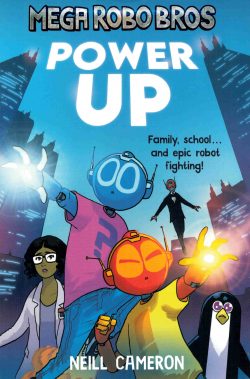
Mega Robo Bros: Power Up and Mega Robo Bros: Double Threat


By Neill Cameron with Abby Bulmer & Lisa Murphy (David Fickling Books)
ISBNs: 978-1-78845-200-7 (Power Up PB) and 978-1-78845-232-8 (Double Threat PB)

Just like The Beano, Dandy and other perennial childhood treasures, weekly comic The Phoenix masterfully mixes hilarious comedy with enthralling adventure serials… sometimes in the same scintillating strip. Such I the case here, with the synthetic stars of these superbly remastered compilations: mega-magnificent sci fi frolics packed into full-colour volumes of high-octane comedy-action, with added activity pages to complete your entertainment experience. Everybody strapped in?

Plunging straight into the enchanting immersive experience, we open in a futuristic London on a Monday morning. Alexand his younger brother Freddie have missed the airbus for school and dad has to take them. It’s a uniquely Sharma-family catastrophe…

In most ways the boys are typical: boisterous, fractious kids, always arguing, but devoted to each other and not too bothered that they’re adopted. It’s also no big deal to them that they were created by the mysterious Dr. Roboticus before he vanished and are considered by those in the know as the most powerful robots on Earth.

For now, it’s enough that Mum and Dad love them, even though the Robo Bros are a bit more of a handful than most kids. They live as normal a life as possible; going to school, making friends, putting up with bullies and hating homework: it’s all part of their Mega Robo routine…

This week, though, things are a bit different. On Wednesday the lads meet Baroness Farooq of covert agency R.A.I.D. (Robotics Analysis Intelligence and Defence) who – despite being initially unimpressed – changes her mind after seeing what the lads do to her platoon of Destroyer Mechs – all while between singing rude songs, reading comics and squabbling with each other.

Thursday is even better. As a treat, the entire family goes to Robo World where Freddy rescues a trio of malfunctioning exhibits. The baby triceratops with dog-programming is ok, but the French-speaking deranged ape and gloomily existentialist penguin might be a handful in days to come. …and all because Mum was trying to explain how her sons’ sentience makes them different from other mechanoids…

Friday wasn’t so good. Alex had another one of his nightmares, of the time before they came to live with the Sharmas…

With the scene exquisitely set, the drama kicks into overdrive when a school visit to the museum offers a hidden menace constantly watching the boys an opportunity to create chaos by hacking all the exhibits. Even though Freddy and Alex use all their super-powers to set things right, it takes all of the Baroness’ astounding influence to hush up the incident. They are supposed to be getting as normal a childhood as possible, with friends and family aware that they’re artificial and sentient, but not that they are unstoppable weapons systems. Now some malign force seems determined to “out” the Robo Bros for unspecified but undoubtedly sinister purposes…

Even greater cloaking measures are necessary when the hidden enemy causes a sky-train crash. The boys very publicly prevent a disaster, but even they are starting to realise something big is up. It also confirms that and Mum is a bit extraordinary herself, even before Freddy overhears some disturbing news about another one of Dr. Roboticus’ other creations…

The crisis erupts after Gran takes Alex and Freddy to a Royal Street Party outside Buckingham Palace. When the hidden enemy hacks the giant robot guards and sets them loose on the Queen and her family, the wonder-bots have to save them on live TV beamed around the world. The secret is out…

With the entire world camped outside their quiet little house, Mum has R.A.I.D. restore the Mega Robo Status Quo by building a super-secret tunnel system in the cellar. It’s a big day all around: Farooq is finally convinced that Alex is at last ready to join the agency… after school and on weekends, of course…

Freddy is extremely peeved that that he’s not invited. The Baroness still considers him too young and immature. He soon proves it when Alex becomes a Mega Robo Secret Agent, compelling Freddy to at last confide in dad the real reason he’s acting up. He then has opportunity to redeem himself and save the day when their nemesis makes his move and Alex finds himself completely out of his depth. Then only Freddy can save the day… if anyone can…

Crafted by Neill Cameron (Tamsin of the Deep, How to Make Awesome Comics, Pirates of Pangea), this is an astonishingly engaging tale that rockets along, blending outrageous comedy with warmth, wit and incredible verve. This volume also includes copious files on all the characters and activity features ‘How to Draw Alex’ and ‘How to Draw Freddy’ plus hilarious strip-within-a-strip ‘The World According to Freddy!’.

Alex and Freddy are utterly authentic boys, irrespective of their artificial origins, and their exploits strike exactly the right balance of future shock, family fun and bombastic superhero action to capture readers’ hearts and minds. With the right budget and producer what a movie this would make!


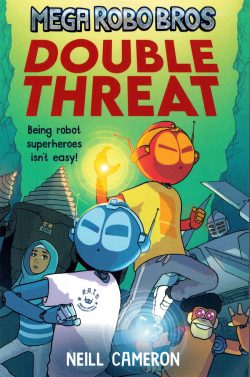
With additional colouring by Abby Bulmer & Lisa Murphy, second volume Mega Robo Bros: Double Threat sees the marvellous metal (and plastic) paladins return to share more of their awesome adventures and growing pains!

It’s still the Future!

In a London much cooler than ours, boisterous, fractious, argumentative, more-or-less typical kids Alex and Freddie are still devoted to each other and not much bothered that they’re adopted, recently became super-secret agents and that almost the entire world knows…

When occasion demands, they undertake missions for Baroness Farooq. They think it’s because they are infinitely smarter and more powerful than the Destroyer Mechs and other man-made minions she employs…

Moreover, Dad might be just be an average old guy, but Mum is a bit extraordinary too…

Life in the Sharma household is pretty normal. Freddie is insufferably exuberant and over-confident whilst Alex is approaching the age when self-doubt and anxiety start kicking in, but mostly it’s their parents’ other robot rescues that are a bit of a trial.

Baby triceratops Trikey with his dog-programming is ok, but French-speaking loony ape Monsieur Gorilla can be mighty confusing. Gloomily annoying, existentialist aquatic fowl Stupid Philosophy Penguin constantly quotes dead philosophers and makes people rapidly consider self-harm or manic mayhem …

Alex is getting a hard time from classmates Mira and Taia. They used to be best friends, but with all his extra-curricular activities, the girls are feeling neglected. Alex’s guilt turns to something far worse on Monday after a heated football match leads bully Jamal to make a startling accusation. But actually, how do we know if Alex is a Boy or a Girl…?

Deeply shaken, the startled hero naturally asks Mum and she’s never been more grateful for a sudden sneaky Surprise Giant Robot Attack that interrupts her answer…

Alex and Freddie are then called in by the Baroness, before jetting over to Aldgate Tube Station to battle a colossal driller-droid. Further investigation leads the lads and a R.A.I.D. science team deep, deep, deep into the abandoned transport tunnels beneath the city….

Here they encounter an army of rejected, rebuilt robots undertaking the bizarre agenda of a crazy bag-lady calling herself The Caretaker. When she abruptly loses control of her precious charges, all Hell breaks loose. During a massive fight, she escapes to an even more secret lair: an ongoing repair project with hidden ramifications that will have dire consequences for the bombastic boys and the entire world…

Freddie experiences Mum’s stern side when she takes him – kicking and screaming – clothes shopping, after which shameful incident, further mortification and emotional distress arrives as the price of fame is fully paid when Prettiest Girl in School Jamila finally notices Alex.

With his shiny head all turned around, he’s in no mood for Freddie’s jealous response: candid home videos posted on VuTube. The elder sibling’s even less chuffed when those postings go mega-viral, drawing some cruel comfort when Freddie’s celebrity bubble inevitably implodes in a most unfortunate manner…

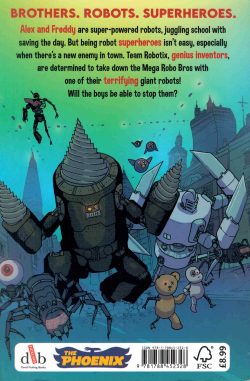
Wrapping up with a spectacular big finish, the kids – and their surprisingly famous mum – are star guests at the massive London Robo Expo. After taking down obnoxious, fame-craving mech-makers Team Robotix in a gladiatorial contest, the lads understandably think the action portion of the entertainment has ended, only to see the Caretaker’s darkest secret burst in with mass-murder in mind…

The huge rampaging robot quickly reinforces all humanity’s fears and anxieties about sentient mechanicals, but as the Mega Robo Bros drive the belligerent Wolfram off, Alex realises with alarm that Mum knows far more about the rogue – and her own “sons” – than she’s ever let on…

Augmented by more character info-files on the players involved; activity features (an extended) ‘How to Draw Freddy’and ‘How to Draw Stupid Philosophy Penguin’ plus even-more outrageous ‘The World According to Freddy!’ strips, this is another exceedingly engaging romp which rockets along like an anti-gravity rollercoaster, blending mirth with warmth, wit and incredible verve. These books offer unmissable excitement for kids of all ages and vintage, and are true “must-have” items.
Text and illustrations © Neill Cameron 2021. All rights reserved.

Both Mega Robo Bros collections will be released on August 5th 2021 and are available for pre-order now.


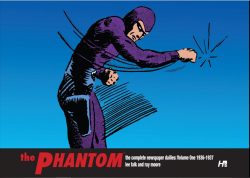
The Phantom: The Complete Newspaper Dailies volume 1 1936-1937


By Lee Falk & Ray Moore: introduction by Ron Goulart (Hermes Press)
ISBN: 978-1-932563-41-5 (HB)

There are plenty of comics-significant anniversaries this year, and this guy is probably right at the top of the birthday cake.

For such a long-lived, influential series, in terms of compendia or graphic novel collections, The Phantom has been very poorly served by the English language market (except in Australia where he has always been accorded the status of a pop culture god).

Numerous companies have sought to collect the strips – one of the longest continually running adventure serials in publishing history – but in no systematic or chronological order and never with any sustained success. At least the former issue began to be rectified with this initial curated collection from Archival specialists Hermes Press…

This particular edition is a lovely large hardback (albeit also available in digital formats), printed in landscape format, displaying two days strip per page in black and white with ancillary features and articles in dazzling colour where required.

Born Leon Harrison Gross, Lee Falk created the Jungle Avenger at the request of his King Features Syndicate employers who were already making history, public headway and loads of money with his first strip sensation Mandrake the Magician. Although technically not the first ever costumed champion in comics, The Phantom became the prototype paladin to wear a skin-tight body-stocking and the first to have a mask with opaque eye-slits…

The Ghost Who Walks debuted on February 17th 1936 in an extended sequence pitting him against an ancient global confederation of pirates. Falk wrote and drew the daily strip for the first two weeks before handing over illustration to artist Ray Moore. A spectacular and hugely influential Sunday feature began in May 1939.

In a text feature stuffed with sumptuous visual goodies like movie posters; covers for comics, Feature and Little Big Books plus merchandise, Ron Goulart’s eruditely enticing ‘Introduction: Enter the Ghost Who Walks’ tells all you need to know about the character’s creation before the vintage magic begins with ‘Chapter 1: The Singh Brotherhood’.

American adventurer Diane Palmer returns to the USA by sea, carrying a most valuable secret making her the target of mobsters, society ne’er-do-wells and exotic cultists. Thankfully, she seems to have an enigmatic guardian angel who calls himself  “the Phantom”…

As successive attacks and assaults endanger the dashing debutante, she learns that an ancient brotherhood of ruthless piratical thieves wants her secret, but that they have been opposed for centuries by one man…

Kidnapped and held hostage at the bottom of the sea, she is saved by the mystery man who falls in love and eventually shares his incredible history with her…

In the 17th century a British sailor survived an attack by pirates, and – washing ashore on the African coast – swore on the skull of his murdered father to dedicate his life and that of his descendants to destroying all pirates and criminals. The Phantom fights crime and injustice from a base deep in the jungles of Bengali, and throughout Africa is known as the “Ghost Who Walks”.

His unchanging appearance and unswerving war against injustice have led to him being considered an immortal avenger by the credulous and the wicked. Down the decades, one hero after another has fought and died in an unbroken family line, and the latest wearer of the mask, indistinguishable from the first, continues the never-ending battle. And he’s looking to propagate the line…

In the meantime, however, there’s the slight problem of Emperor of Evil Kabai Singh and his superstitious armies to deal with…

‘Chapter 2: The Sky Band’ (originally published from 9th November 1936 to April 10th 1937) finds the mystery avenger caught in love’s old game as a potential rival for Diana’s affections materialises in the rather stuffy form of career soldier Captain Meville Horton – an honourable man who sadly knows when he’s outmatched, unwanted and in the way. Mistakenly determined to do the right thing too, The Phantom concentrates on destroying a squadron of thieving aviators targeting the burgeoning sky clipper trade: airborne bandits raiding passenger planes and airships throughout the orient.

His initial efforts lead to the Phantom’s arrest: implicated in the sky pirates’ crimes, before escaping from police custody with the aid of his devoted pygmy witch doctor Guran and faithful Bandar tribe allies, he’s soon hot on the trail of the real mastermind…

On infiltrating their base, he discovers the airborne brigands are all women, and that his manly charms have driven a lethal wedge between the deadly commander and her ambitious second in command Sala…

A patient plaything of the manic Baroness, The Phantom eventually turns the tide not by force but by exerting his masculine wiles upon the hot-blooded – if psychopathic – harridan, unaware until too late that his own beloved, true-blue Diana is watching. When she sets a trap for the Sky Band, it triggers civil war in the gang, a brutal clash with the British military and the seemingly end of our hero, triggering Diana’s despondent decision to return alone to America…

‘Chapter 3: The Diamond Hunters’ opened on April 12th 1936 and revealed how the best laid plans can go awry…

In Llongo territory, white prospectors Smiley and Hill unearth rich diamond fields but cannot convince or induce local tribes to grant them mineral rights to the gems they consider worthless. Like most native Africans, they are content to live comfortably under the “Phantom’s Peace” and it takes all the miners’ guile – including kidnapping a neighbouring chief’s daughter and framing the Llongo; gunrunning and claiming the Ghost Who Walks has died – to set the natives at each other’s throats. Recovering from wounds, the Phantom is slow to act, but when he does his actions are decisive and unforgettable…

With the plot foiled and peace restored, Smiley flees, only to encounter a returned Diana who has acted on news that her man still lives. Seeing a chance for revenge and profit, Smiley kidnaps “the Phantom’s girl”; provoking his being shunned by all who live in the region, a deadly pursuit and a spectacular last-minute rescue. Smiley’s biggest and last mistake is reaching the coast and joining up with a band of seagoing pirates…

At least he is the catalyst for Diana and The Ghost finally addressing their romantic issues….

To Be Continued…

‘Afterword: For Those Who Came in Late…’ then sees editor Ed Rhoades offer his own thoughts on the strip’s achievements and accomplishments.

Stuffed with chases, assorted fights, torture, blood & thunder antics, daredevil stunts and many a misapprehension – police and government authorities clearly having a hard time believing a pistol-packing masked man with a pet wolf might not be a bad egg – this a pure gripping excitement that still packs a punch and quite a few sly laughs. …

© 2010 King Features Syndicate, Inc.: ® Hearst Holdings, Inc.; reprinted with permission. All rights reserved.


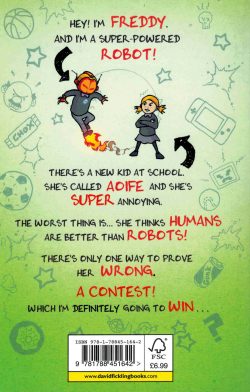
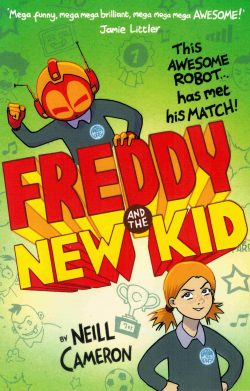
Freddy and the New Kid (The Awesome Robot Chronicles volume 2)


By Neill Cameron (David Fickling Books)
ISBN: 978-1-78845-164-2 (PB)

Neill Cameron (Bulldog Empire; Judge Dredd Megazine; Henry V; The DFC) knows how to charm and enthral kids of all ages, particularly with his work in the picture-perfect pages of wonderful weekly The Phoenix: strips like Tamsin of the Deep; How to Make Awesome Comics and Pirates of Pangea.

To my mind, the best of the proud bunch is Mega-Robo Brothers, set in a futuristic London (at least 3 months from now, but with flying buses…) with a pair of marvellous metal-&-plastic paladins who are not like other schoolkids – no matter how much they try…

Cameron became a stalwart of proper literature after migrating the younger of his artificial wonders to the prose pages of proper books in the grand manner of Just William or Billy Bunter – albeit heavily illustrated, cartoon stuffed ones – with Freddy Vs. School. Here he cracks on with a splendid sequel…

Welcome to the Future!

In a London much cooler than ours Alex Sharma and younger brother Freddy are (mostly) typical kids: boisterous, fractious, argumentative but devoted to each other… and not too bothered that they’re adopted. It’s no big deal for them that they were originally built by mysterious Dr. Roboticus before he vanished, or that they are considered by those in the know as the most powerful robots on Earth.

That includes Mum and Dad. Mr Sharma may be just your average working guy, but Mum is actually a bit extraordinary herself. A renowned boffin, Dr. Nita Sharma carries some surprising secrets of her own, and occasionally allows her boys to be super-secret agents for R.A.I.D. (Robotics Analysis Intelligence and Defence).

It’s enough for the digital duo that they’re loved, even though they are more of a handful than most kids. They try to live as normal a life as possible; going to school, making friends, putting up with bullies and hating homework: it’s all part of Mega Robo Routine to blend boring lessons, fun with friends, games-playing, TV-watching and training in covert combat caverns under R.A.I.D. HQ…

When occasion demands, the lads undertake missions, but mostly it’s just home, games, homework and School. At least that’s how it seems to Freddy: a typical 10-year-old (well, except for the built-in super-powers).

Alex is at the age when self-doubt and anxiety take hold and counters the anxiety by trying to fit in, but Freddy is still insufferably exuberant and over-confident. It leads to frequent confrontations with unreasonable, unliked Deputy Head Mr. Javid and resulted in a specific set of school rules that apply only to the robot boy: a draconian Code of Conduct forbidding any students from using super-strength, booster rockets or lasers on school property…

Even when Freddy sticks to the rules, trouble just seems to go looking for him. He’s wilful and easily led, especially by best friend Fernando who also hates boring learning and loves excitement. Dr. Sharma calls him an “instigator”, but believes the influence of sporty Anisha, quiet swot Riyad and even (mostly) reformed bully Henrik can modify Freddy’s inability to do what he’s told…

Sadly, that was before ultra-competitive new girl Aoife arrived. She’s good at all subjects, a superstar on the sports field and quite likable, but for some reason hates and despises robots. All too soon, she and Freddy are arch enemies, engaged in a duel to prove whether humans or machines are best. The contest divides the school, separates Freddy from his friends and leads to a destructive plague of betting in the school…

Cash-strapped and cost obsessed, Mr Javid exacerbates the situation by systematically laying off human teachers and replacing them with low grade robots. It starts in the sports department but gradually the cheap mechanoids encroach on actual lessons, and all too soon Aoife has taught the students how to modify and reprogram them…

As the rivals strive to prove their point of view, chaos descends on the school. Lessons are affected; relationships shift; the remaining staff revolt and the robot replacements go berserk. Soon it’s time for lasers and rockets and maybe even some necessary explosions…

Somehow amidst all the madness, Freddy and Aoife start to see each other’s point of view, tone down their aggression and even properly get on. Now all they have to do is calm down the rioting kids, turn off the rebellious techno-teaching assistants, safely dismantle the gambling cabal and get their former friends to talk to them again…

Stuffed with monochrome cartoons and bouncy graphics, this is unmissable entertainment for all ages and vintages: a splendidly traditional potent school days comedy romp, amped up on sci fi and superhero riffs and carrying a powerful message that competition has a downside. Freddy and the New Kid is another amazing adventure for younger readers that you’ll adore too.
Text and illustrations © Neill Cameron 2021. All rights reserved.

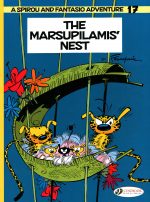
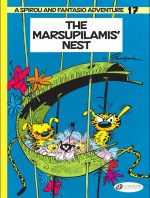
Spirou & Fantasio volume 17 – The Marsupilamis’ Nest


By André Franquin, translated by Jerome Saincantin (Cinebook)
ISBN: 978-1-84918-533-2 (Album PB)

Spirou (whose name translates as “squirrel”, “mischievous” and “lively kid” in the language of Walloons) was created by French cartoonist François Robert Velter – AKA Rob-Vel – for Belgian publisher Éditions Dupuis. The evergreen star was a response to the success of Hergé’s Tintin at rival outfit Casterman. At first, the character Spirou was a plucky bellboy/lift operator employed by the Moustique Hotel (an in-joke reference to Dupuis’ premier periodical Le Moustique) whose improbable adventures with his pet squirrel Spip evolved into astounding and often surreal comedy dramas.

The other red-headed lad debuted on April 21st 1938 in an 8-page, French-language tabloid magazine that bears his name to this day. Fronting a roster of new and licensed foreign strips – Fernand Dineur’s Les Aventures de Tif (latterly Tif et Tondu) and US newspaper imports Red Ryder, Brick Bradford and Superman – the now-legendary anthology Le Journal de Spirou grew exponentially: adding Flemish edition Robbedoes on October 27th 1938, increasing page count and adding compelling action, fantasy and comedy features until it was an unassailable, unmissable necessity for Franco-Belgian kids.

Spirou and chums spearheaded the magazine for most of its life, with many impressive creators building on Velter’s work, beginning with his wife Blanche “Davine” Dumoulin, who took over the strip when her husband enlisted in 1939. She was aided by Belgian artist Luc Lafnet until 1943, when Dupuis purchased all rights to the feature, after which comic-strip prodigy Joseph Gillain (“Jijé”) took over.

In 1946, Jijé‘s assistant André Franquin inherited the feature. Gradually, he retired traditional short gag-like vignettes in favour of longer adventure serials, introducing a wide and engaging cast of regulars. He ultimately devised a phenomenally popular nigh-magical animal dubbed Marsupilami, who debuted in 1952’s Spirou et les héritiers.

Jean-Claude Fournier succeeded Franquin: overhauling the feature over nine stirring serial adventures between 1969-1979 which tapped into the rebellious, relevant zeitgeist with tales of environmental concern, nuclear energy, drug cartels and repressive regimes.

By the 1980s, the series seemed stalled, with three different creative teams alternating on the serial: Raoul Cauvin & Nic Broca, Yves Chaland, and Philippe Vandevelde – writing as “Tome” – & artist Jean-Richard Geurts AKA Janry.

These last reverently referenced the still-beloved Franquin era: reviving the feature’s fortunes in 14 wonderful albums between 1984-1998. After their departure the strip diversified into parallel strands: Spirou’s Childhood/Little Spirou and guest-creator specials A Spirou Story By…

Efforts by Lewis Trondheim and the teams of Jean-Davide Morvan & Jose-Luis Munuera and Fabien Vehlmann & Yoann brought the official album count to nearly 80 (if you include specials, spin-offs series and one-shots, official and otherwise), but there are still plenty of the older vintages uncollected, just waiting for another nostalgia wave to revive them (perhaps in Complete Collections as has been done with Lucky Luke and Valerian and Laureline…?)

Cinebook have been publishing Spirou & Fantasio’s exploits since October 2009, mostly concentrating on translating Tome & Janry’s superb pastiche/homages of Franquin, but for this manic marvel (available in paperback and digitally) we hark all the way back to 1960 for pure Franquin-formulated furore and fiasco.

The contents are actual two separate yarns, originally serialised in LJdS #699-991 (1956-1957) and #1034-1045 (1958) before being collected in 1960 as 12th European album Le nid des Marsupilamis. It’s brought to you as The Marsupilamis’ Nest…

In 1952’s Spirou et les héritiers, intrepid heroes Spirou and Fantasio encountered an incredible elastic-tailed anthropoid in the jungles of Central American nation Palombia: ultimately bringing the fabulous, affable creature back to civilisation and a string of bizarre and absurd adventures.

Franquin had assumed all creative responsibilities for Dupuis’ flagship strip part-way through Spirou et la maison préfabriquée (LJdS #427, June 20th 1946). He ran wild and prospered for two decades, enlarging the scope and horizons of the stories until the feature became purely his own.

As the Bellboy became a globe-trotting journalist, fans continuously met startling new characters such as comrade/rival reporter Fantasio; crackpot inventor Count of Champignac and inept colleague Gaston Lagaffe (known in Britain as Gomer Goof). Travelling to exotic places, they uncovered crimes, challenged the fantastic unknown and clashed with nefarious arch-enemies such as Zorglub and Zantafio. They also competed with one of the first strong female characters in European comics – rival journalist Seccotine (renamed Cellophine in the current English translation).

In this compilation, the eponymous lead story sees the enquiring lads lose out on a prestigious film-&-lecture gig to Cellophine, who has truly scooped them by penetrating the Palombian rain forest to create a compelling documentary of the language, mating habits and daily life of Marsupilamis…

Dramatic, action-packed, romantic, passionate and utterly hilarious, the tale depicts the earliest moments of the manic monkey’s adorable triplets and was apparently crafted by Franquin as his wife Liliane was carrying their first child…

The joys of the wilderness are counterbalanced by an enthralling graphic essay on civilisation and human nature as La foire aux gangsters AKA ‘The Gangster Fair’ sees Spirou and Fantasio – after some spectacular initial resistance – trained in the martial arts by innocuous-seeming Yudai Nao.

The aging oriental gentleman is the dutiful bodyguard of Yankee oil tycoon John P. Nutt, whose upcoming visit to Europe has afforded gangster Lucky Caspiano a chance to extract money and exact vengeance on a despised old enemy. Our heroes’ training is intended to create unsuspected back-up for the sentinel, but when the villains brutally remove Mr Nao and kidnap Nutt’s infant son, the likely lads find themselves on their own and painfully probing a sordid street fair for clues. Eventually their investigations centre on an all-comer’s boxing booth…

Happily, the reporters have unexpected allies – such as hapless office intern Gomer Goof and a thug with a conscience – but as the caper devolves into a manic, violent chase, Spirou deduces that they have been lied to, and that not every player in this game is on the side of the angels…

The Marsupilamis’ Nest offers the kind of lightly-barbed, comedy-thriller that delights readers fed up with a marketplace far too full of adults-only carnage, testosterone-fuelled breast-beating, teen-romance monsters or sickly-sweet fantasy.

Easily accessible to readers of all ages and rendered with the beguiling style and seductively wholesome élan which makes Asterix, Lucky Luke, and Iznogoud so compelling, this is a delicious tale from a long line of superb exploits that cries out to be a household name as much as those series – and even that other kid with the white dog…
Original edition © Dupuis, 1960 by Franquin. All rights reserved. English translation 2020 © Cinebook Ltd.

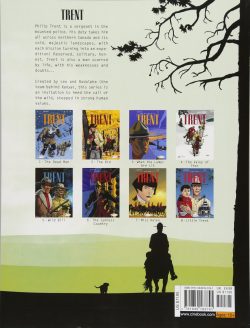
Trent volume 2: The Kid


By Rodolphe & Léo with colour by Marie-Paul Alluard, translated by Jerome Saincantin (Cinebook)
ISBN: 978-1-84918-374-1 (Album PB)

European comics audiences have long been fascinated with the mythologised American experience, whether it be the big-skied Wild West or later eras of crime-riddled, gangster-fuelled dramas. They also have a vested historical interest in the northernmost parts of the New World which has resulted in some pretty cool graphic extravaganzas.

Léo is actually Brazilian artist and storymaker Luiz Eduardo de Oliveira Filho: born in Rio de Janeiro on December 13th, 1944. Attaining a degree in mechanical engineering from Puerto Alegre in 1968, he was a government employee for three years, until forced to flee the country because of his political views. While a military dictatorship ran Brazil, he lived in Chile and Argentina before illegally returning to his homeland in 1974. To survive, he worked as a designer/graphic artist in Sao Paulo and created his first comics art for O Bicho magazine.

In 1981 he migrated to Paris, seeking to pursue a career in Bande Dessinée, and found some work with Pilote and L’Echo des Savanes as well as more advertising and graphics fare. The big break came when Jean-Claude Forest invited him to draw stories for Okapi which led to regular illustration work for Bayard Presse. In 1988 Léo began his long association with scripter and scenarist Rodolphe D. Jacquette – AKA Rodolphe.

His prolific, celebrated writing partner has been a giant of comics since the 1970s: a Literature graduate who transitioned from teaching and running libraries to creating poetry and writing criticism, novels, biographies, children’s stories and music journalism. In 1975, after meeting Jacques Lob, he expanded his portfolio to write for a vast number of artists and strip illustrators in magazines ranging from Pilote and Circus to À Suivre and Métal Hurlant. Amongst his most successful endeavours are Raffini (with Ferrandez) and L’Autre Monde (Florence Magnin) but his collaborations in all genres and age ranges are too numerous to list here.

In 1991 he began working with Léo on a period adventure series of the far north. Taciturn, introspective and fiercely driven Royal Canadian Mounted Police sergeant Philip Trent premiered in L’Homme Mort, forging a lonely path through the 19th century Dominion over eight tempestuous, hard-bitten albums between then and 2000. He also prompted the collaborators’ later fantasy classics Kenya (and its spin-offs), Centaurus and Porte de Brazenac.

Cast very much in the classic adventure mould as crafted by the likes of Jack London and John Buchan, Trent is a man of few words, deep thoughts and unyielding principles who gets the job done whilst stifling emotional turmoil boiling deep within him…

As ‘Le Kid’, this conflicted, moving second exploit originated in 1992, opening with a robbery in Blacktown, North Dakota that goes appallingly awry. The bandits are idealistic teenagers and when Laura is killed in a shootout, her poetry-obsessed partner Emile Tourneur goes completely off the rails…

With nine confirmed kills and nothing to live for, Emile heads north and becomes an RCMP problem. One of many officers assigned to catch him, Trent is despatched to Lake Manitoba with explicit orders to find but not confront the ruthless killer, aided only by faithful canine companion “Dog”.

Following sporadic poetic graffiti, the officer quickly picks up the trail and the impression that something isn’t right. For one thing, the kid is not hiding his tracks, and making plenty of friends and admirers along the way as his adds to the notches on his gun. Some think he’s only killing people who have it coming…

Eventually, Trent locates his quarry in the Frozen wastes and far-too-easily overcomes him. Their long trek back only adds to the mystery of the Rimbaud-quoting golden boy, who has a distressing knack of asking uncomfortable questions…

Brooding tensions and paradoxical revelations explosively come to a head when the now amiable fellow-travellers are ambushed by escaped convicts. Sudden, ruthless gunplay leaves the Mountie inexplicably alive, alone and still fully armed. He can only assume his recent captive is provoking him for some reason, as he traces a trail back to the scene of the kid’s last atrocity and a town full of vengeful survivors…

A beguiling voyage of internal discovery where environment and locales are as much a major character as hero and foe, The Kid offers suspense, action, humour and poignant evocation in a compelling confection that will appeal to any fan of widescreen cinematic crime fiction or epic western drama.
Original edition © Dargaud Editeur Paris 1992 by Rodolphe & Léo. All rights reserved. English translation © 2016 Cinebook Ltd.

Dash: The Case of the Mysterious Zita Makara


By Dave Ebersole, Delia Gable, Vinnie Rico, Sean Von Gorman, Tana Ford, Josh Lester & various (Northwest Press)
ISBN: 978-1-94-389055-2 (TPB) eISBN 978-1-94-389056-9

The 1930s were a golden age of fantasy fiction, particularly in the genres of pulp adventure, crime stories and supernatural horror. As such it’s a time period accessible to some degree by most modern consumers of escapist entertainment. It was also a time of great hypocrisy, social conservatism – except in the arts and politics – and enforced conformity.

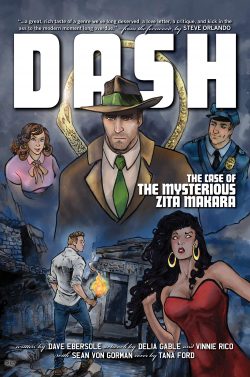
All that gets a great big “So What?” in this deliriously rambunctious melange of mixed media forms wherein writer Dave Ebersole and illustrator Delia Gable finally complete their long-delayed epic tale of boozy, proudly unrepentant queer private eye Dashell Malone, who cautiously negotiates the hostile environment of pre-WWII Los Angeles and outraged former colleagues from the LAPD in search of the mystic horror that destroyed the man he loved…

It all begins in 1940 when exotic and sultry Zita Makara hires him to act as go-between in a shady deal. She is exceptionally unforthcoming with useful details and not a little annoyed at his easy resistance to her charms and attentions… much to the amusement of Dash’s sassy but efficient secretary Cindy Crenshaw…

The PI’s attention is further derailed by the return of his lover, shady ne’er-do-well Johnny Plinketts, so when his diligent investigations of Zita take him to a travelling Egyptian antiquities exhibition, Dash is totally unprepared for the appalling consequences. Dash still has friends on the force – such as patrolman Sal McGillicutty – who is there to break the shocking news that “Plink” has been found dead in incredible circumstances. Moreover, he’s not the first. LA has become the hunting grounds for a ghastly beast…

A convenient suspect for bigoted detective Bruno Perez, Dash is eventually released and falls into a depression until Cindy and Sal get him moving on finding the real killer, but before long the trail leads to an ancient Egyptian heretic cursed by the gods and an undying predator active for ages. This terror has been methodically preparing to turn back time and remake the world and Plink was not only his latest meal but also deeply involved in the plot from the start…

As events spiral and supernatural Hell inescapably comes to Earth, Dash is thrust into the role of mystic avenger and saviour of humanity, but it’s a job the grieving shamus neither wants nor feels qualified to handle…

Augmented by an effusive Introduction and appreciation from Steve Orlando, the book also includes a background-packed ‘Interlude’ from Ebersole and artist Vinnie Rico, as well as a trio of brief ‘Further Cases’.

‘The Case of the Man in the Mask’ (art by Sean Von Gorman) sees Dash dismantle a devious blackmail scheme, whilst Rico’s ‘The Case of the Best Friend on the Police Force’ traces the story of LAPD officers Malone and McGillicutty before Cindy’s origins are explored in ‘The Case of the Wisecracking Secretary’ (Rico again). Rounding up the fun is early promotional art, Afterwords and thank-yous, plus a recipe section inviting you to “make the cocktails you just read about” in ‘You Don’t Have to Drink, But If You Do… Drink Well!’

A superbly engaging romp in the manner of The (1999) Mummy whilst tipping its battered, dusty fedora to classics of film noir and latter-day pulp homages like Raiders of the Lost Ark and Hooten and the Lady, this is a splendid excursion categorically proving that not all rugged he-men get the girl in the end…
© 2020 Dave Ebersole. Dash co-created by Dave Ebersole and Delia Gable. All rights reserved.

David Boring


By Daniel Clowes (Pantheon/Jonathan Cape)
ISBN: 978-0-37540-692-8 (Pantheon HB) 978-1-022406-323-4 (Jonathan Cape PB)

One of the greatest assets of the comics medium is the ostensibly straightforward nature of its storytelling. With pictures wedded to text, what you see is so clearly what you get. So, whenever a master creator deliberately subverts that implicit convention, the result might be occasionally obscure or confusing, but is always utterly engrossing.

At the forefront of comics storytelling for almost four decades Daniel Clowes is, for many, an acquired taste. However, once he’s in your brain there’s certainly no shaking the things he can do with pen and ink, motive, character and the special kind of situational magic that inhabits the world of pictures and words on paper.

Born in Chicago in 1961, he began his career as a cartoonist with humour magazine Cracked before creating uniquely skewed short comic tales for Fantagraphics. His first piece debuted in Love and Rockets # 13 (September 1985): an introductory prelude to his retro-chic detective magazine Lloyd Llewellyn which launched soon after and ran in various incarnations for three years.

In 1989 he created anthology vehicle Eightball and began producing a variety of tales – short and serial-lengths – ranging from social satire, nostalgic absurdist anthropomorphic yarns to surreal, penetrating human dramas, all viewed through the lens of iconic popular cultures and social motifs. All that material has since been collected into graphic novels and two of these, Ghost World and Art School Confidential, have been adapted into critically acclaimed feature films.

His experiences in Hollywood combined with deep-seated childhood influences of noir movies and comics books combined and resulted in ‘David Boring’ – originally serialised in Eightball #19-21 before being collected by Pantheon Books in America and Jonathan Cape in Britain.

David Boring is the narrator of his own story, living a life of unsatisfactory gratification, harassed by his mother and obsessed by his absentee father – a second rate cartoonist and comic book artist who disappeared decades previously. David spends his days with his only real friend, a lesbian named Dot he has known since High School. David is listlessly indulging in his life’s work by searching for his perfect woman when an old friend suddenly shows up, triggering a series of bizarre events that should make his life a living action movie, but instead just steers him into increasingly unpalatable and mundane tragedies and horrors…

Set against a backdrop of impending catastrophes, ranging from murder to the end of the world, David’s progress is trenchantly plebeian and low-key: an odyssey rendered drama-free by the protagonist’s relentless lack of – or rather resistance to – passion and unwillingness to fully engage in events occurring around him.

His world is full of sexual encounters, assaults, murders, chases and even global holocausts, but he passively accepts and adapts to it all.

Clowes has stated that he crafted this stunningly engaging and challenging tale as an exercise in writing an un-filmable comic. He has, but it was still optioned by Hollywood…

This is another of those too-rare productions that shouldn’t really be reviewed, just read, with themes of adolescence, maturity, quest for self and the impending end of life delivered via a landscape of comics, film noir, mock-heroics and the irreducible knowledge that families make individuals; sublimely combining in a truly personal experience for every reader.

Be warned: the most telling narrative device used here is uncertainty. A tremendous amount of the story is left unstated: this is a saga littered with reader’s conclusions not the characters’ actions. Events are set in motion and consequences are noted, but the course of intervening actions if not experienced by David can only be surmised or extrapolated: David Boring is a protagonist with few of the overt drives of a regular narrative hero and his story is one that can’t happen to any one of us…

Brilliant, compelling, utterly wonderful? That’s up to you…
© 2000, 2002 Daniel Clowes. All rights reserved.

August Moon


By Diana Thung (Top Shelf)
ISBN: 978-1-60309-069-8 (PB)

Here’s a mysterious thing. For a while, a few years back, Diana Thung was a glittering name and shining prospect in graphic storytelling, but after two brilliant all-ages fantasy triumphs she dropped out of sight. I don’t know why – or to be honest have any right to. But it is a shame as her work was superb. I hope she’s well and happy, but I’m not going to stop recommending her delightful creations…

Thung was born in Jakarta, and grew up in Singapore before eventually settling in Australia. She is a natural storyteller, cartoonist and comics creator of sublime wit and imagination with a direct hotline to infinite thoughtscapes of childhood. Every single thing populating her astonishingly unique worlds is honed to razor sharpness and pinpoint logical clarity, no matter how weird or whimsical it might initially seem.

The sentiment is pure and unrefined; scenarios are perfectly constructed and effectively, authentically realised …and when things get tense and scary they are excessively tense and really, really scary…

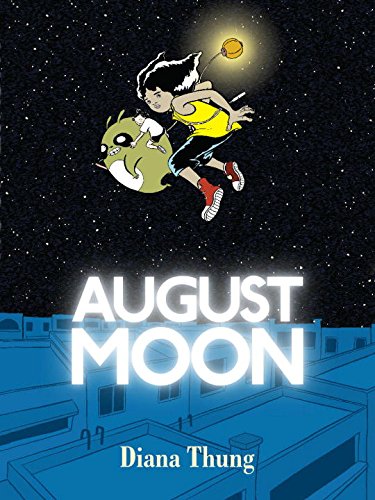
After SLG published debut series Captain Long Ears in 2010, Thung catapulted to (relative) fame two years later following the release of her first graphic novel. August Moon is a magnificent blending of eastern and western comics influences that remixed many standard elements of fantasy into a superbly fresh conjunction for young and old alike.

Rendered in stunning, organically enticing black and white, the scene opens in the Asian township of Callico: an isolated little metropolis in the midst of lush jungle verdure, and a place with a few strange secrets…

Accessible only by one solitary bridge, generally cut off from the wider world by dense surrounding forests and innate unchanging dullness, the town moves at its own pace. Life is slow, existence is bucolic and the biggest deal for the people is the perennial debate over whether the strange dancing lights seen in the trees at night are actually Soul Fire – dead ancestors watching over the town – or just some unexplained scientific phenomenon…

Answers start coming for a select few after ugly, business-suited strangers begin buying up empty shops for a company named Mon & Key. Some older street vendors are understandably anxious, but only Grandma and her peculiar little associate Jaden know the appalling threat these interlopers pose…

Events start spiralling out of control when the newcomers murder a hitherto unknown “animal” and news of the bizarre beast’s corpse leaks out into the wider world. The amazing discovery brings college biologist Dr. Gan back to the town his dead wife grew up in for the first time in years, dragging unhappy teenaged daughter Fiona with him.

Reluctant to be there, Fi keeps to herself; spending time snapping photos with her instamatic camera. The dull old backwater suddenly becomes far more intriguing after she captures a candid shot of a boy leaping like a grasshopper over the rooftops…

When she finally meets the incomprehensibly enigmatic Jaden, Fi is quickly drawn into his bizarre struggle against the ape-like invaders. After meeting the clandestine forest creatures who are the true source of Soul Fire, she makes their struggle her own…

The cruel and cunning interlopers of Mon & Key worship commerce and progress. Their agenda involves destroying forests to build factories. Ruthless and multi-resourced, they retaliate by killing all objectors, whilst attempting to dissuade and eventually assassinate Fi’s father.

However, with the aid of Callico’s street children – and a few clued-in, sympathetic adults like her Uncle Simon – Fi and super-powered, magic moon-boy Jaden spearhead a spirited secret war to destroy the rapacious deforestation machines of Mon & Key.

As the holiday season nears its end, the town prepares for its annual Soul Fire Festival and parade. As Mon & Key’s forces assemble for one final deforesting assault, they have totally underestimated Jaden’s resolve, Fi’s ingenuity and Callico’s communal desire to remain unchanged and unchanging…

A funny, scary, magical and thrilling modern fable, August Moon seamlessly stitches together ecological themes with beguiling myth to create a captivating tale of youthful empowerment and rebellious wonder. This is a fabulously enticing young reader’s epic every lover of comics and storytelling should take to their hearts.
© 2011 Diana Thung.

Spirou & Fantasio volume 15 – Shadow of the Z


By André Franquin, with Jidéhem & Greg; translated by Jerome Saincantin (Cinebook)
ISBN: 978-1-84918-419-9 (Album PB)

Spirou (whose name translates as both “squirrel” and “mischievous” in the tongue of the Walloons) was created by French cartoonist François Robert Velter – AKA Rob-Vel – for Belgian publisher Éditions Dupuis in response to the phenomenal success of Hergé’s Tintin at rival outfit Casterman.

The legendary anthology Le Journal de Spirou was launched on April 21st 1938 with this other red-headed lad as lead of the anthology weekly comic which bears his name to this day.

He began life as a plucky bellboy/lift operator employed by the Moustique Hotel (a reference to the publisher’s premier periodical Le Moustique) whose improbable adventures with his pet squirrel Spip eventually evolved into high-flying surreal comedy dramas.

The Spirou cast have been the magazine’s vanguard for most of its life, with a phalanx of truly impressive creators carrying on Velter’s work, beginning with his wife Blanche “Davine” Dumoulin who took over the strip when her husband enlisted in 1939. She was aided by Belgian artist Luc Lafnet until 1943 when Dupuis purchased all rights to the feature, after which comic-strip prodigy Joseph Gillain (“Jijé”) took over.

In 1946, Jijé‘s assistant André Franquin assumed the reins, slowly retiring short, gag-like vignettes in favour of longer epic adventure serials, introducing a wide and engaging cast of regulars. He ultimately devised a phenomenally popular nigh-magical animal dubbed Marsupilami, with the wondrous critter debuting in Spirou et les héritiers in 1952.

On January 3rd 1924, Belgian Franquin was born in Etterbeek. Drawing from an early age, he began formal art training at École Saint-Luc in 1943 and when the war forced the school’s closure a year later, Franquin found animation work at Compagnie Belge d’Animation in Brussels. Here he met Maurice de Bevere (Lucky Luke creator “Morris”), Pierre Culliford (AKA Peyo, creator of The Smurfs) and Eddy Paape (Valhardi, Luc Orient).

In 1945 all but Culliford signed on with Dupuis, and Franquin began his career as a jobbing cartoonist and illustrator, producing covers for Le Moustique and scouting magazine Plein Jeu. Throughout those early days, Franquin and Morris were being trained by Jijé, at that time the main illustrator at Le Journal de Spirou. He turned the youngsters and fellow neophyte Willy Maltaite – AKA Will (Tif et Tondu, Isabelle, Le jardin des désirs) – into a perfect creative bullpen known as the La bande des quatre or “Gang of Four”. They promptly revolutionised Belgian comics with their prolific and engaging “Marcinelle school” style of graphic storytelling.

Jijé handed Franquin all responsibilities for the flagship strip part-way through Spirou et la maison préfabriquée, (LJdS#427, June 20th 1946. The eager beaver ran with it for two decades, enlarging the scope and horizons until it became purely his own. Almost every week fans would meet startling new characters such as comrade and rival Fantasio and crackpot inventor the Count of Champignac.

Along the way Spirou & Fantasio became globe-trotting journalists, endlessly expanding their weekly exploits in unbroken four-colour glory. They travelled to exotic climes, exposing crimes, revealing the fantastic and clashing with a coterie of arch-enemies such as Zorglub and Zantafio and one of the first strong female characters in European comics – rival journalist Seccotine (renamed Cellophine in the current English translation).

In a splendid example of good practise, Franquin mentored his own band of apprentice cartoonists during the 1950s. These included Jean Roba (La Ribambelle, Boule et Bill), Jidéhem (Sophie, Starter, Gaston Lagaffe) and Greg (Bruno Brazil, Bernard Prince, Zig et Puce, Achille Talon), who all worked with him on Spirou et Fantasio. In 1955, a contractual spat with Dupuis saw Franquin sign up with rivals Casterman on Le Journal de Tintin, where he collaborated with René Goscinny and old pal Peyo whilst creating the raucous gag strip Modeste et Pompon. Franquin soon patched things up with Dupuis and returned to Spirou, subsequently co-creating Gaston Lagaffe (now known in Britain as Gomer Goof) in 1957, but was obliged to carry on his Casterman commitments too…

From 1959, writer Greg and background artist Jidéhem assisted Franquin, but by 1969 the artist had reached his Spirou limit. He quit, taking his mystic yellow monkey with him…

His later creations include fantasy series Isabelle, illustration sequence Monsters and bleak adult conceptual series Idées Noires, but his greatest creation – and one he retained all rights to on his departure – is Marsupilami, which, in addition to comics tales, has become a star of screen, plush toy store, console and albums.

Plagued in later life by bouts of depression, Franquin passed away on January 5th 1997, but his legacy remains: a vast body of work that reshaped the landscape of European comics.

Cinebook have published Spirou and Fantasio’s exploits since 2009, initially concentrating on Tome & Janry’s superb pastiche/homages of Franquin, with infrequent doses of the original article also available in paperback and digitally.

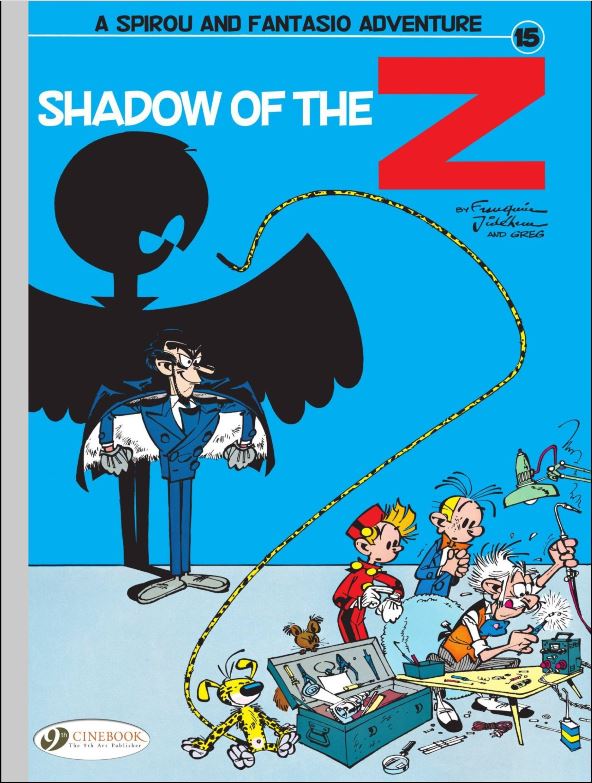
Here, in the sequel to Z is for Zorglub (also by Franquin, Greg & Jidéhem) we head back to 1960 for a return engagement with a super-scientific arrogant buffoon whose believes he is the rightful ruler of Earth and the solar system thanks to his discovery of the mind-bending “Zorglwave”.

Previously, the smug weirdo had used his hypnotic rays to make Fantasio one of his mind-controlled Zorglmen whilst attempting to destroy their inspirational boffin acquaintance: mushroom-mad Count Champignac. Apparently, they were at school together…

After an epic encounter, Zorglub was outwitted by Spirou, Spip and the Marsupilami, and all his grand plans scuttled, but as this volume opens our heroes are cleaning up in the generally placid hamlet of Champignac-in-the-Sticks where one last Zorglman is still prowls, armed with a paralysis ray and causing a catastrophic kerfuffle…

Sadly, no sooner do our heroes solve that problem than Zorglub himself turns up to reclaim the last of his evil machines and advanced aircraft: keen to resume his duel with the kindly Count. An inconclusive clash results in Zorglub heading off for his last hidden base – creating a shocking swathe of chaos and destruction in his wake – unaware that he has left a crucial clue.

Soon the heroic gang are off to Palombia – home of wild Marsupilami – landing just in time to become embroiled in the madman’s latest outrage: dominating the local toiletries market through his hypnotic devices. With all that operating capital, his conquest of Earth is assured…

As economic unrest drags the Palombian populace towards destitution and revolution, the Count perfects his anti-Z wave technology and our heroes’ counterattack, but unknown to all, a malicious old enemy has formed a third faction to exploit Zorglub’s grand scheme for shoddy personal gain. When he’s finally exposed, the monster resorts to the death-ray even Zorglub was too ashamed to use but has underestimated Spirou, the Count and the marvellous Marsupilami. The end is a sudden, shocking, comeuppance but we have not seen the last of Zorglub…

Stuffed with an astounding array of astonishing hi-tech spoofery, riotous chases, sight gags and verbal ripostes, this exultant escapade is a fast and fabulous fiesta of angst-free action and thrills. Readily accessible to readers of all ages and drawn with beguiling style and seductive élan, this is pure cartoon gold, truly deserving of reaching the widest audience possible.

Buy it for you, get another for the kids and give copies to all your friends…
Original edition © Dupuis, 1962 by Franquin, Jidéhem & Greg. All rights reserved. English translation 2018 © Cinebook Ltd.