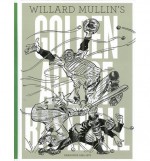
Willard Mullin’s Golden Age of Baseball – Drawings 1934-1972


By Willard Mullin, Hal Bock & Michael Powers (Fantagraphics Books)
ISBN: 978-1-60699-639-3

Britain never really enjoyed the long and lovingly cherished tradition of sports cartoons enjoyed by America throughout the 20th century – more’s the pity – but in the Land of the Free illustrated match précis’, captivating portraits, charismatic caricatures and plain old fashioned gags in drawn form were a crucial element of every national and local newspaper for generations.

Sporting profiles, sketches, technical tips, skits and lampooning broadsides were even a staple of Golden Age comicbooks – and far too often the best drawn items in those fantasy-fuelled periodicals.

Voted “Greatest Sports Cartoonist of the 20th Century” by his extremely talented and partisan peers, Willard Mullin (September 14, 1902-December 20, 1978) best captured the magic of America’s favourite game for almost half a hundred years, encapsulating the power, glory, glum disappointment, heartbreak and just plain unflagging passion of players, managers, owners and fans in spectacular portrait biographies, potent editorial cartoons, gently ferocious caricatures and hilarious, knowing slapstick panels.

Fantagraphics Books have again struck gold by reviving and celebrating a lost hero and a nigh-forgotten sector of graphic narrative arts in this superb commemoration of a mighty talent: featuring a history of the man, his times and the sport which sustained a nation in war and peace; recalled in candid photos and an unbelievable treasure-trove of stupendous drawings and cartoons that charmed and delighted uncounted millions of Americans…

Following a passionate appreciation of the man and his influence from cartoonist, illustrator and author Bob Staake in ‘Mulling over Willard’, Shirley Mullin Rhodes shares intimate and heart-warming times past in Willard Mullin Through the Eyes of His Daughter’.

After another nationally-celebrated cartoonist shares his memories in ‘Gallo on Mullin’ by Bill Gallo, legendary sports columnist Hal Bock then describes the essential impact of ‘The Baseball World of Willard Mullin’ before the man and his work is celebrated through a history of the decades and examples of his own astonishing daily output from the numerous papers and magazines he worked on…

‘The 1930s’ follows an early career that encompassed other sports and social/editorial issues, but always best-favoured Baseball… especially as played by the New York teams Mullins favoured: Yankees, (Brooklyn) Dodgers and his special guys, the Giants (and latterly the Mets, of course)…

Lavishly illustrated throughout, this massive hardback (200 pages and 228x315mm) is packed with vignettes, panels and portraits, and this Golden Age chapter is filled with teams, themes and mythic stars such as Stan Musial, Babe Ruth, Dizzy Dean, Lou Gehrig, Lefty Gomez, the immortal “Brooklyn Bum”, and many more.

‘The 1940s’ were an era of epic change and not solely due to the war. The astounding imagery from those hallowed seasons include the rise of Joe DiMaggio, Ted Williams, Yogi Berra, early images of Jackie Robinson and Satchel Paige (the first African American players to break the colour-bar and play Major League Baseball), and also marked the passing of “the Babe”, as well as Gehrig’s tragic death from ALS. Mullins as always cracked wise about winners, losers and the long-suffering fans, and displayed his sheer virtuosity in the annual Christmas card to the public…

In ‘The 1950s’ the sport truly became a business and, amongst the ever-better drawings and more trenchant comments, Willard became as much a part of the game as bats and socks. Brooklyn Bum toys and premiums here run alongside pennant-winning celebrations, visual discussions of rocketing salaries and teams – like the New York Giants – who followed the money to richer towns, abandoning fans for fame in places like San Francisco or Los Angeles. He also anticipated the death of smaller local Leagues as television brought the big games into households across the nation…

‘The 1960s and The 1970s’ showcase Mullin’s final years – he retired in 1970 – with more magnificent cartoons and commentary, interspersed with excerpts from running features such as ‘So you think you know Baseball!’ and stunning celebrations of the passing of an era and legends like Casey Stengel. In fact with the advances of photo technology and shrinking of page sizes, the entire vast field of sports cartooning was rapidly following him into the pages of nostalgic history…

This engrossing, charming chronicle also includes rare ‘Color Work’ including the cover to The Year the Yankees Lost the Pennant (which inspired the musical Damn Yankees), training roster posters, guides, schedules and programme covers, sporting Year Books and sports books as well as commercial and advertising work, and concludes with a brief history by Bock of the medium and genre of ‘Sports Cartooning: Telling a Story in Pen and Ink’

Whether you’re a fan of sports in general or Baseball in particular, if you’re reading this you love narrative art, and Willard Mullin was the Will Eisner of his field: clever, funny, bold, dramatic and capable of astounding emotional connection with his readers. This is book no lovers of our art form should miss.

This edition © 2013 Fantagraphics Books. Willard Mullin and the Brooklyn Bum are ™ and ® the Estate of Willard Mullin. Other material © its respective holders or owners as noted within.

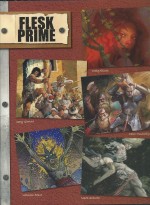
Flesk Prime


Illustrated by Craig Elliott, Gary Gianni, Petar Meseldžija, Mark Schultz & William Stout, edited by John Fleskes (Flesk)
ISBN: 978-1-933865-38-6

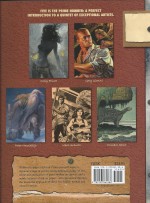
After everything is said and done the most immediate response to narrative art is through the eyes. The right picture is worth far more than a thousand words and this stunning hardback coffee-table sampler is stuffed with finished works and the far-more-interesting roughs, sketches, pencil stages, works-in-progress and details of a quintet of extremely talented stars who are all masters of communicating through unforgettable imagery.

Selected by art addict and specialist publisher John Fleskes, this superb tome collects a tantalising array of material to captivate all fans of fantasy, horror, comicbook action and even dinosauria, but is in fact a delicious physical ad and endorsement for the company’s even more tempting range of dedicated art-books by the contributors and other such talents as Al Williamson, Bruce Timm, James Bama, Steve Rude, Jim Silke, Harvey Dunn, Joseph Clement Coll and many more…

Each entry begins with a brief biography, starting with the incredible career of fine artist, commercial and comicbook painter, animation visual developer (Hercules, Mulan, Monsters vs. Aliens, The Lorax and more) and landscape architect Craig Elliott.

His gallery of 11 stunning fantasy paintings – plus a page detailing his work process – leads into an equally staggering array of works by commercial artist, illustrator and comics aristocrat Gary Gianni, accompanied by sketches, paintings and comic pages from Conan, Solomon Kane, 20,000 Leagues Under the Sea, Indiana Jones, The MonsterMen, Batman, Prince Valiant and much more.

Award-winning Serbian fantasy illustrator Petar Meseldžija is represented in an incredible gallery of 20 fantasy paintings, drawing and sketches, many starring the fantastic mythological monsters of his homeland, whilst comics superstar Mark Schultz contributes a dozen pages of working drawings, roughs and sketches from past glories such as Conan and Xenozoic Tales as well as a myriad of high adventure and fantasy scenarios.

This catalogue of wonders concludes with a selection by legendary artist, natural historian and illustrator William Stout, ranging from monster, zombie and dinosaur paintings to luscious animal pictures to comics covers to film posters and previously unseen record covers.

These pictures, ranging from intoxicating barbarian women, valiant sword-wielding warriors, wondrous dinosaurs, Cowboys and Indians, rockets and robots, bold heroes, period drama scenes, cosmic adventurers, beasts and monsters, aliens, action sequences, beguiling nudes and glamour studies, are the bedrock of fantasy illustration and these beautifully intimate glimpses of masters at work, with high quality colour reproduction capturing every nuance of brushstroke, pen line and pencil mark, make this a book a vital primer for anybody dreaming of drawing for a living. Most importantly the astounding breadth and scope of work presented here make me itch to pick up my pencil and draw, draw, draw some more myself.

Enticing, revealing, rewarding and incredibly inspirational, no lover of wonder or art lover can fail to be galvanised by this superb portfolio of excellence.
© 2011 Flesk Publications LLC. All Rights Reserved. All artworks and features © 2011 the individual creators, owners or copyright holders.

World War Z – the Art of the Film


By various (Titan Books)
ISBN: 978-178116-885-1

Regular readers will know that I’ve never been the biggest fan of zombie fiction but occasionally something comes along that compels me to re-evaluate my position. Such was Max Brooks’ 2009 companion to his excellent novel World War Z released as The Zombie Survival Guide: Recorded Attacks – a truly mind-boggling piece of graphic indulgence.

Now in the interests of completeness – and because those fine people at Titan Books sent me a review copy – I’m putting you wise to the official film-book which accompanies the blockbuster movie adaptation that resulted from the aforementioned paeans to the unliving and unloved…

This should be interesting for all of us as I haven’t seen the movie yet…

Max Brooks is a successful actor and screenwriter (most notably as part of the team scripting Saturday Night Live, and animation aficionados might recognize his name from the voice credits of Buzz Lightyear of Star Command, Batman Beyond and Justice League. You’ve probably laughed at a lot of his dad’s movies such as High Anxiety, Young Frankenstein and the first version of the Producers.

Brooks the Younger’s wry, satirical re-imagining of those hoary shambling horror icons has captivated readers since the book’s release in 2003 and the long-awaited, much-delayed cinema release has been eagerly anticipated…

The basic premise of this specific Rise of the Living Dead posits that a virus is responsible for the fall of civilisation. The infection can be found in every corner of the Earth, and it sure looks like Apocalypse Now…

This epic – 160 pages and 272 x 214mm – paperback volume reprints the shooting script (complete and correct at time of going to press) liberally illustrated and intercut with photographic stills, production art, storyboard sequences, computer modelling pieces and concept illustrations by Seth Engström, Kim Frederickson, Robbie Consing and others, peppered with quotes from cast, production crew, scripters and director Marc Forster.

The global setting and the journey of nominal protagonist Gerry Lane is visually divided into a ‘Prologue’ and key locations from the picture as the hero experiences and explores the Z-zone of ‘Philadelphia’ – paying particular attention to the fact that our own war zone of Glasgow substituted for the “City of Brotherly Love” – plus critical clashes in an ‘EZ Save’ supermarket and the ‘Newark Projects’, all ably augmented by Consign’s designs and storyboards.

Other key scenes encompass a ragtag naval ‘Flotilla’ that might be humanity’s last refuge, glimpses of lost ‘Korea’, the battle for ‘Jerusalem’ and the last retreat to ‘Wales’ before a final illuminative section hands over commentary to Special Effects wizards Andrew R. Jones, Alex Reynolds, Simon Crane, Simon Atherton and Scott Farrar who reveal the secrets of making ‘Zombies’ real, building the ‘Tools’ to kill them again and the magic of ‘Shooting Greenscreen’…

For the technically minded there’s also a full list of Acknowledgements to round off your brush with death…

Always the most engaging publishing add-ons to motion picture releases, such “Art of…” compendia are as much a part of the fun these days as popcorn and gum under your seats.  This book is both intriguing and pretty: enticing and genuinely informative enough to keep any fan happy. It might even convince me to watch the film….
World War Z ™ and © 2013 Paramount Pictures. All Rights Reserved.

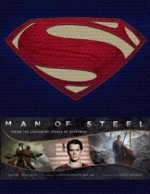
Man of Steel – Inside the Legendary World of Superman


By Daniel Wallace with photographs by Clay Enos (Insight Studios/Titan Books)
ISBN: 978-178116-817-2

Always foremost amongst the fascinating publishing add-ons to accompany major fantasy motion picture releases are the “Art of…” compendiums, and the terrific oversized (286 x 240 x 22mm) hardcover tome which supports the new Man of Steel film is both gloriously enticing and genuinely informative.

Author Daniel Wallace has compiled an eye-popping mix of production art, panoramic stills, pre-production designs and concept paintings gleaned from the various art departments and combined them with behind-the-scenes interviews, commentary and colour to produce a celebratory coffee-table art-book that is absolutely breathtaking.

After a Foreword by producer Christopher Nolan and Introduction from director Zack Snyder, ‘Modern Day Mythmaking’ reveals how the project came about with ‘Making it Happen’ and ‘Making it Real’, further disclosing the secrets of ‘The Suit’ before closing with the film’s philosophical mission statement in ‘Superman Vérité’.

The all-important ‘Casting Man of Steel’ explores and examines the actors, roles and thinking of the vast and stellar cast over nearly thirty electrifying pages, paying great attention to the costumes and designs of a scenario and society such as Superman fans have never seen before.

That imagination overload continues into ‘Welcome to Krypton’, highlighting ‘Kandor’ and ‘The Kryptonian Chamber’ before digressing onto a page dedicated to ‘Speaking Kryptonian’ (in my day it was “Kryptonese” but that’s my own personal digression-lite), after which the visual secrets of ‘The Ruling Council’, ‘Crafted Technology’ and ‘Automated Helpmates’ bring the planet’s robotic excesses to astounding life.

Now a ravaged, worn-torn world, Krypton’s martial advances are spotlighted in ‘Armed for Battle’ whilst ‘The House of El’, ‘Flora and Fauna’ and ‘The Genesis Chamber’ readily inform and expand on the unworldly realities of the lost planet and Superman’s history.

Further visualisations and revelations depict ‘Last Hope’, the awesomely appalling ‘Black Zero’, ‘The Dead Colonies’ long-abandoned by Krypton, and explain how the film designers attempted ‘Communicating with Contours’ before concluding with views of the pivotal ‘Scout Ship’ that changed Clark Kent’s life forever…

Locations and sets star in ‘Welcome to Earth’, with specific attention paid to the hero-in-waiting’s ‘Northern Journeys’, ‘Smallville’, Earth’s military bastion ‘U.S. Northcom’ and of course, ‘Metropolis’ before the epic exploration ends with a heartfelt appreciation of ‘The Heart of the Legend’…

Admittedly Inside the Legendary World of Superman was released to cash-in on the long-awaited movie, but this utterly engrossing picture-treat is such a superb slice of sheer imaginative indulgence no fan of film or funnybooks will want to miss out on such a marvellously magical experience.
© 2013 DC Comics. MAN OF STEEL, SUPERMAN and all related characters and elements ™ and © DC Comics. All Rights Reserved.

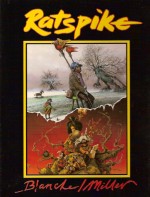
Ratspike


By John Blanche & Ian Miller (Games Workshop)
ISBN: 978-1-87237-200-6

I haven’t covered an actual art book in an age, so let’s look at a little known gem sorely in need of a new edition featuring the grotesquely beautiful art of painter and illustrator Ian Miller (The City, The Luck in the Head, Green Dog Trumpet) and designer, model-maker and illustrator John Blanche.

Both eclectic individualists found a spiritual home and an outlet for their fantastic fantasy imaginings at role-playing, book and comics publisher Games Workshop/Black Library, and their painterly endeavours happily led to the stunning celebration of the macabre and mind-bending melange of modern myth realisation under review today.

The legendary entertainment firm began by importing American product at the beginning of the Dungeons and Dragons craze in the 1980s before quickly moving on to creating their own material. Soon they were expanding into prose and pictorial fiction too, supported by some frankly astounding illustration material on their game packaging, periodical publications (White Dwarf, Fighting Fantasy Gamebooks, Warhammer 40,000, Inferno and others) as well as sequences of original material novels in the fantasy, horror and science fiction genres.

This stunning oversized (29 x 21.8 x 1.5cm) hardback coffee-table tome was released in 1989 and offers a mesmerising selection of paintings and drawing from two uniquely inspired creators, beginning, after a Foreword by fantasy illustration giant Patrick Woodroffe, with John Blanche.

Eventually becoming Games Workshop’s Art Director, Blanche got his first big break after meeting Roger Dean, subsequently going on to develop a dark, punk-inspired painstakingly classical illustration style, usually working smaller than published size and having his work “blown up”, not reduced, for printing.

This compulsive chronicle combines, intersperses and interweaves the art with creator commentary, personal memories, insights and creative secrets as well as evocative literary quotes and snatches of poetry to enhance the images and, after Lewis Carroll’s Jabberwocky, plunges into a welter of nearly 80 paintings and drawings over 62 pages, crammed with amazons, warriors, aliens, barbarians, fairy princes, eldritch post-apocalyptic demons and all the attendant genre icons beloved by generations of imaginers.

The affable maven of menace macabre discusses his unforgettable work such as ‘Ice Unicorn’, ‘War Boss’, ‘Good King Otto’, ‘Amazonia Gothique’ and ‘McDeath’ plus  devoting much time to the infinitesimal discipline of building and painting miniatures – many of which have their own scarily impressive, ironically, mordantly funny section here.

The second half of the book is devoted to Ian Miller’s bleakly complex, convoluted classicist Dürer, Bosch and Druillet inspired futurisms which, before his association with Games Workshop, were best seen illustrating Tolkien, H.P. Lovecraft and Mervyn Peake’s Gormenghast stories as well as in films such as Ralph Bakshi’s Wizards and Coolworld.

His concluding half of the graphic gallery – 68 pages in all – combines quotes from Treasure Island, children’s nonsense rhymes, an intimate biography and disquieting slogans and snatches of prose with sketches, drawings, pen-and-ink studies and more than 100 paintings and less conventional images, displaying the artist’s signature brain-blasting architecture, eye-shredding monsters, blasted trees, isolated warriors and chaos knights.

Also on show are notional comic-strip sequences and works with such evocative if non-defining titles as ‘Death in the Rocking Horse Factory’, ‘Udder Woman, Killer of Cows’, ‘Angel Butcher’, ‘Hollywood Gothic’ and ‘Those Sent to that Dark Place’, all guaranteed to subtly engender unease and worse…

With the fantasy genre in full revival mode thanks to the likes of movies like The Hobbit and TV shows like Game of Thrones and Da Vinci’s Demons, there’s never been a better time to revisit this book or even further explore the lost marvels of a superb cadre of forgotten artists. So if you need to escape this ghastly world of humdrum terrors for a brief moment – and don’t we all? – seek out this Bestiary of the Bizarre and let yourself go…
© 1989 GW Books. © John Blanche & Ian Miller. All rights reserved.

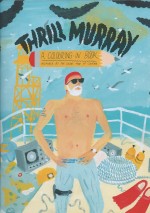
Thrill Murray – a Colouring-In Book


By Mike Coley & various (Belly Kids)
ISBN: 978-0-9574909-0-1

Belly Kids are a quirky multimedia arts company with a fun-fuelled, anything goes attitude, producing art-based books, records, DVDs, t-shirts, merchandise, live shows and comics just because they can.

This decidedly peculiar collective tribute to a true Hollywood original features twenty three memorable coloured images of the masterful William James “Bill” Murray in many of his most iconic roles, crafted by a bevy of uniquely individualistic artists.

Moreover there are adjacent monochrome iterations of each image just so you and your young ‘uns can have a go at improving upon each…

Ranging from passionately illustrative to baldly comic, these cartoon contributions from Hattie Stewart, Murray Somerville, Logan Fitzpatrick, Anneka Lange, Jonny Packham, James Burgess, Alice Devine, Bridget Meyne, Brooke Olsen, Tobias Hall, Mike Kilkelly, Nicholas Stevenson, Thomas Key, Chris Arrowsmith, Richard Fairhead, Marie-Louise Plum, Catherine Askew, Mya Munnelly, Rosie Roberts, Beth Harris, Donald Ely, Mary Cheung and Nathan Dirienzo recapture the magic of the great man’s celluloid hits from Caddyshack to Groundhog Day, Ghostbusters to The Life Aquatic with Steve Zissou and much more.

It’s never too soon or too late to get in touch with your visually expressive side, and the only way this wonderfully wry and imaginative activity book could be improved is with a box of crayons or some paints and pens…

Irreverent, subversive and appallingly addictive, the combination of great characters, compelling pictures and mirthful attention-seizing is a welcome weapon to get kids reading and creating rather than sluggishly absorbing whatever’s on the TV or computer screen.

Forget video-games – buy that child or your partner this book. If you’re worried about exercise, make ’em do the colouring-in standing up and if they make a mess you can boost their cardio rate by getting them to clean up.

Boy, you have a lot of problems having a bit of fun…
© 2012 Belly Kids. All Rights Reserved.

Problematic: Sketchbook Drawings 2004-2012


By Jim Woodring (Fantagraphics Books)
ISBN: 978-1-60699-594-5

Some creators in the world of comics just defy description and their graphic novels and collections are beyond the reviewer’s skills (mine certainly) to elucidate or encapsulate. Some are just so pedestrian or mind-numbingly bad that one simply can’t face writing about them. Others are so emphatically wonderful that no collection of praise and analysis can do them justice.

At the apex of that tricky funnybook pyramid is Jim Woodring: a position he has maintained for years and clearly appears capable of holding for years to come. Woodring’s work is challenging, spiritual, philosophical, funny, beautiful and extremely scary. And, even after reading that sentence, you will have absolutely no idea of what you will be seeing the first time you read any of it.

Moreover, even if you have scrupulously followed cartoonist, animator, Fine Artist, toy-maker and artistic Renaissance Man James William Woodring through an eccentric career spanning his first mini-comics in 1980, the groundbreaking Fantagraphics magazine series such as Jim (1986), the notional spin-off Frank (of which Weathercraft was the latest incredible instalment), Tantalizing Stories, Seeing Things, Congress of the Animals or his more mainstream features such as Star Wars and Aliens tales for Dark Horse, you’ll still have no idea how you will respond to his newest work.

Woodring delivers surreal, abstract, wild, rational, primal cartooning: his clean-mannered art a blend of woodblock prints, Robert Crumb style, wry humour and eerie conviviality, Dreamscape, religious art and monstrous phantasmagoria. His works form a logical, progressional narrative pockmarked with multiple layers of meaning but generally void of speech or words, magnificently dependent on the intense involvement of the reader as a fully active participant.

So you can imagine what his first formative thoughts, passing observations and moments of wild unfettered graphic whimsy must be like…

This stunning little hardback opens the gates of dream just a crack and offers selected graphic snippets from his sketchbooks covering the superbly productive period following the millennium and offering a few choice views of the other graphic avenues he could have travelled if the world of harnessed hallucinations had not such a strong hold…

In his ‘Introduct’ Woodring describes his abandonment of traditional graphic tomes for diminutive “Moleskine” doodle-pads, using the flimsy palm-sized books to capture ideas roughly, quickly and with intense immediacy …and the gimmick clearly works.

The material collected here – mostly enlarged 140% up from the originals – simply buzzes with life and energy.

Many Frank regulars appear, including the eponymous Krazy Kat-like ingénue himself, and there are absolute torrents of bizarre, god-like household appliances, vulture-things, frog-things, rhino-things, plant-things and unspeakable Thing-things, that inhabit the insanely logical traumic universe of his sensoria.

There are snippets of reportage, plenty of designs and even roughs and layouts from finished stories. Woodring also proves himself a pretty sharp pencil when it comes to capturing the weird moment of reality we all experience, a keen caricaturist and a deliciously funny “straight gag-man”, glamour artist and capturer of friends in idle moments – just like all of us sad art-school escapees who break into a cold sweat whenever we realise we’ve left the sketchbook at home and there’s only beer-mats and napkins to draw on….

Woodring is not to everyone’s taste or sensibilities – for starters, his drawings have a distressing habit of creeping back long after you’ve put the book down and scaring the bejeezus out of you – but he is an undisputed master of the form and an innovator always warping the creative envelope.

As such this welcome peek into his creative process and conceptual/visual syllabary offers encouragement and delight to artists and storytellers of every stripe, as well as being just plain wonderful to see.

All art-forms need such creators and this glorious hardback monochrome tome could well change your working and reading habits for life.

Go on, aren’t you tempted, tantalized or terrified yet? What about curious, then…?
© 2012 Jim Woodring. This edition © 2012 Fantagraphics Books. All rights reserved.

A Secret History of Coffee, Coca & Cola


By Ricardo Cortés (Akashic Books)
ISBN: 978-1-61775-134-9

Win’s Christmas Gift Recommendation: potent, punchy and thought-provoking fodder to enjoy after overindulging… 9/10

The astounding power of graphic narrative to efficiently, potently and evocatively disseminate vast amounts of information in layered levels has always been best utilised in works with a political or social component. That’s seldom been better demonstrated than in this stunning and scholarly new picture book from Ricardo Cortés.

Born in 1973, illustrator and artistic intellectual activist Cortés has had a sublimely seditious career thus far. He has made waves in Vanity Fair, Entertainment Weekly, The New York Post, The Village Voice, San Francisco Chronicle, and been challenged on CNN and FOX News after his controversial  children’s book Marijuana: It’s Just a Plant – written by Marsha Rosenbaum – was mentioned in Congress. He followed up by illustrating Adam Mansbach’s Times Best-Selling Go the F**k to Sleep and its sequel Seriously, Just Go to Sleep, and created the colouring book I Don’t Want to Blow You Up! about famous Muslims who aren’t terrorists.

In 2011 the artist received a grant from the Department of Cultural Affairs’ Greater New York Arts Development to create Jury Independence Illustrated – a public booklet dealing with Jury Nullification produced with the intention of educating potential jurors about their powers to acquit if they disagree with specific laws or judicial rulings. Clearly a born troublemaker…

His latest project is a brilliantly engrossing exploration of acceptable addictions blending scrupulously scholarly reportage with a seductively beautiful selection of captivating images and historical reproductions.

The story starts with the origins and history of ‘Coffee‘ from its mythic discovery as a berry fruit for goats in Ethiopia, through being taken up by Yemeni traders who disseminated “qahwah” throughout the Islamic world. A proven intoxicant, concerns over its salubrity, morality and legality grew and it was soon being trafficked by desperate men. In the 16th century the beverage was banned in Mecca, Cairo and elsewhere, but its taste and effects were impossible to resist.

By the time “kahveh” reached Turkeytrading in the beans carried the death penalty. As “Coffee” it reached Europein the 17th century, touted as a miracle cure-all for everything from headache to miscarriage and grew explosively into an intellectual’s seditious vice. In 1675 Charles II ordered it suppressed and closedEngland’s Coffee Houses by Royal Edict.

Things got even stranger in 1820 after the alkaloid “Caffe-ine” was finally distilled from the coffee cherry…

The rest of caffeine’s turbulent and torturous legal and commercial progress to today’s status as the world’s most popular stimulant is followed by the story of ‘Cola and Coca’ in which caffeine’s other singularly popular method of natural dissemination is examined.

The Kola Nut of West Africa is amazingly high in the stimulant alkaloid and has been used for centuries – if not millennia – as a energy-intensifying fortifier by the various tribes and nations either by chewing the raw nut or brewing a drink called “cola”.

Cola is one of the most popular ancient beverages on Earth and when in 1886 Dr. John Pemberton devised his own formulation – dubbed Coca-Cola – by adding a dash of coca leaves, his medicinal tonic, after an initial shaky start, grew to become the most monolithic drinks brand on Earth.

…But not, apparently, without a little government help…

Coca originally came from the Andes of South America where for centuries indigenous peoples used the herbal bounty as a pick-me-up. The Indios chewed coca leaves the way we do gum in the west and in 1499 explorer Amerigo Vespucci brought back tales of the wonder herb’s propensity to promote feats of concentration and endurance.

In 1859 Dr. Karl Scherzer returned to Austria after a two-year scientific voyage aboard the Frigate Novara with sixty pounds of coca, as previously requested by German pharmacologists. Soon after doctoral student Albert Niemann isolated from the samples a new alkaloid which he dubbed “Coca-ine”.

This fresh medical marvel, its transparent crystals easily derived from coca leaves, was from 1884 enthusiastically prescribed by the likes of Sigmund Freud for melancholia and oculist Carl Koller discovered it to be an incredible regional (or as we now know them “local”) anaesthetic, allowing unprecedented new surgical procedures to be performed. It was also used as a commonplace treatment for toothache, labour pains, nervousness, fatigue, impotence, asthma and as a cure for morphine addiction – hence Pemberton’s inclusion of the stuff in his health tonic.

By 1889 cases of compulsive use and abuse began to be reported, leading to heated medical debate, and when the era’s obsessive racial concerns were added to the mix (“cocaine made negroes insane” and it was peddled by “greedy Jewish doctors”) the writing was on the puritanical wall for the foreign import.

On a rising tide of public disapproval the 1914 Harrison Narcotics Act prohibited Cocaine use and coca importation in theUSA. However due to some truly unbelievable backroom dickering, the already powerful Coca-Cola Company secured a constant supply of the banned substance – re-designated “Merchandise No. 5” – for their Schaefer Alkaloid Works in New Jersey – still thriving today as the Stepan Chemical Company.

This mercantile miracle was all due to diligent work of Commissioner Harry J. Anslinger of the Federal Bureau of Narcotics and Ralph Hayes, a former aide to theUS Secretary of War and from 1932, a vice President of the Coca-Cola Company.

Anslinger was a rabid anti-drug zealot, so just why did he spend 40 years – under seven different US Presidents – enforcing draconian and often expensive, nigh-impossible bans on a vast number of natural pharmaceutical products whilst actively securing and defending Coca-Cola’s uninterrupted supply of cocaine?

He even facilitated clandestine schemes to grow coca on American soil and his campaign was so successful that American policy became UN and global norms, forcibly negating all the proven scientific benefits of resources which grew naturally in countries which could never afford Western drugs and chemical advances.

Trust me; you only think you know the answer…

Astonishingly addictive and intoxicatingly revelatory, Coffee, Coca & Cola offers an impressively open-minded history lesson and an incredible look at the dark underbelly of American Capitalism. Exposed here through telling research and beguiling illustrations is a catalogue of hypocrisy wherein successive political administrations and big business always found ways to place commercial interests ahead of any specious moral imperative ingenuously forwarded by the “World’s Cop”.

Learn here how corporations and statesmen conspired to ruthlessly crush the traditions, customs and rituals of other nations and cultures (as recently as 2010, America acted to suppress many sovereign South American countries’ social, spiritual, medicinal and nutritional use of coca) and continue to prevent poor countries utilisation of such ancient natural resources as caffeine and cocaine whilst peddling products inescapably wedded to both American Expansionism and Ideology…

A stunning, hard cover coffee-table book for concerned adults, this captivating chronicle is a true treasure – or perhaps in the parlance of the idiom I might just say – lip-smacking, trust-quenching, cool looking, stimulating, motivating, hard talking, fool busting, fast thinking, hard quizzing… and unmissable.
© 2012 Ricardo Cortés. All rights reserved.

Signal: 02 – A Journal of International Political Graphics


Edited by Alec Dunne & Josh MacPhee (PM Press)
ISBN: 978-1-60486-298-0

“A week is a long time in Politics” – Harold Wilson

I’m going to go all traditional here and offer a few on-line dictionary definitions before I head off on one of my own oblique and off-kilter diatribes.

Politics can be reduced to:

  • The art or science of governing – especially of a political entity such as a nation – and the administration and control of its affairs.
  • The activities or affairs engaged in by a government, politician, or political party.
  • The methods or tactics involved in managing a state or government.
  • Intrigue or manoeuvring within a political unit or group in order to gain control or power.
  • The often internally conflicting interrelationships among people in a society

I’d like to add my own codicil which translates as

  • “Getting large groups of people to do what you want by making them believe it’s their own idea; as perpetually practiced by advertisers, teachers in classrooms, rich folk, commercial organisations and special interest groups, trades unions, and organised religions”.

The early years of the 21st century were plagued with horrors and disasters exacerbated by a hideous global proliferation of lying, greedy, venal, demented and just plain stupid bosses and governments. These paragons finally succeeded in elevating politicians of every stripe to that phylum of generally useless tools and pimples on the butt of humanity once only occupied by lawyers and management consultants.

Since then so many apparently entitled and greedy types like bankers, astrologers, wedding planners, doorstep evangelists, CEOs, celebrity gossip columnists, newspaper editors, the shamelessly privileged and all types of psychics have joined their rarefied ranks, and I’m thinking I probably need to either cut down on coffee or refine my critical parameters…

The century before that wasn’t much better either, but it did spawn a global awareness of the sheer symbolic power of pictures to promote debate, action and change. The political image was used over and over again by the underdogs – and to be honest, the more savvy oppressors – in countless intellectual wars as an irresistible Weapon of Mass Deliberation…

When creative passions are aroused there is no more powerful medium of expression or tool of social change than graphic narrative working in seamless conjunction with a trenchant, targeted image. Whether it’s the swingeing satire of reformers such as Hogarth, the prose of Dickens illustrated by Hablot Knight Browne AKA “Phiz”, the publications of Mark Lemon and Henry Mayhew (founders of Punch), the questing explorations of Will Eisner, Joe Sacco, Art Spiegelman and Marjane Satrapi or even the devastatingly deployed propaganda art of every nation on Earth, the incisive, excoriating or simply biting illustration wedded to the well-loaded word is an overwhelming force and Mass Communication’s only renewable resource: cheap, universally accessible and capable of extrapolating terrifying conclusions from the scarcest of supplied data.

Although not strictly a graphic novel, Signal: 02 was selected to begin this Week in Politics season because it embodies and celebrates the earliest and still most effective forms of mass communication; circumventing reason and language – often even literacy itself – by reaching through the eyes right into the heart and the gut of the viewer.

Signal is produced by illustrator, historian and printmaker Alec Dunn and designer/artist Josh MacPhee, co-founder of the Interference Archive and organizer of Celebrate People’s History Poster Series. Their occasional periodical is dedicated to documenting and sharing political graphics, creative projects and cultural artefacts of international resistance and liberation struggles.

Utilising typography and design in the same bold exuberant manner as the British Vorticist Movement‘s manifesto Blast (which declared war on traditional art in its landmark edition of 1914) to disseminate and keep alive historic moments of global mass-movements, this edition opens with Judy Seidman’s ‘Malangatana’s Fire’: a comprehensive review of the life and achievements of legendary revolutionary painter and UNESCO Artist for Peace Malangatana Valente Nguenha.

The liberally-illustrated piece celebrates the Mozambiquan painter, poet, musician and intellectual whose life and haunting works spanned his rural upbringing under Portuguese colonial rule through revolution and years of civil war to the current national renaissance and his role as Mozambique’s Cultural Ambassador to the World.

The artist’s stunning, moodily symbolic works carried his people through the liberation, civil war, decades of political turmoil and savage brutality into the peaceful present by exalting the people’s age old roots and symbols…

This is followed by ‘Street Murals in the Portuguese Revolution’ wherein Phil Mailer details the guerrilla art and its factional creators who plastered the walls of the nation in a massive explosion of anonymous popular creativity during and after a military coup toppled the Fascist government which ruled Portugal in April 1974, after which Editors Dunn & MacPhee offer a fascinating typographical treat in ‘Selling Freedom’.

This glorious visual reminiscence reveals a riot of ‘Early Twentieth-Century Anarchist Broadsides’ – letterpress printed, broadsheet advertisements for the venerable (established in 1886 and still going) publication Freedom: A Journal of Anarchist Communism. This entrancing example of the polemical power of the printed word is followed by ‘Cranking It Out Old School Style’ as Lincoln Cushing describes the age of Gestetner printers which first brought the process of mass communication into the hands of the people, long before photocopiers, faxes, computer printers, instant messaging and e-pages of every sort. In the hands of imaginative and determined artists visual miracles were made, from campaigns seeking to end violence against women to populist movements fighting prejudice and social injustice …

The ‘Art of Rebellion’ by Deborah Caplow then explores Oaxacan street art in context, recounting decades of internecine strife in Mexico, after which The Center for International Research on Anarchism: Japan describes the life of seminal printer, propagandist, anti-fascist, anti-militarist Esperanto advocate Taiji Yamaga who published radical periodical The People’s Newspaper and opposed the repressive militarist regime of the expansionist Warlords who were de facto rulers of Japan until the end of WWII. At the end of a turbulent life, the great thinker recreate key moments of his life in an autobiographical comic, and ‘Sketches from Memory’ is undoubtedly the star of this show, focussing a surmising light on ‘The Yamaga Manga and Japanese Anarchism’…

By captivatingly relating days and years of domestic intimacy, personal imprisonment, triumph, tragedy and turmoil under appalling political duress, Yamaga turns a spotlight on an aspect of Japanese history carefully glossed over and almost redacted from conventional histories…

‘A Heart of Concrete through Fire and Water’ by Kasper Opstrup Frederiksen explores the history and achievements of the Danish Røde Mor art collective 1968-78 which adopted showbiz techniques and public stunts to change the cultural landscape and mindset. After years of challenging, surreal events, the core of dedicated New Left surrealists in the “Red Mother” art collective gradually became subsumed into the national psyche, as a graphic workshop, a band, a circus and finally a fund to finance political art projects.

So was that a victory or a defeat?

Scholarly, challenging, utterly engrossing and intoxicating, this is a superb treat for everyone whose mind works in pictures and causes…

© 2012 PM Press. Individual copyright retained by respective contributors.

Liberatore Glamour Book


Edited by Vincenzo Mollica & Antonio Vianovi (Glamour International Productions)
No ISBN

A lot of people may find the graphic arts collections under review here to be shocking, unacceptably violent and even revolting or, worse yet, dirty.

If that’s you, please stop right here and come back tomorrow when there will something you’ll approve of but will almost certainly offend someone else.

Italy has a rich and varied comics culture with some highbrow classics and lots and lots of cheap, cheerful, cheesy and even sordid commercial filler – just like everywhere else. Italian illustration superstar Gaetano “Tanino” Liberatore, like most masters of the form, paid his dues and worked his way up the ranks until he eventually found stardom, infamy and his ideal working environment…

He was born in 1953 in Quadri in the province of Chieti. After the usual kind of artistic childhood the kid went to school in Pescara and studied architecture at the University of Rome before moving into the world of work as an advertising illustrator in 1975.

He first met his fellow philosophical seditionist and punk-soul brother (writer, artist and publisher) Stefano Tamburini in 1978 and, in conjunction with strident activist cartoonist Andrea Pazienza, they created ‘Rankxerox’ for the magazine Cannibale. The character evolved and moved to Il Male and eventually Frigidaire, fully realised now as the RanXerox we know today – every bit Libertore’s signature character the way Eisner has The Spirit, and Hergé Tintin…

Liberatore rapidly developed as both artist and writer, with strips ‘Bordello’ and ‘Client’ appearing in Il Male, but when the new, Tamburini-scripted, syndicated RanXerox became a star of French magazine L’Écho des Savanes in 1981, Tanino moved to Paris and began working simultaneously on tales for the more prestigious Gallic market in such magazines as Tranfert, Métal Hurlant, À Suivre and Chic.

A shocking hit in the US Heavy Metal magazine, RanXerox then led to Liberatore jumping the pond and producing material for Twisted Tales and men’s magazine Hustler.

When Tamburini died suddenly in 1986, Liberatore quit comics for nearly a decade. Returning to straight commercial illustration, he worked in movies and designed book and record covers. Eventually, comics captured his attention again, and he produced two new RanXerox tales in 1993 and 1996 (with Jean-Luc Fromental and Alain Chabat), and a piece in Batman Black and White, assorted covers, and illustrated Pierre Pelot and Yves Coppens’s mass-market paperback ‘Le Rêve de Lucy’. As the Nineties closed, he finally came storming back in stunning style with the brilliant, award-winning Lucy L’Espoir in 2007, in which he and writer Patrick Norbert freely adapted a life-story for the famous prehistoric humanoid Australopithecus Afarensis remains found by anthropologists Coppens, Donald Johanson and Maurice Taieb.

The early Liberatore is the unqualified master of shock tactics. His beautifully rendered work dwells with obsessive, aggressive fascination of the grotesque, both visually and thematically. Stylish elegance goes hand-in-hand with horrifying, blunt scarification, in-your-face casually acceptable deformity and abnormality as suave, raffish he-men readily range beside hideous human travesties, ugly children and wanton, fearsome under-age harlots and murderous junkies.

His worlds are not ones where anybody should feel safe or comfortable in visiting…

One fascinating fact often neglected is that the artist usually drew his stunning pages same-size or even smaller than the printed final work – a complete reversal of the regular way comics were produced – and used a huge variety of materials to achieve his artistic effects, from cheap felt pens to high quality pencils, paints or markers and even lipstick and found objects…

That spectacular facility for experimentation is perfectly displayed in the book under review here. In the early 1980s the Italian outfit which produced Popular Arts magazine Glamour Illustrated released a series of phenomenal art-books, collecting and cataloguing the extant works of many modern maestros of mature modern sequential narrative which had limited distribution in Britain – despite the best efforts of specialist importer Titan Distributors – and all those tomes are long past due for revision and reissuing…

This glorious collection of Liberatore’s early years, simultaneously transcribed in Italian, French and English, gathers hundreds of works and excerpts within its 204 pages (many of them full-colour high-gloss inserts), traces the artistic development and displays the incredible ability and versatility of this incomparable, iconoclastic stylist, divided as usual into early ‘Unpublished Works’, ‘Black and White’ – printed pieces and extracts ranging from comics pages and panels, pin-ups, ads, illustrations, posters and covers – and concluding extensive ‘Colour’ section.

The ‘Unpublished Works’ section here include masses of Liberatore’s superb pencil drawings and preliminary sketches, unfinished and self- rejected pages as well as commercial designs, calendars, and a ton of fanzine work dedicated to music sensations such as Frank Zappa, Paul McCartney, Grateful Dead and so on, choreographed fight scenes and designs for every aspect of his finished pieces and is capped by an extra ‘Donne’ chapter featuring a stunning sequence of pencil studies of women…

‘Black and White’ contains a wealth of work showing the artist’s fantastic versatility as seen in record jackets, magazine covers and illustration, satirical comics and cartoons plus loads of strips for publications as varied as Cannibale, Il Male, Frigidaire, Transfert, RanXerox and a host of others.

The ‘Colour’ section reveals, in a wealth of different hues and stylisations, his canon of covers for comics, magazines, books and records; posters, cartoons, works in progress, strips, stage art for theatrical performances, paintings, along with many pages and extracts from his strips produced in Italy and France, and American works for Hustler, Heavy Metal and Marvel’s Savage Sword of Conan.

The collection also contains impressively comprehensive checklists which detail in full Liberatore’s vast publication record to date in their ‘Chronology’ and ‘Bibliography’ sections.

As you would expect, there is a breathtaking amount of beautifully rendered flesh and deeply unsettling hyper-violence and subversive visual political polemic on display – and I’m sure I don’t know which is the most distressingly affecting – in an unrelenting series of lascivious situations and occasionally genuinely disturbing circumstances… and his brutally sly sense of humour.

Liberatore is another world-class storyteller English speakers have too long been deprived of, and books like this have never been more desperately in need of updating and re-release …
No copyright notice again so I’m assuming:
© 1972-1985 Gaetano Liberatore. All rights reserved. If anybody knows better please let me know and we’ll amend the entry.