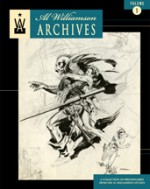
Al Williamson Archives volume 1


By Al Williamson with an introduction by Angelo Torres (Flesk)
ISBN: 978-1-933865-29-4

Al Williamson is one of the greatest draughtsmen ever to grace the pages of comicbooks and newspaper comics sections. He was born in 1931 before his family moved from New York City to Bogota Columbia at the height of the Golden Age of syndicated adventure strips.

The lad’s passion for strips – especially Alex Raymond’s Flash Gordon and Jungle Jim – was broadened as he devoured imported and translated US material as well as the best that Europe and Latin America could provide in such anthology magazines as Paquin and Pif Paf. Aged 12 Williamson returned to America and, after finishing school, found work in the industry that had always obsessed him.

In the early 1950s he became a star of E.C. Comics’ science fiction titles, beside kindred spirits Joe Orlando, Wally Wood, Roy G. Krenkel, Frank Frazetta and Angelo Torres, and drew Westerns Kid Colt and Ringo Kid for Atlas/Marvel. During the business’ darkest days he gravitated to newspaper strips, assisting John Prentice on Rip Kirby – another masterpiece originally created by Alex Raymond.

When comicbooks gradually recovered, Williamson drew Flash Gordon for King Comics and worked on mystery tales and westerns for DC whilst drawing such globally distributed newspaper features as Secret Agent Corrigan plus groundbreaking film adaptations of Bladerunner and Star Wars.

His stunning poetic realism, sophisticated compositions and fantastic naturalism graced many varied tales, but in later years he became almost exclusively a star inker over pencillers as varied as John Romita Jr., Larry Stroman, Rick Leonardi, Mark Bright, José Delbo and a host of others on everything from Transformers to Spider-Man 2099, Daredevil to Spider-Girl.

Al Williamson passed away in June 2010.

Flesk Publications is an outfit specialising in art books and the tomes dedicated to the greats of our industry include volumes on sequential narrative and fantasy illustration starring Steve Rude, Mark Shultz, James Bama, Gary Gianni, Franklin Booth, William Stout and Joseph Clement Coll. The guiding light behind the company is devoted and passionate art lover John Fleskes.

This initial oversized (305 x 232mm) 64 page collection of sketches, working drawings, unused and unfinished pages from one of the stellar creators of our art form stars captivating heroines, lusty barbarians, space heroes, beasts, aliens and so many wonderful dinosaurs, but also presents lesser known western scenes, science fiction tech, character sketches, duels, action sequences, nudes and glamour studies, unfinished pages from Xenozoic tales and John Carter of Mars, religious scenes and delicious unseen excerpts from Rip Kirby, as well as a glimpse into Williamson’s creative process.

The beautifully intimate glimpses of a master at work, with full colour reproduction capturing every nuance of Williamsons’ gorgeous pencil strokes, make this a book a vital primer for anybody dreaming of drawing for a living and the stirring lavish material revealed here will enthral and entice every fan of wondrous worlds and fantastic forgotten realms.

© 2010 Al Williamson. All Rights Reserved.

Krampus: the Devil of Christmas


By various, edited by Monte Beauchamp (Last Gasp)
ISBN: 978-0-86719-747-1

With Easter upon us it’s clearly time to start thinking about Christmas and this delightfully engrossing hardback celebration from artist, historian and designer Monte Beauchamp (a welcome expansion on his 2004 book The Devil in Design) focuses on a lost aspect of the Season of Good Will.

For decades Monte Beauchamp’s iconic, innovative narrative and graphic arts magazine Blab! highlighted the best and most groundbreaking trends and trendsetters in cartooning and other popular creative fields. Initially published through the auspices of the much-missed Dennis Kitchen’s Kitchen Sink Press it moved first to Fantagraphics and exists as the snazzy hardback annual Blabworld from Last Gasp. Here however he looks back not forward to revel in the lost exuberance and dark creativity of a host of anonymous artists whose seasonal imaginings spiced up the Winter Solstice for generations of kids…

In Western Europe, particularly the German-speaking countries but also as far afield as Northern Italy and the Balkans, St Nicholas used to travel out with gifts for good children accompanied by a goat-headed, satanic servant. Fur-covered, furtive, chain-bedecked, sinister and all-knowing, the beast-man with a foot long tongue and one cloven hoof, wielded a birch switch to thrash the unruly and a large sack to carry off disobedient children.

The Krampus became a fixture of winter life in Austria, Switzerland and the German Principalities, with his own special feast-day (December 5th – just before St. Nikolaus’ Day), parades, festivals and ceremonial child-scaring events. Back then we really knew how to reward the naughty and the nice…

This spectacular tome celebrates the thrilling dark edge of the Christmas experience as depicted through the medium of the full-colour postcards that were a vital facet of life in Europe from 1869 to the outbreak of World War I.

However, even with fascinating histories of the character and the art-form related in ‘Greetings From Krampus’, ‘Festival of the Krampus’ and ‘Postal Beginnings’ the true wonder and joy of this collection is the glorious cacophony of paintings, prints, drawings collages – and even a few primitive photographic forays – depicting the delicious scariness of the legendary deterrent as he terrified boys and girls, explored the new-fangled temptations of airplanes and automobiles and regularly monitored the more mature wickednesses of courting couples…

A feast of imagination and tradition ranging from the wry, sardonic and archly knowing to the outright disturbing and genuinely scary this magical artbook is a treasure not just for Christmas but for life…

© 2010 Monte Beauchamp. All rights reserved.

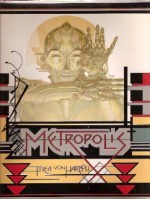
Metropolis


By Thea von Harbou, illustrated by Michael W. Kaluta (Donning/Starblaze)
ISBN: 0-89865-519-6

People who work in comics adore their earliest influences, and will spout for hours about them. Not only did they initially fire the young imagination and spark the drive to create but they always provide the creative yardstick by which a writer or artist measures their own achievements and worth. Books, comics, posters, even gum cards (which mysteriously mutated into “Trading Cards” in the 1990s) all fed the colossal hungry Art-sponge which was the developing brain of the kids who make comics.

But by the 1970s an odd phenomenon was increasingly apparent. It became clear that new talent coming into the industry was increasingly aware only of comic-books as a source of pictorial fuel. The great illustrators and storytellers who had inspired the likes of Howard Chaykin, Bernie Wrightson, Mike Kaluta, P. Craig Russell, Charles Vess, Mike Grell, and a host of other top professionals were virtually unknown to many youngsters and aspirants. I suspect the reason for this was the decline of illustrated fiction in magazines – and general magazines in general.

Photographs became a cheaper option than artwork in the late 1960s and as a broad rule populations read less and less each year from that time onwards.

In the late 1980s publisher Donning created a line of oversized deluxe editions reprinting “lost” prose classics of fantasy, illustrated by major comics talents who felt an affinity for the selected texts. Charles Vess illustrated Shakespeare’s A Midsummer Night’s Dream, P. Craig Russell created magic for The Thief of Bagdad and Mike Grell depicted the word’s greatest archer in The Merry Adventures of Robin Hood of Great Renown in Nottinghamshire.

Arch period stylist Mike Kaluta worked on something a little more exotic; illustrating the original film scenario (a broad shooting script used by movie-makers in the days before dialogue) written by Thea von Harbou after her husband returned from a trip to America.

Herr “von Harbou” was German expressionist genius Fritz Lang, and his account of his fevered impressions, responses and reminiscences became the ultimate social futurist fiction film Metropolis – possibly the most stirring, visually rich and influential movie of the silent era – and officially the most expensive film ever made during the pre-talkies era.

If you haven’t seen the film… Do. Go now, a new re-re-restored version was released in 2010 – the most complete yet. I’ll wait…

The plot – in simple terms – concerns the battle between proletarian workers and the rich, educated elite of a colossal city where workers toil in hellish, conformist subterranean regiments to provide a paradise for the bosses and managers who live like gods in the lofty clouds above.

It would be the perfect life for Freder, son of the grand architect Joh Fredersen, except for the fact that he has become besotted with Maria, an activist girl from the depths. The boy will move Heaven and Earth to have her love him. He even abandons his luxuries to become a worker near her…

Distraught Fredersen renews his tempestuous relationship with the crazed science-wizard Rotwang, once ally and rival for the love of the seductive woman Hel.

Rotwang offers his aid but it is a double-edged sword. He kidnaps Maria and constructs an incredible robotic replacement of her, to derail her passive crusade and exact his own long-deferred revenge…

This “novelisation” – for want of a better word – is as engrossing as the film in many ways but the story is elevated by the incredible illustrations produced by Kaluta -5 full page artworks in evocative chalk-and-pastel colour, two incredible double-page spreads in black line plus 32 assorted monochrome half-frames and full pages rendered in black & white line, grey-tones, charcoal, chalk monotones and pastel tints – an absolute banquet for lovers of art deco in particular and immaculate drawing in general.

Whilst no substitute for the filmic experience, this magnificent book is a spectacular combination of art and story that is the perfect companion to that so-influential fantasy masterpiece beloved by generations of youngsters.
© 1988 by the Donning Company/publishers. Art © 1988 Michael W. Kaluta. All rights reserved.

Blabworld #1


By various, edited by Monte Beauchamp (Last Gasp)
ISBN: 978-0-86719-746-4

For decades Monte Beauchamp’s iconic and innovative narrative and graphic arts magazine Blab! has highlighted the best and most groundbreaking trends and trendsetters in cartooning and other popular creative fields. Initially published through the auspices of the much missed Dennis Kitchen’s Kitchen Sink Press it moved over to Fantagraphics and now it has resurfaced, reformed in a snazzy hardback annual format from Last Gasp.

As ever there is an eclectic and eye-popping mix of strips, articles and features on show and Blabworld #1 opens with a gloriously enchanting sequence of paintings describing everything you wanted to know about ‘Slime Moulds’ crafted by Geoffrey Grahn, after which Kari Laine McCluskey enchants and disturbs with a series of toy and doll photomontages entitled ‘Colloidion’.

Greg Clarke delivers a droll and dry assault on the obsessive ownership mentality with ‘The Neurotic Art Collector’, Bill North examines youth’s most popular graphic symbol in ‘Skull!’ – an article tracing the use of the memento mori in popular publishing with loads of cool covers to ogle and covet – and Nora Krug relates in unique cartoon manner ‘Quicksand: The Tumultuous Life of Isabelle Eberhardt’, before cover artist Shag delivers another magically hip gag on the consumer society.

The major central portion of this volume is devoted to magnificent artworks in a variety of media from a stellar collection of artists grouped together under the umbrella theme of ‘Artpocalypse’:

Ron English contributed ‘The Creation of Evolution’, Ryan Heshka depicted ‘The Rapture’, Owen Smith showed ‘Fin’ and Jean-Pierre Roy revealed ‘No Secrets Left From Us.’ ‘Beyond the Fence’ came via Martin Wittfooth, Kathleen Lolly showed ‘Knowledge Dies Too’ and Andy Kehoe painted ‘When the Last Leaf Falls’. Andrea Dezso contributed ‘Strangely Normal’, Natalia Fabia ‘Hooker in the Apocalypse’, Karen Barbour ‘Lamentations Over the Merciless Void’, Edel Rodriguez ‘Farewell to Grace’ and Fred Stonehouse ‘Dream of St. John’.

‘Well-Matched Lovers’ by Marc Burckhardt is followed by Femke Hiemstra’s ‘Hayano & Koheu’, Calef Brown’s ‘Endtime Tigerbird’, Larry Day’s ‘Rapture in Birdville’ and underground commix legend Spain Rodriguez delivers a glimpse of ‘2012’.

Lowbrow art virtuoso Mark Ryden displays his ‘End of the World’, Yoko D’Holbachie contributes ‘Final Farewell’, Gary Basemen ‘Another Average Day’, Alex Gross ‘Jozaikai (Purgatory)’, Sue Coe ‘Revenge of the Swine’, Sofia Arnold ‘Smoke Cave’ and Gary Taxali illuminates both ‘End World’ and ‘Rapture’.

‘Armageddon Flub’ by Travis Lampe, John Pound predicts ‘All Things Must Fall’, Kris Kuksi conducts ‘An Opera for the Apocalypse’ and Ryan Heshka returns to deliver a ‘Flaming End’ (as well as the mesmerising back cover).

Michael Noland reveals the ‘Revelation Roaches’, Teresa James collects ‘Weapons of Divine Power’, and Tom Huck a ‘Pile O’ Poon’ before Joe Sorren wraps it all up with ‘The Secret Collapse of Miss Lorraine’.

After the art show Sergio Ruzzier takes up the comic strip baton with a mercurial watercolour saga entitled ‘The Life of an Artist’, designer Steven Heller explores the hypnotic cover art of R. Crumb in ‘Covering Weirdo’ whilst James Lowe relates the astounding history of ‘Propaganda Caricature Art of World War II’ in ‘Axe the Axis!’ before Mark Landman amuses and offends with the story of ‘Fetal Elvis’ Art Empire’.

Steven Guarnaccia adapts Julia Moores poem ‘Lament on the Death of Willie’, Mark Todd details the sordid horror of ‘The Dreaded Mothman of West Virginia’ and ‘Ballpoint Bravura: Drawings by CJ Pyle’ spotlights the incredible dexterity and imagination of the rock drummer turned graphic craftsman with superstar Peter Kuper dramatically closing out this first fantastic happening with his appropriately apocalyptic strip ‘Four Horsemen’

There has never been a more vibrant and exciting time for lavish imaginative art and cutting edge graphic narrative and this superb catalogue of marvels is sure to become a watchword for what to watch out for.

© 2010 by the respective creators and contributors. All rights reserved.

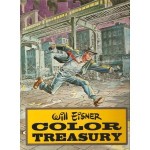
Will Eisner Color Treasury


By Will Eisner, written by Catherine Yronwoode (Kitchen Sink Press)
ISBN: 0-87816-006-X

It is pretty much accepted today that Will Eisner was one of the key creative forces who shaped the American comic book industry, with most of his graphic works more or less permanently in print – as they should be. But as far as I know at least one of his milestones has generally escaped public attention.

From 1936 to 1938 Eisner worked as a jobbing cartoonist in the comics production firm known as the Eisner-Eiger Shop, creating strips to be published in both domestic US and foreign markets. Using the pen-name Willis B. Rensie he created and drew the opening instalments of a huge variety of characters ranging from funny animal to historical sagas,

Westerns, Detectives, aviation action thrillers… and superheroes – lots of superheroes …

In 1940 Everett “Busy” Arnold, head honcho of the superbly impressive Quality Comics outfit, invited Eisner to take on a new challenge. The Register-Tribune newspaper syndicate wanted a 16-page weekly comicbook insert to be given away with the Sunday editions. Eisner jumped at the opportunity, creating three strips which would initially be handled by him before two of them were handed off to his talented assistants. Bob Powell inherited Mr. Mystic and distaff detective Lady Luck fell into the capable hands of Nick Cardy (then still Nicholas Viscardi) and later the inimitable Klaus Nordling.

Eisner kept the lead strip for himself, and over the next twelve years The Spirit became the most impressive, innovative, imitated and talked-about strip in the business. In 1952 the venture folded and Eisner moved into commercial, instructional and educational strips, working extensively for the US military in manuals and magazines like P*S, the Preventative Maintenance Monthly, generally leaving comics books behind.

In the wake of “Batmania” and the 1960s superhero craze, Harvey Comics released two giant-sized reprints with a little material from the artist, which lead to underground editions and a slow revival of the Spirit’s fame and fortune via black and white newsstand reprint magazines. Initially Warren Publishing collected old stories, even adding colour sections with painted illumination from such contemporary luminaries as Rich Corben, but with #17 the title reverted to Kitchen Sink, who had produced the first two underground collections.

Eisner found himself re-enamored with graphic narrative and saw a willing audience eager for new works. From producing new Spirit covers for the magazine (something the original newspaper insert had never needed) he became increasingly inspired. American comics were evolving into an art-form and the restless creator finally saw a place for the kind of stories he had always wanted to tell.

He began crafting some of the most telling and impressive work the industry had ever seen: first in limited collector portfolios and eventually, in 1978, with the groundbreaking graphic novel A Contract With God.

If Jack Kirby is the American comicbook’s most influential artist, Will Eisner is undoubtedly its most venerated and exceptional storyteller. Contemporaries originating from strikingly similar Jewish backgrounds, each used comic arts to escape from their own tenements, achieving varying degrees of acclaim and success, and eventually settling upon a theme to colour all their later works. For Kirby it was the Cosmos, what Man would find there, and how humanity would transcend its origins in The Ultimate Outward Escape. Will Eisner went Home, went Back and went Inward.

This fictionalised series of tales about the Jewish immigrant experience led to a wonderful succession of challenging, controversial and breathtakingly human stories for adults which changed how comics were perceived in America… and all because the inquisitive perfectionist was asked to produce some new covers for old stories.

This glorious oversized hardback (still available through internet retailers) features two full Spirit adventures, fully re-coloured by the master (who was never particularly pleased with how his strips were originally limned), pencil sketches and a magnificent confection of those aforementioned covers – plus some really rare extras.

The eerie 1948 chiller ‘Lorelei of Odyssey Road’ leads off this tome followed by a barely seen science fiction Spirit story. ‘The Invader’ – produced in the 1970s as the result of a teaching gig Eisner had at Sheridan College in Canada.

Eisner created the first page in class to show students the fundamentals of comics creation, and after months of coaxing was convinced to complete the tale, which was published in an extremely limited edition as the Tabloid Press Spirit in 1973. The action and sly, counter-culture comedy is impressively compact and well coordinated: ‘The Invader’ comfortably fits 57 panels into its five pages whereas the old eight-page yarns used to average a mere 50 frames…

Following two gloriously lush wraparound Kitchen Sink covers (complete with a pencil rough) and the hilarious cover to underground anthology Snarf #3, the single page Warren pieces commence. Originally seen on issues #2 through 10 they have all been re-mastered by Eisner and are simply stunning.

After these come the fully-painted wraparounds (all magnificently presented as double-page spreads) that graced the Kitchen Sink Spirit issues #18,-24, #27-29 and #31 and then the rare 1977 Spirit Portfolio is reproduced in the same generous proportions: eleven stunning paintings encapsulating key moments in the masked detective’s astonishing career.

‘The Hideaway’, ‘The Scene of the Crime’, ‘The Women’, ‘The Duel’, ‘Dead End’, ‘The Convention’, ‘The Rescue’, ‘The Chase’, ‘The Capture’ and ‘The City’ plus the portfolio cover are followed by the contents of 1980’s ‘City: a Narrative Portfolio’ a series of evocative black line and sepia ghetto images with obverse blank verse and cameo images dealing with the eternal themes that shape man as a metropolitan dweller. Once more including the cover image, ‘The Spark’, ‘The City’, ‘Predators’, ‘Mugger’, ‘Family’ and ‘Life’ are powerfully moving and magically rendered one-frame stories that presage his growing use of the urban landscape as an integral character in his later works.

With a fascinating biography and commentary from historian and publisher Cat Yronwoode this book is a lavish treat for Eisner aficionados, but the treats still aren’t exhausted: there are also rare colour works and illustrations from Cosmos magazine and Esquire, plus poster art, unpublished Spirit paintings and a preview of his then forthcoming book Big City…

Will Eisner is rightly regarded as one of the greatest writers in American comics but it is too seldom that his incredible draughtsmanship and design sense get to grab the spotlight. This book is a joy no fan or art-lover can afford to be without.
© 1981 Will Eisner. All rights reserved.

Fire & Water: Bill Everett, the Sub-Mariner and the Birth of Marvel Comics


By Blake Bell (Fantagraphics Books)
ISBN: 978-1-60699-166-4

Win’s Christmas Gift Recommendation: 9/10 Perfect for art lovers, Marvel Zombies, wannabe illustrators and lovers of pure comic magic

There’s currently a delightful abundance of beautiful coffee-table art-books/biographies celebrating the too-long ignored founding fathers and lost masters of American comic books, and this fabulous tome highlights the astounding wizardry of one of the most accomplished draughtsmen and yarn-spinners of that incredibly fertile early period.

As always you can save time and trouble by simply buying the book now rather than waste your valuable off-hours reading my blather, but since I’m going to froth on anyway feel free to accompany me as I delineate just why this tome needs to sit on your “favourites” shelf.

This lavishly illustrated, oversized tome traces the tragic life and awe-inspiring body of work of possibly the most technically accomplished artist of the US comicbook industry: a man of privilege and astonishing pedigree (he was a direct descendent and namesake of iconoclastic poet and artist William Blake) haunted by illness, an addictive personality and especially alcoholism, but a man who nevertheless raised a family, shaped an art-form and left twin legacies: an incredible body of superlative stories and art, and, more importantly, broken lives saved by his becoming a dedicated mentor for Alcoholics Anonymous.

William Blake Everett was born in 1917 into a wealthy and prestigious New England family. Bright and precocious he contracted Tuberculosis when he was twelve and whilst recuperating in Arizona began a life-long affair with and battle against booze. For the rest of his chequered life “Wild Bill” vacillated between magnificent artistic highs and heartbreaking personal lows, covered with chilling frankness in this excellent biography, written in conjunction with the artist’s surviving family.

Although telling, even revelatory and concluding in a happy ending of sorts, what this book really celebrates is not the life but the astounding legacy of Bill Everett. A gifted, driven man, he was a born storyteller who had the sheer naked ability to make all his own worlds real; and for nearly five decades his incredible art and wondrous stories, which began in the heydays of the Pulps (see also Spicy Tales Collection) enthralled and inspired successive generations of fellow dreamers.

His beautiful artwork featured in a variety of magazines before his fortuitous stumbling into the right place at the right time secured Everett’s place in history forever with his creation of the first anti-hero in comics.

Yet even before the advent of the mutant hybrid Sub-Mariner who, along with his elemental counterpart The Human Torch, secured the fortunes of the budding Marvel Comics (covered in a fascinating and detailed account which clears up many controversies that have raged amongst fans ands historians for decades) Everett was a valued and admired writer/artist/letterer/designer whose early seminal triumphs are lovingly covered here in many reproduced strip extracts, sketches and an utterly invaluable collection of original art pages.

Bill Everett was a jobbing cartoonist who drifted into the new world of comicbooks: a budding industry that combined his beloved drawing with his other compulsion – making up stories. The first chronological art selection here features a plethora of his compelling and irresistible covers for Amazing Mystery Funnies, Blue Bolt, Target Comics, Amazing-Man Comics, Victory Comics, Heroic Comics, and the landmark Motion Picture Funnies Weekly (for which he produced not only the pre-Marvel/Timely Sub-Mariner, but also the all-important back cover sales pitch) and many designs and roughs for unpublished titles, interspersed with pages and spreads from early creations Amazing-Man, Dirk the Demon, Skyrocket Steele, Music Master, The Chameleon, Hydroman, Sub-Zero and of course Prince Namor.

The early days of Marvel Mystery Comics and the Sub-Mariner’s own feature title are thoroughly represented with many pages of original art starring not only his aquatic antagonist but also The Fin and Human Torch, and this section is also full of delightful sketches from his four years of service in the Army Corps of Engineers.

The industry had changed radically by the time Everett mustered out: superheroes were on the wane and other genres were rising in popularity. Returning as a freelancer to Marvel/Timely, Everett worked again on Sub-Mariner and even created the sexy spin-off Namora and stillborn kid crusader Marvel Boy, but it was with the series Venus that he moved in a new direction: glamorous, glorious horror.

For over a decade he brought a sheen of irresistible quality to the generally second-rate chillers Timely/Atlas/Marvel generated in competition with genre front-runners EC Comics. It’s easy to see how they could compete and even outlive EC, with these lush and lurid examples of the hundreds of stunning covers and chillingly beautiful interior pages selected from such titles as Mystic, Menace, Astonishing, Adventures into Weird Worlds, Uncanny Tales, Suspense, Marvel Tales, Spellbound, Mystery Tales, Men’s Adventures and others. My only quibble is that unlike the companion volume featuring unsung genius Mort Meskin (see From Shadow to Light) there are no complete stories collected in this otherwise perfect primer.

Despite being unacknowledged as a master of terror, this period was probably Everett’s most technically adroit, but he also excelled in the other genre-ghettoes of the period. His ability to freeze manic action and convey tension into a single image made him the perfect choice for lead cover artist in the burgeoning military comics fields as can be seen in examples from Man Comics, Navy Tales, Battlefield, Navy Action, Navy Combat and others.

Everett truly excelled in the lush, stylistic depiction of action and horror themes – as well as the seductive delineation of sexy women, although he was equally effective in less histrionic arenas such as merchandising art, wholesome western, romances, cartoon and Bigfoot comedy styles, represented here by pages and covers from such diverse publications as Marvin the Mouse, Nellie the Nurse, Cracked, Jann of the Jungle, True Secrets, Girl Confessions, Bible Tales For Young Folk, Tales of Justice, Quick Trigger Western, Yellow Claw, Sports Action, Pussycat and so many others.

His final creative period follows his return to Marvel after time in the commercial art world and covers the creation of Daredevil, unsatisfactory runs on the Hulk, Dr. Strange, Sub-Mariner, Rawhide Kid and others as well as his stints inking Jack Kirby, Gene Colan, Ross Andru, Herb Trimpe, Dan Adkins and Barry Windsor Smith, before, clean and sober after decades, he produced a landmark run on his signature Sub-Mariner.

Tragically, decades of smoking and alcohol abuse had taken its toll, and only four years after turning his life around he died of complications arising from heart surgery, just when he seemed on the cusp of a brilliant creative renewal as remarkable as his meteoric rise in the 1930s and 1940s.

Evocatively written by biographer Blake Bell, with dozens of first hand accounts from family, friends and contemporaries; the sad, unjust life of this key figure of comics art is lovingly recounted here with hundreds of artistic examples from school days, army service, commercial and cartoon illustration and many intimate photographs supplementing the treasure trove of comics images. By tracking Everett’s early career as a pulp magazine illustrator, through his pioneering superhero art to the moody masterpieces of the 1950s and the Pop Art comics renaissance of the his later years, Fire and Water offers an opportunity to revel in the mastery of a truly unique pillar of America’s sequential Art establishment.

Most importantly for collectors and art-fans there is a overwhelming abundance of beautiful comics magic; from compelling page layouts, sketches and compositions to bold, vibrant pencils and slick luscious inking, and for we comics cognoscenti, the jackpot of never-before-seen unpublished pages: penciled, inked and camera-ready art-boards, as well as illustrations, family pieces and examples of his non-comics career

Brilliant, captivating, and utterly unmissable, this is the book Bill Everett deserves – and so do you.

© 2010 Fantagraphics Books. Text © 2010 Stephen Brower. All art © its respective owners and holders. All rights reserved.

Too Soon?: Famous/Infamous Faces 1995-2010


By Drew Friedman (Fantagraphics Books)
ISBN 13: 978-1-60699-537-6

Technically, this isn’t a graphic novel or trade collection, it’s a picture book – but it is an absolutely stunning one, collecting some of the best and most trenchantly funny illustrations by a contender for the title of America’s Greatest Living Caricaturist in a lavish, full-colour hardback.

Drew Friedman began drawing commercially in the late 1970s. His meticulous, stippled monochrome satirical and socially biting cartoons of celebrities – and the rare comic strip – appearing in RAW, Screw, High Times, Weirdo, Comical Funnies, Heavy Metal, National Lampoon and the Holy of Holies MAD Magazine.

Gradually he moved into the publishing mainstream, and the phizzogs and foibles of the Rich and Famous gathered here are culled from a number of eclectic sources including Time, Newsweek, The New Yorker, GQ Magazine, The Wall Street Journal, New York Observer, New York Times, Rolling Stone, The Washington Post, Entertainment Weekly, Village Voice, Mojo, The New Republic, The Los Angeles Times, The Weekly Standard, Blab!, Maximum Golf and even the gun-totin’ sports organ Field & Stream among many others – an hilarious cavalcade of covers and spot illustrations by a master of the graphic ideal moment.

After a funny and extremely informative potted history the mostly painted (but with occasional pen, wash, tone and even charcoal examples), staggeringly cruel, cutting and insightful images are unleashed, beginning with a section covering political and business highflyers.

The period 1995 to 2010 turned up an unenviable horde of risible leaders and manipulative malcontents and included here are 107 cartoon snapshots of such luminaries as the Clintons, Monica Lewinsky, Helmut Kohl, George W. Bush, Barack Obama, Al Gore, Ross Perot, Sarah Palin, “Mayor Mike” Bloomberg, John McCain, Rudy Giuliani, Dick Cheney and many other domestic demagogues as well as such international ideologues as Tony Blair, Yasser Arafat, Mother Theresa, Jacques Chirac and Osama Bin Laden among many others.

The second section deals with Showbiz types ancient and modern, an includes a couple of astonishingly grand panoramic gatefold fold outs amidst the 140+ illustrations featuring super-stars and should-have-beens from sports, music, acting, the media and that nebulous twilight world of people who are famous without actually doing or achieving anything.

The roster includes Tiny Tim, Dean Martin, Sinatra, John Lennon, Michael Jackson (lots of him at various stages of his life-long metamorphosis), Tommy Lee, Madonna, Fred MacMurray, Judy Garland, Jackie Chan, Bob Dylan, Brando, De Niro, Woody Allen, Stallone, Will Smith, Tiger Woods, Mike Tyson, Jack Nicholson and so many others. The volume also includes some book and CD covers and private commissions, and also a fresh selection of the artist’s favourite artistic subjects: sideshow freaks and obscure Jewish and vintage comedians.

Friedman is a master craftsman who can draw and paint with breathtaking power, and his work is intrinsically funny. It’s relatively simple to make Blair, Bush or Bin Laden look like buffoons but try it with Rod Serling, Marilyn Manson, Mother Theresa or Salman Rushdie…

His caricatures are powerful, resonant and joyful, but without ever really descending to the level of graphic malice preferred by such luminaries as Ralph Steadman or Gerald Scarfe. Too Soon? is a book for art lovers, celebrity stalkers and anyone who enjoys a pretty, good laugh.

© 2006 Drew Friedman. All Rights Reserved.

You can see sample pages on the arts website www.Drawger.com

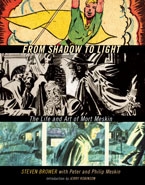
From Shadow to Light: The Life and Art of Mort Meskin


By Stephen Brower with Peter & Philip Meskin (Fantagraphics Books)
ISBN: 978-1-60699-358-3

Win’s Christmas Gift Recommendation: Perfect for art lovers, wannabe illustrators and lovers of pure comic magic  9/10

There’s currently a delightful abundance of beautiful coffee-table art-books/biographies celebrating the too-long ignored founding fathers and lost masters of American comic books, but few have been as well anticipated and hungered for as this magnificent tome highlighting the troubled life and stunning ability of Morton Meskin, one of the guiding spirits of the industry and a man clearly unaware or unwilling to admit just how influential he actually was.

Rather than waste your time being overly specific (just buy the book – it’s extremely informative and truly wonderful) let me just state that Meskin is the kind of creative force that no real fan of the medium can afford to be ignorant of. This lavishly illustrated, oversized tome traces his life and awesome body of work from school days and early career as a pulp magazine illustrator, through his pioneering superhero art for MLJ, DC, Standard and others through the leaner years and appalling treatment by editors in the 1960s through to the superb advertising art of his later life.

A quiet, diligent and incredibly prolific artist (the text contains numerous accounts of “races” with Jack Kirby, vying to see who could produce the most pages in a day!) Meskin’s manner and philosophical approach influenced dozens of major artists – as the testimonials from Kirby, Steve Ditko (a young student from Meskin’s days as a teacher), Jerry Robinson, Joe Kubert, Alex Toth, Carmine Infantino, George Roussos, Will Eisner and so many others attest over and over again.

Evocatively written by creative/art director, designer, educator and biographical author Stephen Brower, with dozens of first hand accounts from family, friends and contemporaries; the sad, unjust life of this major figure of popular art is fully explored and gloriously justified by every miraculous page of his work reproduced herein. As well as dozens of full colour reproductions from his breathtaking Sheena, Queen of the Jungle, Vigilante, Johnny Quick, Seven Soldiers of Victory, Wildcat, Starman, Fighting Yank, Black Terror and particularly Golden Lad and Tom Corbett, Space Cadet superhero action-adventure delights are lesser known gems of crime, horror, historical and mystery tales.

His prolific days at Simon & Kirby’s S&K Studios producing content for Headline, Crestwood and Prize Comics are well represented with many striking examples of his 1900 or so pages of mystery, psycho-drama, western and romance work, as well as Meskin’s latter days at DC, turning mediocre, fright-free mystery yarns and anodyne science fiction tales into stunning exercises of minimalist tension and drama.

Most importantly for collectors and art-fans there is a huge amount of space devoted here to the artist’s unique manner of working; from compelling page layouts and compositions to bold, vibrant inking, and for we comics cognoscenti, the visual El Dorado of never before seen unpublished pages.

There are dozens of penciled, inked and camera-ready art-boards – many shot from actual original artwork – including assorted genre-works (humour, horror, westerns, romances, covers), legendary features such as Boy’s Ranch, Fighting Yank, Black Terror and Captain 3-D) and even complete unpublished stories including a whole Golden Lad superhero romp, a nautical epic from colonial days starring Bill Blade, Midshipman and a positively electric gangland reworking of Macbeth.

Eventually Meskin left the industry, as so many unappreciated master artists did, for advertising work where he found appreciation, security and financial reward, if not creative contentment, and the latter portion of the scintillating tome is filled with not only an amazing selection of magnificent illustrations, sketches, ad layouts and storyboards but also the purely experimental art – painting, prints, collage and lots of lovely drawings in every medium possible – that clearly kept this obsessively questing artisan’s passions fully engaged..

Brilliant, captivating, utterly unforgettable and unknown, Meskin’s enforced anonymity is finally coming to an end and this magical chronicle is hopefully only the first step in rediscovering this major talent. Buy this book and lobby now for complete collected editions of Mark Merlin, Vigilante, Johnny Quick, Golden Lad and all the fabulous rest…

© 2010 Fantagraphics Books. Text © 2010 Stephen Brower. All art © its respective owners and holders. All rights reserved.

How to Draw Disney’s Mulan


By uncredited (Titan Books)
ISBN: 978-1-84023-038-3

I haven’t covered a “How To” book for ages and as this one’s entertaining, wonderfully fit for purpose and readily available it would well serve any budding artists and prospective animators to seek it out and absorb…

Following a brief précis of the story – involving a young girl who rose to prominence in the army of legendary Ancient China – the instructional portion begins with Equipment and Techniques, Designing Characters – animal and human, comedic, villainous and heroic. Costume Design, Staging the Action and Use of Props. This large scale, slim book concludes with a test – Creating a Scene: providing a chance to use the knowledge gained to have fun and practice.

Brilliantly colourful and with clear concise instructions covering the undeniable basics that every artist of any age needs to master, such as stylisation and basic anatomy, and including detailed step-by-step breakdowns and model sheet for every major character from the films this is an indispensable aid and a tremendously inspiring introduction for the aspiring Artist of Tomorrow.
© 1998 Disney Enterprises, Inc. All Rights Reserved.

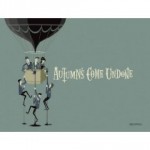
Autumn’s Come Undone


By Shag (SCB – Baby Tattoo Books)
ISBN: 978-0-9793307-3-5

A mystery-man of few words, Josh Agle, the artist currently known as “Shag”, has produced numerous collections of sleek and stylish paintings that are the very epitome of “retro”.

Considered a leading light of the American “Lowbrow” or “Pop Surrealism” art movement his mannered, maddeningly meticulous constructions of 1960s imagery and palettes are mind-warping and oddly comforting at the same time: stirringly reminiscent of the animated credits for TV shows like “Bewitched” and “I Dream of Jeannie” and films such as “The Pink Panther” and “Those Magnificent Men in Their Flying Machines”.

This latest memorable collection, full of doe-eyed, bouffant-ed beach cuties, slick, dark-suited men with horn-rim glasses and thin ties, whales and whalers, beasts, devils and Victoriana viewed through a Baby-boomer’s lens gathers works from his latest gallery tour and provides yet another peek into the mind of a true – if sardonic – cultural archeologist.

Accompanied by poetry and quotations this is an engrossing treat and, I’m sure the beginning of the art-poster and greetings card “next big thing.” Catch the wave before it catches you…
© 2009. All rights reserved.