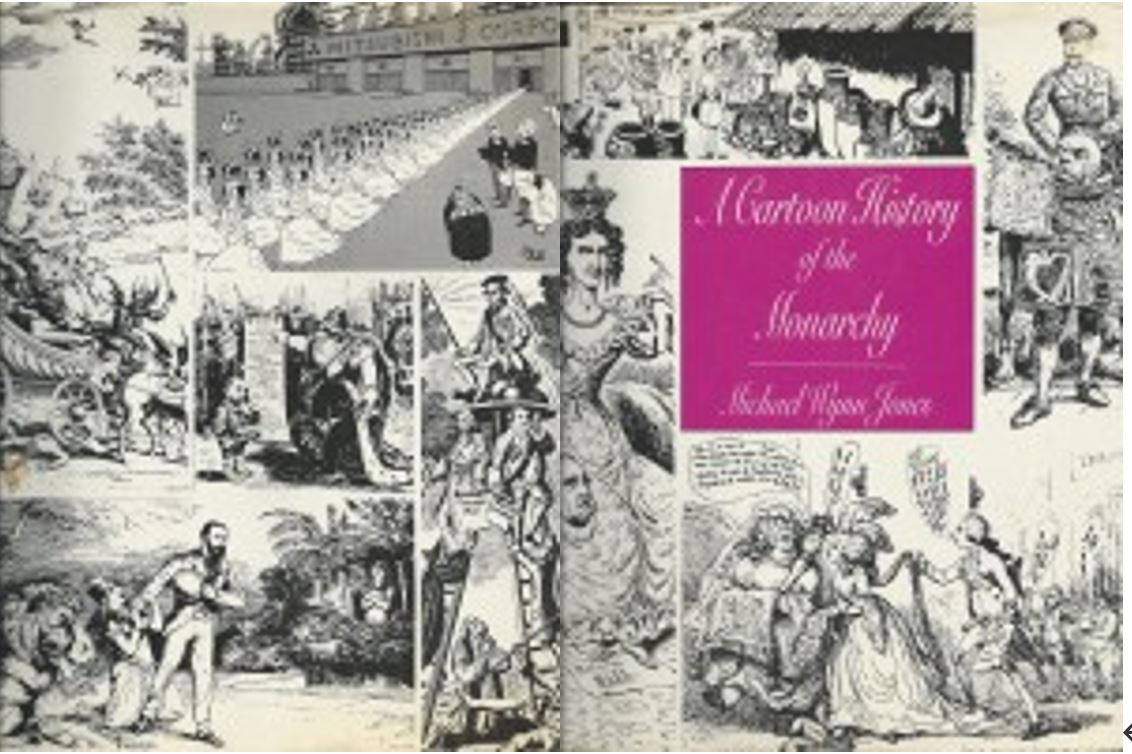
A Cartoon History of the Monarchy


By Michael Wynn Jones and Many & Various (Macmillan)
ASIN: B001H0OAOO (HB), ISBN: 978-0333198056 (PB)

We’re far too reluctant in this country to celebrate the history and quality of our own cartooning tradition; preferring simply to remark on the attention-grabbers or impressive longevity of one or two classic and venerable veterans of the pen-&-ink game for TV soundbites and platform clickbait. The actual truth is that for an incredibly long time the political art movement of the Empire and Commonwealth – and its enemies – was vast, varied and fantastically influential.

The British wing of the form has been magnificently serviced over centuries by masters of form, line, wash and most importantly ideas, repeatedly tickling our funny bones or enraging our sleeping consciences and sensibilities, all whilst poking our communal pomposities and fascinations.

From earliest inception, satiric draughtsmanship has been used to attack and sell: initially ideas, values, opinions and prejudices or but eventually actual products too. In newspapers, magazines and especially comic books, the sheer power of graphic narrative, with its ability to create emotional affinities, has led to the creation of unforgettable images and characters – and the destruction of real people or social systems.

When those creations can affect the daily lives of millions of readers, the force they can apply in the commercial or political arena is well-nigh irresistible…

In Britain, the cartoonist has held a bizarrely precarious position of power for centuries: the deftly designed bombastic broadside or savagely surgical satirical slice instantly capable of ridiculing, exposing, uplifting or deflating the powerfully elevated, unapproachable and apparently untouchable with a simple shaped-charge of scandalous wit and crushingly clear, universally understandable visual metaphor.

For this method of concept transmission, lack of literacy or education is no barrier. As the Catholic Church proved centuries ago with the Stations of the Cross, stained glass windows and a superteam of idealised saints, a picture is worth far more than a thousand words…

For as long as we’ve had printing there have been scurrilous gadfly artists commentating on rulers, society and all iniquities: pictorially haranguing the powerful, pompous, privileged and just plain perfidious through swingeing satire and cunning caricature. Sometimes artists have been just plain mean. Those are usually the best and most memorable…

Britain had no monopoly on talent and indignation, and this canny compendium also frequently features European – and latterly American – takes on our always-scandalous Royals and oddball citizenry…

Released in 1978 and desperately in need of updating and re-issue, A Cartoon History of the Monarchy offers a potted, far from hagiographic history and deliciously skewed view of our Ruling Elite in all their unsavoury glory. Here is an unbroken line of jibes, asides and broadsides culled from diverse sources by jobbing journalist and aficionado of japes, lampoons and sketches Michael Wynn Jones, who casts his discriminating eye from the reign of Elizabeth I up until just before the Silver Jubilee of the second Regina to bear the name…

Following a rota of the Kings and Queens of England, the pomposity-puncturing procession commences with The Age of Intolerance, reproducing cartoons and adding commentary dealing with the doings of the 10 monarchs from the initial Elizabeth I to George II.

Accompanying essays share the zeitgeist of those times; the religious questions as England, Wales, Ireland and eventually Scotland faced numerous crises regarding succession. That issue always revolved around whether the land should be Catholic or Protestant. ‘Popes, Plots and Puritans’ led to a final solution when ‘The Men from Hanover’ arrived to settle the matter and fully cement the nation under the Church of England.

A savage sampling of national and European opinions are represented by 26 visual bombards such as allegorical assault ‘Diana and Callisto’ by Dutch artist Miricenys (1585), the anonymous ‘England’s Miraculous Preservation’ (1648) and ‘The Royal Oake of Brittayn’ (1649) amongst many others.

Cartoon grotesques like ‘Cromwell’s Car’ (1649) or ‘Babel and Bethel’ (1679) appear beside such scandalous foreign attacks as Dutch illustrator Dusart’s ‘Fr. James King’ or anonymous French pictorial polemic ‘Notice of Burial’ (both from 1690). We Brit’s riposted with jeering celebrations of martial triumphs such as ‘The Arrival of William and Mary’ (1689), ‘The Great Eclipse of the Sun’ (simultaneously a topical spin on a 1706 solar event and defeat of “Sun King” Louis XIV by the British armies of Queen Anne), and ‘A Bridle for the French King’ from the same year.

Domestic contretemps are highlighted through such draughtsman’s delights as anonymous 1743 shocker ‘The Hanover Bubble’, Ebersley’s ‘The Agreeable Contrast’ (1746 and attacking King George’s brother “Butcher” Cumberland’s treatment of Jacobites after the Young Pretender’s defeat), and exposure of Popish influence in the Highlands, described in ‘The Chevalier’s Market’ 1745…

Whereas much of this material – British and foreign – was generally national commentary and straight religio-political assault, by the time period covered in The Wickedest Age: George III to George IV (1760-1830), the cartoon had also evolved into a weapon designed to wound with wit and crush through cruel caricature.

After covering major crises and scandals of the generally sensible – if parsimonious – third George in ‘The Royal Malady’, ‘The Dregs of Their Dull Race’ and ‘Twilight Years’, a veritable Golden Age of popular disapproval and pictorial pummelling of the Prince Regent and much-delayed, frustrated monarch (plus his many indiscreet mistresses) is covered in ‘The Prince of Whales’, ‘The Secret Marriage’, ‘…Pray Get Me a Glass of Brandy’ and ‘Delicate Investigations’.

The public disdain of the times generated a fusillade of cartoon prints, represented here by 35 graphic thrusts and savage cartoon sallies by names now as famous as any ruler. However master character assassins Townsend (‘The Scotch hurdy-gurdy’), George Cruikshank (‘Royal Condescension’), Gillray (‘A New Way to Pay the National Debt’, ‘A Voluptuary under the Horrors of Digestion’), Rowlandson (‘The Prospect Before Us’) and Heath (‘A Triumph of innocence over perjury’) are brilliantly bolstered by lesser lights West (‘The Save-all and the Extinguisher!’), Williams (‘Low Life above stairs’), Vowles (‘The shelter for the destitute’) and Marshall (‘The kettle calling the pot ugly names’) and some anonymous pen-pricks who nevertheless hit hard with ‘Tempora Mutantor’, ‘The captive Prince’ and ‘Reading of the Imperial decree’ and more.

Eventually, periodical publication overtook print-shops as the great disseminators of carton imagery, and open savagery and targeted vulgarity of caricaturists gradually gave way to mannered, if barbed, genteel observation. Thus, The Age of Discretion: William IV to Victoria (1830-1901) offers a different style of Royal Commentary: no less challenging, but certainly more overtly respectful even when critical. Sometimes, though, the new family-oriented cartooning – even in magazines like Punch and The Times, simply sunk to fawning veneration as the institution of monarchy became more and more removed from the lives of the citizenry.

William’s times are summed up in text via ‘The Sailor King’ and ‘Reform Billy’ whilst Victoria’s epochal reign and the Parliamentarians who increasingly wielded decisive power is described through ‘The Queen of the Whigs’, ‘Revolutions are bad for the Country’, ‘The Black and the Brown’ and ‘Years of Widowhood’.

The 36 collected images recapture days of Empire, with Heath, Seymour and Doyle predominant in illustrating bluff sea-dog William’s socially contentious days of Reform.

Victoria’s years – from engaging popular ingénue Queen, through happy bride to politically intrusive grand dame of European Court intrigue – highlights the craft of Doyle ‘The Queen in Danger’ (1837), Leech ‘There’s Always Something’ (1852), Tenniel ‘Queen Hermione’ (1865), ‘New Crowns for Old Ones!’ (1876), Morgan (Where is Britannia?’ and ‘A Brown Study’ (both 1867) and Sambourne ‘Kaiser-i-Hind’ (1876) amongst so many others.

Her latter years saw a rise in social conscience cartooning as displayed by the crusading Merry with ‘The Scapegrace of the Family’ (1880), ‘The fall of the rebels’ in 1886 and more. The telling modernist take of Max Beerbohm cuttingly illustrated the rift between the Empress and her playboy heir in ‘The rare, the rather awful visits of Albert Edward to Windsor Castle’…

Despite her well-publicised disapproval of the good-time Prince, he became an effective king as did his son, both covered in The Edwardian Age: Edward VII to George V, spanning 1901-1936. Their dutiful achievements are depicted in ‘The Coming King’ and ‘The First Gentleman of Europe’ before war with Germany necessitated a family name change for George: ‘The First Windsor’…

With kings increasingly used as good-will ambassadors and cited in scandals frequently ending in court (sound familiar?), the 30 cartoons in this section include many German pieces from not only the war years but also the tense decade that preceded them. At that time of tinderbox politics, Imperial Superpowers jostled for position and used propaganda to appeal to the world’s “unwashed masses” for justification in their aims and ambitions.

Beside veteran caricaturists like Leech, Morgan, May, Partridge, Staniforth and David Low are merciless lampoons from German cartoonists Brandt, Blir, Heine, Gulbransson and Johnson as well as French illustrator Veber and lone American Kirby.

Our pen-&-ink pictorial history lesson concludes with The Age of Respectability: Edward VIII, George VI, Elizabeth II, by generally skipping World War II, concentrating on the openly secret scandal of Edward and Mrs Simpson in ‘Abdication’. Thereafter the advent of ‘New Elizabethans’ brought a modern age of monarchs as sideshow attractions…

Although Fleet Street chose to whitewash and suppress the affair between a King-in-waiting and an American divorcee, the rest of the world made great play of the situation: as seen here with 11 telling cartoon shots from Americans McCutcheon and Orro, whilst French scribbler Effel posited typically insouciant Gallic pragmatism in ‘Une Solution’ and German-based Gulbransson played up the true romance angle…

In the meantime, British cartoonist Low had to be at his most obliquely hilarious, delineating the crisis by not mentioning it, whilst Punch stars such as Partridge steadfastly pursued a line of deferential, tragic sacrifice…

Although there is very little material featuring wartime monarch George VI – a propaganda casualty of the conflict – the last 20 cartoons herein celebrate the changing image of a very public Royal Family, pictured by names hopefully familiar to contemporary cartoon lovers.

The imagery is also contextually far more familiar – and presumably comfortable – to modern tastes as print media generally learned to save their vitriol for politicians and celebrities: reserving only minor chidings and silly teasing for “the Royals”, as seen in ‘Birthday Greetings’ and ‘Under the Splendid Empire Tree’ (Shepard from 1947) or Illingworth’s 1951 panels ‘Family Ties’ and ‘Happy Returns’.

Papers were, however, happy to utilise the monarchy to score points against governments, as seen in an attack on Enoch Powell (Cummings’ ‘Ministry of Repatriation’) and the battle between Rhodesia’s Ian Smith and Harold Wilson, lampooned in ‘Your Move!’ by Jak (both 1968) or the legendary Giles’ ‘New Rent Assistance Bill’ (1971).

Also offering acerbic jollity of a far more blueblood-specific variety are cartoon giants Trog and Waite, joining the abovementioned in exploiting the Royal Family’s gift for headline-stealing gaffes in such daring gags as ‘I Suppose we did send them to the Right Schools?’, ‘I Suppose she’ll think these are of the Queen Mother’, ‘More Pay’ and ‘Andrew’s Exchange Student’: coming full circle with the best of Hanoverian excesses scrutinised by cost-conscious government and public – albeit this time for rather more gentle laughs…

Appended with a scholarly section of Acknowledgements, Illustration sources and Index of artists, this is an extremely effective introduction to the lasting relationship between Royalty, Church and Fourth Estate, offering a fantastic overview of Regal adaptability and cultural life through cunningly contrived images and pictorial iconography that shaped society and the world.

These are timeless examples of the political pictorialist’s uncanny power and, as signs of the times, form a surprising effecting gestalt of the never-happy nation’s feeling and character.

None of that actually matters now, since these cartoons have performed the task they were intended for: moulding attitudes of generations of voters who never voted for monarchy. That they have also stood the test of time and remain beloved relics of a lethal art form is true testament to their power and passion.

Stuffed with astounding images, fascinating lost ephemera and mouth-watering tastes of comic art no aficionado could resist, this colossal collection is a beautiful piece of cartoon history to delight and tantalise all who read it.

We haven’t had many monarchs since this book was first released, but there are plenty of new Royals and scandals to ponder, so it’s long past time for a fresh edition, no?
© Michael Wynn Jones 1978. All rights reserved.
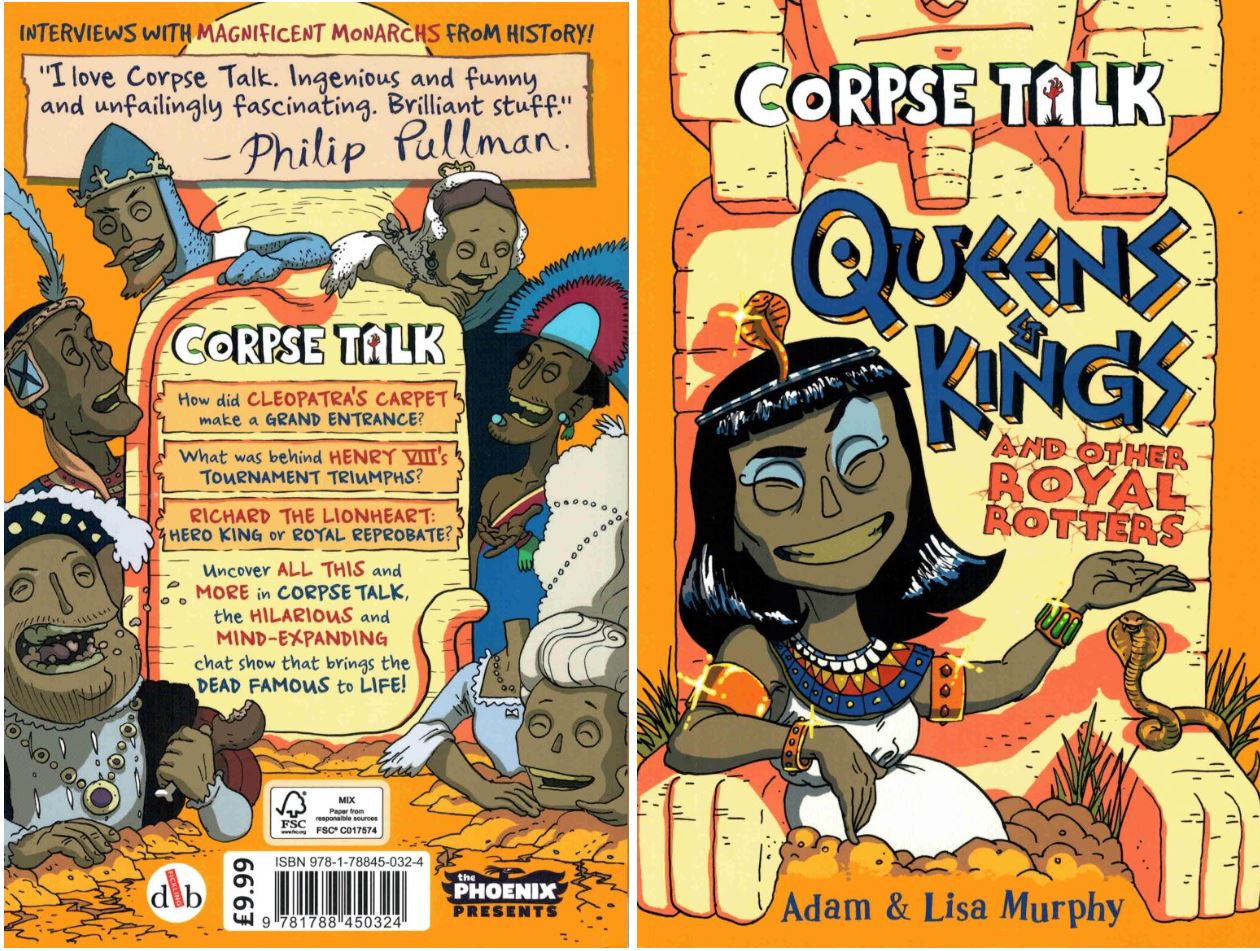
Corpse Talk: Queens & Kings and Other Royal Rotters


By Adam & Lisa Murphy (David Fickling Books)
ISBN: 978-1-78845-032-4 (PB)

The educational power of comic strips has been long understood and acknowledged: if you can make material memorably enjoyable, there’s nothing that can’t be better taught with pictures. The obverse is also true: comics can make any topic or subject come alive… or at least – as here – outrageously, informatively undead…

The fabulously effective conceit of Corpse Talk is that your cartooning host Adam Murphy (ably abetted off-camera by Lisa Murphy) tracks down (digs up?) famous personages from the past: serially exhumed for a chatty, cheeky This Was Your Life talk-show interview. It also often grosses one out, which is no bad thing for either a kids’ comic or learning experience.

Culled from the annals of The Phoenix, this regally-themed recollection is dedicated to not-so-private audiences with a succession of famous, infamous and utterly unforgettable royal rogues and rapscallions in what would almost certainly not be their own words…

Catching up in date of demise succession, our fact-loving host begins the candid cartoon conferences by digging the dirt with Ramesses II: Pharaoh of Egypt 1303 BCE – 1213 BCE. He preferred to be called ‘Ramesses the Great’ and our intrepid interviewer incisively traces the “accomplishments” and gift for self-promotion of the dusty legend.

As always, each balmy biography is supplemented by a sidebar feature examining a key aspect of their lives, such as here with ‘How to Make a Mummy’, scrupulously and systematically sharing the secrets of interring the definitely departed, after which we refocus on the ancient orient to quiz Qin Shi Huang Di: Chinese Emperor 259 BCE 210 BCE on his reign and once more sifting truth from centuries of post-mortem PR briefings.

Backing up the inquiry ‘The Emperor’s Tomb’ details the layout of the vast City of Death Qin was buried in, as well as the Palace of Shadows, its terracotta army and the treasures it guarded.

Cleopatra: Pharaoh of Egypt 69 BCE – 30 BCE outlines her incredible life, whilst ‘Barging In’ examines her astounding gold sea-craft – and how it brought her to the attention of back-up lover/sponsor Mark Anthony.

A thankfully thoroughly sanitised account of the sordid exploits of Nero: Roman Emperor 37-68 is supported up by a deconstruction of one of his feasts in ‘Cafe Nero’, after which Justinian II: Byzantine Emperor 669-711 personally explains how his determination and guile enabled him to rule, lose, recapture and retake control of the mighty Late Roman Empire. The impenetrable defences of 8th century Constantinople are then dissected in ‘The Walled City’…

As well as a bit about burned cakes, Alfred the Great: King of Wessex 849-689 reveals remarkable military and civilising feats of the learning-obsessed ruler whilst expanding the knowledge base and defining the fractured kingdoms of ‘The Dark Island’ of Britain.

The Norman conquest is unpicked from the (one-eyed) view of the losing contender in Harold Godwinson: English King 1022-1066. The account is accompanied by an extended look at the historical source document in ‘Born on the Bayeaux’ before the first English civil war is remembered by formable Angevin matriarch Empress Matilda: English Queen 1102-1167. This is followed by a detailed deconstruction of the sturdy castle defensive system in ‘The Old Bailey’.

The Crusades are represented by rival legends made real. First up is admirable and noble Saladin: Sultan of Egypt and Syria 1137-1193, bolstered by a catalogue of Moslem contributions to global civilisation in ‘Gifts of Genius’, after which the unhappy truth about Richard the Lionheart: English King 1157-1199 is laid bare. After debunking centuries of self-aggrandising myths, ‘The Siege of Acre’ traces one of the crusaders’ few actual heroic exploits…

Moctezuma II: Aztec Emperor 1456-1520 relates how his timidity and sense of self-preservation led to the destruction of his dominions at the hands of conquistadores before ‘Temple of Doom’ takes us into the deepest inner workings of the bloodstained ziggurats dedicated to human sacrifice on an industrial scale…

The most complex and contentious period in British history is taken apart by those royals at the heart of it all when Henry VIII: English King 1491-1547 tries to give us his spin on events leading to the reformation. Following ‘Full Tilt – a History of Jousting’ – come ‘The Six Wives of Henry VIII’ – consecutively Catherine of Aragon (1485-1536), Anne Boleyn (1507-1536), Jane Seymour (1508-1537), Anne of Cleves (1525-1557), Catherine Howard (1523-1542 and Catherine Parr (1512-1548) – offering their side of the arguments and events.

Their raucous riotous revelations are augmented by a breakdown of the duties of a Queen’s faithful attendants in ‘The Waiting Game’.

Charles II: English King 1630-1685 relates how he came to power following the Second Civil War, backing up personal reveries with ‘A Memoir on Monarchy’ running down the changing role of rulers, after which we cross the channel to hear how it all went wrong for France’s final female autocrat in Marie Antoinette: French Queen 1755-1793. Her fall from grace is abutted by a chilling lesson on guillotine mechanics in ‘Decapitation Stations’.

Contemporary cousin Catherine the Great: Russian Empress 1729-1796 managed to run things largely her own way, but as back-up ‘Tsars in their Eyes’ shows, she was plagued by a constant stream of pretenders, all claiming to be true, proper, better qualified and, yes, male contenders for her throne.

South African rebel and strategic genius Shaka Zulu: Zulu King 1787-1828, recounts how he literally created a mighty nation from nothing whilst ‘The Battle of Isandlwana’ covers how his innovations were used to humiliate the overwhelmingly powerful British Army before the procession of pomp and circumstance closes with Queen Victoria: English Queen 1819-1901, accompanied by a phenomenally absorbing family tree, branching out and into every royal bloodline in Europe: a true ‘Game of Thrones’…

Clever, cheeky, outrageously funny and formidably factual throughout, Corpse Talk unyieldingly tackles history’s more tendentious moments whilst personalising the great, the grim and the good for coming generations.

It is also a fabulously fun read no parent or kid could possibly resist. Don’t take my word for it though, just ask any reader, royal-watcher or republican in waiting…
Text and illustrations © Adam & Lisa Murphy 2018. All rights reserved.

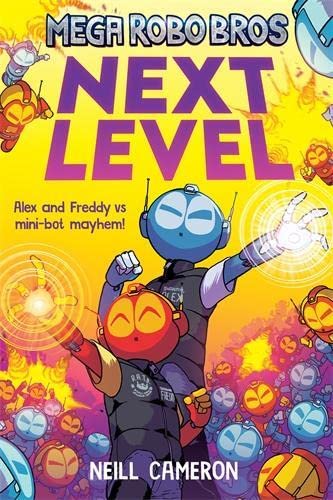
Mega Robo Bros: Next Level


By Neill Cameron, with Abby Bulmer (David Fickling Books)
ISBN: 978-1-78845-294-6 (TPB)

Mighty in metal and potent in plastic, here’s another solid gold all-ages outing from Neill (Tamsin of the Deep, Pirates of Pangea, How to Make Awesome Comics, Freddy) Cameron’s marvellous purpose-built paladins. However, the rambunctious Mega Robo Bros find that even they can’t fight progress adventures and growing pains – in more adventures balancing frantic fun with portents of darker, far more violent days to come…

It’s still the Future!

In a London far cooler than ours, Alex and his younger brother Freddie Sharma are generally typical kids: boisterous, fractious, eternally argumentative yet devoted to each other, and not too bothered that they’re adopted. It’s really no big deal for them that they were meticulously and covertly constructed by the mysterious Dr. Roboticus – before he vanished – and are considered by those in the know as the most powerful – and only fully SENTIENT – robots on Earth.

Dad is just your average old guy who makes lunch and does a bit of writing, but when not being a housewife, Mum is a bit extraordinary, herself – surprisingly famous and renowned robotics boffin Dr. Nita Sharma harbours some shocking secrets of her own…

Life in the Sharma household tries to be pretty normal. Freddie is insufferably exuberant and over-confident, whilst Alex is at the age when self-doubt and anxiety hit hard. Moreover, the household’s other robot rescues can also be problematic…

Programmed as a dog, baby triceratops Trikey is ok, but French-speaking deranged ape Monsieur Gorilla can be mighty confusing, whilst gloomily annoying, existentialist aquatic fowl Stupid Philosophy Penguin hangs around ambushing everyone with quotes from dead philosophers…

The boys have part-time but increasing insistent jobs as super-secret agents, although because they weren’t very good at the clandestine part, almost the entire world knows of them. Generally, however, it’s enough for the digital duo that their parents love them, even though they are a bit more of a handful than most kids. They all live as normal a life as possible: going to human school, playing with human friends and hating homework. It’s all part of their “Mega Robo Routine”, combining dull human activities, actual but rare fun, games-playing, watching TV and constant training in the combat caverns under R.A.I.D. HQ.

Usually, when a situation demands, the boys carry out missions for bossy Baroness Farooq: head of government agency Robotics Analysis Intelligence and Defence. They still believe it’s because they are infinitely smarter and more powerful than the Destroyer Mechs and other man-made minions she usually utilises.

Originally published in UK weekly comic The Phoenix, this revised, retooled and remastered saga opens with the lads feted as global heroes.

After defeating a reject robot rebellion sparked by artificial life activist The Caretaker, the Bros battled monstrous, deadly damaged droid Wolfram and learned that he might be their older brother…

Over the course of that case they learned that fifteen years previously Mum was a young, pretty and brilliant roboticist working under incomparable (but weird) pioneering genius Dr. Leon Robertus. whose astounding advances had earned him the unwelcome nickname Dr. Roboticus. Maybe that was what started pushing him away from humanity…

After months, Robertus to let her repurpose his individually superpowered prototypes into a rapid-response team for global emergencies. Mum used to be a superhero, leading manmade Rapid Response team The Super Robo Six!

While saving lives with them she first met crusading journalist/future husband Michael Mokeme who proudly took her name when they eventually wed…

Robertus was utterly devoid of human empathy but – intrigued by the team’s acclaim and global acceptance – created a new kind of autonomous robot. Wolfram was more powerful than any other construct, and was equipped with certain foundational directives allowing him to make choices and develop his own systems. He could think, just like Alex and Freddy can! Only, as it transpired, not quite…

When Robertus demoted Nita and made Wolfram leader of a new Super Robo Seven, the result was an even more effective unit, until the day Wolfram’s Three Directives clashed during a time-critical mission. Millions of humans paid the price for his confusion and hesitation…

In the aftermath, R.A.I.D. was formed. They tried to shut down Robertus and decommission Wolfram, but the superbot rejected their judgement, leading to a brutal battle, the robot’s apparent destruction and Roboticus escaping…

As the boys absorbed their “Secret Origins”, Wolfram returned attacking polar restoration project Jötunn Base. It covered many miles and was carefully rebalancing the world’s climate, when Wolfram took it over: reversing the chilling process to burn the Earth and drown humanity…

Alex and Freddy were ordered to stay put and not help by Baroness Farooq, but rebelled. By the time the Bros reached Jötunn Base, Wolfram has already ruthlessly crushed a RAID force led by their friend Agent Susie Nichols. After also failing to stop their determined and utterly unreasonable brother, thoughtful, kind contemplative Alex found a way to defeat – and perhaps, destroy – his wayward older brother and save the world…

Here, the boys are seen adapting to a new normal. Their exploit has made them global superstars and whilst immature Freddy is revelling in all the attention Alex is having trouble adjusting: not just to the notoriety and acclaim, but also the horrifying new power levels he achieved to succeed and also the apparent onset of robot puberty…

A collection of shorter, interlinked exploits, Next Level opens with the turbocharged lads attending another Royal Garden Party at Buckingham Palace. Mum has cleverly dodged the affair, leaving Dad and Grandma policing Stupid Philosophy Penguin and Freddy’s increasingly outrageous behaviour in front of the Queen. Anxious and upset, Alex hides in a spectacularly-appointed toilet and finds the Crown Prince doing likewise. Before long, he’s comparing notes on duty and expectation: sharing his feelings of guilt and grief to perhaps the only other kid on Earth who could be expected to comprehend…

Chapter 2 finds the Bros back at R.A.I.D. HQ, breezing through the usual training programs. To stop Wolfram, the boys had to be upgraded with safety protocols rescinded and they are now almost too powerful. That’s proved the moment they let go against the latest droid weapon and reduce it to more budget-busting spare parts in seconds. That’s when Dr. Sharma’s assistant Zahra Abdikarim has a rather brilliant idea, involving force fields and holograms…

Freddy’s dangerous boredom levels are soon decreased via a training regime that resembles a giant video game…

Another day and another first as Freddy foils an actual bank robbery by an actual exo-suited supervillain and stumbles into an even more insidious crime scheme: copyright infringement!

Whilst grandstanding for the crowds after the bust, the little lout sees a street seller hawking extremely sophisticated robot toy knock-offs of him and his brother. Suspicious and worried, Alex and still-recuperating Agent Susie (working from her hospital bed by telemetric tech) trace the toys to Toymakr Industries and clash with a ruthless narcissistic entrepreneur with no respect for law and life. Not only has he stolen their images and reputations, but also weaponised the little dolls and constructed “upgraded” doppelgangers of the real deal…

Cue huge robot-on-robot carnage…

Chapter 4 takes a more introspective tone as Alex’s PTSD trauma manifests as horrific bad dreams and his parents look into therapy and quickly hit a huge biological snag. Although the boys have literally grown from babies and physically change like humans, they are still mechanical not organic and most counselling strategies just won’t work on them. Thankfully Mum is a genius and finds another way to get Alex the help he so badly needs…

Introspection turns to action when the Bros are called in by the Metropolitan Police to help solve a string of impossible robotics/computer company robberies. With Susie in a tricked-out wheelchair, the boys rapidly uncover a cunning, ludicrous yet deadly scheme by an old foe…

A different kind of crisis manifests next as the Mega Robo Bros experience the dubious joys of camping, on and organised kids-only Outbound Adventure trip. It’s the first time away from home – other than for Earth-saving – for both boys and neither is keen to spend time in a strange camp with boys they don’t know. It’s a life-changing experience for all concerned…

After many close calls, Chapter 7 finally hosts the wedding of Susie Nichols and Zahra Abdikarim, but of course the brides’ big day acts as a magnet for chaos and one particular old enemy. Happily, Baroness Farooq is astoundingly adept at anticipating any possible contingency and the Bros are delighted to hand out a hearty hammering to the party crasher in the bombastic feelgood final chapter…

Crafted by Cameron and colouring assistant Abby Bulmer, this rip-roaring riot isn’t quite over yet: offering charming activity pages on ‘How To Draw Cuddle-Bots!’ and ‘How To Panda’ (both Cute and Angry!), as well as delivering a whacky brace of Bonus Comic! capers with ‘Monsieur Gorilla in Les Vacances de M. Gorilla’ before Alex & Freddy play ‘Legend of Heroes’ with catastrophic results…

Exceedingly engaging excitement and hearty hilarity is balanced here with poignant moments of insecurity and introspection, affording g thrills, chills, warmth, wit and incredible verve. Alex and Freddy are utterly authentic kids, irrespective of their origins, and their antics strike exactly the right balance of future shock, family fun and superhero action to capture readers’ hearts and minds. What movies these tales would make!

Text and illustrations © Neill Cameron 2023. All rights reserved.
Mega Robo Bros Next Level will be released on May 4th 2023 and is available for pre-order now.

Garth Ennis Presents Battle Classics


By John Wagner, Alan Hebden, David Hunt, Mike Western, Ron Tiner, John Cooper, Cam Kennedy & various (Titan Books)
ISBN: 978-1-78116-741-0 (HB)

In Britain, for decades after the rise of television, Easter Monday was the day when you all sat back after a big lunch and sank into a classic war movie. Some of them were pretty good.

I’m nothing if not nostalgic and backward-looking, so let’s see what that’s like in comic terms…

Perhaps you don’t know, but: apart from his other scripting wonders, Garth Ennis is the best writer of war comics working today. In fact, if you disregard the splendid Commando Picture Library series published by DC Thomson (which you shouldn’t – even though no one admits to reading them in my circle), he may well be the only full-time comics professional regularly working with the genre in the entire English Language.

His credentials are well established and, despite his self-deprecating tone in his Foreword, here, Ennis’s affinity for and love of combat tales makes him the go-to guy if you’re planning to re-publish classic war stories and even more so if they all come from his favourite boyhood read…

In January 2014, Titan Books began a series of Garth Ennis Presents Battle Classics, but there have only been two thus far. Volume II did manage a digital incarnation, but sadly that first shot only came in a solid, outsized hardback edition. Perhaps the publisher or their successors will amend that discrepancy soon, and even curate a couple more from the vast reservoir of unseen canonical wonders?

For most of the industry’s history, British comics have been renowned for the ability to tell a big story in satisfying little instalments. This, coupled with supremely gifted creators and the anthological nature of our publications, ensured that hundreds of memorable characters and series seared themselves into the little boy’s psyche inside most British (adult) males.

One of the last great weekly comics was Battle: a strictly combat-themed confection which began as Battle Picture Weekly, launching on 8th March 1975. Through absorption, merger and re-branding (as Battle Picture Weekly & Valiant, Battle Action, Battle, Battle Action Force and Battle Storm Force) it reigned supreme in Blighty before itself being combined with Eagle on January 23rd 1988. Over 673 blood-soaked, testosterone-drenched issues, it fought its way into the bloodthirsty hearts of a generation, consequently producing some of the best and most influential war stories ever.

Happily, some of the very best – like Charley’s War, Darkie’s Mob and Johnny Red – have been preserved and revisited in resilient reprint collections, ably supplemented by taster tome The Best of Battle, but there’s still loads of superb stuff to see, as typified by recent releases from Rebellion Studios (stay alert for those in days to come, chums!)…

This particular Titanic compendium (still readily available) re-presents two of the very best in their entirety, and also provides a triple dose of short, sharp shockers illustrated by doyen of war artists Cam Kennedy.

In introductory essay ‘And you expected to die hard: HMS Nightshade’, Ennis offers background on the strip which disproved an abiding publishing maxim that kids didn’t want to read “ship stories” whilst detailing how and when the 48-instalment feature began in Battle #200, dated January 6th 1979 and just why it was so special…

The simple answer is sheer talent: scripter John Wagner (Bella at the Bar, One-Eyed Jack, Joe Two Beans, Roy of the Rovers, Judge Dredd, Strontium Dog, Fight for the Falklands, Button-Man, The Bogie Man, Batman, A History of Violence etc.) and artist Mike Western (The Leopard of Lime Street, Jack o’ Justice, The Wild Wonders, The Sarge and so many more) had worked together on other strips like Partridge’s Patch and the aforementioned Darkie’s Mob, but here especially their talents synchronised and merged to form a minor classic of grit, determination and courage under fire and despite stupidity and cupidity.

Set in an almost forgotten and much-neglected maritime arena, HMS Nightshade shares the stories of Seaman George Dunn, as told to his grandson: grim and glorious events of the Second World War as seen from the rolling decks of a British Flower-Class Corvette.

Escorting merchant marine ships and tanker convoys keeping Britain on her feet during the Battle of the Atlantic, or constantly re-supplying war materiel to Russia on the Murmansk Run, meant days of back-breaking toil and unending tedium, punctuated by moments of insane amusement or terror-filled tension and sudden death, but the old salt slowly, engagingly reveals how bonds forged between shipmates and the vessel which protected them remain strong – even though old George is the last survivor of those perilous days…

With occasional art assistance from Ron Tiner, the saga begins with young George and his new shipmates Big Stan, Smiffy and Jock McCall joining a relatively tiny vessel in May 1940.

Forced to adapt quickly to life aboard ship, the quartet are just in time to become part of the vast flotilla rescuing British soldiers from Dunkirk: experiencing first-hand and up close all the horrors of war and shocks of personal loss.

Learning to despise the ever-present, merciless U-Boats and perpetual airborne attacks from Stukas and other predatory planes, Nightshade’s crew quickly master spotting and shooting back, but escort duty still consists mostly of barely suppressed panic and the appalling anger and pain as one more tanker or cargo ship under their protection explodes and sinks…

Wagner’s amazing ability to delineate character through intense action and staccato humour carried the series from the North Atlantic, through an astounding sequence in Russia, to Africa: blending sea battles with evocative human adventures – such as an imbecilic merchant sea captain, Smiffy’s tragic marriage and brush with Black Marketeers, or George’s vendetta with psychotic bullying shipmate Parsons. That villain’s ultimate fate remains one of the most unforgettable scenes in British comics history…

The voyage abounds with sharply defined and uniquely memorable supporting stars such as Handsome John, tragic Dennis Flowers and despondent “Never-gonna-make-it” Brown – who was so obsessed with his impending demise that every man aboard carried one of his goodbye letters to his mum. Even Dogfish – a half-drowned mongrel saved from drowning, and whose canine senses proved invaluable in early warning of German air raids – became a beloved co-star -which meant nothing to a writer like Wagner who knows how to use sentiment to his advantage…

Constant attacks led to a high turnover and later replacements included Whitey Bascombe, who barely survived an immersion in Arctic waters and never felt warm ever again, affable coward/inevitable absconder Tubby Grover and simpleminded body builder “Muscles” Thomson – who took his repugnant role of “Ship’s Crusher” to his heart…

Packed with intense combat action, bleak introspection, oppressive tension and stunning moments of gallows hilarity, the life and inescapable death of HMS Nightshade is a masterpiece of maritime fiction and war comics in general, and alone would be worth the price of admission here.

Even so, there are more dark delights to tickle the military palate, and the next inclusion offers a view of the conflict through an enemy’s eyes…

As explained by Ennis in ‘Rest Easy, Herr Margen: The General Dies at Dawn’ is a short yet provocative serial dealing with the concept of “the Good German”, cleverly executed here as a deathbed confession by a disgraced Wehrmacht officer awaiting death at Nuremberg.

Scripted by Alan Hebden (Rat Pack, Fighting Mann, M.A.C.H. 1, Meltdown Man, Major Eazy, etc) with art by John Cooper (Thunderbirds, Judge Dredd, Dredger, Armitage, One-Eyed Jack, Johnny Red, Dr. Who and so much more), this brief – 11 episodes from October 4th to December 28th 1978 – thriller traces the meteoric career of professional soldier Otto Von Margen.

Found guilty of Cowardice, Disobedience, High Treason and Defeatism by his fellow Nazi generals, he languishes in a cell at Stadiheim Military Prison, Nuremburg, on the 20th April 1945: counting down the 11 hours to his execution by telling his side of the story to his jailer.

Beyond the walls, the surging US army is drawing ever closer…

From early triumphs in Poland to the invasion of Norway, from Dunkirk to Yugoslavia, the Siege of Stalingrad and eventually Normandy – where his incessant opposition to the monstrous acts of his own side finally became unpardonable – Von Margen and his devoted comrade Feldwebel Korder proved themselves brilliant, valiant and honourable soldiers.

However, their incessant interference in Gestapo affairs and SS battlefield atrocities made them marked men, and finally the General went too far…

The tale of a patriotic soldier who served his country ruthlessly and proudly as a tank commander, whilst conducting a private and personal war against barbaric Nazi sadists of the Gestapo and SS, is both gripping and genuinely moving, and the glittering, dwindling hope of the Americans arriving before his execution keeps the suspense at an intoxicating level…

This epic monochrome collection (256 pages and 312mm x 226mm) then concludes with three complete short stories, all illustrated by the magnificent Cam Kennedy (Commando, Fighting Mann, Judge Dredd, Rogue Trooper, Batman, Star Wars, The Light and Darkness War, The Punisher, Zancudo).

Sadly, as explained by Ennis in his prelude ‘Get out, Leave me alone! This is my grave!: Private Loser and other stories’, only the last – and by far best – has a writer credit.

‘Clash by Night!’ is a classic “irony” tale, as a group of US Marines on Iwo Jima fall foul of the Japanese trick of imitating wounded American soldiers, whilst equally anonymous ‘Hot Wheels’ wryly describes the do-or-die antics of flamboyant supply truckers Yancy and Mule as they break all the rules to get a shipment of food and ammo to hard-pressed G.I.s closing in on Berlin in 1945…

There’s a subtle knack and true art to crafting perfect short stories, and Battle’s veteran editor Dave Hunt shows how it should be done in impressively gripping ‘Private Loser’ wherein a meek, hopeless failure left to die during the British retreat from Burma in 1942 finally finds a horrific, gore-soaked, existentialist moment where he matters…

Ennis’ Afterword wraps everything up with appropriate Thank-Yous and some very handy information on where to find even more masterful martial comics madness to enthral and delight anyone whose appetite for torment, tragedy, blood and wonder hasn’t been fully slaked yet…

These spectacular tales of action, tension and drama, with heaping helpings of sardonic grim wit from both sides, have only improved in the years since Battle folded, and these gems are as affecting and engrossing now as they’ve ever been. Fair warning though: this is astoundingly addictive fare and you might feel compelled to take up arms and campaign for more…
© 2013 Egmont UK Ltd. All rights reserved.

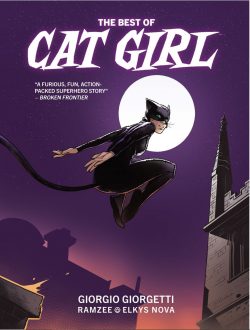
The Best of Cat Girl


By Giorgio Giorgetti, Ramzee, Elkys Nova, anonymous & various (Rebellion Studios)
ISBN: 978-1-78618-585-3 (TPB/Digital edition)

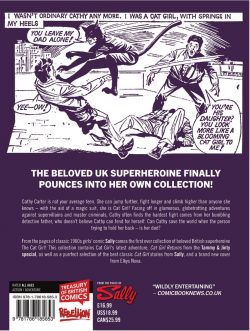
Here’s another superb lost treasure of British comics finally getting some of the attention its always deserved. Of course, that statement only applies if you are male and old. Just like every place on Earth that puttered along obliviously until a white guy stuck a flag in it, I’d imagine the girls who bought Sally back then had no problem appreciating the thrilling travails of young Cathy Carter who donned a literal catsuit to prowl our nation’s smoky rooftops in search of villainy to crush and people to help.

In terms of variety, emotional quality and respect for the readership’s intelligence, experience and development, British girls’ periodicals were always far more in tune with the target audience, and I wish now that I’d been more open-minded and paid more attention back then…

It’s certainly an attitude modern editors have embraced. Since 2016, Rebellion Studios has been commemorating the best of a very large bunch in assorted curated reprint archives – and even some new material – as part of its Best of… and Treasury of British Comics strands, as well as ongoing Judge Dredd/2000 AD publications.

Sally was a colourful, adventure-themed Girls weekly from London-based IPC (formerly Fleetway): running 94 anthological issues from June 14th 1969, before merging with juvenile juggernaut Tammy in 1971. The Sally brand of strange tales survived until 1976 through Christmas Annuals (6 of them). The title relied heavily on mystery and action strips such as Schoolgirl Princess, Justine, the Winged Messenger of Justice, Maisie’s Magic Eye and today’s star turn, The Cat Girl…

Another unmissable gem from days gone by, and re-presenting serialised thrills spanning June 1969 to mid-1970, this collection features yet another kitty-clad costumed crusader to augment Billy the Cat and Katie (The Beano), The Cat (June), The Cat (Bunty), Peter the Cat (Score & Roar), The Leopard from Lime Street (Buster) and others. Of course, this lass is exceptionally well-produced and memorable…

Whereas the writer is sadly unknown to us, these detective delights were sublimely illustrated by Italian émigré/UK comics stalwart Giorgio Giorgetti (Rat-Trap, House of Dolmann, Mam’selle X, Jump, Jump, Julia, and many others). He was swift and prolific, tackling newspaper strips, book illustration and seen almost constantly in titles including Mirabelle, Girl’s Crystal, Tammy, Jinty, Sally, Katy, June and School Friend as well as for general interest comics like Shiver & Shake and Look and Learn. He died far too early, in 1982.

I mentioned that these recovered memories have inspired new stories, and this enticing, mostly monochrome tome opens with a modern, full-colour revival of the feline fury, courtesy of writer Ramzee (FAB, LDN), artist Elkys Nova (Roy of the Rovers), colourist Pippa Bowland & letterer Simon Bowland.

Taken from 2020’s Tammy & Jinty Special and set in the present, ‘Cat Girl Returns’ sees single parent police inspector Cathy Cooper trailing murderous kidnappers/diamond thieves, covertly assisted by her daughter Claire.

The precocious kid has found an old cat “onesie” in mum’s closet that comes with a mask and imparts actual feline superpowers upon her…

Karl Stock’s full and comprehensive illustrated fact-feature on ‘Giorgio Giorgetti – The Cat Girl Artist’ – also from the T & J Special – closes this collection as part of a bonus section of creator biographies, but between those poles lurk a quintet of quirky, “kitchen-sink” superhero sagas utterly unlike anything the Americans were attempting at the time…

Girls’ comics always had a history of addressing modern social ills and issues but this “Girls Juvenile Periodical” viewed events and characters through a lens of soap opera criminality and casual mysticism. It was also one of the best-drawn comics ever seen…

Heading back to a time before mobile phones and social media, a widower tries to combine solo parenting with keeping his business afloat. Mr. Carter is a private detective slowly going under because he’s obsessed with a mysterious gangland mastermind.

Typically – in a classic early example of what we now know as Mental and Emotional Loads for women – young Cathy pretty much runs the home and keeps him going, whilst fretting over ways to help him more. She gets her chance after cleaning the attic and stumbling over a strange garment sent from Africa by a grateful and satisfied client. It was hidden inside a puzzle box Dad couldn’t get open…

Helpless to resist its weird appeal, Cathy dons the gear and realises it’s instantly made her stronger, faster, more agile, supernaturally sensitive and alert. It’s even given her claws and the ability to communicate with cats – and when she does it, they listen…

Soon ‘The Cat Girl’ (14th June – 2nd August 1969) is secretly supervising Carter’s cases, watching his back and fighting crime to help get ahead of the mounting bills. The first exploit sees him crack a massive insurance scam engineered by the hidden mastermind, who then targets his true nemesis prior to a major raid on a stately home…

Cat Girl constantly outwits sinister foe ‘The Eagle’, who returns for more in a second adventure (running from 9th August – 13th September) that sees her put all the clues together to scupper a huge mail train robbery.

Sadly, in the process the scurvy schemer deduces her secret. Abducting the kid, Eagle tests her almost to destruction whilst seeking to steal her powers. He does succeed in mesmerising her into becoming a tool in his wicked arsenal, but is still outwitted at the end…

The Cooper’s third performance here spans 24th January and 21st March 1970. Their star had risen, and Dad’s far more prosperous and prestigious agency is engaged to locate stolen gems lost during a major robbery. Meanwhile, Cathy quietly toils to clear the name of a performer seemingly possessing all the skills of the svelte vigilante…

Acrobatic Betty Breton claims she has been framed for stealing her theatre show’s takings, but there’s a far more complicated game in play, one requiring Cathy going undercover as a ‘Theatre Cat’ When her super-suit is swiped, both Cooper cases converge and a grim grand scheme is exposed…

In the aftermath of public acclaim, ace criminologist Cooper and his kid are invited to South America by flashy, wealthy CEO Mr. Barton. He wants them to capture infamous bandit El Sorro, whose extortion racket is cutting into Monza Oil’s vast profits, but Cathy learns a slightly different story when lodging with the Carlos family and befriending their daughter Mario.

Running 28th March to 30th May, this exotic extravaganza sees our schoolgirl hero infiltrating the bandit gang as ‘El Catto’, only to inadvertently expose and compromise her dad’s investigations whilst rapidly rising in the rogues ranks.

Only after a succession of astounding feats and incredible ventures does the masked “boy” (because no girl could fight like El Catto does) bring down the gang, save Dad and earn the eternal gratitude of Monza Oil and the common folk…

One final foray comes in a self-contained extended tale from Sally Annual 1971 (released in Autumn 1970), with Cathy countermanding Dad’s wishes and joining a travelling carnival. Her stint as acrobatic aerialist ‘Circus Cat’ is to help trapeze artist Kay Katoni, who can’t keep narrowly escaping a series of bizarre and potentially fatal “accidents” forever. It doesn’t take long for the feline flyer to divine who’s got it in for Kay and why…

This engaging and tremendously compelling tome is another glorious celebration of a uniquely compelling phenomenon of British comics and one that has stood the test of time and still adhered to the prime directive of UK costumed champions: “all British superheroes must be weird and off-kilter”.

Don’t miss this chance to get in on something truly special and sublimely entertaining…
© 1969, 1970, 2020 & 2022 Rebellion Publishing IP Ltd. All Rights Reserved. The Cat Girl and all related characters, distinctive likenesses and relevant elements featured in this publication are trademarks of Rebellion Publishing IP Ltd.

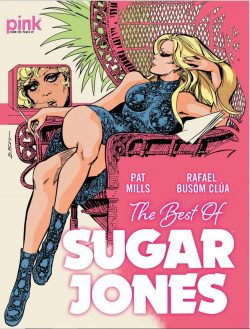
The Best of Sugar Jones


By Pat Mills, Rafael Busóm Clùa & various (Rebellion Studios)
ISBN: 978-1-78108-770-1 (TPB/Digital edition)

At first glance British comics prior to the advent of 2000 AD fall into fairly ironclad categories. Back then, you had cosily fantastic preschool whimsy, a large selection of adapted TV and media properties, action, adventure, war and comedy strands, with the occasional dash of mild supernatural horror. Closer scrutiny would confirm a persistent subversive undertone, especially in such antihero series as Dennis the Menace and The Spider, or simply quirky fare like Marney the Fox or His Sporting Lordship.

British comics have always been able to tell big stories in satisfyingly moreish small instalments. Coupled with superior creators and the anthological nature of our publications, this has ensured hundreds of memorable characters and series have seared themselves into the little boy’s psyche inside most adult males. I gather that’s equally true of the stuff girls were reading at the time…

Like most of my comics contemporaries I harbour a secret shame. Growing up, I was well aware of the weeklies produced for girls, but would never admit to willingly reading them. My loss: I now know that they were packed with amazing strips by astounding artists and writers, many of whom were (sadly anonymous) favourites who also drafted sagas of stalwart soldiers, marauding monsters, evil aliens or weird wonders …because all British superheroes were bizarrely off-kilter.

I now know that – in terms of quality and respect for the readership’s intelligence, experience and development – girls’ comics were far more in tune with the sensibilities of their target audience, and I wish I’d paid more broad-minded attention back then. Thus, I’m delighted to share here another peek at superb and oddly sophisticated comics from a publication I never went near, even though it was just as groundbreaking as its later stablemates Action or 2000AD – albeit not as nostalgically revered or referenced nowadays…

Girl’s Juvenile Periodicals always addressed modern social ills and issues, and also embraced those things women needed to be indoctrinated in: Fashion, pop trends, pets, toys, style-consumerism, make-up and more (even cooking, general knowledge and sewing!).

Pink came out of IPC’s girl’s publications division in 1973 and was quite successful before finally merging with Mates in 1980, just as television and teen fashion mags finally supplanted the mix of comics stories and trend journalism foe female audiences. Those girls’ grandkids are now lost in social media and the world turns ever on…

During its mercurial run of 377 issues, Pink offered targeted “news” features, games, puzzles, competitions and a wealth of strip mystery, adventure and particularly romantic fare in serials like Don’t Let him Fool You, Faye!, The Haunting of Jilly Johnson, The Island of Stones, Shadows of Fear, Memories of Mike, Rich Girl, Poor Girl, The Sea People and Remember, Rosanna, Remember!

As years rolled by, it was clear that the editors were gradually shifting the demographic, targeting older teens by developing a saucy, cheeky persona in keeping with a readership getting ready for adult life. One of those editors was Pat Mills – arguably the greatest creative force in British comics.

He began his career at DC Thomson in Dundee, scripting and editing for teen romance title Romeo and others before going freelance. At this time Mills wrote girls comics and humour strips, and moved south to London to join IPC and do the same for them. After editing and writing for Tammy, Pink and Sandy – and starting a small evolution in content and style on Jinty – he moved on and killed posh-comics-for-middle-class-boys (and girls) stone-dead.

After creating Battle Picture Weekly (1975, with John Wagner & Gerry Finley-Day), as well as Action (1976) and 2000AD (1977), Mills launched Misty and Starlord (both 1978). Along the way, he also figured large in junior horror comic Chiller…

As a writer he’s responsible for Ro-Busters, ABC Warriors, Nemesis the Warlock, Slaine, Button Man, Metalzoic, Marshal Law and Requiem Vampire Knight among so many, many others. That especially includes Battle’s extraordinary Charley’s War (with brilliant Joe Colquhoun): the best war strip of all time and one of the top five explorations of the First World War in any artistic medium.

Unable to hide the passions that drive him, Mill’s most controversial work is probably Third World War which he created for bravely experimental comics magazine Crisis. This fiercely socially conscious strip blended his trademark bleak, black humour, violence and anti-authoritarianism with a furious assault on Capitalism, Imperialism and Globalisation. It contained elements of myth, mysticism, religion and neo-paganism – also key elements in his mature work. You should also see his run on Doctor Who Weekly and Serial Killer – his final collaboration with Kev O’Neill…

Mills has always kept a judgemental eye on the now and recognised the power of humour and satire. In 1974 that led to his debuting a new kind of star for Pink. In 1973, the much-maligned and deliberately misunderstood (we call it “gaslighting” these days) “Sexual Revolution” hit a media high.

It was an epoch of “cheesecake” and “girly” strips: a genre stuffy old-fashioned Britain used to excel at and happily venerate. Saucy postcards, Carry-On films, ingenuously innocent smut and a passion for double entendre had for decades obscured and obfuscated genuine concerns like institutionalised gender pay-gaps, unwarranted interest in and control of female reproductive rights and sexual behaviour. There were double standards for men and women’s work and recreational behaviours, and that incomprehensible Mystery of Mysteries: just why men are utterly certain that anything they see automatically fancies them back and is therefore fair game for creepy jollity and unwanted attentions excused as “just having bit of fun” or “paying a compliment”…

After years of feminist agitation and balanced by entrenched institutional male mockery, countless publications and TV shows suddenly boiled at a wave of unexpected militancy. Everywhere women were demanding equal rights, equal pay and fair treatment …and isn’t it simply marvellous that they’ve got all those things now?..

Contraception was becoming more readily – if not quite universally – available and apparently everywhere bras were burning. This meant men actually coming to believe that sex might be less expensive and perhaps even repercussion/responsibility free. It was a reactionary Male Chauvinist Pig’s Dream, and unrepentant, old-school stand-up comedians had a field day. The only changes I can recall were more skin on TV, a wave of female-starring comics strips like Amanda, Scarth, Danielle, Axa and Wicked Wanda (in which each of the titular heroes lost her clothes on a daily basis) and the rise of “Page 3” newspaper nudies…

I’m not sure how many editors of daily and Sunday papers were supporters of the Women’s Liberation movement, or whether they simply found a great excuse to turn the industry’s long tradition of beautifully rendered naked birds on their pages into something at least nominally hip, political and contemporary.

I do know that an awful lot of new features appeared, with aggressive, strident (if not actually liberated), forceful women who nevertheless still had hunky take-charge boyfriends in tow…

In comics, Pat Mills created a rather greedy and generally nasty piece of work who – if not actually a villain – was certainly utterly selfish, shallow and self-absorbed. We Brits love rogues and scoundrels and will forgive them for almost anything – just look at the result of any election in the last 30 years

Thus Sugar Jones expertly capitalised on our national tradition of forgiving appallingly egregious actions and public weakness for inept wickedness: standing legs akimbo at the vanguard of a growing compulsion to slavishly follow what we now call “celebrity culture”. She too spent a lot of time in her underwear or less…

The series was illustrated by Spanish master of style Rafael Busóm Clùa who was a fixture of girls comics from the era. As well as The Island of Stones in Pink, he also limned The Three Wishes serial in Tammy, Two of a Kind in Misty and Warm Love in Oh Boy!

The Best of Sugar Jones features material seen in Pink from 16th October 1974 to 21st May 1977: episodic snippets that are all loving and lavish riffs on a single theme: cruel self-delusion.

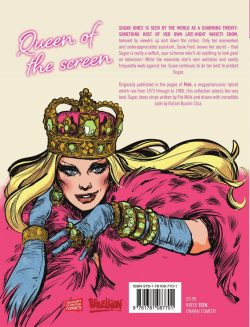
Sugar is a beautiful, successful sexy thing. She has her popular TV variety show and knows everyone. She sings, dances, does chat and interviews, opens fetes and sponsors charities. The public all love her… or at least the heavily made-up, cynically manufactured image of the sweet 20-something “fabulous super sex symbol” she unceasingly pretends to be.

Sugar is actually in her 40s: an amalgamated masterpiece of the skills of make-up artists, and art of clothiers, camera technicians and trainers. The enable her to frantically cling on to the illusion of vivacious attainability. She wants everyone to want her, and only her dutiful but increasingly disenchanted and abused assistant Susie Ford knows the plain truth.

Every week Sugar goes through formulaic sitcom motions of another scheme to build the star’s ego, reputation, bank account or bedpost notch count, with Susie forced to assist or secretly sabotage the shameless plot.

It sounds pretty tedious and repetitive, but Mills’ deft scripts and manic plotting, so sublimely rendered by good girl artist Busóm Clùa, make these assorted cheesecake treats absolutely captivating to see. High on glamour, the strips would have made so many pubescent boys rethink their views on girls comics, but thankfully, nobody let us in on the secret…

Here you’ll see the never-long-defeated fame-&-acclaim chaser adopt a hunky jungle man; scupper the careers of up-&-coming rivals; seduce impresarios and showbiz bigwigs; fail to launch a respectable movie/pop/theatrical/dance career; lose many prospective rich husbands or simply sow utter chaos with new and unwise, unsanctioned publicity stunts.

Her plans always fail, but somehow the self-absorbed seductress never really pays for her misdeeds, except in secret shame and frustration. Always, she bounces back with a new notion…

Sugar’s not averse to using her assets to make an illicit buck either, but her financial skulduggery always leaves her poorer in pocket. Even if the oblivious masses can’t get enough of her, whenever she tries to exploit charities, or breaking political crises, Susie’s there to see no one is harmed or suffers hardship…

A wickedly barbed social fantasy and satire on fame, fortune and pride, Sugar Jones presents a truly unique, likably unlovable antihero who’s one step beyond normal role model fare – or even standard raunchy cheesecake classification: someone who also transcends the rather shocking core assumption of that era, which seems to be “women are worthless once they turn 21”…

Exploring fashion, branding, celebrity culture, and the toxic legacy of glamour – on male terms and in a playing field controlled by men – from a time when that “laddish” culture of “banter” and “cheekiness” was even seeping into girls comics and magazines, Sugar Jones affords a totally different view of a woman on top: one any student of sexual politics and legacy of the culture cannot afford to miss…
© 1974, 1975, 1976, 1977 & 2020 Rebellion Publishing IP Ltd. All rights reserved.

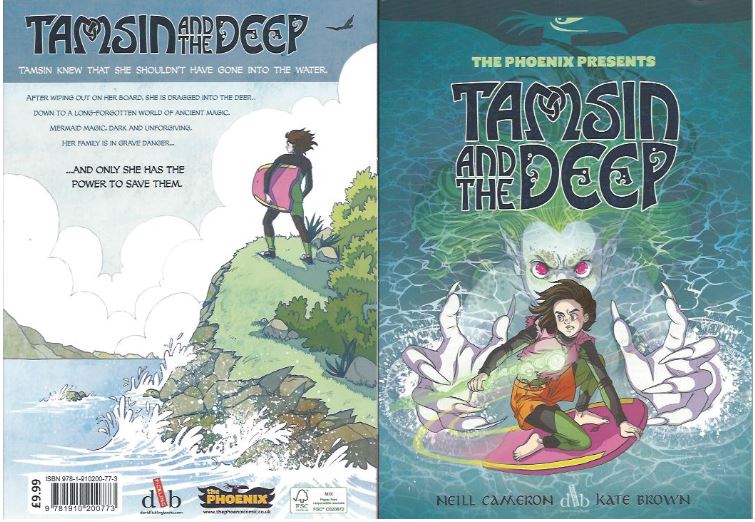
Tamsin and the Deep


By Neill Cameron & Kate Brown (David Fickling Books)
ISBN: 978-1-910200-77-3 (TPB)

In January 2012 Oxford-based David Fickling Books launched a traditional anthology comics weekly aimed at under-12s which revelled in reviving the good old days of picture-story entertainment intent whilst embracing the full force of modernity in style and content.

Each issue features humour, adventure, quizzes, puzzles and educational material in a joyous parade of cartoon fun and fantasy. Since that launch, The Phoenix has gone from strength to strength, winning praise from the Great and the Good, child literacy experts and the only people who really count – the astoundingly engaged kids and parents who read it…

Like the golden age of The Beano and The Dandy, the magazine is equally at home to boys and girls, mastering the magical trick of mixing hilarious humour strips with potently powerful adventure serials such as this one.

Here a wondrous seaside sorcerous saga with intriguing overtones of The Little Mermaid, by way of the darker works of Alan Garner, sails under the general title of Tamsin and the Days and leaves all the coping and crusading to a brilliantly capable lass who’s a match for any boy…

Written by Neill Cameron (Mega Robo Bros, Freddy, How to Make Awesome Comics, Pirates of Pangea) and beguilingly illustrated by Kate Brown (Manga Shakespeare: A Midsummer Night’s Dream, Young Avengers, Fish + Chocolate), our fishy tale opens with a ‘Prologue’ on the Cornish coast as a young girl berates her older brother Morgan.

He promised to teach her how to surf, but is just messing about with his mates, so – fed up and disappointed again – she leaves her dog Pengersek on the sands, swipes a bodyboard and paddles out alone. After all, how hard can it be?

When the big wave hits and she goes down for the final time, she’s sure she feels a grip on her foot and sees a green fishy face…

The story proper starts after ‘Tamsin’ – coughing and gasping – drags herself ashore. Somehow she’s drifted miles down the coast, and with nobody there to help has to make her own way home. Her leg hurts and the bus driver won’t let her on (she’s soaking wet and without cash) but at least she’s still got that old stick to lean on even if she can’t quite recall where she picked it up…

There are more surprises when she finally staggers home. Mum goes absolutely crazy and Morgan is clearly scared. Maybe it’s because their dad was lost at sea nine years ago, but it’s probably the fact that Tamsin vanished a month ago and has been officially declared dead and drowned…

The police have loads of questions she can’t answer, but as far as Tamsin knows she was only gone a few minutes. Eventually life settles back into a normal routine – apart from Morgan acting oddly and her own increasingly nasty dreams.

Things get bad again a few nights later. Awakening from a particularly vivid nightmare, Tamsin discovers she’s clutching that stick and riding a surfboard… hundreds of feet above the town! Moreover, from her shocking vantage point, she can see Morgan. He’s slowly walking into the sea…

Instantly, she zooms into the roaring brine to yank the sleepwalker out, blithely unaware that hostile, piscatorial eyes are angrily watching…

Morgan is shattered. He’s been having nightmares too, and the sleepwalking is not a new phenomenon. It’s probably from guilt but every time he wakes up he’s been heading for the sea…

‘A Nice Day Out’ sees Tamsin taking a little “me time”. Finding a secluded spot to practise flying with the aid of what is clearly a magic stick, she revels in her new gifts, but from high above she notices that Morgan is still unsettled. He’s sworn not to go near the water and has even quit the local surfing competition; and is clearly scared of something. Later, to cheer up her kids, Mum drags them to the beachside amusements where Morgan meets an enigmatic girl. She easily convinces him to re-enter the event…

Tamsin meanwhile has had another strange encounter. After having her ice cream stolen by a pixie thing, she meets a cocky Blackbird (he says he’s a Chough) who snidely and loquaciously tells her the newcomer was an Undine …before warning her to keep Morgan well away from water.

She’s almost too late: Morgan has wiped out in the contest’s early heats and is now being pulled under by a gloating mermaid. Tamsin blasts into the depths on her board, explosively ripping him free of her clawed clutches, and hurling them both high into the sky before landing in a terrified heap on the beach…

With the sorcerous she-wight fuming below the waves and scheming further mischief, in the sunshine Tamsin shares her secret with traumatised big brother before discovering a little ‘Family Mythology’ after that smug bird returns…

Deeper knowledge comes at a steep price, however, and her learning curve involves an awful lot of fighting against many more awful creatures before Tamsin is ready to save Morgan from a dread destiny and horrible fate hundreds of years in the making…

Apprised of a fantastic family heritage and now fully prepared to combat a generational curse that has seen all the males of her line swallowed by ‘The Deep’, Tamsin prepares herself for fantastic battle against a finned demon, but the foe is impatient: launching her own monstrous invasion of the surface-world which quickly reduces the entire town to panic and uproar…

Once the foam settles, triumphant Tamsin tries to ease back into a normal routine but that ill-omened bird returns for an ‘Epilogue’, explaining that she now has a mission for life – protecting Cornwall from all mystic threats – and that the next crisis has already begun…

This yarn is a fabulous blend of scary and fabulous, introducing a splendid new champion for kids of all ages to cheer on, with the certain promise of more to come, beginning with second mission Tamsin and the Dark…

Boisterous, bold and bombastically engaging, this is a rollicking supernatural romp of pure, bright and breezy thrills just the way kids love them, leavened with brash humour and straightforward sentiment to entertain the entire family.
Text © Neill Cameron 2016. Illustrations © Kate Brown 2016.

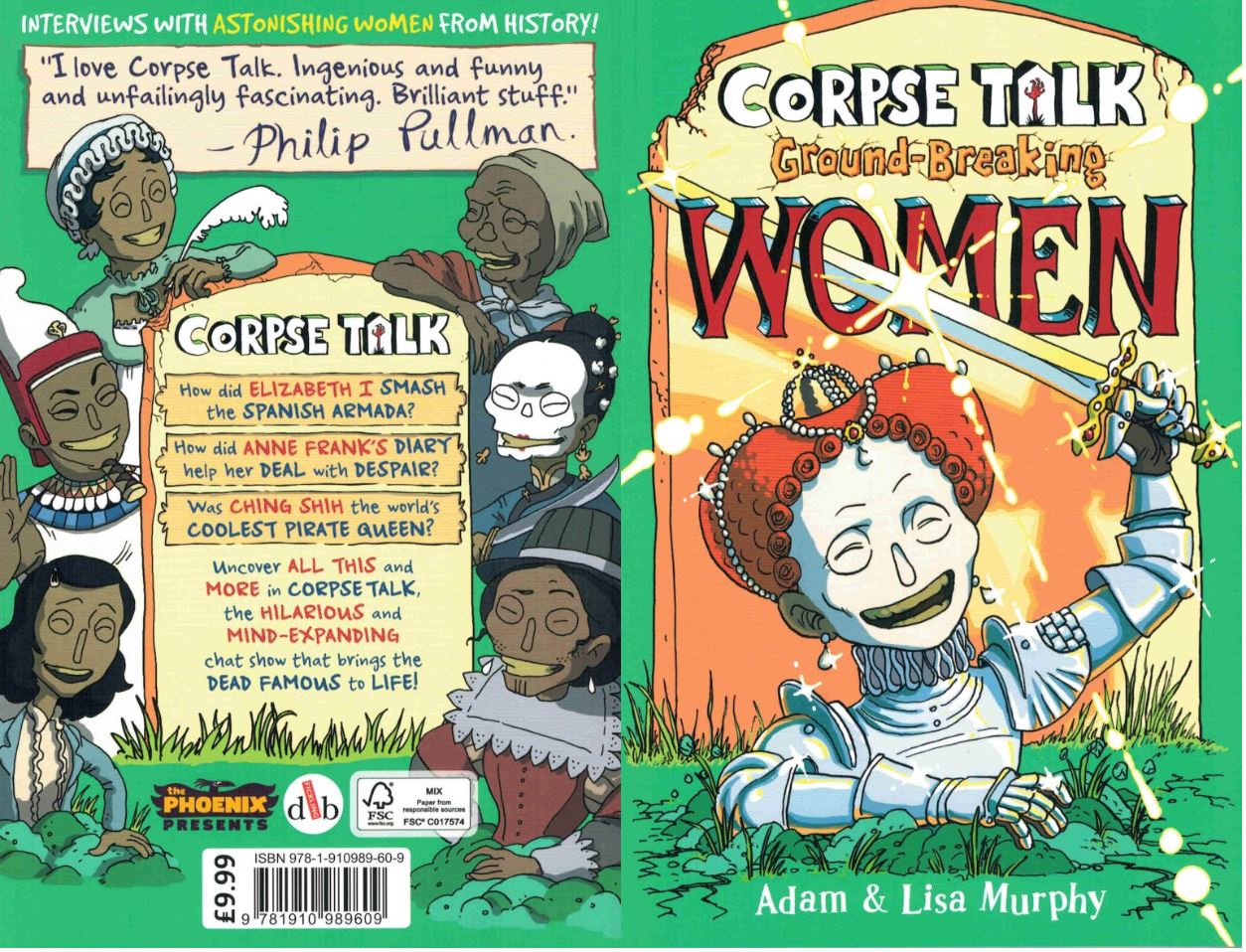
Corpse Talk: Groundbreaking Women


By Adam & Lisa Murphy (David Fickling Books)
ISBN: 978-1-910989-60-9(Digest PB)

The educational power of comic strips has been long understood and acknowledged: if you can make the material memorably enjoyable, there is nothing that can’t be better taught with pictures. The obverse is also true: comics can make any topic or subject come alive… or at least – as in this delightful almanac of inspiration – outrageously, informatively undead…

The comical conceit at play in Corpse Talk is that your scribbling, cartooning host Adam Murphy (ably abetted off-camera by Lisa Murphy) digs up famous personages from the past: all serially exhumed for a chatty, cheeky This Was Your Life talk-show interview that – in Reithian terms – simultaneously “elucidates, educates and entertains”. It also often grosses one out, which is no bad thing for either a kids’ comic or a learning experience…

Another splendid release culled from the annals of British modern wonder The Phoenix (courtesy of those fine saviours of weekly comics at David Fickling Books) this collection -regrettably still unavailable in digital editions – quizzes a selection of famous, infamous and “why-aren’t-they-household names?” women from history, in what would probably be their own – post-mortem – words…

Be warned, as you absorb these hysterical histories, you may say to yourself again and again “but… that’s not FAIR…” over and over again.

Catching up in order of date of demise, our fact-loving host opens these candid cartoon conferences by digging the dirt with ‘Hatshepsut: Pharaoh 1507-1458 BCE’, tracing her reign and achievements …and why her name and face were literally erased from history for millennia.

As ever, each balmy biography is accompanied by a side feature examining some crucial aspect of their lives, such as here where ‘Temple Complex’ diligently details the controversial pharaoh’s astounding and colossal “Holy of Holies”: the Djeser-Djeseru Mortuary Temple of Hatshepsut.

‘Hypatia of Alexandria: Mathematician & Philosopher 360s-415’ sketches out the incredible accomplishments, appalling treatment and tragic fate of a brilliant teacher and number-cruncher, supplemented here by a smart lesson in the almost-mystical concept of ‘The Golden Ratio’.

Throughout all civilisations, (mostly male) historians have painted powerful women with extremely unsavoury reputations and nasty natures. Just this once, however, the facts seem to confirm that ‘Irene of Athens: Empress of Byzantium 752-803’ was every bit as bad as detractors described her. Her atrocious acts against friends, foes and her own son Constantine are offset in the attendant fact-feature ‘Spin Class’, revealing how Irene employed religious industrial espionage to break China’s millennial monopoly on silk production, and comes complete with a detailed breakdown of how the Byzantine silk trade worked…

Every comic reader or fantasy fan is familiar with the idea of women warriors, but a real-life prototype for them all was the great-granddaughter of Genghis Khan. ‘Khutulun: Wrestling Princess 1260-1300s’ refused to be married off unless a suitor could defeat her in the Mongolian grappling martial art Bökh. So effective a fighter, archer and strategist was she, that the Khan appointed her his Chief Military Advisor and even nominated her his successor on his deathbed – an honour and can of worms she wisely sidestepped to become a power behind the throne.

Her incredible account is backed-up by an in-depth peek into the ferocious wrestling style she dominated in ‘Mongolian Moves’, after which ‘Joan of Arc: Saint 1412-1431’ explains how it all went wrong for her in asks-&-answers feature ‘How Do You Become a Saint?’

On more traditional and familiar ground, ‘Elizabeth I: Queen of England 1533-1603’ recounts her glorious reign and explains the how and why of her power dressing signature appearance in ‘A Killer Look!’ whilst transplanted near-contemporary ‘Pocahontas: Powhattan Princess 1596-1617’ shares the true story of her life before ‘Sad Ending, Continued…’ discloses the ultimate fate of her tribe at the hands of English Settlers.

Another astonishing character you’ve presumably never heard of is ‘Julie D’Aubigny: Swashbuckler 1670-1707’. She was a hell-raising social misfit who scandalised and terrorised the hidebound French Aristocracy. Daughter of a fencing teacher, she fought duels, broke laws, travelled wherever she wanted to, enjoyed many lovers – male and female – and even sang with the Paris Opera (now that’s a movie biopic I want to see!). What else could she offer as a sidebar but a lesson on duelling for beginners in ‘Question of Honour’?

‘Granny Nanny: Resistance Fighter 1686-1755’ started life as an Ashanti Princess, taken to Jamaica as a slave. However, once there she organised the ragtag runaways known as Maroons into an army of liberation. The workings of her rainforest citadel Nanny Town (now Moore Town) are explored in ‘Fortresses of Freedom’ after which a more sedate battle against oppression is undertaken with the interrogation of ‘Jane Austen: Novelist 1775-1817’, complete with cartoon precis of her subversive masterpiece ‘Pride & Prejudice (The Corpse Talk Version)’…

‘Ching Shih: Pirate Queen 1775-1844’ tells of another woman who beat all the odds but has since faded from male memory: a young girl kidnapped by China Seas pirates who rose to become their leader. Ravaging the Imperial coast, the corsair created an unshakable pirate code that benefitted the poor, outsmarted the Chinese Emperor and ultimately negotiated a pardon for herself and all her men to live happily ever after!

That salty sea saga is accompanied by the lowdown and technical specs on ‘Punks in Junks’ and followed by another bad girl with a good reputation.

‘Princess Caraboo: Con-Artist 1791-1864’ was never the Malayan royal refugee British High Society was captivated by, but rather a Devonshire serving maid who made the most of outrageous fortune via her quick wits. Her story is backed up by a delightful opportunity to forge your own faux identity with ‘Caraboo’s Character Creation Course!’…

Far more potent and worthy exemplars, ‘Harriet Tubman: Abolitionist 1822-1913’ ferried more than 300 of her fellow slaves from Southern oppression to freedom in northern American states and what we now call Canada: supplemented here by a detailed breakdown of ‘The Underground Railway’ before emancipation martyr ‘Emily Wilding Davison: Suffragette 1872-1913’ shares her brief, troubled life and struggle to win women the right to vote and participatory roles in society. The history is backed up by an absolutely unmissable graphic synopsis of the long struggle in ‘A Brief History of Women’s Rights’…

Someone who made every use of those hard-won concessions was ‘Nellie Bly: Journalist 1864-1922’, whose sensational journalistic feats and headline-grabbing stunts made her as newsworthy as her many, many scoops. One of the most impressive was beating Jules Verne’s fictional miracle of modernity by voyaging for ‘72 Days Around the World’ – as seen in the gripping sidebar spread – whereas the career of ‘Amy Johnston: Aviator 1903-1941’ was cut tragically short by bad luck and male intractability. Her flying triumphs are celebrated through a fascinating tutorial on her preferred sky-chariot. The ‘De Havilland Gypsy Moth’.

The short, tragic life of ‘Anne Frank: Journalist 1864-1922’ follows, accompanied by a detailed breakdown of the secret hideout and necessary tactics employed to conceal Anne, her family and friends in ‘The Secret Annex’.

Closing on an emotional high note, the rags to riches/riches to rags to riches account of dancer, comedian, freedom fighter and social activist ‘Josephine Baker: Entertainer 1906-1975’ details the double rollercoaster life of a true star and ends this book on a big finish with her teaching the secrets of how to ‘Dance the Charleston’.

Clever, moving, irreverently funny and formidably factual throughout, Corpse Talk: Ground-Breaking Women cleverly yet unflinchingly handles history’s more tendentious moments: personalising the great, the grim and the good in ways certain to be unforgettable. It is also a fabulously fun read no parent or kid could possibly resist.

Don’t take my word for it though, just ask any reader, spiritualist or dearly departed go-getter…
Text and illustrations © Adam & Lisa Murphy 2018. All rights reserved.

Von Hoffman’s Invasion Book One


By Tom Tully & Eric Bradbury (Rebellion Studios)
ISBN: 978-1-78108-626-1 (TPB/Digital edition)

In the sixties and seventies the British liked their comics characters weird, wild, utterly amoral, flagrantly inept and invariably corrupt to the core. These days it’s a requirement we only demand from and venerate in our politicians and public servants.

One thing we have adored above all other things is a great, properly flamboyant villain…

British comics have always enjoyed a strange, extended love affair with what can only be described as “unconventional” (for which feel free to substitute “weird” or “creepy”) heroes. So many stars and putative role models of our serials and strips have been outrageous or just plain “off”: self-righteous voyeurs-vigilantes like Jason Hyde, deranged vigilante geniuses like Eric Dolmann, self-absorbed outsiders like Robot Archie, arrogant, morally ambivalent former criminals like The Spider or outright racist supermen such as Captain Hurricane…

We also made much of (barely) reformed criminals like Charlie Peace and sinister masterminds in the manner of The Dwarf, Black Max, Dr. Mesmer, Grimly Feendish, The Snake and this particular Menace to Society…

Until the 1980s, UK periodicals exclusively employed an anthological model: offering variety of genre, theme and character on a weekly – or sometimes fortnightly – basis. Humour comics were leavened by action-heroes, whilst adventure papers always carried some palate-cleansing gag-strips and stars. Buster offered the best of all worlds.

Running 1902 issues from May 28th 1960 to 4th January 2000, it delicately balanced drama, mystery, action and comedy, with its earliest days – thanks to absorbing Radio Fun and Film Fun – heavily dosed with celebrity-licensed material starring media mavens like Charlie Drake, Bruce Forsyth and Benny Hill backing up the eponymous cover star billed as “the son of (newspaper strip icon) Andy Capp”.

Buster became the final resting place of many, many companion papers in its lifetime, including The Big One, Giggle, Cor!, Monster Fun, Jackpot, School Fun, Nipper, Oink!,

Whizzer & Chips and Jet, so its cumulative content was wide, wild and usually wacky…

Jet debuted in 1971 but only lasted 22 weeks at a time when our indigenous periodicals industry struggled to cope with spiralling costs and mass importation of brash, flashy, full-colour comics from America.

A product of the editorial policy described as “Hatch, Match and Dispatch”, similar to US try-out comics, it involved launching whole titles with new features to catch reader attention and mercilessly culling them and harvesting the most popular features into established, proven sellers like Lion, Tiger, Valiant or Buster.

Jet was dedicated to adventure features but also carried humour strips. Only three (out of 14 contenders) survived amalgamation, but for The Kids of Stalag 41 the reprieve was a short one. Long-term, only Ken Reid’s immortal Face Ache and a mad masterpiece of weird science called Von Hoffman’s Invasion proved worthy of our attention. The arcane antagonist and enemy of the people even scored the cover spot of issue #1…

British comics in the 1960s and 1970s were a phantasmagorical playground of bizarre wonders. Recognisably heroic protagonists appeared in war, western and gradually declining crime serials, whilst the most memorable momentum devolved to a hybrid, bastardized mixture of fantasy, horror and science fiction themes to spawn unique stars of a graphic pantheon unlike any other…

Another stunning salvo of baby boomer nostalgia courtesy of Rebellion’s Treasury of British Comics strand, this initial collection of Von Hoffman’s Invasion gathers all the material from Jet, spanning May 1st to September 25th 1971 and its continuation in Buster running from October 2nd to February 5th 1972. The home front weird war eventually concluded on October 21st of that year, thanks I’m sure to the sheer quality of its creators, who were undoubtedly drawn away for newer – and potentially more successful – escapades…

I’m sure I don’t need to remind you that this was the mid-Sixties, so racial depictions like the half-sized sumo wrestler-bot last cited were perpetrated “in fun”, and not fairness or good taste…

Von Hoffman’s Invasion was a classic example of the many-stranded uncanny menace genre young Brits thrived upon, blending elements of war stories with super science, seeing evil geniuses thwarted by bold kids and plucky Everymen. It all seemed so incredibly credible thanks to the efforts of two of our industry’s greatest talents…

This inexplicably compelling blend of marauding monster, unjustifiable revenge and scary invasion was scripted by impossibly prolific Glasgow-born Tom Tully. His astoundingly broad output of classic delights included Roy of the Rovers, Heros the Spartan, Dan Dare, Master of the Marsh, The Leopard from Lime Street, Janus Stark, Mytek the Mighty, The Wild Wonders, Nipper, Adam Eterno, The Mind of Wolfie Smith, Johnny Red, Harlem Heroes, Mean Arena, Inferno, The Robo Machines, Football Family Robinson, Buster’s Ghost and many more.

His collaborative co-creator here worked on many of those sagas. The incredibly gripping moody comic art of Eric Bradbury had begun gracing newsagents’ shelves in 1949 in Knockout. Frequently working with studio mate Mike Western, Bradbury drew strips like Our Ernie, Blossom, Lucky Logan, Buffalo Bill, No Hiding Place, The Black Crow and Biggles. He was an “in-demand” illustrator who worked into the 1990s on landmark strips like The Avenger, Cursitor Doom, Phantom Force 5, Maxwell Hawke, Joe Two Beans, Mytek the Mighty, Death Squad, Doomlord, Darkie’s Mob, Crazy Keller, Hook Jaw, The Sarge, Invasion, Invasion 1984, The Mean Arena, The Fists of Jimmy Chang, The Dracula Files, Rogue Trooper, Future Shocks, Tharg the Mighty and so much more…

From the start, Tully & Bradbury delivered intense, claustrophobic tension-drenched, action-packed episodic adventures, opening here with the release after 25 years of a war criminal who was still a fanatical Nazi and faithful servant of the Third Reich.

Doktor von Hoffman had been constructing mechanised moister terror-weapons as WWII ended, and the destruction of his robot centipede tipped him over the edge.

He went to jail sworn to destroy the British, but the only thing he had learned upon his release in 1970 was that biology was more effective than engineering…

In his old lab on the outskirts of Berlin, he created an enlarging chemical that also made those subjected to it slaves to his commands. On reaching the French coast he used it to turn an eel into a colossal animal torpedo and rode it to England, dallying only to sink a cross channel ferry. On beaching in Cornwall, he started his petty campaign of revenge by using the growth gas (concealed in the battered umbrella all evil geniuses carry) to magnify a crab to the size of a house and destroy a fishing village, reinforcing the walking tank with a deadly giant wasp. With local police fearfully outmatched the RAF finally get involved, scoring a rather pyrrhic victory at the cost of an attack helicopter…

Still at large, utterly unsuspected but also deeply paranoid, Von Hoffman continues randomly unleashing destructive colossi – such as giant toads, pigeons, roving dogs and assorted insects – culled from English country gardens until he encounters Barry and Joey Drake. When they are attacked by monsters in the cottage at Little Upton, the young brothers discover one of the serums their scientist dad is working on reverses the effects of the mad doctor’s gas…

It happens when the madman briefly transforms their good dog Major into a marauding beast and an old bottle in the shed saves them and their faithful four-legged friend…

Armed with a solution and plenty of X2FO4, the lads go after the maniac and clash just as Herr Doktor unleashes a massive mole on (or rather under) a British army base. Interrupting a top secret tank test, Von Hoffman ups the ante with a horde of rampaging woodlice that results in a blistering battle between ancient armour and modern ordnance.

It all goes very badly for mankind until Barry and Joey find a way to deploy their dad’s solution…

Thwarted but undaunted, the crazed war criminal then invades a monkey sanctuary where things get really hairy when bad-tempered, behaviourally-challenged chimp Charlie gets a dose of growth gas and goes on a very cinematic rampage…

When that all goes wrong, the boys actually capture the villain, but his umbrella and some rapidly enhanced woodworm serve to extricate Von Hoffman for another assault on Albion: this time augmented by a rampaging rabbit that thumps the army hard. Meanwhile in London, the government is finding it harder and harder to keep a lid on the chaos happening out in the provinces…

The cover-up gets its biggest bashing when aided by a super stag beetle, the Doktor plans to strike a shattering blow to British morale; attacking the nation’s soul by disrupting football’s “Global Cup Final”: a grudge match between England and Germany…

Cue enhanced ants, budgerigars, rats, hedgehogs and spiders, the abduction of England’s captain and the debut of absolutely indescribable pedigreed dog breeder/footy fan Cynthia Fulbright whose help – along with the boys’ serum-filled water pistols – saves the day and cinch the cup for England….

Foiled again and almost out of growth gas, Von Hoffman is on the back foot now, but strikes again with an enlarged coypu that enables to restock his chemical larder by attacking Weldale Research Laboratories whilst building up his forces via the facilities stock of squid and octopi, sparking another battle with the army. Although driven off, the madman is not disheartened: after all, now he has fresh hope, fresh resources and best of all a small army of giant birds and mechanical dinosaurs!

To Be Continued…

Closing this titanic tome is a tempting teaser extract for similarly themed star Black Max so enjoy that too….

Completely bonkers but utterly engaging, this brilliantly wry romp is sheer addictive nostalgia for my generation, but the stories also hold up against anything made for today’s marketplace. Buy it for the kids and read it too. This is a big, bold glorious tale, and brace yourself for even better yet to come…
© 1971, 1972, 2018 Rebellion Publishing Ltd. All rights reserved.

The Adventures of Gideon Gunn – The Pagan Priest #1: Strange Alchemy


By Daniel Whiston & Andrew Richmond (Richmond Press)

Like so many others, I started out in the publishing biz making minicomics, collaborating on fanzines and concocting stripzines with fellow starry-eyed weirdoes, outcasts and addicts. Seeing the raw stuff of creativity in hand-crafted paper pamphlets – or better yet in professionally printed packages which put the dreamers’ money where their mouths are – still gets me going in ways which endanger my tired old heart.

Ah, the lost joys of copydex, spray mount and cowgum…

These days, in terms of quality and at first glance, there’s very little to distinguish between self-published material and major events from big brands – except maybe movie contracts and a subtle whiff of sheer fun-filled exuberance you just can’t find once telling stories becomes your day job…

With that in mind, here’s a delightful treat sent to me last year and which only just arrived. Still, better late than never, and I’m certain comics this good will always find an appreciative audience… and maybe a movie contract…

As I’ve frequently demonstrated, British comics have always enjoyed odd and/or deeply flawed heroes. To be fair, that quirky affinity doesn’t just apply to paper wonders such as Cursitor Doom, Adam Eterno, Flame o’ the Forest and The Spellbinder – or even Warrior’s Father Shandor – but also to many stars of books, radio, television and films…

There’s a definite nod to that last one in the three tales gathered here: detailing in short sharp vignettes the sacred cause of a conflicted but supremely pragmatic warrior against evil – Holy Heathen Gideon Gunn – the Pagan Priest. A working priest in 18th century Somerset, Gunn takes the eternal war against sin to uncanny extremes…

Reverend Gunn is also a true believer in pagan gods and combines the devotional power of two vastly opposing faiths with the latest in science and weapons technology to hold back the forces of darkness assaulting his flock. This mostly manifests as the rising of primordial goddess Sulis and attendant and subsequent depredations of vampires, warlocks, zombies, mechanical myrmidons, homunculi, the mad natural philosopher whose discoveries inspired Victor Frankenstein, and even the corrupt and debased aristocracy smugly ruling the United Kingdom at this time…

It transpires that all manner of wicked things are seeking to control the unleashed forces of the “Deep Dark Waters”…

Action-packed, tongue-in-cheek and blending faux found documentation with superb art pastiching the feel of its filmic antecedents, these adventures revel in the sheer joy of a tirelessly dedicated hero, devotional vigilante and Man of Gods fighting the Good Fight with every weapon he can lay his hands on…

This first issue also includes an annotated map of ‘Wyrd Bath’ for the clarification and edification of readers…

Cunningly channelling the tone of cult and classic British historical horror tales (like Witchfinder General and The Blood on Satan’s Claw or Hammer Films’ Dracula and Frankenstein franchises), Gideon Gunn delivers fearsome fun in self-contained monochrome episodes reminiscent of early 2000 AD or Scream.

Scripter Daniel Whiston (Neroy Sphinx, Judge Dredd Megazine, FutureQuake) and illustrator Andrew Richmond (Aces Weekly, The77, Octobriana, Blazer!) are having a great deal of fun – and so will you…

™ & © 2022 Daniel Whiston and Andrew Richmond. All rights reserved.

Available from Gideon Gunn – Andrew Richmond (andrewrichmondart.com)