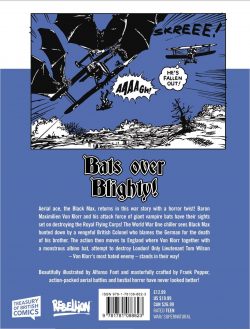
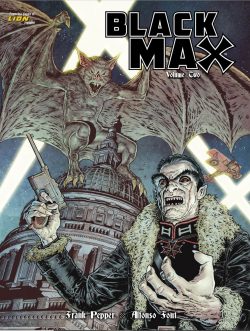
Black Max: Volume 2


By Frank S. Pepper, Alfonso Font & various (Rebellion Studios)
ISBN: 978-1-78108-862-3 (TPB/Digital edition)

Win’s Christmas Gift Recommendation: Astounding Air Ace Action… 9/10

It’s time for another sortie down memory lane for us oldsters and hopefully a fresh, untrodden path for fans of the fantastic seeking a typically quirky British comics experience.

This stunning sequel selection delivers one more stunning nostalgia-punch from Rebellion’s superb and ever-expanding Treasury of British Comics, collecting more episodes of seminal war/horror shocker Black Max.

The strip debuted in Thunder #1 and ran the distance: surviving cancelation and merger and continuing into Lion and Thunder until that magazine finally gave up the ghost mid-decade.

This second volume carries the next wave of those stories, covering May 15th to December 25th 1971, with the periodical perils rounded out by longer yarn taken from Thunder Annual 1973.

The series is typical of the manner in which weekly periodicals functioned back then: devised by screenwriter, veteran Editor and prolific scripter Ken Mennell (Cursitor Doom, Steel Claw, The Spider and many more) with the first episode limned by the company’s star turn for mood and mystery Eric Bradbury (Invasion, The Black Crow, Cursitor Doom, House of Dolman, Hookjaw and dozens more). The whole kit and kaboodle was then handed off to another team to sink or swim with, which they did until 1974: a pretty respectable run for a British comic…

In many ways, the attrition rate of British comic strips bore remarkable similarities to casualty figures in war, but this serial was well-starred. The assigned writer was Frank S. Pepper. who began his legendary comics career in 1926. By 1970 he had clocked up many major successes like Dan Dare, Rockfist Rogan, Captain Condor, Jet-Ace Logan and Roy of the Rovers to name but a very, very few.

Series illustrator Alfonso Font was a ten-year veteran – mostly for overseas publications. Based in Spain, he had worked not just for Odhams/Fleetway but on strips for US outfits Warren and Skywald and continental classics such as Historias Negras (Dark Stories), Jon Rohner, Carmen Bond, Bri D’Alban, Tex Willer, Dylan Dog and more…

Episodic by nature and generally delivered in sharp, spartan 3-page bursts, by the time of these trench warfare and skyborne tales the premise and key characters were firmly established and Pepper & Font were growing bolder and more experimental…

In 1917, the Great War was slowly being lost by Germany and her allies. In the Bavarian schloss of Baron Maximilien von Klorr, the grotesque but brilliant scientist and fighter ace had devised a horrific way to tip the scales back in favour of his homeland. His extremely ancient family had for millennia enjoyed an affinity with bats and the current scion had bred giant predatory versions he controlled by various means – including telepathy – that flew beside him to terrify and slaughter the hated English. Initially, they had been a secret weapon used sparingly but by this juncture soldiers and aviators knew well this other form of death from the skies…

His schemes were imperilled and countered on a weekly basis by young British pilot Tim Wilson of Twelve Squadron. Originally a performer in a peacetime flying circus, the doughty lad was possibly the best acrobatic aviator on the Western Front and his constant encounters with von Klorr and the colossal chiropteran constantly frustrated the manic monster master…

Now, Wilson’s superiors are aware of the fearsome bio-weapons, and thanks to his constant interference, the Baron devotes an astonishing amount of time and effort to killing the English fighter ace …when not butchering Allied fliers and ground troops in vast numbers.

The odds seemed to shift once von Klorr began mass-producing his monsters, but Wilson eventually gained the upper hand: driving “Black Max” out of his castle HQ and into a hidden facility where the villain retrenched and made bigger, better terrors…

The private duel resumes here as extended, multi-part serials became standard. The first finds veteran English Ace Colonel “Hero” Hall quitting his desk job to take personal command of Twelve Squadron, after his younger brother is reported missing after meeting Max’s bats.

The vendetta makes life particularly hard for Tim Wilson and leads to Hall’s gross dereliction of duty in the field, but does send the German into retreat and cost him almost all of his monstrous animal allies…

On the back foot and frantically rebuilding, von Klorr is forced to improvise. Capturing and brainwashing ambitious new British recruit Johnny Crane the evil genius embeds him as a secret weapon against Wilson. After miraculously and obliviously escaping many traps, Tim is eventually captured by his nemesis and subjected to the same torture process, before turning the tables on Black Max and apparently killing the bat man in a spectacular escape…

Of course it’s not true and the Baron resurfaces in London weeks later. Wilson is there too, on sick leave, but as Zeppelins bomb the capital, he stumbles into a plot to kidnap British animal scientist Professor Dutton. Von Klorr needs the boffin to improve the strength of his killer beasts, but cannot resist going after Wilson too: a mistake that scuttles his grand scheme and costs him dearly…

Down but never out, the Baron returns to his regular tactics and familiar killing fields, but suffers another reversal when Wilson discovers his current laboratory base. With only one giant bat and his resources exhausted, Von Klorr relocates to a deserted aerodrome to consider his options and is shocked to receive a message from his grandfather. The terrifying patriarch of the bat clan has arcane knowledge spanning millennia and reveals he has unearthed an ancient potion to recreate the “great King-bat”!

Recovering the actual formula is far from easy as it rests beneath Allied lines, but after herculean efforts Black Max secures it and doses his final pet. Thanks to more timely interference from Tim, the killer beast imbibes far too large a dose and mutates into an immense, unstoppable horror that attacks both German and British lines, necessitating an unprecedented alliance of the sworn enemies. Wilson is completely ready for von Klorr to betray him, but is still taken unawares when the moment comes – just as they finally kill the rampaging terror…

To Be Continued…

As previously stated, this initial collection also includes a complete adventure from Thunder Annual 1973: an extended saga rendered by Font but sadly uncredited as regards a writer. It’s 1917, and Black Max is distracted from his obsession when glory-hungry Prussian Ace Major Heinrich Stynkel uses his influence to ground the bats and their master so that he can have first pick of the English fliers. The new psychopath’s plot almost ends the reign of terror until cruel fate and Wilson play their part in a macabre comedy of errors…

These strip shockers are amongst the most memorable and enjoyable exploits in British comics: smart, scary and beautifully rendered. This a superb example of war horror that deserves to be revived and revered.
© 1971, 1973 & 2021 Rebellion Publishing Ltd. Black Max and all related characters, their distinctive likenesses and related elements are ™ Rebellion Publishing Ltd. All Rights Reserved.
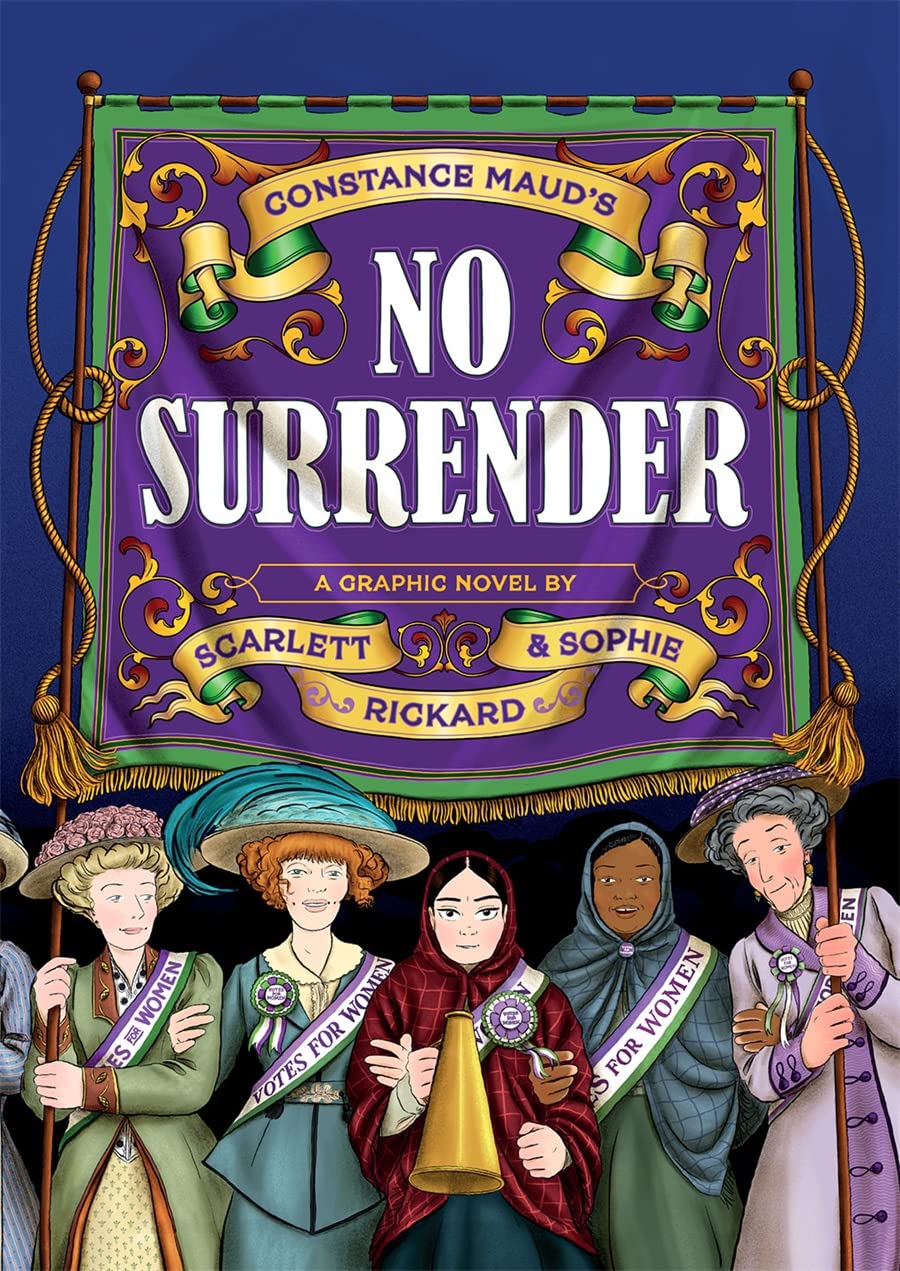

No Surrender


By Constance Maud: adapted by Scarlett & Sophie Rickard (SelfMadeHero)
ISBN: 978-1-91422-406-5 (TPB/Digital edition)

Win’s Christmas Gift Recommendation: Triumphant Tribute to Freedom Fighters and Literary Legends… 9/10

Constance Elizabeth Maud (1857-1929) was a child of privilege: daughter of a celebrated English scholar and cleric. She was primarily educated in France and lived there or in Chelsea for most of her life. Between 1895 and 1924 she wrote numerous articles and 8 novels – of which No Surrender was the penultimate – and became a member of the 400-strong Women Writers Suffrage League.

In 1908 she joined The Women’s Social and Political Union and The Women’s Freedom League: turning her writings to the needs of the cause. Her work subsequently appeared in many periodicals, especially magazines like the Suffragist movement’s newspaper Votes For Women.

In No Surrender (published in 1911 – and again in an annotated centenary edition released by publisher Persephone in 2011), Maud incorporated actual events with fictionalised analogues of many contemporary activists participating in the struggle to craft a history and playbook of the campaign for emancipation. The book became a rallying point and recruiting tool for the movement and was used to promote the soft end of the battle for equality. It inspired countless women (and presumable many male sympathisers) with a dramatised story of how the great and good would join with the humblest workers and unite to overcome…

Maud lived just long enough to see British women secure the right to vote: in 1918 with the Representation of the People Act – which enfranchised women over 30 years old – and at last witnessing universal female suffrage established in 1928’s Act, legislating that all Britons of 21 years or above could freely vote.

The main reason why No Surrender was such an effective weapon in the war to win the vote for all is that its propaganda and polemic were disguised by readily accessible drama. Beginning in industrial hub Greyston, ‘The Mill’ tells how northern mill worker Jenny Clegg is fired up by the many injustices afflicting women’s lives: with cruelty, unfair taxation, financial neglect, legitimised maltreatment and a status of second-class citizens chaining every female to a man of the gutter…

Rebelling, she forsakes her crusading socialist love interest Joe Hopton – a successful prime mover in winning better lives and wages for male workers – and dedicates her life to winning those same rights and representation for women. Upper class Suffragist Mary O’Neill has a more refined but similarly intransigent family at ‘The Country House’ all decrying her passion for women’s suffrage. She and Jenny will become friends, allies and leading lights in the struggle, inspiring millions of women, converting men, embarrassing the authorities and challenging a society where even other women refuse to see a status quo threatened…

Both driven by ‘The Calling’, they and a growing army of allies will invade London and suffer police and legal suppression in ‘The Courtyard’ and face ‘The Magistrate’ but never stray from their course. Whether testing tactics in ‘The Routes To Battle’ or challenging their detractors through heated debate on ‘The Cart’ the socially-distanced allies never stop their work, and gradually make converts even amongst the stratified intelligentsia who enjoy the closeted luxuries of ‘The Weekend Cottage’…

The story sees numerous characters interact on many levels like a soap opera, but underpinning it all is a roster of actual protest events woven into the plot, such as ambushing a number of off-duty cabinet ministers in ‘The Church’ and then infiltrating ‘The Dinner Party’ to reinforce their message.

The darkest and most notorious moments of the cause are also featured, as Clegg, O’Neill and other notable activists of every class endure imprisonment, abuse and medical torture – but each according to their own social rank and standing in ‘The Crushed Butterfly’, ‘The Prison’ and the deeply distressing culmination of ‘The Punishment’. Always, efforts to disunite and separate rich from poor, inherently virtuous from tawdry and lowborn, fails as the core principle – that they are all women together – completely eludes the smug, hectoring, insensate elitist male oppressors, prejudiced and scared working men and the Anti-Suffrage Women’s groups populated with ladies who know and defend their privileged place in the world…

Ultimately, Jenny and Joe are united in the cause and Mary makes her own converts in ‘The Homecoming’ before the story ends with a proud rallying of all in the march to inevitable universal enfranchisement and victory in ‘The Standard is Raised’ – a rousing graphic tour de force with illustrator Sophie Rickard crafting a stunning multi-page fold-out any art fan would cry to see…

Maud’s tale was ostensibly a romance and account of families in crisis with a thinly disguised moral message like a Dickens or Thomas Hardy novel. She explored and contrasted the lives of poor working folk with gentry and aristocracy, but also scrupulously catalogued the added travails and insecurities of working women. At this time women had been successively deprived of most financial and civil rights and privileges. They had to pay taxes but enjoyed no representation under the law; could not be legal guardians of their own children or property and, if married, could not divorce whilst their husbands could. The men could also beat them, but only with cudgels of judicially-mandated size…

At the end of this hefty and substantial graphic novel there’s a chart showing when – and how incrementally – the nations of the world instituted female enfranchisement, and an Afterword by adapting creators Scarlett & Sophie Rickard (Mann’s Best Friend, A Blow Borne Quietly, The Ragged Trousered Philanthropists), naming names and offering factual provenance for the incidents and characters enriching the narrative.

It also declares why – in the current environment where a citizen’s right to dissent and protest is being deviously and criminally whittled away – the principles of organised resistance and role and consequences of righteous civil disobedience must be stridently defended…

Fair minded, honestly and powerfully expressing the views of all – including those opposing universal enfranchisement (and restoration of previously-removed social and civil rights) – Maud’s words are reinvigorated here with the authorities, capitalists, police and judiciary all given a fair hearing – and generally convicted out of their own mouths.

Of particular interest to modern readers will be the opinions of women who didn’t want a vote and the low workingmen who were generally the most passionate and violent opponents of change and equality…

Powerful, enraging, engaging and even occasionally funny, this never-more-timely tale of the force of the disenfranchised with their backs to the wall and ready to fight is supremely readable and should be compulsory viewing for all – as long as we don’t force anyone to…
© 2022 SelfMadeHero. Text © 2022 Sophie Rickard. Artwork © 2022 Scarlett Rickard. All rights reserved.

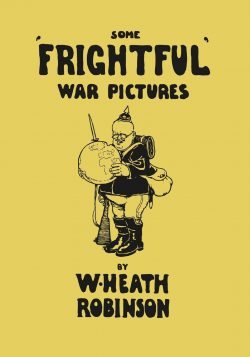
Some Frightful War Pictures illustrated by W. Heath Robinson


By W. Heath Robinson (Last Post Press)
ISBN: 978-1-4733-3483-0 (PB/Digital edition)

Not many people enter the language due to their own works and efforts. Fewer still last the course and remain relevant. Can you recall what “doing an Archer” means? We’ll soon be calling it “doing a Boris”… or “Truss” or “Sunak” or…

Moreover, when such endeavours also challenge egregious public perceptions and seek to correct outrageous out-of-control attitudes whenever  governments seek to enflame the worst of humanity for immediate political gain – and yes I am drawing parallels with now – these heroes need to be remembered just as much as The Fallen of so many wars. On this day of all days, never forget that, and also please recall that all the dead we commemorate are only that way because politicians and diplomats on all sides of every conflict failed to do their jobs right and only cartoonists and satirists ever called them out for it…

William Heath Robinson was born on 31st May 1872 into an artistic dynasty. His father Thomas was chief staff artist for Penny Illustrated Paper and older brothers Thomas and Charles were also illustrators of note. After proper schooling, William tried – unsuccessfully – to become a watercolour landscape artist before turning to the family trade.

In 1902, he released fairy story Uncle Lubin before finding graphic work at The Tatler, Sketch, Strand, Bystander and London Opinion. During this period, he developed the humorous whimsy and penchant for eccentric over-engineered mechanical devices for simple tasks which made him a household name.

During The Great War, Heath Robinson uniquely avoided the jingoistic stance and fervour of many of his competitors, preferring to satirise the absurdity of conflict itself in every periodical venue and volumes of collected cartoons. When the shooting stopped, he went on to a career of phenomenal success and creativity in cartooning, illustration and advertising.

Sadly he found himself doing it all over again in World War Two…

William Heath Robinson died on 13th September 1944.

There was a mild resurgence of interest in his efforts some years ago (from whence stems this timely collection) and if you’re interested you could scour the internet or even real bookshops for Hunlikely! (1916) or The Saintly Hun: A Book of German Virtues (1917). More general joys and niggles can be seen in Flypapers (1919), Get On With It (1920), The Home Made Car (1921), Quaint and Selected Pictures (1922), Humours of Golf (1923) and Let’s Laugh (1939), and in larger compendia Heath Robinson At War (1941) and The Penguin Heath Robinson (1946)

His literary collaborations can be found in The Incredible Inventions Of Professor Branestawm – 1933, accompanying the novels of N Hunter – or in Mein Rant with R. F. Patterson (1940).

In the 1970s and 1980s Duckworth reprinted a selection of albums including Inventions, Devices, The Gentle Art of Advertising, Heath Robinson at War, Humours of Golf, How To Be A Motorist, How To Be A Perfect Husband, How To Live in a Flat, How To Make your Garden Grow, How To Run a Communal Home, How To Build a New World, and, ominously and rather perspicaciously foresightfully, How To Make the Best of Things…

Some of these may still be found at or ordered through your local Library Service. Both Ribaldry and Absurdities were reissued in the 1990s and were readily available online last month…

There is very little point of in-depth analysis in the limited space available here, but surely some degree of recommendation is permissible. In Absurdities (1934), Heath Robinson personally gathered his favourite works into a single volume that more than any other describes the frail resilience of the human condition in the Machine Age and particularly how the English used to deal with it all. They are also some of his funniest panels.

In Railway Ribaldry – a commission from The Great Western Railway Company to celebrate their centenary in1935 (and more power to them; can you imagine a modern company paying someone to make fun of them?) – he examined Homo Sapiens Albionensis, as steel and rails and steam and timetables gradually bored their way into the hearts and minds of us folk. Much too little of his charming and detailed illustrative wit is in print today, a situation that cries out for rectification more than any other injustice in the sadly neglected field of cartooning and Popular Arts.

I apologize for the laundry-list nature of the above, but I’m not sorry to have produced it and neither will you be when you find any the wonderful, whimsical, whacky work of William Heath Robinson, Wizard of Quondam Mechanics.

In the spirit of his unique contribution to war and peace, this review ostensibly concerns his first combat collection which is readily available in digital editions. Published in 1915, Some Frightful War Pictures reprinted gags and observations first published in The Sketch and The Illustrated Sporting and Dramatic News: assaulting both the despised and press-pilloried “Boche” and the Empire’s own inept High Command with genteel mockery.

In complex, convoluted cartons with titles like ‘The True Reason of the War (July 1914)’, ‘Nach Paris!’, ‘Hague Convention Defied!’, ‘Kolossal!’, ‘The War Lord at the Front!’ and ‘War Komforts!’, the artist repeatedly points out how alike all sides are, whilst subtly hinting that other ways of settling issues are always available…
© 2017 The Estate of William Heath Robinson.

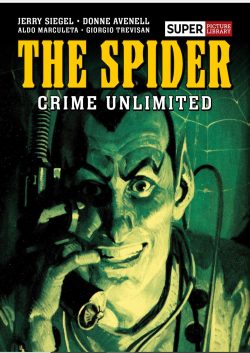
The Spider: Crime Unlimited


By Jerry Siegel, Donne Avenell, Aldo Marculeta, Giorgio Trevisan & various (Rebellion Studios)
ISBN: 978-1-78618-465-8 (HB/Digital)

Win’s Christmas Gift Recommendation: Bizarrely Bombastic Action Adventure… 8/10

Part of Rebellion’s Treasury of British Comics strand, The Spider: Crime Unlimited is a sublimely cool hardback collection celebrating an all-but forgotten sub-strand of the 1960s comics experience.

Until the 1980s, comics in the UK were based on an anthological model, offering variety of genre, theme and character on a weekly – or sometimes fortnightly – basis. Humorous periodicals like DC Thomson’s The Beano were leavened by thrillers like Billy the Cat or General Jumbo and adventure papers like Amalgamated Press/Fleetway’s Lion or Valiant always included gag strips such as The Nutts, Grimly Feendish, Mowser and a wealth of similar quick laugh treats. And yes, both rival companies had equivalents in those categories too…

They also produced Seasonal specials, hardcover Annuals and digest-sized anthology publications. DCT still publishes Commando Picture Library and used to have romance and science fiction titles such as Starblazer, matched by their London competitors with titles like Super Picture Library, War Picture Library, Air Ace Picture Library and Action Picture Library. These were half-sized, 64 page monochrome booklets with glossy soft-paper covers, but between 1967 and 1968 – at the height of the sixties Spy and Superhero booms – were supplemented by a deluxe, card-cover, 132 page version – The Fleetway Super Library.

As well as the always-popular war option of “Front Line” (starring by turn Maddock’s Marauders or Top-Sergeant Ironside), this line offered a “Secret Agent Series” – alternating cool spy operatives Johnny Nero and Barracuda – and the “Stupendous” (formerly and briefly “Fantastic”) series: delivering lengthy complete sagas starring either The Steel Claw or The Spider. These extra adventures came twice a month and ran 13 tales for each, and this spiffy hardback tome (245x177mm) re-presents the second and fourth releases, both starring the eerie webspinning master of crime…

British comics had a strange and extended love affair with what can only be described as “unconventional” (for which feel free to substitute “creepy”) heroes. So many of the stars and potential role models of our serials and strips were just plain “off”: self-righteous, moody voyeurs-turned vigilantes like Jason Hyde, sinister masterminds like The Dwarf, deranged geniuses like Eric Dolmann, jingoistic, racist supermen like Captain Hurricane and more often than not reformed criminals or menaces like Charlie Peace, The Steel Claw or The Spider…

…And don’t get me started on our legion of lethally anarchic comedy icons or that our most successful symbol of justice is an Eagle-bedecked, anonymously-helmeted, jack-booted poster boy for a fascist state. Perhaps that explains why these days we can’t even imagine or envision what a proper leader looks like and keep on electing clowns, crooks and obliviously blinkered over-privileged simpletons…

All joking aside, British comics are unlike any other kind and simply have to be seen to be believed and enjoyed. One of the most revered stars of the medium has finally begun to be collected in various archival editions, and perfectly encapsulates our odd relationship with heroism, villainy and particularly the murky grey area bridging them…

Mystery criminal genius and eventual superhero The Spider launched in peerless weekly anthology Lion with the June 26th 1965 issue. He would reign supreme until April 26th 1969, and periodically return in reprint form (in Vulcan) and occasionally new stories ever since.

As first introduced by Ted Cowan (Ginger Nutt, Paddy Payne, Adam Eterno, Robot Archie) & Reg Bunn (Robin Hood, Buck Jones, Captain Kid, Clip McCord), the moody malcontent is an enigmatic super-scientist whose goal is to be acclaimed the greatest criminal of all time. The flamboyantly wicked narcissist began his public career by recruiting crime specialists: safecracker Roy Ordini and genteelly evil inventor Professor Pelham before attempting a massive gem-theft from America’s greatest city. He was foiled by cruel luck and resolute cops Gilmore and Trask: crack detectives cursed with the task of capturing the arachnid arch-villain.

Cowan scripted the first two serialised sagas before handing over to comics royalty: Jerry Siegel (Superman, Superboy, The Spectre, Doctor Occult, Slam Bradley, Funnyman, The Mighty Crusaders, Starling), who was forced to look elsewhere for work after an infamous dispute with DC Comics over the rights to the Man of Steel.

Here his unique approach and astounding imagination results in a truly bizarre outing for Aldo Marculeta – who draws like Massimo Bellardinelli – to illustrate in 2 panels per page as Super Picture Library #2 heralds the menace of ‘The Professor of Power’…

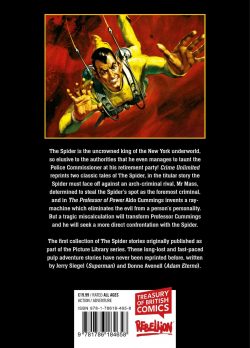
It begins as The Spider crashes a fancy party to mock retiring Police Chief Brady whilst abusively reminding his minions who is boss, but has unexpected repercussions as outraged scientist Aldo Cummings creates a process to counteract the evil of such villainy by removing wickedness from living beings. Sadly, his ray machine malfunctions and utterly alters his own personality whilst also bestowing other arcane gifts…

Although completely evil now, the shapeshifter is still obsessed with The Spider and sets out to humiliate and destroy him through a campaign of terror that sees his opponent beaten and jailed whilst the Professor disrupts global peace and even sacrifices humanity to alien body snatchers from an extradimensional realm. With human beings inhabited by the evil entitoids, the maniac deems his duels with the webspinner over, but he has underestimated the cunning and resolve of his foe, who finds himself in the strange position of being Earth’s saviour…

Following is ‘Crime Unlimited’ from SPL #4, illustrated by Italian multinational star turn Giorgio Trevisan (Cherry Brandy, War Picture Library, Battler Britton, HMS Outcast, Trelawney of the Guards, The Flying Fortress, Bob Pepper, Silver Arrow, Ken Parker, Sherlock Holmes and so much more) with a terse, gritty script from British legend Donne Avenell.

Staring his career before WWII, Avenell cut his teeth on many British comics icons like Radio Fun, War Picture Library, The Phantom Viking, Adam Eterno and Dr. Mesmer’s Revenge, major international features line Nigeria’s Powerman, Buffalo Bill, The Phantom and assorted Disney strips. He was equally at home with newspaper strips such as Tiffany Jones, Axa and Eartha novels and TV screenwriting on shows like The Saint). Here he pits the swaggering arrogant super-criminal against a brilliant and ruthless inventor who applies Henry Ford’s business practices to organised crime: using vast engineering talents and mass-production techniques with the view to getting rich by stealing The Spider’s title as Emperor of Crime…

Mr. Mass begins with a wealth magnet to snatch the proceeds of a Florida heist right out of the Spider’s bony fingers, builds an unstoppable mole machine and ultimately unleashes an army of plundering doppelganger thanks to his Mass-Replicator, with neither Pelham & Ordini nor Trask & Gilmore able to slow the warring masterminds down.

Implacable foes conducting industrial warfare, the duelling geniuses hurtle towards a spectacular final accounting after Mass reduces an entire city to mental infancy, but fails to stop his webspinning nemesis tracking him down to a catastrophic clash in an automated factory…

These retro/camp masterpiece of arcane dialogue, insane devices and rollercoaster antics are augmented by Extras including original covers, biographies of the writers and ads for even more uncanny UK comics collections, both available and forthcoming…

This titanic tome reaffirms that the Emperor is back at last and should find a home in every kid’s heart and mind, no matter how young they might be, or threaten to remain. Batty, baroque and often simply bonkers, The Spider proves that although crime does not pay, it always provides a huge amount of white-knuckle fun…
© 1967 & 2022 Rebellion Publishing IP Ltd. All Rights Reserved.
Metalzoic – DC Graphic Novel #6


By Pat Mills & Kevin O’Neill and various (DC Comics)
ISBN: 978-0-93028-910-2 (Album TPB)

Once again sad news comes to us that another comics great – and brilliantly entertaining convention companion – has gone too soon. We use the word unique far too often in our hyperbole-ridden industry, but I can honestly say there was never anyone quite like Kevin O’Neill, so – rightfully shamed by guilt – I’ll be reviewing a bunch of his best stuff that I never-quite-got-around-to in the weeks and months to come, but for now let’s look again at one of his most remarkable and neglected manic masterpieces… 

In the years immediately following the release of Crisis on Infinite Earths, DC Comics was a paragon of experimentation and quality, as this decidedly post-punk, English-flavoured offering from 2000 AD mainstays and certified “British Invaders” Pat Mills & Kevin O’Neill proves.

Not long after this book was published. illustrator O’Neill won the singular accolade of having his entire style of drawing – not a panel, not a story, but every single mark he left on paper – banned by the dried-up-but-not-quite-dead Comics Code Authority!

Not that it stopped the rise of his remarkable and truly unique talent in later triumphs such as Marshal Law, Serial Killer and The League of Extraordinary Gentlemen.

“Kev” was born in 1953 and, at age 16, began work as an office boy/art corrector for British weekly Buster. He worked in every aspect of the compartmentalised industry: lettering, art paste-up, logo design, colouring and more. He even apparently self-published a fanzine – Just Imagine: The Journal of Film and Television Special Effects…

As the kids stuff began to pale, life changed in 1977, when author/editor Pat Mills transferred him to a forthcoming, iconoclastic new science fiction comic.

O’Neill became a mainstay: producing covers, pinups and Future Shock short stories, whilst contributing to serials like Ro-Busters, satirical super parody Captain Klep, ABC Warriors and breakthrough character Nemesis the Warlock.

From there on, America came calling in the form of DC Comics…

In the far, far future robotic animals have evolved on the declining planet to fill the vacated niches once populated with specialised organic creatures. Civilised humanity has absconded to the stars and Mek-Animals roam the savage Earth. Armageddon is the ruler of the ape-like Mekaka, proud and ambitious, but his tribe are losing faith. They live on scavenged power and the mammoth-like Wheeled Beasts have not been seen for five years…

But this season they will return, led by the terrible God-Beast Amok, and the Mekaka will kill him and rule the world. Sadly, complications arise when joy-riding humans Jool and Ngila crash on this desolate dying world: one which most humans have forgotten ever existed. They have knowledge, but no survival instincts at all…

After US publication, the story was later serialised in 2000 AD #483-942, where it found a more welcoming audience before tragically vanishing from sight and memory. However, it remains purely primal savage satire: a fantastic fantasy; that remains an incontrovertible highpoint in DC’s abortive 1980s Graphic Novel line. Its scope and power are mesmerising and its return to print long, long overdue. Let’s hope someone gets the message…
© 1986 DC Comics Inc. All Rights Reserved.

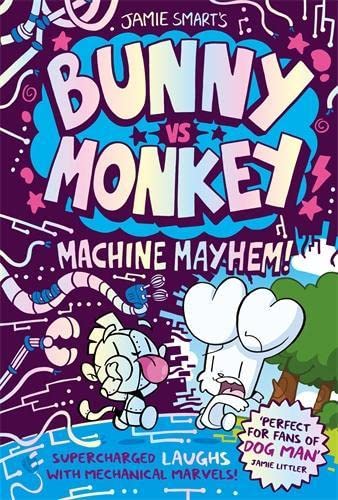
Bunny vs Monkey: Machine Mayhem!


By Jamie Smart, with Sammy Borras (David Fickling Books)
ISBN: 978-1-78845-285-4 (Digest HB)

Win’s Christmas Gift Recommendation: Madcap Mega-Meta Magnificence… 10/10

Bunny vs. Monkey has been a staple of The Phoenix since the very first issue in 2012: recounting a madcap vendetta gripping animal arch-enemies set amidst an idyllic arcadia masquerading as more-or-less mundane but critically endangered English woodlands.

Concocted with gleefully gentle mania by cartoonist, comics artist and novelist Jamie Smart (Fish Head Steve!; Looshkin; Flember), his trendsetting, mind-bending yarns have been wisely retooled as graphic albums available in remastered, double-length digest editions such as this one.

All the tail-biting tension and animal argy-bargy began yonks ago after an obnoxious little beast plopped down in the wake of a disastrous British space shot. Crashlanding in Crinkle Woods – scant miles from his launch site – lab animal Monkey believed himself the rightful owner of a strange new world, despite all efforts from reasonable, sensible, genteel, contemplative forest resident Bunny to dissuade him. For all his patience, propriety and good breeding, the laid-back lepine just could not contain the incorrigible idiot ape, who was – and is – a rude, noise-loving, chaos-creating loutish troublemaker…

Problems are exacerbated by the other unconventional Crinkle creatures, particularly a skunk called Skunky who has a mad scientist’s attitude to life and a propensity to build extremely dangerous robots and super-weapons…

Here – with artistic assistance from design deputy Sammy Borras – the war of nerves and mega-ordnances appears to be over. The unruly assortment of odd critters cluttering up the bucolic paradise had finally picked sides and the battles ended. They even seemingly forgot the ever-encroaching Hyoomanz…

Following a double-page pin-up of our odd and ever-expanding cast, this magnificent hardback archive of insanity opens in the traditional manner: divided into seasonal outbursts, and starting slowly with a querulous teaser tale as the cold retreats and Spring begins in ‘D.I.Whyyyy?’

As the animals all gather to help Bunny repair his much-abused house, universal innocents Weenie squirrel and Pig Piggerton are more keen than skilled, with no idea that cheese is not a suitable substitute for wallpaper paste, plaster or cement…

Despite the subsequent collapse, times are good and very peaceful since the anarchic ape went away and Ai acts quickly to keep it that way when Bunny feels nostalgic for the old days. Sadly, somebody’s listening and brings in a ‘Makeshift Monkey!’ – until the real deal returns in ‘The Little Monkey Who Cried…’

It isn’t long before Skunky is back too and everyone’s fleeing for their lives from deadly underground tentacles, but life quickly resumes its old pattern until obsolescence rears its ugly head and cyborg gator Metal Steve is pronounced ‘Out of Warranty’ and left to wither on Skunky’s scrapheap…

Back and still bad, Monkey briefly inflicts himself on Bunny and wrecks the joint again in ‘The Housemate’ after which the mercurial monochrome megamind constructs a replacement for the gone gator and triggers a ‘Robot Rampage’ when infinitely superior mechanoid Metal E.V.E. decides to lay down her law…

Falling foul of another near-lethal prank the silly simian is scientifically resurrected and evolved in ‘Curse of the Monkey’ only to trip on his own incompetence and barely escape a fishy final fate in ‘Toilet Run!’

A close call with humans in ‘Bunny vs Monkey Jellybeans!’ precedes Weenie and Pig going on ‘A Dangerous Voyage’ as pirates, before Monkey endures his own Fantastic Voyage. Skunky is “The Most Brilliant Animal in the Woods” and convinces his erstwhile ally to shrink down and explore the inner cerebellum of brain-battered, bewildered former stuntman Action Beaver in search of ‘The Lost Memory’ of a misplaced ultimate weapon, which is what probably inspires him to make his own after entering a competition and prematurely unleashing his ‘Winning Entry’…

Metal E.V.E. is forming her own plans but they have to wait a bit as she’s ‘Keepin’ Busy’ with some domestic chores in Skunky’s lab, but’s not long until Summer begins and the woods are imperilled by subterranean invasion from new menace ‘Roland T. Mole’…

Hijinks in parallel dimensions herald the arrival of doomsayer ‘Skunky?’ whilst the forgotten stuntman stumbles onto his ancestral homeland in ‘Beaverville’ with catastrophic consequences even as Monkey creates unexpected carnage but precious little terror with super-cute kaiju ‘Rofl Axolotl’ before being painfully reminded how dangerous the woods can be in ‘So Beautiful’…

After a brief and deceptive flirtation with ‘The Dark Arts’ the hairy halfwit returns to science and creates little golden minions, but his ‘Gloobs’ prove too smart for servitude, so he instead embraces high fashion in ‘C’est Chic!’ Utterly uncaring, Weenie and Pig go about their business until a ‘A New Friend’ almost breaks up the partnership. The swiftly-developing relationship of ‘Weenie and Winnie’ seems set to end the good old days but another robotic invasion sets the world to rights in ‘Just Checking’…

A reality-altering beast threatens in ‘Wishful Thinking’ and the entire woods go all French just as aliens invade in ‘L’Honk Honk’ before Monkey and Skunky explore artisanal dining in ‘Eat Up!’ with appalling consequences for their customers, after which Ai and Monkey discover uncanny ‘Night Lights’ in the deep dark woods…

The eventful season concludes as Metal E.V.E. gets ahead by installing some crucial ‘Upgrades’ and inadvertently making contact with an unsuspected predecessor just as Autumn opens with ‘Bumblesnatch’ as the pig and squirrel enjoy some super-powers-inducing chewing gum and Crinkle Woods is catapulted into a different kind of chaos when broached by pet dog ‘Fluffy’…

When ‘The Summoning’ invokes some pretty indifferent forest gods, Skunky lodges with over-accommodating Bunny who is soon sucked into unwanted adventure ‘Down Below’ and unearths E.V.E.’s brave new world and hopeless old ally as Metal Steve runs amok with nano-bots and spawns the unlikely armageddon beast ‘Pig-Kira!’

Once that menace vanishes into vapour, the mostly organic animals unite and formulate ‘Some Kind of Plan’ to fight E.V.E. – except ‘Nurse Monkey’ who’s keen to explore other lifestyles – until reenlisting in ‘Roll Up! Roll Up!’ with a barmy spinning machine which has no chance of easing their plight but will probably end their lives before she does…

The crusade pauses for Weenie’s birthday and the hunt for ‘The Best Present in the World’ but starts again when E.V.E. crashes the party with ‘Something to Say’ about the “rise of the machines” and end of all flesh…

Skunky’s obvious response is another monster, but giant mecha-hedgehog ‘Thunderball!’ is easily overcome, and as so-distractable Monkey goes wild among the fallen leaves in ‘Leaf it Alone’, the machine rise begins in ‘Nahhhhh!’ Sadly, Metal E.V.E. makes a big mistake then, spilling Monkey’s drink and kicking the conflict to an unprecedented new level…

Pausing for Weenie, Pig, Ai and Bunny to share some ‘Scary Stories’ around a night time campfire, the crisis enters a new phase when the ghost of local legend Fantastic Le Fox, manifests, even as the manic simian is captured and transformed into E.V.E.’s ‘Metal Monkey’…

Le Fox is ‘An Old Friend’ resolved to help the animals survive, and his strategic advice is welcome, but the turning point comes in ‘Clash of the Robots’ as Metal Monkey and Steve duel, even as their mecha-mistress takes charge, unleashing DNA-altering microbots that put the fleshy freedom fighters to flight in ‘Uh-Oh-Nano!’

Winter sets in and hostilities suddenly cease as all concerned succumb to the temptation of chucking ‘Snowballs’ after which the end gets nigher in a wave of robotic attacks triggered by ‘Metal Mania’. Yet again everything pauses as Christmas gives the heroes a moment to unwrap ‘Presents’ but, drenched in seasonal spirit, ‘An Unlikely Hero’ dares to bring the message of the moment right to the robot queen: unwittingly changing the course of history in the woods, and leaving only some ‘Tidying Up’ to restore everything to what passes for normal in the sylvan glade…

The animal anarchy might have ended for now there’s more secrets to share thanks to detailed instructions on ‘How to Draw Metal Steve’ and ‘How to Draw Metal E.V.E.’ to wind down from all that angsty furore…

The zany zenith of absurdist adventure, Bunny vs Monkey is weird wit, brilliant invention, potent sentiment and superb cartooning all crammed into one eccentrically excellent package. These tails never fail to deliver jubilant joy for grown-ups of every vintage, even those who claim they only get it for their kids. This is the kind of comic parents beg kids to read to them. Shouldn’t that be you?
Text and illustrations © Jamie Smart 2022. All rights reserved.

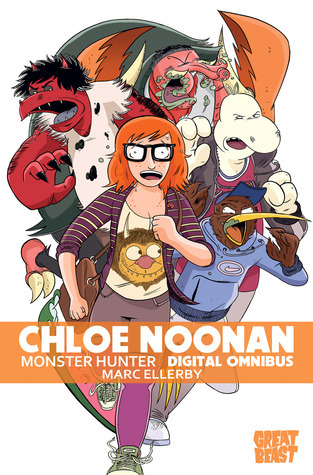
Chloe Noonan: Monster Hunter Digital Omnibus


By Mark Ellerby, with additional colours by Adam Cadwell (Great Beast Books)
ISBN: 978-1-78845-285-4 (Digest HB)

When the TV show Buffy the Vampire Slayer debuted, its mix of sassy teen culture, wry humour, scary adventure, soap opera group dynamics and supremely quotable zingers utterly revolutionised popular entertainment – but not as much as the kick-ass star who proved once and for all that girls could be action heroes.

In the wake of the phenomenon, cartoonist Marc Ellerby (Love the Way You Love, Phonogram: The Singles Club, Ellerbisms, Rick and Morty, Regular Show, Doctor Who) deployed the sarcastic whimsical contrariness we Brits are so grievously afflicted with and belatedly devised a wry riposte to the saga of the mystically superpowered American “Chosen One” and her dedicated team of troubleshooters…

Between 2009 and 2014, Ellerby self-published five issues (and a few extra bits) of Chloe Noonan: Monster Hunter – the sublimely daft exploits of a plucky, determined and utterly normal girl who splits her time between going to college and holding back the malign forces of darkness lurking all around us.

In 2012, the majority of these Kitchen Sink/School Daze/Eldritch Exploits were coloured and gathered in a Digital Omnibus. Here you can comfortably enjoy a jolly jump back in time and space to see how the nuts and bolts of saving humanity works with hilarious hits from Chloe Noonan #1-4, Chloe Noonan Halloween Special 2012, Chloe Noonan Christmas Special 2012 and material from Paper Science #5 and Solipsistic Pop #2-3.

The preternatural perils are preceded by ‘Just a quick word! An introduction from the author’ wherein we learn the origins of the feature and how and why it was remastered, before we finally meet the snarky, sarky, brittle “plain Jane” B-lister who’s nobody’s first choice to save the world…

As well as benefitting from added colour, these terror tales have been chronologically adjusted so keep your wits about you as Chapter 1/ Chloe Noonan #1 takes us to a chip shop in Raven Dale where two students are chatting. Chloe is reluctantly revealing she’s in a band to ingenuous hottie Zoe Fox, when the dowdy, meek-seeming redhead gets an urgent call. For reasons she cannot understand, Noonan suddenly breaks protocol – and her oath of secrecy – and invites Zoe to come along as she tackles a rampaging monster. Her duty is onerous, unpaid and voluntary, so they have to take the bus…

It’s a long ride, made truly interminable by having to disabuse her new friend of ridiculous TV-fuelled notions of the job’s glamour, innate magic powers and skill with ancient weaponry, but eventually they locate the beastly Dahgul. It is not willing to come along quietly…

Forced to consult irascible mentor Professor Lemon Barley, the increasingly pissed off Chloe resorts to her favourite solution – nets and really big bombs – but is then stuck babysitting the beast while she plays a gig with the band…

Issue #2 opened with an inconclusive clash against drunken lobster-horror Pinchy, before another tedious day at Raven’s Dale College commences. Watching guys – especially cute but gormless Doug Stonebridge – hitting on Zoe does nothing to lift her mood, especially after her new self-elected BFF blurts out Cloonan’s monster-hunting sideline. More grief about her failures from Barley follows, and the absolute end comes when Pinchy – AKA Skaldjur – invades the college looking for girls, booze and a rematch and sparking a riot. Chloe might be merely human – and not very fit – but the brute has turned up just when she really needed to hit something and gets just what he deserves…

She’s barely regained her composure when the top secret clean-up crew show up, delivering pat disinformation and trying to impress pretty little Zoe…

Chapter 3 comes from Paper Science #5: a brief encounter with band nerds and ice creams, before Chloe Noonan #3 reveals how bandmate Zach pilfers arcane lore from Chloe’s bag and enhances the latest gig by summoning arcane armageddon in the form of an awakened Kraken…

Thankfully, a full-on angry rant seems to be Chloe’s private superpower…

A brace of shorts from Solipsistic Pop #3 and #2 reveals how Chloe & Zoe deal with a gang of monster-seeming Chavs and annoying girl band Pozzy Pops before chapter 7 presents the full-length fun of Chloe Noonan #4 with the “Nooners”, Zoe and Doug spending an unpleasant night clubbing, only to find that even supernal haunts crave a good time, cheap drinks and ear-splitting beats. However, when Chloe tries to lay down the law, she gets an unlikely schooling in monster politics…

Chloe Noonan #3 delivers the next instalment as drunken Doug falls foul of supernatural Chavs (think Devil-Moomins) in a deserted playground, and Zoe drags her “Nooners” out of a well-earned sleep to save his undeserving ass after which ‘Trick or Treat’ (from Chloe Noonan Halloween Special 2012) sees awestruck Zoe dressing up as her hero for a spot of fancy-dress, door-to-door begging on October 31st. Of course, prowling darkened streets with a happier, prettier, sexier version of herself is everything Chloe dreaded it would be, and she’s in no mood to dick about when the real monsters turn up to celebrate “their” special day…

Wrapping up the spooky selection is the Chloe Noonan Christmas Special 2012 with the surly supernaturalist and Professor Barley dutifully and pointlessly hunting an unknown antagonist and enduring ‘A Very Noony Christmas’ whilst everybody else is getting outrageously inebriated at a major college party…

Accompanying the morose mirth is a ‘Cover Gallery’ (fronts and backs!) including a spiffy art print; a selection of ‘Fan Art’ by Will Kirkby, Tom Humberstone, Liz Prince and Luke Pearson and a fulsome (29 pages) and fascinating dip into the author’s ‘Annotated Sketchbook’ as well as a ‘Biography’ of the creator.

Fun, funny, fiercely foolish and fabulously entertaining, this ancient arcane artefact is as fresh and festive as it ever was. Forget the Chosen One and just choose Chloe Noonan.
™ & © 2009-2012, 2020 Marc Ellerby. All rights reserved.

Evil Emperor Penguin: Antics in Antarctica


By Laura Ellen Anderson, with Kate Brown (David Fickling Books)
ISBN: 978-1-78845-282-3 (Digest PB)

Win’s Christmas Gift Recommendation: Outrageous Acts and Brilliant Buffoonery… 8/10

In 2012 Oxford-based family publisher David Fickling Books launched an “old school” weekly comics anthology aimed at girls and boys between 6 and 12. It revelled in reviving the good old days of British picture-story entertainment intent whilst embracing the full force of modernity in its style and content. This comprised comic strips, humour, adventure, quizzes, puzzles and educational material in a joyous parade of cartoon fun and fantasy.

In the years since its premiere, the periodical has gone from strength to strength, its pantheon of superbly engaging strips generating a line of superbly engaging graphic novel compilations, the latest of which is this riotous romp starring a gloriously malign arch-wizard of scientific wickedness to delight all readers with a profound sense of mischief and unbridled imagination…

Conceived and created by illustrator and author Laura Ellen Anderson (Kittens, Snow Babies, My Brother is a Superhero, Amelia Fang!, Rainbow Grey, I Don’t Want…), these are the revived ad remastered exploits of Evil Emperor Penguin!

He lives in a colossal fortress beneath the Antarctic, working tirelessly towards total world domination, assisted by his stylish, erudite administrative lackey Number 8 and cutely fuzzy, passionately loyal Eugene. The latter is an endlessly inventive little abominable snowman clone. EEP had whipped up a batch of 250, but none of the others are quite like Eugene…

The Penguin appointed the hairy, bizarrely inventive tyke his Top Minion, but somehow never managed to instil him with the proper degree of evilness. He is, however, a dab-hand with spaghetti hoops, so it’s not a total loss…

Following a pin-up of the ‘Fridge of Evil’ and an info-packed double-page map of the Evil Underground Headquarters disclosing all you’ll need to know, an assortment of vile vignettes begins with ‘A Stitch in Time’ wherein the cape-draped malcontent megalomaniac unleashes his Evil Emperor-bot of Icy Doom at the annual World Leaders’ Picnic.

Unfortunately, due to a totally typical cock-up with the plans by oafish underlings, the titanic tin-can terror’s ice-laser eyes have somehow been replaced by instant knitting machines…

The next nasty invention doesn’t even get out of the lab before malfunctioning. ‘Have No Fear’ finds a dire device that manifests personal terrors running amok in the lab, unleashing EEP’s domineering mother and sweet Eugene’s incredible, ghastly secret phobia before the inventors can reach the Emergency Self-Destruct Button…

‘Cat-astrophe’ introduces a terrifying rival in the Word Domination stakes who infiltrates the bad bird’s base as a cute and fluffy feline pet for Number 8…

When EEP’s giant spider robot immobilises the entire Earth in its ‘World-Wide-Web’, even Evil Cat is caught off guard, and only Eugene’s incomprehensible preoccupation with shiny, sparkly unicorns prevents total disaster.

The top-hatted, moustachioed, perfidious puss then attempts amnesty in ‘The Truce’ but the fuzzy fiend is, of course, shamming friendship. The floral gift he proffers is actually a deadly animated booby-trap which is only just defeated thanks to Eugene’s inherent ineptitude.

Would-be World Dictators are not a particularly forgiving bunch and when the fuzzy tyke accidentally unleashes the full force of EEP’s Ferocious And Really Terrible machine, ‘The Stinking Truth’ is released in a Nuclear Stench Cloud and prompting the penguin peril to fire his Top Minion. EEP’s loss is Evil Cat’s gain though, and Eugene soon settles in with a Malign Master who really appreciates him.

‘Please Alight for the Domination Station’ finds them quashing the chilly Caped Fiend’s scheme to transform Britain’s seat of government into the Houses of Penguinment (which I’m pretty sure we’d all vote for this week), but a pitched battle between super-science cat and ghastly gadget bird swiftly escalates beneath London streets before Eugene’s cuteness-filled ultimate weapon sadly takes out his new boss by mistake…

As a result of that debacle, the little snowman is briefly evaporated by Evil Cat and ends up floating wistfully over Antarctica as a ‘Head in the Clouds’ even as Evil Emperor Penguin faces his greatest challenge when his little sister Ruth – she prefers “Ruth-less” – pays a visit, sees what big bro is up to and decides that she too is going to rule the world in ‘Sibling Rivalry’…

Things get even worse after Evil Cat interferes, holding Ruth-less hostage until everybody involved has foolishly forgotten that tiny turncoat Eugene is afflicted with niceness and a powerful conscience…

The exploration of  cartoon evil and daft depravity amplifies and intensifies in an epic exploit detailing ‘The Return’ when sweet-natured Eugene’s continual bodges at last force Evil Cat to fire him with extreme prejudice. Hopeless, homeless and homesick, the shaggy savant is on his last legs when he’s adopted by jolly unicorn Keith, who nurses him back to health and flies him to Antarctica just in time for them both to become embroiled in a final fateful clash between Penguin and Cat.

Naturally such devoted do-gooders can only get stuck in and engineer some marvellously magical reconciliation…

More nefarious nonsense unfolds in extended thriller-chiller ‘I Will Crèche You’ wherein EEP’s incredible De-Ageifying “Youth Juice” wreaks the now-customary havoc after insidious rival Evil Cat breaks into the citadel and everybody gets a rejuvenating soaking…

Undaunted, the Penguin of Perfidy attempts to increase his own stature with a growth ray but doesn’t consider that his top menial might wander in and accidentally become ‘Hugene’…

More trouble arrives when the Barmy Bird decides to digitise and upload himself into the global data net via his Super Computer of Evil. Believing supreme power is in his feathered grasp once he becomes ultimate virus ‘X-Treme Evil’, EEP is ambushed in virtual reality by digital demon virus Trojan the Hunk. Luckily, Eugene is a dab paw with computer games and comes to his master’s rescue… sort of…

Back in the physical world once again the Emperor is next subjected to a terrifying surreal assault by feathered scavengers and finds himself ‘Pigeon Holed’…

Everybody loves cute kittens, which is what Evil Cat’s cousin Debra counts on when she uses soppy Eugene to infiltrate the fortress and steal all the Spaghetti Hoops in ‘What’s New Pussycat’. With the team – even Evil Cat – trapped and helpless, they must surrender all pride and dignity and call on jolly unicorn Keith to save them…

Without their favourite food, Christmas seems drab and dreary for the entire ice-bound army but when Eugene finds ‘The One Hoop’ it unleashes a torrent of unexpected emotion to tide the Evil Emperor over, even though it ultimately leads to deprivation mania in ‘A New Hoop’…

Deranged and desperate, EEP is only saved after Eugene and Number 8 track down Debra and steal back the vast cache of spaghetti tins. Good thing too, as she wasn’t planning on eating them but needed them to power her world-destroying machine…

After all that drama, ‘Eugene’s Day Off’ is an unremitting stream of great experiences for the faithful servitor, but for the Penguin Potentate – forced to put up with substandard substitute Neill – a string of catastrophic and painful disasters. Thus, it’s no surprise and a total tragedy when EEP’s top flunky is lost on a melting ’berg after watching the pretty sunset ‘On Thin Ice’…

Happily, the unthinkable occurs as the cape-clad malcontent megalomaniac teams up with scintillating Keith the Unicorn to save Eugene from dire deep sea doom…

‘Pop Goes the Easel’ finds the putrid penguin planning an attack on world leaders through the medium of art, but sadly, turning his victims into paintings proves to be a double-edged sword with unexpected repercussions, especially after Eugene tries to help…

This gag-filled grimoire of bird-based bombast concludes in high style as a sinister scheme to flood the world with scented candles of distilled Ultimate Evil is thwarted once ‘Essence of Eugene’ is added to the wax mixer, resulting in a global outpouring of warm, fuzzy euphoria…

Rocket-paced, hilariously inventive, wickedly arch and utterly determined to be silly when it most counts, this tome of terror also has educational merit as it offers lessons on ‘How to Draw Eugene’. Evil Emperor Penguin: Antics in Antarctica is a captivating cascade of smart, witty funny adventure, which will delight readers of all ages.
Text and illustrations © Laura Ellen Anderson 2022. All rights reserved.

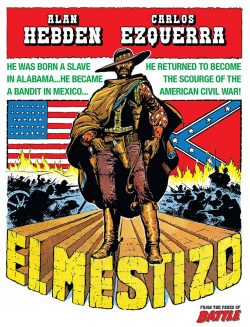
El Mestizo


By Alan Hebden & Carlos Ezquerra (Rebellion Studios)
ISBN: 978-1-78108-657-5 (HB/Digital edition)

Carlos Sanchez Ezquerra was born in Aragon on November 12th 1947. Growing up in Ibdes, in the Province of Zaragoza, he began his career illustrating war stories and westerns for Spain’s large but poorly-paying indigenous comics industry. In 1973 he got a British agent (Barry Coker: a former sub-editor on Super Detective Library who formed Bardon Press Features with Spanish artist Jorge Macabich): joining a growing army of European and South American illustrators providing content for British weeklies, Specials and Annuals.

Like so many superbly talented newcomers, Ezquerra initially worked on Girls’ Periodicals  – like Valentine and Mirabelle – and more cowboys for Pocket Western Library as well as assorted adventure strips for DC Thomson’s The Wizard. The work proved so regular that the Ezquerras upped sticks and migrated to Croydon…

In 1974, Pat Mills & John Wagner tapped him to work on IPCs new Battle Picture Weekly, where he drew (Gerry Finley-Day’s) Rat Pack, and later, Major Eazy scripted by Alan Hebden. Three years later he was asked to design a new character called Judge Dredd for a proposed science fiction anthology. Due to creative disputes, Carlos left the project and went back to Battle to draw instead a gritty western entitled El Mestizo…

As we all know, Carlos did return to 2000AD, illustrating Dredd, dozens of spin-offs such as Al’s Baby, Strontium Dog (1978), Fiends of the Eastern Front (1980), adaptations of Harry Harrison’s Stainless Steel Rat and key Dredd storylines such as the epic Apocalypse War and Necropolis.

Soon after, Ezquerra was “discovered” by America…

El Mestizo debuted amidst a plethora of British-based war features and didn’t last long – June 4th to September 17th 1977 – with author Alan Hebden giving you his take on why in a concise Introduction before the action begins.

Born in Bristol in 1950, Hebden is a second generation comics scripter, having followed his dad into the profession. The lad began his career writing Commando Picture Library stories for DC Thomson – and he still does – and also contributed to the company’s adventure titles Hornet and Victor.

For Fleetway he co-created Major Eazy, and scripted Rat Pack for Battle; The Angry Planet for Tornado; Comrade Bronski, The Fifth Horseman and The Tower King for Eagle; Holocaust and Mind Wars for Starlord and – for 2000 AD – M.A.C.H. One, Mean Team, Death Planet, Meltdown Man, Future Shocks, amongst many others.

Heavily leaning on Sergio Leone “spaghetti westerns”, the first starkly monochrome Mestizo episode – of 16 – introduces a half-black, half-Mexican bounty-hunting gunfighter who offers his formidable services to both the Union and Confederate sides in the early days of the War between the States.

Proficient with blades, pistols, long guns and a deadly bola, El Mestizo plays both sides while hunting truly evil men, whether they be Southern raiders, rogue Northern marauders, treacherous Indian scouts, army deserters from both sides organised by a crazy, vengeful femme fatale, or even a demented physician seeking to end the war by releasing plague in Washington DC.

Along the way, the mercenary even finds time to pay off a few old scores from his days as a starved and beaten plantation slave…

Sadly, the feature was always a fish out of water and was killed off before it could truly develop, but the artwork is staggeringly powerful and the stories deliver the kind of cathartic punch that never gets old.

This stunning package is another nostalgia-triumph from Battle, collecting a truly seminal experience, and hopefully forging a new, untrodden path for fans of grittily compelling fare and sampling a typically quirky British comics experience.

This gem is one of the most memorable and enjoyable exploits in British comics: acerbic, action-packed and potently rendered: another superb example of what British and European sensibilities do best. Try it and see…
© 1977 & 2018 Rebellion Publishing IP Ltd. All Rights Reserved.

Je Ne Sais Quoi


By Lucie Arnoux (Jonathan Cape)
ISBN: 978-1-78733-359 8 (HB/Digital edition)

Win’s Christmas Gift Recommendation: Sweet, Smart Reminder of What We Are and Where We’re Going … 9/10

The French have a word for it…

We Brits have an hard-won and insanely-cherished Awkward Relationship with the French. On “our” side, the unending, frequently re-declared war of cultures and attitudes stems from our envy of their scenery, beautiful holiday locations, wonderful food, all those different words (like chic and elan) for style, mature and easy attitudes to sex and even the cheap booze & smokes. It’s all bundled up in a shared history of squabbling with a neighbour.

For us, it’s their arrogant smugness, never knowing when they’re wrong and/or beaten, inconceivable ability to say no to their leaders and rulers, never knowing their place and just plain not being British. Worst of all is they do it all whilst making us look stupid: “indulging” and “tolerating” our antics.

Oh, and sport too. They won’t accept our clear superiority there, either. They don’t even play cricket and have their own name for bowls…

I won’t detail their side, even though it’s probably as justified and well-reasoned. Until this book, there was never any evidence that a Gallic heart could fathom the workings of the English mind…

At least the rivalry is generally good natured these day, but can still somehow be exploited to rile up an unwholesome and frankly embarrassing audience whenever dog-whistle politics are unleashed or if newspapers need a quick boost to prop up our equally despised governments. Of course, theirs are despised at home too, but at least seem to know what they’re doing…

At heart, the entente cordiale is an ambiance we’ve carefully cultivated for more than a millennium, nurturing it like a Home Counties lawn or boutique-brewed artisanal gin, which is why it’s such a splendid moment when national disgraces like me can say “Oi! Look at this”…

The one place where the French constantly and conclusively kick our derrieres is comics. Acknowledged as an art form (officially The Ninth Art, in fact) the medium and industry is supported, understood and appreciated by all: calling forth talented individuals like the ungrateful émigré revealed in this tome: someone who inexplicably loves us here as we are and has made her home among us oiks and heathens for more than a decade now…

Lucie Arnoux is a story-maker based in London, from where she’s been embracing our peculiar uniqueness for over a decade. When not travelling the world, she gratefully returns to her English home, celebrating so many conflicting aspects of us, channelling her mania for drawing and music and art in all forms into comics, teaching, illustrating, book writing, set design, sculpture, knitting and so many more forms of sharable self-expression…

I’ve never met her, but she’s clearly as engaging and personable as she is gifted, and – in this big colourful hardback collection of strips – shares her history, thoughts, dreams and adventures with astounding frankness.

A self-confessed misfit looking to find her place, Arnoux draws beautifully in a clear, expressively welcoming – almost chatty – manner and knows how to quietly sneak up, grab your undivided attention and never let go. In a succession of seditiously disciplined 9-panel grids which act as counterpoint to the free flowing pictorial excursions, the auteur deftly steers us through her self-determined chaotic life.

It’s like a comics take on those wonderful 1990s Alan Bennett character studies Talking Heads, revealing greater truth through apparent conversation, intimate fact and candid self-assessment, except here you can actual see what does and doesn’t happen …and how…

Across these page you’ll learn how the drawing-addicted prodigy grew up in Marseilles in an unconventional family amidst unfriendly school inmates and unsettled environs. How she was a remarkable comics prodigy who began working professionally at the age 14, the same year she first visited Britain and inexplicably fell in love with the place…

Formally learning her craft under a strong editor at Studio Gottferdom, she produced a weekly autobiographical strip for legendary fantasy publication Lanfeust Magazine, studied unhappily in Paris, and eventually migrated to her happy place and spiritual home… London.

You’ll pry no more secrets from me: this is a hugely enjoyable treat that you deserve to experience with no preconceptions or spoilers. So go do that, then buy copies for all your friends…

Je Ne Sais Quoi is a fabulously absorbing jolly with a delightfully forthright companion. Arnoux unstintingly shares her thoughts, feeling and experiences in a manner guaranteed to win over the most jaded companion – especially as she garnishes her slivers of fresh experience with laconic but unguarded observations, glimpsed through the welcoming lens of regional foods, booze, hunts for companionship, festivals attended, artworks made, consumed and enjoyed.

Sharp, funny, disarmingly incisive, heart-warming, uncompromising and utterly beguiling, this moving memoir is a comics experience you’ll want to relive over and again.
© Lucie Arnoux 2022.

Je Ne Sais Quoi will be published on 27th October 2022 and is available for pre-order now.

If, like Lucie, you’re London-based, love to travel and party, there’s a Launch Event scheduled for that day at the wondrous and fascinating Gosh! Comics. For details see Gosh! Comics (goshlondon.com)

There could be wine, there may be cheese, there WILL be Lucie Arnoux, convivial conversation and Signed Copies.