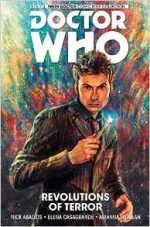
Dr. Who: The Tenth Doctor volume 1: Revolutions of Terror


By Nick Abadzis, Elena Casagrande, Arianna Florean & various (Titan Comics)
ISBN: 978-1-78276-384-0

Doctor Who first materialised through our black-&-white television screens on November 23rd 1963 in the first episode of ‘An Unearthly Child’. Less than a year later his decades-long run in TV Comic began with issue #674 and the premier instalment of ‘The Klepton Parasites’. Throughout the later Sixties and early 1970’s strips appeared in Countdown (later retitled TV Action) before shuttling back to TV Comic.

On 11th October 1979 (although adhering to the US off-sale cover-dating system so it says 17th) Marvel’s UK subsidiary launched Doctor Who Weekly, which became a monthly magazine in September 1980 (#44) and has been with us under various names ever since.

All of which only goes to prove that the Time Lord is a comic hero with an impressive pedigree…

In recent years the strip portion of the Whovian mega-franchise has roamed far and wide and currently rests with British publisher Titan Comics who have sagely opted to run parallel series starring the Tenth, Eleventh, and Twelfth incarnations of the tricky and tumultuous Time Lord.

Scripted by the ever-excellent Nick Abadzis (Hugo Tate, Children of the Voyager, The Amazing Mr. Plebus, Laika) and illustrated by Elena Casagrande (Suicide Risk, Star Trek, X Files) & Arianna Florean – with art assistance from Luca Lamberti, Michele Pasta, Annapaolo Martello, Giorgio Sposito & Paolo Villanelli – these tales comprise the first five issues of the 2014 monthly comicbook and are set at the conclusion of the Fourth Season starring David Tennant, just after he lost his cherished (time) travelling Companion Donna Noble…

‘Revolutions of Terror’ opens in picturesque Sunset Park, Brooklyn, where the locals are gearing up for Halloween and the Mexican Day of the Dead.

Gabriella Gonzalez is less than joyous. A talented creative type, she wants to go to art school but her father is keeping her home to help in his restaurant and run his latest side-venture – a Laundromat. He is letting her go to night college though… but only to study accountancy and book-keeping…

When the washing machines all go crazy and spin out of control that day, prospective brother-in-law Hector is quick to pass on the blame to her, so Gabriella is feeling pretty annoyed and despondent. When the weird British-sounding guy turns up at the Castillo Mexicano for breakfast she barely notices him, what with grandma suddenly seeing ghosts and Hector being accosted by a demon…

Strange sights and uncanny apparitions continue throughout the day and Sunset Park is in no mood for celebrations as Gabby takes the subway to class, but when the train is attacked by monsters the weird Brit is there to fight the thing off with a buzzing blue flashlight…

Soon introductions are made and “The Doctor” has introduced her to an uncanny new universe she never believed possible… and one that might soon be ending thanks to an invasion by toxic-emotion devourers called The Silent. They are – apparently – voracious weaponised Cerebravores from another planet…

As she ingeniously holds the terrors at bay in the Laundromat, the Doctor visits their origin-world and, once he’s gained the knowledge he needs, returns with a plan to defeat them. Sadly it depends completely on Gabby’s artistic gifts and her family’s good mood…

Nevertheless global doom is averted, and the Doctor is preparing to slope off when Gabriella makes her big pitch to go with him…

Agreeing to just one quick trip, the Time Lord takes his new guest to the Pentaquoteque Gallery of Ououmos, one of the greatest collections of ‘The Arts in Space’ but, as Gabby’s cartoon strip journal shows, it’s much more of a pant-wetting scary adventure than a dry museum visit…

A driven artistic soul, Gabriella is naturally intoxicated with everything, but the real show-stopper is her introduction to puissant Zhe Ikiyuyu‘s block transfer sculptures: a rare discipline which can manifest solid objects by mathematically manipulating Quantum Foam Harmonics through singing or chanting…

However the rapt fascination quickly turns into more terrified running after the Doctor takes her to Zhe’s private moon where they discover the compulsive creative artist has taken the ultimate step in her art and the creations now run the roost…

This racy, pacy, superbly authentic and in-touch little tome comes with a bunch of bonus material such as humorous strip extras by A. J, David Leach, Emma Price & Rachel Smith and a vast gallery of Gallifreyan alternate and variant covers (photographic, digitally manipulated, painted and/or drawn) by the likes of Casagrande, Alice X. Zhang, Rob Farmer, Warren Pleece and Verity Glass. Also on offer is a behind-the-scenes peek at ‘Designing Gabby’ making this a splendid slice of comics magic starring an incontestable bulwark of British Fantasy.

If you’re a fan of only one form, this book might make you an addict to both. Revolutions of Terror is a fabulous treat for casual readers, a fine shelf addition for devotees of the TV show and a perfect opportunity to cross-promote our particular art-form to anyone minded to give comics a proper go…
BBC, Doctor Who (word marks, logos and devices) and Tardis are trade marks of the British Broadcasting Corporation and are used under licence. BBC logo © BBC 1996. Doctor Who logo © BBC 2009. Tardis image © BBC 1963. First edition April 2015.

Death Sentence: London


By Montynero & Martin Simmonds with John Pearson & Jimmy Betancourt (Titan Comics)
ISBN: 978-1-78276-507-3

For most of us Sex Sells. If that’s not you and you’re easily shocked or offended, stop Right Here, Right Now and come back for a less grown-up review tomorrow.

As for the salacious, tawdry, vulgar majority of humanity, however, fornication is a force that will not be resisted and we’re always gagging for it.

One outrageous potential result of that inescapable biological imperative was recently explored in a dark, decadent fable from writer, artist and games designer Montynero who, with illustrator Mike Dowling, crafted a ferociously effective satire on modern attitudes in Death Sentence.

After an initial and truncated appearance in Clint Magazine in 2012 the sexily sordid saga was retooled as a breakthrough 6-issue miniseries which took the comics world by storm when released in 2013.

Something that good was bound to be tried again and a series followed, of which Death Sentence: London – illustrated now by Martin Simmonds – is but the first compulsive compilation…

In the World That’s Coming a sexually transmitted disease known as G+ is spreading rapidly through the population. It is invariably fatal and kills in six months. For that length of time, however, the victim “suffers” from increased vigour, stamina, sex drive and even develops super powers…

The true extent of the threat only became apparent to the public after media darling, affirmed libertine and proud G-Plus carrier David “Monty” Montgomery used his exponentially-expanding psychic powers to kill Britain’s government, royal family and one million Londoners.

Having crowned himself King of Britain, Monty was only stopped by two other critically enhanced G-Plus sufferers: frustrated artist Verity Fette and shambolic fading rock star Daniel Waissel AKA Weasel.

More through luck than effort – and despite the interference of a UN Taskforce, covert US super-weapon deployment and best attempts of the British military – the wonder kids narrowly managed to kill Monty in a blockbusting super-battle televised around the world. The conflagration especially terrified the assorted world governments who collectively feared their days of ruling the masses were over…

Britain’s bosses had been aware of the growing crisis for ages and had already tasked its shadowy Department of National Security to deal with it. The usual tactics of murder, blackmail, disinformation and cover-ups proved ineffective, however, and soon something else was being considered.

At least Verity died in the final battle and what’s left of the UK’s Powers-That-Be now only have sybaritic, self-destructive Weasel to manage until the disease finally kills him…

In the meantime, on a remote Scottish island, a very nice old lady runs a vast secret base beneath the heather where she and her team toil away with no sense of scientific niceties – or ethics – as they strive to find a cure for G+…

Dr. Lunn had been helping sufferers for quite a while. She crash-trained Verity and Weasel in the use of their abilities (also providing space, time, tuition and medical-grade drugs) before siccing them on the out-of-control Monty…

Following handy recap ‘Previously in Death Sentence’ the story resumes with ‘“A” Bomb on Wardour Street’ as Weasel is riotously fêted by the metropolitan populace whilst über-ambitious Old Etonian London Mayor Tony Bronson seethes and schemes. There’s a power-vacuum in the country at this moment and he’ll be buggered if he lets anyone else fill it… especially some oikish, pox-ridden musical miscreant…

An ocean away, undercover Fed Jeb Mulgrew is closing his latest case when everything goes tits-up after his targets display out of control super-powers. Luckily his keenly-observing back-up team are equipped with the latest horrific innovation in anti-G-Plus ordnance…

At City Hall, Tony’s latest opportunistic sound-bite does nothing to slow the looting tearing up the remainder of London; much of it seemingly orchestrated by new dissident movement the Invaders. The spreading violence even reaches a nearly deserted fast-food franchise where an armed robbery is foiled, giving first notice that Verity might not be dead after all…

As Jeb tries to reconnect with his wife and home in Texas, London sees another bloody crime stopped by the enigmatic Artgirl and Tony snaps, declaring martial law in His city…

Each episode is followed by a carefully-tailored supplemental feature and here ‘The Age of the Super G’ exposes the Americans’ thermonuclear contribution to Monty’s demise before the comics saga continues with ‘Uprising’ as Weasel attends a rally in Brixton. The borough is in the process of declaring its independence and seceding from Tory-infested London and big-business corrupted Britain…

Bronson’s response is uniquely typical: ramping up military action, closing down social media and arresting G+ carriers whilst ordering the public to stop having sex until a cure is found.

When tanks roll up during a memorial service, Weasel is just in the mood to share the misery he’s been feeling since Monty killed his little boy, but in the victorious aftermath it’s the anonymous mask-wearing Invaders who are making converts and dictating policy on the streets of Brixton…

In Texas, things just aren’t working out for Jeb so when his bosses ask him to infiltrate British intelligence and steal their potential cure for the super-sex plague, he can’t wait to start…

After a faux magazine feature on Creighton Baines and how his alien-masked Invaders haunt protest sites and agitate for social change, the story starts again in ‘Eton Rifles’ as dedicated journalist Fincham is handed a certain dossier by a mole with suspicious intent. Soon the Chronicle‘s top scribe is making things hot for golden gibbon-esque, sexually-deviant Tony…

As tensions escalate everywhere, Verity assuages her own through increasingly bawdy encounters as she drifts ever closer to isolated, segregated, curfew-enduring Brixton. She has no idea that she’s been targeted for immediate assassination, but then again, her would-be executioners have no idea how powerful she now is…

Preceded by excerpts from reputable rag The Chimes – detailing the rise of international angst and the stalling of the World Powers debating a space-based weapons ban – ‘Sitting Here’ sees a turf war brewing between local gangster Retch and weed-dealing newcomer Roots. Both have their supporters and both are high-functioning G-Plus victims, with all the deadly benefits that condition brings…

As Tony’s Territorials rumble into Brixton savage violence erupts, but he’s elsewhere, busily indulging his nasty copulatory habits. Fincham, meanwhile, is tracking a rumour about a Scottish Island and a woman who might have a cure, even as Retch and Roots clash for control of their streets…

Following snippets from The Chronicle News – revealing the not-so-quiet war for dominance between power-hungry Mayor Bronson and top surviving aspirant Party-leader Michael DeGraves – the Mayor gets a rude and ribald awakening as the winner of the Brixton gang rumble exposes the hypocrite’s nasty upper-class peccadilloes in ‘Burn’. Across town, Verity gives doggedly determined Fincham an exclusive, comprehensive interview which will never see print…

Later, as Bronson strives frantically to keep ahead of the political game, an intimate well-wisher makes a big mistake by approaching G+ sufferers in tune with the old guard and hereditary rulers. They can be of immense service to this Sceptr’d Isle… after they pass a training course at a facility on a certain Scottish island…

An excerpt from Creative Review debating ‘Artgirl: High Art of Graffiti?’ leads the tale to a temporary halt in ‘Kill at Will’ as Dr. Lunn welcomes a new bioanalyst – who looks remarkably like American Jeb Mulgrew – to her little secret empire. In Brixton, meanwhile, the military are moving in to wipe out all resistance but are totally unprepared for the unlikely, unstable convergence of all London’s omega-level G-Plus super-beings waiting for them…

And then long-range telemetry shows that Verity’s condition has taken a terrifying and impossible turn nobody could have predicted…

To Be Continued…

Packed with plenty of bonus features including a breathtaking covers and variants selection by Montynero, Death Sentence: London is an uproarious adult fairytale blending superhero tropes with outrageous cheek, deliriously shocking situations and in-your-face irreverence.

Buy it, read it and spread it around to anyone you fancy… and maybe some you don’t…
Death Sentence ™ and © 2014 Montynero, Mike Dowling and Titan Comics. All rights reserved.

Wolf Country volume One


Jim Alexander, Luke Cooper, Will Pickering & various (Planet Jimbot)
No ISBN:

Jim Alexander has been around and done a lot. His other comic stories have been published by Marvel, DC, 2000AD and so many more bastions of graphic narrative success and distinction. He writes with sharp sophistication, an inherent understanding that comics are primarily pictorial and the certain knowledge that the majority of his audience are not morons.

His scripts always have a great sensitivity to place and a strong sense of directed motion, with sparse, spartan self-control that lets his smartly seditious ideas percolate. (Despite what the much-missed Alan Rickman may have said, “Subtlety is everything”).

With a few good men and women he is quietly creating a little wave of interest through the business through self-publishing enterprise Planet Jimbot (officially with work-partner Jim Campbell, and a number of splendidly effective artists): generating addictive, well-considered tweaks on established genre models such as superhero yarns, police procedurals (GoodCopBadCop), Samurai revenge sagas and a captivating distillation of westerns, horror movies and dystopian sci fi entitled Wolf Country.

As rumours percolate of a screen option for this last series, the first four issues and two vignettes from anthology Amongst the Stars have been enticingly reconfigured into a stunning graphic novel collection, perfect for introducing a larger audience to the otherworld religio-political saga with seductive echoes of Unforgiven, The Searchers and the Underworld franchise (although thankfully devoid of the silly fang-&-claw fights and skin-tight leather bodysuits…)

Somewhere far from here and now a land exists where blood-drinkers have built a nation. In The Kingdom, however, the people are moving from a religion-based culture to a modern meritocracy where science increasingly dominates: run by a progress-minded government and bureaucracy methodically ditching the old ways in favour of a soulless, ruthless, rationalist super-state whilst offering pious lip-service to dissenters and bribing the citizenry with a gory menu of bread and circuses…

Their brave new world is surrounded by ancestral enemies: humans who transform into beasts when the moon is full, whose toxic vital fluids mean instant death to the faithful and apostates alike.

The beasts control the wild lands beyond the city-state, but an uncompromising sect of devout vampires, adhering to the tenets of their faith, inhabit a fort in the desolate badlands, challenging the monsters and hostiles of Wolf Country. By the Grace of God – and largesse of the Kingdom – the fundamentalists struggle daily for survival in their frontier outpost following the doctrines of Holy Scriptures and confronting their eternal enemies in the traditional ways.

The drama opens as Alexander and illustrator Luke Cooper take us into the dreams and nightmares of the leader of that isolated, endangered enclave. From their beds Halfpenny and his wife Natasha foresee the next attack on their embattled fort and know that without the supplies grudgingly air-dropped to them by the increasingly hard-line secular government they cannot survive.

When the moon-maddened assault comes, the Faithful fight valiantly but are almost overwhelmed by the time crates of fresh plasma and silver bullets blossom in the night skies…

The scene switches to the city three years earlier, where a young man finds himself the unwilling star of a long-awaited, prophesied future. The destiny stalking ‘Luke’ catches him when a gigantic wolf-thing goes rogue in the metropolis yet is somehow miraculously destroyed by the inconsequential waif.

Now, the celebrated “Boy Who Killed Wolf” has freshly relocated to The Settlement. Following a close encounter with the hirsute savages, young Luke explains what actually happened that night to his companion, mentor and chief scout Carmichael…

His impossible feat made Luke a sensation and a symbol of prophecy proved; but the adulation and agendas of others disgusted him and upon reaching his majority and -despite being an unbeliever – he fled to The Settlement to live his own life and find his own answers. When disaster strikes Luke goes native, remaining alone in the wilderness after he and Carmichael narrowly escape a wolf attack…

Will Pickering takes over the illustration for ‘Kingdom Come’ as Halfpenny reluctantly transports a captured werewolf back to the decadent, science-loving Kingdom. It’s not his idea. As the helicopter ferries the sacrificial beast for the populace’s next bloodletting spectacle, Halfpenny is ordered to go with it whilst a squad of arrogant, impious, heavily-armed troops billet themselves in his spartan home.

The High Executor wants to interview the leader of the quaint religious freaks since there has been fallout over The Settlement’s loss of the legendary, beloved “Boy Who Killed Wolf”…

Later, whilst atheist Sergeant Urquhart attempts to intimidate and dominate the Settlers, in faraway City Chambers Halfpenny learns the real reason he has been summoned…

‘Wax and Wane’ then sees Urquhart forcing the deluded religious throwbacks in joining his sortie against the lupine tribes just as the moon enters its most dangerous phase.

Meanwhile in the Kingdom, Halfpenny is dragooned into being a stalking horse for the draconian Department of Purity, interviewing radical spokesman Fabian in his bloodily bohemian stronghold of wrong-thinkers and backwards-lookers…

Back in the Badlands, natural enemies Carmichael and Urquhart warily test each other out and quite forget who their real enemies are, whilst a universe away Halfpenny’s interview with Fabian goes disastrously awry. The rebel has honeyed words and access to sacred writings which shake the devout outsider to his core, but before he can properly form a response the Executor’s troops move in and the slaughter begins…

At the Settlement, with the soldiers and able-bodied men still deep in-country, the massed wolf tribes attack the fort with an incredible monster…

The brooding tension explodes into horrifying action as the stockade walls are breached before the ‘Cavalry’ arrive, whilst in the Kingdom a full-blown riot ensues, forcing Halfpenny to reveal the uncanny abilities which underpin his ferocious reverence to Scripture…

And in the bloody aftermath at the fort, an unchecked, out-of-control Urquhart turns his sadistic attention on the settlers – and particularly Carmichael – in his quest for the truth about Luke’s whereabouts and in pursuit of the other hidden directives he’s been given by his scheming rationalist masters…

To Be Continued…

Complex, multi-layered and instantly engaging, Wolf Country takes a chilling proposition and dares the reader to pick sides in a burgeoning conflict between Church and State, science and mysticism, the sacred and the profane and every station in between. Moreover, despite the death, deviancy and destruction on show there is clear evidence that there is something deeper going on, so jump aboard and stick around: the best is certainly yet to come…
© 2016 Jim Alexander (story), Luke Cooper (art © Wolf Country intro, #1) Will Pickering (art #2-4).

Wolf Country volume One is available direct from the Planet Jimbot shop so go to:Wolf Country TPB volume 1

Bunny vs. Monkey Book Three


By Jamie Smart (David Fickling Books)
ISBN: 978-1-910200-84-1

Way back in 2012, Oxford-based family publisher David Fickling Books launched a weekly comics anthology for girls and boys which revelled in reviving the grand old days of British picture-story entertainment intent whilst embracing the full force of modernity in style and content.

Still going strong, each issue offers humour, adventure, quizzes, puzzles and educational material: a joyous parade of cartoon fun and fantasy. Since its premiere, The Phoenix has gone from strength to strength, winning praise from the Great and the Good, child literacy experts and the only people who really count – the totally engaged kids and parents who read it…

The publishers naturally gathered their greatest serial hits into a line of fabulously engaging album compilations, the latest of which is a third contentious engagement in the dread conflict gripping a once-chummy woodland waif and interloping, grandeur-obsessive simian…

Concocted with feverishly gleeful inspiration by Jamie Smart (Fish Head Steve!), Bunny vs. Monkey has been a fixture in The Phoenix from the first issue: recounting a madcap vendetta between animal arch-enemies set amidst an idyllic arcadia which started out as a more-or-less mundane English Wood.

Book Three ramps up the tittering, tail-biting tension, detailing the ongoing war of wits and wonder-weapons over another half-year in the country. The obnoxious simian intruder originally arrived after a disastrous space shot went awry. Having crash-landed in Crinkle Woods – a scant few miles from his blast-off site – Monkey believes himself the rightful owner of a strange new world, despite the continual efforts of reasonable, sensible, genteel, contemplative Bunny. Despite patience, propriety and good breeding the laid-back lepine is increasingly compelled to wearily admit that the incorrigible idiot ape is a rude, noise-loving, chaos-creating troublemaker…

Following the vivid Contents pages and a spectacular pinup double-spread, the month-by-month mayhem reports recommence with January and chilly snow blanketing the ground. In ‘Log Off!’ Bunny is in need of a little firewood, but should never have asked happily brain-battered, bewildered former stuntman Action Beaver to help…

Blithering innocents Weenie Squirrel and Pig take centre stage next as the baking-addicted tree-rodent reveals he has an imaginary friend. The mocking fools have no idea that ‘Lionel!’ is actually one of the ghastly Hyoomanz intent on the demolition of Crinkle Wood and the building of something called a motorway…

Monkey’s greatest ally is ostracised outcast and hairy mad scientist Skunky (a brilliant inventor with a bombastic line in animal-themed atrocity weapons and a secret agenda of his own) whose latest bovine-inspired stealth weapon ‘Ca-Moo-Flarj!’ promptly goes the way of most of his ghastly gimmicks, after which both furry factions catch gold fever in ‘The Quest for Blackbeard’s Treasure!’ Sadly the old map found in a tree trunk is of most recent vintage…

February opens with ‘T3-ddy!’ as Skunky’s colossal and devastating robo-bear is suborned and defeated by its own innate need for a cuddle, after which Bunny discovers a vast cavern under his food store. Aft first he thinks its just Skunky’s latest indiscretion, but even the evil mega-genius is surprised at the hideous thing ‘What Lies Beneath!’

‘Casa Del Pig!’ sees the woodland folk unite to make the porcine ingénue a home of his own after which ‘Meet Randolph!’ brings them all together to greet a visiting raccoon. The masked stranger claims to be the cousin of surly radical environmentalist and keeper of ancient secrets Fantastique Le Fox, and he can certainly handle himself in a crisis, as evidenced by the swift and efficient way he despatches Monkey and Skunky’s rampaging mechanical Helliphant…

March ushers in a not-so fragrant Spring as Skunky decides to weaponise his own natural defences, but ‘The Stench!’ proves yet again that his intellect far outstrips his common sense and any iota of self-restraint…

When an irrepressible yet lonely cyber crocodile finds a message in a bottle he unbends enough to ask Bunny for reading and writing lessons in ‘The Educating of Mister Metal Steve!’ Sadly his eventual RSVP proves that core-programming is hard to escape…

A rare victory for Evil is revealed through the creation of a giant beached flounder in ‘Fishy Plops!’ before nature reasserts itself in ‘Bad Crowd!’ wherein the tantrum-throwing Monkey meets some heretofore unknown woods-dwellers who terrify even him…

The Skunk scientist finally goes too far in his quest for knowledge and accidentally invents Boomantium, capable of creating ‘The Biggest, Mostest Enormousest Explosion in the World!’ Nobody expected dim-witted Action to find a solution to the imminent cacophonous catastrophe but as April opens ‘Billion Dollar Beaver!’ reveals that their crash-helmeted comrade is indestructible…

He should therefore be considered another actual ultimate weapon… unless, of course, you’re just a short-sighted, imagination-limited primate with delusions of grandeur…

Over the months the Woods have become home to an increasingly impressive variety of non-native species and an unsavoury crisis of explosive proportions is barely averted when ‘The Kakapo Poo Kaboom!’ defeats the ever-encroaching “Humans” but not the combined contemplative efforts of Bunny and Skunky.

His evil dominance in decline, the invader anthropoid is blackmailed by Pig and Weenie into being their ‘Monkey Butler!’ before May blossoms and ‘The Big Eye Am!’ sees a gigantic laser-firing orb crashing through the verdure, closely followed by its previous owner…

‘On the Road!’ finds the animals trying to decide on how to stop the human motorway builders when the meeting is disrupted by cute running-toy addict Hamster 3000. This allows Skunky and Le Fox to resume their own private negotiations after which Monkey returns to his devious top form when subjecting the flora and fauna to the inundation of

‘The Purple!’

May becomes June during ‘The Weird, Weird Woods! (Part One and Two)’ as the animals invade the humans’ building site shed. They are furiously repelled and pursued by the bizarre and terrified creatures within, but their first foray is soon forgotten when Bunny wakes up in proposed paradise ‘Bunnyopia!’ only to discover it is a monstrous and frightening sham…

Skunky’s perpetual and wanton splashing about in the gene-pool results in terrifying travesty ‘Octo-Fox!’ and only Monkey’s arrant disregard for all rules and laws – including Nature’s – saves the day by one-upping the tentacled terror, after which ‘Weenie’s Big Adventure!’ gives the benign waif a day to remember after waking an oversleeping bear. A little later, however, a mind-swapping device in the wrong paws leads to a plague of chaotic ‘Brainache!’

With a seemingly quiet moment to spare the animals all consider the past and their futures in ‘Woodland Story!’, leading to our latest hiatus in this ever more convoluted mystery after Skunky’s new Clone-a-Tron generates ‘So Many Monkeys!’ that the dream of Monkeytopia seems a forgone conclusion, resulting in tantalising puzzle-feature ‘Masses and Masses of Monkeys’… after which guaranteed audience participation we can only assure you To Be Continued…

Absurdist adventure of the most enthralling kind, Bunny Vs Monkey is an absolute treasure-chest of weird wit, brilliant invention and superb cartooning: an utterly irresistible joy for youngsters of all ages.

Text and illustrations © Jamie Smart 2016. All rights reserved.
Bunny Vs Monkey Book Three will be released on 7th July 2016 and is available for pre-order now.

Mega Robo Bros volume 1


By Neill Cameron with Lisa Murphy (David Fickling Books)
ISBN: 978-1-910200-83-4

In 2012 David Fickling Books launched a traditional anthology comic for girls and boys reviving the good old days of picture-story entertainment Intent whilst embracing the full force of modernity in terms of delivery and Content. Each strip-packed issue of The Phoenix offers humour, adventure, quizzes, puzzles and educational material in a joyous parade of cartoon fun and fantasy. In the years since its premiere, the magazine has gone from strength to strength, winning praise from the Great and the Good, child literacy experts and the only people who actually matter – the perpetually-engaged kids and parents who read it every week…

Just like the golden age of Beano, Dandy and other childhood treasures, The Phoenix masterfully manages the magical trick of marrying hilarious comedy with enthralling adventure serials… sometimes in the same scintillating strip such as the stars of this latest compilation: a mega-magnificent sci fi frolic packed into an extra-long full-colour lexicon of high-octane comedy-action.

Plunging straight into the enchanting immersive experience, we open in a futuristic London on a Monday morning. Alex and his younger brother Freddie have missed the airbus for school and dad has to take them. It’s a uniquely Sharma-family catastrophe…

In most ways the boys are typical: boisterous, fractious kids, always arguing, but devoted to each other and not too bothered that they’re adopted. It’s also no big deal to them that they were created by the mysterious Dr. Roboticus before he vanished and are considered by those in the know as the most powerful robots on Earth.

For now though it’s enough that Mum and Dad love them, even though the Robo Bros are a bit more of a handful than most kids. They live as normal a life as possible; going to school, making friends, putting up with bullies and hating homework: it’s all part of the ‘Mega Robo Routine’…

This week, however, things are a little different. On Wednesday the lads meet Baroness Farooq of covert agency R.A.I.D. (Robotics Analysis Intelligence and Defence) who is initially unimpressed but changes her mind after seeing what they do to her squad of Destroyer Mechs – all while between singing rude songs, reading comics and squabbling with each other.

Thursday is even better. As a treat, the entire family goes to Robo World where little Freddy rescues a trio of malfunctioning exhibits. The baby triceratops with dog-programming is ok, but the French-speaking deranged ape and gloomy existentialist penguin will be a handful…

And all because Mum was trying to explain how her sons’ sentience makes them different from all other mechanoids…

Friday wasn’t so good. Alex had another one of his nightmares, of the time before they came to live with the Sharmas…

With the scene exquisitely set, the drama kicks into overdrive with ‘Mega Robo School Trip’ as a visit to the museum gives a hidden menace watching the boys the opportunity to create chaos by hacking the exhibits and forcing the boys to use all their super-powers to set things right. It takes all of the Baroness’ astounding influence to hush up the incident. The boys are supposed to be getting as normal a childhood as possible, with friends and family aware that they’re artificial and sentient, but not that they are unstoppable weapons systems.

Now some malign force seems determined to “out” the Robo Bros for an unspecified but undoubtedly sinister purpose…

Even greater cloaking measures are necessary when the enemy causes a sky-train crash and the boys very publicly prevent a ‘Mega Robo Disaster’, but even they are starting to realise something big is up and Mum is a bit extraordinary herself.

Then Freddy overhears some disturbing news about another one of Dr. Roboticus’ other creations in ‘Mega Robo Full House’…

The crisis comes in ‘Mega Robo Royal Rumble’ after Gran takes Alex and Freddy to a Royal Street Party outside Buckingham Palace. When the hidden enemy hacks the giant robot guards and sets them loose on the Queen and her family, the wonder-bots have to save them on live TV beamed around the world. The secret is out…

Now the entire world is camped outside their quiet little house, so Mum has R.A.I.D. restore some semblance of the ‘Mega Robo Status Quo’ by building a super-secret tunnel system in the cellar. It’s a big day all around: Farooq is finally convinced that Alex is at last ready to join R.A.I.D. as a full-fledged operative… after school and on weekends, of course…

Freddy is far from happy to learn that he’s not invited. The Baroness still considers him too young and immature…

He quickly proves it when big brother Alex becomes the ‘Mega Robo Secret Agent’. Freddy at last shares with dad the real reason he’s acting up, but has the opportunity to redeem himself and save the day when the ‘Mega Robo Nemesis’ at last makes his move and Alex finds himself completely out of his depth. Then only Freddy can save the day… if anyone can…

Written and drawn by Neill Cameron (Tamsin of the Deep, How to Make Awesome Comics, Pirates of Pangea), this is an astonishingly engaging tale which rockets along, blending outrageous comedy with warmth, wit and incredible verve. Alex and Freddy are utterly authentic boys, irrespective of their artificial origins, and their exploits strike exactly the right balance of future shock, family fun and bombastic superhero action to capture readers’ hearts and minds. With the right budget and producer what a movie this would make!

Unmissable excitement for kids of all ages and vintage, this is a true “must-have” item.

Text and illustrations © Neill Cameron 2016. All rights reserved.
Mega Robo Bros will be released on June 2nd 2016 and is available for pre-order now.

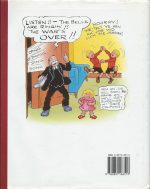
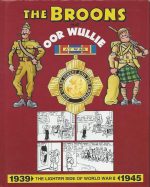
The Broons: Facsimile Edition of the First Ever Broons Annual


By R.D. Low & Dudley D. Watkins (D.C. Thomson/Aurum)
ISBN: 978-0-85116-

The Broons is one of the longest running newspaper strips in British history, having appeared well-nigh continuously in Scottish periodical The Sunday Post since the March 8th edition of 1936. That same issue launched equally timeless cartoon stable-mate and icon of Hibernian tradition Oor Wullie: a mischievous wee laddie who epitomises carefree youthful excess.

Both the boisterous boy and the gregariously engaging working class family were co-created by journalist, writer and Editor Robert Duncan Low in conjunction with DC Thomson’s most celebrated cartoonist Dudley D. Watkins. Both were overnight hits and instantly unmissable so within a few short years the weekly episode strips began to be collected in reprint editions as Seasonal Annuals. Those books alternated stars and years right up to the present day.

The book under discussion here comes from 2006: a magnificent recreation of that first Broons Annual compendium as launched in 1939. It’s a sturdy hardback with monochrome interiors, crammed full of gags and wholesome family fun delivered with gleeful exuberance by masters of the comedy comics form, lavishly presented in its own card slipcase.

Low (1895-1980) began at the Scottish publishing monolith as a journalist and quickly rose to the post of Managing Editor of Children’s Publication. Between 1921 and 1933 he created the company’s “Big Five” story-papers for boys: Adventure, The Rover, The Wizard, The Skipper and The Hotspur. These were text-base adventure weeklies liberally illustrated and in 1936 his next brilliant idea was the Fun Section: an 8-page pull-out comic strip supplement for Scottish national newspaper The Sunday Post.

As cited above this landmark illustrated accessory began on 8th March and from the very outset The Broons and Oor Wullie were its undisputed top draws…

Low’s shrewdest notion was to devise both strips as comedies played out in the charismatic Scottish idiom and broad unforgettable vernacular where – supported by features such as Auchentogle by Chic Gordon, Allan Morley’s Nero and Zero, Nosey Parker and other strips – they laid the groundwork for the company’s next great leap.

After some devious devising in December 1937 Low premiered the first DC Thomson weekly comic. The Dandy was followed by The Beano in 1938 and early-reading title The Magic Comic in 1939.

War-time paper shortages and rationing sadly curtailed the strip periodical revolution, and it was 1953 before the next wave of cartoon caper picture paper releases. The Topper started the ball rolling again (with Wullie in the logo and masthead but not included in the magazine’s regular roster) in the same year that Low & the great Ken Reid created Roger the Dodger for Beano…

Low’s greatest advantage was his prolific illustrator Dudley Dexter Watkins, whose style, more than any other, shaped the look of DC Thompson’s comics output until the bombastic advent of Leo Baxendale shook things up in the mid-1950s.

Watkins (1907-1969) had started life in Manchester and Nottingham as a genuine artistic prodigy before entering Glasgow College of Art in 1924. It wasn’t long before he was advised to get a job at burgeoning, Dundee-based DCT, where a 6-month trial illustrating boys’ adventure stories led to comic strip specials and some original cartoon creations.

Percy Vere and His Trying Tricks and Wandering Willie, The Wily Explorer made him a dead cert for both lead strips in the Sunday Post‘s proposed Fun Section and, without missing a beat, Watkins later added The Dandy‘s Desperate Dan to his weekly workload in 1937, eventually including The Beano‘s placidly and seditiously outrageous Lord Snooty seven months after.

Watkins soldiered on in unassailable triumph for decades, drawing some of the most lavishly lifelike and winningly hilarious strips in illustration history. He died at his drawing board on August 20th 1969.

For all those astonishingly productive years he had unflaggingly drawn a full captivating page each of Oor Wullie and The Broons every week, and his loss was a colossal blow to the company.

DC Thomson’s chiefs preferred to reprint old Watkins episodes of both strips in the newspaper and the Annuals for seven years before a replacement was agreed upon, whilst The Dandy reran Watkins’ Desperate Dan stories for twice that length of time.

An undeniable, rock-solid facet of Scots popular culture from the very start, The Broons reflected changing times and ordinary life for generations of readers; sharing trials and triumphs and celebrating each changing year with unflagging wit, warmth and inspired, self-deprecating buffoonery. For fans outside Scotland – like me – they always conjure feeling of holidays and special moments, so on this wet Bank Holiday (it’s always raining somewhere on a public vacation day) I’m reliving a halcyon time…

So What’s the Set Up?: the multigenerational Brown family inhabit a tenement flat at 10 Glebe Street, in the timelessly metafictional Scottish industrial everytown of Auchentogle (or sometimes Auchenshoogle), based in large part on the working class Glasgow district of Auchenshuggle. As such it’s an ideal setting in which to tell gags, relate events and fossilise the deepest and most reassuring cultural archetypes for sentimental Scots wherever in the world they might actually be residing. And yes, a huge part of the laugh track comes from the gloriously rich accent humour deriving from the Scots idiom and cultural consciousness.

If it’s good enough for Sir Harry Lauder, Andy Stewart, Stanley Baxter, Bill Forsyth, Chic Murray, Billy Connolly, Craig Ferguson, Frankie Boyle, Susan Calman…

As is always the case, the adamant, unswerving cornerstone of any family feature is long-suffering, understanding Maw, who puts up with cantankerous, cheap know-it-all Paw, and a battalion of stay-at-home kids comprising hunky Joe, freakishly tall Hen (Henry), sturdy Daphne, gorgeous Maggie, brainy Horace, mischievous twins Eck and the unnamed “ither ane” plus a wee toddling lassie referred to only as “The Bairn”.

Not officially in residence but always hanging around is gruffly patriarchal clod Granpaw – a comedic gadfly who spends more time at Glebe Street than his own cottage and constantly tries to impart his decades of hard-earned but painfully outdated experience to the kids… but do they listen?

In later years they family would grow a bit better off, taking regular breaks from the inner city turmoil whilst simultaneously sentimentalising, spoofing and memorialising more traditional times at their But ‘n’ Ben (a dilapidated rustic cottage in the Highlands) but in these initial pre-war tales the range of any excursion is simply the inner city and wherever a day-trip by charabanc or steam train can take the bustling, boisterous clan…

The endless escapades of these formative strips comprise timeless subject-matter such as oldster’s teasing young ‘uns about their beaus, males thinking they know best whether its cleaning fire-grates, mopping floors or organising parties, or females jockeying for social status. You can learn the real cost of a “bargain”, the wisdom of holding your tongue and the value of one night of actual peace and quiet…

All the kids live in a comfortably secure world of playing, pranking and stopping out late, whilst neighbours are equal parts pains-in-the-necks and salts-of-the-earth. But as well as slapstick shenanigans – ranging from plumbing pitfalls, decorating disasters, fireplace fiascos, food foolishness, dating dilemmas, appliance atrocities, fashion freak-outs, party panics, bothered Bobbies, excessive exercising, chore-dodging, galling goofs, family frolics and sly jests – there’s a sense of unified purpose and progress made, with the Broons part of a proper working community.

The overall impression is that, unlike today when the phrase is no more than cynically exploitative lip-service from a crass, glib plutocracy intent on disempowering everyone poorer than themselves, folks back then were genuinely “all in it together” just to get by.

And Low and Watkins made it funny and rewarding…

Packed with all-ages fun, rambunctious hilarity and deliriously domestic warmth, this exemplary example of happy domesticity convivially celebrates a mythic lost life and time and is a sure cure for post-modern glums…
The Broons ™ and © D.C. Thomson & Co., Ltd. 2006.

Small Press Sunday

I started out in this game when marks on paper were considered Cutting Edge, making minicomics, collaborating on fanzines and concocting stripzines with fellow weirdoes, outcasts and comics addicts. Even today, seeing the raw stuff of creativity in hand-crafted paper pamphlets still gets me going in ways that threatens my tired old heart…

With that in mind here’s a selection of tantalising treats that have landed in my review tray recently…

I’ve been collecting comics for more than fifty years now and my biggest regret is that for all the magnificent things I’ve read and enjoyed, only a pitifully fraction of the superb Alternative/Small Press/Self Published stuff I’ve seen has ever been collected in the online or graphic novel boom of this century.

I don’t know how to fix that problem – maybe a communal site where old stuff can be posted for readers to enjoy – but that means finding shy, lost or embarrassed creators and securing permissions and, most distressingly, so many of the creative folk I loved most are dead, vanished or cured now…

I’m not going to let such great material pass un-eulogized though, so whenever I feel like it I’m going to review something ancient, handmade and wonderful, and if the paper gods permit, perhaps you’ll find copies lurking in back-issue bins (do they still exist?) or at conventions or maybe the forgotten ones will re-emerge to take their long-deserved bows.

I’m going to start with a glorious prototype graphic novel compilation far ahead of its time, solely because creator Bob Lynch has already preserved it – and all of his other work – online. Skip my babblings and go right to his site if you wish.

Behold the Hamster

By Bob Lynch (Bob Comics)
No ISBN:

Most British comics devotees first noticed the self-effacing Bob Lynch through his contributions to the wonderfully eclectic self-publishing phenomenon Fast Fiction. From 1981 through 1990 Paul Gravett, Phil Elliott and Ed Pinsent’s Little Creative Co-operative That Could made conventions, comic-marts and monthly meetings of the Society of Strip Illustrators and Comics Creators Guild distractingly fun and bemusingly intoxicating with hand-crafted magazines of tiny print-runs yet immeasurably vast and broad comics entertainment.

Bob’s work first featured in the middle teens of the run (my memory is even more worn out than I am) and Behold the Hamster ran in #19, 20 and 22 – amongst other Bob bits such as Sav Sadness and rhymic slug Samantha – before being collected by your man himself in the book under discussion here and The Whirlpool of Disaster and Sadness in Space.

Lynch’s artwork is deceptively simple and astoundingly stylish, with puckish characterisations rendered in strong, bold black lines (sheer self-defence in an era where paper printing plates and public photocopiers were the acme of affordable reproduction technology for most of us). He was – hopefully still is – also one of the most surreal and simultaneously inviting story-men in the business; incorporating shared cultural icons from all vistas of the TV-watching, pub-going, comics-reading UK public into whacky whimsies and gently barbed observations on the human condition. You know: all the usual stuff…

This little A-5 64-page pamphlet has brightened my day on many occasions since I bought it in 1991, with its mad mash-up of time-travel, Frankensteinian science, detective mystery, true love and daft humour starring a star-crossed hamster named Behold who was brought back from beyond the grave to achieve an incredible destiny and save something or other…

Don’t take my word for it: check out –
https://www.flickr.com/photos/8424687@N08/sets/72157618049179283/

If I’ve piqued your interest you can catch a different flavour of Bob’s fantastic life at http://savsadness.blogspot.co.uk/

Captain Pugwash Comic Book Collection


By John Ryan (Frances Lincoln Children’s Books)
ISBN: 978-1-84780-384-9

John Ryan was an artist and storyteller who straddled three distinct disciplines of graphic narrative, with equal qualitative if not financial success. The son of a diplomat, Ryan was born in Edinburgh on March 4th 1921, and undertook his military service in Burma and India. After being de-mobbed and attending the Regent Street Polytechnic from 1946 to 1948, he took up a post as assistant Art Master at Harrow School from 1948 to 1955. It was during this time that he began contributing strips to Fulton Press publications.

On April 14th 1950 Britain’s grey, post-war gloom was partially lifted with the first issue of a new comic that literally gleamed with light and colour. Avid children were soon understandably enraptured; blown away by the gloss and dazzle of Dan Dare, Pilot of the Future, a charismatic star-turn venerated to this day as well as a host of other spectacularly illustrated stories strips and features.

The Eagle was a tabloid-sized paper with full-colour inserts alternating with text and a range of various other comic features. “Tabloid” is a really big page and you can fit a lot of material onto each one. Deep within, on the bottom third of a monochrome page, was an 8-panel strip entitled ‘Captain Pugwash – The story of a Bad Buccaneer and the many Sticky Ends which nearly befell him’ delivered with dash and aplomb by the aforementioned Mr. Ryan.

The indefatigable artist’s quirkily effective, welcomingly spiky style also lent itself to the numerous spot illustrations required throughout the comic every week and he even found time to regularly produce ‘Lettice Leefe, the Greenest Girl in School’ for Eagle‘s distaff companion comic Girl.

Pugwash, his harridan of a wife and the useless, lazy crew of the Black Pig ran until issue #19 when the feature disappeared.

This was no real hardship as Ryan had been writing and illustrating the incomparable and brilliantly mordant ‘Harris Tweed – Extra Special Agent’; a full page (tabloid, remember, upwards of twenty cram-packed and meticulously detail-stuffed panels per huge page, per week) from The Eagle #16 onwards.

Tweed ran for three years as a full page until 1953 when it dropped to a half-page strip and was repositioned as a purely comedic venture.

In 1956 the indefatigable old salt (I’m referring to Horatio Pugwash, but it could so easily be Ryan: an unceasing story-peddler with a big family, he still found time to be head cartoonist at the Catholic Herald for four decades) made the jump to children’s picture books and animated features for television.

The not-so-scurvy seadog washed up next in A Pirate Story: a proper illustrated children’s book and the first official first Pugwash chronicle. It was originally published by Bodley Head before the budding franchise switched to children’s publishing specialist Puffin. It was the first of a vast (sorry nautical puns are contagious, they really, really Arrr!) run of children’s books on a number of different subjects. Pugwash himself starred in 21 tomes; there were a dozen books based on the animated TV series Ark Stories, as well as Sir Prancelot and numerous other inspired creations.

Ryan worked whenever he wanted to in the comic world and eventually the books and the strips began to cross-fertilise.

When A Pirate Story was released in 1957, the BBC wisely pounced on the property, commissioning Ryan to produce a series of 5-minute black-&-white cartoon episodes (86 in all from 1957 to 1968, which were later reformatted in full colour and rebroadcast in 1976). In the budding 1950s arena of animated television cartoons, Ryan developed an entirely new system for producing cheap, high-quality animations to a tremendously tight deadline.

Naturally he began with Pugwash, keeping the adventure milieu, but replaced the Captain’s shrewish wife with a tried-and-true boy assistant. Tom the Cabin Boy is the only capable member of an astoundingly affable and inept crew which included such visual archetypes as Willy, Pirate Barnabas and Master Mate (fat, thin and tall – all dim and not at all bloodthirsty) instantly affirming to the rapt, young audience that grown-ups are fools and kids do, in fact, rule.

Ryan also drew a weekly Pugwash strip in the Radio Times for eight years, before going on to produce other animated series including Mary, Mungo and Midge, The Friendly Giant and Sir Prancelot, plus adaptations of some of his many children’s books. In 1997 an all new CGI-based Pugwash animated TV series began. There was even a thematic prequel in Admiral Fatso Fitzpugwash, in which it was revealed that the not-so-salty seadog had a medieval ancestor who became England’s First Sea Lord, despite being terrified of water…

John Ryan returned to pirate life in the 1980s, drawing new Pugwash storybooks. In swift succession he released The Secret of the San Fiasco, The Battle of Bunkum Bay and The Quest of the Golden Handshake, all joyously gathered in this resoundingly ample (194 x 254 mm) full-colour paperback…

The first Pugwash storybooks were traditional in format, with blocks of text and single illustrations illuminating a particular moment. By 1982 however the entire affair had evolved into lavishly painted comic strips, with standard word balloons on splendid panoramic double-page spreads or informative and complex layouts of as many as eight panels per page.

A fitting circularity to his careers and a nice treat for us old-fashioned comic drones, this trio of tales finds the master at his most exceptional and opens with The Secret of the San Fiasco, as the somewhat shaky stalwarts of the Black Pig fetch up in not-so-scenic Bogle Bay on Scotland’s wind-lashed Atlantic coast.

Ostensibly in search of a little holiday-break, the lads are actually hunting a fabulous treasure lost since the days of the Armada, when a gold-packed Spanish galleon apparently vanished into a solid cliff-face.

Many clever, greedy people have failed to find the treasure ever since 1588, but Pugwash is certain he will succeed. However as he and the crew check into draughty Bogle Castle, they are struck by the forbidding nature of the place and the sinister aspect of the only attendant, McGroggie the caretaker. They’re not amiss in their suspicions: as he terrifies them with spooky tales they are blissfully unaware that the old scoundrel is working with Pugwash’s arch-enemy Cut-Throat Jake…

After a night of terrifying noises and spooky events the cowardly Captain, Willy, Barnabas and Master Mate are quivering wrecks but intrepid Cabin Boy Tom is on the case and has tracked down the imprisoned Laird, heard the full true story of the San Fiasco’s end and deduced the treasure ship’s final resting place.

Sadly, as he leads his shipmates to the hidden trove, Jake and McGroggie are ready to pounce, but after the villains get away Scot free, the rogues fall out as rogues so often do…

The Pugwash stories are gloriously adrift sometime in the 18th century, never too closely bound by continuity whilst benefiting from many of the most momentous moments of a deliciously pick-&-mix grasp of history.

The wily Captain next bobs up during (another) war between England and France. The Battle of Bunkum Bay sees the seedy seamen sailing to the Pajamah Islands in search of a foundered Spanish bullion ship, but said wreck is slap-bang in the middle of two warring fleets. As has been previously noted, Pugwash is good at plans and sourcing loot, but terrible at keeping secrets, and his endeavours have again been observed by Cut-Throat Jake who follows the treasure-hunters at a cautious distance.

When they all reach the Pajamah Islands, the vile buccaneer hijacks Tom’s brilliant trick to sneak between the combative fleets of British Admiral Sir Splycemeigh-Mainbrace and his French rival Admiral the Marquis de Frilly de Pommes-Frites, but just this once canny Tom has overlooked a flaw in his usually impeccable thinking…

Jake leaves the hapless heroes in a dire death-trap and sails off, only to get calamitously caught up in the middle of the legendarily embarrassing Bunkum Bay maritime disaster, allowing Tom time to save the day and lead the Captain to an unaccustomed profit on his schemes…

Closing the piratical peregrinations is The Quest of the Golden Handshake, wherein our querulous, quivering Captain finds a genuine treasure map at an auction. All too soon though, a bidding-war with nefarious nemesis Cut-Throat Jake turns into a full-blown riot in which the coveted chart is torn a-twain…

Never knowingly daunted, Pugwash and company steal Jake’s half of the map that night but on returning to the safety of the Black Pig are horrified to discover that their rival has had the same idea…

Luckily the brilliant cabin boy had anticipated the move and copied their portion of the priceless document. Heartened and enraptured by thoughts of vast wealth, the crew hastily set sail for the Americas, determined to plunder the fabled Lost Treasure of the Stinkas…

Devious Jake, however, smuggles himself and a burly accomplice aboard, planning to let Pugwash do all the heavy lifting whilst awaiting a golden moment to claim revenge and the loot…

Packed with in-jokes, glorious tom-foolery and daring adventure, the voyage to the New World in a “haunted” ship culminates in a splendid battle of (half) wits before Tom, as usual, saves the day in his quiet, competent and deucedly clever way…

Gripping, hilarious and packed with gloriously effective and educational art of the most eye-catching quality these magically wry and enchantingly smart yarns are amongst Ryan’s very best: a humorous hoard of comic gems for fans of all ages.

We don’t have that many multi-discipline successes in comics, so why don’t you go and find out why we should celebrate one who did it all, did it first and did it well? Your kids will thank you and, if you’ve any life left in your old and weary adult fan’s soul, you will too…
© 1983, 1984, 1985, 1992, 2012 the Estate of John Ryan. All rights reserved.

Small Press Sunday


I started out in this game when marks on paper were considered Cutting Edge, making minicomics, collaborating on fanzines and concocting stripzines with fellow weirdoes, outcasts and comics addicts. Even today, seeing the raw stuff of creativity in hand-crafted paper pamphlets still gets me going in ways that threatens my tired old heart…
With that in mind, here’s a selection of tantalising treats that have landed in my review tray recently…
A few days before I began a major writing project with an insane deadline, I reviewed the magnificent GoodCopBadCop collections (still readily available and waiting to make your existence worthwhile…). In the same package was the first issue of the latest storyline and now that my day job’s back to normal – and with deepest apologies to Jim and the lads – here’s that promised review of the new follow-up case…

GoodCopBadCop Casebook #3.1 ‘Only Pigs and Horses’ Part 1
By Jim Alexander and Aaron Murphy, with Chris Twydell & Jim Campbell (Planet Jimbot Comics)

As well as mind-boggling graphic albums, independent publisher Planet Jimbot (Jims Alexander & Campbell with an ever-shifting pool of graphic talent) also delivers proper black-&-white comicbooks: none better than the continuing exploits of the most challenging rozzer in the history of crime.

City of Glasgow Police Inspector Brian Fisher is a worthy, weary, dedicated public servant with the oddest partner an honest copper could ever imagine – his own ruthless, rule-less crazy-man bad side…

Following directly on from the last book collection (GoodCopBadCop Casebook volume 2) this deceptively moody yarn finds Fisher about to start work again after a long period of sick leave. He’s been stood down ever since he caught catching a macabre, mutilating serial killer who left his bloody mark on the seemingly inoffensive Inspector.

Also out of sorts is his assistant Detective Sergeant Julie Spencer, who’s presently kipping on his couch. She was starting to piece together the truth about Fisher’s condition, but just stopped caring when her mother died…

Before he was a quietly effective Detective, Fisher learned his trade in the mounted police division and spent many educational hours doing community policing for the Violence Reduction Unit, visiting schools where the kids were more ruthlessly ferocious than any full-grown bad guy. Moreover, Brian’s condition is not a total secret. Certain higher-ups know that he goes off the rails but no one important has complained yet and the clean-up rate is phenomenal…

Those halcyon days on horseback come back to haunt Brian here and now as a ghastly atrocity is invoked when a new nutter hits the streets and, with astounding overkill, butchers two beat coppers.

Back in the saddle, Brain immediately makes a connection to the events at the Tannoch police stables thirteen years previously and heads to Barlinnie jail to interview an old lag who knew the original perpetrator “Peter the Horse”.

For a sordid and risky moment of quid pro quo, Michael offers Brian the full SP on the maniac – including the fact that he’s been dead for year…

He also reveals that Peter had an acolyte: another Peter the Horse in the making and one that been out in the real world for six months now…

To Be Continued…

This is another beautifully paced, chillingly unfolding mystery soaked in chilling complexity and shocking moments, tailor made to be a movie or late-night Scandi-style drama serial…

This deftly underplayed, chillingly believable and outrageously black-humoured serial is a magnificent addition to the annals of Tartan Noir: smart, compelling, compassionate and fiercely engaging. If you like your crime yarns nasty and your heroes deeply flawed, GoodCopBadCop is a series you must not miss.
GoodCopBadCop Casebook #3.1 © 2016 Jim Alexander (story) and Aaron Murphy (art.)

Planet Jimbot has a splendid online shop so why not check it out?

Von Doogan and the Great Air Race


By Lorenzo Etherington (David Fickling Books)
ISBN: 978-1-910200-82-7

These days, young kids are far more likely to find their formative strip narrative experiences online or between the card-covers of specially tailored graphic novels rather than the comics and periodicals of my long-dead youth.

Once upon a time, however, the comics industry was a commercial colossus which thrived by producing copious amounts of gaudy, flimsy pamphlets covering a multitude of themes, subjects and sub-genres, all further subdivided into a range of successful, self-propagating, seamlessly self-perpetuating age-specific publications.

Such eye-catching items once generated innumerable tales, delights (and cherished memories) intended to entertain, inform and educate such well-defined target demographics as Toddler/Pre-school, Younger and Older Juvenile, General, Girls, Boys and even Young Teens. Today, sadly, Britain seems only capable of maintain a few paltry out-industry, licensed tie-ins and spin-offs for a dwindling younger readership.

Where once cheap and prolific, strip magazines in the 21st century are extremely cost-intensive and manufactured for a highly specific – and dying – niche market, whilst the beguiling and bombastic genres that originally fed and nurtured comics are more immediately disseminated via TV, movies and assorted interactive media.

There are one or two venerable, long-lived holdouts such as The Beano and 2000AD but overall the trend has been downwards for decades.

That maxim was happily turned on its head back in January 2012 when Oxford-based family publisher David Fickling Books launched The Phoenix: a traditional-seeming anthology comic weekly aimed at girls and boys between 6 and 12 which revelled in reviving the good old days of picture-story entertainment Intent whilst embracing the full force of modernity in style and Content.

Still going strong, each issue offers humour, adventure, quizzes, puzzles and educational material in a joyous parade of cartoon fun and fantasy. In the years since its premiere, The Phoenix has gone from strength to strength, winning praise from the Great and the Good, child literacy experts and the only ones who really count – the astoundingly engaged kids and parents who read it…

The Phoenix was voted No. 2 in Time Magazine‘s global list of Top Comics and Graphic Novels and is the only strip publication started in the UK in the last forty years to have reached issue #100. It is now rapidly approaching its double-century. The magazine celebrated its first anniversary by developing a digital edition available globally as a tablet app and is continually expanding its horizons.

It is, most importantly, big and bold and tremendous fun.

On the other hand, whilst comics companies all seem to have given up the ghost, in this country at least, old-school prose publishers and the newborn graphic novel industry have evolved to fill their vacated niche. With a less volatile business model and far more sustainable long-term goals, book sellers have prospered from magazine makers’ surrender, and there have never been so many and varied cartoon and comics chronicles, compilations and tomes for readers to enjoy.

Naturally The Phoenix is part of that growing market, with a superb line of graphic albums repackaging and re-presenting their Greatest Bits.

The one we’re looking at today is The Phoenix Presents… Von Doogan and the Great Air Race: a dazzling display of cartoon virtuosity and mind-mangling comic challenges composed by Lorenzo Etherington, originally seen as captivating, addictively challenging weekly instalments of The Dangerous Adventures of Von Doogan.

The serial combined captivating cartoon narrative with observational tests, logic puzzles and other kids’ favourite brain-teasers, craftily taking readers and participants on a magnificently constructed progressive voyage of adventure and discovery in 37 clue, game, maze and mystery-packed episodes.

Our hero is a brilliant and intrepid young explorer with a keen sense of justice and an insatiable thirst for action. Here, following his previous exploit, Von Doogan is in the World Adventurers’ Club with the profits of the Golden Monkey caper burning a hole in pocket. Realising he is incredibly bored, he seeks out a fresh a challenge and is soon off and away…

Recovering, decoding and accepting an invitation to a global Great Air Race, our hero sets out in a hurry, gathering on the way supplies, a plane and a pilot in the form of very bad waitress Abby “Ace” Poontoon.

Then it’s a mad dash to decipher routes, maps and clues en route from one clandestine destination to the next; perpetually tackling – with your help – all manner of conundra (each with a daunting icon reckoning its “impossibility level”) as our heroes zero in on the goal.

As if puzzles such as ‘Secret Sandwich’, ‘The Big Choke’, ‘Cockpit Lockout’ and ‘Blazing Maze’ aren’t enough to challenge the keenest intellectual daredevil, there’s also the knotty problem of a saboteur amongst the intrepid contestants slowing and winnowing out the competition at every stage…

‘Doogan’s Discovery’ …

Naturally we aren’t all as smart as Von Doogan or a six-year old so this spectacular colourful cornucopia comes with a page explaining ‘How the Book Works’, an expansive ‘Equipment Checklist’ and a fulsome secret section offering extra help with ‘The Clues’ and – thankfully – it all wraps up with graphically glitzy explanations in ‘The Solutions’.

There’s even a free printable download page providing your own handy dandy copy of ‘Doogan’s Danger Kit’ to stop you cutting up the one in this mesmerising manuscript of mystery.

Story! Games! Action! … and all there in the irresistible form of entertaining narrative pictures. How much cooler can a book get?
Text and illustrations © Lorenzo Etherington 2016. All rights reserved.

To find out more about The Phoenix or subscribe, visit: www.thephoenixcomic.co.uk
Von Doogan and the Great Air Race will be released on April 7th 2016.