The Best of Eagle

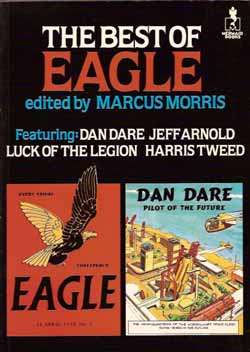
Best of Eagle
Best of Eagle

Edited by Marcus Morris (Mermaid Books)
ISBN: 0-7181-22119 (trade paperback) ISBN:0-7181-1566X (hardback)

A little hard to find but well worth the effort is this upbeat pictorial memoir from the conceptual creator of arguably Britain’s greatest comic. Eagle was the most influential comic of post-war Britain, and launched on April 14th 1950, running until 26th April 1969.

It was the brainchild of a Southport vicar, The Reverend Marcus Morris, who was worried about the detrimental effects of American comic-books on British children, and wanted a good, solid, Christian antidote. Seeking out like-minded creators he jobbed around a dummy to many British publishers for over a year with little success until he found an unlikely home at Hulton Press, a company that produced general interest magazines such as Lilliput and Picture Post.

The result was a huge hit spawning clones Swift, Robin and Girl which targeted other demographic sectors of the children’s market, as well as radio series, books, toys and all other sorts of merchandising.

A huge number of soon-to-be prominent creative figures worked on the weekly, and although Dan Dare is deservedly revered as the star, many other strips were as popular at the time, and many even rivalled the lead in quality and entertainment value.

At its peak Eagle sold close to a million copies a week, but eventually changing tastes and a game of “musical owners” killed the title. In 1960 Hulton sold out to Odhams, who became Longacre Press. A year later they were bought by The Daily Mirror Group who evolved into IPC. In cost cutting exercises many later issues carried cheap Marvel Comics reprints rather than British originated material. It took time but the Yankee cultural Invaders won out in the end…

With the April 26th 1969 issue Eagle was merged into Lion, eventually disappearing altogether. Successive generations have revived the title, but never the success.

Here Morris has selected a wonderfully representative sampling of the comic strips that graced those pages of a Golden Age to accompany his recollection of events. Being a much cleverer time, with smarter kids than ours, the Eagle had a large proportion of scientific, historical and sporting articles as well as prose fiction.

Included here are over 30 pages reprinting short text stories, cut-away paintings (including the Eagle spaceship), hobby and event pages, sporting, science and general interest features – and it should be remembered that the company produced six Eagle Novels and various sporting, science and history books as spin-offs between 1956 and 1960. Also on show are many candid photographs of the times and the creators behind the pages.

Of course though, the comic strips are the real gold here. Morris has selected 130 pages from his tenure on Eagle that typify the sheer quality of the enterprise. Alongside the inevitable but always welcome Hampson Dan Dare are selections from his The Great Adventurer and Tommy Walls strips.

Other gems include The Adventures of PC. 49 by Alan Stranks and John Worsley, Jeff Arnold in Riders of the Range, by Charles Chilton & Frank Humphris, Chicko by Norman Thelwell, Professor Brittain Explains…, Harris Tweed and Captain Pugwash by John Ryan, Cortez, Conqueror of Mexico by William Stobbs, Luck of the Legion by Geoffrey Bond & Martin Aitchison, Storm Nelson by Edward Trice & E. Jennings and Mark Question (The Boy with a Future – But No Past!) by Stranks & Harry Lindfield.

There are selections from some of the other glorious gravure strips that graced the title: Jack o’Lantern by George Beardmore & Robert Ayton, Lincoln of America by Alan Jason & Norman Williams, The Travels of Marco Polo by Chad Varah & Frank Bellamy, The Great Charlemagne and Alfred the Great (both by Varah & Williams).

Extracts from Bellamy & Clifford Makin’s legendary Happy Warrior and the less well known The Shepherd King (King David), run beside The Great Sailor (Nelson) by Christopher Keyes, as well as The Baden Powell story (Jason & Williams) and even David Livingstone, the Great Explorer (Varah & Peter Jackson), and the monochrome They Showed the Way: The Conquest of Everest by Peter Simpson & Pat Williams makes an appearance.

The book is peppered with nostalgic memorabilia and such joys as George Cansdale’s beautiful nature pages plus a host of cartoon shorts including the wonderful Professor Puff and his Dog Wuff by prolific Punch cartoonist David Langdon. Also included is The Editor’s Christmas Nightmare by Hampson, a full colour strip featuring every Eagle character in a seasonal adventure that is fondly remembered by all who ever saw it…

These may not all resonate with modern audiences but the sheer variety of the material should sound a warning note to contemporary publishers about the fearfully limited range of comics output they’re responsible for. But for us, it’s enough to see and wish that this book, like so many others, was back in print again.

Text © 1977 Marcus Morris. Illustrations © 1977 International Publishing Corporation. All Rights Reserved.
Marshal Law: Origins

Marshal Law: Origins

By Pat Mills & Kevin O’Neill (Titan Books)
ISBN: 9781-84576-943-7

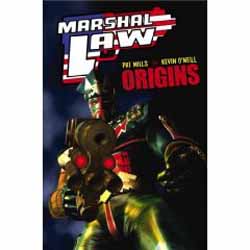
Though not strictly a graphic novel this copiously illustrated book finally collects the prose stories starring the deeply troubled superhero hunter that appeared on Nick Percival’s Cool Beans website between 2000 and 2002. A continuation of the character first published by Epic Comics and Dark Horse as well as the British Apocalypse Comics, these stories are intended for adult readers – whatever that means, these days.

In the dystopian metropolis of San Futuro, the returned dregs of America’s latest war litter the streets. Once again soldiers have been abandoned by their country as soon as the conflict ended, but his time drugs trauma and stress aren’t the only long-term problems. Genetic engineering made US troops into superheroes, but it couldn’t unmake them so now they’re just a dangerous problem the Authorities would love to ignore.

Joe Gilmore is one such returnee who took a different route. He’s a cop who uses his cursed abilities to remove the worst of the super-scum from the streets. He is Marshal Law and far too infrequently since 1987 he’s been a tool of brutal criticism and satire on the overweening cult of superheroes in American comicbooks.

In the comics incarnation the series is characterised by nudity, creative profanity, barbed parody, sexual situations (I don’t think I’ve ever typed that phrase before!) extreme violence and fabulous hilarity. O’Neill’s art is always stuffed with extras and both creators blatant dislike for costumed heroes shines out like a batsignal.

This book then is a mixed blessing. It’s great to see two more canonical tales ‘The Day of the Dead’ (a showdown with a band of superhero serial killers) and ‘Cloak of Evil’ (the suspicious suicide of San Futuro’s top Sex Worker leads to way more than anybody expected) but Mill’s choppy prose won’t be to everybody’s taste. Moreover even with O’Neill’s wonderful illustrations (19 black and white double page spreads) a vital story element is absent. On a Marshal Law page as much goes on in the backgrounds and margins and the scenery walls as in front of the camera, but that simply isn’t possible here.

This compilation is interesting and powerful, but not as effective as a new comic would be. We’re waiting…

â„¢ & © 2008 Pat Mills & Kevin O’Neill. All rights reserved.

Shaun the Sheep: Championsheep Games

Shaun the Sheep: Championsheep Games

Published by Egmont
ISBN: 978-1-4052-3085-2

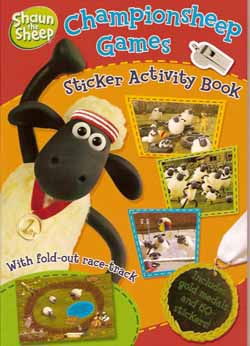
Here’s another great activity book for three year olds (and over) that’s a huge bunch of fun and–as the subject is also that rarest of animals: a British kids franchise with his own newsstand comic–well worth a mention in my never-ending crusade to teach kids to love comics, books and reading.

In case you haven’t seen the stop-motion adventures of Shaun the Sheep let’s recap: He first appeared in the Wallace and Gromit film A Close Shave in 1997 (he’s the one that got shorn – get it? – in the knit-o-matic machine). After a guest-shot on the 2002 series Cracking Contraptions he finally graduated to his own show on the BBC in early 2007.

Shaun is a sheep of singular intellect yet he lives on a farm where he has worryingly surreal adventures which pay mute tribute to those timeless silent classics of slapstick comedy. They are extremely entertaining for both adults and kids alike.

This attention-riveting tome is a Sticker Activity Book, which means that there are full colour peel-off adhesive images which can be placed in relevant – or not – places to great effect. The body of the book is a series of black and white pages stuffed with colouring puzzles, spot-the-difference tests, mazes, join-the-dots, finish-the-picture scenes, tracing games, word-searches, hidden-object quests, counting games, comparison quizzes and even a fold-out race-track. I’m nearly three hundred and fifty-two and even I found this to be a dazzling display of captivating teasers. And some of the kids who get this book will want to graduate to the comic afterward…

In a world where books are increasingly alien to people, the combination of great characters, compelling stories and pictures, plus every darn trick in the book, is a welcome tactic in getting kids reading. Forget video games, buy that child a book!

© and ™ Aardman Animations, Ltd 2008. All Rights Reserved. Based on a character created by Nick Park.

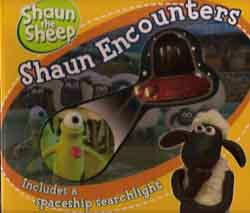
Shaun the Sheep: Shaun Encounters

A SEARCHLIGHT BOOK 

Shaun the Sheep: Shaun Encounters

ISBN: 978-1-4052-4169-4

I haven’t covered anything specifically created for the very young for a while so let’s rectify that omission with this great activity book for three year olds (and over) that’s a huge bunch of fun and a great introduction to graphic narratives and themes, especially as the subject is also that rarest of animals, a British kids franchise with his own newsstand comic.

In case you haven’t seen the stop-motion adventures of Shaun the Sheep let’s start with a quick biography. He first appeared in the Wallace and Gromit animated feature A Close Shave in 1997 (he’s the one that got shorn – get it? – in the knit-o-matic machine). After a guest-shot on the 2002 series Cracking Contraptions he finally graduated to his own show on the BBC in early 2007.

Shaun is a sheep of singular intellect yet he lives on a farm where he has worryingly surreal adventures which pay mute tribute to those timeless silent classics of slapstick comedy. They are extremely entertaining for both adults and kids alike.

This lovely book uses the best of modern paper technology to tell the eerie tale of annoying aliens who invade the farmhouse where, as usual, the humans and Bitzer the sheepdog are useless. Naturally, Shaun has to deal with the invasion in his own inimitable manner…

This robust hardback is a great introduction to the magical world of books, and especially pictorial narrative. It is augmented by the coolest thing I’ve seen in years: a number of the illustrations are printed on transparent cels, and by the deft application of a torch the pictures come fantastically alive.

In a world where books are increasingly alien to people, the combination of great characters, compelling stories and pictures, plus every darn trick in the book, is a welcome tactic in getting kids reading. Forget games, buy that child a book!

© and ™ Aardman Animations, Ltd 2008. All Rights Reserved. Based on a character created by Nick Park.

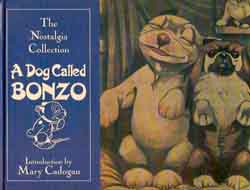
The Nostalgia Collection: A Dog Called Bonzo

A Dog Called Bonzo

By George Studdy, with an introduction by Mary Cadogan (Hawk Books)
ISBN: 0-94824-52-1

The history of popular culture is studded with anthropomorphic animals that have achieved legendary, almost talismanic status. Mickey Mouse, Tiger Tim, Garfield, Smokey (the) Bear, Bonzo…

If that latter causes a puzzled frown that’s a shame because for a while this playful, charming dog-of-dubious-pedigree was a British animorph that rivalled Disney’s mouse and duck combined. Only the artistic integrity and creative drive of his creator George Earnest Studdy prevented the mutt from attaining the global domination (and subsequent tawdry commercialisation) of the Disney duo.

Studdy was born in 1878 in Devon of a military family, but a childhood injury prevented him from following that path, and his prodigious artistic talent moved him to an unsatisfactory position as an engineer before he eventually found his niche as an illustrator and animator.

His first artistic success was a series of Boer War pictures of the Royal Artillery, followed by cartoons and illustrations for such comics as Big Budget, Funny Pips, Jester and Wonder and others, plus papers and magazines including The Graphic, The Humorist, Little Folks, London Magazine, Punch, Windsor Magazine, The Tatler, The Bystander, Illustrated London News, The Field and especially The Sketch. A superb general stylist he was most widely known for his animals although he was an early proponent of science fiction themes as well. He worked extensively in the budding field of advertising.

Deemed unfit to fight in the Great War, he pioneered animation propaganda films that are still acclaimed for their quality and effectiveness. He first began producing pictures of a homely, engaging dog for The Sketch in the early 1920s, which were immensely popular. Eventually “the Studdy dog” became a permanent fixture and was christened Bonzo in the November 8th issue of 1922. The luxuriously painted or drawn single panels became a full gag-strip with the talking dog and his long-suffering lady-friend Chee-Kee captivating young and old alike with their playful yet slyly mature antics.

Bonzo was a merchandising miracle of his time, featuring in games, puzzles, toys of all types, figurines, china and dinnerware, cups, cruets and host of other household objects and all manner of advertising campaigns. He even had his own neon sign in Piccadilly Circus.

Although Studdy voluntarily moved on from his creation to create many other pictorial marvels and to serve his country again in WWII as a draughtsman for the Royal Navy, the dog continued under other hands in strips syndicated worldwide by King Features and in a series of wonderful books and annuals. These began in 1935 and continued until 1952, with translations into many foreign editions. For a spectacular view of these you should see the superb websites at http://www.studdying-with-bonzo.co.uk/books.htm and http://www.bonzo.me.uk/ as well as this magical and far too short commemorative edition produced by Mike Higgs under his much-missed Hawk Books imprint.

Funny, charming, brilliantly illustrated, overwhelmingly successful and still as entertaining today as it always were, Bonzo is long overdue for an extensive repackaging job. Until such a happy event this little gem should act as a tantalising taster.

© 1990 the Estate of George Studdy. All Rights Reserved.

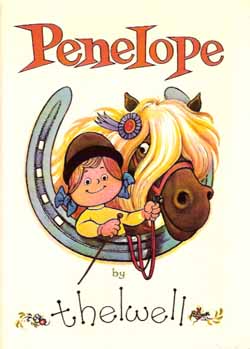
Penelope

Penelope

By Thelwell (Eyre Methuen)
ISBN: 978-0-41329-340-4

Norman Thelwell is one of our most beloved cartoonists – even though he sadly passed away in 2004. I was going to astound you with my knowledge here but frankly his work has always been its own best advocate, and if you want to know more about this brilliant creator – and see more of his work – you should crank up your search-engine of choice. I specifically recommend the official website (www.thelwell.org.uk/biography/biography.html) as well as Steve Holland’s excellent Bear Alley .

Thelwell’s superbly gentle cartooning combined Bigfoot abstractions with a keen and accurate eye for background detail, not just on the riding and countryside themes that made him a household name, but on all the myriad subjects he turned his canny eye and subtle brushstrokes to. His pictures are an immaculate condensation of everything warm yet charged and resonant about being Post-War, Baby-Booming British, without ever being parochial or provincial. His work has international implications and scope, neatly achieving that by presenting us to the world. There are 32 books of his work and any aficionado of humour could do much worse than own them all.

From 1950 when his gag-panel Chicko first began in the Eagle, and especially two years later with his first sale to Punch, he built a solid body of irresistible, seductive and always funny work. He appeared in innumerable magazines, comics and papers ranging from Men Only to Everybody’s Weekly. In 1957 Angels on Horseback, his first collection of published cartoons was released, and in 1961 he made the rare reverse trip by releasing a book of all-new cartoons that was subsequently serialised in the Sunday Express.

A Leg at Each Corner was a huge success and other books followed. Eventually this led to the strip collected in the book reviewed here. Thelwell’s short obnoxious muses originated in the field next door to his home, where roamed two shaggy ponies…

“Small and round and fat and of very uncertain temper” – apparently owned by “Two little girls about three feet high who could have done with losing a few ounces themselves….”

“As the children got near, the ponies would swing round and present their ample hindquarters and give a few lightning kicks which the children would side-step calmly as if they were avoiding the kitchen table, and they had the head-collars on those animals before they knew what was happening. I was astonished at how meekly they were led away; but they were planning vengeance – you could tell by their eyes.”

Penelope and her formidable steed Kipper ran – or at least reluctantly trotted – (sorry, I have no will-power or shame) through the pages of the Sunday Express where Thelwell toiled from 1962 to 1971. This wonderful book is readily available, as is the sequel Penelope Rides Again, and I trust that anyone with an ounce of decency and taste will treat themselves to the work of this master as soon as humanly possible.

© 1972 Norman Thelwell and Beaverbrook Newspapers Ltd.

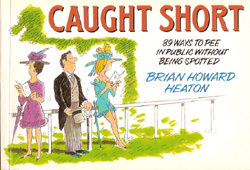
Caught Short

Caught Short

By Brian Howard Heaton (Grub Street)
ISBN: 978-0-95881-760-1

Here I go again bemoaning the gradual loss of the cheap ‘n’ cheerful cartoon paperbacks that were so ubiquitous in the past but are now fast fading as the much more important sounding Graphic Novels and Trade Collections carve a niche in our psyches and on our bookshelves. And here’s another disturbing thought – how many people these days even have bookshelves and any sort of tome to put on them?

None of which matters a jot or tittle as I call to your attention a relatively late entry in the field from Brian Howard Heaton subtitled “89 ways to pee in public without being spotted”. This sort of themed gag-book was the last commercial gasp in a tradition of pictorial entertainments that began with Punch, and evolved into a saucy standby of British life.

Heaton is a competent artist in the modern style and the gags range from contrived to fiendishly clever, all delivered with easy charm and utterly without text – never an easy job in cartooning. If you find this book or anything similar give it a try; this sort of thing use to be bread ‘n’ butter in our game, and you really will mess them if they disappear forever.

© 1992 Brian Howard Heaton. All Rights Reserved.

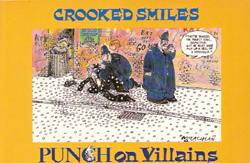
Crooked Smiles: Punch on Villains

Crooked Smiles: Punch on Villains

By various (Grafton Books)
ISBN: 978-0-24613-242-0

Punch began in 1841; a magazine dedicated to satire and humour, and swiftly became a national – and international – institution. It ran more or less non-stop until 2002 before finally closing its jolly doors, featuring sharp, witty writers such as W. M. Thackeray, P.G. Wodehouse, P.J. O’Rourke and Alan Coren among so very many others. Many of these writers’ efforts were illustrated by brilliant draughtsmen and artists. It was a social force, an astute historian and its contents could even influence governments.

Punch probably invented, and certainly perfected, the gag and strip cartoon. The list of brilliant cartoonists who graced its pages is something I couldn’t live long enough to relate. Name a cartoonist; if he or she were any good they will have been published in Punch.

With such a wealth of material, it’s truly surprising how very few collections have been generated from its pages. The one under the glass here is from 1987, selected by Editor William Hewison and features mostly British gag-men doing their bit in the War on Crime. The cartoons range from the comfortably familiar to the just plain weird, and if humour is in the eye of the beholder, the wealth of ability and talent is certainly less open to debate.

This book isn’t really what I’m recommending here, it’s the type of book. These gags and many like them by the likes of such luminaries as David Langdon, Heath, Brockbank, Graham, Honeysett, Bill Tidy, Stark, Thelwell, Larry, ffolkes, Sally Artz, Mahood, McLachlan, Raymond Lowry and all the wonderful rest are sitting idle when they could be filling bookshelves and making us all a little happier…

© 1987 Punch Publications Ltd. All Rights Reserved.

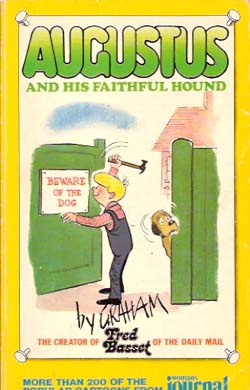
Augustus and His Faithful Hound

Augustus and His Faithful Hound

By Graham (Mirror Books)
ISBN: 0-85939-120-5

Cartoons and gag-panels are a universal medium but we purveyors of sequential narrative have an unhappy tendency to become protective and parochial about our own particular specialism within the medium. How many times have I heard an artist or writer working on a hot new comic-book property, revelling in sales of sixty-to-seventy thousand monthly copies, disparage a strip such as Hagar the Horrible or Garfield whose daily readership can be numbered in millions, if not billions? Let’s all just try to remember that tastes differ, and that we all make lines on a surface here, and most especially that TV and Computer Games are the real enemy of our industry, shall we?

Rant over.

Mainstream cartooning is a huge joy to a vast readership whose needs are quite different from those of hard-core, dedicated comic fans, or even that growing base of intrigued browsers dipping their toes in the sequential narrative pool. Even those stuck-up stickybeaks who have pointedly “never read a comic” have seen and enjoyed cartoon strips or panels, and in this arena Britain has produced more than its share of classics.

Alex Graham, best known for the charming and reassuringly middle-class Fred Bassett strip, was a jobbing cartoonist for nearly fifty years and in that time produced a vast range of work that delighted readers on a wide range of subjects. He died in 1991, and Bassett was continued by his daughter Arran and artist Michael Martin. I’ll save the details for upcoming Fred Bassett reviews.

Augustus and his Faithful Hound is a less well-known strip that appeared in the late 1970’s in The Woman’s Journal, a home-maker’s magazine with a highly specialised demographic. The strip is a perfect fit: the gently amusing and reassuring exploits of a timid young lad and his equally timid, if boisterous, dog. The drawing is highly polished, captivating and charming; the gags undemanding and very reassuring – and that’s just what they’re supposed to be. This was not a venue for sarcasm, slapstick, surrealism or brisk, salacious vulgarity. These were cartoons to make your mum laugh, and as such they are perfect.

I’m sure there’s not much chance of this collection ever being reprinted, but if you chance across a copy, try it before dismissing it. The craft and skill is just as hard-learned as any superhero, fantasy or horror artist’s, the results fitted the brief perfectly and the audience was so very happy with the result. Other than a bigger cheque and global celebrity, what more could a creator possibly want from his labours?

© 1978 Woman’s Journal. All Rights Reserved.

Columbus

Columbus

By Les Lilley & Anthony Hutchings (Millbank Books)
ISBN: 978-0-95198-980-7

I’m always banging on about how British creators have been slighted and cursed with anonymity in our industry so I’m going to use this review to shine a light on one of the most egregious examples of that practise. Leslie Alfred Joseph Lilley was born in Dartford in 1924. After Navy service in World War II he joined the burgeoning pool of demobbed servicemen selling cartoons to the news trade. At a time when publications were toiling under paper restrictions, “pocket cartoons” were ubiquitous as column breaks in text-heavy papers (a practise pioneered by Osbert Lancaster). As the restrictions eased periodical magazines returned and flourished. Digests and magazines could expect to publish upwards of 40 gags and panels per week and many artists found them a vital source of income.

Lilley was never the world’s best artist, and as the newspapers adopted the US model for strip continuities, he moved from pencil to typewriter and became one of the most prolific scripters of cartoons and strips in Britain. With Ian Scott he formed an agency for cartoon scripting and began a lifelong career as writer, promoter and ambassador for the narrative arts. He founded the Cartoonists Club of Great Britain and was president of the Federation of European Cartoonist’s Organisations. He was instrumental – with Frank Bellamy – in creating the Society for Strip Illustration (which became the Comics Creators Guild in 1993).

Among his many works were the strips Jane, Choochi and Twink, Tiffany Jones, Scarth and hundreds of others. For IPC comics he wrote The Tin Teacher, Fiends and Neighbours, Son of Sherlock and much, much more, as well as an uncountable number of single panel gags. He also wrote entire Christmas annuals (128 pages of mirth and mayhem every Christmas!) for Wham! and Pow!

In 1964 he and Scott produced the scripts for the legendary BBC television series Vision On, and later ATV’s Golden Shot, and many others. Latterly he wrote Robbin’ Hood and Christopher Columbus for the Mail on Sunday; this last drawn by the award-winning cartoonist Anthony Hutchings.

Columbus was produced in 1992 to celebrate the 500th anniversary of the epic voyage of discovery and is a gently comedic situation-spoof with plenty of laughs, a dash of satire and a great deal of heart. It’s a strip in the Grand British Tradition designed to raise a chuckle amongst everyday folk and does it very well indeed.

Credit never paid bills and modern creators have a much better time being noticed and acclaimed, even if the job opportunities are less than the industry heyday. Les Lilley died in 1998 so he got to see the changes occur, and in the long run the best way to celebrate a cartoonist’s work is to read it; and so you should.

© 1992 Grand Prix Productions. All Rights Reserved.