

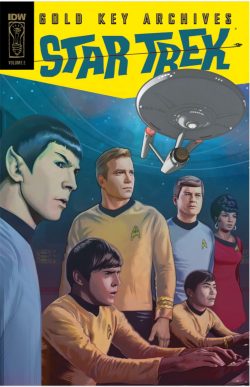
By Dick Wood, Len Wein, Alfredo Giolitti & various (IDW)
ISBN: 978-1-63140-108-4 (HB), 978-1-62302-656-1 (Digital edition)
This book includes Discriminatory Content produced in less enlightened times
Star Trek debuted on American televisions on September 8th 1966, running until June 3rd 1969: three seasons comprising 79 episodes. A moderate success, the series only really became popular after going into syndication, running constantly in American local TV regions throughout the 1970s. It was also sold all over the world, popping up seemingly everywhere and developing quite a devoted fanbase.
Being a third world country, Britain didn’t see the show until July 12th 1969 during the rocket fever surrounding the Apollo moon landings. BBC One screened “Where No Man Has Gone Before” in black-&-white before proceeding to broadcast the rest of the series in the wrong order. “Arena” was the first episode screened in colour (November 15th 1969), but viewers didn’t care. We were all hooked anyway and many of the show’s catchphrases – quite a few erroneous and some entirely fictitious – swiftly entered the popular lexicon of the nation.
The series spawned a licensed but British-originated comic strip which ran from the late 1960s into the 1970s in Joe 90, TV21 & TV21 and Valiant. These have also been collected and I’ll get to them in the fullness of time and space.
Back in the USA, although there was some merchandising, the phenomenon was a little less enthusiastically embraced. Even though there was a comic book from “properties magnate” Gold Key and running for almost a decade after the show’s cancellation, authenticity at the start wasn’t really a watchword. Nor was immediacy or urgency an issue. In fact, only six issues were released during the show’s entire three-season run. Published between July 1967 and December 1968, they were all gathered in the first Star Trek Gold Key Archive…
Printing giant Whitman Publishing had been producing their own books and comics for decades via their Dell and Gold Key imprints which rivalled in sales and popularity and often surpassed DC and Timely/Marvel at the height of their powers. Famously Whitman never capitulated to the wave of anti-comics hysteria resulting in the crippling self-censorship of the 1950s and Dell Comics never displayed a Comics Code Authority symbol on their covers.
They never needed to: their canny blend of media and entertainment licensed titles were always produced with a family market in mind and the creative staff took their editorial stance from the mores of the filmic Hayes Code and the burgeoning television industry.
Just like the big and little screen, the product enticed but never shocked and kept contentious social issues implicit instead of tacit. It was a case of “violence and murder are fine, but never titillate”…
Moreover, the vast majority of their adventure comics’ covers were high quality photos or paintings – adding a potent degree of veracity and verisimilitude to even the most outlandish of concepts for us wide-eyed waifs in need of awesome entertainment. The company seemed the only logical choice for a licensed comic book, and to be honest, these stories are cracking space opera yarns, even if they occupy an odd position in the hearts of older screen-dominant fans. In the UK, distribution of US comics was haphazard at best, but Gold Key Trek yarns were reprinted in our beloved hardback Christmas annuals. Nevertheless, the earliest ones bore little resemblance to what we’d seen on TV. Our little minds were perplexed and we did wonder, but as the tales offered plenty of action and big sci fi concepts we just enjoyed them anyway. Those original British Star Trek yarns came in serialised comic-strip form, superbly illustrated and bearing a close resemblance to the source material. The feature only appeared as 2 or 3-page instalments in weekly anthologies, but was at least instantly familiar to TV viewers.
The reason for the inaccuracies between the US screen and page versions was simple and probably a clear indicator of the attitude both studio and publisher held about science fiction material. Scripter Dick Wood (a veteran comics writer with credits ranging from on hundreds of series from Batman to Crime Does Not Pay to Doctor Solar, Man of the Atom) had never seen any episodes when commissioned to write the comic, with he and Italian artists Nevio Zaccara – and latterly Alberto Giolitti – receiving only the briefest of outlines and scant reference materials from the show’s producers. The comics craftsmen were working almost utterly in a vacuum…
Nevertheless, by the time of these interstellar exploits (reprinting Star Trek #7-12 and cover-dated March 1970 to November 1971) the well-intentioned contradictions to now-firmly established Trek lore were slowly fading, thanks to better reference. Also vastly increasing veracity for a solid Gold Key seller was creator who had an actual familiarity with TV episodes which solidly steered the printed Enterprise incidents towards canonical parity with the TV phenomenon.
Following revelatory Introduction ‘The Adventure Continues…’ from licensed-character specialists/authors Scott & David Tipton, another stunning photo-collage cover – a rarity at the time outside Gold Key titles – leads into an eerie cosmic quest as Kirk and his crew discover ‘The Voodoo Planet’ (#7 by Wood & Giolitti). In an unexplored region of space, Enterprise discovers an uninhabited duplicate of Earth, complete with monuments and landmarks. When a hidden mastermind then causes the Eiffel Tower to crumble, word comes that the original back home has also come tumbling down…

As the seemingly magical destruction continues, Enterprise tracks a transmission and travels to another planet almost obscured by debris and space junk and finds there a primitive race practising voodoo. Shock follows shock as a landing party finds escaped Earth war-criminal Count Dressler has subjugated the natives and adapted their abilities to launch devastating attacks on the world that exiled him…
However, the villain’s arrogance proves his undoing as Dressler underestimates the ingenuity of Mr. Spock and sheer bloody-mindedness of James T. Kirk…
‘The Youth Trap’ was released with a September 1970 cover-date and sees assorted crew members transformed into children by a manic alien explorer who has turned a fantastic survival technology into an irresistible weapon. Whilst Kooba’s appalled comrades only want to get home, the madman believes his chronal ray will win him a universe. Once again the combination of Spock’s brains and Kirk’s daredevil brawn win the day…
From the February 1971 9th issue, Wood was replaced by devoted Trek viewer Len Wein (Swamp Thing, Batman, Spider-Man, Hulk) who joined astounding Alberto Giolitti to explore ‘The Legacy of Lazarus’, wherein the ever outward-bound Enterprise fetches up to a remote planet and finds it populated with all the great figures of humanity’s past. When Spock vanishes, his trail leads to a hidden cavern where Earth’s greatest historian Alexander Lazarus has combined robotics and recovered alien technology to locate and gather in the actual brainwaves of history’s giants and create the most astounding resource for knowledge ever conceived.
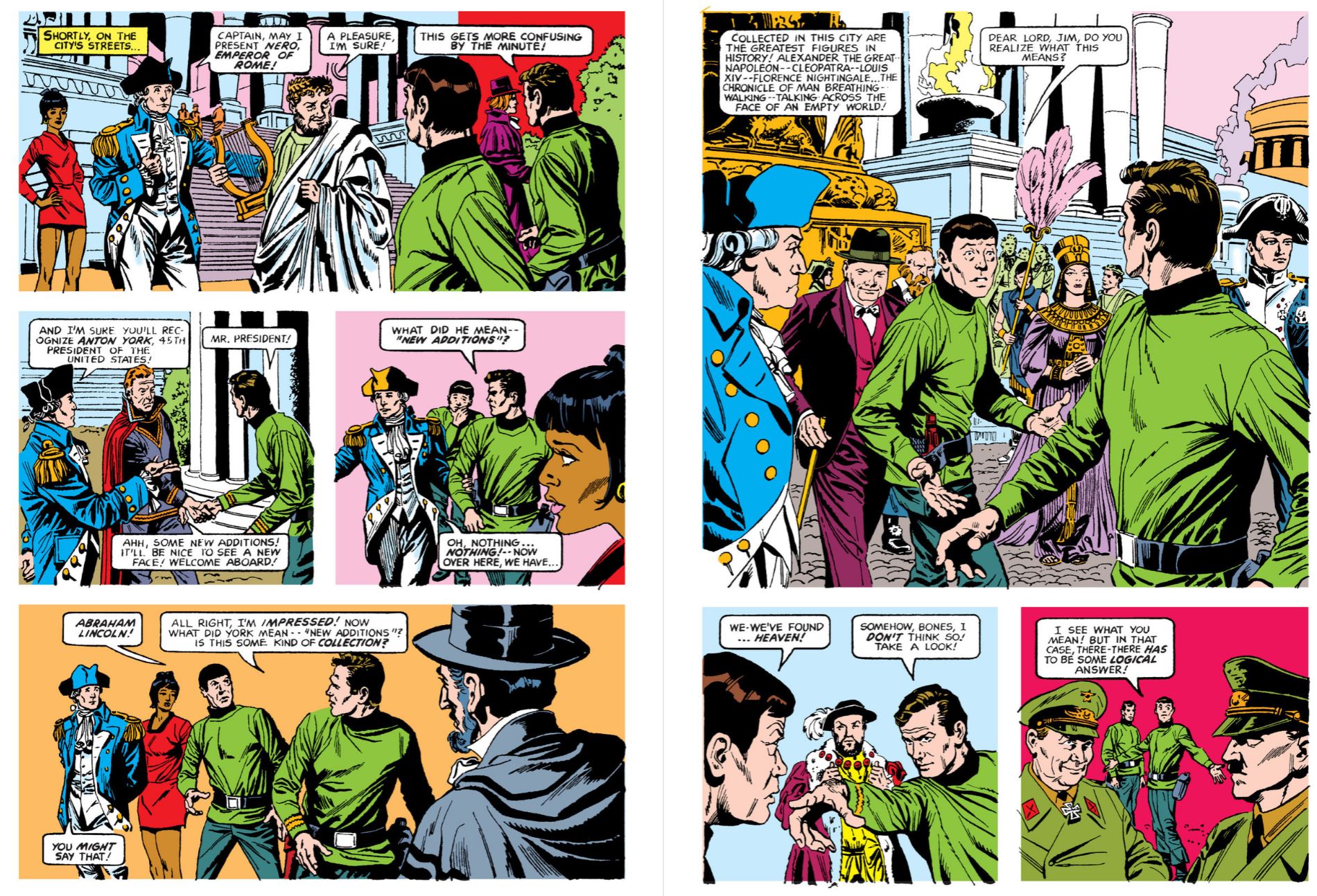
Sadly, the great feat has only whetted the savant’s appetite. Lazarus wants to perform the same feat with the great and good of Vulcan’s past. To get started, he needs the brain of a native and Spock is the nearest and therefore only logical candidate. Luckily for the endangered Science Officer, Kirk and his shipmates can call on the wisdom and courage of Earth’s greatest heroes to aid in their rescue attempt…
With Star Trek #10 (May 1971) stills from Paramount were no longer forthcoming and George Wilson began his series of captivating painted covers. Meanwhile, on the pages within, mystery and imagination hold sway as the starship is plucked out of the void by a cosmic genie whilst Kirk, Spock, Dr. Leonard McCoy and Chief Engineer Montgomery Scott are dumped at the feet of a storybook tyrant who demands they steal for him the awesome ‘Sceptre of the Sun’. All too soon though, the doughty space-farers unravel the lies underpinning the seeming omnipotence of Chang the Sorcerer and find his true origins stem from a long-lost expedition from Earth in ages past…
From August 1971, ‘The Brain Shockers’ details how neophyte Yeoman Pandora Trask is tricked by a marauding alien into opening a hatch she wasn’t meant to, unleashing a wave of malignant emotions hidden aboard the Enterprise. These deadly feelings were originally extracted and bottled at the time Vulcans first sought to abandon passion for logic and were being transported to a secret destination, but now their rampage through the ship and the assailant’s world will wreak total havoc unless Spock can outthink both them and immortal, seemingly suicidal custodian Malok…
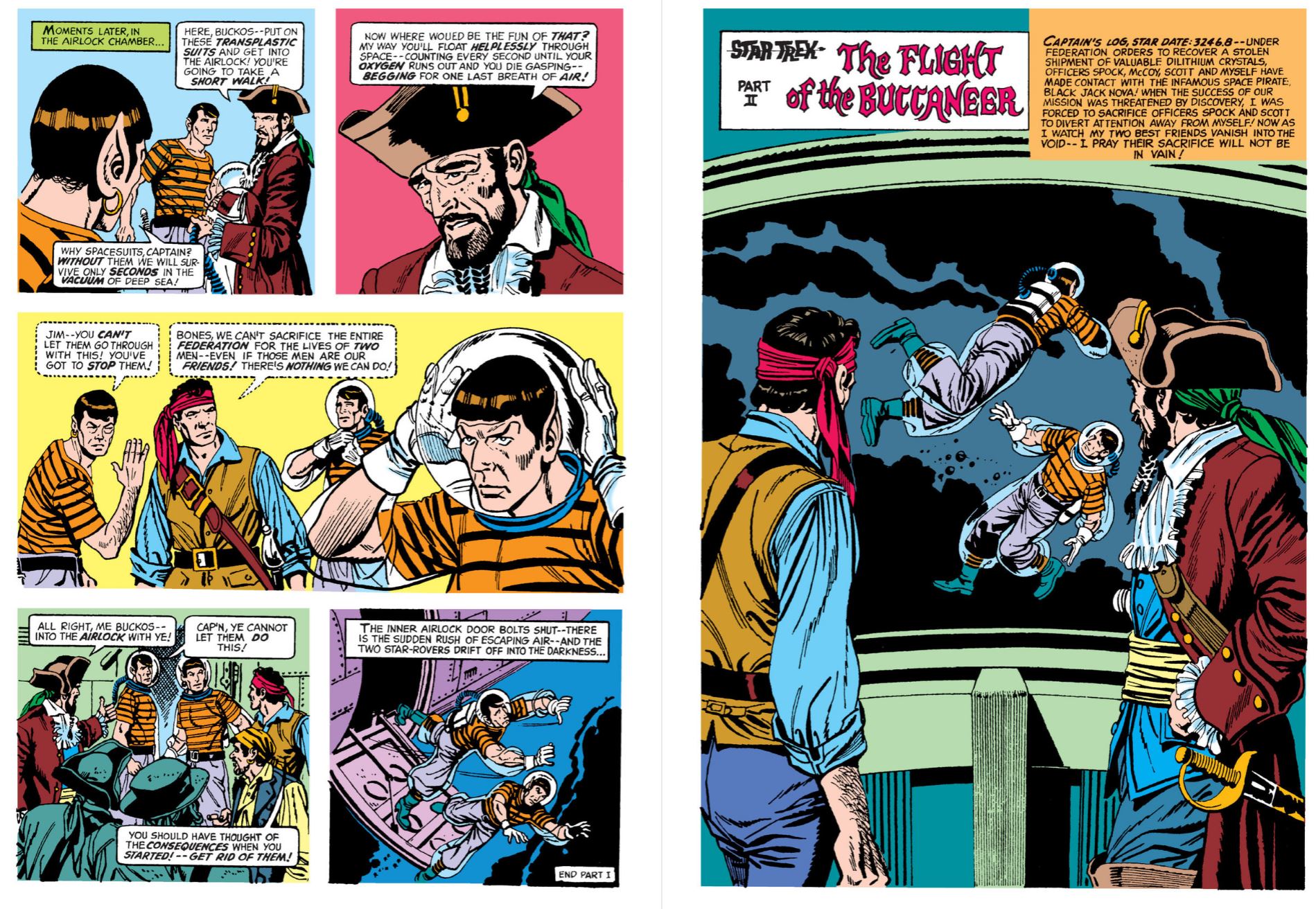
Closing this bombastic treasure-trove is ‘The Flight of the Buccaneer’ (#12, November 1971) with Kirk, McCoy, Scott & Spock ordered undercover to infiltrate a nest of interstellar pirates and recover Star Fleet’s stolen store of Dilithium crystals in a fast-paced, all-guns-blazing romp referencing and homaging Treasure Island…
Packed with photo-covers, promotional photos and a complete Cover Gallery this is another fabulously enticing, expansive and epic compendium of thrills: truly engaging stories to delight young and old alike and well worthy of your rapt attentions.
® and © 2014 CBS Studios, Inc. Star Trek and related marks are trademarks of CBS Studios, Inc. All Rights Reserved.