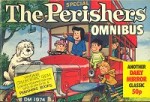
The Perishers Omnibus book 1


By Maurice Dodd & Dennis Collins (Daily Mirror Books)
ISBN: 0-85939-031-4

Although written almost entirely by Maurice Dodd throughout its 48 year history, the National Treasure that is (Are? Am?) The Perishers was actually created in 1957 by artist Dennis Collins, writer Bill Witham (who went on to huge success with the innocent everyman Useless Eustace) and cartoon editor Bill Herbert. The daily exploits of a bunch of typical kids was first published in the Manchester edition of the Daily Mirror in February 1958 but after only a couple of frankly mediocre months the wacky adventures of Maisie and Marlon were withdrawn and retooled.

Jack-of-all-trades, budding artist and advertising whiz-kid Dodd was approached by ex-paratroop service comrade and drinking buddy Herbert and promptly jumped at the chance to reinvent the characters in what was a meandering but beautifully illustrated all-ages feature simply stuffed with untapped potential.

Drawing on his own life (he would describe it as shamelessly pilfering) Dodd created a plethora of new characters, animal and human – although with this strip the distinctions are loose and hard to defend – and rescued an early 1958 casualty in the unkempt and ill-maintained person of laconic orphan and philosophical dilettante Wellington: a street urchin who lived on his wits but still attended school and endured all the daily trials and indignities of British youth.

Relaunched in October 1959 in the London and national editions, the revamped strip quickly caught on and became a morning mainstay for generations of Britons, blending slapstick and surreal comedy with naive charm, miniaturised modern romantic melodramas (Maisie loves Marlon, Marlon loves fashion and “inventing” and Wellington loves sausages), liberally laced with sardonic cultural commentary – especially a wonderfully twisted faux misperception of contemporary politics and the burgeoning advertising and commercial media.

Even in its earliest days the strip was superbly illustrated, conjuring up in a few judicious lines and cannily applied tones a communal urban wonderland we all knew as kids: a familiar post-war wonderland of shops and streets, building sites and overpasses, alleys and parks and fields where we could get on with our adventures and no adults could interfere or spoil the fun.

The major protagonists of the series are Wellington and Boot, his old English Sheepdog (sort of: the wily, hairy chancer and raconteur considers himself a Manorial Milord sufferin’ under the curse of a Gypsy wench). They are ably unsupported by the formidable Maisie, a thoroughly modern miss torn between her passion for the boy of her dreams, sweets, and unrelenting violence and the aforementioned Marlon himself. Cool, suave and debonair are just three of the words he doesn’t know the meaning of, but lots of the girls at school fancy him anyway. If he grows up he wants to be a brain surgeon or a bloke wot goes down sewers in great big gumboots…

Being on his own Wellington takes every opportunity to support himself with sordid scavenging and shoddy schemes –usually involving selling poorly constructed carts and buggies to Marlon who far more money than sense: to be honest Marlon has more noses than sense… Maisie is a shy beautiful maiden waiting for true beloved to sweep her off her feet – and if he doesn’t she gives him a thorough bashing up and nicks his sweets…

Other unreasonable regulars introduced here include Baby Grumplin’ – Maisie’s toddler brother and a diabolical force of nature, Plain Jane – a girl who asks too many questions and the dapper Fiscal Yere, smugly complacent go-getting son of a millionaire and another occasional sucker for Wellington’s automotive inexpertise.

On the anthropomorphic animal front the extremely erudite Boot regularly encounters stroppy ducks, militant squirrels, socialist revolutionary Fred the Beetle and his long-suffering wife Ethel, Asiatic bloodhound journalist B.H. Calcutta (Failed) and latterly, a nicotine-addicted caterpillar who stunted his growth and became Fred’s inseparable comrade in the struggle against canine oppression but implacable rival for any food or dog-ends the Bolshevistic bugs might find…

Every day notable events in this madcap melange include Wellington gentrifying out of the large concrete pipe that he used to live in to take up residence in an old railway station abandoned after the Beeching Cuts decimated the train infrastructure and the first couple of kids-only, unaccompanied camping holidays to the seaside (such innocent times) to encounter sun, surf and the rock-pool crabs who worshipped the uncannily canine “Eyeballs in the Sky” which annually manifest in their isolated “Pooliverse”…

Utterly English, fabulously fantastical and resoundingly working-class, the strip generated 30 collections between 1963 -1990, 4 Big Little Books, 5 novels and 2 annuals as well as an audio record and an immensely successful animated TV series.

The tome under review here was released in 1974; the first of a series of extra-sized recapitulations, and containing most of the contents of the first four Perishers collections (covering 1959-1965) and superbly sets the scene for newcomers with a glorious extravaganza of enchanting fun and frolics, liberally annotated by Dodd himself.

Dennis Collins magnificently and hilariously illustrated the feature until his retirement in 1983, after which Dodd himself took up the pens and brushes. Eventually artist Bill Melvin took over the art chores whilst Dodd scripted until his until death in 2006. Once the backlog of material was exhausted The Perishers finished on June 10th 2006.

Last year The Mirror began reprinting classic sequences of the strip to the general approval of everyone, so perhaps it’s not too much to hope that eventually all the classic collections will once more be freshly available to one and all…
© 1974 IPC Newspapers Limited.

The Pin-up Art of Humorama


By various, edited by Alex Chun & designed by Jacob Covey (Fantagraphics Books)
ISBN: 978-1-56097-959-3

You’ve all done it; laughed at something you know you shouldn’t have and for us utterly reconstructed modern men – and, let’s face it, women too – sometimes a sexually, racially or otherwise politically incorrect joke or scene in an old movie or TV clip. You know it’s wrong, you know it’s wicked but dammit! – funny just is…

Once upon a time when we were all trapped in our cruel and unthinking hidebound world of stereotypes and pre-judgements, there was a thriving market for staggeringly coy smutty books, naughty cartoon joke periodicals and girly magazines for men.

Women read other things and we never enquired. It’s the only sensible example of “Don’t Ask, Don’t Tell” that I can think of…

After volumes of Pin-ups from specific comics stars (Dan DeCarlo, Bill Wenzell, Jack Cole, Bill Ward) this anthology celebration gathers the Rest of the Best from the prolific Humorama pulp-digest division. They provided saucy gags and male-oriented mirth from 1938 to the mid 1980s – when hardcore porn ended all the tamer men’s mag markets – ubiquitous little throwaway digests with titles such as Gaze, Jest, Stare, Joker, Zip, Breezy, Cartoon Comedy Parade and Romp, packed with photos of saucy vixens like Tina Louise, Sophia Loren, Betty Page, Irish (Sheena of the Jungle) McCalla, Julie (Catwoman) Newmar and her cheesecake ilk – and oodles of deliciously daring cartoons.

The company was part of the Goodman publishing empire which included Atlas/Marvel Comics and reached its pulchritudinous peak during the 1950s when Editor Abe Goodman was the biggest buyer of cartoons on Earth.

Once the sexual revolution began, however, the oddly innocent, clandestine “men only” craft atmosphere was lost to increasing in-your-face frankness and a steady decline into vulgar X-rated smut as good old-fashioned raciness and stolen illicit glimpses became the meat of TV and cinema.

After an illustrated foreword by Howard Chaykin and a comprehensive history from Editor Alex Chun the parade of risqué gags – populated by the kind of girls that made Mad Men such a hit and Marilyn Monroe immortal – works its wiles, stretches its intellects and stuns its willing prey in a glorious panoply of old-fashioned fun and frolics. These racy renditions are superbly rendered in colour, monochrome and all points in between – ink and wash, conté-crayon, pen and even photo-montages, and this tome even finds space to squeeze in a few amazing house ads.

From amongst the memorable proponents you’ve already heard of are gags by Ward, Wenzell, Jefferson MacHamer, Dan DeCarlo, Vic Martin, Kurt Schaffenberger (AKA Schaff), Louis Priscilla, Niso “Kremos” Ramponi, Bill Hoest, George Crenshaw, Michael Berry, Stan Goldberg, Jim Mooney, Dave Berg and Basil Wolverton, but there are so many others by unsung pencil-pushers equally deserving of your attention.

This charmingly innocent compendium of Lush Ladies, Willing Wantons, Savvy Sirens, Naive Nymphs (always stunningly beautiful women) collects more than 200 or so rude cartoons from a time when boys thought girls didn’t actually like sex – when in fact they just didn’t like us or the way we did it.

Technically, this isn’t a graphic novel or trade collection, it’s a picture book – but an absolutely stunning one, collecting some of the best and most guiltily funny illustrations ever produced: a beguiling remembrance of a different time and the sexual mores of an entirely alien generation which nevertheless presents an enticing, intoxicating treat for art lovers and, I’m afraid to admit, many hearty laughs. This is work which is still utterly addictive and the book is an honest-to-gosh treasure beyond compare.

© 2011 Fantagraphics Books. Foreword © 2011 Howard Chaykin. Introduction © 2011 Alex Chun. All rights reserved.

The Beast is Dead: World War II Among the Animals


By Edmond-François Calvo, Victor Dancette & Jacques Zimmerman (Abi Melzer Productions)
No ISBN:

In Acknowledgement of the upcoming Comics in Conflict event at the Imperial War Museum this weekend – see our Noticeboard for details – I’m going to be reviewing a few intriguing and hopefully pertinent classics beginning with this tragically neglected cartoon masterpiece…

As the European phase of World War II staggered to its bloody and inevitable conclusion, the enslaved nations began to reclaim their homelands and various national prides in a glorious wave of liberation. All over the Old World long suppressed stories and accounts, true or otherwise, began to be shared. During France’s occupation publishing was strictly controlled – even comics – but the Nazis couldn’t suppress creative spirit and many conquered citizens resisted in the only ways they safely could.

For sculptor, artist, caricaturist and social satirist Edmond-François Calvo (26/8/1892-11/10/1958) that was by drawing. Watched by his adoring apprentice-artist Albert (Asterix) Uderzo and inspired by the Gallic graphic giant Daumier, the venerable creator of such joyous anthropomorphic classics as ‘Patamousse’, ‘Anatomies Atomiques’, ‘Les Aventures de Rosalie’, ‘Monsieur Royal Présente’, ‘Grandeur et Décadente du Royaume des Bêtes’ and ‘Cricri, Souris d’Appartement’ worked quietly and determinedly on his own devastating war-effort secret weapon.

He latterly specialised in sparkling, socially aware and beautiful family-friendly strips such as ‘Moustache et Trottinette’, ‘Femmes d’Aujourd’hui’, ‘Coquin le Petit Cocker’ and a host of fairytale adaptations for Tintin, Baby Journal, Cricri Journal, Coq Hardi, Bravo!, Pierrot Âmes Vaillantes and Coeurs Vaillants.

Beginning as a caricaturist for Le Canard Enchaîné in 1938 Calvo eventually moved into strip stories, but also had to moonlight with “real” jobs such as woodcarver and innkeeper. By the time France fell to the Germans in June 1940 he was working for Offenstadt/S.P.E. press group, contributing ‘Le Chevalier Chantecler’, ‘D’Artagnan’, ‘Les Grandes Aventures’, ‘Robin des Bois’, ‘Les Voyages de Gulliver’ and the initial three chapters of ‘Patamouche’ to Fillette, L’Épatant, L’As and Junior plus ‘La Croisière Fantastique’, ‘Croquemulot’ and ‘Un Chasseur Sachant Chasser’ to Éditions Sépia.

Most of this material was produced under the stern scrutiny of the all-conquering censors – much like his comics contemporary Hergé in Belgium – but Calvo also found time to produce something far less anodyne or safe.

With both Editor Victor Dancette and writer Jacques Zimmermann providing scripts, and beginning as early as 1941, Calvo began translating the history of the conflict into a staggeringly beautiful and passionately vehement dark fable, outlining the betrayal of the European nations by literal Wolves in the Fold.

After years of patient creation – and presumably limited dissemination amongst trusted confreres – the first part of La Bete est Mort!When the beast is raging’ was published in 1944, followed a year later with the concluding When the animal is struck down’. Both were colossal hits even before the war ended and the volumes were continually reprinted until 1948 when the public clearly decided to move on with their lives…

The story is related in epic full-page painted spreads and captivating, luscious strip instalments and the smooth, slick glamour of Disney’s production style was co-opted to deliver the list of outrages to be addressed and a warning to the future, with each nation being categorised by a national totem.

The French were rabbits, the Italians hyenas and the Japanese monkeys. Britain was populated by bulldogs, Belgium by lions, Russia by polar bears and America by vast herds of buffalo…

Hitler’s inner circle of monsters got special attention: such as Goering the Pig and Himmler the Skunk, but so did the good guys: General de Gaulle was depicted as a magnificent Stork…

A fiercely unrepentant but compellingly lovely polemic by a bloody but unbowed winning side, The Beast is Dead was forgotten until republished in 1977 by Futuropolis. This particular English-language, oversized (225 x 300mm or 9 inches x 12) hardback edition was released in 1985 and includes the introduction from a Dutch edition; a dedication from Uderzo and a monochrome selection of Calvo’s wartime and post-war cartoons.

Magnificent, compelling radiant, hugely influential (without this there would never have been Maus), astoundingly affecting and just plain gorgeous, this modern horror tale of organised inhumanity is out of print but still available if you look hard and since an animated film adaptation was begun in 2005, hopefully there’s a new edition in the works too.
© 1944-1945 Éditions G.P. © 1977 Éditions Futuropolis. © 1984 Abi Melzer Productions.

Setting the Standard: Comics by Alex Toth 1952-1954


By Alex Toth, Mike Peppe & various (Fantagraphics Books)
ISBN: 978-1-60699-408-5

Alex Toth was a master of graphic communication who shaped two different art-forms and is largely unknown in both of them.

Born in New York in 1928, the son of Hungarian immigrants with a dynamic interest in the arts, Toth was something of a prodigy and after enrolling in the High School of Industrial Arts doggedly went about improving his skills as a cartoonist. His earliest dreams were of a strip like Milton Caniff’s Terry and the Pirates, but his uncompromising devotion to the highest standards soon soured him on newspaper strip work when he discovered how hidebound and innovation-resistant the family-values based industry had become whilst he was growing up.

At age 15 he sold his first comicbook works to Heroic Comics and after graduating in 1947 worked for All American/National Periodical Publications (who would amalgamate and evolve into DC Comics) on Dr. Mid-Nite, All Star Comics, the Atom, Green Lantern, Johnny Thunder, Sierra Smith, Johnny Peril, Danger Trail and a host of other features. On the way he dabbled with newspaper strips (see Casey Ruggles: the Hard Times of Pancho and Pecos) and found nothing had changed…

Continually trying to improve his own work he never had time for fools or formula-hungry editors who wouldn’t take artistic risks. In 1952 Toth quit DC to work for “Thrilling” Pulps publisher Ned Pines who was retooling his prolific Better/Nedor/Pines comics companies (Thrilling Comics, Fighting Yank, Doc Strange, Black Terror and many more) into Standard Comics: a comics house targeting older readers with sophisticated, genre-based titles.

Beside fellow graphic masters Nick Cardy, Mike Sekowsky, Art Saaf, John Celardo, George Tuska, Ross Andru and Mike Esposito and particularly favourite inker Mike Peppe, Toth set the bar high for a new kind of story-telling: wry, restrained and thoroughly mature; in short-lived titles dedicated to War, Crime, Horror, Science Fiction and especially Romance.

After Simon and Kirby invented love comics, Standard, through artists like Cardy and Toth and writers like the amazing and unsung Kim Aamodt, polished and honed the genre, regularly turning out clever, witty, evocative and yet tasteful melodramas and heart-tuggers both men and women could enjoy.

Before going into the military, where he still found time to create a strip (Jon Fury for the US army’s Tokyo Quartermaster newspaper The Depot’s Diary) he illustrated 60 glorious tales for Standard; as well as a few pieces for EC and others. On his return to a different industry – and one he didn’t much like – Toth split his time between Western/Dell/Gold Key (Zorro and many movie/TV adaptations) and National (assorted short pieces, Hot Wheels and Eclipso): doing work he increasingly found uninspired, moribund and creatively cowardly. Soon he moved primarily into TV animation, designing for shows such as Space Ghost, Herculoids, Birdman, Shazzan!, Scooby-Doo, Where Are You? and Super Friends among many others.

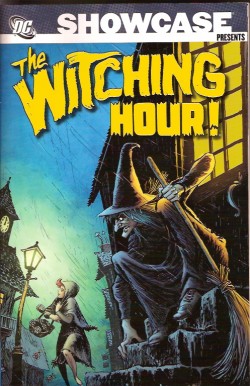
He returned sporadically to comics, setting the style and tone for DC’s late 1960’s horror line in House of Mystery, House of Secrets and especially The Witching Hour and illustrating more adult fare for Warren’s Creepy, Eerie and The Rook. He redesigned The Fox for Red Circle/Archie, produced stunning one-offs for Archie Goodwin’s Batman or war comics (whenever they offered him a “good script”) and contributed to landmark or anniversary projects such as Batman: Black and White.

His later, personal works included Torpedo and the magnificently audacious Bravo for Adventure!

Alex Toth died of a heart attack at his drawing board on May 27th 2006.

After reprinting an extensive interview with the artist from Graphic Story Magazine conducted by Vincent Davis, Richard Kyle and Bill Spicer in 1968, this fabulous full colour chronicle reprints every scrap of Toth’s superb Standard fare beginning with impressive melodrama in ‘My Stolen Kisses’ from Best Romance #5 (February 1952), after which light-hearted combat star Joe Yank nearly lost everything toBlack Market Mary’ in the debut issue of his own title (#5 March 1952).

Perhaps a word of explanation is warranted here: due to truly Byzantine commercial considerations all Standard Comics started with issue #5, although the incredibly successful Romance comics were carried over from their earlier Better Comics incarnations such as New Romances #10 (March 1952) for which Toth illustrated the touching ‘Be Mine Alone’ or the parable of empty jealousy ‘My Empty Promise’ from #11.

The hilarious ‘Bacon and Bullets’ offered a different kind of love in Joe Yank #6 (May) – a very pretty pig named Clementine – after which witty 3 pager ‘Appointment with Love’ (Today’s Romance #6 May) provides a charming palate cleanser before the hard-bitten ‘Terror of the Tank Men’ from Battlefront #5 (June 1952) offers a more traditional view of the then raging Korean War.

‘Shattered Dream!’ (My Real Love #5 June) is an ordinary romance well told whilst ‘The Blood Money of Galloping Chad Burgess’ (The Unseen #5 June 1952) reveals the sheer quality of Standard’s horror stories and ‘The Shoremouth Horror’ (Out of the Shadows #5) that same month proved Toth to be an absolute master of terror.

‘Show Them How to Die’ (This is War #5 July) is a superbly gung-ho combat classic whilst the eerie ‘Murder Mansion’ and ‘The Phantom Hounds of Castle Eyne’ both from Adventures into Darkness #5 (August) once more demonstrate the artist’s uncanny flair for building suspense.

The single page ‘Peg Powler’ (The Unseen #6 September) is reprinted beside the original artwork – which makes me wish the entire collection was available in black and white – after which the experimental ‘Five State Police Alarm’ (Crime Files #5) displays the artist’s amazing facility with duo-tone and craft-tint techniques before the salutary ‘I Married in Haste’ (Intimate Love #19, September) takes a remarkably modern view of relationships.

Science Fiction was the metier of Fantastic Worlds #5 which provided both the contemporary ‘Triumph over Terror’ and futuristic fable ‘The Invaders’ to finish off Toth’s September chores after which ‘Routine Patrol’ and ‘Too Many Cooks’ offered two-fisted thrills from This is War #6 (October).

‘The Phantom Ship’ is a much reprinted classic chiller from Out of the Shadows #6 and October also offered the extremely unsettling ‘Alice in Terrorland’ in Lost Worlds #5. Toth only produced four covers for Standard, and the first two, Joe Yank #8 and Fantastic Worlds #6 precede ‘The Boy who Saved the World’ from the latter (November 1952) after which service rivalry informed ‘The Egg-Beater’ from Jet Fighters #5.

The cover of Lost Worlds #6 (December) perfectly introduces the featured ‘Outlaws of Space’ after which the single-page ‘Smart Talk’ (New Romance #14) perfectly closes the first year and sets up 1953 which opens strongly with ‘Blinded by Love’ from Popular Romance #22 January) in which the classic love triangle has never looked better…

This was clearly Toth’s ideal year as ‘The Crushed Gardenia’ from Who is Next? #5 shows his incredible skills to their utmost in one of the best crime stories of all time. ‘Undecided Heart’ (Intimate Love #21 February) is a delightful comedy of errors whilst both ‘The House That Jackdaw Built’ and ‘The Twisted Hands’ from Adventures into Darkness #8 perfectly reveal the artist’s uncanny facility for building tension and anxiety.

The cover to Joe Yank #10 is followed by the splendid aviation yarn ‘Seeley’s Saucer’ from the March Jet Fighters (#7) whilst the clever and racy ‘Free My Heart’ from Popular Romance #23 (April) adds new depth to the term sophisticated and ‘The Hands of Don José’ (Adventures into Darkness #9) is just plain nasty in the manner horror fans adore…

‘No Retreat’ (This is War #9 May) offers more patriotic combat, but ‘I Want Him Back’ (Intimate Love #22) depicts a far softer and more personal duel and ‘Geronimo Joe’ (Exciting War #8 May) proves that in combat there’s no room for rivalry.

Toth was rapidly reaching the peak of his design genius as ‘Man of My Heart’ (New Romances #16 June), ‘I Fooled My Heart’ (Popular Romance #24 July, and reprinted in full as original art in the notes section) and both ‘Stars in my Eyes’ and ‘Uncertain Heart’ from New Romances #17 (August) saw him develop a visual vocabulary that cleanly imparted plot and characterisation simultaneously.

He often stated that he preferred these mature and well-written romance stories for the room they gave him to experiment and expand his craft and these later efforts prove him right: especially in the moving ‘Heart Divided’ (Thrilling Romances #22) and compelling ‘I Need You’ from the September Popular Romances (#25).

‘The Corpse That Lived’ was a historically based tale of grave-robbing from Out of the Shadows #10, whilst the deeply affecting ‘Chance for Happiness’ (Thrilling Romances #23 October) is as powerful today as it ever was. ‘My Dream is You!’ (New Romances #18) offered a fresh look at the old dilemma of career or husband whilst a far darker love was displayed in ‘Grip on Life’ (The Unseen #12 November), but true love actually triumphed in ‘Guilty Heart’ from Popular Romance #26.

Another ‘Smart Talk’ advice page ends 1953 (New Romances #19 December) and neatly precedes an edgy affair in ‘Ring on Her Finger’ (Thrilling Romances #24 January 1954), after which ‘Frankly Speaking’ from the same issue leads to a terrifying historical horror in ‘The Mask of Graffenwehr’ (Out of the Shadows #11).

February produced a fine crop of Toth tales beginning with charming medical drama ‘Heartbreak Moon’ (Popular Romance #27), spooky mining mystery ‘The Hole of Hell’ (The Unseen #13), one-page amorous advisory ‘Long on Love’ (Popular Romance #27), the lesson in obsession ‘Lonesome for Kisses’ and two further advice pages ‘If You’re New in Town’ and ‘Those Drug Store Romeos’ all from Intimate Love #26.

These last stories were eked out in the months after Toth had left, drafted and posted to Japan. However, even though he had presumably rushed them out whilst preparing for the biggest change in his young life there was no loss but a further jump in artistic quality.

One final relationship ‘Smart Talk’ page (New Romances #20 March 1954) precedes a brace of classic mystery masterpieces from Out of the Shadows #12: ‘The Man Who Was Always on Time’ (also reproduced in original art form in the ‘Notes’ section at the back of this book) and the graphic wonderment regrettably concludes with the cynically spooky ‘Images of Sand’ – a sinister cautionary tale of tomb-robbing…

After all this the last 28 pages of this compendium comprise a thorough and informative section of story annotations, illustrations and a wealth of original art reproductions to top off this sublime collection in perfect style.

Alex Toth was a tale-teller and a master of erudite refinement, his avowed mission to pare away every unnecessary line and element in life and in work. His dream was to make perfect graphic stories. He was eternally searching for “how to tell a story, to the exclusion of all else.”

This long-awaited collection shows how talent, imagination and dedication to that ideal can elevate even the most genre-locked episode into a masterpiece the form and a comicbook into art.

All stories in this book are in the public domain but the specific restored images and design are © 2011 Fantagraphics Books. Notes are © 2011 Greg Sadowski and the Graphic Story Magazine interview is © 2011 Bill Spicer. All rights reserved.

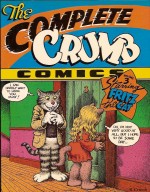
The Complete Crumb Comics volume 13: the Season of the Snoid


By Robert Crumb and others (Fantagraphics Books)
ISBN: 978-1-56097-296-9

Like crisps, chocolate and bad puns; once you get the taste of Robert Crumb on your palate, it’s almost impossible to shift the craving for more. Here’s another re-released edition from the superb and multi-award winning Complete Crumb Comics series that will tickle the bad-taste-buds of discerning comics cognoscenti and is bound to make a whole new generation of fans among the cool kids who will take my usual disclaimer in the full spirit which it is intended.

This book contains really clever and outrageously dirty pictures, rude words, non-condemnatory drug references and allusions, godless questioning of authority and brilliantly illustrated. highly moving personal accounts and opinions. If you – or those legally responsible for you – have a problem with that, please skip this review and don’t buy the book. That will certainly teach us…

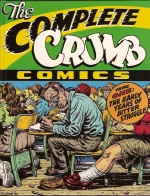
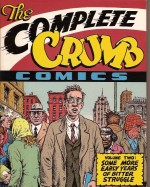
Robert Crumb is a unique creative force in the world of comics and cartooning with as many detractors as devotees. His uncompromising, excoriating, neurotic introspections, his pictorial rants and invectives, unceasingly picked away at societal scabs and peeked behind forbidden curtains for his own benefit, but he has always happily shared his unwholesome discoveries with anybody who takes the time to look… In 1987 Fantagraphics Books began the nigh-impossible task of collating, collecting and publishing the chronological totality of the artist’s vast output and those mesmeric volumes are now being reissued.

The son of a career soldier, Robert Dennis Crumb was born in Philadelphia in 1943, into a functionally broken family. He was one of five kids who all found different ways to escape their parents’ highly volatile problems and comic strips were paramount among them.

As had his older brother Charles, Robert immersed himself in the comics and cartoons of the day; not just reading but creating his own. Harvey Kurtzman, Carl Barks and John Stanley were particularly influential, but also strip artists such as E.C. Segar, Gene Ahern, Rube Goldberg, Bud (Mutt and Jeff) Fisher, Billy (Barney Google), De Beck, George (Sad Sack) Baker and Sidney (The Gumps) Smith as well as illustrators like C.E. Brock and the wildly imaginative and surreal 1930’s Looney Tunes and Merrie Melodies animated shorts.

Defensive and introspective, young Robert pursued art and self-control through religion with equal desperation. His early spiritual repression and flagrant, hubristic celibacy warred with his body’s growing needs…

Escaping his stormy early life, he married young and began working in-house at the American Greeting Cards Company. He discovered like minds in the growing counterculture movement and discovered LSD. In 1967 Crumb relocated to California and became an early star of Underground Commix. As such he found plenty of willing hippie chicks to assuage his fevered mind and hormonal body whilst reinventing the very nature of cartooning with such creations as Mr. Natural, Fritz the Cat, Devil Girl and a host of others.

He worked on in what was essentially a creative utopia throughout the early 1970’s but the alternative lifestyle of the Underground was already dying. Soon it would disappear: dissipated, disillusioned, dropped back “in” or demised. A few truly dedicated publishers and artists stayed the course, publishing on a far more businesslike footing as Crumb carried on creating, splitting his time between personal material and commercial art projects whilst incessantly probing deeper into his turbulent inner world.

After an introduction from his brother Maxon Crumb, this re-issued 13th tome opens with ‘Treasure Island Days’ an autobiographical junket of the young Crumb boys from Lemme Outa Here in 1978, produced in collaboration with brother Charles, after which come the nigh-legendary pieces produced for CoEvolution Quarterly #23-26 in 1979-1980, still powerfully impressive after all these years.

The gently biting ‘A Short History of America’, the subversively salacious ‘Bearzie Wearzies’ as well as the stunning black, white and yellow covers to #24, the wildly manic ‘Bop It Out’ (with a canny cameo from the amazing “No-Shit Sherlock”) and the gloriously dry and acerbic fable ‘Adventures of Onionhead’, is followed by the first of a clutch of fabulous American Splendor collaborations with uniquely Ordinary Hero Harvey Pekar in ‘Excerpt’ (from Cleveland Magazine 1980). ‘Me and My Sweetie’ (Portfolio of Underground Art) and the superbly expressionistic cover to Tele Times (vol. 2 #21) end the initial black and white section of the book.

The middle section is full colour and comprises covers and album art; beginning with Bizarre Sex, #8, American Splendor #24 and Snoid Comics, before presenting the rarer (for comics readers at least) material: Blind Boy Fuller: Truckin’ My Blues Away, Banana in Your Fruit Basket, Cheap Suit Serenaders (Crumb’s own Swing nostalgia band), Cheap Suit Party Record, Memphis Jug Band, Yazoo’s History of Jazz, Wild Family Orchestra, a selection of record labels designed by Crumb and Eddie Lange: Jazz Guitar Virtuoso. In addition to these magical concoctions there are also four superb pages of Heroes of the Blues Trading Cards and an Early Jazz Greats poster ad.

The comics section resumes with Crumb’s crudest, most abrasive, confrontational and possibly most cathartic creation: an arrogant, abusive, sex-crazed little homunculus called Mr. Snoid.

Unpleasant and usually unwelcome, Snoid was utterly self-obsessed; a rampaging animate artistic impulse which nevertheless managed to sway or bully those around him into complying with whatever gratuitous flight of the Id he might contemplate or require instant gratification for…

Always his own harshest critic and ever-searching for artistic perfection, it was still hard for even his biggest fans to look at Crumb-the-creator in the same way after the Snoid hit town.

The character debuted in 1980 in – what else – Snoid Comics , grabbing the spotlight from panel one of ‘This Cartooning is Tricky Business’ before declaring his unpleasant manifesto and attitude on everything from art to women in ‘The Snoid Goes Bohemian.’ The most unsavoury origin in comics followed in ‘How Snoids are Born’ after which ‘One Foot to Heaven’ finds the little stinker looking for a little action and ‘Mr. Snoid Among His Fellow Humans’ gives a final insight into his obscenely unique philosophy of life.

As liberating, challenging and guiltily, wrongly funny as Snoid was, his creation – or perhaps escape – certainly reinvigorated Crumb creative juices, both as auteur and artistic collaborator.

‘Freddy Visits for the Weekend’ and the two strips that comprise ‘Vox Populi’ (drawn for Harvey Pekar’s American Splendor #5) resonate with new vehemence and understated tension, whilst the illustrations for Michael Bloomfield’s ‘Me and Big Joe’ from High Times #64 sparkle with affection and warmth.

‘Hospital Fun’ #1-2, scripted by Pekar, first appeared in Village Voice #25, after which Crumb’s next breakthrough series began in Zap #10, 1982, as the introspective, retrospective autobiographical ‘My Troubles With Women’ shockingly and hilariously opened more doors into Crumb’s troubled soul for us all to peer uncomfortably at…

This incautiously appealing edition ends with a selection of covers, ads and illustrations by Crumb from the ecologically proactive (we would now call it “Green”) Californian magazine Winds of Change (volume 2, #1-9 from 1980-1981) and includes articles by wife Aline Kominsky-Crumb and five of their collaborative strips ‘Everyday Funnies’ before this 13th chronicle closes with a typically effective (unpublished) book cover for ‘King of the Freaks’.

None of these collections is free of potentially offensive material and Crumb’s work is riddled with his often hard-to-embrace obsessive self-exploratory concerns. As always his work gouges out the creator’s most intimate and disturbing idiosyncrasies about women, sex, racial stereotypes, unchecked social change and a million other daily beefs and niggles. But there’s no disparagement intended or harm meant – except perhaps to himself – and his staggering honesty, incisive inquisitiveness and neurotic, intimate over-sharing is always leavened with a devastatingly ironic wit and rendered in imagery too powerful to ignore. Be warned but please don’t misunderstand what you’re looking at…

Crumb’s sublime cartooning has brought cachet and serious critical thought to our once ghettoised art form and, love or loathe him, no one can diminish his contribution to the broad world of graphic narrative. These superb books are the perfect introduction to any (definitively over 18) newcomers unaware of grown up comics… so if you are intrigued snatch up this book and all the others as soon as conceivably possible…

All material from American Splendor © 1980, 1998 Harvey Pekar & R.Crumb. All other material © 1976, 1978, 1979, 1980, 1981, 1998, 2011 R. Crumb. All rights reserved.

The Complete Crumb Comics volume 15: Featuring Mode O’Day and Her Pals


By Robert Crumb and others (Fantagraphics Books)
ISBN: 978-1-56097-413-0

Robert Crumb is a unique creative force in the world of comics and cartooning with as many foes as fans, but his idiosyncratic, unflinching, uncompromising, controversial and always bewitching work is impossible to ignore.

Therefore if intemperate language, putative blasphemy, artfully grotesque cartoon nudity, fetishism and comedic fornication are liable to upset you, stop reading this review and don’t buy the book. Stop reading now, check out an old, archived review instead or just come back tomorrow…

In 1987 Fantagraphics began the almost impossible task of collating, collecting and publishing the chronological totality of the artist’s output.

Son of a career soldier, Robert Dennis Crumb was born in Philadelphia in 1943 to a large and troubled family. After a tempestuous early life, he began working as an in-house art-drone at the American Greeting Cards Company and trading card giant Topps Publishing, married early and briefly before “dropping out” and joining the Counterculture movement, where he changed the nature of cartooning with such creations as Mr. Natural, Fritz the Cat, Devil Girl and a host of others.

Within a decade the explosively reactive underground movement was gone; dissipated, disillusioned, dropped back “in” or dead, with only a few notable independent and truly dedicated publishers staying the course. Always his own harshest critic and ever-searching for artistic perfection, in 1981 Crumb convinced Ron Turner of Last Gasp to publish a new anthology of underground/alternative/cutting edge commix in a new anthology.

Weirdo – with Crumb as editor and major contributor until 1983 when he handed over the editor’s role to his “discovery” Peter Bagge (who provides a fascinating introduction and overview for the tome under review here) – was, for many of us, the last bastion of a real gone world.

With the onus of deadlines and responsibility of magazine production removed Crumb resumed his quixotic search for artistic satisfaction…

Recently re-released, this 15th softcover volume (originally published in 2001) collects Crumb’s comic strips from Weirdo #9-15, assorted gags, private commissions, freelance illustration work, album covers and other pictorial ephemera plus strips from American Splendor and Zap Comix, covering the hedonistic, greed-soaked early 1980s which were such a painful anathema to someone of the Artist’s socialist/liberal leanings.

After Bagge’s aforementioned text recollections the graphic magic begins with the Crumb contributions in Weirdo #9 (Winter 1983-1984), a stunning and meticulous frontispiece, ‘Arline ‘n’ Bob and that Thing in the Back Bedroom’ – an autobiographical account of the “joys” of parenthood crafted in collaboration with second wife Aline Kominsky-Crumb plus the first snide and sardonic appearance of Reagan-era, appalling and avaricious anti-icon ‘Mode O’Day and Her Pals’ in a barbed observation of fame-hungry wannabes and the pathetic, empty gullibility of the nouveau-riche.

More of Mode (dabbling with the chic of being a benefactor and coffee-magnate of the so-troubled Nicaraguans) and nothing else appeared in Weirdo #10 in Summer 1984 whilst #11 featured a stark and salutary updating of an old favourite in ‘Goldilocks and the Three Bears’ and a magical selection of single panel cartoons declaring ‘Love’s Like That!’

Mode stalked and blagged her way into the good graces of an ugly plutocrat with her usual lack of success or happiness in #12, but Weirdo #13 (Summer 1985) was given over to Crumb’s stunning ‘Psychopathia Sexualis’ wherein the case histories of a number of “deviants” were brought to incredible grimy, sordid, evocative life as Crumb sampled the truly bizarre nature of humanity described by giant of psychology Richard Freiherr von KrafftEbing.

Issue #14 featured the far lighter and whimsically bombastic anti-pop (or is it simply anti-maximum decibels?) inquiry ‘Where Has It Gone, All the Beautiful Music of Our Grandparents?’ and the marvellously introspective yet light ‘Life Certainly Is Existential!’, whilst #15 opened with the surreal domesticity of ‘Comics from Other Planets Dept’, slipped comfortably into two pages of splendid ‘Gags’ and closed with a captivating ad parody.

The covers of Weirdo #9-15 (including a heartfelt ‘Parting Shot‘ at Ayn Rand), lead off the expansive central, full-colour section, which continues with record and book covers for The Klezmorim’s Streets of Gold, The Otis Brothers, Charles Bukowski’s Bring Me Your Love and There’s No Business Like Show Business, novel covers Texas Crude and The Monkey Wrench Gang; a Louis Bluie poster plus incidental illustrations and sticker art.

Back in black and white there’s a page of miscellaneous ads and illustrations from 1983, after which ‘Hypothetical Quandry’ (written by Harvey Pekar for his magnificent American Splendor on-going graphic autobiography: issue #9, if you’re keeping count) appears, showcasing Crumb’s far bolder and more liberated big-black-brush art style.

Crumb’s long creative association with author Charles Bukowski produced phenomenal results, and here, after a portrait of the writer and promotional art, follows a sequence of illustrations from Bring Me Your Love and There’s No Business Like Show Business, as well as Ken Weaver’s Texas Crude. More miscellaneous illustration art for Pepper & Stern Rare Books, The Magazine, Co-Education Quarterly and seven pages of vignettes and cameos from The Monkey Wrench Gang round out this section.

‘Constipated Chaos Consortium’ is a mind-bending jam-collaboration with fellow underground luminaries Spain Rodriguez, Bosirus Eerie, Victor Moscoso, S. Clay Wilson and Robert Williams and the first of three contributions to Zap #11 from 1985: the other two being ‘Jesus People USA’ (a hypothetical interview between a fundamentalist Christian reporter and ‘R. Crumb, Underground Pornographer and All-Around Lost Soul’) and the powerful and engaging biography of lost Blues legend (Charley) ‘Patton’.

This sublime – and key – transitional tome in the development of one of the art form’s greatest living proponents concludes with another section of miscellaneous illustrations including collaborations with wife and daughter Aline and Sophie and a poster with Dan O’Neill, Victor Moscoso and Bob Crabb.

As always this varied and impressive selection of Crumb’s craft is riddled with his often hard-to-embrace themes and emblematic declamatory and potentially offensive visual vocabulary: as always the work touches on the creator’s most intimate and disturbing idiosyncrasies regarding sex and women, both in the unsettling Abstract and the painful, side-splitting, lustful, painful and loving Concrete and, as always, the reader’s response can only be Love or Loathe…

Crumb’s subtle mastery of his art-form and obsessive need to reveal his most hidden depths and every perceived defect – in himself and the world around him – has always been a unquenchable wellspring of challenging comedy and riotous rumination. This superb series charting the perplexing pen-and-ink pilgrim’s progress is the perfect vehicle to introduce any (definitively over 18) newcomers of your acquaintance to the world of grown up comics. And if you need a way in yourself, snatch up this book and the other sixteen as soon as conceivably possible…

All material © 2011 R. Crumb and its respective owners or co-owners. All other material © 1978, 1979, 1981, 1982, 1983, 1984, 1985, 2001, 2011 R. Crumb. All rights reserved.

Willie and Joe: Back Home


By Bill Mauldin (Fantagraphics Books)
ISBN: 978-1-60699-351-4

Throughout World War II William Henry “Bill” Mauldin fought “Over There” with the United States Infantry whilst producing cartoons about the fighting men and for the fighting men. He told as much of the real nature of the war as his censors and common sense would allow and became an unwilling international celebrity as much because of his unshakable honesty as his incredible artistic talent.

He was in controvertibly one of the guys and American soldiers and civilians loved him for it. During his time in the service he produced cartoons for the folks back home and intimately effective, authentic and quirkily morale-boosting material for military publications 45th Division News, Yank and Stars and Stripes.

They mostly featured two slovenly “dogfaces” – a term he made his own and introduced to the world at large – giving a trenchant and acerbically enduring view of the war from the point of view of the poor sods ducking bullets in muddy foxholes and surviving shelling in the ruins of Europe.

Willie and Joe, to the dismay of much of the Army Establishment, gave an honest overview of America’s ground war. In 1945 a collection of his drawings, accompanied by a powerfully understated and heartfelt documentary essay, was published by Henry Holt and Co. Up Front was a sensation, telling the American public about the experiences of their sons, brothers, fathers and husbands in a way no historian would or did. A biography, Back Home, followed in 1947.

Willie even made the cover of Time magazine in 1945, when 23 year old Mauldin won his first Pulitzer Prize. Like so many other returning soldiers, however, Mauldin’s hard-won Better Tomorrow didn’t live up to its promise…

Mauldin’s anti-war, anti-Idiots-in-Charge, anti-bigot views never changed but found simply new targets at home. However, during the earliest days of the Cold War and despite being a bone fide War Hero, Mauldin’s politically strident cartoons fell ever more out of step with the New America: a place where political expediency allowed racists to resume repressing ethnic sections of the nation now that their blood and sweat were no longer needed to defeat the Axis; a nation where women were expected to surrender their war-time freedoms and independences and become again servants and baby machines, happy to cook suppers in return for the new labour-saving consumer goods America now needed to sell, sell, sell: a nation far too eager to forget the actual war and genuine soldiers in favour of massaged messages and conformist, inspirational paper or celluloid heroes.

The New America certainly didn’t want anybody rocking their shiny new boat…

When Sergeant Bill Mauldin mustered out in 1945 he was notionally on top of the world: celebrity hero, youngest Pulitzer Prize winner in history, with a lucrative 3-year syndicated newspaper contract and Hollywood clamouring for him.

Unfortunately, the artist was as dedicated to his ideals as to his art. As soon as he became aware of the iniquities of the post-war world he went after them, using his newspaper cartoon as a soapbox, Mauldin attacked in bitterly brilliant barrages the maltreatment and sidelining of actual soldiers (during the country’s entire involvement in WWII less than 10% of military men actually fought, or even left their home country) whilst rear-echelon brass seemed to increasingly reap the benefits and unearned glory of the peace.

The ordinary enlisted men and veterans were culture-shocked, traumatised, out of place and resented by the public who blamed them disproportionately for the shortages and “suffering” they had endured. Black and Japanese Americans were reduced to second class citizens and America’s erstwhile allies demonised, whilst everywhere politicians and demagogues were rewriting recent history for their own advantage… His fondest wish had been to kill the iconic dogfaces off on the final day of World War II, but Stars and Stripes vetoed it, and the demobbed survivors moved into a world that had changed incomprehensibly in their absence…

Always ready for a fight, Mauldin’s peacetime Willie and Joe became a noose around the syndicate’s neck as the cartoonist’s acerbic, polemical and decidedly non-anodyne observations perpetually highlighted the iniquities and stupidities inflicted on returning servicemen, attacked self-aggrandising politicians, advocated such socialist horrors as free speech, civil rights and unionisation, affordable public housing and universal medical care for everybody – no matter what their colour, gender or religion. He even declared war on the Ku Klux Klan, American Legion and red-baiting House UnAmerican Activities Commission: nobody was too big. When the Soviet Union and United Nations betrayed their own ideological principles Mauldin went after them too…

An honest broker he had tried to quit early, but the syndicate held him to his contract. Trapped in a situation that increasingly stifled his creative urges and muzzled his liberal/libertarian sensibilities, he refused to toe the line and his cartoons were incessantly altered and reworked. During six years of War service his cartoon had been censored three times; now the white paint and scissors were employed by rewrite boys almost daily…

The movie Up front – which Mauldin wanted to reflect the true experience of the war – languished unmade for six years until a sappy flimsy comedy bearing the name was released in 1951. The intended screenplay by Mauldin, John Lardner and Ring Lardner Jr., disappeared, deemed utterly unsuitable and unfilmable until much of its tone reappeared in Lardner Jr.’s 1970 screenplay M*A*S*H…

As the syndicate bled clients, mostly in segregationist states, and contemplated terminating his contract, Mauldin began simultaneously working for the New York Herald-Tribune and with a new liberal outlet changed his tactics in the Willie and Joe feature: becoming more subtle and less bombastic. He still picked up the best of enemies however, adding J. Edgar Hoover and the FBI to the roster of declaimers and decriers…

When his contract finally ended in 1948, neither side wanted to renew. Mauldin left the business to become a journalist, freelance writer and illustrator. He was a film actor for awhile (appearing in Red Badge of Courage with Audie Murphy among other movies), a war correspondent during the Korean Conflict and an unsuccessful candidate for Congress in 1956.

He only finally returned to newspaper cartooning in 1958 in a far different world and worked for the St. Louis Post-Dispatch before moving to the Chicago Sun-Times, winning another Pulitzer and a Reuben Award for his political cartoons

He retired in 1991 after a long, glittering and properly- appreciated career. He only drew Willie and Joe four times in that entire period (for an article on the “New Army” in Life magazine; for the funerals of “Soldier’s Generals” Omar Bradley and George C. Marshall and to eulogize Milton Caniff).

This magnificent hardback companion volume to Willie and Joe: the WWII Years covers the period of work from July 31st 1945 to 31st December 1948, supplemented by a brilliant biographical introduction from Todd DePastino: a superb black and white compendium collecting the bittersweet return of the forgotten heroes as they faced confusion, exclusion, contention and disillusion: but always with the edgy, stoic humour under fire that was Mauldin’s stock in trade.

Moreover it features some of the most powerful assaults on the appalling edifice of post-war America ever seen. The artist’s castigating observations on how a society treats returning soldiers are as pertinent now as they ever were; the pressures on families and children even more so; whilst his exposure of armchair strategists, politicians and businessmen seeking to exploit wars for gain and how quickly allies can become enemies are tragically more relevant than any rational person could wish.

Alternating trenchant cynicism, moral outrage, gallows humour, sanguine observation and uncomprehending betrayal, this cartoon chronicle is an astounding personal testament that shows the powers of cartoons to convey emotion if not sway opinion.

With Willie & Joe: the WWII Years, we have here a magnificent example of passion and creativity used as a weapon of social change and a work of art every citizen should be exposed to, because these are aspects of humanity that we seem unable to outgrow…

This edition © 2011 Fantagraphics Books. Cartoons © 2011 the Estate of William Mauldin. All right reserved.

Willie and Joe: the WWII Years


By Bill Mauldin, edited by Todd DePastino (Fantagraphics Books)
ISBN: 978-1-60699-439-9

During World War II a talented, ambitious young man named William Henry “Bill” Mauldin (29/10/1921 – 22/01/2003) fought “Over There” with the 45th Division of the United States Infantry as well as many other fine units of the army. He learned to hate war and love his brother soldiers – and the American fighting man loved him back. During his time in the service he produced civilian cartoons for the Oklahoma City Times and The Oklahoman, and intimately effective and authentic material for his Company periodical, 45th Division News, as well as Yank and Stars and Stripes; the US Armed Forces newspapers. Soon after, his cartoons were being reproduced in newspapers across Europe and America.

They mostly featured two slovenly “dogfaces” – a term he popularised – giving a trenchant and laconic view of the war from the muddied tip of the sharpest of Sharp Ends. Willie and Joe, much to the dismay of the brassbound, spit-and-polish military martinets and diplomatic doctrinaires, became the unshakable, everlasting image of the American soldier: continually revealed in all ways and manners the upper echelons of the army would prefer remained top secret.

Willie and Joe even became the subject of two films (Up Front -1951 and Back at the Front – 1952) whilst Willie made the cover of Time magazine in 1945, when 23 year old Mauldin won his first Pulitzer Prize.

In 1945 a collection of his drawings, accompanied by a powerfully understated and heartfelt documentary essay, was published by Henry Holt and Co. Up Front was a sensation, telling the American public about the experiences of their sons, brothers, fathers and husbands in a way no historian would or did. A biography, Back Home, followed in 1947.

Mauldin’s anti-war, anti-Idiots-in-Charge-of-War views became increasingly unpopular during the Cold War and despite being a War Hero Mauldin’s increasingly political cartoon work fell out of favour (those efforts are the subject of forthcoming companion volume Willie & Joe: Back Home).  Mauldin left the business to become a journalist and illustrator.

He was a film actor for awhile (appearing in Red Badge of Courage with Audie Murphy among other movies), a war correspondent during the Korean War and, after an unsuccessful campaign for Congress in 1956, finally returned to newspaper cartooning in 1958.

He retired in 1991 after a long, glittering and award-studded career. He only drew Willie and Joe four times in that entire period (for an article on the “New Army” in Life magazine; for the funerals of “Soldier’s Generals” Omar Bradley and George C. Marshall; and to eulogize Milton Caniff). His fondest wish had been to kill the iconic dogfaces off on the final day of World War II, but Stars and Stripes vetoed it.

The Willie and Joe cartoons and characters are some of the most enduring and honest symbols of all military history. Every Veterans Day in Peanuts from1969 to 1999, fellow veteran Charles Schulz had Snoopy turn up at Mauldin’s house to drink Root Beers and tell war stories with an old pal. When you read Sgt. Rock you’re looking at Mauldin’s legacy, and Archie Goodwin drafted the shabby professionals for a couple of classy guest-shots in Star-Spangled War Stories (see Showcase Presents the Unknown Soldier).

This immense mostly monochrome (with some some very rare colour and sepia items) softcover compendium – 704 pages, 229 x 178mm – collects all his known wartime cartoons originally released in two hardback editions in 2008, featuring not only the iconic dog-face duo, but also the drawings, illustrations, sketches and gags that led, over 8 years of army life, to their creation.

Mauldin produced most of his work for Regimental and Company newspapers whilst under fire: perfectly capturing the life and context of fellow soldiers – also under battlefield conditions – and gave a glimpse of that unique and bizarre existence to their families and civilians at large, despite constant military censorship and even face-to-face confrontations with Generals such as George Patton, who was perennially incensed at the image the cartoonist presented to the world. Fortunately Supreme Commander Eisenhower, if not a fan, knew the strategic and morale value of Mauldin’s Star Spangled Banter and Up Front feature with the indomitable everymen Willie and Joe…

This far removed in time, many of the pieces here might need historical context for modern readers and such is comprehensively provided by the notes section to the rear of the volume. Also included are unpublished pieces and pages, early cartoon works, and rare notes, drafts and sketches.

Most strips, composites and full-page gags, however are sublimely transparent in their message and meaning: lampooning entrenched stupidity and cupidity, administrative inefficiency and sheer military bloody-mindedness whilst highlighting the miraculous perseverance and unquenchable determination of the ordinary guys to get the job done while defending their only inalienable right – to gripe and goof off whenever the brass weren’t around… Moreover Mauldin never patronises the civilians or demonises the enemy: the German and Italians are usually in the same dismal boat are “Our Boys” and only the war and its brass-bound conductors are worthy of his inky ire…

Alternating trenchant cynicism, moral outrage, gallows humour, absurdist observation, shared miseries, staggering sentimentality and the total shock and awe of still being alive every morning, this cartoon catalogue of the Last Just War is a truly breathtaking collection that no fan, art-lover, historian or humanitarian can afford to miss.

…And it will make you cry and laugh out loud too.

With a fascinating biography of Mauldin that is as compelling as his art, the mordant wit and desperate camaraderie of his work is more important than ever in an age where increasingly cold and distant brass-hats and politicians send ever-more innocent lambs to further foreign fields for slaughter. With this volume and the aforementioned Willie & Joe: Back Home, we should finally be able to restore the man and his works to the forefront of graphic consciousness, because tragically, his message is never going to be out of date…

© 2011 the Estate of William Mauldin. All right reserved.

Drought Chic – a Dry Analysis of the Water Shortage


By Shary Flenniken (Shary Flenniken)
No ISBN

I’m feeling nostalgic, thirsty and in need of a laugh all at once so here’s an intriguing self-published gem from the mid-1970s whose theme and subject matter seems to be coming back into vogue as the days seep by…

Do you remember that sweet pretty girl you admired and day-dreamed about from afar? All glowing soft focus summer afternoons and sherbet refreshers, scents of new-mown hay, tinkly bells and soaring strings? And after a lifetime you found the courage to talk to her and she swore like a trooper, cackled like a loon, pulled your hair and was all loud and boisterous and not at all serious and girly and your heart broke just a little?

Shary Flenniken’s sense of humour is like that. With her affable, underplayed, deceptively simple line drawing style (so devastating effective in the glorious Girl and her Talking Dog strip Trots and Bonnie) everything looks clean and sugary and chocolate-coated, but then you realise there’s a devastatingly sharp mind and a tungsten-tipped razor-edged scalpel sense of humour at play as you’re hit with a really spiky and heavy giant pink boxing glove…

Flenniken is a scripter/artist/editor/illustrator/screenwriter of enormous talent who contributed to and edited the funniest years of National Lampoon, has published her own books – such as the slim gem under review today – and has illustrated some of the funniest books even written by other people, with titles such as When a Man Loves a Walnut, Blood-Lust Chickens & Renegade Sheep and Nice Guys Sleep Alone.

She started out as an underground cartoonist in 1971 with the fabulously notorious Air Pirates Collective (the other bold cartoonists taking on Disney whilst preserving the classic heritage of past cartoon masters and waving the flag for free speech and the Right to Parody and Satirise were Dan O’Neill, Bobby London, Gary Hallgren and Ted Richards).

Her own drawing style is often likened to pioneering strip artists Clare Briggs (When a Feller Needs a Friend!!, Danny Dreamer, The Days of Real Sport, Mr. and Mrs, Real Folks at Home, Someone’s Always Taking the Joy Out of Life) and the laconically mordant master Harold Tucker Webster (Our Boyhood Ambitions, How to Torture Your Wife, Life’s Darkest Moment, How to Torture Your Husband and the legendary Caspar Milquetoast/The Timid Soul) – especially in the long-running(1971-1990) and aforementioned sardonic comedy masterpiece Trots and Bonnie which I simply must get around to…

In recent years Flenniken has edited Seattle Laughs: Comic Stories about Seattle and worked for DC’s Paradox Press and Mad, freelanced in Premiere, Details and The American Lawyer whilst winning critical acclaim for her adaptations of the works of Mark Twain, O. Henry and others.

Drought Chic was self-published in 1977, and this tiny tidal wave of crafty cartoons and satisfyingly salty asides resulted from close observation and experience of the global heat-wave (can you remember that Long Hot Summer of Punk in the UK?) and the perennial water paucity of America’s West Coast; extrapolating on the sage advice offered by those in power as the country all-too briefly saw the (fashionably faddy) sense in dabbling with water discipline.

Suggestions to the trend-setters of society riffed-on here include “share baths and showers”, “don’t flush toilets”, “import icebergs”, “replant your lawn with cactus” and “drink something else”… directives I’m fairly sure we’ll all be considering again in the months and years ahead.

Of course here in Britain we’ve already taken the most effective step to conserve water consumption by selling off the water utility, privatising a natural resource and pricing it out of the reach of ordinary folk…

Still, if you’re saving a little time and money as a new member of the Great Unwashed at least you can spend your grubby free hours seeking out this wry, dry and slyly sophisticated soupcon of delightful disinformation.
© 1977 Shary Flenniken. All rights reserved.

Roy Crane’s Captain Easy, Soldier of Fortune: The Complete Sunday Newspaper Strips volume 2 1936-1937


By Roy Crane (Fantagraphics Books)
ISBN: 978-1-60699-391-0

The comics industry evolved from newspaper strips and these circulation boosting pictorial features were, until relatively recently, utterly ubiquitous, hugely popular with the public and thus regarded as invaluable by publishers who used them as an irresistible sales weapon to guarantee consumer loyalty, increase sales and  ensure profits. Many a scribbler became a millionaire thanks to their ability to draw pictures and spin a yarn…

It’s virtually impossible for us to today to understand the overwhelming power of the comic strip in America (and the wider world) from the Great Depression to the end of World War II. With no television, broadcast radio far from universal and movie shows at best a weekly treat for most folk, household entertainment was mostly derived from the comic sections of daily and especially Sunday Newspapers. “The Funnies” were the most common recreation for millions who were well served by a fantastic variety and incredible quality.

From the very start humour was paramount; that’s why we call them “Funnies” or “Comics”, after all. From these gag and stunt beginnings, blending silent movie slapstick, outrageous antics, fabulous fantasy and vaudeville shows, came a thoroughly unique entertainment hybrid: Roy Crane’s Wash Tubbs.

Debuting on April 21st 1924 Washington Tubbs II was a comedic gag-a-day strip not dissimilar from confirmed family favourite Harold Teen (by Crane’s friend and contemporary Carl Ed).

Tubbs was a diminutive, ambitious young shop clerk when the strip began, but gradually he moved into mock-heroics, then through harm-free action into full-blown, light-hearted, rip-roaring adventure series with the introduction of pioneering he-man, moody swashbuckling prototype Captain Easy in the landmark episode for 6th May, 1929.

As the tales became increasingly more exotic and thrill-drenched the globe-trotting little dynamo clearly needed a sidekick who could believably handle the combat side of things, and thus in the middle of a European war Tubbs liberated a mysterious fellow American from a jail cell and history was made. Before long the mismatched pair were inseparable comrades; travelling the world, hunting treasure, fighting thugs and rescuing a bevy of startlingly comely maidens in distress…

The two-fisted, bluff, completely capable and utterly dependable, down-on-his-luck “Southern Gentleman” was something not seen before in comics, a raw, square-jawed hunk played straight rather than the buffoon or music hall foil of such classic serials as Hairsbreadth Harry or Desperate Desmond. Moreover Crane’s seductively simple blend of cartoon exuberance and compelling page-design was a far more accessible and powerful medium for action story-telling than the static illustrative style favoured by artists like Hal Foster (just starting to make waves on the new Tarzan Sunday page).

Tubbs and Easy were as exotic and thrilling as the Ape Man but rattled along like the tempestuous Popeye, full of vim, vigour and vinegar, as attested to by a close look at the early work of the would-be cartoonists who followed the strip with avid intensity: Floyd Gottfredson, Milton Caniff, Jack Kirby, Will Eisner and especially young Joe Shuster…

After a couple of abortive attempts starring his little hero, Crane bowed to the inevitable and created a full colour Sunday page dedicated to his increasingly popular hero-for-hire. Captain Easy debuted on 30th July 1933, in madcap, two-fisted exploits (originally) set before his fateful meeting with Tubbs.

Following a foreword from historian, archival publisher and critic Rick Norwood, ‘Stealing Color From Black and White’ a fascinating extended introduction by award-winning cartoonist Paul Pope and ‘Three Strip Monte’ a brief history of Crane’s career gambles by legendary strip historian Bill Blackbeard, this second volume (of four) really begins with ‘Gold of the Frozen North’ as the dour, sour soldier of fortune reaches the chilly snow-swept mining boom-town of Bugaboo.

Exhausted after his part in the war between Nikkateena and Woopsydasia (as seen in Roy Crane’s Captain Easy, Soldier of Fortune: The Complete Sunday Newspaper Strips volume 1) all Easy wanted was a meal and a bed, but his innate chivalry defending a bar-girl’s honour soon had him on the run from Nikky Eskota, the savage gang-boss who ran the town. He then compound the error by helping beautiful Gizzy escape the brute’s amorous attentions and escorting down the frozen river to trade her fathers’ diamonds.

Of course the wicked thug dispatched an army of heavies to stop them…

This spectacular icy wilderness adventure ran from 8th December 1935 to 19th April 1936, after which ‘The Hook-Nosed Bandit’ (4th April -8th August 1936) found the footloose hero heading to the trouble-soaked nation of Hitaxia where his penchant for trouble soon branded him a wanted criminal fugitive and landed him in the midst of a civil war. As usual a pretty girl was the immediate cause of his many woes and the method of his eventual escape… that and the advent of a bombastic new companion – unconventional millionaire inventor Mr. Belfry.

With Easy and Belfry’s daughter languishing in a Hitaxian jail the sagacious entrepreneur acted to end the crisis in unique manner with a handy shipment of pigs…

When the Belfry’s returned to America, Easy accompanied them only to become embroiled in a whirlwind cops ‘n’ robbers thriller as mobsters and businessmen alike tried to obtain by every means fair and foul ‘The Diamond Formula’ (16th August – 13th December 1936): the inventor’s new process for creating gems from coal or sugar…

After this wild and woolly New York set romp, Crane opted to take the theme into wholly different territory as Easy takes a mild-mannered old daydreamer from Belfry’s Gentleman’s Club on the Screwball comedy of ‘Dinwiddy’s Adventure’ – a fast-paced rollercoaster romp of intrigue, suspense and multiple practical jokes, with a twist and turn on every gloriously rendered page first published between 13th December 1936 and March 14th 1937…

The Club also provided the maguffin for ‘Lost at Sea’ (March 21st – May 9th 1937) as hen-pecked and harassed Benjamin Barton hired the laconic Southern Gentleman to engineer his escape from his ghastly social climbing wife and wastrel children. Barton even left them all his money: the rattled old goof simply wanted peace and quiet and perhaps a little fishing. Despite all Easy’s best efforts he didn’t get it…

Clearly on a roll with the emphasis on comedy Crane then introduced one of his wackiest characters in ‘The King of Kleptomania’ (16th May – November 14th 1937), as an audacious, freeloading, lazy, good-for-nothing hobo actually turned out to be Kron Prinz Hugo Maximillian von Hooten Tooten; the audacious, freeloading, lazy, good-for-nothing spendthrift heir to a European nation who was paid by the Dictator of Kleptomania to stay away and not seek his rightful throne.

Saving the bum’s life in America only caused the lovable leech to attach himself to Easy, but after going through his bi-annual stipend of $25, 000 in mere days “Hoot” decided to welsh on his deal with the despot and take back his country. Against his better judgement and to his lasting regret, Captain Easy goes along for the ride and is soon knee deep in ineptitude, iniquity and revolution…

With the war over Easy is stranded in Ruritanean Europe and stumbles into an espionage plot culminating in a welcome reunion and ‘The Firing Squad’ (21st November 1937 – 15th May 1938). Framed and jailed again Easy is to be shot so it’s luckily that the captain of the aforementioned executioners is his long-lost pal Wash Tubbs!

Risking life and diminutive limb to save his old pal, Wash also rescues sultry spitfire Ruby Dallas who promptly entangles them in her desperate tale of woe. Ruby was unfortunate enough to have witnessed a murder in America and has been on the run ever since. The killer was a prominent millionaire with too much to lose so he’s been hunting her ever since, but once the trio escape murderous cutthroats, slavers and assassins they soon settle his hash…

When he began the Sunday page Crane’s creativity went into overdrive: an entire page and vibrant colours to play with clearly stirred his imagination and the results were wild visual concoctions which achieved a timeless immediacy and made each instalment a unified piece of sequential art. The effect of the pages can be seen in so many comic and strips since – even in the works of such near-contemporaries as Hergé and giants in waiting like Charles Schulz.

These pages were a clearly as much of joy to create as to read. In fact, the cited reason for Crane surrendering the Sunday strip to his assistant Les Turner in 1937 was NEA Syndicate’s abrupt demand that all its strips be henceforward produced in a rigid panel-structure to facilitate them being cut up and re-pasted as local editors dictated. You can actually see the day that happened in this volume.

Whilst the basic drawing of Crane and Turner is practically indistinguishable the moment when the layout and composition were shackled stands out like a painful sore thumb. Crane just walked away from his playground, concentrating on the daily feature, until in 1943, contract expired he left the NEA to create the aviation adventure strip Buz Sawyer.

In this selection Roy Crane’s irrepressible humour comes perfectly into focus and this enchanting serial abounds with breezy light-hearted banter, hilarious situations and outright farce – a sure-fire formula modern cinema directors still plunder to this day.

Easy is Indiana Jones, Flynn (the Librarian) Carsen and Jack (Romancing the Stone) Cotton all at once and clearly set the benchmark for all of them.

This superb hardback and colossal second collection is the perfect means of discovering or rediscovering Crane’s rip-snorting, pulse-pounding, exotically racy adventure trailblazer. The huge pages in this volume (almost 14 ½ by 10½ inches or 21x14cm for the younger, metric crowd) provide the perfect stage to absorb and enjoy the classic tale-telling of a master raconteur.

This is storytelling of impeccable quality: unforgettable, spectacular and utterly irresistible. These tales rank alongside the best of Hergé, Tezuka, Toth and Kirby and unarguably fed the imaginations of them all as he still does for today’s comics creators. Now that you have the chance to experience the strips that inspired the giants of our art form, how can you possibly resist?

Captain Easy strips © 2011 United Feature Syndicate, Inc. This edition © 2011 Fantagraphics Books, all other material © the respective copyright holders. All rights