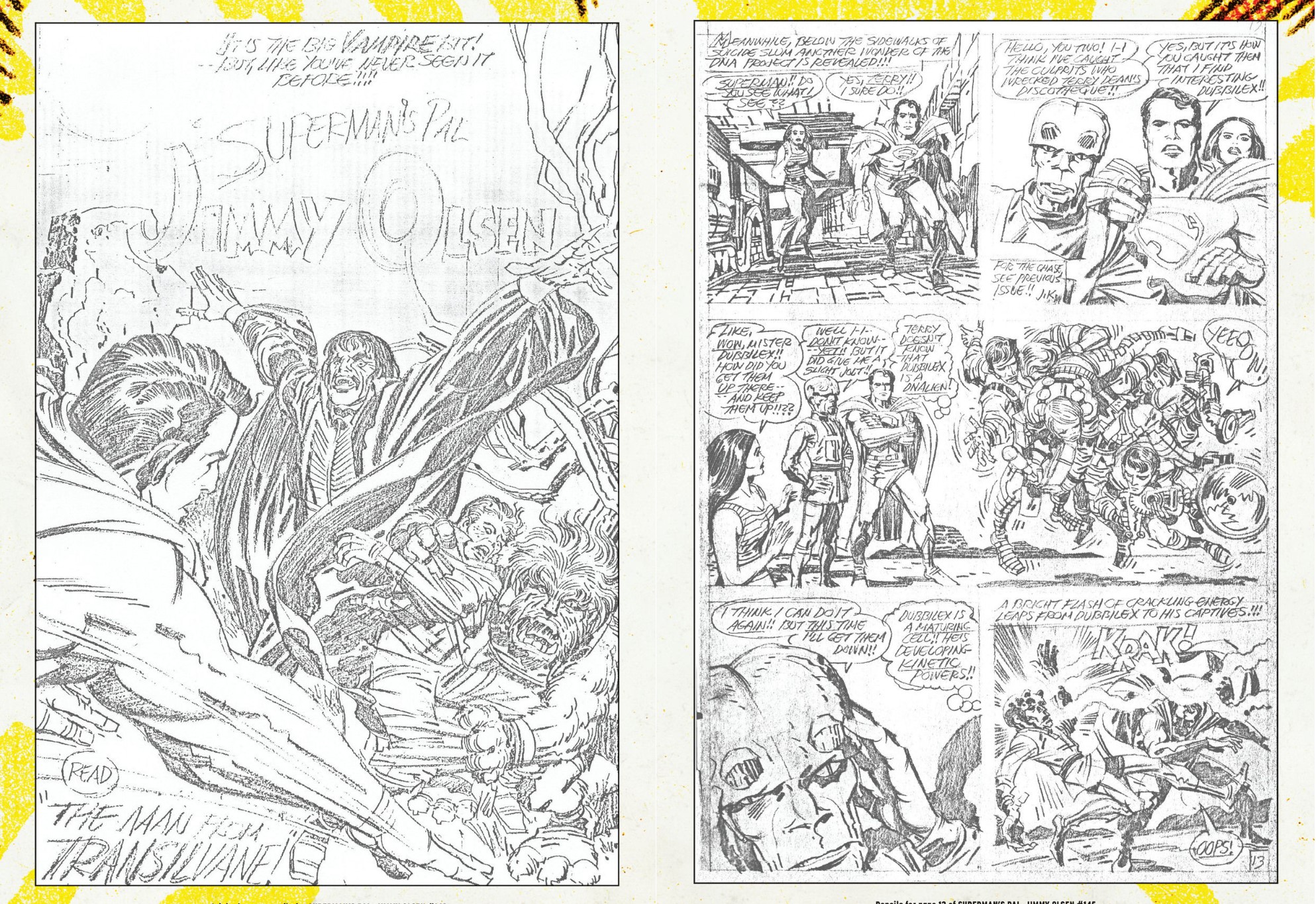
Moomin volume 9 – The Complete Lars Jansson Comic Strip


By Lasse Lars Jansson (Drawn & Quarterly)
ISBN: 978-1-77046-157-4 (HB) eISBN: 978-1-77046-556-5-

Today 25-years ago in Helsinki Lars Fredrik Jansson died. His work and that of his sister lives on.

Tove Jansson was one of the greatest literary innovators and narrative pioneers of the 20th century: equally adept at shaping words and images to create worlds of wonder. She was especially expressive with basic components like pen & ink, manipulating economical lines and patterns into sublime realms of fascination, whilst her dexterity made simple forms into incredibly expressive and potent symbols. So was her brother…

Tove Marika Jansson was born into an artistic, intellectual and rather bohemian Swedish family in Helsinki, Finland on August 9th 1914. Patriarch Viktor was a sculptor and mother Signe Hammarsten-Jansson a successful illustrator, graphic designer and commercial artist. Tove’s brothers Lars AKA “Lasse” and Per Olov became – respectively – an author and cartoonist, and an art photographer. The family and its close intellectual, eccentric circle of friends seems to have been cast rather than born, with a witty play or challenging sitcom as the piece they were all destined to inhabit.

After extensive and intensive study (from 1930-1938 at the University College of Arts, Crafts and Design, Stockholm, Graphic School of the Finnish Academy of Fine Arts and L’Ecole d’Adrien Holy and L’Ecole des Beaux-Arts, Paris), she became a successful exhibiting artist through the troubled years of WWII.

Brilliantly creative across many fields, she published her first Moomins fable in 1945. Småtrollen och den stora översvämningen (The Little Trolls and the Great Flood – latterly and more euphoniously The Moomins and the Great Flood) was a whimsical epic of gentle, inclusive, accepting, understanding, bohemian misfit trolls and their strange friends…

The term “Moomin” came from maternal uncle Einar Hammarsten who tried to stop Tove pilfering food when she visited by warning that a Moomintroll guarded the kitchen, creeping up on trespassers and breathing cold air down their necks… you can check out our other reviews such as Christmas Comes to Moominvalley for how the critter became a mega franchise and proto-mythology. Here and now, let’s discuss how Lars got involved…

More popular with each successive book, global fame loomed. And in 1952 Finn Family Moomintroll/The Happy Moomins was translated into English to great acclaim, prompting British publishing giant Associated Press to commission a daily newspaper strip starring the seductively sweet & sensibly surreal creations. Jansson had no misgivings or prejudices about strip cartoons as she had already adapted Comet in Moominland for Swedish/Finnish paper Ny Tid. Mumintrollet och jordens undergäng/Moomintrolls and the End of the World was hugely popular and she welcomed the chance to extend her eclectic family’s range. In 1953, The London Evening News began the first of 21 Moomin strip sagas which captivated readers of all ages. Tove Jansson’s involvement in the cartoon ended in 1959, a casualty of its own success and the punishing publication schedule. So great was the strain that she had already recruited brother Lars to help. He quietly took over, continuing the feature until its close in 1975. His tenure as sole creator officially began with the sixth collection in this series and reaches its penultimate volume here…

Liberated from cartooning pressures, Tove returned to painting, writing and other pursuits: generating plays, murals, public art, stage designs, costumes for dramas and ballets, a Moomin opera and 9 more Moomin-related picture-books and novels, as well as 13 books and short-story collections strictly for grown-ups. She died on June 27th 2001, with awards too numerous to mention, and her face on the national currency…

Lars Fredrik Jansson (October 8th 1926 – July 31st 2000) was almost as amazing as his sister. Born into that astounding overachieving clan 12 years after Tove, at 16 he started writing – and selling – his own novels (nine in total). He also taught himself English because there weren’t enough Swedish-language translations of books available for his voracious reading appetite. In 1956 at his sister’s request he began co-scripting the Moomin strip: injecting his own witty whimsicality to ‘Moomin Goes Wild West’. He had been Tove’s English language translator and sense-reader from the start, seamlessly converting her Swedish into text and balloons even the British could grasp.

In 1959, when her contract with The London Evening News expired, Lars officially took over, having spent the interim period learning to draw and perfectly mimic his sister’s art style. He had done so in secret, assisted and tutored by their mother Signe Hammarsten-Jansson. From 1961 to strip’s end in 1974, Lars was sole steersman of trollish tabloid tails (I fear that could be much misconstrued these days…).

“Lasse” was a man of many parts. Other careers included aerial photographer, professional gold miner, writer and translator. He was basis and model for ultimate cool kid Snufkin and his Moomins exploits were subtly sharper than his sister’s version: far more in tune with the quirky British sense of humour. Nevertheless, his whimsically wry sense of wonder was every bit as compelling. In 1990, long after the original series, Lasse began a new career, working with Dennis Livson (designer of Finland’s acclaimed Moomin World theme park) as producers of anime series The Moomins and, with daughter Sophia Jansson in 1993, on new Moomin strips…

Moomintrolls are easy-going free spirits: polite modern bohemians untroubled by hidebound domestic mores but under Lars, increasingly diverted and distracted by societal pressures. Moominmama is warm, kindly tolerant and capable, if perhaps overly concerned with propriety and appearances, whilst her devoted spouse Moominpappa spends most of his time trying to rekindle his adventurous youth or dreaming of fantastic journeys. Their darling son Moomintroll is a meek, dreamy boy with confusing ambitions who adores – and moons over – permanent houseguest the Snorkmaiden – although that impressionable, flighty gamin prefers to play things slowly whilst awaiting somebody potentially better…

A particularly acerbic affair, this 9th monochrome compilation revisits serial strip sagas #34-37, and opens with Lars in full charge as confusion blooms with the arrival of cinematic thespians and sundry other playactors all concerned with immortalising a ‘Damsel in Distress’.

Sadly our happy family and most of Moominvalley are utter neophytes regarding the miracles of the moving image and understandable initial confusion soon grows into envy, dangerous jealousy, unleashed ambition and when Moominpappa leaps to a wrong conclusion, frustrated heroism and vigilantism once the old stalwart spots ladies tied to railway tracks and caped mustachio-twirling figures lurking about…

No soon does that furore die down than domestic strife manifests as ‘Fuddler and Married Life’ finds the androgynous collector and equally ambiguous new spouse Jumble exploit everyone’s goodwill and happy wishes to unwisely expand their personal button collection into a rapacious runaway commercial enterprise that soon leaves them homeless and straining the good will of all around them. Luckily, Moominmamma is on hand to take over babysitting chores whilst the drama sorts itself out…

Rampant unchecked capitalism gone mad is also the order (to go) of the day in ‘Sniff’s Sports Shop’ as the exceptionally shy and nervous critter inherits a thriving activities emporium from an uncle whose sole previous contact was a monthly stipend for staying the full length of the valley away from him…

Moomin is there to support Sniff’s crash course in commercial enterprise and unwise quest for a game or endeavour he can take up as his very own, but the escalating chaos inevitably ends in tizzies, higgledy-piggledy behaviours, embarrassment and injury, before the sporting mogul wisely calls it a day…

Concluding proceedings is the sorry salutary saga of ‘Mymble’s Diamond’ wherein the impulsive, impressionable, incurable romantic shows everyone the flashy ring she’s been given by latest flame Rinaldo, and certain tongues begin wagging once again…

Soon the valley is afire with stridently expressed opinions and mounting certainty that “something should be done”, but what and to whom and – for pity’s sake – why?

A cautionary tale exploring the power of gossip and apparently irresistible need for some to judge others, here is a perfect example of cartoons’ power for cultural commentary and social satire, and a splendid place to pause and think quietly for a moment…

This compilation again closes with a closer look at the creator in ‘Lars Jansson: Roll Up Your Sleeves and Get to Work’ courtesy of family biographer Juhani Tolvanen, extolling his many worthy attributes…

These are utterly, adorably barbed tales for the young, laced with the devastating observation and razor-sharp mature wit which enhances and elevates only the greatest kids’ stories into classics of literature. These tomes – both Tove & Lars’ – are an international treasure trove no fan of the medium – or carbon-based lifeform with even a hint of heart and soul – can afford to be without.
© 2013 Solo/Bulls. “Lars Jansson: Roll Up Your Sleeves and Get to Work” © 2011/2013 Juhani Tolvanen. All rights reserved.

Fantastic Four: The Life Fantastic


By J. Michael Straczynski, Karl Kesel, Dwayne McDuffie, Mike McKone, Drew Johnson, Casey Jones, Lee Weeks & various (Marvel)
ISBN: 978-0-7851-1896-1 (TPB/Digital edition)

Today sees the UK general release of the latest cinematic interpretation of the “World’s Greatest Comics Magazine”. Here’s a quirky book you could and should buy online and read in your Imax seat while all those other, lesser trailers waste your time prior to the big event. Thus we prove once again that it’s never too late to catch up to the really good stuff…

The Fantastic Four has long been rightly regarded as the most pivotal series in modern comic book history, responsible for introducing both a new style of storytelling and a radically different manner of engaging the readers’ impassioned attentions. More family than team, the line-up has changed frequently over the years before always eventually and inevitably returning to Stan Lee & Jack Kirby’s original configuration of Mister Fantastic, Invisible Woman, Human Torch and The Thing, who jointly comprised the vanguard of modern four-colour heroic history.

The quartet are maverick supergenius Reed Richards, his wife Susan, their trusty college friend Ben Grimm and Sue’s obnoxious, impetuous younger brother Johnny Storm; survivors of an independent space-shot which went horribly wrong once ferociously mutative Cosmic Rays penetrated their ship’s inadequate shielding. When they crashed back to Earth, the foursome found all been hideously changed into outlandish freaks. Richards’ body became elastic, and Sue gained the power to turn herself and other objects invisible – and latterly form forcefields. Johnny could more-or-less at will turn into self-perpetuating living flame, whilst poor, tormented Ben transformed into a horrifying brute. However, unlike his comrades, Grimm could not return to a semblance of normality on command… or at all…

The sheer simplicity of four B-movie archetypes – mercurial boffin, self-effacing distaff, solid everyman and hot-headed youth – uniting to triumph over accident and adversity shone under Lee’s irreverent humanity, coupled to Kirby’s rampant imagination and tirelessly emphatic sense of adventure.

Decades of erratic quality and floundering plotlines followed the original creators’ departures, but from the beginning of the 21st century Marvel’s First Family experienced a steady and sustained escalation in quality which culminated in repeated film attempts and a string of top-flight, radical reboots in their comic incarnations.

The return to peak quality was the result of sheer hard work by a number of “Big Ideas” writers and this slim compilation – re-presenting Fantastic Four #533-535, and spanning January to April 2006, is one of the best, especially as its content is supplemented and bolstered by a selection of celebratory one-shots -specifically Fantastic Four Wedding Special (January 2006), Fantastic Four Special 2005 and Fantastic Four: A Death in the Family (July 2006). These tales wrapped up a brief but splendidly entertaining tenure in the typist’s chair by comics and screen writer J. Michael Straczynski (Babylon 5, Sense8, Amazing Spider-Man, Superman, Wonder Woman, Before Watchmen, Captain America).

Illustrated by Mike (Amazing Spider-Man, Punisher War Zone, Exiles, assorted X-Men, Justice League International/Justice League of America) McKone – with inkers Andy Lanning, Simon Coleby & Cam Smith – the never-ending excitement and frenetic fun opens with a bombastic 3-part tale offering arguably the ultimate clash between the Thing and The Incredible Hulk… and possibly the funniest yet most heart-rending FF story ever written.

‘What Happens in Vegas, Stays in Vegas’ opens as the Hulk – currently green, governed by Bruce Banner’s intellect and working for S.H.I.E.L.D. – dramatically fails to defuse a gamma bomb and is subsequently caught in the resulting detonation…

Meanwhile in Manhattan, Reed & Sue are facing their greatest battle; attempting to stop civil servant Simone Debouvier of New York’s Division of Child Welfare from placing their children Franklin and Valeria into State custody to protect them from the FF’s life-threatening influence and circumstances. It’s almost a relief for the embattled parents to despatch their boisterous and understandably furious team-mates to Nevada so they can concentrate on navigating the tricky legal maze of the Social Services system…

By the time the Torch & Thing arrive, it’s to their worst nightmare: the gamma blast has seemingly devolved the Hulk’s mind back to his primitive, enraged and devastatingly destructive state and supercharged his body. The heroes are all that stand between the unstable grey juggernaut and the utter destruction of the city…

Utterly overmatched, Ben is pushed to his limits in ‘Shadow Boxing’ the rampaging beast, but even amidst the hurricane of shattering violence, he realises it’s not rage but guilt that’s pushing the uber-Hulk to such brutal excesses, even as back East Reed & Sue take a desperate gamble to keep their family together…

The transcontinental confrontations crash into a pair of stunning victories for heart and brains over brawn in the climactic finale ‘To Be This Monster’

The rest of this sleek celebratory volume concentrates on special editions and follows up with Fantastic Four Wedding Special wherein Karl Kesel, Drew Johnson, Drew Geraci & Drew Hennessy combine to venerate the past and offer tantalising glimpses of things to come as Sue & Reed go for a quiet meal and – thanks to the technological miracle of time travel – discover that every guest is the happy couple themselves, plucked from key moments of their fantastic past and incredible future…

That gloriously heart-warming spectacle is followed by a far more tense but no less intriguing yarn from Fantastic Four Special #1 with Dwayne McDuffie, Casey Jones & Vince Russell depicting ‘My Dinner with Doom’ as Reed opts for fine dining and frank conversation as a way of finally ending the long-standing feud between him and the relentless, duplicitous Iron Dictator. If only Doom was as open-minded about the eventual outcome…

Focus shifts to Johnny for the last epic as Fantastic Four: A Death in the Family (Kesel, Lee Weeks, Rob Campenella & Tom Palmer) sees the frat-boy goof suddenly forced to wise up, man up and make a horrific choice to save his beloved, fractious family from certain doom in another time-travel-tinged tale.

In this story, however, there is no happy ending…

A stellar combination of apocalyptic action, heartbreak, suspense and hilarious low comedy, this exhilarating compilation also includes stunning covers by McKone, Gene Ha, Leinil Yu, Morry Hollowell & Weeks for a warm, fast-paced, tension-soaked Fights ‘n’ Tights chronicle which will provide all the thrills and chills a devoted Costumed Drama lover or freshly-turned film freak could ever want.
© 2005, 2006, 2016 Marvel Characters, Inc. All rights reserved.

Pogo – The Complete Syndicated Comic Strips volume 3: Evidence to the Contrary


By Walt Kelly, edited by Carolyn Kelly & Eric Reynolds (Fantagraphics Books)
ISBN: 978-1-60699-694-2 (HB/Digital edition)

This book includes Discriminatory Content included for comedic and satirical effect.

Today in 1975 the final episode of Pogo was published. Walt’s widow Selby Kelly said it was because newspapers were reducing print size to accommodate more ads but many, Many, Many of us knew it was really because fiction and satire could no longer keep up with reality. now with the burden of hindsight I can safely say “What the $££&%!! did we know?”

Books of this stature, calibre and merit are worth buying and reading at every moment of every day, and rather than waste your valuable time with my purely extraneous blather, you could just hit the shops or online emporia and grab this terrific tome right now. And Stay Tuned, Every time I see the news I resolve to finally finish reviewing these astounding tomes… AND THIS TIME I MEAN IT!

If you still need more though, and aren’t put off by me yet, I’m honoured to elucidate at some length so let’s restart here…

Walter Crawford Kelly Jr. was born in 1913 and began his cartooning career whilst still in High School as artist/reporter for the Bridgeport Post. In 1935 he moved to California and joined the Disney Studio, working on animated short films and such features as Dumbo, Fantasia and Pinocchio. His steady ascent was curtailed by the infamous animator’s strike in 1941. Refusing to take sides, Kelly quit, moving back East and into comic books – primarily for Dell, who held at that time the Disney rights license – amongst many other popular and invaluable properties.

Despite his glorious work on major mass-market, people-based comics classics such as the Our Gang movie serial spin-off, Kelly preferred – and particularly excelled – with anthropomorphic animal and children’s fantasy material.

For the December 1942-released Animal Comics #1 he created Albert the Alligator and Pogo Possum, and wisely retained the copyrights to the ongoing saga of two affable Bayou critters and their young African-American pal Bumbazine. Although the black kid soon disappeared, the animal actors stayed on as stars until 1948 when Kelly moved into journalism, becoming art editor and cartoonist for hard-hitting, left-leaning liberal newspaper The New York Star.

On October 4th 1948, Pogo, Albert and an ever-expanding cast of gloriously addictive, ridiculously exuberant characters began strip careers, appearing in the paper six days a week until the periodical folded in January 1949.

Although ostensibly a gently humorous kids feature, by the end of its NYS run (collected in Pogo: The Complete Syndicated Comic Strips vol. 1), first glimmerings of an astoundingly barbed, boldly satirical masterpiece of velvet-pawed social commentary had begun to emerge.

When the paper folded, Pogo was picked up for mass distribution by the Post-Hall Syndicate, debuting on May 16th 1949 in selected outlets across the nation. The colour Sunday page launched on January 29th 1950 and both were produced simultaneously by Kelly until his death in 1973 and thereafter by his talented wife and family until the feature was at last laid to rest on July 20th 1975. At its height the strip appeared in 500 papers in 14 countries and book collections (which began in 1951) eventually numbered nearly 50; collectively selling over 30 million copies… and all long before this Fantagraphics series even began…

In this third volume of a proposed full dozen reprinting the entire Kelly canon of Okefenokee Swamp’s critter citizenry, undoubtedly our main aspect of interest is the full-on comedic assault against possibly the greatest danger and vilest political demagogue America ever endured (at least in the last century…) but the counterattack against witch-hunter Senator Joe McCarthy is merely one of many delights in this stunning mix of free expression and wild and woolly whimsy…

This colossal and comfortingly sturdy landscape compilation includes monochrome ‘Daily Strips’ from January 1st 1953 to December 31st 1954, and Sundays – in their own full-colour section at the back of the bus book – from January 4th to December 26th of the same years.

Supplemental features this time comprise a Foreword by award-winning cartoonist Mike Peters (Mother Goose & Grimm); a wealth of deliriously winning unpublished illustrations, working drawings by Kelly and utterly invaluable context and historical notes in R.C. Harvey’s ‘Swamp Talk’ appendix. This last also compellingly, almost forensically, details the rise and fall of rabblerousing “red-baiter” Joe McCarthy and how Kelly courageously opened America’s fight back against the unscrupulous, bullying chancer (and the movement for which he was merely a publicity-hungry figurehead. Nope! NOTHING CHANGES) with an unbeatable combination broadside of ridicule and cool disdain…

Mark Evanier’s closing biographical feature ‘About Walt Kelly’ is supplemented by a comprehensive ‘Index of the Strips’ and a gloriously inspired selection of ‘Noteworthy Quotes’ to fill the academic needs of the reader, but of course the greatest boon here is the strips and characters themselves.

Kelly was a masterful inventor of engaging and endearing personalities, all of whom carried as many flaws as virtues. The regular roll call (some commentators reckon to be as many as 1000!) included gentle, perpetually put-upon bemused possum Pogo; boisterous, happily ignorant alligator Albert; dolorous, sensitive Porkypine; obnoxious turtle Churchy La Femme; lugubrious hound Beauregard Bugleboy; carpet-bagging Seminole Sam Fox; pompously ignorant know-it-all Howland Owl; sveltely seductive skunk Miz Mam’selle Hepzibah; long suffering matron Miz Beaver; maternal Miz Groun’chuck and her incomprehensible, bitey baby Grundoon plus all the other bugs, beasts and yapping young’uns of the swamp, but the author’s greatest strength lay in his uniquely Vaudevillian rogues, scoundrels and outright villains.

The likes of Tammanany Tiger, officious Deacon Mushrat, sinister, sycophantic beatnik communist Catbirds Compeer and Confrere, sepulchral Sarcophagus MacAbre, sloganeering P.T. Bridgeport and a trio of brilliantly scene-stealing bats named Bewitched, Bothered and Bemildred were perfect confections to illustrate all manner of pestilential pettifogging, mean manners and venal self-serving atrocities as they intermingled and interfered with the decent folk volubly enduring the vicissitudes of such day-to-day travails as love, marriage, comic books, weather, rival strips, fishing, the problem with kids, the innocent joys of sport, cadging food, making a living and why neighbours shouldn’t eat each other.

You could – and probably should – replace any government anywhere on Earth with them today and nobody would spot a lick of difference…

In this volume topics of exotically extravagant conversation include the longevity and worth of New Year’s Resolutions; the scandalous behaviour of Porkeypine’s kissing-thief Uncle Baldwin; a get-rich scheme involving dirt; and opening shots at the burgeoning phenomenon of commercial television. However, the gradual conversion of the Deacon’s Boy Bird Watchers society into a self-policing vigilante committee looking for strangers and making sure all citizens are right-thinking and proper-looking would quickly insinuate itself into every corner of the feature…

Anti-foreigner sentiments peak following the arrival of Deacon Mushrat’s old pal The Hon. Mole MacCarony; a blind, self-aggrandizing politico determined to root out all (undisclosed) threats, enforce conformity and stamp out the diseases obviously carried by strangers. The xenophobic dirt-digger was based on Nevada Senator Patrick McCarran, who briefly shaped paranoid public opinion on a platform of severely restricting immigration and implementing the speedy deportation of all communists and non-Americans. Clearly and sadly, his poisonous legacy and methodology remains a valuable asset and divine dogma for many politicos and opinion-shapers today…

Things got much darker – and therefore more effectively ludicrous – with the arrival of Mole’s malicious and ambitious associate Simple J. Malarkey – whose bullying tactics soon began to terrify his fellow bigots as much as the increasingly outraged, off-balance citizens. Eventually the villains fall out and trigger their own downfall, with the mortified Deacon sheepishly denying his part in the fiasco. Peace and (in)sanity return and with sunny days ahead weather-prognosticating frog Picayune debuts, only to suffer a great loss when Albert accidentally ingests the amphibian’s pal Halpha – an amoeba who actually did all the meteorological messing about…

Voracious Albert swallowed a lot of things over the years, but his biggest gaffe probably occurs after meeting Roogey Batoon, a pelican impresario who – briefly – “managed” Flim, Flam & Flo: a singing fish act billed as the Lou’siana Perches

Many intriguing individuals shambled into view at this time: Ol’ Mouse and his tutorial pal Snavely (who taught worms how to be cobras and rattlers); cricket-crazed British bugs Reggie and Alf and family icons Bug Daddy and Chile, but the biggest mover and shaker to debut was undoubtedly a sporty Rhode Island Red chicken dubbed Miss Sis Boombah. The formidable biddy is a physically imposing and prodigiously capable sports enthusiast – and Albert’s old football coach – who wanders in as survey taker for Dr. Whimsy’s Report on the Sectional Habits of U.S. Mail Men (a brilliant spoof of societally sensational Kinsey Report on sexual behaviour in America) but her arrival also generates a succession of romantic interludes and debacles which eventually lead to a bewildered Mushrat proposing marriage before leaving her in the lurch and disappearing into the deepest parts of the swamp…

Mole reared his unseeing head again, causing merely minor mischief, but when the marriage-averse Deacon encounters the terrifying Malarkey lurking in hiding with sinister acolyte Indian Charlie (who bears a remarkable resemblance to then US Vice-President Richard Milhouse Nixon) the scene is set for another savage, often genuinely scary confrontation…

That’s also exactly what Miss Boombah has in mind as she sets out – accompanied by Bewitched, Bothered and Bemildred – to hunt down the scoundrel who left her in the lurch at the church…

Other story strands and insane interludes include such epic mini sagas as the search for an abducted puppy – lampooning TV cop series Dragnet – and a long session on the keeping and proper sharing of secrets; much ado about gossip and the art of being a busybody. Most memorable of all though, is Churchy’s sudden predilection for dressing up as a pretty little blonde girl, perpetually visiting Martians, and poor Pogo’s oddly domestic recipe for A-Bombs…

In his time, satirical supremo Kelly unleashed his bestial spokes-cast upon many other innocent, innocuous celebrity sweethearts such as J. Edgar Hoover, the John Birch Society and Ku Klux Clan, as well as lesser leading lights like Hubert Humphrey, Lyndon B. Johnson and – with eerie perspicacity – George W. Romney (U.S. Secretary of Housing and Urban Development, Governor of Michigan and father of a guy named Mitt), but nothing ever compared to his delicious and devilish deconstruction of “Tailgunner Joe” in the two extended sequences reprinted here. Kelly’s unmatched genius lay in his seemingly effortless ability to lyrically, if not vivaciously, portray through anthropomorphic affectation and apparently frivolous nonsense language comedic, tragic, pompous, infinitely sympathetic characters of any shape or breed, all whilst making them undeniably human.

Kelly used that gift to readily blend hard-hitting observation of our crimes, foibles and peccadilloes with rampaging whimsy, poesy and sheer exuberant joie de vivre. However, he usually toned down the satirical scalpels for the magnificently imaginative ‘Sunday Funnies’: concentrating instead on fantastic and unfailingly hilarious serial fables and comedy romps.

Some of the best he ever conceived conclude this volume, beginning with the epic saga of little faun Melonbone whose search for the Fountain of Youth inadvertently causes Sam Duck to revert to an egg. The distraught drake’s wife is not best pleased at having to hatch her own husband out at her age… after all, she’s no spring chicken…

Churchy & Albert endure the ire of sharp toothed tot Grundoon as the kid’s inability to converse leads the alligator to accidentally swallow his turtle pal, after which the animal crackpots all get very lost for a long time in their own swampy backyard…

Howlan Owl’s latest get-rich-quick scheme – digging to China – results in his and Albert’s reluctant consultation of an Atlas and the shocking conclusion that the Russians have taken over Georgia…

The panicked reaction of the chumps precipitates their accidentally awakening an oversleeping bear who opts to celebrate Christmas in the middle of August. Eventually, everybody catches up to him just in time for the true Yule event…

After the usual New Year’s shenanigans, 1954 truly takes hold as everyone’s favourite alligator tries to recount the amazing exploit of ‘King Albert and the 1001 Arabian Knights of the Round Table’ – despite each listener’s evident and express disinterest – before Howlan and Churchy became compulsively embroiled in a furious feud over pugilism. Soon thereafter Albert is mistaken for a monster after getting his head stuck in a cauldron. Sadly, once he’s finally extricated from the calamitous cookpot, other unhappy folk become the infernal alembic’s unwilling method of locomotion…

No sooner does that culinary catastrophe conclude than the whole sorry fiasco promptly kicks off again with a lovesick octopus now playing transient chapeau to a succession of unfortunate and duly startled swamp critters…

The hairy, scaly, feathered, slimy folk of the surreal swamplands are, of course, inescapably us, elevated by burlesque, slapstick, absurdism and all the glorious joys of wordplay from puns to malapropisms to raucous accent humour into a multi-layered hodgepodge of all-ages delight – and we’ve never looked or behaved better. This stuff will certainly make you laugh; it will probably provoke a sentimental tear or ten and will certainly satisfy your every entertainment requirement. Timeless and ineffably magical, Pogo is a giant not simply of comics, but of world literature and this magnificent third tome should be the pride of every home’s bookshelf, right beside the others.

… Or, in the popular campaign parlance of the all politically astute critters – “I Go Pogo!”… and so should you.

Pogo Vol. 3: Evidence to the Contrary and all POGO images, including Walt Kelly’s signature © 2014 Okefenokee Glee & Perloo Inc. All other material © 2014 the respective creator and owner. All rights reserved.

Rails on the Prairie – Lucky Luke Adventure vol. 32 & The Bluefeet are Coming! – Lucky Luke Adventure vol. 43


Lucky Luke volume 25: Rails on the Prairie
By Morris & Goscinny, translated by Jerome Saincantin (Cinebook)
ISBN: 978-1-84918-104-4 (Album PB/Digital edition)

Lucky Luke volume 43 – The Bluefeet are Coming!
By Morris, translated by Jerome Saincantin (Cinebook)
ISBN: 978-1-84918-173-0 (Album PB/Digital editions)

These books include Discriminatory Content produced in less enlightened times.

Today in 2001 we said “adios!” to one of the true masters of our industry and art form. Happily, his legend lives on in the form of his most significant creation.

A precocious, westerns-addicted, art-mad kid, well off and educated by Jesuits, Maurice de Bevere was born on December 1st 1923 in Kortrijk, Belgium. A far from illustrious or noteworthy scholar – except in all the ways teachers despise – Maurice later sought artistic expression in his early working life via forays into film animation before settling into his true vocation. While working at the CBA (Compagnie Belge d’Actualitiés) animation studio, “Morris” met future comics superstars Franquin & Peyo, and worked for weekly magazine Le Moustique as a caricaturist. Morris quickly became one of la Bande des quatre – The Gang of Four – comprising Jijé, Will and old comrade Franquin: leading proponents of a loose, free-wheeling artistic style known as the “Marcinelle School” which dominated Le journal de Spirou in aesthetic contention with the “Ligne Claire” style favoured by Hergé, EP Jacobs and other artists in Le Journal de Tintin.

In 1948, said Gang (all but Will) visited America, befriending many US comics creators and sightseeing. Morris stayed for six years, meeting fellow traveller René Goscinny, scoring some work from newly-formed EC sensation Mad and making copious notes and countless sketches of the swiftly vanishing Old West. That research would resonate on every page of his life’s work.

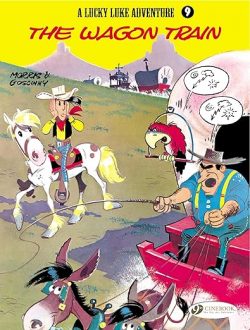
Working solo, albeit with occaisonal script assistance from his brother Louis De Bevere until 1955, Morris produced nine albums of affectionate sagebrush parody and comedic cinematic homage before formally uniting with Goscinny, who became the regular wordsmith as Luke attained the dizzying heights of superstardom, commencing with Des rails sur la Prairie which began in weekly  LJd S on August 25th 1955. The collected album was first released for Christmas in 1957, the ninth in the series, and was follewed by Morris’ final solo tale Alerte aux Pieds Bleus/The Bluefeet are Coming! in 1958.

Lucky Luke Rails on the Prairie

Doughty, rangy, and dashingly dependable Lucky Luke is a likable, imperturbable, implacably even-tempered cowboy do-gooder who can “draw faster than his own shadow”. He amiably ambles around a mythic, cinematically informed Old West, having light-hearted adventures on his petulant, stingingly sarcastic wonder-horse Jolly Jumper. Over nearly nine decades, his exploits in Le Journal de Spirou (and from 1967, in rival periodical Pilote) have made the sharp shooter a legend of stories across all media and monument of merchandising.

His exploits have made him one of the bestselling comic characters in Europe (83 collected albums plus around a dozen spin-offs and specials – totalling over 300 million books in at least 33 languages), with all the spin-off toys, computer games, puzzles, animated cartoons, TV shows and live-action movies that come with that kind of popularity.

The rapid pace and seeming simplicity of these spoof tales means older stories can generally sit quite comfortably alongside newer material crafted for a more modern readership. Here, material from Le Journal de Spirou #906-929 – originally spanning 25th August 1955 to 2nd February 1956 – was collected in November 1957 as ninth album Des rails sur la Prairie: the first epic result of a grand partnership.

Although initially uncredited, it was cowritten by Morris and fellow euro-expat/US tourist Goscinny: auguring an astounding creative partnership to come. Goscinny produced 45 albums with Morris before his death in 1977, from whence Morris continued both singly and with fresh collaborators. Before all that, though, this wild & woolly transitional delight offers a far more boisterous and raw hero than we’re used to, highlighting the sunnier side of a mythic western scenario. Moreover, it ends with the first incidence of Lucky riding into the sunset singing “I’m a poor, lonesome cowboy”…

When track-laying for the Transcontinental Railroad stalls, outraged train moguls demand action. Dead Ox Gulch, Nebraska becomes a crunch point of construction confrontation. Constant hold-ups are actually caused by a traitor at home back East. Although a board-member in good standing, Black Wilson is secretly sabotaging the project to protect his other business: a stage coach company…

He contracts the nefarious Wilson Boys to keep up their bad work, even as a laconic stranger rides into town. Before long, the newcomer is assuredly spearheading the march of progress and civilisation simply by foiling every dirty trick the gang can conceive…

Once renewed efforts have moved beyond town and onto the prairie and the rails inch ever closer to California, a train carries Lucky, passengers and the navvies further westward, negotiating and stymying hostile natives, greedy townships and the still-active Wilson boys’ shady tactics and stratagems.

Ultimately, Black Wilson takes personal charge and boards a stagecoach westward to destiny. Despite his every trick, though, the showdown between spoiler and visionary is a foregone conclusion…

Fast funny, episodic and enthralling, these early exploits are a big old hoot in the tradition of Destry Rides Again or Support Your Local Sheriff, superbly set up and laid out by a master storyteller, and make a wonderful introduction to a unique genre for modern kids who might well have missed the romantic allure of the Wild West that never was.

The Bluefeet are Coming! Lucky Luke volume 43

Au Continent, the populace has a mature relationship with comics, according them academic and scholarly standing as well as nostalgic value and the validation of acceptance as an art form. That even applies to challenging material such as seen in Alerte aux Pieds Bleus: Morris’s final solo effort until Goscinny passing in 1977. A tribute to all the purest western tropes and leitmotifs, it too offers a rowdier, boldly raw hero in transition, just hitting his stride and strutting his stuff, but also relies heavily on the cliches and narrative shortcuts of that earlier era, particularly in the depiction of other cultures and races appearances and customs for comedic intent. I can only apologise for my ancestors and ask that you read with an open mind: after all, Morris was simply exploiting longstanding filmic and comics influences. If I was really desperate, I might also say that his utilsation of comedy in these stereotypes may have helped challenge the status quo…

Lucky Luke debuted in autumn 1946: catapulted sans name or title into rolling gag vignettes in the French edition of multinational publication Le Journal de Spirou, before appearing (with a name) in Christmas Annual L’Almanach Spirou 1947. Then his comic serial ‘Arizona 1880’ opened in the December 7th 1946 comic; and no one has ever looked back…

He first appeared in Britain syndicated to weekly comic Film Fun and again in 1967 in Giggle where he was renamed Buck Bingo. In all these venues – as well as numerous attempts to follow the English-language successes of Tintin and Asterix albums – Luke hung a trademark cigarette insouciantly from his lip, before in 1983 Morris, no doubt amidst pained howls and muted mutterings of “political correctness gone mad” (oooh! That’s what “woke” must mean!!) substituted a strand of straw for the dog-end, which garnered him an official tip of the hat from the World Health Organization…

Morris died in 2001, having drawn 70 Lucky adventures, plus spin-off tales of Rantanplan (“dumbest dog in the West” and a charming spoof of cinema canine Rin-Tin-Tin), with a posse of talented creators taking over the franchise.

The most successful attempt to bring Lucky Luke to our shores and shelves comes from Cinebook (who rightly restored the foul weed to his lips on the interior pages if not the covers), but sensibly took their own sweet time bringing the oldest, most potentially controversial tales to market. As serialised in LJdS #938 – #957, Alerte aux Pieds Bleus is certainly one of those…

A procession of linked gags sees Morris pile on and kick hard familiar themes and scenarios as the town of Rattlesnake Valley welcomes wanderer Lucky. The lone rider is just in time to save super-superstitious sheriff Jerry Grindstone from sneaky gambler and professional cheat Pedro Cucaracha whose plans to fleece the old codger result in his painful and shameful eviction from civilisation. Of course, the scoundrel had tried to rob and blow up the bank on his way out…

Chased into the desert, the scurvy Mexican then gulls the alcoholic Great Chief of the local Bluefeet Indians into laying siege to the town, tempting the old warrior with promises of unlimited booze…

Old Parched Bear is happy to oblige, and soon the town is forming a militia, telegraphing for the cavalry and setting up barricades. As food and water grow scarce profiteering proliferates, with Lucky and Jerry battening down the hatches and bolstering morale for a long and dangerous defence of their lives and loved ones…

Against that framework of classic movie moments there are rich slapstick pickings as spies, crossdressers, raids & counter-raids and devious secret weapons all build to a bombastic finale, with Pedro and Parched Bear attempting all manner of nefarious invention to get respectively vengeance and more “firewater”…

… And then, when it’s almost too late, the Cavalry arrive… just after the deployment of late arriving support from the Greenfeet and Yellowfeet branches of the family of First Nations. It can only end in catastrophe unless Lucky can contrive a solution…

Daft and Spectacular in equal amounts, this is perhaps a tale for older kids who have gained a bit of historical perspective and social understanding, although the action and slapstick situations are no more contentious than any old movie…
© Dargaud Edituer Paris 1971 by Morris. © Lucky Comics. English translations © 2011, 2013 Cinebook Ltd.

Lucky Luke volume 24: The Judge


By Morris & Goscinny, translated by Jerome Saincantin (Cinebook)
ISBN: 978-1-84918-045-0 (Album PB/Digital edition)

This book includes Discriminatory Content produced in less enlightened times.

Doughty, rangy, and dashingly dependable cowboy Lucky Luke is an imperturbable, implacably even-tempered do-gooder who can “draw faster than his own shadow”. He roams the mythic, cinematically fuelled Old West in light-hearted adventures astride his petulant, stingingly sarcastic wonder-horse Jolly Jumper. Over nine decades, his exploits in Le Journal de Spirou (and from 1967, in rival periodical Pilote) have made the sharpshooter a legend across all media… and a monument of merchandising.

Working solo with occasional script assistance from his brother Louis, Morris – AKA Maurice de Bévère – produced 10 albums worth of affectionate and thrilling sagebrush parody before formally uniting with René Goscinny, who became regular wordslinger with Des rails sur la Prairie (Rails on the Prairie) commencing in Le Journal de Spirou on August 25th 1955. Morris & Goscinny literarily rode together on another 44 albums as Luke scaled the dizzying heights of superstardom. The partnership continued after the six-gun straightshooter switched teams in 1968, transferring to Goscinny’s own magazine Pilote with classic comedy thriller La Diligence (The Stagecoach).

Our laconic volunteer lawman’s trailblazing travails often draw on actual western history as much as movie mythology and he regularly interacts with noteworthy figures, as well as even odder fictional folk as his authors incessantly explore and refine key themes of classic cowboy films – plus some uniquely European notions and interpretations. The happy wanderer is not averse to being a figure of political change and Weapon of Mass Satire… as in this primal, heavily history-affronting affair…

First published continentally in December 1959, Le Juge was the 13th European album and Morris & Goscinny’s fourth official outing together, opening – after a terse background note on the real Judge Roy Bean – with Lucky as a literal cowboy ferrying a herd of prime steers from Austin, Texas to Silver City, New Mexico. The relatively uneventful cattle conveyance sadly stalls when, ignoring the advice that “there ain’t no law west of the Pecos”, Lucky stops at Langtry: a growing town on that legendary river that is ruled by saloon keeper/self-appointed Judge Roy Bean, who with his trained bear Joe rides roughshod over the citizenry whilst making himself incomprehensibly rich by exploiting an old law book he possesses. Through a system of carefully mis-applied court fines, bribes, indentured servitude and judicious hangings, the charismatic rogue is a virtual king who finally bites off more than he can chaw after impounding Lucky’s herd and subjecting him to a bogus trial (for rustling his own cattle) that ends with the hero sentenced to hang…

Escaping at gunpoint, Luke suddenly hatches a plan after travelling gambler Bad Ticket hits town and decides to set up in opposition to Bean with his own saloon, bad booze, sham trials and crooked scams…

Craftily striving to balance the scales of injustice, Lucky at first aids newcomer Bad Ticket in the war of law and lore. However, as Bad Ticket swiftly proves to be even less honourable and more devious than Bean, Luke switches sides – albeit almost too late – as the new judge turns on him and also sentences the citizens to string him up…

Opting for the devil he knows, Lucky recruits exiled loser Roy Bean – and Joe – to help him reclaim the town for decency and, with the rascally reprobate actually trying to make amends and (in his own way) atone for past sins and misdemeanours, sets Langtry back on the path to peace and progress. Of course that means much fighting, running, shenanigans & hijinks, insane alliances and a unique day in court for all concerned, in a case utterly unique to the annals of jurisprudence…

These youthful forays of an indomitable hero offer grand joys in the wry tradition of Destry Rides Again, Support Your Local Sheriff, or, dare I say it, John Milius & John Huston’s misunderstood 1972 demi-classic The Life and Times of Judge Roy Bean. Superbly executed by master storytellers, this is a wonderful introduction to a unique genre for modern kids who might well have missed the romantic allure of the Wild West that never was…
© Dargaud Editeur Paris 1971 by Morris. © Lucky Comics. English translation © 2010 Cinebook Ltd.

Shazam! Family Archives volume 1


By William Woolfolk, Otto Binder, Joe Millard and many unknown authors, C.C. Beck, George Tuska, Mac Raboy, Al Carreño, Mark Swayze & various (DC Comics)
ISBN: 978-1-4012-0779-3 (HB)

This book includes Discriminatory Content produced in less enlightened times.

One of the most venerated and beloved characters of America’s Golden Age of comic books, Captain Marvel was created in 1940: part of the wave of opportunistic creativity which followed the stunning success of Superman in 1938 and Batman one year later. Although there were many notable similarities in the early months, Fawcett’s champion quickly moved squarely into arenas of light entertainment and even pure comedy, whilst as the years passed the Man of Steel increasingly left whimsy behind in favour of action, drama and suspense.

Homeless orphan and all-around decent kid Billy Batson was selected by an ancient wizard named Shazam to utilise the powers of six ancient gods and heroes in a never-ending battle against injustice. Thereafter he could transform from scrawny, precocious kid to brawny (adult) hero Captain Marvel by speaking aloud the wizard’s acronymic name – invoking the powers of legendary patrons Solomon, Hercules, Atlas, Zeus, Achilles and Mercury.

Publishing house Fawcett had first gained prominence through an immensely well-received magazine for WWI veterans entitled Captain Billy’s Whiz-Bang, before branching out into books and general interest magazines. Their most successful publication – at least until the Good Captain hit his stride – was the ubiquitous boy’s building bible Mechanix Illustrated and, as the comicbook decade unfolded, the scientific and engineering discipline and “can-do” demeanour underpinning MI suffused and informed both the art and plots of the Marvel Family titles.

Captain Marvel was the brainchild of writer/editor Bill Parker and brilliant illustrator Charles Clarence Beck who, with his assistant Pete Costanza, handled most of the art for the series throughout its stellar but too brief run. Before eventually evolving his own affable personality the Captain was serious, bluff and taciturn: a rather charmless powerhouse. Always, junior alter ego Billy was the true star: a Horatio Alger archetype of impoverished, boldly self-reliant and resourceful youth overcoming impossible odds through gumption, grit and sheer determination…

After homeless orphan newsboy Billy was granted access to the power of legendary gods and heroes, he won a job as a roaming radio reporter for Amalgamated Broadcasting and first defeated demonic Doctor Thaddeus Bodog Sivana, setting a pattern that would captivate readers for the next 14 years…

At the height of his immense popularity Captain Marvel – and many of his fellow Shazam!-powered pals – were published twice monthly and outsold Superman, but as the Furious Forties closed, tastes changed, sales slowed and Fawcett saw the way the wind was blowing. In 1953, they settled an infamous, long-running copyright infringement suit begun by National Comics in 1940 and the “Big Red Cheese” vanished – like so many other superheroes – becoming no more than a fond memory for older fans. Fawcett in full bloom, however, was a true publishing innovator and marketing dynamo – now regarded as inventor of many established comic book sales tactics we all take for granted today. This stunning, lavishly sturdy full-colour hardback compendium gathers magnificent examples of the most effective strategy: spin-off characters linked to the primary star. Fawcett was the company responsible for creating crossover-events and in 1942 they devised a truly unforgettable villain and set him simultaneously loose on their stable of costumed champions whilst using his (temporary) defeat to introduce a new hero to their colourful pantheon.

The epic creation of Captain Marvel Jr. and his originating antithesis Captain Nazi were fully covered in Shazam! Archives volume 4 so feel free to go there first…

This subsidiary collection gathers his subsequent appearances as brand new headliner in Master Comics #23-32 (February to November 4th 1942) plus the first issue of his own solo title (Captain Marvel Jr. #1, cover-dated 18th November 1942) and also includes the debut appearance of mighty Miss Mary Marvel who premiered in Captain Marvel Adventures #18 (December 11th 1942). All that and the stunning covers by Beck & Raboy are preceded by an erudite and incisive Foreword from artist, editor, historian – and former student of C.C. Beck – P.C. Hammerlinck, who reveals many secrets of the original comics’ production before the classics commence.

Sadly, although the artists involved are easily recognisable, the identities of these tales’ writers are lost to us but strong possibilities include primarily Rod Reed and Ed “France” Herron (both early editors of Fawcett’s comics line) as well as Bill Parker, Manly Wade Wellman, Joe Millard, Otto Binder and William Woolfolk.

Before the advent of the World’s Mightiest Boy, Bulletman – ably assisted by his companion Bulletgirl – was undoubtedly Fawcett’s runner-up star turn; hogging the covers in monthly Master Comics and carrying his own solo comic title. That all changed with the 21st issue and murderous arrival of Captain Nazi. Hitler’s Übermensch made manifest, the monstrous villain was despatched to America to spread terror and destruction and kill all its superheroes.

The Horrendous Hun stormed in, taking on Bulletman and Captain Marvel who united to stop the Fascist Fiend wrecking New York City. The battle ended inconclusively but restarted when the Nazi nemesis tried to wreck a hydroelectric dam. Foiled again, the monster sought to smash a new fighter plane prototype before Captain Marvel countered him, but was not quick enough to prevent the killer murdering an old man and brutally crushing a young boy.

Freddy Freeman seemed destined to follow his grandfather into eternity, but guilt-plagued Billy brought the dying lad to Shazam’s mystic citadel where the wizard saved his life by granting Freddy access to the power of the ancient gods and heroes. Physically cured – except for a permanently maimed leg – there was a secondary effect: whenever he uttered the phrase “Captain Marvel” Freeman transformed into a superpowered, invulnerable version of his mortal self.

The prototype crossover epic concluded in Master Comics #22 when the teen titan joined Bulletman & Bulletgirl in stopping a string of Captain Nazi-sponsored murders, victoriously concluding with a bold announcement that from the very next issue he would be starring in his own solo adventures. That parade of epic exploits begins in this tome with ‘Captain Nazi’s Assassination Plot’ (Master Comics #23), immaculately rendered by the Alex Raymond-inspired Raboy who would produce for the feature some of the most iconic art of his illustrious career. Sadly, that meant struggling constantly with punishing deadlines and his own impossibly harsh standards. Moreover, the legend abounds that Raboy would rewrite scripts he wasn’t happy with…

Earning a living selling newspapers on street corners, young Freddie spots Captain Nazi again and dogs his corpse-strewn trail as the fascist kills a British agent and attempts to murder President Roosevelt. Then ‘Death by Radio’ introduces sinister serial killer Mr. Macabre who brazenly broadcasts his intention to assassinate former business partners until the young Marvel confronts him. Master Comics #25 sees Freddie investigate a little lad’s broken balloon in Woolfolk & Raboy’s ‘The Case of the Face in the Dark!’, only to stumble upon a cunning plot by the Japanese to invade Alaska. Whereas his senior partner’s tales were always laced with whimsy, Junior’s beautifully depicted exploits were always drenched in angst, tension and explosive action. The climax, which involved the bombastic boy-warrior shredding wave after wave of bombers, is possibly one of the most staggering printed spectacles of the Golden Age…

On a smaller scale, the next issue featured Otto Binder’s ‘The Return of Mr. Macabre!’ as the killer, turned sickly green after a failed suicide attempt, kidnaps a US inventor ferrying vital plans to England. The plot goes well until Macabre’s rendezvous with Captain Nazi in mid-Atlantic is interrupted by Junior, who saves the day by ripping their battleship apart with his bare hands! In a rare display of close continuity, Freddie then carries on to London in MC #27 to counter ‘Captain Nazi and the Blackout Terror’, with the malign master of disguise setting out to neutralise the city’s anti-Blitz protocols. For his service, Freddie is made a special agent for Winston Churchill…

Never captive for long, in the next issue the Hunnish Hauptman spearheads an Atlantic reign of terror and kidnaps America’s chief of War Production, until Junior single-handedly invades ‘Hitler’s Headquarters of Horror’, linking up with a German Resistance movement to free the crucial captive. After such smashing successes it was no surprise that in #29 British Intelligence tapped innocuous Freddie Freeman to infiltrate Hitler’s Fortress Europa and prepare the enslaved populations under ‘The Iron Heel of the Huns’ to rise when the inevitable Allied counterattack came…

MC #30 saw the wonder boy back in the USA, stopping Captain Nazi’s plan to poison an entire military base in ‘Captain Marvel Jr. Saves the Doomed Army’, before malignant Mr. Macabre joins the Japanese to abduct a crucially-placed diplomat in ‘The Case of the Missing Ambassador’ but inevitably tasting frustrating defeat and receiving the sound thrashing he so richly deserves…

With #32, Master Comics became a fortnightly publication, but Freddie barely noticed since he was embroiled in a decidedly domestic atrocity wherein corrupt orphanage officials collected and abused disabled kids to turn a profit in ‘The Cripple Crimes’…

A blockbuster hit, “The Most Sensational Boy in the World” promptly won his own title as 1942 drew to a close, but with Raboy already hard-pressed to draw 14 pages a month to his own exacting standards, Captain Marvel Jr. #1 was illustrated by reliable Al Carreño – a Fawcett regular who had covered almost every character in the company’s stable.

The bumper book – probably scripted by Binder & Joe Millard – began by briefly reprising ‘The Origin of Captain Marvel Jr.’ before depicting ‘Wings of Dazaggar!’ wherein Junior follows Captain Nazi to an occupied West African colony and uncovers a flight of secret super-planes intended to bomb America to dust. After scotching that scheme Freddie is drawn into an eerie murder-mystery as a succession of gangsters and investigative reporters fall victim to ‘The Shadow that Walked!’

Then, thugs snatching beggars off the street to fuel a fantastically callous insurance scam make their biggest mistake by grabbing lame Freddie Freeman as their next patsy in ‘The Case of the Cripple Kidnappers’, before the soaring sagas conclude on a redemptive note as Captain Marvel Jr. “encourages” ‘The Cracked Safecracker’ to renounce his criminal ways and look after his elderly, ailing and extremely gullible parents…

This superb graphic grab-bag concludes with a landmark from ‘Captain Marvel Introduces Mary Marvel’, as capably rendered by Otto Bonder and Fawcett illustration mainstay Mark Swayze as first seen in Captain Marvel Adventures #18 (cover-dated December 11th, 1942). Preceded by a glorious painted cover from Beck of what would become known as The Marvel Family, the story saw boy broadcaster Billy Batson hosting a radio quiz show and finding himself drawn to sweet rich kid Mary Bromfield. During the course of the show – which also includes Freddie Freeman amongst the contestants – Billy is made shockingly aware that Mary is in fact a long-lost twin sister he never knew he had (take that, Luke Skywalker!), but before he can share the knowledge with her, gangsters kidnap her for a hefty ransom. Although Captain Marvel & Junior rescue Mary, they foolishly fall under the sway of the crooks and are astounded when she idly mutters the word “Shazam!”, transforms into the World’s Mightiest Girl and rescues them all…

Crisis over, the trio then quiz the old wizard and learn the secret of Mary’s powers – gifts of a group of goddesses who have endowed the plucky lass with the grace of Selene, strength of Hippolyta, skill of Ariadne, fleetness of Zephyrus, beauty of Aurora (always crucial when battling thugs, brutes and beasts!) and wisdom of Minerva – before welcoming their new companion to a life of unending adventure…

Notwithstanding the acute implied sexism of Mary’s talents coming from goddesses rather the same source as the boys’, her creation was a milestone of progress adding a formidable, unbeatable female role model to the ranks of the almost universally male mystery-man population of comic books.

The original Captain Marvel is a key factor in the development of American comics history and a brilliantly conceived superhero for all ages. These enchanting, compelling tales show why “The Big Red Cheese” and his oddly extended family was such an icon of the industry and proves that such timeless, sublime graphic masterpieces are an ideal introduction to the world of superhero fiction: tales that cannot help but appeal to readers of every age and temperament.
© 1942, 2006 DC Comics. All Rights Reserved.

A Spirou and Fantasio Adventure: In the Clutches of the Viper (volume 22)


By Yoann & Fabien Vehlmann, designed by Fred Blanchard & coloured by Hubert: translated by Jerome Saincantin (Cinebook)
ISBN: 978-1-80044-162-0 (Album PB/Digital edition)

This book includes Discriminatory Content produced in less enlightened times. This book also includes Discriminatory Content included for comedic and literary effect.

Boyish hero Spirou (which translates as both “squirrel” and “mischievous” in the Walloon language) was created by French cartoonist Françoise Robert Velter AKA Rob-Vel. This was before World War II for Belgian publisher Éditions Dupuis, in response to the phenomenal success of Hergé’s Tintin at rival outfit Casterman. Soon-to-be legendary weekly comic Le Journal de Spirou launched on April 21st 1938 with a rival red-headed lad as lead feature in an anthology which bears his name to this day. The eponymous hero was a plucky bellboy/lift operator employed in the Moustique Hotel – in reference to the publisher’s premier periodical Le Moustique. The bellboy’s improbable adventures with pet squirrel Spip gradually evolved into far-reaching, surreal comedy dramas.

Spirou and his chums helmed the magazine for most of its life, with a cohort of truly impressive creators carrying on Velter’s work, beginning with his wife Blanche “Davine” Dumoulin who took over the strip when her husband enlisted in 1939. She was assisted by Belgian artist Luc Lafnet until 1943, when Dupuis purchased all rights to the property, after which comic-strip prodigy Joseph Gillain (Jijé) took the helm. In 1946, his assistant André Franquin assumed the creative reins: gradually ditching the well-seasoned short gag format in favour of epic adventure serials. He also expanded the cast, introducing a broad band of engaging regulars such as reporter Fantasio, phenomenally popular magic animal Marsupilami, master of mushroom Pacôme Hégésippe Adélard Ladislas de Champignac (the Count of Champignac) and one of the first strong female characters in European comics. Renamed Cellophine for Cinebook’s English translations, rival journalist Seccotine – of the tabloid The Moustic – became a regular foil and plays a key role in this very modern thriller…

Franquin was followed by Jean-Claude Fournier who updated the feature over nine stirring sagas tapping into the rebellious, relevant zeitgeist of the times: tales of environmental concern, nuclear energy, drug cartels and repressive regimes. By the 1980s, however, the series seemed outdated and lacking direction, so three separate creative teams alternated on it. Eventually overhauled and revitalised by Philippe Vandevelde (writing as Tome) and artist Jean-Richard Geurts AKA Janry. Adapting, referencing and in many ways returned to the beloved Franquin era and ethos, the strip found its second wind.

Their sterling efforts revived the floundering feature’s fortunes, generating 14 wonderful albums between 1984 and 1998. When the strip diversified into parallel strands (Spirou’s Childhood/Little Spirou and Guest-Creator Specials A Spirou Story By…), the team on the core feature were succeeded by Jean-David Morvan & José-Luis Munuera. Then Yoann & Vehlmann took over the never-ending procession of amazing adventures…

Multi-award-winning French comics author Fabien Vehlman was born in 1972, began his comics career in 1996 and has been favourably likened to René Goscinny. He’s probably still best known for Green Manor (illustrated by Denis Bodart), Seven Psychopaths with Sean Phillips, Seuls (drawn by Bruno Gazzotti and available in English as Alone), Wondertown with Benoit Feroumont and Isle of 1,000,000 Graves with Jason.

Yoann Chivard was born in October 1971 and drawing non-stop by age five. With qualifications in Plastic Arts and a degree in Communication from the Academy of Fine Arts in Angers, he became a poster/advertising artist whilst just dabbling in comics. His creations include Phil Kaos and Dark Boris for British Indie publications Deadline and Inkling, Toto l’Ornithorynque, Nini Rezergoude, La Voleuse de Pere-Fauteuil, Ether Glister and Bob Marone and he has contributed to Trondheim & Sfar’s Donjon. In 2006, Yoann was the first artist to produce a Spirou et Fantasio one shot Special. It was scripted by Vehlmann…

As globe-trotting journalists, Spirou and Fantasio regularly voyage to dangerously exotic places, uncover crimes, explore the fantastic and clash with exotic archenemies like Fantasio’s deranged and wicked cousin Zantafio and maddest of Mad Scientists, Zorglub. In 2011 one adventure (vol. 20 The Dark Side of the Z) saw Zorglub abduct them to the Moon where Spirou became a werewolf in a resort playground for the ultra-super-rich. It’s also – as we see here – where they first met their most insidious, pitiless and realistic supervillain…

As Spirou & Fantasio – dans les griffes de la vipère this cautionary tale from 2013 was the 53rd collected album in a series collectively approaching a landmark 100 volumes…

As Spirou chills out at a collectors market he meets excitable fan Annie: an adventure-hungry child determined to a roving reporter one day. The shy hero’s ego boost soon takes a hard knock however, as news comes that their magazine is being sued for inciting violence in children. The day in court is a disaster as seductive, bellicose lawyer Miss Jones, hired by affronted parents, makes the troubleshooters look like monsters, runs rings around Fantasio’s counsel and wins a million Euros in compensation from the deflated defendants. With ruin staring them in the face, the shocked wanderers wonder what they can do next. Miraculously, Spirou gets a visitation from his greatest hero…

Based on LJdS co-star Jean Valhardi, “Detective-Explorer” Gil Braveheart was downcast Spirou’s inspiration when he was growing up, and has again come to the rescue, offering to find a new investor to save the magazine…

He soon puts S&F in touch with an investment fund that will pay the parents off and fund continued publication, but as the heroes foolishly breeze past all the pages of a vast contract, Spirou sees old frenemy Cellophine being threatened by two very burly men-in-suits. All her efforts though cannot stop the lads signing on with the Viper Corporation…

Now paid incomprehensible amounts of money every month, Spirou and Fantasio initially flounder before simply giving it away to charities and good causes, but soon become bored as exploits and adventures apparently dry up. Soon after, Braveheart invites Spirou to visit Viper’s higher ups in their paradisical Marmalade Islands super resort and at last the canny crusader wises up. He’s blindly strolled into the most devious trap ever devised…

Again confronting one of the idle, petty super-rich magnates he’d met and disrespected on the Moon, Spirou realises all the power of money has been utilised to neutralise his friends and allies, obtrusively surveille his entire life and manipulate him into contractually and legally surrendering all aspects of his own life. He’s a brand of the corporation now and will do what he’s told when he’s told to, just like all the other heroes the top plutocrat has spitefully obtained in his constant search for meaning and validation and to counter his overwhelming boredom…

Trapped in a gilded cage and denied nothing except liberty, autonomy, fresh thrills and fun, Spirou refuses to bow to the admittedly heavenly, sybaritic life. Even sad broken Gil Braveheart’s admonishments can’t stop him making a bid for freedom, evading all the bugging tech and brutal heavies money can buy by recruiting brave Annie to act as his long-distance agent…

And then, after much preparation Spirou makes his break and the chase is on all over the Earth, but as the reporter seeks sanctuary, his flight across the globe and the way Viper treats ordinary people begins to inspire long-corrupted heroes and a way is found to reverse the intolerable situation. It’s not legal but it is unassailable and unstoppable…

Rocket-paced, action-packed, compellingly convoluted and with just the right blend of absurdity and helter-skelter excitement, In the Clutches of the Viper is a wry romp that is also genuinely terrifying, capturing the zeitgeist of modern concerns about the power of unchecked wealth and influence – and lawyers! This is pure cartoon gold, truly deserving of reaching the widest audience possible.
© Dupuis 2013, by Vehlmann, Yoann. All rights reserved. English translation © 2025 Cinebook Ltd.

DC Finest: Metamorpho – The Element Man


By Bob Haney, Gardner Fox, Ramona Fradon, Joe Orlando, Sal Trapani, Chic Stone, Jack Sparling, Charles Paris, Mike Sekowsky, Jim Aparo, Mike Esposito, Bernard Sachs & various (DC Comics)
ISBN: 978-1-79950-184-8 (TPB)

This book includes Discriminatory Content produced in less enlightened times.

It’s a big year for comics anniversaries, and we can’t let this special guy go unmentioned – especially as he’s in this years much-debated new Superman blockbuster.

Sadly, most of his far & wide back catalogue is still unavailable even in digital formats, and when the star is as long-lived and media-present as this guy that’s an awful lot of extra appearances for a fan to find. Maybe this book and the film will act as a catalyst for DC to get a move on…

By the time Metamorpho, The Element Man was introduced to an increasingly superhero-obsessed world, the first vestiges of a certifiable boom were just becoming apparent. As such, his light-hearted, nigh-absurdist blue-collar take struck a Right-Time, Right-Place chord, blending far out adventure with tongue-in-cheek comedy. The bold, brash – often positively vulgar – “Man of a Thousand Elements” debuted in The Brave and the Bold #57, cover-dated January 1965 and on sale from October 29th 1964: just in time for Halloween. After a second try-out tale in the next issue, he and his crackers cast catapulted right into a solo title for an eclectic, oddly engaging 17-issue run augmented by plenty of opportunistic guest shots. Sadly, this canny compendium – collecting all those eccentric debut adventures from B&B #57- 58, 66, 68 & 101, Metamorpho, The Element Man #1-17 and Justice League of America #42 – is at present unavailable in digital formats too.

Sans dreary preamble, the action commences immediately with ‘The Origin of Metamorpho’, written by Bob Haney, who created the concept and character and wrote everything here bar the Justice League story. The captivating art is by Ramona Fradon & Charles Paris and introduces glamorous he-man Soldier of Fortune Rex Mason: employed as a globetrotting artefact-procurer and agent for ruthlessly acquisitive scientific genius/business tycoon Simon Stagg. Mason is obnoxious, tough talking and insolent, but his biggest fault as far as the boss is concerned is that the mercenary dares to love – and be loved by – the plutocrat’s only daughter Sapphire

Determined to rid himself of the impudent “fortune-hunter”, Stagg sends his potential son-in-law to Egypt tasked with retrieving fantastic artefact the Orb of Ra from the lost pyramid of Ahk-Ton. The tomb raider is accompanied only by Java: formerly a fossilised Neanderthal corpse Rex had extracted from a swamp and whom Stagg subsequently restored to life. Mason plans to take his final fabulous fee and whisk Sapphire away from her controlling father forever, but fate and his companion have other plans…

Utterly faithful to the scientific wizard who was his saviour, Java sabotages the mission, leaving Mason to die in the tomb, victim of an ancient, glowing meteor. The man-brute rushes back to his master, carrying the Orb and fully expecting Stagg to honour his promise and give him Sapphire in marriage. Meanwhile, trapped and painfully aware his time has come, Mason swallows a suicide pill as the scorching star-stone rays burn through him…

Instead of death relieving his torment, Rex mutates into a ghastly chemical freak able to shapeshift and transform into any of the elements or compounds that comprised his human body: carbon, hydrogen, oxygen, calcium, iron, cobalt and so many others…

Hungry for vengeance, Mason returns to confront his betrayers, only to be overcome by alien energies emanating from the Orb of Ra. An uneasy détente is declared as Mason accepts Stagg’s desperate offer to cure him – “if possible”. The senior Stagg is further horrified when Rex reveals his condition to Sapphire and finds she still loves him. Totally unaware of his employer’s depths of duplicity, Mason starts working for the tycoon as metahuman problem-solver Metamorpho, the Element Man

Brave and the Bold #58 (February-March 1965) reveals more of Stagg’s closeted skeletons when old business partner Maxwell Tremayne kidnaps the Element Man and later abducts Sapphire to ‘The Junkyard of Doom!’ Apparently, the deranged armaments manufacturer was once intimately acquainted with the girl’s mother and never quite got over it…

The test comics an unqualified success, Metamorpho promptly started in his own title, cover-dated July-August 1965 and on sale from May 27th, just as a wildly tongue-in-cheek “High Camp” craze was catching on in all areas of popular culture. This blended ironic vaudevillian kitsch with ancient movie premises as theatrical mad scientists and scurrilous spies began appearing absolutely everywhere…

‘Attack of the Atomic Avenger’ sees nuclear nut-job Kurt Vornak seeking to crush Stagg Industries, only to be turned into a deadly, planet-busting radioactive super-atom, after which fashionably foreboding ‘Terror from the Telstar’ pits our charismatic characters against Nicholas Balkan, a ruthless criminal boss set on sabotaging America’s Space Program. Manic multi-millionaire T.T. Trumbull uses his own daughter Zelda to get to Simon Stagg through his heart, accidentally proving to all that the old goat actually has one. This was part of TT’s attempt to seize control of America in ‘Who Stole the U.S.A.?’ with the ambitious would-be despot backing up the scheme with an incredible robot specifically designed to murder Metamorpho. Happily, Rex Mason’s guts and ingenuity prove more effective than the Element Man’s astonishing powers…

America saved, the dysfunctional family head South of the Border, becoming embroiled in ‘The Awesome Escapades of the Abominable Playboy’ as Stagg schemes to marry Sapphire off to Latino Lothario Cha Cha Chavez. The spoiled, wilful child is simply trying to make Mason jealous and has no idea of Daddy’s true plans whilst Stagg senior has no conception of Chavez’s real intentions… or connections to the local tin-pot dictator…

With this issue gloriously stylish innovator Ramona Fradon left the series, to be replaced by two artists who strove to emulate her unique, gently madcap manner of drawing with varying degrees of success. Luckily, veteran inker Charles Paris stayed on to smooth out rough edges.

Before we see them though, the buzz extended to a quick guest shot in a top mainstream title.

A classic romp written by Gardner Fox and illustated by Mike Sekowsky & Bernard Sachs, Justice League of America #42 (February 1966) sees the reluctant hero joyfully join the World’s Greatest Superheroes to defeat cosmic menace The Unimaginable. The grateful champions instantly offer him membership but are astounded when – and why – ‘Metamorpho Says… No!’:

In Metamorpho #5 the first substitute was E.C. veteran Joe Orlando whose 2-issue tenure began with outrageous doppelganger drama ‘Will the Real Metamorpho Please Stand Up?’ wherein eccentric architect Edifice K. Bulwark wants Mason to lend his abilities to his chemical skyscraper project. When Metamorpho declines, Bulwark and Stagg attempt to create their own Element Man with predictably disastrous consequences. ‘Never Bet Against an Element Man!’ (#6 May-June 1966) then takes the team to the French Riviera as gambling grandee Achille Le Heele snookers Stagg and wins “ownership” of Metamorpho. The Gallic toad’s ultimate goal was stealing the world’s seven greatest wonders (including the Taj Mahal and Eiffel Tower) and, somehow, only the Element Man can make that happen…

Elemental entertainment returned to The Brave and the Bold in #66 (June/July 1966) as ‘Wreck the Renegade Robots’ by Haney, Sekowsky & Mike Esposito sees a mad scientist usurp control of the Metal Men just as their creator Will Magnus is preoccupied with a cure to turn Metamorpho back into an ordinary mortal…

Sal Trapani began drawing the regular title with #7’s ‘Terror from Fahrenheit 5,000!’ as the acronymic superspy fad hit hard. Metamorpho is enlisted by the C.I.A. to stop suicidal maniac Otto Von Stuttgart destroying the entire planet by dropping a nuke into the Earth’s core, before costumed villain Doc Dread is countered by an undercover Metamorpho becoming ‘Element Man, Public Enemy!’ in a diabolical caper of doom and double-cross.

B & B #68 (October/November 1966), the still chemically active crimebuster battles popular TV Bat-Baddies The Joker, Penguin and Riddler as well as a fearsomely mutated Caped Crusader in thoroughly bizarre tale ‘Alias the Bat-Hulk!’ – both yarns courtesy of Haney, Mike Sekowsky & Mike Esposito.

Metamorpho #9 shifted to classic fantasy when suave and sinister despot El Mantanzas maroons the cast in ‘The Valley That Time Forgot!’: battling cavemen and antediluvian alien automatons, after which a new catalysing element is added in ‘The Sinister Snares of Stingaree!’ This yarn introduces Urania Blackwell – a secret agent somehow transformed into an Element Girl and sharing all Metamorpho’s incredible abilities. Not only is she dedicated to eradicating evil like criminal cabal Cyclops, but Urania is also the perfect paramour for Rex, who even cancels his wedding to Sapphire to go gangbusting with her…

With a new frisson of sexual chemistry sizzling barely beneath the surface, ‘They Came from Beyond?’ finds a conflicted Element Man confronting an apparent alien invasion whilst ‘The Trap of the Test-Tube Terrors!’ sees another attempt to cure Rex of his unwanted powers. This allows mad scientist Franz Zorb access to Stagg Industry labs long enough to build an army of chemical horrors. The plot thickens with Zorb’s theft of a Nucleonic Moleculizer, prompting continuation in #13 wherein Urania is abducted only to triumphantly experience ‘The Return from Limbo’

Prior to that, however, the tone of the times dictated the birth of a new – comedic – feature as ‘Meta-Maniacs of the World Unite!’ exposes domestic secrets of the cast. A second dose, ‘Meta-Maniacs of the World Unite… Again??’ closed the issue and even more in-vogue nonsense closed #14 in the form of ‘Meta-Maniacs of the Universe (we’re expanding) Unite… Once More??’

Events and stories grew increasingly outlandish and outrageous as TV’s superhero craze intensified, and ‘Enter the Thunderer!’ (#14, September/October 1967) depicted Rex pulled between Sapphire and Urania whilst marauding extraterrestrial Neutrog terrorises the world in preparation for the arrival of his mighty mutant master. The next instalment augured an ‘Hour of Armageddon!’ as the uniquely menacing Thunderer takes control of Earth until boy genius Billy Barton aids the Elemental defenders in defeating the alien horrors. The drama closed with more silliness and a competition in ‘Meta-Maniacs of the World, This is it… The Big Payola!’

Trapani inked himself for Metamorpho #16: an homage to H. Rider Haggard’s She novels (and the 1965 movie blockbuster) wherein ‘Jezeba, Queen of Fury!’ changes the Element Man’s life forever. When Sapphire marries playboy Wally Bannister, the heartbroken Element Man undertakes a mission to find the lost city of Ma-Phoor and encounters an undying beauty who wants to conquer the world… and who just happens to be Sapphire’s exact double.

Moreover, the immortal empress of a lost civilisation once loved an Element Man of her own: a Roman soldier named Algon who became a chemical warrior 2000 years previously. Believing herself reunited with her lost love, Jezeba finally launches a long-delayed attack on the outside world with disastrous, tragic consequences…

‘Metamaniacs! The Large Payola… Again???’ and a cast pinup by Fradon & Paris stridently underscore the parlous state of play before the oddly appetising series came to a shuddering, unsatisfactory halt with the next issue as the superhero bubble burst. Costumed comic characters suffered their second recession in 15 years and Metamorpho was an early casualty, cancelled just as (or perhaps because) the series was emerging from its quirky comedic shell with the March/April 1968 issue. Illustrated by Jack Sparling, ‘Last Mile for an Element Man!’ sees Mason tried – and executed! – for the murder of Bannister, resurrected by Urania Blackwell and set on the trail of true killer Algon. Consequently, Mason and Element Girl uncover a vast conspiracy and rededicate themselves to defending humanity at all costs. The tale ends on a never-resolved cliffhanger: when Metamorpho was revived as a back-up feature some years later no mention was ever made of these last game-changing issues…

Before that though, one final indigity to endure offers a last look at the cast as‘Meta-Maniacs of East Cupcake (wherever that is), Unite! More Mighty Element Man Contest Winners!’

delivers the last edirorial duties before the lights went out.

The final exploit in this volume as comes from Brave and the Bold #101 (April/May 1972) as, Haney & Jim Aparo close proceedings with a grim and gritty finish for our hero when he assists the World’s Greatest Detective in outrageous murder-mystery ‘Cold-Blood, Hot Gun!’: seeking to save stubborn disinherited Sapphire Stagg from the World’s deadliest hitman.

Individually enticing, always exciting but oddly frustrating in total, this book will delight readers who aren’t too wedded to cloying continuity but simply seek a few moments of casual, fantastic escapism.
© 1964, 1965, 1966, 1967, 1968, 1970, 1972, 2005 DC Comics. All Rights Reserved.

Daredevil Marvel Masterworks volume 16


By Frank Miller & Klaus Janson, Mike W. Barr, Roger McKenzie, Terry Austin, Paul Smith, Denys Cowan, Fred Hembeck, Paul Gulacy & various (MARVEL)
ISBN: 978-1-3029-3316-6 (HB/Digital edition)

This book includes Discriminatory Content included for dramatic effect.

Matt Murdock is a lawyer obsessed with saving the innocent. Thanks to a childhood nuclear accident he lost his sight but later discovered his remaining senses were hyper-stimulated to a miraculous degree, allowing him to become an astonishing acrobat, formidable fighter and living lie-detector. He also developed a kind of biological radar giving him complete awareness of his local environment.

A second-string hero for most of his early years, Daredevil was nonetheless a striking and popular one, due in large part to the captivatingly humanistic art of Gene Colan. He fought gangsters, a variety of super-villains and even the occasional monster or alien invasion. He quipped and wise-cracked his way through life and life-threatening combat, but under the auspices of Jim Shooter, Roger McKenzie and finally Frank Miller and Klaus Janson, the character transformed into a dark, moody avenger and grim, quasi-religious metaphor of justice and retribution…

Spanning cover-dates August 1981- October 1982, this crucial compilation comprises relevant material from Daredevil #173-181, plus spin-off material generated for a readership that simply could not get enough of the newly darkened avenging devil as seen in Bizarre Adventures #28 and What If? #28, 34 & 35 and material from Marvel Fanfare #1. The visual tumult and tension are preceded by an Introduction from Klaus Janson, detailing his increasing contribution to the character’s arc, and foreshadowing the time when the title would, visually at least, be all his…

When Miller took on authorship in #168 he immediately began remodelling Matt’s past, testing his established relationships and the memory of his murdered father Battling Jack Murdock and created a deadly new former lover in Elektra Natchios, all while putting the damned hero through his paces against archnemesis Bullseye and severely denting the untouchable empire and reputation of evil untouchable Wilson Fisk.

The end result was The Kingpin once more implicitly ruling New York, but enthroned in misery after losing his greatest treasure when his beloved wife Vanessa was blown up and presumed killed during the gang war that followed…

With the city increasingly awash in mobsters, monsters, assassins and deviants, Daredevil 173 returns to the difficult, painful redemption of mentally troubled former foe The Gladiator. Having suffered an emotional crisis Melvin Potter prays his violent old life is over but when a woman is brutalised in the streets, she identifies the supervillain as her attacker. Murdock begins a stout defence of the ‘Lady Killer’, but despite his truth-sensing abilities, even his confidence takes a battering when his own assistant Becky Blake reveals Potter is the man who put her in a wheelchair years ago. Shocked and betrayed on all sides Matt lets DD take charge and discovers a world of horror and abuse as he tracks down a cunning, opportunistic human beast torturing women for kicks…

Elektra co-stars in #174 as her former master The Jonin orders ‘The Assassination of Matt Murdock’, introducing resurrecting zombie ninja cult The Hand, just when the Potter trial is going badly and faithful partner Foggy Nelson has abandoned him. The cult’s official expansion into America is lethally and effectively countered by Elektra, but when Daredevil joins the fight he is wounded, losing his greatest supersense, leaving him to depend on her and Melvin reluctantly returning to his Gladiator persona…

Now targeted by immortal super ninja Kirigi, Elektra goes after the Jonin in ‘Gantlet’ and leaves DD to his own devices. In ‘Hunters’, severely impaired Matt hunts for the old guy who first taught him to use his super senses and rattles his old foes and street sources so badly that even Z-grade thugs Turk and Grotto are prompted to steal a super-armour suit and settle with the Scarlet Swashbuckler for good…

As Elektra finally faces Kirigi, #177 sees Murdock in the brutal care of old hermit Stick; undergoing pitiless trials and torment to regain all that he has lost. The physical and mental abuse triggers hallucinations, flashbacks to his early life and ultimately delirious revelation ‘Where Angels Fear to Tread’

Meanwhile elsewhere, future Mayor Winston Cherryh is being investigated by Daily Bugle reporter Ben Urich, who uncovers his links to the Kingpin just as a reinvigorated, reunited Nelson & Murdock find a kid with physical proof of Hizzoner’s malfeasance. They recruit Heroes for Hire Luke Cage & Iron Fist as bodyguards whilst Fisk hires the best assassin in town to clean up the impending mess. However, Elektra is deeply conflicted and the resultant ‘Paper Chase’ leaves no winners…

Things get deep and dirty when Elektra sends Urich a warning he’ll never forget, but does put aside after getting a photo of a sewer-dwelling bag lady Wilson Fisk would do anything to know about. As the war of wills mounts she then has to kill the reporter and defeat Matt in ‘Spiked!’, leading the sightless sentinel of the modern hell beneath his city: a community of ‘The Damned’ governed by a barbaric degenerate thug who loses everything to the crimson invader, especially his queen, Vanessa…

Forced to scuttle Cherryh to regain his beloved, Wilson Fisk craves petty vengeance and orders the assassination of Foggy Nelson. Meanwhile, recovered from brain surgery undertaken after his last defeat by Daredevil, Bullseye escapes jail to reclaim his position and title as the world’s deadliest killer for hire. He desperately wants to kill Elektra, and finds himself able to profit from it when she baulks at ending Foggy. The assassins’ brutally balletic dance across New York City ends with her, and Daredevil seeks revenge with the words Bullseye said when he was last captured. “By saving me, everyone I kill from now on is on you”…

Daredevil #181 ‘Last Hand’ (April 1982) is a cinematically styled masterpiece of graphic design reflecting emotional tumult and is one of the best single stories of the era. It also ends the old Daredevil and heralds a new hero to come, but that’s all for another book.

Here, however, the events sparked a number of ancillary delights beginning with spectacular monochrome prequel ‘Elektra’, as crafted by Miller for Bizarre Adventures #28 (October 1981) with the hired killer going off-book after finding out an unsavoury truth about her client. That’s followed by What If? #28 and ‘Matt Murdock, Agent of S.H.I.E.L.D.’ by Mike W. Barr, Miller & Janson, exploring what might have been had Anthony Stark and Nick Fury been nearby when Young Matt was hit by that senses-altering radioactive cannister…

Cover dated August 1982, What If? #34 was an all-comedy issue with Miller outrageously expressing the results of answered question ‘What if Daredevil Were Deaf Instead of Blind?’, before the rather self-explanatory ‘What if Bullseye Had Not Killed Elektra?’ (WI? #35, October 1982) by Miller & Terry Austin…

As a special treat, a short Christmas yarn from Marvel Fanfare #1 (March 1982) concludes the comics treats as DD joins a street Santa to save the season for a bunch of orphans in ‘Snow’ by Roger McKenzie, Paul Smith & Austin.

The Miller limned back cover of that issue begins this book’s bonus section, and is followed by Miller’s full Daredevil character bible, written in 1980 as he prepared to take over the writing. A house ad for the Power Man & Iron Fist team-up precedes Fred Hembeck & Miller’s collaboration from Fantastic Four Roast #1 (May 1982) prior to a gallery of fan publication art. The Miller/Janson cover for Amazing Heroes #4 (September 1981) segues into Comics Feature #14 (December 1981) and their wraparound for The Daredevil Chronicles (February 1982) which also reprints the lengthy ‘Frank Miller/Klaus Janson Interview’ conducted by Peter Sanderson, with illos by Hembeck, George Peréz, John Byrne, and Miller & Janson (including a double page pin-up of DD, Black Widow, Black Panther and Elektra).

Joe Rubinstein inked the covers of Marvel Index 9B (listing DD, Black Widow, Black Goliath, Black Panther, Shanna the She-Devil, Dazzler and the Human Fly) and Rick Hoberg rendered the Frontispiece, before Paul Gulacy’s sublime “Good Girl” art Black Widow Portfolio – 6 stunning monochrome plates plus cover – segues into a 20-strong covers and interior page gallery, topped off by Miller & Steve Buccellato’s 2001 cover for Daredevil Visionaries: Frank Miller vol. 2, as well as its Elektra frontispiece, and Diana Schutz’ reminiscing Introduction

Short sharp, shocking, game-changing, revolutionary and still fantastically readable, these tales kicked open the doors for truly mature comics dramas, whilst promising the true potential of Daredevil was in reach. Their narrative energy and exuberant excitement are dashing delights no action fan will care to miss.

… And the next volume heads full on into darker shadows, the grimmest of territory and the breaking of even more boundaries…
© MARVEL 2022.

Leonard & Larry 4: How Real Men Do It


By Tim Barela (Palliard Press)
ISBN: 978-1884568060 (Album PB)

This book includes Discriminatory Content employed for comedic and dramatic effect.

We live in an era where Pride events are world-wide and commonplace: where acceptance of LGBTQIA+ citizens is a given… at least in all the civilised countries where dog-whistle politicians, populist “hard men” totalitarian dictators (I’m laughing at a private dirty joke right now) and sundry organised religions are kept in their generally law-aware-if-not-actually-abiding places by their hunger for profitable acceptance and desperation to stay tax-exempt, scandal-free, rich and powerful.

There’s still too many places where it’s not so good to be Gay but at least Queer themes and scenes are no longer universally illegal and can be ubiquitously seen in entertainment media of all types and age ranges… and even on the streets of most cities. For all the injustices and oppressions, we’ve still come a long, long way and it’s and simply No Big Deal anymore. Let’s affirm that victory and all work harder to keep it that way…

Such was not always the case and, to be honest, the other team (with most organised religions and minor theological hate-groups proudly egging them on and backing them up) are fighting hard and dirty to reclaim all the intolerant high ground they’ve lost thus far.

Incredibly, all that change and counteraction happened within the span of living memory (mine, in this case). For English-language comics, the shift from illicit pornography to homosexual inclusion in all drama, comedy, adventure and other genres started as late as the 1970s and matured in the 1980s – despite resistance from most western governments – thanks to the efforts of editors like Robert Triptow and Andy Mangels and cartoonists like Howard Cruse, Vaughn Bode, Trina Robbins, Lee Marrs, Gerard P. Donelan, Roberta Gregory, Touko Valio Laaksonen/“Tom of Finland” and Tim Barela.

A native of Los Angeles, Barela was born in 1954, and became a fundamentalist Christian in High School. He loved motorbikes and had dreams of becoming a cartoonist. He was also a gay kid struggling to come to terms with what was still judged illegal, wilfully mind-altering psychosis and perversion – if not actual genetic deviancy – and an appalling sin by his pious peers and close family…

In 1976, Barela began an untitled comic strip about working in a bike shop for Cycle News. Some characters then reappeared in later efforts Just Puttin (Biker, 1977-1978); Short Strokes (Cycle World, 1977-1979); Hard Tale (Choppers, 1978-1979) plus The Adventures of Rickie Racer, and even cooking strip (!) The Puttin Gourmet… America’s Favorite Low-Life Epicurean in Biker Lifestyle and FTW News. Four years later, the cartoonist unsuccessfully pitched a domestic (AKA “family”) strip called Ozone to LGBTQA news periodical The Advocate. Among its proposed quotidian cast were literal and metaphorical straight man Rodger and openly gay Leonard Goldman… who had a “roommate” named Larry Evans

Gay Comix was an irregularly published anthology, edited at that time by Underground star Robert Triptow (Strip AIDs U.S.A.Class Photo). He advised Barela to ditch the restrictive newspaper strip format in favour of longer complete episodes, and printed the first of these in Gay Comix #5 in 1984. The remodelled new feature was a big success, included in many successive issues and in 1992 became the solo star of Gay Comix Special #1.

Leonard & Larry also showed up in prestigious benefit comic Strip AIDs U.S.A. before triumphantly relocating to The Advocate in 1988, and from 1990 to rival publication Frontiers. The lovely lads even moved into live drama in 1994: adapted by Theatre Rhinoceros of San Francisco as part of stage show Out of the Inkwell. In the 1990s their episodic exploits were gathered in a quartet of wonderfully oversized (220 x 280 mm) monochrome albums which gained a modicum of international stardom and some glittering prizes. Final compendium How Real Men Do It was released by Palliard Press in 2003, and follows the convoluted, constantly crossing paths of the vast cast until the strip’s painfully abrupt demise…

As previously stated, as well as featuring a multi-generational cast, Leonard & Larry was a strip that progressed in real time, with characters all aging and developing accordingly. The episodes were never about sex – except in that the subject is a constant generator of hilarious jokes and outrageously embarrassing situations. Triumphantly skewering hypocrisy and rebuking ignorance with dry wit and superb drawing, instalments and extended sequences cover various couples’ home and work lives, perpetual parties, physical deterioration, social gaffes, rows, family revelations, holidays and even events like earthquakes and ever imminent anti-gay legislation and even fanciful prognostications.

Following an Introduction from Ron Jackson Suresha and the standard recaps, the highly strung hilarity continues much as it always has…

Leonard Goldman and Larry Evans live together in relatively calm, happily and expressively snide happiness, despite vast family circles and friend groups all at odds with each other. As well as an overwhelming panoply of real life travails and traumas, their existences are complicated by redoubling dreams, weird events and increasingly odd fantasy and dream manifestations, such the ghosts of composers Peter Ilyich Tchaikovsky and his bitter frenemy Johannes Brahms who plague many cast members: acting always as the vanguard of even odder occurrences to come…

The interwoven family tapestry is primarily a comedy of manners, played out against social prejudices and changing attitudes to gay life, but also delivers shocking moments of drama and tension and heartwarming sentiment set in and around West Hollywood. The extensive L&L clan comprise Goldman’s formidable, eternally unaccepting mother Esther – who still ambushes him with blind dates and nice Jewish girls – and Mr. Evans’ ex-wife Sharon: mother of Richard and David (the sons of their 18-year marriage).

Whilst still in school Richard knocked up and wed classmate Debbie, making the scrappy loco parentals and Leonard unwilling grandparents years (decades even!) before they were ready. By this stage the oldsters equally adore baby Lauren and little brother Michael

Maternal grandparents Phil and Barbra Dunbarton are ultra conservative and stridently Christian, spending much time fretting over all those unsaved souls… and their own social standing. They’re particularly concerned over role models and whatever horrors the grandkids are exposed to whenever the gay guys babysit. Their appearances are always some of funniest and most satisfying as the deviant clan expands exponentially, as in this edition when some of Phil’s own youthful indiscretions are exposed, thanks to one of Larry’s cherished and long hoarded 1970’s gay porn magazines that he refused to throw away…

David Evans is as queer as his dad, and works in Larry’s leather/fetish boutique store on Melrose Avenue. That iconic venue provides loads of quick, easy laughs and many edgy moments, thanks to local developer/predatory expansionist Lillian Lynch who still wants the store at any cost and passing trade who all carry secrets of their own.

David also adds to grandparental burden after he and his bestie Collin help their lesbian roommate Nat get pregnant with the net result that our freaked out oldsters become grandfathers yet again…

The store is also the meeting point for many other couples in Leonard & Larry’s eccentric orbit. Close friend and flamboyant former aerospace engineer Frank Freeman lives with acclaimed concert pianist Bob Mendez and is saddled with a compulsive yen for uniforms. It’s previously come in handy whenever Bob’s sex-crazed celebrity stalker Fiona Birkenstock breaks jail to re-kidnap him, but almost every acquaintance brings fresh wonders to the mix.

L&L’s friends and clients all enjoy expanded roles this time, offering other perspectives on LA life, as the cast broadens ever wider, to include a wave of faded starlets, B-movie actors, workmen, contractors and ever more aggressive anti-gay activists…

Larry’s other store employee is Jim Buchanan whose alarming dating history stabilised when he met a genuine cowboy at one of L&L’s parties. Merle Oberon was a newly “out” Texan trucker who added romance and stability to Jim’s lonely life. Sadly, it got complicated in other ways once Merle became a Hollywood soap star and his agents, managers and co-star convinced him his career needed Oberon back in that closet. That extremely long-running plot thread comes to a most satisfactory conclusion here after Merle comes out in the most spectacular stunt TV sitcoms have ever seen, but also brings fresh perils when Merle’s scheming PA Vicky decides to add poor timid Jim to the list of gay men she’s attempted to cure with her bodily allure and ruthless manipulations…

Jim, by the way, was the original and central focus of the overly-critical dead composers’ puckish visits, but now has to share them with so many others. He’s not sorry about that…

As the demanding ghost composers play pranks on more of the minor cast members, their wild games and snarky comments are always balanced by the slow panic of ever-kvetching aging-averse Larry who is painfully refusing to adapt to being a doting grandad/perennial babysitter while observing his failing facilities. Even the local Gym for “his people” don’t want him: apparently hairy men are so last decade. Larry does, however, find some new lease on life when Leonard has the kitchen redone and he meets the burly contractors toiling hard and stripped down to their skivvies in the fierce Melrose summer heat…

Ex-wife Sharon remains a prime source of hilarious woe having been recently “knocked up” at one of Leonard & Larry’s frequent dinner parties thanks to fine wine and their only straight acquaintance (classical violinist Gene Slatkin). Their brief encounter originally sparked incomprehensible jealousy and primeval macho ownership behaviour in Larry, but now his nights attending her geriatric pregnancy have made him an unpaid babysitter for yet another family addition…

As the Millennium approaches, Larry gets extremely house proud and increasingly voyeuristic, but all hopes for “easy eyefuls” and schemes to arrange for good-looking, similarly minded pretty men to move in next door are disasters, leading to shame, humiliation, Leonard’s sustained mockery, minor injury and the world’s worst case of manifest “be careful what you wish for”…

After losing his safe comfy show, Texan star Merle joins the cast of a Sesame Street knock-off where he learns puppets, puppeteers and kids’ entertainers are a breed unto themselves…

With younger players taking centre stage, the author takes every opportunity to spike not just anti-gay bigots but take on good old-fashioned racism and dated ideas too, such as granddaughter Lauren’s inappropriate underwear moment or via gleefully potent pokes at American fundamentalism, as when the “Christian Coalition” relentlessly pursue anti-gay marriage legislation Proposition 22 and seeks to “turn” Larry’s Lauren into a propaganda spouting angel of good…

The series ended on an accidental cliffhanger as Good God-fearing Christians bought the building complex David lived in and started evicting tenants. Just the ones with same-sex roommates of course…

That was where it all ended back then, but see below for an update…

Leonard & Larry was a traditional domestic marital sitcom/soap opera with Lucille Ball & Desi Arnaz – or more aptly, Dick Van Dyke & Mary Tyler Moore – replaced by a hulking bearded “bear” with biker, cowboy and leather fetishes and a stylishly moustachioed, no-nonsense fashion photographer. Taken in total, it’s a love story about growing old together, but not gracefully or with any semblance of dignity. Populated by adorable, appetisingly fully fleshed out characters, the strip was always about finding and then being yourself. It remains an irresistible slice of gentle whimsy to nourish the spirit and beguile the jaded palate. If you feel like taking a Walk on the Mild Side now this tome is still at large through internet vendors. So why don’t you?
How Real Men Do It © 2002, 2004 Palliard Press. All artwork and strips © 2002-2004 Tim Barela. All rights reserved Introduction © 2003 Ron Jackson Suresha.


After decades of waiting, the entire ensemble epic was made available again courtesy of Rattling Good Yarns Press. Hefty hardback uber-compilation Finally! The Complete Leonard & Larry Collection (ISBN: 978-1-955826-05-1) was released in 2021, reprinting the entire saga – including cartoon afterword ‘…Meanwhile Twenty Years Later’ to catch readers up on what happened when the strip shut down. It’s a little smaller in page dimensions (216 x 280mm) and far harder to lift, but it’s Out There if you want it…