DC Finest: The Spectre – The Wrath of the Spectre


By Gardner F. Fox, Bob Haney, Mike Friedrich, Steve Skeates, Dennis J. O’Neil, Mark Hanerfeld, Jack Miller, Michael L. Fleisher, Paul Kupperberg, Mike W. Barr, Roy Thomas, Murphy Anderson, Carmine Infantino, Ross Andru & Mike Esposito, Neal Adams, Jerry Grandenetti, Jack Sparling, Bernie Wrightson, José Delbo, Jim Aparo, Frank Thorne, Ernie Chan, Michael R. Adams, Rick Hoberg, Jerry Ordway, Richard Howell, Larry Houston, Gerald Forton & various (DC Comics)
ISBN: 978-1-4012-3417-1 (TPB)

This book includes Discriminatory Content produced in less enlightened times

This stunning compilation is another long-awaited full colour chronolgically curated compilation delivering “affordably priced, large- paperback collections” highlighting DC’s past glories. Sadly, none are yet available digitally, as were the last decade’s Bronze, Silver and Golden Age collections, but we live in hope…

Win’s Christmas Gift Recommendation: Sublime Seasonal Spookfest for Comics Addicts… 10/10

Created by Jerry Siegel & Bernard Baily in 1940 and debuting via a 2-part origin epic in More Fun Comics #52 & 53, The Spectre is one of the oldest characters in DC’s vast character stable. Crucially, just like Siegel’s other iconic creation, the Ghostly Guardian soon began suffering from a basic design flaw: he was just too darn powerful. However, unlike Superman this relentless champion of justice is already dead, so he can’t really be logically or dramatically imperilled. Moreover, in those far off early days that wasn’t nearly as important as sheer spectacle: forcibly grabbing the reader’s utter attention and keeping it stoked to a fantastic fever pitch.

Starting as a virtually omnipotent phantom, the Astral Avenger evolved over various revivals, refits and reboots into a tormented mortal soul bonded inescapably to the actual embodiment of the biblical Wrath of God…

The story is a genuinely gruesome one: police detective Jim Corrigan is callously executed by gangsters before being called back to the land of the living. Commanded to fight crime and evil by a glowing light and disembodied voice, he was indisputably the most formidable hero of the Golden Age. He has been revamped many times, and in the 1990s was revealed to be God’s own Spirit of Vengeance wedded to a human conscience. When Corrigan was finally laid to rest, Hal (Green Lantern) Jordan and murdered Gotham City cop Crispus Allen replaced him as the mitigating conscience of the unstoppable, easily irked force of Divine Retribution. Last time I looked, Corrigan had the job again…

However, the true start of that radically revitalised career began in the superhero-saturated mid-1960s when, hot on the heels of feverish fan-interest in the alternate world of the Justice Society of America and Earth-2 (where all their WWII heroes retroactively resided), DC began trying out solo revivals of 1940’s characters, as a counterpoint to such wildly successful Silver Age reconfigurations as Flash, Green Lantern, Atom and Hawkman

This colossal compilation documents the almighty Man of Darkness’ resurrection in the Swinging Sixties, his landmark reinterpretation in the horror-soaked, brutalised 1970s and even finds room for some later appearances before the character was fully de-powered and retrofitted for the post-Crisis on Infinite Earths DC Universe. As such, this Spectre-acular tome of terror (660 subtly sinister peril-packed pages!) re-presents material from Showcase #60, 61 & 64; team-up tales from The Brave and the Bold #72, 75, 116, 180 & 199; The Spectre #1-10; lead strips from Adventure Comics #431-440: a tryptich serial from horror-anthology Ghosts #97-99 and a wartime-set saga from JSA retro hit All-Star Squadron #27-28: cumulatively channelling January/February 1966 to December 1983.

Back in the Sixties DC had attempted a number of Earth-2 team-iterations (Starman & Black Canary – with Wildcat – in The Brave and the Bold #61-62, whilst Showcase #55 & 56 spotlighted Doctor Fate & Hourman, with a cameo from the original Green Lantern), but inspirational editor Julie Schwartz & scripter Gardner F. Fox only finally achieved their ambition to relaunch a Golden Age hero into his own title with the revival of the Ghostly Guardian in Showcase. It had been hard going and perhaps ultimately happened only thanks to a growing general public taste for supernatural stories…

After three full length appearances and many guest-shots, The Spectre won his own solo series at the end of 1967, just as the superhero craze went into steep decline, but arguably Showcase #60 (cover-dated January/February 1966 but actually on sale from Novenember 25th 1965) anticipated the rise of supernatural comics by re-introducing Corrigan and his phantom passenger in ‘War That Shook the Universe’ by Earth-2 team supreme Fox & illustrator Murphy Anderson. This spectacular saga reveals why the Heroic Haunt had vanished two decades previously, leaving fundamentally human (but dead) Corrigan to pursue his war against evil on merely mortal terms – until a chance encounter with a psychic investigator frees the spirit buried deep within him. A diligent search reveals that, 20 years previously, a supernal astral invader broke into the Earth plane and possessed a mortal, but was so inimical to our laws of reality that both it and the Grim Ghost were locked into their meat shells until now…

Thus began a truly Spectre-acular (feel free to groan, but that’s what they called it back then) clash with devilish diabolical Azmodus that spans all creation and blew the minds of us gobsmacked kids…

Showcase #61 (March/April) upped the ante as even more satanic Shathan the Eternal subsequently insinuates himself into our realm from ‘Beyond the Sinister Barrier’: stealing mortal men’s shadows until he is powerful enough to conquer the physical universe. This time The Spectre treats us to an exploration of the universe’s creation before narrowly defeating the source of all evil…

The Sentinel Spirit paused before re-manifesting in Showcase #64 (September/October 1966) for a marginally more mundane but no less thrilling case after ‘The Ghost of Ace Chance’ takes up residence in Jim’s body. By this time, it was established that ghosts need a mortal anchor to recharge their ectoplasmic “batteries”, with this unscrupulous crooked gambler determined to inhabit the best frame available…

Try-out run concluded, the editors sat back and waited for sales figures to dictate the next move. When they proved inconclusive, Schwartz orchestrated a concerted publicity campaign to further promote Earth-2’s Ethereal Adventurer. Thus The Brave and the Bold #72 (June/ July 1967) saw the Sentinel Spook clash with Earth-1’s Scarlet Speedster in ‘Phantom Flash, Cosmic Traitor’ (by Bob Haney, Carmine Infantino & Charles “Chuck” Cuidera). This sinister saga sees the mortal meteor arcanely transformed into a sinister spirit-force and power-focus for expired but unquiet American aviator Luther Jarvis who returns from his death in 1918 to wreak vengeance on the survivors of his squadron – until the Spectre intervenes…

Due to the vagaries of comic book scheduling, B&B #75 (December 1967/January 1968) appeared at around the same time as The Spectre #1, although the latter had a cover-date of November/December 1967. In this edition it follows the debut of the haunted hero in his own title…

‘The Sinister Lives of Captain Skull’, by Fox & Anderson, divulges how the botched assassination of American Ambassador Joseph Clanton and an experimental surgical procedure allows one of the diplomat’s earlier incarnations to seize control of his body and, armed with mysterious eldritch energies, run amok on Earth. These “megacyclic energy” abilities enable the revenant to harm and potentially destroy the Grim Ghost, compelling the Spectre to pursue the piratical Skull through a line of previous lives until he can find their source and purge the peril from all time and space. Meanwhile over in the Batman team-up tale – scripted by Haney and limned by Ross Andru & Mike Esposito – Ghostly Guardian joins Dark Knight to liberate Earth-One Gotham City’s Chinatown from ‘The Grasp of Shahn-Zi!’: an ancient oriental sorcerer determined to prolong his reign of terror at the expense of an entire community and through the sacrifice of an innocent child, after which the Astral Avenger proceeded on Earth-Two in his own title…

With #2 (January/February 1968) artistic iconoclast Neal Adams came aboard for Fox-scripted mystery ‘Die Spectre – Again’ wherein crooked magician Dirk Rawley accidentally manifests his etheric self and severely tests both Corrigan and his phantom lodger as they seek to end the double-menace’s string of crimes, mundane and magical. At this time, the first inklings of a distinct separation and individual identities began. The two halves of the formerly sole soul of Corrigan were beginning to disagree and even squabble…

Neophyte scripter Mike Friedrich joined Adams for #3’s ‘Menace of the Mystic Mastermind’ wherein pugilistic paragon Wildcat faces the inevitable prospect of age and infirmity even as an inconceivable force from another universe possesses petty thug Sad Jack Dold, turning him into a nigh-unstoppable force of cosmic chaos.

Next, ‘Stop that Kid… Before He Wrecks the World’ was written & illustrated by Adams with a similar trans-universal malignity deliberately empowering a young boy as a prelude to its ultimate conquest, whilst #5’s ‘The Spectre Means Death?’ (all Adams again) appears to show the Astral Adept transformed into a pariah and deadly menace to society, until Corrigan’s investigations uncover emotion-controlling villain Psycho Pirate at the root of the Heroic Haunt’s problems…

Despite the incredible talent and effort lavished upon it, The Spectre simply wasn’t finding a big enough audience. Adams left for superhero glory elsewhere and a hint of changing tastes emerged as veteran horror comics illustrator Jerry Grandenetti came aboard. Issue #6 (September/October 1968) saw his eccentric, manic cartooning adding raw wildness to the returning Fox’s moody thriller ‘Pilgrims of Peril!’ Anderson also re-enlisted, applying a solid ink grounding to the story of a sinister quartet of phantom Puritans who invade the slums of Gateway City, driving out the poor and hopeless as they hunt long-lost arcane treasures. These would allow demon lord Nawor of Giempo access to Earth unless Spectre can win his unlife or death duel with the trans-dimensional horror…

As the back of #7 was dedicated to a solo strip starring Hourman (not included here), The Spectre saga here – by Fox, Grandenetti & Anderson – was a half-length tale following the drastic steps necessary to convince the soul of bank-robber Frankie Barron to move on. As he was killed during a heist, the astral form of aversion therapy used to cure ‘The Ghost That Haunted Money!’ proves not only ectoplasmically effective but outrageously entertaining…

Issue #8 (January/February 1969) was scripted by Steve Skeates and began a last-ditch and obviously desperate attempt to turn The Spectre into something the new wave of anthology horror readers would buy.

As a twisted, time-lost apprentice wizard struggles to return to Earth after murdering his master and stealing cosmic might from the void, on our mundane plane an exhausted Ghostly Guardian neglects his duties and is taken to task by his celestial creator. As a reminder of his error, the Penitent Phantasm is burdened by a fluctuating weakness – which would change without warning – to keep him honest and earnest. What a moment then, for desperate disciple Narkran to return, determined to secure an elevated god-like existence by securing ‘The Parchment of Power Perilous!’

The Spectre #9 completed the transition, opening with an untitled short from Friedrich (illustrated by Grandenetti & Bill Draut) finding the Man of Darkness again overstepping his bounds by executing a criminal. This prompts Corrigan to refuse the weary wraith the shelter of his reinvigorating form and when the Grim Ghost then assaults his own host form, the Heavenly Voice punishes the spirit by chaining him to the dreadful Journal of Judgment: demanding he atone by investigating the lives inscribed therein in a trial designed to teach him again the value of mercy.

The now anthologised issue continued with ‘Abraca-Doom!’ (Dennis J. O’Neil & Bernie Wrightson) as The Spectre attempts to stop a greedy carnival conjurer signing a contract with the Devil, whilst ‘Shadow Show’ – by Mark Hanerfeld & Jack Sparling – details the fate of a cheap mugger who thinks he can outrun the consequences of a capital crime. The Spectre gave up the ghost, folding with #10 (May/June 1969), but not before a quartet of tantalising tales shows what might have been. ‘Footsteps of Disaster’ (Friedrich, Grandenetti & George Roussos) follow a man from cradle to early grave, revealing the true wages of sin, whilst ‘Hit and Run’ (Steve Skeates & Jose Delbo) proves again that the Spirit of Judgment is not infallible and even human scum might be redeemed. Jacks Miller & Sparling asked ‘How Much Can a Guy Take?’ with a shoeshine boy pushed almost too far by an arrogant mobster before the series closed with a cunning murder mystery involving what appeared to be a killer ventriloquist’s doll in Miller, Grandenetti & Roussos’ ‘Will the Real Killer Please Rise?’ With that the Astral Avenger returned to comic book limbo for nearly half a decade until changing tastes and another liberalising of the Comics Code saw him arise as lead feature in Adventure Comics #431 (January/February 1974) for a shocking run of macabre, ultra-violent tales from Michael L. Fleisher, Jim Aparo and friends

‘The Wrath of… The Spectre’ offered a far more stark, unforgiving take on the Sentinel Spirit; reflecting the increasingly violent tone of the times. Here, a gang of murderous thieves slaughter the crew of a security truck and are tracked down by a harsh, uncompromising police lieutenant named Corrigan. When the bandits are exposed, the cop unleashes a horrific green and white apparition from his body which inflicts ghastly punishments horrendously fitting their crimes.

With art continuity (and no, I’m not sure what that means either) from Russell Carley, the draconian encounters continue in #432 as in ‘The Anguish of… The Spectre’ assassins murder millionaire Adrian Sterling and Corrigan meets the victim’s daughter. Although the now-infallible Wrathful Wraith soon exposes and excises the culprits, the dead detective has to reveal his true nature to grieving Gwen. Moreover, Corrigan begins to feel the stirring of impossible, unattainable yearnings…

Adventure #433 exposed ‘The Swami and… The Spectre’ with Gwen seeking spiritual guidance from a ruthless charlatan who promptly pays an appalling price when he finally encounters an actual ghost, whilst #434’s ‘The Nightmare Dummies and… The Spectre’ (with additional pencils by Frank Thorne), reveals a plague of department store mannequins running wild in a killing spree at the behest of a crazed artisan who believes in magic – but cannot imagine the cost of his dabbling. AC #435 introduces journalist Earl Crawford who tracks ghastly fallout of the vengeful spirit’s anti-crime campaign in ‘The Man Who Stalked The Spectre!’ Of course, once he sees the ghost in grisly action, Crawford realises the impossibility of publishing this scoop…

Adventure #436 finds Crawford still trying to sell his implausible story as ‘The Gasmen and… The Spectre’ sets the Spectral Slaughterman on the trail of a gang who kill everyone at a car show as a simple demonstration of intent before blackmailing the city. Their gorily inescapable fate only puts Crawford closer to exposing Corrigan…

Meanwhile elsewhere, Haney & Aparo reunite Batman, Detective Corrigan and a far kinder Spectre for Brave and the Bold #116’s ‘Grasp of the Killer Cult’, as the heroes hunt WWII veterans targetted by the spirits of dead Kali worshippers on a murder spree to generate enough arcane energy to resurrect their goddess, before Adventure #437’s ‘The Human Bombs and… The Spectre’ (pencilled by Ernie Chan with Aparo inks) sees a kidnapper abduct prominent persons – including Gwen – to further a mad scheme to amass untold wealth… until the Astral Avenger ends both financial aspirations and deadly depredations forever.

Despite critical acclaim – and popular controversy – the weird writing was on the wall for the grimmest ghost ever and AC #438 heralded the beginning of the end in Fleischer, Chan & Aparo’s ‘The Spectre Haunts the Museum of Fear’. Here a deranged taxidermist turns people into unique dioramas until the original spirit of vengeance intervenes. The end was in sight again for the Savage Shade and #439’s ‘The Voice that Doomed… The Spectre’ (all Aparo art) turns the wheel of death full circle, as the Heavenly Presence who created him allows Corrigan to fully live again so that he can marry Gwen. Sadly, it’s only to have the joyous hero succumb to ‘The Second Death of The… Spectre’ in the next, last issue (#440, July/ August 1975) before tragically resuming his never-ending mission. This milestone serial set a stunning new tone and style for the Ghostly Guardian which has informed each iteration ever since…

By the early 1980s, the latest horror boom had exhausted itself and DC’s anthology comics were disappearing. As part of the effort to keep them alive, Ghosts featured a 3-part serial starring “Ghost-Breaker” and inveterate sceptic Dr. Terry 13 who at last encounters ‘The Spectre’ in issue #97 (February 1981, by Paul Kupperberg, Michael R. Adams & Tex Blaisdell). Here, terrorists invade a high society séance and are summarily dispatched by the inhuman poetic justice of a freshly-manifested Astral Avenger. Resolved to destroy the sadistic revenant vigilante, recently converted true beliver Dr. 13 returns in #98 when‘The Haunted House and The Spectre’ finds the Ghost-Breaker interviewing Earl Crawford and subsequently discovering the long-sought killer of his own father. Before 13 can act, however, the Spectre appears to hijack his justifiable retribution…

The drama ends in Ghosts #99 as ‘Death… and The Spectre’ (inked by Tony DeZuñiga) sees scientist and spirit locked in one final furious confrontation. Then more team-up classics from Brave and the Bold follow, beginning with ‘The Scepter of the Dragon God’ (by Fleisher & Aparo from #180, November 1980). Although Chinese wizard Wa’an-Zen steals enough mystic artefacts to conquer Earth and destroy The Spectre, he gravely underestimates the skill and bravery of merely mortal Batman, before #199’s ‘The Body-napping of Jim Corrigan’ (June 1983 by Mike W. Barr, Andru & Rick Hoberg), depicts the undead investigator baffled by the abduction and disappearance of his mortal host. Even though he cannot trace his own body, the Spectre knows where the World’s Greatest Detective hangs out…

This staggering compendium of supernatural thrillers concludes with a two-part saga from revivalist treat All-Star Squadron #27 & 28 as Roy Thomas, Jerry Ordway, Richard Howell, Larry Houston & Gerald Forton take us back to embattled 1942 where America’s greatest superheroes strive against the last outbreak of fascist tendencies.

Here the Golden Age Superman, Batman and Robin join Doctor Fate, Tarantula, Firebrand, The Atom, Hawkman, Phantom Lady, Amazing Man, Commander Steel, Dr. Mid-nite, Starman, Sandman, Flash, The Guardian, Johnny Thunder, Green Lantern, Johnny Quick, Liberty Belle and Wonder Woman go in search of a missing ghostly Guardian only to learn ‘A Spectre is Hanting the Multiverse!’ with the mightiest being in creation enslaved to pan-dimensional tyrant Kulak, High Priest of Brztal and facilitating a long-anticipated scheme to eradicate Earth, it’s no small mercy that humanity has other uncanny defenders – such as Sargon the Sorceror – to call upon…

Although an incongruously superhero-heavy tale to end on this compilation covers much of the darlest corners of DC legend and fable. With covers by Anderson, Infantino, Jack Adler, Adams, Grandenetti, Nick Cardy, Aparo, Tatjana Wood, George Tuska, Anthony Tollin & Jerry Ordway, and ranging from fabulously fantastical to darkly, violently enthralling, these comic masterpieces perfectly encapsulate the way superheroes changed over a brief 20-year span, but remain throughout some of the most beguiling and exciting tales of the company’s canon. If you love comic books you’d be crazy to ignore this one.
© 1966, 1967, 1968, 1969, 1974, 1975, 1981, 1983, 2012 DC Comics. All Rights Reserved.

On this day in 1867 strip pioneer Winsor McCay was born. Check out Daydreams and Nightmares – The Fantastic Visions of Winsor McCay for more.

Today in 1938 Belgian giant Raoul Cauvin was born. Bluecoats volume 18: Duel in the Channel was the last book of his we covered, whilst in 1946, the first issue of Le Journal de Tintin went on sale. Stuff from there like Blake and Mortimer is all over this site. Just use the search box and see…
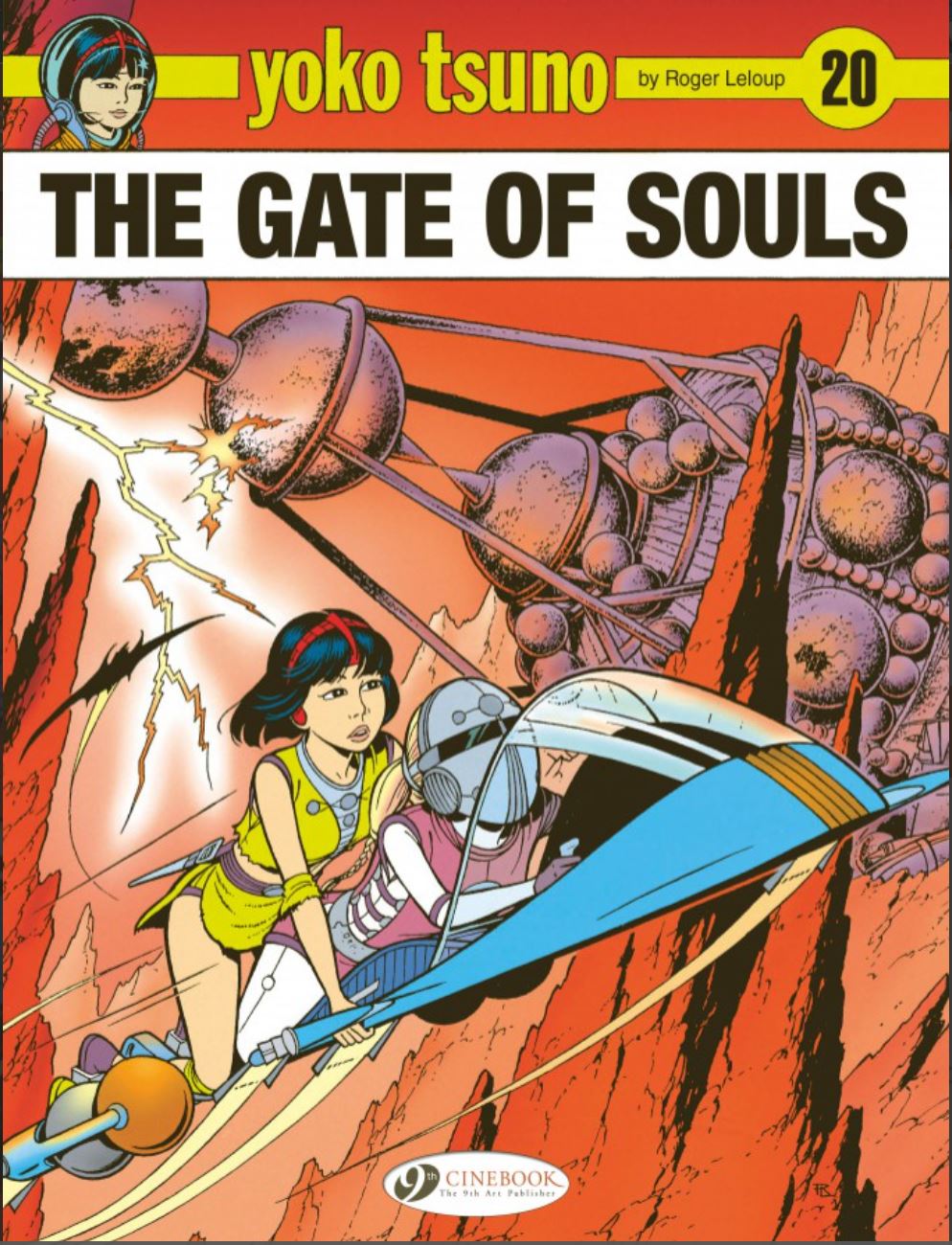
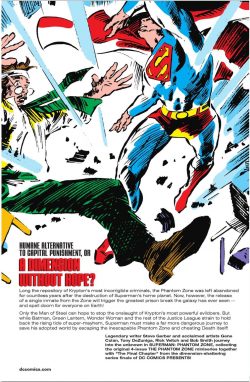
Yoko Tsuno volume 20: The Gate of Souls


By Roger Leloup, coloured by Studio Leonardo & translated by Jerome Saincantin (Cinebook)
ISBN: 978-1-80044-160-6 (Album PB)

This book includes Discriminatory Content produced in less enlightened times.

On September 24th 1970, “electronics engineer” Yoko Tsuno first began her troubleshooting career as an indomitable intellectual adventurer. Bon anniversaire, ma brave cherie!

Her debut in Le Journal de Spirou was realised in “Marcinelle style” cartoonish 8 page short ‘Hold-up en hi-fi’ and although she is still delighting readers and making new fans to this day, for a while it looked as if she wasn’t going anywhere soon. Thankfully, her astonishing, astoundingly accessible exploits were revised and she quickly evolved into a paragon of peril: helming a highpoint of pseudo-realistic fantasies numbering amongst the most intoxicating, absorbing and broad-ranging comics thrillers ever created. Her globe-girdling mystery cases and space-&-time-spanning epics are the brainchild of Belgian maestro Roger Leloup who launched his own solo career in 1953 whilst working as studio assistant/technical artist on Hergé’s Adventures of Tintin.

Compellingly told, sublimely imaginative and – no matter how implausible the premise of an individual yarn – always firmly grounded in hyper-authentic settings underpinned by solidly-constructed, unshakably believable technology and unswerving scientific principles, Leloup’s illustrated escapades were at the vanguard of a wave of strips revolutionising European comics. Early in the journey, he switched from loose illustration to a mesmerising, nigh-photo realistic style that is a series signature. The long-overdue sea-change in gender roles and stereotyping he led heralded a torrent of clever, competent, brave and formidable women protagonists taking their rightful places as heroic ideals and not romantic lures. That consequently elevated Continental comics in the process. Such endeavours are as engaging and empowering now as they ever were, none more so than the travails of masterful Miss Tsuno.

Her first outings (oft-aforementioned, STILL unavailable Hold-up en hi-fi, and co-sequels La belle et la bête and Cap 351) were introductory vignettes prior to epic authenticity taking a firm grip in 1971 when the unflappable problem solver met valiant but lesser (male) pals Pol Paris and Vic Van Steen. Instantly hitting her stride in premier full-length saga Le trio de l’étrange (in LJdS’s May 13th edition), from then on, Yoko’s efforts encompassed explosive exploits in exotic corners of our world, spy and crime capers, time-travelling jaunts and sinister deep-space sagas such as this one. There are 31 European bande dessinée albums to date, with 21 translated into English thus far, albeit – and ironically – none of them available in digital formats…

Initially serialised in LJdS #3033 to 3044, spanning May 29th to 14th August 1996, La Porte des âmes became Europe’s 21st collected Yoko Tsuno album at year’s end. Following chronologically from The Astrologer of Bruges, it returns our terrestrial troubleshooters to their friends in the sky with another momentous visit with the prodigiously reconstructing Vineans.

In a disturbingly philosophical, metaphysically-tinged caper the Earthlings – including Yoko’s adopted daughter Morning Dew and Mieke (Pol’s fiancée from the 16th century) – all toil in deep space beside the disaster-prone lethally pragmatic alien colonists with their most trusted ally when another echo from the distant past changes lives and destines once again.

Their constant guide and companion is Khany: the competent, commanding single mother who combines parenting her toddler Poky and the humans with saving worlds, leading her people, averting continual cosmic catastrophe and – with Yoko – recovering lost knowledge. Frequently that stems from attempts to restore a moral compass to those ancient survivors ruthlessly rebuilding their fallen civilisation and permanently undermining and gaslighting the upstarts who slept out the apocalypse on another planet. Progress is slow and regularly results in uncovered, long forgotten threats that might end the racial resurrection in flaming instants…

In their initial adventure together, Yoko, Vic and Pol had discovered an enclave of dormant aliens hibernating for eons in Earth’s depths. After saving the sleepers from robotic/AI subjugation, the humans occasionally helped the refugees (who had fled their planet two million years previously) to rebuild their lost sciences. Ultimately, the humans accompanied the Vineans on their return to their natal star system and (wrongly presumed) long-dead homeworld. In the years Vineans slept, primary civilisation collapsed, and the world they strive to reclaim is much changed, with isolated pockets of inhabitants evolved beyond recognition. As the re-migrants gradually restore a decadent, much-debased civilisation and culture, the human trio become regular guests and helpers against sabotage, political intrigue and simple skulduggery…

And as seen here, it’s not just people they must beware of…

On a previous visit Yoko had established a unique psychic link with ancient mech-intellect Queen Hegora: one granting her certain technophilic abilities. A later excursion saw her bonded with an equally antediluvian child-rearing toy robot. “Myna” and her kind were constant sentient companions to young children – until parents abruptly deemed them all too smart and dangerous, before subsequently banishing them to distant asteroid. Now that last relic is hastily consulted as another time-lost probe soars back into Vinean territory from out of history and the (currently) unknown…

A constant cause of contemporary strife is piecemeal rediscovery of ancient beings who have endured due to the Vinean practise of digitally encoding living persons into automatons. Now a space salvage effort is interrupted by a probe from the deep past, and the excited explorers confront the possibility of being able to finally penetrate the fabled mysteries of occluded and forbidden lost colony Ultima. Their actions precipitate shocking and tragic discoveries which expose the downside of immortality.

Deadly strife begins as the discoverers plunge down to the revealed world and find another survivor outpost divided into factions indulging in an unending war of technologies and philosophies. An imminent crash and collision makes allies of advance scout Yoko and a bold indigenous pilot named Litsy, and soon the human learns that here vassals are forced to carry the personalities of other deceased servants. Servitude is eternal with useful, knowledgeable “souls” digitally impressed upon successive bodies. All the lower orders can anticipate is forced reincarnation and losing themselves bit by bit to someone else’s soul’s past history…

In a society where biology and mechanisms are less valuable than knowledge and experience, the newcomers are soon caught up in a devilish scheme challenging and undermining the very nature and fine print definition of life on Ultima, as they expose a long unfolding plot by rebel Isora who currently inhabits a menial flying droid. She illicitly made copies of her soul before committing suicide and now she ruthlessly seeks to recover and reunite her fractured personalities in a fresh – and stolen – body. This is over and despite violent objections of its original occupier Ethera, and once morally-outraged Yoko fully grasps the complexities of the situation she is prepared to do whatever is necessary to end this ghastly refinement of intellectual slavery…

Ultimately, overwhelming institutionalised digital malevolence proves inadequate in the face of Yoko Tsuno’s passionate humanity, bold imagination and quick thinking, but her success comes at great cost and cannot truly be called a triumph. Moreover, as the weary explorers return to established Vinean borders, Isora delivers a chilling message revealing nothing is settled yet…

Blending rocket-paced action with shattering suspense and byzantine twists, this deviously twisted, terrifying plausible battle with bigotry is superbly mesmerising, proving once more how smarts and combat savvy are pointless without compassion. As always, the most potent asset of this edgy outer space dramas is its astonishingly authentic setting, as ever benefitting from Leloup’s diligent research and meticulous attention to detail.

The Gate of Souls is a magnificently tense all-action psycho- thriller, taut and compelling, and surely appealing as much to fans of blockbuster space opera as ordinary general purpose comic addicts.

Original edition © Dupuis, 1996 by Roger Leloup. All rights reserved. English translation © 2025 Cinebook Ltd.

Today in 1972, talented wee nipper Jock was born. You can remind yourself how good an artist he is by looking at Green Arrow Year One – The Deluxe Edition.

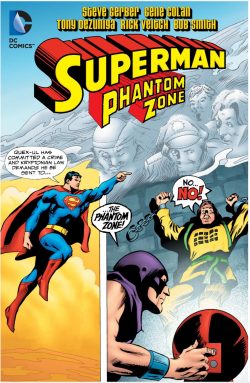
Superman: Phantom Zone


By Steve Gerber, Gene Colan, Rick Veitch, Tony DeZuñiga & Bob Smith (DC Comics)
ISBN: 978-1-4012-4051-6 (TPB/Digital edition)

This book includes Discriminatory Content produced in less enlightened times.

Today would have been Steve Gerber’s 78th birthday. For no appreciable reason, he would have found that to be quite funny. You should go read more comics by him. Here’s some many people don’t immediately think of when listing his so-many sublime star turns…

Once upon a time for fans and comics creators alike continuity could be a harsh mistress. When maintaining a faux-historical cloak of rational integrity for made-up worlds we inhabited was paramount, the greatest casualty of semi-regular reboots and sweeping changes, often meant some terrific tales suddenly never happened. Everything goes now of course, thanks to parallel world-ery, but way back whenever, it was a most painful time for me…

Many examples of this wholesale binning of entire charm-drenched mythologies happened but the convergent growth of graphic novels fortunately provided a sanctuary of sorts, such as this paean of pictorial praise for the mythology had evolved around Superman in the wonder years between 1948 and 1986.

Thankfully DC has always understood that a good story is worth cherishing. This slim, trim spectral selection gathers superb 4-issue miniseries The Phantom Zone (originally appearing from January to April 1982) and includes the very last pre-Crisis on Infinite Earths Zone yarn as first seen in DC Comics Presents #97 (September 1986). It also simultaneously celebrates the stylish and enthralling scripting of unique comics voice Steve Gerber and his most ardent collaborator Gene (Howard the Duck, Stewart the Rat) Colan.

Gerber was a uniquely gifted writer who combined a deep love of comic book continuity minutiae with dark, irrepressible wit, incisive introspection, barbed socio-cultural criticism, a barely reigned-in imagination and boundless bizarre surrealism. His stories were always at the extreme edge of any mainstream company’s intellectual canon and never failed to deliver surprise and satisfaction, especially when he couched his sardonic sorties as thinly-veiled attacks on burgeoning cultural homogenisation and commercial barbarity.

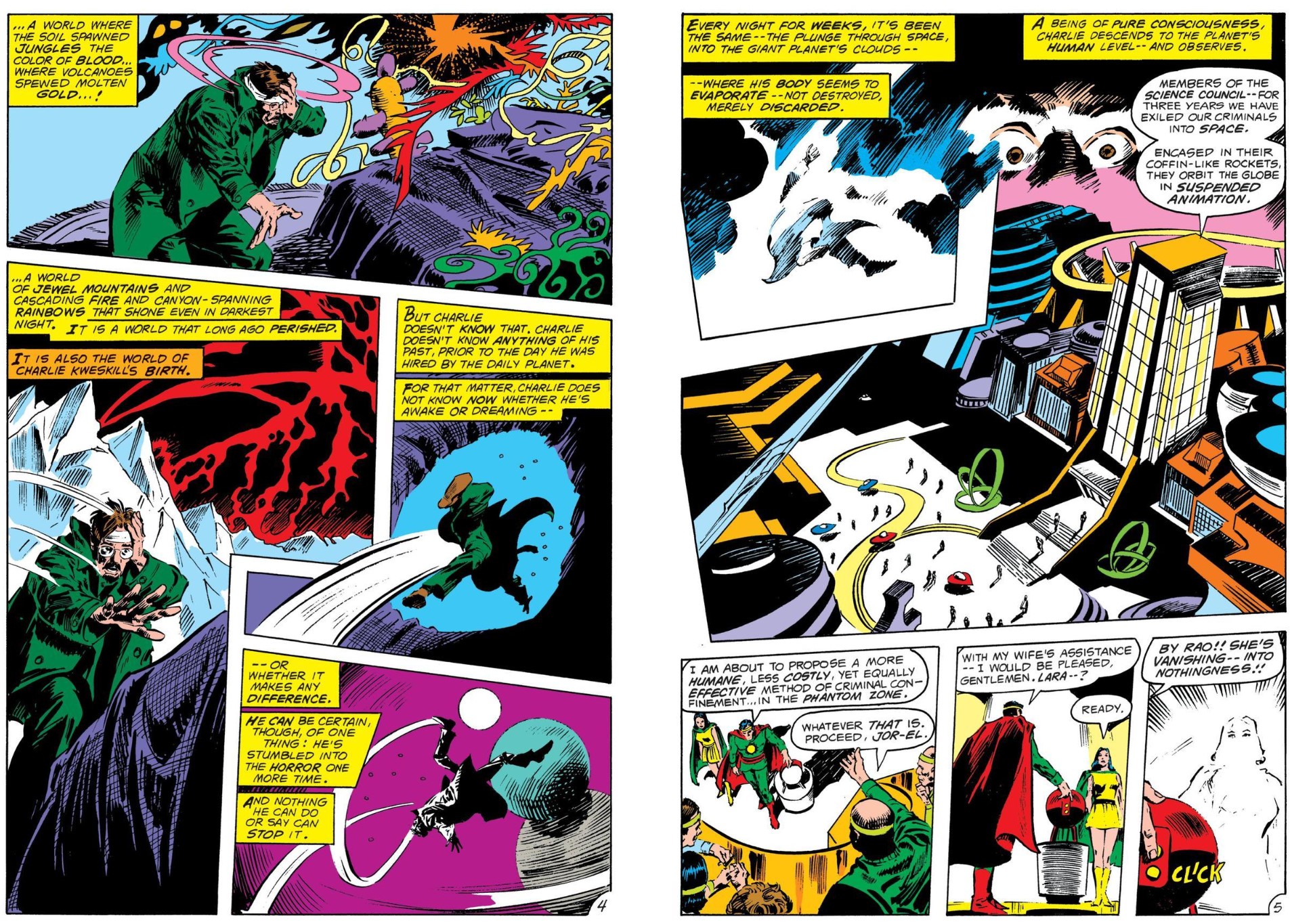
This riotous recapitulation of all that lost Man of Tomorrow ficto-history begins in ‘The Haunting of Charlie Kweskill!’ as the eponymous Daily Planet paste-up artist collapses at work. The solitary little dweeb has been sleeping badly, plagued by nightmares of a life on long-gone planet Krypton. His dreams detail how brilliant scientist Jor-El devised a non-lethal way to deal with Krypton’s most incorrigible criminals: human monsters such as Jax-Ur, Professor Va-Kox, Dr. Xadu, sadistic psycho-killer Faora Hu-Ul, potential dictator General Dru-Zod, and even Jor’s own bad & crazy cousin Kru-El

Many lesser menaces like psionic aberrants Az-Rel and Nadira were also banished to the misty twilit realm, as well as stranger outcasts like callous biological experimenter Nam-Ek, but the one who most catches Charlie’s attention is fraudster Quex-Ul; a Kryptonian who appears to be Charlie’s doppelganger…

Of course, the dreams are all true: telepathic broadcasts beamed at Charlie by Zone inmates from within the plane of timeless intangibility. Quex-Ul had been one of them, surviving long after Krypton died, but was innocent of his crimes. He had been framed and mind-controlled by a mastermind who had deservedly perished when the Red Sun world detonated. Once Superman corrected the injustice and released the poor dupe, Qwex-Ul had saved the Man of Steel from a Gold Kryptonite trap, thereby losing his inherent Kryptonian abilities and memory in the process. The grateful, heartsick Action Ace had found the amnesiac a job at the Planet and almost forgot his alien origins in the years since. Charlie’s former fellow inmates had not…

Their telepathic onslaught turns Kweskill into a somnambulistic slave, unknowingly spending his nights breaking into labs and stealing high-tech components. Superman, slowly putting the puzzle pieces together, is just too late to thwart the stealthy scheme, and as he bursts into Charlie’s apartment a hastily cobbled together Phantom Zone projector hurls him and the hapless mind-slave into the ghostly region, whilst simultaneously freeing a legion of the cruellest and most bored criminals in existence…

The saga expands with ‘Earth Under Siege!’ as Superman and Charlie helplessly watch Zod, Jax-Ur, Va-Kox, Faora and Kru-El immediately undertake the next stage of their plan, leaving passively nihilistic Az-Rel and Nadira to negligently torture monstrous Nam-Ek with their psychic talents when not mocking the ranting liturgies of religious zealot Jer-Em, whose manic bigotry and fundamentalist isolationism caused the death of every person in Argo City

Superman’s cousin Kara Zor-El had been born on the city-sized fragment of Krypton, hurled intact into space when the doomed world detonated. Eventually, Argo turned to Green Kryptonite like most of Krypton’s detonated debris, and her dying parents, observing Earth through their scopes, sent their daughter to safety as they perished. On Earth, the teenager met the Man of Steel who created for her the identities of Linda Lee and Supergirl, concealing her from the wider world whilst she learned all about her new home… and how to use her astounding new abilities in secrecy and safety.

As the emotionally disconnected, disaffected and doubly alienated youths laconically saunter through Metropolis; casually slaughtering cops and citizens, Zod’s more motivated cronies have reached Superman’s Fortress of Solitude and destroyed the only means of returning them to their extra-dimensional dungeon.

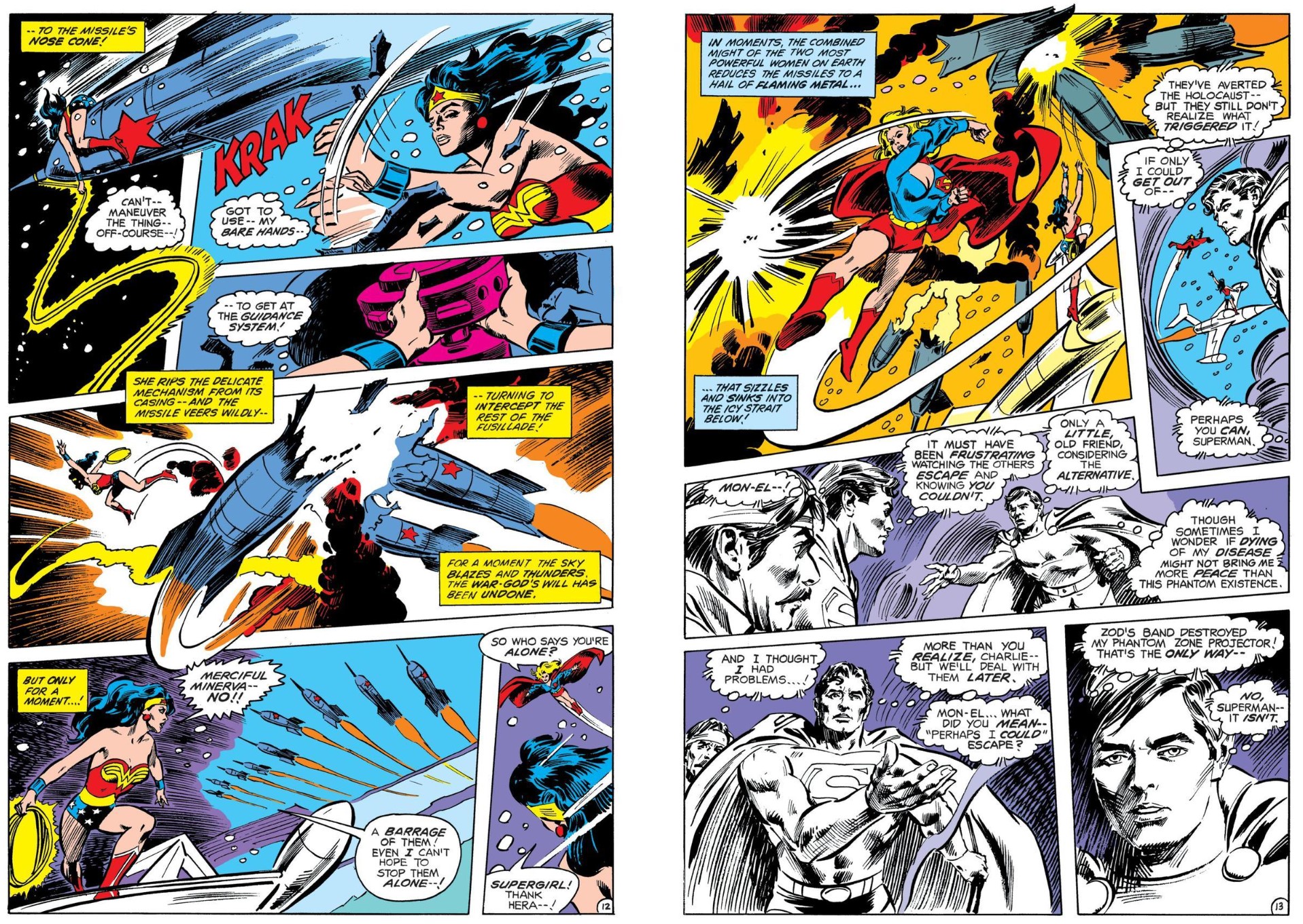
The next move is attacking the Justice League satellite, hurling it and occupants Flash, Red Tornado, Zatanna, Black Canary, Elongated Man, Firestorm & Aquaman on a non-stop trajectory out of the Solar System. Rampant Kryptonians destroy Earth’s communications satellites and trigger a mass launch of nuclear missiles, leaving Wonder Woman and Supergirl to narrowly avert atomic Armageddon whilst the frantic Man of Tomorrow can only watch in horror…

Not every Zone inhabitant is a criminal. For instance, Daxamite Mon-El was exposed to common lead in ‘Superboy’s Big Brother’ (by Robert Bernstein & Papp in June 1961’s Superboy #89) when his lingering, inexorable death was only forestalled by depositing the dying alien in the Zone until a cure could be found. Now, as Green Lantern faces the Zod Squad on Earth only to be soundly beaten and have his Power Battery stolen, Mon-El informs Charlie and Superman of a possible back way out of the realm of hellish nullity…

On Earth, as Wonder Woman subdues Nam-Ek, Supergirl checks in with Batman, desperately trying to ascertain where Superman has gone. As the Dark Knight heads to Metropolis to investigate, Kara returns to the Fortress and is ambushed by Kryptonian escapees and beaten near to death…

With no other choice, Charlie and Superman reluctantly pass through a dimensional portal even the obsessed villains were too scared to risk, encountering surreal madness in ‘The Terror Beyond Twilight!’

Back in the physical world of touch and time, Supergirl saves herself from ghastly atomic disintegration as Charlie and Superman pass through stormy turbulence and a tedious waiting-room-realm before arriving on a peculiar plane where they are confronted by luscious sirens with impossible riddles and exploding heads. Their narrow escape from the Priestesses of the Crimson Sun only leads to Kryptonian wizard Thul-Kar who magicked himself into the Zone in ages past and now slavishly serves an erratic, malevolent sentient universe named Aethyr. It wants to consume Charlie and Superman but only by passing through it can they reach the physical world again…

On Earth, chaos reigns. Batman is utterly unable to pacify extremist Jer-Em, who deems the planet impure, unclean and unholy. He would rather die than soil his Kryptonian purity here.

… And high above the world, other freed villains have their own plan to fix the situation: a gigantic Phantom Zone Cannon to inexorably and eternally banish Earth into the twilight dimension in the course of one full rotation…

The drama comes to a tragic conclusion in ‘The Phantom Planet!’ as Az-Rel and Nadira, having found kindred spirits amongst Metropolis’ disenfranchised Punk Rock counterculture – before killing them – encounter Jer-Em in martyr mode. The now-suicidal cleric is quite keen on taking the rest of the apostate Kryptonians with him…

As the world turns into intangibility, in France, Faora has briefly resumed her passion for murdering males (before they’re all gone) whilst in Aethyr’s universe an appalling sacrifice enables Superman to return to physicality just in time to lead a last desperate charge, saving the day and putting the villains back where they belong… those still alive, that is…

The remainder of this fantastic collection recounts the tying up of all those intriguing concepts and loose ends in a spectacular sidebar to the end of DC’s original universe.

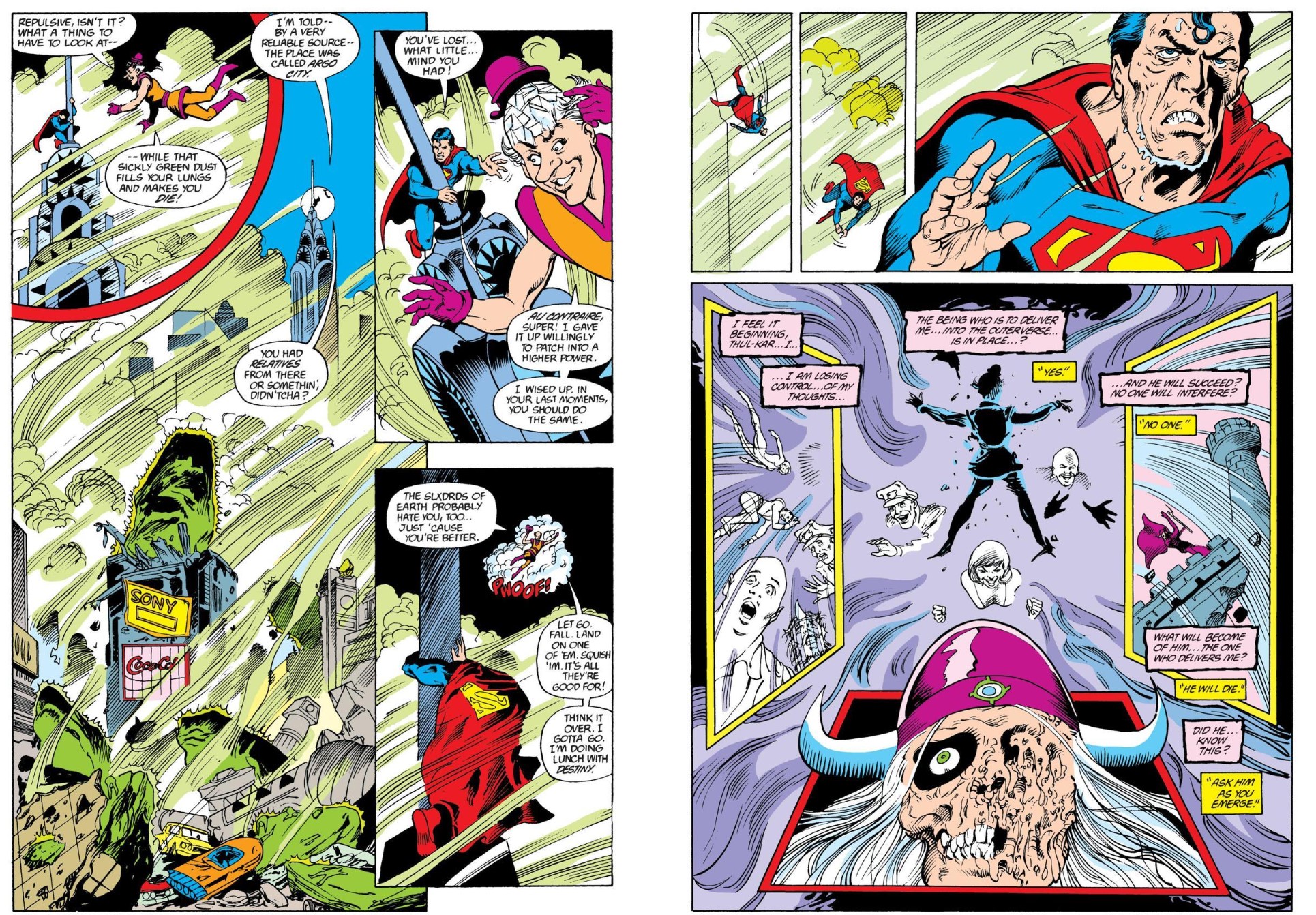
In 1986 the company celebrated its 50th year with groundbreaking Crisis on Infinite Earths: radically overhauling a convoluted multiversal continuity and starting afresh. All Superman titles were cancelled or suspended pending a back-to-basics reboot courtesy of John Byrne, allowing for a number of very special farewells to the old mythology. One of the most intriguing and challenging came in the last issue of DC Comics Presents (#97) wherein ‘Phantom Zone: the Final Chapter’ by Gerber, Rick Veitch & Bob Smith offered a creepy adieu to a number of Superman’s greatest foes.

Tracing Jor-El’s discovery of the Phantom Zone through to imminent multiversal annihilation, this dark yarn built on Gerber’s landmark miniseries and revealed that the dread region of nothingness was in fact a sentient echo of a dead universe which had always regarded the creatures deposited within it as irritants and agonising intruders.

Now as cosmic carnage reigns Aethyr, still served by Kryptonian mage Thul-Kar, causes the destruction of the Bizarro World “Htrae” and the deification/corruption of Fifth Dimensional pest Mr. Mxyzptlk, as well as the subsequent crashing of Argo City on Metropolis. As a result Zod and fellow immaterial inmates are freed to wreak havoc upon Earth – but only until the now-crystalline pocket dimension merges with and absorbs the felons, before implausibly abandoning Superman to face his uncertain future as the very Last Son of Krypton…

Superman has proven to be all things to all fans over his decades of existence and Gerber’s takes on these timeless tales of charm, joy and wholesome wit are unique and more necessary than ever: not just as a reminder of great tales of the past but as an all-ages primer of wonders still to come…
© 1982, 1986, 2013 DC Comics. All Rights Reserved.

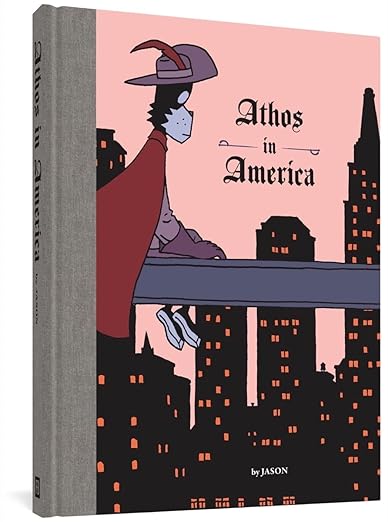
Athos in America


By Jason, coloured by Hubert, translated by Kim Thompson (Fantagraphics Books)
ISBN: 978-1-60699-478-8 (HB/Digital edition)

This book includes Discriminatory Content produced for dramatic, comedic and ironic effect.

Born in 1965 in Molde, Norway, John Arne Sæterøy is known globally by his enigmatic, utilitarian nom de plume Jason. The shy & retiring draughts-scribe started on the path to international cartoon superstardom in 1995, once first graphic novel Lomma full ay regn (Pocket Full of Rain) won Norway’s biggest comics prize: the Sproing Award. Prior to that, he had contributed to alternate/indie magazine KonK whilst, from 1987, studying graphic design and illustration at Oslo’s Art Academy, before going on to Norway’s National School of Arts. After graduating in 1994, three years later he founded his own comic book Mjau Mjau, citing Lewis Trondheim, Jim Woodring & Tex Avery as primary influences, and constantly refining his style into a potent form of meaning-mined anthropomorphic minimalism.

Moving to Copenhagen Jason worked at Studio Gimle alongside Ole Comoll Christensen (Excreta, Mar Mysteriet Surn/Mayday Mysteries, Den Anden Praesident, Det Tredje Ojet) and Peter Snejbjerg (Den skjulte protocol/The Hidden Protocol, World War X, Tarzan, Books of Magic, Starman, Batman: Detective 27). His efforts were internationally noticed, making waves in France, The Netherlands, Slovenia, Spain, Germany and other Scandinavian countries as well as the Americas. He won another Sproing in 2001 – for self-published series Mjau Mjau – and from 2002 turned nigh-exclusively to producing graphic novels, and won even more major awards.

Jason’s breadth of interest is wide and deep: comics, movies, animated cartoons, music, literature and pulp fiction all feature equally with no sense of rank or hierarchy. This puckish and egalitarian mixing and matching of inspirational sources always and inevitably produces picture-treatises well worth a reader’s time. Over a succession of tales Jason built and constantly re-employed a repertory company of stock characters to explore deceptively simplistic milieux based on classic archetypes of movies, childhood entertainments, historical and literary favourites. These all role-play in deliciously absurd and surreal sagas centred on his preferred themes of relationships and loneliness. In latter years, Jason returned to such “found” players as he built his own highly esoteric universe, and even has a whole bizarre bunch of them “team-up” or clash…

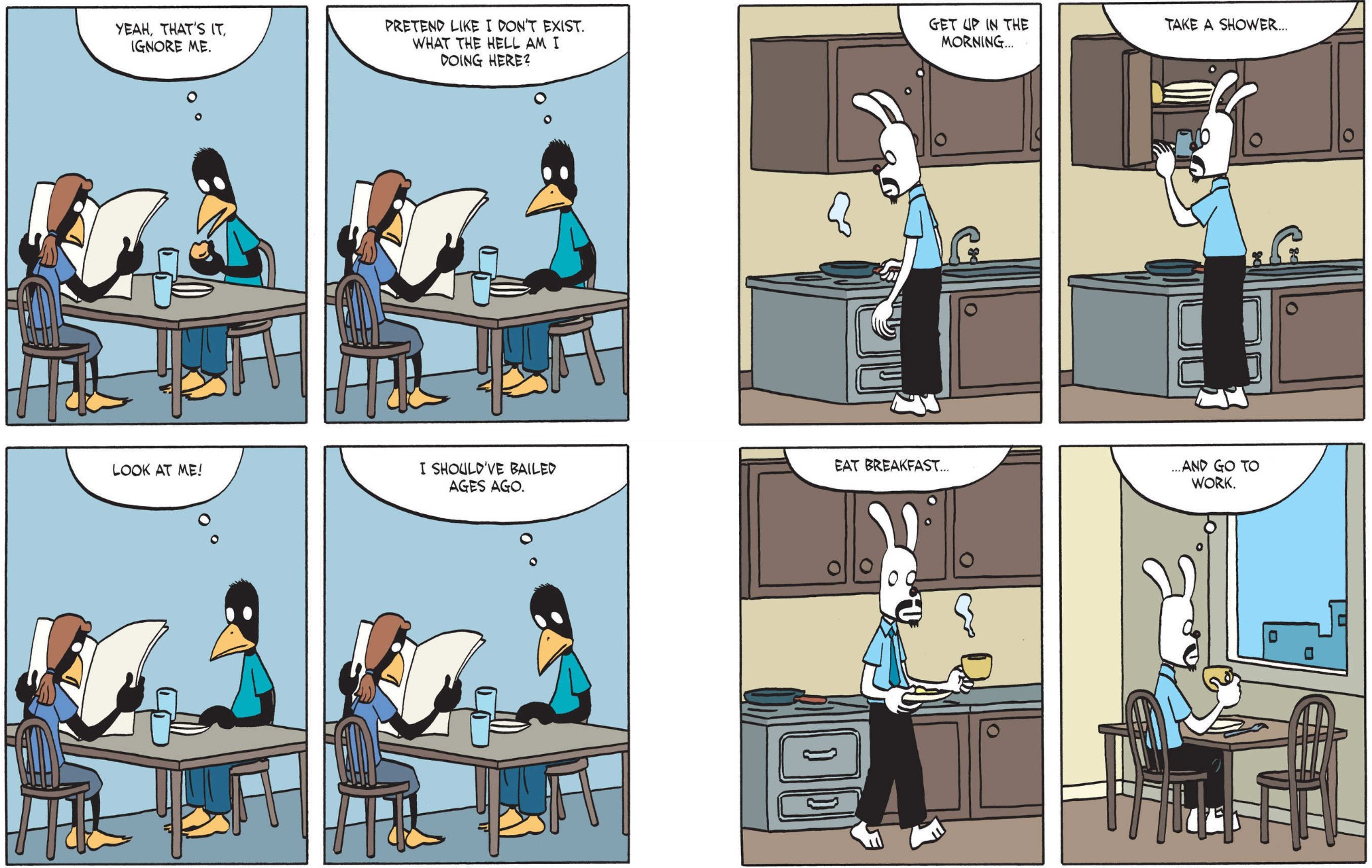
As always, visual/verbal bon mots unfold in beguiling, sparse-dialogued, or even as here silently pantomimic progressions, with compellingly formal page layouts rendered in a pared back stripped-down interpretation of Hergé’s Claire Ligne style: solid blacks, and thick outlines dominating settings of seductive monochrome simplicity augmented by a beguiling palette of stark pastels and muted primary colours.

The majority of his tales brim with bleak isolation, swamped by a signature surreality: largely populated with cinematically-inspired, darkly comic, charmingly macabre animal people ruminating on those inescapable concerns whilst re-enacting bizarrely cast, bestial movie tributes.

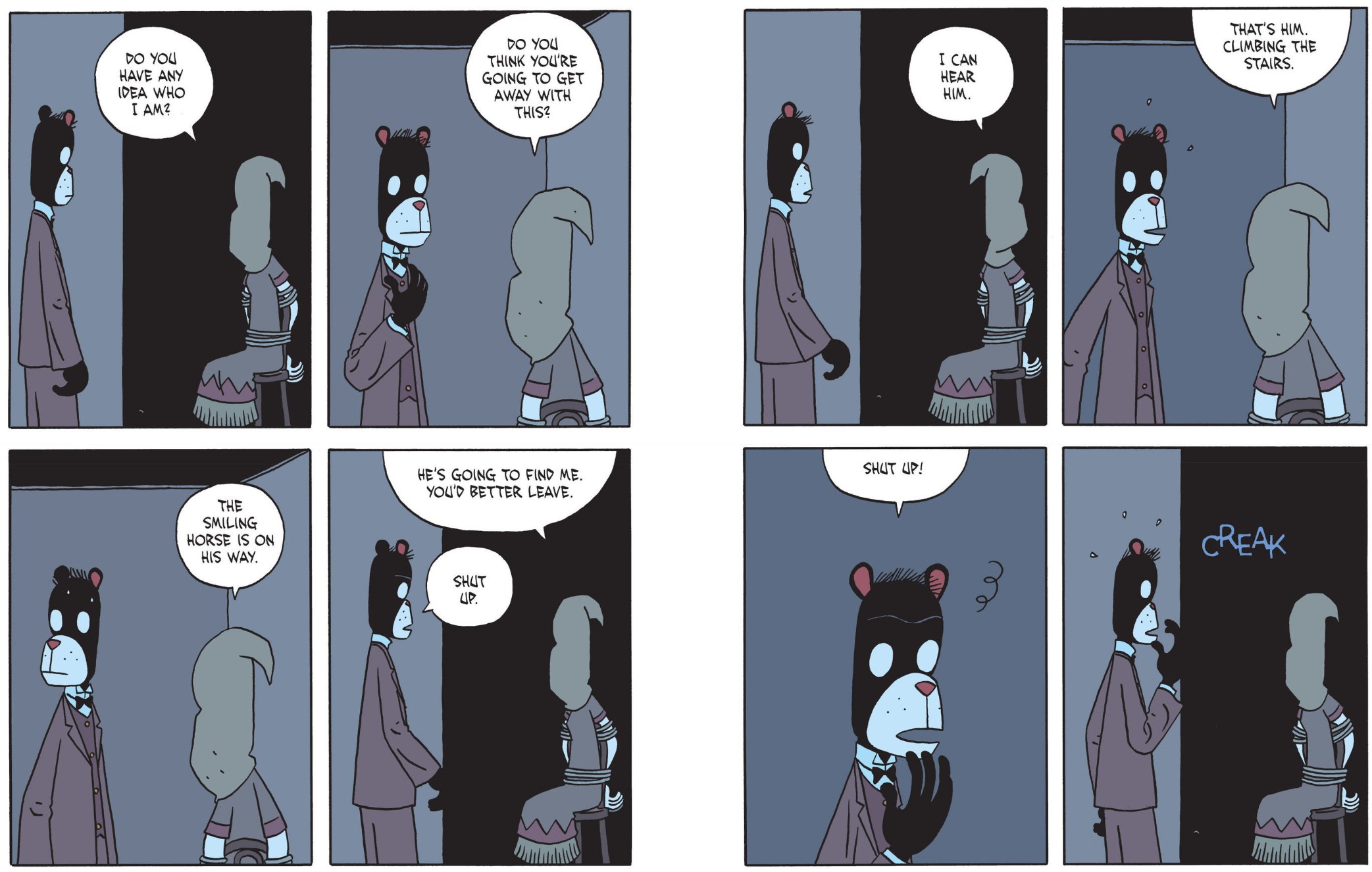
This perfect example of his oeuvre is something of a prequel and available as a sturdily comforting hardback or exalted eBook edition: a mild torrent of subtle wonderment that opens with understated crime thriller ‘The Smiling Horse’, wherein the last survivor of a kidnap team endures decades of tense anticipation before their victim’s uncanny avenger finally dispenses long-deferred justice.

Jason then examines his own life, career and romantic failings with harsh, uncompromising detail in ‘A Cat from Heaven’ whilst B-Movie Sci Fi informs ‘The Brain That Wouldn’t Virginia Woolf’ as a scientist spends years killing women whilst looking for a body that won’t reject the mean-spirited, constantly carping head he keeps alive in his laboratory, before ‘Tom Waits on the Moon’ inexorably draws together a quartet of introspective, isolated loners into a web of fantastic horror. Still they spend too much time thinking not doing so they get what they deserve…

A cunning period gangster pastiche rendered in subdued shades of red and brown, ‘So Long, Mary Anne’ depicts a decent woman helping a vicious escaped convict flee justice. After they snatch a hostage, the “victim” soon begins to exert an uncanny influence over the desperate killer, but is she just wicked or is there a hidden agenda in play?

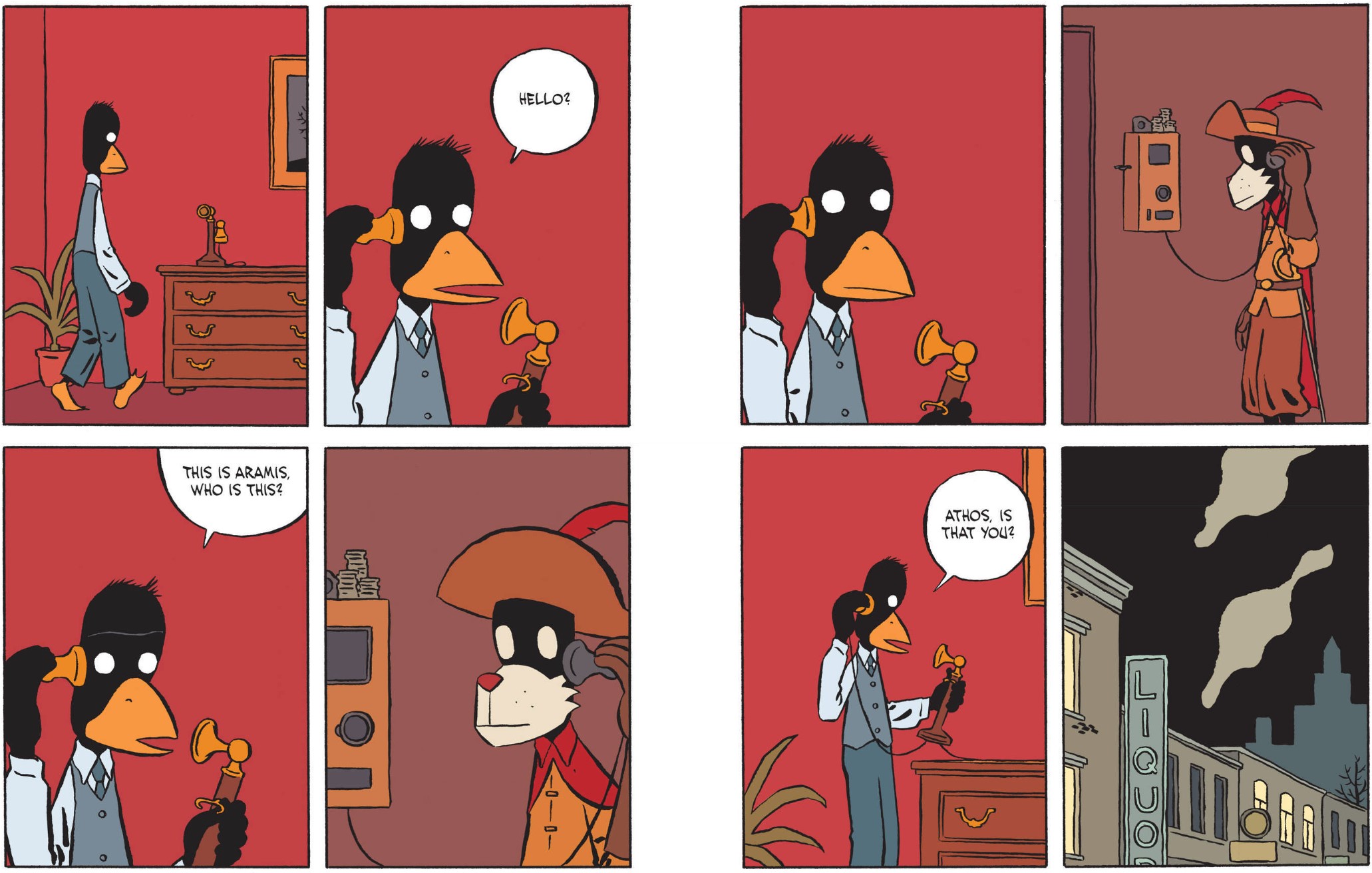
Most welcome attraction here is eponymous final story ‘Athos in America’. This is a fabulously engaging “glory days” yarn, acting as a prequel to the author’s spellbinding graphic romp The Last Musketeer. That epic detailed the final exploit of the dashing Athos, who met his end bravely and improbably after 400 years of valiant adventure. But what was he doing in the years before that tragic denouement?

A guy walks into a bar… It’s America in the 1920s and the oddly-dressed Frenchman starts chatting to Bob the barman. As the quiet night unfolds the affable patron relates how he came to America to star in a movie about himself and his three greatest friends. Sadly, after he enjoyed a dalliance with the Studio’s top star, things quickly started to go wrong…

Effortlessly switching back and forth between genre, milieu and narrative pigeonholes, this grab-bag of graphic goodies again proves that Jason is a creative force in comics like no other: one totally deserving as much of your time, attention and disposable income as possible.
All characters, stories and artwork © 2011 Jason. All rights reserved.

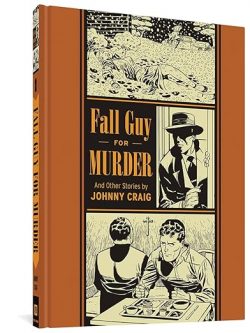
Fall Guy for Murder and Other Stories


By Johnny Craig, with Ray Bradbury, Bill Gaines & Al Feldstein (Fantagraphics Books)
ISBN: 978-1-60699-658-4 (HB/Digital edition)

This book includes Discriminatory Content produced in less enlightened times.

Forgotten giant Johnny Craig died today in 2001. He was a graphic titan and should be remembered for more than a stellar run on Iron Man in the 1960s – although that alone is worth your attention…

From 1950-1954 EC was the most innovative and influential comic book publisher in America, dominating the genres of crime, horror, adventure, war and science fiction. They even originated an entirely new beast: the satirical funnybook. After a shaky start, following the death of his father (who actually created the modern comic book in 1933), new head honcho William Gaines and his trusty master-of-all-comics trades Al Feldstein turned a slavishly derivative minor venture into a pioneering, groundbreaking enterprise which completely altered the perception of the industry and art form.

As they began co-plotting the bulk of EC’s output together, intent on creating a “New Trend” of stories aimed at older and more discerning readers – and not the mythical 8-year-old comic books ostensibly targeted – they shifted the ailing company’s emphasis towards dark, funny, socially aware and absolutely more adult fare. Their publishing strategy also included hiring some the most gifted writers and artists in the field. One of the very best, most undervalued and least remembered today was writer, artist, editor John Thomas Alexis “Johnny” Craig (1925-2001).

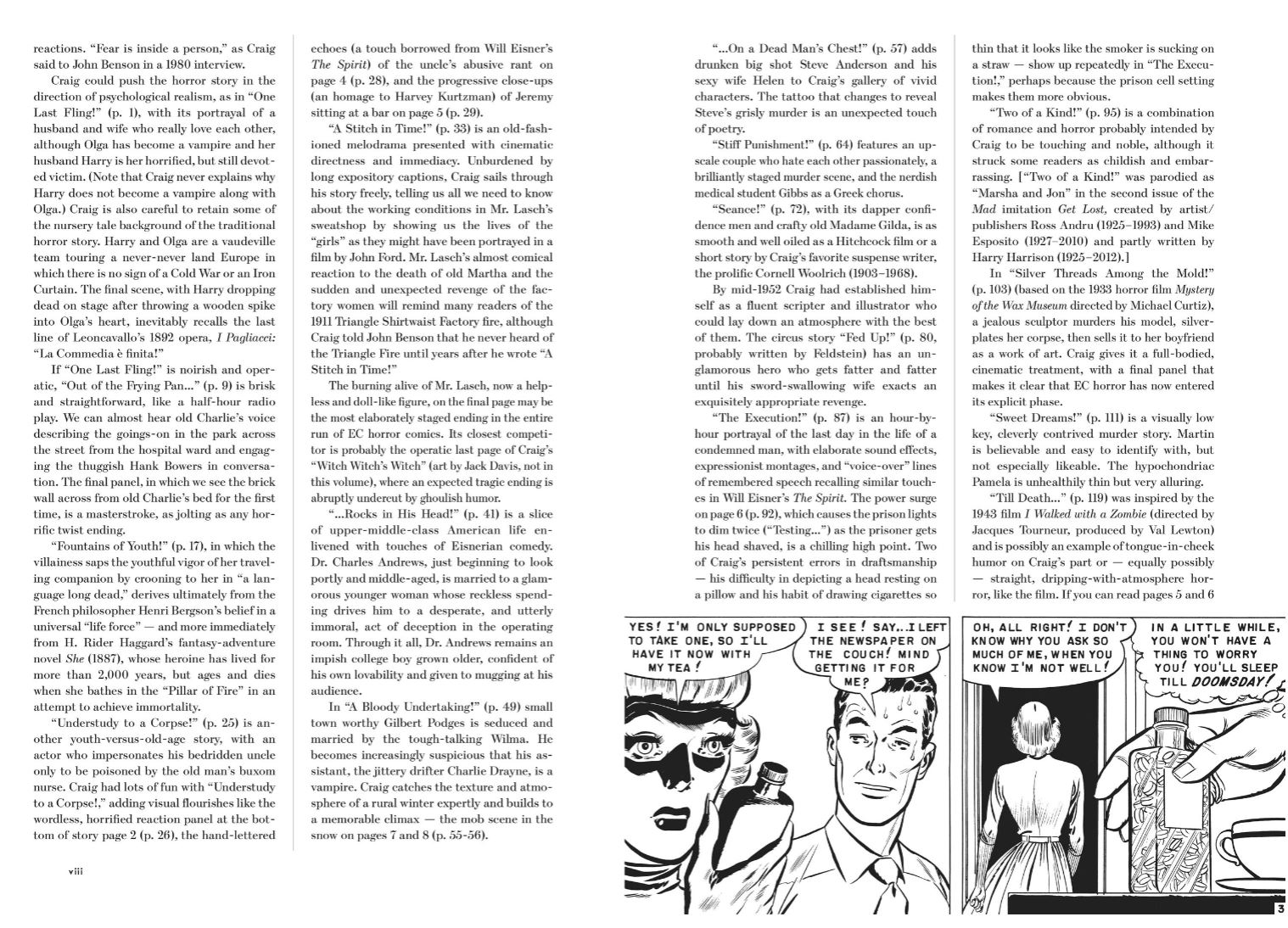
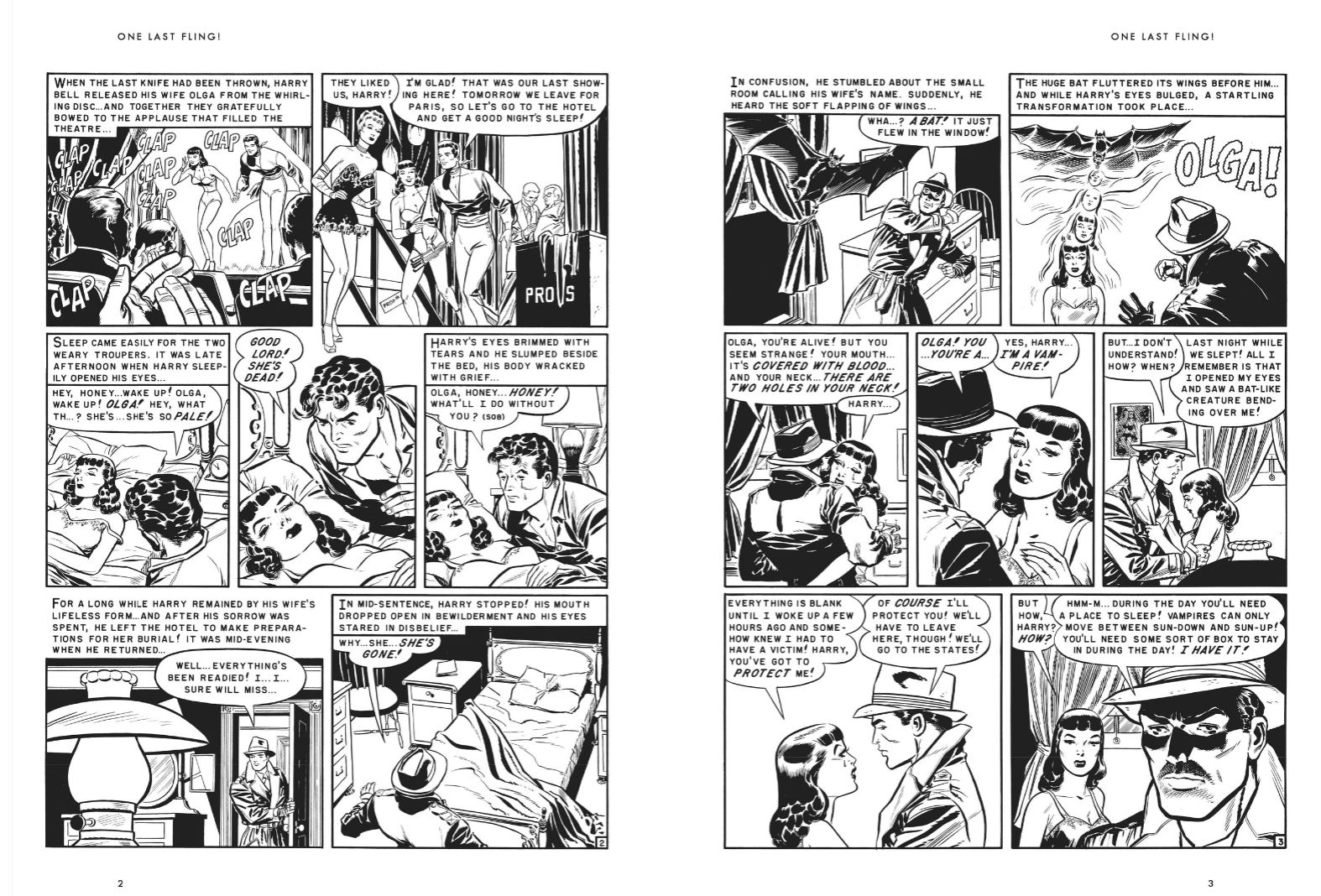
This lavish and eternally appealing monochrome hardcover/digital volume is part of Fantagraphics’ EC Library. It gathers a chilling collection of Craig’s supernatural suspense and especially his superbly Noir-drenched crime stories in a wonderful primer of peril packed with supplementary interviews, features and dissertations, beginning with the informative and picture-packed ‘Brilliant Good Guys, Even More Brilliant Bad Guys’ by lecturer Bill Mason. A parade of classic genre tales begins with ‘One Last Fling!’ from Vault of Horror #21 October/November 1951. Craig was a sublime master of pen-&-ink illustration, and his scripting was just as slick and deceptively, hilariously seductive.

In his initial yarn here, a circus knife-thrower refuses to let the fact that his beloved assistant has become a vampire drive them apart, whilst from Crime SuspenStories #8 (December 1951/January 1952), ‘Out of the Frying Pan…’ is a wry gem of deception and misdirection, with a temporarily blind killer allowing the wrong little old man to plan his escape from hospital for him…

Originating in Vault of Horror #22 (December 1951/January 1952), ‘Fountains of Youth!’ is a straightforward supernatural thriller about a vitality-leeching monster, but ‘Understudy to a Corpse!’ (Crime SuspenStories #9, February/March 1952) offers a brilliantly twisty murder-plot involving a penniless actor who kills his uncle and diverts subsequent police attention by impersonating the victim post mortem. It does not go according to plan…

‘A Stitch in Time!’ (Vault of Horror #23, February/March 1952) is a grotesque classic in which a tyrannical sweatshop boss pays a ghastly price for abusing desperate seamstresses in his employ, before ‘…Rocks in His Head!’ (Crime SuspenStories #10, April/May of the same year) sees a harassed, hard-pressed surgeon with a greedy young wife making a disastrous choice when faced with a jewel-bedecked corpse to autopsy. In that same month prolific Craig graced Vault of Horror #24 with ‘A Bloody Undertaking!’, taking the same theme into supernatural territory when a pretty young thing turns the head of an old country doctor… who really should know better…

Regarded as one of the company’s slowest creators, Craig nevertheless found time to illustrate scripts by Gaines & Feldstein such as ‘…On a Dead Man’s Chest!’ (Haunt of Fear #12, March/April 1952) wherein, after a sordid affair and brutal murder, retribution from beyond the grave seeks out the victim’s wife and philandering brother…

Cover-dated June/July 1952, Crime SuspenStories #11’s ‘Stiff Punishment!’ is all Craig, and again dealt with avaricious ingenues who wed staid old doctors. This time, though, when the medical lecturer finally snaps, his assumption that he’d found the perfect way to hide the body proved utterly erroneous. In ‘Séance!’ (Vault of Horror #25, June/July) a couple of conmen kill a mark who learns too much, but are ultimately undone when his widow consults their own spiritualist for answers, after which Gaines & Feldstein script a shocking tale of gluttony and a vengeful sword-swallower in gloriously macabre fable ‘Fed Up!’ from Haunt of Fear #13 May/June.

The riveting tension of ‘The Execution!’ (Crime SuspenStories #12 August/September 1952) – wherein a death row inmate waits for the witness who could save him from the chair – came from one simple shocking fact. In Craig’s stories the good guys didn’t always win, and justice was frequently derailed and even cheated. ‘Two of a Kind!’ (Vault of Horror #26 August/September 1952) offered a sexually charged love story of the most extreme kind of sacrifice, whilst in ‘Silver Threads Among the Mold!’ (VoH #27 October/November 1952) an avaricious model regrets making a fool of a sculptor who adores and supports her, and ‘Sweet Dreams!’ (CSS #14, December 1952/January 1953) reveals the dire lengths an insomniac will stoop to in search of a little rest.

As first seen in VoH #28 (December 1952/January 1953) ‘Till Death…’ is, for many fans, the ultimate zombie story, as a besotted plantation owner loses his new bride to disease and soon learns to regret using voodoo to restore her to his side, whereas ‘When the Cat’s Away…’ (CSS #15 February/March 1953) is pure undiluted Crime Noir. Here a cuckolded husband attends to his wife and best friend with finesse and grim finality, whilst ‘The Mausoleum!’ (VoH #29, in the same month) sees an English landowner sell his family castle to a ghost-crazy American; lock, stock and damning evidence of the murder he committed to inherit everything…

‘Rendezvous!’ (Crime SuspenStories #16, April/May 1953) brilliantly outlines the sheer dumb luck that scotched a perfect murder/insurance scam, before ‘Split Personality!’ (VoH #30 April/May) details the incredible lengths to which a con artist strives to deprive identical twin sisters of their fortunes. Then, ‘Touch and Go!’ (CSS #17 June/July) delivers Craig’s sublimely paranoiac and compulsive adaptation of the Ray Bradbury vignette about a killer who leaves damning fingerprints whilst in the same month romantic obsession underpins the tragic tale of an artist-turned-mugger who only stole to pay for true love’s medical bills in ‘Easel Kill Ya!’ (VoH #31).

This awesomely addictive compilation concludes with the devilishly convoluted tale of a Private Eye set up to take the blame for a perfect crime. Written by Gaines & Feldstein, eponymous epic ‘Fall Guy for Murder!’ comes from Crime SuspenStories #18 (August/ September 1953) and is the quintessential 1950s crime story: smart, scary, devious and utterly morally ambiguous…

The comics classics are followed by more background revelations via S.C. Ringgenberg’s in-depth personal history in ‘Johnny Craig’ – complete with a stunning selection of Craig’s most eye-catching and controversial covers – and a general heads-up on the short-lived but world-shaking phenomenon in ‘The Ups and Downs of EC Comics: A Short History’ courtesy of author/editor/critic/comics fan Ted White. Also Educating Consumers is comprehensively illuminating feature ‘Behind the Panels: Creator Biographies’ by Mason, Tom Spurgeon & Janice Lee.

The short, sweet but severely limited comics output of EC has been reprinted ad infinitum in the decades since the company died (or was it murdered?). These titanic tales revolutionised not just our industry but also impacted the greater world through film and television and via the millions of dedicated devotees still addicted to New Trend tales.

Fall Guy for Murder was the fifth Fantagraphics compendium highlighting contributions of individual creators, adding a new dimension to aficionados’ enjoyment whilst providing a sound introduction for those lucky souls encountering the material for the very first time.

Whether an aged EC Fan-Addict or the merest neophyte convert, this is a book no comics lover or crime-caper victim should miss…

Fall Guy for Murder and Other Stories © 2013 Fantagraphics Books, Inc. All comics stories © 2013 William M. Gaines Agent, Inc., reprinted with permission. All other material © 2013 the respective creators and owners.

Also today in 1982 the legendary Reed Crandall passed away. His presence was seen all over the Golden and Silver Age of Comics, but some of his finest work appeared in Piracy: The Complete Series 1-7 (The EC Archives Library).

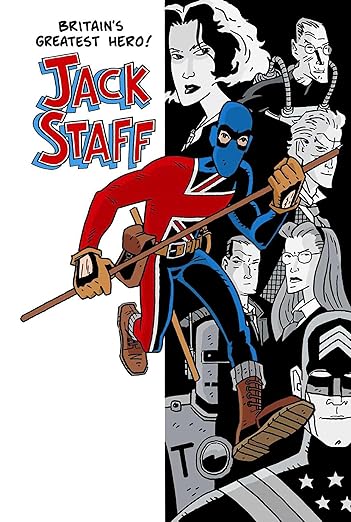
Jack Staff: Everything Used to Be Black and White


By Paul Grist (Dancing Elephant/Image Comics)
ISBN: 978-1-5824-0335-9 (TPB/Digital edition)

Just like many aging Brits & gits, I forget things and yesterday I missed a birthday. September 9th 1960 should be best known as the natal debut of cartoon paragon Paul Grist. Read this – and absolutely the book and its three sequels – to learn why.

Growing up a comic fan in 1960s -1970s Britain was an oddly schizophrenic situation. Not only were we bombarded and enthralled by our own weirdly eclectic mix of TV stars, Dying Empire jingoism and military bluster, fantastic anti-establishment fantasy, science-fiction and sport yarns – all augmented by the sheerly inspired, madcap anarchy of gag strips that always accompanied such adventure serials in our anthology weeklies – but from 1959 on, we also had unfettered access to exotic worlds and thinly veiled cultural imperialism of US comic books, bulk-imported as ballast in cargo ships and readily available in glorious full colour…

And don’t even get me started on the precious few, but always exotic and classy European wonders like Tintin, Lucky Luke and Asterix, simultaneously filtering into the funnybook gestalt constantly brewing in our fevered little heads. All this pictorial wonderment tended to make us young strips disciples a tad epicurean in our tastes and broad-minded, eccentric synthesists about our influences…

I’ve followed Paul Grist’s work since the small press days of Burglar Bill and St. Swithin’s Day, and his brilliantly refined design sense and incisive visual grasp of character made his interpretations of Grendel, Judge Dredd and other commercial properties excellent examples of why individuality always trumps house style. However, when he writes his own material, he steps into a creator class few can touch, always blending and refining key elements of genre and shared public consciousness into a stunningly inviting new nostalgia. For another perfect example check out what he accomplished with hard-boiled detective archetypes in his splendid Kane (see Kane: Welcome to New Eden among others)…

Grist established his own company, Dancing Elephant Press, to produce the kind of works big-time publishers lacked the imagination to support and in 2002 returned to the childhood delights of superhero comics with the creation of Jack Staff, who began life as a proposed Union Jack story for Marvel.

When they pulled the plug, Grist, unable to let a good idea go and now freed of the usual creative restraints that come from playing with other people’s toys, went wild and produced a purely British take on the superhero phenomenon that is simultaneously charming, gripping and devilishly clever. I usually go into laborious (most would say tedious) detail about the events in these graphic novel reviews but this first Jack Staff collection (gathering the first 12 issues) will be an exception as Grist’s captivating style here (based on and mimicking the anthology format of British Weeklies such as Lion and Valiant) means each issue feels like seven stories in one. As my intention is to convince to buy this book I’m sacrificing detail for brevity… you lucky people.

In a nondescript British city Becky Burdock is a feisty girl reporter for trashy newspaper The World’s Press. Opening gambit ‘Yesterday’s Heroes’ finds her hunting down a serial killer scoop on the “Castletown Slasher”, when she accidentally stumbles onto the identity of Jack Staff (Britain’s greatest costumed hero since WWII, and a man missing since the 1980s).

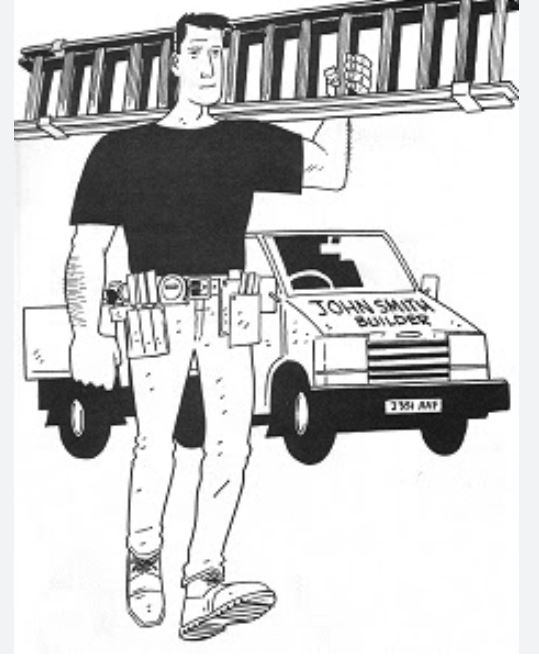
It happens when local builder John Smith saves her from a collapsing billboard, precipitating memories of wartime international superhero team The Freedom Fighters and a battle against a centuries-old vampire. It also strangely involves British Q Branch (investigating un-rational or weird crimes) and US superhuman Sgt. States, Jack Staff’s opposite number and another seemingly immortal patriotic hero.

Marvel Zombies will rightly identify this tale has echoes of the Roy Thomas & Frank Robbins Baron Blood storyline from 1970s title The Invaders, and if Marvel had been more accommodating this would indeed have been a classy sequel to that saga. However they missed their chance and this magically tongue-in-cheek pastiche is the magnificent result and our gain.

There are still superhumans in this world such as heroic Tom Tom, the Robot Man and villainous Doc Tempest, and even mortal champions like Albert Bramble and his son Harold who battle dark forces as vampire hunters, but even they cannot prevent Becky becoming a victim of the killer stalking the city. John Smith is clearly reluctant to rejoin the masked hero community but events keep pushing him until he uncovers an international conspiracy of sanctioned atrocity that naturally gets hushed up by the powers that be…

These stories are rife with references and cameos from 50 years of popular culture, and not just comics. Us Brits love television and thinly disguised TV icons such as Steptoe and Son, Dad’s Army and The Sweeney ferociously jostle alongside purely comic stars such as Captain America and Dr. Strange and members of our own uniquely bizarre periodical pantheon including Robot Archie, Zip Nolan, Kelly’s Eye, Jason Hyde, Adam Eterno and even relatively real people such as Alan Moore and Neal Gaiman.

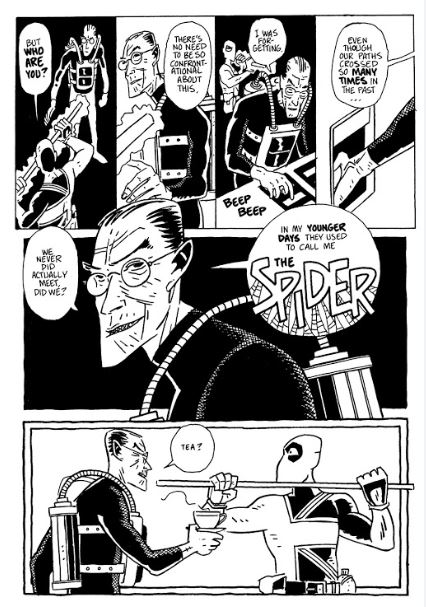
A far larger part is played by incomparable poacher turned gamekeeper The Spider in second story-arc ‘Secrets, Shadows and the Spider!’ as things go quirkily cosmic after Becky Burdock, Vampire Reporter and the increasingly intriguing Q cops stumble into real X Files territory and we get some welcome background into recent history when a 1960s super-criminal starts stealing again.

Or does he? The Spider never shot anybody before…

The mystery is cleared up when elderly Alfred Chinard (it’s a partial anagram – work it out…) hires builder John Smith and springs a trap on his old foe before they notionally team up to stop the real thief. Of course, it doesn’t really go Jack’s way and he’s literally left holding the bag. After a full-length Q adventure ‘Quotations’ involving a meta-fictional serial killer, ‘Out of Time’ rounds out the book (and don’t forget there are three sequels…).

Here, Victorian showman and escapologist Charlie Raven (a canny reworking of period masterpiece Janus Stark) enters the picture, encountering a Dorian Gray-like mystery and losing a battle to a foe who consumes time itself. As a result, charismatic Raven endures an Adam Adamant moment and ends up in 21st century Castletown, where his enemy is still predating the human populace. Also causing trouble is Ben Kulmer – the invisible bandit known as The Claw (and lovingly homaging Ken Bulmer, Tom Tully & Jesús Blasco’s astounding antihero The Steel Claw).

When that nice Mr. Chinard turns up again the stage is set for a spectacular time-rending chronal clash involving the entire expansive cast that is spectacular, boldly bewildering and superbly satisfying.

The stark yet inviting monochrome design, refined, honed and pared down to minimalist approachability has an inescapable feeling of Europe about it. If ever anyone was to create a new TinTin adventure, Grist would be the ideal choice to draw it. Not because he draws like Hergé, but because he knows his craft as well as Hergé did. However, I’m deliriously happy that he has so brilliantly assimilated the essences of cherished keystones of my beloved comics-consuming past and given them such a vital and compelling fresh lease of life.

Thrilling, funny, fabulous. Buy this Book!
™ & © Paul Grist. All rights reserved.

Today in 1952 writer Gerry Conway was born, as was Alison Bechdel in 1960. We’ve done some but hardly all of their many works and we’ll be adding to that list soon.

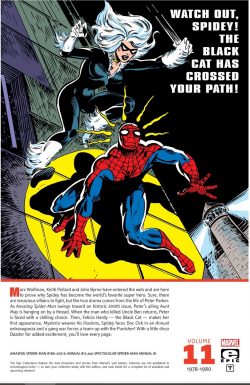
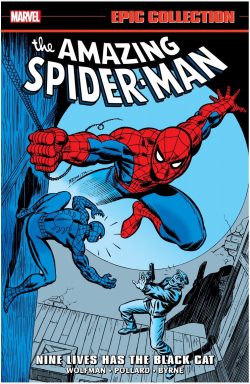
The Amazing Spider-Man Epic Collection volume 11: Nine Lives Has the Black Cat (1978-1980)


By Marv Wolfman, Bill Mantlo, Roger Stern, David Michelinie, Jim Starlin, Keith Pollard, John Byrne, Rich Buckler, Sal Buscema, Al Milgrom, Jim Mooney, Mike Esposito, Frank Giacoia, Terry Austin, Gene Day, Pablo Marcos, Bob McLeod, Frank Springer, Marie Severin, Alan Kupperberg & various (MARVEL)
ISBN: 978-1-3029-5641-7 (TPB/Digital edition)

Win’s Christmas Gift Recommendation: Spectacular Seasonal Spider Sensationalism … 8/10

This book includes Discriminatory Content produced in less enlightened times.

Peter Parker was a smart yet alienated kid when he was bitten by a radioactive spider during a school science trip. Developing astonishing arachnid abilities – which he augmented with his own natural chemistry, physics and engineering genius – the boy did what any lonely, geeky nerd would do with such newfound prowess: he tried to cash in for girls, fame and money.

Making a costume to hide his identity in case he made a fool of himself, Parker became a minor media celebrity – and a criminally self-important one. To his eternal regret, when a thief fled past him one night, the cocky teen didn’t lift a finger to stop him. When Parker returned home he learned that his beloved guardian uncle Ben Parker had been murdered.

Crazed with a need for vengeance, Peter hunted the assailant who had made his beloved Aunt May a widow and killed the only father he had ever known, finding, to his horror, that it was the self-same felon he had neglected to stop. His irresponsibility had resulted in the death of the man who raised him, and the traumatised boy swore to forevermore use his powers to help others…

Since that night he has tirelessly battled miscreants, monsters and madmen, with a fickle, ungrateful public usually baying for his blood even as he perpetually saves them, and by the time of the tales in this full-colour compendium of web-spinning adventures the wondrous wallcrawler was a global figure and prime contender for the title of the World’s Most Misunderstood Hero. Spanning November 1978 to July 1980, chronologically re-presenting Amazing Spider-Man #186-206, Annual #13 & Spectacular Spider-Man Annual #1 the transformative tales are an attempt to reconcile the tragic, ill-fated young man with the changing world of the fast-approaching, take-no-prisoners 1980s; and regrettably they don’t always succeed in our hindsight-equipped 21st century eyes…

Previously: old girlfriend and current neurotic stranger Betty Brant-Leeds returned after fleeing a dying marriage. She was absorbed with nostalgic notions to rekindle old flames with first love Peter Parker, but that mature-&-moved-on, almost-college-graduate’s social life was already deeply out of control. For his arachnid alter ego life involved constant attacks especially from increasing out-of-whack J. Jonah Jameson who funds yet another fringe science secret scheme to trap Spider-Man…

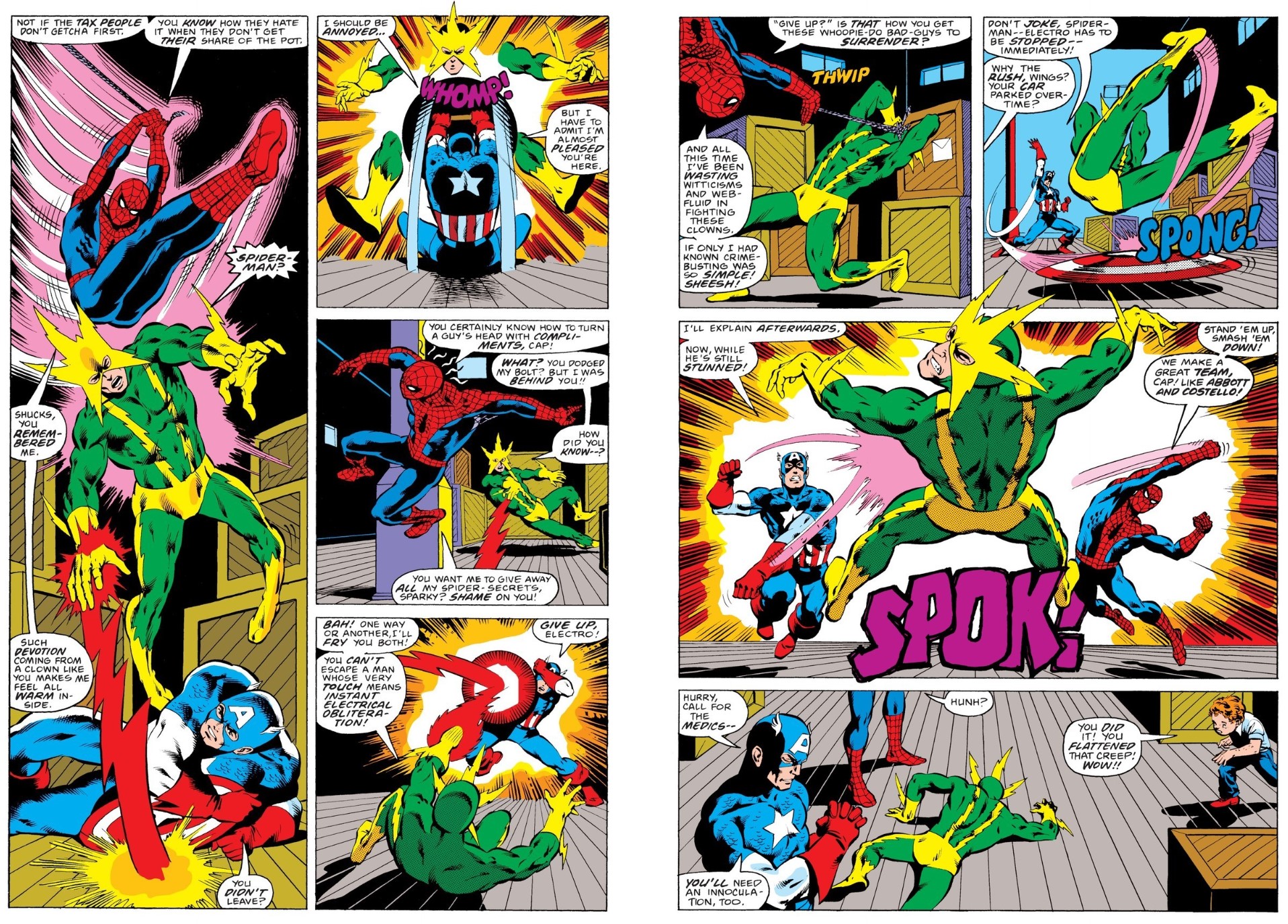
At this time a star of (1970s) television, the webslinger’s adventures were downplaying traditional fantasy elements as Keith Pollard became penciller for #186. Now, ‘Chaos is… the Chameleon!’ sees the devious disguise artist seeking to discredit the webslinger, even as District Attorney Blake Tower works to dismiss all charges against him, and is followed by a moody tale of lockdowns and plague as Spider-Man and Captain America unite to stop a voltaic villain inadvertently using ‘The Power of Electro!’ (Marv Wolfman, Jim Starlin & Bob McLeod) to trigger a biological time bomb…

Ruthlessly violent thugs are on the rampage next as ASM #188 depicts ‘The Jigsaw is Up!’ (illustrated by Pollard & Mike Esposito) after the river party cruise Peter, his pals and increasingly insistent Betty are enjoying is hijacked. Jameson’s secret then gets out to inflict ‘Mayhem by Moonlight!’ in a sharp two-part shocker limned by John Byrne & Jim Mooney. Exploited by malign and dying science rogue Spencer Smythe, Jonah is abducted by his own monster-marked son John leaving the wallcrawler ‘In Search of the Man-Wolf!’ Forced to witness the (presumed) death of his child at his worst enemy’s hands leads to a savage confrontation with Smythe’s Spider-Slayer robots in ‘Wanted for Murder: Spider-Man!’ (#191 by Pollard & Esposito) before all Jonah’s debts are paid and another death results after Spidey & Jonah are bound to the same bomb and given ‘24 hours Till Doomsday!’

Eluding doom by the skin of their shackled wrists, a new phase in the Jonah’s psychotic enmity begins in ASM #193’s ‘The Wings of the Fearsome Fly!’ with Wolfman, penciller Keith Pollard and inker Jim Mooney recapping how would-be Spider-Slayer Spencer Smythe had handcuffed JJJ to his despised bête noir Spider-Man in an explosive deathtrap and how that drew mutual old enemy The Fly as well as causing the death of John Jameson in his monster form of the ferociously feral Man-Wolf

Peter is most disturbed by a half-remembered moment. In that clash Jonah might have peeked under the arachnid’s mask whilst the wallcrawler was briefly unconscious, and not knowing is driving Parker crazy. The loss of his son has absolutely unhinged the publisher, however, and, after firing Peter, Jonah swears to destroy Spider-Man, even as Peter dutifully hunts down the Fly. He finally finds him robbing the Metropolitan Museum of Art and succumbs to an opportunity to release his pent-up anger. It ends badly…

In the aftermath, another plot strand resurfaces as Ned Leeds show up and punches Parker out. The incensed reporter thinks its justifiable as his (recently estranged) wife Betty has been nostalgically and aggressively pursuing old flame Peter. Meanwhile at May Parker’s empty house, a strangely familiar figure is tearing walls down hunting for something. After eventually giving up, he moves on to the Restwell Nursing Home where the widow Parker currently resides… and finds a situation he can readily exploit…

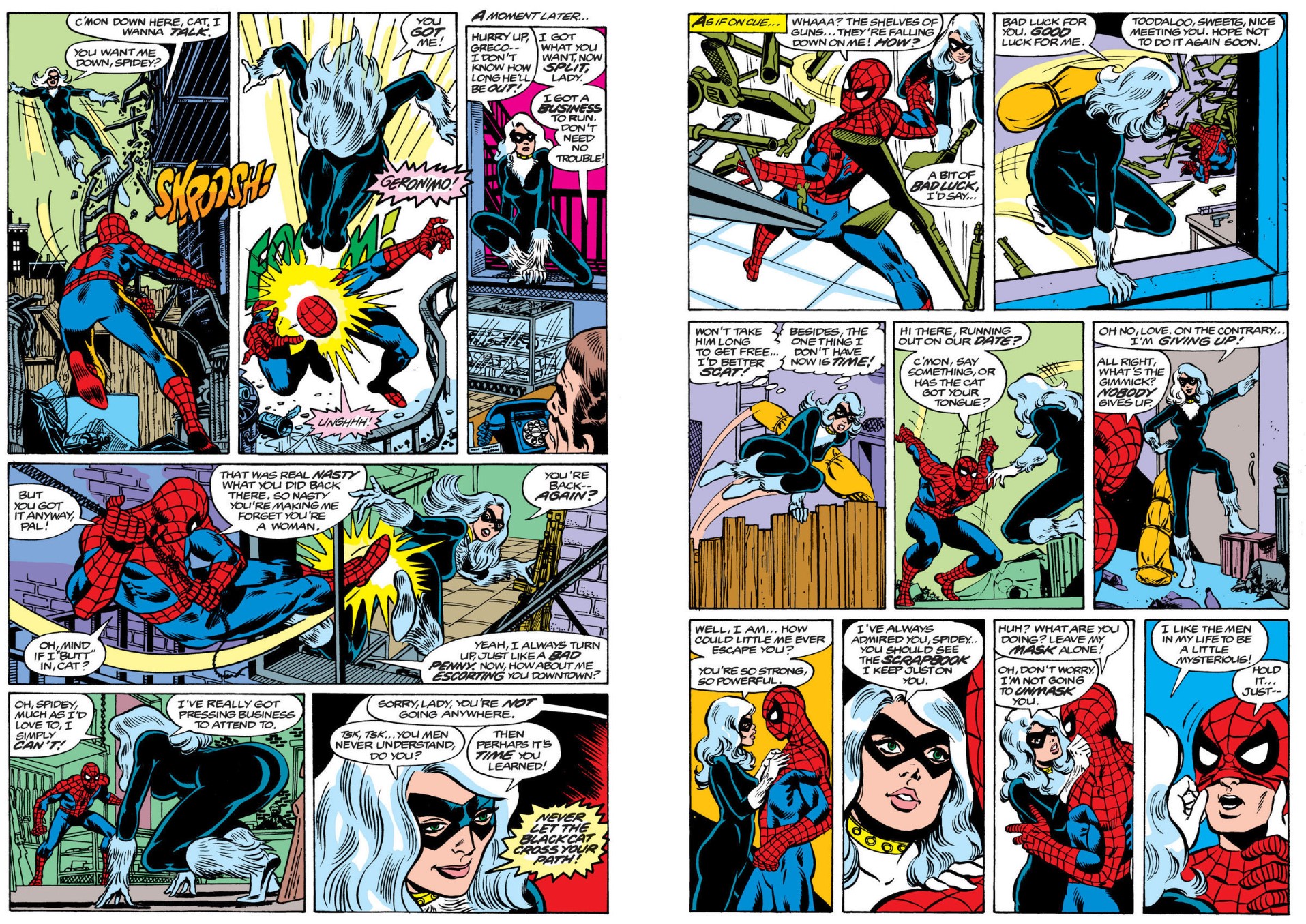
With life in turmoil Peter is poorly prepared for the major change that begins in #194, painfully learning ‘Never Let the Black Cat Cross Your Path!’ after encountering a svelte femme fatale costumed jewel thief with luck always on her side. However, she seems to have forsaken profit for a new, darker agenda. Inked by Frank Giacoia, the tale sees her recruit a crew to break someone out of jail, and – despite an obvious (and mutual) attraction to sexy Spidey – she will let nothing stop her…

Now working as a photographer for rival paper the Daily Globe where he immediately sparks the curiosity of reporter April Maye, Peter continues to pursue the feline felon in a chase to disaster, quickly realising ‘Nine Lives Has the Black Cat!’ (collectively inked by “M. Hands” Mooney, Mike Esposito & Al Milgrom). This affords an origin for the curvaceous crook and culminates in shocking news for Peter…

I’d normally give lip service here to “spoilers” and indeed back then, the death of Aunt May was – for a brief moment – a big deal, but it wasn’t real and didn’t last long. In-world though, Peter is crushed by the loss of his last relative and only family, with ‘Requiem!’ – limned by Milgrom, Mooney & Frank Giacoia – seeing him shattered by her “peaceful passing” whilst he was elsewhere, and at this moment still blithely unaware of a plot by unctuous home director Dr. Rinehart. Many older fans had already clocked who he really was…

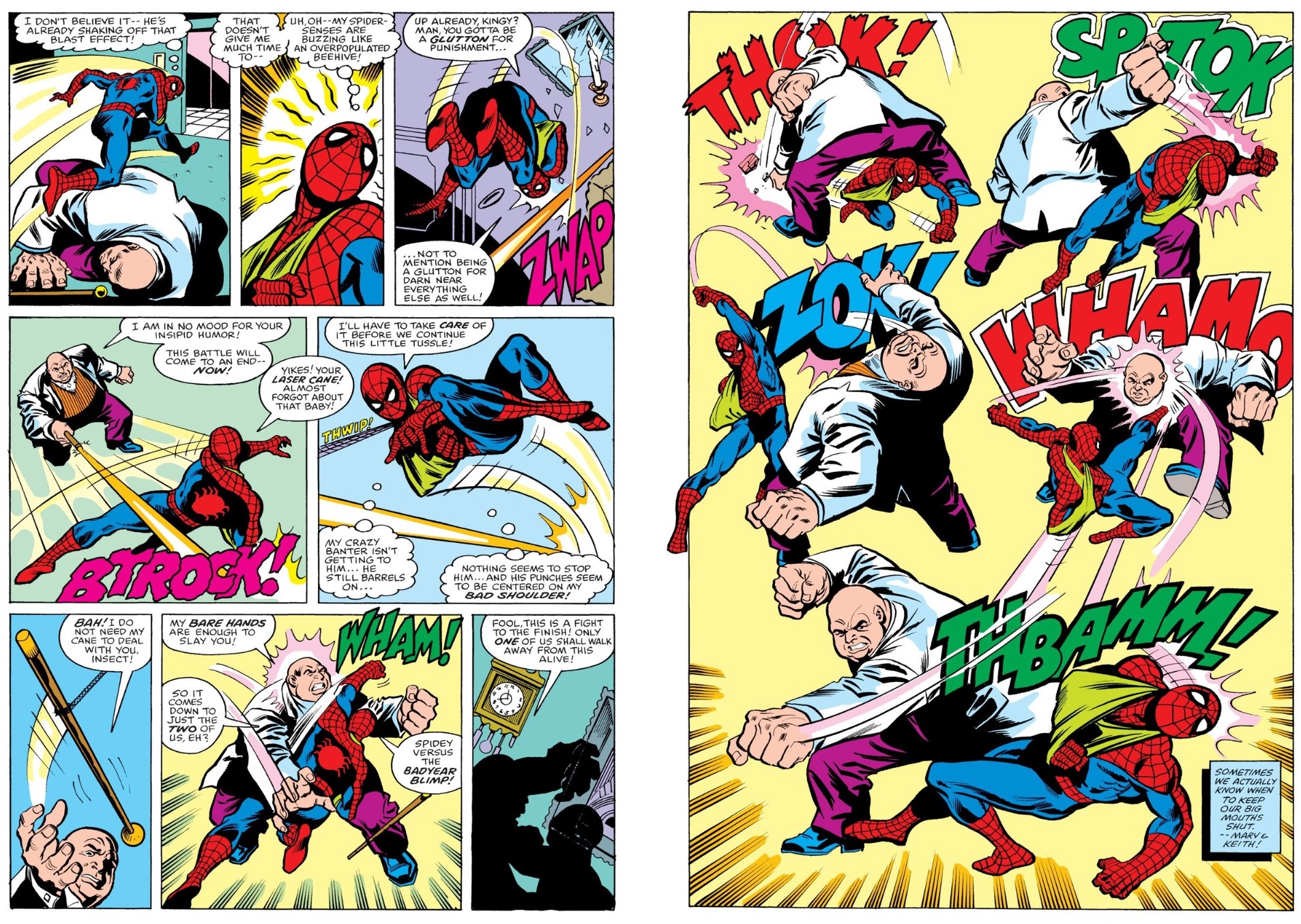
Dazed and reeling, the hero is just starting to suspect something isn’t right as he’s ambushed by thugs and dragged to ‘The Kingpin’s Midnight Massacre!’ in ASM #197. Here Wolfman, Pollard & Mooney show the soon-to-be-retired crime lord packing to leave and up against an immovable deadline. To please his beloved wife Vanessa, the villain will cease his illegal activities at the witching hour. All that’s left on his to-do list is to kill Spider-Man, but the clock’s ticking and the wallcrawler just won’t die…

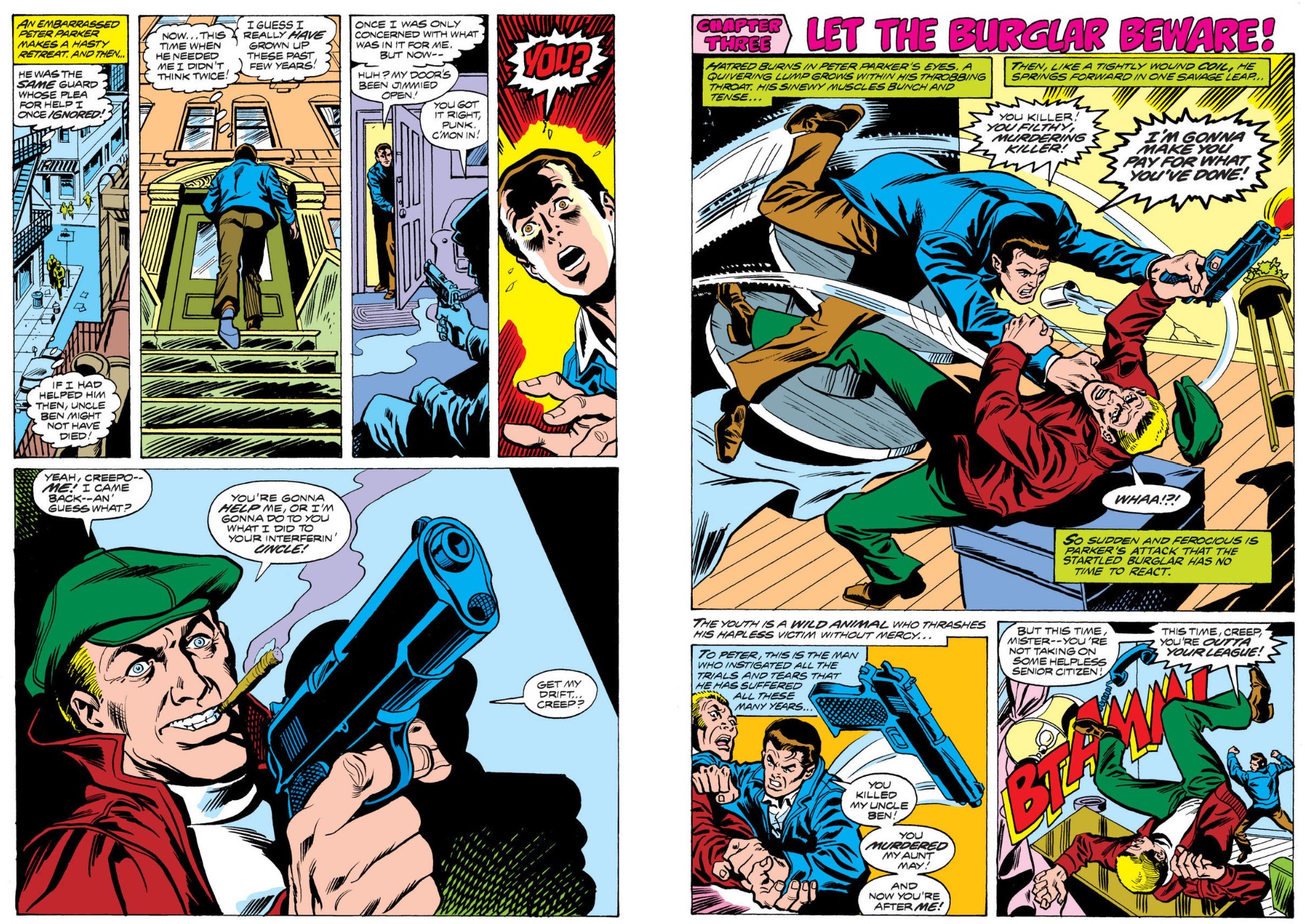
Building up to the anniversary spectacular and illustrated by Sal Buscema & Mooney, most dangling plot threads start cleaving together when Peter realises who Rinehart actually is and bursts into the Restwell Home in ‘Mysterio is Deadlier by the Dozen!’ to find the master of illusion preying on sundowning oldsters and teamed up with the burglar who shot Uncle Ben. Out of jail and desperate to retrieve something long hidden in the Parker house, the long-discarded thug has hijacked Mysterio’s comfortably risk-free scam and attracted the wrath of a really, really angry Spider-Man…

Despite fighting back fiercely in ‘Now You See Me! Now You Die!’ the writing is truly on the wall for the now-at-odds bad guys who meet their fates in The Amazing Spider-Man #200’s extra-length conclusion ‘The Spider and the Burglar… A Sequel!’ – cover dated January 1980 and courtesy of Wolfman, Pollard & Mooney.

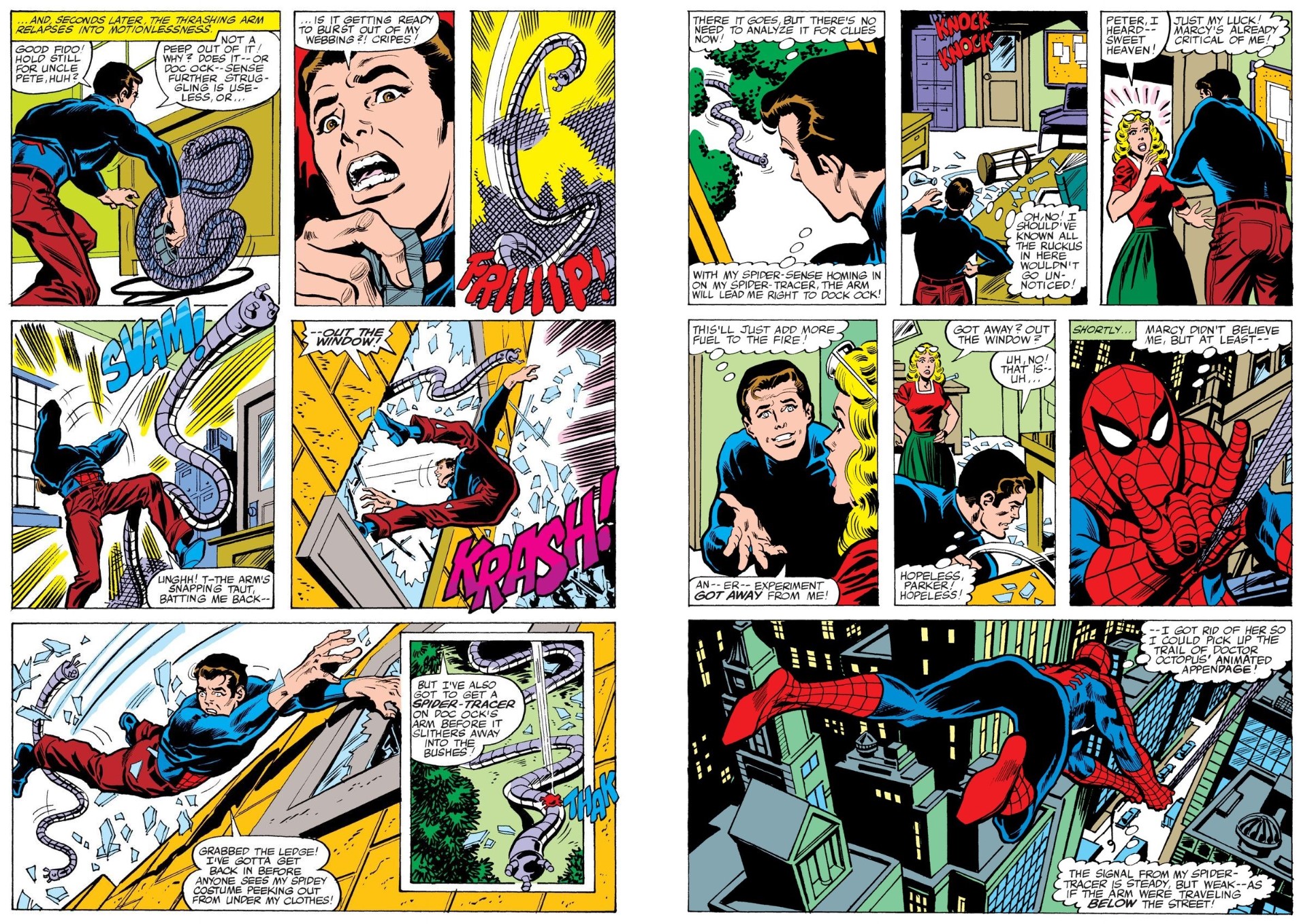
With the truth out and May restored, Peter is ready for whatever the future holds as we segue into The Amazing Spider-Man Annual #13 where Wolfman, Byrne & Terry Austin occupy ‘The Arms of Doctor Octopus’ with a murderous scheme to regain his underworld reputation and dominance. The plot is brought to Spider-Man’s attention by murdered federal agent Kent Blake, who blackmails the hero into going undercover in the gang to recover stolen plans and ends with a catastrophic clash that sees the villain maimed…

Although momentarily defeated, Ock isn’t finished with New York or Spider-Man, and the saga continues and concludes in the first annual of a companion Spider-title. Before that, though, Annual traditions are upheld by additions to ongoing feature ‘A Gallery of Spider-Man’s Most Famous Foes’. Rendered by Pollard, the roster expands for The Molten Man, The Looter, The Rhino, The Shocker, The Kingpin, Silverman and Man-Mountain Marko, The Prowler and The Kangaroo before ending on ‘A Mighty Marvel Bonus’ offering updated locations and floorplans for ‘Peter Parker’s Pad!’, The Daily Bugle & Daily Globe offices and Empire State University Campus – and Peter’s colleagues.

The Spectacular Spider-Man Annual #1 details the denouement in ‘And Men Shall Call Him… Octopus!’ as Bill Mantlo, Rich Buckler & Mooney follow a furious and confused webslinger who uses Ock’s severed metal tentacle to lure the near-insane-with-pain-&-shock villain into a cataclysmic showdown aboard a ship’s graveyard in the East River and apparently final clash in an undersea base…

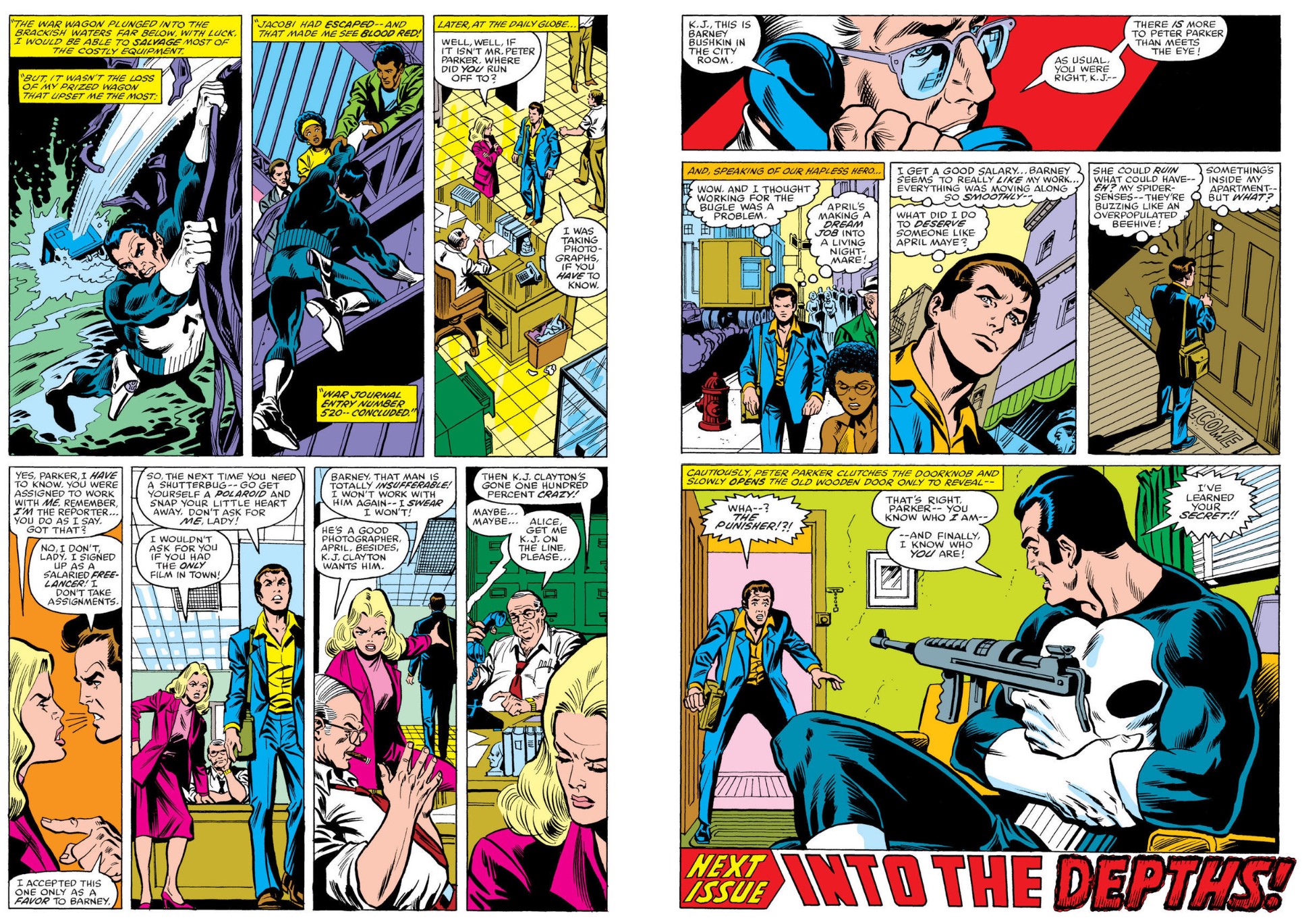
Dried out and back to business basics, the hero’s journey resumes in ASM 201’s ‘Man-Hunt!’ as Wolfman, Pollard & Mooney reunite the hero with The Punisher, whose hunt for a gang boss turns up a suspicious connection between photo seller Parker and his star subject Spider-Man…

Further muddying the waters is the latest woe to befall Jonah, whose nervous collapse devolves into pure mania, prompting his escape into delusion and the city’s back alleys. Guilt-ridden Parker can’t do much for his favourite gadfly, but can send Frank Castle on an identity-saving wild goose chase, before helping to deal with his latest target in concluding chapter ‘One For Those Long Gone!’

More infomercial than adventure – and probably a deadline-busting fill-in – Amazing Spider-Man #203 is one huge plug for Marvel’s disco sensation as Wolfman, Pollard, Esposito & Friends introduce Spider-Man to mutant musician Dazzler. The siren songstress is being hunted by old arachnid foe Lightmaster who needs her energies to bust him free of the light dimension that holds him captive but fails again in ‘Bewitched, Bothered and B-Dazzled!’

Another strong independent woman (re)appears in Pablo Marcos inked #204, as Wolfman signs off with ‘The Black Cat Always Lands on her Feet!’ Here the presumed-dead super thief returns to steal a selection of romance-themed art, and Spidey’s pursuit is the bandit’s actual goal. As seen in #205’s David Michelinie, Pollard & Mooney conclusion ‘…In Love and War!’, second generation purloiner Felicia Hardy has become fixated on the enigmatic masked man and stealing these items is her way of wooing the wallcrawler. Just for a change, this is a challenge requiring Parker’s mind and empathy, not Spider-Man’s might…

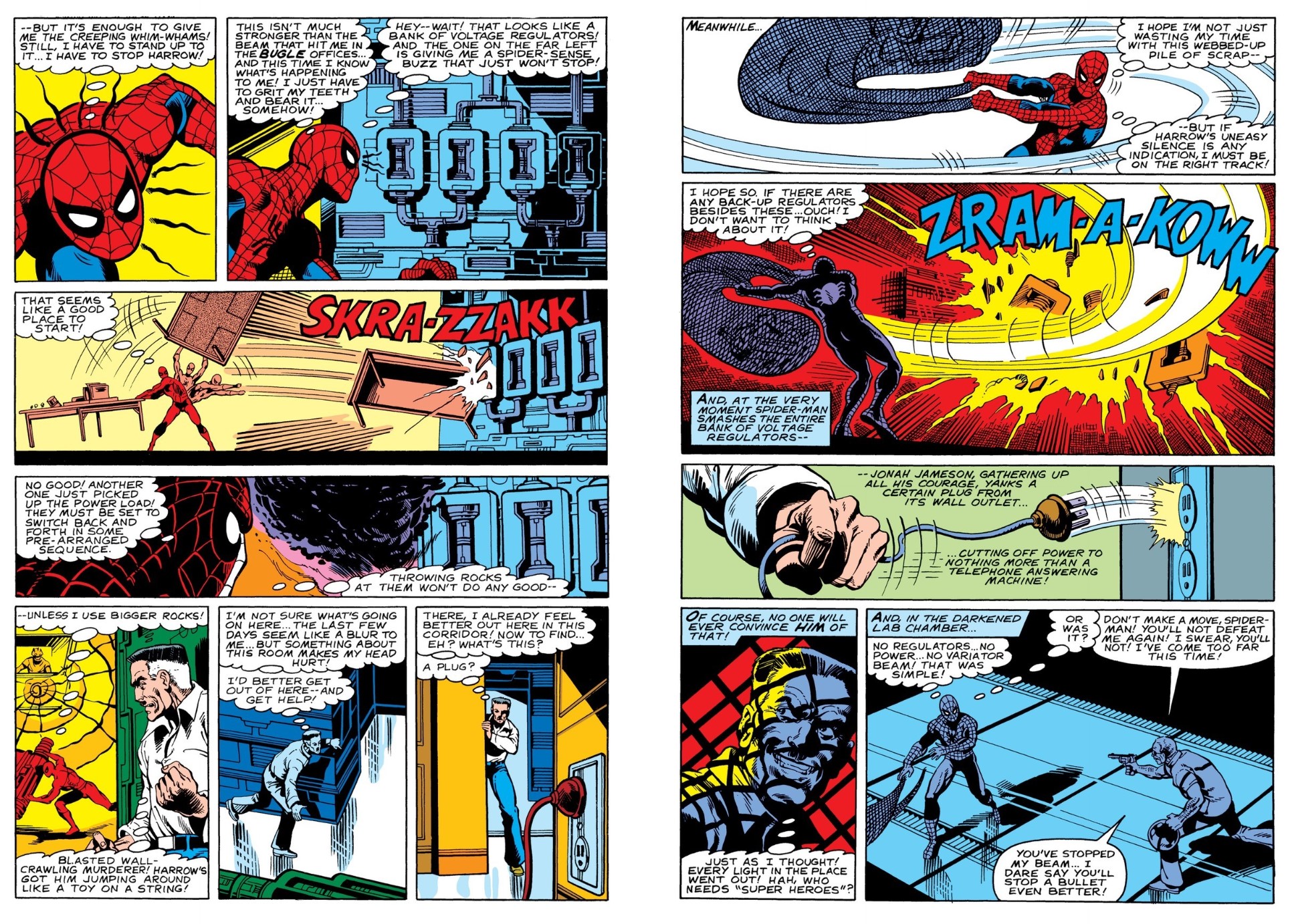
With an increasingly angry and unstable Joe Robertson replacing a lost amnesiac Jameson at the Daily Bugle, ASM #206 sees Roger Stern, John Byrne & Gene Day resolve the saga of his breakdown in closing inclusion ‘A Method in his Madness!’ Here it’s revealed that rogue scientist Dr. Jonas Harrow (who remade sundry second-rate thugs into super-foes like Will-O’the-Wisp, Kangaroo and Hammerhead) had turned the publisher’s office into a testing ground for his fringe science. Now that his Mental Attitude-Response Variator ray has driven Jonah to the edge of madness, Harrow plans to turn it on Spider-Man himself, but one last test on the entire Bugle staff gives our hero a heads-up and leads to the devil doctor’s defeat…

With covers throughout from Milgrom, Pollard, John Romita Sr., Buckler, McLeod & Josef Rubinstein, this tome also offers a selection of original art by Pollard with Mooney, Frank Giacoia and Byrne & Austin; Carmine Infantino & Steve Leialoha’s unused cover to Spider-Woman #9 where Wolfman originally intended Black Cat to debut, and Dave Cockrum’s revamped design for her as well as an unused Pollard & McLeod cover for ASM #194 and Cockrum’s rough for the cover they finally used. Completing the extras are House ads for forthcoming landmark ASM #200.

These yarns confirmed Spider-Man’s growth into a global multi-media brand. Blending cultural veracity with superb art, and making a dramatic virtue of the awkwardness, confusion and imputed powerlessness most of the readership experienced daily, resulted in an irresistibly intoxicating read, especially when delivered in addictive soap-styled instalments, but none of that would be relevant if Spider-Man’s stories weren’t so utterly entertaining. This action-packed collection relives many momentous and crucial periods in the wallcrawler’s astounding life and is one all Fights ‘n’ Tights fanatics must see…
© 2025 MARVEL.

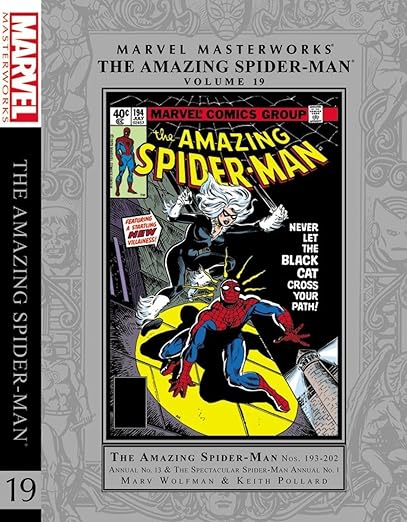
The Amazing Spider-Man Marvel Masterworks volume 19


By Marv Wolfman, Bill Mantlo, Keith Pollard, Al Milgrom, Sal Buscema, John Byrne, Rich Buckler, Jim Mooney, Frank Giacoia, Marie Severin, Mike Esposito, Terry Austin, & various (MARVEL)
ISBN: 978-1-3029-0339-8 (HB/Digital edition)

This book includes Discriminatory Content produced in less enlightened times.

Peter Parker was a smart yet alienated kid when he was bitten by a radioactive spider during a school science trip. Developing astonishing arachnid abilities – which he augmented with his own natural chemistry, physics and engineering genius – the boy did what any lonely, geeky nerd would do with such newfound prowess: he tried to cash in for girls, fame and money.

Making a costume to hide his identity in case he made a fool of himself, Parker became a minor media celebrity – and a criminally self-important one. To his eternal regret, when a thief fled past him one night, the cocky teen didn’t lift a finger to stop him. When Parker returned home he learned that his beloved guardian uncle Ben Parker had been murdered.

Crazed with a need for vengeance, Peter hunted the assailant who had made his beloved Aunt May a widow and killed the only father he had ever known, finding, to his horror, that it was the self-same felon he had neglected to stop. His irresponsibility had resulted in the death of the man who raised him, and the traumatised boy swore to forevermore use his powers to help others…

Since that night he has tirelessly battled miscreants, monsters and madmen, with a fickle, ungrateful public usually baying for his blood even as he perpetually saves them…

A newly-minted star of live action television, Spider-Man’s adventures generally still downplayed traditional fantasy elements at the time of the yarns packing this 19th fabulous collection of web-spinning wonderment. The wondrous wallcrawler was a global figure and prime contender for the title of the World’s Most Misunderstood Hero and here, covering June 1979 to March 1980, are the chronologically re-presented contents of Amazing Spider-Man #193-202, and a combined story that spanned Amazing Spider-Man Annual #13 and The Spectacular Spider-Man Annual #1. The transformative tales are preceded by an appreciative appraisal and reminiscence from writer/editor Marv Wolfman in his Introduction.

The graphic action kicks off with #193’s ‘The Wings of the Fearsome Fly!’ with Wolfman, penciller Keith Pollard and inker Jim Mooney recapping how would-be Spider-Slayer Spencer Smythe had handcuffed J. Jonah Jameson and his despised Bête noir Spider-Man together in an explosive deathtrap that drew old enemy the Fly and resulted in the death of Jonah’s son John, albeit in his monster form as the ferociously feral Man-Wolf

In that clash Jonah might have peeked under the arachnid’s mask whilst the wallcrawler was unconscious, and the not knowing is driving Parker crazy. The loss of his son has absolutely unhinged the publisher, however, and after firing Peter, he swears to destroy Spider-Man, even as Peter dutifully hunts down the Fly and finally finds him robbing the Metropolitan Museum of Art. It’s an opportunity to release his pent-up anger but ends badly…

In the aftermath, another plot strand resurfaces as Ned Leeds returns and punches Parker out. The reporter thinks its justifiable as his (recently estranged) wife – the former Betty Brant –has been nostalgically and aggressively pursuing old flame Peter, making Parker’s social life even more deeply complicated and exhausting…

Meanwhile at May Parker’s empty house, a strangely familiar figure is tearing the walls down hunting for something. After eventually giving up he then moves on to the Restwell Nursing Home where the widow Parker currently resides… and finds a situation he can readily exploit…

With life in turmoil Peter is poorly prepared for the major change that begins in #194 as he painfully learns ‘Never Let the Black Cat Cross Your Path!’ after encountering a svelte femme fatale costumed jewel thief with luck always on her side. Sadly, she seems to have forsaken profit for a new darker agenda. Inked by Frank Giacoia, the tale sees her recruit a crew to break someone out of jail, and – despite an obvious and mutual attraction – she will let nothing, not even sexy Spidey – stop her…

Now working as a photographer for rival paper the Daily Globe and immediately sparking the curiosity of reporter April Maye, Peter continues to pursue the feline felon in a chase to disaster, but soon realises ‘Nine Lives Has the Black Cat!’ (collectively inked by “M. Hands” Mooney, Mike Esposito & Al Milgrom) thereby affording an origin for the curvaceous crook and culminating in shocking news for Peter…

I’d normally give lip service here to “spoilers” and indeed back then, the death of Aunt May was a big deal for a brief moment, but it wasn’t real and didn’t last long. In-world however, Peter is crushed by the death of his last relative and only family, with ‘Requiem!’ – limned by Milgrom, Mooney & Frank Giacoia – finding him shattered by her “peaceful passing” whilst he was elsewhere, and blithely unaware of a plot by unctuous home director Dr. Rinehart. Many older fans had already clocked who he really was…

Dazed and reeling, the hero is just starting to suspect something isn’t right as he’s ambushed by thugs and dragged to ‘The Kingpin’s Midnight Massacre!’ in ASM #197. Here Wolfman, Pollard & Mooney show the soon-to-be-retired crime lord packing to leave and up against an immovable deadline. To please his beloved wife Vanessa, the villain will cease all his illegal activities at the witching hour. All that’s left on his to-do list is to kill Spider-Man, but the clock’s ticking and the wallcrawler just won’t die…

Building up to the anniversary spectacular and illustrated by Sal Buscema & Mooney, most dangling plot threads begin cleaving together as Peter realises who Rinehart actually is and bursts into the Restwell Home in ‘Mysterio is Deadlier by the Dozen!’ to find the master of illusion preying on sundowning oldsters and teamed up with the burglar who shot Uncle Ben. Out of jail and desperate to retrieve something long hidden in the Parker house, the long-discarded thug has hijacked Mysterio’s comfortable scam and attracted the wrath of a really, really angry Spider-Man…

Despite fighting back fiercely in ‘Now You See Me! Now You Die!’ the writing is truly on the wall for the now-at-odds bad guys who meet their fates in The Amazing Spider-Man #200’s extra-length conclusion ‘The Spider and the Burglar… A Sequel!’ cover dated January 1980 and courtesy of Wolfman, Pollard & Mooney.

With the truth out and May restored, Peter Parker is ready for whatever the future holds as we segue into The Amazing Spider-Man Annual #13 where Wolfman, John Byrne & Terry Austin occupy ‘The Arms of Doctor Octopus’ with a murderous scheme to regain his underworld reputation and dominance. The plot is brought to Spider-Man’s attention by murdered federal agent Kent Blake, who blackmails the hero into going undercover in the gang to recover stolen plans and ends with a catastrophic clash that sees the villain maimed…

Although momentarily defeated, Ock isn’t finished with New York or Spiderman, and the saga continues and concludes in the first annual of the companion Spider-title.

Before that though, the Annual traditions are upheld by additions to the ongoing feature ‘A Gallery of Spider-Man’s Most Famous Foes’. Rendered by Pollard, the roster adds here The Molten Man, The Looter, The Rhino, The Shocker, The Kingpin, Silverman and Man-Mountain Marko, The Prowler and The Kangaroo before ending on ‘A Mighty Marvel Bonus’ offering updated locations and floorplans for ‘Peter Parker’s Pad!’, The Daily Bugle & Daily Globe offices and Empire State University Campus – and Peter’s colleagues.

The Spectacular Spider-Man Annual #1 details the denouement in ‘And Men Shall Call Him… Octopus!’ with Bill Mantlo, Rich Buckler & Mooney following the furious and confused webslinger who uses a severed metal tentacle to lure the near-insane-with-pain-&-shock Doc Ock into a cataclysmic showdown aboard a ship’s graveyard in the East River and apparently final clash in an undersea base…

Dried out and back to business basics, the hero’s journey resumes in ASM 201’s ‘Man-Hunt!’ as Wolfman, Pollard & Mooney reunite the wallcrawler with The Punisher whose hunt for a gang boss turns up a suspicious connection between photo seller Parker and his star subject Spider-Man…

Further muddying the waters is the latest woe to befall Jonah, whose nervous collapse now devolves into pure mania, prompting his escape into delusion and the streets of the city. Guilt-ridden Parker can’t do much for his favourite gadfly, but at least he can send Frank Castle on an identity-saving wild goose chase. And help deal with his latest target in concluding chapter ‘One For Those Long Gone!’

To Be Continued…

With covers by Milgrom, Pollard, John Romita Sr., Buckler, Bob McLeod & Josef Rubinstein, this tome also offers a selection of original art by Pollard with Mooney, Frank Giacoia and Byrne & Austin; Carmine Infantino & Steve Leialoha’s unused cover to Spider-Woman #9 where Wolfman originally intended Black Cat to debut, and Dave Cockrum’s revamped design for her as well as an unused Pollard & McLeod cover for ASM #194 and Cockrum’s rough for the cover they finally used. Completing the extras are House ads for forthcoming landmark ASM #200.

These yarns confirmed Spider-Man’s growth into a global multi-media brand. Blending cultural veracity with superb art, and making a dramatic virtue of the awkwardness, confusion and imputed powerlessness most of the readership experienced daily resulted in an irresistibly intoxicating read, especially when delivered in addictive soap-styled instalments, but none of that would be relevant if Spider-Man’s stories weren’t so utterly entertaining. This action-packed collection relives many momentous and crucial periods in the wallcrawler’s astounding life and is one all Fights ‘n’ Tights fanatics must see…
© 2017 Marvel Characters, Inc. All rights reserved.

22nd George Herriman was born today in 1880. If you also want to learn about him, our most recent review of his magic can be found here.

DC Finest: Hawkman volume 1 – Wings Across Time


By Gardner F. Fox, Bob Haney, Joe Kubert, Gil Kane, Murphy Anderson, Howard Purcell, Carmine Infantino & various (DC Comics)
ISBN: 978-1-79950-250-0 (TPB)

This book includes Discriminatory Content produced in less enlightened times.

Here’s another stunning compilation from the DC Finest line: full colour chronolgically curated collections delivering “affordably priced, large-size (generally around 600 pages) paperback collections” of past glories. Whilst concentrating on the superhero pantheon, there are and will also be assorted genre selections like horror and war books, and themed compendia.  

Sadly, none of these comics classics are available digitally, as were the last decade’s Bronze, Silver and Golden Age collections, but we live in hope and keep on whining…

Not all passions are romantic: mine is to finally have all old comics forever available in curated editions. These astoundingly engaging Silver Age tales are another joyous moment of past glories revisited highlighting one of the most effective and enduring romantic crime-busting, world-saving partnerships in comics…

With a superhero revival in full swing by 1961, Editorial mastermind Julius Schwartz turned to resurrecting one of DC’s most visually arresting and iconic Golden Age characters. Once again eschewing mysticism for science fiction (the original Hawkman was a reincarnated Egyptian prince murdered by a villainous priest who just kept coming back…), Schwartz picked scripter Gardner F. Fox who had created the Golden Age great and matched him with artist Joe Kubert to construct a new and contemporary hero for the Jet/Space Age.

This titanic tome at last gathers in full colour the works and deeds of the Winged Wonders as first seen in The Brave and the Bold #34-36 & 42-44 & 51; The Atom #7; Mystery in Space #87-90 and Hawkman #1-11: cumulatively spanning February/March 1961 to December 1965/January 1966.

Katar Hol and Shayera Thal are police officers on their own planet of Thanagar. The married couple have travelled to Earth from the star system Polaris in pursuit of a spree-thief named Byth who assaulted a scientist and stole a drug bestowing the ability to change into anything. Thus the scene was set in ‘Creature of a Thousand Shapes!’ which graced The Brave and the Bold #34 (cover-dated February/March 1961) back when the title was a try-out vehicle like Showcase. Disappointments aside, the origin yarn is a spectacular work of graphic magic, with the otherworldly nature of the premise rendered captivatingly human by the passionately emphatic, moody expressiveness of Kubert’s art. It is a minor masterpiece of comic storytelling, and still a darned good read.

The high-flying heroes returned in the next issue, now “temporarily” stationed on Earth to study Terran police methods. In ‘Menace of the Matter Master’ they defeat a plundering scientist who has discovered a means to control elements and indulge in super-larceny, before ‘Valley of Vanishing Men’ takes our fully-integrated visitors from another world to the Himalayas to unlock the astounding and ironic secret of the Abominable Snowmen. Last shot in the try-out session, B&B #36 sees them defeat modern day wizard Konrad Kazlak in ‘Strange Spells of the Sorcerer!’ and, soon after, save Earth from another Ice Age whilst outwitting ‘The Shadow Thief of Midway City!’

With the 3-issue audition over, the publishers sat back and waited for the fan letters and sales figures… and something odd happened: fans were vocal and enthusiastic, but the huge sales figures that previously accompanied such reactions just weren’t there. It was inexplicable. The quality of the work was plain to see on every page, but somehow not enough people had plunked down their dimes to justify an ongoing Hawkman series.

A year later DC tried again. The Brave and the Bold #42 (June/July 1962) featured ‘The Menace of the Dragonfly Raiders’ which found Katar & Shayera returning to Thanagar just in time to encounter a bizarre band of alien thieves and the sinister hand of their oldest foe. Here was superhero action in a fabulous alien locale and the next issue maintained the exoticism – at least initially – before Hawkman and Hawkgirl returned to Midway City to defeat a threat to both worlds – ‘The Masked Marauders of Earth!’.

One last B&B issue followed (#44, October/November 1962) with two splendid and delightful short tales. ‘Earth’s Impossible Day!’ focused on Shayera’s desire to celebrate a holiday tradition of Thanagar before eerie doomsday thriller ‘The Men who Moved the World’ unearthed a lost civilisation and the return of Earth’s original occupiers seeking to move back again…

And then the Hawks vanished again. It certainly looked like this time the Schwartz magic had stumbled if not faltered. It was not, however, the end of the saga. Convinced he was right, Schwartz retrenched. Enjoying some success with his latest revival and mindful of the response when he had teamed Flash with Green Lantern in the summer of 1962, the editor had writer Fox include the Winged Wonder in The Atom #7 (cover-dated June/July 1963). An interplanetary thriller illustrated by Gil Kane & Murphy Anderson, ‘The Case of the Cosmic Camera!’ is a rocket-paced invasion rollercoaster ranging from the depths of space to Earth’s most distant past, where this new, clean-limbed version of the Avian Avenger clearly found fan-favour. In 1963 Hawkman returned! Again!

Mere months later, and dated November, Mystery in Space #87 had the Pinioned Paladin in action on the cover. The anthologogical sci fi standard had been the home of interstellar adventurer Adam Strange since #53, so now Schwartz moved his Winged Wonders into a plausible back-up slot and even bestowed occasional cover-privileges. Still beguilingly written by Fox, Kubert’s dark gritty art was superseded by the clean, graceful illustration of Anderson. Crime caper ‘The Amazing Thefts of the I.Q. Gang!’ dealt with a unexpected repercussion of an Adam Strange thriller and was followed a month later by ‘Topsy-Turvy Day in Midway City!’… a whimsical flourish as the cosmic couple’s devotion and Thangarian wedding customs lead to the capture of Terran bank bandits…

With the management now on board, guest appearances to maximise profile were easier to find. Hawkman returned to The Brave and the Bold with #51 (December 1963/January 1964) to team with Aquaman and face the ‘Fury of the Exiled Creature’ in a quirky tale of monsters, magic and mayhem in sunken Atlantis written by Bob Haney and illustrated by the criminally neglected Howard Purcell. Back in Mystery in Space #89 the ‘Super-Motorized Menace!’ proved the highest tech motor cycle is still no match for ancient weapons and alien  advantages…

These brief, engaging action pieces paled before the majesty and ambition of MiS #90 which delivered a full length epic uniting teaming the Hawks and Adam Strange in a legendary End-of the-World(s) epic. Illustrated by Carmine Infantino & Anderson, ‘Planets in Peril!’ was the last Hawkman back-up. From the next month, and after three years of trying, Hawkman soared into his own title.

Cover-dated April/May 1964, Hawkman #1 is a gem by Fox & Anderson. Two of the most visually arresting chracters in comics, the Hawks also boasted one of the most subtle and sophisticated relationships in the business. Like Sue & Ralph Dibney (Elongated Man and wife) Katar & Shayera are equal partners, and both couples were influenced by the Nick & Nora Charles characters of the Thin Man movies. Like those progenitors, the interplay of the Hols at home or at work is always rich in humour and warmth. In ‘Rivalry of the Winged Wonders’ – and whilst accommodatingly recapping their origins for newcomers, the couple decide to turn their latest case into a contest – Hawkgirl (eventually more appropriately called Hawkwoman) will use Thanagarian super-science to track and catch a band of thieves, whilst Hawkman limits himself to Earth techniques and tools to solving the crime.

This charmingly witty yarn is balanced by action thriller ‘Master of the Sky Weapons’ as recentlt resurrected ancient Mayan warrior Chac threatens Earth with disinterred alien super weapons. The the second issue stuck with star-stuff as the ‘Secret of the Sizzling Sparklers!’ offered an action-packed thriller of transdimensional invasion before closing with ‘Wings across Time!’: a mystery revolving around the discovery of the flying harness of legendary figure Icarus.

With “Carter & Shiera Hall” established as archeologists at Midway City Museum and Earth’s crypto-history & -zoology offering constant story-inspiration, another criminal brain-teaser opened the third issue. However, scientific bandits proved less of a menace than ‘The Fear that Haunted Hawkman’ with inexplicable panic attacks, before ordinary thugs and an extraordinary alien owl converged to make our heroes ‘Birds in a Gilded Cage’. Hawkman #4 then opened with a tale destined to revolutionise DC comics. ‘The Girl who Split in Two!’ introduced legacy hero Zatanna, daughter of a magician who fought crime in the 1940s only to “mysteriously disappear”…

From the very first issue, and for over a decade, Zatarra was a hero in the Mandrake mould who fought evil in the pages of Action Comics. During the Silver Age, Gardner Fox had Zatarra’s young, equally gifted daughter search for the missing mage, systematcally teaming up with superheroes he was currently scripting (if you’re counting, those tales appeared in Hawkman #4, The Atom #19, Green Lantern #42, and the Elongated Man strip from Detective Comics #355). A very slick piece of backwriting latterly included the high-profile Caped Crusader via Detective #336 – ‘Batman’s Bewitched Nightmare!’. The saga concluded in Justice League of America #51’s ‘Z… As in Zatanna… and Zero Hour!’). The collected saga Zatanna’s Search is currently out of print but you can go here for our take on it…

This wide, long-running experiment in continuity proved there was a dedicated fanbase with a voracious appetite for experimentation and relatively deep pockets. Most importantly, it finally signalled an end of the period where DC heroes largely lived and battled in self-imposed worlds of their own.

Hawkman #4 back-up ‘The Machine that Magnetized Men!’ is another enthalling howdunnit  tale as the Pinioned Paladins use reason and deduction to defeat thieves who are impossible to touch. For the next issue ‘Steal, Shadow… Steal!’ was the first full-length thriller, wherein ruthless Shadow Thief Carl Sands returns seeking revenge, believing causing Earth’s next Ice Age to be an acceptable consequence of his schemes, whilst in #6, publishing fashion caught up with the Hawks…

Another epic, and one that turned DC’s peculiar obsession with gorillas into a classic adventure, ‘World Where Evolution Ran Wild!’ lures our heroes to fabled Illoral, where a scientist’s explorations and interventions have stretched Natural Selection to un-natural limits. Bold, brash and daft in equal amounts, this is a fabulous romp and seeing again the cover where Hawkman struggles for his life against a winged gorilla makes the adult me realise those DC chaps might have known what they were doing with all those anthropoid covers!

By issue #7 (April/May 1965) the world was gripped in secret agent fever as the likes of James Bond, The Man from U.N.C.L.E., and a host of others snuck and sashayed across our screens. Comics were not immune,  even though spies had been a staple threat there for decades. Before Hawkman joined the gang, however, he had to deal with the rather mediocre threat posed by solar ray inspired criminal genius Ira Quimby and ‘The Amazing Return of the I.Q. Gang!’ As they were quickly returned to prison the Hawks faced the ‘Attack of the Crocodile-Men!’: a high-octane super-science thriller introducing C.A.W. – the Criminal Alliance of the World…

Another supremely captivating cover adorned #8, as the Hawks fought an ancient Roman Artificial Intelligence, built by not-so-mythical metalsmith Vulcan in ‘Giant in the Golden Mask!’, before defeating an alien Harpy who’d been buried for half a million years and promptly triggered a ‘Battle of the Bird-Man Bandits!’ as soon as she woke up…

Hawkman #9 saw The Atom as guest star when an old villain returned with a seemingly perfect revenge plan. Full-length super-thriller ‘Master Trap of the Matter Master!’ offered sheer superhero hi-jinks, after which #10 saw a playful Fox at his best in both ‘Hawkman Clips the Claws of C.A.W!’ This was another espionage drama with a delicious subplot as the Winged Wonder aids a sexy CIA agent with a big secret of her own – before solving ‘The Magic Mirror Mystery!’: a fair-play brainteaser with lots of high-flying action to balance the smart stuff.

This glorious volume closes with another superb full-length epic. Clearly designed as a so-fashionable “player on the other side”, ‘The Shrike Strikes at Midnight!’ leaving our heroes trailing a super-powered, winged bandit all over the world and on to the star system Mizar, in a gripping tale of crime, super-villainy, aliens, revolutions and even dinosaurs…

Although never the major player of his 1940s ancestor, Hawkman grew to be one of the most iconic characters of the second superhero boom, not just for the superb art but also because of a brilliantly sly, whimsically subtle writer with a huge imagination. These tales are comfortably familiar but also grippingly timeless. Thankfully, comics are a funny business; circumstances, tastes and fashions often mean that wonderful works are missed and unappreciated, but it aso means revivals are never too late. Don’t make the same mistake readers did in the 1960s. Whatever your age, read these astounding adventures and become a fan. It’s never too late.
© 1961, 1962, 1963, 1964, 1965, 1966, 2025 DC Comics. All Rights Reserved.

Eagle Classics: Harris Tweed – Extra Special Agent


By John Ryan (Hawk Books -1990)
ISBN: 978-0-94824-822-1 (album TPB)

This book includes Discriminatory Content produced in less enlightened times.

Happy anniversary Eagle!

The son of a diplomat and irrefutably a died-in-wool True Gent, John Ryan was born in 1921, served in Burma and India during WWII and – after attending the Regent Street Polytechnic (1946-48) – took up a teaching post as assistant Art Master at Harrow School from 1948 to 1955. It was during this time that he began contributing strips to comics such as Girl and a newfangled but soon to be legendary weekly comic…

On April 14th 1950, Britain’s grey, post-war gloom was partially lifted with the first issue of a glossy new comic that literally shone with light and colour. Mesmerised children were soon understandably enraptured with the gloss and dazzle of Dan Dare, Pilot of the Future, a charismatic star-turn venerated to this day, as well as a plethora of strips illustrating some of their favourite radio shows.

Eagle was a tabloid sized paper with full photogravure colour inserts alternating with text and a range of other comic features. Tabloid is a big page and you can get a lot of material onto each one. Deep within, on the bottom third of a monochrome folio was an 8-panel strip entitled Captain Pugwash, the story of a Bad Buccaneer and the many sticky ends which nearly befell him. Ryan’s quirky, spiky style also lent itself to the numerous spot illustrations required every week. Pugwash, his harridan of a wife and the useless, lazy crew of the Black Pig ran until issue #19 when the feature disappeared. This was no real hardship as Ryan had already begun writing and illustrating new feature Harris Tweed – Extra Special Agent which began as a full page (tabloid, remember – an average of 20 panels a page, per week) since #16 (cover-dated July 28th 1950).

Tweed ran for three years as a full page. Then in 1953 it dropped to a half-page strip and deftly repositioned as a purely comedic venture. For our purposes and those of the book under review, it’s those first three years we’re thinking of even if the only decent illustration I could find comes from the 1959 Eagle Annual

Harris Tweed was a bluff and blundering caricature of the military “Big Brass” Ryan had encountered during The War. In gentler times, the bumbler with a young, never-to-be-named assistant known only as “Boy” solved mysteries and captured villains to general popular acclaim. Thrilling – and often eerily macabre – adventure blended seamlessly with sly yet cheerful schoolboy low comedy in these strips, since Tweed was in fact that most British of archetypes: a bit of a twit and a bit of a sham stumbling through a world of Thud & Blunder…

His totally undeserved reputation as detective and crime fighter par excellence, and his good-hearted yet smug arrogance – as demonstrated elsewhere by the likes of Bulldog Drummond, Dick Barton – Special Agent, or Sexton Blake – somehow endeared the arrogant, posturing buffoon to a young and impressionable public which would in later years take to its heart Captain Mainwaring in Dad’s Army and, more pointedly perhaps, Peter Sellers’ numerous film outings as Inspector Clouseau. Maybe most of those enthralled kids had an uncle or dad who buffaloed on about the war in just the same way…

Ryan’s art here is particularly noteworthy. Deep moody blacks and intense, sharp, edgy inking creates a constant mood of fever-dream intensity. There are anachronistic echoes and nuances of underground cartoons of more than a decade later, and much of the inevitable ‘brooding, lurking horror’ atmosphere found in the best works of Basil Wolverton. Ryan knew what kids liked and he delivered it by the cartload.

This too-slim, oversized (324 x 234mm x) paperback compilation is all that’s readily available these days, but surely in the era of electronic publishing, some enterprising fan with a complete Eagle collection can link up with a perspicacious publisher someway, somehow and produce a comprehensive compilation of the nation’s most self-lauded sleuth? I simply KNOW today’s TV crowd and dwindling but still-potent ancient 10-year-olds and their grandchildren would just lap him up….
Harris Tweed © 1990 Fleetway Publications. Compilation © 1990 Hawk Books.