Batman’s Mystery Casebook


By Sholly Fisch, Christopher A. Uminga & various (DC Comics)
ISBN: 978-1-7795-0586-6 (TPB/Digital edition)

Win’s Christmas Gift Recommendation: Wonderfully Watching What’s What… 9/10

In recent years DC has opened up its shared superhero universe: generating Original Graphic Novels featuring its many stars in stand-alone adventures for the demographic so sadly misnamed Young Adult. To date, results have been rather hit or miss, but when they’re good, they are very good indeed…

Another sublime example of the process at its best is this cheery practical class in crimefighting: picking the brains and capitalising on the experience of Gotham’s greatest gangbusters and delivering details in the form of a comics activity book for all ages…

Author Sholly Fisch is no stranger to comics, having splendidly scripted Scooby Doo in various print incarnations and almost every DC superhero in All-New Batman: The Brave and the Bold and other animation-based spin-offs, Superman, Star Wars and so much more. When not doing that, he’s a developmental psychologist consulting for companies who make digital games and toys, with clients including Sesame Street, Cyberchase, The Magic School Bus Rides Again and The Cat in the Hat Knows a Lot About That. If you love fun superheroics and vintage comics trivia, you should seek out his work.

Cartoonist/designer/visualiser Christopher A. Uminga has worked for many media giants including DC Comics/Warner Bros., Lucasfilm, Foot Locker, Disney’s WonderGround Gallery and more, and is assisted in making this complex and arresting tome work by colourist Silvana Brys and lettering entity Andword Design (Morgan Martinez, Justin Birch & Deron Bennett)…

A quick word to the wise: Although for years DC’s mainstream continuity has depicted the Dark Knight as a driven and tormented borderline sociopath doing good for what seems to be all the wrong reasons, Batman has always been an archetype who works for all ages on vastly differing levels. This version is far more Caped Crimecrusher than Bat out of Hell, and reaffirms his reputation as “the World’s Greatest Detective” in a series of “fair play mystery” vignettes with the reader invited to pay close attention and participate at every moment of each case. Kids can enjoy alone or with the grandparents who watched the 1966 Batman TV phenomenon unfold and the parents who watched the 1990s movies and stunning Batman: The Animated Adventures series they spawned…

It begins in ‘Prologue: Whodunit?’ as Batman, Robin & Batgirl examine a crime scene and talk the readers through the clues left behind that lead to their deduction of the culprit…

With every reader fully briefed ‘Chapter 1: The Case of the Perilous Puzzles’ sees The Riddler running riot, obsessively dropping his verbal hints for us to solve, but don’t get so caught up that you miss the cunning visual clues scattered around since the Dynamic Duo might be too busy escaping death traps to spot them…

Each adventure is augmented by a quick lesson in historical criminology, deduction and data gathering (just like the old Dick Tracy Crime Stoppers feature) beginning with a foundation in forensic science courtesy of ‘Batcave Crime Lab: Crime Scene Investigation’ with Clayface inadvertently assisting enquiries…

Of course Two-Face stars in second chapter ‘The Case of the Dual Identity’ and the hunt offers many chances to study modus operandi before the boom is lowered, after which ‘Batcave Crime Lab: Fingerprints’ reveals the secrets of the ancient system…

World-weary cop Harvey Bullock and Catwoman are involved in third chapter ‘The Case of the Art Attack’ but Batgirl – and the reader! – can’t be rushed to hasty conclusions if they think things through, whilst ‘Batcave Crime Lab: Tracks’ offers a quick refresher on Locard’s Exchange Principle (weren’t you paying attention last chapter?) as we learn to watch where we – and everybody else – steps…

Bruce Wayne and Alfred Pennyworth show off their skills in civilian style for ‘The Case of the History Mystery’ which take us back to WWI and an encounter with Enemy Ace Hans von Hammer, augmented by some modern milestones in ‘Batcave Crime Lab: DNA’

We’re back in supervillain territory for chapter 5 as ‘The Case of the Cold Cash’ seems to prove chilly Mister Freeze is the bad guy… until our heroes take a closer look, complemented by the Terrific Trio taking stock of fraud in ‘Batcave Crime Lab: Fakes and Phonies’

Batgirl and Robin have their wits truly tested in ‘The Case of the Digital Ghost’ before ‘Batcave Crime Lab: Eyewitness Testimony’ wonderfully tests every reader’s memory and visual acuity – with helpful hints from Commissioner Gordon – as we rush to the conclusion in Chapter 7 as The Joker and Harley Quinn threaten appalling consequences for all in ‘The Case of the Perilous Parade’: a thrilling manhunt that literally demands your full attention…

‘Epilogue’ then provides a summation from Batman and a so-cool poster to declare “Case Closed!” on this vivid and vibrant anticrime primer… for now!

The caseload is done-in-one (hopefully only until we get a sequel and series puh-leeeze!) but this tome also offers a tantalising peek at Sara Farizan & Nicoletta Baldari’s Gotham-set tale of bullying and being the new kid My Buddy Killer Croc that’s also worth some of your time and attention…

Smart, compelling, brilliantly entertaining, astoundingly infectious and deliciously addictive, Batman’s Mystery Casebook is a superbly challenging activity and adventure romp packed with charm and wit to captivate fans and nervous neophytes alike: one introducing a new wondrous world with a rousing reminder that all is never as it seems…
© 2022 DC Comics. All Rights Reserved.

The Spider: Crime Unlimited


By Jerry Siegel, Donne Avenell, Aldo Marculeta, Giorgio Trevisan & various (Rebellion Studios)
ISBN: 978-1-78618-465-8 (HB/Digital)

Win’s Christmas Gift Recommendation: Bizarrely Bombastic Action Adventure… 8/10

Part of Rebellion’s Treasury of British Comics strand, The Spider: Crime Unlimited is a sublimely cool hardback collection celebrating an all-but forgotten sub-strand of the 1960s comics experience.

Until the 1980s, comics in the UK were based on an anthological model, offering variety of genre, theme and character on a weekly – or sometimes fortnightly – basis. Humorous periodicals like DC Thomson’s The Beano were leavened by thrillers like Billy the Cat or General Jumbo and adventure papers like Amalgamated Press/Fleetway’s Lion or Valiant always included gag strips such as The Nutts, Grimly Feendish, Mowser and a wealth of similar quick laugh treats. And yes, both rival companies had equivalents in those categories too…

They also produced Seasonal specials, hardcover Annuals and digest-sized anthology publications. DCT still publishes Commando Picture Library and used to have romance and science fiction titles such as Starblazer, matched by their London competitors with titles like Super Picture Library, War Picture Library, Air Ace Picture Library and Action Picture Library. These were half-sized, 64 page monochrome booklets with glossy soft-paper covers, but between 1967 and 1968 – at the height of the sixties Spy and Superhero booms – were supplemented by a deluxe, card-cover, 132 page version – The Fleetway Super Library.

As well as the always-popular war option of “Front Line” (starring by turn Maddock’s Marauders or Top-Sergeant Ironside), this line offered a “Secret Agent Series” – alternating cool spy operatives Johnny Nero and Barracuda – and the “Stupendous” (formerly and briefly “Fantastic”) series: delivering lengthy complete sagas starring either The Steel Claw or The Spider. These extra adventures came twice a month and ran 13 tales for each, and this spiffy hardback tome (245x177mm) re-presents the second and fourth releases, both starring the eerie webspinning master of crime…

British comics had a strange and extended love affair with what can only be described as “unconventional” (for which feel free to substitute “creepy”) heroes. So many of the stars and potential role models of our serials and strips were just plain “off”: self-righteous, moody voyeurs-turned vigilantes like Jason Hyde, sinister masterminds like The Dwarf, deranged geniuses like Eric Dolmann, jingoistic, racist supermen like Captain Hurricane and more often than not reformed criminals or menaces like Charlie Peace, The Steel Claw or The Spider

…And don’t get me started on our legion of lethally anarchic comedy icons or that our most successful symbol of justice is an Eagle-bedecked, anonymously-helmeted, jack-booted poster boy for a fascist state. Perhaps that explains why these days we can’t even imagine or envision what a proper leader looks like and keep on electing clowns, crooks and obliviously blinkered over-privileged simpletons…

All joking aside, British comics are unlike any other kind and simply have to be seen to be believed and enjoyed. One of the most revered stars of the medium has finally begun to be collected in various archival editions, and perfectly encapsulates our odd relationship with heroism, villainy and particularly the murky grey area bridging them…

Mystery criminal genius and eventual superhero The Spider launched in peerless weekly anthology Lion with the June 26th 1965 issue. He would reign supreme until April 26th 1969, and periodically return in reprint form (in Vulcan) and occasionally new stories ever since.

As first introduced by Ted Cowan (Ginger Nutt, Paddy Payne, Adam Eterno, Robot Archie) & Reg Bunn (Robin Hood, Buck Jones, Captain Kid, Clip McCord), the moody malcontent is an enigmatic super-scientist whose goal is to be acclaimed the greatest criminal of all time. The flamboyantly wicked narcissist began his public career by recruiting crime specialists: safecracker Roy Ordini and genteelly evil inventor Professor Pelham before attempting a massive gem-theft from America’s greatest city. He was foiled by cruel luck and resolute cops Gilmore and Trask: crack detectives cursed with the task of capturing the arachnid arch-villain.

Cowan scripted the first two serialised sagas before handing over to comics royalty: Jerry Siegel (Superman, Superboy, The Spectre, Doctor Occult, Slam Bradley, Funnyman, The Mighty Crusaders, Starling), who was forced to look elsewhere for work after an infamous dispute with DC Comics over the rights to the Man of Steel.

Here his unique approach and astounding imagination results in a truly bizarre outing for Aldo Marculeta – who draws like Massimo Bellardinelli – to illustrate in 2 panels per page as Super Picture Library #2 heralds the menace of ‘The Professor of Power’

It begins as The Spider crashes a fancy party to mock retiring Police Chief Brady whilst abusively reminding his minions who is boss, but has unexpected repercussions as outraged scientist Aldo Cummings creates a process to counteract the evil of such villainy by removing wickedness from living beings. Sadly, his ray machine malfunctions and utterly alters his own personality whilst also bestowing other arcane gifts…

Although completely evil now, the shapeshifter is still obsessed with The Spider and sets out to humiliate and destroy him through a campaign of terror that sees his opponent beaten and jailed whilst the Professor disrupts global peace and even sacrifices humanity to alien body snatchers from an extradimensional realm. With human beings inhabited by the evil entitoids, the maniac deems his duels with the webspinner over, but he has underestimated the cunning and resolve of his foe, who finds himself in the strange position of being Earth’s saviour…

Following is ‘Crime Unlimited’ from SPL #4, illustrated by Italian multinational star turn Giorgio Trevisan (Cherry Brandy, War Picture Library, Battler Britton, HMS Outcast, Trelawney of the Guards, The Flying Fortress, Bob Pepper, Silver Arrow, Ken Parker, Sherlock Holmes and so much more) with a terse, gritty script from British legend Donne Avenell.

Staring his career before WWII, Avenell cut his teeth on many British comics icons like Radio Fun, War Picture Library, The Phantom Viking, Adam Eterno and Dr. Mesmer’s Revenge, major international features line Nigeria’s Powerman, Buffalo Bill, The Phantom and assorted Disney strips. He was equally at home with newspaper strips such as Tiffany Jones, Axa and Eartha novels and TV screenwriting on shows like The Saint). Here he pits the swaggering arrogant super-criminal against a brilliant and ruthless inventor who applies Henry Ford’s business practices to organised crime: using vast engineering talents and mass-production techniques with the view to getting rich by stealing The Spider’s title as Emperor of Crime…

Mr. Mass begins with a wealth magnet to snatch the proceeds of a Florida heist right out of the Spider’s bony fingers, builds an unstoppable mole machine and ultimately unleashes an army of plundering doppelganger thanks to his Mass-Replicator, with neither Pelham & Ordini nor Trask & Gilmore able to slow the warring masterminds down.

Implacable foes conducting industrial warfare, the duelling geniuses hurtle towards a spectacular final accounting after Mass reduces an entire city to mental infancy, but fails to stop his webspinning nemesis tracking him down to a catastrophic clash in an automated factory…

These retro/camp masterpiece of arcane dialogue, insane devices and rollercoaster antics are augmented by Extras including original covers, biographies of the writers and ads for even more uncanny UK comics collections, both available and forthcoming…

This titanic tome reaffirms that the Emperor is back at last and should find a home in every kid’s heart and mind, no matter how young they might be, or threaten to remain. Batty, baroque and often simply bonkers, The Spider proves that although crime does not pay, it always provides a huge amount of white-knuckle fun…
© 1967 & 2022 Rebellion Publishing IP Ltd. All Rights Reserved.

Scalped Book One Deluxe Edition (Indian Country and Casino Boogie)


By Jason Aaron & R.M. Guéra (DC Comics/Vertigo)
ISBN: 978-1-4012-5091-1 (HB/Digital edition)

The Western is a tricky genre to pin down: all at once infinitely re-inventible, compellingly human and shockingly mythic. The genre also enjoys a chameleonic gift for subsuming the unique memes and tropes of other forms of story-making and pitting them against each other.

There are horror westerns, space westerns, comedy westerns and – because time and location aren’t key to our definition – especially crime stories that can be fully acknowledged as being pure Cowboys and Indians…

These revelations have always been best explored in the relatively recent phenomenon of “grim & gritty” comics. Initially the preserve of Good-Guys-In-Tights savagely slaughtering really bad folk instead of arresting them, now the tarnished grime of über-realism can be seen where it belongs – in tales of darkly desperate people facing their greatest challenges.

You don’t need a history degree to know that Native Americans have had a pretty crap time since Europeans colonized their country. However, in recent decades lip-service and guilt have been turned into some minor concessions to the most disadvantaged ethnicity in the USA, and contemporary Federal mandates allowing gambling on officially designated Indian Lands have meant a cash bonanza for various tribes on reservations throughout the country. The Indians are getting rich.

Well, some of them are…

Disenchanted son of a 1970s Native American activist, Dashiell Bad Horse ran away from the desolate squalor of the Prairie Rose Indian Reservation as soon as he turned fifteen. Now he’s back and although there’s a snazzy new casino operating, “the Rez” is still a hell-hole: a sordid Demilitarized Zone where his people subsist in crushing poverty, still prey to every self-destructive social toxin money or favours can buy or bestow.

Reluctantly Dash takes a job with the Sheriff’s department, but he knows he’s actually just another leg-breaker for current Tribal Leader and fully-installed crime boss Lincoln Red Crow. Still, whilst wiping out rival drug and booze gangs for his brooding boss, he’s slowly growing closer to the all-powerful Indian Godfather…

The job even provides a number of tantalising, too-tempting fringe benefits, which facilitate Bad Horse finally getting to really know the former rebel who was once his mother’s closest ally in the all-but-forgotten freedom movement of the 1970s.

That’s good. After all, that’s why the FBI planted him there in the first place…

As concocted by writer Jason Aaron and potently limned by R.M. Guéra, this slow-boiling saga is seedy, violent, overtly sexual and ferociously compelling: a darkly brutal, modern-day Western Noir.

The oddly familiar yet fiercely exotic locale and painfully unchanging foibles of people on the edge make this tale an instant classic and the increasingly impressive writing of Jason Aaron kicks into compellingly high gear in the second half (originally issues #6-11 and then the Casino Boogie collection) of the dark and nasty crime series.

The Prairie Rose Indian Reservation is a desolate forgotten hellhole run by gangsters and housing nothing but broken people. The biggest boss is Lincoln Red Crow, former Indian Rights activist who runs all the rackets from his own casino. Everybody else thinks it’s a community venture and they’re all going to be rich.

Dashiel Bad Horse was always trouble, and escaped as soon as he could. He was the son of Red Crow’s fellow militant Gina, but since he came back and started working as a sheriff and leg-breaker for the big boss, events have started to turn against the crimelord.

Gina is the last real rebel, and Red Crow is as just as much an oppressor as the White Man ever was. How would the fallen rebel react if she knew that her son is working for both of the forces she sees as destroying her people? It’s a good thing no one knows Dash Bad Horse is an undercover FBI agent. But is it still a secret?

Moving beyond gripping Noir drama with the introduction of a shaman called Catcher, the saga moves into even more convoluted plots and schemes as Red Crow’s plans near fruition. The Big Boss stands to win or lose everything at this critical juncture, but is Catcher just another booze-raddled Indian or does he really see Visions? Can Red Crow really accept the White’s way of Sex, Power and Money, or is he as tied to his roots as even the poorest, dumbest dirt-grubber on the Rez?

Complex, atmospheric and disturbingly graphic in execution, this is a thriller with a powerful social message underpinning the action and drama, and goes from strength to strength. This is one of the best adult comic series produced in the last thirty years and one you should see for yourselves.

Augmenting the experience is a broad selection of promo images, covers and cover sketches by Jock and Jason Aaron’s full script for issue #1.

Scalped Book 1 is a brutal warning shot in an uncompromising thriller hitting hard, hitting often and hitting home. Best of all, it’s just the opening salvo in an epic sequence of compulsive confrontations and unwrapped mysteries so why not hold on to your hat and jump right in?
© 2007 Jason Aaron & Rajko Miloševi?. All Rights Reserved.

The Newsboy Legion Volume One


By Joe Simon & Jack Kirby with Arturo Cazeneuve, Gil Kane, John Daly, Harry Tschida & others (DC Comics)
ISBN: 978-1-4012-2593-3 (HB/Digital edition)

Win’s Christmas Gift Recommendation: Never Too Early for Classic Comic Kid Capers… 9/10

Just as the Golden Age of Comics was beginning, two young men with big dreams met and began a decades-long association that was uniquely, intensely creative, immensely productive and spectacularly in tune with popular tastes. As kids both had sold newspapers on street-corners to help their families survive the Great Depression…

Joe Simon was sharp, smart, talented and studious, with 5 years’ experience in “real” publishing: working from the bottom up to become art director on a succession of small paper like the Rochester Journal American, Syracuse Herald and Syracuse Journal American.

He moved to New York City and a life of freelancing as an illustrator, art & photo retoucher. Encouraged and recommended by his boss, Simon joined Lloyd Jacquet’s pioneering Funnies Inc.: a production “shop” generating strips and characters for numerous publishers, all eager to cash in on the success of Action Comics and its stellar attraction Superman. Within days, Simon devised The Fiery Mask for Martin Goodman of Timely Comics (AKA Marvel), where he became acquainted with young Jacob Kurtzberg, a cartoonist and animator just hitting his stride with The Blue Beetle for the Fox Features Syndicate.

Together Simon & Kurtzberg (who went through many pen-names before settling on Jack Kirby) built a creative empathy and synergy that galvanized an already electric neo-industry with a vast catalogue of features and even sub-genres. They produced influential monthly periodical Blue Bolt, sub-contracted and dashed out Captain Marvel Adventures (#1) for Fawcett and, once Martin Goodman appointed Simon his editor at Timely, created a host of iconic characters like Red Raven, the first Marvel Boy, Hurricane, The Vision, proto-Kid Gang The Young Allies and, of course, million-selling megahit Captain America.

Famed for his larger-than-life characters and colossal cosmic imaginings, “King” Kirby was an astute, spiritual, hard-working family man who lived through poverty, gangsterism and the Depression. He loved his work, hated chicanery of every sort and foresaw a big future for the comics industry…

When Goodman failed to make good on his financial obligations, Simon & Kirby jumped ship to National/DC, who welcomed them with open arms and a fat chequebook. Bursting with ideas the staid company were not comfortable with, the hypercreative duo were initially an uneasy fit, and given two strips that were in the doldrums until they could find their creative feet: Sandman and Manhunter.

They turned both around virtually overnight before, ensconced, established and left to their own devices, launching the aforementioned Kid Gang genre (technically “recreating” as the notion was one of their last Timely innovations in 1941s bombastic, jingoistic Young Allies #1). Their DC star fully rose with a unique juvenile Foreign Legion dubbed The Boy Commandos.

The little warriors began by sharing the spotlight with Batman and Robin in flagship title Detective Comics, but they rapidly won their own solo title. It promptly became one of the company’s top three sellers.

Boy Commandos was such a success – frequently cited as the biggest-selling US comic book in the world at that time – that the editors and Publisher Jack Liebowitz, knowing the Draft was imminent, greenlit completion of a wealth of extra material to lay away for when their stars were called up. S&K consequently assembled a creative team which generated so much material in a phenomenally short time that Liebowitz suggested they retool some of it into adventures of a second juvenile team. Thus was born The Newsboy Legion (and superheroic mentor The Guardian)…

Based on the Our Gang/Little Rascals film shorts (1922-1944) and Angels With Dirty Faces (1938, directed by Michael Curtiz), the Newsboy Legion was pitched halfway between a surly bunch of comedy grotesques and charmingly naive ragamuffins, and comprised four ferociously independent orphans living together on the streets, peddling papers to survive. There was earnest, good-looking Tommy Tompkins, garrulous genius Big Words, diminutive, hyper-active chatterbox Gabby and feisty, pugnacious Scrapper, whose Brooklyn-based patois and gutsy belligerence usually stole the show. They were headed for a bad end until somebody extraordinary entered their lives…

Their exploits generally offered a bombastic blend of crime thriller and comedy caper, leavened with dynamic superhero action and usually seen from a kid’s point of view. The series debuted in Star-Spangled Comics #7, forcing the Star-Spangled Kid and Stripesy off the cover slot and lead position. The youngsters remained opening feature until the end of 1946, when – without fanfare or warning – #65 found them gone: ousted and replaced by Robin, the Boy Wonder. His own youth-oriented solo series subsequently ran all the way to SSC #130 in 1952, by which time superhero romps had largely been supplanted throughout the industry by general genre tales.

This collection reprints the first 26 episodes, spanning Star-Spangled Comics #7 to 32 (April 1942-May 1944), and includes stunning covers by Kirby, inker Arturo Cazeneuve, Fred Ray and teenage debutante Gil Kane. It opens with a lyrical and revelatory reminiscence from Joe Simon himself. His invaluable Introduction ‘Birth of the Legion’ leads directly into a potent tale of poverty and skulduggery pitted against idealism to create optimism in the darkest of urban outposts as ‘The Story of the Newsboy Legion’ introduces rookie cop Jim Harper walking a beat in the inner city hellscape dubbed “Suicide Slum”.

When he’s jumped by a gang of thugs and severely beaten, Harper responds in an unlikely manner: raiding a costume store and cobbling together an outfit to obscure his identity. Donning a blue bodystocking, hooded mask, crash-helmet and shield, he hunts down his assailants and gives them the thrashing they so richly deserve…

Happily, his illegal actions accidentally result in the arrest of an infamous kidnap ring. The mysterious figure is dubbed the Guardian of Society by the newspapers selling like hotcakes on street corners. Harper has no intention of repeating his foray into vigilantism, but when he catches Tommy, Big Words, Gabby & Scrapper shoplifting, their lives are all forever changed…

The tough little monkeys are destined for reform school until the cop makes an earnest plea for clemency on their behalf. In response, the judge appoints him their legal guardian. The lads are far from grateful and send him packing, but when their next get-rich-scheme involves them with armed bandits, they realise the mettle of the man they’re saddled with…

Witnesses to the crimes of murderous mobster Frankie the Fence and hopelessly implicated in them, the boys are about to die when a human thunderbolt in a mask and helmet comes to their rescue.

In actual fact it’s unclear who saves whom, but at the end the Newsboy Legion are finally set on a righteous path, but with their suspicions aroused. Frustratingly, no matter how hard they try, the boys can’t prove that their two Guardians are the same guy…

And thus the scene was set: the lads constantly looking for broadly legal ways to make a living, whilst Harper hovered over them as a guide and his alter ego worked tirelessly behind the scene to keep them alive and extricate from the trouble that always found them on the streets and alleys of the most-crime-infested slum in America…

The very next month Tommy stumbles onto the hideout of fugitive killer Black Leo Lucas and his abduction to ‘Last Mile Alley’ leads the fighting-mad Guardian to a confrontation with the latest Big Boss who thought himself untouchable. ‘The Rookie Takes the Rap’ then sees Harper framed by devious gambler Sure Thing Kelly and only cleared by the actions of his now-devoted foster-kids…

To be frank, the relationship between Jim and the boys was never properly defined. Although he was responsible for keeping them out of trouble, they never lived with him and generally provided for themselves whilst – presumably – still sleeping on the streets…

Having now made some headlines of their own, the boys are offered the chance to be ‘Kings for a Day’ in Star-Spangled Comics #10: running various municipal departments in a grand civic publicity stunt. Sadly, the event is hijacked by mobster The Mark, whose plans to plunder the entire city would have succeeded had he not underestimated those pesky kids temporarily in charge of the emergency services…

Many episodes worked powerfully against the pervasive backdrop of crushing poverty and social injustice. SSC #11 saw the boys arrested by a heartbroken Jim for burglary and sent to the State Reformatory. What he doesn’t know is that the boys have learned of corruption at ‘Paradise Prison’ and seek to expose unctuous, sanctimonious Warden Goodley for the sadistic grafter he truly is…

With little kids starving in their hovels and resorting to petty theft, the boys decide to make a documentary with borrowed film equipment. Naturally the hunt for perfect locations drops them right in the laps of bank bandits resulting in a ‘Prevue of Peril’, and requiring another last-minute save by the blockbusting blue-&-gold mystery man with the pot on his head…

With the clue in the name, the Legion still made most of their living hawking newspapers. Whenever tabloids weren’t selling, things got tough, and in SSC #13 falling sales spur the lads to create their own local periodical. With Harper’s assistance, the premier issue of the Slum Sentinel proves a huge success but ‘The Scoop of Suicide Slums!’ makes the area too hot for crooks in their warrens. However, in seeking to crush the little newsmakers, the city’s biggest racketeer only exposes himself to Legion scrutiny …and the Guardian’s furious fists!

Philanthropist Wilbur Whilling is a man with a plan. Using the Legion as his unwitting shills, he convinces slum residents to donate everything they have to build a modern apartment project to house everyone. Sadly, ‘The Meanest Man on Earth!’ never expected the kids to uncover his fraudulent alliance with lawyers and planners to repossess the snazzy new complex upon completion, and certainly isn’t ready for the personal retribution doled out by Scrapper and the man in the mask.

Arturo Cazeneuve became prime inker with #15’s ‘Playmates of Peril!’ as Patrolman Harper’s frequent absences lead to his being partnered with a supervising sergeant. It doesn’t stop his trouble-magnet wards falling into another criminal caper and being taken hostage: necessitating a storm of frantic improvisation to save them, his job and his secret identity…

When Tommy saves a child from being run over, the hero is eagerly adopted by rich banker Willis Thornton. He doesn’t want to go but his pals force him to take his shot at escaping the ghetto. All too soon, though, ‘The Playboy of Suicide Slum!’ is framed for robbery at the Thornton mansion and needs his true brothers to clear his name, after which ‘The Newsboy Legion versus the Rafferty Mob’ finds the kids in a turf-war with rival street toughs led by the toughest girl they have ever encountered.

Hostilities cease as soon as a gang of gunsels use the distraction as a way of trapping the Guardian…

‘The Education of Iron-Fist Gookin’ sees the slum’s most brutal thug taking elocution lessons from Big Words, and picking up a few morals – plus a pardon and new start – along the way, before ‘The Fuehrer of Suicide Slum’ focuses on Scrapper and takes the odd narrative liberty, depicting the boys battling Nazis after a sneak attack and invasion of New York City…

Steve Brodie inked the return to comic book reality in Star-Spangled Comics #20’s ‘The Newsboys and the Champ!’ as the boys help hillbilly boxer Zeke Potts navigate the lethally crooked big city fight game before ‘The House Where Time Stood Still’ (Cazeneuve inks) finds the kids selling war bonds. To do so they explore a derelict house and discover two be-whiskered hermits who have shunned the world for decades. The belligerent Presby brothers change their isolationist attitudes once Nazi spies move into their home, so it’s a good thing the Legion didn’t take that first “no” for an answer…

Gabby wrecks an automobile and incurs dubious yet huge debt in the Cazeneuve-inked ‘Brains for Sale!’ and his proposed payment solution leads the entire team into deadly danger from an underworld surgeon, after which ‘Art for Scrapper’s Sake’ (John Daly inks) sees that bellicose boy discovering his extremely profitable creative side. Typically, he’s far from happy after realising he’s just the patsy for a high-end art fraud…

Cazeneuve returns as regular inker with ‘Death Strikes a Bargain’ in SSC #24, as a crime crackdown in Suicide Slum leads to the kids being parachuted into a luxurious new life as part of a bold social experiment. Of course, the reformer in charge has a murderous ulterior motive for his seeming benevolence…

A vacation growing vegetables on a farm in ‘Victuals for Victory’ lands the lads in more trouble as their nearest neighbours turn out to be bucolic bandits hiding out after a big city crime spree, whilst ‘Louie the Lug Goes Literary’ sees the Guardian bust a major felon and inadvertently spark a massive hunt for the racketeer’s favourite tome… and the incredible secrets it holds…

Star-Spangled Comics #27 has the lads as volunteer firefighters encountering an insurance inspector-turned-arsonist eager to ‘Turn on the Heat’, whilst #28’s ‘Poor Man’s Rich Man’ sees kindly night watchman Pop O’Leary inherit a fortune. Immediately lavishing largesse on all the other unfortunates in Suicide Slum, Pop only starts to worry after his unpaid bills mount up and his lines of credit dry up, until the Newsboys discover the generous geezer is victim of a cruel plot by saboteurs. They furiously take appropriate action, with the hammer-fisted Guardian charging along for the ride…

Always seeking solid investments, the kids hop on the publishing bandwagon in ‘Cabbages and Comics’: hoping to make millions peddling their own strip magazine. Their big mistake is incorporating local hoods’ likenesses and overheard snippets of gossip in the final mix…

Naturally, their masked protector is on hand to prevent them perishing from the indignation – and guns – of the plunderers they inadvertently expose and plagiarize…

In SSC #30, a reformed crook is framed and ‘The Lady of Linden Lane’ suddenly abandons her miserly ways and starts acting very strangely, leading the lads to devilish fraud, after which neophyte superstar Gil Kane illustrates ‘Questions, Please?’ with brilliant Big Words and even his less cerebral comrades becoming radio quiz sensations on the very night the dread Purple Mask gang raid the studio.

This stunning assemblage of astounding articles concludes with Star-Spangled Comics #32 as the boys act as ‘The Good Samaritans!’ (by Kane & Harry Tschida), unknowingly sheltering a gang of desperate, starving thieves holding millions in hot cash they can’t spend… yet…

After years of neglect, the glorious wealth of Jack Kirby material available these days is a true testament to his influence and legacy, and this magnificent, initial collection of his collaborations with fellow pioneer Joe Simon is a gigantic box of delights perfectly illustrating the depth, scope and sheer thundering joy of the early days of comics.
© 1942, 1943, 1944, 2010 DC Comics. All Rights Reserved.

Shaft: A Complicated Man


By David F. Walker, Bilquis Evely & various (Dynamite Entertainment)
ISBN: 978-1-60690-757-3 (TPB/Digital edition)

For decades Black consumers of popular entertainments had far too few fictive role models. For the English-speaking world that began changing in the turbulent 1960s and truly took hold during the decade that followed. A lot of the characters developed at that time came from a cultural phenomenon called “Blaxploitation” (other spellings are available). Despite being criticised for their seedy antecedents, stereotypical situations and violence, these films and books were the first mass-market examples of minority characters in leading roles, rather than as mere fodder or flunkies.

One of the earliest movie icons of the genre was a man called Shaft.

The landmark film was scripted by journalist and screenwriter Ernest Tidyman (The French Connection; High Plains Drifter) from his own 1970 novel. He authored six more between 1972 and 1975, with his timeless urban warrior starring in numerous films and a TV series. Eighth novel Shaft’s Revenge was released in 2016, written by David F. Walker.

Amongst his many gifts Walker numbers writing comics (Occupy Avengers; Cyborg; Red Sonja and many more) and in 2014 he was invited to write a long-overdue comics iteration… Illustrated by Bilquis Evely and coloured by Daniela & Miwa (Walker lettered the series himself), the comic book took its look, settings and tone primarily from the novels rather than the Richard Roundtree films. The first 6-chapter story-arc was collected as Shaft: A Complicated Man and offers some intriguing love overdue backstory. In all the detective’s prior appearances, no mention was made of his past, but here Big John gets a proper Origin…

Following an Introduction by educator and author Shawn Taylor, the saga – which won the 2015 Glyph Comics Award for Story of the Year – begins in December 1968. John Shaft is a former marine and veteran of the Vietnam war who’s come home and is trying to find his place in the world. An indomitable fighter, he’s using boxing as his big chance, but when he refuses to throw a fight, he incurs the wrath of both local black gang boss Junius Tate and the district’s mafioso overlord Sal Venneri.

Proud and resolute, but no fool, Shaft wins his bout, and accepts brutal punishment from Tate’s conflicted leg-breaker Bamma Brooks before vanishing from the cloistered island-within-an-island known as Harlem…

Just drifting, Shaft briefly goes to college before the call of adventure finds him joining private detective agency National Investigation & Security Services. His first job is as a plainclothes guard and “undercover negro shopper” at a fancy department store…

While on duty he meets pretty Arletha Havens and finds a reason to stop drifting and start planning. Before long, he’s seeing a bright future together.

That all goes to hell when thugs bust into their apartment looking for a hooker named Marisol Dupree and her pimp Jimmy Style

With Arletha hostage, Shaft is forced to accompany one of the abductors back to Harlem for the first time in years, hunting the missing woman and a package she’s holding: something someone really important wants back. In fact, Marisol’s mystery treasure has big city money men in a panic and all the criminal factions in Harlem at each other’s throats, but Shaft’s immediate problem is simply staying alive…

After surviving a savage gunfight dropping five bodies in an alley, he returns home to find Arletha’s body and resolves that somebody – maybe everybody – is going to pay…

All on his own again, the coldly furious avenger finds his true calling, tracking down Marisol, methodically putting the pieces together in a chilling city-wide web of graft, favours, murder and money before ensuring the guilty parties pay the ultimate price…

Comprising a devious, byzantine wasps’ nest of civic corruption, crooked cops, warring mobsters and treacherous allies, played out against a tragic backdrop of true love forever lost, Shaft’s first case is a superb crime thriller no fan of the genre should miss and comes with a bevy of bonus features. These include character designs; unused illustrations by Walker & John Jennings; script excerpts; in-production art pages and a covers and variants gallery by Denys Cowan, Bill Sienkiewicz, Ivan Nunes, Francesco Francavilla, Michael Avon Oeming, Ulises Farinas, Matt Haley, Sanford Greene, Nacho Tenorio & Sergio Mora.

It even comes with a toe-tappingly cool playlist to track down and enjoy whilst reading…
Shaft is ™ & © 2015 Ernest Tidyman. All rights reserved.

Frostbite


By Joshua Williamson, Jason Shawn Alexander, Luis NCT, Steve Wands & various (DC Comics)
ISBN: 978-1-4012-7134-3 (HB/Digital edition)

As you have probably noticed, Earth as we know it is doomed. It’s a tragedy of staggering proportions and a telling indictment of the suicidal greed and indifference afflicting so many humans. Ironically this fact does fuel an immense and growing genre of armageddon fiction…

Here’s a – brace yourselves! – truly chilling, utterly gripping yarn from writer Joshua Williamson (The Flash, Infinite Frontier, Justice League vs Suicide Squad, Birthright. Deathbed), illustrator Jason Shawn Alexander (Killadephia, Marvel Zombies, Empty Zone, Batman), colour-artist Luis NCT and letterer Steve Wands that superbly captures all the grim foreboding of the Last Days whilst still dangling cruel hopes of possible survival.

If you’re one of that strange breed of modern knight errant who just can’t stomach a woman – and a black one, too! – in the role as Last Action Hero, you won’t like this superb science-gone-bad, doom-watched dystopian drama, so you’ll want to go play somewhere else for validation…

Once upon a time, six scientists sought to save the world from destruction and humanity from itself. As inexorable climate change turned Earth into an uninhabitable tinderbox, they did something wondrous with cold fusion and eradicated the searing heat build-up.

However, as we all know, no good deed ever goes unpunished and their miraculous solution unleashed a new ice age that brought civilisation to its knees and human beings to the edge of extinction.

In the aftermath, as pockets of mankind sought to stay warm and eat on a desolate ice-ball world, it was revealed that the temperature inversion had brought another – even more terrifying – tribulation: a bizarre disease that slowly turned living creatures into ice. Terrified humans began isolating themselves in smaller groups, making pariahs of strangers, abhorring the blue stigma and dreading the inescapable death sentence that was “Frostbite”…

America 57 years after big freeze is an icy wind-wracked wilderness, with meagre population pockets occupying what used to be mega-cities. It’s a world of barter, exploitation and quick violence, with heating devices and drugs as the prime transferable resources. Criminals have scrambled to the top of the heap and dictate the way things are. Everyone is terrified that fraternisation also brings the cold contagion…

In Mexico City, freelance cargo-shippers Keaton and her partner Chuck Barlow accept a commission to transport a father and his daughter to what used to be Alcatraz Island. Both prospective passengers are science doctors and display obvious signs of great wealth, but broke as she is, Keaton can’t shake her suspicions of something bad in play…

Henry Bonham and his brilliant child Victoria clearly have the resources to travel in style and comfort, but instead want the secrecy of a lumbering tractor like Barlow’s pride-&-joy Icebreaker. Keaton would be even more upset if she knew who they were and who was chasing them…

When those pursuers attack, the Bonhams are separated and Keaton, on learning Henry’s secret, kills him herself. Only afterwards does she discover that it wasn’t him the pursuers wanted, but Victoria. The junior scientist has developed a cure for frostbite and is now the most valuable thing on earth…

Furious, guilt-ridden, repentant, hopeful and slowly dying, Keaton resolves to get the daughter to the Alcatraz lab before she expires, no matter who or what stands in their way. As she grows ever closer to her trek buddy, the hardest part is not confessing what she’s done and what’s she’s becoming. Although built on mutual lies, there’s a painfully doomed relationship growing that might be even more important to Keaton than saving the world or her own life…

Their voyage across the frozen south overflows with violent clashes as relentless pursuit constantly results in explosive violence, with Keaton’s prowess and ingenuity significantly reducing the numbers of humans in existence every time they are caught or intercepted.

Soon however, their only foe is Keaton’s secret and when that’s exposed, everything changes forever…

Fast-paced, smart, action-packed and tension-taut, Frostbite is a picture perfect action adventure with a flawed but indomitable hero in the same unstoppable yet fragile mould as Ripley or Sarah Connor.

Graced by a magnificent cover gallery by Alexander & NCT, this is the kind of chill affirmative action we should all enjoy.
© 2016, 2017 Joshua Williamson and Jason Shawn Alexander. All Rights Reserved.

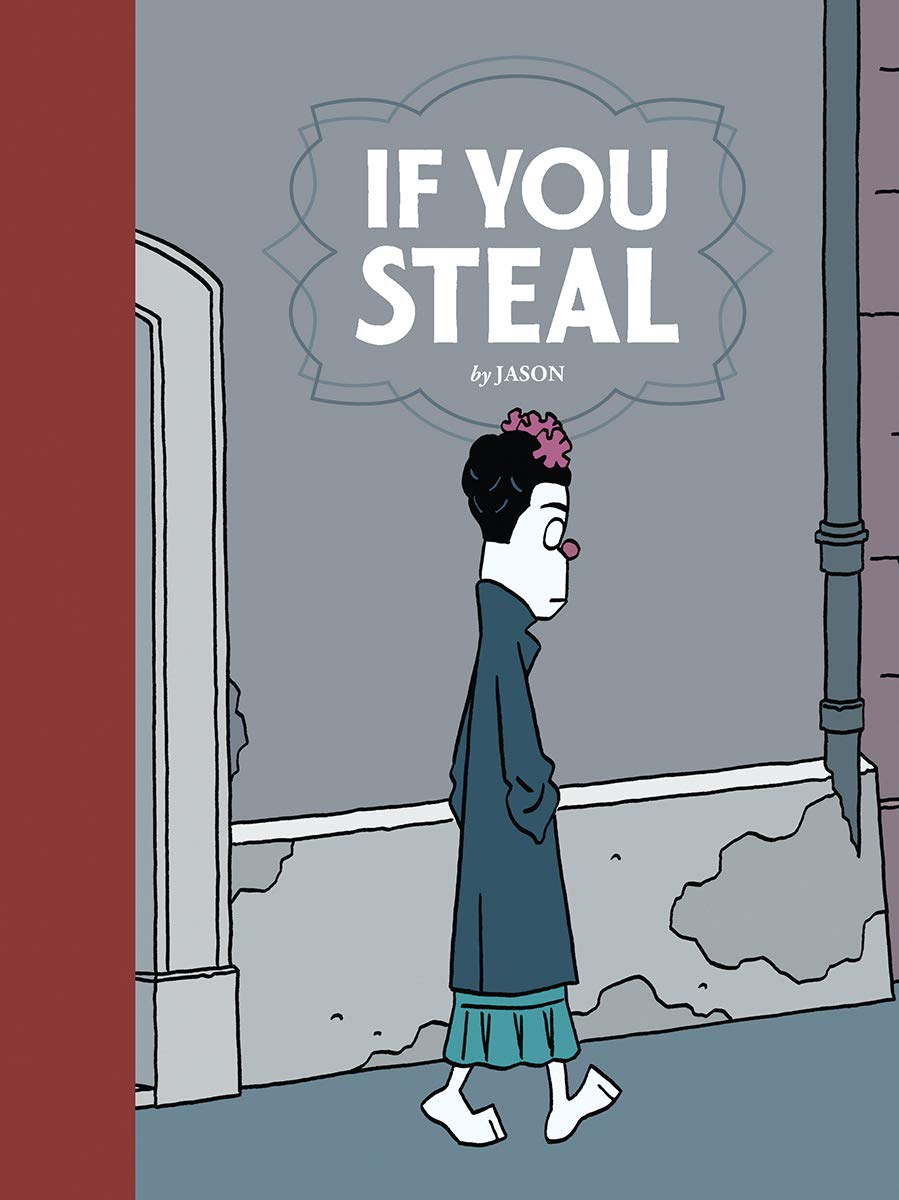
Werewolves of Montpellier


By Jason, translated by Kim Thompson (Fantagraphics Books)
ISBN: 978-1-60699-359-0 (HB/Digital edition)

Jason is secretly John Arne Saeterrøy: born in Molde, Norway in 1965 and an overnight international cartoon superstar since 1995 when his first graphic novel Lomma full ay regn (Pocket Full of Rain) won Norway’s biggest comics prize A Sproing Award.

He won another in 2001 for the series Mjau Mjau and by 2002 was almost exclusively producing graphic novels. Now a global star, he has won many more major awards from such disparate regions as France, Slovakia and the USA.

Rife with his signature surreality, this novella was first released in 2010; populated with cinematic, darkly comic anthropomorphs and featuring more bewitching ruminations on his signature themes of relationships and loneliness, viewed as ever through a charmingly macabre cast of bestial movie archetypes and lost modern chumps.

Here he focuses on the hollow life of expatriate Swede Sven, a purposeless artist who has gravitated into a stagnant, romance-lite existence in a provincial French town. Sven fritters away his days just like his close friend Audrey – another listless intellectual looking for the right lady to love.

The only thing quickening his pulse these days is the occasional nocturnal foray over the rooftops: burglarizing houses dressed as a werewolf. Unfortunately, Montpellier already has a genuine lycanthrope community and they don’t look kindly upon gauche parvenus intruding into their world with criminal cosplay…

This post-modern short-&-spooky fable unfolds in Jason’s beguiling, sparse-dialogued, pantomimic progressions delivering resonances of Hitchcock’s bubbly comedy-thrillers, quirkily blended with Bergman’s humanist sensibilities. The enchantingly formal page layouts are rendered in his minimalist evolution of Hergé’s Claire Ligne style: solid blacks, thick lines and settings of seductive simplicity augmented here by a stunning palette of stark pastels and muted primary colours.

Jason’s work always jumps directly into the reader’s brain and heart, deftly probing the nature of “human-ness” by using the beastly and unnatural to ask persistent and pertinent questions. Although the clever sight-gags are less prominent here, his repertory company of “funny-animal” characters still uncannily displays the subtlest emotions with devastating effect, proving again just how good a cartoonist he is.

This comic tale is best suited for adults but makes us all to look at the world through wide-open childish eyes. Jason is instantly addictive and a creator every serious fan of the medium should move to the top of the “Must-Have” list. Buy, borrow or even steal it if you must, but be aware that actions have consequences… even for faux monsters…
© 2010 Jason. All rights reserved.

House of Dolmann


By Tom Tully & Eric Bradbury, with Carlos Cruz & various (Rebellion)
ISBN: 978-1-78618-491-7 (TPB/Digital edition)

Win’s Christmas Gift Recommendation: Weird, Wonderful, So Why Not?… 9/10

Wrapping up a week of Unamerican Superheroes is a classic British confection which might well be the closest we ever got to a Silver Age super-team – even if the members are technically all the same bloke…

Valiant debuted as a “Boys’ Paper” in 1962, as our indigenous periodicals industry struggled to cope with spiralling costs and a sudden mass importation of brash, flashy, full-colour comics from America. A weekly anthology dedicated to adventure features and providing a constantly-changing arena of action, the comic became the company’s most successful title for over a decade: absorbing many less successful titles whilst preserving their top features between its launch on October 6th and eventual amalgamation into new-styled, immensely popular Battle Picture Weekly in 1976. It also generated dozens of extra-sized Summer Specials and 21 Annuals between 1964 and 1985: combining original strips with prose stories; sports, science and general interest features, short humour strips and – increasingly from the 1970s onwards – reformatted reprints from IPC/Fleetway’s copious back catalogue.

In February of 1963 it merged with the company’s previous star vehicle Knockout and, mere months later, became the brand title for a series of fortnightly – later monthly – digest-sized comics volumes. The Valiant Picture Library offered longer stories at the cost of 1 shilling. It ran to 144 issues ending in 1969…

In May 1965, the weekly Valiant increased its price from sixpence to 7d (that was in old money, of course) but also increased the page count from 28 to 40 action and fun-packed pages, and ramped up the innovative anthological entertainment…

British weekly comics in the 1960s and early 1970s were a phantasmagorical playground of bizarre wonders. Truly recognisable heroes appeared in war, western and its gradually declining straight crime serials, whilst the most memorable momentum devolved to a hybrid, bastardized mixture of fantasy, horror and science fiction themes to spawn an evil-crushing pantheon unlike any other…

The Spider, Steel Claw, Thunderbolt, Phantom Viking, Captain Hurricane, Robot Archie, Kelly’s Eye, Cursitor Doom and others utterly tainted the gleaming pristine gene pool of noble superheroism with its bleak and often manic sensibilities. You can thank this stuff for the 1980s “British Invasion” of American comic books and the dystopian weltschmerz that dominated the industry for a decade thereafter, peppering the genre with our sort of misfit, maverick and malcontent misanthrope…

Even early on when we briefly adopted full-blown US style superheroes like Marvelman, Captain Universe, Danger Man and Thunderbolt Jaxon, or late entries Tri-Man, The Leopard from Lime Street, Gadget Man & Gimmick Kid and the wondrous Johnny Future at the height of “Batmania”, Brits could never really take it straight. There was always something daft, anarchic, quirky or just scarily warped in the final result…

Here’s a sublimely perfect example of all that: a seedy solitary inventor with a hidden past who spends his days playing with puppets: an obsessive who can’t help literally putting words into their mouths…

Another stunning salvo of baby boomer nostalgia courtesy of Rebellion’s Treasury of British Comics strand, this first collection of The House of Dolmann gathers the early material from Valiant, spanning October 8th 1966 (issue #208) to May 6th 1967, plus a late entry from Valiant Super Special 1980. The strip itself ran until May 1970, and has resurfaced a few times since then, both in reprint form and new tales…

It also offers an incisive Introduction from modern day comics scribe Simon Furman and begins with a handy character guide in ‘Meet Dolmann’s Dolls (part 1)’ providing a pictorial and text run-down of Astro, Elasto, Giggler, Micro, Mole, Raider and Togo: purpose-built robots designed with amazing specialised abilities. I’m sure I don’t need to remind you that this was the mid-Sixties, so racial depictions like the half-sized sumo wrestler-bot last cited were perpetrated “in fun”, and not fairness or good taste…

House of Dolmann was a curious, inexplicably compelling blend of super-spy and crime-buster strip scripted by the magnificently prolific Glasgow-born Tom Tully. His astoundingly broad output included classic delights like Roy of the Rovers, Heros the Spartan, Dan Dare, Master of the Marsh, Janus Stark, Mytek the Mighty, The Wild Wonders, Nipper, Adam Eterno, The Mind of Wolfie Smith, Johnny Red, Harlem Heroes, Mean Arena, Inferno, The Robo Machines, Football Family Robinson, Buster’s Ghost as well as many of the strips cited above.

His collaborative co-creator here also worked on many of those sagas. The incredibly gripping moody comic art of Eric Bradbury had begun gracing newsagents shelves in 1949 in Knockout. Frequently working with studio mate Mike Western, Bradbury drew strips like Our Ernie, Blossom, Lucky Logan, Buffalo Bill, No Hiding Place, The Black Crow and Biggles. He was an “in-demand” illustrator who worked into the 1990s on landmark strips like The Avenger, Phantom Force 5, Maxwell Hawke, Death Squad, Doomlord, Darkie’s Mob, Hook Jaw, The Sarge, Invasion, Invasion 1984, Rogue Trooper, Future Shocks, Tharg the Mighty and so much more…

From the start, Tully & Bradbury delivered intense, claustrophobic tension-drenched, action-packed episodic adventures, opening with a spectacular kidnapping at the London Opera House.

When Professor Hanson – head of Britain’s atomic missile program – is abducted by jetpack-wearing masked thugs, the police and security services are stumped and the authorities have no recourse but to call in independent contractors International Security. Enigmatic chief Mr. Marshal and his top aide promptly pop over to the East End and The House of Dolmann: a pokey shop owned by a grimy, creepy puppet seller who apparently makes ends meet as a mannequin repairman who also dabbles in second-hand dolls, puppets, animatronics and shop or museum dummies.

However, in the grotty emporium – looking like a blend of junk shop and the parlour set of Steptoe & Son – a brilliant inventor has been clandestinely building an army of automated assistants – if not actual friends – to do his bidding. The IS operatives are greeted by a 3-foot tall articulated sumo automaton who invites them inside. They are as yet unaware that the voice – and appallingly racist accent – in fact belongs to proprietor Eric Dolmann who uncontrollably puts words in the mouths of all his creations… and perhaps divides a series of multiple personalities amongst them all at the same time. Shabby Dolmann’s life is pure subterfuge. (I digress here, but an awful lot of “our” heroes were tattily unkempt: we had “Grunge” down pat decades before the Americans made a profit out of it!)

The bizarre figure is in fact a troubled engineering genius who designs and constructs an army of specialised robots disguised as puppets to act as his shock-troops in his a dark and crazy war against the forces of evil. They are all directly radio-controlled by the inventor, but seem to act with increasing autonomy as the months go by …

Top of his hit list is subversive organisation D.A.R.T. – the Department for Arson, Revolution and Terror – and he eagerly accepts the job of foiling their plans by single-handedly raiding their London secret HQ with small army of super-bots…

The assault is a complete success but in the resultant rout and rescue, D.A.R.T. boss Rafe Garrott gets away from Dolman and his “children”…

Pattern set, what follows is a potent and spectacular parade of peril-packed romps: complete 4-page thrillers alternating with extended sagas wherein the troubled and frankly disturbing puppeteer and an ever-expanding team tackle high-tech kidnappers, rascally protection racketeers, road haulage hijackers, weapons dealers, bullion bandits, museum marauders, blackmailers and a silver-obsessed madman…

In his unceasing war on wickedness, the daring Dolls hunt and confront modern-day river pirates, escaped killer convicts, train robbers and mail van raiders, fur-thieves, mad scientists Dr. Magno and Doctor Volt, a costumed cat-burglar, super-sophisticated safecrackers, deranged arsonist Firebug, cunning counterfeiters in their tricked-out funfair of doom, a brutal biker gang and – repeatedly – the massed minions of arch super-criminal ‘The Hawk’. The half-pint heroes even infiltrate a prison in search of justice…

As the series progressed, additions were made to the synthetic squad – like tactical calculator Egghead – and supplemental gadgets such as a flying Dolmobile and all-terrain Dol-Bike (with sidecar for the fractious, ever-squabbling toy boys), tacitly acknowledging the tropes and trends gripping the world beyond the comic.

A slow backstory develops, hinting at the inventor’s murky past. Eventually his real name – Jonas Luthor – is revealed after his obscuring clown mask falls off in a tussle with a career criminal. The accident belatedly leads to his squalid shop being threatened by a police raid as diabolical plunderer The Gold Miser drives London into a glistering plutocratic panic and it takes all Dolmann’s ingenuity and dexterity to deflect, divert, disinform and save the day…

Ultimately, wild sci fi spy paraphernalia like levitation ray thieves and the tank-driving Commando Raiders inform and dominate the stories, with D.A.R.T.’s resurrection adding layers of fearsome fantasy frenzy. Crucially, the always-unsettling sight of dolls perpetually arguing amongst themselves grows more frenetic, generating moments of apparently genuine animosity within the automatic adventurers …

The weekly stories were always a mix of action, surreal humour and topical bombast, which close here with a rowdy, rousing romp involving saving the Tower of London and the Crown Jewels from fake guards tunnelling under the walls…

One final treat opens the ‘Extras’ section, with the 1980 Valiant Summer Special providing an extended maritime exploit from Tully and Spanish artist Carlos Cruz (AKA Carlos Cruz González, who limned many UK yarns including Sergeant Kirk, The Shrinker’s Revenge, Mighty McGinty, Sergeant Rock – Paratrooper, Dr. Mesmer’s Revenge, Bloodfang, Union Jack Jackson, M.A.S.K., Dan Dare: Pilot of the Future, The Phantom and so forth) detailing how a jaunt to Cornwall leads to the plastic pack scuppering a gang of transatlantic pirates raiding shipping in a submarine…

That’s supplemented by prose thriller ‘Slaves of the Spider’: a tantalising promo and extract by Barrington J. Bayley & Bradbury taken from the forthcoming Mind of Jason Hyde collection and a batch of Creator Biographies

Brilliantly bizarre, creepily compelling and stuffed to overflowing with zany thrills and chills, The House of Dolmann is inconceivably engrossing and incontrovertibly British to the core: fast-paced, freakily funny and once seen, never forgotten. Buy it for the kids and read it too; this is a glorious book, and you should brace yourself for better yet to come…
© 1966, 1967 & 2022 Rebellion Publishing IP Ltd. All Rights Reserved.

Mystery Girl


By Paul Tobin, Alberto J. Albuquerque, Marissa Louise & Marshall Dillon (Dark Horse Books)
ISBN: 978-1-61655-959-5 (TPB/Digital edition)

There are many fabulous smartly entertaining stand-alone comics collections on the market these days, offering readers a single done-in-one hit of graphic entertainment without the grief of buying into massive back-history or infinite cross-continuity.

One of the best I’ve ever seen compiles a fierce, frenetic and funny 4-issue miniseries from 2015, starring the most infallible detective of all time. No sequel yet, but I live in hope, which is a rather apposite thing to say here…

As crafted by American author Paul Tobin (Marvel Adventures Spider-Man, Plants vs. Zombies, Bandette, Colder) and Spanish artist Alberto Jimenez Albuquerque (Les Fugitifs de l’Ombre, Letter 44, Generation X, Wakanda Forever) – with colours by Marissa Louise and letters from Marshall Dillon – this slim, sleek, slick yarn simply screams for more enigmas to be excitingly unravelled by this sleuthing star in waiting.

Like any ancient city, London has its fair share of unique characters and unsolved mysteries, but that’s never the case whenever Trine Dorothy Hampstead sets up her “office” on the pavements and begins chatting…

The effusive, ebullient young woman has an incredible gift. She knows the answer to any question she’s asked. Instantly and infallibly. “Where are my keys?” “Did Dad leave a will?” “Where is my missing son’s body…?”

All inquiries get an instant response and every answer is correct!

Trine is a local celebrity in her community, not only for the fact that she’s never judgemental or exploits her gift, but also because everyone knows there’s only one mystery the poor lass can’t solve: how she got her uncanny power…

Trine has an immense taste for life at full throttle and abiding desire to help those in need: regularly consulting with local private eye Alfie and aiding her perpetually sceptical boyfriend Ken Bloke – a Metropolitan police constable – in his work, even though he refuses to believe in her gift…

Her already extraordinary life takes a big step into the unknown when ancient DNA specialist Jovie Ghislain comes to Trine with a fascinating query. The biologist had been researching a 1930’s expedition to the wild Sakha region of Siberia. In the notes of the fabled Weimar-Steinberg trek, the explorers detailed how they uncovered a frozen mammoth carcass so perfectly preserved that the meat was still fresh and edible. Their records are tragically incomplete and Ghislain – desperate to secure viable DNA from the deceased giant – wants to know where the rest of the body is now…

The answer is not immediately forthcoming. In fact, Trine refuses to say anything unless she can join Jovie’s new expedition to personally show the scientists where it is.

Trine thrives on new experiences and this time her gift pays a huge dividend. As preparations are made, she shrugs off all questions from friends and acquaintances, but does confide in her pet budgie Candide. The reason that mammoth meat was so fresh is obvious. It hadn’t been dead long. Now she’s off to see its kin in the only place on earth where the mighty beasts still live…

Sadly, the original expedition – and its journals – are also the subject of a search by wealthy and far less friendly folk. However, when a mystery billionaire commissions a psychopathic hitman to find and secure all the original journals and stop the new expedition, even deadly Linford is taken with Trine. Foregoing his usual callous efficiency, the murdering mercenary takes his time, insinuating himself into the life of all her friends. It’s all working out just fine until the Mystery Girl is asked about her pal’s latest boyfriend and suddenly “knows” all about the new beau – including his actual profession.

Miss Hampstead’s plan to deal with him is shockingly effective, but doesn’t go nearly far enough…

Believing the coast clear, Trine and Jovie head for the Arctic Circle, blissfully unaware that their trail is being dogged by Linford’s sinister paymaster or that the killer himself is down, but not out. Instead, he has devised a cunning method to turn his opponent’s gift against her…

Even so, the obsessive hitman has underestimated Trine’s power, ingenuity and ruthless resolve. However when finesse fails, he can always fall back on overwhelming firepower and direct action…

With the steadfast explorers nearing their frozen El Dorado, the bad guys make their move, revealing what’s actually behind all the death and destruction. Now it no longer matters if Trine is asked the right question or not…

As the ghastly truth of the Weimar-Steinberg expedition is exposed, their heirs and inheritors prove willing to commit mass murder to keep the bloody secret covered up. Happily, Trine asks herself a different question and a life-saving solution pops into her head…

Fast-paced, spectacularly action-packed, witty and superbly balanced as hero and villain play cat-&-mouse around the world, Mystery Girl is funny, imaginative and savagely uncompromising: a superb introduction to a potent and engaging new female character who seems destined for greatness.

Also included are satisfyingly informative bonus features including a copious and heavily annotated Sketchbook section with commentary from Tobin & Albuquerque; concept to finished art examples; cover roughs: designs and unused cover art, all revealing the masses of effort that went into making this such a treat.

Don’t ask why you weren’t in at the beginning of her climb to stardom: get Mystery Girl and become someone with (some of) the answers…
Mystery Girl ™ & © 2015, 2016 Paul Tobin and Alberto J. Albuquerque. Mystery Girl and all prominently featured characters are trademarks of Paul Tobin and Alberto J. Albuquerque.

The Question: The Deaths of Vic Sage


By Jeff Lemire, Denys Cowan, Bill Sienkiewicz, Chris Sotomayor, Willie Schubert & various (DC Comics)
ISBN: 978-1-7795-0558-3 (HB/Digital edition)

One of DC’s best 1980s comics series was – for the longest time – out of print and unavailable digitally. It more or less still is, except for a prohibitively expensive Omnibus edition, and if you have strong arms and a big budget you should really track those stories down, whilst the rest of us wait for more reasonable trade paperbacks and eBook editions…

As devised and delivered by Steve Ditko in the 1960s – as he sank ever more deeply into the Objectivist philosophy of Ayn Rand – The Question was Vic Sage: a driven, implacable, justice-obsessed journalist seeking out crime and corruption uncaring of the consequences.

The Charlton “Action-Line Hero” was acquired by DC when the Connecticut outfit folded and was the template for compulsive vigilante Rorschach when Alan Moore & Dave Gibbons first drafted the miniseries that would become the groundbreaking Watchmen.

The contemporary rumour-mill had it that since the creators couldn’t be persuaded to produce a spin-off Rorschach comic, DC went with a reworking of the Ditko original…

As revised by writer Denny O’Neil and illustrators Denys Cowan & Rick Magyar, Vic Sage was an ordinary man pushed to the edge by his obsessions, using his fists and a mask that made him look utterly faceless to get answers (and justice) whenever standard journalistic methods failed. After a few minor appearances around the DC universe, Sage got a job in the town where he grew up and resumed his campaign for answers…

Always more cult hero than classic crusader, The Question revival carved a unique niche for itself as “comics grew up” post Crisis on Infinite Earths and Watchmen. The character was periodically radically rebooted and reimagined, but here scripter Jeff Lemire (Sweet Tooth, The Underwater Welder, Trillium, Black Hammer, Descender, Ascender, Gideon Falls, Essex County) returns to O’Neil’s canon to tell a revelatory tale of reincarnation, zen mystery and undying evil. The project was part of DC’s latest high end mature reader imprint Black Label: released as four single issues before becoming a spiffy hardback with a digital equivalent…

Hub City is a hell-hole, the most corrupt and morally bankrupt municipality in America. Mayor Wesley Fermin is a slick, degenerate crook, but real power resides in his Special Counsel Holden Malick, political cronies, a hand-picked gang of “heavies” and the largely corrupt and racist police force…

Originally, Sage was supported by college lecturer Aristotle “Tot” Rodor: the philosopher-scientist who created his faceless mask and other gimmicks as well as being a sounding board for theories and plans and ethical bellwether. He remains so here but is also increasingly challenging his former pupil’s motives and methods…

After being killed by Fermin’s forces The Question was revived and retrained by O’Neil’s other legendary martial arts creation, Richard Dragon, Kung Fu Fighter . A year passed and a reenergised, faceless avenger began cleaning up Hub City…

The saga opens with the city rushing into chaos and the Question busting a brothel trafficking children to city officials. Later, when reporting the raid on his TV show, Sage ambushes former lover Myra Fermin (the mayor’s sister and oblivious City Alderman) with the fact that the Councilman he left for the cops has mysteriously been erased from all official reports. Shocked and outraged, Fermin continues deluding herself about her brother and the administration, but the damage has been done and she starts looking where she shouldn’t…

When Malick arrives to clean up the mess, Sage notices a ring the politico wears: something old and somehow deeply disturbing…

Tot is no help, but the ring sticks in Sage’s mind and eventually he uncovers a historical organisation called the Hub City Elder Society that all wore such symbols and draws some telling conclusions to today’s political elite…

Hot on the trail he moves, unaware that events are converging into a dark miracle. At the exact moment The Question uncovers an ancient den of occult ceremony, an innocent black man is gunned down by a racist cop and Myra Fermin bursts in on her beloved brother committing savage atrocities on a bound captive. The concatenation of blood climaxes as The Question finds an old faceless mask with a bullet hole through the forehead in a cavern under the city. It’s not one of his, but he is assaulted by a wave of memories and images of supernal evil when he holds it…

Barely conscious, he retreats from the underground lair into streets awash with blood as a protest march becomes a race riot. Urged by Tot to go on TV to calm the tide, all Sage can think of is finding Dragon and getting some metaphysical first aid…

What he gets is doped, as the hermit applies zen hoodoo and drugged tea, despatching the unwilling rationalist sceptic on a vision quest into the past…

Sage awakens in the wilderness that will one day be his home town, bare-footed and wearing a faceless mask…

In Hub City 1886, Viktor Szasz is a blacksmith desperately seeking to escape the vile acts he committed as a soldier fighting the Comanche, in a frontier outpost well on its way to becoming truly civilised. Silent and solitary Viktor intervenes when negro settler Irving Booker and his family are repeatedly harassed and ultimately murdered by the local priest and his devout flock. Szasz reverts to his gun-toting ways to save or avenge them but is outmatched until rescued by a red-headed Indian woman. She shares some secrets about true evil, most notably that a mystical “Man with a Thousand Faces” can only be killed by someone named “Charlie”.

Delirious and experiencing hallucinations of himself in different times, agnostic Szasz still refuses to believe in devils, which is probably why the thing in pit under the town gets the drop on him…

In 1941, Hub City private eye Charlie Sage groggily looks at his notebook, where someone has written “Man with no face” and “man with a thousand faces???”. Blaming too much booze, he cleans himself up whilst glimpsing flashes of unknown dead people and adds “red-haired woman” to the page for no reason he can think of…

When red-haired walk-in client Maggie Fuller hires him to investigate her brother Jacob’s disappearance, he has no idea it will be his last case. They are both union organisers and prime targets for the bosses and the city officials they own, and before long the shamus has annoyed all the wrong people, ending up attacked by thugs wearing fancy rings…

Even his one pal on the Police Force – veteran patrolman “Tot” – can’t help him. But does reluctantly pass him a file full of juicy potential prospects for Fuller’s absence. Still enduring staggering western visions and brutal flashforwards, Charlie becomes lost in civil violence in three eras, and succumbs to another ring-wearer ambush.

The PI awakes in a subterranean chapel in the middle of some kind of crazy black mass, meets a devil and is never seen again…

Awaking from his vision-quest, present-day Sage leaves Dragon, set on sorting his city’s real world distress: braving riot and savage, premeditated retaliation by the administration and cops hungry to put the rabble back in their place. Unable to stop the carnage with his fists, The Question instead uses mass media to deliver a stunning counterstroke, turning the tables and critically destabilising Firmin and Malick.

He also has Tot build a permanent solution to the thing in the pit under Hub City, but has gravely underestimated the horror and indeed his own childhood connection to it…

Even after overcoming the odds, the illusion of victory is tenuous and insubstantial, leaving The Question still looking for answers in all the wrong places…

This book also offers covers and a gallery of variants by Cowan, Sienkiewicz & Sotomayor, Lemire & Marcelo Maiolo; Eduardo Risso; Howard Chaykin & Gustavo Yen, Andrea Sorrentino plus Cowan & Sienkiewicz’s sketchbook section ‘Questionable Practises’ with roughs, finished pencils pages and covers, portraits, finished pre-colour inks, unused cover art and creator bios.

Combating Western dystopia with Eastern Thought and martial arts action is not a new concept, but here the problems of a society so utterly debased that the apocalypse seems like an improvement are also lensed though a core of absolutism. Is man good? Is there such a thing as True Evil? What can one man do?

Who’s asking..?

Although the creators keep the tale focused on dysfunction – social, societal, civil, political, emotional, familial and even methodological – the core motivation for today’s readers has shifted, with the horror show that is and always has been Hub City now arguably attributed to an eternal supernatural presence. Regulation masked avenger tactics don’t work in such a world, and some solutions require better Questions…
© 2019, 2020 DC Comics. All Rights Reserved.