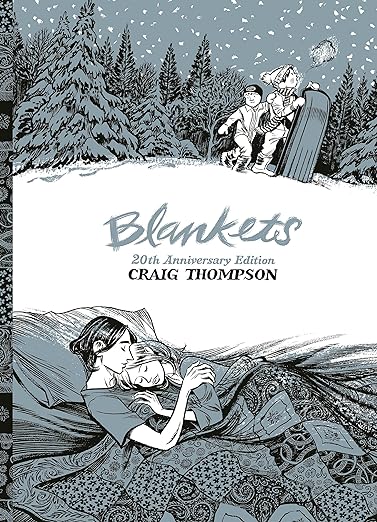
Blankets – 20th Anniversary Edition


By Craig Thompson (faber)
ISBN: 978-0-571-38784-7 (TPB/Digital edition)

Win’s Christmas Gift Recommendation: Perfect Story of Imperfect Humanity… 10/10

This is one of those reviews where I try not to say too much about the story, because it’s a sin and a form of theft to deprive readers of the joy of it unfolding just for them.

When first released in July 2003, Blankets started slowly but soon achieved monumental fame and almost unanimous critical approval from comics’ Great and Good and Fabled. If you have a favourite author or artist they probably loved this book – and rightly so.

After taking 3½ years to create, in 2004 Blankets scooped 3 Harvey Awards, 2 Eisners, 2 Ignatz Awards and – a year later – France’s Prix de la Critique. Translated into French, Italian, Spanish, Catalan, Portuguese, Greek, German, Norwegian, Danish, Dutch, Czech, Polish, Korean, Hungarian, Slovenian, Estonian, Serbian and Greek, it was latterly published in 17 foreign editions (so far). It’s also winner of a YALSA Popular Paperback for Young Adult prize and is listed as one of Entertainment Weekly’s Top Ten Graphic Novels of All Time. Portland band Tracker were so impressed that they recorded an entire soundtrack to accompany your inevitable reading and re-readings of the modern masterpiece.

Divided into 8 chapters – ‘Cubby Hole’, ‘Stirring Furnace’, ‘Blank Sheet’, ‘Static’, ‘I Don’t Wanna Grow Up’, ‘Teen Spirit’, ‘Just Like Heaven’, ‘Vanishing Cave’, and ‘Foot Notes’, Blankets tells of the formative experiences, hopes and dreams of Craig and younger brother Phil, growing up in a devout, proudly intolerant Evangelical Baptist family in Wisconsin, primarily in the winters where snow whitewashes and transforms everything.

A harsh life changes forever when Craig attends Christian Church Camp and meets Raina. Her faith is being increasingly tested by the shock and shame of a parental divorce and being left to look after her two cognitively impaired adopted siblings Laura and Ben and an infant niece.

Although devout and truly devoted to Jesus and Ministry, Craig’s life shifts, altering forever when he’s allowed to visit Raina’s family in (relatively) faraway Michigan. There, friendship blossoms in the cold and dark, becoming irresistible first love…

Inspirationally and movingly addressing eternal issues of spirituality and control, child/adult sexuality, sibling relationships and Becoming Independent, this celebratory edition also includes ‘XX Years: Dreaming & Drawing’: a copious and revelatory look at the story’s development, liberally supported by candid treats from Thompson’s 100+ sketchbooks, used in mapping out his magnum opus. There’s even a plug for his debut tome Good-bye Chunky Rice, and subsequent books Carnet de voyage, Habibi, Space Dumplins and Ginseng Roots. You should sample them too.

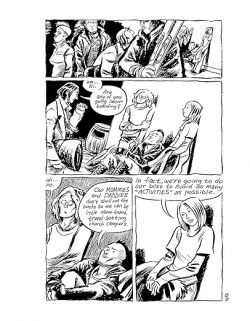
For such a weighty tome, Blankets is a remarkably quick and easy read, with Thompson’s imaginative and ingenious marriage of text and images carrying one along in the way only comics can. One of the most powerful and lovely tales of first love and faith lost, this book has lost none of its charm and seductive power over the decades. If you aren’t slavishly addicted to skimpily-clad incel-fodder or punch-in-the-face comics and have held on to the slightest shreds of your innate humanity, this is that rarest of beasts – a perfect story in pictures.
Entire contents © 2023 Craig Thompson. All rights reserved.

Blankets 20th Anniversary Edition will be published on November 2nd 2023 and is available for pre-order now.

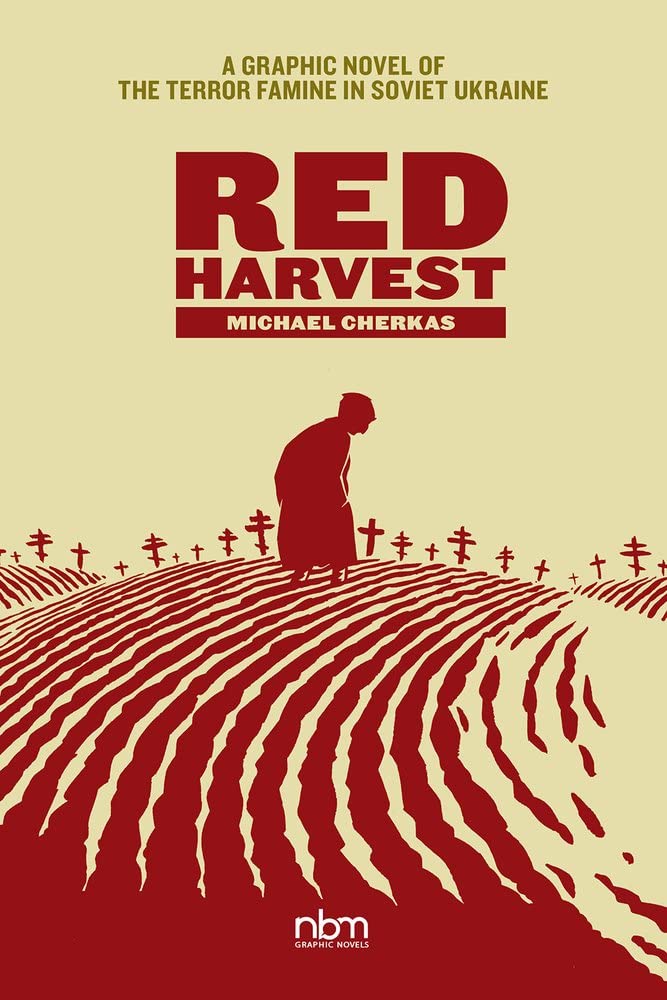
Red Harvest – A Graphic Novel of the Terror Famine in 1930’s Soviet Ukraine


By Michael Cherkas (NBM)
ISBN: 978-1-68112-320-2 (HB) eISBN: 978-1-68112-323-3

Win’s Christmas Gift Recommendation: Because Truth is the Greatest Gift… 10/10

Generally this month varies between Halloween scary stories and material pertinent to Black History month, but today we’re looking at something that is best described as a true horror story.

In 1954 Michael Cherkas was born in Oshawa Ontario. He grew up, studying cartooning at Sheridan College in nearby Oakville, before delving deeper into the art world through Illustration and Design courses at The Ontario College of Art in Toronto. A professional graphic artist, cartoonist and art director for over three decades, he has also – with associates Larry Hancock, John van Bruggen, John Sabli’c – winningly blended social commentary with subversion and paranoic science fiction in comics and books like The Silent Invasion quartet and spin-offs The Purple Ray, The New Frontier and Suburban Nightmares.

Cherkas’ family came to Canada from Ukraine, and Red Harvest is a far more personal comics narrative: one he has taken fifteen years to tell…

The deeply personal passion project details how one prosperous, self-sufficient farming village – Zelenyi Hai – was caught up in and destroyed by the doctrinaire and utterly botched “collectivization of farming” program initiated by Josef Stalin in 1931. That triumph of dogma over logic, common sense and physical practicality stated that the principles of industrialisation be applied to farming to maximise yields, with the resultant increase being sold to the rich-but-failing capitalist nations to secure much-needed funds and resources.

It didn’t work out that way and – aggravated by inefficiency and abetted by levels of regional featherbedding and root-&-branch institutional corruption unmatched until the current British Government started handing out contracts during the Covid crisis – resulted in a wholly man-made famine that killed over five million and displaced millions more.

Ukrainians call that time in 1932 and 1933 the “Holodomor” (literally “death/murder by hunger”). The policy (or naked landgrab) was forcibly applied to the Soviet-controlled (and non-Russian) regions of eastern and central Ukraine, northern Kuban and Kazakstan, with cautious modern estimates reckoning their populations diminished by 35%. However, thanks to decades of Party gag-orders, news-editing and fact-suppression, barely anywhere else knows it ever happened…

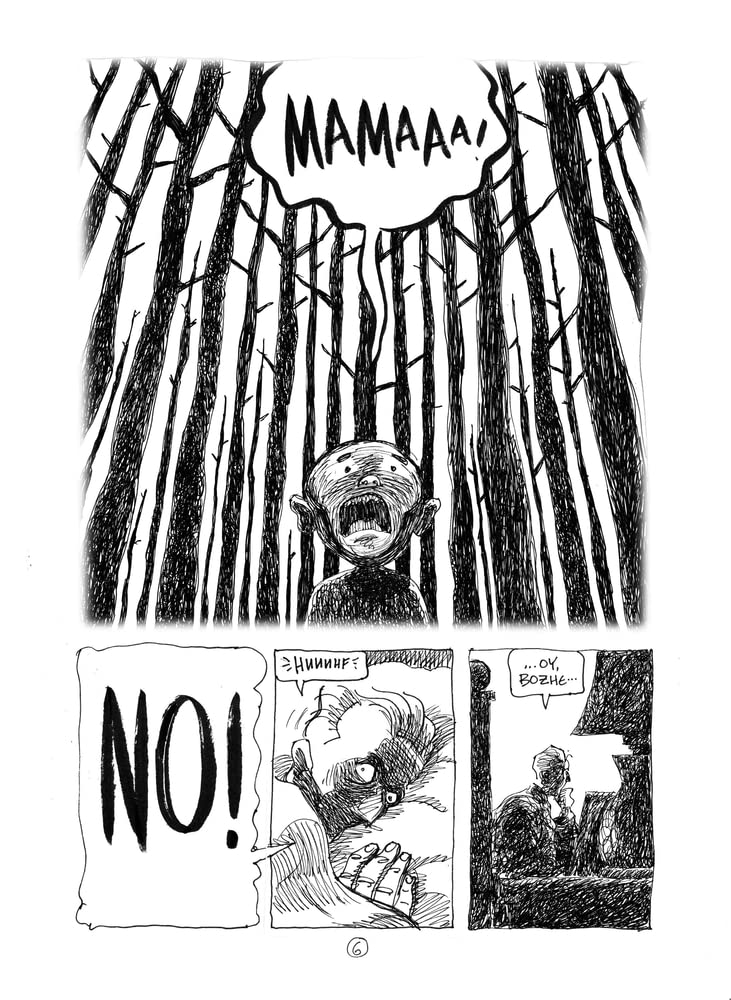
How this graphic novel came about – and particularly the powerful illustrative style used – is discussed in Cherkas’ Introduction, and the tale is preceded by a Glossary of language used to add impact and colour to this bleak monochrome masterpiece.

A targeted investigation rather than a straight memoir, the fictionalised saga opens in 2008 as aging Canadian citizen and recently-retired farmer Mykola Kovalenko prepares for his first visit to Ukraine since leaving in 1942. The big event has made him anxious and he’s started dreaming of the past and remembering…

What follows is a compelling yet engaging narrative exposing a war crime and systematic genocide the world has been happy to forget. Rendered with wit, tact and great reserve, it adds meat to history’s bones, tracing the slow, gradual, hopeless decline and repercussions very much in the manner later employed in George Orwell’s Animal Farm. That author also knew human nature, political chicanery; he has painful inescapable truths and a bit of history…

Cherkas is astoundingly adept at giving the many contributory factors and factions human faces: by turn hopeful, enthusiastic, stoic, enduring, fanatical, ruthless, crushed, despondent and ultimately hopeless. By blending Mykola’s contemporary return with the concatenation of cozening deceptions, betrayals, mismanagements, brutally enforced separations, family divisions and stupid changes applied with ruthless inefficiency by Party Officials local and Russian, the author has shone a light on a story that never goes away and never ends happily.

Couched in terms of a family drama, Red Harvest is potent, and unforgettable: a dish we should all dip into and accept that sometimes bitterness is the best we can aspire to.

Red Harvest is © 2023 by Michael Cherkas. ALL RIGHTS RESERVED.

Red Harvest will be released on November 14th 2023 and is available for digital and physical copy pre-orders now.

Most NBM books are available in digital formats. For more information and other great reads see http://www.nbmpub.com/.

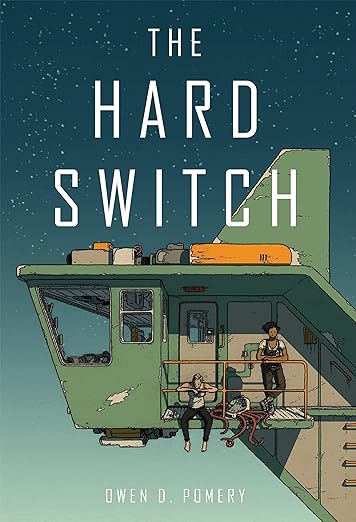
The Hard Switch


By Owen D. Pomery (Avery Hill Publishing)
ISBN: 978-1-910395-70-7 (HB)

Win’s Christmas Gift Recommendation: Worlds Enough but Never the Time… 9/10

It’s a dog-eat-dog universe and commerce is the only weapon with real power. Everything knows that. However, in what appears to be a barely-fictionalised acknowledgment of the tone of our times, Owen D. Pomery (after wowing discriminating comics fans with books Victory Point & British Ice, or shorter pieces Between the Billboards, The Megatherium Club Vl. 1: The Great Ape) has again picked imagination as his instrument for low-key speculative pessimism and wrought one of the most sinister sagas in utterly ages.

After studying architecture, mastering printmaking and succeeding in commercial illustration venues as varied as Tribune, Monocle and The New Yorker, subtle visualizer Pomery turns his Ligne Claire-influenced eye (like Hergé jamming with Moebius) and seditious tendencies upon a declining tomorrow too much like the one we’re all enduring…

A glorious paean to traditional “hard sci fi”, The Hard Switch follows hard-working independent traders at the end of civilisation. Interplanetary, interstellar, and intergalactic travel/trade depend on a substance called Alcanite. The mineral facilitates all converse between worlds and it’s almost all gone. When there’s no more, the universe faces an abrupt and total reversion to complete isolation-by-distance and everyone gets stuck wherever they are when the lights go out and the other shoe drops…

In advance of imminent inescapable disaster, many seek to monopolise what resources remain, whilst others – like cargo freighter crew Ada, pilot Haika and octopoid engineer Mallic – graft even harder. They are exploring every wreck and rumour: stockpiling exotic artefacts or simple offworld nuts-&-bolts in anticipation of the worst panic buying spree in history…

On desolate desert world Dakhos, a chance encounter with other salvage-scavengers leads to a staggering theory when a truly ancient artefact hints at another method of star-travel predating – and utterly exclusive of – Alcanite. Humanoid Ada is descended from Mateaic nomads and the relic holds clues arguably confirming the legends that her kind roamed the stars before the over-exploited mineral was ever discovered…

Sadly, proving it won’t pay bills, so they continue hauling cargo while quietly looking for more data. Their search sparks clashes with organised crime, murderous “hunters”, and even people-smugglers, before their misplaced – and unaffordable – ethics lead to another mouth to feed after cargo-turned-sole-survivor Hodge joins the crew. The 12-year-old also has plenty of close calls before the crew fetch up the world of a super-rich scientist who might have the information they need to offer civilisation a second chance, if not actual salvation…

Naturally, he’s not at all what he seems, or what they need.

Tense and action-oriented, subtle and potently affable, this yarn is packed with tension and intrigue as our unlikely stars seek a whole new/old manner of interstellar transit and just staying alive for a sequel. Seductive and restrained in the Continental manner, The Hard Switch is a potent confection delivered in a beautiful, evocative and utterly compelling way no one could possibly resist. Therefore just don’t… possibly all the vacation you’ll need this year…
© Owen D. Pomery 2023.

The Hard Switch is scheduled for release on October 24th 2023 and is available for pre-order now.

Retrograde Orbit


By Kristyna Baczynski (Avery Hill Publishing)
ISBN: 978-1-910395-42-4 (PB/Digital edition)

Great storytelling never goes out of style and the basis of all drama is examination of the human condition (albeit sometimes in extraordinary circumstances). Somehow, that’s even more true when your characters aren’t human at all.

Author and illustrator Kristyna Baczynski hails from the Pennines of Yorkshire, by way of the Carpathians of the Ukraine. That’s not at all germane here but it does sound incredibly romantic; conjuring up all manner of deep-seated preconceptions about windy moors and bleak moody peaks. Preconceptions, aspirations, dreams and that old devil hope are what this book is about…

In a faraway star system, a little girl grows up as a refugee and immigrant. Flint finds it hard to adapt to life on mining colony world Tisa and, even though she has no real memories of the place, feels the call of her homeworld Doma – long-abandoned due to a geological or maybe industrial toxic detonation. No one at school cares or understands and her mother and grandmother never want to talk about it…

Years pass but those feelings of something missing don’t. Days pass, Flint acts out like any teen and then inevitably graduates into a mining job, but the something-missing still plagues her. Moments pass as she collects memoirs and mementoes of her lost world and grows increasingly colder and duller.

… And then a message is received from the supposedly dead, barren planet. Flint now has a purpose and a goal, and nothing will stand in her way…

This lyrical and uplifting yarn offers a beautifully understated and moving glimpse at the power of place in our lives, using science fiction themes and trappings to pick apart the most primitive and fundamental longings to which humans are subject. It also reminds us that there’s always hope…

A glorious celebration of humanity’s constant follies and greatest assets, this tale is certain to be a beloved touchstone for every lover of great stories.
© Kristyna Baczynski 2018. All rights reserved.

(The Tragedie of) Macbeth


By William Shakespeare, adapted by K. Briggs (Avery Hill Publishing)
ISBN: 978-1-910395-73-8 (HB)

Depending on how you liken it, William Shakespeare may be one of the most prolific comic scripters in the business. His mighty works have been staged and adapted as graphic narratives for decades in every language you might consider, and frequently allow contemporary artistic collaborators opportunity to be bold, experimental and vibrantly daring.

This is certainly the case with the lovingly crafted vision of American illustrator, performer and educator K. Briggs (Resistance, The New Chapter Tarot) who opts for colour-blind and gender-balanced casting to recount a visually striking and vivid interpretation which makes Scotland itself a player in the mix. Combining the full text with an abundance of mixed media including collage, paints, markers and pure linework, in a procession of nature-informed, magically-motif-ed page designs referencing ancient charts and maps, Illuminated manuscripts, tapestries, Tarot iconography, medical grimoires, nigh-abstract mood-enhancing tableaux and found historical artworks. These function as a moving backdrop to the actors unfolding the tale before your eyes.

What you already know: valiant general Macbeth meets three witches after saving the kingdom of his liege lord Duncan, and comes away with the notion that he will be King instead. Egged on by greed, ambition and his wife, the Thane of Cawdor personally kills the King whilst the monarch graces them with a visit. The red trail includes framing the guards and heirs and then progressively removing all threats to his reign.

However, both he and his Lady cannot escape their own consciences and the witches’ prophecy leads to delusion, disaster, derangement and death, but never glory…

As far as we can tell, Macbeth was first performed in 1606, written for Shakespeare’s patron King James I of England/VI of Scotland. It is an epic tragedy of ill-starred political ambition, the psychological costs of guilt, the consequences of betrayal and inevitability of tyranny, all wrapped up in veneer of supernatural horror.

The story is one of the greatest in world literature, but also a studied hatchet job, with the Bard shamelessly currying favour by ignoring facts and bigging up James’ distant ancestor and antecedent Macduff. The text first appeared in print in the Folio of 1623, but there have been plenty of editions since then.

The immortal story has frequently made it into comics form. If you’re one of the precious few people unfamiliar with the tale in its intended format (firstly, shame on you and secondly, go watch it right now; there are many excellent filmed versions in every possible language), this imaginatively welcoming rendition is extremely enthralling and powerful…

Moreover, the plot lends itself to many eras and milieux. You may even have already enjoyed it in epics as varied as Joe MacBeth (UK 1951), Throne of Blood (Japan 1957), Teenage Gang Debs (USA 1966), Men of Respect (USA 1991), and Mandaar (India 2021), amongst so many more interpretations – or even thematically as Blackadder Season 1…

Maybe you have seen it all before, but this is better….

Or if you will permit, “By the pricking of my thumbs, Something Wicked your way comes…”
© K. Briggs, 2023. All rights reserved.

Macbeth will be published on 23rd July 2023 and is available for pre-order now.

Kurt Cobain & Mozart Are Both Dead – A Leonard & Larry Collection


By Tim Barela (Palliard Press)
ISBN: 978-1-88456-804-6 (Album PB)

We live in an era where Pride events are world-wide and commonplace: where acceptance of LGBTQIA+ citizens is a given… at least in all the civilised countries where dog-whistle politicians, populist “hard men” totalitarian dictators (I’m laughing at a private dirty joke right now) and sundry organised religions are kept in their generally law-abiding places by their hunger for profitable acceptance and desperation to stay tax-exempt, scandal-free, rich and powerful.

There’s still too many places where it’s not so good to be Gay but at least Queer themes and scenes are no longer universally illegal and can be ubiquitously seen in entertainment media of all types and age ranges and even on the streets of most cities. For all the injustices and oppressions, we’ve still come a long, long way and it’s and simply No Big Deal anymore. Let’s affirm that victory and all work harder to keep it that way…

Such was not always the case and, to be honest, the other team (with religions proudly egging them on and backing them up) are fighting hard and dirty to reclaim all the intolerant high ground they’ve lost thus far.

Incredibly, all that change and counteraction has happened within the span of living memory (mine, in this case). For English-language comics, the shift from simple illicit pornography to homosexual inclusion in all drama, comedy, adventure and other genres started as late as the 1970s and matured in the 1980s – despite resistance from most western governments – thanks to the efforts of editors like Robert Triptow and Andy Mangels and cartoonists like Howard Cruse, Vaughn Bod?, Gerard P. Donelan, Roberta Gregory, Touko Valio Laaksonen/“Tom of Finland” and Tim Barela.

A native of Los Angeles, Barela was born in 1954, and became a fundamentalist Christian in High School. He loved motorbikes and had dreams of becoming a cartoonist. He was also a gay kid struggling to come to terms with what was still judged illegal, wilfully mind-altering psychosis and perversion – if not actual genetic deviancy – and an appalling sin by his theological peers and close family…

In 1976, Barela began an untitled comic strip about working in a bike shop for Cycle News. Some characters then reappeared in later efforts Just Puttin (Biker, 1977-1978); Short Strokes (Cycle World, 1977-1979); Hard Tale (Choppers, 1978-1979) plus The Adventures of Rickie Racer, and cooking strip (!) The Puttin Gourmet… America’s Favorite Low-Life Epicurean in Biker Lifestyle and FTW News.

In 1980, the cartoonist unsuccessfully pitched a domestic (or “family”) strip called Ozone to LGBT news periodical The Advocate. Among its proposed quotidian cast were literal and metaphorical straight man Rodger and openly gay Leonard Goldman… who had a “roommate” named Larry Evans

Gay Comix was an irregularly published anthology, edited at that time by Underground star Robert Triptow (Strip AIDs U.S.A.; Class Photo). He advised Barela to ditch the restrictive newspaper strip format in favour of longer complete episodes, and printed the first of these in Gay Comix #5 in 1984. The remodelled new feature was a huge success, included in many successive issues and became the solo star of Gay Comix Special #1 in 1992.

Leonard & Larry also showed up in prestigious benefit comic Strip AIDs U.S.A. before triumphantly relocating to The Advocate in 1988, and – from 1990 – to its rival publication Frontiers. The lads even moved into live drama in 1994: adapted by Theatre Rhinoceros of San Francisco as part of stage show Out of the Inkwell.

In the 1990s their episodic exploits were gathered in a quartet of wonderfully oversized (220 x 280 mm) monochrome albums which gained a modicum of international stardom and glittering prizes. This compendium was the second compiled by Palliard Press between 1993 and 2003, following Domesticity Isn’t Pretty and paving the way for Excerpts from the Ring Cycle in Royal Albert Hall and How Real Men Do It.

Triptow provides sly and witty Foreword ‘Discovering the World of Leonard & Larry’ before a copious, detailed and lengthy Introduction reintroduces the huge byzantinely interwoven cast in tasty bite-sized Gordian knots (sorry, the classical and literary allusions peppering the comics are eerily infectious…).

‘The Cast of Characters – So Far’ re-briefs us on star couple Leonard Goldman and Larry Evans, ‘Larry’s Relatives’, ‘Leonard Relatives’, ‘The In-Laws’ and ‘Friends and Acquaintances’ which prominently features the dream manifestations – or is it the actual ghosts? – of composers Peter Ilyich Tchaikovsky and his bitter frenemy Johannes Brahms…

This family saga is primarily a comedic comedy of manners, played out against social prejudices and grudging popular gradual acceptances, but it also has shocking moments of drama and tension and whole bunches of heartwarming sentiment set in and around West Hollywood.

The extensive and extended Leonard & Larry clan comprise the former’s formidable unaccepting mother Esther – who still ambushes him with blind dates and nice Jewish girls – and the latter’s ex-wife Sharon and their sons Richard and David.

Teenaged Richard recently knocked up and wed equally school-aged Debbie, and promptly made Leonard & Larry unwilling grandparents years (decades even!) before they were ready. The oldsters adore baby Lauren – who is two when this book starts – but will soon relive all that aging trauma when Debbie announces the kid will soon be an older sister…

Maternal grandparents Phil and Barbra Dunbarton are ultra conservative and stridently Christian, and spend a lot of time fretting over Debbie and Lauren’s souls and social standing. They’re particularly concerned over role models and what horrors she’s being exposed to whenever the gay grandpas babysit…

David Evans is as Queer as his dad, and works in Larry’s leather/fetish boutique store on Melrose Avenue. That iconic venue provides plenty of quick, easy laughs and even some edgy moments thanks to local developer/predatory expansionist Lillian Lynch who wants the store at any cost. It’s also the starting point for the many other couples in Leonard & Larry’s eccentric orbit.

Their friends and clients enjoy even larger roles this time around whilst cunningly presenting other perspectives on LA life and the ever-evolving scene. Flamboyant former aerospace engineer Frank Freeman lives with acclaimed concert pianist Bob Mendez and has an obsessive yen for uniforms, which comes in handy when Bob is targeted by a sex-crazed celebrity stalker. It’s no use at all though, when she kidnaps them at gunpoint and demands Bob satisfies her every desire…

Larry’s other employee is Jim Buchanan, whose alarming dating history suddenly picks up when he meets a genuine cowboy at one of L & L’s parties. Merle Oberon is a newly “out” Texan trucker who adds romance and stability to Jim’s lonely life. Sadly, that’s only until Merle is discovered by Hollywood and pressured by agents, manager and co-star to go right back “in” again if he really wants to be a movie megastar…

Jim, by the way, is the original and main focus of the overly-critical dead composers’ puckish visits…

Among the highlights this time are the cast’s participation on the “March on Washington” in April 1993 in support of Gay Rights, Larry’s jury duty and the introduction of a draconian Judge who is also a major purchaser of the Melrose’ stores most imaginative BDSM under-apparel, jury service, and Jim and Merle’s fraught but fun foray to Texas to get the blessing of the cowboy’s fundamentalist parents…

The opposing sides/families in the “lifestyle vs sin” debate meet often and outrageously and there’s even a couple of ceremonies (this is long before same sex weddings were legal) to confirm that the heart wants what the heart wants.

Terrifyingly there’s also a second episode of “queer-bashing” (David being the first in the previous volume) that results in Larry’s death.

Thankfully his trip to heaven is pleasant and his prompt return to the mortal coil proves “God Loves Gays” and provides sublimely satisfying satirical laughs whilst scoring major points… When he revives it’s to meet his new – and so very, very ugly – grandson… and thus life goes on…

As well as featuring a multi-generational cast, Leonard & Larry is a strip that progresses in real time, with characters all aging and developing accordingly. The strips are not and never have been about sex – except in that the subject is a constant generator of hilarious jokes and outrageously embarrassing situations. Deftly skewering hypocrisy and rebuking ignorance with dry wit and great drawing, episodes cover various couples’ home and work lives, constant parties, physical deterioration, social gaffes, rows, family revelations, holidays and even events like earthquakes and fanciful prognostications. Tchaikovsky and Brahms are also regular visitants and serve to keep the proceedings wry, sarcastic and surreal…

Leonard & Larry is a traditionally domestic marital sitcom/soap opera with Lucille Ball & Desi Arnaz – or more aptly, Dick Van Dyke & Mary Tyler Moore – replaced by a hulking bearded “bear” with biker, cowboy and leather fetishes and a stylishly moustachioed, no-nonsense fashion photographer. Taken in total, it’s a love story about growing old together, but not gracefully or with any dignity…

Populated by adorable, appetising fully fleshed out characters, Leonard & Larry is about finding and then being yourself: an irresistible slice of gentle whimsy to nourish the spirit and beguile the jaded.

If you feel like taking a Walk on the Mild Side now this tome is still at large through internet vendors. So why don’t you?
Kurt Cobain & Mozart Are Both Dead © 1993 Palliard Press. All artwork and strips © 1996 Tim Barela. Introduction © 1996 Robert Triptow. All rights reserved.

After decades of waiting, the entire ensemble is available again courtesy of Rattling Good Yarns Press. Sublimely hefty hardback uber-compilation Finally! The Complete Leonard & Larry Collection was released in 2021, reprinting the entire saga – including rare as hens’ teats last book How Real Men Do It (978-1955826051). It’s a little smaller in page dimensions (216 x280mm) and far harder to lift, but it’s Out there if you want it…

Pet Peeves


By Nicole Goux (Avery Hill Publishing)
ISBN: 978-1-910395-72-1 (PB)

Since college, Bobbie has just coasted. Saddled with massive debt, she lives with her lifelong friend and co Ohio U alumnus Clara. She pays her – far less than fair – share of the rent by tending bar in crappy booze-&-music dive The Pig’s Knuckles: beguiled by a lack of professional impetus, and the (constantly never-materialising) promise of a performance slot, someday. There’s late starts and free drinks to offset being harassed by the frat-boy clientele. At least there’s no pressure and plenty of time to work on her songs and it keeps her away from Clara’s ghastly cat Poptart and obnoxious new girlfriend…

Just getting by is bad enough, with manager Richard always stalling her and customers being jerks, but it all gets too much when her ex Carlos comes in with his new trophy trollop and deliberately tries to spoil Bobbie’s day. In response all she can do is drink on the job.

Too smashed to drive – or even hold her keys – Bobbie staggers home and is adopted by the ugliest dog she has ever seen…

She wakes up at home after the strangest dreams, with the mutt happily ensconced and already making trouble.

She calls him Barkley, and he’s an instant wedge between her and Clara, creating utter chaos and revolting messes, tormenting Poptart and somehow taking up so much time that Bobbie even stops writing music. At least he cares about her and always helps alleviate the drudgery and misery of her life…

What Bobbie doesn’t see is how that life is spiralling: slowly changing into something even more petty and desperate…

Eschewing her regular digital process, Eisner-award nominee Nicole Goux (for illustrating DC’s Shadow of the Batgirl) goes old-school and back to pen &-ink basics in Pet Peeves. Unleashing her own narrative notions in a boldly experimental, creepily compelling, itchily abrasive yet understated urban horror story trading marauding monsters for animosity, angst, disappointment and despair, the author presents here a youthful cast who aren’t shallow morons and slasher-fodder in a beastly fable where the protagonist is the victim and the secondary characters slowly turn on each other in a most engaging and appetising way because of an unwelcome new addition to the group…

Deploying imaginative page layouts reminiscent of Ditko’s Mr A and Avenging World, Goux (Forest Hills Bootleg Society, Everyone is Tulip, F*ck Off Squad at Silver Sprocket Bicycle Club) delivers a charming edgy fable about surrendering your dreams that conceals a wicked and chilling shock ending to die for…
© Nicole Goux, 2023. All rights reserved.

Thomas Girtin: The Forgotten Painter


By Oscar Zárate (SelfMadeHero)
ISBN: 978-1-914224-07-2 (HB/Digital edition)

Oscar Zárate was born in Argentina in 1942. After studying architecture he worked in advertising until 1971, at which time, like so many other countrymen, he migrated to Europe. Restarting his life and career, his design and painting jobs were augmented from 1977 onwards by illustrating histories of scientific and political luminaries (the …For Beginners and Introducing… series). This led to his adapted literary graphic novels Othello (1983) and Dr. Faustus (1986). A year later he collaborated with Alexei Sayle on Geoffrey the Tube Train and the Fat Comedian and in 1991 the award-winning A Small Killing, written by Alan Moore. He also produced socially active comics strips for Fleetway’s Crisis magazine.

A creator of intellect, passion and sensitivity, Zárate has always delivered far more than expected and in his latest magnum opus advances the potential of graphic biography by combining the avowed popular rediscovery of outsider English Master Thomas Girtin: The Forgotten Painter with a compelling (hopefully, largely fictionalised) drama. The players are three modern day artistic apprentices, devout and dedicated yet adrift and floundering in their own highly personalised searches for integrity and eternal truths. Ultimately, they all finally find ways forward by looking back to a rebel genius inexplicably sidelined by history…

Arturo, Sarah and Fred are all mature-student artists who meet up at a weekly life drawing class in London. Each is passionate about their pastime but cannot escape the crippling pressures their regular lives bring. Arturo is from Argentina and still carries self-inflicted scars of betrayal and failure, as well as the shame of having escaped terror at the cost of his family. It makes him seem gruff, distrusting, weary and cynical …

Architect and imminent grandmother-to-be Sarah is crippled by a different kind of guilt: perpetually wracked by how she is not good enough at anything she does. This recently remanifested when her greatest friend from art school reached out after decades of silence and separation. Back then, Sarah had abandoned and ghosted her on the cusp of success and greatness and has ever since writhed in the torment of debilitating guilt only Catholicism can (self) inflict.

Poor Fred is perhaps the most troubled: an honest, fair-minded worker who accidentally uncovered high levels of tax fraud at work. Even after losing his job because of it, he is still being pilloried: on one side pursued by a journalist who wants him to become a whistle-blower and on the other by a gang of heavies his former bosses hired to ensure his silence…

For nearly a year the trio have gradually become friends, discussing art in after-class pub sessions. Now Fred has become an impassioned zealot with a new love. He’s discovered an 18th century genius who changed the shape of English watercolour painting and then simply vanished from public view and memory.

It’s an injustice Fred is determined to set right…

The story of Thomas Girtin is woven throughout their cumulative tale. He is an intriguing mystery and shining exemplar whose gradually reconstructed history inspires each modern-day acolyte to change the course of their own life. Arturo finds strength from the tragically ill-starred artist’s resolve and courage at a time of widespread and earthshaking political unrest: an outright proudly rebel republican in an avidly monarchist nation, despising, decrying and working against the patronage system that supported his work and kept him in luxury.

Sarah finds inspiration in the driven quest for an almost-mystical connection to Nature and a higher truth. Young Girtin was a contemporary, rival and friend of latterday English icon JMW Turner, and at the turn of the 18th century was rapidly growing in renown. Already recognised as a groundbreaking pioneer outselling his old schoolmate in the cutthroat and exploitative art scene of the day, Girtin never rested, but continually strove to capture the fundamental revelations of reality.

That all ended with his early death in 1802, aged 27. Crucially for Sarah, in his search for the truth of time and the cosmos, Girtin martyred himself: dying due to his own obsessive compulsion to capture the elements in all their ferocious fury and restorative glories…

As for Fred, Girtin’s life increasingly becomes his own. Resurrecting and redeeming the lost painter’s reputation and sharing his mastery with the world becomes his reason for living, driving him to make a pilgrimage in Girtin’s footsteps and thereafter reorder the course of his own remaining years…

The twinned stories are subtly and smoothly presented by Zárate using two different styles of illustrative painting; mixing modern-day pastel tones with stark, sepia-tinted historical episodes that reveal – in his and his characters’ eyes at least – who Girtin was and how he lived, thrived and died.

As this monumental tome unfolds and tellingly argues for Girtin’s popular revival and reassessment, the most convincing asset in that campaign are the beautiful original Girtin works. The reproductions of his greatest triumphs – “View near Beddgelert”, “Estuary of the River Taw, Devon”, “Storiths Heights” and his undisputed masterpiece “The White House at Chelsea” – are judiciously folded into the text and include a selection of large gatefold images.

This is a book about Art and a story of artists, operating on the principle that what we see which moves us, we need to share. Once the story’s done here, that can be easily first facilitated by reading erudite and engaging endpiece ‘Thomas Girtin (1775-1802) An Afterword’ by Dr Greg Smith, (Senior Research Fellow, Paul Mellon Centre for Studies in British Art) and the attendant Acknowledgements, Permissions, and copious Bibliography sections.

You can always check him out yourself. There are many places online to see Girtin’s work, and even a few museums, if you’re pushy. Then go tell a like-minded friend.
© Oscar Zárate 2023. All rights reserved.

Big Ugly


By Ellice Weaver (Avery Hill Publishing)
ISBN: 978-1-910395-66-0 (pocket HB)

We’ve all experienced something of an interpersonal revolution thanks to Covid-19 and the measures used to counter it, as well as the undeclared global depression and rising functional poverty in developed world that followed. However, it’s wise to remember that relationships between friends and especially family members are – and always have been – complex, varied and nothing like fiction would have us believe…

Most folk lead ordinary lives with forgettable days, minor affections and grudges and lots of tedium and bills. All days and everydays are not grand affairs and soaring missions undertaken by grand heroes and threatened by Machiavellian villains. Cradle to grave, it’s just carrying on until you finally stop. We grown-ups call it “life” and Mel is utterly mired in it.

Her existence is about plodding on, making ends meet, being underappreciated in her job and just getting by, but her mental and emotional loads take a big hit when brother Matt hits a pothole in his dreams and moves into her spare room.

Soon everything that was annoying and unsettling about their shared past together is slipping out, resurfacing and occupying her bandwidth: his unrealistic expectations, daft schemes, lack of attention and selfishness. It’s just like when they were kids all over again…

Mel might have been unhappy, but at least she was settled and now it’s all Upset, Change and Challenge, and Matt hasn’t let the passage of time mellow him at all. He’s no less obnoxious and pig-headed than when he first left home. Still, he has his good sides too, and it’s some comfort to feel kinship rekindled and re-share experiences. Some moments even afford a smattering of long-delayed clarity, but it’s obvious they have very different ways of being grown-ups.

They haven’t quite got to the stage where they can talk about Dad yet though, but it is good to have someone to share her decidedly rare medical condition – or perhaps rather unique kind of hypochondria? Above all, Mark is Family. Mel might be permanently peeved with him, but who else could she share such intimate concerns with. There’s certainly no one else ready to help the way Matt is…

… And thus the situation quietly slowly spirals, as Matt infuriatingly settles in, expecting and encouraging his sister to change whilst sinking back into his old selfish, foolishly ambitious patterns of behaviour and daydreams of creative superstardom. He even brings in his weird new girlfriend Jill – the one Mel technically introduced him to…

When he gets Mel to drive him and Jill across the country to a ridiculous podcast convention things get both painfully honest and truly revelatory…

Simultaneously placid and tense, painfully pedestrian and infuriatingly abstract, this darkly comedic interaction is a “Post Coming-of-Age” tale of ordinary people, afflicted like we all are with the binary condition most adults experience: the feeling that life’s leaving you behind whilst you are convincing yourself that you’ve never even caught up in the first place…

Born in Bath and based in Bristol, Ellice Weaver became a freelance illustrator after graduating from The University of West England and moving to Berlin. Past clients include The Guardian, Washington Post, New Yorker, The Times and Transport for London. A compulsive storyteller, her first graphic novel Something City was released in 2017 and awarded “Indie Comic of the Year”.

Her second full narrative outing, Big Ugly is a slyly entrancing, graphically compelling observational essay on expectation – familial, personal and professional – and how it can founder on the forge of humdrum subsistence, daily disappointment and diminishing dreams. It also reveals just how much early days and sibling support (or not) can shape and affirm, and at what price…
© Ellice Weaver, 2023. All rights reserved.

If you’re London based/adjacent – or just a bit keen – there’s a launch party for Big Ugly on 22nd June. It’s at Jam Bookshop in Hackney Rd E2 7NX and launches an art exhibition that will run until July 9th.

Wandering Son volume one


By Shimura Takako, translated by Matt Thorn (Fantagraphics Books International)
ISBN: 978-1-60699-416-0 (HB)

Huge fan though I am of the ubiquitous digest-sized monochrome format that makes up the greatest part of translated manga volumes, there’s a subtle enhanced superiority to these hearty and satisfyingly substantial oversized hardback editions from Fantagraphics’ manga line (see also Moto Hagio’s A Drunken Dream and Other Stories) that just adds extra zest to any work of pictorial narrative.

It’s just a shame the story still isn’t accessible digitally or that the remaining volumes (as far as I know, we got to Book 8 before everything paused) still languish untranslated for us who don’t speak Japanese….

Especially effective and affecting, Wandering Son was this second intriguing offering from the good FBI, following two youngsters mutually experiencing the most difficult times of their lives…

Shuichi Nitori is a boy freshly transferred into a new school. He’s starting Fifth Grade and on the cusp of puberty. He’s also in a bit of a quandary. Slim, androgynous and, to be frank, rather pretty, he is constantly thinking about wearing girls’ clothes…

On his first day, he is befriended by Yoshino Takatsuki; a tall, burly tomboy harbouring similar secret yearnings. Her instinctive friendliness towards Shuichi is shared by pretty Saori Chiba, who is happy with her own gender but troubled in almost everything else. Always over-eager to please, she is a ball of inexplicable guilty feelings and – even at her young age – is considering converting to Christianity…

From the start, both girls encourage Shuichi to submit to his urges. Yoshino’s clueless mother keeps buying dresses which the despairing daughter just gives to her confused new pal, whilst Saori, also acutely aware of the Nitori boy’s underlying otherness, actively encourages him to cross-dress. She even buys him an extravagant frock for his birthday, almost killing their budding friendship stone-dead.

It is Saori who successfully suggests the unsuspecting class perform The Rose of Versailles as their end-of-term play, with all the girls playing the male roles and vice versa…

(The Rose of Versailles is a monumentally popular Shoujo manga tale – later, a movie and musical – by Riyoko Ikeda, telling the story of Lady Oscar: a girl whose soldier father raises as a man. She/He eventually becomes a dashing Palace Guard and the darling of Marie Antoinette’s Court.)

Both Shuichi and Yoshino are hard-pressed to deny their overwhelming mutual need: boy wants to be girl and girl, boy. Inevitably, their need proves too great and both succumb. Yoshino has her hair cut and goes out in her brother’s school uniform, only to be chatted up by an older woman in a burger bar. Shuichi’s periodic capitulations are less public, but increasingly important to his happiness and wellbeing – and to be honest he does make an astonishingly pretty girl, more so even than Roger Taylor in that Queen Video – although utterly pure, innocent and raunch-free…

Nevertheless, no matter how much Shiuchi and Yoshino wish they could exchange gender, time and biology inexorably march on and the changes of puberty are causing their treacherous bodies to horrifyingly and inescapably betray them…

From any other culture this type of story would be crammed with angst and agony: gratuitously filled with cruel moments and shame-filled subtext, but instead Takao Shimura (Even Though We’re Adults, Sweet Blue Flowers) crafts a genteel, winningly underplayed and enchantingly compulsive school saga that is filled with as much hope and positivity as drama.

As Hōrō Musuko the tale began in Comic Beam monthly in December 2002, running until 2013 and eventually collected as 15 volumes. It is resplendent in its refined charm and exudes assured contentment, presenting a very personal linked history in an open-minded spirit of childlike inquiry and accepting optimism that make for a genuine feel-good experience.

But of course there is more to come in the unavoidably difficult futures of Shuichi and Yoshino…

This moving, gently enticing tome also includes a helpful watercolour character chart, a pronunciation guide for Japanese speech and ‘Snips and Snails, Sugar and Spice’, a fantastically useful guide to Japanese honorifics by translator Matt Thorn, explaining social, gender and age ranking/positions so ingrained in the nation’s being. Trust me, in as hide-bound and stratified a culture as Japan’s, this background piece is an absolute necessity…

The comics portion of this volume is printed in the traditional back-to-front, right-to-left format.
© 2003 Takako Shimura. All rights reserved.