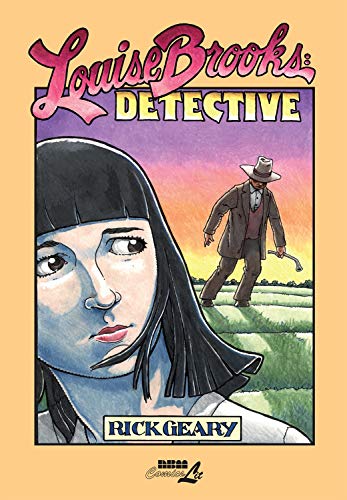
Louise Brooks: Detective


By Rick Geary (NBM/Comics/Lit)
ISBN: 978-1-56163-952-6 (HB)

Rick Geary is a unique talent not simply because of his style of drawing but especially because of his tale-telling methodology. He’s best known for crime examinations via his Treasury of Victorian Murder and Treasury of XXth Century Murder series but also worked for decades as an Underground cartoonist and freelance illustrator of strange stories, published in locales as varied as Heavy Metal, Epic Illustrated, Twisted Tales, National Lampoon, Bizarre Sex, RAW, High Times and elsewhere. He possesses a unique gift for sublimely understated storytelling: stringing together seemingly unconnected streams of narrative to compose moving, often melancholy and always beguiling yarns. He is an international treasure.

Geary has grown into a grand master and unique presence in both comics and true crime literature through those aforementioned forensic reconstructions. He has entertainingly analysed some of the most infamous murder mysteries since policing began, but here marvellously repurposes his eye for historical verity to concoct something new and truly fascinating.

A fixation with mercurial silent movie star Louise Brooks coincides with the recorded historical facts of her fall from global fame and subsequent disappearance into the American heartland. A little casual speculation, a few wry ruminations and this is the result…

In ‘Louise: An Introduction’, Geary précis’ how, for a brief flickering moment in 1927, dancer/actress Louise Brooks was the toast of global cinema: her face known from America to Zanzibar before she inexplicably declined to renew her Paramount Pictures contract, moved to Germany to star in erotic classic Pandora’s Box and began an inexorable decline into obscurity.

She returned to the US in 1930, but parts were hard to find. Returning to club dancing, she married twice and divorced both men by 1940 when, aged 33, she suddenly chucked everything and returned to the family home in Kansas…

Following a triptych of the author’s trademark maps (Central Wichita, the area south east of the city and rural Burden, Kansas in 1941-1942) the cartoon chapter-play begins with ‘Back to Wichita’ as Louise retreats to a fractious, unwelcoming Brooks household and desperately begins hunting for a job. Increasingly, however, she is drawn into the town’s only topic of conversation: the seemingly impossible “locked-room” murder of wealthy widow Edna Leach, which is like something out of a movie…

Louise strikes up an acquaintance with a mousy shop assistant at the music store, but ‘My Friend Helen’ only has two topics of conversation: her never-seen boyfriend Walden Pond and the grisly demise of Mrs. Leach…

After America enters World War II and her latest business venture fails, Louise sets upon a new career path as a writer. Such ‘A Pilgrimage’ is daunting so she seeks out a former New York playwright who has lately taken residence in nearby Burden.

Borrowing her brother’s car, she sets off one morning in June 1942, having first made plans to meet Helen and her elusive beau, but encounters ‘Unforeseen Difficulties’ and stumbles upon a deeply personal tragedy inadequately explained by ‘Helen’s Story’…

Finding herself lost in the middle of an actual murder mystery where everything is painfully real and terrifying, the performer soon realises she even has doubts about ‘The Victim’ and reluctantly takes on the unlikely role of ‘Louise Brooks, Detective’…

It’s a part she was born to play, but after nearly losing her own life putting together the disparate strands and winkling out the culprit, she says ‘Farewell, Wichita’ and heads back to New York with reinvigorated dreams and her future again filled with untapped potential…

Combining a superlative talent for laconic prose, incisive observation and meticulously detailed pictorial extrapolation with his fascination with the lethal propensities of humanity, Geary’s forensic eye has scoured police blotters, newspaper archives and history books to compile his irresistibly enthralling documentaries. Happily, all that expertise is soundly utilised for his first major fiction feature and once again he has proved bloody murder is always a black and white affair…

A superbly engaging crime conundrum available in doughty hardback and accessible digital formats, the only thing that could improve this book is a sequel…
© 2015 Rick Geary.

A Thousand Coloured Castles


By Gareth Brookes (Myriad Editions)
ISBN: 978-0-993563-30-0 (HB)

The world is filled with amazing women passing largely unnoticed by the loud, shouty males with their hands on the tillers of history and the media, but seldom the kettle or shopping bags. This amazing tale is broadly based on one of them…

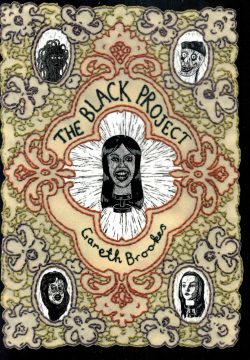
It comes to us from an equally intriguing source. Gareth Brookes is a capital-A Artist, printmaker, textile creator and educator who began literally crafting comics in 2015 with his astounding and disturbing epic (and forthcoming review) The Black Project.

With A Thousand Coloured Castles, RCA graduate Brookes sealed a growing reputation for challenging and rewarding graphic narratives of the artisanal kind. Brookes is a deep and slyly humorous thinker with his roots in the Littlest of Englands and a skewed eye to storytelling. This captivating hardback tome was created solely from dark wit and wax crayons, resulting in a truly tactile and absurdly otherworldly viewing experience…

Myriam is in her declining years: married to a set-in-his-ways old know-it-all curmudgeon, as seen in most traditionally happy families and captured on paper by Raymond Briggs and TV sitcoms by Richard Wilson.

Fred spends most of his time complaining about everything, which is why it takes a very long time for him to notice that Myriam’s eyesight is fading. It takes even longer for him to grasp that she’s increasingly subject to wild, abstract and utterly convincing hallucinations: vivid visions and shapes that baffle and bewilder even as they light up her drab, interminable existence.

Of more concern to Fred is the wife’s increasing fascination with the overgrown, unkempt back garden next door. He’s happy to moan about it in private but doesn’t want to engage in potential suburban hostilities with the woman living there.

Myriam, however, keeps seeing a strange bedraggled little boy trapped there, even though everybody knows that’s not possible. All except her toddler grandson Jack, who’s always happy to see things her way…

And thus unfolds a multi-layered observation of social norms and aberrant behaviours, supposition and expectation, declining faculties and domestic evil that is truly magical to behold and impossible to predict.

Despite her condition, Myriam proves that she knows what’s what and what’s right as events spiral to an inevitable conclusion and answers are shockingly forthcoming…

Gentle, genteel and utterly beguiling, this is a masterpiece of British fantasy understatement with a potent underpinning of quietly desperate lives truly lived…
© Gareth Brookes 2017. All rights reserved.

Dog Days


By Anja Dahle Øverbye, translated by Agnes Scott Langeland (Centrala)
ISBN: 978-0-9933951-9-2 (TPB)

Friendship is a strange and potent thing, especially if formed during or overlapping and surviving the fraught transition from little kids to turbulent teen…

Released as Hundedagar in 2015, Anja Dahle Øverbye’s award-winning debut graphic novel is set in a timeless “Then” in North West Norway as a small group of schoolgirls endure the dull tedium and decimating heat and foul odours of the annual Dog Days – when the usual nothing-to-do is cruelly exacerbated by debilitating heat and still air to match the static lives of the same old crowd.

Anne is having a difficult time. She’s too old for silly pranks, stamp albums and other kids’ stuff, but not old enough to go with life-long friend Marielle to interesting new places like the youth club. Worse yet, annoying creepy Carrie is monopolising Marielle’s time. They’re forming a bond: a clique of two who seem to spend most of their time being mean and playing nasty pranks on Anne.

Endless days go by and even tragedy at a neighbour’s house, the big fair and that creepy adult hanging around can’t dispel the tedium. The situation between the rivals worsens, so Anne decides to act. If she wants to restore the status quo or be part of a new one, she needs to adapt. Happily, shy, quiet Kate is around to take the cruel heat…

A sleek but chilling examination of unformed personalities instinctively vying for dominance, Dog Days is a deceptively powerful treatment of friendship and alliances that will remain with you long after yo finish reading.
© Centrala Ltd./Anja Dahle Øverbye. Translation © Agnes Scott Langeland. All rights reserved.

A Journal of my Father


By Jiro Taniguchi translated by Kumar Sivasubramanian with Chitoku Teshima (Fanfare-Ponent Mon)
ISBN: 978-1-91209-743-2 (HB)

Unless you’re a dedicated fan of manga, you probably haven’t heard of Taniguchi Jirō (14th August 1947-11 February 2017). Despite his immense talent as both writer and artist – in 2011, France knighted him a Chevalier of the Ordre des Arts et des Lettres – his “gekiga” work has been slow to reach English speakers since his 1970 debut in Young Comic with Kareta Heya (A Desiccated Summer).

With nearly 50 different series and collections to his credit – originally hard-edge crime like City Without Defense, The Wind of the West is White, Lindo 3, Blue Fighter and Knuckle Wars – the 1990s saw him move into more universal and mature themes with Kamigami no itadaki (The Summit of the Gods), Kamigami no itadaki, and – in 1997, in collaboration with Moebius – Ikaru (Icarus).

He expanded into straight drama with Botchan no Jidai, Inu o Kau and the remarkable A Distant Neighborhood (a major, albeit Belgian, motion picture since 2010).

Joking aside, Mr. Taniguchi was a major force in international comics and now his most personal masterpiece is at last available in English, thanks, I suspect to a career-long and most appreciative French connection. Hopefully, that will extend to digital editions fairly soon …

Beguilingly mild, understated and packed with suppressed and repressed emotion, Chichi no Koyami details how a quiet, diligent parent is called back to his home town after years away in Tokyo. Yoichi Yamashita has spent decades away, carving out a life and family for himself while avoiding all contact with his own father.

Now the old man is dead, and the dutiful son returns for the funeral rites. Talking with family and friends, he gradually learns of a man and life he never really knew and, as he re-examines his side of a never-changing story probably repeated in every household in the world, Yoichi reassesses and apply an uncompromising lens of hard-earned experience to the life he made after leaving so long ago.

In dignified, revelatory slices, beginning with ‘A Sunny Place on the Floor’ and ‘Traces of Spring’, he reconsiders his life. ‘Crimson Memories’, ‘New Roads’, ‘My Beautiful Mother’, ‘Summer Recollections’, ‘Separation’ and ‘Another Mother’ fill in details like a detective thriller with all the clues and evoked memories of ‘A Particular Photograph’, ‘My Uncle’s Words’, ‘Revolving Seasons’ and ‘Hometown in Spring’ drawing him into long-delayed emotional metamorphosis and catharsis…

Gentle and lyrical, rendered with staggering visual authenticity and ruthless honesty, this old, old story is mesmerising in its power to move: an emotional tonic every father and son should apply lavishly to their own experience and a truly grown-up picture book we should all use as manual to navigating family life.
Chichi no Koyami by Jiro Taniguchi © Papier/1995 Jiro Taniguchi. All rights reserved. © 2021 Potent Mon for the English language edition.

Run for It – Stories of Slaves who Fought for their Freedom


By Marcelo D’Salete, translated by Andrea Rosenberg (Fantagraphics Books)
ISBN: 978-1-68396-049-2 (HB)

Art historian Professor Marcelo D’Salete was born in 1979 and is one of Brazil’s most respected authors and graphic novelists. A graduate of Carlos de Campos College and the University of São Paulo, much of his output examines the relationship of the country to its history of slavery and issues affecting the vast Afro-Brazilian underclass resulting from it.

This multi award-winning translation (hardback and digital formats are available) of Cumbe comes from 2017 and details in stark and shocking monochrome, all but devoid of dialogue or narration, a quartet of stories of slaves who risked everything to escape their shackles and set up free villages beyond the reach of their would-be masters and owners.

A brief Introduction sets the scene and adds context to the period (1500s-1800s) and explains the exact meaning and derivation of catch-all term “cumbe”. You won’t need much more. These are timeless tales of a problem that has been plaguing humanity since long before we started counting days and years. It’s with us still: either overtly or hidden behind sly commercial subterfuges like “zero hours contracts” and “races to the bottom”…

Appreciative, informative Foreword ‘The Sun rises on Brazilian Bantu Culture’, by Allan Da Rosa, further stokes every decent person’s moral outrage before the astounding examinations of humanity at its best and worst opens with ‘Kalunga’as a young man in love plots with his beloved to run away to the endless water of the title. Tragically, Valu and Nana are not as subtle as they think, or as determined as they need to be…

The troubles caused by white debauchery and slave pregnancy are ruthlessly detailed in ‘Sumidouro’ (The Well) when a natal event leads to death and terror, after which plans for a long-overdue slave revolt stumble as the plotters succumb to fear, mistrust, treachery and incompetence in ‘Cumbe’…

‘Malungo’ means comrade and refers to a special companion sharing the journey from Africa to Brazil. As terror and superstition grips workers planning bloody reprisals against plantation-owners, the term takes on new meaning…

Accompanying these captivating parables is a full Glossary of terms and their originations, plus a copious Bibliography. Awful and beautiful, this is a superb testament to depravity and hope and one every casual consumer of corporate culture needs to see.
© 2017 Marcelo D’Salete. This edition © 2017 Fantagraphics Books. All rights reserved.

The Broadcast


By Eric Hobbs & Noel Tuazon (NBM/ComicsLit)
ISBN: 978-1-56163-590-0 (PB)

When you read that as many as one million Americans were fooled into hysterical panic by Orson Welles’ now-legendary Halloween radio broadcast of the War of the Worlds, it’s hard not to think “how dumb are you?” or “don’t you people read books?” but the sad fact remains that a vast proportion of the population heard only a piece of the innovative updating of the HG Wells classic on October 30th 1930 and genuinely thought the end of humanity had come. Or it never happened at all and the media have perpetrated one more lie upon for inexplicable reasons…

This superbly understated, low-key monochromatic tale takes a canny peek at human nature in a time of sustained privation (the Great Depression had just hit the USA a damned sight harder than any Martian death-ray could) and urgent – if only imagined – emergency as a small community in rural Indiana endures a couple of unhappy coincidences result in a horrific but very human confrontation…

At the height of a brutal storm, a small band of farmers and families huddle in a barn. It’s been a bad day all around. Young Gavin Baker has finally asked wealthy Thomas Shrader if he could marry his daughter Kim, but the meeting didn’t go well. Nevertheless, the lovers still plan to escape to New York where Kim can become a writer…

Shrader has made a killing bailing out and buying up failing farms over the past year and isn’t well liked by the newly-destitute townsfolk such as widower Jacob Lee or cropper Eli Dawson, but he’s the only employer left, so they make do…

A severely beaten, wandering Negro named Martin Steinbeck stumbles into the Baker place later that day. He’s clearly had a brutally rough encounter and is astonished when the family offer him help and sustenance rather than hatred and further violence…

Later, throughout the community townsfolk tune in their radios and catch what they believe to be newscasts reporting Martian invaders blasting New York and New Jersey. Suddenly, a storm hit and the town loses power…

With the phones and lights out, panicked, terrified people all head towards the Shrader place with its solid storm cellar but, when Kim discovers a truck with dead bodies it in, the only conclusion is that the aliens have already reached the Heartland…

When the families arrive, Shrader delivers an ultimatum: only five people will be allowed refuge: him, his wife and three others – but only if rebellious Kim is one of them…

With imminent doom lurking in the darkness, friendship, civility and human empathy star breaking down, and a very human atrocity seems inevitable…

This is an enchantingly subtle and impressive tale, deftly avoiding histrionics and bombast, and is ultimately uplifting and positive. Eric Hobbs has focused on the communal heroism of the common man, with the misty, raw line-&-wash illustration of Noel Tuazon marrying dreamy introspection with painful sufferance to bestow the ensemble cast with a look far removed from the general run of modern comics.

The book also contains a photo-&-clippings gallery displaying the media’s response to the original radio broadcast, deleted scenes, character sketches and a brief commentary on the creator’s working process. Tense, ironic and deeply moving, this is a lost gem of our art form, long overdue for some popular attention…
© 2010 Eric Hobbs.

10, 20 and 30 volume 1


By Morim Kang (Net comics)
ISBN 13: 978-1-60009-183-4 (Tankōbon PB)

Some stories are great because of their innovation and novelty, whilst others just tell the same old tale over and over. When these latter tales succeed, it’s solely because of the nuance, skill and artistry with which the commonplace has been shaped to feel fresh and new.

Available in paperback and digital editions, 10, 20, And 30 is an evergreen saga of women and the search for love, tenderly observed, pragmatically and humorously told. Rok Nah is a young teenaged girl (a “10-Something”) going through those difficult years. She has a boyfriend – sort of – but is obsessed with all the other confusions of growing up to deal with.

Her mother Krumb Yoon (“30-Something”) is a widow with a thankless job at a fashion company. Recently, though, the company boss has been taking an inappropriate (but still chaste) interest in her. The “20” part of the equation is Krumb’s niece Belle Woo who has become like an older sister to Rok since her parents all but disowned her for having sex and refusing to get married. As the totally different, yet painfully similar, problems of love confront the three, their natures and unique responses make for an entrancing and addictive read.

Although a standard soap-opera romance in conception, the light treatment and strong characterisations give this Manhwa (manga style comics produced in and for South Korea) a compelling edge that should win it fans across not just the age but also the gender divide…
© 1998 Morim Kang. All Rights Reserved. English text © 2007 NETCOMICS. All Rights Reserved.

Bogart Creek volume 1


By Derek Evernden (Renegade Arts Entertainment)
ISBN: 978-1-98890-349-1 (PB) eISBN: 978-1-98890-355-2

Fancy a laugh? Not one of those genteel chuckles, but a big hearty guffaw laced with a heaping dose of old-fashioned guilt because the subject matter might be a bit cruel or near-the-knuckle. Hilarity evincing undertones of nervous titters because the whole thing is just a bit strange and surreal?

If so, Derek Evernden has got you covered…

You know that old line about writing/drawing what you know? Evernden grew up in actual Bogart Creek, Ontario, so let’s all hope at least some of this stuff is just made up, right? He’s Canadian, so is polite and sympathetic, but clearly, he’s also the other sort of Canadian: someone with a lot to laugh at, plenty of time to sit up and take notice and probably perfused with that slow-burning, ever-mounting rage everyone gracious and well-mannered has boiling inside, because of the nonsense the rest of us get up to…

The strip Bogart Creek is a daily single panel gag delivered in a variety of artistic styles; turning a mordant, trenchant and cruelly satirical eye on modern life. It deftly offers the lighter side of suicide, philosophy, crime, psychiatry, the natural (!?) world, murder, movies, fashion, vengeance, sports, cryptozoology, popular culture and anything else two strangers might feel compelled to discuss at a water cooler or bus stop in deference to social convention…

The strip is also hopelessly addicted to painful punning on a mega “dad-joke” scale, absurdist revelation and surreal slapstick. The creator has mastered the art of marrying funny notions to effective dialogue and efficient, smart cartooning. Evernden proudly admits his debt to and influence of Gary Larson’s The Far Side, but he can’t blame that guy for all of this stuff…

Sick, inventive, witty: instantly addictive and charmingly outrageous, this is a collection (in paperback or digital editions) to delight any weary adult in need of tension release and a therapeutic slice of schadenfreude.
Cover illustration, book design and cartoons all © 2019 Derek Evernden. All rights reserved.

Black Jack volume 1


By Osamu Tezuka, translated by Camelia Nieh (Vertical)
ISBN: 978-1934287-27-9 (Tankōbon PB)

There aren’t many Names in comics. Lots of creators; multi-disciplined or single focussed, who have contributed to the body of the art form, but we don’t have many Global Presences whose contribution have affected generations of readers and aspirants all over the World, like a Mozart or Michelangelo or Shakespeare. There’s just Hergé and Jack Kirby and Osamu Tezuka.

Tezuka was born in Qsaka Prefecture on 3rd November 1928, and as a child suffered a severe illness that made his arms swell. The doctor who cured him inspired him to study medicine, and although Osamu began his professional drawing career while at university, he persevered with his studies and qualified as a doctor too. As he faced a career crossroads, his mother advised him to do the thing that made him happiest. He never practiced as a healer but the world was gifted with such classic cartoon masterpieces as Tetsuwan Atomu (Astro-boy), Kimba the White Lion, Buddha, Adolf and literally hundreds of other graphic narratives. Along the way Tezuka incidentally pioneered, if not created, the Japanese anime industry…

Able to speak to the hearts and minds of children and adults equally, Tezuka’s work ranges from the charming to the disturbing and even terrifying. In 1973 he turned his storyteller’s heart to the realm of medicine and created Burakku Jakku, a lone wolf surgeon living outside society’s boundaries and rules: a scarred and seemingly heartless mercenary working miracles for the right price but also a deeply human wounded soul who makes surgical magic from behind icy walls of cool indifference and casual hostility – think Silas Marner before the moppet turns up or Ebenezer Scrooge before bedtime; except Black Jack never, ever gets soft and cuddly.

These translated, collected adventures – available paperback and digital formats – begin with the frankly startling ‘Is There a Doctor?’, wherein the joyriding son of the richest man in the world is critically injured. The boy’s ruthless father forces Black Jack to perform a full body transplant on an unwilling victim… but the super-surgeon still manages to turn the tables on the vile plutocrat…

Each story is self-contained over about 20 pages, and the second – ‘The First Storm of Spring’ – tells the eerie, poignant tale of a young girl whose corneal transplant has gone strangely awry. Can the handsome boy she keeps seeing possibly be the ghostly original owner of the eye, and if so, what was he truly like?

With ‘Teratoid Cystoma’ the series solidly enters into fantasy territory whilst ramping up the medical authenticity. Tezuka chose to draw in a highly stylised, “Big-foot” manner (he was the acknowledged inventor of the Manga Big-Eyes artistic device) but with increasing dependence on surgical and anatomical veracity, his innate ability to render anatomy and organs realistically truly came to the fore.

A teratonous cystoma occurs when twins are conceived but one of the embryos fails to cohere. Undifferentiated portions of one twin, a limb or organ grows within and nourished by the other. As the surviving twin matures, the enclosed “spare parts” start to distend the body, appearing like a cyst or growth.

For the sake of narrative – and possibly to just plain freak you out – in this story a famous personage wishing total discretion requires the Ronin Doctor to remove a huge growth from her. Many Japanese have a frankly unhealthy prejudice against physical imperfection – for more search “the Hibakusha” – and this case is a much about stigma and position as wellbeing…

The mystery patient’s problem is exacerbated because whenever other surgeons have tried to operate, they have been debilitated by a telepathic assault from the growth. Overcoming incredible resistance, Black Jack succeeds, removing a fully-formed brain and nervous system. Ignoring the disgust of the patient and doctors, he then builds an artificial body for the stunted, sentient remnants; and calls her Pinoko.

‘The Face Sore’ combines Japanese legends of the Jinmenso (intelligent, garrulous tumours) with cases of disfiguring carbuncles and rashes to produce a very scary modern horror story – and by modern, I mean lacking a happy ending…

Pinoko, looking like a little girl (whether she’s a year old or eighteen is a running gag throughout the series) has meanwhile become Black Jack’s secretary/major domo and gadfly. In ‘Sometimes Like Pearls’, she opens a unique parcel addressed to him which leads to some invaluable back-story as the solitary surgeon travels to see his great teacher and learns one final lesson…

‘Confluence’ provides a little twisted romance as the medical maverick loses out on a chance at love when undertaking a radical procedure to save a young woman from uterine cancer, whilst in ‘The Painting is Dead!’ an artist caught in a nuclear test endures a full brain transplant just to be able to finish his painting condemning atomic warmongers.

‘Star, Magnitude Six’ exposes the pompous venality and arrant cronyism, not to mention entrenched stupidity, of hospitals’ hierarchical hegemonies in a tale satisfyingly reminiscent of Steve Ditko’s H series and J series of polemical objectivist parables before the ruthless outlaw surgeon meets his female counterpart in the bittersweet ‘Black Queen.’

‘U-18 Knew’ moves us into pure science fiction territory when the unlicensed doctor is hired by an American medical facility to operate on a vast medical computer that has achieved true sentience, leading to some telling questions about who – and what – defines “humanity.”

An annoying sidebar I feel compelled to add here: For many years broad, purely visual racial stereotypes were common “shorthand” in Japanese comics – and ours, and everybody else’s. They crop up here, but please remember that even at the time this story originated from, this was in no way a charged image; Tezuka’s depictions of native Japanese were just as broad and expressionistic. A simple reading of the text should dispel any notions of racism: but if you can’t get past these decades-old images, just put the book down. Don’t buy it. It’s your loss.

A heartrendingly powerful tale of determination sees a young polio victim almost fail a sponsored walk until an enigmatic stranger with a scarred face bullies, abuses and provokes him to finish. It also provides more clues to Black Jack’s past in ‘The Legs of an Ant’ before this first collection concludes with ‘Two Loves’ as a van driver deprives the greatest sushi artist in the world of his arm and his dreams when he runs him over. The lengths to which the driver goes to make amends are truly staggering… but sometimes Fate just seems to hate some people…

One thing should always be remembered when reading these stories: despite all the scientific detail, all the frighteningly accurate terminology and trappings. Black Jack isn’t medical fiction; it is an exploration of morality with medicine raised to the level of magic… or perhaps duelling.

This is a saga of personal combat, with the lone gunfighter battling hugely oppressive counter-forces (the Law, the System, himself) to win just one more victory: medicine as mythology, battles of a prescribing Ronin with a Gladstone bag.

Elements of rationalism, science-fiction, kitchen sink drama, spiritualism and even the supernatural appear in this saga of Japanese Magical Realism to rival the works of Carlos Fuentes and Gabriel García Márquez. Mostly though, these are highly addictive tales of heroism; ones that that will stay with you forever.
© 2008 by Tezuka Productions. Translation © 2008 by Camelia Nieh and Vertical, Inc. All Rights Reserved.

Biscuits Assorted


By Jenny Robins (Myriad Editions)
ISBN: 978-1-91240-82-90 (TPB)

Win’s Christmas Gift Recommendation: Utterly Captivating Human-Scaled Enticement… 10/10

There’s a 1944 Powell & Pressburger film called A Canterbury Tale, where a group of disparate but loosely associated characters weave in and out of each other’s klives for a defined period, gradually proceeding towards a shared denouement. It’s about far more than that and is really good. You should see it.

Biscuits Assorted is a bit like that, but also completely different. You should read it. It’s really, Really good.

Artist, teacher, Small Press artisan and author Jenny Robins is clearly a keen observer and gifted raconteur deftly attuned to nuance and ambiance and quite possibly hopelessly in love with London. Her award-winning debut graphic novel is a paean to modern living in the city, recounted through overlapping snapshots of many women’s lives in the months of June, July and August of a recent year (and don’t worry about which one).

If you need the metaphor explained, there are different varieties and, occasionally, they don’t do what it says on the tin…

Seriously though, here in captivating monochrome linework are a plethora of distinct and well-round individuals of differing ages and backgrounds working, playing, living, dying, risking, winning, failing and constantly interacting with each other to a greater or lesser extent, all united by place, circles of friends, shared acquaintances and enjoying – for once – full access to their own unexpurgated voices.

Strangers or intimates, life-long or Mayfly-momentary, this addictively engaging collection of incidents and characters all share locations and similar pressures as they go about their lives, but the way in which they all impact upon each other is truly mesmerising. I’m a bluff old British codger and I’ve met these very women and girls all my life, except for those who are completely new to my white male privileged experience. Now, however, I know what they’re like and what they’ve been thinking all this time…

And it’s outrageously funny and terrifying elucidating, rude in all the right ways and places and able to break your heart and jangle the nerves with a turn of a page.

Biscuits Assorted is a brilliant and revelatory picaresque voyage that is impossible to put down and certain to become a classic of graphic literature. It’s also the most fun you can have with your brain fully engaged.

Yesterday we published our Top Ten of 2020. Be sure to add this to the list. We did.
© Jenny Robins 2020. All rights reserved.