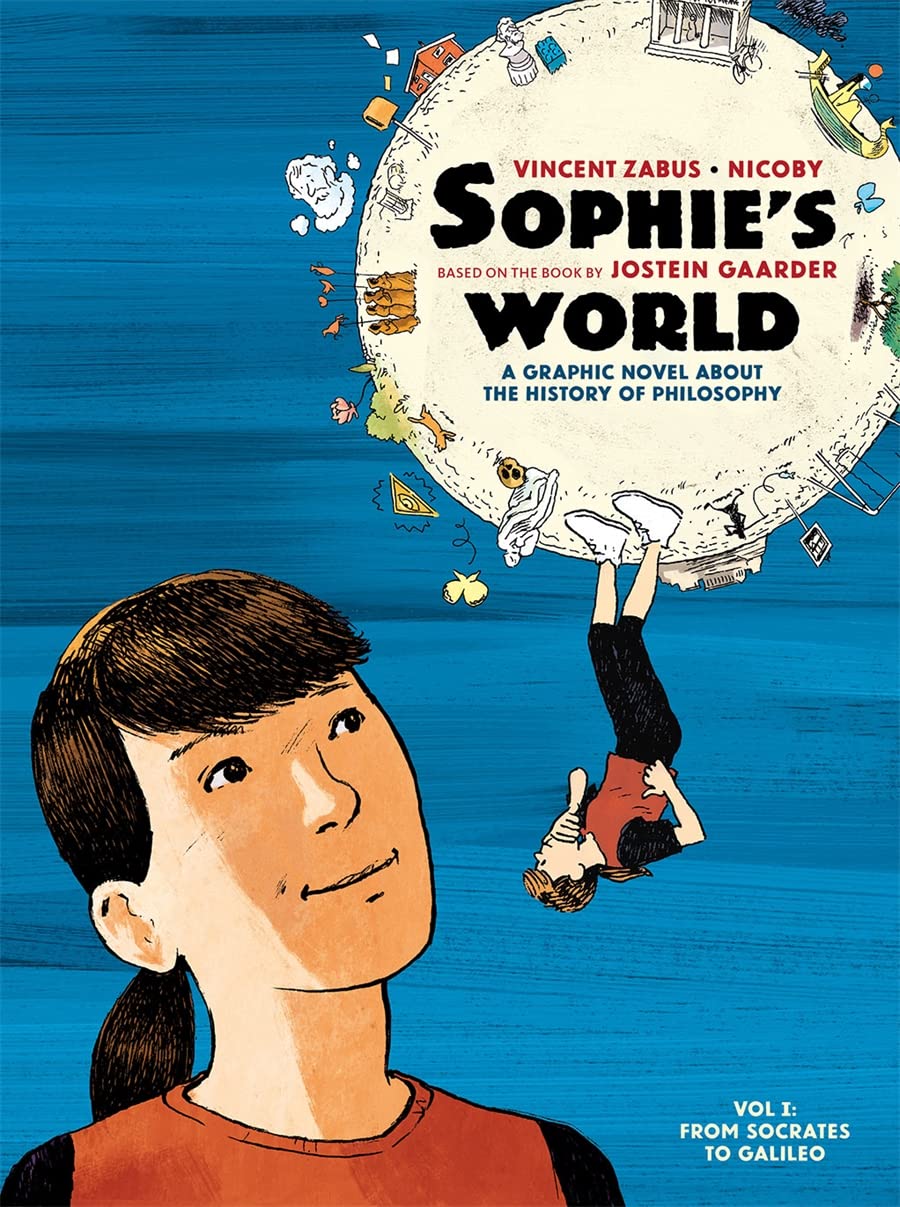
Sophie’s World – A Graphic Novel About the History of Philosophy: Volume 1: From Socrates to Galileo


By Jostein Gaarder, adapted by Vincent Zabus & Nicoby, colours by Philippe Ory with Bruno Tatti; translated by Edward Gauvin (SelfMadeHero)
ISBN: ?978-1-91422-411-9 (TPB/Digital edition)

It has long been a truism of the creative arts that the most effective, efficient and economical method of instruction and informational training is the comic strip. If you simply consider the medium’s value as a historical recording and narrative system, the process encompasses cave paintings, hieroglyphs, pictograms, oriental prints, Stations of the Cross, the Bayeux Tapestry and so much more: and pretty succinctly covers the history of humanity…

For well over a century and a half, advertising mavens exploited the easy impact of words wedded to evocative pictures, whilst public information materials frequently used sequential narrative to get hard messages over quickly and simply. In a surprisingly short time, the internet and social media restored and enhanced the full universal might of image narratives to transcend language. Who doesn’t “speak” emoji?

Since World War II, carefully crafted strips have been used as training materials for every aspect of adult life from school careers advice to various disciplines of military service – utilising the talents of comics giants as varied as Milton Caniff, Will Eisner (who spent decades producing reams of comic manuals for the US army and other government departments), Kurt Schaffenberger and Neil Adams. The educational value and merit of comics is a given.

The magnificent Larry Gonick in particular uses the strip medium to stuff learning and entertainment in equal amounts into weary brains of jaded students with his webcomic Raw Materials and such seasoned tomes as The Cartoon History of the Universe, The Cartoon History of the United States and The Cartoon Guide to… series (Genetics, Sex, The Environment et al). That’s not even including his crusading satirical strip Commoners for Common Ground, and educational features Science Classics, Kokopelli & Company and pioneering cartoon work with the National Science Foundation…

For decades Japan has employed manga textbooks in schools and universities and has even released government reports and business prospectuses as comic books to get around the public’s apathy towards reading large dreary volumes of public information. So do we and everybody else. I’ve even produced the occasional multi-panel teaching-tract myself. The method has also been frequently used to sublimely and elegantly tackle the greatest and most all-consuming preoccupation and creation of the mind of Man…

Like organised religion, the conceptual discipline dubbed Philosophy has had a tough time relating to modern folk and – just like innumerable vicars in pulpits everywhere – its proponents and followers have sought fresh ways to make eternal questions and subjective verities understandable and palatable to us hoi-polloi and average simpletons.

In 1991 Norwegian teacher Jostein Gaarder found one that became a global sensation. Oslo-born in 1952, he taught Philosophy and the History of Ideas in Bergen until he retired to write a modern prose masterpiece of allegory and symbolism in the guise of a fantastic mystery and quest saga.

In an assortment of languages, Sofies verden became an award-winning bestseller in Europe, before being translated into English in 1994 and – as Sophie’s World: A Novel About the History of Philosophy – metamorphosed into the top-selling book on Earth a year later.

Translated into 59 languages with sales far in excess of forty million copies, it enjoys regular anniversary rereleases, and has been adapted to the large and small screen in many countries, as well as PC and board games, and all the usual merchandising instances of a global sensation…

In 2022, playwright/comics scribe Vincent Zabus (Le Journal de Spirou, Les Ombres, Incroyable!) and prolific, wide-ranging Bande Dessinée illustrator Nicolas Bidet AKA “Nicoby” and “Korkydü” (Ouessantines, Le Manuel de la Jungle, Belle-Île en père, Sang de Sein, Tête de gondola, Poète à Djibouti, C’est la guerre – journal d’une famille confine) joined forces to translate the philosophical phenomenon into words and pictures: deftly embracing the magically realist underpinnings of the tale by fully exploring and exploiting the self-imposed fourth wall (and floors and ceilings) of the “ninth art”…

Big, bold and embracing wonderment head-on, Sophie’s World – A Graphic Novel About the History of Philosophy: Volume 1: From Socrates to Galileo seductively adapts the first half of Gaarder’s masterpiece as 14-year-old Sophie Amundsen and her best friend Colleen anticipate their first protest event. They are fired up about the planet’s imminent demise and ready to fight for its life, but Sophie’s scattershot passions are suddenly derailed and her curiosity enflamed after receiving an anonymous package asking the somehow compulsively significant question ‘Who Are You?’

The Who and Why of this enigmatic pen pal transaction completely obsess her after the unseen arrival of follow-up question “Where does the world come from”, and as she ponders, she is lured into the first of some frankly weird if not supernatural proceedings…

As Sophie determinedly seeks answers on a range of conceptual levels, further inquiring despatches literally take her on a journey through all of human development, guided at first remotely, but eventually in the shadow and company of a seemingly benign tutor with an agenda all his own.

…And at every moment and juncture – no matter how wild, impossible or magical – the girl learns and grows…

This initial comics session encompasses cunningly targeted and curated visits, affording up-close-&-personal experiences, via the entirety of the evolution of Western history and culture…

However, as bewildering engagements (or at least gripping, interactive syntheses thereof) unfold in ‘Myths and Natural Philosophers’, ‘Atom and Fate’, ‘Athens and Socrates’, ‘Plato’, ‘Aristotle’, ‘Hellenism’, ‘Two Cultures’, ‘St. Augustine, Averroes, St. Thomas’, ‘The Renaissance’, there’s a turning point in ‘The Baroque’ that unlocks and expands Sophie’s understanding whilst addressing a secret tragedy that unconsciously drives her.

Ultimately, the avid teen discovers other forces in play and unknown actors participating in her lessons, as glimpsed in ‘The Dream of Hilde’ and rebellious phase/phrase ‘A Woman is a Man’s Equal’, and before long the seeker is ready to chart her own course…

Completing the educational brief, this opening discourse includes ‘Author Biographies’ of ‘Nicoby’, ‘Vincent Zabus’ and ‘Jostein Gaarder’ and is absolutely To Be Continued…

Rendered in bright, cheerfully inviting colours in the welcoming manner of a children’s book, this vibrant voyage of discovery is mesmerising in its gently mischievous intensity: an outrageously joyous, entertaining rundown of humanity’s evolution and fundamental principles of thought, cunningly disguised as a superb conundrum to rival any detective yarn. Moreover, the seeds have all been laid for a monumental “Big Reveal” in the next volume…
© 2022 Albin Michel. Based on & © Jostein Gaarder’s novel Sophie’s World. English translation © 2022 SelfMadeHero. All rights reserved.

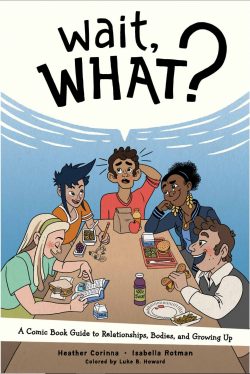
Wait, What? – A Comic Book Guide to Relationships, Bodies, and Growing Up


By Heather Corinna, Isabella Rotman, Luke B. Howard & various (Limerence Press)
ISBN: 978-1-62010-659-4 (PB) eISBN: 978-1-62010-660-0

Comic strips have long been acknowledged as an incredibly powerful tool to educate, rendering tricky or complex issues easily accessible. They also have an irresistible capacity to affect and change behaviour and have thus been used for centuries by politicians, religions, the military and commercial concerns to modify how we live our lives. Call it visual nudge-theory…

Here’s a splendid example of the art form using those great powers for good.

Sometimes it looks like the entire world’s political and moral leaders are seeking to re-mystify the most basic human experience by obfuscating all knowledge of it – leaving our most vulnerable at the mercy of their own basic instincts, wicked exploitation, cruel misinformation and simple ignorance. So if school, church and parental guardians can’t deliver, where can the new and confused go to learn about sexual interactions?

The Comic Book Guide to Relationships, Bodies, and Growing Up begins with an introductory message from Scarleteen – a sex and relationships information, education and support organisation/resource aimed at young people. As official consultants on this project, they start the ball rolling with ‘sex ed for the real world’, detailing the work and purpose of the project and other places the confused or cautious might seek advice and help.

Like many other Limerence publications, this one uses strips, games, puzzles, debate and tutorials – delivered via an engagingly diverse cartoon cast – to explore a variety of potential situations, share vital information (that my generation got from a succession of embarrassed and unwilling teachers despite what our parents thought or said) and proffer advice on where to obtain more.

The publisher’s sequence of informational comics and books has an admirable record of confronting uncomfortable issues with taste, sensitivity and breezy forthrightness: offering solutions or starting points as well as awareness and solidarity. Crucially here, that comes wrapped up in a blanket of reassurance and accepting non-judgement. The message is that every one of us is different and brings something unique to the table…

‘So Who’s at the Lunch Table?’ introduces Rico, Malia, Max, Sam and Alexis: generalised teen spokes-people representing a variety of races, backgrounds, ambitions and sexualities. There is also a narrative usher to authorially move things along …the sublimely neutral Weird Platypus

The mess and muddle around Sex is systematically tackled, beginning with an assault on the myth of timing and physical development in ‘Due Dates’: explaining biology, emotional maturity and even consent and opportunity, whilst contributing numerous anecdotes and opinions in ‘What Do You Think and Where Are You At?’

The carefully manufactured war between media, self-aspiration and everyday life is deconstructed in ‘IRL: in real life’ confirming that “the way things are in media are not necessarily how they ACTUALLY ARE”, after which we gain great graphic and factual clarity in ‘What is Puberty?’

The chapter details the basic ‘Stages of Puberty’, initially concentrating on ‘For Every Body’ before affording specialist data with ‘If You’ve got a Vagina’ and ‘If You’ve got a Penis’

‘You’re a Man/Woman Now!’ then busts some fallacies on the subject to reveal ‘These Things Don’t Actually Mean Very Much About Growing Up’

The next topic opens with overview ‘Ohhh Yeah, Real Mature!’: asking the gang ‘What Does Maturity Mean to You?’ before plunging into the charged subject of ‘Masturbation!’

Expanding into lesson and anecdotal discourse, we learn ‘Masturbation is Healthy – and nothing to be ashamed of’ and sensibly enquire ‘Why Do People Masturbate’ before tackling an increasingly serious problem in ‘Weird Genitals!: Worried Your genitals look weird? Feeling like other people’s do???’

This section is augmented by ‘A Whole Bunch of Genitals’ in a gallery display plus a join-the-dots activity page cheekily page proving ‘Genitals come in all sorts of different sizes, shapes and colors’

The major issue of Difference is laid out and explained in ‘Boys vs. Girls’, covering every aspect of possible confusion and contention via sports or toys to genderised colours, cunningly rationalised by a series of non-binary paper-dolls and clothing outfits with gender-fluid Max guiding us in making declarations and identifications…

A seemingly overwhelming youthful hurdle is cut down to size in ‘What is a Crush?’ with hapless cisgendered heterosexual Rico pointing out some pitfalls, assisted by his tablemates answering the question ‘Have You Ever Had a Crush?’ and ‘Do You Really want to Be Someone’s Partner, Girlfriend or Boyfriend?’ Whilst exploring ‘Promises and Dating’ and negotiating a bewildering maze entitled ‘As If There Was Only One Path!’ we learn how to end relationships kindly and safely in ‘It’s Okay To Go’

The mysteries and challenges of informed choice are explored in ‘By Invitation Only’ – reinforced by a ‘Consent Word Search’ – before we move on to the bit every parent always freaks out over…

What defines intimacy and sexual behaviour is debated and explored in ‘It’s Not Sex, It’s Just Messing Around’, pictorially questioning ‘Why Do People Have Sex Together’, ‘So What’s the Difference between Sex and “Messing Around”’ and gaming out ‘If it Wasn’t a Choice’

Graphs and statistics are deployed for ‘How Do You Know When You’re Ready for Sex Stuff’, backing up the cartoon wisdom of vox-pop ‘When Do You Think You Will Be Ready for Sex Stuff’ and pivotal enquiry ‘Why is Sex Such a Big Deal?’: only pausing to ask ‘Are You… Gay? Straight? Both? Neither?’ and if it even matters…

A ‘Sexual Orientation Crossword’ – with handy ‘Sexual Orientation Word Bank’ – introduces a new (and increasingly toxically contentious contemporary topic) in ‘Sexual Identity Isn’t a Lifelong Commitment’, with pictured points of view culminating in a space for readers to verbalise their own thoughts, after which the end approaches as we ponder ‘What Does it Mean to be a Virgin?’

Here Malia, Rico and Sam deconstruct the term from widely differing starting points, whilst ‘I Hate That Word!’ examines the infinitely loaded term’s accusatory and demeaning contexts before unleashing ‘A Note About Double Standards’

When beginning or even just anticipating a sexual life, support is crucial and a trustworthy network is a must if it’s possible at all. ‘Assemble Your Superteam!’ offers some sage advice on how in ‘Your Sidekick’, ‘Your Parental Figure’, ‘Your Mentor’ and ‘Your League’. The process is reinforced by another Wordsearch – ‘Find all the people you could maybe talk to!’ – before neatly segueing into ‘Know Your Community Resources!’ and affirming questionnaire ‘Who is on your Superteam?’

The cerebral sex session ceases with ‘In Conclusion: What is One Last Thing You Want to Leave Everyone With?’, supplemented by ‘Dear You’: a direct message from the creators that endeth the lessons…

Cartoonist Isabella Rotman (A Quick & Easy Guide to Consent, Bodies, and Growing Up; Not on My Watch: The Bystanders Handbook for the Prevention of Sexual Violence; You’re So Sexy When You Aren’t Transmitting STIs) and New Orleans colourist Luke Howard have crafted a cogent and compelling primer covering the irrefutable basics for a wide and varied range of potential users, with the facts and messaging scripted by author, educator and youth advocate Heather Corinna (S.E.X.: The All-You-Need-To-Know Sexuality Guide to Get You Through Your Teens and Twenties; Our Bodies Ourselves).

Identifying as Queer and disabled, Corinna is the founder, designer and director of Scarleteen and Rotman became the organisation’s artist in residence in 2013.

A comprehensive ‘Glossary’ of pertinent terms opens a section of codicils including ‘I Can’t Keep Up With the Slang!’ – an advisory on changing trends in talk about sex; ‘Puzzle Solutions’; creators bios and appreciation ‘We are so grateful for:’ after which ‘More Cool Things!’ offers a bibliography and listings of other resources online, organisational and other for kids and adults to further explore…

This book is a bright and breezy primer covering the irrefutable basics on beginning one’s sexual life and confirming a gender that most suits each individual. By sharing facts and honest opinions it may hopefully help readers safely navigate all manner of relationship and explore the spectrum of experiences that should be available us all…
Wait, What? – A Comic Book Guide to Relationships, Bodies, and Growing Up is ™ & © 2019 Heather Corinna and Isabella Rotman. All rights reserved.

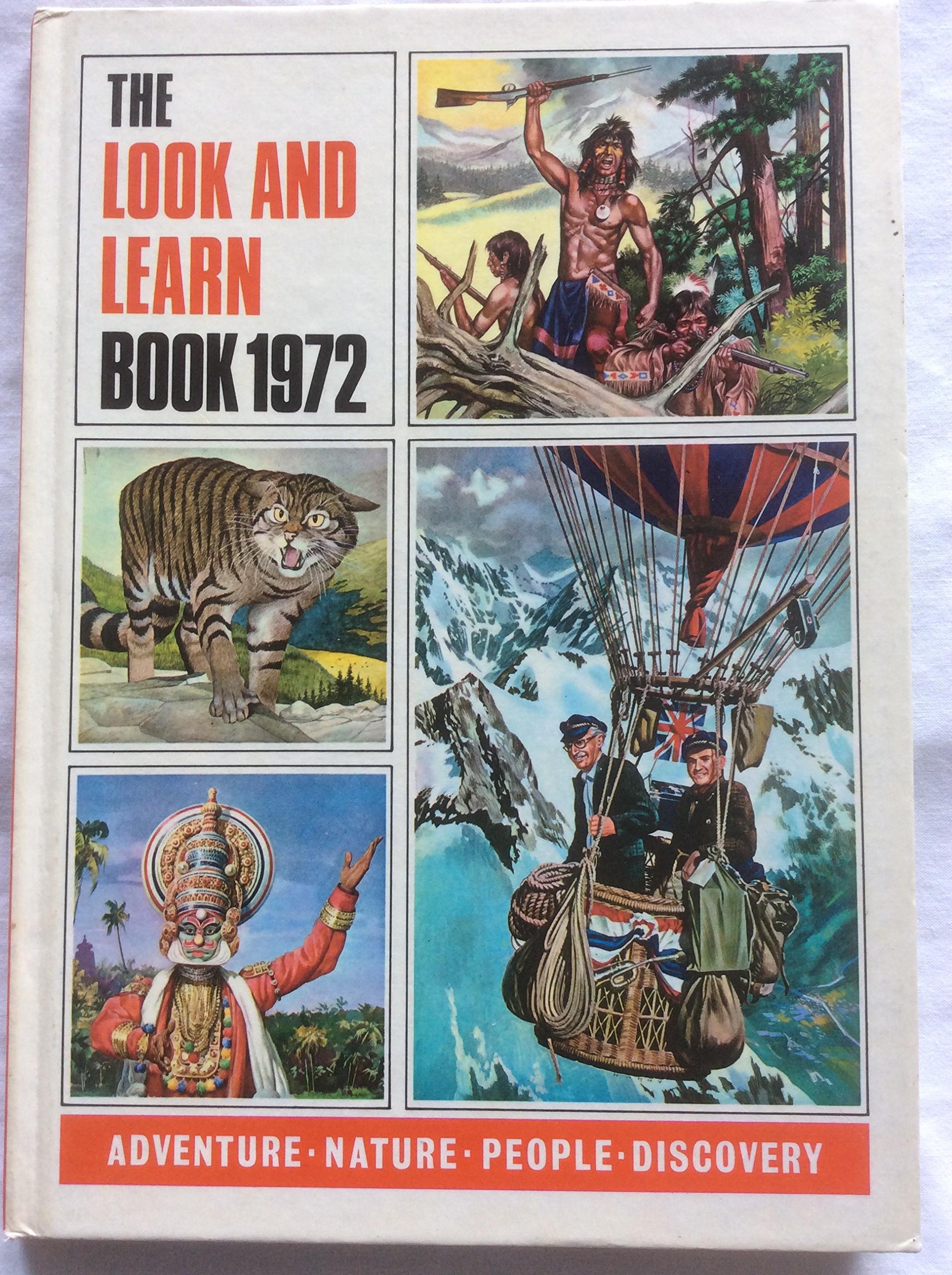
Look and Learn Book 1964


By many & various (Fleetway)
ISBN10: 901267-49-X – ISBN13: 978-0-90126-749-8

One the most missed of publishing traditions in this country is the educational comic. From the fact features in the legendary weekly The Eagle to the small explosion of factual and socially responsible boys and girls papers in the late 1950s to the heady go-getting heydays of the 1960s and 1970s, Britain had a healthy sub-culture of comics that informed, instructed and revealed …and don’t even get me started on sports comics!

Amongst many others, Speed & Power, World of Wonder, Tell Me Why and the greatest of them all Look and Learn spent decades making things clear and bringing the marvels of the world to our childish but avid attentions. They always did so with taste. wit, style and – thanks to the quality of the illustrators involved – astonishing beauty.

Look and Learn launched on 20th January 1962, brainchild of Fleetway Publications Director of Juvenile Publications Leonard Matthews, and executed by Editor David Stone (almost instantly replaced by John Sanders), Sub-Editor Freddie Lidstone and Art Director Jack Parker.

For twenty years and 1049 issues, the shiny beautifully printed comic delighted children by bringing the marvels of the universe to their doors, and was one of the country’s most popular children’s publications. Naturally, there were many spin-off tomes such as The Look and Learn Book of 1001 Questions and Answers, Look and Learn Book of Wonders of Nature, Look and Learn Book of Pets and Look and Learn Young Scientist, as well as the totally engrossing Christmas treat The Look and Learn Book.

This volume was released for Christmas 1971 (as with almost all UK Annuals it was forward-dated) and is a prime example of a lost form. Within this 132 heavy-stock paged hard-back are 46 fascinating features on all aspects of human endeavour, history and natural wonders.

Technology always played a growing part in proceedings and – aided and abetted by printing advances photography – the ever innovative editors subdivided this volume into themed categories: opening naturally with a Science Section that includes – in drawn and painted but mostly photo – features Beneath the Waves – the Story of Submarines, A Jet in your garage?, Cities in the Sky, Our Polluted Planet (yep they were bloody warning us way back then!), Quiet Please! and Tested for Toughness.

To keep readers on their intellectual toes there are tests at the end of each course module and a Science Quiz ushers readers into the next phase – Our Wonderful World of History

Here – although photographs are increasingly used throughout – traditional illustrators still rule. Diagrams, cartoons, paintings and drawings were rendered by some of the world’s greatest commercial artists and might include such luminaries as Ron and Gerry Embleton, Helen Haywood, Ron Turner, Ken Evans, Angus McBride, Peter Jackson, “Pratt”, Fortunino Matania, John Millar Watt, John Worsley, Alberto “Albert” Breccia, Clive Upton, James E. McConnell, Ken Lilly, C.L. Doughty, Wilf Hardy, Dan Escott, R.B. Davis, Oliver Frey and many others, illuminating the articles and making these books (and the comics) an utter delight for hungry minds to devour whilst the Roast Beast and plum pudding slowly digested…

Right here back then that meant revealing such marvels as Conquerors of the Incas, The Heart of Sienna, When Horses Went to War, Are You Superstitious?, Signs of the Times, The First Americans, and Christmas Customs which comes with its own History Quiz and heralds a swift sojourn in the Wonderful World of Nature.

That means admiring and studying our native fauna in Their Home is the Highlands, Marine Marvels, The Grand Canyon, Winged Beauties (butterflies on stamps), Gems from the Ocean, Fish with a difference, When a Boar Goes to War, Creatures of the Night, Builders without hands, Puma – or Rumour?, Snakes Alive!, Fabulous Monsters and Birds of Prey and then taking the Nature Quiz

Our Wonderful World of Art injects some high culture to the mix, starting with The Artist at War – enhanced by famous contemporary images from G.H. Davis, Bruce Bairnsfather, Frank Wooton, Paul Nash and Dame Laura Knight – which is followed by facts, photos and paintings of Pompeii.

An examination of silent cinema comedies in The Banana Skin Boys, The Young Road to Fame (acting and actors) and exploration of Sir Arthur Conan Doyle in He Lived His Books covers more sedentary interests before Their Fathers Made Them Stars and The Revolutionary Genius (William Morris) segues into The Arts Quiz. That takes us to the end with a peek at Our Wonderful World

Here Round-the-World Sailors take the lead after which This town was… Buried for 1,500 Years (Herculaneum this time) offers more insights in lost worlds and Australia’s original inhabitants take centre stage in Corroboree! The Silent City explores Mdina in Malta before Ballooning over the Alps, The Making of a Sea, Ellan Vannin, Land of Music and Song and Under a Spanish Sky bring the session to a close – with its attendant Quiz – and of course all the answers…

With modern digital media I suppose this kind of book is unnecessary and irrelevant now, but nostalgia aside, the glorious art in these editions make them worth the effort of acquisition, and I defy anyone of any age to not be sucked into the magic of learning that looks this lovely…

© 1971 IPC Magazines, Ltd. All Rights Reserved.


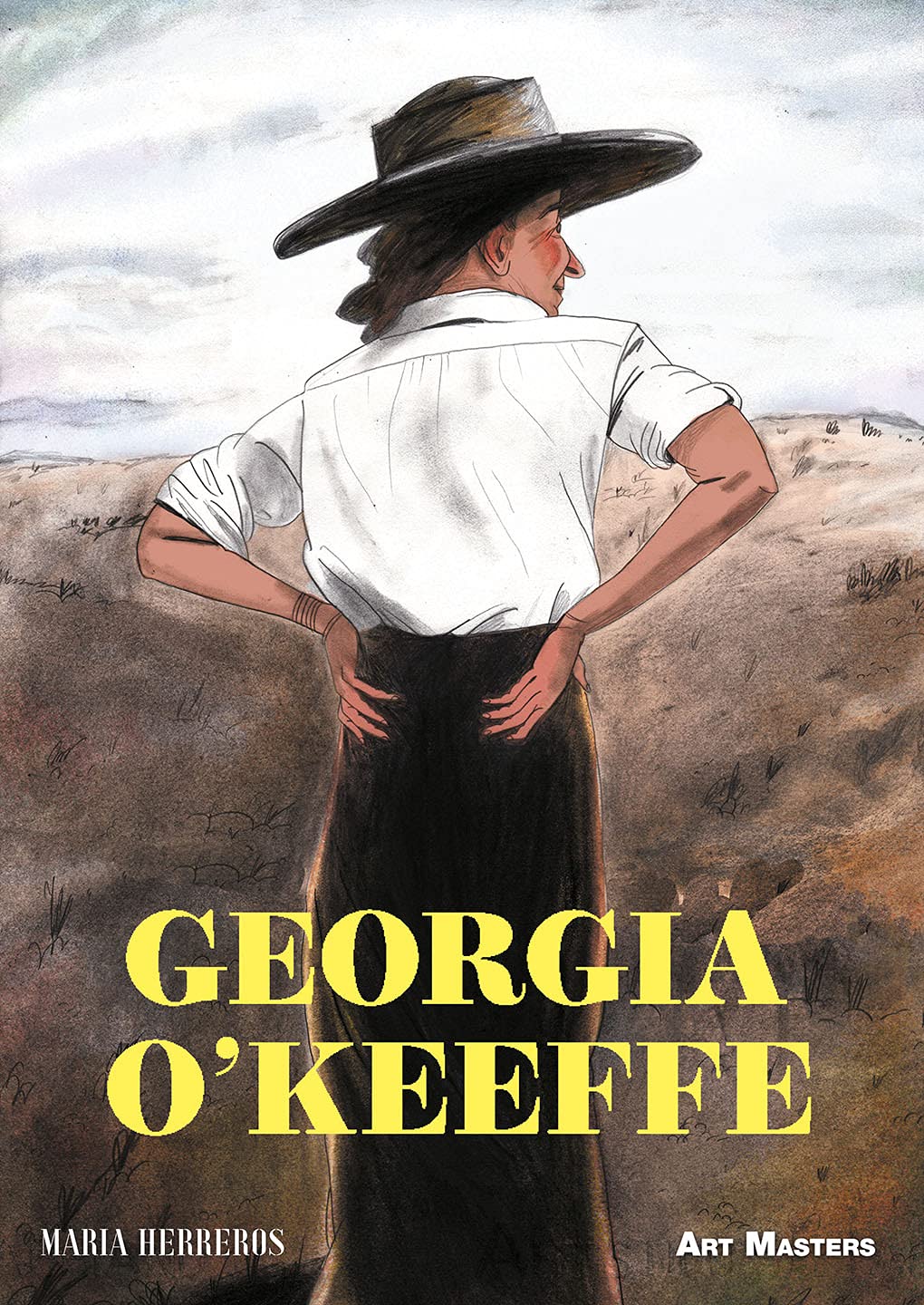
Georgia O’Keeffe


By María Herreros; translated by Lawrence Schimel (SelfMadeHero)
ISBN: 978-1-914224-05-8 (TPB/Digital edition)

Georgia Totto O’Keeffe entered the world in Sun Prairie, Wisconsin on November 15th 1887, second of seven children born to a dairy farmer turned (failed) construction entrepreneur. Seized and overwhelmed by the artistic impulse before the age of ten, she overcame financial hardship to secure an impressive traditional artistic education which she promptly rejected in favour of finding her own path.

From 1917 and her first exhibition, to her death in 1986, she made art her way, most famously with series of paintings of flowers, buildings and ultimately desert scenes which became a catalyst of taste and part of global artistic culture. She is regarded as America’s first abstract artist and has been called The Mother of American Modernism.

Innocently controversial from the start, O’Keeffe increasingly sought to understand colour and shape via stark cityscapes and florid blossoms but had to endure censure and gossip over nude photos exhibited by her patron Alfred Stieglitz, and the indignity of having her flower paintings mansplained by critics – even female ones – who continuously likened them to female sexual organs.

Bored with saying ‘They’re just flowers’ and self-important fools, she began a gradual, years-long process of quitting metropolitan civilisation for peace, contentment and endless inspiration under the big skies and vivid deserts of New Mexico.

Over a decades-long career. O’Keefe garnered international acclaim and many awards. These included an honorary Doctor of Fine Arts degree from the College of William and Mary (1938); election to the American Academy of Arts and Letters and a fellowship of the American Academy of Arts and Sciences(1966); receiving the M. Carey Thomas Award from Bryn Mawr College (1971) and another honorary degree (from Harvard in 1973) as well as the Presidential Medal of Freedom (1977), The National Medal of Arts (1985) and – in 1993 – posthumous induction into the National Women’s Hall of Fame.

As you’d expect of a determined, driven professional woman of that period in that country, making extremely successful headway in a predominantly male preserve, her personal life was something of a trainwreck, but this compelling examination chooses to downplay those aspects.

Sensibly side-lining the more sensationalised moments of O’Keefe’s past in favour of tracing her accomplishments and victories, graphic biographer Mar­a Herreros has employed her painterly, primitivistic narrative style which liberally samples O’Keeffe’s copious canon of letters and idiosyncratic writings to bring us inside the head of a profoundly visual and arguably obsessive being.

Based in Madrid, but born in Valencia in 1983, Herreros is a modern multidisciplinary artist. She studied at the University of Fine Arts, San Carlos and since 2011 has combined high level commercial commissions with gallery shows, book collaborations and comics such as Viva la Dolce Vita, Marilyn tena once dedos en los pies, and Paris sera toujours Paris. Her personal works explore human emotion, societal evolution and the concepts of beauty and normative states.

Although remaining primarily positive and inquisitive here, Herreros touches on O’Keeffe’s mental ill health issues, her Svengali-like attachment (later marriage) to older, already-married Fine Art photographer/gallery owner Stieglitz and her end-of-life companion John Bruce “Juan” Hamilton – both notorious age-inappropriate public scandals that Georgia casually, magnificently, ignored.

Via communications with Georgia’s close female friends and Stieglitz, Herreros takes us inside the painter’s mind, revealing the creative process and progress in navigating society, the public and the poison chalice of simply having to exhibit art to survive, while emphasising making the images she wanted to in places she truly loved which became her greatest joy and solitary citadels.

Less a biography than a carefully crafted appreciation and appraisal of a career and legacy by a fellow fully emancipated, self-determining female creator, Georgia O’Keeffe is a compelling and beguiling glimpse into the forces that shape art and artists.
Text and illustrations © 2021 by Mar­a Herreros. All rights reserved. Published by agreement with Astiberri Ediciones and Fundacian Coleccian Thyssen-Bornemisza English translation © 2021 SelfMadeHero.

The Boxer – the True Story of Holocaust Survivor Harry Haft


By Reinhardt Kleist; translated by Michael Waaler (SelfMadeHero)
ISBN: 978-1-906838-77-5 (TPB/Digital edition)

Multi-award-winning German illustrator, designer, author, cartoonist and comics maker Reinhard Kleist (Berlinoir; Steeplechase; Das Grauen im Gemäuer) has been working in the industry since 1994: setting up a cooperative studio/atelier and beginning his professional career with graphic biography Lovecraft, and supernal dramas Minna, Das Festmahl, and Abenteuer eines Weichenstellers while still a student in Münster.

He has constantly explored and gratified his fascination with notable individuals who have overcome stacked odds and inner darkness in stellar works such as Johnny Cash: I See a Darkness; Elvis – An Illustrated Biography; Castro; An Olympic Dream: The Story of Samia Yusaf Omar and Nick Cave: Mercy on Me.

In 2011 he again turned to boxing for inspiration, adapting a Holocaust biography written by the son of a survivor of the death camps. Hertzko/Herschel “Harry” Haft might be regarded amongst the more noteworthy of those benighted souls: a ruthlessly determined individual who overcame every iteration of horror and privation, using his fists and low cunning.

His life was first recounted in 2006 by his son Alan Scott Haft in prose biography Harry Haft: Auschwitz Survivor, Challenger of Rocky Marciano, and as well as the graphic novel under review here, you can absorb the tale in filmic form in Barry Levinson’s movie adaptation The Survivor.

Delivered in stark monochrome, Kleist’s compelling and uncompromising interpretation opens with the protagonist a humble grocer in America, trying to relate to his young son. Harry is a hard man to relate to, but in a moment of contrition he promises to one day share with his boy what made him that way.

Alan waited another forty years to hear the truth and turned it into a narrative for everyone…

The story proper opens in 1939, in the Polish town of Belchatow. Since the Germans came, the Jewish Haft family have become smugglers, and 14-year old Hertzko thinks himself invincible.

His father had sold fruit and veg but found it increasingly difficult to support a wife and eight children. When he died, the family splintered and only Hertzko and brothers Aria and Peretz stayed with their mother. When the invasion took hold, their illicit activities made them all targets, but amidst daily outrages, he found opportunity for love and was betrothed to Leah Pablanski, daughter of the receiver of all the contraband he shifted across the Nazis’ new borders…

When Hertzko was transported to his first labour camp, seeing Leah again one day was the dream that kept him going. Barely literate but strong and determined he had a gift for being useful and, despite toiling in the most horrific circumstances and being present for every atrocity of the regime, he endured – especially after his smuggling experience made him an essential tool of one particular guard officer who was methodically enriching himself at the prisoners’ expense…

Moved from camp to camp as a slave labourer, Hertzko eventually arrived in Jaworzno camp and was reunited with his brother Peretz. Here his sponsor found him less egregious duties. All he had to do was fight other prisoners in Sunday exhibition matches for the officers. Haft had never boxed before, but would do anything for better conditions and what passed for “guaranteed” survival. What he did there remained with him for the rest of his life…

Despite his resilience and adaptability, Haft always found himself at the mercy of superior and more ruthless forces. As the Allies slowly pushed the Nazis back on all fronts, he was left to the “death marches” the SS instigated to empty the camps and hide evidence of their industrialised slaughter factories. Over and again, Haft dodged certain death and committed more sins until finally captured by American troops. Soon his underworld experience was being exploited by the GIs as Hertzko ran a bordello for the soldiers. When Peretz resurfaced, Haft finally had time and enough money to go looking for Leah. That trail led ultimately to America.

While in US-occupied Straubing, Haft had won a boxing competition organised by the Army, and was – after further machinations – allowed to emigrate in 1946. He was 23 years old…

The second half of Haft’s life began in the New World. He still wanted Leah and decided fame would be the key. The fight game in America was popular but increasingly under the control of organized crime. Nevertheless, Haft – now calling himself “Hershel” and “Harry” – pursued his chosen path with relentless zeal.

Overcoming every administrative obstacle, he found a manager, learned how to actually box rather than fight and kept on winning.

The equation was simple. Leah was here somewhere. If he could get his picture in the papers or newsreels or even on this new television thing, she would see him and get in touch. Sadly, it only brought him to the attention of mobsters. After his moment of glory fighting Rocky Marciano in 1949, Haft learned how his chosen world really worked…

Walking away, he married a neighbour’s daughter in November and opened a grocery store in Brooklyn. In 1963 the family took a trip to Florida and young son Alan helped locate a woman named Leah Lieberman…

Please be warned: The Boxer is not just a testament of atrocity or celebration of the human spirit under the most appalling conditions. It’s also a real world love story where the always-inevitable ultimate reunion does not follow the rules of romantic fiction or bring about a happy ending.

Kleist’s graphic tour de force is supplemented by a stunning gallery of sketches and working drawings, and backed up with a picture-packed essay from sports journalist Martin Krauss.

‘Boxing in concentration camps – a report’ details the long-neglected topic of Nazi sports exhibitions in work and death camps and relates it to Haft’s later professional career in America, including a chilling sidebar on ‘US boxing and the Mafia’. Also on the bill are biographies of other ‘Forgotten champions’ of the camps: Victor “Young” Perez; Noach Klieger; Leendert “Leen” Josua Sanders; Leone “Lelletto” Efrati; Salamo Arouch; Jacko Razon; Johann “Rukelie” Trollman; Tadeusz “Teddy” Pietrzykowski and Francesco “Kid Francis” Buonagurio.

Potent, powerful, moving and memorable, this is a quest tale well told and one not easily forgotten.
© Text and illustrations 2012 CARLSEN Verlag GmbH, Hamburg, Germany. © Appendix 2012 Martin Krauß and CARLSEN Verlag. English translation © 2021 SelfMadeHero. All rights reserved.

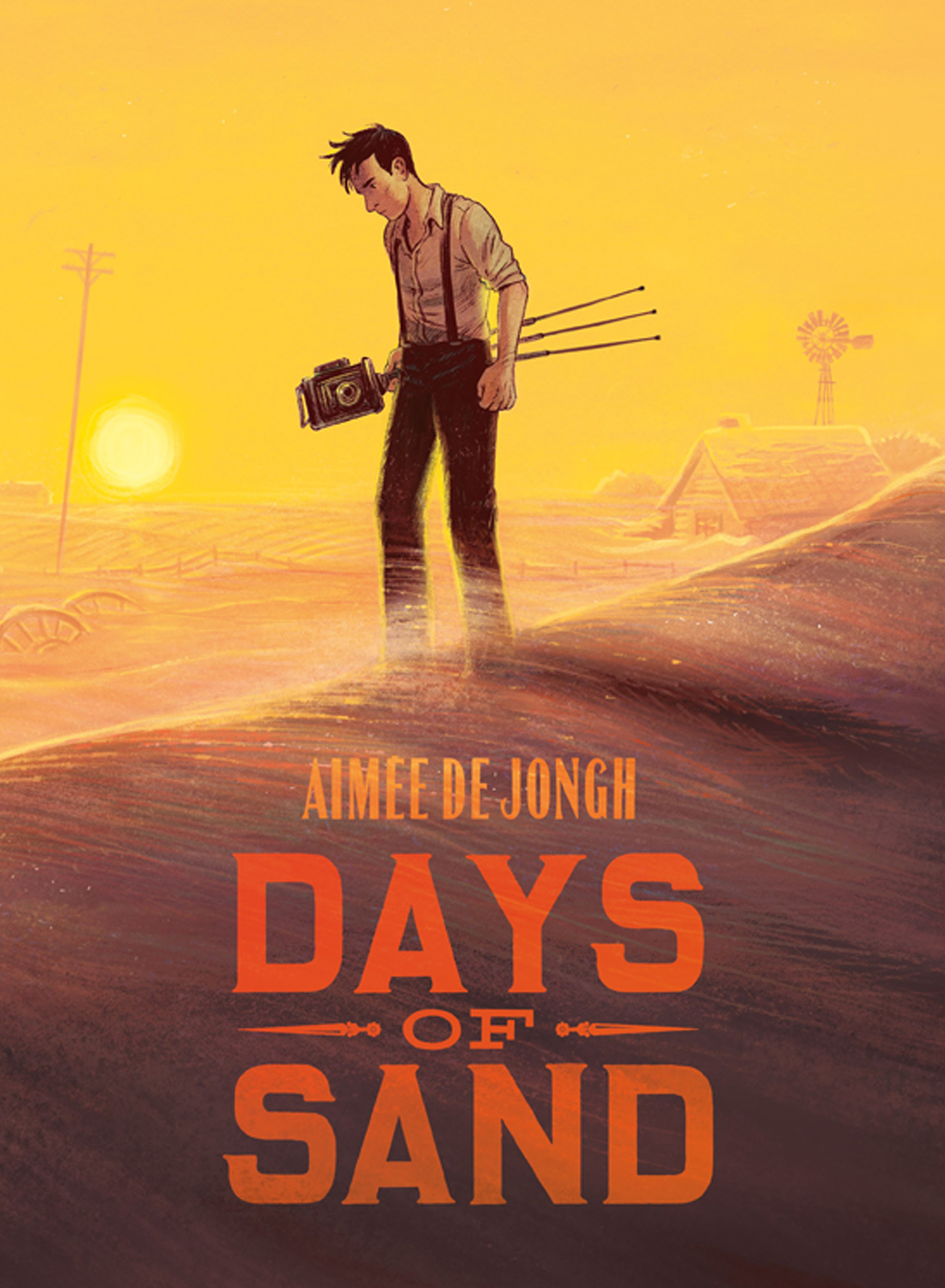
Days of Sand


By Aimée De Jongh, translated by Christopher Bradley (SelfMadeHero) 
ISBN: 978-1-914224-04-1 (HB)  

Certain eras and locales constantly resonate with both narrative consumers and creators. The mythical Wild West, the trenches of the Somme, Ancient Rome, 1940s Hollywood and so many more emotionally evocative enclaves of mythologised moments spark responses of drama, tension and tales crying out to be told.  

One of the most evocative derives from Depression-era America, but rather than a noir-drenched misty Big City, Aimée De Jongh drew her inspiration from a scrupulously documented decade long human catastrophe that inescapably presages ecological collapse in our imminent future. 

The Netherlands-born comics creator, story-boarder, Director and animator studied at Rotterdam, Ghent and Paris before beginning her career as a newspaper cartoonist. While releasing graphic novels The Return of the Honey Buzzard, Blossoms in Autumn and Taxi!, the multi-disciplined, multi award-winning artist worked in television, on music videos and animated movies (Aurora), for gallery shows (Janus), and latterly turned to graphic journalism, detailing refugee life in Greece’s migrant camps. 

Combining overlapping interests in travel, documentary and ecology, her latest opus tells a carefully curated and fictionalized account of one young man’s reaction to the 1930’s Dust Bowl disaster and the resultant diaspora it triggered over ten years of drought.  

To research the tale – released in Europe in 2021 as two-volume Jours de sable – De Jongh travelled extensively through the region (Oklahoma to California), visiting remaining historical sites and museums while accessing the precious wealth of photographic material sponsored by the contemporary Farm Security Administration. This federal entity recorded the tragedy which forms the narrative spine of this story.  

De Jongh’s blog offers interested readers further insights and this book includes commentary and many of the original photographs that ultimately moved the event from environmental aberration to cultural myth and human tragedy. 

This is not a tale about plot and action but premise and reaction. Captivatingly rendered with colour acting as a special effects suite and utilizing original 1930s photographs throughout, it sees unemployed photographer John Clark take a job in 1937: hired like many others to document the human and economic effects of a decade-long drought and bad farming practises on the people of Oklahoma. Trapped at the heart of an un-Natural Disaster, they daily endure the frightening and no-longer gradual transition of their once lush lands of milk and honey and grass and fruitfulness into a new Sahara desert… 

Unfortunately, Clark has more baggage than just a shooting script and camera cases, and as he carries out his task, he slowly loses perspective and secure distance in the face of awestriking nature and humanity in its rawest, most reduced state. How can his camera intrude and explore when he’s as much lost and unbalanced as any of his subjects? 

It’s easy to read in subtextual messages and apply modern tropes and memes ranging from the movie Dune to the current global migrant crisis or each and every western government’s insipid pettifogging disinclination to take charge or an iota of responsibility. The world has never been in a worse state and if this book motivates anyone to make a change – however small – that’s a big win. However, it’s not the point.  

Terror, loss, hopeless misery and hunger for a better life have always been with us. The fact that our imminent doom is self-inflicted is irrelevant. The fact that everyone is/will be affected is a non sequitur. What’s germane is that when Kent or Hampshire are dust bowls and all Pacific islands are underwater, it’s still going to come down at some point to every one of us making a decision…  

An international hit garnering many honours and accolades, Days of Sand is staggering beautiful, distressingly unforgettable and never more timely, but please don’t dismiss it as a trendy and pretty polemic. This is a timeless examination of individual human choice in reaction to overwhelming, immeasurable forces and how individuals may respond. What’s presented here is one concerned artist’s narrative riposte. What’s yours? 

Jours de sable © DARGAUD-BENELUX (DARGAUD-LOMBARD S.A.) 2021, by Aimée De Jongh. All rights reserved  

Comics Ad Men


By Many & various, written and compiled by Steven Brower (Fantagraphics Underground Press)
ISBN: 978-1-68396-307-3 (TPB)

Win’s Christmas Gift Recommendation: A Catalogue of Cartoon Nostalgia… 8/10

From its earliest inception, cartooning has been used to sell: initially ideas or values but inevitably actual products too. In newspapers, magazines and especially comic books the sheer power of narrative – with its ability to create emotional affinities – has been linked to the creation of unforgettable images and characters. When those stories affect the daily lives of generations of readers, the force that they can apply in a commercial arena is almost irresistible…

Any ad exec worth their salt knows instinctively how to catch and hold public attention so as comics developed its star characters and top creators became invaluable resources and many accounts rose and fell on the force of celebrity Brand spokes-doodles rendered by the best artists around – often the very cartoonists creating strips and comic books. Ultimately, many of comics’ greatest were seduced away from the harsh deadlines of strips for the better-paid environs of the marketing moguls. That’s where this delightful collation from design wizard, Creative Director, Educator, art lover and comics afficionado Steven Brower (From Shadow to Light: The Life and Art of Mort Meskin; Golden Age Western Comics; Astounding, Mysterious, Weird and True: The Pulp Art of Comic Book Artists) comes in: a fascinating picture-packed directory of top comics creators leasing their talents to sell stuff…

It’s a guaranteed nostalgia-fest: I know of many – including star industry folk and Plain Old me – who have bought assorted Golden Age comics just because they carry CC Beck Captain Tootsie ad pages or Twinkies shills concocted and populated by Marvel and DC’s top guns…

Delivering an effusive and erudite essay and lecture on the history and development of the phenomenon – liberally accompanied by dozens of captivating illustration examples – Brower makes a compelling case for further study and successfully jingles the heartstrings of comics devotees with a delicious roster of astoundingly impressive artists clandestinely operating in the real world of commerce. Did you know that Golden Age Green Lantern originator Martin Nodell also created the Pillsbury Doughboy? You do now, and so much more can be yours to bemuse your chums…

The big draw is a carefully curated and stunning Gallery of historical examples comprising star turns and their famous creations. Here Sydney Smith co-opts The Gumps to sell “Funy Frostys”, E.C. Segar’s Popeye crew tout Mazda Lamp lightbulbs and Al Capp’s Li’l Abner recommends Cream of Wheat.

The parade of stars continues with Mel Graf (Secret Agent X-9; Captain Easy), Frank Robbins (Jonny Hazard; Batman, The Invaders), Vic Herman (Little Dot; Elsie the Cow), Clifford McBride (Napoleon and Uncle Elby), Sheldon Moldoff (Hawkman; Batman), Basil Wolverton (Spacehawk; Powerhouse Pepper; Mad), Noel Sickles (Scorchy Smith) and  Jacob Landau (Military Comics; Captain America).

Some artists’ styles were perfect for changing times and were in high demand. Otto Soglow (The Little King) and Dik Browne (Hagar the Horrible; Hi and Lois) were highly sought after with Browne being represented here by solo strips and in collaboration with Gill Fox (Torchy; Hi and Lois) and Roland Coe (The Little Scouts), VIP – AKA Virgil Partch – (Big George), Bill Williams (Henry Aldrich; Millie the Model), Hank Ketcham (Dennis the Menace – the American one), Marvin Stein (Justice Traps the Guilty; Young Love) and Paul Fung (Dumb Dora).

There were even agencies repping many illustrators, and a copious sampling of Young & Rubicam and Johnstone & Cushing alumni precede beguiling work from Stan Drake (The Heart of Juliet Jones; Blondie; Kelly Green), Lou Fine (Doll Man; The Ray; The Spirit; Black Condor), Creig Flessel (The Sandman, Detective Comics; Pep Morgan; Superboy), Jack Betts (Britannia Mews), Bob Bugg (The New Neighbors; Popular Comics), Kelly Freas (assorted covers), Alex Kotzky (Blackhawk; Apartment 3-G), George Roussos (Air Wave; Batman; Crypt of Terror; Fantastic Four) and Tom Scheuer (Flash Gordon; My Love Story).

Neal Adams (Batman; X-Men; Ben Casey) actually set up his own agency Continuity Associates, employing many contemporaries such as Dick Ayers (Human Torch, Ghost Rider; Sgt. Fury  and his Howling Commandos) and talented newcomers but there was always a demand for older veterans like Mort Meskin (Sheena; Johnny Quick; Vigilante; Mark Merlin), Joe Simon (Captain America; The Fly; Fighting American; Boy Commandos) and Wallace Wood (T.H.U.N.D.E.R. Agents; Daredevil; Weird Science; Mad; Witzend), all seen here in a wealth of amazing art.

Wrapping up the with a final push of superb selling points are briefs filled by Ken Penders (Sonic the Hedgehog), some Twinkies moments courtesy of John Romita Snr. (Amazing Spider-Man) and Ross Andru & Mike Esposito (Wonder Woman; The War that Time Forgot; The Metal Men; Amazing Spider-Man), a drinks campaign designed to reach modern youth featuring Daniel Clowes (Lloyd Llewellyn; Eightball; Ghost World; Patience) and an abundance of superb stuff from the mightily prolific Jack Davis (Mad; Frontline Combat; Rawhide Kid).

Available in paperback or instantly gratifying digital editions and stuffed with astounding images, fascinating lost ephemera and mouth-watering bouts of nostalgia, Comics Ad Men is an absolute visual delight no fan of pop culture, comics or narrative illustration will be able to resist.
© 2019 Steven Brower and Fantagraphics Books. All art and trademarks © & ™ & their respective copyright and trademark holders. Essay © Steven Brower. All rights reserved.

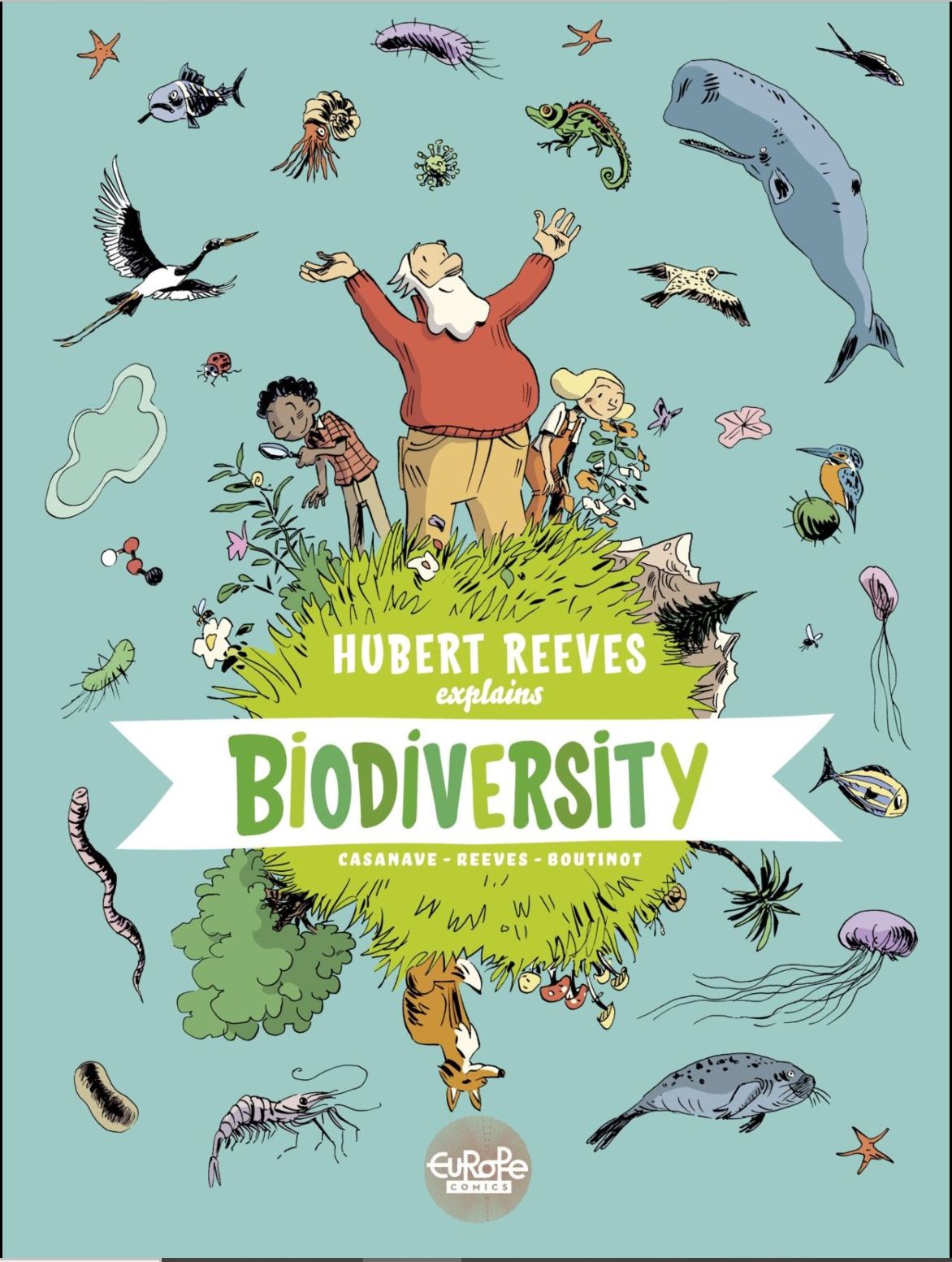
Hubert Reeves Explains BiodiversitY


By
Hubert Reeves, Nelly Boutinot & Daniel Casanave, coloured by Claire Champion and translated by Joseph Laredo (Europe Comics)
No ISBN: digital release only

Win’s Christmas Gift Recommendation: Lasting Lessons Lavishly Limned and Laudably Learned… 9/10

It’s sometimes easy to forget that other countries have national treasures, too: popular spokes-folk sharing their passions for the good of us all. Living folk, that is, not pilfered artefacts taken into “protective custody” by most western “explorers” whilst visiting other people’s continents: that’s just shameful and unforgivable…

Sir David Attenborough, Greta Thunberg, Professors Brian Cox, Lucy Worsley, Neil DeGrasse Tyson and many others have translated their passions into education, elucidation, mass entertainment and good works, but they are not alone and most nations have their own voices of wonder, reason and sanity. For French-speakers, one of those effulgent natural educators is Professor Hubert Reeves.

Born Quebecois in 1932, raised and educated in Montreal but now resident in Paris, the physicist and professional educator is a major name in Thermonuclear Reactions, Light Nuclei and “Positronium”; advises NASA and has – since 1965 – been Director of Research at the Centre national de la recherche scientifique.

In later life he became the go-to guy for science stuff on French TV and has contrived a series of bande dessinée detailing Earth’s rapidly dwindling and almost expired bounties. Following the translated book featured here – which started life in 2017 as Hubert Reeves explique: La bioversité – he turned his sagacious eye to Oceans and Forests, which I’ll probably get around to later, assuming we still have any next year…

Working with co-writer Nelly Boutinot (vice-president of the Humanity and Biodiversity Association) and publisher/illustrator Daniel Casanave (Shelly; Romantica; Une Aventure rocambolesque) the Man of Letters has here inserted himself into a gentle and laconic nature ramble with a group of school children exploring lush countryside which inescapably includes all our mighty works. Delivered with simple but strictly factual directness in a captivating cartoon style that enchants and seduces, the relationships and shared history of cities, suspension bridges and other technologies is deconstructed in terms of their impact on the natural world.

Clarifying and connecting the link between microorganisms and petrochemicals; weather cycles and climate change; the balance between prey and predators in healthy ecosystems; the impact of invasive species (both deliberately imported and free-roaming); the cost to us all of every extinction and the no-brainer importance and function of the oxygen cycle that keeps us all alive, Le Professeur makes his case and proves his points while exulting in the majesty and complexity of existence…

Explained with stunning clarity using powerful symbols and examples from all across the embattled globe, yet still able to end on an optimistic note, Hubert Reeves Explains Biodiversity affords a superb and satisfying life lesson that belongs in every classroom, library and boardroom. Get it for the kids, or maybe they’ll get it for you…
© 2019 – LE LOMBARD (DARGAUD-LOMBARD s.a.) – CASANAVE, REEVES, & BOUTINOT

The Chagos Betrayal – How Britain Robbed an Island and Made Its People Disappear


By Florian Grosset (Myriad Editions)
ISBN: 978-1-912408-67-2 (TPB) eISBN 978-1-912408-93-1

Win’s Christmas Gift Recommendation: Because Knowledge is Power and Shame is a Weapon… 9/10

Words wedded to images have long been a cheap and reliable tool of the functionally powerless in addressing injustice. When used to craft potent and damning testaments of authoritarian oppression and atrocity, they stand a pretty good chance of shifting balances of power, changing the course of events and auditing history. Let’s hope it’s still the case here…

Comics and Graphic Novels carry a powerful ability to whip up empathy, deliver damaging detail, summarise complex issues and events without lessening emotional impact, and visually embed nuance that dry reports and impassioned novels cannot, at a fraction of the cost of a live action documentary. That’s exactly what graphic designer and first person witness Florian Grosset has achieved here as she details how successive British governments have displaced, lied to and fatally ignored some of their poorest, weakest and most trusting subjects, simply to curry favour with foreign allies and obtain discount weapons systems…

The uprooting and forced relocation of thousands of mostly brown-skinned, generally poor and universally uneducated British citizens by the British government in London to lease America a strategically advantageous naval base in the Indian Ocean has been a shameful ongoing affair since 1965. The plight of the displaced people of the Chagos archipelago as they perpetually petition British and International Courts and struggle to return to their ancestral homes on the island of Diego Garcia is still a slowly unfolding current affair, not a done and dusted historical footnote.

Utilising beautiful imagery, blunt facts and beguiling personal testimonies Grosset has assembled a grimly unforgettable argument, detailing how the Chagos litigants were belittled, lied to, discounted, ignored and ultimately stalled in hope that they would die out or go away.

A tragically effective tactic still in use – especially by civilised First World governments – is to rewrite the terms rules and definitions. Great Britain is a past master of this: even today glibly changing the status of any troublesome citizen from “British” to “Somebody Else’s Problem, Now”.

In the case of the former Chagos Archipelago islanders, redefining their centuries-old home as the British Indian Ocean Territory (BIOT) and its British-citizen inhabitants as “migrant workers” before summarily shipping them off against their will to imminently independent Mauritius probably seemed a “cunning wheeze”, but what it was – and remains – is damning proof of how elites regard the rest of us…

This staggeringly moving account – broken down into understated but powerfully enthralling chapters ‘You must leave and never return’, ‘Life in the slums’, ‘A troubled history’, ‘We must be very tough about this…there will be no indigenous population except seagulls..’, ‘There may be times when we are powerless to prevent injustice, but there must never be a time when we fail to protest.’ And ‘…any person who enters BIOT without permission may be liable to imprisonment for three years and/or a fine of £10,000…’ – summarises the current state of play and offers a chance for us all to make ourselves heard about the things done in our name but without our knowledge or consent.

Fully backed up by a ‘Sources’ section and grateful ‘Acknowledgements’ this is a superbly designed weapon of enlightenment no concerned citizen of our dying Earth should miss.
© 2021 Florian Grosset. All rights reserved.

There’s a HAIR in My Dirt! – A Worm’s Story


By Gary Larson, coloured by Nick Bell (Little, Brown and Co/HarperCollins)
ISBNs: 978-0-31664-519-5 (HB) 978-0060932749 (PB)

We may not be rocket scientists but all cartoonists tend to lurk at the sharp end of the IQ bell curve – and then there’s Gary Larson. He could be a rocket scientist if he wanted to. Happily though, his inclinations tend towards natural history, Jazz and Life Sciences.

And making people laugh in a truthful, thinking kind of way…

Larson was born in 1950 and raised in Washington State. After school and college (also Washington State where he got a degree in communications), he bummed around and got a job in a music store – which he hated. During a self-imposed sabbatical he evolved into a cartoonist by submitting to Pacific Search Magazine) in Seattle, who astonished him by accepting and paying for his six drawings. Bemused and emboldened, Larson kept on doodling and in 1979 The Seattle Times began publishing his strip Nature’s Way. When The San Francisco Chronicle picked up the gag feature, they renamed it The Far Side…

From 1980 on, the Chronicle Syndicate peddled the strip with huge success. The Far Side became a global phenomenon and Larson’s bizarre, skewed and bitingly surreal strip – starring nature Smug in Tooth and Claw – almost took over the world. With 23 collections (over 45 million copies sold), two animated movies, calendars, greetings cards and assorted merchandise seemingly everywhere, the smartypants scribbler was at the top of his game when he retired the feature on January 1st 1995.

After fifteen years at the top, Larson wanted to quit while he was ahead. He still did the occasional promo piece or illustration but increasingly devoted his time to ecological causes and charities such as Conservation International. He is still passionately crusading for environmental reform – hell, even a slim simple common sense will do – and other issues affecting us all. Happily, on July 7th this year, he began releasing new material online: just go to the Far Side website and check out “New Stuff”…

Of course, even back in the 1990s, he couldn’t stop drawing or thinking or, indeed, teaching even if officially off the clock. In 1998 he crafted this stunningly smart and cool children’s book for concerned and nervous adults. It was a huge hit and is more relevant now than ever…

There’s a HAIR in My Dirt! brilliantly, mordantly tells a parable within a fable and serves up a marvellously meaningful message for us to absorb and ingest whilst simultaneously making us laugh like loons and worry like warts.

One day underground, a little worm having dinner with his folks finds something unnatural and icky in his meal and starts bemoaning the lowly status and general crappiness of his annelidic existence (look it up, I’m showing off and making a comedic point too…).

To counter this outburst of whingeing, Father Worm offers up a salutary tale to put things into their proper perspective…

Thus begins the tragic tale of Harriet, a beautiful human maiden living – she believed – at one with the whole world. Dwelling in the woods, she was enraptured with the bountiful Magic of Nature and on one particularly frolicsome day encountered cute squirrels, lovely flowers, icky bugs, happy birds, playful deer, tortoises and every kind of creature… and completely missed the point about all of them…

Masterfully mimicking an acerbic fairytale teller, Larson delivers an astoundingly astute and unforgettable ecology lesson, equally effective in educating young and old alike about Nature’s true nature – and yet still miraculous wonders – whilst maintaining a monolithic amount of outrageous comic hilarity.

This sublime illustrated yarn became a New York Times Best Seller on its release and still serves as a fabulous reminder of what really clever people can achieve even if they don’t do rocket science…

There’s a HAIR in My Dirt! is one of the smartest, funniest and most enticingly educational kid’s books ever created and should be on every school curriculum. Since it isn’t, perhaps it’s best if you picked one up for the house…?
© 1998 FarWorks, Inc. All rights reserved.