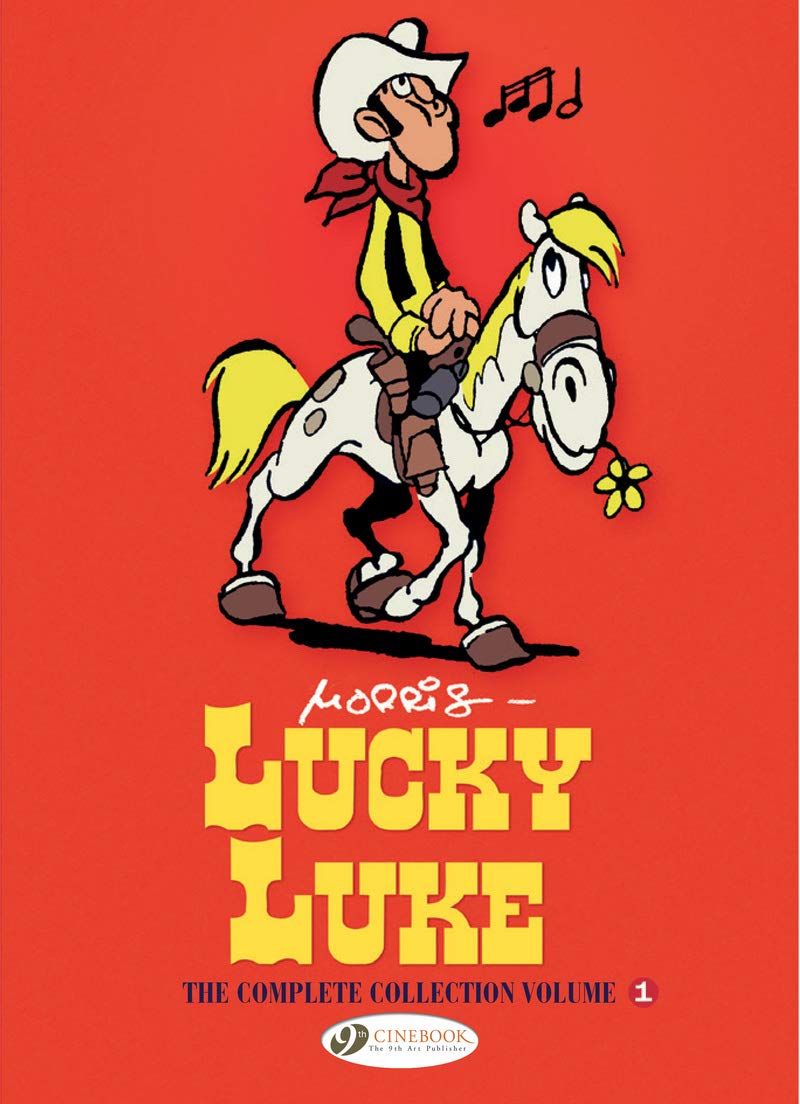
Lucky Luke: The Complete Collection Volume One


By Morris with Louis De Bevere, translated by Jerome Saincantin (Cinebook)
ISBN: 978-1-84918-454-0 (Album HB)

Win’s Christmas Gift Recommendation: Immaculate All Ages Western Wonderment… 9/10

On the Continent, the populace has a mature relationship with comics: according them academic and scholarly standing as well as nostalgic value and the validation of acceptance as an art form. This hardback/digital compilation celebrates the early triumphs of a fictional hero who is certainly a national treasure for both Belgium and France, whilst tracing the lost origins of a global phenomenon.

As we know him now, Lucky Luke is a rangy, good-natured, lightning-fast cowboy roaming the fabulously mythic Old West, having light-hearted adventures with his horse Jolly Jumper and interacting with a host of historical and legendary figures of the genre.

His continued exploits over seven decades have made him one of the best-selling comic characters in Europe (81 collected books and more than 300 million albums in at least 33 languages thus far), with spin-off toys, computer games, animated cartoons and a plethora of TV shows and live-action movies.

He was created in 1946 by Belgian animator, illustrator and cartoonist Maurice de Bévère (“Morris”). For years we believed it was for Le Journal de Spirou Christmas Annual (L’Almanach Spirou 1947), before being launched into his first weekly adventure ‘Arizona 1880′ on December 7th 1946. However, this wonderful hardback album (and digital delight) reveals we’ve been inadvertently lying to you all these years…

As revealed in the copious and fascinating-photo-filled essay accompanying the reprinting of the first three collected Lucky Luke Album compilations, the strip actually debuted in the multinational weekly comic, but without a title banner and only in the edition released in France…

Morris’ life is carefully unpicked and shared by Christelle & Bertrand Pissavy-Yvernault, whose text deftly covers the precocious, westerns-&-art-mad kid’s transition to comics idol with plenty of early art and family photos. This includes his education at the hands of Jesuits, his pre-comics cartooning career and forays into film animation before settling into his true vocation.

While working at the CBA (Compagnie Belge d’Actualitiés) cartoon studio, Morris met future comics superstars Franquin and Peyo, and worked for weekly magazine Le Moustique as a caricaturist. Those days are extensively covered as Morris quickly became one of “la Bande des quatre” – The Gang of Four – comprising Jijé, Will and old comrade Franquin: the leading proponents of the loose and free-wheeling artistic style known as the “Marcinelle School” which dominated Spirou in aesthetic contention with the “Ligne Claire” style used by Hergé, EP Jacobs and other artists in Le Journal de Tintin.

In 1948 said Gang (all but Will) visited America, meeting US creators and sightseeing. Morris stayed for six years, meeting fellow traveller René Goscinny, scoring some work from newly-formed EC sensation Mad and making copious notes and sketches of the swiftly vanishing Old West.

That research would resonate on every page of his life’s work.

Working solo (with script assistance from his brother Louis De Bevere) until 1955, Morris produced another nine albums worth of affectionate sagebrush parody before reuniting with Goscinny, who became the regular wordsmith as Luke attained the dizzying heights of superstardom, commencing with ‘Des rails sur la Prairie’ (Rails on the Prairie), which began in Le Journal de Spirou on August 25th 1955.

In 1967 the six-gun straight-shooter switched teams, transferring to Goscinny’s own magazine Pilote with ‘La Diligence’(The Stagecoach). Goscinny produced 45 albums with Morris before his death, from whence Morris continued both singly and with fresh collaborators.

Morris died in 2001 having drawn fully 70 adventures, plus the spin-off adventures of Rantanplan (“dumbest dog in the West” and a charming spoof of cinema canine Rin-Tin-Tin), with Achdé, Laurent Gerra, Benacquista & Pennac taking over the franchise, producing another five tales to date.

Lucky Luke first appeared in Britain syndicated to weekly comic Film Fun and again in 1967 in Giggle where he was renamed Buck Bingo. In all these venues – as well as the numerous attempts to follow the English-language successes of Tintin and Asterix albums from Brockhampton and Knight Books – Luke had a trademark cigarette hanging insouciantly from his lip, but in 1983 Morris, no doubt amidst both pained howls and muted mutterings of “political correctness gone mad”, substituted a piece of straw for the much-travelled dog-end, which garnered him an official tip of the hat from the World Health Organization.

The most recent successful attempt to bring Lucky Luke to our shores and shelves comes from Cinebook (who have rightly restored the foul weed to his lips on the interior pages if not the covers…)

Before all that, though, this wild and woolly delight features a far more boisterous and raw hero in transition, who begins strutting his stuff after the essay concludes by filling us in on the tone of the times, Morris’ filmic and comics influences and that eventful US sojourn…

Originally released as L’Intégrale 1, this scholarly collection re-presents the contents of the first three albums (Dick Digger’s Gold Mine, Rodeo and Arizona -1952) and abruptly switches from elucidation to all action mode for debut tale Arizona (LJdS #443-462) wherein a wandering cowboy tenaciously tracks down stagecoach bandits. He returned in Spirou #478-502) for the serial La Mine D’or de Dick Digger, wherein a map to a lost payload causes great grief until our hero returns it to the true owner.

As well as a treasure trove of vintage cartoon material, original art, designs and sketches, this tome also restores the many serial pages that were edited out of the first albums for brevity.

Le Journal de Spirou #505 (18th December 1947) began the third adventure, by which time the Lonesome Cowboy was clearly here to stay. Running until #527 (May 20th 1948) ‘Lucky Luke’s Double’ was the second feature half of first album Dick Digger’s Gold Mine in 1949: another riotous slapstick chase and comedy of errors as our hero is constantly mistaken for deadly desperado Mad Jim, much to the profit of minor crooks Stan Strand and Tiny Charley Chick. Big mistake…

‘Rodeo’ ran in #528-545, ending in September 1948 and becoming the title tale of the second album in 1950. The art took a major upturn towards the style we are familiar with today as Lucky competes in a legendary competition and uncovers both skulduggery and poor sportsmanship. Without a pause, new escapade ‘Lucky Luke in Desperado City’ followed (LJdS #546-566, ending 17th February 1949), wherein Lucky becomes sheriff of an embattled frontier town to defeat tyrannical owlhoots The Pistol Brothers.

‘The Buffalo Creek Goldrush’ (LJdS #567-584, ending 23rd June 1949), filled out that second album with a delicious satire on greed as a simple mistake turns a barren wasteland into an ephemeral metropolis of miners – until the penny finally drops…

It was back to outright villains for ‘Lucky Luke versus Cigarette Cesar’ (#585-601, ending October 20th 1949 and included in third album Arizona in November 1951), as Lucky trails a deadly and devious escaped convict south of the border (and indulges in the kind of animal cruelty gags we just don’t tolerate these days where bullfighting is largely discredited – so be warned…) to conclude this initial vintage voyage to the Wild West Neverlands.

Packed with contemporaneous extras, commentary, creator biographies and more, this is a delight for older kids who have a gained a bit of perspective and historical understanding, although the action and slapstick situations are no more contentious than any Laurel and Hardy film (perfectly understandable as Morris was a devout fan of the bumbling duo).

The first forays of an indomitable hero: this grand old hoot sits in the tradition of Destry Rides Again and Support Your Local Sheriff, superbly executed by a master storyteller, and is a wonderful introduction to a unique genre for modern kids who might well have missed the romantic allure of the Wild West that never was…

Bon anniversaire, Lucky!

© Morris/Dupuis, 1946 to 1949 for the first publications in Le Journal de Spirou.

© Morris/Dupuis 2016 for this collected edition. All other material © 2016 its respective creators/owners.

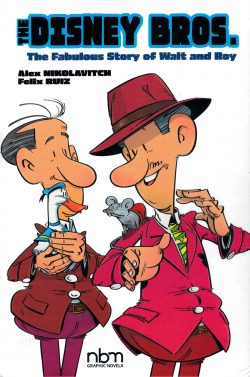
The Disney Bros – The Fabulous Story of Walt and Roy


By Alex Nikolavitch & Felix Ruiz, translated by Montana Kane (NBM)
ISBN: 978-1-68112-266-3(HB) eISBN: 978-1-68112-267-0

Win’s Christmas Gift Recommendation: Because it’s not Christmas without magic castles in the air… 9/10

When it comes to biography, Walt Disney is a true “Marmite” figure, with writers and historians pretty evenly divided between effusive hagiography and excoriating exposés.

As fully discussed in author Alex Nikolavitch’s Introduction, the genius who nurtured and nourished the childhood dreams of generations across the globe is an immensely polarising figure: a sensitive creator and twice-burned artisan who grew increasing and equally obsessed with micromanaging all around him and spreading heartfelt joy.

What this superb graphic summation of the fantasy overlord’s complex and contradictory life adds is the necessary balance quietly provided throughout and beyond Walt‘s life by his nigh-invisible brother Roy…

Alex Nikolavitch is a French author, screenwriter, essayist and educator, who writes comics and has a steady sideline translating English-language books like V for Vendetta, Tank Girl and Spawn to supplement his own series such as Burton and Les Canaux du Mitan. His collaborator here is mercurial Spanish artist and colourist Felix Ruiz (Savage Wolverine, Agents of Atlas: Marvel Boy, The Uranian, Halo) who reverts to a charmingly compelling and effective École de Marcinelle bigfoot style to trace the career of America’s greatest dream factory…

In episodic bursts of vivid scenes preceded by a potted history of animation, the story opens with ‘Of a Mouse and Men’as cartoon pioneers Walt Disney and Ub Iwerks – reeling from having their creation Oswald the Lucky Rabbit taken from them by unscrupulous money men – bounce back with a new character… a mouse.

More crucially, Walt asks his brother Roy to join the team. He is an accountant, with his feet planted firmly on the ground and his hands on the financial tiller.

…And then “Talkies” revolutionise the film industry and Walt has another good idea just as the Great Depression looms…

Second Chapter ‘Childhood Dreams’ covers the turbulent period after Snow White was released, as Roy secures global distribution in some very unwholesome places, balanced with the brothers’ fruitless attempts to rationalise their new lifestyles to their pious, old-fashioned doctrinaire parents. This leads to revelatory flashbacks of the boys growing up in rural religious Missouri and Walt’s transformative first encounter with Movies…

The war years and infamous union-busting strike of Disney’s animation studio is covered in ‘Turbulence’, as well as the post war years of expansion, as the arch creator increasingly seeks to control every aspect of his ever-expanding kingdom.

Walt’s anti-communist mania blatantly manifests in ‘Builder of Empires’, as the company moves into television and theme parks and the aging autocrats faces his own mortality…

Skilfully negotiating the complex web of beguiling creativity that always warred with a ruthless struggle for autonomy, political control and money, The Disney Bros – The Fabulous Story of Walt and Roy is a superbly delivered balancing act between reportage and drama. Evoking amazement, glee, sympathy and moral outrage in turn, the tale – delivered in jolly, velvetxglove-over-lead-lined-blackjack cartoon manner – is available in substantial hardback and various digital formats and is supplemented with an historical critique by author Jarett Kobek in ‘Afterword: How to Build a Media Empire’ plus suggested Further Reading.

This is a splendid work no fan of comics or film history should miss.
© 2019 Blue Lotus Prod. © 2020 NBM for the English translation.

The Disney Bros – The Fabulous Story of Walt and Roy is scheduled for release on November 26th 2020 and is available for pre-order in both print and digital editions.

Most NBM books are also available in digital formats. For more information and other great reads see, http://www.nbmpub.com/

Melusine volume 2: Halloween


By Clarke (Frédéric Seron) & Gilson, coloured by Cérise and translated by Erica Jeffrey (Cinebook)
ISBN: 978-1-905460-34-2 (Album PB)

Teen witches have a long and distinguished pedigree in fiction and one of the most engaging first appeared in venerable Belgian magazine Le Journal de Spirou in 1992.

Mélusine is actually a sprightly 119 year-old who spends her days working as an au pair in a vast, monster-packed, ghost-afflicted chateau whilst diligently studying to perfect her craft at Witches’ School…

The long-lived feature offers everything from one-page gag strips to full-length comedy tales on supernatural themes detailing her rather fraught life, the impossibly demanding master and mistress of the castle and her large circle of exceedingly peculiar family and friends.

Collected editions began appearing annually or better from 1995, with the 27th published in 2019 and hopefully more to come. Thus far five of those have transformed into English translations thanks to the fine folk at Cinebook.

The strip was devised by writer François Gilson (Rebecca, Cactus Club, Garage Isidore) and cartoon humourist Frédéric Seron – AKA Clarke – whose numerous features for all-ages LJdS and acerbic adult humour publication Fluide Glacialinclude Rebecca, Les Cambrioleurs, Durant les Travaux, l’Exposition Continue… and Le Miracle de la Vie.

Under pseudonym Valda, Seron also created Les Babysitters and, as Bluttwurst, Les Enquêtes de l’Inspecteur Archibaldo Massicotti, Château Montrachet, Mister President and P.38 et Bas Nylo.

A former fashion illustrator and nephew of comics veteran Pierre Seron, Clarke is one of those insufferable guys who just draws non-stop and is unremittingly funny. He also doubles up as a creator of historical and genre pieces such as Cosa Nostra, Les Histoires de France, Luna Almaden and Nocturnes and apparently is free from the curse of having to sleep…

Halloween – available in paperback and in digital formats – was the eighth European-released Mélusine album, originally released in 2001, and gathers a wealth of stunning seasonally sensitive strips. This makes it a great place for newcomers to start as the majority of the content comprises one or two-page gags starring the sassy sorceress who – like a young but hot Broom Hilda – makes excessive play with fairy tale and horror film conventions and themes. Not that what she looks like should make a (witch’s) wit of difference, but hey, it’s comics and it’s France…

When brittle, moody Melusine isn’t being bullied for her inept cleaning skills by the matriarchal ghost-duchess who runs the castle, or ducking cat-eating monster Winston and frisky vampire The Count, she’s avoiding the attentions of horny peasants, practising her spells or consoling and coaching inept, un-improvable and lethally unskilled classmate Cancrelune.

Mel’s boyfriend is a werewolf so he only bothers her a couple of nights a month…

Daunting dowager Aunt Adrezelle is always eager and happy to share the wisdom of her so-many centuries but so, unfortunately, is family embarrassment cousin Melisande, who spurned the dark, dread and sinisterly sober side of the clan to become a Fairy Godmother; all sparkles, fairy-cakes, pink bunnies and love. She’s simplicity, sweetness and light itself in every aspect, so what’s not to loathe…?

This turbulent tome riffs mercilessly on the established motifs and customs of Halloween, where kids fill up to lethal levels on sweets and candies, monsters strive to look their worst, teachers try to keep the witches-in-training glued to their books and grimoires even as their over-excitable students experiment most unwisely on what to do with pumpkins – including how to grow, breed or conjure the biggest ones – whilst the fearfully pious local priest and his human flock endeavour to ruin all the magical fun…

Even Melisande gets in on the party atmosphere in her own too-nice-to-be-true manner, lightening the happy shadows with too much sunshine and saccharine before the collection ends with the extended eponymous ‘Halloween’, wherein Melusine and Cancrelune learn the true meaning of the portentous anniversary when they inadvertently join creaking, clacking cadavers of the Risen Dead as they evacuate their graves on their special night to fight and drive away for another year the Evil Spirits who haunt humanity…

Wry, sly, fast-paced and uproariously funny, this compendium of arcane antics is a great taste of the magic of European comics and a beguiling delight for all lovers of the cartoonist’s art. Read before bedtime and don’t eat any hairy sweets…
Original edition © Dupuis, 2000 by Clarke & Gilson. All rights reserved. English translation 2007 © Cinebook Ltd.

Cinebook Recounts the Battle of Britain


By Bernard Asso, illustrated by Francis Bergése with colours by Frédéric Bergése: translated by Luke Spear(Cinebook)
ISBN: 978-84918-025-2 (Album PB)

Originally titled Le Bataille d’Angleterre and first seen here as Biggles and The Battle Of Britain, the material in this album sprang out of the continent’s decades-long love affair with the plucky British aviator.

Biggles is huge all over Europe, particularly in Holland, Germany, Belgium and France, which makes it doubly galling that apart from a big run of translations in India, only a short-lived Swedish interpretation of his comicbook exploits (see W.E. Johns’ Biggles and the Golden Bird) and a paltry few from the Franco-Belgian iteration licensed by British outfit Red Fox in the mid-1990s – which included this very volume – have ever made the move back to Blighty…

Hopefully some enterprising publisher will be willing to brave the Intellectual Property rights minefield involved and bring us all more of his superb graphic adventures one day…

Happily, as this tome is more of a documentary than a drama and the Air Ace doesn’t feature, publisher Cinebook have twice released this fine and visually erudite mini epic by historian Bernard Asso and the utterly compelling Francis Bergése.

Like so many artists involved in aviation stories, Bergése (born in 1941) started young with both drawing and flying. He qualified as a pilot whilst still a teenager, enlisted in the French Army and was a reconnaissance flyer by his twenties. At age 23 he began selling strips to L’Étoile and JT Jeunes (1963-1966) after which he produced his first air strip Jacques Renne for Zorro. This was soon followed by Amigo, Ajax, Cap 7, Les 3 Cascadeurs, Les 3 A, Michel dans la Course and many others.

Bergése worked as a jobbing artist on comedies, pastiches and WWII strips until 1983 when he was offered the plum job of illustrating venerable, globally syndicated Buck Danny. In the 1990s the seemingly indefatigable Bergése split his time, producing Danny dramas and Biggles books. He retired in 2008.

In this double-barrelled dossier delight from 1983, his splendidly understated, matter-of-fact strip illustration is used to cleverly synthesise the events following the defeat at Dunkirk to the Battle of Britain (1940) and the eventual turnaround in May 1941. Combining and counterpointing the works of famous figures like Churchill, Hitler, Douglas Bader and Goering with key tactical players such as Air Chief Marshal Hugh Dowding, Grand Admiral Erich Raeder, Galland and Mölders and relating actual tales of individual valour in the skies, the fact-packed narrative tracks the actions and experiences of specious winged warriors Leutnant Otto Werner and True Brit Flight Lieutenant James Colby as they struggle to survive in the skies over England.

The saga deals with the early days of terrifying air duels, later Blitz bombings, Albion’s logistical trials and eventual triumphs with factual expertise, but also affords a human face on each side of the conflict…

The latter half of the book then switches time and focus as Asso & Bergése detail The Bombing of Germany (1943-1945)paying especial attention to Air Chief Marshal Harris‘ controversial tactic of “Terror Bombing” and its effects on allies and enemies – and innocents.

Here Colby has transferred to Britain’s Bomber Command, trading Hurricanes and Spitfire for Lancasters, Halifaxes and B-17 Flying Fortresses. Major Werner is there too, as the Allies’ campaign slowly destroys the Nazi War Machine and the embattled Ace graduates from prop-powered Fockers and Messerschmitts to the first jet-planes – but too late…

Cunningly converting dry dusty history into stellar entertainment, Asso & Bergése brilliantly transform statistical accounts and solid detail into powerful evocative terms on a human scale that most children will easily understand, whilst never forgetting the war had two sides, but no “us” or “them”…

Whilst perhaps not as diligent or accurate as a school text, Cinebook Recounts: Battle of Britain (part of a graphic history strand that also includes The Falklands War and The Wright Brothers making distant events come alive) offers a captivating and memorable introduction to the events that no parent or teacher can afford to miss, and no kid can fail to enjoy.
© Editions du Lombard (Dargaud- Lombard SA), 2003 by Marazano & Ponzio. English translation © 2007 Cinebook Ltd.

City of Crocodiles


By Knut Larsson (Borderline Press)
ISBN: 978-0-99269-725-9 (PB)

Born in 1972, Swedish cartoonist, artist, filmmaker and teacher – at the prestigious Comics Art School of Malmö – Knut Larsson is blessed with a unique vision and talent to spare (just check out his graphic albums Canimus, Lokmannen (Locomotive Man), Biografmaskinisten (The Projectionist), Kolonialsjukhuset – En kolonialläkares anteckningar (Colonial Hospital – A Colonial Doctor’s Notebook) or the tract Triton.

If you’re a keen devotee of Euro-comics you’ll have seen his stories in C’est Bon Anthology, Electrocomics, Galago, Glömp, Rayon Frais, Strapazin, Stripburger, Turkey Comix, or Bild & Bubbla amongst others, and may well have visited his international exhibitions as far afield as Angoulême, Tokyo, Erlangen or St. Petersburg. Typically, he is not a household name in Britain or America…

Sadly, that means a lot of brilliant works – like this book – are also unavailable in digital formats yet…

Back in 2008 Larsson crafted Krokodilstaden: an eerie, post-apocalyptic, horror-tinged love story devoid of all dialogue or sound effects: a neo-symbolist paean to the end times (Gee, I wonder when those are due?) combining brutish, callous survivalism, ghostly mysticism, unchanging human passions, stubborn self-inflicted loneliness and the tenacious capacity of life to adapt to changing situations. Borderline Press released it in an English Edition as the deliciously eerie City of Crocodiles…

Rendered in muted greys and brown monotones, one panel per page, the tale focuses on a drowned Earth where the waters have risen, relegating humanity to the top floors of buildings whilst toothy amphibians have proliferated all around and below them. Adamant Mankind is still hanging on, turning crocodiles into the primary natural resource: affording food, clothing, tooled utensils and even objects of cultish worship.

The saurians are everywhere and everybody and everything – humans, birds, surviving mammalian pets – are missing limbs or appendages…

In this world, one particular croc-hunter ekes out his solitary existence, trading reptiles for booze and gasoline, haunted by his memories until the day he captures a strangely enticing woman in his nets. She is young, beautiful, exotic… and has a vestigial reptilian tail.

Avoiding the spooky, crazy crocodile cultists that also proliferate, he takes her back to his place and endeavours to dress her in the garb and form of his dead lover before she seduces him…

Sadly, that’s when his dearly departed darling returns, bristling with malice and ready for some spirited revenge…

Wry, moving, nightmarish yet ethereally lovely, City of Crocodiles is a masterpiece of visual storytelling that will astound and delight all lovers of the weird and macabre. If you love to be disturbed and distressed, this is a treat you must track down…
© 2008, 2014 Knut Larsson.

Stigmata


By Lorenzo Mattotti & Claudio Piersanti (Fantagraphics Books)
ISBN: 978-1-60699-409-2 (HB)

It’s rather hard not to think that it’s the end of days at the moment, and naturally that’s affecting what I’m reading. You too, I expect.

In that spirit, here’s a book you simply must read before you die, and if you already have, it truly stands another go.

In his latest magnificent endeavour, Lorenzo Mattotti is a giant of European graphic narrative with a back catalogue of truly stunning confections. In 1999 he teamed with novelist and screenwriter Claudio Piersanti for the first of two potent yarns (the other being the still untranslated Anonymes): to produce one of the most powerful and memorable examinations of religious experience with Stigmata.

This impressive hardback (still no digital edition yet) describes the Job-like trials and tragedies of a brutal, alcoholic shipwreck of a man pushed beyond the brink of tolerance and sanity. The pariah finds a kind of peace and resolution, but unlike his Old Testament antecedent, what begins in misery with nothing, only proceeds to forfeit even his last remaining graces. By the end of his travails, the sinner has found precious little knowledge or understanding, but some sort of peace…

Drunken, brutal, dissolute, middle-aged and heading nowhere, the last thing he needed was holes in his hands that bled but wouldn’t heal. Already despised and feared, the lonely bum works at a bar, but the wounds and the blood upset even those gin-soaked sots. Moreover, people follow him, thinking he possesses some divine secret or power to heal…

Eventually he snaps, wrecking the bar and confronting the vicious gangster who runs it… Some folks call him “the Saint”. He doesn’t think it’s funny…

As the city becomes even more savage and ugly, he takes off; tracking down an uncle who worked in a carnival. When he finds the travelling show his uncle is gone – arrested for stealing – but the Carnies accept him and he strikes up a romance with the vivacious Lorena. Even working as a handyman, his bleeding hands interfere, but the canny show-people turn it to their advantage, setting him up in a booth dispensing piety and miracle from his shabby, tawdry “House of Blessings.”

Travelling from town to town, he finds a kind of contentment, but eventually the Carnies’ secret sideline of burglary brings police attention. When his old gangster boss tracks him down and delivers a hideous punishment, he destroys the Stigmatic’s last shred of hope and Lorena’s life forever.

And then the storm hits… a tempest of Biblical proportions that changes everything…

Brooding, compelling and rendered in a cacophony of swirling miasmic lines, this fearsome modern parable is a fierce interrogation of faith and destiny asking uncompromising and uncomfortable questions about the price of Grace and the value of belief. Are these trials, so like Job’s cruel yet purposeful tests, the tough love of a benevolent father, the whims of a despicable devil or the random vagaries of an uncaring fate?

Stigmata is a grotesque and beautiful metaphysical rollercoaster with existential angst and blind faith gripping each other’s philosophical throats and squeezing really, really hard. No rational reader or mature comics fan can afford to miss this dark shining delight.
© 2010 Lorenzo Mattotti & Claudio Piersanti. All rights reserved.

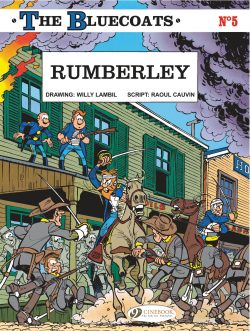
The Bluecoats volume 4: The Greenhorn


By Willy Lambil & Raoul Cauvin, translated by Erica Jeffrey (Cinebook)
ISBN: 978-1-84918-014-6 (Album PB)

The modern myths and legends of the filmic American West have fascinated Europeans virtually since the actual days of stagecoaches and gunfighters. Hergé and Moebius were passionate devotees and the wealth of stand-out Continental comics series ranges from Italy’s Tex Willer to such Franco-Belgian classics as Blueberry and Lucky Luke, and tangentially even children’s classics such as Yakari or colonial dramas such as Pioneers of the New World and Milo Manara and Hugo Pratt’s superbly evocative Indian Summer.

As devised by Louis “Salvé” Salvérius & Raoul Cauvin – who has scripted every best-selling volume – Les Tuniques Bleues (we know them as The Bluecoats) debuted as the 1960s closed. The strip was specifically created to replace Lucky Luke when the laconic gunslinger defected from weekly anthology Le Journal de Spirou to rival publication Pilote. The substitute swiftly became one of the most popular bande dessinée series in Europe.

Salvé was a cartoonist of the Gallic big-foot/big-nose humour style, and when he died suddenly in 1972 his replacement, Willy “Lambil” Lambillotte gradually introduced a more realistic – but still broadly comedic – illustrative tone and manner. Lambil is Belgian, born in 1936 and, after studying Fine Art in college, joined publishing giant Dupuis as a letterer in 1952.

Born in 1938, scripter Cauvin is also Belgian and, before entering Dupuis’ animation department in 1960, studied Lithography. He soon discovered his true calling – comedy writing – and began a glittering and prolific career at Spirou. In addition to Bluecoats he has written dozens of long-running, award winning series including Cédric, Les Femmes en Blanc and Agent 212: more than 240 separate albums. The 62 current volumes of Les Tuniques Bleues alone has sold in excess of 15 million copies.

As translated for English audiences, our sorry, long-suffering protagonists are Sergeant Cornelius Chesterfield and Corporal Blutch: a pair of worthy fools in the manner of Laurel & Hardy, hapless, ill-starred US cavalrymen posted to the wild frontier and various key points of fabled America during the War Between the States.

The original format featured single-page gags set around an Indian-plagued Wild West fort, but from the second volume Du Nord au Sud (North and South) the sad-sack soldiers went back East to fight in the American Civil War (a tale was rewritten as 18th album Blue retro to describe how the chumps were drafted during the war). Every subsequent adventure, although often ranging far beyond America and taking in a lot of thoroughly researched history, is set within the timeframe of the Secession conflict.

Blutch is your average whinging little-man-in-the street: work-shy, mouthy, devious and especially critical of the army and its inept commanders. Ducking, diving, even deserting whenever he can, he’s you or me – except sometimes he’s quite smart and heroic if no other (easier) option is available.

Chesterfield is a big burly fighting man; a career soldier who has passionately bought into all the patriotism and esprit-de-corps of the Military. He is brave, never shirks his duty and wants to be a hero. He also loves his cynical little troll of a pal. They quarrel like a married couple, fight like brothers and simply cannot agree on the point and purpose of the horrendous war they are trapped in…

The Greenhorn was the fourth album translated by Cinebook (chronologically 14th Franco-Belgian volume Les Tuniques Bleues: Le blanc-bec) and opens with a grand Officer’s Ball in distant, desolate Fort Bow. As the festivities continue, out in the moonlit desert two weary cavalrymen wend their way towards the stockade…

Chesterfield and Blutch have just returned for three weeks leave and are infamous amongst the troops as regular survivors of the quite mad Captain Stark’s Suicide Regiment – as well as for their own reputation for starting fights.

It’s for that reason the guards don’t want to mention that Colonel Appleton‘s lovely daughter Emily has been dancing with a dashing young Lieutenant named George. Every man there knows Chesterfield is smitten with her and has subsequently developed a hair-trigger temper these days…

The news nearly incites him to mass-murder and it takes all Blutch’s guile to convince his pal to ride into town – and Charlie’s Saloon – instead. Sadly, Chesterfield’s well-earned reputation for trouble is just as feared there, and when an Indian boy is bullied by local drunks, the spoiling-for-trouble sergeant – subtly prodded by underdog-loving Blutch – gleefully steps in…

By the time the harried barman reaches Fort Bow and brings back a contingent of troops, Chesterfield has decimated most of the saloon and all of the patrons and is hungry for more. When brash neophyte Lieutenant George slaps the enraged enlisted man, all hell breaks loose…

Events spiral even further out of control after the patrol final drags the unrepentant sergeant back to the Fort. When the Indian – dragged along as a witness – takes his chance to escape, he is shot by the flustered “greenhorn” officer.

It is both a tragedy and a disaster: the boy is the son of Chief Gray Wolf who, on discovering what’s happened, demands that whoever perpetrated the appalling act be surrendered to his justice.

…Or else it’s war…

When Chesterfield and Blutch discover exactly who George is, the little corporal flees, rushing off to the encamped hostiles and claiming he was responsible. Chesterfield, not to be outdone in the guilt stakes, also owns up and baffled Gray Wolf is nearly driven crazy when bold, brave, stupid and honourable Colonel Appleton also rides into camp to take the blame…

A tense compromise is reached as Gray Wolf agrees to let the “Long Knives” treat his gravely wounded boy; decreeing that if he lives they will be no war. If the morning brings bad news, the entire fort and town will suffer…

With a little time bought, the Colonel deals with his most immediate problem. After a ferocious dressing down, Chesterfield and Blutch are sent back to Stark’s Suicide Regiment and – over Emily’s hysterical protestations – George goes with them…

Days later, the trio rendezvous with Stark’s dispirited contingent as he manically battles Confederate forces. The Captain’s sole tactic is to have his men charge straight at their artillery, presumably in the certain knowledge that the enemy must run out of ammunition eventually…

Blutch and Chesterfield have developed a countermeasure which has kept them alive so far and, having sworn to Emily to keep George safe, force him to employ it too. However, the guilt-ridden, hero-struck fool is unhappy with the shameful strategy and soon starts throwing himself into the thick of battle, intending to die with dignity…

When word comes of the recovery of Gray Wolf’s son, their ordeal seems over and, with honour satisfied, all three make a grateful departure from Stark’s depleted forces. Typically however, just as a peace (and quiet) seem likely, Blutch and Chesterfield find another way to set the West ablaze and drive the natives to the brink of war…

This is a hugely amusing anti-war saga targeting young and less cynical audiences. Historically authentic, and always in good taste despite its uncompromising portrayal of violence, the attitudes expressed by the down-to-earth pair never make battle anything but arrant folly and, like the hilarious yet insanely tragic war-memoirs of Spike Milligan, these are comedic tales whose very humour makes the occasional moments of shocking verity doubly powerful and hard-hitting.

Fun, informative, beautifully realised and eminently readable, in either paperback of digital formats, Bluecoats is the sort of war-story that appeals to the best, not worst, of the human spirit. And don’t we all need a bit of that these days?
© Dupuis 1979 by Lambil & Cauvin. English translation © 2010 Cinebook Ltd. All rights reserved.

Papyrus volume 5: The Anger of the Great Sphinx


By Lucien De Geiter: colours by Georges Vloeberghs & translated by Erica Jeffrey (Cinebook)
ISBN: 978-1-84918-115-0 (Album PB)

Papyrus is the rapturously beguiling masterwork of Belgian cartoonist Lucien de Gieter. It premiered in 1974 in legendary weekly Le Journal de Spirou, running to 35 albums and consequently spawned a wealth of merchandise, a television cartoon show and a video game.

De Gieter was born in 1932 and studied at Saint-Luc Art Institute in Brussels before going into industrial design and interior decorating. He made the jump into sequential narrative in 1961, first through ‘mini-récits’ (fold-in, half-sized booklets) inserts for Spirou, starring his jovial cowboy Pony, and later by writing for art-star regulars such as Kiko, Jem, Eddy Ryssack and Francis.

He later joined Peyo’s studio as inker on Les Schtroumpfs (The Smurfs) and took over the long-running newspaper strip Poussy.

In the 1960s, De Gieter launched mermaid fantasy Tôôôt et Puit whilst Pony was promoted to the full-sized pages of Spirou, thereafter deep-sixing the Smurfs to expand his horizons by going to work for Le Journal de Tintin and Le Journal de Mickey.

From 1972-1974 he assisted cartooning legend Berck on Mischa for Germany’s Primo, whilst he perfected his newest project: a historical confection which would occupy his full attention and delight millions of fervent fans for the following four decades.

The annals of Papyrus encompass a huge range of themes and milieux, mixing Boy’s Own adventure with historical fiction, fantastic fantasy and interventionist mythology: the epic yarns gradually evolving from traditional “Bigfoot” cartoon style and content towards a more realistic, dramatic and authentic iteration. Moreover, each tale readily blends light fantasy escapades with the latest historical theories and discoveries.

Papyrus is a fearlessly forthright young fisherman favoured by the gods who quickly rises to become a hero of Egypt and friend to Pharaohs. As a youngster the plucky Fellah was singled out and given a magic sword courtesy of the daughter of crocodile-headed Sobek.

The youthful champion’s first task was to free supreme deity Horus from imprisonment in the Black Pyramid of Ombos, thereby restoring peace to the Double Kingdom, but his most difficult and seemingly never-ending duty is to protect Pharaoh’s wilful, high-handed and insanely danger-seeking daughter Theti-Cheri – a princess with an astounding knack for finding trouble…

Avaliable in paperback and digital editions, The Anger of the Great Sphinx is the fifth Cinebook translation (20th album of the series and originally released in 1997 as La Colère du grand Sphinx); a spooky testing of faith through vile supernatural villainy, all eventually thwarted by unflinching daring and honest devotion…

The eerie escapade opens when restless Papyrus discovers the princess sleepwalking in the corridors of Pharaoh’s great Palace in Memphis. Cautiously following, he trips over court jester Puin. By the time he recovers his feet, Theti-Cheri has seized a waiting chariot and hurtled into the dark desert beyond the gates. Extremely alarmed, the lad leaps astride Puin’s phenomenally intelligent donkey Khamelot and rushes after her…

In the bleak wastes, Papyrus is attacked by a living sandstorm threatening to end the line of Pharaohs, but successfully drives it off with his magic sword, just as terrified Puin catches up. As the sun rises, they see they’re near the venerable complex of pyramids and Re Harmakhis, Guardian of the Horizon. The mighty monuments and the Great Sphinx are all but buried under the eternally shifting sands…

Nervous Puin wants to return to the city, leaving such great concerns to Pharaoh and the gods, but Papyrus refuses to abandon the mesmerised princess who can be seen between the paws of the great statue. As he approaches, the stone beast roars that Theti-Cheri now belongs to him because her father has broken an ancient pact to keep the sands from covering him and his temples.

As assign of his dissatisfaction, the princess will die at sunset…

Desperate for a solution, our hero agrees to give the insidious sandstorm his magic sword if it will save the princess and the swirling devil advises the lad to find Anty, the Divine Ferryman and seek passage to the Island of the Gods where he can petition the Divinities for merciful intervention…

Dashing to the Nile with Puin and Khamelot in hot pursuit, Papyrus matches wits with the duplicitous Ferryman – a conniving talking crocodile boat with a grudge against the boy from previous encounters.

Once again, the rogue vessel tries to cheat and bamboozle the boy. Whilst ostensibly taking the trio to the gods’ home, Anty plies the humans with a hallucinogenic drink – resulting in a stunning and baroque display of the author’s spectacular imagination and artistic virtuosity – before leaving them unconscious in a bed of reeds.

Here they are discovered by trio of sibling dotards – dubbed Pepi I, Pepi II and Pepi III – who minister to them. They are in turn saved by Papyrus when bullying brigands try to rob their hovel. The elders are fishermen now, but once they were paid by Pharaoh to keep the Sphinx and pyramids clear of sand. In recent years though they appear to have been forgotten…

With horror the boy realises they have been left back near the Sphinx and the day is fast fading. With ho hope left of gaining the gods’ aid, he rushes off to find Anty and teach the conniving Ferryman the error of his wicked ways before returning to hand his wonderful sword over to the smugly triumphant sandstorm…

At his most despondent moment, through the roaring sand Papyrus sees the Pepis. The elderly janitors have organised the entire village: young and old alike are toiling amid the storm to clear the Sphinx for the sake of their beloved princess.

When Khamelot inadvertently reminds the frantically labouring peasants of a tried-and-true – albeit noxious – way to dampen down the swirling grains and make them more manageable, the furiously screaming storm devil is at last beaten and blows away…

In the quiet still morning, the Sphinx is again free from obstruction and obscurity, but Papyrus is heartbroken to see that it is all too late.

Carrying the corpse of Theti-Cheri into the desert he denies his faith, screaming at the gods who have been so unfair… and they answer, revealing the foolish mistake the passionate, impatient lad has made…

With the princess joyously restored and Re Harmakhis gleaming in all his golden glory, Pharaoh at last arrives in a blare of trumpets to reaffirm his dynasty’s obligations and devotion to the gods, elevating the three Pepis to the exalted station of Eternal Guardians of the Sphinx. The newly appointed opponents of the shifting sands have recently taken possession of a certain magic sword and gratefully return it to the boy who restored their family fortunes…

Epic, chilling, funny, enthralling and masterfully engaging, this is another amazing adventure to thrill and beguile lovers of wonder from nine to ninety-nine, again proving Papyrus to be a sublime addition to the family-friendly pantheon of continental champions who wed heroism and humour with wit and charm, and anybody who has worn out those Tintinand Asterix albums would be wise beyond their years to add these classic chronicles to their dusty, well-beloved bookshelves. Let’s hope Cinebook will soon resume translating the rest for our eager eyes…
© Dupuis, 1997 by De Gieter. All rights reserved. English translation © 2012 Cinebook Ltd.

Isle of 100,000 Graves


By Fabien Vehlmann & Jason, coloured by Hubert and translated by Kim Thompson (Fantagraphics Books)
ISBN: 978-1-60699-442-9 (TPB)

Not much chance of a hearty communal “Yo-Ho-Ho” or any satisfactory plundering or pillage this International Talk Like a Pirate Day. Best to stay tucked and layin’ low, with some age-appropriate grog, a few hearty nibbles and a good book on the subject… like this one, perhaps…

Multi-award-winning French comics author Fabien Vehlman was born in 1972, began his comics career in 1996 and has been likened to the legendary René Goscinny. He’s best known for the wonderful Green Manor< series (illustrated by Denis Bodart), Seven Psychopaths with Sean Phillips, Seuls (drawn by Bruno Gazzotti and available in English as Alone) and Wondertown with Benoit Feroumont. In 2011 Vehlmann assumed the writing reins on legendary series Spirou et Fatasio.

Jason is secretly John Arne Saeterrøy: born in Molde, Norway in 1965 and an overnight international cartoon superstar since 1995 when his first graphic novel Lomma full ay regn (Pocket Full of Rain) won that year’s Sproing Award (Norway’s biggest comics prize). He won another Sproing in 2001 for the series Mjau Mjau before in 2002 turning almost exclusively to producing graphic novels. He is a global star among the cognoscenti and blokes like me, and has won numerous major awards from all over the planet.

This was his first collaboration with a writer, and Jason adds his uniquely laconic anthropomorphic art-stylings to a surprisingly edgy, deliciously dark and blackly comedic tale of sundered families, sinister secrets and bombastic buccaneers.

Holding his signature surreality in check, Jason perfectly captures the odd tale of homely little girl Gwenny, who leaves her appalling mother to search for her long-lost father: gone for many a year in search of pirate treasure.

The self-assured and devious lass tricks her way onto a sea-rovers vessel, outwits the murderous corsairs long enough to reach the eponymous Isle of 100,000 Graves – even tricking one of that scurrilous brotherhood into becoming her unwilling protector – and then abandons them to a horrendous fate as the uncanny denizens of the lost land attack…

The island is home to a cult of torturers and killers called the Hangman’s Academy: an institution dedicated to preserving the traditions and teaching the myriad skills necessary to becoming a top-flight inquisitor and officially-sanctioned executioner. Moreover, the scary school has recently run out of live specimens for maiming and murdering…

As Gwenny single-mindedly searches for signs of her missing dad, she meets Tobias, a killer-in-training sadly out of place amongst his fellow students. With his aid the doughty maid survives incalculable horrors before freeing the surviving pirates as a callous distraction. When they escape, a colossal battle with the hooded executioner ensues.

Gwenny, however, is not distracted: she’s found the answer to her questions…

Mordantly hilarious, this superbly cynical fable rattles along in captivating fashion: a perfect romp for older kids and a huge treat for fans looking for something a little bit different…

Jason’s work always jumps directly into the reader’s brain and heart, using his beastly repertory company to gently pose eternal questions about basic human needs in a soft but relentless quest for answers. That you don’t ever notice the deep stuff because of the clever gags and safe, familiar “funny-animal” characters should indicate just how good a cartoonist he is. His collaboration here with the slyly sardonic Vehlmann produced a genuine classic that we’ll all be talking about for years to come…
© Jason and Fabien Vehlmann. All rights reserved.

Comanche volume 2: Warriors of Despair


By Hermann & Greg, translated by Montana Kane (Europe Comics)
No ISBN. Digital only edition

Welcome to another Wild West Wednesday with a self-indulgent peek at a favourite book I first read way back in the 1980s, crafted by two Belgian masters of graphic narrative.

Best known as Greg, Michel Régnier was born in 1931 in Ixelles. The cartoonist, writer editor and publisher sold his first series – Les Aventures de Nestor et Boniface – at age 16 to Belgian magazine Vers l’Avenir and followed up over many decades with legendary strips such as Luc Orient, Bruno Brazil, Bernard Prince and Achille Talon in Héroic Albums, Le Journal de Spirou (scripting the title feature amongst many others), Paddy and Le Journal de Tintin (which he eventually edited from 1966-1974). One of his new finds on Spirou during this period was an artist named Hermann Huppen…

Greg is estimated to have worked as writer or artist on more than 250 strip albums during his career. He died in 1999, leaving behind an astounding and beautiful legacy of drama and adventure.

Hermann Huppen entered the world on July 17th 1938 in what’s now the Malmedy region of Liège Province. He studied to become an interior architect and furniture maker but was thankfully swayed and diverted by comics. His narrative career began in 1963 but really took off three years later when he joined with writer Greg to create cop series Bernard Prince for Le Journal de Tintin. The artist then added to his weekly chores with Roman adventure serial Jugurtha (scripted by Jean-Luc Vernal).

In 1969, Hermann expanded his portfolio further, adding Greg-penned western Comanche to his seamlessly stunning output. At this time Charlier & Jean Giraud’s epic Blueberry was reaching its peak of excellence…

Bernard Prince and Comanche made Hermann a superstar of the industry – a status built upon with further classics such as The Towers of Bois-Maury, Sarajevo-Tango, Station 16 and many more (I estimate upwards of 24 separate series and a total north of 94 albums, but I bet I’m falling short).

In 1978 Hermann bravely dropped guaranteed money-spinner Bernard Prince to create as (writer and illustrator) Jeremiah but he stayed with Comanche until 1982 (10 albums in total) because of his abiding love for western-themed yarns.

Thanks to digital-only publishing commune Europe Comics, it’s easy to see why in this second translated volume of the sprawling cowboy epic which here resumes with no-longer wandering gunslinger Red Dust and his new friends at the Triple 6 ranch. The taciturn hombre has found a home – if not peace and quiet – after joining a most unlikely band of comrades on an on-its-uppers cattle spread in Wyoming. The heart of the ranch crew are crotchety ancient pioneer Ten Gallons and the new owner he dotes upon: a young, lovely and immensely stubborn woman called Comanche…

Comprised of linked weekly episodes, and originally published in 1978, ‘Warrior of Despair’ sees our quotidian, ever-expanding cast prepare steers for hungry railway workers rapidly build their way across the plains. The backbreaking toil is suddenly disrupted by the arrival of a party of Cheyenne who want the beef the cowboys are guarding…

A fractious but peaceful conference reveals the Indians are starving: the supplies they’ve been promised by treaty haven’t arrived and no one can locate the Government’s Indian Agent to sort out the problem…

After the warriors rush off with the cattle, she and Red join them at their camp in a last attempt to prevent a mess becoming a crisis. The upshot is that Dust has three days to find the Agent and restore the missing provisions. For that time Comanche will remain a “guest” of the tribe…

And so begins a desperate chase with double-dealing, ingrained mistrust and sheer bad luck on all sides hindering the quest and leading to the inescapable conclusion that the plains will soon be awash in flame and blood…

An epic tale in the classical manner of the western genre, this yarn also has plenty of European style and ingenuity to recue it from the unreconstructed mire, uncomfortable associations and unsavoury old tropes that make even venerated old movie an uncomfortable experience in these enlightened days.

It’s also so beautifully rendered the images will stay with you forever…

A splendid confection of Cowboys and Indians combined with sleek yet gritty European style, Warriors of Despair is a timeless treat comics fans and movie lover will adore. Don’t miss out on a chance to enjoy one of the most celebrated comics classics of all time…
© 2017 – LE LOMBARD – HERMANN & GREG. All rights reserved.