
IR$ volume 1: Taxing Trails


By Vranken & Desberg, coloured by Coquelicot: translated by Luke Spear (Cinebook)
ISBN: 978-1-905460-51-9 (Album PB)

The most appetising thing about European comics (and manga too, although we only ever see the tip of that vast iceberg in English) is the sheer breadth of genres, styles and age ranges of material available.

The same used to be true of British and US comics, but creeping cultural colonisation by calcified fan-bases has slowly but surely eradicated many types of tale that might pique interest beyond the generalised ghettoes of superheroes, space opera, sexy horror and merchandised adaptations. Even crime and war comics are a rare exception these days.

Thus, finding that this quirky but exceedingly readable thriller series with a tantalising twist has finally arrived as eBooks is a welcome treat even if the Franco-Belgian original first saw print in 1999.

The unlikely champion of these sagas is a civil servant with the US government. Once upon a time these dedicate civil servants started employing super-cool and infallibly effective agents to go after the type of tax dodger far beyond the reach of the law. These days, every country should have one…

Belgian writer Stephen Desberg remains one of the bestselling comics authors in France. Son of an American lawyer (who was the distribution agent for Metro-Goldwyn Mayer) and a French mother, he was born in Brussels in 1954 and studied law at Université Libre de Bruxelles. However, he dropped out to follow a winding path into the comics biz…

Starting with plots and eventually scripts for Will (AKA Willy Maltaite) on Tif et Tondu in Le Journal de Spirou, he developed into a reliable jobbing creator on established strips for younger readers before launching his own in the Stéphane Colman illustrated Billy the Cat (a funny animal strip, not the DC Thomson superhero series).

Thereafter came 421 with Eric Maltaite, Arkel (Marc Hardy), Jimmy Tousseul (with Daniel Desorgher) and many others. During the 1980s, he gradually redirected his efforts to material for older readerships (such as The Garden of Desire), and in 1999 created this modern thriller before capping it all a year later with exuberant historical drama Le Scorpion joining his catalogue of major hits.

Bernard Vranken was an award-winning artist by the time he was fifteen and working on Le Journal de Tintin a year later. Whilst studying architecture at Saint-Luc, he took some comics courses by legendary illustrator Eddy Paape at St. Gilles and his true career path was set. Vranken was crafting short stories for A Suivre when he met Desberg, and in 1996 they collaborated for the first time on epic romance Le Sang Noir. Three years later they traded love for money and launched IR$…

The premise is simple and delicious, and this English edition doubles your money by combining the first two albums – La voie fiscal and La stratégie Hagen – into one compelling compilation.

As Taxing Trails it opens with stylish American mystery man Larry B. Max calling his new favourite chat-line girl Gloria Paradise (Larry hates complications in his life) to kill some time before heading out.

A few days previously a Swiss banker had been rather ostentatiously splurging cash on a visit to California when he ended up as a freeway statistic. However, his spending spree and sudden demise raised a few red flags…

A right place, wrong time kind of guy, Larry was decisively ending a convenience store hold-up he’d stumbled into when he got a call and soon was working his way up a deadly chain of wealthy reprobates trying to track down who had issued the contract on the banker…

Before long Max identifies the former Luc Cretier as a minor banker and major blackmailer who pushed someone too hard and paid the price. That said, the person he was putting the squeeze to is of far more interest to the tax detective.

Jewish-American Abraham Loewenstein is a rags-to-riches holocaust survivor who turned tragedy into a life of success and good works. Larry, however, has seen something the rest of the world has not, and his interview with the aged activist (as an author investigating the scandal of Jewish gold illegally held in Swiss Banks) puts him on another profitable track…

Those esteemed institutions always found some legal chicanery to deny the claims of survivors and family members who tried to attempted to retrieve their property, but recent years – due to the efforts of people like Loewenstein – have seen frustrated victims begin to win justice through court cases exposing bank practises.

Now Larry’s forensic investigation leads straight to those so-secretive Swiss Banks and a generations-long scandal regarding the illegal retention and redistribution of Jewish funds deposited whilst Hitler was rising to power.

Although the Nazis are apparently long gone, their heritage of plunder remains in those Helvetic vaults and somehow, enigmatic, untouchable multi-billionaire survivor of the Death Camps Moshe Geldhof is involved…

Larry knows he’s on to something when his car is sabotaged and less feasible accidents – such as a girl on a motorbike blasting him with a machinegun – complicate his investigation. Undaunted, he confronts Geldhof in a fancy New York restaurant and finds hot lead is the first course on the menu…

After Abraham is murdered for knowing too much, a spectacular, breakneck car chase results in Max arresting Geldhof, but for once, the infallible tax man has grossly underestimated the sheer power of money…

The story concludes in The Hagen Strategy as the scene shifts to 1943 for the incredible truth about Moshe Geldhof, as the indefatigable Max delves deeper into the history of the man who has the ear of governments, especially Israel’s…

In America, the man himself seems to be “too big to fail” but his sudden liberation only pushes Larry to greater efforts. That means heading to Bern and cultivating the attentions of Geldof’s ferociously Amazonian daughter Lenni whilst dear daddy is tangled in red tape…

No sooner has Larry broached the palatial fortress-like mansion, however, than the sinister patron turns up and the hunt is on, with a cadre of heavily armed killers at his well-shod heels…

Larry has finally gleaned the true appalling secret of the contemporary Croesus and the truth is something his government can’t cover up for him. Now he has only one possible ally in his all-or-nothing war against the money-man… and places a call to Mossad.

Sleek, lean, almost Spartan in its lithe, muscular tribute to James Bond movies, IR$ is a splendidly effective, stylishly gritty thriller series to delight fans of modern mayhem in all its literary and artistic forms.

Only death and taxes are inescapable, and Larry B. Max offers either or both in one suavely economical package…
Original edition © 1977 EDITIONS DU LOMBARD (Dargaud-Lombard) 1999-2000 by Desberg &Vrancken. English translation © 2008 Cinebook Ltd.

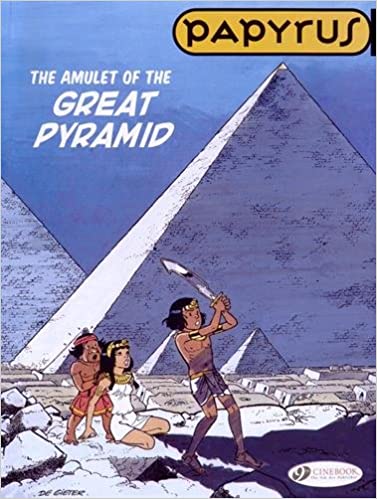
Papyrus volume 6: The Amulet of the Great Pyramid


By Lucien De Geiter, coloured by B. Swysen: translated by Jerome Saincantin (Cinebook)
ISBN: 978-1-84918-240-9 (Album PB)

Papyrus is the astoundingly addictive magnum opus of Belgian cartoonist Lucien de Gieter. Launched in 1974 on the pages of legendary weekly Le Journal de Spirou, it has run to 35 albums and spawned a wealth of merchandise, a TV cartoon series and video games.

Born in 1932, the author studied at Saint-Luc Art Institute in Brussels before going into industrial design and interior decorating. In 1961 he made the jump to sequential narrative, first via ‘mini-récits’ (half-sized, fold-in booklet inserts) for Spirou, starring his jovial cowboy ‘Pony’, and later by writing for art-star regulars such as Kiko, Jem, Eddy Ryssack and Francis.

He later joined Peyo’s studio as inker on ‘Les Schtroumpfs’ (The Smurfs), took over long-running newspaper strip ‘Poussy’ and launched mermaid fantasy ‘Tôôôt et Puit’ when Pony was promoted to Spirou‘s full-sized pages. Deep-sixing the Smurfs, de Gieter expanded his horizons by joining a select band contributing material to both Le Journal de Tintin and Le Journal de Mickey.

From 1972-1974 he worked with cartooning legend Berck on ‘Mischa’ for Germany’s Primo whilst perfecting his dream project: a historical fantasy which would soon occupy his full attention and delight millions of fervent fans for decades to come.

The annals of Papyrus encompass a huge range of themes and milieux, mixing Boy’s Own adventure with historical fiction, fantastic action and interventionist mythology. The Egyptian epics gradually evolved from standard “Bigfoot” cartoon style and content to a more realistic, dramatic and authentic iteration. Each tale also deftly incorporated breaking historical theories and discoveries into the beguiling yarns.

Papyrus is a fearlessly forthright young fisherman favoured by the gods who rises against all odds to become an infallible hero and friend to Pharaohs. As a youngster, the plucky Fellah was singled out and given a magic sword, courtesy of the daughter of crocodile-headed Sobek, before winning similar boons and blessings from many of the Twin Land’s potent pantheon.

The youthful champion’s first accomplishment was freeing supreme deity Horus from imprisonment in the Black Pyramid of Ombos and restoring peace to the Double Kingdom, but it was as nothing compared to current duty: safeguarding Pharaoh’s wilful, high-handed and insanely thrill-seeking daughter Theti-Cheri – a dynamic princess with an astounding knack for finding trouble …

The Amulet of the Great Pyramid was 6th-&-last-to-date Cinebook translation (the 21st album of the series, originally released in 1998 as Le Talisman de la grande pyramide). It’s an enthralling rollercoaster romp through living mythology and a spooky trial for the plucky chosen one which begins when Papyrus is dragged from the palace – and a rare reward from Theti-Cheri for saving her life and soul again – by spookily intelligent donkey Khamelot.

The savvy beast of burden belongs to court jester Puin and whenever it comes running in such a manner, it means the funny little man has found more trouble…

An eventful trip to the Giza plateau with its royal necropolis and great pyramids of Kheops, Khefren and Mykerinusresults in the daring lad finding not only his diminutive friend but also a desiccated yet extremely active mummy unearthed by tomb-robbers.

Puin has been hearing ghastly screams emanating from the tombs and convinces the boy-hero to stay and listen for them too. He never anticipated his bold friend to look for what made them…

The sinister sounds lead deep into the nobles’ grave fields, but as they proceed, the searchers stumble upon another acquaintance. The unconscious man is one of the three Pepi brothers charged with keeping the recently-restored Sphinx free of desert sands. Leaving the comatose victim in Puin’s care, Papyrus presses on. Before very long though, the eerie events prove too much and the panicked Professional Fool bolts. His pell-mell rush carries him down a passage far under the Kheops pyramid where he is confronted with the spirit of Seneb the Dwarf, magician and priest of that august and long-deceased pharaoh…

The garrulous ghost is in need of a favour and urges his terrified “guest” to carry his jewelled heart scarab to Papyrus who will know what to do with it…

Scrabbling out of the ancient passageway, Puin is eventually rescued by his donkey and impetuous Theti-Cheri – who again refused to be left out of any action and secretly followed her bodyguard into peril.

Papyrus, meanwhile, plunges deeper into the necropolis and is attacked by a pack of spectral jackals. Even his magic sword is no help and the malign mobbing only ends when Anubis himself calls a halt to it. The God of the Dead is angered by the sudden increase in grave-robbing and has abducted two of the caretaking Pepi brothers, thinking them desecrators.

Unfortunately, rather than admit a mistake, the jackal-headed judge demands Papyrus retrieve Kheops’ heart amulet in return for their liberty. Anubis needs it to weigh the king’s soul before he can remove all the wandering spirits of the region to a place where the living can no longer disturb them…

And thus ensues an astonishing race against time as the young champion has to scour the Great Pyramid from top to bottom (magnificently detailed and scrupulously explained in some of the best action illustration the author has ever produced); defeating deadly traps, defying spectral sabotage and godly interventions and solving the riddles of the dead to accomplish his mission.

However, even after more than satisfying the demands of Anubis, there’s still the murderously mundane menace of the real grave-robbers holding Theti-Cheri hostage to deal with before the canny champion can rest easy…

Epic, chilling, funny, fast-paced and utterly engaging, this is another amazing adventure to thrill and enthral lovers of wonder from nine to ninety-nine, confirming Papyrus to be a sublime addition to the family-friendly pantheon of Euro Stars who wed heroism and humour with wit and charm.

Any avid reader who has worn out those Tintin, Lucky Luke and Asterix albums would be wise beyond their years to add such classic chronicles to their bookshelves, and actively agitate the publishers to get on with releasing the rest of these too-long buried treasures.
© Dupuis, 1998 by De Gieter. All rights reserved. English translation © 2015 Cinebook Ltd.

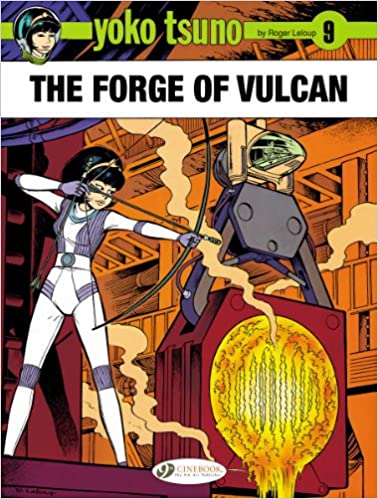
Yoko Tsuno volume 9: The Forge of Vulcan


By Roger Leloup (Cinebook)
ISBN: 978-1-84918-197-6 (Album PB)

The uncannily edgy yet excessively accessible European exploits of Japanese scientific adventurer Yoko Tsuno began first began gracing the pages of Le Journal de Spirou in September 1970 and are still going strong.

The explosive, eye-popping, expansively globe-girdling, multi award-winning series was devised by Roger Leloup, another hugely talented Belgian who worked as one of Hergé’s assistants on the Adventures of Tintin strip before striking out on his own.

Compellingly told, superbly imaginative but always solidly placed in hyper-realistic settings sporting utterly authentic and unshakeably believable technology, these illustrated epics were at the vanguard of a wave of strips starring smart, competent and brave female protagonists which revolutionised Continental comics from the last third of the 20th century onwards and are as potently empowering now as they ever were.

The initial Spirou stories ‘Hold-up en hi-fi’, ‘La belle et la bête’ and ‘Cap 351’ were introductory vignettes before the formidable Miss Tsuno and her always awestruck and overwhelmed male comrades truly hit their stride with premier extended saga Le trio de l’étrange which began serialisation with the May 13th 1971 issue.

That epic of extraterrestrial intrigue was the first of 30 European albums, with this one was first serialised in 1973 (Spirou #1819-1840) before being released the same year as La forge de Vulcain. A spectacular earth-shaking rollercoaster romp, it was chronologically the third album and reached us as Cinebook’s ninth translated chronicle.

It all begins when Yoko spots a TV report of a disaster on an oil rig near Martinique and realises the drill has impacted and penetrated the same strange material – “vitreous, luminous and ultra-magnetic” – that was a basic building material of the subterranean aliens known as the Vineans…

Those ancient wanderers had been secretly hibernating deep within the earth for hundreds of thousands of years until she, TV producer Vic Van Steen and his frivolous cameraman pal Pol Paris encountered them to set the lost race on a new path…

Now the Vineans seem to be at the heart of a burgeoning ecological catastrophe of cataclysmic proportions, and none too soon Yoko and the lads are winging their way to the Caribbean. Upon landing, they waste no time in bluffing their way into the offices of oil company Forex, aided by a few mementoes of their under-earth adventure.

They are, however, about to be unceremoniously ejected when news comes that the soon-to-explode rig has encountered a new problem: a strange craft, unlike any ever seen, trapped in the rig’s legs even as inexplicable seismic distortions propagate, creating an area of meteorological instability.

Yoko convinces the manager she has prior experience in matters like these and is promptly jetting over in a helicopter. Of course, she had to stow away first…

Before long she is valiantly prying a live Vinean and his scout vessel out of a boiling gusher of mud and has discerned the true scale of the threat. The rig’s drill has intercepted a Vinean magma tunnel – used in their construction projects – which has strayed too close to the oil field, triggering a potential geological time-bomb…

Thankfully the crisis has brought forth an unexpected benefit too as old friend and benevolent alien scientist Khanyarrives to take charge. The forthright technologist already has a plan but needs her old surface allies’ assistance to carry it out. Soon Yoko, Pol and Vic are abandoning the incredulous rig engineers and heading back under earth where an unpleasant surprise is awaiting them.

The Vineans had slept in huge, manufactured caverns for almost half a million years, but since recently reviving, internecine strife has entered the lives of the blue-skinned colonist/refugees.

In The Curious Trio, ambitious militaristic throwback Karpan made a play to seize power from the vast electronic complex known as The Centre which regulated the lives of the colonists. The blustering bully was ultimately frustrated by Khany and her newfound surface pals but now – thanks to humanity’s underground atomic testing – has returned to prominence amongst his terrified people and set in motion a dangerous scheme to destroy Earth’s civilisation and conquer the survivors.

Subverting a plan to divert magma and grow a new continent for the Vineans to occupy, Karpan wants to use the colossal magma-shifting technology to drown the surface world. Khany and her followers were already attempting to scuttle the scheme, but now grim fortune and the humans’ drill have damaged the super-engineered magma-tubes, a drastic solution is necessary to save the planet both species occupy from exploding like a cosmic firecracker…

Naturally Yoko has a plan, but this one depends as much on luck as her scientific ingenuity and martial arts prowess as she tries to mould lava like plasticine and thwart Karpan’s globally suicidal schemes…

As always, the most potent asset of these breathtaking dramas is the staggeringly detailed draughtsmanship, which benefits from Leloup’s diligent research and meticulous attention to detail, honed through years of working on Tintin.

Possibly the most frenetic and visually spectacular of all her adventures, The Forge of Vulcan is a relentless, rocket-paced race to doom or salvation that will appeal to any fan of blockbuster action fantasy.
Original edition © Dupuis, 1973, 1979 by Roger Leloup. All rights reserved. English translation 2014 © Cinebook Ltd.

Marie Antoinette: Phantom Queen


By Rodolphe & Annie Goetzinger, translated by Peter Russella (NBM)
ISBN: 978-1-68112-029-4 (HB)

As I’m perpetually reiterating, just like so much European art and culture, French language comics (I’m controversially including Belgium and Swiss strips in this half-baked, nigh-racist, appallingly sweeping statement) often appear as a triumph of style over content.

That doesn’t mean they’re bad – far, far from it – but rather that sometimes writing and plot aren’t as important to the creators – or readers – as the way it looks on a page/in a book, and complex characterisation isn’t always afforded the same amount of room that scenery, players, fighting or sex gets.

Such is not the case in this sublimely evocative and eerily placid episode by eminent Bande Dessinée scenarist Rodolphe D. Jacquette (Le Conservateur, Raffini, Cliff Burton) and former fashion artist turned comics creator supreme Annie Goetzinger (Girl in Dior, Casque d’Or, Aurore, L’Agence Hardy) which seamlessly blends the tone and timbre of two iconic eras in French history into a tale of mystery, imagination and rather indolent intrigue…

First seen in 2011 as Marie Antoinette, La Reine Fantome, the translated wonderment follows an enlightening Introduction from Rodolphe, describing the origins and provenance of the story before co-writer and sole illustrator Goetzinger introduces us to artist Maud as she sits in the gardens of the Petit Trianon at Versailles.

It’s October 5th 1934 and her sketching of the scene is a brief yet welcome escape from her own problems. Her beloved but far older husband is recently dead, leaving her a vast fortune which her stepson son covets. Remy constantly pesters her to marry him, but she knows he’s as likely to kill as wed her to get his hands on the inheritance…

Things take a strange turn when her dog breaks loose and scampers away. He is quite the hit with the ladies of the Court when he bounds into a grand building, just as a frantic footman warns Queen Maria Antoinette that they must all retreat to the castle before the peasants besieging Versailles find them. It is still October 5th, but also somehow, so very long ago…

As her stepson’s attentions become more obnoxious and intolerable, Maud’s dreams are hunted by potent, tangible glimpses of the dead queen’s final days, and close friends Suzy and Maggie convince her to try an oh-so-fashionable séance.

Also attending the affair is attractive psychiatrist Dr. Maurice D’Octrobre, a man of great charm and learning, possessed of a remarkably open mind…

Good thing too, since the ceremony allows Marie Antoinette to manifest, imploring Maud to find her remains and re-bury her so that the tragic queen can rest at last…

And so begins an utterly beguiling, entrancingly sophisticated, classically constructed ghost story with clever plot twists, genteel suspense and even a vile villain who sees his stepmother’s unsuspected psychic gifts as a handy stepping stone to having her committed and possessing her fortune…

Maud’s path is unswerving and her triumph never in doubt, but she never expected that in addition to the satisfaction of a job well done and a soul saved there would be such tangible rewards for her good deed…

Eerily comfortable and superbly satisfying; balancing melancholy shades of The Ghost and Mrs Muir with the foreboding poesy of Daphne Du Maurier’s Rebecca, Marie Antoinette: Phantom Queen is a superb step back into a lost world of elegant mystery and imagination: one no fantasy lover or mature comics reader should miss.
© Dargaud 2011. All rights reserved.

For more information and other great reads see http://www.nbmpub.com/

The Magical History Tour volume 1: The Great Pyramid


By Fabrice Erre &Sylvain Savoia translated by Joseph Laredo (Papercutz)
ISBN: 978-1-54580-633-3 (HB)

Here’s the first instalment of a superb European export designed to make history even more compelling for kids. Originally edited by the fabulous Lewis Trondheim and Frédéric Niffle, Le Fil de l’Histoire is a series of handy introductions to pertinent periods starring an all-wise older sister and her little brother who visit key moments and learn lots.

This kiddies’ hand-sized hardback tome was originally Tome 2: La Pyramide de Khéops, and sees Annie turn young Nico‘s Lego-building triumph into an immersive teaching moment, whisking them back to see the great Pyramid in all its glory, detailing how and why it was built and conducting a tour of the interior most Egyptologists would give their last scarab cartouche for…

Responsible adults are author/educator/newspaper columnist and Doctor of History Fabrice Erre while illustration honours go to diligent comics pro Sylvain Savoia, who will be further entertaining later this month when I review his magnificent Marzi series. Trust me, you can’t wait…

Today’s treat also offers building techniques, comparisons of other mastabas, mausoleums and tombs and traces the history of the magnificent edifice through the centuries. Herodotus‘ misreading of facts, the Caliph of Baghdad’s brutal desecration of the site, tomb robbers, Napoleon‘s obsession and others interactions are all covered as well as a peek into possible future of the site.

Adding extra value are biographies of Imhotep, Cheops, Hemiunu, Herodotus, plans of the Giza Plateau, the Six Other Wonders of the World (now lost) and a comprehensive Timeline.

History is fun and comics are great. This book is both. Add it to your shelves and brace yourself for the chronicles to follow.
© 2018- DUPUIS – Erre – Savoia. All other material © 2021 Papercutz.

Yakari volume 17: The Snow Bird


By Derib & Job, coloured by Dominique and translated by Jerome Saincantin (Cinebook)
ISBN: 978-1-84918-460-1 (Album PB)

Children’s magazine Le Crapaud à lunettes was founded in 1964 by Swiss journalist André Jobin who then wrote for it under the pseudonym Job. Three years later he hired fellow French-Swiss artist Claude de Ribaupierre AKA “Derib”. The illustrator had launched his own career as an assistant at Studio Peyo (home of Les Schtroumpfs), working on Smurfs strips for venerable weekly Le Journal de Spirou. Together they created the splendid Adventures of the Owl Pythagore before striking pure comics gold a few years later with their next collaboration.

Derib – equally au fait with enticing, comically dynamic “Marcinelle” cartoon style yarns and devastatingly compelling meta-realistic action illustrated action epics – went on to become one of the Continent’s most prolific and revered creators. It’s a crime that groundbreaking strips such as Celui-qui-est-né-deux-fois, Jo (the first comic ever published dealing with AIDS), Pour toi, Sandra and La Grande Saga Indienne) haven’t been translated into English yet, but we still patiently wait in hope and anticipation…

Many of Derib’s stunning works over the decades feature his cherished Western themes; magnificent geographical backdrops and epic landscapes. Yakari is considered by fans and critics to be the strip which first led him to deserved mega-stardom.

Debuting in 1969, Yakari follows the life of a young Oglala Lakota boy on the Great Plains; set sometime after the introduction of horses by the Conquistadores but before the coming of modern Europeans.

The series – which has generated two separate TV cartoon series and a movie release – has achieved 40th albums: a testament to the strip’s evergreen vitality and the brilliance of its creators, even though originator Job has moved on and Frenchman Joris Chamblain has assumed the writer’s role from 2016.

Overflowing with gentle whimsy and heady compassion, young Yakari enjoys a largely bucolic existence: at one with nature and generally free from privation or strife. For the sake of our delectation, however, the ever-changing seasons are punctuated with the odd crisis, generally resolved without fuss, fame or fanfare by a little lad who is smart, brave… and can – thanks to the boon of his totem guide the Great Eagle – converse with all animals …

Originally released in 1992, L’osieau de niege was the 18th European album, but – as always with the best books – the content and set-up are both stunningly simple and effectively timeless, affording new readers total enjoyment with a minimum of familiarity or foreknowledge required…

This time, the little wonder willingly yields focus to human companion Rainbow as the kids idly play at the debilitating heights of the summer. They are confined to one of the capacious rawhide tipis thanks to a sudden deluge when the storm suddenly picks up the entire tent – floor and all – and whisks them away into the sky…

The tipi heads steadily north at high altitude and eventually lands in frozen tundra where old pal and mystic spirit rabbit Nanabozho is waiting. He’s summoned them for fun and adventure…

Rapt in wonder, the little girl soon befriends a lemming and saves him from a hunting snowy owl before she and Yakari are separated. A long search for each other finds them exhausted and baffled as the sun never goes down…

After a long nap on the too-bright plains, Yakari has a long chat with the giant owl and joins an army of lemmings as they cross a stream. Rainbow, meanwhile, is caught in a similar migration, but the reindeer she’s wandered into are far larger and determined. Before long she’s been carried with them and dumped in a raging river. Thankfully, the owl is soaring above and drags her out before she can drown…

Reunited at last, the little wanderers seek out their tipi, and befriend a herd of musk oxen just as a snap snowstorm hits. Not only do the mighty beasts warm them until it passes, but they’re quite protective when a hungry and inquisitive pack of wolves considers them as the next meal…

When Nanabozho pops up again, the general consensus is that it might be time to return, but as the tipi takes off, the kids realise they have a stowaway…

Exotically enticing, deviously educational and wildly entertaining, this cheery travelogue of natural wonders allows Derib & Job full rein to display their astounding and compelling narrative virtuosity: a glorious graphic tour de force capturing the appealing courage of our diminutive heroes, and a visually stunning, seductively smart and happily heart-warming saga to delight young and old alike.

Yakari is one of the most unfailingly absorbing all-ages strips ever conceived and should be in every home, right beside Tintin, Uncle Scrooge, Asterix and The Moomins.
Original edition © Derib + Job – Editions du Lombard (Dargaud- Lombard s. a.) 2000. English translation 2019 © Cinebook Ltd.

Skin Deep


By Charles Burns (Fantagraphics Books/Penguin)
ISBN: 978-1-60699-167-1 (PB, Fantagraphics) 978-0-14016-543-2 (UK Penguin)

I’s nearly St. Valentine’s day, and the time for extreme efforts for little discernible reward, so here’s a classic treatise on love and affection, inexplicably unattainable in the its native English language. Worth the hunt though…

Charles Burns is a creative force with his roots firmly placed in 1950s kids’ culture (B-movies, cartoons, EC comics and especially Mad Magazine) and talented fingers in many areas of the creative media. As an illustrator, graphic designer, photographer, film-maker and especially cartoonist, his slick, precise methodology tells stories and evokes responses from a place that is dark, skewed, beautiful and overwhelmingly nostalgic.

His comics work blends horror, true romance and Film Noir sensibilities with sensationalistic fascination for the grotesque and absurdist; all delivered in a slick, meticulous, heavy linear style reminiscent of woodcut prints; with huge swathes of solid black, like darkness and light suspended and perfectly balanced in a Cold War on every page.

This gigantic softcover (297mm high x 224mm wide) was the third in a series collecting all the artist’s work prior to the landmark publication of the incredible Black Hole, with the three interlinked – or rather perhaps, overlapping – stories here all originating between 1988 to1992. They were slightly revised after debuting in his Big Baby weekly strip and – in the case of ‘A Marriage Made in Hell’ – the legendary Raw Magazine. All in their own manner examine the theme of love in the modern world.

Leading off is ‘Dog-Boy’, the simple tale of a young man who has a cut-rate heart transplant and finds himself increasingly taking on the characteristics of the canine who provided his new ticker. Just because he acts a little differently, does this mean that there is no girl out there for him? This tale formed the basis of a 1991 MTV serial for the Liquid Television TV programme…

This leads to the outrageously funny and deeply unsettling ‘Burn Again’ wherein reformed televangelist Bliss Blister once more falls under the influence of his huckster father, as well as his own wife, who use him to con the religiously gullible. Unfortunately, what only Bliss knows is that God – in the form of a hideous, diabolical extraterrestrial Cyclops – is coming to end mankind’s self-inflicted woes…

The book ends with the aforementioned and intensely disturbing story-within-a-story ‘A Marriage Made in Hell’. When horny new bride Lydia finally marries her war-hero husband she regretfully discovers that he won’t consummate their union. Just what is the fantastic secret of battle-scarred veteran John Dough, and how does Lydia cope with the incredible situation she finds herself trapped in?

As well as these staggeringly dry, wry and funny tales there is also a selection from the Burns sketchbook, a look at some of those altered story-pages and a brief commentary from the artist himself.

This volume is also available as a hardback edition and was previously released as a Penguin book in 1992. You stand more chance of finding that these days, but if you’re intrigued and can read almost any European tongue, this stuff can be yours in the twinkling of a search engine. Funny old world, isn’t it?
© 1988-1992 Charles Burns. All Rights Reserved.

Billy & Buddy volume 7: Beware of (Funny) Dog!


By Roba, translated by Jerome Saincantin (Cinebook)
ISBN: 978-1-84918-457-1 (Album PB)

Known as Boule et Bill in Europe (at least in the French speaking bits, that is; the Dutch and Flemish call them Bollie en Billie or perhaps Bas et Boef if readers first glimpsed them in legendary weekly Sjors), this evergreen, immensely popular cartoon saga of a dog and his boy debuted in the Christmas 1959 edition of Le Journal de Spirou.

The perennial family fan-favourite resulted from Belgian writer-artist Jean Roba (Spirou et Fantasio, La Ribambelle) putting his head together with Maurice Rosy: the magazine’s Artistic Director and Ideas Man who had also ghosted art and/or scripts on Jerry Spring, Tif et Tondu, Bobo and Attila during a decades-long, astoundingly productive career at the legendary periodical.

Intended as a European answer to Charles Schulz’s Peanuts, Boule et Bill quickly went its own way, developing a unique style and personality and becoming Rosa’s main occupation for the next 45 years. He had launched the feature as a mini-récit (a 32-page, half-sized freebie insert) in the December 24th 1959 Spirou.

Like Dennis the Menace in The Beano, the strip was a huge hit from the start and for 25 years held the coveted and prestigious back-cover spot. Older Brits might recognise the art as some early episodes – retitled It’s a Dog’s Life – ran in Fleetway’s legendary weekly Valiant from 1961 to 1965…

A cornerstone of European life, the strip generated a live-action movie, animated TV series, computer games, permanent art exhibitions, sculptures and even postage stamps. Like some select immortal Belgian comics stars, Bollie en Billie were awarded a commemorative plaque and have a street named after them in Brussels….

Large format album editions began immediately, totalling 21 volumes throughout the 1960s and 1970s. These were completely redesigned and re-released in the 1980s, supplemented by a range of early-reader books for toddlers. Collections are available in 14 languages, selling well in excess of 25 million copies of the 40 albums to date.

Roba crafted more than a thousand pages of gag-strips in a beguiling, idealised domestic comedy setting, all about a little lad and his exceedingly smart Cocker Spaniel, before eventually surrendering the art chores to his long-term assistant Laurent Verron in 2003.

The successor subsequently took over the scripting too, upon Roba’s death in 2006.

As Billy and Buddy, the strip returned to British eyes in enticing Cinebook compilations from 2009 onwards: introducing to 21st century readers an endearingly bucolic late 20th century, sitcom-styled nuclear family set-up consisting of one bemused, long-suffering and short-tempered dad, a warmly compassionate but painfully flighty mum, a smart, mischievous son and a genius dog who has a penchant for finding bones, puddles and trouble.

Originally released in 1974, Attention chien marrant! was the 15th European collection, comfortingly resuming in the approved manner and further exploring the evergreen relationship of a dog and his boy (and tortoise) for our delight and delectation. Available in paperback and digital editions and delivered as a series of stand-alone rapid-fire, single-page gags with titles like Cleaned Out’, Bad Mood’ and Schoolyard Blues’, Beware of (Funny) Dog! Is packed with visual puns, quips and jolly “dad-joke” jests: affirming the socialisation and behaviour of little Billy is measured by carefree romps with four-footed friend Buddy.

Buddy is the perfect pet for an imaginative and playful boy, although the manipulative mutt is overly fond of purloined food, buried bones (ownership frequently to be determined) and ferociously protective of boy, pet Tortoise and his ball.

The pesky pooch also cannot understand why everyone wants to constantly plunge him into foul-tasting soapy water, but it’s just a sacrifice he’s prepared to make to be with Billy…

Buddy also has a fondly platonic relationship with tortoise Caroline (this autumnal collection finds her largely absent through hibernation pressures) and a suspicious knack for clearing off whenever Dad has one of his explosive emotional meltdowns over the cost of canine treats, repair bills or the Boss’ latest impositions.

The inseparable duo interact with pals, play pranks, encounter other unique pets, dodge baths, hunt and hoard bones, rummage in bins, misunderstand adults, cause accidents and cost money; with both kid and mutt equally adept at all of the above.

This time, the capacity for chaos is heightened by vacation frolics involving mountains and fondue – wanna guess where the family are? – but there’s also plenty of domestic distress involving burglars, dog licenses and the onset of Christmas snows to foster a fond feeling of lost golden days…

Roba was a master of this cartoon artform. The strips are genially paced, filled with wry wit and potent sentiment: enchantingly funny episodes running the gamut from heart-warming to hilarious, silly to surreal and thrilling to just plain daft: a charming tribute to and lasting argument for a child for every pet and vice versa. This is a supremely engaging family-oriented compendium of cool and clever comics no one keen on introducing youngsters to the medium should be without.
Original edition © Dupuis 1974 by Roba © Studio Boule & Bill 2019. English translation © 2019 Cinebook Ltd.

Benny Breakiron volume 3: The Twelve Trials of Benny Breakiron


By Peyo, with Yvan Delporte & Walthéry, translated by Joe Johnson (Papercutz/NBM)
ISBN: 978-1-59707-492-6 (HB Album)

Pierre Culliford was born in Belgium in 1928 to a family of British origin living in the Schaerbeek district of Brussels. An admirer of the works of Hergé and American comics licensed to Le Journal de Mickey, Robinson and Hurrah!, he developed his own artistic skills but the war and family bereavement forced him to forgo further education and find work.

After time spent toiling as a cinema projectionist, in 1945 Culliford joined C.B.A. animation studios, where he met André Franquin, Morris and Eddy Paape. When the studio closed, he briefly studied at the Brussels Academy of Fine Arts before moving full-time into graphic advertising. In his spare time, he began submitting comic strips to the burgeoning post-war comics publishers.

His first sale was in April 1946: Pied-Tendre, a tale of American Indians in Riquet, the comics supplement to the daily L’Occident newspaper. Further sales to other venues followed and in 1952 his knight Johan found a permanent spot in Le Journal de Spirou. Retitled Johan et Pirlout, the strip prospered and in 1958 introduced a strange bunch of blue woodland gnomes to the tale. They were called Les Schtroumpfs.

Culliford – by now using nom de plume Peyo – would gradually turn those adorable little mites (known to us and most of the world as The Smurfs) into an all-encompassing global empire, but before being sucked onto that relentless treadmill, he still found time to create a few other noteworthy strips such as the titanic tyke on view here today.

In 1960, Benoît Brisefer – AKA Benedict Ironbreaker and/or (in Dutch) Steven Sterk – debuted in Le Journal de Spirou #1183 (December 1960). With a few slyly added tips of the hat to Siegel & Shuster’s Superman, the wryly bucolic adventures celebrated a small boy with superhuman strength living in a generally quiet and unassuming little Belgian town.

Quiet, well-mannered, gentle and a little lonely, Benny just happens to be the mightiest boy on Earth; able to crush steel in his tiny hands, leap huge distances and run faster than a racing car. He is also generally immune to all physical harm, but his fatal and rather ubiquitous weakness is that all his strength deserts him whenever he catches a cold…

Benny never tries to conceal his abilities but somehow no adults ever catch on. They generally think he’s telling fibs or boasting, and whenever he tries to prove he can bend steel in his hands, the unlucky lad gets another case of the galloping sniffles…

Most kids avoid him. It’s hard to make friends or play games when a minor kick can pop a football like a balloon and a shrug can topple trees…

Well-past-it Brits of my age and vintage might remember the character from weekly comics in the 1960’s. As Tammy Tuff – The Strongest Boy on Earth – and later as Benny Breakiron and Steven Strong – our beret-wearing champion appeared in Giggle and other periodicals from 1967 onwards.

With Peyo’s little blue cash-cows taking up ever larger amounts of his concentration and time, other members of his studio assumed greater responsibilities for Benoît as the years passed. Willy Maltaite (“Will”), Gos, Yvan Delporte, François Walthéry and Albert Blesteau all pitched in and Jean Roba created many eye-catching Spirou covers, but by 1978 the demands of the Smurfs were all-consuming and all the studio’s other strips were retired.

You can’t keep a good super-junior down, though, and after Peyo’s death in 1992, his son Thierry Culliford and cartoonist Pascal Garray revived the strip, adding six more volumes to the eight generated by Peyo and his team between 1960 and 1978.

Thanks to the efforts of US publisher Papercutz, the first four of those gloriously genteel and outrageously engaging power fantasies are available to English-language readers – both as robust full-colour hardbacks and as all-purpose eBooks – and this third exploit begins in the sedate city of Vivejoie-la-Grande, where the kid goes about his solitary life, doing good deeds in secret and being as good a boy as he can….

During the annual fair, his elderly friend Monsieur Dussiflard meets an old chum from their days in a jazz band. In the course of catching up, they learn that another mutual pal has become emir of an Arabian kingdom. Long ago, he gave the members of the band a charter granting them rights to a piece of desert… one that is now worth billions in oil revenues…

Back then, the comrades thought it hilarious to scrupulously divide the precious paper into nine parts, but none of them ever threw way their scrap…

As the adults chat and Benny listens, dark deeds are underway. Dussiflard’s home is burgled, triggering a frantic race around the world, with our heroes one step behind a cunning mastermind who will baulk at nothing to secure the entire document and the riches it promises…

All over the globe, Little Benny performs a succession of incredible feats – each one completely missed by Dussiflard and his beleaguered Jazz men – to stymie the malevolent schemer, before arriving home to deal the villain his just desserts…

Fast-paced, wry and sporting a fine eye for the dafter side of super-heroics, this is another fabulously winning fantasy about childhood validation and agency, providing a wealth of action, thrills and chortles for lovers of incredible adventure and comics excellence.
© Peyoâ„¢ 2013 – licensed through Lafig Belgium. English translation © 2013 by Papercutz. All rights reserved.

The Bluecoats volute 5: Rumberley


By Willy Lambil & Raoul Cauvin, translated by Erica Jeffrey (Cinebook)
ISBN: 978-1-84918-108-2 (Album PB)

The myths and legends of the cinematic American West have fascinated Europeans virtually since the actual days of stagecoaches and gunslingers. Hergé and Moebius were passionate devotees and the wealth of stand-out Continental comics series ranges from Italy’s Tex Willer to such Franco-Belgian classics as Blueberry and tangential all-ages classics such as Yakari. Even colonial dramas such as Pioneers of the New World and Milo Manara & Hugo Pratt’s Indian Summer fit the broad-brimmed bill.

As devised by Louis “Salvé” Salvérius & Raoul Cauvin – who has scripted the first 64 best-selling volumes until his retirement in 2020 – Les Tuniques Bleues (The Bluecoats) debuted at the end of the 1960s, specifically created to replace Lucky Luke when the laconic maverick defected from weekly anthology Le Journal de Spirou to rival publication Pilote.

The substitute swiftly became one of the most popular bande dessinée series in Europe.

Salvé was a cartoonist of the Gallic big-foot/big-nose humour school, and when he died suddenly in 1972 his replacement, Willy “Lambil” Lambillotte slowly introduced a more realistic – but still overtly comedic – illustrative tone and manner. Lambil is Belgian, born in 1936 and, after studying Fine Art in college, joined publishing giant Dupuis in 1952 as a letterer.

Born in 1938, scripter Cauvin is also Belgian and before entering Dupuis’ animation department in 1960 studied Lithography. He soon discovered his true calling – comedy writing – and began a glittering and prolific career at Spirou. In addition to Bluecoats he scripted dozens of long-running, award winning series including Cédric, Les Femmes en Blanc and Agent 212: more than 240 separate albums. The Bluecoats alone has sold more than 15 million copies of its 65 (and counting) album sequence.

Our sorry, long-suffering protagonists are Sergeant Cornelius Chesterfield and Corporal Blutch; a pair of worthy fools in the manner of Laurel & Hardy: hapless, ill-starred US cavalrymen posted to the wild frontier and various key points of fabled America during the War Between the States.

The original format featured single-page gags set around an Indian-plagued Wild West fort, but from the second volume Du Nord au Sud, the sad-sack soldiers went back East to fight in the American Civil War (a tale was rewritten as 18thalbum Blue retro to describe how the chumps were drafted during the war). Every subsequent adventure, although often ranging far beyond America and taking in a lot of thoroughly researched history, is set within the timeframe of the Secession conflict.

Blutch is your run-of-the-mill, whinging little-man-in-the street: work-shy, mouthy, devious and especially critical of the army and its inept commanders. Ducking, diving, even deserting whenever he can, he’s you or me – except sometimes he’s quite smart and heroic if no other (easier) option is available.

Chesterfield is a big burly professional fighting man; a career soldier who has passionately bought into all the patriotism and esprit-de-corps of the Military. He is brave, never shirks his duty and wants to be a hero. He also loves his cynical little troll of a pal. They quarrel like a married couple, fight like brothers and simply cannot agree on the point and purpose of the horrendous war they are trapped in…

Rumberley was the fifth translated Cinebook album (chronologically the 15th European volume) and a far darker affair than usual. After a horrific battle, Union and Confederate forces are spent and exhausted, although the Blues have advanced far into the South as a result of the sustained slaughter. However, with dwindling food and little ammunition, the Generals opt to fall back and re-supply with fresh troops and munitions. The only problem is what to do with the wounded. After all, bringing them back to safety would only slow down the rearward advance. Then one bright, over-privileged spark has the notion of just billeting the unusable Union soldiers on the nearest – albeit enemy – town…

Amongst the dead and dying are grievously injured Chesterfield and war-crazy Captain Stark. Even Blutch is there, but his leg wound might be minor, self-inflicted or possibly utterly bogus…

Their reception by the women, children, aged and infirm of Rumberley is hostile to say the least, but the Union dregs have no place else to go and no strength left to leave anyway. Forcibly appropriating the livery stable as a field hospital, Blutch and Chesterfield aid the exhausted doctors and surgeons as best they can, but the simmering tensions and occasional assaults by the townsfolk indicates there is real trouble brewing and this kettle is about to boil over very soon…

And then the townsfolk start drifting away. Rumours spread that a Confederate force is approaching Rumberley. The doctors try to move their charges out, and Blutch finds himself in the uncanny position of staying behind as rearguard when Chesterfield decides to buy them time to get away…

When it comes, the battle is a bizarre affair. The Rebels are fit but have little ammunition so the Bluecoats give a good accounting of themselves, but are almost done for when Stark unexpectedly leads a life-saving cavalry charge of the Union wounded to save them. During the insane clash, town buildings are set afire and the citizens of Rumberley rush back to save their home and possessions.

And then something strange happens: the killing stops and Blues, Greys and civilians work together to save rather than destroy…

This is a hugely amusing anti-war saga targeting younger, less world-weary audiences. Historically authentic, and always in good taste despite an uncompromising portrayal of violence, the attitudes expressed by our down-to-earth pair never make battle anything but arrant folly and, like the hilarious yet insanely tragic war-memoirs of Spike Milligan, these are comedic tales whose very humour makes the occasional moments of shocking verity doubly powerful and hard-hitting.

Funny, thrilling, beautifully realised and eminently readable, Bluecoats is the sort of war-story and Western which appeals to the best, not worst, of the human spirit.
© Dupuis 1979 by Lambil & Cauvin. English translation © 2011 Cinebook Ltd. All rights reserved.