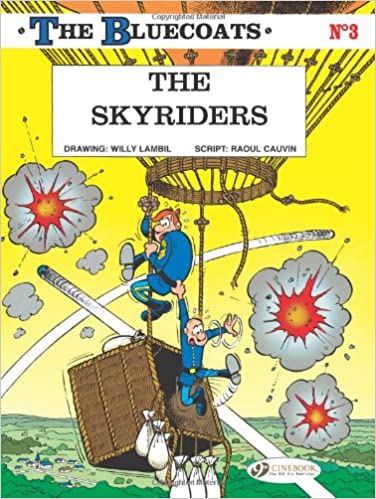
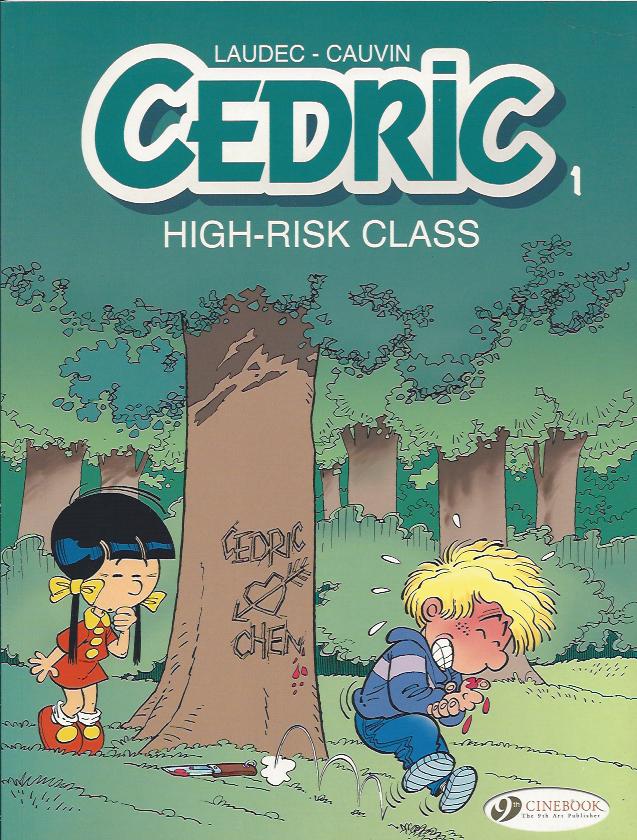
Cedric volume 1: High Risk Class


By Laudec & Cauvin with colours by Leonardo and translated by Erica Jeffrey (Cinebook)
ISBN: 978-1-905460-68-7 (Album pb)

Raoul Cauvin is one of Europe’s most successful comics scripters. Born in Antoing, Belgium in 1938, he joined Dupuis’ animation department in 1960 after studying the dying and much-missed print production technique of Lithography.

Happily he quickly discovered his true calling – comedy writing – and began a glittering and prolific career at Le Journal de Spirou where he devised (with Salvérius) the astoundingly successful Bluecoats as well as dozens of other long-running, award winning series such as Sammy, Les Femmes en Blanc, Boulouloum et Guiliguili, Cupidon, Pauvre Lampil and Agent 212: cumulatively shifting more than 240 separate albums. Bluecoats alone has sold more than 15 million copies so far.

His collaborator on kid-friendly family strip Cedric is Italian born, Belgium raised Tony de Luca who studied electro-mechanics and toiled as an industrial draughtsman until he could make the break into comics.

After a few fanzine efforts in the late 1970s, in 1979 as Laudec he landed soap-style series Les Contes de Curé-la-Fl’ûte at Spirou and built it into a brace of extended war-time serials (L’an 40 in 1983 and Marché Noir et Bottes à Clous in 1985) whilst working his way around many of the title’s other strips.

In 1987 he united with Cauvin on the first Cédric shorts and the rest is history… and science and geography and PE and…

We have Dennis the Menace and the Americans have one too – but he’s not the same – whilst the French-speaking world has Cédric: a charming little rapscallion with a heart of gold and an irresistible streak of mischief dogging his heels. Collected albums of the short, sharp strips – ranging from a ½ page to half a dozen – began appearing in 1989 (with 31 released so far) and are always amongst the most popular and best-selling on the continent, as is the animated TV show spun off from the strip.

Available in paperback album and digital formats, this first Cinebook translation – from 2008 and originally continentally released as Classe tous risques in 1990 – was the third compilation and hauls straight in to the action as the little lout is surprised by the introduction of ‘The New Girl’ to the class.

Previously, overly-imaginative Cedric had been utterly enamoured of his teacher Miss Nelly but when Chen is introduced his mind and heart go into fantasy overdrive. She’s different, her skin isn’t the same colour as everybody else’s and she talks really funny.

Of course a proper gentleman would have a better and less dangerous way of saying that to a newcomer’s face. Happily, however, Cedric’s gaffe is an opportunity for demure but feisty Chen to properly break the ice…

When the restless lad and his best friend Christian get hold of some stink bombs an awful lot of surprised adults are forced to cry ‘What Stinks?’ but the peewee pranksters eventually go too far and are trapped in their own efforts, whereas when Cedric attempts to cheat in a geography competition involving ‘Balloons’ the repercussions are all on him alone…

His deviltry actually succeeds with no comeback when he sabotages the ‘Olympic Disciplines’ of excessively keen Games Master Mr Oliver but when Cedric tries to obscure his latest bad report card by getting injured and crying for ‘Nurse Mum’ his tactics are sorely mistaken…

There’s more social angst – and unleashed aggression – in store when Christian confuses Chinese Chen with Vietnamese ‘Boat People’ and shares his “expertise” with our gullible star but the boys are soon pals again and summarily run amok with a radio-controlled car in ‘Driving Under the Influence of Laughter’ after which Grandpa lands in the doghouse when Cedric steals his champagne and gets disastrously hammered on his ‘First Sip’…

Disclosing he is over Miss Nelly, the love-struck lad goes completely over the top with ‘The Gift’ he has chosen to win Chen, which leads to near disaster when he manfully decides he must let his deserted older woman down gently in ‘One Love Follows Another…’

Typically, Cedric picks the very moment after his teacher has received some extremely upsetting news…

Focus satirically switches to conservative, reactionary Grandpa who takes the news that Cedric is seeing a Chinese girl with an appalling lack of understanding, taste or decorum in ‘The Oil Can’ but it’s the boy who’s soon back in everyone’s bad books when he swaps suntan oil for toothpaste in ‘Bathing Beauties’.

At least his classmates still respect him, especially Freddy who needs all the escape tips he can get after delivering ‘The Report’ of his latest scholastic disgraces to his own furious father whilst Cedric’s family are subjected to cruel and unusual punishment when neighbours ‘Crazy for Television’ invite themselves over…

The introductory antics hilariously conclude as Cedric decides to use a school ‘Picnic’ to tell Chen of his feelings, despite the sustained mockery of his mates. Of course his courage is no substitute for discretion or tact and when he goes too far again, at least the boys are there to console and medicate him…

Rapid-paced, warm and witty, the adventures of this painfully keen, young romantic scallywag are a charming example of how all 8-year-old boys are just the same and infinitely unique. This is a solid family-oriented comics book no one trying to introduce youngsters to the medium should be without.
© Dupuis 1990 by Cauvin & Laudec. All rights reserved. English translation © 2008 Cinebook Ltd.

Alone volume 2: The Master of Knives


By Gazzotti & Vehlmann, translated by Jerome Saincantin (Cinebook)
ISBN: 978-1-84918-206-5 (PB Album)

Fabien Vehlmann was only born in 1972, yet his prodigious canon of work (from 1998 to the present) has earned him the soubriquet of “the Goscinny of the 21st Century”. He entered the world in Mont-de-Marsan and grew up in Savoie, studying business management before taking a job with a theatre group.

In 1996, after entering a writing contest in Le Journal de Spirou, Vehlmann caught the comics bug and two years later published – with illustrative collaborator Denis Bodart – a mordantly quirky and sophisticated portmanteau period crime comedy entitled Green Manor. From there on, his triumphs grew to include – many amongst others – Célestin Speculoos for Circus, Nicotine Goudron for l’Écho des Savanes and a stint on major-league property Spirou and Fantasio…

Bruno Gazzotti is Belgian, born in 1970 and a former student of Institut Saint Luc in Liège. Another artist addicted to comics from his earliest years, he started getting paid to draw them in 1988, after being hired by Spirou editor Patrick Pinchart on the strength of his portfolio alone. Before long he was illustrating Le Petit Spirou with Tome & Janry.

In 1989, he and Tome created New York Cop Soda, which kept Gazzotti busy until 2005, when he resigned to co-create award-winning feature Seuls…

Originally released in January 2006, Seuls – La disparition began a superb example of how to craft a thriller suitable for kids: evoking the eerie atmosphere of TV series Lost and the most disturbing elements of Philip Wylie’s The Disappearance and William Golding’s Lord of the Flies. In a post-virus, Lockdown-besieged world, it also has eerie echoes of how humans deal with enforced isolation…

Debut volume The Vanishing showed us how an ordinary bustling town, with simple folk going about their business overnight became an empty mausoleum, with a small cross-section of kids left behind to survive or die.

The scant remainers comprise Ivan, an imaginative child of wealth who wants for nothing but never saw his dad and Leila, a born engineer, inventor and tinkerer. Her poor but honest dad always found time to play and critique her latest gadget…

Studious Camille was over-focussed on exams and achievement whilst Terry is pretty much still a baby: refusing to obey orders and throwing tantrums if he doesn’t get his way.

Typically, even in an ideal environment, not all children lived comfortable lives. Dodzi was in the protective services system. His early life made him tough and resilient but couldn’t stop the other young inmates handing him a beating on this ominous, odd-feeling night before everything changed…

When it happened, the kids wandered a terrifyingly quiet and forbidding city until finding each other. All the adults were gone, and all their child pals. The internet was down, with only static from TVs and radios. Above, fearsome storm clouds hung low and ominous. As they went wild with freedom and panicked from anxiety, eventually Dodzi brutally enforced calm and lead them away to find a succession of temporary – albeit palatial – refuges to regroup and think… After an uncanny series of encounters with escaped circus animals, the little band settle in the towering Majestic Hotel and Master of Knives (originally released as Seuls: Le Maître des couteaux) opens with Dodzi scouting the empty metropolis and helping Leila consolidate supplies for a long stay in the lap of luxury. His nervousness remains high as there are still close calls with the liberated beasts in the streets, but the younger kids seem to have adapted well. It certainly helps that they are hoarding every toy and treat they can find in abandoned shops and houses…

Ivan has a plan to occupy him too: systematically calling every phone number in the phone book. No luck yet, though…

Things start to go south swiftly after he finds his father’s pistol and tempts Leila into a spot of target practice on the roof. As Dodzi furiously confiscates the lethal toy, he has no idea that he has become the chosen prey of a mysterious stalker. As the cloaked pursuer slowly enacts a chilling campaign of terror, the stressed leader agonisingly discovers he is not the only obsession of the terrifying, nebulous figure clad in cloaks and draped in blades and daggers…

As the other kids obliviously fritter away the day, Dodzi is remorselessly hunted over the rooftops by the manic killer. When he briefly eludes the hunter, the Master simply doubles back to menace the children in the hotel. A shocking confrontation then ensues, which sees the tables turned but only at the cost of Dodzi’s closely withheld secrets being exposed to all…

In the painful aftermath, the days of innocence are discarded and the little orphan family prepare to hit the open road to find out if other cities have been emptied too…

To Be Continued…

This spooky, powerful and often shocking tale of mystery and imagination sees bereft children facing increasingly daunting physical hazards and an escalating series of events which can have no logical or rational explanation, and the tension simply amplifies with every instalment. Alone became one of the biggest critical and commercial comics hits of the decade and if you love eerie enigmas and powerful tale-telling, you’ll buy this and successive releases to see why…
© Dupuis 2007 by Gazzotti & Vehlmann. All rights reserved. English translation © 2014 Cinebook Ltd.

Ralph Azham volume 1: Why Would You Lie to Someone You Love?


By Lewis Trondheim, coloured by Brigitte Findakly and translated by Kim Thompson (Fantagraphics Books)
ISBN: 978-1-60699-593-8 (HB)

With over 100 books bearing his pen-name (his secret identity is actually Laurent Chabosy), writer/artist/editor and educator Lewis Trondheim is one of Europe’s most prolific comics creators: illustrating his own work, overseeing animated cartoons of adaptations of previous successes such as La Mouche (The Fly) and Kaput and Zösky or editing the younger-readers book series Shampooing for Dargaud.

His most famous tales are such global hits as ‘Les Formidables Aventures de Lapinot’ (translated as The Spiffy Adventures of McConey), (with Joann Sfar) the Donjon series of nested fantasy epics (translated here as the conjoined sagas Dungeon: Parade, Dungeon: Monstres and Dungeon: the Early Years) and his utterly beguiling cartoon diaries sequence Little Nothings.

In his spare time, and when not girdling the globe from convention to symposium to festival, the dourly shy and neurotically introspective savant has written for satirical magazine Psikopat and provided scripts for many of the continent’s most popular artists such as Fabrice Parme (Le Roi Catastrophe, Vénézia), Manu Larcenet (Les Cosmonautes du futur), José Parrondo (Allez Raconte and Papa Raconte) and Thierry Robin (Petit Père Noël).

Trondheim is a cartoonist of uncanny wit, outrageous imagination, piercing perspicacity, comforting affability and self-deprecating empathy who prefers to scrupulously control what is known and said about him…

Originally released by Belgian publisher Éditions Dupuis in 2001, this delicious yarn returns to the genre of anthropomorphic fantasy in a saga of wryly cynical faux-heroism revolving around failed Messiah and all-around disappointment Ralph Azham.

In his mountainous rural village, teenaged slacker Ralph is barely tolerated. He’s lazy, rude to his elders, constantly flouts authority, is always mouthing off and perpetually gets into trouble. Moreover, when he turned blue on the Night of the Double Moon – a certain sign of magical powers and an indicator that one may be the long-awaited Chosen One – he subsequently failed the tests of The Envoy and was ignominiously returned to the village…

Now he’s just an obnoxious waste of space whose only gift is the unnerving ability to tell when someone is pregnant or going to die…

His desolate village is slowly expiring. Situated in a depressing gully and old riverbed, the ramshackle dump comprises barely a dozen families now; the hard subsistence toil gradually forcing the least-dispirited farmers to emigrate to the less hostile but crowded lowlands. Moreover, with the annual visit from the rapacious marauding barbarian horde forever looming, the hamlet has precious little comfort or security to offer its dour citizens.

When the elders send Ralph out on a useless herb-gathering mission so they can have a council meeting without his annoying presence, the pariah is accosted by coquettish, scheming Claire who tries to seduce him and make him take her away from it all. After all, a boy with his gifts could surely make some money in the civilised parts of the world…?

Ralph spurns her and returns to eavesdrop on the village meeting, but when Claire follows and forcefully tries again, her big brother Piatch observes everything and attacks in a vain and pointless effort to defend her long-spent “honour”.

The running fight crashes through the village with many of the indignant elders eagerly joining in. When the well-thrashed Ralph furiously exposes many of their marital secrets, he finds himself confined to the pigsty for two months by the shamed and outraged citizens…

Later that night, his long-suffering father Bastien passes Ralph food and a knife, sadly recalling those distant days when the entire populace thought the boy was their literal ticket to salvation. After all, when the Chosen One was finally found, his mighty powers would totally destroy the terrible threat of predatory conqueror Vom Syrus and save the entire nation.

The whole episode was ill-starred. On their last night together, father and son were trapped in a cave-in and Ralph discovered his unsettling but militarily useless power. Even after they escaped death by suffocation, the airborne pilgrimage to fabled Astolia went tragically wrong – just how bad only Bastien knew for certain – and when the boy was returned to the village the populace’s high expectations soon soured.

They’ve been taking it out on Ralph ever since…

In the pigpen, Claire tries once more to sway the fed-up and furious miracle boy, but he’s already declined one attempt to help him escape. Wastrel Ralph has no intention of ever leaving his doting dad. Later, as Bastien quizzes him on why he’s still there, the alarm is sounded. The Horde is near…

The village is perfectly divided. Exactly half want to fight whilst the others favour abject surrender and throwing themselves on the invaders’ mercies. Unbelievably, now they desperately need Ralph to settle matters as the tie-breaking vote. The outcast is utterly unable to ignore the irony or resist the temptation to make them all squirm, but he is distracted by the ailing Filbert kid. The lad isn’t very well and it is another night of the Double Moon…

When the militant faction proves to be the most determined to win and acquiesces to Ralph’s outrageous and humiliating demands, the vote is cast and the villagers begin building a huge deadfall trap to kill as many Horde raiders as possible, guided by the pariah’s dear old dad, who was once a military engineer.

As the labours progress, further hidden secrets of Ralph’s interesting time in Astolia are revealed, but even as the weary folk return to their homes, the trap is sprung: not by the invaders, but rather one of their own.

Sore loser Mortimer knew that only he was right and thus couldn’t abide by the results of the vote. Surely that’s how Democracy really works?

In the cascade of rocks, little Raoul Filbert is injured and, as the enraged mob hunt for the new village pariah, forgotten Ralph carries the wounded child to the wise woman Auntie Milla. As she tends to the lad, something happens to Ralph too. Soon, he realises that his powers have changed. He can see dead people…

When he meets his father, Ralph realises that the ghost of the Envoy from his long-ago journey is attached to Bastien and soon the awful truth of his boyhood trip to Astolia comes tumbling out…

Milla too was part of the conspiracy, and now, as Ralph realises the horrible, selfish cause for his years of abuse and ostracization, he severs all ties with his father. Suddenly, the alarm sounds and the old soldier rushes back to the village where the Horde has arrived. Dejected Ralph picks up the sleeping Raoul and follows, but in the dark, nobody has noticed that the little lad’s head has turned blue…

In a wild and cataclysmic display of arcane power, Raoul destroys half the village and routs the panicked barbarians, but once they have recovered their wits, Horde outriders give chase. However, when the azure couple are cornered, Ralph’s new gift and the spirits of the pursuers’ previous victims combine to save them all, before a final cataclysm erupts and wipes out the invaders… and most of the village too…

After one final fractious confrontation with the surviving elders, Ralph heads for the plains and summons the latest Astolian Envoy to take him and Raoul to the city where new Chosen Onea are trained. As they prepare to take off on the civil servant’s triple-headed winged reptile, Claire rushes up, demanding to join them. She feels she has the right, since her cat ears and tiger stripes have turned a vibrant shade of blue…

Mesmerising and superbly enjoyable, this still-unfolding epic features a truly intriguing and clay-footed hero in a fantastic world of inescapably shallow and typically callous everyday folk: venal, self-serving and barely worth saving even if a Messiah can be found…

This engagingly sly and witty fantasy adventure tale for grown-ups begins here in a 96-page, full-colour landscape (218x168mm) sturdy hardcover edition (but sadly not in digital editions, if those are your preferred Chosen Ones): another must-not-miss epic masterpiece from one of the world’s greatest comic geniuses.
Contents © DUPUIS 2001 by Trondheim. All rights reserved. This edition © 2012 Fantagraphics Books. All rights reserved.

Clara


By Cécile & Christophe Lemoine, translated by Kevin Sullivan (Europe Comics)
No ISBN: digital only

It’s a truly horrific realisation that 2020 has brought the concept of imminent mortality back to the forefront of societal consciousness in way we in the west thought gone with gaslight, horse-brasses and Victorian ornaments. Now you’re truly lucky indeed if death hasn’t touched you, your family or circle of friends.

So, with the subject now truly unavoidable, how do you explain it to those who most need to understand what as much as why things have suddenly changed?

Originally released in Europe in May 2012, Clara is a children’s comic book tackling exactly that thorny issue in a potent – but ultimately uplifting – fantasy splendidly reminiscent of kindergarten classic The Velveteen Rabbit…

Written by actor, novelist and script doctor Christophe Lemoine and illustrated by artist, cartoonist and designer Cécile Brosseau, the tale reveals how the idyllic life of a bright, imaginative seven-year old changes forever when her devoted mother receives some terrifying news from her doctors.

In the days before and after her mother’s death, little Clara experiences a wave of unwelcome and uncontrollable emotions, barely held in check by the attentions of her equally-shattered dad and grandmother and centred around the scruffy old doll mummy gave her before everything changed…

However, at her lowest point, a journey into a bleak and terrifying fantasy world offers Clara revelation and perspective to balance the loss and grief and provides a chance of working out for herself the mystery of being left behind…

Balancing the largely unformed emotions of a child suffering bereavement with the escapist fantasy of saving a cherished toy is not a new concept, but it’s done here with style, aplomb and scrupulous sensitivity. Lemoine & Cécile focus clearly and efficiently on their message that death is not abandonment: accepting that kids do not process reality the same way adults do, but never sugar-coating or downplaying the tragedy.

Clara is a powerful tale impeccably told and one many adults would be well-advised to add to their armoury of learning aids to life…
© 2016 – LE LOMBRD – CÉCILE & LEMOINE. All rights reserved.

Papyrus volume 3: Tutankhamun, the Assassinated Pharaoh


By Lucien De Geiter, coloured by G. Vloeberghs & translated by Luke Spear (Cinebook)
ISBN: 978-1-90546-084-7 (Album PB)

British and European comics have always been happier with historical strips than our American cousins (a pugnacious part of me wants to say that’s because we have so much more past to play with – and yes, I know they’re responsible for Prince Valiant, but he’s an exception, not a rule).

Our Franco-Belgian brethren in particular have made an astonishing art form out of days gone by. The happy combination of familiar exoticism, past lives and world-changing events blended with drama, action and especially broad humour has resulted in a genre uniquely suited to enchanting readers of all ages and tastes. Don’t take my word for it – just check out Asterix, Adèle Blanc-Sec, The Towers of Bois-Maury, Iznogoud or Thorgal to name but a few which have made it into English, or our own much missed period classics such as Olac the Gladiator, Dick Turpin, Janus Stark, Heros the Spartan or Wrath of the Gods; all far too long overdue for collection in archival form, I might add…

Papyrus is the magnificent magnum opus of Belgian cartoonist Lucien de Gieter. He first saw the light of day in 1974 in legendary weekly Le Journal de Spirou, running to 35 albums thus far, as well as a wealth of merchandise, a television cartoon show and a video game.

De Gieter was born in 1932 and studied at Saint-Luc Art Institute in Brussels before going into industrial design and interior decorating. He made the jump into sequential narrative in 1961, first through ‘mini-récits’ (fold-in, half-sized-booklets) inserts for Spirou, starring his jovial little cowboy ‘Pony’, and later by writing for art-star regulars such as Kiko, Jem, Eddy Ryssack and Francis. He then joined Peyo’s studio as inker on Les SchtroumpfsAKA The Smurfs – and took over the long-running newspaper strip Poussy .

In the 1960s, De Gieter launched South Seas mermaid fantasy Tôôôt et Puit whilst Pony was promoted to the full-sized interior pages of Spirou, deep-sixing the Smurfs gig to expand his horizons working for Le Journal de Tintin and Le Journal de Mickey.

From 1972-1974 De Gieter assisted cartooning legend Berck on Mischa for Germany’s Primo, whilst applying the finishing touches to his dream project: a historical confection which would occupy his full attention and delight millions of fervent fans for the next forty years…

The annals of Papyrus encompass a huge range of themes and milieus, blending Boys’ Own adventure with historical fiction and interventionist mythology, gradually evolving from traditionally appealing “Bigfoot” cartoon style and content towards a more realistic, dramatic and authentic iteration. The journey came through light fantasy romps leavened and flavoured with the latest historical theories and discoveries and starring a fearlessly forthright boy fisherman favoured by the gods to become a hero of Egypt and friend to Pharaohs…

As a youngster the plucky “fellah” was blessed by the gods and given a magic sword courtesy of the daughter of crocodile-headed Sobek, and the lad’s initial task was to free supreme god Horus from imprisonment in the Black Pyramid of Ombos: thereby restoring peace to the Double Kingdom, but his most difficult and never-ending duty was to protect Pharaoh’s wilful, high-handed and safety-averse daughter Theti-Cheri – a princess with an unparalleled gift for seeking out trouble…

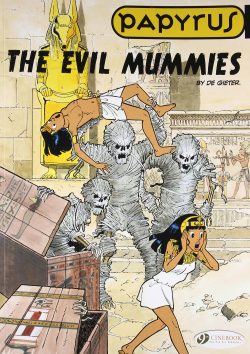
Now available digitally as well as in traditional paperback album format, Tutankhamun, the Assassinated Pharaoh was the third Cinebook translation – 17th in the series and originally released in 1994 as Toutânkhamon, le Pharaon assassiné. The sand and sandals mystery skilfully blends fact and fantasy into a strange and disturbing tale of grave robbery, unquiet ghosts and madness…

It all begins with a squabble between the Mayor of the City of the Dead and his equivalent civil servant for the City of Thebes. The vast, desolate region of imperial tombs, sepulchres and lesser burials is being systematically ransacked by blasphemous thieves and, whilst the aforementioned Executive of the Interred Paur claims the sacrilegious raids must be the work of roving Bedouins, Thebes’ Mayor Paser posits that the vile defilers’ knowledge of the holy sites indicates they must be Egyptians… perhaps even some of Paur’s workers or tomb guards…

Bored with the interminable bickering, Theti-Cheri drags Papyrus and court jester Puin away, demanding they join her father’s lion hunt in the deep desert. Amidst the hustle and bustle, the jolly dwarf is left behind and forced to frustratingly follow on his astoundingly smart donkey Khamelot.

Naturally, this leads to him being attacked by the self-same decrepit man-eater Pharaoh is trying to eradicate, but as Puin frantically flees the hungry cat he sees chariot-borne scout Papyrus save a fellah from brutal grave guards. The grateful peasant is a plant, however, and secretes a golden tomb treasure on the boy hero before knocking him out…

When Papyrus comes to, he is surrounded by soldiers and accused by Paur’s captain Rhama of tomb-robbing. A crowd of suspiciously overly-incensed citizens even try to stone him to death and Pharaoh has no choice but to have the boy imprisoned for trial. However, before the doughty lad can gather his wits, Paur attempts to assassinate the boy hero with snakes and then kidnaps him from his temple cell, hiding his drugged, unconscious form in a secret access shaft to the grave of tragic boy king Tutankhamun…

Falling through into the tomb proper, Papyrus’ spirit is suddenly accosted by the ghost of Ankhsenamun and discovers from Tutankhamun’s beloved child-bride how his own peasant great-grandfather played a major role in their tragic romance and the brief, complex reign of the murdered Boy-King…

As Papyrus learns the incredible, unpalatable truth about the legendary ruler’s fate, in the physical world Puin – and Khamelot – have informed Theti-Cheri of the plot. The impetuous Princess rushes to the site and subsequently traps herself in the tomb whilst gold-crazed Paur’s men close in to murder everybody who knows of the Mayor of the City of the Dead’s perfidy. However, the blasphemous bandits have not reckoned on Pharaoh’s cunning perspicacity or a certain donkey’s loyal ingenuity…

This astounding, amazing adventure will thrill and enthral fans of fabulous fantasy – although some of the finer points of Pharaonic marriage customs might distress fainter-hearted parents and guardians – and De Gieter’s clever merging of archaeological revelation with gothic romance and ghost story make for a particularly impressive treat…

Papyrus is a brilliant addition to the family-friendly pantheon of continental champions who marry heroism and humour with wit and charm, and anybody who has worn out those Tintin, Asterix or Lucky Luke volumes would be wise beyond their years in acquiring all these classic chronicles. Even smarter would be publisher Cinebook finally releasing the rest of the translated canon before much more sand passes through the hourglass…
© Dupuis, 1994 by De Gieter. All rights reserved. English translation © 2009 Cinebook Ltd.

The Adventures of Blake and Mortimer: Atlantis Mystery


By Edgar P. Jacobs, translated by Jerome Saincantin (Cinebook)
ISBN: 978-1-84918-107-5 (PB Album)

When I was a little kid, the nuns at the convent constantly banged on about reading. The cornerstone of all knowledge, it would also transport one to any place or time, depending on the quality of the book, they reckoned.

Loath though I am to agree with those terrifying, bullying-yet-scholarly penguins – about anything – that lesson stuck and it’s still true. Even in lockdown, no place or time on Earth or beyond is outside the realm of an extensive library and book collection. It also pleases me to use their philosophy to promote comics: a little delayed payback for all the great stuff they confiscated over the years…

If we’re talking wonderment and imagination delivered with potent veracity and graphic credibility there’s no better source material than master raconteur Edgar P. Jacobs. Over painstaking decades he pitted his distinguished duo of Scientific Adventurers Professor Philip Mortimer and Captain Francis Blake against a wide variety of perils and menaces in stunning action thrillers which blended science fiction, detective mysteries and supernatural thrillers in the same timeless Ligne Claire style which had done so much to make intrepid boy reporter Tintin a global sensation.

The strip debuted in Le Journal de Tintin #1 (26th September 1946): an international anthology comic with editions in Belgium, France and Holland. The magazine was edited by Hergé, with his eponymous star ably supplemented by a host of new heroes and features for the modern age, and Jacobs’ efforts were a welcome delight there until his death in 1987. Since then diverse hands have continued the casebook and expanded the series’ horizons. A 22nd adventure is scheduled for release in 2022…

L’enigme de l’Atlantide was Jacobs’ fourth electrifying exploit starring the peerless pair: originally serialised from March 30th 1955 to May 30th 1956, and subsequently collected in a single chronicle as the seventh drama-drenched adventure album.

The stunning secret history saga became the 12th translated release from UK-based Cinebook, and opens here with vacationing Intelligence operative Francis Blake arriving in the Azores. His journey to idyllic island Sao Miguel is at the urgent request of devoted comrade-in-peril Philip Mortimer, currently engaged in exploring deep caves in his ceaseless search for new knowledge. From the moment he lands, the British Agent is under constant scrutiny by mysterious gangsters and no sooner does he join his old friend than petty acts of vandalism and outright sabotage begin to occur, making their return to Mortimer’s home a living nightmare. Unbeknownst to the pair, whilst they are distracted, a mysterious intruder searches the Professor’s palatial lodgings only to be blasted by an even more fantastic figure with a ray-gun…

The delayed detectives only arrive in time to observe an astounding escape, leaving the frustrated bellicose boffin to explain how he has apparently discovered a new mineral of incredible potential in the vast cave system far below the surface of the island. He suggests it might be the wonder metal described by Plato as “Orichalcum”: the most prized element of the fabled Atlanteans…

Undeterred by the break-in, the bold Brits lay plans to further evaluate Mortimer’s mammoth cavern, and before long a small but dedicated team are scrambling through daunting crevices to terrifying depths in search of more mystery. The “mad English” are no longer the main topic of conversation on the island, however: everybody else is glued to newspaper reports of flying saucer sightings…

Heartened by their fortuitous return to obscurity and utterly unaware that one of their team has been replaced by a deadly old enemy, the valiant subterranean explorers struggle on against formidable and oppressive odds underground, but when the Professor’s Geiger Counter begins to react wildly and they recover a huge chunk of the mystery mineral, the saboteur makes his move.

As a sudden storm threatens to wash the entire expedition away, the infiltrator intercepts warnings from the surface, swipes the samples and – cutting the rope ladders – abandons Blake and Mortimer to their deaths…

His big mistake is pausing to gloat. A well-aimed rock hurled by the Secret Serviceman seemingly seals the scoundrel’s fate too…

Unable to go back, the plucky duo chance everything on following a subterranean river under the island in the vanishingly small hope of finding an exit. Instead, after an astounding under-earth odyssey, what they discover is mercilessly marauding pterodactyls and a fantastically advanced civilisation of super-scientists…

Soon the pair are recuperating in the vast bastion of Poseidopolis – thriving last outpost of legendary Atlantis. They are befriended by young noble Prince Icarus who happily shares the epic true history of Ancient Earth and his still space-faring nation with them, secure in the knowledge that they will never leave the subterranean metropolis for as long as they live…

Unfortunately, with their customary impeccable timing, the British bravos have arrived just as the city’s most trusted civil servant Magon attempts to usurp the hereditary rulers’ millennia of unchallenged power. All too soon, the surface-worlders are embroiled in a shattering civil war at the earth’s core.

Not only is the entire kingdom of noble Lord Basileus at stake, but the schemer and his allies also have designs upon the Atlanteans’ outer space dominions and the hapless, ignorant surface nations in between…

Packed with astounding action, double-doses of dastardly duplicity and captivatingly depicting the cataclysmic end of a fabulous secret civilisation, this is one of the Distinguished Duo’s most glorious exploits and one no lover of lost world yarns should miss.

Addictive and fantastic in the truest tradition of pulp sci-fi and Boys’ Own Adventures, the annals of Blake and Mortimer are the very epitome of dogged heroic determination; the natural successors to such heroic icons as Professor Challenger, Bulldog Drummond and Richard Hannay: infallibly delivering grand, old-fashioned Blood-&-Thunder thrills and spills in timeless fashion and with mesmerising visual punch. Any kid able to suspend modern mores and cultural disbelief (call it alternate earth history or bakelite-punk if you want) can and will experience the adventure of their lives…

This Cinebook edition – available in paperback and digital formats – also includes tantalising excerpts from companion albums The Curse of the 30 Pieces of Silver and The Strange Encounter, plus a short biographical feature and chronological publication chart of Jacobs’ and his successors’ efforts to offer further proof that The Adventures of Blake and Mortimer is a series no comics fan can do without…
Original edition © Editions Blake & Mortimer/Studio Jacobs (Dargaud-Lombard S. A.) 1988 by E.P. Jacobs. All rights reserved. English translation © 2011 Cinebook Ltd.

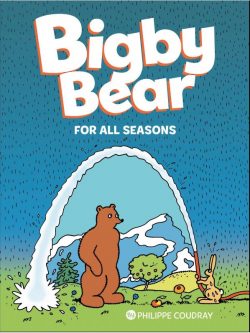
Bigby Bear Book One


By Philippe Coudray, translated by Miceal Ogriefa (BiG/Humanoids)
ISBN: 978-1-59465-806-8(HB)

Bordeaux-born in March 1960, writer, photographer and illustrator Philippe Coudray specialises in cartoons and books for children. Working with his brother Jean-Luc, he co-crafted the Drôles sequence of books and comics series Théocrite.

Howevwr, Philippe conceived and executed his signature creation L’Ours Barnabé – the philosophically absurdist ruminations of an artistic bear and his woodland companions all on his own…

When not crafting kids’ comics or surreal otherworldly gags (such as Loin de Tout) Philippe writes articles and such like for magazines such as Capsule Cosmique, Psikopat, Perlin and Fripounet as well as books such as Guide to Hidden Animals: Treatise on Cryptozoology. His works have been used by the government to combat illiteracy in France and translated into many languages; none more so than L’Ours Barnabé which has appeared in Japan, China, Germany Sweden, and twice in America. The first time was as Benjamin Bear (twice nominated for Eisner Awards and winning China’s 2012-2013 Panda Prize) and latterly here as the beguiling and frequently beguiled Bigby…

As much children’s storybook – although having no narrative structure and relying on episodic vignettes to deliver charming and visually challenging puzzles and riddles – as graphic novel, these collected strips feature an affably gentle bruin living wild and honing his artistic skills in a bucolic forest and mountain idyll, observing the world and pondering big questions in a surreal and often absurdist daze.

Visual tricks and double-takes abound as he and his rabbit chum encounter other animals and aliens, ignore the laws of the universe, carve, sculpt, paint, compose, garden and wander for the sheer joy of creativity. Subtly posing questions to make youngsters think – about art, science, psychology, mathematics, ecology and much more – Coudray never misses an opportunity to share a solid laugh with his readers and reinforce his message that life would be great if we all just mellowed out and got along with each other.

He’s also more than happy to pepper the strips with the occasional telling moment of social commentary if the chance arises…

Genteel fun, bemusing whimsy and enchanting illustration cloaking a supremely inclusive philosophy of curiosity, enquiry and cohabitation, Bigby Bear is a delightful example of how to enjoy life and crucial reading for young and old alike. Get the digital edition immediately before backing it up with the wonderfully tactile, sturdy hardback your kids will want to paw and peer at over and over again…
© 2012-2018 La Boîte à Bulles and Philippe Coudray. All rights reserved.

Violette around the world volume 1: My Head in the Clouds

By Teresa Radice & Stefano Turconi, translated by Terrence Chamberlain (EuroComics/IDW) ISBN: 978-1-68405-188-5 (HB Album) eISBN: 978-1-68406-411-3

Globetrotting Viola volume 1: Treasure Everywhere!
By Teresa Radice & Stefano Turconi, translated by Terrence Chamberlain (Europe Comics – Digital Only) No ISBN

There’s never been a more fruitful time for comics and graphic novels than today but the digital revolution has thrown up a few confusing moments for dithery old guard reviewers like me. Here’s a perfect case in point.

Europe comics is a collective syndicate of continental publishers from numerous countries collaboratively releasing the best of European material in translated digital formats. They also act as agents, so many of their digital releases eventually end up as physical books for English-language publishers like NBM, IDW and Cinebook.

Quite rightly, these publishers also have their own digital editions, and naturally these feature small variations and deviations in the final product. All in all, however, it’s no big deal. There is no “correct” edition and the art and story reman fundamentally the same. You pays yer money and takes yer choice…

In this instance I bought and reviewed both, so could you, if you so pleased…

Scripted by Teresa Radice and painted by Stefano Turconi – a prolific Italian husband-&- wife team who have co-created many books for varying ages of kids, such as Mickey and the Great Sea of Sand, The Forbidden Harbour and the Orlando Curioso series – this award-winning historical romp from 2013 follows the life of a young circus girl in very memorable times…

Alternatively dubbed Violette or Viola Vermeer, our young star – daughter of a cannonball woman and an insect trainer – is a fourth-generation performer of the Cirque de la Lune, currently chafing under the strictures of having to attend a draconian school for ladies in fin de siècle Paris.

She would far rather be travelling the land with her friends and family, and her scholastic inattention – and love of animals – keeps landing her in hot water with the stuffy schoolmarms of the posh institution she’s trapped in…

Her life takes an interesting and life-changing turn after meeting an itinerant painter named Henri. She ends up trailing him all over the metropolis, trying to return a lost sketchbook to the absent-minded dauber. The quest takes her all over the City of Lights and into places I am not going far more educational than her usual classroom: even to the resplendently scandalous Moulin Rouge, resulting in her downtrodden attitude being replaced by a new zest for living and a brand-new sense of adventure and purpose…

A breezy, light-hearted coming of age tale about diversity and acceptance set in a glamourous historical wonderland, this superb yarn also includes loads of captivating extra art by Turconi and a potted biography of Henri de Toulouse-Lautrec to aide amusement and elucidation…
Globetrotting Viola: Treasure Everywhere! © 2016 TUNUÉ (Tunué s.r.l.) – Teresa Radice & Stefano Turconi
Violette around the world: My Head in the Clouds text and illustrations © 2013 Teresa Radice & Stefano Turconi – Tunué. All rights reserved.

Mickey’s Craziest Adventures


By Lewis Trondheim & Keramidas, with Brigitte Findakly: translated by Ivanka Hahnenberger & David Gerstein (IDW)
ISBN: 978-1-63140-694-2 (HB) eISBN 978-1-68406-124-2

In his ninety years of existence, Walt Disney’s heroic everyman Mickey Mouse has tackled his fair share of weirdos and super freaks in tales crafted by creators from every corner of the world. A true global phenomenon, the little wonder has staunchly overcome all odds, and he’s always done so as the prototypical nice guy beloved by all. Mickey might have been born in the USA, but he belongs to all humanity now and thus some of his very best comics adventures come from countries like Denmark, Holland, Italy and France. This translation of a saga by Lewis Trondheim & Keramidas ranks right up at the top of the list…

With over 100 books bearing his pen-name (his secret identity is actually Laurent Chabosy), writer/artist/editor/animator and educator Lewis Trondheim is one of Europe’s most prolific comics creators: illustrating his own work, overseeing cartoons adaptations of previous successes such as La Mouche (The Fly) and Kaput and Zösky or editing the younger-readers book series Shampooing for Dargaud.

His most famous tales are such global hits as Les Formidables Aventures de Lapinot (seen in English as The Spiffy Adventures of McConey), the Donjon series of nested fantasy epics (co created with Joann Sfar and translated as conjoined sagas Dungeon: Parade, Dungeon: Monstres and Dungeon: the Early Years), comedy fable Ralph Azham and an utterly beguiling cartoon diaries sequence entitled Little Nothings.

In his spare time – and when not girdling the globe from convention to symposium to festival – the dourly shy and neurotically introspective savant wrote for satirical magazine Psikopat and provided scripts for many of the continent’s most popular artists such as Fabrice Parme (Le Roi Catastrophe, Vénézia), Manu Larcenet (Les Cosmonautes du futur), José Parrondo (Allez Raconte and Papa Raconte) and Thierry Robin (Petit Père Noël).

Ostensibly retired but still going strong, Trondheim is a cartoonist of uncanny wit, outrageous imagination, piercing perspicacity, comforting affability and self-deprecating empathy who prefers to scrupulously control what is known and said about him…

Nicolas Kerimidas (Donjon Monstres, L’Atelier Mastodonte, Donald’s Happiest Adventures) is a French cartoonist hailing from Grenoble who studied animation at the Gobelins School. He worked at Walt Disney Animation France’s Montreuil Studious for almost a decade before switching to comics as illustrator of Didier Crisse’s Luuna. He branched out and carried on, scripting his own stuff as well as being a much sought-after artist for others…

Patterned on Gold Key’s fabulous 1950-1960s run of anthological Walt Disney’s Comics and Stories, Mickey’s Craziest Adventures purports to be a restored – but tragically incomplete – compilation of a lost serial that ran in those vintage comics, “rediscovered” by the author and artist. The overwhelmingly successful conceit of this little gem – available in hardback and digital formats – is that we all love comics and can’t resist the mystery of an unread one we’ve never heard of…

After opening with essay ‘A Forgotten Treasure’ the yarn jerks into high gear once the “found” pages appear, starting with ‘Chapter 2’ as Mickey gives Donald Duck a lift to Uncle Scrooge‘s Money Bin. On arrival, they witness the entire kaboodle swiped via Gyro Gearloose‘s shrinking ray before being perilously diminished themselves!

Hot pursuit takes our heroes into a primeval world of (comparatively) giant insects and backyard jungles, but the game is afoot and even stranger hazards await them as they pursue the mystery bandits…

With cameos from most of Duckburg and Mouseton’s pantheon of major and minor stars and veteran villains such as Pegleg Pete and the Beagle Boys, this pell-mell romp across the world also encompasses monsters, cavemen, outer space perils and even the gods themselves, to create an unmissable delight for both aged aficionados like you and me and the newest generation of fans.

Frantic, frenzied fun for one and all. You know you have to have it!
© 2016 Disney Enterprises, Inc. All rights reserved.

Iznogoud and the Magic Computer (volume 4)


By Goscinny & Tabary translated by Anthea Bell & Derek Hockridge (Cinebook)
ISBN: 978-1-905460-79-3 (PB Album)

How are you coping with voluntary incarceration? If you’re feeling a little frustrated, why not chill out with a good book – instantly available via digital purchasing and still accessible if you go the physical delivery route as a spiffy paperback tome – and see what real frustration looks like and costs…

During his too-short lifetime (1926-1977) René Goscinny was one of the most prolific, most read writers of comic strips the world has ever seen.

He still is.

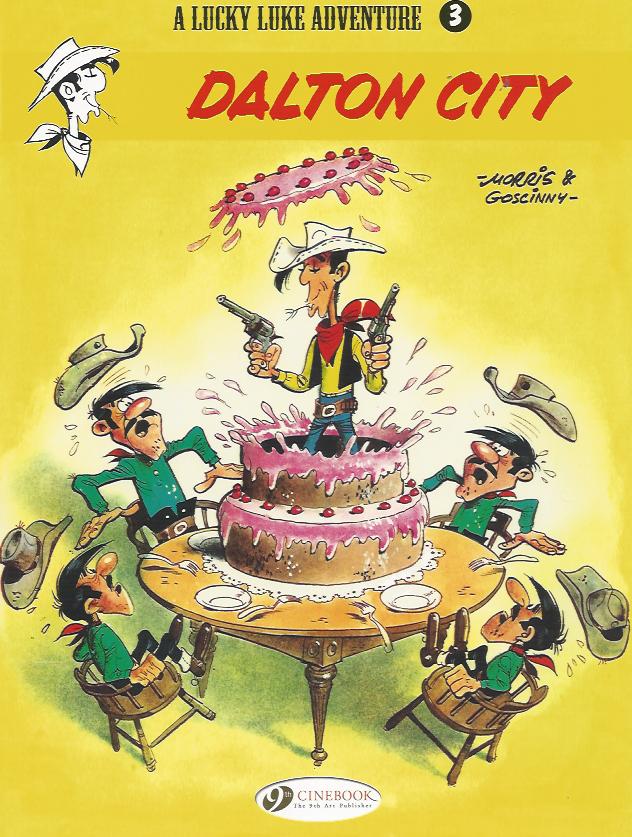
Among his most popular comic collaborations are Lucky Luke, Le Petit Nicolas and, of course, Asterix the Gaul. There are so many others, too such as this timeless classic…

Scant years after the Suez crisis, the French returned to the deserts when Goscinny teamed with sublimely gifted Swede Jean Tabary (1930-2011) who numbered Richard et Charlie, Grabadu et Gabaliouchtou, Totoche, Corinne et Jeannot and Valentin le Vagabond amongst his other hit strips.

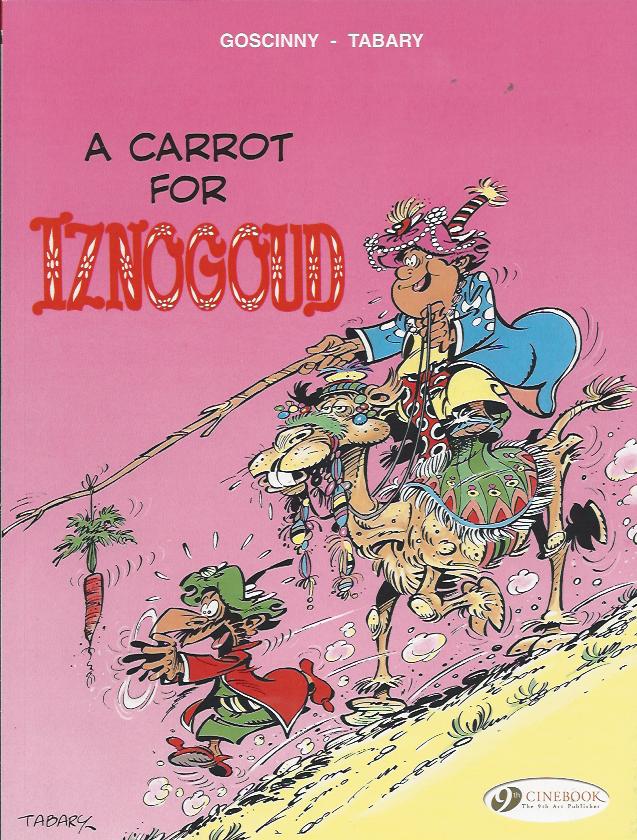
Together they produced imbecilic Arabian (im)potentate Haroun el-Poussah. However, it was the strip’s villainous foil, power-hungry vizier Iznogoud who stole the show – possibly the conniving little weasel’s only successful scheme.

Les Aventures du Calife Haroun el Poussah was created for Record, with the first instalment appearing in 1962 in the January 15th issue. A minor hit, it latterly jumped ship to Pilote – a magazine created and edited by Goscinny – where it was refashioned into a starring vehicle for the devious little rat-bag who had increasingly hogged all the laughs and limelight.

Like all great storytelling, Iznogoud works on two levels: for younger readers as a comedic romp with sneaky baddies coming a cropper, and as a pun-filled, witty satire for older, wiser heads, much like its more famous cousin Asterix. Happily, it’s also translated here by master translators Anthea Bell & Derek Hockridge who made the indomitable little Gaul so very palatable to the English tongue. Best of all, the deliciously malicious whimsy is always heavily-laden with manic absurdity and brilliantly applied creative anachronism to keep the plots bizarrely fresh and inventive.

Our insidious anti-hero is Grand Vizier to affable, generous, easy-going Haroun Al Plassid, Caliph of Ancient Baghdad, but the sneaky little toad has loftier ambitions, or as he is always shouting “I want to be Caliph instead of the Caliph!”…

The revamped series launched in Pilote in 1968, quickly becoming a huge European hit, with 29 albums so far (with 14 translated into English to date). The series has been carried on by Tabary’s children Stéphane, Muriel and Nicolas, in his own solo comic, and has spun-off into a game, TV cartoon show and live action movie.

Goscinny died in 1977, having completed a dozen book’s worth of wonderment and Tabary assumed the scripting as well as the superbly stylish illustration, moving to book-length complete tales, rather than the compilations of short punchy stories that typified their collaborations.

This fourth Cinebook album was the sixth French album (released in 1970 as L’ordinateur magique) and features a clenched and grasping fistful of short, sharp salutary tales beginning – after a handy catch-up profile page – with ‘A Calculated Risk’, wherein the cunning conniver, desperate to forestall a pact between the Caliph and mighty military neighbour Sultan Pullmankar, hires forward-thinking I-Bee’Em and his ponderous problem-solving “computer” to stop the signing of the treaty. The big grey box might be brilliant, but it’s agonisingly slow in reaching its infallible conclusions…

Things then get hilariously surreal after Iznogoud and his long-suffering, bumbling assistant Wa’at Alahf discover a mystic crossroads that can lead unwary travellers onto an unending, pointless journey from which they can neither escape nor return. Dashing back to Baghdad to lure the Caliph onto ‘The Road to Nowhere’, our wicked wayfarers eventually realise that they’ve been stuck on it all along…

Eventually reality resumes and back home and itching to take over, the Vile Vizier then seeks to employ the tragic gifts of lonely hermit Ghoudas Gho’ld: a direct descendent of legendary King Midas in ‘The Golden Handshake’. All Iznogoud has to do to remove the Caliph is get the accursed involuntary metal-maker back to the palace without him touching anything. Easy, no? No…

There’s more tacit skulduggery afoot in ‘The Caliph’s Sceptre’ when Iznogoud hires a master thief to sneak him into the high-security vault where the Staff of Office is cached. If he can prevent the Caliph from presenting it to the people in the annual reaffirmation of worthiness to rule ceremony, the Vizier can legally assume control of the country. Of course, it doesn’t quite play out that way…

This fine kettle of funny fish concludes with ‘The Mysterious Ointment’ as fabled explorer Notsobad the Sailor returns to the port of Basrah. Having forgotten to bring the undetectable Occidental poisons he promised the Vizier, the wily voyager palms him off with a tube of “Schpouk toothpaste’.

Assured the container holds a lethal and undetectable toxin, Iznogoud embarks on an eccentrically convoluted campaign to convince the Caliph and the court that cleaning one’s choppers is the latest and most beneficial of scientific advancements. Care to guess how well that goes?

Snappy, fast-paced hi-jinks and gloriously agonising pun-ishing badinage abound in this mirthfully infectious series which is a household name in France where “Iznogoud” is common parlance for a certain type of politician: over-ambitious, unscrupulous – and often of diminutive stature.

When first released here in the 1970s, these tales made little impression, but hopefully have finally found an appreciative audience among today’s more internationally aware, politically jaded comics-and-cartoon savvy Kids Of All Ages…
© 1970 Dargaud Editeur Paris by Goscinny & Tabary. All rights reserved.