Yakari and Great Eagle (volume 1)


By Derib & Job, translated by Erica Jeffrey (Cinebook)
ISBN: 978-1-90546-004-5 (PB Album)

Westerns of every sort have always captivated consumers in Europe and none more so than the assorted French-speaking sections who also avidly devour comics. Historically, we Brits have also been big fans of sagebrush sagas and the plight of the “noble savage”…

In 1964, French-Swiss journalist André Jobin founded children’s magazine Le Crapaud à lunettes and began writing stories for it under the pseudonym Job. Three years later he hired young fellow French-Swiss artist Claude de Ribaupierre, who had begun his own career as an assistant at Studio Peyo, (home of Les Schtroumpfs/The Smurfs) where the promising lad had worked on a number of Smurfs strips for venerable weekly Le Journal de Spirou.

As “Derib”, Claude co-created with Job Adventures of the Owl Pythagore for Le Crapaud à lunettes.

Two years later they struck pure glittering gold with their next collaboration.

Launching in 1969, Yakari told the compassionate, whimsical tale of a young Oglala Lakota boy on the Great Plains; set sometime after the introduction of horses by the Conquistadores but before the coming of the modern White Man.

Delib, equally adept in both the enticing, comically dynamic “Marcinelle” cartoon big-foot style and a devastatingly evocative meta-realistic mannerism, went on to become one of the Continent’s most prolific, celebrated, honoured and beloved artists – mostly of western-themed tales with astounding and magnificent geographical backdrops and landscapes – and Yakari is considered by many to be the feature that catapulted him to mega-stardom.

It’s a crime that such groundbreaking strips as Celui-qui-est-né-deux-fois, Jo (the first comic ever published dealing with AIDS), Pour toi, Sandra and La Grande Saga Indienne) haven’t been translated into English yet, but we still patiently wait in hope and anticipation…

The series has reached 39 albums: a testament to the strip’s evergreen vitality and the brilliance of its creators, although Job has finally relinquished scripting to French writer Joris Chamblain (Les Carnets de Cerise) for the upcoming 40th tome….

Overflowing with gentle whimsy and heady compassion, young Yakari enjoys a largely bucolic existence: at one with nature and generally free from privation or strife. For the sake of our delectation, however, the ever-changing seasons are punctuated with the odd crisis, generally resolved without fuss, fame or fanfare by a little lad who is smart, brave… and can – thanks to the boon of his totem guide who he meets for the first time in the tale under review here – communicate with all animals…

The eponymous first collected edition was released in 1973 and the strip rapidly rose to huge prominence. In 1978 it began running in Le Journal de Tintin, spawning two animated TV series (1983 and 2005), the usual merchandising spin-offs and monumental global sales in 17 languages to date. There’s also a movie…

In 2005 that translated first volume – Yakari et le grand aigle – was released by Cinebook as part of their opening salvo in converting British audiences to the joys and magic of Euro-comics and is still readily available for you and your family to enjoy on paper or digitally.

Yakari and Great Eagle begins one quiet night on the plains whilst the little boy is deep in dreams. In that sunny ethereal world, he is walking to meet his totem spirit who greets him with a grand flourish and presents him with a huge feather enabling the child to soar like a bird. The rendezvous is tinged with joy and sadness as the sagacious raptor informs him that he will no longer come to him in dreams, but if the boy becomes as much like an eagle as possible, they will meet again in the living world…

Awake and excited, Yakari rushes about the camp trying to decide what the riddle means. Hunt like a raptor? Wear a feather-filled war-bonnet? Every eager attempt leads to disappointment and embarrassment and sleepy loafer Eye-of-Broth can’t even be bothered to wake up and share the benefit of his years of idle contemplation…

However, when young friend Rainbow loses the puma cub she is carrying, Yakari gallantly dashes after it and only quick thinking saves them both from the baby’s furious mother…

The next day Yakari asks his father Bold Gaze, but the warriors are all too busy preparing to capture a new herd of wild horses. Sneaking off into the rocky desert with older boy Buffalo Seed to watch the roundup, Yakari wonderingly observes how nimble pinto Little Thunder easily avoids all the experienced wranglers’ traps.

As the adults drive the new intake back to the encampment, Yakari follows Little Thunder high into the rocky escarpments and frees the panicked pony from a rockslide that’s pinned a hind leg.

Great Eagle appears and for this selfless act awards the boy a feather, but when Yakari returns home his father takes it from him, admiring his imagination but explaining that only those who have accomplished great deeds – for which read grown-ups – have a right to wear one. Nothing the stern but loving parent can do will change the stubborn boy’s story that a talking eagle awarded him the singular honour…

Days pass and the despondent – featherless – lad wanders alone when he is suddenly engulfed in a stampede and trapped by a brushfire. Immediately Great Eagle is there, guiding him to safety and advising him that soon his father will return the feather to him. The lad is grateful but confused. How is he ever meant to become like his totem spirit? Moreover, how will he ever find his way home from the strange region he now finds himself in?

As the tribe searches for lost Yakari, the hungry child has a close encounter with a bear; finds food by observing her cubs; falls into and subsequently escapes from a deep bear trap and narrowly escapes becoming supper for a lone wolf.

Eventually, he finds a river and rides a makeshift canoe until washed up on a shore where horses are drinking. Spotting Little Thunder, the boy tries to capture him, but the tricks and tactics Yakari has seen working for his elders are useless against the wily horse. The lad is utterly gobsmacked when Little Thunder refuses to be his captive but offers to be his friend…

With his new comrade, it’s not long before Yakari comes riding proudly home out of the wilderness astride a pony no man can tame and justifiably reclaims his honour-feather… Thus begins the gloriously gentle and big-hearted saga of the valiant little brave who can speak with animals and who enjoys a unique place in an exotic world: a 50-year parade of joyous, easygoing and inexpressibly fun adventures honouring and eulogising an iconic culture with grace, wit, wonder and especially humour.

A true masterpiece of children’s comics literature, Yakari is a series no fan should be without and here is just the place to start…
Original edition © 1973 Le Lombard/Dargaud by Derib + Job. English translation 2005 © Cinebook Ltd.

Cedric volume 6: Skating on Thin Ice


By Laudec & Cauvin with colours by Leonardo; translated by Jerome Saincantin (Cinebook)
ISBN: 978-1-84918-408-3 (PB Album)

Raoul Cauvin is one of Europe’s most successful comics scripters. Born in Antoing, Belgium in 1938, by 1960 he was working in the animation department of publishing giant Dupuis after studying the print production technique of Lithography.

Happily, he quickly discovered his true calling was writing funny stories and began a glittering, prolific career at Le Journal de Spirou.

While there he concocted (with Salvérius) the astoundingly successful Comedy-Western Bluecoats plus dozens of other long-running, award-winning series such as Sammy, Les Femmes en Blanc, Boulouloum et Guiliguili, Cupidon, Pauvre Lampil and Agent 212: cumulatively shifting more than 240 separate albums.

His collaborator on superbly sharp and witty kid-friendly family strip Cédric is Italian born, Belgium-raised Tony de Luca, who studied electro-mechanics and toiled as an industrial draughtsman until he could make his own break into bandes dessinée.

Following a few fanzine efforts in the late 1970s, as “Laudec” he landed soap-style series Les Contes de Curé-la-Fl’ûte at Spirou in 1979. He built that into a brace of extended war-time serials (L’an 40 in 1983 and Marché Noir et Bottes à Clous in 1985) whilst working his way around many of the comic’s other regular strips. In 1987, he united with Cauvin on the first Cédric shorts and from then on all was child’s play…

We have Dennis the Menace (the Americans have their own too, but he’s not the same) whilst the French-speaking world has Cédric: an adorable, lovesick rapscallion with a heart of gold and an irresistible penchant for mischief. He’s also afflicted with raging amour…

Collected albums (31 so far) of variable-length strips – ranging from a ½ page to half a dozen – began appearing in 1989, and remain amongst the most popular and best-selling in Europe, as is the animated TV show spun off from the strip.

…A little Word to the Wise: this is not a strip afraid to suspend the yoks in favour of a little suspense or near-heartbreak. Our bonny boy is almost-fatally smitten with Chen: a Chinese girl newly arrived in his class yet so very far out of his league, leading to frequent and painful confrontations and miscommunications.

Whilst the advice given by his lonely, widowed grandpa is seldom of any practical use, it can pick open scabs from the elder’s long, happy but now concluded marriage which can reduce normal humans to tears…

This sixth Cinebook translation (available in paperback album and digital formats) was continentally released in 1994 as Cédric – Comme sur des roulettes and opens with a typically chaotic school Christmas play which is anything but a ‘Holy Night, Silent Night‘, after which select parents and kids attend a downtown school carnival. Contrary to the notion that ‘Everyone’s a Winner…‘, there’s a lot of pain and resentment come close of play…

Cedric’s belief that his grandad walked with dinosaurs is painfully refuted in ‘Showing His Age’, after which a ‘Recycling Report‘ and river clean-up exhumes some report cards thought lost forever, before the diminished energy of the young and old leave mum and dad with some unexpected ‘Snuggling Time‘… but not for long…

A bone of domestic contention is the elder’s bitterly-expressed belief that his son-in-law’s career in lowly retail is not real work. However, ‘Carpet Diem‘ reveals how a young rug seller made his mark and met his true love – albeit at risk of life, limb and sanity – before Cedric and co-conspirator Freddy devise a new way to hide bad news from the teacher in ‘Hidden in Plain Sight‘…

Our boy’s constant quest to impress Chen plumb new depths when the ‘Budding Artist‘ attempts to make a clay bust of his inamorata and, unabashed by that debacle, then idiotically agrees to teach her how to skateboard in ‘Balancing Act…

When Grandpa gets sick, Cedric offers to babysit for the most selfish of motives in ‘The Labourer is Worthy of his Hire‘ and is similarly selfish in sabotaging Chen’s attempts to get fit in ‘Miss Muscle‘ but is totally outmatched when Mum gets out a crystal ball to detail his latest crimes in ‘Misfortune Teller‘…

As Chen’s birthday rolls around again, Cedric determines to win the humiliating war of gifts and ‘Put a Ring on it‘, after which Grandpa feel invisible thanks to a familial loss of ‘Listening Skills‘, even as an acrobatic new kid’s showing off turns all the female classmates’ heads. His attempts to steal back the limelight end in the usual aggrieved fashion in ‘Hanging in There…‘ before this slice of school life closes with the lad’s latest psychological ploy to lighten his egregious learning load collapsing in failure when he discovers ‘It’s All in the Delivery‘…

Sharp, rapid-paced, warmly witty yet unafraid to explore the harsher moments of life, the exploits of this painfully keen, beguilingly besotted rapscallion are a charming example of how all little boys are just the same and infinitely unique. Cedric is a superb family strip perfect for youngsters of every vintage…
© Dupuis 1994 by Cauvin & Laudec. All rights reserved. English translation © 2018 Cinebook Ltd.

Quick & Flupke: Fasten Your Seatbelts


By Hergé, translated by David Radzinowicz (Egmont UK)
ISBN: 978-1-4052-4742-9 (PB Album)

Georges Prosper Remi – known to all as Hergé – created a genuine masterpiece of graphic literature with his tales of a plucky boy reporter and his entourage of iconic associates. Singly, and later with assistants including Edgar P. Jacobs, Bob de Moor and other supreme stylists of the select Hergé Studio, he crafted 23 splendid volumes (originally produced in brief instalments for newspaper periodicals) which have since grown beyond their popular culture roots and attained the status of High Art.

Globally renowned for these magnificent Tintin adventures, Hergé also did much to return comics to the arena of mass entertainment, a position largely lost after the advent of television, video-recording and computer games.

However, the bold boy and his opinionated dog were by no means his only creation. The author was a prodigious jobbing cartoonist in the years before the junior journalist finally assured him immortality and he generated a minor pantheon of other topical strips and features such as Tim the Squirrel in the Far West, The Amiable Mr. Mops, Tom and Millie and Popol Out West.

Among the best of the rest were the tales of Jo and Zette Legrand and their chimpanzee Jocko in much the same wholesome action vein as Tintinand the episodic, all-ages shenanigans of a pair of mischievous ragamuffins in pre-WWII Belgium.

In 2005 Egmont translated three escapades of Jo, Zette and Jocko into English (although there are more just sitting out there, all foreign and unreadable by potential fans too lazy to learn French or any of a dozen other civilised languages…) so in 2009 the publisher tried again with two collections of the Master’s second most successful creation: Quick et Flupke, gamins de Bruxelles.

These rambunctiously subversive, trouble-making working-class rapscallions and scallywags were precursors and thematic contemporaries of such beloved British boy acts as The Bash Street Kids, Winker Watson, Roger the Dodger et. al., and for more than a decade – January 1930 to May 1940 – rivalled the utterly irresistible Tintin in popularity and almost certainly acted as a rehearsal room for all the humorous graphic and slapstick elements which became so much a part of future Tintin tales.

Ten years ago Egmont had a brief stab at reviving the likely lads and it was only the general public’s deplorable lack of taste and good sense which stopped the kids from taking off again…

On leaving school in 1925, Hergé began working for Catholic newspaper Le XXe Siécle, falling under the influence of its Svengali-like editor Abbot Norbert Wallez. Remi produced his first strip series The Adventures of Totor for Boy Scouts of Belgium monthly magazine the following year, and by 1928 was in charge of producing the paper’s children’s weekly supplement Le Petit Vingtiéme.

He was unhappily illustrating The Adventures of Flup, Nénesse, Poussette and Cochonette, written by the staff sports reporter, when Abbot Wallez asked him to create a new adventure series. Perhaps a young reporter who would travel the world, doing good whilst displaying solid Catholic values and virtues?

Having recently discovered the word balloon in imported newspaper strips, Remi decided to incorporate the innovation into his own work. He created a strip both modern and action-packed – and heavily anti-communist. From January 10th 1929, weekly episodes of Tintin in the Land of the Soviets appeared in Le Petit Vingtiéme, running until May 8th 1930.

Around this time the cartoonist also began crafting weekly 2-page gag strips starring a pair of working-class rascals on the streets of Brussels. They played pranks, got into good-natured trouble and even ventured into the heady realms of slapstick and surrealism: the sort of antics any reader of Dennis the Menace (ours, not the Americans’) would find fascinatingly familiar.

Originally seen in black-&-white in Le Petit Vingtiéme, the lads larked about for over a decade until the war and mounting pressures of producing Tintin meant they had to go. They were only rediscovered in 1985 and their collected adventures ran to a dozen best-selling albums… so there’s still plenty left out there to be translated into English…

Fasten Your Seat Belts contains a superbly riotous celebration of boyish high spirits, beginning with hose-pipe pranks in ‘The Big Clean’, before a rare good deed leads to strife with ‘A Poor Defenceless Woman’ and a day ‘At the Seaside’ results in another round of boyish fisticuffs after which their arch-foe the policeman succumbs to the irresistible temptations of a handy catapult in ‘Everyone Gets a Turn’.

Quick – the tall one in the beret – then learns to his cost ‘How Music Calms the Nerves’ and discovers the drawback of ‘Pacifism’, whilst portly Flupke tries tennis and finds himself far from ‘Unbeatable’…

‘Advertising’ then proves to be a dangerous game and an annoying insect meets its end in ‘Instructions for Use’, before ‘Quick the Clock Repairer’, proves to be something of an overstatement and ‘Football’ becomes just another reason for the pals to fall out…

Although unwelcome ‘At the Car Showroom’, some Eskimos (you’re going to have to suspend some of your modern sensitivities every now and again, remember) seem happy to share in ‘A Weird Story’ whist Hergé himself turns up in ‘A Serious Turn of Events’, even as the kids are disastrously ‘At Odds’ over a funny smell in their proximity.

Then, ‘Quick the Music Lover’ cleverly deals with an annoying neighbour, Flupke goes Christmas skiing in ‘That’s How It Is’ and another good turn goes bad in ‘All Innocence’ before a sibling spat gets sorted through ‘Children’s Rights’ and Quick cocks up cuisine even with ‘The Recipe’…

A handy ‘Yo-yo’ causes traffic chaos and a milk run goes spectacularly awry in a buttery ‘Metamorphosis’ before this magical blast from the past concludes with cleverly appealing ‘Tale Without a Tail’.

Regrettably hard to find now (and past time for a digital edition if not paper reissue), this book and the simple, perfect gags it contains show another side to the supreme artistry of Hergé – and no lover of comics can consider life complete without a well-thumbed copy of their own…
© Hergé – Exclusivity Editions Casterman 1991. All Rights Reserved. English translation © 2009 Egmont UK Limited. All rights reserved.

Lucky Luke Volume 17 – Apache Canyon


By Morris & Goscinny, translated by Frederick W. Nolan (Cinebook)
ISBN: 978-1-905460-92-2 (PB Album)

Doughty yet dependable cowboy champion Lucky Luke is a rangy, even-tempered do-gooder able to “draw faster than his own shadow”. He amiably roams the fabulously mythic Old West, enjoying light-hearted adventures on his rather sarcastic wonder-horse Jolly Jumper. The taciturn nomad regularly interacts with a host of historical and legendary figures as well as even odder folk in tales drawn from key themes of classic cowboy films – as well as some uniquely European ideas…

His unceasing exploits over 7 decades have made him one of the best-selling comic characters in Europe – if not the world – generating upwards of 85 individual albums and sales totalling in excess of 300 million in 30 languages… so far. That renown has led to a mountain of spin-off albums and toys, computer games, animated cartoons, a plethora of TV shows and live-action movies and even commemorative exhibitions. No theme park yet but who knows when…?

The brainchild of Belgian animator, illustrator and cartoonist Maurice de Bévère (“Morris”) and first seen in Le Journal de Spirou‘s seasonal Annual L’Almanach Spirou 1947, Luke sprang to laconic life in 1946, before inevitably ambling into his first weekly adventure ‘Arizona 1880’ on December 7th 1946.

Working solo until 1955, Morris produced nine albums of affectionate sagebrush spoofery before teaming with old pal and fellow trans-American tourist Rene Goscinny. When he became regular wordsmith Luke attained dizzying, legendary, heights starting with Des rails sur la Prairie (Rails on the Prairie). This began serialisation in Spirou on August 25th 1955.

In 1967, the six-gun straight-shooter switched sides, joining Goscinny’s own magazine Pilote with La Diligence (The Stagecoach). Goscinny co-created 45 albums with Morris before his untimely death, from whence Morris soldiered on both singly and with fresh collaborators.

Morris died in 2001, having drawn fully 70 adventures, plus numerous sidebar sagebrush sagas crafted with Achdé, Laurent Gerra, Benacquista & Pennac, Xavier Fauche, Jean Léturgie, Jacques Pessis and others, all taking their own shot at the venerable vigilante…

Lucky Luke has history in Britain too, having first pseudonymously amused and enthralled young readers during the late 1950s, syndicated to weekly anthology Film Fun. He later rode back into comics-town in 1967 for comedy paper Giggle, where he used the nom de plume Buck Bingo.

In each of these venues – as well as many attempts to follow the English-language album successes of Tintin and Asterix – Luke laconically puffed on a trademark roll-up cigarette which hung insouciantly and almost permanently from his lip. However, in 1983 Morris – amidst pained howls and muted mutterings of “political correctness gone mad” – deftly substituted a piece of straw for the much-travelled dog-end, thereby garnering for himself an official tip of the hat from the World Health Organization.

For historical veracity, that tatty dog-end has been assiduously restored for this particular tale and indeed all of Cinebook’s fare – at least on interior pages…

The Canterbury-based publisher is the most successful in bringing Lucky Luke to our shores and shelves, and it’s clearly no big deal for today’s readership as we’re at 73 translated books and still going strong.

Canyon Apache was Morris & Goscinny’s 28th collaboration, originally serialised in 1971 before becoming the 37th album release: a grimly hilarious saga of obsession and intransigence, fuelled by sworn enemies driven to extremes by past wrongs. As such, it’s also one of the most daftly slapstick and wonderfully ludicrous tales of the canon, spoofing particularly on the venerated, semi-sacrosanct cavalry trilogy of John Ford (that’s Fort Apache, She Wore a Yellow Ribbon and Rio Grande to you. You really should see more old movies…).

Far, far out west stubborn Colonel O’Nollan and his worthy Irish lads of the US Cavalry man Fort Canyon. They’re caught in a constant spiral of attack and counterattack with renegade chief Patronimo, who leads his band of Kimikuris on raids into America from a base across the border in Mexico. It’s a war of perpetual attrition nobody can win but they will not listen to reason…

Most of the region is peaceful and the great chiefs have foresworn warfare, but the intensely personal duel between O’Nollan – whose son was abducted by raiders decades previously – and Patronimo threatens that détente even as it endlessly escalates in scale. The tit-for-tat attacks are constant and even endanger relations with the Mexican government.

Into that hostile mess shuffles laconic scout Mr Smith, soon exposed as an exceedingly put-upon Lucky Luke: despatched by Washington to end the strife at all costs. Sadly, the vendetta is too deeply ingrained. Even talking with the noble, misunderstood Kimikuris and especially their white-hating Medicine Man proves to be an uphill struggle.

His temper fraying, the hero tries joining the Indians, infiltrating Mexico and reasoning with the Colonel, but is branded a traitor and barely escapes execution by both sides before stumbling into a bizarre solution…

Tense as that sounds, this tale is an epic farce, heavy on satire and absurdity, with a brilliant sub-plot and plenty of weird twists to keeps readers guessing… and giggling.

Apache Canyon is wildly entertaining: another perfect all-ages confection by unparalleled comics masters, affording an enticing glimpse into a unique genre for today’s readers who might well have missed the romantic allure of an all-pervasive Wild West that never was…
© Dargaud Editeur Paris 1971 by Goscinny & Morris. © Lucky Comics.

Asterix Omnibus volume 9: Asterix and the Great Divide; Asterix and the Black Gold; Asterix and Son


By Uderzo, translated by Anthea Bell & Derek Hockridge (Orion Childrens’ Books and others)
ISBNs: 978-1-44400-967-5 (HB), 978-1-44400-966-8 (PB)

Alberto Aleandro Uderzo was born on April 25th 1927 in Fismes, on the Marne, a son of Italian immigrants. Showing great artistic flair as a child reading Mickey Mouse in Le Pétit Parisien, he dreamed of becoming an aircraft mechanic one day. Albert became a French citizen when he was seven and found employment at 13, apprenticed to the Paris Publishing Society, where he learned design, typography, calligraphy and photo retouching.

When WWII broke out, he spent time with farming relatives in Brittany and joined his father’s furniture-making business. Brittany beguiled and fascinated Uderzo: when a location for Asterix’s idyllic village was being mooted the region was the only choice.

During the post-war rebuilding of France, Uderzo returned to Paris and became a successful artist in the country’s revitalised and burgeoning comics industry. His first published work, a pastiche of Aesop’s Fables, appeared in Junior, and in 1945 he was introduced to industry giant Edmond-François Calvo (whose own comics masterpiece The Beast is Dead is long overdue for a new edition…).

Indefatigable Uderzo’s subsequent creations included the indomitable eccentric Clopinard, Belloy, l’Invulnérable, Prince Rollin and Arys Buck. He illustrated Em-Ré-Vil’s novel Flamberge, worked in animation, as a journalist and illustrator for France Dimanche, and created vertical comic strip Le Crime ne Paie pas for France-Soir. In 1950, he illustrated a few episodes of the franchised European version of Fawcett’s Captain Marvel Jr. for Bravo!

An inveterate traveller, the prodigy met Rene Goscinny in 1951. Soon fast friends, they decided to work together at the new Paris office of Belgian Publishing giant World Press. Their first collaboration was in November of that year; a feature piece on savoir vivre (how to live right or perhaps gracious living) for women’s weekly Bonnes Soirée, after which an avalanche of splendid strips and serials poured forth.

Jehan Pistolet and Luc Junior were created for La Libre Junior and they devised a western starring a native hero who eventually evolved into the delightfully infamous Oumpah-Pah. In 1955 with the formation of Édifrance/Édipresse, Uderzo drew Bill Blanchart for La Libre Junior, replaced Christian Godard on Benjamin et Benjamine, before in 1957 adding Charlier’s Clairette to his portfolio.

The following year he made his debut in Le Journal de Tintin, as Oumpah-Pah finally found a home and a rapturous audience. Uderzo also drew Poussin et Poussif, La Famille Moutonet and La Famille Cokalane.

When Pilote launched in 1959, Uderzo was a major creative force for the new magazine, collaborating with Charlier on Tanguy et Laverdure and launching – with Goscinny – a little something called Astérix le gaulois…

Despite Asterix being a massive hit from the start, Uderzo continued working on Les Aventures de Tanguy et Laverdure, but once the first Roman romp was compiled and collected as Astérix le gaulois in 1961, it became clear that the series would demand most of his time – especially as the incredible Goscinny seemed to never require rest or run out of ideas.

By 1967 the strip occupied all Uderzo’s time and attention, so in 1974 the partners formed Idéfix Studios to fully exploit their inimitable creation. When Goscinny passed away three years later, Uderzo had to be convinced to continue the adventures as writer and artist, producing a further ten volumes until 2010 when he retired.

After nearly 15 years as a weekly comic strip subsequently collected into albums, in 1974 the 21st tale (Asterix and Caesar’s Gift) was the first to be published as a complete original album before being serialised. Thereafter each new release was a long-anticipated, eagerly-awaited treat for the strip’s millions of fans…

According to UNESCO’s Index Translationum, Uderzo is the tenth most-often translated French-language author in the world and the third most-translated French language comics author – right after his old mate René Goscinny and the grand master Hergé.

More than 370 million copies of 37 (soon to be 38) Asterix books have sold worldwide, making his joint creators – and their successors Jean-Yves Ferri and Didier Conrad – France’s best-selling international authors.

One of the most popular comics features on Earth, the collected chronicles of Asterix the Gaul have been translated into more than 100 languages since his debut, with a wealth of animated and live-action movies, TV series, assorted games, toys, merchandise and even a theme park outside Paris (Parc Astérix, naturellement)…

So what’s it all about?

Like all the best stories the premise works on more than one level: read it as an action-packed comedic saga of sneaky and bullying baddies coming a cropper if you want or as a punfully sly and witty satire for older, wiser heads. We Brits are further blessed by the brilliantly light touch of master translators Anthea Bell & Derek Hockridge who played no small part in making the indomitable little Gaul so very palatable to English tongues.

More than half of the canon is set on Uderzo’s beloved Brittany coast, where – circa 50 B.C. – a small village of cantankerous, proudly defiant warriors and their families resist every effort of the mighty Roman Empire to complete the conquest of Gaul. The land has been divided by the conquerors into compliant provinces Celtica, Aquitania and Amorica, but the very tip of the last cited just refuses to be pacified…

The remaining epics occur in various locales throughout the Ancient World, with the Garrulous Gallic Gentlemen visiting every fantastic land and corner of the myriad civilisations that proliferated in that fabled era…

When the heroes were playing at home, the Romans, unable to defeat the last bastion of Gallic insouciance, futilely resorted to a policy of absolute containment. Thus, the little seaside hamlet is permanently hemmed in by the heavily fortified garrisons of Totorum, Aquarium, Laudanum and Compendium.

The Gauls couldn’t care less: daily defying the world’s greatest military machine simply by going about their everyday affairs, protected by the magic potion of resident druid Getafix and the shrewd wits of the diminutive dynamo and his simplistic, supercharged best friend Obelix…

Firmly established as a global brand and premium French export by the mid-1960s, Asterix continued to grow in quality as Goscinny & Uderzo toiled ever onward, crafting further fabulous sagas; building a stunning legacy of graphic excellence and storytelling gold. Moreover, following the civil unrest and nigh-revolution in French society following the Paris riots of 1968, the tales took on an increasingly acerbic tang of trenchant satire and pithy socio-political commentary…

By the time of the first tale in this omnibus edition was released Goscinny had been gone for three years and Uderzo soldiered on alone…

Asterix and the Great Divide was the 25th volume, released in 1980 as Le Grand Fossé, and in many ways something of a departure and stylistic compromise.

In another Gaulish village, internecine strife is brewing. Political rivals Cleverdix and Majestix have split the sleepy hamlet down the middle, with an election for chief ending in a dead tie. They then make the figurative literal by having a huge trench dug through the centre of town, cutting the tribe in two, with the population resolved into uncompromising Leftists and stubborn Rightists…

It’s a tragedy in many ways, with friends and families split into feuding camps, but the most heartrending separation concerns dashing Histrionix, son of Leftist Cleverdix and his one true love Melodrama, daughter of Majestix. Their warring sires refuse to concede or compromise and that simmering Cold War has frustrated their children’s happiness forever…

The lover’s pleas cannot move either deadlocked party leader and the intolerable situation is further exacerbated by the insidious, coldly calculating advisor to Majestix who secretly eggs on the old warrior for his own purposes.

Wily toady Codfix‘s latest idea is to get their Roman overlords to intervene, installing Majestix as sole ruler by force. In return, Codfix would be given Melodrama in marriage. Of course, that would make him next in line for the ruler’s position. Codfix is both patient and ambitiously far-sighted…

When Melodrama learns of the plan, she immediately informs Histrionix and the prince tells Cleverdix – who knows full well he cannot resist the overwhelming might of the Romans. The former soldier then remembers an old war-buddy who still successfully resists the conquerors. His name was Vitalstatistix…

As Histrionix heroically dashes to the village of Indomitable Gauls – everything he does is heroic – Codfix has gone to the local garrison with his request. Centurion Umbrageous Cumulonimbus, however, has his own problems: discipline is lax and the soldiers are grumbling because of the menial chores they are forced to perform. Codfix has the perfect solution. If the Romans put Rightist Majestix in charge, they could take the pacified Leftists as slaves…

In the meantime, Histronix has returned with Vitalstatistix’ best men. Asterix, Obelix and Getafix the Druid are discussing the matter with Cleverdix when Roman soldiers arrive. Codfix however, has overstepped himself and underestimated the nobility of Majestix…

The doughty Rightist refuses to let any Gaul be enslaved – even political opponents – so the uncaring Romans grab him and his followers instead. Impressed with his rival’s integrity, Cleverdix accepts Asterix’ offer of assistance and our heroes infiltrate the garrison as volunteer slaves using an elixir that revitalises the body but causes a touch of amnesia…

Having fun by exploiting these new Romans’ ignorance of their true identities, the infilitrators feed the imprisoned Gauls soup fortified with the Druid’s strength potion before Asterix and Obelix lead a mass breakout which soon finds the prisoners back in their divided hamlet but no closer to an amicable resolution.

And both sides know that the Romans will soon come, eager for revenge…

Codfix has sensibly stayed with the garrison and found the last of Getafix’ elixir, left behind during the liberation. When he sneaks back into the village, he also discovers a fresh batch of power-potion whipped up in advance of the impending attack… and steals it.

The next day, the Gauls wake to find invaders marching upon them, fortified by the elixir which has erased the punishing memory of their recent defeat, and simultaneously super-charged by power potion.

Left with nothing but Obelix and Gaulish courage, the villagers unite to fight and fall with honour, but are astonished when a bizarre series of transformations wrack the empowered Romans. It takes a long time to become a Druid and apparently the first thing you learn is to never mix potions…

Codfix has used the distraction to kidnap Melodrama. Demanding ransom and safe passage, he has not reckoned on Histrionix’ determination, Asterix’s ingenuity or Obelix’ strength and – after a climactic confrontation involving our perennially luckless Pirates – gets what’s coming to him…

With the Romans routed and Codfix suitably punished, Cleverdix and Majestix settle their differences with a traditional Gaulish duel after which someone else becomes chief of the reunified village. The former divide is transformed into an appropriate symbol of their unity and life goes on happily…

Asterix and the Great Divide was devised by Uderzo as a critique on current affairs and metaphorical attack on the Berlin Wall which had, since 1961, split the city physically, Europe symbolically and the world ideologically. His earnest tale was more dramatic and action-oriented than previous Asterix fare, with the regulars frequently reduced to subordinate roles, but for all that there are still cunning laughs and wry buffoonery in welcome amounts.


Asterix and the Black Gold (L’Odyssée d’Astérix) debuted in 1981 and again saw Asterix and Obelix embarking on a long voyage into the unknown, rife with bold adventure and underpinned by topical lampooning and timeless swingeing satire.

The 26th saga begins with a brace of wild boar demonstrating that they are canny opponents for voracious Obelix. Whenever the gigantic Gaul encounters these particular pigs in his daily hunts, they escape by leading him to the nearest Roman patrol. The only thing Obelix loves more than eating pork is bashing Romans…

Back in Rome, Julius Caesar is livid. He’s just received news that the insufferable, indomitable Gauls are training wild boars to lead Roman patrols into Gaulish ambushes…

The raging ruler’s continued attempts to end the aggravating resistance always fail and in a fit of fury he charges his chief of the Roman Secret Service M.I.VI (geddit?) with ending his galling Gallic grief – or else…

M. Devius Surreptitius has just the man for the job. Dubbelosix is of Gaulish-Roman extraction and has, by persistence and deviousness, qualified as a Druid. He is wily, charming, debonair and comes with a host of cunning hidden gadgets – and he’s also the spitting image of Sean Connery…

Dispatched on a mission to stop the French resisting, Dubbelosix is secretly working with his boss M to supplant Caesar, and also harbours ambitions to rule Rome alone …but first he has to destroy the infernal Gauls. His chance comes almost as soon as he arrives in that little village…

Getafix is in a near-panic. The Druid has been eagerly awaiting the arrival of Phoenician merchant Ekonomikrisis who is bringing a vital ingredient for the magic potion that keeps the Romans at bay. When the ship at last arrives and the peddler apologises for forgetting the fabled rock oil, the highly strung Getafix has a fit and passes out.

Luckily a young Druid dubbed Dubbelosix is passing and, after a minor skirmish with a Roman patrol, accompanies Asterix and Obelix back to their comatose friend…

The spy might be a double agent, but he knows his stuff and soon cures the ailing Getafix, who explains that the generally useless black ooze from the Middle East is vital to the potion: without a fresh supply they are all doomed…

When Asterix and Obelix – and faithful hound Dogmatix, of course – volunteer to obtain some of the crucial rock oil, Dubbelosix insists on accompanying them. But as they commandeer the Phoenician’s ship for the emergency mission, Getafix clandestinely warns Asterix to watch the too-good-to-be-true young Druid…

Expediting matters by selling off Ekonomikrisis’ wares at prices nobody – even Pirates – dare refuse, our heroes make their way to Mesopotamia, unaware that Dubbelosix, using his unique messaging service, has briefed Caesar and M to stop the ship at all costs.

After a succession of military vessels are sent to the bottom of the Mediterranean by the joyfully belligerent Gauls, the Ruler of the World is forced to change tactics and blockade all ports to prevent Asterix and Obelix from disembarking.

With time running out, Ekonomikrisis eventually sneaks the Gauls and Dubbelosix ashore in distant Judea. The trio travel overland to Jerusalem where they are befriended by the locals who have no love for the Romans. The oppressors are always just one step behind the voyagers, though. It is as if someone is telling them every time the questers alter their plans…

After a memorable night in a village called Bethlehem, the Hebrews’ attempt to smuggle the Gauls into Jerusalem is sabotaged by Dubbelosix. However, the Middle Eastern garrisons have never seen fighters like Asterix and Obelix and the doughty heroes escape, leaving the scurrilous double agent behind.

With time running out at home and no word of the fate of their friends, the Gauls are hidden by friendly merchants, and learn that the Romans have seized and burned all the rock oil in the city – and probably the entire region. Their only chance to secure some of the previously worthless black goo is to get it from the source – in Babylon, where it just seeps out of the ground…

Assisted by brave, helpful guide Saul ben Ephishul (a loving visual tribute to Uderzo’s deeply-missed partner René Goscinny, who was Jewish) Asterix and Obelix undertake another perilous journey into the deep desert, frolicking in the Dead Sea and encountering a procession of fanatical tribes all warring on each other for long-forgotten reasons in a savage lampoon of modern Middle East strife…

Eventually, the Gauls become completely lost; waterless and without hope under the scorching sun. However when little Dogmatix starts digging in the sand, the resultant oil gusher provides more than enough to buoy up their hopes and they battle on to rendezvous with Ekonomikrisis for a frantic return to Gaul.

Unfortunately, Dubbelosix has tracked them down again and has one last trick to play…

This return to the style and format of classic collaborations features hilarious comedy set-pieces, thrilling drama and a bitingly gentle assault on the madness of keeping ancient feuds alive, intransigence of religious tensions and the madness of recurring oil crises; lampooning ideologies and dogmas whilst showing how great it is when people can just get along.

Fast, furious and funny-with-a-moral, this is one of the artist/author’s very best efforts and even manages a double-shock ending…


Asterix and Son was released in 1983, the 27th saga and another unconventional step off the well-worn path as it touches on a rather touchy subject…

One particularly fine morning in the Village of Indomitable Gauls, Asterix and Obelix awake to discover someone has left a baby in a basket on their doorstep. Nonplussed and bewildered, they try to care for the infant – much to the horror of the local cows who would be delighted to provide sustenance if milked in a normal manner – but human tongues in the village are beginning to wag…

Things only get worse after the feisty tyke develops a taste for magic potion and somehow keeps finding new supplies of it…

Determined to clear his name and find the real parents, Asterix begins his investigations at the four Roman Garrisons, even as Crismus Cactus, Prefect of Gaul begins a suspiciously sudden emergency census of the local villages…

Hyper-charged on potion, the baby keeps getting out and following Asterix and Obelix, who discover that the Romans seem to be looking for one child in particular…

After a painful encounter with our heroes, Crismus Cactus retires to his villa where a VIP from Rome is waiting. Marcus Junius Brutus is Caesar’s adopted son and is most insistent that the mystery baby is found and turned over to him – even if he has to raze all Gaul to achieve his aim…

The infant in question is still causing trouble for the villagers and Brutus marshals an army near the isolated hamlet, successfully confirming the child’s location with a rather inept spy. The kid’s treatment of the intruder prompts Asterix to seek out a nanny, but as the village women are still suspicious and condemnatory, he hires a rather unsavoury stranger named Aspidistra for the task…

This provokes even more vicious tongue-wagging amongst the women, who assume the worst of both her and Asterix. Inexplicably, nobody notices the ferocious childminder’s astonishing resemblance to the Prefect of Gaul…

Unfortunately, once Crismus has successfully infiltrated the village he can’t get out again, and spends a punishing time amusing the infant horror until his nerve breaks. Drained of patience, Brutus then attacks with the full might of Rome, torching the village and bombarding it with catapults.

As the men tank up on potion and counterattack, the village women head for the beach. Sadly, Brutus is willing to sacrifice his entire army, and is waiting to grab the baby…

Once the Roman Legions are crushed, Asterix and Obelix return and discover what has occurred. Filled with rage, they set off in deadly pursuit and save the child just in time for his real mother and father to arrive. Two of the most powerful people in the world, they are extremely angry with somebody…

Laced with a dark and savage core, this rollicking rollercoaster ride combines tragedy with outrageous slapstick, transforming historical facts into a compelling comedy-drama that is both delightful and genuinely scary in places…

Stuffed with sly pokes and good-natured joshing, featuring famous caricatures to tease older readers whilst the raucous, bombastic, bellicose hi-jinks and riotous action astounds and bemuses the younger set, these tales celebrate the illustrative ability of Uderzo, confirming his potion-powered paragon of Gallic Pride to be a true national and cultural treasure.

If you still haven’t experienced this sublime slice of French polish and graphic élan, it’s never too late…
© 1980-1983 Goscinny/Uderzo. Revised English translation © 2002 Hachette. All rights reserved.

Benson’s Cuckoos


By Anouk Ricard, translated by Helge Dascher (Drawn & Quarterly)
ISBN: 978-1-77046-138-3 (PB)

Here’s another superb example of sophisticated yet simple Euro-cartooning designed to charm and challenge in equal amounts.

Couched in terms of British television, this beautifully bonkers anthropomorphic fable of modern life is akin to watching David Brent guest star in Little Britain whilst apparently coming down off a mixed selection of unsanctioned recreational pharmaceuticals. However, for those with better things to do than stay glued to the goggle box, here’s a more informative, longer-winded appreciation…

Anouk Ricard is an extremely gifted storyteller, author, artist and animator who hails from Istres in the South of France. Her creative output is vast, ranging from puzzles to films, book and magazine illustration to science tracts and much, much more.

Her comic albums – both for children and adult audiences – have garnered many awards and nominations, with the all-ages Anna aet Froga series (Capsule Comique, 2004) and Galaxy Darling (2009, with Hugo Piette in Le Journal de Spirou) being particularly popular amongst critics and the public.

She was born in 1970 and graduated from the Arts décoratifs de Strasbourg in 1995 before beginning her multi-directional career. Now based in Lyon, 2012 saw Ricard win a raft of awards and honours for Coucous Bouzon, a wryly surreal anthropomorphic satirical parody of modern day office practice and politics. In 2014, GQ France magazine named her one of the 25 most humorous women in France.

The disturbing and hilarious lampoon delivered here is a calculatedly naïve, faux juvenile soap operatic melodrama. It’s one of her few translated works thus far, but one of the best……

Benson’s Cuckoos produces and distributes those bird-themed clocks loved and loathed in equal amounts by holidaymakers everywhere, and our cautionary tale begins when highly strung Richard (he’s the blue duck on the cover) attends an interview for an office position which has suddenly and mysteriously become vacant.

The encounter is a nightmare. Mr. Benson is erratic, unfocused and quite emotionally detached – and quite possibly completely mad. Told to turn up on Monday, Richard leaves the interview unsure whether he has got the job or not…

His first day is even stranger. For starters, he has to provide his own computer and the first colleague he meets threatens him sexually…

Dragged into a staff meeting within minutes of setting up, Richard meets receptionist Sophie who tells him how George – the person he’s replacing – simply vanished one day. She seems nice, but won’t let him sit in George’s chair…

The day goes downhill from there and the job appears less and less appealing as the endless hours pass. Almost everybody is terse and self-absorbed when not outright hostile, and Benson roams around wearing strange hats; alternately threatening to fire everybody and over-sharing uncomfortable personal observations.

Tuesday, pressured for a progress report, Richard opens a fresh can of worms when he innocently asks to see George’s old files. Amidst an aura of sullen intractability, Sophie takes pity on him and passes on an old one, but it mysteriously vanishes from his desk before he can read it…

Feeling disturbed, the new guy stops in for a session with his analyst but the self-absorbed charlatan just fobs him off with a fresh prescription for antidepressants. Desperate for a little respite when he arrives home, Richard collapses on the couch and turns on the TV.

There’s a Crimewatch style show on. Lost and Found is highlighting the case of a wife whose husband never came home from work. His name was George McCall and he was the Accounts Manager at Benson’s Cuckoos…

A film crew turns up at work the next day and all too soon Richard and Sophie are exposed to the harsh and unjust scrutiny of trial-by-media…

From there the strange tale inescapably escalates into a bizarre and paranoiac crime-caper punctuated by a succession of further odd events and mysterious disappearances which inexorably reduce our reluctant hero to the status of an alienated, disoriented and powerless player in a grand conspiracy.

Moreover, for Richard and Sophie the course of true love runs anything but smooth before the hyper-surreal and increasingly absurdist drama is concluded…

Moody, calculatedly deranged and feeling like Kafka seen through rainbow-tinted spectacles, Benson’s Cuckoos is a sublime psychological fantasy, an enticingly funny comic treatise on the hidden perils of being a grown up and a grand old-fashioned mystery thriller that will delight any reader smart enough to realise that ducks don’t use computers but can always find some way to get into trouble…
© 2014 Anouk Ricard. Translation © 2014 Helge Dascher. All rights reserved.

Zombillenium volume 4: Royal Witchcraft


By Arthur de Pins, translated by Joe Johnson (NBM)
ISBN: 978-1-68112219-9- (HB)

Arthur de Pins is a British-born French filmmaker, commercial artist and Bande Dessinées creator whose strips – such as adult comedy Peccadilloes (AKA Cute Sins) and On the Crab – have appeared in Fluide Glacial and Max.

In recent years his superbly arch and beautifully illustrated supernatural horror-comedy Zombillénium has become his greatest success and lead to the overlong hiatus between the last translated volume and the cracking read under review today. The in-demand maestro was supervising and co-directing with Alexis Ducord a magnificent animated movie. If you haven’t seen it yet, check out your streaming service of choice…

The Bande dessinée it was based on is a truly addictive comics cult classic which began in 2009 (serialised in Le Journal de Spirou from #3698 on) and has now filled four albums released in English thanks to Canadian publisher NBM.

Rendered with beguiling style and sleek, easy confidence, the unfolding saga details the odd goings-on in a horror-themed amusement park staffed by actual monsters and operated and owned by a cabal of capitalistically-inclined infernal powers. They have big expansion plans that are only curtailed by the perpetually lethal jockeying for pole position on the diabolical Board of Directors…

Zombillenium is a truly magical entertainment experience celebrating every aspect of the spooky and supernatural, where (human) families can enjoy a happy day out rubbing shoulders with werewolves, witches and all breeds of bogeyman. Of course, those enthralled customers might not laugh so hard if they knew all the monsters were real, usually hungry and didn’t much like humans … except in a culinary fashion…

The inaugural volume introduced hard-working, exceedingly humane Park Director (and vampire) Francis Von Bloodt, newly-reborn Aurelian Zahner (a pathetically inept thief until he expired at the park and returned transformed into a demonic indentured employee of the business) and quirkily stroppy British Witch Gretchen: a young newcomer interning at the park whilst secretly advancing her own agenda.

As they individually toiled away at the vast entertainment enterprise its true nature was slowly revealed: for unwary, unlucky mortals the site is a conduit to the domain of the damned and its devilish overlord Behemoth: an intolerant horror ever-hungry for fresh souls…

The humans of the nearest town know the monsters are real (as work-shy absconders keep hiding from their bosses there) and undertake many schemes to evict or exorcise the inhabitants of the site. For the uncanny undead workers from the Park – who would rather be anywhere else – conditions of employment worsen every day: it is regarded as one of the least profitable holiday destinations on Earth and The Board are always threatening to make sweeping changes…

For most of its existence – despite the incredible bargaining power of the many monster Trade Unions – the only way out of a Zombillenium contract was the True Death and a final transition to Hell, but then a cascade of changes upset many apple-carts. Through it all, newcomer Aurelian was somehow always shouldering the blame for every new crisis.

Stuck between a rock and a hot place, Zahner gradually adapts to his new (un)life of constant sorrow whilst growing closer to Gretchen after she shared with him her own awful life-story; revealing what he has become whilst disclosing what her real mission is at the Park. The big boob has no idea how much she left out…

The saga moved into apocalyptic high gear in previous episode Control Freaks as Gretchen’s private plot gathered pace after she made contact with a loved one currently confined in Hell. The bold sorceress promised a seemingly impossible liberation before sneaking out, whilst in the mortal world a long-dreaded day dawns and all the arcane artisans and supernatural staff quailed at Big News…

Officially a consultant despatched to “observe” how the park was run, elite vampire Bohémond Jaggar de Rochambeau wanted to take the business by the throat and shake things up. He forces Von Bloodt, the revolting Shop-Stewards and all objectors to achieve his new business model at any cost…

One of the most unfortunate aspects of the fearsome funfair is that any human dying on Zombillenium property is instantly reborn a monster, owned by Behemoth and compelled to work eternally in the theme park until the master takes them below. Under Francis’ governance that had been wisely offset by a set of stringent rules, the first of which stated that no employee is ever allowed to attack a human. Jagger has other ideas: he impetuously killed a little girl, delivering in no uncertain terms the new working time directives to Francis and the astounded staff.

The Park was a pump designed to generate money for the shareholders and a steady supply of souls to Behemoth. Now Von Bloodt’s hands-off-humans policy was superseded by more robust policies demanding bigger returns on both sides of the investment…

The news was met with mixed feelings by the workforce: most were scared, appalled and resistant, but a significant proportion saw it as the opportunity they’ve long argued for and a chance to feed and feast and hunt all those obnoxious yet tasty human morsels…

The result of the mounting tensions was a cataclysmic battle of supernatural forces and revolt of the monsters, which triggered an evacuation of Zombillenium. Casualties were kept to a minimum but eventually, when the dust settled, Francis was out and Jaggar was in charge; actively encouraging the killing of unattached or unaccompanied humans, who now come in droves to the most exciting entertainment experience in the world…

This latest infernal escapade – released in Europe as La Fille de l’air and available in English in both oversized Hardback Album and eBook formats – opens some time later as the Board’s machinations result in the entire Park enterprise being offered as the prize in a demonic contest.

At the Park site, winter grips the land and Aurelian and Gretchen are running a dangerous side-game: smuggling monsters to freedom outside the infernal boundaries. That enterprise ends when the young witch is ambushed and defeated in a spectacular aerial duel with an even more powerful sorceress – Charlotte Hawkins – Monster Hunter!

The victor is Director Jagger’s latest attraction, but also hides a tragic and deadly secret that will shatter lives and post lives in Zombillenium. In the meantime, however, the rebels undertake a desperate scheme to oust Jaggar and replace him with Aurelian before the discorporate raider slaughters every breather in the vicinity. Sadly, it involves recruiting Lieutenant Leonie Tran: a human police officer still seething from the transformation spell Gretchen ruined her life with…

As always, nothing goes right and before long all-out magical war breaks out, with demons deviously vying for control of the site, humans screaming and running about in panic and Gretchen forced into a fatal rematch with Charlotte that leads to a most unlikely and unexpected denouement…

To Be Continued…

One of the most engaging candidates in a burgeoning category of seditiously mature and subversively ironic horror-comedies, this deliciously arch tale combines pop-cultural archetypes with smart and sassy contemporary insouciance and a solid reliance on the verities of Nature – Human or otherwise…

Sly, smart, sexy and scarily hilarious, Zombillenium masters that remarkable trick of marrying slapstick with satire in a manner reminiscent of Asterix or Cerebus the Aardvark, whilst deftly treading its own unforgettable and enticing path. You’ll curse yourself for missing out and if you don’t, there are things out there which will do it for and to you…
© Dupuis 2018 by De Pins. All rights reserved. © NBM 2019 for the English edition.

Tintin in Tibet


By Hergé, Bob De Moor, Roger Leloup and others, translated by Leslie Lonsdale-Cooper & Michael Turner (Egmont UK)
ISBN: 978-1-40520-819-2 (HB) 978-1-40520-631-0 (Album PB)

Georges Prosper Remi, known all over the world as Hergé, created a timeless masterpiece of graphic literature with his tales of a plucky boy reporter and entourage of iconic associates.

Singly, and later with assistants including Edgar P. Jacobs, Bob de Moor and other supreme stylists of the Hergé Studio, he created 23 timeless yarns (initially serialised in instalments for a variety of newspaper periodicals) which have grown beyond their pop culture roots to attain the status of High Art.

On leaving school in 1925, Remi began working for conservative Catholic newspaper Le Vingtiéme Siécle where he fell under the influence of its Svengali-esque editor Abbot Norbert Wallez. A devoted boy scout, one year later the artist was producing his first strip series – The Adventures of Totor – for monthly Boy Scouts of Belgium magazine. By 1928 Remi was in charge of producing the contents of the newspaper’s weekly children’s supplement Le Petit Vingtiéme.

While he was illustrating The Adventures of Flup, Nénesse, Poussette and Cochonette written by the staff sports reporter – Wallez asked his compliant cash-cow to create a new adventure series. Perhaps a young reporter who roamed the world, doing good whilst displaying solid Catholic values and virtues?

The rest is history…

Some of that history is quite dark: During the Nazi Occupation of Belgium, Le Vingtiéme Siécle was closed down and Hergé was compelled to move his supremely popular strip to daily newspaper Le Soir (Brussels’ most prominent French-language periodical, and thus appropriated and controlled by the Nazis).

He diligently toiled on for the duration, but following Belgium’s liberation was accused of collaboration and even being a Nazi sympathiser. It took the intervention of Belgian Resistance war-hero Raymond Leblanc to dispel the cloud over Hergé, which he did by simply vouching for the cartoonist.

Leblanc also provided cash to create a new magazine – Le Journal de Tintin – which he published and managed. The anthology comic swiftly achieved a weekly circulation in the hundreds of thousands, which allowed the artist and his growing studio team to remaster past tales: excising material dictated by the Fascist occupiers and unwillingly added to ideologically shade the wartime adventures. These modernising exercises generally improved and updated the great tales, just in time for Tintin to become a global phenomenon.

With World War II over and his reputation restored, Hergé entered the most successful period of his artistic career. He had mastered his storytelling craft, possessed a dedicated audience eager for his every effort and was finally able to say exactly what he wanted in his work, free from fear or censure. Sadly, Hergé’s personal life was less satisfactory, but although plagued by physical and mental health problems, the travails only seemed to enhance his storytelling abilities…
Tintin au Tibet began initial serialisation in Le Journal de Tintin #523, running from 17th September 1958 to #585: the November 25th 1959 issue. The inevitable book collection was released in 1960.

Tintin in Tibet is unlike any other story of the plucky, valiant boy reporter. At this time Hergé’s 25-year marriage was ending, and he was recovering from a series of nervous breakdowns whilst tormented by dreams of “unending white”. Rather than take a break or even retire, he began the most eerie, mystical and personal story of his long career.
This yarn is special in many ways and the Master’s personal favourite…

Tintin and Captain Haddock are vacationing in the mountains of Europe when the boy reporter is seized by a bizarre fit after reading of a plane crash in Nepal. Inexplicably, he screams the name of his old friend Chang (Chang Chong-Chen, left behind in China at the end of The Blue Lotus).

From that moment, his entire consciousness is preoccupied with his old friend. Frenzied inquires reveal that Chang was indeed, on the crashed airliner and is now believed dead. Despite all rational argument, Tintin knows somehow his friend has survived and immediately sets out to rescue him, with a protesting Captain Haddock reluctantly in tow.

Against all odds, the duo travel through India to the mountainous borderlands and into the Himalayas. Nothing can shake Tintin’s obsessive belief that Chang is alive and urgently needs him… Along the way they make another new comrade in the person of Sherpa guide Tharkey

How the attendant physical and mental hardships are overcome make for a grim and uncharacteristically bleak tale, whilst the examples of mysticism, paranoia and overtly supernatural phenomena are an uncomfortable fit in the fantastic but rational universe that Tintin inhabits. There isn’t even a villain du jour, but for all that, the story does work, and no other adventure so well depicts the heroic qualities of the lad and the deep emotional bond between him and his greatest friends, Chang and Haddock.

Of course, Hergé’s utter professionalism would not allow him to produce anything that was not eminently readable, captivatingly funny (where appropriate) and stirringly thrilling. Although perhaps the oddest tale, this might just be the author’s most revealing.
Tintin in Tibet: artwork © 1960, 1984 Editions Casterman, Paris & Tournai. Text © 1962 Egmont UK Limited. All rights reserved.

Gomer Goof volume 2: It’s a Van Goof!


By André Franquin, Jidéhem & Delporte, translated by Jerome Saincantin (Cinebook)
ISBN: 978-1-84918-365-9 (PB Album)

Like so much in Franco-Belgian comics, it all started with Le Journal de Spirou. The magazine had debuted on April 2nd 1938, with its engaging lead strip created by Rob-Vel (François Robert Velter). In 1943 publishing giant Dupuis purchased all rights to the comic and its titular star, after which comic-strip prodigy Joseph Gillain (“Jijé”) took the helm.

In 1946 Jijé’s assistant André Franquin assumed the creative reins, gradually side-lining the previously-established short gag vignettes in favour of extended adventure serials. He introduced a broad, engaging cast of regulars; creating phenomenally popular magic animal Marsupilami (first seen in Spirou et les héritiers in 1952 and eventually a spin-off star of screen, plush toy store, console games and albums in his own right) to the mix.

Franquin continued crafting increasingly fantastic tales and absorbing Spirou sagas until his resignation in 1969. During that period the creator was deeply involved in the production of the weekly Spirou comic

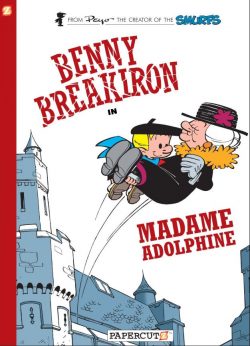
Franquin was born in Etterbeek, Belgium on January 3rd 1924. Drawing from an early age, the lad only began formal art training at École Saint-Luc in 1943. When the war forced the school’s closure a year later, he found work at Compagnie Belge d’Animation in Brussels where he met Maurice de Bévère (AKA Lucky Luke creator “Morris”), Pierre Culliford (Peyo, creator of The Smurfs and Benny Breakiron) and Eddy Paape (Valhardi, Luc Orient).

In 1945 all but Peyo signed on with Dupuis, and Franquin began his career as a jobbing cartoonist/illustrator, producing covers for Le Moustique and scouting magazine Plein Jeu. During those early days, Franquin and Morris were being tutored by Jijé, who was the main illustrator at Spirou. He turned the youngsters and fellow neophyte Willy Maltaite (AKA “Will” – Tif et Tondu, Isabelle, Le jardin des désirs) into a smoothly functioning creative bullpen known as La bande des quatre or “Gang of Four”. They later reshaped and revolutionised Belgian comics with their prolific and engaging “Marcinelle school” style of graphic storytelling…

Jijé handed Franquin all responsibilities for the flagship strip part-way through Spirou et la maison préfabriquée (Spirou #427, June 20th 1946). He ran with it for the next two decades; enlarging the scope and horizons of the feature until it became purely his own. Almost every week fans would meet startling new characters such as comrade/rival Fantasio or crackpot inventor and Merlin of mushroom mechanics the Count of Champignac.

Spirou &Fantasio became globe-trotting journalists, travelling to exotic places, uncovering crimes, exploring the fantastic and clashing with a coterie of exotic arch-enemies. However, throughout all that time Fantasio was still a full-fledged reporter for Le Journal de Spirou and had to pop into the office all the time.

Sadly, lurking there was an accident-prone, big-headed junior in charge of minor jobs and dogs-bodying. His name was Gaston Lagaffe…

There’s a long history of fictitiously personalising the mysterious creatives and all those arcane processes they indulge in to make our favourite comics, whether its Stan Lee’s Marvel Bullpen or DC Thomson’s lugubrious Editor and underlings at the Beano and Dandy. Let me assure you that it’s a truly international practise and the occasional asides on text pages featuring well-meaning foul-up/office gofer Gaston – who debuted in #985, February 28th 1957 – grew to be one of the most popular and perennial components of the comic.

I’d argue, however, that current iteration Gomer Goof (his name is taken from an earlier, abortive attempt to introduce the character to American audiences) is an unnecessary step. The quintessentially Franco-Belgian tone and humour doesn’t translate particularly well (la gaffe translates as “the blunder”) and contributes nothing here. When the big idiot surprisingly appeared in a 1970s Thunderbirds annual as part of an earlier syndication attempt, he was rechristened Cranky Franky. Perhaps they should have kept the original title…

In terms of entertainment schtick and delivery, older readers will certainly recognise beats of Jacques Tati and timeless elements of well-meaning self-delusion British readers will recognise from Some Mothers Do Have ‘Em or Mr Bean. It’s slapstick, paralysing puns, pomposity lampooned and no good deed going noticed, rewarded or unpunished…

This second album-sized paperback compilation (available also in digital formats) consists of half-page shorts, longer cartoon strips and comedic text story “reports” from the comic’s editorial page as well as ultimately full episodes of madcap buffoonery.

As previously stated, Gomer is employed (let’s not dignify or mis-categorise what he does as “work”) at the Spirou offices, reporting to go-getting hero journalist Fantasio and generally ignoring the minor design jobs like paste-up and reading readers’ letters (the official reason why fans requests and suggestions are never answered…) he’s paid to handle.

He’s lazy, opinionated, forgetful and eternally hungry and his most manic moments stem from cutting corners or stashing and illicitly consuming contraband food in the office…

These characteristics frequently lead to clashes with police officer Longsnoot and fireman Captain Morwater, but the office oaf remains eternally easy-going and incorrigible. Only two questions are really important here: why does Fantasio keep giving him one last chance, and what can gentle, lovelorn Miss Jeanne possible see in the interfering, self-opinionated idiot?

Originally released in 1968 as sixth volume Gaston – Des gaffes et des dégâts, the translated chaos (available in paperback and digital formats) commences with a quartet of short, sharp two-tier episodes involving Gomer’s office innovations and war of nerves with Longsnoot, before the first illustrated text “report” from the comic’s editorial page details a catastrophe in glass in ‘Whistle While You Work’.

A second, entitled ‘Letter from the Countryside’ shares space with a calamitous seaside excursion and selection of rural escapades turned camping Armageddon…

Prose missive ‘Gomer Writes Us’ (on the joys of go-karting) leads to a ‘Conversation on a Street Corner’ and details on a new kind of music in ‘Honky-honk copper’, after which computer-assisted design is proved to be one more thing Gomer must never attempt in ‘Chorus and Bridge’…

The remainder of the volume is all picture strip pandemonium as the imbecile’s attempts at rooftop cookery lead to aviation disasters, projectile peril, standoffs on staircases and a unique form of petty theft…

Rallying and racing capture his mayfly attention-span, but a hunt for a new vehicle never succeeds and Gomer always returns to his appallingly decrepit and dilapidated Fiat 509 auto(barely)mobile, but the fool is set in his ways and even doctors can’t fix or remove him…

However, somebody rational really should have foreseen what the slacker was capable of when he brought in a chemistry set…

Far better enjoyed than précised or described, these strips allowed Franquin and fellow scenarists Yvan Delporte and Jidéhem (in reality, Jean De Mesmaeker: his analogue is a regular in the strips as an explosively irate and unfortunate foil for the Goof) to flex their whimsical muscles and even subversively sneak in some satirical support for their beliefs in pacifism and environmentalism, but at their core the gags remain supreme examples of all-ages comedy: wholesome, barbed, daft and incrementally funnier with every re-reading.

What’s stopping you from Goofing off?
© Dupuis, Dargaud-Lombard s.a. 2017 by Franquin. All rights reserved. English translation © 2017 Cinebook Ltd.

Marie Curie – The Radium Fairy


By Chantal Montellier & Renaud Huynh translated by Lara Vergnaud (Europe Comics)
No ISBN: digital-only publication

I’ve waited ages (well, since March 2017, but I’m old and my days are limited) for this superb book to be picked up by a print publisher, but now I’m just going to review it anyway and assume that as you’re reading this on a computer, you can make the leap to seeing comics that way too. And yes, I know all about the smell and feel of proper books. I feel that way too, but we’re killing more trees than we really need to, guys. Just think of it as portable fun you can’t fold, or tear…

Originally released across Europe in 2011, Marie Curie La Fée du Radium was produced in collaboration with the Curie Museum and the Cité des sciences et del ‘industrie (part of Universcience), with educator, illustrator and bande dessinée creator Chantal Montellier (Odile et les crocodiles, Les Damnés de Nantes) summarising and dramatizing in graphic narrative a most astounding life, after which research scientist, educator and museum curator Renaud Huynh (La fantastique histoire du radium) provides an extensive and copious Timeline, tracing the triumphs, tribulations and legacy of Marie Sklodowska-Curie (1867-1934): thus far, the only woman to ever be awarded two Nobel Prizes.

The crucial comics component kicks off in Stockholm on September 4th as aging Marie Curie works on a speech; preparing to receive that second cherished accolade…

Thinking back, she pictures her departed husband Pierre Curie. Their joint isolation of the element they named Polonium after her place of birth was a grand achievement but doesn’t make up for her years of struggle for acceptance or his tragic accidental death so early in their marriage…

And so, briefly, concisely and without fanfare unfolds a true epic of brilliance applied, adversity overcome and persistence rewarded. Today Curie is credited with adding two elements to the Periodic Table – Radium was the other one – and venerated for her researches. She was also the first woman allowed to teach at the prestigious Sorbonne, but for much of her life had to overcome entrenched patriarchal attitudes and oppression whilst being vilified in the media and by wider society for her “scandalous” personal life and generally just for being an uppity female who didn’t know her place. Isn’t it great how much everything has changed since then? (I am of course waiting for my own Nobel for the isolation of Sarcastium™…).

This small but powerful digital only tome concludes with a large and detailed Timeline. Huynh’s pictorial essay is packed with photographic illustrations, cartoons and clippings; encapsulating and clarifying Curie’s life and achievements and précised in chapters entitled ‘1867/1895 Warsaw-Paris’, ‘1896/1905 A Scientific Dream’, ‘1906/1911 Hardships and Success’, ‘1912/1921 The Radium Institute’ and ‘1922/1934 An International Figure’, and closes with an ‘Epilogue’ revealing how sixty years after her death, Marie Curie’s ashes were transferred to the Pantheon (resting place of the nation’s greatest citizens). She was the first woman to be accorded this honour based solely on her own merits…

Making learning fun, Marie Curie – The Radium Fairy is a potent and powerful inspiration, venerating one of histories most dedicated scientists, and one every youngster should read.
© 2016 – DUPUIS – Chantal Montellier & Renaud Huynh. All rights reserved.