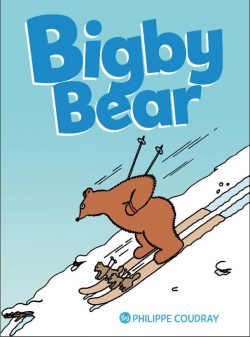
Bigby Bear Book One


By Philippe Coudray, translated by Miceal Ogriefa (BiG/Humanoids)
ISBN: 978-1-59465-806-8(HB)

Bordeaux-born in March 1960, writer, photographer and illustrator Philippe Coudray specialises in cartoons and books for children. Working with his brother Jean-Luc, he co-crafted the Drôles sequence of books and comics series Théocrite.

Howevwr, Philippe conceived and executed his signature creation L’Ours Barnabé – the philosophically absurdist ruminations of an artistic bear and his woodland companions all on his own…

When not crafting kids’ comics or surreal otherworldly gags (such as Loin de Tout) Philippe writes articles and such like for magazines such as Capsule Cosmique, Psikopat, Perlin and Fripounet as well as books such as Guide to Hidden Animals: Treatise on Cryptozoology. His works have been used by the government to combat illiteracy in France and translated into many languages; none more so than L’Ours Barnabé which has appeared in Japan, China, Germany Sweden, and twice in America. The first time was as Benjamin Bear (twice nominated for Eisner Awards and winning China’s 2012-2013 Panda Prize) and latterly here as the beguiling and frequently beguiled Bigby…

As much children’s storybook – although having no narrative structure and relying on episodic vignettes to deliver charming and visually challenging puzzles and riddles – as graphic novel, these collected strips feature an affably gentle bruin living wild and honing his artistic skills in a bucolic forest and mountain idyll, observing the world and pondering big questions in a surreal and often absurdist daze.

Visual tricks and double-takes abound as he and his rabbit chum encounter other animals and aliens, ignore the laws of the universe, carve, sculpt, paint, compose, garden and wander for the sheer joy of creativity. Subtly posing questions to make youngsters think – about art, science, psychology, mathematics, ecology and much more – Coudray never misses an opportunity to share a solid laugh with his readers and reinforce his message that life would be great if we all just mellowed out and got along with each other.

He’s also more than happy to pepper the strips with the occasional telling moment of social commentary if the chance arises…

Genteel fun, bemusing whimsy and enchanting illustration cloaking a supremely inclusive philosophy of curiosity, enquiry and cohabitation, Bigby Bear is a delightful example of how to enjoy life and crucial reading for young and old alike. Get the digital edition immediately before backing it up with the wonderfully tactile, sturdy hardback your kids will want to paw and peer at over and over again…
© 2012-2018 La Boîte à Bulles and Philippe Coudray. All rights reserved.

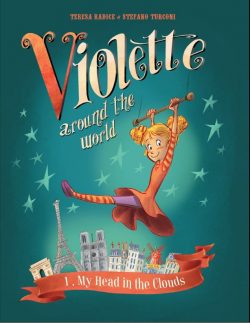
Violette around the world volume 1: My Head in the Clouds

By Teresa Radice & Stefano Turconi, translated by Terrence Chamberlain (EuroComics/IDW) ISBN: 978-1-68405-188-5 (HB Album) eISBN: 978-1-68406-411-3

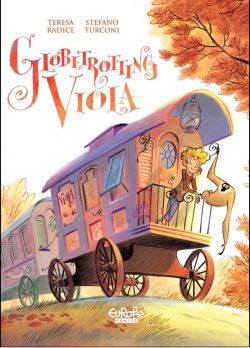
Globetrotting Viola volume 1: Treasure Everywhere!
By Teresa Radice & Stefano Turconi, translated by Terrence Chamberlain (Europe Comics – Digital Only) No ISBN

There’s never been a more fruitful time for comics and graphic novels than today but the digital revolution has thrown up a few confusing moments for dithery old guard reviewers like me. Here’s a perfect case in point.

Europe comics is a collective syndicate of continental publishers from numerous countries collaboratively releasing the best of European material in translated digital formats. They also act as agents, so many of their digital releases eventually end up as physical books for English-language publishers like NBM, IDW and Cinebook.

Quite rightly, these publishers also have their own digital editions, and naturally these feature small variations and deviations in the final product. All in all, however, it’s no big deal. There is no “correct” edition and the art and story reman fundamentally the same. You pays yer money and takes yer choice…

In this instance I bought and reviewed both, so could you, if you so pleased…

Scripted by Teresa Radice and painted by Stefano Turconi – a prolific Italian husband-&- wife team who have co-created many books for varying ages of kids, such as Mickey and the Great Sea of Sand, The Forbidden Harbour and the Orlando Curioso series – this award-winning historical romp from 2013 follows the life of a young circus girl in very memorable times…

Alternatively dubbed Violette or Viola Vermeer, our young star – daughter of a cannonball woman and an insect trainer – is a fourth-generation performer of the Cirque de la Lune, currently chafing under the strictures of having to attend a draconian school for ladies in fin de siècle Paris.

She would far rather be travelling the land with her friends and family, and her scholastic inattention – and love of animals – keeps landing her in hot water with the stuffy schoolmarms of the posh institution she’s trapped in…

Her life takes an interesting and life-changing turn after meeting an itinerant painter named Henri. She ends up trailing him all over the metropolis, trying to return a lost sketchbook to the absent-minded dauber. The quest takes her all over the City of Lights and into places I am not going far more educational than her usual classroom: even to the resplendently scandalous Moulin Rouge, resulting in her downtrodden attitude being replaced by a new zest for living and a brand-new sense of adventure and purpose…

A breezy, light-hearted coming of age tale about diversity and acceptance set in a glamourous historical wonderland, this superb yarn also includes loads of captivating extra art by Turconi and a potted biography of Henri de Toulouse-Lautrec to aide amusement and elucidation…
Globetrotting Viola: Treasure Everywhere! © 2016 TUNUÉ (Tunué s.r.l.) – Teresa Radice & Stefano Turconi
Violette around the world: My Head in the Clouds text and illustrations © 2013 Teresa Radice & Stefano Turconi – Tunué. All rights reserved.

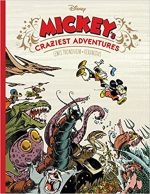
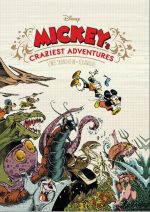
Mickey’s Craziest Adventures


By Lewis Trondheim & Keramidas, with Brigitte Findakly: translated by Ivanka Hahnenberger & David Gerstein (IDW)
ISBN: 978-1-63140-694-2 (HB) eISBN 978-1-68406-124-2

In his ninety years of existence, Walt Disney’s heroic everyman Mickey Mouse has tackled his fair share of weirdos and super freaks in tales crafted by creators from every corner of the world. A true global phenomenon, the little wonder has staunchly overcome all odds, and he’s always done so as the prototypical nice guy beloved by all. Mickey might have been born in the USA, but he belongs to all humanity now and thus some of his very best comics adventures come from countries like Denmark, Holland, Italy and France. This translation of a saga by Lewis Trondheim & Keramidas ranks right up at the top of the list…

With over 100 books bearing his pen-name (his secret identity is actually Laurent Chabosy), writer/artist/editor/animator and educator Lewis Trondheim is one of Europe’s most prolific comics creators: illustrating his own work, overseeing cartoons adaptations of previous successes such as La Mouche (The Fly) and Kaput and Zösky or editing the younger-readers book series Shampooing for Dargaud.

His most famous tales are such global hits as Les Formidables Aventures de Lapinot (seen in English as The Spiffy Adventures of McConey), the Donjon series of nested fantasy epics (co created with Joann Sfar and translated as conjoined sagas Dungeon: Parade, Dungeon: Monstres and Dungeon: the Early Years), comedy fable Ralph Azham and an utterly beguiling cartoon diaries sequence entitled Little Nothings.

In his spare time – and when not girdling the globe from convention to symposium to festival – the dourly shy and neurotically introspective savant wrote for satirical magazine Psikopat and provided scripts for many of the continent’s most popular artists such as Fabrice Parme (Le Roi Catastrophe, Vénézia), Manu Larcenet (Les Cosmonautes du futur), José Parrondo (Allez Raconte and Papa Raconte) and Thierry Robin (Petit Père Noël).

Ostensibly retired but still going strong, Trondheim is a cartoonist of uncanny wit, outrageous imagination, piercing perspicacity, comforting affability and self-deprecating empathy who prefers to scrupulously control what is known and said about him…

Nicolas Kerimidas (Donjon Monstres, L’Atelier Mastodonte, Donald’s Happiest Adventures) is a French cartoonist hailing from Grenoble who studied animation at the Gobelins School. He worked at Walt Disney Animation France’s Montreuil Studious for almost a decade before switching to comics as illustrator of Didier Crisse’s Luuna. He branched out and carried on, scripting his own stuff as well as being a much sought-after artist for others…

Patterned on Gold Key’s fabulous 1950-1960s run of anthological Walt Disney’s Comics and Stories, Mickey’s Craziest Adventures purports to be a restored – but tragically incomplete – compilation of a lost serial that ran in those vintage comics, “rediscovered” by the author and artist. The overwhelmingly successful conceit of this little gem – available in hardback and digital formats – is that we all love comics and can’t resist the mystery of an unread one we’ve never heard of…

After opening with essay ‘A Forgotten Treasure’ the yarn jerks into high gear once the “found” pages appear, starting with ‘Chapter 2’ as Mickey gives Donald Duck a lift to Uncle Scrooge‘s Money Bin. On arrival, they witness the entire kaboodle swiped via Gyro Gearloose‘s shrinking ray before being perilously diminished themselves!

Hot pursuit takes our heroes into a primeval world of (comparatively) giant insects and backyard jungles, but the game is afoot and even stranger hazards await them as they pursue the mystery bandits…

With cameos from most of Duckburg and Mouseton’s pantheon of major and minor stars and veteran villains such as Pegleg Pete and the Beagle Boys, this pell-mell romp across the world also encompasses monsters, cavemen, outer space perils and even the gods themselves, to create an unmissable delight for both aged aficionados like you and me and the newest generation of fans.

Frantic, frenzied fun for one and all. You know you have to have it!
© 2016 Disney Enterprises, Inc. All rights reserved.

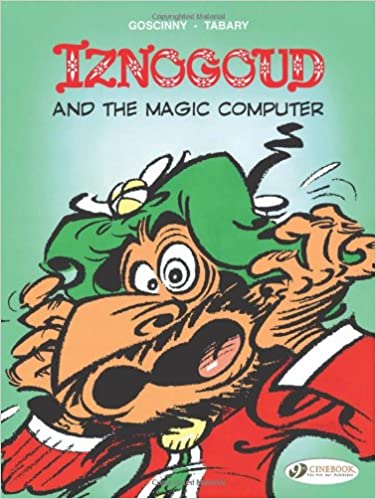
Iznogoud and the Magic Computer (volume 4)


By Goscinny & Tabary translated by Anthea Bell & Derek Hockridge (Cinebook)
ISBN: 978-1-905460-79-3 (PB Album)

How are you coping with voluntary incarceration? If you’re feeling a little frustrated, why not chill out with a good book – instantly available via digital purchasing and still accessible if you go the physical delivery route as a spiffy paperback tome – and see what real frustration looks like and costs…

During his too-short lifetime (1926-1977) René Goscinny was one of the most prolific, most read writers of comic strips the world has ever seen.

He still is.

Among his most popular comic collaborations are Lucky Luke, Le Petit Nicolas and, of course, Asterix the Gaul. There are so many others, too such as this timeless classic…

Scant years after the Suez crisis, the French returned to the deserts when Goscinny teamed with sublimely gifted Swede Jean Tabary (1930-2011) who numbered Richard et Charlie, Grabadu et Gabaliouchtou, Totoche, Corinne et Jeannot and Valentin le Vagabond amongst his other hit strips.

Together they produced imbecilic Arabian (im)potentate Haroun el-Poussah. However, it was the strip’s villainous foil, power-hungry vizier Iznogoud who stole the show – possibly the conniving little weasel’s only successful scheme.

Les Aventures du Calife Haroun el Poussah was created for Record, with the first instalment appearing in 1962 in the January 15th issue. A minor hit, it latterly jumped ship to Pilote – a magazine created and edited by Goscinny – where it was refashioned into a starring vehicle for the devious little rat-bag who had increasingly hogged all the laughs and limelight.

Like all great storytelling, Iznogoud works on two levels: for younger readers as a comedic romp with sneaky baddies coming a cropper, and as a pun-filled, witty satire for older, wiser heads, much like its more famous cousin Asterix. Happily, it’s also translated here by master translators Anthea Bell & Derek Hockridge who made the indomitable little Gaul so very palatable to the English tongue. Best of all, the deliciously malicious whimsy is always heavily-laden with manic absurdity and brilliantly applied creative anachronism to keep the plots bizarrely fresh and inventive.

Our insidious anti-hero is Grand Vizier to affable, generous, easy-going Haroun Al Plassid, Caliph of Ancient Baghdad, but the sneaky little toad has loftier ambitions, or as he is always shouting “I want to be Caliph instead of the Caliph!”…

The revamped series launched in Pilote in 1968, quickly becoming a huge European hit, with 29 albums so far (with 14 translated into English to date). The series has been carried on by Tabary’s children Stéphane, Muriel and Nicolas, in his own solo comic, and has spun-off into a game, TV cartoon show and live action movie.

Goscinny died in 1977, having completed a dozen book’s worth of wonderment and Tabary assumed the scripting as well as the superbly stylish illustration, moving to book-length complete tales, rather than the compilations of short punchy stories that typified their collaborations.

This fourth Cinebook album was the sixth French album (released in 1970 as L’ordinateur magique) and features a clenched and grasping fistful of short, sharp salutary tales beginning – after a handy catch-up profile page – with ‘A Calculated Risk’, wherein the cunning conniver, desperate to forestall a pact between the Caliph and mighty military neighbour Sultan Pullmankar, hires forward-thinking I-Bee’Em and his ponderous problem-solving “computer” to stop the signing of the treaty. The big grey box might be brilliant, but it’s agonisingly slow in reaching its infallible conclusions…

Things then get hilariously surreal after Iznogoud and his long-suffering, bumbling assistant Wa’at Alahf discover a mystic crossroads that can lead unwary travellers onto an unending, pointless journey from which they can neither escape nor return. Dashing back to Baghdad to lure the Caliph onto ‘The Road to Nowhere’, our wicked wayfarers eventually realise that they’ve been stuck on it all along…

Eventually reality resumes and back home and itching to take over, the Vile Vizier then seeks to employ the tragic gifts of lonely hermit Ghoudas Gho’ld: a direct descendent of legendary King Midas in ‘The Golden Handshake’. All Iznogoud has to do to remove the Caliph is get the accursed involuntary metal-maker back to the palace without him touching anything. Easy, no? No…

There’s more tacit skulduggery afoot in ‘The Caliph’s Sceptre’ when Iznogoud hires a master thief to sneak him into the high-security vault where the Staff of Office is cached. If he can prevent the Caliph from presenting it to the people in the annual reaffirmation of worthiness to rule ceremony, the Vizier can legally assume control of the country. Of course, it doesn’t quite play out that way…

This fine kettle of funny fish concludes with ‘The Mysterious Ointment’ as fabled explorer Notsobad the Sailor returns to the port of Basrah. Having forgotten to bring the undetectable Occidental poisons he promised the Vizier, the wily voyager palms him off with a tube of “Schpouk toothpaste’.

Assured the container holds a lethal and undetectable toxin, Iznogoud embarks on an eccentrically convoluted campaign to convince the Caliph and the court that cleaning one’s choppers is the latest and most beneficial of scientific advancements. Care to guess how well that goes?

Snappy, fast-paced hi-jinks and gloriously agonising pun-ishing badinage abound in this mirthfully infectious series which is a household name in France where “Iznogoud” is common parlance for a certain type of politician: over-ambitious, unscrupulous – and often of diminutive stature.

When first released here in the 1970s, these tales made little impression, but hopefully have finally found an appreciative audience among today’s more internationally aware, politically jaded comics-and-cartoon savvy Kids Of All Ages…
© 1970 Dargaud Editeur Paris by Goscinny & Tabary. All rights reserved.

A Matter of Time


By Juan Gimenez (Catalan Communications)
ISBN: 978-0-87416-012-3 (Album PB), Del Rey edition (2005): 978-0-34548-314-0 (PB)

The pandemic is hitting hard and hitting everywhere now. Here’s a rather rushed response to news that a global giant has been taken from us. I’ll have more in the days to come: reviews of his more recent triumphs and books you can get in digital formats, unlike this lost classic that – as always – is long overdue for a new edition…

Juan Antonio Giménez López was born in Mendoza, Argentina in 1943 and after studying industrial design, attended the Academy of Fine Arts in Barcelona. Hugely influenced by Hugo Pratt and Francisco Solano López, Giménez broke into the comics field with stories for Argentine magazines Record and Colomba before beginning a long association with European comics in such publications as Spain’s Zona 84, Comix International and 1994; France’s Metal Hurlant and Italy’s Lanciostory, L’Eternauta and Skorpio. He ultimately attained critical acclaim and gaining global fame with his scintillant Metabarons series produced in collaboration with Alejandro Jodorowsky.

Giménez’s preferred metier was adult-oriented tales of science fiction and/or combat. He was an accredited expert on all things avionic or to do with air combat. Back in 1985, Catalan Communications collected into one gloriously baroque and stunningly beautiful fantasy anthology a selection of time-travel related short stories – many of which had appeared in American Heavy Metal – usually known as The Time Paradox Tales. Dark, sardonic and incorporating sublimely lyrical overtones of classic 2000AD Future Shocks or Twisted Times, these are a feast of irresistible “sting-in-the-tale” stories…

Following an expansive and lavishly illustrated critique from Carlos Gimenez (no relation), the elegantly lush procession of exotic, eccentric 8-page excitements begins with ‘DIY’, wherein a father and son meddle with the wrong home-computer program and dear old dad ends up a terrified touchline visitor at some of the most dangerous moments of all time and space…

Following on, ‘Tridisex’ details the horrific fate of a couple of salacious chronal researchers who land in the right place at the right time but at the wrong size, after which ‘Express’ sees a dedicated time-assassin dispatched into the past to unwittingly murder himself before ‘Entropy’ details a tragic timeslip which causes the greatest combat aircraft of two eras to experience the closest of encounters…

‘8½’ then explores the secret advantage of the fastest gunslinger of the Wild West and recounts the fate of a time-tourist who rooted for him whilst a tragic synchronicity-loop and incomprehensible paradox at last explains the great leap forward of an ancient civilisation in ‘Chronology’…

‘Residue’ takes the exercise in futility that is war to its inescapable conclusion in a lustrous four-page paean to technological advantage, bringing this magnificent artistic treat to a close on the darkest of downbeats…

Gritty, witty and ever so pretty, A Matter of Time is pure speculative gold: old-fashioned, cutting-edge fantasy fun and electrically-charged entertainment with a satirical edge and its tongue firmly in its cheek. Perfume for the eyes so breathe deeply and jump aboard.

In later years, the Master’s fantasy forays grew ever more ambitious. Whilst working with fellow Argentinian émigré Ricardo Barreiro on As de Pique and The City, he collaborated with industry giants such as Carlos Trillo, Emilio Balcarce and Roberto Dal Prà.
A gifted writer, he generated many of his own classic yarns. However, in 1992, after completing his own space opera epic The Fourth Power, he began an astounding 8-volume run on his visual magnum opus – illustrating Jodorowsky’s The Metabarons: expanding the universe built by Moebius and reshaping the nature and scope of graphic sci fi forever.
Juan Giménez died on April 2nd 2020 at his home in Mendoza, from complications of COVID-19.
© 1982-1985 Juan Gimenez. English translation © 1985 Catalan Communications. All rights reserved.

Spirou and Fantasio volume 3 and 4: Running Scared and Valley of the Exiles


By Tome & Janry, colored by Stephane de Becker & translated by Jerome Saincantin (Cinebook)
ISBN: 978-1-84918-116-7 (Running Album PB), 978-1-84918-157-0 (Exiles Album PB)

For most English-speaking comic fans and collectors, Spirou is probably Europe’s biggest secret. The character is a rough contemporary – and calculated commercial response – to Hergé’s iconic Tintin, whilst the comic he has headlined for decades is only beaten in sheer longevity and manic creativity by our own Beano and America’s Detective Comics.

Conceived at Belgian Printing House by Jean Dupuis in 1936, this anthological magazine targeting a juvenile audience debuted on April 21st 1938; neatly bracketed by DC Thomson’s The Dandy which launched on 4th December 1937 and The Beano on July 30th 1938. It was edited by Charles Dupuis (a mere tadpole, only 19 years old, himself) and took its name from the lead feature, which recounted improbable adventures of a plucky Bellboy/lift operator employed by the Moustique Hotel (a sly reference to the publisher’s premier periodical Le Moustique).

Joined on June 8th 1939 by pet squirrel, Spip (the longest running character in the strip after Spirou himself), the series was visually realised by French artist Robert Velter (who signed himself Rob-Vel). A Dutch language edition – Robbedoes debuted a few weeks later, running more-or-less in tandem with the French parent comic until cancellation in 2005.

The bulk of the periodical was taken up with cheap American imports – such as Fred Harman’s Red Ryder, William Ritt & Clarence Gray’s Brick Bradford and Siegel & Shuster’s landmark Superman – although home-grown product crept in too. Most prominent were Tif et Tondu by Fernand Dineur (which ran until the1990s) and L’Epervier Blue by Sirius (Max Mayeu), latterly accompanied by work from comic-strip wunderkind Joseph Gillain – “Jijé”.

Legendarily, during World War II Jijé drew the entire comic by himself, including home grown versions of banned US imports, simultaneously assuming production of the Spirou strip where he created current co-star and partner Fantasio).

Except for a brief period when the Nazis closed the comic down (September 1943 to October 1944) Le Journal de Spirouand its boyish star – now a globe-trotting journalist – have continued their weekly exploits in unbroken four-colour glory. Among other myriad major features that began within those hallowed pages are Jean Valhardi (by Jean Doisy & Jije), Blondin et Cirage (Victor Hubinon), Buck Danny, ‘Jerry Spring, Les Schtroumpfs (The Smurfs to you and me), Gaston Lagaffe/Gomer Goof and a certain laconic cowboy named Lucky Luke.

Spirou the character (whose name translates as both “squirrel” and “mischievous”) has starred in the magazine for most of its life, evolving under a series of creators into an urbane yet raucous fantasy/adventure hero with the accent heavily on light humour. With comrade and rival Fantasio and crackpot inventor the Count of Champignac, Spirou voyages to exotic locales, uncovering crimes, revealing the fantastic and garnering a coterie of exotic arch-enemies.

During WWII when Velter went off to fight, his wife Blanche Dumoulin took over the strip using the name Davine, assisted by Luc Lafnet. Publisher Dupuis assumed control of and rights to the strip in 1943, assigning it to Jijé who then handed it to his assistant André Franquin in 1946. It was the start of a golden age.

Among Franquin’s innovations were the villains Zorglub and Zantafio, Champignac and one of the first strong female characters in European comics, rival journalist Seccotine (renamed Cellophine for Cinebook’s English translations), but his greatest creation – one he retained on his own departure in 1969 – was incredible magic animal Marsupilami. The miracle beast was first seen in Spirou et les héritiers (1952), and is now a star of screen, plush toy store, console… and albums too.

From 1959, writer Greg and background artist Jidéhem assisted Franquin, but by 1969 the artist had reached his Spiroulimit and resigned, taking his mystic yellow monkey with him. He was succeeded by Jean-Claude Fournier who updated the feature over the course of 9 rousing yarns tapping into the rebellious, relevant zeitgeist of the times, telling tales of environmental concern, nuclear energy, drug cartels and repressive regimes.

By the 1980s, the series seemed to stall: three different creative teams alternated on the serial: Raoul Cauvin & Nic Broca, Yves Chaland and the author of the adventure under review here: Philippe Vandevelde writing as Tome and artist Jean-Richard Geurts AKA Janry. These last adapted and referenced the still-beloved Franquin era and revived the feature’s fortunes, producing 14 wonderful albums between 1984-1998. Since their departure, Lewis Trondheim and the teams of Jean-Davide Morvan & Jose-Luis Munuera and Fabien Vehlmann & Yoann have brought the official album count to 55 (there also dozens of specials, spin-offs series and one-shots, official and otherwise)…

Running Scared is from 1988: originally entitled La frousse aux trousses or ‘Fear on the Trail’. It was their eighth and the 40th collection of the evergreen adventurers. Harking back to the Fournier years, it comprises the first of an excellent extended 2-part thriller which concluded in Valley of the Exiles (originally released as La vallée des bannis AKA ‘Valley of the Banished’ in 1989).

Running Scared opens with a frantic and mesmeric chase scene as our eponymous young star races across the city in splendid breakneck tribute to the silent movie chases of Harold Lloyd and Buster Keaton. He’s late for a conference where he will recount his many harrowing, career-related escapes and show films of his numerous close shaves…

Barely making it, Spirou is disappointed by the reaction of the audience: those that don’t faint dead away from fear, flee the theatre in horror…

It’s a huge disappointment: the daring reporter was hoping to use the profits from the lecture tour to fund an upcoming expedition to discover the fate of two explorers who vanished in 1938. They were attempting to climb a mountain and discover the legendary “Valley of Exiles” in the mysterious Himalayan nation of Yurmaheesun-shan…

Since 1950, the tiny country has been subject to numerous invasions by rival super-powers and is a hotbed of rebellion, insurgency and civil war. Nevertheless, ever-undaunted Spirou and Fantasio are utterly determined to solve the ancient mystery.

Happily, their plans are only temporarily derailed. One of the fainters at the conference is timid but esteemed Dr. Placebo: renowned authority on the medical condition Spasmodia Maligna and a man convinced that the only cure for the condition – prolonged, sustained and life-threatening synchronous diaphragmatic flutters (hiccups to you and me) – is to be scared out of one’s wits.

Having seen Spirou in action, Placebo wants the reporters to take his most chronic patients with them on the assignment and offers to fund the entire expedition to the war-torn hell-hole…

Over Fantasio’s cynical but sensible objections, a deal is struck and soon the lads, Spip and five disparate, desperate hiccupping victims are sneaking across the Nepalese border where diligent Captain Yi is tasked with keeping all foreigners – and especially western journalists – out of the country as it undergoes its pacification and re-education…

However, thanks to native translator Gorpah (a wily veteran guide who once proved invaluable to another red-headed reporter, as well as his little white dog and foul mouthed-sea captain pal) the daring band are soon deep in-country, but the occupying invasion forces are quickly hot on their trail in tanks, armoured cars and attack helicopters: providing plenty of opportunities for the annoyingly obnoxious singulitus flutterers to be terrified – but with little evidence of a cure…

And then, just as they find their first real clue as to the location of the lost Valley of Exiles, the explorers are captured by native partisans and rebels. Even this doesn’t scare off any hiccups, nor does the daring later escape attempt masterminded by Spirou and Fantasio.

As the liberated captives pile into a lorry, a huge storm breaks and the rebels give chase, but when one of their pursuer’s vehicles plunges over a cliff, the valiant fugitives frantically form a human chain to rescue the driver and in the horrendous conditions Spirou is washed away and lost in the raging torrent.

…And that’s when all the hiccupping finally stops…

To Be Continued…

Starting in superb slapstick comedy mode and with gallons of gags throughout, Running Scared quickly evolves into a dark-edged, cunningly shaded satirical critique of then current geo-political scandals like the Soviet invasion of Afghanistan and systematic eradication of Tibetan culture by the Chinese – which both of course still resonate in today’s world – as it unfolds an epic and utterly compelling rollercoaster of fun and thrills.

Valley of the Exiles! concludes the excellent exotic escapade with the roving reporters retracing the steps and uncovering the whereabouts of explorers who vanished climbing a mountain before discovering a legendary lost valley in the inscrutable, isolated Himalayan nation of Yurmaheesun-shan…

The story resumes with the battered, weary duo entombed deep within a Himalayan mountain. Slowly, blindly, they grope their way towards a faint light, emerging through an ancient, barbaric idol’s head into the very place they’ve been seeking…

Utterly enclosed by peaks, the Valley is an idyllic paradise but its very isolation has led to the development of a number of truly unique species of flora and fauna. There are colossal carnivorous waterlily pads, ferociously determined man-eating turtles, electric geckoes, the seductive Hammock Flytrap and many more bizarre and potentially lethal creatures.

The one that most imperils the lost boys is the diminutive Manic Midgie: a mosquito-like bug carrying the disease “raging hostiliasis”. Not long after one bites Fantasio, poor Spirou realises his best friend has become a homicidal maniac determined to kill him and everything else in range…

The deranged lad goes completely off the deep end, and only luck and a handy itching-powder boxing glove plant prevents our favourite reporter’s gory demise. Wounded, hunted by his best friend and perhaps the only human in the apparently inescapable enclosed wilderness, near-despondent Spirou – and Spip – begin exploring their incredible prison and find a rough shack, proving that at some time other humans have been there.

Further investigation reveals it to be the last resting place of the lost explorers Siegfried and Maginot. The mystery of the 1938 expedition is solved – even though Spirou has no way of filing this scoop!

More worryingly, Maginot’s copious notes on the creatures of the valley offer some grim hypotheses as to the nature of the nature in this fantastic hidden gorge: creatures inimical to both body and mind of man. Plants that cast illusions, murderous mammals mimicking harmless life, bugs whose bite produces madness…

Crazed beyond imagining – and burbling hilarious, fourth-wall breaking nonsense – Fantasio is determinedly hunting his old friend. The frantic chase drives our limping hero deep into a hidden temple where he uncovers the remnants of fantastic lost civilisation Backik: a race banished by Mongol conquerors to this distant valley. These reluctant settlers lived just long enough for the manic-midgies to bring their unlucky lives crashing down into doom and disaster…

As Spirou lurches through the eerie tombs of the fallen Backiks, Fantasio ambushes him and prepares to finish off his former friend when a mysterious figure attacks…

A little later, Spirou awakens in the warming sunlight of the valley, with deranged Fantasio securely bound beside him. Resolved to escape this fantastic trap and get his crazy pal back to civilisation and medical assistance, our red-headed hero begins to explore his best options only to feel the terrifying sting of a mosquito. Is all lost?

Of course not…

Packed with oodles of action and a host of incredible surprises and revelations, Valley of the Exiles is a truly splendid escapade, with thrills, chills, spills, a mountain of choice comedy moments and eccentric, surreal mysteries to keep readers spellbound.

This kind of engaging, lightly-barbed adventure comedy-thriller is a sheer joy in an arena far too full of adults-only carnage, sordid cheesecake titillation, testosterone-fuelled breast-beating, teen-romance monsters or sickly-sweet fantasy. Easily accessible to readers of all ages and drawn with all the beguiling style and seductive but wholesome élan which makes Asterix, Lucky Luke, The Bluecoats and Iznogoud so compelling, this is another cracking read from a long line of superb exploits, certain to be as much a household name as those series – and yes, even that other red-headed kid with the white dog…
Running Scared original edition © Dupuis, 1988 by Tome & Janry. All rights reserved. English translation 2012 © Cinebook Ltd.
Valley of the Exiles original edition © Dupuis, 1989 by Tome & Janry. All rights reserved. English translation 2013 © Cinebook Ltd.

Asterix Omnibus volume 1: Asterix the Gaul; Asterix and the Golden Sickle; Asterix and the Goths


By René Goscinny & Albert Uderzo, translated by Anthea Bell & Derek Hockridge (Orion)
ISBN: 978-0-75289-154-5(HB) 978-1-44400-423-6(TPB)

I’ve just heard the sad news about Albert Uderzo, who has just passed away after 92 amazing, gloriously productive and fun-filled years. In the current climate of horrific global crisis, it’s ultimately just one more death, no more or less important than any other, but I’m compelled to mark his end with sadness, inexpressible gratitude and this rerun of a review for his greatest work.

In a career absolutely packed with joyous invention, Uderzo brought happiness and inspiration to generations of readers across the world through Asterix and his many other creations, so I can only say “thank you” to him and urge you to revisit his works if you’re already au fait. If you have never seen his genius in action – especially in conjunction with his perfect partner René Goscinny – this collection is the ideal place to start, and you won’t be sorry…

Asterix the Gaul is probably France’s greatest literary export. The feisty, wily little warrior who fought the iniquities and viewed the myriad wonders of Julius Caesar‘s Roman Empire with brains, bravery and – whenever necessary – a magical potion imbuing the imbiber with incredible strength, speed and vitality, is the go-to reference all us non-Gallic gallants when we think of France.

The diminutive, doughty darling was created at the close of the 1950s by two of our artform’s greatest masters…

René Goscinny is arguably the most prolific and remains one of the most-read writers of comic strips the world has ever known. Born in Paris in 1926, he grew up in Argentina where his father taught mathematics. From an early age René showed artistic promise. He studied fine arts and graduated in 1942. Three years later, while working as junior illustrator at an ad agency, his uncle invited him to stay in America, where he worked as a translator.

After National Service in France, he returned to the States and settled in Brooklyn, pursuing an artistic career and becoming, in 1948, an assistant for a small studio which included Harvey Kurtzman, Will Elder, Jack Davis and John Severin, as well as European giants-in-waiting Maurice de Bévère (Morris, with whom from 1955-1977 Goscinny produced Lucky Luke) and Joseph Gillain (Jijé).

Goscinny also met Georges Troisfontaines, head of the World Press Agency, the company that provided comics for the French magazine Le Journal de Spirou.

After contributing scripts to Belles Histoires de l’Oncle Paul and Jerry Spring, Goscinny was promoted to head of World Press’ Paris office where he met his ultimate creative collaborator Albert Uderzo. In his spare time, Rene also created Sylvie and Alain et Christine with Martial Durand (Martial) and Fanfan et Polo, drawn by Dino Attanasio.

In 1955, Goscinny, Uderzo, Charlier and Jean Hébrard formed the independent syndicate Édipress/Édifrance, creating magazines for business and general industry (Clairon for the factory union and Pistolin for a chocolate factory). With Uderzo, René spawned Bill Blanchart, Pistolet and Benjamin et Benjamine, whilst illustrated his own scripts for Le Capitaine Bibobu.

Under nom-de-plume Agostini he wrote Le Petit Nicholas (drawn by Jean-Jacques Sempé), and in 1956 began an association with revolutionary periodical Le Journal de Tintin, writing for various illustrators including Attanasio(Signor Spagetti), Bob De Moor (Monsieur Tric), Maréchal (Prudence Petitpas), Berck (Strapontin), Globule le Martienand Alphonse for Tibet; as well as Modeste et Pompon for André Franquin, and – with Uderzo – the fabulously funny adventures of inimitable Indian brave Oumpah-Pah. He also wrote for the magazines Paris-Flirt and Vaillant.

In 1959, Édipress/Édifrance launched Pilote, and Goscinny went into overdrive. The first issue featured re-launched versions of Le Petit Nicolas, Jehan Pistolet/Jehan Soupolet, new serials Jacquot le Mousse and Tromblon et Bottaclou(drawn by Godard), plus a little something called Astérix le gaulois: inarguably the greatest achievement of his partnership with Uderzo.

When Georges Dargaud bought Pilote in 1960, Goscinny became Editor-in-Chief, but still found time to add new series Les Divagations de Monsieur Sait-Tout (with Martial), La Potachologie Illustrée (Cabu), Les Dingodossiers (Gotlib) and La Forêt de Chênebeau (Mic Delinx).

He also wrote frequently for television, but never stopped creating strips such Les Aventures du Calife Haroun el Poussahfor Record and illustrated by Swedish artist Jean Tabary. A minor success, it was re-tooled as Iznogoud when it transferred to Pilote. Goscinny died far too young, in November 1977.

Alberto Aleandro Uderzo was born on April 25th 1927, in Fismes, on the Marne, a child of Italian immigrants. As a boy reading Mickey Mouse in Le Pétit Parisien, he showed artistic flair from an early age. Alberto became a French citizen when he was seven and dreamed of becoming an aircraft mechanic, but at 13 he became an apprentice of the Paris Publishing Society, learning design, typography, calligraphy and photo retouching.

When WWII broke out, he spent time with farming relatives in Brittany, joining his father’s furniture-making business. Brittany beguiled Uderzo: when a location for Asterix’s idyllic village was being decided upon the region was the only choice…

In the post-war rebuilding of France, Uderzo returned to Paris to become a successful illustrator in the country’s burgeoning comics industry. His first published work – a pastiche of Aesop’s Fables – appeared in Junior and, in 1945, he was introduced to industry giant Edmond-François Calvo (whose masterpiece The Beast is Dead is long overdue for the world’s closer attention…).

Young Uderzo’s subsequent creations included indomitable eccentric Clopinard, Belloy, l’Invulnérable, Prince Rollin and Arys Buck. He illustrated Em-Ré-Vil’s novel Flamberge, worked in animation, as a journalist, as an illustrator for France Dimanche and created vertical comic strip ‘Le Crime ne Paie pas’ for France-Soir.

In 1950, he drew a few episodes of the franchised European version of Fawcett’s Captain Marvel Jr. for Bravo!

Another inveterate traveller, the young artist met Goscinny in 1951. Soon fast friends, they decided to work together at the new Paris office of Belgian Publishing giant World Press. Their first collaboration was in November of that year; a feature piece on savoir vivre (how to live right or gracious living) for women’s weekly Bonnes Soirée, after which an avalanche of splendid strips and serials poured forth.

Jehan Pistolet and Luc Junior were created for La Libre Junior and they produced a comedy Western starring a very Red (but not so American) Indian who evolved into Oumpah-Pah. In 1955, with the formation of Édifrance/Édipresse, Uderzo drew Bill Blanchart for La Libre Junior, replacing Christian Godard on Benjamin et Benjamine before, in 1957 adding Charlier’s Clairette to his bulging portfolio.

The following year, he made his Tintin debut, as Oumpah-Pah finally found a home and rapturous audience. Uderzo also illuminated Poussin et Poussif, La Famille Moutonet and La Famille Cokalane

When Pilote launched in 1959, Uderzo was the major creative force for the new magazine, limning Charlier’s Tanguy et Laverdure and a humorous historical strip about Romans…

Although Asterix was a massive hit from the start, Uderzo continued working with Charlier on Michel Tanguy, (subsequently Les Aventures de Tanguy et Laverdure), but soon after the first serial was collected in a single volume as Astérix le gaulois (in 1961), it became clear that the series would demand most of his time – especially as the incredible Goscinny never seemed to require rest or run out of ideas (after the writer’s death, the publication rate of Asterix tales dropped from two per year to one volume every three-to-five).

By 1967, Asterix occupied all Uderzo’s time and attention. In 1974 the partners formed Idéfix Studios to fully exploit their inimitable creation, and when Goscinny passed away three years later, Uderzo had to be convinced to continue the adventures as writer and artist. Happily, he gave in and produced a further ten volumes before retiring in 2009.

According to UNESCO’s Index Translationum, Uderzo is the 10th most-often translated French-language author in the world and 3rd most-translated French language comics author – right behind his old mate René and the grand master Hergé.

So what’s it all about?

Like all entertainments the premise works on two levels: as an action-packed comedic romp of sneaky and bullying baddies coming a-cropper for younger readers and as a pun-filled, sly and witty satire for older, wiser heads, transformed here by the brilliantly light touch of master translators Anthea Bell & Derek Hockridge (who played no small part in making the indomitable little Gaul so very palatable to the English tongue).

Originally published in Pilote #1-38 (29th October 1959-4th July 1960, with the first page appearing a week earlier in a promotional issue #0, distributed on June 1st 1959), the story is set on the tip of Uderzo’s beloved Brittany coast in the year 50BC.

Here a small village of redoubtable warriors and their families frustrate every effort of the immense but not so irresistible Roman Empire to complete their conquest of Gaul. Unable to defeat these Horatian hold-outs, the Empire resorts to a policy of containment leaving the little seaside hamlet hemmed in by the heavily fortified permanent garrisons of Totorum, Aquarium, Laudanum and Compendium.

The Gauls don’t care: they daily defy the world’s greatest military machine by just going about their everyday affairs, protected by a magic potion provided by the resident druid and the shrewd wits of a rather diminutive dynamo and his simplistic best friend…

In Asterix the Gaul this immaculate comedy-drama scenario is hilariously demonstrated when Centurion Crismus Bonus– fed up with his soldiers being casually beaten up by the fiercely free Frenchmen – sends reluctant spy Caligula Minus to ferret out the secret of their incredible strength.

The affable insurgents take the infiltrator in and, soon dosed up with potion, the perfidious Roman escapes with the answer – if not the formula itself…

Soon after, wise Druid Getafix is captured by the invaders and the village seems doomed, but wily Asterix is on the case. Breaking into Compendium and determined to teach the Romans a lesson, he drives them crazy for ages by resisting all efforts at bribery and coercion, until abruptly wizard and warrior seemingly capitulate and make the Romans a magic potion – but not the one the rapacious oppressors were hoping for…

Although comparatively raw and unpolished, the good-natured, adventurous humour and sheer energy of the yarn barrels along, delivering barrages of puns, oodles of insane situations and loads of low-trauma slapstick action, all marvellously rendered in Uderzo’s seductively stylish bigfoot art-style.

From the second saga on the unique and expanding cast would encroach on events, especially the unique and expanded, show-stealing sidekick Obelix – who had fallen into a vat of potion as a baby – and became a genial, permanently superhuman, eternally hungry foil to our little wise guy…

Asterix and the Golden Sickle was originally serialised in Pilote #42-74 and recounts the disastrous consequences of Getafix losing his ceremonial gold sickle just before the grand Annual Conference of Gaulish Druids. Since time is passing and no ordinary replacement will suffice to cut ingredients for magic potion, Asterix offers to go all the way to Lutetia (you can call it Paris if you want) to find another.

As Obelix has a cousin there – Metallurgix the Smith – he also volunteers for the trip and the punning pair are swiftly off, barely stopping to teach assorted bandits the errors of their pilfering ways but still finding a little time to visit many roadside inns and taverns serving traditional roast boar…

There is concurrently a crisis in Lutetia: a mysterious gang is stealing all the Golden Sickles and forcing prices up. The druid community is deeply distressed and, more worrying still, master sickle-maker Metallurgix has gone missing. Asterix and Obelix investigate the dastardly doings in their own bombastic manner and discover a nefarious plot that seems to go all the way to the office of the local Roman Prefect…

The early creative experiment was quickly crystallizing into a supremely winning format of ongoing weekly episodes slowly building into complete and readily divisible adventures. The next epic cemented the strip’s status as a popular icon of Gallic excellence.

Asterix and the Goths ran from 1962-1963 and followed the dangling plot-thread of the Druid Conference as Getafix, brand new sickle in hand, sets off for the Forest of the Carnutes to compete. However, on the Gaul’s Eastern border savage Goths – barbarians who remained unconquered by the might of the empire – crossed into pacified Roman territory. The barbarians are intent on capturing the mightiest Druid and turning his magic against the rule of Julius Caesar…

Although non-Druids aren’t allowed into the forest, Asterix and Obelix had accompanied Getafix to its edge, and as the competition round of the Conference ends in victory for him and his power-potion, the Goths strike, abducting him in his moment of triumph…

Alerted by fellow Druid Prefix, our heroic duo track the kidnappers, but are mistaken for Visigoths by Roman patrols, allowing the Goths to cross the border into Germania. Although Romans are no threat, they can be a time-wasting hindrance, so Asterix and Obelix disguise themselves as Romans to invade the Barbarian lands…

Well-used to being held prisoner by now, Getafix is making himself a nuisance to his bellicose captors and a genuine threat to the wellbeing of his long-suffering translator. When Asterix and Obelix are captured dressed as Goths, the wily Gauls conceive a cunning plan to end the ever-present threat of Gothic invasion – a scheme that continues successfully for almost two thousand years…

Asterix is one of the most popular comics in the world, translated into 111 languages; with a host of animated and live-action movies, assorted games and even his own theme park (Parc Astérix, near Paris). More than 380 million copies of 38 Asterix books have been sold worldwide, making Goscinny & Uderzo France’s bestselling international authors.

This is sublime comics storytelling and you’d be as Crazy as the Romans not to increase that statistic by finally getting around to acquiring your own copies of this fabulous, frolicsome French Folly.
© 1961-1963 Goscinny/Uderzo. Revised English translation © 2004 Hachette. All rights reserved.

Yoko Tsuno volume 7 – The Curious Trio


By Roger Leloup (Cinebook)
ISBN: 978-1-84918-127-3 (PB Album)

The edgy yet uncannily accessible European exploits of Japanese scientific adventurer Yoko Tsuno began gracing the pages of Le Journal de Spirou from the September 24th issue in 1970 and are still going strong, with 29 albums at the last count. The mind-blowing, eye-popping, extremely expansive multi-award-winning series was created by Belgian author, artist and novelist Roger Leloup, who was born in 1933 and worked as one of Hergé’s meticulous background assistants on the iconic Adventures of Tintin strip before striking out on his own.

Compellingly told and superbly imaginative, whilst always framed in hyper-realistic settings and sporting utterly authentic and unshakably believable technology, these illustrated epics were at the forefront of a wave of strips featuring competent, brave and immensely successful female protagonists which began revolutionising European comics in the 1970s and 1980s and are as potently empowering now as they ever were.

The series has a complex history in English. Comcat previously released a few adventures – albeit poorly translated and adapted – before British-based Cinebook acquired the franchise and opened a comprehensive and entrancing sequence in 2007 with the seventh collected exploit (1976’s La frontière de la vie– AKA On the Edge of Life).

Moreover, in French and Dutch the first Spirou stories ‘Hold-up en hi-fi’, ‘La belle et la bête’ and ‘Cap 351’ were all brief, introductory vignettes testing the waters. Miss Tsuno truly hit her stride with premier full-length epic Le trio de l’étrange, which started serialisation with the May 13th 1971 issue. Translated as The Curious Trio, it was actually the 7th chronicle released by Cinebook and is still not available digitally…

The story opens in a busy TV studio at midnight (back when actual humans pushed, pulled and focussed the clunky paraphernalia) as young Director Vic Van Steen loses his rag with best pal Pol Paris for falling asleep on his camera. Later, still smarting from another fractious tiff, the pair walk home past a deserted construction site and espy what looks like an elegantly brilliant burglary…

The quietly flamboyant break-in is, in fact, a pre-arranged test by a sleekly capable freelance Japanese electrical engineer named Yoko Tsuno. She has been hired by the owners of a major company to test their new security. After apologising for nearly ruining her trial with their well-intentioned interference, the lads invite the enigmatic tech-bod to join their film crew as sound engineer on a proposed outside shoot.

The gig is to explore a region of flooded caves for a documentary and before the week ends the new friends are hauling equipment to a spectacular cavern, ready to work out the technical details. No sooner do they begin, however, than something goes terribly wrong when the trio are dragged deep underground by irresistible, swirling waters…

From here the achingly realistic and rationalist strip takes a huge leap into the uncanny as their subterranean submersion dumps them into a huge metal-shod vault where they are seized by blue-skinned humanoids.

The colossal complex is of incredible size and, as the captives are bundled into a fantastic vessel which runs on rails via magnetic levitation and driven even deeper underground, a handy translation helmet enables the only friendly-seeming stranger to explain. Her name is Khany and her race, the Vineans, have been sleeping deep beneath the Earth for almost half a million years…

However, since recently awakening, internecine strife has entered the lives of the colonists. Ambitious militaristic brute Karpan now constantly manoeuvres to seize power from the vast electronic complex known as The Centre, which regulates the lives of the colonists.

The humans’ first meeting with the blustering bully does not go well. When he attempts to beat Khany, martial artist Yoko gives him a humiliating and well-deserved thrashing…

Infuriated, Karpan tries to disintegrate them but is pulled away by security forces. As the newcomers resume their trip to the Centre, he secretly follows their magnetocarrier, resolved to destroy them…

As the maglev ship hurtles to unimaginable depths, Khany introduces the humans to a stowaway – her young daughter Poky – while relating the astounding tale of the Vineans’ escape from planetary doom and two-million-light-year voyage to Earth. Accustomed to subterranean living, on arrival the Vineans hollowed out a mountain and dug down even further.

The history lesson is interrupted by Karpan’s murderous attack, which is only thwarted by Yoko’s quick thinking and her companions’ near-insane bravery…

Eventually, after another, far more subtle murder attempt, the badly damaged magnetocarrier reaches its destination and the astonished visitors are brought before a stupendous computer to plead their case and expose Karpan’s indiscretions. The vast calculator dubbed The Centre controls every aspect of the colony’s life and will deliver judgement on the human invaders’ ultimate fate. After mind-scanning Yoko its pronouncement is dire: the strangers are to be placed in eternal hibernation…

When Pol plays his long-hidden trump card and threatens to destroy the machine with a stolen disintegrator, diplomatic Khany proposes a solution; suggesting simply waiting until they can all confront the still-absent Karpan. Yoko is still deeply suspicious and not convinced that Karpan is responsible for every attempt on their lives. That “night”, while Yoko’s resting, Poky sneaks into her habitation chamber and takes her on an illicit tour of the underside and innards of the impossibly huge complex. The jaunt verifies the engineer’s suspicions with a ghastly revelation. What they expose is a horrific threat not just to the Vineans – Karpan included – but to every human on the surface of Earth…

The eerie mystery then explodes into spectacular action and a third act finale worthy of a James Bond movie as Tsuno’s dramatic duel with an incredible malign menace settles the fate of two species…

Absorbing, rocket-paced and blending tense suspense with bombastic thrills, spills and chills, this is a terrific introduction to a world of rationalist mystery and humanist imagination with one of the most unsung of all female action heroes and one you’ve waited far too long to meet…
Original edition © Dupuis, 1979 by Roger Leloup. All rights reserved. English translation 2012 © Cinebook Ltd.

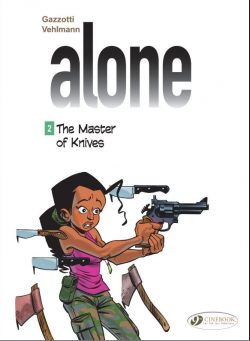
Alone volume 1: The Vanishing


By Gazzotti & Vehlmann, translated by Jerome Saincantin (Cinebook)
ISBN: 978-1-849181-96-9 (PB Album)

Fabien Vehlmann was only born in 1972 yet his prodigious canon of work (from 1998 to the present) has earned him the soubriquet of “the Goscinny of the 21st Century”. He entered the world in Mont-de-Marsan and grew up in Savoie, growing up to study business management before taking a job with a theatre group.

In 1996, after entering a writing contest in Le Journal de Spirou, he caught the comics bug and two years later published – with illustrative collaborator Denis Bodart – a mordantly quirky and sophisticated portmanteau period crime comedy entitled Green Manor. From there on his triumphs grew to include – many amongst others – Célestin Speculoos for Circus, Nicotine Goudron for l’Écho des Savanes and major-league property Spirou and Fantasio…

Bruno Gazzotti is Belgian, born in 1970 and was a student of Institut Saint Luc in Liège. Another artist addicted to comics from his earliest years, he started being paid to draw them in 1988, after being hired by Spirou editor Patrick Pinchart on the strength of his portfolio alone. Before long he was illustrating Le Petit Spirou with Tome & Janry. In 1989, he and Tome created New York Cop Soda, which kept Gazzotti busy until 2005, when he resigned to co-create award-winning feature Seuls…

Released in January 2006, Seuls – La disparition is a superb example of a kids’ thriller suitable for all ages: evoking the eerie atmosphere of TV series Lost and the most disturbing elements of Philip Wylie’s The Disappearance and William Golding’s Lord of the Flies.

Translated as The Vanishing, the first chapter show us peeks of an ordinary bustling town, with simple folk going about their business. Our swift glimpses show us a cross section of kids: Ivan, an imaginative child of wealth who wants for nothing but never sees his dad any more and Leila, a born engineer, inventor and tinkerer. Her poor but honest dad always has time to play and critique her latest gadget…

Camille is studious and over-focussed on exams and achievement and Terry is pretty much still a baby. He certainly acts like one, trying to stay up late, binge watching TV and throwing tantrums if he doesn’t get his way.

Sadly, not all children in town have such typical lives. Dodzi has just been taken into the system. His early life has made him tough and resilient but won’t stop the other young inmates handing him a beating on this ominous, odd-feeling night…

Next morning dawns overcast and forbidding. The city is quiet. Roaming empty streets, Dodzi calls out to anybody who can hear and is met – or actually run over – by Leila and Terry on her bike. They are all pretty scared and have seen nobody else at all…

No one else is around. All the adults have gone, and all their child pals. The internet is down, television and radio only blare out static. Above, fearsome storm clouds gather. Within minutes fear turns to panic and violence but eventually Dodzi brutally enforces calm and leads them away, only to stumble into Camille being attacked by a dog. As the tough guy tries to fight it off, the rabid beast senses something in the shadows of an alley and flees…

As they wander, someone watches the waifs and after they joyously blow off steam in a fountain, they meet final lost boy Ivan. He invites them back to his mansion on the edge of town where they find food while being subjected to his theories on what’s happened: everything from a shared dream to an extinction event to the possibility that they’re dead and in hell…

Needing more information, Dodzi and Leila try to drive one of many cars on the estate while the smaller ones sort out a proper meal, but neither task goes well. The cooking is a disaster while the near-lethal reconnaissance only finds more empty streets, wrecked shop fronts and wild animals in the streets. While the motoring minors seek to evade two rhinos, Terry and Camille are almost eaten by a white tiger that’s got through the estate gates…

When Dodzi and Leila return – and following a burst of viciously released tensions – the kids modify and weaponize a 4 by 4 and head back to town. Ivan’s dad owns the tallest building in the city: somewhere stuffed with resources and easily fortified and defended…

As the first day alone ends, the kids are bloated with vending machine snacks and playing in the vast office block’s upper reaches, but de facto leader Dodzi is still uneasy.

When Leia reports little Terry is missing, he heads out to search and finds to his horror where all the animals have come from: a scene of destruction that distracts him enough that a hidden stalker almost takes him.

Thankfully, the others have ignored his orders and followed so it isn’t Dodzi that dies…

Thus begins a spooky, powerful and often shocking tale of mystery and imagination with the bereft children facing increasingly daunting physical hazards and an escalating series of events which can have no logical or rational explanation…

Alone rapidly became one of the biggest critical and commercial comics hits of the decade and if you love eerie enigmas and powerful tale-telling, you’ll soon be buying this and seeing why for yourself…
© Dupuis 2006 by Gazzotti & Vehlmann. All rights reserved. English translation © 2014 Cinebook Ltd.

The Bluecoats volume 2: The Navy Blues


By Willy Lambil & Raoul Cauvin, translated by Erica Jeffrey (Cinebook)
ISBN: 978-905460-82-3 (Album PB)

The mythology of the American West has never been better loved or more honourably treated than by Europeans. Hergé was a passionate devotee, and the range of incredible comics material from Tex Willer to Blueberry, Yakari to Lucky Luke to Camanche display over and over again our fascination with all aspects of that legendary time and place.

Les Tuniques Bleues or Bluecoats began at the end of the 1960s, visually devised by Louis “Salvé” Salvérius with scripts by Raoul Colvin – who has also written the succeeding 63 volumes of this much-loved Belgian comedy western series. The strip was created on the fly to replace the aforementioned Lucky Luke when the great gunslinger defected from prominent weekly anthology Le Journal de Spirou to rival comic Pilote, and became another one of the most popular series on the Continent.

After its initial run, Bluecoats graduated to the collected album format (published by French publishing powerhouse Dupuis) that we’re all so familiar with in Un chariot dans l’OuestA Wagon in the West – in 1972.

Salvé was proficient in the Gallic style of big-foot/big-nose humour cartooning, and when he died suddenly in 1972 his artistic replacement Willy “Lambil” Lambillotte gradually leavened the previous broad style with a more realistic – but still crucially comedic – illustrative manner. Lambil is Belgian, born in 1936, and after studying Fine Art, joined Dupuis as a letterer in 1952.

In 1959 he created Sandy – about an Australian teen and a kangaroo – later self-parodying it and himself with Hobby and Koala and Panty et son kangaroo as well as creating the comics industry satire ‘Pauvre Lampil’.

Belgian writer Raoul Cauvin was born in 1938 and, after studying Lithography, joined Dupuis’ animation department in 1960. His glittering and prolific writing career began soon after. Almost exclusively a humourist and always for Le Journal de Spirou, other than Bluecoats he has written more than 20 long-running and award-winning series – more than 240 separate albums. Bluecoats alone has sold in the region of 23 million copies.

The protagonists are Sergeant Cornelius Chesterfield and Corporal Blutch, a hopeless double act of buffoons in the manner of Laurel and Hardy, perhaps Abbot & Costello or our own Morecambe & Wise: two hapless and ill-starred cavalrymen posted to the wilds of the arid frontier.

The first strips were single-page gags based around an Indian-plagued Wild West fort but with second volume Du Nord au Sud (North and South) the sorry soldiers went back East to fight in the American Civil War (this scenario was retconned in the 18th album Blue retro which described how the everyman chumps were first drafted into the military). All subsequent adventures, although ranging all over the planet and taking in a lot of genuine and thoroughly researched history, are set within that tragic conflict.

Blutch is your average little man in the street: work-shy, reluctant and ever-critical of the army – especially his inept commanders. Ducking, diving, deserting when he can, he’s you or me – except sometimes he’s quite smart and heroic if no other easier option is available. Chesterfield is a big man, a career soldier, who has bought into all the patriotism and esprit de corps. He is brave, never shirks his duty and wants to be a hero. He also loves his cynical little pal. They quarrel like a married couple, fight like brothers and simply cannot agree on the point and purpose of the horrendous war they are trapped in…

The Navy Blues, second book in this translated series, is actually the 7th French volume ‘Les Bleus de la marine’, and finds the lads as usual in the midst of a terrible battle. However, when Blutch is wounded, his cavalry commanders prefer to save his horse rather than aid a fallen soldier, and Chesterfield finds all his cherished dreams of camaraderie and loyalty ebbing away.

Disillusioned, he demands a transfer to the infantry and with the never-happy Blutch beside him tries to adapt to his lowered status. Sadly, Chesterfield discovers officers are the same everywhere and stupidity and cupidity are rife throughout the armed forces. A progression of calamitous transfers eventually lands the pair in the Union Navy at a time of intriguing technological advancement, playing an unfortunately ill-omened part in the development of both Submarines and armoured battleships. As always, their misadventures result in pain, humiliation and not a few explosions…

The secret of Les Tuniques Bleues success…? This is a hugely amusing anti-war saga targeting younger less cynical audiences. Historically authentic, always in good taste despite its uncompromising portrayal of violence, the attitudes expressed by the down-to-earth pair never make battle anything but arrant folly and, like the hilarious yet insanely tragic war-memoirs of Spike Milligan, these are comedic tales whose very humour makes the occasional moments of shocking verity doubly powerful and hard-hitting.

Fun, informative, beautifully realised and eminently readable, Bluecoats is the sort of war-story that appeals to the best, not worst, of the human spirit.
© Dupuis 1975 by Lambil & Cauvin. English edition © 2008 Cinebook Ltd. All Rights Reserved.