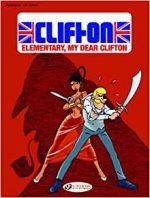
Clifton volume 7: Elementary, My Dear Clifton


By Rodrigue & de Groot, translated by Mark Bence (Cinebook)
ISBN: 978-1-84918-198-3

An infallible agent of Her Majesty’s assorted security forces, Clifton was created by Raymond Macherot for the weekly Tintin. The doughty exemplar of Albion debuted in December 1959, just as a filmic 007 was preparing to set the world ablaze and get everyone hooked on spycraft…

After three albums of strip material – all compiled and released in little more than a year – Macherot defected to arch-rival Spirou and his bombastic British buffoon was benched. Tintin reactivated him at the height of the Sixties’ Swinging London scene and that aforementioned spy-craze, courtesy of Jo-El Azaza & Michel Régnier (code-named Greg to his millions of fans).

Those strips were subsequently collected as Les lutins diaboliques in French and De duivelse dwergen for Dutch-speakers in 1969.

Then it was back into retirement until 1971 when Greg – with artist Joseph Loeckx – took another shot. They tinkered with the True Brit until 1973 when Bob De Groot & illustrator Philippe “Turk” Liegeois fully regenerated the be-whiskered wonder man. After ten more tales, in 1984 artist Bernard Dumont (AKA Bédu) limned de Groot’s scripts before eventually assuming the writing chores as well. The series concluded in 1995.

…But You Only Die Twice… or thrice, or lots…

In keeping with its rather haphazard Modus Operandi and indomitably undying nature, the Clifton strip returned yet again in 2003, crafted now by De Groot & Michel Rodrigue for four further adventures. Although the humorous visual vein was still heavily mined in these tales, now the emphasis was subtly shifted and the action/adventure components strongly emphasised…

Bob de Groot was born in Brussels in 1941, to French and Dutch parents. He became art assistant to Maurice Tillieux on Félix, before creating his own short works for Pilote. A rising star in the 1960s, he drew 4 × 8 = 32 L’Agent Caméléon, where he met Liegeois, consequently began a slow transition from artist to writer. Together they created Archimède, Robin Dubois and Léonard before eventually inheriting Macherot’s moribund spy.

In 1989, de Groot – with Jacques Landrain – devised Digitaline, a strong contender for the first comic created entirely on a computer, and co-created Doggyguard with Rodrigue, even whilst prolifically working with the legendary Morris on both Lucky Luke and its canine comedy spin-off Rantanplan.

He’s still going strong with strips such as Léonard in Eppo, Père Noël & Fils and Le Bar des acariens (both published by Glénat) and so much more.

Michel Rodrigue was born in Lyon in 1961 and really, really likes Rugby. He pursued higher education at the National School of Fine Arts, where he also studied medieval archaeology and from 1983-85 was part of the French Rugby team. In 1987, he designed France’s mascot for the World Cup.

His comics debut came in 1984 with sports (guess which one) strip Mézydugnac in Midi Olympique. After illustrating an adaptation of Edmond Rostand’s Cyrano de Bergerac in 1986 he and collaborator Jean-Claude Vruble produced a volume of La Révolution Française, scripted by Patrick Cothias.

Rodrigue then joined Roger Brunel on Rugby en B.D., Du Monde dans la Coupe!, Concept, Le Rugby en Coupe and La Foot par la Bande.

For Tintin he drew Bom’s Les Conspirateurs and produced Rugbyman, the official monthly of the French Rugby Federation, amongst a welter of other strips. Along the way he began scripting too, and, after working with de Groot on Doggyguard joined him on the revived Clifton.

He also remains astonishingly creatively occupied, working on Ly-Noock with André Chéret, Brèves de Rugby, La Grande Trambouille des Fées for René Hausmann, Futurama comics, Cubitus with Pierre Aucaigne, and many more…

For Your Eyes Only: Pompous, irascible Colonel Sir Harold Wilberforce Clifton is ex-RAF, a former officer with the Metropolitan Police Constabulary and recently retired from MI5. He has great difficulty dealing with being put out to pasture in rural Puddington and takes every opportunity to get back in the saddle, assisting Her Majesty’s Government or needy individuals as an amateur sleuth whenever the opportunity arises. He occupies his idle hours with as many good deeds as befits a man of his standing and service. He is particularly dedicated to sharing the benefits of organised Scouting with the younger generations…

Originally released as Elémentaire mon cher Clifton in 2006 this yarn is a little off the far-from-sedentary sleuth’s beaten paths. As the cover and title might lead you to deduce, Elementary, My Dear Clifton takes its lead from that unflinching bastion of British fiction Sherlock Holmes, but not quite in the way you might imagine…

This rollicking caper begins with the old soldier and his svelte sidekick Jade inspecting a fleet of outrageously expensive luxury cars before getting into a headbanging prang whilst driving home in Clifton’s own stylish sports-roadster.

When he regains consciousness, Jade is missing, abducted by a shadowy figure from the vintage car which forced him off the road…

After another frustrating and infuriating interview with Highway Code martinet and personal gadfly Constable Strawberry, Clifton sets in motion the wheels of protocol that will enable his intelligence community contacts to find the missing assistant, before staggering home to bed and passing out.

Next morning, he finds his multi-talented housekeeper Mrs. Partridge chatting with a distinguished gentleman. Clothed in outmoded attire, “the Doctor” claims to know what’s happened to Jade but if Clifton wants to save her he’ll have to return with him to October 7th 1912…

The physician claims that he and his partner – a certain unnamed consulting detective – were on the trail of a nefarious inventor named Professor Hamilton. That villain was nosing about the preparations for the gala celebrations of a Maharaja on the eve of a sumptuous nuptial event when the Doctor fortuitously trailed him to a warehouse and saw him vanish into a bizarre contraption. Having keenly observed, the stealthy stalker then followed and ended up here and now…

Refusing to believe the cock-and-bull story but equally unable to disprove the evidence before him Clifton eventually concedes defeat and follows the crime doctor back in time and into his strangest adventure ever…

What follows is a hilarious and gripping romp with eerie personal echoes and foreshadowings for our temporally-misplaced manhunter: a ripping yarn all devotees of crime capers and time travels will love…

Funny, fast and furiously thrill-packed, Elementary, My Dear Clifton reveals hidden depths to our Old Soldier whilst playing deliriously fast and loose with history in the grandly enticing manner of Nicholas Meyer’s Time after Time and Terry Gilliam’s Time Bandits; a confection guaranteed to astound and delight thrill and laughter-addicts of every age.
Original edition © Les Editions du Lombard (Dargaud-Lombard SA) 2006 by Rodrigue & De Groot. English translation © 2014 Cinebook Ltd.

I Killed Adolf Hitler


By Jason, coloured by Hubert and translated by Kim Thompson (Fantagraphics Books)
ISBN: 978-1-56097-828-2

Jason is secretly John Arne Saeterrøy: born in Molde, Norway in 1965 and an overnight international cartoon superstar since 1995 when his first graphic novel Lomma full ay regn (Pocket Full of Rain) won that year’s Sproing Award (Norway’s biggest comics prize).

He won another Sproing in 2001 for the series Mjau Mjau and in 2002 turned almost exclusively to producing graphic novels. A global star among the cognoscenti, he has won many major awards from such disparate regions as France, Slovakia and the USA.

In this deliciously wry novella his signature surreality is marginally restrained in favour of a shaggy-dog-story plot, although the quirky tale is – as ever – populated with cinematic, darkly comic anthropomorphs and features more bewitching ruminations on his favourite themes of relationships and loneliness, viewed as ever through a charmingly macabre cast of bestial archetypes and socially-lost modern chumps.

Here he puts his sedately fevered mind to an issue that has perplexed the intellects and consciences of many modern generations and produced – as you would imagine – the very last thing anybody expected…

This post-modern short-and-speculative fable unfolds through the usual beguiling, sparse-dialogued, pantomimic progressions he favours but also resonates with the best of B-Movie Sci Fi shtick. The solidly formal page layouts are rendered in Jason’s minimalist evolution of Hergé’s Claire Ligne style: solid blacks, thick lines and settings of seductive simplicity augmented here by Hubert’s enticing but reductive palette of stark pastels and muted hues.

In a world much like our own, but where petty annoyances can be easily eradicated by one of the many contract killers legally plying their trade in shops and cafes, a certain hard-working hitman toils his weary way through the unchanging days.

The murder mechanic’s love life is troubled and the work-life balance tipped too far into the repetitive tedium of the next execution. He barely breaks a sweat as someone fails to erase him, and he’s pretty sure he knows who sent the gunman to kill him whilst he watched TV…

That missing spark rekindles the next day, however, when an old professor comes into the office. This old duffer wants him to kill Hitler and has even built a time machine to accomplish the task.

Soon the assassin is prowling the halls of the Berlin Chancellery but hasn’t reckoned on the fanatical devotion of the Fuehrer’s minions. That crucial first attempt spoiled, the job becomes impossible after Adolf steals the time machine and escapes to the future where he makes the best of his opportunity to start over…

Still, a job is a job and the hunter finds a way to persevere… and that’s when things get really complicated…

Jason’s work always jumps directly into the reader’s brain and heart, always probing the nature of “human-ness” by using the beastly and bizarre to ask persistent and pertinent questions. Although the clever sight-gags are less prominent here his repertory company of “funny-animal” characters still effectively depicts the subtlest emotions with devastating flair, proving again just how good a cartoonist he is.

This comic tale is best suited for adults but makes us all look at the world through wide-open childish eyes. Jason is instantly addictive and a creator every serious fan of the medium should move to the top of the “Must-Have” list. While you’re at it, make room there for Werewolves of Montpellier, The Left Bank Gang and all the scintillating rest too…
All characters, stories and artwork© 2007 Editions de Tournon-Carabas/Jason. All rights reserved.

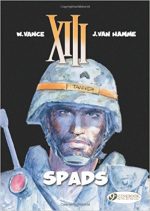
XIII volume 4: SPADS


By William Vance & Jean Van Hamme, coloured by Petra (Cinebook)
ISBN: 978-1-84918-058-0

One of the most consistently entertaining and popular adventure serials on the European scene, XIII was created by author Jean Van Hamme (Wayne Shelton, Blake and Mortimer, Lady S.) and illustrator William Vance (Bruce J. Hawker, Marshal Blueberry, Ramiro).

Van Hamme was born in Brussels in 1939 and is one of the most prolific writers in comics. After pursuing Business Studies, he moved into journalism and marketing before selling his first graphic tale in 1968. Immediately clicking with the public, by 1976 he had also branched out into prose novels and screenwriting. His big break was monumentally successful mixed-genre fantasy series Thorgal for Tintin magazine but he truly cemented his reputation with mass-market bestsellers Largo Winch and XIII as well as more cerebral fare such as Chninkel and Les maîtres de l’orge. In 2010 Van Hamme was listed as the second-best selling comics author in France, ranked between the seemingly unassailable Hergé and Uderzo.

William Vance is the bande dessinée nom de plume of William van Cutsem. He was born in 1935 in Anderlecht and, after military service in 1955-1956, studied art at the Académie Royale des Beaux-Arts. He became an illustrator of biographic features at Tintin in 1962. His persuasive illustrative style is a classical blend of meticulous realism, scrupulous detail and spectacular yet understated action.

In 1964 he began maritime adventure serial Howard Flynn (written by Yves Duval) before graduating to more popular genre work with western Ray Ringo and espionage thriller Bruno Brazil (scripted by Greg). Further success followed when he replaced Gérald Forton on science fiction classic Bob Morane in Femmes d’Aujourd’hui and latterly Pilote and Tintin.

Although working broadly and constantly on serials and stand-alone stories, Vance’s signature achievement is his lengthy collaboration with fellow Belgian Van Hamme on this contemporary thriller loosely based on Robert Ludlum’s novel The Bourne Identity…

XIII launched in 1984, originally running in Spirou to great acclaim. A triad of albums were rushed out – simultaneously printed in French and Dutch editions – before the first year of serialisation ended.

The series was a monumental hit in Europe but fared less well in its earlier attempts to make the translation jump to English, with Catalan Communications, Alias Comics and even Marvel all failing to find an audience for the epic mystery thriller.

The grand conspiracy saga of unrelenting mood, mystery and mayhem opened in The Day of the Black Sun when an old beachcomber found a body. The human flotsam had a gunshot head wound and was near death when Abe and his wife Sally found him. She discovered a key sewn into his clothes and the Roman numerals for thirteen tattooed on his neck. The remote hideaway offered little in the way of emergency services, but their alcoholic, struck-off surgeon friend managed to save the stranger…

As he recuperated, a complication became apparent. The patient – a splendid physical specimen clearly no stranger to action or violence – had suffered massive and irreversible brain trauma. Although increasingly sound in body he had completely lost his past.

Language skills, muscle memories, even social and reflexive conditioning all remained, but every detail of his life-history was gone…

They named him “Alan” after their own dead son – but hints of the intruder’s lost past explosively intruded when hitmen invaded the beach house with guns blazing. Alan lethally retaliated with terrifying skill, but too late…

In the aftermath he found a photo of himself and a young woman on the killers and traced it to nearby Eastown. Desperate for answers and certain more killers were coming, the human question mark headed off to confront unimaginable danger and hopefully find the answers he craved.

The picture led to a local newspaper and a crooked cop who recognised the amnesiac but said nothing…

The woman in the photo was Kim Rowland, a local widow recently gone missing. Alan’s key opened the door of her house. The place had been ransacked but a thorough search utilising his mysterious talents turned up another key and a note warning someone named Jake that “The Mongoose” had found her…

He was then ambushed by the cop and newspaper editor Wayne. Calling him “Shelton” they demanded the return of a large amount of missing money…

Alan/Jake/Shelton reasoned the new key fitted a safe-deposit box and bluffed the thugs into taking him to the biggest bank in town. The staff there also knew him as Shelton, but when his captors examined the briefcase in Shelton’s box a booby trap went off. Instantly acting, the mystery man expertly escaped and eluded capture, holing up in a shabby hotel room, pondering again what kind of man he used to be…

As he prepared to leave he stumbled into a mob of armed killers. In a blur of lethal action he escaped and ran into another bunch of heavies led by a Colonel Amos. This chilling executive referred to his captive as “Thirteen”, claiming to have dealt with his predecessors XI and XII in regard to the “Black Sun” case…

Amos very much wanted to know who Alan was, and offered some shocking titbits in return. The most sensational was film of the recent assassination of American President, William B Sheridan, clearly showing the lone gunman was XIII…

Despite the amnesiac’s heartfelt conviction that he was no assassin, Amos accused him of working for a criminal mastermind, and wanted that big boss. The interrogator failed to take Alan’s instinctive abilities into account and was astounded when his prisoner leapt out of a fourth floor window…

The fugitive headed back to the beach where he was found but more murderers awaited; led by a mild-seeming man Alan inexplicably knew was The Mongoose. The criminal overlord expressed surprise and admiration: he thought he’d killed Thirteen months ago…

Following an explosion of hyper-fast violence which left the henchmen dead and Mongoose vanished but vengeful, the mystery man regretfully hopped a freight train west towards the next stage in his quest for truth…

His journey of discovery took him to the army base where Kim Rowland’s husband was stationed. His enquiries provoked an unexpected and violent response resulting in his interrogation by General Ben Carrington and his sexily capable aide Lieutenant Jones.

They’re from the Joint Chiefs of Staff, know an awful lot about black ops units and have proof that their memory-challenged prisoner is in fact their agent: believed-deceased Captain Steve Rowland…

After testing the amnesiac’s abilities Carrington then drops him off in Rowland’s home town of Southberg to pursue his search for his missing wife, but the prodigal’s return to his rat’s nest of a family rekindles long-simmering passions and jealousies. The entire town seems to want Rowland’s blood and before long he’s been made the target of an assassination attempt and victim of a diabolical murder-plot…

Despite Carrington and Jones’ last-minute intervention Alan/Steve is framed for murdering his father and grabbed by a furious posse.

After an indeterminate period of time “Steve” resurfaces, undergoing the worst kind of psychiatric care at Plain Rock Penitentiary for the Criminally Insane. Despite drugs and shock treatments, progress is negligible, probably because aging martinet Dr Johansson‘s claims of curing for his patient’s apparent amnesia are clearly just a judgemental sadist’s justifications for inflicting agony on the helpless…

Carrington and Jones meet with Amos who has troubling information. His investigations revealed the amnesiac had undergone illicit plastic surgery and his army records were altered. Whoever was in Plain Rock, he wasn’t Steve Rowland…

Amos’ files proved the plotters who had the President killed were still active and their amnesiac assassin was now the only link to them. Acting on her own initiative, Jones decided it was time she took a hands-on approach…

Anxious and isolated, Not-Rowland received a visitor who galvanised him out of his induced torpor and knew his days were numbered…

Deep within the corridors of power, Amos informs Carrington further researches have obtained them a name. XIII and the man they are actually dealing with is former soldier and intelligence operative Ross Tanner.

Probably…

Perhaps…

Rowland/Tanner opts for escape but is swiftly recaptured and restricted to the medical section. XIII is helpless when the Mongoose’s inside man makes his move. Luckily Jones had also inserted herself in a position where she could do the most good…

Spectacularly busting out, “Rowland” and the mystery woman then race into the desert, somehow avoiding a massive manhunt before vanishing without trace.

Some time later, Amos and Carrington confer over the disappearance, but one of them knows exactly where the fugitive is. Now, with another new name, the warrior without a past and his new powerful allies lay plans to take the fight to their secret enemy…

SPADS is the fourth complex and convoluted chapter (first released in Europe in 1987) and opens with a much more concise and visual recap than I’ve just given, before kicking the plot into high gear as the race to replace murdered President Sheridan hots up. The contenders are Old Boy Network hack and former Vice President Joseph Galbrain battling Sheridan’s glamorous and idealistic younger brother Walter: latest scion of a venerable dynasty of leaders…

Amos’ diligent investigation is relentless. After exhuming a host of bodies, he can confidently claim to know who Tanner really is, is but when his search leads him into a trap that kills his assistant and incapacitates him, he starts to wonder if he’s tracking a target or being led onto a bullseye…

Elsewhere, in a green hell of sweat and testosterone, Ross Tanner is making no friends as he trains to join elite combat unit SPADS (SPecial Assault and Destruction Squads). He doesn’t fit in and is always causing trouble. It’s as if he’s there under false pretences…

When Amos and Judge Allenby confront Carrington at the Pentagon with news that Tanner is also an alias for an as yet unknown operative, the reaction is little short of explosive. Soon after, special aide Lieutenant Jones goes AWOL…

Back in the Bayou, the man everybody is hunting has made a fresh advance into uncovering his occluded past. Sergeant Betty served with the real Rowland and knows he didn’t die at the time and in the manner the official reports describe. Before she shares the details, however, she has an itch that needs scratching…

That conversation is curtailed by camp commander Colonel McCall, who tells the undercover operative that he’s being transferred out in the morning by direct order of General Carrington. Realising his chance to solve his personal mystery is evaporating, XIII settles a few outstanding scores before sneaking into Betty’s quarters…

Amos and Allenby meanwhile have not been idle, and the former is certain he has at last gleaned the actual identity of the multi-named agent XIII, but when they visit a certain grave they walk right into another ambush and a well-placed mole is forced to break cover…

As Amos is plucked from the firefight by the last person he expected to see, a continent away Tanner’s liaison gets even more dangerous when another Mongoose mole interrupts and tries to kill them both. Happily, Carrington’s back-up agent is well placed to save them and they all flee together, unaware that their escape vehicle has been boobytrapped and sabotaged…

Amos by now is securely ensconced in a palatial hideaway, being feted by a coterie of political heavyweights who finally reveal the truth about all the men Ross Tanner is and isn’t. They then explain the incredible reason for the smoke-&-mirrors operation and the earth-shattering stakes…

To Be Continued…

XIII is one most compelling and multi-layered mystery adventures ever conceived, with subsequent instalments constantly taking the questing human enigma two steps forward, one step back, stumbling through a world of pain and peril whilst cutting through an interminable web of past lives he seemingly led…

Rocket-paced and immensely inventive, XIII is a series no devotee of action sagas and conspiracy thrillers will want to miss.
Original edition © Dargaud Benelux (Dargaud-Lombard SA), 1987 by Van Hamme, Vance & Petra. All rights reserved. This edition published 2010 by Cinebook Ltd.

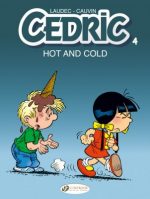
Cedric volume 4: Hot and Cold


By Laudec & Cauvin with colours by Leonardo and translated by Jerome Saincantin (Cinebook)
ISBN: 978-1-84918-158-7

Raoul Cauvin is one of Europe’s most successful comics scripters. Born in Antoing, Belgium in 1938, by 1960 he was working in the animation department of publishing giant Dupuis after studying the dying – and much-missed – print production technique of Lithography.

Happily, he quickly discovered his true calling was writing funny stories and began a glittering, prolific career at Spirou.

While there he devised (with Salvérius) the astoundingly successful Comedy-Western Bluecoats as well as dozens of other long-running, award-winning series such as Sammy, Les Femmes en Blanc, Boulouloum et Guiliguili, Cupidon, Pauvre Lampil and Agent 212: cumulatively shifting more than 240 separate albums.

Bluecoats alone has achieved sales well north of 15 million copies thus far…

His collaborator on the superbly sharp and witty kid-friendly family strip Cédric is Italian born, Belgium-raised Tony de Luca, who studied electro-mechanics and toiled as an industrial draughtsman until he could make his own break into bandes dessinée.

Following a few fanzine efforts in the late 1970s, Laudec landed soap-style series Les Contes de Curé-la-Fl’ûte at Spirou in 1979. He built that into a brace of extended war-time serials (L’an 40 in 1983 and Marché Noir et Bottes à Clous in 1985) whilst working his way around many of the comic’s other regular strips.

In 1987 he united with Cauvin on the first Cédric shorts and from then on it was all child’s play…

We have Dennis the Menace (the Americans have their own too but he’s not the same) whilst the French-speaking world has Cédric: an adorable, lovesick rapscallion with a heart of gold and an irresistible penchant for mischief.

Collected albums (29 so far) of the variable-length strips – ranging from a ½ page to half a dozen – began appearing in 1989 and are always amongst the most popular and best-selling on the Continent, as is the animated TV show spun off from the strip.

Be Warned: this is not a strip afraid to suspend the yoks in favour of a little suspense or near-heartbreak. Cedric is almost-fatally smitten with Chen: a Chinese girl in his class yet so very far out of his league, leading to frequent and painful confrontations and miscommunications.

Whilst the advice given by his lonely widowed grandpa is seldom of any practical use it can pick open scabs from the elder’s long, happy and now ended marriage which might reduce any normal human to tears…

This fourth Cinebook translation – from 2011 and first continentally released in 1993 as Cédric 6: Chaud et Froid – opens with ‘Skateboarding Champ…‘ as the scamp finds Chen watching an older boy show off his prowess on wheels and is utterly unable to steer clear of a humiliating confrontation and revoltingly precipitate action…

‘Lightning to Thunder’ sees Grandpa attempting to teach Cedric how to time the interval between the two awesome natural events when Dad interrupts with an unnatural one both painful and impressive, after which Christmas brings ‘Little Presents’ from the lad to his family that causes outrage, terror and – eventually – much mirth…

When Grandpa borrows the boy’s ‘Badges Galore’, his long-suffering daughter is quick to spot his ulterior motives after which, to everyone’s chagrin, Cedric’s spoiled, smug and shamelessly social-climbing ‘Horrible Cousin’ Yeti visits.

She is brought down a peg or ten after trying to cosy up to aristocratic twit The Right Honourable Alphonse Andre Jones-Tarrington-Dupree – with deliciously gratifying results for the eagerly-watching oik in jeans and trainers – before ‘Back in My Day…’ finds a family meal derailed by the boy asking when his parents will make him a little sister. The resultant three-way adult – and hilarious – argument about modern sex education allows Cedric to successfully bury bad news about his grades…

Jealousy again causes a clash between Cedric and long-suffering Chen in ‘Ice Love You’ before Grandpa brilliantly outsmarts his lazy, study-shy grandson with a spot of ‘Blackmail’: threatening to show Chen’s mother the kid suitor’s latest appalling report card and prove the ardent boy is not good enough for her darling daughter…

When Dad impetuously tries out a skateboard, he finds the experience ‘No Bed of Roses’ even as Cedric’s rapscallion inclination to go scrumping is dreadfully scuppered in ‘How About Them Apples?’

A little later when slow-witted Manu gets hold of a disposable camera (ask your dad), Cedric goes to superhuman extremes to be in a perfect picture with his unobtainable inamorata despite the constant invocations to ‘Say Cheese!’ seemingly inspiring the universe to play its most mean tricks on the little Lothario…

Another devilish demonstration of devious designs occurs after Cedric demands of his family ‘Wanna See My School Report?’ but they’re probably all too preoccupied anticipating the result and cost of ‘Grandpa’s Cooking’: the aftermath of which is a life-threatening bout of depression for the fragile old geezer which can only be cured by the youngster saying something truly stupid in ‘Some Days Are Like That…’

Late night viewing of unsuitable movies and a change in Cedric’s behaviour leads Mum to make her own ‘French Connection’ before we learn that little boys’ egos – and trousers – are fragile things. However, if the unimaginable does happen in front of your intended true love, as long as your mates are around one can always depend on a ‘Conga Line’ to get you home with a minimum of blushes…

More elderly health concerns manifest in ‘A Bit Tired…’ but once again the boy knows just the wrong thing to say to banish Grandpa’s doldrums before this sparkling friends-&-family saga pause with ‘Makes You Deaf’ as Cedric devises a wild Walkman (ask your granddad) based scheme to get Chen to marry him one day…

Rocket-paced, warmly witty and not afraid to explore sentiment or loss, the exploits of this painfully keen, beguilingly besotted young rascal are a charming example of how all little boys are just the same and infinitely unique. Cedric is a superb family strip perfect for youngsters and old folk alike…
© Dupuis 1993 by Cauvin & Laudec. All rights reserved. English translation © 2013 Cinebook Ltd.

Lucky Luke


By Morris & Goscinny, translated by Luke Spear (Cinebook)
ISBN: 978-1-905460-49-6

It’s hard to think of one of Europe’s most beloved and evergreen comics characters being in any way controversial, but when changing times caught up with the fastest gun in the West (“so fast he can outdraw his own shadow”) and the planet’s most laconic cowboy moved with them, the news made headlines all over the world.

Lucky Luke is a rangy, good-natured, lightning-fast cowboy who roams the fabulously mythic Old West, having light-hearted adventures with his sarcastic horse Jolly Jumper and interacting with a host of historical and legendary figures. His continued exploits over nearly seventy years have made him one of the best-selling comic characters in Europe (68 individual adventures totalling more than 300 million albums in 30 languages thus far), with the usual spin-off toys, computer games, animated cartoons and a plethora of TV shows and live-action movies.

He was created in 1946 by Belgian animator, illustrator and cartoonist Maurice de Bévère (“Morris”) and first seen the 1947 Annual (L’Almanach Spirou 1947) of Le Journal de Spirou, before launching into his first weekly adventure ‘Arizona 1880’ on December 7th 1946.

Working solo until 1955, Morris produced nine albums worth of affectionate sagebrush spoofery before teaming with old pal and fellow trans-American tourist Rene Goscinny, who became the regular wordsmith as Luke attained the dizzying heights of superstardom, commencing with ‘Des rails sur la Prairie’ (Rails on the Prairie), which began in Spirou on August 25th 1955.

In 1967, the six-gun straight-shooter switched sides, transferring to Goscinny’s own magazine Pilote with ‘La Diligence’ (The Stagecoach). Goscinny co-created 45 albums with Morris before his untimely death, from whence Morris soldiered on both singly and with fresh collaborators.

Morris himself died in 2001 having drawn fully 70 adventures, plus some spin-off sagas crafted with Achdé, Laurent Gerra, Benacquista & Pennac, Xavier Fauche, Jean Léturgie, Jacques Pessis and others, all taking a crack at the venerable franchise…

Moreover, apart from that very first adventure, Lucky (to appropriate a quote applied to the thematically simpatico TV classic Alias Smith and Jones) “in all that time… never shot or killed anyone…”

Lucky Luke was first spotted in the UK syndicated to weekly anthology Film Fun during the late 1950s and again in 1967 in Giggle, where he was renamed Buck Bingo.

In all these venues – as well as the numerous attempts to follow the English-language successes of Tintin and Asterix albums – Luke sported a trademark cigarette hanging insouciantly from his lip. However, in 1983 Morris – no doubt amidst both pained howls and muted mutterings of “political correctness gone mad” – deftly substituted a piece of straw for the much-travelled dog-end, which garnered him an official tip of the hat from the World Health Organization.

The most recent and successful attempt to bring Lucky Luke to our shores and shelves comes from Cinebook (who have rightly restored the foul weed to his lips on the interior pages, if not the covers…), and it’s clearly no big deal for today’s readership as we’re well past sixty translated books and still going strong.

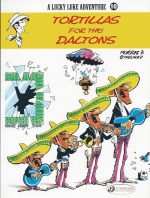
Tortillas for the Daltons was the tenth of their 63 albums, now available both on paper and as e-books. As Tortillas pour les Daltons it was first published in Europe 1967: the charming cowboy’s 31st sagebrush foray and Goscinny’s 22nd collaboration with Morris, offering a beguilingly exotic and action-packed visit across the fabled Rio Grande in search of justice and good times…

It all begins in jail as vile owlhoots Averell, Jack, William and their slyly psychotic, overly-bossy shorter brother Joe Dalton are roused from their cosy comfort zone with the shocking news that they’re all being moved to a less crowded penitentiary – one situated near the Mexican border…

The infamous Dalton Gang are incorrigible criminals and no effort is spared to make sure they arrive at their destination. The warden even assigns faithful prison hound Rin Tin Can to the large escort but has apparently forgotten that the vain, friendly and exceedingly dim pooch is utterly loyal to absolutely everybody and no use at all in any kind of crisis…

Parking up for the night by the mighty border, the soldiers and security are sadly unaware that a gang of banditos are eyeing up the iron-studded coach and wondering just what manner of gringo valuables it might contain…

Despite striking with typical dash, verve and flamboyance, the gaudy thieves are ultimately quite disappointed with their haul, but in America the public breathes a huge communal sigh of relief that the Daltons are no longer a menace to their property. Sadly, the Mexican government kicks up such a fuss at the unwelcome additions to their population that the US authorities summon Lucky Luke to Washington DC and beg him to retrieve the contentious criminal tourists…

Not that the Daltons have actually broken any laws yet. They’ve been spending all their time trying to convince bandit supremo Emilio Espuelas that they are as good at being bad as any Mexican.

Whilst he may not accept that, the sinister sombrero-wearer is pretty certain that the odd quartet will be an unnecessary and costly burden. It takes all Joe’s efforts to convince him not to kill them outright. Eventually however, the burly brigand agrees to accept them as apprentice thieves. That tenuous situation almost ends when the assembled scoundrels scout the sleepy village of Xochitecotzingo and Joe a has a fit. The little loon has seen Lucky Luke riding into town with dumb mutt Rin Tin Can in tow.

After his introduction in 1962’s Sur la piste des Dalton, (On the Daltons’ Trail) Rantanplan – “dumbest dog in the West” and a wicked parody of cinema canine Rin-Tin-Tin – became an irregular feature in Luke’s adventures before eventually landing his own spin-off series title. The moronic mutt is in top form here, spreading confusion and mirth far and wide especially after meeting his cross-border counterpart – a clever chihuahua named Rodriguez…

Joe Dalton’s devious mind goes into inventive overdrive after spotting his laconic nemesis: determined that Emilio must not learn of the hero’s presence, else he sell the brother back to the emissary of America for a tidy profit…

As Luke avails himself of the local hospitality and acquaints himself with the friendly foreigners’ funny customs, Joe leads the multinational miscreants in a good old US bank raid but has failed to take into account the hamlet’s lack of a proper venue to store money…

As international relations go into a steep decline, the extremely suspicious Espuelas is ready to cut his losses. In town, Lucky is experiencing similar difficulties lost in translation. The local law enforcers have a long tradition of keeping the peace by not asking for trouble by chasing outlaws…

Eventually, however, the canny cowboy drums up a little support, just as Joe convinces Emilio to rob the lavish ranchero of the region’s richest man. Sadly for them, that’s exactly where Lucky and Rin Tin Can are staying…

When noble Don Doroteo announces a grand party, the villains are tempted beyond their ability to resist. Emilio even finds a way for the Daltons to be useful at last. Disguised as a Mariachi band, the gringos can move about the event in preparation for a classic Mexican raid – but only if nobody asks them to play or sing…

Sensibly devolving into total farce and a ferocious gunfight, Tortillas for the Daltons is a wild and woolly comedy romp, offering fast-paced, seductive slapstick and wry cynical humour in another delicious yarn in the tradition of Destry Rides Again and Evil Roy Slade, superbly executed by master storytellers and providing a wonderful introduction to a unique genre for today’s kids who might well have missed the romantic allure of an all-pervasive Wild West that never was…
© Dargaud Editeur Paris 1971 by Goscinny & Morris. © Lucky Comics. English translation: © 2008 Cinebook Ltd.

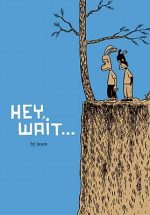
Hey Wait…


By Jason, translated by Kim Thompson (Fantagraphics Books)
ISBN: 978-1-56097-641-7

It’s usually a cheap cop-out by tired or hackneyed critics but some creators’ work comes close to defying description. That’s never more true than when reviewing another brilliant graphic exposition by Jason.

Jason is secretly John Arne Saeterrøy: born in Molde, Norway in 1965 and an overnight international cartoon superstar since 1995 when his first graphic novel Lomma full ay regn (Pocket Full of Rain) won that year’s Sproing Award (Norway’s biggest comics prize).

He won another Sproing in 2001 for the series Mjau Mjau and in 2002 turned almost exclusively to producing graphic novels.

A global star among the cartoon cognoscenti, Jason has earned many major awards from all over the planet. His work always jumps directly into the reader’s brain and heart, utilising the beastly and unnatural to gently pose eternal questions about basic human needs in a soft but relentless quest for answers. That you don’t ever notice the deep stuff because of the clever gags and safe, familiar “funny-animal” characters should indicate just how good a cartoonist and storyteller he is…

The stylised static-seeming artwork is delivered in formalised page layouts rendered in a minimalist evolution of Hergé’s Claire Ligne style, solid blacks, thick outlines and settings of seductive simplicity – often augmented by a deft and subtle use of flat colour which enhances his hard, moody, suspenseful and utterly engrossing Cinema-inspired world.

The superbly understated art acts in concert with his dead-on, deadpan pastiche repertoire of scenarios which dredge deep from our shared experience of old film noir classics, horror and sci fi B-movies and other visual motifs which transcend time and culture, and the result is narrative dynamite. His preferred oeuvre mixes such fantasy elements with a deep and overwhelming inquiry into why bad stuff happens to ordinary “people”…

A compact (176 x 254mm) monochrome paperback, Hey Wait… is just such a confection: an eerie and glorious paean to boyhood friendships with young Bjorn and Jon enjoying a life of perfect childhood of collecting comics, watching movies and gadding about until a tragic accident – perhaps the result of boon companions egging each other on a little too much? – ends the idyll forever.

Life, however, goes on (and on and on and on) for one of the inseparable childhood comrades but it has become a life sentence…

The survivor’s existence becomes populated from then on with mundane encounters, tedious assignations, failed aspirations and the usual parade of ghosts and visions, but then again so is everybody else’s tedious day to day progress to the end …

Hey Wait… resonates with Jason’s favourite themes and shines with his visual dexterity and skewed sensibilities. disclosing a decidedly different slant on secrets and obsessions. Primal art supplemented by sparse and spartan dialogue, enhanced to a macabre degree by immaculate cartooning and skilled use of silence and moment utilised with devastating economy, affords the same quality of cold, bleak yet perfectly harnessed stillness which makes Scandinavian crime dramas such compelling, addictive fare.

This comic tale allows us all to look at the world through wide-open young eyes but never sugar-coats what’s there to see…
© 1998, 1999, 2001, 2005 Jason. Translation © 2001 Fantagraphics Books. All rights reserved.

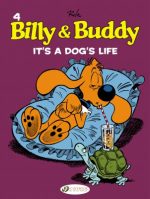
Billy and Buddy volume 4: It’s a Dog’s Life


By Jean Roba & various translated by Erica Jeffrey (Cinebook)
ISBN: 978-1-84918-171-6

Known as Boule et Bill on the Continent (at least in the French speaking bits, that is; the Dutch and Flemish call them Bollie en Billie), this evergreen, immensely popular cartoon saga of a dog and his boy debuted in the Christmas 1959 edition of Spirou.

The perennial fan-favourite resulted from Belgian writer-artist Jean Roba (Spirou et Fantasio, La Ribambelle) putting his head together with Maurice Rosy – the magazine’s Artistic Director and Ideas Man who had also ghosted art and/or scripts on Jerry Spring, Tif et Tondu, Bobo and Attila during a decades-long, astoundingly productive career at the legendary periodical.

Intended as a European answer to Charles Schulz’s Peanuts, Boule et Bill quickly went its own way and developed a unique style and personality, becoming Rosa’s main occupation for the next 45 years.

He crafted more than a thousand pages of gag-strips in a beguiling, idealised domestic comedy setting, all about a little lad and his exceedingly smart Cocker Spaniel before eventually surrendering the art-chores to his long-term assistant Laurent Verron in 2003.

The successor subsequently took over the scripting too, after Roba’s death in 2006.

Jean Roba was born in Schaerbeek, Belgium on July 28th 1930 and grew up reading a lot of American newspaper strip translations and reprints. He was particularly fond of Rudolph Dirks and Harold H. Knerr’s Katzenjammer Kids and after the War began working as a jobbing illustrator before adopting the loose, free-wheeling cartooning style known as the “Marcinelle School” and joining the Spirou crew.

He followed Uderzo on Sa majesté mon mari and perfected his craft under Franquin on Spirou et Fantasio before launching Boule et Bill as a mini-récit (a 32-page, half-sized freebie insert) in the December 24th 1959 Spirou.

Like Dennis the Menace in The Beano, the strip was a big hit from the start and for 25 years held the coveted and prestigious back-cover spot. Older British fans might also recognise the art as early episodes – (coincidentally) retitled It’s a Dog’s Life – ran in Fleetway’s legendary anthology weekly Valiant from 1961 to 1965…

A cornerstone of European life, the strip has generated a live-action movie, animated TV series, computer games, permanent art exhibitions, sculptures and even postage stamps. Like some select immortal Belgian comics stars, Bollie en Billie have been awarded a commemorative plaque and have a street named after them in Brussels….

Large format album editions began immediately, totalling 21 volumes throughout the 1960s and 1970s. These were completely redesigned and re-released in the 1980s, supplemented by a range of early-reader books for toddlers. Collections are available in 14 languages, selling in excess of 25 million copies of the 32 albums to date.

As Billy and Buddy, the strip returned to British eyes in enticing Cinebook compilations from 2009 onwards: introducing to 21st century readers an endearingly bucolic late 20th century, sitcom-styled nuclear family set-up consisting of one bemused, long-suffering and short-tempered dad, a warmly compassionate but painfully flighty mum, a smart, mischievous son and a genius dog who has a penchant for finding bones, puddles and trouble…

Originally released in 1974, Une vie de chien was the 9th European collection, and here simply serves to further explore the timeless and evergreen relationship of a dog and his boy (and tortoise) for our delight and delectation. This time however, we’re left in no doubt as to who is running the show…

Delivered as a series of stand-alone rapid-fire gags, quips and jests, the progress and behaviour of seven-year old Billy is measured by carefree romps with four-footed friend Buddy: indulging in spats with pals, dodging baths, hunting and hoarding bones, outwitting butchers, putting cats and school friends in their place, misunderstanding adults, causing accidents and costing money; with both kid and mutt equally adept at all of the above.

Buddy is the perfect pet for an imaginative and playful boy, although the Machiavellian mutt is overly fond of purloined food and ferociously protective of boy and bones and his ball. The pesky pooch also cannot understand why everyone wants to constantly plunge him into foul-tasting soapy water, but it’s just a sacrifice he’s prepared to make to be with Billy…

Buddy also has a fondly platonic relationship with tortoise Caroline (although this autumnal and winter-themed compilation finds her again largely absent through hibernation pressures) and a suspicious knack for clearing off whenever Dad has one of his explosive emotional meltdowns over the cost of canine treats, repair bills or the Boss’ latest impositions.

Taking pride of place in this tome are numerous close escapes from kids intent on involving the dog in their crazy games of cowboys, hunting encounters, pranks and practical jokes, strange romantic encounters (with cats and other lower life forms) …

Unwise intrusions onto film sets abound this time and there are more brushes with belligerent birds, adoring girls, impertinent mannequins and voracious fleas (or at least so the humans think), as well as hitchhiking hilarity and an embarrassing almost-accident involving ancient automobiles and crusty dowagers.

The onset of snow season brings fresh confrontations with the neighbour’s cat Corporal and, humiliating ice-capades, skid patches and sliding competitions, snowball wars, indoor blizzards and the unique experience of romantically-inclined sleepwalking tortoises as well as Buddy’s debut as a soccer referee for schoolboy games and more displays of the dog’s social pulling power and food-procuring acumen.

Gently-paced and filled with wry wit and potent sentiment, these captivating funny pages run the gamut from heart-warming to hilarious, silly to surreal and slapstick to satire: a charming tribute to and lasting argument for a child for every pet and vice versa.

This is another splendidly enticing and engaging family-oriented compendium of cool and clever comics no one keen on introducing youngsters to the medium should be without.
Original edition © Studio Boule & Bill 2010 by Roba. English translation © 2013 Cinebook Ltd.

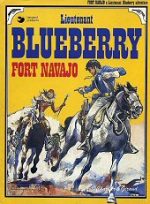
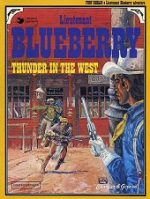
Dargaud Presents Lieutenant Blueberry: Fort Navajo & Thunder in the West


By Charlier & Giraud, translated by Anthea Turner and Derek Hockridge (Egmont/Methuen)
ISBN: 978-0-41605-370-8 and 978-0-41605-370-X

Franco-Belgian comics have enjoyed a decades-long love affair with the mythos of the American West and responded with some of the most beautiful and exciting graphic narratives in the history of the medium. They have, however, had less success creating characters that have gone on to be global household names.

One that did has made that jump is Michel Charlier & Jean Giraud’s immortal bad-ass Blueberry…

Sadly, although many publishers have sporadically attempted to bring him to our thrill-starved shores, there’s no readily available complete catalogue (yet) of the quintessential antihero in the English language. Thus, this first of many forthcoming reviews with a brace of albums that are decades old, although they do still turn up in back-issue bins and in second hand or charity shops…

Jean-Michel Charlier is arguably Europe’s most important writer of realistic adventure strips.

Ever.

He was born in Liege, Belgium in 1924 and like so many groundbreaking comics creators, began as an artist, joining the staff of Spirou in September 1944, contributing aviation illustrations, and a strip about gliders co-produced with Flettner. In 1946 Charlier’s love affair with flying inspired him to co-create fighter-pilot strip Buck Danny, providing scripts for star turn artist Victor Hubinon.

Before long – and on the advice of prestigious senior illustrator Jijé – Charlier was scripting full time and expanding his portfolio with many other series and serials.

In 1951 he co-created historical series Belles Histoires de l’Oncle Paul which afforded dozens of major artists their big break over the years, and supplemented the series with other strips such as Kim Devil (art Gérald Forton), Jean Valhardi and Marc Dacier (both with artist Paape) and Thierry le Chevalier (with Carlos Laffond) as well as popular scouting series La Patrouille des Castors, illustrated by MiTacq.

In conjunction with Goscinny and Uderzo, Charlier founded the business and industry oriented commercial comics agency Edifrance after which Charlier and Goscinny edited the magazine Pistolin (1955-1958) before launching Pilote together in October 1959.

For the soon to be legendary periodical Charlier created

Tanguy and Laverdure (with Uderzo and later Jijé), Barbe-Rouge (with Hubinon) and Jacques le Gall (MiTacq). In 196, Charlier visited America he created arguably his most significant character – and Europe’s greatest Western comic – which would eventually be known as Blueberry.

In later years, the engaging antihero would support his own equally successful spin-off La Jeunesse de Blueberry (AKA Young Blueberry, illustrated by Colin Wilson) but Charlier never rested on his laurels, concocting further grittily realistic fare: historical biographies in collaboration with Hubinon (Surcouf, Jean Mermoz, and Tarawa) and Martial (Alain et Christine in Libre Junior, Rosine in Pistolin), Brice Bolt for Spirou with Aldoma Puig, Los Gringos with Victor de la Fuente and many more. He passed away in 1989.

Jean Henri Gaston Giraud was born in the suburbs of Paris on 8th May 1938. Raised by grandparents after his mother and father divorced in 1941, he began attending Institut des Arts Appliqués in 1955, becoming friends with Jean-Claude Mézières who, at 17, was already selling strips and illustrations to magazines such as Coeurs Valliants, Fripounet et Marisette and Spirou. Giraud apparently spent most of his college time drawing cowboy comics and left after a year.

In 1956 he travelled to Mexico, staying with his mother for eight months, before returning to France and a full-time career drawing comics, mostly Westerns such as Frank et Jeremie for Far West and King of the Buffalo, A Giant with the Hurons and others for Coeurs Valliants, all in a style based on French comics legend Joseph Gillain AKA “Jijé”.

Between 1959 and 1960 Giraud spent his National Service in Algeria, working on military service magazine 5/5 Forces Françaises before returning to civilian life as Jijé’s assistant in 1961, working on the master’s long-running (1954-1977) western epic Jerry Spring.

A year later, Giraud and Belgian writer Jean-Michel Charlier launched the serial Fort Navajo in Pilote #210. All too soon the ensemble feature threw forth a unique icon in the shabby shape of disreputable, rebellious Lieutenant Mike Blueberry who took over as the star and evolved into one of the most popular European strip characters of all time…

In 1963-1964, Giraud produced numerous strips for satire periodical Hara-Kiri and, keen to distinguish and separate the material from his serious day job, first coined his pen-name “Moebius”.

He didn’t use it again until 1975 when he joined Bernard Farkas, Jean-Pierre Dionnet and Philippe Druillet – all devout science fiction fans – as founders of a revolution in narrative graphic arts created by “Les Humanoides Associes”.

Their ground-breaking adult fantasy magazine Métal Hurlant utterly enraptured the comics-buying public and Giraud again wanted to utilise a discreet creative persona for the lyrical, experimental, soul-searching material he was increasingly driven to produce: series such as The Airtight Garage, The Incal and the mystical, dreamy flights of sheer fantasy contained in Arzach…

To further separate his creative twins, Giraud worked his inks with a brush whilst the dedicated futurist Moebius rendered his lines with pens. After a truly stellar career which saw him become a household name, both Giraud and Moebius passed away in March 2012.

Fort Navajo and Thunder in the West were originally released in Britain in 1977 by Euro-publishing conglomerate

Egmont/Methuen; the first two of four full-colour albums which utterly failed to capture the attention of a comics-reading public besotted in equal amounts by Science Fiction in general, Star Wars in specific and new anthology 2000AD in the main…

It’s a great shame: if the translated series had launched even a year earlier, I might not be whining about lack of familiarity with a genuine classic of genre comics…

The magic begins in Fort Navajo as clean-cut West Point graduate Lieutenant Craig takes a break from his dusty journey. The stagecoach stopover is just another town on the border between Arizona and New Mexico but leads to his involvement in a brutal battle sparked by a cheating card-sharp. After the gun-smoke clears the military paragon is appalled to discover that the quick-shooting cad at the centre of the chaos is a fellow officer stationed at his new posting…

Further outraged after Lieutenant Mike Blueberry inadvertently insults Craig’s father – a decorated general – the pair acrimoniously part company but are soon reunited on the trail after the scoundrel’s horse dies even as Craig’s stagecoach encounters the remnants of settlers slaughtered by marauding Indians…

Dying survivor Stanton informs them that his son has been taken by Apaches but Craig’s vow to hunt them down is overruled by Blueberry and the stage’s crew and passengers. Incensed, the young fool sets off in pursuit of the attackers on his own. Despite his better judgement, Blueberry trails him, cursing all the while…

After using an arsenal of canny tricks to repeatedly save Craig from his suicidal notions of heroism, the pair are picked up by a relief column from Fort Navajo led by Major Bascom: a man who sincerely believes the only good Indians are dead ones…

Ignoring his orders and the advice of his officers, Bascom decides to pursue the kidnappers and compounds his insubordination by attacking a group of women, children and old men. The massacre would have been total had not Blueberry “accidentally” given the wrong bugle calls and called the cavalry back too soon. Learning quickly, Lieutenant Craig covertly assists the rogue in calling back the troops…

In the aftermath, Bascom demonstrates how unstable he is by trying to execute Blueberry without convening a court martial and goes almost ballistic when Craig prevents him by quoting chapter and verse of the military code…

Frustrated on all sides, Bascom can only turn the column back to Fort Navajo and plan revenge on the puppies that have baulked his bloodlust. Commanding officer Colonel Dickson is a reasonable man, however, and refuses all Bascom’s entreaties. He even tries to broker a pow-wow and new treaty with great chief Cochise for the return of the kidnapped boy and to forestall the war Bascom so fervently desires. It is a valiant effort doomed to failure. The Apaches were not responsible for the butchery and abduction at all. The true culprits were Mescaleros from across the Mexican border…

Tragically, when Dickson is bitten by a rattlesnake, Bascom seizes command and uses the peace talks to capture Cochise and his delegation. In a flurry of action the aged warrior breaks free and escapes to his waiting armies: determined to make the two-faced soldiers pay for their treachery by bringing blood and vengeance to all of Nevada, Arizona and New Mexico…

The brooding tension resumes in Thunder in the West as affronted tribal chiefs fiercely debate how to liberate the rest of their hostage peace-delegation before their own war-hungry followers start a bloodbath no one can win.

At Fort Navajo Blueberry and Craig ponder the coming dawn and are on hand when a tortured settler arrives to warn them every messenger sent for reinforcements has perished and the Apaches have taken dozens of new prisoners. The weary soul then delivers an ultimatum and final offer from Cochise: safe passage for the soldiers to Tucson or Albuquerque in return for the captive Indians in their custody.

Bascom, clearly beyond all reason, instead threatens to execute the prisoners…

Desperate Blueberry counters with a tactic to forestall the growing certainty of all-out war: he will attempt to cross the siege lines and reach Tucson for reinforcements but before he can start, a fellow officer – half-breed scout lieutenant Crowe – acts precipitately and frees the Indians from the stockade.

Whilst Bascom raves and blusters, Blueberry takes off anyway, undertaking an epic journey through hostile territory and past hundreds of warriors hungry for blood, not just to call for more troops but to get snakebite antidote for Dickson so that he can end the escalating madness…

Capping peril-filled days of fight and flight, the battered cavalryman successfully crosses searing desert only to stumble into a gang of Mexican bandits who almost end his voyage and life until he turns their own greed against them…

Finally, Mike rides into Tucson only to find the town all but deserted as thousands of Apaches have been approaching the outskirts of town for hours…

Frantically batting his way out of the trap Mike, wearily retraces his route back to Fort Navajo. The citadel is deserted except for Crowe, who tells him that after a catastrophic battle he negotiated a truce which allowed the white survivors a means of escape. Now the half-breed has a new plan. He and Blueberry will track down the Mescalero renegades who truly started the war by kidnapping young Stanton…

A feat of staggering bravado, the audacious plan succeeds, but as Blueberry outdistances the outraged renegades and thunders through the mountains with the rescued boy on his horse, he realises Crowe is missing and must go back for him…

To Be Continued…

Although perhaps a tad traditional for modern tastes and nowhere near as visually or narratively sophisticated as it was to become, this epic opening to the saga of the immortal Blueberry is an engaging yarn and all-action romp: a stunning reaffirmation of the creative powers of Charlier & Giraud and potent testimony to the undying appeal and inspiration of the Western genre.
© 1965, 1966 Dargaud Editeur. Text these editions © 1977 by Egmont Publishing Limited, London. All rights reserved.

Valerian and Laureline volume 13: On the Frontiers


By Méziéres & Christin, with colours by Evelyn Tranlé; translated by Jerome Saincantin (Cinebook)
ISBN: 978-1-84918-312-3

Valérian is possibly the most influential science fiction series ever drawn – and yes, I am including both Buck Rogers and Flash Gordon in that undoubtedly contentious statement. Although to a large extent those venerable newspaper strips formed the medium itself, anybody who has seen a Star Wars movie has seen some of Jean-Claude Méziéres & Pierre Christin’s brilliant imaginings which the filmic phenomenon has shamelessly plundered for decades: everything from the look of the Millennium Falcon to Leia‘s Slave Girl outfit…

Simply put, more carbon-based lifeforms have experienced and marvelled at the uniquely innovative, grungy, lived-in tech realism and light-hearted swashbuckling of Méziéres & Christin creation than any other cartoon spacer ever imagined. Now with a big budget movie of their own in the imminent offing, that surely unjust situation might finally be addressed and rectified…

Valérian: Spatio-Temporal Agent debuted in weekly Pilote #420 (November 9th 1967) and was an instant smash-hit. The feature was soon retitled Valérian and Laureline as his feisty distaff sidekick rapidly developed into an equal partner and scene-stealing star through a string of fabulously fantastical, winningly sly and light-hearted time-travelling, space-warping romps.

Packed with cunningly satirical humanist action, challenging philosophy and astute political commentary, the mind-bending yarns struck a chord with the public and especially other creators who have been swiping, “homaging” and riffing off the series ever since.

Initially Valerian was an affably capable yet ploddingly by-the-book space cop tasked with protecting the official universal chronology (at least as it affected humankind) by counteracting and correcting paradoxes caused by incautious time-travellers.

When he travelled to 11th century France in debut tale Les Mauvais Rêves (Bad Dreams), he was rescued from doom by a tempestuously formidable young woman named Laureline whom he had no choice but to bring back with him to Galaxity: the 28th century super-citadel and administrative capital of the vast Terran Empire.

The indomitable female firebrand crash-trained as a Galaxity operative and accompanied him on subsequent missions – a beguiling succession of breezy, space-warping, social conscience-building epics. This so-sophisticated series always had room to propound a satirical, liberal ideology and agenda (best summed up as “why can’t we all just get along?”), constantly launching telling fusillades of commentary-by-example to underpin an astounding cascade of visually appealing, visionary space operas.

Sur les frontièrs (or On the Frontiers to us English-speakers) is the 13th Cinebook translation and symbolises a landmark moment in the series’ evolution.

When first conceived every Valérian adventure started life as a serial in Pilote before being collected in album editions, but with this adventure from 1988, the publishing world shifted gears. This subtly harder-edged saga was debuted as an all-new, complete graphic novel with magazine serialisation relegated to minor and secondary function.

The switch in dissemination affected all popular characters in French comics and almost spelled the end of periodical publication on the continent…

One clarifying note: in the canon, “Hypsis” is counted as the twelfth tale, due to the collected albums being numbered from The City of Shifting Waters: the second actual story but the first to be compiled in book form. When Bad Dreams was finally released as a European album in 1983, it was given the number #0.

In the previous storyline the immensity of Galaxity was eradicated from reality and our Spatio-Temporal Agents – along with a few trusted allies – were stranded in time and stuck on contemporary (late 20th century) Earth…

In the depths of space a fantastic and fabulous luxury liner affords the wealthy of many cultures and civilisations the delights of an interstellar Grand Tour. Paramount amongst the guests are two god-like creatures amusing themselves by slumming amongst the lower lifeforms as they perform the ages old, languid and slow-moving mating ritual of their kind…

Sadly the puissant and magnificent Kistna has been utterly deceived by her new acquaintance Jal. He has no interest in her or propagating their species: he simply intends stealing her probability-warping powers…

Jal is actually a disguised Terran and once he has completed his despicable charade he compels the ship’s captain to leave him on the nearest world… a place the natives call Earth…

Stranded on that world since Galaxity vanished, partners-in-peril Valerian and Laureline have used their training and the few futuristic gadgets they had with them to become freelance secret agents.

At this moment they are in Soviet Russia where Valerian has just concluded that the recent catastrophic meltdown of the Chernobyl reactor was deliberately caused by persons unknown…

As the officials on site absorb the news Val is extracted from the radioactive hotspot and ferried by most laborious means across the frozen wastes to Finland and a belated reunion with Laureline and Mr. Albert: once upon a time Galaxity’s volubly jolly, infuriatingly unflappable 20th information gatherer/sleeper agent…

The topic of discussion is tense and baffling: who could possibly profit from sparking Earth’s political tinderbox into atomic conflagration?

And far away in a plush hotel a man with extraordinary luck discusses a certain plan with his awed co-conspirators, unaware that in the Tunisian Sahara near the frontier with Libya, three time-travelling troubleshooters are following his operatives…

That trail leads to a nuclear mine counting down to detonation, but happily Valerian and Laureline are well-versed in tackling primitive weaponry and the close call allows Albert to deduce why Libya and an unknown mastermind are working to instigate nuclear conflict in Africa…

After another near-miss on the US-Mexican border the investigators finally get a break and isolate the enigma behind the multiple manufacture of near-Armageddon moments. However, when Laureline later approaches the super-gambler financing global nuclear terrorism through his bank-breaking casino sprees, she is astounded to realise her target recognises her Galaxity tech…

Moreover, as Valerian hurtles to her rescue he discovers the villain is an old comrade. For what possible reason could a fellow survivor of Galaxity orchestrate the destruction of Earth; the home and foundation of the time-travelling Terran Empire they are all sworn to protect and restore?

This stunning caper was writer Christin and artist Méziéres’ further deft rationalising of the drowned Earth of 1986 (as seen in 1968’s The City of Shifting Waters) with the contemporary period that they were working in, and had the added benefit of sending Valerian and Laureline into uncharted creative waters.

Thus the agents’ solution to the problem of their deranged, broken and super-powered comrade is both impressively humane and winningly conclusive …

Smart, subtle, complex and frequently hilarious, the antics of Valerian and Laureline added outrageous satire to blistering action, stirring the mix with wry humour to create one of the most thrilling sci fi strips in comics. If you’re not an addict yet, jump aboard now and be ready to impress all your friends with your perspicacity when the film comes out.
© Dargaud Paris, 1988 Christin, Méziéres & Tranlệ. All rights reserved. English translation © 2016 Cinebook Ltd.

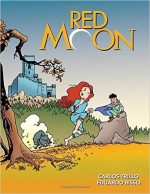
Red Moon


By Carlos Trillo & Eduardo Risso, translated by Zeljko Medic (Dark Horse/SAF Comics)
ISBN: 978-1616554477(HC)             eISBN: 978-1-62115-916-2
Dimensions: 221 x 22 x 283 mm

If you like a whiff of tongue in cheek whimsy with your fantastic fairytales you might want to take a look at this superb treat from prolific and much-missed Argentinean journalist/comics writer Carlos Trillo (Topo Gigio, Alvar Mayor, El Loco Chávez, Peter Kampf, Cyber Six, Point de rupture) and terrifyingly versatile illustrator Eduardo Risso (100 Bullets, Jonny Double, Parque Chas, Fulù, Simon, Boy Vampire), starring an affable boy acrobat and a tempestuous little princess.

Los misterios de la Luna roja was originally released as a quartet of comics between 1997 and 1998 by Ervin Rustemagić’s Balkan publishing powerhouse Strip Art Features and appears compiled in this stunning translated hardback thanks to Dark Horse Comics.

Kicking off with scene-setting epic ‘Bran the Invisible’ the supremely wry and deftly comedic action opens as junior tumbler Antolin and his showbiz mentors Crocker and Theo fetch up their travelling show in the extremely depressed and downhearted land of Burien.

Unable to raise a single smile or any approbation the lad soon learns that the kingdom is in mourning. Burien’s Lord and defender has been stricken with grief since his wife Tyl died. Moreover, their daughter Moon is both bonkers and prone to violence. She also talks to (shouts at and fights with) an invisible friend…

However after encountering the red-haired daughter of the despondent widower, Antolin is quickly forced to conclude that she’s not crazy at all…

His first clue is that unseen Bran apparently predicted the acrobat’s arrival and that the orphan boy would help Red Moon save the land. The clincher, though, is that something undetectable keeps hitting him.

There’s no time to waste since the marauding armies of cruel yet cowardly Lord of Leona are already making their uncontested way over the now-undefended borders…

And thus begins an epic confection with crucial quests, astounding odysseys, barbaric villains, fairy queens, witches, dragons and monsters as the valiant children and Bran flee the invasion, uncover the incredible truth of Tyl’s fate and seek to amass a meagre but prophesied army of incredible individuals to rescue Burien and restore Moon’s father to his previous competence and glory…

The saga concludes as Antolin and Red Moon return to the troubled land accompanied by their implausibly unbeatable ‘Attack Circus’ and a few useful Fairy trinkets, resolved to repel the vile invasion and deliver to the sadistic Leona his just deserts. However, that inevitable prospect provides no Happy Ever After for Antolin, who learns in the throes of triumph for Burian that his beloved mentors Theo and Crocker were sent to certain doom by the invaders…

Thus he sets off again, following their trail into ‘The Never Kingdom’ and is soon delighted to see Moon and (not see) Bran have followed their former partner-in-peril. Braving icy wastes, horrific beasts and a population of magically-mutated monsters, the kids challenge the power of wicked crone Panta and consequently discover that the malevolent sorceress and cannibal might perhaps be the long-lost mother of foundling Antolin…

Family feeling doesn’t count for much in Panta’s world, so there are few regrets after Moon discovers the secret of reversing the witch’s transformation spells and starts putting the Never Kingdom to rights…

The fabulously engaging, deliciously trenchant frolics then wrap up with the introduction of insalubrious junior jester Patapaf – and his ventriloquistic stick Pitipif – who play a critical role in the search for ‘The Book of All Dreams’.

With peace and joy restored to his subjects, the widowed Lord of Burian remarries but his new bride is almost immediately abducted by invulnerable ogre Lamermor de Granf to ensure that her husband will duel him for the right to rule Burien…

Outraged Moon can do nothing until she enjoys a fairy-sent dream and learns the smug giant has a hidden weakness. Setting off with Patapaf to find wandering showman Antolin and talking cat Blas Pascual de la Galera the little heroes invade Witch Queen Yaga‘s fortress and subconscious to ferret out the long-occluded means to destroy Lamermor and accidentally acquire an unlikely ally who will ensure their victory and a Happy Ending at last…

Fast, funny and filled with family-friendly action and thrills, Red Moon is a delirious double-edged delight, with knowing sophistication for adult readers working side-by-side with gloriously inventive takes on traditional tale-telling, all adeptly visualised by Risso’s magnificently surreal illustration.

Ideal bedtime reading for anybody and any time.
Red Moon™ & © 2005, 2006, 2014 SAF Comics. All rights reserved.