Yoko Tsuno volume 10: Message for Eternity


By Roger Leloup translated by Jerome Saincantin (Cinebook)
ISBN: 978-1-84918-251-5

The uncannily edgy yet excessively accessible European exploits of Japanese scientific adventurer Yoko Tsuno began first began gracing the pages of Spirou in September 1970 and are still going strong.

The explosive, eye-popping, expansively globe-girdling multi-award winning series was the brainchild of Roger Leloup, another hugely talented Belgian who worked as a studio assistant to Herge’s on The Adventures of Tintin before striking out on his own.

Compellingly told, superbly imaginative but always solidly grounded in hyper-realistic settings sporting utterly authentic and unshakably believable technology, these illustrated epics were at the vanguard of a wave of strips featuring competent, clever and brave female protagonists which revolutionised Continental comics from the last third of the 20th century onwards and are as potently empowering now as they ever were.

The initial Spirou stories ‘Hold-up en hi-fi’, ‘La belle et la bête’ and ‘Cap 351’ were short introductory vignettes before the superbly capable Miss Tsuno and her always awestruck and overwhelmed male comrades Pol and Vic truly hit their stride with premier extended saga Le trio de l’étrange which began serialisation with the May 13th 1971 issue.

That epic of extraterrestrial intrigue was the first of 27 European albums to date, and the on show here was first serialised in Spirou #1882-1905 (9th May-17 October 17th 1974) and released the following year as Message pour l’éternité. A skilfully suspenseful mystery thriller, it was chronologically the fifth album and reaches us as Cinebook’s tenth translated chronicle.

It all begins as ever-restless Yoko perfects her skills in a new hobby. Gliding high above Brittany she fortuitously sets down in a field near a vast telecommunications complex. Offered a tour of the space-probing facility she learns from one of the scientists of a fantastic “ghost message” recently picked up by satellites: a Morse code signal from a British plane lost in 1933. Moreover the signal is still being regularly broadcast…

When Yoko tries to arrange to have her glider picked up and sort out her own departure, a mysterious Englishman offers her a lift in his private helicopter. He has an ulterior motive: an employee of the company which insured the lost flight he is looking for someone with certain precise qualifications to trace the downed flight and recover a fortune in jewels from it. Her fee will be £20,000…

It transpires that his firm has known where the plane went down for some time, but geographical and logistic difficulties have prevented them from undertaking a recovery mission until now. Moreover, although they have now started the process, the petite engineer is physically superior to the candidates the company are currently working with…

Cautiously accepting the commission, Yoko starts planning but even before Pol and Vic can join her the following day, strange accidents and incidents begin to imperil her life…

The boys are understandably reluctant but that attitude turns to sheer frustration and terror after someone tries to shoot down Yoko as she practises in her glider. This only makes her more determined to complete the job at all costs.

Two weeks later the trio are heading to the daunting Swiss fortress the company uses as a base when another spectacular murder attempt almost ends their lives, but Yoko is undaunted. Not so Vic and Pol, especially after hearing that two of her fellow trainees have recently died in similar “accidents” in the mountains…

Carrying on regardless, she is introduced to the fantastic glider-&-launch system which will take her to the previously unattainable crash site and begins perfecting her landing technique in a fantastic training simulator.

Eventually more details are provided and the real story unfolds. The Handley-Page transport they are seeking was conveying diplomatic mail from Karachi to London in November 1933, but vanished in a storm over Afghanistan. Decades later a satellite somehow picked up a broken radio message stating it had landed… somewhere…

The businessman the trio call “Milord” identifies himself as Major Dundee – a spymaster from Britain’s Ministry of Defence – and explains how a shady American former U2 pilot approached the British government, claiming to have spotted the downed ship during a clandestine over-flight of Soviet territories.

He provided purloined photos showing the plane in the centre of a vast circular crater on the Russo-Chinese border, but subsequent reconnaissance flights revealed nothing in the hole and the decision was taken to make a physical assessment, even though the already inaccessible site was deep in hostile enemy territory…

Since then it has become clear that some unidentified agent or group is acting against the recovery project, probably intent on retrieving the ship’s mysterious but valuable cargo for a foreign power.

Events spiral out of control when a traitor in the training team attempts to kill Yoko and “Operation Albatross” is rushed to commencement before the unknown enemy can try again…

Within a day she is transported in a most fantastic and speedy manner around the world before her space-age glider prototype is secretly deployed over the enigmatic crater…

Narrowly avoiding patrolling Soviet jets, Yoko deftly manoeuvres into the mist-covered chasm and plunges into one of the most uncanny experiences of her life.

The old plane is certainly gone. The floor of the crater is strangely cracked and at the centre stands a strangely burned and blackened monolith, there are uncharacteristic animal bones everywhere and at one end of the vast cavity there is a primitive but large graveyard…

Whilst the astounded girl is exploring she is ambushed by her treacherous fellow trainee who has raced after her by conventional means and parachuted into the bizarre basin. However, his original plans have changed drastically since arrival and despite the machine gun he wields he needs Yoko’s help.

He’s already located the Handley-Page – somehow manually dragged under an unsuspected overhang in the crater – but is mortally afraid of what he describes as the “tiny people” infesting the terrifying impact bowl…

As the unlikely allies head towards the perfectly preserved plane, the truth about the terrifying homunculi is shockingly revealed and they encounter the last human survivor of downed Diplomatic Flight, discover to their supreme cost the uncanny and ultimately deadly atmospheric anomaly which has kept the plane a secret for decades and turned the crater into a vast geological radio set…

When the dust settles Yoko realises she is trapped in the subterranean anomaly. With all her escape plans rendered useless she must align herself with the bizarre sole survivor and his bestial, rebellious servants, but she also refuses to give up on the recovery mission.

Of course that doesn’t mean that she has to trust anything the old relic in the hole or Major Dundee has said. With that in mind she lays her own plans to settle matters…

As always the most potent asset of these breathtaking dramas is the astonishingly authentic and staggeringly detailed draughtsmanship and storytelling, which superbly benefits from Leloup’s diligent research and meticulous attention to detail, honed through years of working on Tintin.

With this sleekly beguiling tale Yoko proved that she was a truly multi-faceted adventurer, equally at home in all manner of dramatic milieus and able to hold her own against the likes of James Bond, Modesty Blaise, Tintin or any other genre-busting super-star: as triumphantly capable pitted against spies and crooks as alien invaders, weird science or unchecked force of nature…

This is a splendidly frenetic, tense thriller which will appeal to any fan of blockbuster action fantasy or devious espionage exploit.
Original edition © Dupuis, 1973, 1979 by Roger Leloup. All rights reserved. English translation 2015 © Cinebook Ltd.

The Bluecoats volume 4: The Greenhorn


By Willy Lambil & Raoul Cauvin, translated by Erica Jeffrey (Cinebook)
ISBN: 978-1-84918-014-6

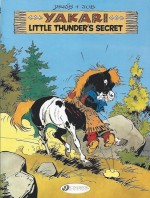
The modern myths and legends of the filmic American West have fascinated Europeans virtually since the actual days of owlhoots and gunfighters. Hergé and Moebius were passionate devotees and the wealth of stand-out Continental comics series ranges from Italy’s Tex Willer to such Franco-Belgian classics as Blueberry and Lucky Luke, and tangentially even children’s classics such as Yakari or colonial dramas such as Pioneers of the New World and Milo Manara and Hugo Pratt’s Indian Summer.

As devised by Louis “Salvé” Salvérius & Raoul Cauvin – who has scripted every best-selling volume – Les Tuniques Bleues (or as we know them The Bluecoats) debuted at the end of the 1960s, specifically created to replace Lucky Luke when the laconic gunslinger defected from weekly anthology Spirou to rival publication Pilote.

The substitute swiftly became one of the most popular bande dessinée series in Europe.

Salvé was a cartoonist of the Gallic big-foot/big-nose humour style, and when he died suddenly in 1972 his replacement, Willy “Lambil” Lambillotte slowly introduced a more realistic – but still broadly comedic – illustrative tone and manner. Lambil is Belgian, born in 1936 and, after studying Fine Art in college, joined publishing giant Dupuis as a letterer in 1952.

Born in 1938, scripter Cauvin is also Belgian and before entering Dupuis’ animation department in 1960 studied Lithography. He soon discovered his true calling – comedy writing – and began a glittering and prolific career at Spirou. In addition to Bluecoats he has written dozens of long-running, award winning series including Cédric, Les Femmes en Blanc and Agent 212: more than 240 separate albums. The Bluecoats alone has sold more than 15 million copies of its 58 album series.

As translated for English audiences, our sorry, long-suffering protagonists are Sergeant Cornelius Chesterfield and Corporal Blutch: a pair of worthy fools in the manner of Laurel & Hardy, hapless, ill-starred US cavalrymen posted to the wild frontier and various key points of fabled America during the War Between the States.

The original format featured single-page gags set around an Indian-plagued Wild West fort, but from the second volume Du Nord au Sud (North and South) the sad-sack soldiers went back East to fight in the American Civil War (a tale was rewritten as 18th album Blue rétro to describe how the chumps were drafted during the war).

Every subsequent adventure, although often ranging far beyond America and taking in a lot of thoroughly researched history, is set within the timeframe of the Secession conflict.

Blutch is your average whinging little-man-in-the street: work-shy, mouthy, devious and especially critical of the army and its inept commanders. Ducking, diving, even deserting whenever he can, he’s you or me – except sometimes he’s quite smart and heroic if no other (easier) option is available.

Chesterfield is a big burly fighting man; a career soldier who has passionately bought into all the patriotism and esprit-de-corps of the Military. He is brave, never shirks his duty and wants to be a hero. He also loves his cynical little troll of a pal. They quarrel like a married couple, fight like brothers and simply cannot agree on the point and purpose of the horrendous war they are trapped in…

The Greenhorn was the fourth translated Cinebook album (chronologically 14th Franco-Belgian volume Les Tuniques Bleues: Le blanc-bec) and opens with a grand Officer’s Ball in distant, desolate Fort Bow. As the festivities continue, out in the moonlit desert two weary cavalrymen wend their way towards the stockade…

Chesterfield and Blutch have just returned for three weeks leave and are infamous amongst the troops as regular survivors of the quite mad Captain Stark’s Suicide Regiment – as well as for their own reputation for starting fights.

It’s for that reason that the guards don’t want to mention that Colonel Appleton‘s beautiful daughter Emily has been dancing with a dashing young Lieutenant named George. Every man there knows Chesterfield is smitten with her and has a hair-trigger temper these days…

The news nearly incites the sergeant to mass-murder and it takes all Blutch’s guile to convince his pal to ride into town – and Charlie’s Saloon – instead. Sadly Chesterfield’s well-earned reputation for trouble is just as feared there and when an Indian boy is bullied by local drunks the spoiling-for-trouble sergeant – subtly prodded by underdog-loving Blutch – gleefully steps in…

By the time the harried barman reaches Fort Bow and brings back a contingent of troops, Chesterfield has decimated most of the saloon and all of the patrons and is hungry for more. When brash neophyte Lieutenant George slaps the enraged enlisted man, all hell breaks loose…

Events spiral even further out of control after the patrol final drags the unrepentant sergeant back to the Fort. When the little native lad, dragged along as a witness, takes his chance to escape, he is shot by the flustered “greenhorn” officer.

It is both a tragedy and a disaster: the boy is the son of Chief Gray Wolf who, on discovering what’s happened, demands that whoever perpetrated the appalling act be surrendered to his justice.

…Or else it’s war…

When Chesterfield and Blutch discover exactly who George is, the little corporal flees, rushing off to the encamped hostiles and claiming he was responsible. Chesterfield, not to be outdone in the guilt stakes, also owns up and baffled Gray Wolf is nearly driven crazy when bold, brave, stupid and honourable Colonel Appleton also rides into camp and takes the blame…

A tense compromise is reached as Gray Wolf agrees to let the “Long Knives” treat his gravely wounded boy; decreeing that if he lives they will be no war, but if the morning brings bad news the entire fort and town will suffer…

With a little time bought, the Colonel deals with his most immediate problem. After a ferocious dressing down Chesterfield and Blutch are sent back to Stark’s Suicide Regiment and – over Emily’s hysterical protestations – George goes with them…

Days later the trio rendezvous with Stark’s dispirited contingent as he manically battles Confederate forces. The Captain’s sole tactic is to have his men charge straight at their artillery, presumably in the certain knowledge that the enemy must run out of ammunition eventually…

Blutch and Chesterfield have developed a tactic which has kept them alive so far and, having sworn to Emily to keep George safe, force him to employ it too. However the guilt-ridden, hero-struck fool is unhappy with the shameful strategy and soon starts throwing himself into the thick of battle, intending to die with dignity…

When word comes of the recovery of Gray Wolf’s son, their ordeal seems over and, with honour satisfied, all three make a grateful departure from Stark’s depleted forces. Typically however just as a peace (and quiet) seems likely, Blutch and Chesterfield find another way to set the West ablaze and drive the natives to the brink of war…

This is another hugely amusing anti-war saga targeting young and less cynical audiences. Historically authentic, and always in good taste despite its uncompromising portrayal of violence, the attitudes expressed by the down-to-earth pair never make battle anything but arrant folly and, like the hilarious yet insanely tragic war-memoirs of Spike Milligan, these are comedic tales whose very humour makes the occasional moments of shocking verity doubly powerful and hard-hitting.

Fun, informative, beautifully realised and eminently readable, Bluecoats is the sort of war-story that appeals to the best, not worst, of the human spirit.
© Dupuis 1979 by Lambil & Cauvin. English translation © 2010 Cinebook Ltd. All rights reserved.

The Magician’s Wife


By Jerome Charyn & François Boucq, with Foreword by Drew Ford (Dover Comics & Graphic Novels)
ISBN: 978-0-486-80049-3

Although all comics evolved from products designed to appeal to a broad variety of age ranges, we have finally reached a stage in our culture where individual stories and collaborations always intended by their creators to appeal to older or intellectually select audiences are now commonplace and acceptable.

What that means in simple terms is that complex, controversial and challenging graphic narratives which have come and largely gone unheralded now have an ideal opportunity to reach the mass audiences they were intended for and who deserve them…

A sublime case-in-point is this astounding, groundbreaking and compellingly wonderful transatlantic collaboration originally released in 1986, and which shone brightly but briefly; winning immense critical acclaim and glittering prizes from the comics cognoscenti yet barely troubling the mass public consciousness within or outside our particular art form’s bubble. Now after nearly thirty years in fabled obscurity it gets another chance to become the universally lauded masterpiece it deserves to be…

La Femme du magicien by American crime author and graphic novelist Jerome Charyn (Johnny One-Eye, I Am Abraham, Citizen Sidel series, Bitter Bronx: Thirteen Stories) and French illustrator François Boucq (Bouncer, Sente, Bouche de diable, Billy Budd, KGB) won numerous awards at the Angoulême International Comics Festival and elsewhere and even enjoyed a rare English Language translation in 1988 before dropping out of comics consciousness. Now their breakthrough masterpiece is back, visually remastered and re-translated by Charyn himself.

Following a piquant personal reminiscence in the Foreword by Dover Editor Drew Ford and intimate insights from the author in ‘A Note to the American Reader’ the twice-told tale begins, draped in dangerous and disturbing overtones of magic realism and tracing a chillingly unique co-dependent relationship between a servant’s daughter and a mercurial, mother-oppressed young man who always wanted to make magic …

Events begin to unfold in Saratoga Springs in 1956 as a weary jockey stumbles into an eerie old house and befriends precocious little Rita, daughter of the cook/housekeeper. The florabundant old pile is redolent of suppressed hostility and perilously-pent tensions, with a macabre old harpy ruling the roost but also teems with strange sights and obscure illusions thanks to the creepy son of the house’s owner.

Edmund is a scary and charming teenager who knows lots of legerdemain and many tricks of the prestidigitator’s art…

Little Rita daily lives with a host of animals (real or imagined?) but is only truly disturbed by Edmund’s outrageous attentions. He says it’s the proper way for a magician to court his future bride…

Feeling distressingly like observers of grooming-in-action, we see the child is fascinated by his hot-and-cold attentions, making her shocking discovery of Edmund’s callous sexual dalliances with her blowsy, lumpen mother all the more hurtful…

Four years later they are in Moscow, having escaped the crushing atmosphere of the old house and the forbidding matriarch. Rita’s mum is Edmund’s Famulus Mrs Wednesday, a living prop and stage assistant enduring a barrage of humiliating transformations and subtly guided and controlled by Edmund’s harsh declarations of love as Rita wonderingly watches from the wings, gradually maturing into a beautiful young toy.

By 1962 she is the centre of attention in theatres all around the world and Edmund’s intentions have become blatant. The grand gesture comes in Paris where in an act of extraordinarily callous cruelty he demotes faithful, doting Mrs Wednesday to the role of Rita’s Dresser and makes the teenaged daughter his co-star and assistant – to the lustful appreciation of the huge theatre audiences who seem captivated by his remarkably imaginative but savagely mortifying conjuring act…

Edmund has been personally educating Rita for years, but something strange happens on stage in London in 1963 when his precious “Miss Wednesday”, in the middle of his signature shameful hypnosis game, suddenly transforms into a monstrous beast apparently beyond the magician’s control…

They married in Munich in 1967 but the wedding night was marred by Rita’s memories of what her husband used to so blatantly do with her mother. Moreover, the axis of power seems to have shifted and Rita is increasingly the one calling the shots…

The crisis comes later when Rita’s mother is found mysteriously dead and the daughter’s long-suppressed passions explode…

Some time afterward, Rita is a waitress in a New York City Diner just trying to forget. Sadly her looks make her a target for both scuzzy lowlifes and simple-minded, paternalistic protectors and only the fact that cops frequent the eatery keep her even marginally safe. Haunted by ghosts and memories, she pushes her luck one night crossing through a park and is attacked by her most persistent admirers. It’s only after she viciously fights them off that a disturbing apparition manifests…

She feels pursued from all sides – by her attackers keen on silencing her, a kindly war veteran who wants to keep her safe and a persistent if painfully familiar vision – and Rita’s life spirals out of control. When Edmund seemingly shows up, a savage monster starts slaughtering visitors to the park and peculiar French detective Inspector Verbone takes an interest in her, apparently possessing impossible secrets and arcane insights when he arrives at her ratty apartment.

When events spiral to a bloody and so very unjust conclusion, Rita flees, taking a bus to Saratoga where she finds some very familiar folk and a cataclysmic, elemental and hallucinatory climax waiting for her…

Bizarre, baroque, phantasmagorical and wickedly playful, this is a story that can’t really be deconstructed, only ridden like a maddened, stampeding horse and then pondered at leisure while your bruises heal. If you like your mysteries complex and inexplicable and your love stories dauntingly bleak and black, you really should make the acquaintance of The Magician’s Wife…
© 1987 Jerome Charyn and François Boucq. Introduction © 2015 Jerome Charyn. Foreword © 2015 Drew Ford. All rights reserved.

The Magician’s Wife will be released November 27th 2015 and is available for pre-order now. Check out www.doverpublications.com, your internet retailer or local comics-store or bookshop.

Iznogoud the Relentless


By Goscinny and Tabary, translated by Jerome Saincantin (Cinebook)
ISBN: 978-1-84918-181-5

For the greater part of his far-too-short lifetime (1926-1977), René Goscinny was one of the most prolific and widely-read writers of comic strips in history. He still is.

Amongst his most popular and enduring comic collaborations are Lucky Luke, Le Petit Nicolas, Signor Spaghetti and, of course, Asterix the Gaul, but there were so many others, such as the despicably dark deeds of a dastardly usurper whose dreams of diabolical skulduggery perpetually proved to be ultimately no more than castles in the sand…

In the wake of the Suez crisis, the French returned – by way of comics, at least – to the hotly contested deserts when Goscinny teamed with hugely gifted Swedish émigré Jean Tabary (1930-2011) – who numbered Richard et Charlie, Grabadu et Gabaliouchtou, Totoche, Corinne et Jeannot and Valentin le Vagabond amongst his other hit strips – to detail the innocuous history of imbecilic Arabian (im)potentate Haroun el-Poussah.

However, as is so often the case, it was the strip’s villainous foil, power-hungry vizier Iznogoud, who stole the show… possibly the conniving little blackguard’s only successful insurrection.

Les Aventures du Calife Haroun el Poussah was created for Record; the first episode appearing in the January 15th issue of 1962. A petite hit, the feature subsequently jumped ship to Pilote – a new comics magazine created and edited by Goscinny – where it was artfully refashioned into a starring vehicle for the devious little Tuareg toe-rag who had increasingly been hogging all the laughs and limelight.

Insidious Iznogoud is Grand Vizier to affable, easy-going Caliph of Ancient Baghdad Haroun Al Plassid, but the sneaky little second-in-command has loftier ambitions, or as he is always declaiming “I want to be Caliph instead of the Caliph!”…

The retooled rapscallion resurfaced in Pilote in 1968, quickly becoming a massive European hit, resulting in 29 albums to date, his own solo comic, a computer game, animated film, TV cartoon show and even a live-action movie.

Like all great storytelling, Iznogoud works on two levels: for youngsters it’s a comedic romp with adorably wicked baddies invariably hoisted on their own petards and coming a-cropper, whilst older, wiser heads can revel in pun-filled, witty satires and superbly surreal antics.

This same magic formula made its more famous cousin Asterix a monolithic global phenomenon and, just like the saga of the indomitable Gaul, the appallingly addictive Arabian Nit was first adapted into English by master translators Anthea Bell & Derek Hockridge who make all that foreign stuff so very palatable to picky British tastes.

Following Goscinny’s death in 1977, Tabary began scripting his own tales, switching to book-length complete adventures rather than the short, snappy vignettes which typified his collaborations. Upon his passing, Tabary’s children Stéphane, Muriel and Nicolas took over the franchise.

The deliciously malicious whimsy is always heavily dosed with manic absurdity, cleverly contemporary cultural critiques and brilliantly delivered creative anachronisms which serve to keep the assorted escapades bizarrely fresh and hilariously inventive.

Iznogoud l’acharné was originally released in 1974, the tenth outrageously exotic album compilation, offering another quintet of trend-setting tales with our ambitious autocrat scheming to seize power from his good but gullible Lord and Master, and following the traditional introductory page introducing our tawdry star and other regulars, the devious deceptions resume with ‘The Malefic Hopscotch Grid’.

The origins of that venerable children’s pastime is traced back to beleaguered Baghdad where ignoble Iznogoud has hired a sorcerer to turn the Caliph into a child, thereby making the Vizier the only choice for Regent. All the target has to do is skip the number-squares in the right order to be rejuvenated right out of office…

Sadly as everybody knows the urge to jump on the devilish design is irresistible and almost all of Baghdad tries the game before unlucky Iznogoud can get the Caliph to give it a go. Moreover all those pesky kids milling about make the Vile Vizier hopping mad…

It’s Haroun Al Plassid’s birthday and his legendarily miserly servant Iznogoud is scouring the bazaar in search of the cheapest piece of tat he can find for a present when he meets a strange merchant selling the oddest items. Of course the vizier plays his usual unfair haggling tricks so the vendor magically despatches him to ‘Souvenir Island’: a peculiar place packed with the absurdest absurdist trash of all the ages…

When a new charmer from India sets up in Baghdad, Iznogoud dashes straight over to see what the magician has in the way of obstacle-removers. Mumbaijumbo is ‘The Merchant of Forgetfulness’ and eventually remembers to flog the villainous vizier a perfume which causes instant amnesia, but of course getting the Caliph to sniff the sinister smelly-stuff is fraught with calamity and peril…

A far better weapon to advance Iznogoud’s evil ambition is ‘The Doggy Flute’ used by a Chinese mage to turn rude people, bullies and obnoxious boors into cute canines. Sadly Iznogoud, after fooling the wizard into parting with the flute and teaching him the tricky tune needed to operate it, loses the refrain and his frantic practising causes all manner of animal magic to run wild before justice catches up with him…

The sandy silliness reaches the summit of time-bending barmyness when another Indian magic-man arrives bearing ‘The Magic Catalogue’.

Uatsdhada (Mage) leaves the venal vizier his copy of the incredible grimoire Seers of Bombay from which the owner can summon items from all of time and space. There are drawbacks of course: only three items can be ordered and, although there are pictures and descriptions, a client’s basic knowledge limits what he can even recognise…

Thus instead of guns or bombs the nasty nabob summons such wicked-looking instruments of torture as exercise bikes to deal with imperial impediment Haroun Al Plassid, all the while blithely unaware that there is an actual plot against the Caliph by traitors who actually know what they’re doing and might get the job done as long as nobody gets in their way…

Such convoluted witty, fast-paced hi-jinks and craftily crafted comedy set pieces have made this addictive series a household name in France where “Iznogoud” is common parlance for a certain kind of politician: over-ambitious, unscrupulous – and frequently insufficient in inches (or should that be centimetres?).

Desiring to become “Caliph in the Caliph’s place” is a popular condemnation in French, targeting those perceived as overly-ambitious, and since 1992 the Prix Iznogoud is awarded annually to “a personality who failed to take the Caliph’s place”.

Nominees are chosen from prominent French figures who have endured spectacular failures in any one year and been given to the likes of Édouard Balladur (1995) and Nicolas Sarkozy (1999). The jury panel is headed by politician André Santini, who gave himself one after failing to become president of Île-de-France in regional elections in 2004.

When first released in Britain during the late 1970s and 1980s (and again in 1996 as a periodical comicbook) these tales made little impression, but at last this wonderfully beguiling strip has deservedly found an appreciative audience among today’s more internationally aware, politically jaded comics-and-cartoon savvy connoisseurs…
Original edition © 2013 IMAV éditions by Goscinny – Tabary. All rights reserved. English translation © 2013  Cinebook Ltd.

Melusine volume 2: Halloween


By Clarke (Frédéric Seron) & Gilson, coloured by Cerise and translated by Erica Jeffrey (Cinebook)
ISBN: 978-1-905460-34-2

Teen witches have a long and distinguished pedigree in fiction and one of the most engaging first appeared in venerable Belgian magazine Spirou in 1992.

Mélusine is actually a sprightly 119 year old who spends her days working as an au pair in a vast monster-packed, ghost-afflicted chateau whilst diligently studying to perfect her craft at Witches’ School…

The long-lived feature offers everything from one-page gag strips to full-length comedy tales on supernatural themes detailing her rather fraught life, the impossibly demanding master and mistress of the castle and her large circle of exceedingly peculiar family and friends.

Collected editions began appearing annually or better from 1995, with the 24th published in 2015 and another due next year. Thus far five of those have transformed into English translations thanks to the fine folk at Cinebook.

The strip was devised by writer François Gilson (Rebecca, Cactus Club, Garage Isidore) and cartoon humorist Frédéric Seron, AKA Clarke whose numerous features for all-ages Spirou and acerbic adult humour publication Fluide Glacial include Rebecca, Les Cambrioleurs, Durant les Travaux, l’Exposition Continue… and Le Miracle de la Vie.

Under the pseudonym Valda, Seron also created Les Babysitters and, as Bluttwurst, Les Enquêtes de l’Inspecteur Archibaldo Massicotti, Château Montrachet, Mister President and P.38 et Bas Nylo.

A former fashion illustrator and nephew of comics veteran Pierre Seron, Clarke is one of those insufferable guys who just draws non-stop and is unremittingly funny. He also doubles up as a creator of historical and genre pieces such as Cosa Nostra, Les Histoires de France, Luna Almaden and Nocturnes and apparently is free from the curse of having to sleep…

Halloween was the eighth Mélusine album, originally released in 2001, and gathers a wealth of stunning seasonally sensitive strips, making it a great place for newcomers to start as the majority of the content is comprised of one or two page gags starring the sassy sorceress who – like a young but hot Broom Hilda – makes excessive play with fairy tale and horror film conventions and themes.

When brittle, moody Melusine isn’t being bullied for her inept cleaning skills by the matriarchal ghost-duchess who runs the castle, or ducking cat-eating monster Winston and frisky vampire The Count, she’s avoiding the attentions of horny peasants, practising her spells or consoling and coaching inept, un-improvable and lethally unskilled classmate Cancrelune.

Mel’s boyfriend is a werewolf so he only bothers her a couple of nights a month…

Daunting dowager Aunt Adrezelle is always eager and happy to share the wisdom of her so-many centuries but so, unfortunately, is family embarrassment cousin Melisande who spurned the dark, dread and sinisterly sober side of the clan to be a Fairy Godmother; all sparkles, fairy-cakes, pink bunnies and love. She’s simplicity, sweetness and light itself in every aspect, so what’s not to loathe…?

This turbulent tome riffs mercilessly on the established motifs and customs of Halloween where kids fill up to lethal levels on sweets and candies, monsters strive to look their worst, teachers try to keep the witches-in-training glued top their books and grimoires even as their over-excitable students experiment most unwisely on what to do with pumpkins – including how to grow, breed or conjure the biggest ones – whilst the fearfully pious local priest and his flock endeavour to ruin all the magical fun…

Even Melisande gets in on the party atmosphere in her own too nice-to-be-true manner, lightening the happy shadows with too much sunshine and saccharine before the collection ends with the extended eponymous ‘Halloween’ wherein Melusine and Cancrelune learn the true meaning of the portentous anniversary when they inadvertently join the creaking clacking cadavers of the Risen Dead as they evacuate their graves on the special night to fight and drive away for another year the Evil Spirits which haunt humanity…

Wry, sly, fast-paced and uproariously funny, this compendium of arcane antics is a great taste of the magic of European comics and a beguiling delight for all lovers of the cartoonist’s art. Read before bedtime and don’t eat any hairy sweets…
Original edition © Dupuis, 2000 by Clarke & Gilson. All rights reserved. English translation 2007 © Cinebook Ltd.

The Rugger Boys volume 1: Why Are We Here Again?


By Béka & Poupard with colour work by Sylvain Frecon & Murielle Rousseau, translated by Luke Spear (Cinebook)
ISBN: 978-1-905460-33-5

Human beings – and apparently a huge variety of our pets and animal housemates – seem obsessed with and are delighted by chasing balls about. So much so that we/they even apply a range of convoluted sets of rules to the sheer exhilaration of the process, just to make things more difficult and artificially extend proceedings.

We call it sport and when it’s not hugely thrilling and deadly serious it can be hilariously funny…

Comics over the decades and throughout the world have often mined our obsession with assorted games for secondary entertainment value and this Cinebook compilation gathers a fine bunch of strips starring a dedicated amateur team of French gladiators all painfully enamoured of the manly (and British-originated) ball-based pastime called Rugby…

Les Rugbymen: was created in 2005 by writing partnership Bertrand Escaich & Caroline Roque under their collaborative nom de plume Béka (Studio Danse, Les Fonctionnaires) in conjunction with self-taught illustrator Alexandre Mermin, who generally labours under the pseudonym Poupard (Chez Gaspard, Les Brumes du Miroboland).

The resulting flurry of short sharp gags and yarns have filled an even dozen albums thus far. There’s even a junior league spin-off which began in 2010 entitled Les Petits Rugbymen…

On n’est pas venus pour être là! was the third Euro-volume but the first to be translated by Cinebook – probably because it features a brief sporting tour of England – and perfectly encapsulates the passion, toil and sheer testosterone-idiocy which can warp normally rational folk.

Our stars are a few dedicated souls faithfully enjoying the trials of club rugby (and that’s Rugby Union, right?) as played by the stalwarts of fictional south-western French town side Paillar Athletic Club, affectionately known to their frankly obsessive fans as The PAC…

As seen on the introductory page, the usual suspects generally manifest as intellectually compromised Hooker Lightbulb, Herculean Prop Fatneck, 2nd Row star The Anaesthetist, dashing sex-crazed Back Romeo and Scrumhalf/Captain The Grumpster, all regularly adored and vilified by The Coach who never lets his speech defect get in the way of a good insult to the dozy slackerrrs…

All you need to know is that these guys are bold, sturdy and love to eat and drink as much as they do smashing each other into the mud…

The exploits are generally delivered as single page sequences, lavishly, lovingly and outrageously illustrated and jam-packed with snippets of off-kilter slapstick to supplement the main gag and the material. Content is almost everything you’d expect from such a fixture: big beefy blokes in very small towels, lots of booze-fuelled gaffes, eating eccentricities, knob jokes and the mutual sportsmanlike skulduggery which permeates all games Real Men compete in…

However also on display are a profusion of smartly-planned running gags and little comedic gems such as the well-meaning meatheads’ ongoing efforts to help Lightbulb find “love”, Romeo’s constant comeuppances from husbands, boyfriends and employers unhappy with his off-pitch conquests and The Coach’s eternal battle to whip his band of idiots into a team he can be proud of…

As previously mentioned, this collection also contains a wry, preconception/prejudice-confirming international excursion when The PAC accept an offer to play a friendly match against British college side Camford. As well as a chance to pummel the despised English, there’s the promise of seeing a Six Nations match to offset the unbearable pain of living on the foreigners’ appalling food and pathetic beer…

Fast, furiously funny and splendidly boisterous, these are the kind of cartoon antics that might even inspire dedicated couch-potatoes to get out of the house – unless they order books and dinner online…
© BAMBOO EDITION, 2006 by Béka & Poupard. All rights reserved. English translation © 2007 Cinebook Ltd.

Cedric volume 1: High-Risk Class


By Laudec & Cauvin with colours by Leonardo and translated by Erica Jeffrey (Cinebook)
ISBN: 978-1-905460-68-7

Raoul Cauvin is one of Europe’s most successful comics scripters. Born in Antoing, Belgium in 1938, he joined Dupuis’ animation department in 1960 after studying the dying and much-missed print production technique of Lithography.

Happily he quickly discovered his true calling – comedy writing – and began a glittering and prolific career at Spirou where he devised (with Salvérius) the astoundingly successful Bluecoats as well as dozens of other long-running, award winning series such as Sammy, Les Femmes en Blanc, Boulouloum et Guiliguili, Cupidon, Pauvre Lampil and Agent 212: cumulatively shifting more than 240 separate albums. Bluecoats alone has sold more than 15 million copies so far.

His collaborator on kid-friendly family strip Cedric is Italian born, Belgium raised Tony de Luca who studied electro-mechanics and toiled as an industrial draughtsman until he could make the break into comics.

After a few fanzine efforts in the late 1970s, in 1979 as Laudec he landed soap-style series Les Contes de Curé-la-Fl’ûte at Spirou and built it into a brace of extended war-time serials (L’an 40 in 1983 and Marché Noir et Bottes à Clous in 1985) whilst working his way around many of the title’s other strips.

In 1987 he united with Cauvin on the first Cédric shorts and the rest is history… and science and geography and PE and…

We have Dennis the Menace and the Americans have one too – but he’s not the same – whilst the French-speaking world has Cédric: a charming little rapscallion with a heart of gold and an irresistible streak of mischief dogging his heels. Collected albums of the short, sharp strips – ranging from a ½ page to half a dozen – began appearing in 1989 (with 29 released so far) and are always amongst the most popular and best-selling on the continent, as is the animated TV show spun off from the strip.

This first Cinebook translation – from 2008 and originally continentally released as Classe tous risques in 1990 – was the third compilation and hauls straight in to the action as the little lout is surprised by the introduction of ‘The New Girl’ to the class.

Previously, overly-imaginative Cedric had been utterly enamoured of his teacher Miss Nelly but when Chen is introduced his mind and heart go into fantasy overdrive. She’s different, her skin isn’t the same colour as everybody else’s and she talks really funny.

Of course a proper gentleman would have a better and less dangerous way of saying that to a newcomer’s face. Happily, however, Cedric’s gaffe is an opportunity for demure but feisty Chen to properly break the ice…

When the restless lad and his best friend Christian get hold of some stink bombs an awful lot of surprised adults are forced to cry ‘What Stinks?’ but the peewee pranksters eventually go too far and are trapped in their own efforts, whereas when Cedric attempts to cheat in a geography competition involving ‘Balloons’ the repercussions are all on him alone…

His deviltry actually succeeds with no comeback when he sabotages the ‘Olympic Disciplines’ of excessively keen Games Master Mr Oliver but when Cedric tries to obscure his latest bad report card by getting injured and crying for ‘Nurse Mum’ his tactics are sorely mistaken…

There’s more social angst – and unleashed aggression – in store when Christian confuses Chinese Chen with Vietnamese ‘Boat People’ and shares his “expertise” with our gullible star but the boys are soon pals again and summarily run amok with a radio-controlled car in ‘Driving Under the Influence of Laughter’ after which Grandpa lands in the doghouse when Cedric steals his champagne and gets disastrously hammered on his ‘First Sip’…

Disclosing he is over Miss Nelly, the love-struck lad goes completely over the top with ‘The Gift’ he has chosen to win Chen, which leads to near disaster when he manfully decides he must let his deserted older woman down gently in ‘One Love Follows Another…’

Typically, Cedric picks the very moment after his teacher has received some extremely upsetting news…

Focus satirically switches to conservative, reactionary Grandpa who takes the news that Cedric is seeing a Chinese girl with an appalling lack of understanding, taste or decorum in ‘The Oil Can’ but it’s the boy who’s soon back in everyone’s bad books when he swaps suntan oil for toothpaste in ‘Bathing Beauties’.

At least his classmates still respect him, especially Freddy who needs all the escape tips he can get after delivering ‘The Report’ of his latest scholastic disgraces to his own furious father whilst Cedric’s family are subjected to cruel and unusual punishment when neighbours ‘Crazy for Television’ invite themselves over…

This introductory album hilariously concludes as Cedric decides to use a school ‘Picnic’ to tell Chen of his feelings, despite the sustained mockery of his mates. Of course his courage is no substitute for discretion or tact and when he goes too far again, at least the boys are there to console and medicate him…

Rapid-paced, warm and witty, the adventures of this painfully keen, young romantic scallywag are a charming example of how all eight year boys are just the same and infinitely unique. This is a solid family-oriented comics book no one trying to introduce youngsters to the medium should be without.
© Dupuis 1990 by Cauvin & Laudec. All rights reserved. English translation © 2008 Cinebook Ltd.

Long John Silver volume III: The Emerald Maze


By Xavier Dorison & Mathieu Lauffray, translated by Jerome Saincantin (Cinebook)
ISBN: 978-1-84918-105-1

British and European comics have always been far more comfortable with period-piece strips than our American cousins and much more imaginative when reinterpreting classical fiction for jaded comicbook audiences. The happy combination of familiar exoticism, past lives and world-changing events blended with drama, action and, most frequently, broad comedy has resulted in a uniquely narrative art form suited to beguiling readers of all ages and tastes.

Our Franco-Belgian associates in particular have made an astonishing success out of repackaging days-gone-by but this particularly enchanting older-readers yarn forgoes the broad belly-laughs whilst extending the adventures of literature’s greatest rogue into a particularly engaging realm of globe-girdling thriller.

Robert Louis Stevenson’s Treasure Island was originally serialised from 1881-1882 in Young Folks magazine as Treasure Island or, the mutiny of the Hispaniola, as pseudonymous penned by one “Captain George North”.

It was collected and published as a novel in May 1883 and has never been out of print since. A landmark of world storytelling, Treasure Island has been dramatised too many times to count and adapted into all forms of art. Most significantly, the book created a metafictional megastar – albeit at best an anti-hero – as immortal as King Arthur, Robin Hood, Sherlock Holmes, Tarzan or Superman. Almost everything the public “knows” about pirates devolves from the book and its unforgettable, show-stealing one-legged antagonist…

Writer Xavier Dorison was born in Paris in 1970 and graduated business school before moving into storytelling. He works as an author, film writer, lecturer and movie script doctor. He began the award-winning Long John Silver in conjunction with preferred collaborator Mathieu (Prophet) Lauffray in 2006, with the last volume released in 2013.

Lauffray is also a Parisian born in 1970. He spends his days illustrating, drawing comics, crafting games and concept designing for movies. His art has graced international items as varied as Dark Horse’s Star Wars franchise, games like Alone in the Dark, the album Lyrics Verdun, February 21, 1916 – December 18, 1916, Tarzan and much more…

Their collaborative exploration of the piratical prince’s later years is a foray into far more mature arenas set decades after the affair of the Hispaniola and ranges far and wide: from foggy, oppressive England to the vast, brooding inner recesses of the Amazon.

What has Gone Before: in 1785 treasure-hunting Lord Byron Hastings found the lost bastion of Guiana-Capac but needed further funds to exploit this fabulous City of Gold.

In England, his profligate and wanton wife Lady Vivian had been enjoying herself too much and was with child by lecherous neighbour Lord Prisham. With a baby in her belly and a husband gone three years, she was considering having Byron declared dead and undertaking a hasty remarriage…

Suddenly shattering those plans her despised brother-in-law turned up with an aged, garish tribesman named Moxtechica bearing a message and map from her long-lost husband. Prudish and cruel, Royal Naval officer Edward Hastings gleefully told the scheming strumpet he abhorred that his brother had succeeded and demanded she sell everything – including all the treasured family possessions, manor house and lands she brought to the marriage – to finance his return…

Byron named Edward sole Proxy and the martinet delighted in giving high-born trollop Vivian her marching orders. He even urged her to confine herself to a convent and save them all further shame and disgrace…

Raging in front of her conniving maid Elsie, the Lady considered a number of retaliatory tactics before settling upon the most bold, dangerous and potentially rewarding. After announcing to the stunned Edward that she would accompany him to South America and reunite with her beloved husband, the fallen noblewoman sought out a doctor to take care of the biological problem she was still secretly carrying…

Dr. Livesay was a decent, god-fearing soul who led a quiet, prosperous life ever since his adventures on Flint’s Island. However, it was not just her condition which brought Vivian to the physician’s door, but also persistent tales of a former acquaintance; a formidable, peg-legged rogue with a reputation for making life’s difficulties disappear…

Against his better judgement, Livesay capitulated to Vivian’s urgings and introduced her to retired sea-cook John Silver. Amidst the (alleged) ex-pirate’s inner circle of scary-looking confederates she spun the story of the Spaniard Pizarro‘s discovery of a City of Gold and how, centuries later, her husband had reclaimed it.

She wanted to travel there with a few capable men and make those riches her own and needed Silver and his colleagues to infiltrate Edward’s crew, seize the ship he chartered and complete the voyage under her command…

Unable to convince Vivian to desist or Silver to reject her offer, Livesay reluctantly joined them in vain hopes that he could keep the debased woman from mortal harm. Nobody was aware that Silver concealed a debilitating and soon-to-be-fatal affliction as the rascal orchestrated his own hiring and packed the Neptune with suitable scoundrels and compelled Lady Vivian to sign a sacrosanct Pirates Contract.

With all the various schemers believing their own plans were proceeding satisfactorily, the Neptune set sail for the Americas, but at the last moment Silver suffers a major setback when rival rogue Paris inveigled his way into the crew…

As the tension-driven voyage progressed, Silver’s men, Paris’ contingent and even Captain Hastings’ innocent hires all slowly succumbed to the Sea Cook’s glib tongue and fascinating tales of the Red Brotherhood.

Only Hastings’ lieutenants Dantzig and Van Horn had any inkling of the battle of wills occurring below decks, but even that shaky détente shattered after Elsie was murdered. Well-aware that everybody aboard was gripped by gold-fever, Hastings tried to rule with a rod of iron and full naval discipline. Settling upon boy seaman Jack O’Kief (a protégé of Paris, but beloved by Silver) as responsible for the maid’s death, Hastings had him brutally flogged.

A vicious and prolonged battle of wills followed, pushing the crew to the edge of mutiny. Hastings delayed making final landfall on the tantalisingly close South American coast and strained tensions exploded just as a colossal storm pushed Neptune inexorably towards its foregone destination. An inevitable mutiny erupted, resulting in appalling bloodshed and a red-handed settling of many scores…

Literally above it all, old shaman Moxtechica rode out both tempests, patiently waiting to see what the calm of dawn might bring…

The Emerald Maze opens in the ghastly aftermath of the maelstroms of human and natural forces with the becalmed and battered Neptune drifting idly off-shore and the survivors reeling aimlessly on her decks. In sight of terrifying cliffs, the stunned rabble are near panic and babbling of sailing on to Tortuga until Silver’s ferocious tongue-lashing brings them to heel.

Now completely in charge, the old pirate almost loses them again after making Dantzig (the only trained pilot and navigator left alive) second-in-command, despite the Navy Man swearing he’ll see them all hang one day…

Boldly sailing Neptune straight into the cliffs, Silver and Dantzig navigate a barely discernible channel in the stony walls and bring the ship through into a calm and beguiling tributary of the Amazon. With time taken to repair and recover, however, the men soon resort to their old ways. Dead are buried, a few old scores settled and Jasper, a new rival to Silver’s authority, begins to assert himself. Seeing the way things are going, Vivian steps in and employs her wiles and cunning…

She quickly beguiles the entire crew with her story of the Emperor Viracocha and his immense pagan City of Gold. She tells of how her husband claimed it and wins them all over by promising how they will take it from him…

With their goal so close, the wary mariners impatiently and so-slowly sail up the vast river in an epic journey through labyrinthine courses and jungle backwaters. Each time they stall or founder Moxtechica is there, silently divining which way they should go in the inexorable voyage to lost Guiana-Capac.

This in itself is a cause of growing suspicion to Lady Vivian. Her brutal, impatient husband was never a man to trust others or inspire loyalty – even in other Englishmen – and now she begins to have grave doubts over the shaman’s true motives…

Those same thoughts are plaguing Silver and his wily old shipmate Olaf as the river gradually becomes perilously shallow. Soon the voyagers are shocked to see the foundered, rotting wreckage of Lord Byron Hastings’ ship The Nimrod in the scant waters abutting a hugely overgrown and jungle-covered city…

As Silver readies his depleted contingent to begin searching the ruins, Vivian surprises the pirate by requesting to be left aboard Nimrod. She has too many questions and perhaps her husband’s ship holds some answers…

As Vivian find a grimy journal and begins to read, aboard the Neptune nobody really cares that Moxtechica has gone missing… but they should…

To Be Concluded…

Tense, evocative, shockingly powerful and eerily, magnificently realised, these further exploits of Long John Silver are a modern masterpiece of adventure fiction worthy of Stevenson’s immortal adventure. They might even convince a few more folks to actually read the original novel…
© Dargaud, Paris, 2010 by Dorison & Lauffray. All rights reserved. English translation © 2011 Cinebook Ltd.

Blake and Mortimer: The Time Trap


By Edgar P. Jacobs, translated by Jerome Saincantin (Cinebook)
ISBN: 978-1-84918-214-0

Pre-eminent fantasy raconteur Edgar P. Jacobs devised one of the greatest heroic double acts in fiction: pitting his distinguished Scientific Adventurers Professor Philip Mortimer and Captain Francis Blake against a wide variety of perils and menaces in a stellar sequence of stunning action thrillers which merged science fiction scope, detective mystery suspense and supernatural thrills. The magic was made perfect through his stunning illustrations rendered in the timeless Ligne claire style which had made intrepid boy-reporter Tintin a global sensation.

The Doughty Duo debuted in the very first issue of Le Journal de Tintin (26th September 1946): an ambitious international anthology comic with editions in Belgium, France and Holland. The magazine was edited by Hergé, with his eponymous star ably supplemented by a host of new heroes and features for the post-war world…

The Time Trap comes from a transitional period when the entire world seemed to be changing. The tale was originally serialised from January 8th 1958 to 22nd April 1959 and subsequently collected in a single album, as B & M’s eighth drama-drenched epic album escapade, six months after the conclusion. However, as befitted the times, this largely solo saga seemed to offer faster, leaner drama and stripped-down action in bigger, less dense panels…

It was only recently translated by Cinebook (2014 as their 19th Blake and Mortimer release), and begins here with the heroes relaxing in Paris when Mortimer gets a rather shocking message. Not long before, the incomparable boffin had been instrumental in foiling the plans of diabolical Professor Milosh Georgevich who used the vast resources of an aggressor nation to weaponise the weather (as seen in SOS Meteors) in advance of an audacious scheme to invade France, and now the villain has seemingly communicated from beyond the grave…

The literally mad scientist was believed to have perished and now word comes that he has bequeathed to Mortimer – the only man he considered an intellectual equal – his estate as well as his last and greatest invention…

With his naturally suspicious comrade called to Germany on another Secret Service errand, the Professor slowly motors alone down to rural La Roche-Guyon and – still looking for traps – cautiously inspects the 10th century house known locally as “The Bove of the Maiden” bequeathed to him by Milosh.

The idyllic setting, complete with haunted, legend-drenched castle, is not one to likely to set off any alarms in his bemused head…

What he finds in the deep cellars beneath his new property defies belief and comprehension. As described in recorded messages Georgevich had solved the mystery of time travel and, since he was dying of radiation poisoning, wanted his incredible device to be used by the only other person who could truly appreciate the scope of his genius…

In a daze the still sceptical Mortimer follows the taped instructions, donning the protective suit provided before activating the vehicle. Only as the “Chronoscaphe” rumbles into action and deposits him a terrifying antediluvian world of colossal plants, rampaging dinosaurs and marauding giant bugs does he realise how he has been tricked…

Against all his expectations the time machine works, landing him in a fantastic lost realm. Sadly the machine’s selector controls have been sabotaged, leaving Mortimer no way to return…

Devilish Milosh however has not counted on his dupe’s steely determination, expansive brilliance and sheer stubbornness, and before long the Professor is hurtling forward 100,000,000 years through eternity, roughly calculating in his shaggy head his original point of origin.

He’s not far off in his sums, relatively. The cellar is indeed the one he first found the Chronoscaphe in, but some time before Georgevich built his lab. Realising he needs to know the exact date before he can fine-tune his calibrations Mortimer works his way through the tunnels towards the surface and promptly finds himself in the midst of a feudal rebellion…

Gui de la Roche is not a benevolent overlord and is currently losing control of his lands to an uprising of his Serfs. The petty tyrant is understandably unhappy and suspicious when a strangely dressed Englishman drops into the middle of the conflict, babbling like a loon. The ill-educated peasants simply think he’s a demon…

Mortimer barely makes it back to the Chronoscaphe and in his haste overshoots his desired destination, encountering a few bizarre temporal manifestations as he plunges far into a dystopian future…

Finding himself embroiled in an all-out war to liberate mankind from an insidious global dictator, the Professor’s insights wedded to the technology of a broken future soon topple the tyrant and he thereafter adapts Tomorrow’s technology to solving his own problems.

With everything he needs to steer true a course home, the wily boffin even has an opportunity to turn the tables on the madman who caused his eccentric odyssey through the corridors of time…

Swift-paced, witty and spectacularly action-packed, this solo outing for Mortimer rockets from staggering sci fi set-piece to set-piece, building to an explosive conclusion with a tantalising final flourish, resulting in a superbly engaging blockbuster to delight every adventure addict.

This Cinebook edition also includes excerpts from two other Blake & Mortimer albums plus a short biographical feature and publication chart of Jacobs’ and his successors’ efforts.
Original edition © Editions Blake & Mortimer/Studio Jacobs (Dargaud-Lombard s. a.) 1962 by E.P. Jacobs. All rights reserved. English translation © 2014 Cinebook Ltd.

Yoko Tsuno volume 9: The Forge of Vulcan


By Roger Leloup (Cinebook)
ISBN: 978-1-84918-197-6

The uncannily edgy yet excessively accessible European exploits of Japanese scientific adventurer Yoko Tsuno began first began gracing the pages of Spirou in September 1970 and are still going strong.

The explosive, eye-popping, expansively globe-girdling multi-award winning series was devised by Roger Leloup, another hugely talented Belgian who worked as one of Herge’s assistants on the Adventures of Tintin strip before striking out on his own.

Compellingly told, superbly imaginative but always solidly placed in hyper-realistic settings sporting utterly authentic and unshakably believable technology, these illustrated epics were at the vanguard of a wave of strips starring smart, competent and brave female protagonists which revolutionised Continental comics from the last third of the 20th century onwards and are as potently empowering now as they ever were.

The initial Spirou stories ‘Hold-up en hi-fi’, ‘La belle et la bête’ and ‘Cap 351’ were short introductory vignettes before the formidable Miss Tsuno and her always awestruck and overwhelmed male comrades truly hit their stride with premier extended saga Le trio de l’étrange which began serialisation with the May 13th 1971 issue.

That epic of extraterrestrial intrigue was the first of 26 European albums, and this one was first serialised in 1973 (Spirou #1819-1840) and released the same year as La forge de Vulcain. A spectacular earth-shaking rollercoaster romp, it was chronologically the third album and reaches us as Cinebook’s ninth translated chronicle.

It all begins when Yoko spots a TV report of a disaster on an oil rig near Martinique and realises the drill has impacted and penetrated the same strange material – “vitreous, luminous and ultra-magnetic” – that was a basic building material of the subterranean aliens known as the Vineans…

Those ancient wanderers had been secretly hibernating deep within the earth for hundreds of thousands of years until she and her new comrades (freelance TV producer Vic Van Steen and his frivolous cameraman pal Pol Paris) encountered them and set the lost race on a new path…

Now the Vineans seem to be at the heart of a burgeoning ecological catastrophe of cataclysmic proportions, and none too soon Yoko and the lads are winging their way to the Caribbean. Upon landing they waste no time in bluffing their way into the offices of oil company Forex, aided by a few mementoes of their under-earth adventure.

They are, however, about to be unceremoniously ejected when news comes that the soon-to-explode rig has encountered a new problem: a strange craft, unlike any ever seen, is trapped in the rig’s legs even as inexplicable seismic distortions are propagating, creating an area of meteorological instability.

Yoko desperately tries to convince the manager that she has prior experience in matters like these and is promptly jetting over in a helicopter. Of course, she had to stow away first…

Before long she is valiantly prying a live Vinean and his scout vessel out of a boiling gusher of mud and has discerned the true scale of the threat. The rig’s drill has intercepted a Vinean magma tunnel – used in their construction projects – which has strayed too close to the oil field and triggered a potential geological time-bomb…

Thankfully the crisis has brought forth an unexpected benefit too as old friend and benevolent alien scientist Khany arrives to take charge.

The forthright technologist already has a plan but needs her old surface allies’ assistance to carry it out. Soon Yoko, Pol and Vic are abandoning the incredulous rig engineers and heading back under earth where an unpleasant surprise is awaiting them.

The Vineans had slept in huge, manufactured caverns for almost half a million years, but since recently reviving, internecine strife has entered the lives of the blue-skinned colonist/refugees.

In The Curious Trio, ambitious militaristic throwback Karpan made a play to seize power from the vast electronic complex known as The Centre which regulated the lives of the colonists but he was ultimately frustrated by Khany and her newfound surface pals.

Now though – thanks to humanity’s underground atomic testing – the blustering bully has returned to prominence amongst his terrified people and undertaken a dangerous scheme to destroy Earth’s civilisation and conquer the survivors.

Subverting a plan to divert magma and grow a new continent for the Vineans to occupy, Karpan wants to use the colossal magma-shifting technology to drown the surface world and conquer the survivors…

Khany and her followers were already attempting to scuttle the scheme but now that grim fortune and the humans’ drill has damaged the vast, super-engineered magma-tubes, a drastic solution is necessary to save the planet both species occupy from exploding like a cosmic firecracker…

Naturally Yoko has a plan, but this one depends as much on luck as her scientific ingenuity and martial arts prowess as she tries to mould lava like plasticine and thwart Karpan’s globally suicidal schemes…

As always the most potent asset of these breathtaking dramas is the astonishingly authentic and staggeringly detailed draughtsmanship, which benefits from Leloup’s diligent research and meticulous attention to detail, honed through years of working on Tintin.

Possible the most frenetic and visually spectacular of all her adventures, The Forge of Vulcan is a relentless, rocket-paced race to doom or salvation that will appeal to any fan of blockbuster action fantasy.
Original edition © Dupuis, 1973, 1979 by Roger Leloup. All rights reserved. English translation 2014 © Cinebook Ltd.