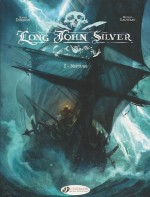
Long John Silver volume II: Neptune


By Xavier Dorison & Mathieu Lauffray, translated by Jerome Saincantin (Cinebook)
ISBN: 978-1-84918-072-6

British and European comics have always been far more comfortable with period-piece strips than our American cousins and much more imaginative when reinterpreting classical fiction for jaded comicbook audiences. The happy combination of familiar exoticism, past lives and world-changing events blended with drama, action and, most frequently, broad comedy has resulted in a uniquely narrative art form suited to beguiling readers of all ages and tastes.

Our Franco-Belgian brethren in particular have made an astonishing success out of repackaging days-gone-by but this particularly enchanting older-readers yarn forgoes the broad bellylaughs whilst extending the adventures of literature’s greatest rogue into a particularly engaging realm of globe-girdling thriller.

Robert Louis Stevenson’s Treasure Island was originally serialised from 1881-1882 in Young Folks magazine as Treasure Island or, the mutiny of the Hispaniola, pseudonymous penned by one “Captain George North”.

It was collected and published as a novel in May 1883 and has never been out of print since. A landmark of world storytelling, Treasure Island has been dramatised too many times to count and adapted into all forms of art. Most significantly, the book created a metafictional megastar – albeit at best an anti-hero – as immortal as King Arthur, Robin Hood, Sherlock Holmes, Tarzan or Superman. Almost everything the public “knows” about pirates devolves from the book and its unforgettable, show-stealing one-legged star…

Writer Xavier Dorison was born in Paris in 1970 and graduated business school before moving into storytelling. He works as an author, film writer, lecturer and movie script doctor. He began the award-winning Long John Silver in conjunction with preferred collaborator Mathieu (Prophet) Lauffay in 2006, with the last volume released in 2013.

Lauffay is also a Parisian born in 1970. He spends his days illustrating, drawing comics, crafting RPGs and working as a concept designer for movies. His art has graced such international items as Dark Horse Comics’ Star Wars franchise, games like Alone in the Dark, the album Lyrics Verdun, February 21, 1916 – December 18, 1916, Tarzan and many more…

Their continuation of the piratical prince is a foray into far more mature arenas set some years after the affair of the Hispaniola and ranges far and wide: from foggy, oppressive England to the vast, brooding inner recesses of the Amazon.

What has Gone Before: 1785 and treasure-hunting Lord Byron Hastings has finally found the lost city of Guiana-Capac but now needs further funds to exploit this promising City of Gold.

In England, his profligate and wanton wife Lady Vivian has been enjoying herself too much and is with child by lecherous neighbour Lord Prisham. With a baby in her belly and a husband gone three years, she is considering having Byron declared dead and undertaking a hasty remarriage…

Suddenly shattering those plans is her despised brother-in-law who turns up with an old native named Moxtechica bearing a message and map from her long-lost husband. Prudish and cruel Royal Naval officer Edward Hastings delights in telling the scheming strumpet he abhors that his brother has succeeded and now orders her to sell everything… including all the treasured family possessions, manor house and lands she brought to the marriage…

Byron has named Edward sole Proxy and the martinet delights in giving the high-born trollop Vivian her marching orders. He strongly urges her to confine herself to a convent and save them all further shame and disgrace…

Raging in front of her conniving maid Elsie, the Lady considers a number of retaliatory tactics before settling upon the most bold, dangerous and potentially rewarding. After announcing to the stunned Edward that she will accompany him to South America and reunite with her beloved husband, the fallen noblewoman seeks out a doctor to take care of the “problem” she is – for the moment at least – still secretly carrying…

Dr. Livesay is a decent, god-fearing soul who has led a quiet, prosperous life since his adventures on Flint’s Island. However, it is not her current condition which has brought Vivian to the physician’s door, but rather persistent tales of a scurrilous former acquaintance; a formidable, peg-legged rogue with a reputation for making life’s difficulties disappear…

Against his better judgement, Livesay capitulates to Lady Vivian’s urgings, introducing her to retired sea-cook John Silver. Amidst the (alleged) ex-pirate’s inner circle of scary-looking confederates she relates the story of the Spaniard Pizarro‘s discovery of a City of Gold and how, centuries later, her husband has reclaimed it.

The rest of her sorry tale tumbles out. She plans to travel there with a few capable men – and the far-from-willing Elsie – to make those riches her own. She needs Silver and his colleagues to infiltrate Edward’s crew, seize the ship he has chartered and complete the voyage under her command…

Unable to convince Vivian to desist or Silver to reject her offer, Livesay reluctantly joins them in vain hopes that he can keep the debased woman from mortal harm. Silver is hiding a debilitating and soon-to-be-fatal case of malaria, but still orchestrates his own hiring before packing the Neptune with suitable scoundrels and compelling Lady Vivian to sign a sacrosanct Pirates Contract. With all the various schemers believing their own plans are proceeding satisfactorily, the Neptune sets off for the Americas, but at the last moment Silver suffers a major setback when rival rogue Paris inveigles his way into the crew…

Volume two commences with the voyage well under way and the crew – Silver’s men, Paris’ contingent and even Captain Edward Hastings’ innocent hires – all slowly succumbing to the Sea Cook’s glib tongue and fascinating tales of the Red Brotherhood. Only Hastings’ lieutenants Dantzig and Van Horn have any inkling of the battle of wills occurring below decks, but the shaky détente is shattered after duplicitous Elsie tries to expose Lady Vivian’s plans only to suffer a tragic “accident” when a huge load of storage barrels falls upon her.

Hastings knows all too well that his ship is filled with men just waiting for him to pilot them to the mouth of incomprehensible wealth. Thus he rules with a rod of iron and full naval discipline just to stay alive.

Boy seaman Jack O’Kief is a protégé of Paris, but Silver has developed a fondness for the lad. That relationship is tested to the limit when Hastings declares Jack responsible for the maid’s death and has him brutally flogged to force the Sea Cook’s hand.

A vicious and prolonged battle of wills follows, pushing the crew to the edge of mutiny as Hastings stalls in making final landfall and Jack’s life slowly ebbs away…

Tensions come to a tragic head as a colossal storm pushes the Neptune inexorably towards its foregone destination and another death sparks the inevitable mutiny, appalling bloodshed and a red-handed settling of many scores…

Literally above it all, the shaman Moxtechica rides out the tempest above and the savage battle of the white men below, patiently waiting to see what the calm of dawn will bring…

To Be Continued…

Tense, evocative, suspenseful and shockingly powerful, these further exploits of Long John Silver are a modern masterpiece of adventure fiction worthy of Stevenson’s immortal adventure which should even convince a few more folks to actually read the original novel. © Darguad, Paris, 2008 by Dorison & Lauffray. All rights reserved. English translation © 2011 Cinebook Ltd.

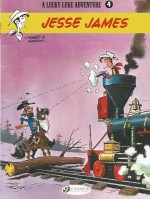
Jesse James: Lucky Luke volume 4


By Morris & Goscinny, translated by Frederick W. Nolan (CineBook)
ISBN: 978-1-905460-14-4

It’s hard to think of one of Europe’s most beloved and long-running comics characters being in any way controversial, but when changing times caught up with the fastest gun in the West (“so fast he can outdraw his own shadow”) and the planet’s most laconic cowboy moved with them, the news made headlines all over the world.

Lucky Luke is a rangy, good-natured, lightning-fast cowboy who roams the fabulously mythic Old West, having light-hearted adventures with his horse Jolly Jumper and interacting with a host of historical and legendary figures of the genre.

His continued exploits over nearly seventy years have made him one of the best-selling comic characters in Europe (81 collected books and more than 300 million albums in 30 languages thus far), with spin-off toys, computer games, animated cartoons and even a plethora of TV shows and live-action movies.

He was created in 1946 by Belgian animator, illustrator and cartoonist Maurice de Bévère (“Morris”) for the 1947 Annual (L’Almanach Spirou 1947) of Le Journal de Spirou, before launching into his first weekly adventure ‘Arizona 1880’on December 7th 1946.

Prior to that, while working at the CBA (Compagnie Belge d’Actualitiés) cartoon studio, Morris met future comics super-stars Franquin and Peyo, and worked for weekly magazine Le Moustique as a caricaturist – which is probably why (to my eyes at least) his lone star hero looks uncannily like the young Robert Mitchum who graced so many memorable mid-1940s B-movie Westerns.

Morris quickly became one of “la Bande des quatre” – The Gang of Four – which comprised creators Jijé, Will and his old comrade Franquin: the leading proponents of the loose and free-wheeling artistic style known as the “Marcinelle School” which dominated Spirou in aesthetic contention with the “Ligne Claire” style used by Hergé, EP Jacobs and other artists on Tintin Magazine.

In 1948 said Gang (all but Will) visited America, meeting US creators and sightseeing. Morris stayed for six years, meeting fellow traveller René Goscinny, scoring some work from the newly-formed EC sensation Mad whilst making copious notes and sketches of the swiftly vanishing Old West.

That research would resonate on every page of his life’s work.

Working solo until 1955, Morris produced another nine albums worth of affectionate sagebrush parody before reuniting with Goscinny, who became the regular wordsmith as Luke attained the dizzying heights of superstardom, commencing with ‘Des rails sur la Prairie’ (Rails on the Prairie), which began in Spirou on August 25th 1955.

In 1967 the six-gun straight-shooter switched sides, transferring to Goscinny’s own magazine Pilote with ‘La Diligence’ (The Stagecoach). Goscinny eventually produced 45 albums with Morris before his death, from whence onwards Morris continued both singly and with fresh collaborators.

Morris himself died in 2001 having drawn fully 70 adventures, plus spin-off sagas of Rantanplan (“dumbest dog in the West” and a charming spoof of cinema canine Rin-Tin-Tin), with Achdé, Laurent Gerra, Benacquista & Pennac, Xavier Fauche, Jean Léturgie, Jacques Pessis and others all taking a crack at the evergreen franchise…

Moreover, apart from that very first adventure, Lucky (to appropriate a quote applied to the thematically simpatico TV classic Alias Smith and Jones) “in all that time… never shot or killed anyone”…

Lucky Luke first appeared in Britain syndicated to weekly comic Film Fun in the late 1950s and again in 1967 in Giggle where he was renamed Buck Bingo. In all these venues – as well as the numerous attempts to follow the English-language successes of Tintin and Asterix albums from Brockhampton and Knight Books – Luke had a trademark cigarette hanging insouciantly from his lip, but in 1983 Morris, no doubt amidst both pained howls and muted mutterings of “political correctness gone mad”, substituted a piece of straw for the much-travelled dog-end, which garnered him an official tip of the hat from the World Health Organization.

The most recent attempt to bring Lucky Luke to our shores and shelves comes from Cinebook (who have rightly restored the foul weed to his lips on the interior pages if not the covers…) and Jesse James was the fourth of 50 albums (and counting) currently available both on paper and as e-book editions.

On the continent it was the 35th comic cowboy chronicle and Goscinny’s 26th collaboration with Morris, originally appearing in 1969 and featuring an engaging overlapping of real world history and fantastic fiction. You have been warned…

After an informative and funny graphic reintroduction to our splendid stars and their impressive capabilities, the saga commences as a recuperating gentleman named Jesse reads a book about Robin Hood and decides that he too is going to rob from the rich and give to the poor.

His first foray as a gun-toting social worker goes well except for the moral quandary resulting from giving a poor man all the money he’s just liberated and making him a rich one. Shakespeare-quoting brother Frank has a clever solution: if they keep the money, but keep passing it back and forth to each other, they can take from the rich and give to the poor at the same time and keep it in the family too…

To make sure nobody stays rich for too long they bring hulking practical joking cousin Cole Younger into the pact and set about making themselves the most feared and unwelcome bandits in Oklahoma, Arkansas and Missouri. After robbing banks and derailing trains throughout the region the gang heads for Texas where events are already unfolding to their eventual detriment.

In sleepy, prosperous Nothing Gulch two of the least undercover detectives ever employed by the Pinkerton Agency approach lean, laconic Luke. Agents Smith and Jones (not their real names) want his aid in apprehending the most wanted men in America, but our hero can only promise that since they’ve committed no crimes in Texas he will watch them and act accordingly if they do…

Satisfied with the compromise, the very Public Eyes retire to their camp outside town whilst Lucky proceeds to warn the locals of their impending guests. He is greeted with a wave of Texan bombast and bravado but realises the people are not-so-secretly terrified by the prospect of the James Boys…

The subjects of all that apprehension have just crossed the border into Texas and, after much pleading, foolishly allowed Cole to try his hand at derailing a train. The big lunk simply doesn’t have the knack for it however and soon Main Street is torn up as a runaway locomotive and still-attached carriages – having careened across county without benefit of rails – plough to a halt outside the saloon…

The spectacular event is the trigger for every citizen to pull their cash out of the town bank before the bandits do and spurs Luke into riding off and intercepting Jesse and Co to deliver a friendly warning.

Unfortunately Jesse is too proud to be told and the gang hit town only to discover the residents have taken even more extreme measures, donating enough cash to the town drunk to make him – comparatively – the richest man in Nothing Gulch…

With Lucky Luke watching and pickings slim, the James Boys begin a sly charm offensive to put everybody at ease but once the townsfolk calm down enough to put their money back in the bank all bets are off. Luring Luke away Jesse goes to work, raiding the Bank whilst Cole has another go at derailing, unaware that Lucky has second-guessed him and turned the gold-carry train into a trap…

However, on dragging the owlhoot back to town he finds the citizens so cowed that they organise a quick sham trial just so they can clear Younger of all charges and get him out of the district. Utterly disgusted, our hero and Jolly Jumper abandon the yellow Texans and Cole rides off to tell his cousins that the town is wide open for another raid…

In the shameful night time the citizens gather and something strange happens. Disgusted with themselves the ordinary folk talk themselves into a froth of righteous indignation and seek out Lucky. They need to redeem themselves and humbly beg the disgusted hero to join them as they prepare for Jesse James’ inevitable return…

Fast-paced, seductive slapstick and wry cynical humour colour this splendidly mad ride, making it another grand old hoot in the tradition of Destry Rides Again and Support Your Local Sheriff (perhaps Paint Your Wagon, Evil Roy Slade or Cat Ballou are more your style?), superbly executed by master storytellers and a wonderful introduction to a unique genre for today’s kids who might well have missed the romantic allure of an all-pervasive Wild West that never was…

And in case you’re worried, even though the interior art still has our hero chawin’ on that ol’ nicotine stick, trust me, there’s very little chance of anyone craving a quick snout – especially since Jolly Jumper is acting like a Greek chorus warning of the hazards of the evil weed – but quite a high probability that they’ll be addicted to Lucky Luke Albums…
© Dargaud Editeur Paris 1969 by Goscinny & Morris. © Lucky Comics.
English translation © 2006 Cinebook Ltd.

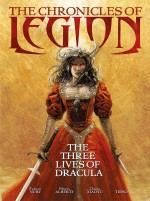
The Chronicles of Legion volume 1: Rise of the Vampires


By Fabien Nury, Mathieu Lauffray, Mario Alberti, Zhang Xiaoyu & Tirso , translated by Virgine Selavy (Titan Comics)
ISBN: 978-1-78276-093-1

We’ve all been in love with vampires since the golden age of Victorian Gothic and it’s taken the undead in some extremely odd directions (I personally draw the line at sparkly, immortal kissy-face boy-toys, but to each his own)…

Thankfully our European cousins have a more sanguine view of such matters and innate respect for tradition even when they reinterpret the old classics. Prolific writer Fabien Nury (Stalin’s Death: A Real Soviet History, Once Upon a Time in France, The Master of Benson Gate, Necromancy as well as the epic Je Suis Légion with John Cassaday) began in 2011 a generational saga which put a new spin on the legend whilst keeping a steady eye on the tone of what has gone before…

Les Chroniques de Legion was illustrated by round-robin art-team Mathieu (Star Wars, Long John Silver) Lauffray, Mario (Nathan Never, Morgana, assorted DC covers) Alberti, the enigmatic Zhang Xiaoyu & Tirso Cons (Eye of the Devil, Le Manoir murmurs) and opens here (in good old English) in 1476 as barbaric warlord Vlad Tepes finally falls before the overwhelming armies of the invading Moslem horde.

His stubborn Transylvania a crushed and broken province, the infamous leader had been dragged from the arms of his favourite concubine and beheaded by exultant general Selim Bey. Working for the invaders, Vlad’s despised and treacherous brother Radu knew that the story was not over yet…

As the victorious Turk ravished his despised enemy’s beloved, Dracula’s implacable sibling rival was too late to stop his brother’s malign blood invading the Moslem’s body and eating his devout mind. In an instant Selim Bey’s was gone, overwritten by the undying Impaler…

Nor could Radu not stop the horror escaping and after “Selim” murdered the Sultan and vanished, the Transylvanian turncoat endured all the anger and hatred of the Ottomans. Of course since his blood was just as accursed as Vlad’s, Radu’s story didn’t end with his body’s death either…

In 1521 Vlad was on the move once more, inhabiting the body of Gabriella Del La Fuente. This recent orphan was travelling to the New World, contracted to marry the audacious conquistador Hernan Torres. A flower of the aristocracy, her perfect beauty was only marred by the strange red mark on the back of her neck – a blemish shared with her recently-departed father Victor and a long-dead Turk named Selim Bey…

She had no idea Radu had reached the Americas first and transformed them to a hell of his own devising. The other brother had sustained his own arcane life by equally esoteric means, only in his case the intellect was scattered and diminished by the swarm of rats who consumed him for the longest time…

In Russia in 1812, an undying warrior sprit was wearing French Hussar Armand Malachie. As Napoleon’s broken armies fled before the vengeful Cossacks, he convinced his faithful subordinates Kholya, Stern, Hartmann and Feraud to desert with him. Detouring to the Wallachian Mountains they hunted for valuable loot Armand had heard about: the Lost Treasure of Vlad Dracula Tepes…

It was all a lie. The true reason for the diversion was that Dracula sensed far-distant Radu had allowed an unprecedented atrocity to be created and the time had come to end their infinitely extended vendetta forever…

London, 1887: elderly lawyer Morris Webster contacts friendless, antisocial clerk and gambling addict Victor Douglas Thorpe with an offer that will forever liberate the morose wastrel and ne’er-do-well from the drudgery of his impoverished Whitechapel life.

For reasons inexplicable, Thorpe has been selected by immensely rich aristocratic recluse Lord Byron Cavendish to inherit all his lands and properties… upon successful conclusion of a personal interview, of course…

To Be Continued…

Lavishly presented in an oversized (211 x 282mm) full-colour hardback, evocatively illustrated and told through contiguous strands in many concurrent times, this epic, intoxicatingly absorbing horror mosaic depicts a constant battle between two remorseless foes inextricably linked by blood to grip and delight lovers of all things dark and demonic…
The Chronicles of Legion and all contents © Éditions Glénat 2011. Translated edition © Titan Comics, 2014.

Valerian and Laureline book 8: Heroes of the Equinox


By Méziéres & Christin, with colours by E. Tranlé; translated by Jerome Saincantin (Cinebook)
ISBN: 978-1-84918-213-3

Valérian and Laureline is the most influential science fiction comics series ever created; an innovation-packed, Big-Ideas bonanza stuffed with wry observation, knowing humour, intoxicating action and underpinned throughout by sardonic sideswipes at contemporary mores and prejudices.

Valérian: Spatio-Temporal Agent debuted in weekly Pilote #420 (November 9th 1967) and was an instant hit. It swiftly evolved into its current designation as his feisty, fire-headed female sidekick developed into the equal partner – and eventually scene-stealing star – of light-hearted, fantastically imaginative, visually stunning, time-travelling, space-warping fantasies.

Nevertheless the so-sophisticated series always found room to propound a satirical, humanist ideology and agenda, launching telling fusillades of political commentary and social satire to underpin the astounding imagination of the space opera.

At first the tough, bluff, taciturn affably, capable – if unimaginative – by-the-book space cop just did his job: tasked with protecting official universal chronology (at least as per Terran Empire standards) by intercepting or counteracting paradoxes caused by incautious time-travellers.

When Valérian landed in 11th century France during debut tale ‘Les Mauvais Rêves (‘Bad Dreams’ and infuriatingly still not translated into English), he was rescued from doom by a capable young woman named Laureline. He brought her back to the 28th century super-citadel and administrative capital, Galaxity, where the indomitable firebrand took a crash course in spatiotemporal operations and began accompanying him on his missions.

Heroes of the Equinox was originally serialised in the monthly Pilote (issues #M47 to M50 from 21st March to June 27th 1978) before being collected later that year as eighth album Les héros de l’équinoxe: a sparkling, over-the-top spoof of superheroes and political ideologies which also found time and space to take a good-natured, gentle poke at the eternal battle of the sexes.

Spectacularly visual and imaginatively designed, the story starts as a quartet of vastly disparate planetary champions depart for the distant and distressed world of Simlane, where an ancient and cultivated civilisation is experiencing a uniquely tragic crisis…

The heroes comprise three dedicated – almost fanatical – supermen whilst Galaxity – far more concerned with courting public opinion than actually helping – have packed off a handy and presently unoccupied Spatio-Temporal agent named Valerian, just to show willing…

With Laureline mocking him for the entire trip, Earth’s Prime Champion touches down on Simlane to be greeted by a crowd of effusive oldsters from a glorious city of once magnificent but now crumbling edifices with an incredible story to tell.

The inhabitants of the derelict tourist trap are uniformly old and sterile and desperately need a new generation of children to repopulate the world, but their manner of achieving their goal is unique. For the lifetime of their civilisation, every hundred equinoxes the best and bravest males of Simlane venture to isolated Filine, Island of Children in a fierce and often deadly competition. The winner then somehow spawns a whole new generation who sail back on little boats to re-people the world.

That didn’t go entirely according to plan last time so the planetary leaders have invited four prime specimens from other worlds to do the necessary this time – much to the anger and dismay of a creaky host of crotchety, doddering indigenous old would-be sire-heroes…

At the packed but painfully weathered Great Theatre the assembled geriatrics are treated to a destructive floor show as the brazen alien warriors display their prowess. Bombastic Irmgaal of Krahan is a godlike superman wielding a flaming sword whilst proletarian technological wonder Ortzog of worker’s paradise Boorny reveals the power of a united people through his blazing, flailing chains. Mystic nature boy Blimflim of elysian, arcadian Malamum calmly displays the gentle irresistibility of the spirit harnessed to willpower. Each couldn’t be more different yet the result of each display is catastrophic destruction.

When eager eyes turn to Galaxity’s representative, Valerian simply shoots a chip off a distant stone cornice with his blaster… to tumultuous disinterest…

Dwarfed by the Herculean alien supermen, he shambles off to prepare for the great contest and dawn finds him with his fellow contestants ready to brave the stormy skies for the grand prize and glory…

This is one of the most visually extravagant and exuberant of all the albums, with a huge proportion of the book dedicated to the fantastic foursome overcoming their particular challenges and monstrous foes in astounding demonstrations of bravura puissance and awesome might… well, three of them anyway. The earthman’s travails are generally nasty, dirty smelly and ingloriously dangerous…

Eventually however all the warriors prove themselves a credit to their particular lineage and system before facing one final test. It’s in the form of a simple question: “If you sired the next generation how do you envision their future?”

Each strange visitor propounds a glorious agenda of expansion according to the customs and principles of his own culture but it’s the rather diffident and lacklustre vision of the Terran slacker that wins the approval of the incredible being who is the eternal mother of Simlane’s repopulation…

When the trio of failed supermen wash up on the shores of the city, the people realise who has fathered their soon-to-arrive new sons and daughters and patiently wait for the equinox tide to bring them over.

Laureline, horrified to discover that each successful father is never seen again, quickly sails to the Island of Children and navigates the trials which so tested the wonder men with comparative ease. She arrives at the misty citadel atop Filine in time to see an army of disturbingly familiar-looking toddlers tumble into little sailboats…

Broaching the idyllic paradise further she finally meets the Great Mother and sees what the breeding process has made of her reprehensible, sleazy, typically male partner…

Reaching an accommodation with the gargantuan progenitor, Laureline negotiates the release of her partner and they are soon winging home to Terra, with him having to listen to just what she thinks of him whilst praying Galaxity’s medical experts can make him again the man he so recently was…

Sharp, witty and deliciously over-the-top, this tale is a wry delight, spoofing with equanimity human drives, notions of heroism and political and philosophical trendiness with devastating effect. Whether super-heroic fascism, totalitarian socialism or even the woolly mis-educated, miscomprehendings of new age eco-fundamentalists who think aromatherapy cures broken legs or that their kids are too precious to be vaccinated and too special to share herd immunity, no sacred cow is left soundly unkicked…

However, no matter how trenchant, barbed, culturally aware and ethically crusading, Valerian and Laureline stories never allow message to overshadow fun and wonder and Heroes of the Equinox is one of the most entertaining sagas Méziéres & Christin ever concocted, complete with a superb sting in the tale…

Between 1981 and 1985, Dargaud-Canada and Dargaud-USA published a number of selected albums in English (with a limited UK imprint from Hodder-Dargaud) under the umbrella title Valerian: Spatiotemporal Agent and this was the fourth, translated then by L. Mitchell.

Although this modern Cinebook release boasts far better print and colour values plus a more fluid translation, total completists might also be interested in tracking down the 1983 edition too…
© Dargaud Paris, 1978 Christin, Méziéres & Tran-Lệ. All rights reserved. English translation © 2014 Cinebook Ltd.

Dungeon: the Early Years Set (volume 1: The Night Shirt: volume 2: Innocence Lost)


By Joann Sfar & Lewis Trondheim, art by Christophe Blain, translated by Joe Johnson (NBM)
Set ISBN: 978-1-56163-932-1

As crafted by prolific artisans Joann Sfar (Professeur Bell, Les olives noires, The Rabbi’s Cat) and Lewis Trondheim (La Mouche, Kaput and Zösky, Little Nothings) with assorted associates of their New Wave-ish collective of bande dessinée creators most often seen under the aegis of independent publisher L’Association, the Donjon saga has generated more than thirty interlinked volumes since it launched in 1998 and has become far more than a mere cult hit all over the world.

These slim, translated and re-released tomes form a small sub-division of a vastly generational, eccentrically raucous and addictively wacky franchise which melds starkly adult whimsy to the fantastic worlds of fantasy fiction, and the Early Years tomes (now available as a complete set) fill in some historical gaps which might have puzzled occasional readers of Dungeon Parade, Zenith, Monstres and Twilight.

There’s this magic castle, in a fantastic land of miracles, see, and it’s got a dungeon…

But before that citadel was constructed there was the debauched, bureaucratised and grimly frenetic urban hellhole of Antipolis, greatest and most appalling city on the strange world of Terra Amata…

Illustrated in compellingly frenetic style by Christophe Blain, it all begins with volume one and the origin of ‘The Night Shirt’. Young Hyacinthe De Cavalerre is the scion of an esteemed and noble – if provincial – house and line. The world is changing however; shifting from feudal aristocracy and blood-privilege to a civilisation based on mercantilism, greed and bureaucracy.

Thus a father dispatches his dreamy boy to the capital to study, residing with an estranged uncle to learn the rules of the New Age. The boy’s dreams of literary glory soon founder after an encounter with monstrous “Brutes” in the forest and are forever dashed when faced with the filth and unbridled avarice of the city…

At least he has made one friend: learned fellow traveller Doctor Hippolyte is also heading to Antipolis, determined to petition the city council to free a gigantic Arboress the municipality intends to burn alive as part of their upcoming carnival celebrations…

Literally negotiating their way into the fetid metropolis the travellers separate, and Hyacinthe makes his way to the mansion of wheelchair-bound Count Florotte and has a tense encounter with a serpentine – if mannish – seductress who teasingly offers to teach him how to use his sword.

His uncle calls her Alexandra; a valued – if occasional – employee…

Wearily settling in that night the young man is roused by screams and rushes to the aid of a serving girl being cruelly assaulted by an arrogant bully who boasts that no one will to come to her aid. When the boy intervenes he is casually rebuffed and shamefully leaves. The villain is Michael, his uncle’s most valued deputy and the one Hyacinthe has been indentured to…

Despondently returning to his room the boy then makes the acquaintance of the house elves as they busily steal his golden jacket buttons…

The next day Michael begins the fiscal and social education of his new charge, having Hyacinthe carry the huge bag of gold Florotte regularly dispenses for bribing officials to leave his various business enterprises alone. The lad is horrified to see the system used to throw Hippolyte in jail after failing to convince the town council to spare the captive tree-woman…

Michael celebrates by dragging the lad to an insalubrious tavern and getting plastered. The feline factotum knows Alexandra too…

After carrying the soused villain home, the furious, fanciful boy comes to a bizarre decision and returns to the dark streets, draped in a big blouse, waving his sword and wearing a mask…

More by luck than skill he breaks Hippolyte out of his noisome cell and the pair flee through the city. The flight is particularly easy as someone is killing all the guards and impediments in their path…

Soon they see Alexandra, dispatching more men, and the still-unnamed crusader gallantly rushes to her aid. She is more than a little charmed, even as she saves the neophyte from his own impetuous folly…

After she vanishes Hyacinthe attempts to get Hippolyte out of the city but the scholar refuses to leave without the Arboress. Forced to leave him hidden inside the gigantic tree-woman, the exhausted little hero staggers home and stumbles upon one of Michael’s more devilish schemes. The reprobate is taking gold from the elves to stop his own workers dynamiting the ground under Antipolis…

Some businessmen have plans to build a vast subway system beneath the city and have hired Blasters to blow up or expand the already in situ elf tunnels. Michael is taking cash from the little people to “stop” the project he’s actually expediting. He’s even crass enough to boast to Hyacinthe that they have over-paid him…

Scrupulously honest, the lad determines to return the extra gold but upon reaching the bowels of the city he accidentally causes a huge detonation which kills the Blasters, earning the undying devotion of the elves…

On reaching the house again he is horrified to find the mastermind behind the subway scheme is his own uncle and the elder doesn’t care how many suffer or die to accomplish his grand design…

Later as the Carnival begins, besotted Hyacinthe follows Alexandra and discovers what she does for Florotte: as the finest killer in the Guild of Assassins she is invaluable in his business dealings. When the heartbroken boy confronts her on the matter he painfully learns just how good she is at her job…

Battered and probably delirious, he determines to save her from herself and is astonished to find an army of elves awaiting him in his room. Blasters have returned in force and the wee folk have decided to abandon their underground homes for somewhere less busy…

Donning his commodious crime-busting costume, the lad chooses to do some good by saving Hippolyte and the Arboress. Accompanied by the elves he heads for the enclosure where the remarkably strong little people offer to carry the all-but-immobile tree-woman for their beloved “Nightshirt”. Soon, under cover of colossal carnival floats, the fugitives are heading for the wild woods surrounding the city…

After the carnage of a breakneck chase and unlikely triumph, Arboress and elves are invited to live in the castle of Hyacinthe’s father and a new story begins sometime later with the boy now a dutiful student attending the University of Antipolis.

When newcomer Alcibiades joins the class of prominent Dr. Fontaine, he is soon taken under the lad’s generous wing, experiencing the heady freedom of student life where Hyacinthe is the butt of the organ-juggling jokes of the Necromancy undergraduates. He regularly blows off steam prowling the dark streets, dishing out justice as the infamous urban legend The Night Shirt…

Utterly besotted with Alexandra, one night he spies on her and observes a passionate tryst with the vile Michael. Sadly the villain observes him back and a violent rooftop duel ensues…

Barely escaping with his life Hyacinthe heads home where his uncle has a favour to ask. Fontaine is a strenuous critic of Florotte’s proposed subway and, since a succession of “gifts” have not swayed the scientist’s opinions, perhaps the student might have a quiet word with his teacher?

The interview does not go well and despondent Hyacinthe opts to visit his father in the country rather than return to Florotte’s mansion. Enjoying the break, the lad lapses from unrequitable love of Alexandra and suffers a frustrating dalliance with a young lady named Elise. This leads to a violent battle between forest monsters and the Night Shirt…

Wounded and bleeding he is rescued by the elves who give him a pipe with magic tobaccos which temporarily impart a host of strange powers and abilities. When he returns to Antipolis, Fontaine has been murdered and Night Shirt has claimed responsibility…

Resolved to clear his alter ego’s name, things go quite badly for the boy until Alexandra deals herself in to save the little oaf from himself, but in the end justice is only served and the real killer exposed after sensible Elise takes over…

The saga continued in Volume 2: Innocence Lost as some time later future supreme Dungeon-Keeper Hyacinthe prowls the night as a far more effective masked vigilante. The Night Shirt’s nocturnal adventures are however seriously curtailed by his still-unrequited inamorata Alexandra.

Her violent disdain does not stop her from sharing her unbridled passions – and a rather painful social disease – with the poor fool. Visiting old friend Dr. Hippolyte at the rapidly expanding country castle for advice (and possible medical solutions) he meets fair Gabrielle Olivet and offers to accompany her as she travels to join her fiancé in far-off Necroville.

However during a stopover in lawless, rabbit-infested frontier town Zedotamaxim, she is falsely arrested by over-officious sheriffs and trusts Hyacinthe to engineer her release by fetching her intended – prominent lawyer Eustace Ravin – from the wilds of the charnel hamlet…

Sadly once Hyacinthe gets there Eustace proves to be a rather faithless gadabout who couldn’t care less about Gabrielle’s plight. By the time he convinces the rogue of his duty it’s too late and she has been sold to the biggest brothel in Antipolis.

Determined to set things right The Night Shirt realises he’s going to need the assistance of the kind of people he usually fights…

Second story After the Rain is set many years later when aging and now dissolute Hyacinthe is a middle-aged, unhappily married roué. Set in his ways and terminally unhappy the former Night Shirt is enticed into making a comeback by clever and strangely superhuman Doctor Cormor who must battle greed and the establishment itself to stop completion of the infernal subway being dug through the unstable pile of detritus that forms the bedrock of the city.

Perhaps it is less a noble quest than the return of slinky Alexandra that fires up the weary hero, but when inevitable disaster strikes will Hyacinthe be ready or able to cope?

Featuring the catastrophic events which destroyed Antipolis and sparked the creation of the modern Dungeon of Terra Armata this is perhaps the most effective yarn in the franchise’s vast scope and span…

The inhabitants of this weirdly surreal universe include every kind of anthropomorphic beast and bug as well as monsters, demons, mean bunnies, sexy vamps and highly capable women-folk who know the true (lack of) worth of a man. This is an epic saga of cynically world-weary political intrigue, played as an eternal and highly amusing battle of the sexes, with tongues planted firmly in cheeks – and no, I won’t clarify or specify…

Comprising in total four translated French albums – ‘Donjon Potron-Minet: Le Chemisede la Nuit’, ‘Un Justicier dans L’Ennui, ‘Une Jeunesse Qui S’Enfuit’ and ‘Apres La Pluie’ – this baroque bunch of barbaric books comprise a delightfully absurd, earthy, sharp, poignant and brilliantly outlandish romp that’s a joy to read with vibrant, wildly eccentric art as moody as Dark Knight, as jolly as Rupert Bear and as anarchic as the best of Leo Baxendale.

Definitely for grown-ups with young hearts, Dungeon is a near-the-knuckle, illicit experience which addicts at first sight, but for fuller comprehension – and added enjoyment – I’d strongly advise buying all the various incarnations which are happily also currently available as collectors’ sets…

© 2001-2006, 2014 Delcourt Productions-Trondheim-Sfar-Blain. English translation © 2005 and 2009 NBM. All rights reserved.

Orbital book 4: Ravages


By Serge Pellé & Sylvain Runberg, translated by Jerome Saincantin (Cinebook)
ISBN: 978-1-84918-088-7

Serge Pellé & Sylvain Runberg’s mismatched pair of Diplomatic Peacekeeper agents return in the conclusion of the sinister saga begun in Orbital: Nomads, subtly tweaking and deftly twisting that cunning epic of far-flung, futuristic political intrigue into a full-on horror story of relentless alien terror…

What you need to know: After decades of pariah-status and exclusion, 23rd century Earth finally joined a vast Confederation of interstellar civilisations, despite grave and abiding concerns about humanity’s aggressive nature and xenophobic tendencies shared by many of the member species. On Earth the feeling was largely mutual…

Prior to the humanity’s induction a militant “Isolationist” faction had graduated from politics to horrific terrorism: committing atrocities both on Earth and distant worlds where mankind had already developed colonies and bases. Ultimately they failed to prevent humanity’s inclusion in the pan-galactic union and were sidelined in global politics.

Neither they nor the ill-will they fostered really went away…

One particular Confederation worry was the way humans had treated the alien civilisation of the Sandjarrs, whose world was invaded in Earth’s all-consuming drive for territory and exploitable resources. The subsequent atrocities almost exterminated the stoic desert dwellers…

The vast bureaucracy of the Interworld Diplomatic Office works through operatives assigned in pairs to troubleshoot throughout the galaxy, defusing crises before they can become flashpoints of violence, and recently IDO’s first human recruit Caleb Swany had been surprisingly teamed with Sandjarr Mezoke Izzua: a situation clearly designed as a high-profile political stunt.

So was their initial mission: convincing an Earth mining colony on the moon Senestem to peacefully surrender a profitable planetary industry to the aliens who actually own the satellite it was situated on. Overcoming outrageous odds and problems, the unlikely team of rookies resolved the issue in true diplomatic manner with a minimum of casualties and nobody really happy or satisfied…

Released in France in 2010, Orbital: Ravages is the fourth album released by Cinebook and picks up as Caleb and Mezoke find a simple state function is rapidly devolving into an interspecies crisis…

The Galactic Great-and-Good are on Earth to confirm the end of Human/Sandjarr hostilities in a series of spectacular Reconciliation Ceremonies, but the political glad-handing is in danger of imploding after Kuala Lumpur’s human fisherman clash with a hitherto unsuspected enclave of star-spanning cannibalistic alien gypsies known as the Rapakhun…

One of the greatest benefits of induction into The Confederation has been the infusion of alien technologies which have cleansed and reinvigorated the gravely wounded ecosystem of long-abused and much-polluted Earth. Now, however, the newly restocked, abundant seas and mangrove swamps around Malaysia are blighted by the mass extinction of millions of valuable fish. The humans blame the uninvited aliens, requiring Swany and Mezoke – accompanied by Caleb’s old mentor Hector Ulrich (instrumental in brokering Earth into the Confederation) – to forcefully intervene; promising all aggrieved parties that the truth will be found and shared.

This might be tricky: much of mankind is still anti-alien, and local economies are fragile, whilst the Rapakhun are apparently no innocent angels. Many space civilisations despise them. The stellar nomads are flighty wanderers who go where they please and refuse to be represented in or on Confederation Councils.

Moreover, all the cosmic bigwigs on Earth are only concerned with their precious Reconciliation Ceremonies, looking good and validating their controversial decision to admit Earth to the Civilised Worlds of the galaxy…

Whilst Caleb and Mezoke are fully occupied with the freshly-arrived delegation of Sandjarr dignitaries, fish are still dying and when human fisherman get too close to the agreed-upon neutral zone they are suddenly exterminated, outraging many watching members of the Malaysian Navy.

Although Caleb attempts to downplay and even suppress the concatenation of bad news in hope of keeping the Ceremonies alive the slaughter of fishermen provokes a “patriotic” clique in the Navy peacekeeping force to look the other way when the locals decide to deal with the nomads once and for all…

The riots and bloodshed are appalling and the IDO agents realise they need to know more about the Rapakhun: someone needs to visit their last port of call and see what the nomads are really capable of…

The story resumes in the grimily cosmopolitan Shah Alam district of Kuala Lumpur where impoverished human and alien scrap-merchants work, salvaging materials and tech from defunct starships. As tensions rise everywhere, one of the greedy toilers makes a grisly discovery and dies horribly in exactly the same manner as the fishermen in the swamps…

Caleb meanwhile, over Mezoke’s protests, is in full-spin-control mode; weaving a pack of placatory lies to the journalists of uncounted watching worlds. Unable to leave Earth mid-crisis, the IDO agents have recruited enigmatic human star-pilot Nina and her secretly-sentient Neuronome ship Angus to canvas the distant world of Dehadato, last port of call of the nomadic Rapakhun, but before they can report anything a vast riot breaks out in the Shah Alam.

The Fishermen’s Quarter is ablaze, a war-zone rife with scared and angry humans and aliens, but when Caleb, Mezoke and Hector fly over the scene of destruction and looting they are brought down by rioters and have to fight their way out…

Thanks to IDO intervention, canny bargaining, judicious bribery by city officials and an unlikely detente between the extraterrestrial scrap merchants and ambitious new spokesman of the Fisherman’s Federation, the situation is soon damped down and all sides again tensely wait for answers…

On Dehadato Nina and Angus are exploring the Rapakhun’s last campsite and uncover scenes of horrific devastation, even as in Kuala Lumpur Confederation leaders are thinking about cutting their losses and cancelling the Reconciliation Ceremonies, terrified that the situation is fast becoming politically untenable.

It takes all of Caleb’s strident persuasiveness to convince them – and Mezoke – to continue the itinerary of events. However he only gets his first inkling that they might be right when he’s informed that a body as been found in the city, butchered in the same extreme and inexplicable manner as the fishermen in the swamp…

Back on Dehadato, Nina and Angus have rescued a poacher from the folly of his actions in pursuing monstrous, colossal and protected Nargovals. As the Sülfir recovers he imparts snippets of information about the stellar nomads and an incredible beast which was here before the Rapakhun left.

The doughty hunter only tried for the unstoppable leviathans which killed his entire poaching team after first ensuring there were no more Varosash on the planet. They had apparently departed with the gypsy cannibals…

Caleb has already concluded that the Rapakhun are behind all his problems, but as he stalks them in the Mangrove swamps, word comes from Nina that stops him in his tracks. It may already be too late though. At the biggest sports arena in the city, thousands of avid Speedball fans – human and not – are packed together and reaching a fever pitch of excitement, unaware that a hideous invisible killer, the very essence of all mankind’s fear of alien monsters, is about to consume them all…

Can the disunited Caleb and Mezoke with the pitifully few allies they can call upon end the invisible and rapacious threat before it ends humanity?

Nina and the Sülfir think they have a plan. Risky and probably fatal, but a plan nonetheless…

Fast-paced, action-packed, gritty and spectacular, Ravages is pure space-opera, with delightfully complex sub-plots fuelled by political intrigue and a vast unexplored canvas tantalising readers at very moment.

One of the most beguiling sci fi strips of all time, Orbital is a delight every fan of the future should indulge in…
Original edition © Dupuis 2010 by Runberg & Pellé. All rights reserved. English translation © 2011 by Cinebook Ltd.

Orbital volume 3: Nomads


By Serge Pellé & Sylvain Runberg, translated by Jerome Saincantin (Cinebook)
ISBN: 978-1-84918-080-1

The truest thing that can be said about French science fiction is that it always delivers amazing style and panache even when the underlying premise might be less than original. In Serge Pellé & Sylvain Runberg’s beautiful Orbital series a seemingly-mismatched pair of Diplomatic Peacekeeper agents are deployed to quell incipient brushfire wars and mediate internal pressures within a vast pan-species intergalactic alliance, but the hoary “buddy-movie” format is a mere skeleton for eye-popping missions, star-spanning intrigue and intense personal interactions which are always are handled with deft wit and great imagination, never failing to carry the reader along in a blaze of fantastic fun…

What you need to know: after decades of pariah-status galactic exclusion, Earth in the 23rd century has finally been allowed to join a vast Confederation of interstellar civilisations, despite grave and abiding concerns about humanity’s aggressive nature and xenophobic tendencies.

A militant “Isolationist” faction on Earth had moved from politics to horrific terrorism in the immediate run-up to formal induction, committing atrocities both on Earth and distant worlds where mankind had developed colonies and mining bases, but ultimately they failed to prevent humanity’s inclusion in the pan-galactic union.

One particular Confederation worry was the way humans had treated the alien civilisation of the Sandjarrs, whose world was invaded in Earth’s all-consuming drive for territory and exploitable resources. The subsequent atrocities almost exterminated the stoic, pacifistic desert creatures…

Interworld Diplomatic Office operatives are assigned in pairs to troubleshoot throughout the galaxy, defusing crises before they can become flashpoints of violence. IDO’s first human recruit Caleb Swany had been surprisingly teamed with Sandjarr Mezoke Izzua, a situation clearly designed as a high-profile political stunt, as was their initial mission: convincing an Earth mining colony to surrender a profitable planetary mining industry back to the aliens who actually own the moon Senestem it was situated on…

Moreover, even though Earth is a now a member of the Confederation, with humans well placed in all branches of interstellar service, the Isolationist cause is still deeply cherished by many, needing only the slightest spark to reignite…

Orbital: Nomads is the third epic album published by Cinebook (originally released in 2009 as ‘Nomades’), and picks up soon after Caleb and Mezoke’s hard-won solution was implemented.

The Galactic Great-and-Good have arrived on Earth to very publicly celebrate and affirm the end of Human/Sandjarr hostilities in a series of spectacular Reconciliation Ceremonies, but the political glad-handing looks to be upstaged by another interspecies crisis…

One of the greatest benefits of induction into The Confederation has been the infusion of alien technologies which have cleansed and reinvigorated the ecosystem of long-abused and much-polluted Earth.

Now however an incident has occurred in the newly restocked, abundant seas and mangrove swamps around Malaysia, with the sudden death of millions of fish leading to a bloody clash between local fishermen and an unsuspected enclave of a race of nomadic space-gypsies called The Rapakhun…

In Kuala Lumpur Caleb is reminiscing with his old mentor Hector Ulrich – instrumental in brokering Earth into the Confederation and Swany into the Interworld Diplomatic Office – when news arrives of the trouble.

This will be tricky: much of mankind is still anti-alien, and locale economies are fragile, whilst the Rapakhun are no innocent angels. Many space civilisations despise them: the stellar nomads are flighty wanderers who go where they please, refuse to be represented in or on Confederation Councils and worst of all, practice cannibalism…

Many Confederation races despise them and by the time Caleb and Mezoke arrive on scene events have escalated and tensions heightened to fever pitch as a committee of human fishermen face off against Rapakhun spokeswoman Alkuun.

The ancient tries to explain that the problem was an escaped Elokarn. The wanderers’ gigantic domesticated aquatic beasts have all been excessively agitated since arriving on Earth…

With the Diplomatic Agents assuring all parties that tests are being undertaken to ascertain not only why the Elokarn went crazy but also why the fish are dying off again, the situation seems contained, but when Alkuun invites the human guests to join in their holy consumption of a still-living and eager Rapakhun male they are physically revolted.

No amount of explanation that the willing, deeply spiritual and hugely prestigious sacrifice is meant to strengthen and invigorate the gods of Earth can offset the grisly sight…

Returning to Kuala Lumpur, Mezoke and Caleb are anxious. Although the Malaysian Navy are policing the area, the IDO agents know full well the tenuous trust humans place in any alien species, but their attention is unfortunately diverted by the sudden arrival of Caleb’s old friend Lukas Vesely.

The scrawny teen of his youth has become a hulking, good-natured member of Ulrich’s security force and seems very keen to relive the good old days. Caleb, of course, has no idea of Lukas’ usual duties, which include brutally and mercilessly dealing with any isolationist protests which might give visiting aliens the wrong impression about Confederate Earth…

In the mangrove swamps fish are still dying and when another group of fisherman get too close to the agreed-upon neutral zone Ulrich’s forces overreact and vaporise them, outraging many watching members of the Malaysian Navy…

Caleb and Mezoke are otherwise fully occupied as the delegation of Sandjarr dignitaries have arrived. The aloof and stand-offish nature of the guests of honour provoke Mezoke to surly silence, and reports from Senestem take the shine off their supposed triumphant solution whilst test results from the mangrove swamps all prove inconclusive. No contamination of any sort has killed the fish: the culprit is some unknown form of energy…

Caleb attempts to downplay and even suppress the concatenation of bad news in hope of keeping the Reconciliation Ceremonies alive over Mezuke’s objections until she reveals a shocking truth about her life before joining IDO…

The death of the fishermen meanwhile has reached the populace and a “patriotic” clique in the Navy peacekeeping force has colluded to look the other way if the fishermen want to deal with the nomads once and for all…

By the time the IDO agents learn of the incursion the appalling bloodshed has ceased and, wading through a site of unspeakable carnage, Caleb and Mezuke decide to split up. The rapidly destabilising situation on Earth must be carefully managed but most crucial is to send an urgent investigation team to the last world the Rapakhun visited and find out exactly what the wanderers are really capable of…

To Be Continued…

Fast-paced, action-packed, gritty space-opera with delightfully complex sub-plots fuelled by political intrigue and infighting elevates this tale to lofty and exotic heights, proving Orbital to be a series well worth watching…
Original edition © Dupuis 2009 by Runberg & Pellé. All rights reserved. This edition published 2011 by Cinebook Ltd.

Scared to Death volume 1: The Vampire from the Marshes


By Mauricet & Vanholme, with colours by Laurent Carpentier and translated by Luke Spear (Cinebook)
ISBN: 978- 1-905460-47-2

There’s a grand old tradition of scaring, empowering and entertaining kids through carefully crafted horror stories with junior protagonists, and this occasional series is one of the better modern examples.

Conceived and executed by journalist Virgine Vanholme and youthful yet seasoned illustrator Alain Mauricet, the Mort de Trouille series of albums was launched by Casterman in the year 2000. There have been seven sinister sorties so far…

Whilst I’ve not been able to find out much about the author, the artist is rather well travelled, having worked for CrossGen, Image and DC in America as well as on a wide variety of features in Europe.

He’s also to be seen in David Lloyd’s magnificently wonderful digital delight Aces Weekly…

Born in 1967, Mauricet originally inherited the comic bug from his parents and, after studying at the Academy of Fine Arts under legendary creator Eddy Paape, began his own career aged 20 at Spirou.

From spot cartoons he graduated to strips, creating superhero parody Cosmic Patrouille with Jean-Louis Janssens and Les Rastafioles with Sergio Salma. Following the aforementioned stateside sojourn he resumed his Franco-Belgian efforts with the strip under review here, as well as basketball comedy Basket Dunk (with Christophe Cazanove) and Boulard (with Erroc) and others.

He now lives in Brussels, and also designs for computer games whilst working on a more personal graphic enterprise entitled Une Bien Belle Nuance de Rouge…

Back in early 2000, though, he was detailing the first of a sequence of spooky yarns starring studious Robin Lavigne and boisterous overly-imaginative Max Mornet, a couple of lads with an infallible instinct for ferreting out the weird and uncanny…

In 2008 Cinebook picked up Mort de Trouille: Le vampire des Marais and invited British and American kids to solve the mystery of The Vampire from the Marshes, which began when the boys first snuck a peek at forensic scientist Dr. Lavigne‘s locked files…

The well-travelled medic has been called in to examine a body found in rural Deadwater Swamp: a corpse stinking of booze, drained of blood and completely covered in hundreds of tiny triangular bite marks…

His son Robin and especially horror-story obsessed Max are fascinated by the case and the latter envisions all manner of ghastly and vivid vampiric scenarios, despite his more prosaic pal’s protestations…

All too soon the lads are invading the (still potential) crime scene, recording their own findings and suppositions. They are quite freaked out when they find a strangely slaughtered bird but completely terrified when they disturb a poacher who chases them off with murderous curses…

Unbeknownst to all involved, their prying has also alerted and disturbed a clan of far more dangerous and unnatural creatures…

Soon the boys are being constantly shadowed by an uncanny, cloaked figure who even breaks into the Lavigne home as it strives to preserve its anonymity and ancient secrets from the eyes of prying, violent mankind. It is noisily disturbed as it closes in on the boys and they can only thank their lucky stars that the household cat is such a noisy and vicious beast when stepped upon…

Events peak to a cursed crescendo next day after Max falls into his own hastily dug vampire trap and is taken by the noisome Nosferatu. Whilst Robin anxiously and urgently searches for his missing friend, Max is learning the tragic secret history of the bloodsuckers.

His oddly ambivalent abductor is Janus and seems rather reluctant to bleed him as a proper vampire should. The creature has, however, no problem leaving him – and the freshly captured Robin who stumbles upon them – to drown in a deep well…

Next morning Dr. Lavigne and the police are frantically searching the swamp for the missing boys and only find them thanks to some unknown person leaving Max’s camera on the rim of a well…

As the frightened boys are pulled to safety, Robin’s dad questions them and goes ballistic when he learns they’ve been looking through his confidential files. He also utterly trashes their ridiculous theory of vampire killers, patiently explaining the true and rational – if exceedingly grim and grisly – cause of death of the drunk in the swamp…

Chastened but undaunted and sharing an incredible secret no adults will ever believe, the boys are taken home whilst deep in the wooded mire an ancient family of incredible beings pulls up stakes and moves restlessly on to who knows where…

Deliciously delivered in the manner of Goosebumps and Scooby-Doo, this is a superb slice of all-ages spooky fun in the classic mould that will enthral and enchant everyone who’s suffered from “father knows best” syndrome and loves tall tales with devilish twists.
Original edition © Casterman, 2000 by Mauricet & Vanholme. English translation © 2008 by Cinebook Ltd.

Asterix and the Falling Sky


By Uderzo, translated by Anthea Bell & Derek Hockridge (Orion Books)
ISBN: 978-0-7528-7548-4

Asterix began life in the last year of the 1950s and is part of the fabric of French life. His adventures have touched billions of people all around the world over the decades. However when this particular tale was released it was like nothing anybody had ever seen before. It fact it is considered to be the most controversial and least well-regarded by purists. Some even hate it…

They are all welcome to their opinions. I must admit that I too found it a little unsettling when I first read it. So I read it some more and saw the elements that I’d initially had trouble with weren’t lax or lazy or bad but just not what I was expecting. Soon it became one of my favourites just because it was so different.

Uderzo was and is a comics creator par excellence. With Rene Goscinny he created, owned and controlled his intellectual property Asterix and used it to tell the tales he wanted to tell.

It was his right to say and draw whatever he wanted to through his creation and nobody has the right to dictate what he could or could not do with it as long as no laws were broken.

It’s a lesson the whole world needs to learn, now more than ever…

A son of Italian immigrants, Alberto Aleandro Uderzo was born on April 25th 1927 in Fismes on the Marne. He dreamed of becoming an aircraft mechanic but even as a young child watching Walt Disney cartons and reading Mickey Mouse in Le Pétit Parisien he showed artistic flair.

Albert became a French citizen when he was seven and found employment at thirteen, apprenticed to the Paris Publishing Society, where he learned design, typography, calligraphy and photo retouching. He was brought to that pivotal point by his older brother Bruno (to whom this volume is gratefully and lovingly dedicated for starting the ball rolling) but when World War II reached France he moved to Brittany, spending time with farming relatives and joining his father’s furniture-making business.

The region beguiled and fascinated Uderzo and when a location for Asterix‘s idyllic village was being mooted, that beautiful countryside was the only possible choice…

In the post-war rebuilding of France, Uderzo returned to Paris and became a successful artist in the recovering nation’s burgeoning comics industry. His first published work, a pastiche of Aesop’s Fables, appeared in Junior and in 1945 he was introduced to industry giant Edmond-François Calvo (whose own comic masterpiece The Beast is Dead is far too long overdue for a commemorative reissue…).

Tireless Uderzo’s subsequent creations included the indomitable eccentric Clopinard, Belloy, l’Invulnérable, Prince Rollin and Arys Buck. He illustrated Em-Ré-Vil’s novel Flamberge, dabbled in animation, worked as a journalist and illustrator for France Dimanche and created the vertical comicstrip ‘Le Crime ne Paie pas’ for France-Soir.

In 1950 he illustrated a few episodes of the franchised European version of Fawcett’s Captain Marvel Jr. for Bravo!

An inveterate traveller, the artistic prodigy first met Goscinny in 1951. Soon bosom buddies, they resolved to work together at the new Paris office of Belgian Publishing giant World Press. Their first collaboration was published in November of that year; a feature piece on savoir vivre (gracious living) for women’s weekly Bonnes Soirée, following which an avalanche of splendid strips and serials poured forth.

Jehan Pistolet and Luc Junior were created for La Libre Junior and they resulted in a western starring a “Red Indian” who eventually evolved into the delightfully infamous Oumpah-Pah. In 1955, with the formation of Édifrance/Édipresse, Uderzo drew Bill Blanchart (also for La Libre Junior), replaced Christian Godard on Benjamin et Benjamine and in 1957 added Charlier’s Clairette to his portfolio.

The following year, he made his debut in Tintin, as Oumpah-Pah finally found a home and a rapturous audience. Uderzo also drew Poussin et Poussif, La Famille Moutonet and La Famille Cokalane.

When Pilote launched in 1959 Uderzo was a major creative force for the new enterprise, collaborating with Charlier on Tanguy et Laverdure and devising – with Goscinny – a little something called Asterix…

Although the gallant Gaul was a monumental hit from the start, Uderzo continued on Les Aventures de Tanguy et Laverdure, but once the first hilarious historical romp was collected in an album as Astérix le gaulois in 1961 it became clear that the series would demand most of his time – especially since the incredible Goscinny never seemed to require rest or run out of ideas.

By 1967 Asterix occupied all Uderzo’s time and attention, and in 1974 the partners formed Idéfix Studios to fully exploit their inimitable creation. When Goscinny passed away three years later, Uderzo had to be convinced to continue the adventures as both writer and artist, producing a further ten volumes until 2010 when he gracefully retired.

After nearly 15 years as a weekly comic serial subsequently collected into book-length compilations, in 1974 the 21st (Asterix and Caesar’s Gift) was the first published as a complete original album prior to serialisation. Thereafter each new release was an eagerly anticipated, impatiently awaited treat for the strip’s millions of fans…

More than 325 million copies of 35 Asterix books have sold worldwide, making his joint creators France’s best-selling international authors, and now that torch has been passed and new sagas of the incomparable icon and his bellicose brethren are being created by Jean-Yves Ferri and Didier Conrad…

One of the most popular comics on Earth, the collected chronicles of Asterix the Gaul have been translated into more than 100 languages since his debut, with numerous animated and live-action movies, TV series, games, toys, merchandise and even a theme park outside Paris (Parc Astérix, naturellement)…

Like all the best stories the narrative premise works on more than one level: read it as an action-packed comedic romp of sneaky and bullying baddies coming a-cropper if you want, or as a punfully sly and witty satire for older, wiser heads. English-speakers are further blessed by the brilliantly light touch of master translators Anthea Bell & Derek Hockridge who played no small part in making the indomitable little Gaul so very palatable to English tongues.

Many of the intoxicating epics are set in various exotic locales throughout the Ancient World, with the Garrulous Gallic Gentlemen reduced to quizzical tourists and bemused commentators in every fantastic land and corner of the civilisations that proliferated in that fabled era. The rest – more than half of the canon – take place in and around Uderzo’s adored Brittany, where, circa 50 B.C., a little hamlet of cantankerous, proudly defiant warriors and their families resisted every effort of the mighty Roman Empire to complete the conquest of Gaul.

The land is divided by the notional conquerors into provinces of Celtica, Aquitania and Amorica, but the very tip of the last named just refuses to be pacified…

Whenever the heroes were playing at home, the Romans, unable to defeat the last bastion of Gallic insouciance, futilely resorted to a policy of absolute containment. Thus the little seaside hamlet was permanently hemmed in by the heavily fortified garrisons of Totorum, Aquarium, Laudanum and Compendium.

The Gauls couldn’t care less, daily defying and frustrating the world’s greatest military machine simply by going about their everyday affairs, protected by the miraculous magic potion of resident druid Getafix and the shrewd wits of the diminutive dynamo and his simplistic, supercharged best friend Obelix…

This particular iconoclasm, Uderzo’s eighth solo outing (and originally entitled Le Ciel lui tombe sur la tête) was released in 2005 as the 31st volume of an ever-unfolding saga. The English language version was released that same year as Asterix and the Falling Sky. Apart from the unlikely thematic content and quicker pacing, the critics’ main problem seemed to stem from a sleeker, slicker, less busy style of illustration – almost a classical animation look – but that’s actually the point of the tale.

The entire book is a self-admitted tribute to the Walt Disney cartoons of the artist’s formative years, as well as a sneakily good-natured critique of modern comics as then currently typified by American superheroes and Japanese manga…

The contentious tale opens with the doughty little Gaul and his affable pal Obelix in the midst of a relaxing boar hunt when they notice that their quarry has frozen into petrified solidity.

Perplexed, they head back through the eerily silent forest to the village, only to discover that all their friends have been similarly stupefied and rendered rigidly inert…

Only faithful canine companion Dogmatix and the old Druid Getafix have any life in them, but only when Obelix admits to giving the pooch the occasional tipple of Magic Potion does Asterix deduce that it’s because they all have the potent brew currently flowing though their systems…

With one mystery solved they debate how to cure everybody else – as well as all the woodland creatures and especially the wild boars – but are soon distracted by the arrival of an immense golden sphere floating above and eclipsing the village…

Out of if floats a strange but friendly creature who introduces himself as “Toon” from the distant star Tadsilweny (it’s an anagram, but don’t expect any help from me). He is accompanied by a mightily powered being in a tight-fitting blue-and-red costume with a cape. Toon calls him Superclone…

The mighty minion casually insults Obelix and learns that he’s not completely invulnerable, but otherwise the visitors are generally benevolent. The paralysis plague is an accidental effect of Toon’s vessel, but a quick adjustment by the strange visitor soon brings the surroundings back to frenetic life.

That’s when the trouble really starts as the villagers – and especially Chief Vitalstatistix – see the giant globe floating overhead as a portent that at long last the sky is falling…

After another good-spirited, strenuously physical debate, things calm down and Toon explains he’s come from the Galactic Council to confiscate an earthly super-weapon and prevent it falling into the hands of belligerent alien conquerors the Nagmas (that’s another anagram) and there’s nothing the baffled Earthlings can do about it…

At the Roman camp of Compendium Centurion Polyanthus is especially baffled and quite angry. His men have already had a painful encounter with the Superclone but the commander refuses to believe their wild stories about floating balls and strangers even weirder than the Gauls, but he’s soon forced to change his mind when a gigantic metal totem pole lands in blaze of flame right in his courtyard.

Out of it flies an incredible, bizarre, insectoid, oriental-seeming warrior demanding the whereabouts of a powerful wonder-weapon. Extremely cowed and slightly charred, Polyanthus tells him about the Magic Potion the Gauls always use to make his life miserable…

The Nagma immediately hurries off and encounters Obelix, but the rotund terrestrial is immune to all the invader’s armaments and martial arts attacks and responds by demonstrating with devastating efficacy how Gauls fight…

After zapping Dogmatix the Nagma retreats and when Obelix dashes back to the village follows him. No sooner has Toon cured the wonder mutt than the colossal Nagma robot-ship arrives, forcing the friendly alien to fly off and intercept it in his golden globe…

The Nagma tries to trade high-tech ordnance for the Gauls’ “secret weapon” but Asterix is having none of it, instead treating the invader to a dose of potion-infused punishment.

Stalemated the Nagma then unleashes an army of automatons dubbed Cyberats and Toon responds by deploying a legion of Superclones. The battle is short and pointless and a truce finds both visitors deciding to share the weapon…

Vitalstatistix is outraged but Getafix is surprisingly sanguine, opting to let both Toon and Nagma sample the heady brew for themselves. The effects are not what the visitors could have hoped for and the enraged alien oriental unleashes more Cyberats in a sneak attack.

Responding quickly, Asterix and Obelix employ two Superclones to fly them up to the marauding robots, dealing with them in time-honoured Gaulish fashion.

The distraction has unfortunately allowed the Nagma to kidnap Getafix and Toon returns to his globe-ship to engage his robotic foe in a deadly game of brinksmanship whilst a Superclone liberates the incensed Druid. None too soon the furious, frustrated Nagma decides enough is enough and blasts off, determined never to come back to this crazy planet…

Down below Polyanthus has meanwhile taken advantage of the chaos and confusion to rally his legions for a surprise attack, arriving just as the Gauls are enjoying a victory feast with their new alien ally. The assault goes extremely badly for the Romans, particularly after a delayed effect of the potion transforms affable Toon into something monstrous and uncanny…

Eventually all ends well and, thanks to technological wizardry, all the earthly participants are returned to their safely uncomplicated lives, once again oblivious to the dangers and wonders of a greater universe…

Fast, funny, stuffed with action and hilarious, tongue-in-cheek hi-jinks, this is a joyous rocket-paced rollercoaster for lovers of laughs and all open-minded devotees of comics. This still-controversial award-winning(Eagle 2006 winner for Best European Comic) yarn only confirmed Uderzo’s reputation as a storyteller willing to take risks and change things up, whilst his stunning ability to pace a tale was never better demonstrated. Asterix and the Falling Sky proves that the potion-powered paragons of Gallic Pride will never lose their potent punch.
© 2005 Les Éditions Albert René, Goscinny-Uderzo. English translation: © 2005 Les Éditions Albert René, Goscinny/Uderzo. All rights reserved.

Green Manor volume 1: Assassins and Gentlemen


By Bodart & Vehlmann, translated by Elaine Kemp (Cinebook Expresso)
ISBN: 978-1-905460-53-3

The French are generally considered more passionate than us Brits and always eager to dole out grandiose appellations and epithets about creators, but at least they’re very seldom wrong in their acclamations. Young writer Fabien Vehlmann was only born in 1972 yet his prodigious canon of work (published from 1998 to the present) has earned him the soubriquet of “the Goscinny of the 21st Century”

Vehlmann entered the world in Mont-de-Marsan and grew up in Savoie, studying business management before taking a job with a theatre group. In 1996, after entering a writing contest in Spirou, he caught the comics bug ands two years later published – with illustrative collaborator Denis Bodart – a quirky, mordantly dark and sophisticated portmanteau period crime comedy entitled Green Manor.

The episodic, blackly funny tribute to the seamy underside of Victoriana appeared only sporadically until 2005 (and was revived in 2011), whilst the author spread his wings with a swathe of other features such as Wondertown (art by Benoît Feroumont) and the hugely popular children’s thriller Seuls (with artist Bruno Gazzotti) before undertaking a high-profile stint on veteran all-ages adventure strip Spirou et Fantasio.

Vehlmann has continued to craft enticing and engaging tales for kids (Samedi et Dimanche) but is equally adept on more mature fare like Sept psychopathes (with Sean Phillips). He even briefly drew his own strip Bob le Cowboy…

His partner in crime on Green Manor was Denis Bodart, who studied at the Saint Luc academy in Brussels before taking up teaching. He soon resorted to a life in comics, debuting in 1985 with Saint-Germaine des Morts (scripted by Streng) for publishing house Bédéscope.

Three years later he co-created – with writer Yann (Yannick Le Pennetier) – Célestin Speculoos for Circus and Nicotine Goudron for l’Écho des Savanes whilst becoming a jobbing freelance comics artist with work regularly appearing in Spirou and elsewhere.

Following his highly acclaimed turn here he moved on to succeed Jean-Maire Beuriot as artist of Casterman’s prestigious Amours Fragiles.

The premise is both deliciously simple and wickedly palatable. As this book opens in the infamous Bethlehem Psychiatric Hospital in 1899, prominent Dr. Thorne is seeking to interview the inmate known as Thomas Below.

That poor unfortunate had served as a domestic in a Gentleman’s Club for his entire life but became violently delusional mere days before retirement. Now as Thorne questions the madman deep in the bowels of “Bedlam”, the savant realises the sorry soul before him believes he is Green Manor incarnate. He has certainly been privy to all that strange place’s secrets, surprises and hushed-up scandals…

Hesitantly Below begins telling tales of rich, powerful and ostensibly honourable men at their most excessive and unbearable…

What follows is a macabre menu of short tales beginning with ‘Delicious Shivers’ wherein a roomful of The Great and the Good gather around aged patriarch Dr. Byron on an October night in 1879. The respected physician poses an intriguing challenge to the assemblage: “can there be a murder without a victim or a murderer?”

Most of the men gathered have dark hearts and cunning minds and Sir Foswell rises to the challenge with his story of a noted aristocrat who erased an unwise early marriage – and “disappeared” his unwanted bride – by dint of bloodshed, money and influence.

Inspector Darcroft then proffers a case whereby there was no discernable murderer although the victim was most certainly gunned down at close range…

As the heated banter builds, events take a very dark turn once Byron informs them that he has personally caused such an impossible crime to be committed. To the shocked silence of the throng he describes how the administration of an extremely slow-acting poison in the drinks of some, many or all of those gathered may or may not kill an unspecified number of them at some unguessable time in the future…

Of course he might just be jesting to win a point but nobody goes home complacently that night…

‘Post-Scriptum’ then describes the lethal intellectual duel between dashing young Detective Johnson and aged Sir Alfred Montgomery in August 1882, after the latter defies the policeman to stop him killing a young woman. The rules of the competition are quite strict and the noble believes he has succeeded in committing a perfect crime, but although the noble correctly considers himself a cunning planner his character judgement leaves much to be desired…

Weary and frustrated police Inspector Gray‘s decades-long hunt for a serial killer ends in shock and castigation when he arrives at an astounding conclusion one gloomy night at the Club in September 1882.

That worthy’s too-late grasp of an impossible ‘Modus Operandi’ subsequently leads to glorious triumph but also a most surprising outcome and response from a fellow clubman and confidante…

The most baroque and arcane yarn in this collection involves another intellectual game and imaginative wager placed in March 1893, when two connoisseurs of crime determine to commit the most artful murder of all time. Their target must be none other than author and criminologist Sir Arthur Conan Doyle, and to make things interesting the offending weapon must be ’21 Halberds’…

In April 1872 Lord Denton invited young artist Eric Kaye into the Green Manor Club to repair a damaged painting by the great lost genius Jason Sutter. However the dazzled dauber became obsessed with the story behind the austere family portrait – especially the tragic beautiful daughter who suddenly vanished from history – depicted in ‘Sutter 1801’ but his fervent enquiries led to the resolution of a decades old mystery, murder most foul and eventual banishment as his only reward.

Proud and undaunted, Kaye patiently devised a most exquisite vengeance…

The catalogue of upper class skulduggery concludes with ‘The Ballad of Dr. Thompson’ and a most arcane and uncanny murder mystery which begins in 1878 when great friends Professor Ballard and Thompson bid each other a drunken goodnight on the club steps.

Only one of them makes it home safely and when the other’s corpse is found stuffed into a grandfather clock the police investigations soon lead to the most insane of conclusions…

Wry, witty, wickedly funny and sublimely entertaining, Assassins and Gentlemen offers a superbly rewarding peek at High Society and low morals which will delight and astound lovers of clever crime fiction and classy comics confabulations.
Original edition © Dupuis 2005 by Vehlmann & Bodart. All rights reserved. English translation 2008 by Cinebook Ltd.