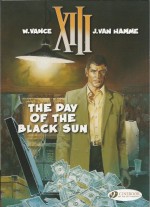
XIII volume 1: The Day of the Black Sun


By William Vance & Jean Van Hamme, coloured by Petra (Cinebook)
ISBN: 978-1-84918-039-9

One of the most consistently entertaining and popular adventure serials in Europe, XIII was created by writer Jean Van Hamme (Wayne Shelton, Blake and Mortimer, Lady S.) and artist William Vance (Bruce J. Hawker, Marshal Blueberry, Ramiro).

Van Hamme – born in Brussels in 1939 – is one of the most prolific writers in comics. After academically pursuing business studies he moved into journalism and marketing before selling his first graphic tale in 1968.

Immediately clicking with the public, by 1976 he had also branched out into novels and screenwriting. His big break was the monumentally successful fantasy series Thorgal for Tintin magazine. He then cemented his reputation with mass-market bestsellers Largo Winch and XIII as well as more cerebral fare such as Chninkel and Les maîtres de l’orge.

In 2010 Van Hamme was listed as the second-best selling comics author in France, ranked beside the seemingly unassailable Hergé and Uderzo.

William Vance is the comics nom de plume of William van Cutsem, who was born in 1935 in Anderlecht. After military service in 1955-1956 he studied art at the Académie Royale des Beaux-Arts and promptly became an illustrator of biographic features for Tintin in 1962. His art is a classical blend of meticulous realism, scrupulous detail and spectacular if understated action.

In 1964 he began the maritime serial Howard Flynn (written by Yves Duval) before graduating to more popular genre work with western Ray Ringo and espionage thriller Bruno Brazil (scripted by “Greg”). Further success followed when he replaced Gérald Forton on science fiction classic Bob Morane in Femmes d’Aujourd’hui, (and later Pilote and Tintin).

Constantly working on both serials and stand-alone stories, Vance’s most acclaimed work is his collaboration with fellow Belgian Van Hamme on a contemporary thriller based on Robert Ludlum’s novel The Bourne Identity…

XIII debuted in 1984, originally running in prestigious comics anthology Spirou to great acclaim. A triad of albums were rushed out – simultaneously printed in French and Dutch language editions – before the first year of serialisation ended.

The series was a monumental hit in Europe – although publishing house Dargaud were initially a little slow to catch on – but has fared less well in its many attempts to make the translation jump to English, with Catalan Communications, Alias Comics and even Marvel all failing to maximise the potential of the gritty mystery thriller.

The epic conspiracy thriller of unrelenting mood, mystery and mayhem begins as The Day of the Black Sun (originally Le jour du soleil noir) opens on a windswept, rocky shore where retired Abe‘s quiet day of fishing is ruined after he reels in a body…

The shocking catch is still alive despite being shot in the head, and as Abe’s wife Sally examines the near-corpse she finds a key sewn into his clothes and the Roman numerals for thirteen tattooed in his neck. The area is desolate and remote and the fisherman has already gone for the only medical assistance he can think of: an alcoholic surgeon struck off for operating whilst inebriated…

After a tense, makeshift and rushed procedure ends in miraculous success, the three conspirators agree they can never tell anyone. Old Martha performed a miracle in saving the presumably shipwrecked stranger, but if the authorities ever find out she would face jail for practicing without a license.

There is a further complication. The gunshot victim – a splendid physical specimen clearly no stranger to action or violence – has suffered massive and probably irreversible brain trauma. Although now sound in body he has completely lost his mind. His language skills, social and reflexive conditioning and muscle memories all remain intact, but every detail of his personal life-history has been utterly erased…

Some time later as Martha explains all this to the swiftly recuperating stranger – whom Abe and Sally have named “Alan” after their own dead son – his lost past life explosively intrudes when contract killers invade the remote beach house with guns blazing…

Terrifying skills he has no conception of immediately surface and Alan lethally counters the attack, but too late to save anybody but himself and Martha…

In the aftermath Alan finds a photo of him and a young woman on one of the hitmen and, with Martha’s help, traces the picture to nearby metropolis Eastown. Desperate for answers and certain that more killers must be coming, the human question mark heads off to confront unimaginable danger and hopefully find the answers he so urgently needs…

Eager to find the mystery woman he was clearly intimate with, Alan tracks the photograph to the offices of the local newspaper, which brings him to the attention of a less than honest cop who recognises the amnesiac and makes sinister plans…

The woman in the photo is Kim Rowland, a local widow officially listed as a “missing person”. When Alan goes to her house he finds the key he was carrying fits the front door…

Inside is a scene of devastation, but a thorough search utilising gifts he was unaware he possessed turns up another key and a note warning someone named “Jake” that “The Mongoose” has found her and she’s going to disappear…

As he continues his probing Alan/Jake is ambushed by the dirty cop and newspaper Editor Wayne. Gloating Lieutenant Hemmings calls him “Shelton” and demands the return of a large amount of money the baffled amnesiac has no memory of.

Thinking fast, Alan/Jake/Shelton guesses that the new key he found is for a safe-deposit box and bluffs the thugs into taking him to the biggest bank in town…

The bank manager there also knows him as Mr. Shelton and happily escorts him to his private room, but when Hemmings and Wayne examine the briefcase left in Shelton’s deposit box a booby trap goes off. Taking advantage of the confusion their prisoner snatches up the case and expertly escapes from the bank despite the institution rapidly initiating lockdown procedures…

Later in a shabby hotel room the agonised amnesiac considers the huge amount of cash in the case and not for the first time wonders what kind of man he used to be…

Preferring motion to inactivity, Alan prepares to leave and stumbles into a mob of armed killers about to bust into his room. In a blur of lethal activity he escapes to the roof with the thugs in hot pursuit and stumbles into another group led by a man addressed as Colonel Amos…

The chilling executive calls his captive “Thirteen”, claiming to have previously dealt with his predecessors XI and XIII over something called the “Black Sun case”…

The Colonel also very much wants to know who Alan is, but has a few shocking facts already at his disposal. The most sensational is a film of the recent assassination of the American President which clearly shows the lone gunman to be none other than the now-appalled Thirteen…

Despite Alan’s heartfelt conviction that he is not an assassin, Amos continues to accuse his memory-wiped captive of being an employee of a criminal mastermind. The Security Supremo wants the man in charge but fails to take Alan’s forgotten instinctive abilities into account and is taken completely by surprise when his prisoner rashly leaps out of a fourth floor window…

Impossibly surviving the plunge and subsequent pursuit, the frantic fugitive heads for the only refuge he knows, but by the time he reaches Martha’s beachside house trouble has beaten him there…

Another band of murderers is waiting; led by a mild-seeming man Alan inexplicably calls The Mongoose. The smug killer expresses surprise and admiration: he thought he’d killed Thirteen months ago…

Tragedy follows an explosion of deadly violence as the agonised amnesiac goes into instinctive action. The henchman are mercilessly despatched – although too late to save Martha – but The Mongoose escapes, promising dire revenge…

With nothing but doubt, confusion and corpses behind him, the mystery man regretfully hops a freight train west and heads toward into an uncertain future…

And so began one of the most compelling and convoluted mystery adventures ever conceived, with subsequent instalments constantly taking the questing Thirteen two steps forward, one step back as he encountered a world of pain and peril whilst tracking down the web of past lives he seemingly led…

Fast-paced, clever and immensely inventive, XIII is a series no devotee of mystery and murder will want to miss.
Original edition © Dargaud Benelux (Dargaud-Lombard SA), 1984 by Van Hamme, Vance & Petra. All rights reserved. This edition published 2010 by Cinebook Ltd.

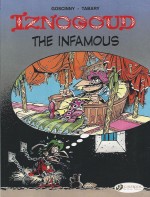
Iznogoud the Infamous


By Goscinny and Tabary (Cinebook)
ISBN: 978-1-84918-074-0

For the greater part of his too-short lifetime (1926-1977) René Goscinny was one of the most prolific and most-read writers of comic strips the world has ever seen. He still is.

Among his most popular comic collaborations are Lucky Luke, Le Petit Nicolas and, of course, Asterix the Gaul, but there were so many others, such as the dazzling, dark deeds of a dastardly usurper whose dreams of diabolical skulduggery perpetually proved to be ultimately no more than castles in the sand…

Scant years after the Suez crisis, the French returned to the hotly contested deserts when Goscinny teamed with sublimely gifted Swedish émigré Jean Tabary (1930-2011) – who numbered Richard et Charlie, Grabadu et Gabaliouchtou, Totoche, Corinne et Jeannot and Valentin le Vagabond amongst his other hit strips – to detail the innocuous history of imbecilic Arabian (im)potentate Haroun el-Poussah.

However it was the strip’s villainous foil, power-hungry vizier Iznogoud who stole the show – possibly the conniving little imp’s only successful coup.

Les Aventures du Calife Haroun el Poussah was created for Record; with the first episode appearing in the January 15th issue. 1962. A minor hit, it subsequently jumped ship to Pilote – a comics magazine created and edited by Goscinny – where it was artfully refashioned into a starring vehicle for the devious little ratbag who had increasingly been hogging all the laughs and limelight.

Like all great storytelling, Iznogoud works on two levels: for the youngsters it’s a comedic romp with adorably wicked baddies invariably hoisted on their own petards and coming a-cropper, whilst older, wiser heads can revel in pun-filled, witty satires and marvellously accessible episodic comic capers.

This same magic formula made its more famous cousin Asterix a monolithic global success and, just like the saga of the indomitable Gaul, the irresistibly addictive Arabian Nit was originally adapted into English by master translators Anthea Bell & Derek Hockridge who made those Roman Follies so very palatable to British tastes.

As always the deliciously malicious whimsy is heavily dosed with manic absurdity, cleverly contemporary cultural critiques and brilliantly delivered creative anachronisms which serve to keep the assorted escapades bizarrely fresh and hilariously inventive.

Insidious anti-hero Iznogoud is Grand Vizier to affable, easy-going Caliph of Ancient Baghdad Haroun Al Plassid, but the sneaky little toad has loftier ambitions, or as he is always declaiming “I want to be Caliph instead of the Caliph!”…

The retooled series launched in Pilote in 1968, and quickly became a massive European hit, with 29 albums to date (carried on by Tabary’s children Stéphane, Muriel and Nicolas), his own solo comic, a computer game, animated film, TV cartoon show and even a live-action movie.

When Goscinny died in 1977 Tabary began scripting his own sublimely stylish tales (from the 13th album onwards), switching to book-length complete adventures, rather than the compilations of short, punchy vignettes which typified the collaborations.

Originally released in 1969, Iznogoud l’infâme was the fourth Dargaud collection and the second volume published by Methuen in 1977, and here it’s the seventh splendid Cinebook album, offering a wry and raucous quintet of short tales with the Vile Vizier on top form as he schemes to seize power from his sublimely oblivious Lord and Master.

The eternal drama begins with ‘The Sinister Liquidator’, which finds Iznogoud and his bumbling, long-suffering henchman and strong-arm crony Wa’at Alahf making their way through a malodorous swamp in search of a Djinn with the power to reduce all he touches to unliving liquid.

Enduring the evil Ifreet’s ghastly manners and painful punning, the devilish diplomat strikes a bargain which spells doom for the Caliph… but first he has to get the demon back to the palace.

Since the Djinn cannot completely leave his fetid fluid environment and glorious bustling Baghdad is beyond the Great Desert, Iznogoud and Wa’at Alahf must Djinngerly transport their secret weapon home. Moreover, as under no circumstances can they afford to be moistened by the monster themselves, a succession of buckets, bowls, bottles and vials inexorably diminish the watery wonder and the Vile Vizier’s chances of success until – as you’d expect – the inevitable occurs…

The pun-punctuated comedy of errors is followed by a sneaky dose of inspired iniquity dubbed ‘The Invisible Menace’ wherein the Vizier learns a magic spell which will banish his imperial impediment from the sight of man. Of course he still has to find and keep his target still long enough for the magic to work…

Sheer broad slapstick-riddled farce is the secret ingredient of the next craftily convoluted saga. When Iznogoud deliberately accepts a cursed gem which brings catastrophic misfortune in the expectation that he can palm it off on his unsuspecting boss, he greatly underestimates the power of ‘The Unlucky Diamond’.

As soon the ghastly gem latches on to a truly deserving victim and unleashes a succession of punitive calamities, it determines to never let go…

A state visit by an African potentate allows the Vizier plenty of time to confer with his opposite number in ‘The Magic Doll’. However the bemused Witch Doctor has no idea that his numerous demonstrations of voodoo magic with a clay figurine are Iznogoud’s dry runs for a stab at the throne.

Of course, for the sorcery to work the Vizier has to somehow obtain a lock of Haroun Al Plassid’s closely guarded and held-as-holy hair…

The manic mirth concludes with a decent into sheer surreal absurdity (granting Tabary license to ascend to M.C. Escher-like heights of graphic invention) as an itinerant magician known as ‘The Mysterious Billposter’ creates a magic advert which can transport people to an idealised paradisiacal holiday destination.

Iznogoud is far more interested in the fact that, once in, no-one can get out again…

Just for a change the plan succeeds perfectly and the blithely unaware Caliph is trapped in an inescapable, idealised extra-dimensional state. Sadly, due to his extreme eagerness, so is his not-so-faithful Vizier…

Just such witty, fast-paced hi-jinks and craftily crafted comedy set pieces have made this addictive series a household name in France where “Iznogoud” is common term for a certain type of politician: over-ambitious, unscrupulous – and frequently a little lacking in height.

When first released in Britain during the late 1970s (and again in 1996 as a periodical comicbook) these tales made little impression, but certainly now this snappy, wonderfully beguiling strip has finally and deservedly found an appreciative audience among today’s more internationally aware, politically jaded comics-and-cartoon savvy Kids Of All Ages…
Original edition © Dargaud Editeur Paris, 1969 by Goscinny & Tabary. All rights reserved. This edition published 2011 by Cinebook Ltd.

Rael: Into the Shadow of the Sun


By Colin Wilson (Acme Press/Eclipse Books)
ISBN: 978-1-87008-465-9

Colin Wilson has been a major force in world comics for decades. Born in New Zealand in 1949, he studied at Christchurch School of Art at the end of the 1960s and became a freelance illustrator. In 1977 he created his own influential fanzine Strips and in 1980 migrated to Britain, finding success and a modicum of fame at 2000AD drawing Tharg’s Future Shocks, Judge Dredd and Rogue Trooper.

After two years he moved to France and created dystopic sci fi trilogy Dans l’Ombre du Soleil for publisher Glenat. The acclaimed series brought him to the attention of Jean-Michel Charlier and his idol Jean Giraud/Moebius. Soon he was illustrating one of the most popular characters in the world – La Jeunesse de Blueberry (Young Blueberry) – to universal acclaim.

Since then he’s expanded his horizons even further, working on the Star Wars franchise, WildStorm’s US revision of Battler Britton and crime thriller Point Blank (with Ed Brubaker), triumphantly returned to 2000AD, and remained a force in European comics. He’s even joined a select band of stars to have worked on Sergio Bonelli Editore’s iconic spaghetti western Tex Willer.

Back in 1988 British publisher Acme Press – in conjunction with Eclipse Books – re-translated (Wilson wrote the first album in English and had it translated into vernacular French by writer Frank Giroud) the opening book in his gripping sci fi trilogy as Rael: Into the Shadow of the Sun.

Despite its superb artwork and thrilling premise it sank without trace on the comics-boom saturated shelves of US and UK Direct Sales Stores.

Far too long overdue for a modern re-release, our story opens as a handful of hardy, human survivors scavenge on an Earth ravaged by genetic and ecological catastrophe. Their latest risky venture is a trap however and an unknowable time later leader Rael and his wary comrades awaken in an incredible new environment: clean, antiseptic, sterile and orbiting high above the broken world they were born into…

The satellite habitat is one of three occupied when the world collapsed, but now even this technological paradise is under threat. There’s mutiny amidst the workers and even worse…

As explained by dictatorial leader Madame Steiner, The Genesis Project is the result of positive and pre-emptive action by responsible individuals answerable to no government. In only twenty years three perfect artificial worlds were constructed and subsequently saved the worthy when Earth succumbed to war and man-made disease.

Now the hardy newcomers are being given the one-in-a-lifetime opportunity to join the project, but Steiner is not being completely candid. As the deeply suspicious Rael finds when he accidentally opens the wrong door, Chief Medical Officer Doctor William Canaris daily deals with a growing menace: a contagion inexorably ravaging the sky-dwellers which the prisoners from Earth seem immune to…

The survivors have been shanghaied for medical experimentation and, if any survive, slave labour to replace the mutineers. When they discover this and violently react the soldiery comes down hard and Rael seizes his chance to escape…

Driven ever deeper into the bowels of the monumental construct by trigger-happy hunters, the lost and wounded fugitive eventually collapses, even as far above Canaris meticulously works his way through the prisoners, making a major medical breakthrough…

Far away, when consciousness returns Rael finds himself tended to by a strange hermit named Oliphant. The recluse evinces no interest in Steiner and her schemes or the rest of depleted humanity, but instead reveals the incredible secrets of “his” inner world.

Most unbelievable is the pristine natural ecosystem at its centre: a preserve of rocky peaks and verdant forests used by the upper echelons of Genesis Society as their own playground.

Moreover, although Oliphant refuses to acknowledge them either, the environment has its secret guardians: autonomous robotic Constructs which originally built the satellites and now work passively against Steiner’s rapacious practises. Befriending the outsider they reveal to Rael the shocking truth behind the planet’s collapse…

With outrage boiling through his being and all his friends slowly being expended, the rebel Earthman then charismatically convinces the robot sentinels to make a stand, leading a rebellion that might be the very last expression of human freedom…

Fast-paced, beautifully illustrated and still astoundingly timely in content, Into the Shadow of the Sun is a masterpiece of fantastic fiction which truly deserves a comprehensive new edition and another shot at the A-List of graphic entertainments.

© 1988 Editions Glenat. English Edition © 1988 Acme Press/Eclipse Books. All artwork © 1988 Colin Wilson. All rights reserved.

Street View


By Pascal Rabaté translated by Terry Nantier (NBM/ComicsLit)
ISBN: 978-1-56163-908-3

Whilst everyone else you know is risking life and limb at the post-Christmas sales (or carpal tunnel syndrome by buying online) here’s a splendid little graphic confection to add to your own shopping list.

French bande dessinée creator (Exode, Ibicus, Les Petits Ruisseaux) and filmmaker (Wandering Streams, Du goudron et des plumes) Pascal Rabaté was born in August 1961 in Tours. Raised in Langeais, he studied printmaking at l’École des Beaux-Arts d’Angers in the 1980s before he began selling comics tales in 1989.

Always experimental, his works ran against contemporary trends as he moved towards a personal kind of Expressionism. His four-volume Tolstoy graphic adaptation Ibicus garnered awards and critical acclaim and cemented his reputation amongst the leading lights of French comics.

In 2013 he crafted a novel and sublimely witty tribute to Alfred Hitchcock (specifically Rear Window) entitled Fenêtre sur rue (Matinées), Fenêtre sur rue (Soirées) which is now available to English speakers. To be honest there’s only a tantalising, scene-setting introductory paragraph to anglicise… everything else is this confection is a wry witty pictorial progression of timeless pantomime and voyeuristic intrigue…

Street View (Mornings) is an “accordion book”: there is no spine holding individual pages together, but rather ten “widescreen” tableaux, run together as one continuous (neatly folded) Mise-en-scène scroll, depicting intimate and personal events as one morning passes on an ordinary street.

The scenario depicts two shops with upstairs apartments, a small house and a low-rise block of flats through certain times of day, with seventeen glass storefronts, doors and windows all affording sneaky peeks at folks living their lives in what they think is perfect privacy…

With the reader as silent witness, all their stories unfold before our sensation-hungry eyes: single viewpoint vignettes of frustration, love, betrayal, family crisis, outrageous humour, petty vindictiveness, idiocy, vanity, bad behaviour, drastic change and maybe even murder…

Street View (Evenings) is the flipside of the scroll, revealing for the dedicated viewer the freedom and license which grips all those isolated participants when they think themselves fully cloaked by darkness (if not drapes and curtains) …

This thrilling, funny – and yes, little bit creepy – intoxicating ensemble piece is a superb example of how pure graphic storytelling can beguile, inform and entertain: transcending barriers of language and custom with slickly effective imagery and primal narrative. It’s also one hell of a damn fine read and you simply must see it…

© 2013 Edition Soleil/Rabaté. © 2014 NBM for the English translation.

The Adventures of Blake and Mortimer: The Yellow “M”


By Edgar P. Jacobs, translated by Clarence E. Holland (Cinebook)
ISBN: 978-1-905460-21-2

Master storyteller Edgar P. Jacobs pitted his distinguished duo of Scientific Adventurers Captain Francis Blake and Professor Philip Mortimer against a wide variety of perils and menaces in stunning action thrillers which merged science fiction, detective mysteries and supernatural thrillers in the same timeless Ligne claire style which had done so much to make intrepid boy reporter Tintin a global sensation.

The strip debuted in Le Journal de Tintin #1 (26th September 1946): an anthology comic with editions in Belgium, France and Holland. The new anthology was edited by Hergé, with his eponymous star ably supplemented by a host of new heroes and features…

Le Marque Jaune was the third astounding exploit of the peerless pair, originally serialised in Le Journal de Tintin from August 6th 1953 to November 3rd 1954, before being collected as the sixth drama-drenched album in 1956.

This moody stand-alone extravaganza is the first in the modern Cinebook sequence with the True Brits for once on home soil as they struggle to solve an eerie mystery and capture an apparently superhuman criminal…

The tale begins a few days before Christmas on a night raining cats and dogs. The guards at the Tower of London are dutifully going about their appointed tasks when a sudden power cut douses all the lights.

By the time Beefeaters and Yeomen can find alternative lighting the damage is done. The Jewel Room is ransacked, the Imperial Crown missing and the wall emblazoned with a large letter M in a bold circle of yellow chalk.

The shocking travesty is but the latest in an outrageous series of incredible crimes by someone the newspapers have taken to calling The Yellow M…

Incensed by the latest outrage the Home Office assigns MI6 to the case and their top man Blake is seconded to assist Chief Inspector Glenn Kendall of Scotland Yard. So serious is the matter that Blake instantly cables his old comrade Professor Mortimer, dragging the bellicose boffin back from a well-deserved vacation in Scotland.

London is ablaze with rumour and speculation about the super-bandit. The old warhorses adjourn to the Centaur Club in Piccadilly to discuss events but as they settle in for a chinwag, Mortimer gets a fleeting impression that they are being spied upon…

Suddenly they are interrupted by four fellow members also hotly debating the case. Sir Hugh Calvin is a judge at the Central Criminal Court; Leslie Macomber edits the Daily Mail and Professor Robert Vernay is a prominent figure in the British Medical Association and they all are hotly disputing Dr Jonathan Septimus – of the Psychiatric Institute – who propounds a theory that the phantom felon is a prime example of his pet theory of “The Evil Influence of Cellular Development”…

The enlarged group continues the verbal back-and-forth into the small hours and when they finally break up Vernay follows his habit of walking home. He does not make it. The police find only his hat and a chalked letter in a circle…

The flamboyant rogue seems to be everywhere. When Blake and Mortimer interview Macomber, Calvin and the terrified Septimus next day, the invisible enigma somehow gets close enough to leave his mark on the MI6 officer’s coat, before sending a mocking cable warning the Mail’s Editor that more and worse is coming…

That night Macomber is abducted from his office in plain view of his staff and Kendall is found in a dazed state after failing to protect Judge Calvin from a mystery intruder…

Septimus concludes that he is next and convinces Blake to get him out of London. The pair board a train for Suffolk with a complement of detectives but even these precautions are not enough. The psychiatrist is impossibly plucked from the Express before it is wrecked in a horrific collision with another train.

In London, cerebral Mortimer has been researching another angle with the assistance of Daily Mail archivist Mr. Stone and has found a decades-old link between the missing men…

It all revolves around a controversial medical text entitled “The Mega Wave” and a scandalous court case, but when the Professor tries to secure a copy of the incredibly rare volume from the British Museum Library he is confounded by the Yellow M who invisibly purloins the last known copy in existence…

That evening he shares his thoughts with the returned Blake, unaware that his house has been bugged. Hours later a mysterious cloaked intruder breaks in but has a fit after passing some of Mortimer’s Egyptian souvenirs. The noise arouses the household and the masked burglar is confronted by Blake, Mortimer and burly manservant Nasir.

Incredibly the villain defeats them all with incredible strength and electrical shocks, even shrugging off bullets when they shoot him…

Exploding through a second story window the M laughs maniacally as they continue futilely firing before running off into the London night. In their shock the adventurers return to the drawing room and trip over the intruder’s listening devices…

Later the recovered Kendall visits just as a package arrives. It contains an anonymous note from someone wishing to share information and directs Blake to a late night rendezvous at Limehouse Dock. The message also contains a desperate note from the missing Septimus begging Blake to comply…

Well aware that it’s a trap and over Mortimer’s strenuous protests, Blake and Kendall lay plans to turn the meeting to their advantage. Left at home the Professor is surprised by a late visit from Stone. The remarkably efficient researcher has found a copy of The Mega Wave and rushed over to show Mortimer.

As Blake manfully braves the foggy waterfront and walks into deadly danger Mortimer is reading the tome, deducing who is behind the plot and perhaps even how the malign miracles are pulled off…

In Limehouse the empty commercial buildings become a spectacular battleground as Blake and the police confront the masked man who easily holds them all at bay with incredible feats of speed and strength, before breaking out of the supposedly impenetrable blue cordon and escaping.

In his destructive flight he tumbles into the frantic Mortimer who is dashing in to warn his old friend. Changing tack, the boffin gives chase, doggedly following the superhuman enigma through parks and sewers until he finds himself in a hidden basement laboratory being assaulted by mind-control devices devised by the sinister mastermind actually behind the entire campaign of vengeance and terror…

As the smirking villain gives an exultant speech of explanation, triumph and justification, Mortimer sees the fate of the abducted men and meets the human guinea pig who has been terrorising London at the behest of a madman. It is the very last person he ever expected to see again, but as he reels in shock Blake and Kendall are on his trail, thanks to the efforts of an avaricious cabbie with a good memory for faces…

As Christmas Day dawns Blake and Kendall lead a raid on the hidden citadel to rescue Mortimer, but the wily savant has already taken dramatic steps to secure his own release and defeat his insane, implacable opponent…

Fast-paced, action-packed, wry and magnificently eerie, this fabulously retro thriller is an intoxicating moody mystery and a sheer delight for lovers of fantastic fiction. Blake & Mortimer are the graphic personification of the Bulldog Spirit and worthy successors to the likes of Sherlock Holmes, Allan Quatermain, Professor Challenger, Richard Hannay and all the other valiant stalwarts of lost Albion…

In 1986 this story was reformatted and repackaged in a super-sized English translation, the last of six volumes with additional material (mostly covers from the weekly Tintin added to the story as splash pages) as part of a European push to win some of the lucrative Tintin and Asterix market here, but failed to find an audience. There were no more translations until January 2007 when Cinebook released this tome to far greater approval and much success…

Gripping and fantastic in the truest tradition of pulp sci-fi and Boy’s Own Adventures, Blake and Mortimer are the very epitome of dogged heroic determination; always delivering grand, old-fashioned Blood-&-Thunder thrills and spills in timeless fashion and with astonishing visual punch. Any kid able to suspend modern mores and cultural disbelief (call it alternate earth history or bakelite-punk if you want) will experience the adventure of their lives… and so will their children.

This Cinebook edition also includes a selection of colour cover sketches and roughs plus a biographical feature and chronological publication chart of Jacobs’ and his successors’ efforts.
Original editions © Editions Blake & Mortimer/Studio Jacobs (Dargaud-Lombard s.a.) 1987 by E.P. Jacobs. All rights reserved. English translation © 2007 Cinebook Ltd.

Moomin: the Complete Tove Jansson Comic Strip volume 5


By Tove and Lars Jansson (Drawn & Quarterly)
ISBN: 978-1-89729-994-4

Win’s Christmas Gift Recommendation: Moomins Aren’t Just For Christmas, But For Life… 10/10

Tove Jansson was one of the greatest literary innovators and narrative pioneers of the 20th century: equally adept at shaping words and images to create worlds of wonder. She was especially expressive with basic components such as pen and ink, manipulating slim economical lines and patterns to realise sublime realms of fascination, whilst her dexterity made simple forms into incredibly expressive and potent symbols.

Tove Marika Jansson was born into an artistic, intellectual and practically bohemian Swedish family in Helsinki, Finland on August 9th 1914. Her father Viktor was a sculptor, her mother Signe Hammarsten-Jansson a successful illustrator, graphic designer and commercial artist. Tove’s brothers Lars and Per Olov became a cartoonist/writer and photographer respectively. The family and its close intellectual, eccentric circle of friends seems to have been cast rather than born, with a witty play or challenging sitcom as the piece they were all destined to act in.

After intensive study from 1930-1938 (University College of Arts, Crafts and Design, Stockholm, the Graphic School of the Finnish Academy of Fine Arts and L’Ecole d’Adrien Holy and L’Ecole des Beaux-Arts, Paris) she became a successful exhibiting artist through the troubled period of the Second World War. Intensely creative in many fields, she published the first fantastic Moomins adventure in 1945: SmÃ¥trollen och den stora översvämningen (The Little Trolls and the Great Flood or latterly and more euphoniously The Moomins and the Great Flood), a whimsical epic of gentle, inclusive, accepting, understanding, bohemian, misfit trolls and their strange friends…

A youthful over-achiever, from 1930-1953 Tove worked as an illustrator and cartoonist for the Swedish satirical magazine Garm, and achieved some measure of notoriety with an infamous political sketch of Hitler in nappies that lampooned the Appeasement policies of Chamberlain and other European leaders in the build-up to World War II. She was also an in-demand illustrator for many magazines and children’s books, and had started selling comic strips as early as 1929.

Moomintroll was her signature character. Literally.

The lumpy, gently adventurous big-eyed romantic goof began life as a spindly sigil next to her name in her political works. She called him “Snork” and claimed she had designed him in a fit of pique as a child – the ugliest thing a precocious little girl could imagine – as a response to losing an argument about Immanuel Kant with her brother.

The term “Moomin” came from her maternal uncle Einar Hammarsten who attempted to stop her pilfering food when she visited by warning her that a Moomintroll guarded the kitchen, creeping up on trespassers and breathing cold air down their necks. Snork/Moomin filled out, became timidly nicer – if a little clingy and insecure – acting as a placid therapy-tool to counteract the grimness of the post-war world.

The Moomins and the Great Flood didn’t make much of an initial impact but Jansson persisted, probably as much for her own edification as any other reason, and in 1946 the second book Kometjakten (Comet in Moominland) was published. Many commentators have reckoned the terrifying tale a skilfully compelling allegory of Nuclear Armageddon.

When it and her third illustrated novel Trollkarlens hatt (1948, Finn Family Moomintroll or occasionally The Happy Moomins) were translated into English in 1952 to great acclaim, it prompted British publishing giant Associated Press to commission a newspaper strip about her seductively sweet and sensibly surreal creations.

Jansson had no misgivings or prejudices about strip cartoons and had already adapted Comet in Moominland for Swedish/Finnish paper Ny Tid.

Mumintrollet och jordens undergängMoomintrolls and the End of the World – was a popular feature so Jansson readily accepted the chance to extend her eclectic family across the world.

In 1953 The London Evening News began the first of 21 Moomin strip sagas which promptly captivated readers of all ages. Tove’s involvement in the cartoon feature ended in 1959, a casualty of its own success and a punishing publication schedule. So great was the strain that towards the end she had recruited her brother Lars to help. He took over, continuing the feature until its end in 1975. The three strips in this volume were all scripted by Lars and illustrated by his sister.

Free of the strip, Tove returned to painting, writing and her other creative pursuits, generating plays, murals, public art, stage designs, costumes for dramas and ballets, a Moomin opera and another nine Moomin-related picture-books and novels, as well as thirteen books and short-story collections strictly for grown-ups.

Tove Jansson died on June 27th 2001 and her awards are too numerous to mention, but consider this: how many modern artists – let alone comics creators – get their faces on the national currency?

Her Moomin comic strips have long been available in Scandinavian volumes and the discerning folk at Drawn & Quarterly have translated these into English for your – and especially my – sheer delight and delectation.

Moomintrolls are easygoing free spirits, bohemians untroubled by hidebound domestic mores and societal pressures. Moominmama is warm and capable but overly concerned with propriety and appearances whilst Moominpappa spends most of his time trying to rekindle his adventurous youth or dreaming of fantastic journeys. Their son Moomin is a meek and dreamy boy who adores their permanent guest Snorkmaiden – although that impressionable gamin prefers to play things slowly whilst waiting for somebody potentially better…

This fifth oversized (312 x 222mm) monochrome hardback compilation gathers the 19th, 20th and 21st strip sagas and is a particular favourite, comprising a trio of epic length sequences commencing with ‘Moomin Winter’ as the worst snow season in living memory begins and the nonconformist family decide that this year they will return to traditional ways and hibernate as proper Moomintrolls should…

However happenstance and their own magnanimous natures work against them as other locals – less prepared for the winter’s icy blasts – keep turning up seeking succour, solace and shelter. Naturally no decent creature could turn away neighbours – or even complete strangers – in need…

First it’s timid Miss Fluffins nervously tapping on the door then a little later the quirkily obnoxious Gromf imposing himself upon them, but the truly disruptive influence only arrives after a most odd Christmas when the snow lies metres deep around the house. Delivered through an upstairs window by the indefatigable parcel post is a box containing a baby Nibling…

Abandoning all hope of a successful hibernation, the Moomins become unwilling but polite hosts to them all although, as Niblings are such legendary troublemakers, it’s understandable that Moominmama first goes on a heroic expedition to all the neighbours, striving to find a suitable home (i.e. somebody else’s) for the little mite…

She even briefly considers the draconian local orphanage before relenting and returning home with the nosy, chaos-causing little critter…

As well as having voracious eating habits, the Nibling is less than welcome for its incessant curiosity and stunningly forthright rudeness. As the snowbound days pass the inquisitive meddler sniffs out every shameful secret of the household from Fluffins’ strangely masculine habits to Snorkmaiden’s binge eating, young Moomintroll’s aspirations to thespianism or the fearsome Gromf’s addiction to knitting doilies…

These secrets and others it uses to virtually run the house. Moominpapa retires to his study to reminisce and read the papers whilst his long-suffering wife resorts to the thankless tasks of housework to keep busy. Eventually however, as the months go by the Moomins decide it’s time for drastic action and try to starve all their increasingly unwelcome guests out…

Sadly, as ever, the hosts are too gracious and well-mannered to persist for long and soon the boy troll and incessant Nibling are skiing through the winter wilderness hunting grizzly and moose for the larder. A little later, things come to a comical head when the assemblage decides to share all their secret peccadilloes thus depriving the mischievous Nibling of its power…

This comedy of manners is followed by a boisterously sedate and surreal adventure as ‘Moomin Under Sail’ finds Moominpapa and family joining neighbour Too-Tikki (the eminently practical and capable lady was based on Jansson’s life partner, graphic artist Tuulikki Pietilä, and first appeared in the novel Moominland Midwinter) in building a wooden sailing ship and going voyaging…

The construction is well underway, with everyone contributing in their own unique way, when a wandering poet appears and names the vessel “Mermaid” – which rash Moomin misspells as “Murmade” when painting the hull – before moving on, and all too soon the travellers are underway…

At least they would be if they hadn’t built their boat on a hill and now can’t shift it. Fortunately Too-Tikki knows a rather irascible but polite giant Booble named Mr. Edward who she can convince to move the river for them…

And in a roar of waters they are off, hurtling out to sea in search of wonder, mystery and romance. It comes all too soon as food and whisky starts to vanish and – at least for the ever-imaginative Snorkmaiden – passion is found when the terrified shipmates discover that the beguiling, advantage-taking poet has stowed away…

Young Moomin is less than sanguine that his one and only has become besotted with the unscrupulous scribbler and is secretly delighted when a school of seagoing wild Niblings board the vessel and eat all his odes…

None too soon they depart, taking the poet with them whilst leaving one of their cubs behind. The rapacious tyke is rather sweet but has a disturbing taste for paper and leather goods…

Things begin to go further awry as the babe eats all the charts so Too-Tikki captures some clouds for the child to chew, accidentally precipitating a colossal hurricane which rips their sails away. Happily the clouds make a suitable substitute. There’s even some left to give to Mr. Edward when the aggrieved Booble suddenly shows up…

Sighting land the Moomins and Co go ashore to re-supply and hear worrying stories of a pirate marauder dubbed the “Bloody Mary” before heading back out to sea and encountering a Marie Celeste-like conundrum and inevitable encountering the dread privateers.

Imagine the surprise of the Murmade mariners when they discover the wild freebooters are in fact old acquaintances…

This amazing, enchanting collection concludes with a salutary tale of unrequited love as Moomin makes a new friend and becomes involved with ‘Fuddler’s Courtship’. The meek and rather scruffy young man is a collector of many things – but most especially buttons – and reveals to his new chum that he is hopelessly in love with quirky, overly romantic and lonely Mymble…

Despite their misgivings over the clear mismatch, Moomin and Snorkmaiden attempt to facilitate affairs but the target of the Fuddler’s affections is currently enamoured of a dynamic strongman. Although she’s prepared to give any new suitor a chance, his clumsiness, diffidence, messiness and collecting habits soon drive Mymble back to her photos of the oblivious Sebastian…

With his confidence crushed Fuddler retreats to his coffee-can home to be depressed, provoking Moomin and Snorkmaiden to call in newspaper psychiatrist Dr. Hatter. It is a terrible mistake…

The Shrink is a mass of complexes and neuroses and soon he has infected almost everybody with one of his problems. Moreover Mymble finds the tortured “genius” utterly fascinating.

Moomin then tries everything – even a helpful ghost – to drive Hatter away, but only succeeds in having his entire family locked up. Happily the Fuddler has a collection of keys and other cage-opening gimmicks amongst his copious possessions…

The course of true love continues to run anything but smoothly for all concerned until one night the Fuddler meets a sweet, confused and messily charming collector of shells and stones. Her name is The Jumble…

Wrapping up the Wild Things wonderment is the short essay ‘Tove Jansson: To Live in Peace, Plant Potatoes, and Dream’: a comprehensive biography and commentary by Alisia Grace Chase (PhD) which celebrates the incredible achievements of this genteel giant of literature.

These are truly magical tales for the young laced with the devastating observation and razor sharp mature wit which enhances and elevates only the greatest kid’s stories into classics of literature. These volumes are an international treasure and no fan of the medium – or carbon-based lifeform with even a hint of heart and soul – can afford to be without them.
© 2010, 2014 Solo/Bulls. All other material © its creators. All rights reserved.

Asterix and the Actress


By Uderzo, translated by Anthea Bell & Derek Hockridge (Orion Books)
ISBN: 978-0-75284-658-8

A son of Italian immigrants, Alberto Aleandro Uderzo was born on April 25th 1927 in Fismes on the Marne. He dreamed of becoming an aircraft mechanic but even as a young child reading Mickey Mouse in Le Pétit Parisien he showed artistic flair. Albert became a French citizen when he was seven and found employment at thirteen, apprenticed to the Paris Publishing Society, where he learned design, typography, calligraphy and photo retouching.

When World War II came he spent time with farming relatives in Brittany and joined his father’s furniture-making business. Brittany beguiled and fascinated Uderzo and when a location for Asterix‘s idyllic village was being mooted, that beautiful countryside was the only choice…

In the post-war rebuilding of France, Uderzo returned to Paris and became a successful artist in the recovering nation’s burgeoning comics industry. His first published work, a pastiche of Aesop’s Fables, appeared in Junior and in 1945 he was introduced to industry giant Edmond-François Calvo (whose own comic masterpiece The Beast is Dead is far too long overdue for a commemorative reissue…).

Tireless Uderzo’s subsequent creations included the indomitable eccentric Clopinard, Belloy, l’Invulnérable, Prince Rollin and Arys Buck. He illustrated Em-Ré-Vil’s novel Flamberge, dabbled in animation, worked as a journalist and illustrator for France Dimanche and created the vertical comicstrip ‘Le Crime ne Paie pas’ for France-Soir.

In 1950 he illustrated a few episodes of the franchised European version of Fawcett’s Captain Marvel Jr. for Bravo!

An inveterate traveller, the artistic prodigy met Rene Goscinny in 1951. Soon bosom buddies, they resolved to work together at the new Paris office of Belgian Publishing giant World Press. Their first published collaboration was in November of that year; a feature piece on savoir vivre (gracious living) for women’s weekly Bonnes Soirée, following which an avalanche of splendid strips and serials poured forth.

Jehan Pistolet and Luc Junior were created for La Libre Junior and they resulted in a western starring a “Red Indian” who eventually evolved into the delightfully infamous Oumpah-Pah. In 1955, with the formation of Édifrance/Édipresse, Uderzo drew Bill Blanchart for La Libre Junior, replaced Christian Godard on Benjamin et Benjamine and in 1957 added Charlier’s Clairette to his portfolio.

The following year, he made his debut in Tintin, as Oumpah-Pah finally found a home and a rapturous audience. Uderzo also drew Poussin et Poussif, La Famille Moutonet and La Famille Cokalane.

When Pilote launched in 1959 Uderzo was a major creative force for the new enterprise, collaborating with Charlier on Tanguy et Laverdure and devising – with Goscinny – a little something called Asterix…

Although the gallant Gaul was a massive hit from the start, Uderzo continued illustrating Les Aventures de Tanguy et Laverdure, but once the first hilarious historical romp was collected in an album as Astérix le gaulois in 1961 it became clear that the hit series would demand most of his time – especially since the incredible Goscinny never seemed to require rest or run out of ideas.

By 1967 Asterix occupied all Uderzo’s time and attention, and in 1974 the partners formed Idéfix Studios to fully exploit their inimitable creation. When Goscinny passed away three years later, Uderzo had to be convinced to continue the adventures as writer and artist, producing a further ten volumes until 2010 when he retired.

After nearly 15 years as a weekly comic serial subsequently collected into book-length compilations, in 1974 the 21st (Asterix and Caesar’s Gift) was the first published as a complete original album before serialisation. Thereafter each new release was an eagerly anticipated, impatiently awaited treat for the strip’s millions of fans…

More than 325 million copies of 35 Asterix books have sold worldwide, making his joint creators France’s best-selling international authors, and now that torch has been passed and new sagas of the incomparable icon and his bellicose brethren are being created by Jean-Yves Ferri and Didier Conrad…

One of the most popular comics on Earth, the collected chronicles of Asterix the Gaul have been translated into more than 100 languages since his debut, with twelve animated and live-action movies, TV series, assorted games, toys, merchandise and even a theme park outside Paris (Parc Astérix, naturellement)…

Like all the best stories the narrative premise works on more than one level: read it as an action-packed comedic romp of sneaky and bullying baddies coming a-cropper if you want, or as a punfully sly and witty satire for older, wiser heads. English-speakers are further blessed by the brilliantly light touch of master translators Anthea Bell & Derek Hockridge who played no small part in making the indomitable little Gaul so very palatable to English tongues.

Many of the intoxicating epics are set in various exotic locales throughout the Ancient World, with the Garrulous Gallic Gentlemen reduced to quizzical tourists and bemused commentators in every fantastic land and corner of the civilisations that proliferated in that fabled era. The rest – more than half of the canon – take place in and around Uderzo’s adored Brittany, where, circa 50 B.C., a little hamlet of cantankerous, proudly defiant warriors and their families resisted every effort of the mighty Roman Empire to complete the conquest of Gaul.

The land is divided by the notional conquerors into provinces of Celtica, Aquitania and Amorica, but the very tip of the last named just refuses to be pacified…

Whenever the heroes were playing at home, the Romans, unable to defeat the last bastion of Gallic insouciance, futilely resorted to a policy of absolute containment. Thus the little seaside hamlet was permanently hemmed in by the heavily fortified garrisons of Totorum, Aquarium, Laudanum and Compendium.

The Gauls couldn’t care less, daily defying and frustrating the world’s greatest military machine simply by going about their everyday affairs, protected by the miraculous magic potion of resident druid Getafix and the shrewd wits of the diminutive dynamo and his simplistic, supercharged best friend Obelix…

Firmly established as a global brand and premium French export from the mid-1960s onwards, Asterix the Gaul continues to grow in quality as new creators toil ever onward, crafting further fabulous sagas and building a stunning legacy of graphic excellence and storytelling gold…

Uderzo’s seventh session as sole auteur was Astèrix et Latraviata released in 2001 as the 30th volume of the ever-unfolding saga. The English language version was released that same year as Asterix and the Actress.

The revelatory epic opens with romance in the air as Obelix and his lifelong pal return to the village laden down with boars and more battered keepsakes of the ongoing battle with the woefully outmatched Romans.

They amiably amble into a huge surprise party. The heroes share the same birthday and their friends have arranged the event to commemorate the occasion. Even their mothers have come down for a visit from fashionable regional capital Condatum…

Soon a feast is in full swing but after handing over their spectacular gifts – a fabulous jewelled sword for Asterix and an equally splendid Roman helmet for Obelix to add to his huge collection – culled from the parents’ fashionable souvenir shop, the mothers begin a battle of their own with their sons.

Fed up with waiting for their hardworking husbands to arrive from the Big City, the impatient matrons start in on the birthday boys with lectures about settling down and providing some grandchildren…

Overruling Asterix and Obelix’s complaints, the insistent Sarsaparilla and Vanilla conduct acutely embarrassing interviews with the village’s contingent of eligible females – and their potential mothers-in-law – and even organise a formal dance to show off their sons’ matrimonial potential, but the matchmaking is a succession of fiascos since the oafish louts just don’t want to play ball…

Fathers Astronomix and Obeliscoidix are now long overdue. Unknown to all they have been arrested by Prefect Bogus Genius. The wily official has a problem which needs some clever and extremely delicate handling…

Already in custody is dipsomaniac former legionary Tremensdelirious (see Asterix and Caesar’s Gift), who sold the aforementioned sword and helmet to the Gaulish souvenir traders. Sadly the items’ true owner is Caesar’s greatest enemy Pompey and thus proof positive that the usurping former tribune is back in Europe. The items must be quietly recovered before Rome realises…

Well aware of the ferocious reputation of the sons of his Gaulish captives, the Prefect enacts a devious scheme suggested by his spies. Mighty Obelix turns to jelly whenever he sees the beautiful Panacea (another village émigré now living in Condatum with her husband Tragicomix – as first seen in Asterix the Legionary) so the devilish conspirator has hired the Empire’s greatest actress Latraviata to impersonate her and steal back the incriminating evidence…

As the despondent dads tire of waiting for rescue by their doughty boys and strike a deal with their cellmate Tremensdelirious, Decurion Fastandfurius is pretending to be a merchant escorting “Panacea” back to her home village. The poor thing has a very selective case of amnesia…

In that certain Gaulish village on the coast of Armorica the actress is readily accepted with only Druid Getafix in the least suspicious. Soon her fawning attention to besotted Obelix wins her the helmet but Asterix is not so easily wooed. That changes when a spat with his now-jealous bosom buddy results in a mighty blow to the head which deprives him of his usually superior wits…

If not for overprotective mother Vanilla the plot would have succeeded then and there, but she stops the ingénue making off with the sword and calls in Getafix to cure her addled son. Unfortunately the magic potion has a bizarre effect on the little zombie and Asterix goes wild, acting like an animal and scrapping with Obelix before hurtling out to sea like a torpedo…

He regains his senses on a rock in the middle of nowhere just as a massive storm erupts about him and only survives due to the intervention of old frenemies The Pirates and a particularly accommodating dolphin…

In the meantime Latraviata and Fastandfurius have secretly secured the sword and started back for Condatum. Still unaware of their true nature, the freshly reconciled Asterix and Obelix – who are heading in the same direction to find out what has delayed their dads – cadge a lift on the infiltrators’ cart.

Elsewhere, other agents are coming into play. A certain spy has already informed Caesar of trouble brewing and the real Panacea, having seen Astronomix and Obeliscoidix’s wrecked shop, has rushed off with Tragicomix to warn the village…

As the heroes head for the city, they are baffled to see Romans so busy fighting each other that they don’t even notice their Gaulish nemeses, and everything comes to a startling head when Panacea apparently meets herself on the road…

After explanations, apologies and a surprising change of heart on behalf of one of the conspirators, Asterix and Obelix dash on to Condatum to rescue their fathers, only to stride straight into a major melee as Caesar and Pompey’s forces furiously clash…

Of course it all works out in the end and cartoon dog-lovers everywhere will rejoice in the last moment arrival of the missing wonder mutt Dogmatix…and the introduction of his new “wife” and family. Apparently some heroes can successfully combine romance and duty…

Packed with outrageous action, good-natured joshing, clever targeted raucous family humour, bombastic spectacle and a torrent of punishing puns to astound and bemuse youngsters of all ages, this rollicking affirmation of life’s eternal verities further confirmed Uderzo’s reputation as a storyteller whilst his stunning illustrative ability affords glimpses of sheer magic to lovers of cartoon art. Asterix and the Actress proves that the potion-powered paragons of Gallic Pride will never lose their potent punch.
© 2001 Les Éditions Albert René, Goscinny-Uderzo. English translation: © 2001 Les Éditions Albert René, Goscinny/Uderzo. All rights reserved.

Tales of an Imperfect Future


By Alfonso Font (Dark Horse Books)
ISBN: 978-1-61655-494-1

Win’s Christmas Gift Recommendation: For Starry-Eyed Cynics Everywhere… 8/10

Barcelona-born creator Alfonso Font Carrera was born on August 28th 1946. He studied Fine Arts and worked as an illustrator before slipping into comics in the 1960s with westerns tales in Hazañas del Oeste and Sioux for Ediciones Toray.

He soon graduated to horror stories and historical crime dramas about infamous criminals for the Selecciones Illustradas Agency and in 1970 began contributing material to British publisher Fleetway on strips such as Black Max in Thunder and Lion, soon thereafter graduating to America with work for mature magazine publishers Warren and Skywald.

With writer Carlos Echevarría, he created ‘Géminis’ (AKA Phil Jackson) and moved to Paris in 1975 to work for major comics magazine Pif Gadget devising ‘Sandberg, Père et Fils’ with Patrick Cothias, ‘Les Dossiers Mystère’ (written by Solet, and sharing art chores with Carlos Giménez and Adolfo Usero) and the Roger Lécureux-scripted ‘Les Robinsons de la Terre’.

From 1976-1982 he also freelanced for Scoop, Tousse Bourin and Super-As and at that time, incensed by publishers reprinting his work without permission or payment, he became active in Creators Rights issues and worked with Giménez, Victor Mora and Usero as the “Workshop Premia” seeking to create a union for comics professionals.

In the mid 1980s Font returned to Spain, contributing to new, home-grown publications like Cimoc, À Tope, and Circus whilst creating (with Mora) ‘Sylvestre’ and ‘Tequila Bang’.

For the Spanish iteration of 1984 he created signature sci fi gadabouts Clarke & Kubrick – who subsequently appeared in Cimoc and Rambla – and began a series of self-scripted, mordantly cynical and sardonic science fiction tales under the umbrella title ‘Cuentos de un futuro imperfecto’ which we know as Tales of an Imperfect Future…

Seemingly never sleeping, he went on to create parody-laced aviation hero ‘Frederico Mendelssohn Bartholdy’, ‘El Prisionero de las Estrellas’, and classical adventure serial ‘Jann Polynésia’ – which evolved into the iconic ‘John Rohner’ for Cimoc and ‘Carmen Bond’ for À Tope

In 1987 he started a fruitful association with French publications Pilote and Charlie Mensuel with his series ‘Taxi’ and, after a brace of independent albums for Planeta publishers, revived John Rohner at Norma publishers.

Always occupied he went on to create ‘Privado’ and medieval warrior ‘Bri D’Alban’ for Cimoc, whilst collaborating on cop series ‘Negras tormentas’ (‘Black Storms’) with writer Juan Antonio De Blas. He even began occasionally illustrating Italy’s venerable western superstar Tex for Bonelli. In 1996 he returned to American pages with his erotic series ‘Dra, Dare’ for Penthouse Comix.

A major force in European graphic storytelling, Font has won numerous awards including The Grand Prize at Comic Barcelona and a Haxtur Award.

His artwork is loose, fluid, intricate and utterly electrifying and now Dark Horse have translated the original European collection of Tales of an Imperfect Future into a stunning oversized (287x224mm) monochrome hardback edition that will delight fans of grittily fantastic fiction.

Any Brit who grew up reading the short complete sagas exemplified and perfected in 2000AD‘s Tharg’s Future Shocks, Pulp Sci-Fi or Tales from Beyond Science will be right at home – unless casual (human and robot) nudity is a problem…

Written and illustrated by Font throughout, the anthological nature of the tales is linked by the simple bridging device of a grotesque alien directly telling us that humanity is simultaneously a threat and embarrassment to the universe. However, rather than go to the time and expense of eliminating us, the Great Powers are offering us one last chance to change our ways and by way of inducement have provided some stories taken from our most probable futures to illustrate just why we’re so much of a problem…

The hard science hagiography commences with ‘Tanatos-1 Comes Home’ as the smug hierarchal rulers of earth gloat over the news that the AI super-weapon they created to destroy the alien fleets of Kloron has spectacularly succeeded.

As boffin Commander Grenh describes to the xenophobic top Bankers, Clerics and Military leaders how his programming compels the indestructible Tanatos-1 to unceasingly and implacably seek out all life in the universe and eradicate it, veteran General Alto Kervis asks himself why it has turned around and now nears Earth…

‘Rain’ introduces hard-working, long suffering blue-collar spacers Stanley Kubrick and Arthur C Clarke, stuck on a sodden world going slowly mad…

When the incessant deluge apparently causes a malfunction, hated computer Hal 2001 insists they go outside to fix the problem but Stanley is convinced the useless metal martinet is trying to kill its human masters…

Barbed humour gives way to barbarian fantasy in ‘Day of Glory’ as valiant John Smith battles devils and monsters to save his princess and his people. Tragically the wonder warrior is in for disappointment and shock once he impossibly defeats the sinister Overlord of Klaarn…

Cracks appear in the foundations of the Military-Industrial complex when a vile capitalist proves to the government why the war they’re fighting must never end in ‘Stocks’, whilst

‘The Hunt’ prophetically takes the Hunger Games trope and ongoing war between “One-Percenters” and the rest of us to its logical conclusion…

Originally crafted in the mid 1980s, it follows two super-rich brats as they stalk each other with lethal weapons through the dystopian wastelands inhabited by the poor. Of course, even when they’re killing each other for sport on a reality show, the oligarchs still find a way to bloodily exploit the despised discarded millions…

‘“Like a Plague”’ then offers an excoriating morality tale about our suicidal ecological irresponsibility before Stanley and Arthur return in ‘Cyberratic’.

Having finally escaped the rain-drenched hellhole and their creepily disturbing electronic taskmaster, the unlikely heroes hit the Welcome Satellite for some R&R but stumble into a major mechanical malfunction on the totally-automated resort. Luckily a small droid keeps pulling their fat out of the robotic fire, but you’d think such passionate machine-haters would stop for a moment to ask why and how their little saviour escaped the malfunction plague…

‘The Final Enemy’ offers a bleak glimpse at the thinking behind the soldiers who will fight in the final atomic Armageddon whilst black humour informs the tale of Earth explorers who land on paradise and destroy it forever with ‘The Kiss’…

Similar silliness informs the trash-inundated post-apocalyptic world of ‘The Cleaner’ when humanity’s last survivors activate a miraculous device to get rid of the cause and effects of the pollution which destroyed the world…

Although meant as a comedic interlude, the next vignette sadly comes across as dated and just a touch homophobic by today’s elevated standards, detailing the shock and peril a solitary explorer endures when he discovers his government-mandated and supplied robotic sexual companion is not a “Betty” but an over-zealous ‘Valentino’…

Far more safe and salutary territory finds ‘Earth Control at Your Service, Sir.’ addressing a version of the Cold Equations quandary as two astronauts bringing an end to global famine realise that they won’t reach Earth if both men keep breathing the rapidly diminishing oxygen supply. As they struggle to make an impossible decision they have no inkling that the authorities on a starving world have their own ideas…

‘The Siege’ bloodily traces the rampage of a merciless murderous maniac as a fractured city endures police martial law and the ceaseless hunt for society’s greatest menace and the tormented tomorrows tumble to a close with the bleak sad tale of a doomed and dying spacer’s escape into fantasy and one last passionate rendezvous with beloved ‘Green Eyes’…

Scary, satirical, suspenseful and superbly intoxicating Tales of an Imperfect Future offers a powerful panoply of graphic pleasures for every lover of comics adventure and science fiction wonders by a master of art long overdue for fame in the English-speaking world.
Tales of an Imperfect Future © 2014 SAF Comics, www.safcomics.com. All rights reserved.

Thorgal volume 1: Child of the Stars/Aaricia


By Rosiński & Van Hamme, translated by Luke Spear (Cinebook)
ISBN: 978-1-905460-23-6

One of the best and most celebrated adventure series of all time, Thorgal manages the ultimate magic trick of being able to both please critics and sell bucketloads. The series debuted in iconic French weekly Tintin in 1977 with the inevitable album compilations beginning three years later. The expansive generational saga has a truly international following in fourteen languages, has generated many spin-off series and naturally offers a strong presence in the global gaming arena.

Narratively, Thorgal offers the best of all amazing worlds with an ostensibly starkly historical milieu of bold Viking adventure glibly yet seamlessly encompassing chilling science fiction elements, monstrous horror, social satire, political intrigue, soap opera, Atlantean mystique and mythically mystical fantasy standards such as gods, monsters, dwarves and demons.

Created by Belgian writer Jean Van Hamme (Domino, XIII, Largo Winch, Blake and Mortimer) and Polish illustrator Grzegorz Rosiński (Kapitan Żbik, Pilot Śmigłowca, Hans, The Revenge of Count Skarbek) the feature grew into a generational saga over the decades with the creative duo completing 29 albums between 1980 and 2006 when Van Hamme moved on. Thereafter the scripting duties fell to Yves Sente who has collaborated on a further five collections to date.

By the time Van Hamme departed the feature had expanded to cover not only the life of the titular hero and his son Jolan but also other valiant family members in a number of spin-off series (Kriss de Valnor, Louve, La Jeunesse de Thorgal) under the umbrella title Les Mondes de Thorgal – all eventually winning their own section of albums.

In 1985 American publisher Donning released a superb series of oversized hardcover book translations but Thorgal never really found an English-speaking audience until Cinebook began its own iteration in 2007.

Although the original French series wanders back and forth through the hero’s life, this first British volume opts for a strictly chronological beginning and even doubles the pleasure by reprinting both the seventh (L’enfant des étoiles, 1984) and fourteenth (Aaricia, 1989) Le Lombard volumes, revealing the star’s origins and a few early adventures as well as the story of his divinely-destined bride-to-be…

Child of the Stars opens with ‘The Lost Drakkar’ as an expedition led by seemingly accursed Viking leader Leif Haraldson founders in stormy seas. Only fifteen men remain of the 120 who set out and wily, ambitious Gandalf the Mad convinces the survivors that the crew’s priest is right. Leif must be sacrificed to angry sea-god Aegir.

With everyone against him Leif prepares to sell his life dearly when the fates intervene. Thor‘s constant storms suddenly subside and their drakkar (ship) pulls through eerie mists into a warm sunlit bay.

The relieved mariners are further stunned to find a strange metal chest unlike anything they have ever beheld, lying on the beach. It contains a baby boy and jubilant chief Haraldson instantly adopts the foundling, naming the child Thorgal Aegirsson after the two forgiving gods who spared them…

The story resumes with ‘The Metal that Didn’t Exist’ by voyaging a thousand years into the past when demon-snake Nidhogg tricked Ivaldi, King of the Dwarves into wagering his name on a game of draughts (they called it “checkers”).

When the gloating serpent won, it allowed the humiliated artificer one last chance: Ivaldi could buy back his name – and power – if he produced a jewel made from a metal that did not exist. He even offered a grace period of one millennium to work in…

The mortified and terrified dwarf nation immediately set their youngest, boldest son to search the world for the impossible and 999 years later the weary, footsore mite wandered into a Haraldson’s Northern Viking village and saw a small dark-haired boy wearing an amulet made of something that had never originated on our world…

Excited Tjahzi explained his plight to the solitary lad and offered him all the wealth of the dwarvish realm but Thorgal refused, instead generously offering to give him the necklace. The astounded seeker instantly set off for home but his travels had exhausted him and he collapsed.

Thorgal picked up Tjahzi and began to carry him towards the distant mountains, telling the aged mite of how the amulet came from the strange “raft” he was found in as a baby…

As they slipped between worlds into the gods’ realm the boy grew – or shrank – to the same size as his diminutive companion but their epic journey was soon interrupted by the giant Hjalmgunnar, The hungry horror would have eaten them if not for the Winged Cats of Frigg but the goddess’ envoys were far less effective against a swarm of flying Vampire-Snakes…

The tiny travellers soon realised their mission was of great import to the major powers of the universe when, as they travelled a subterranean frozen river to the Dwarf Lands, a monstrous many-limbed monster serpent attacked.

Nidhogg was too arrogant, however, permitting the impetuous human boy to grow into his destined mature warrior form to duel more fairly. The intentionally cruel gesture and Thorgal’s dauntless courage allowed Tjahzi to slip by and deliver the unknown amulet to Ivaldi in time – at the cost of the boy-hero’s life.

Frigg, however, would not let such an injustice stand…

Little Thorgal awoke back in his village with the other children shouting. The wife of Gandalf had just been delivered of a baby girl. The little miracle was to be named Aaricia and when she was born she had a teardrop pearl gripped in each tiny fist…

Years later when Thorgal was just approaching adolescence his incredible history was finally revealed in ‘The Talisman’. Following a strange persistent call inside his head the boy voyaged across the country to a distant mountain where a bizarre hermit waited.

Thorgal had grown increasingly apart from the other children. Vile Gandalf had led a campaign to ostracise the foundling and the kids all called the child “bastard” and claimed he was not a true Viking.

The sage vaguely promised all the answers the wanderer wanted, but was astounded when the boy offered his most prized possession in return: a peculiar disc of unknown material given him by foster-father Leif Haraldson. The artefact had been inside the odd “raft” the baby was in and kept by the chief until Thorgal came of age…

The hermit did something to it and then had the boy meditate. Soon Thorgal’s thoughts are in the past and in the stars as an incredible story unfolds…

Years past a ship from the stars came to Earth. The awesomely powerful beings aboard had originated on Earth in eons past before migrating to the heavens, but even though they had returned in glory, many had not escaped the personal tyrannies of greed, jealousy, ambition and lust for power…

There was dissent and rebellion. The starmen battled and died. Soon only a baby in a lifeboat remained…

Former leader Xargos regretfully closed the psycho-transmitter and then removed all the restored memories he had shared with his grandson. The sage felt that with everything gone and the boy clearly not manifesting his race’s sometimes-latent psychic abilities Thorgal’s future would be kinder if he lived and died as an ordinary mortal…

Fourteenth collection Aaricia also contained a selection of short pieces and opens here with a fantastic trip as a sad little girl goes looking for her Mummy only to encounter some friendly “undergrowth Elves” who offer to take her where she wants to be…

As the entire village searches for Aaricia, ever-solitary Thorgal breaks off from the rest and follows a trail only he can discern. The little girl is almost in the arms of her recently dead mother when he arrives to drive off the vile demonic Nixes who have lured her to ‘Odin’s Mountain’…

‘First Snow’ details how, when Haraldson dies, Gandalf makes a cautious power-grab. With the Northern Vikings about to enter the overarching Nordic alliance The Althing as a recognised kingdom, the usurper is terrified that the outsider bastard will become ruler and summarily seizes all Leif’s lands and possessions.

Only Aaricia’s intervention and the arrival of the Althing’s astute adjudicator prevents monstrous murder, but Thorgal is nevertheless left an outcast in his own country…

Years later the outraged boy is denied the universal training all growing warriors are heir to: condemned to become a mere Skald (travelling musician). Although the princess Aaricia still loves him her intended chafes at such injustice and eventually invokes the right of ‘Holmganga’: challenging Gandalf’s son Bjorn to a death-duel for the right to be raised as a true man…

The usurper king sees an opportunity to get rid of the only threat to his rule, and secretly hires assassins to ensure Thorgal’s doom, but the scheme founders when adoring Aaricia – determined to marry Thorgal when they are of age – takes matters into her own inspired hands…

The sagas conclude here with the astounding tale of ‘Tjahzi’s Tears’ as lost and blinded minor poet-god Vigrid washes up in his ramshackle flying Drakkar long enough for the curious princess to climb aboard. Thus begins a fantastic voyage as the girl is wafted away by the tragic nomad and resolves to guide the lost god back to Asgard, despite the attacks of monsters and devils.

Encountering incredible creatures and perilous places, child and despondent deity persevere over uncanny distances, overcoming a host of perils until she sacrifices her greatest treasure – the teardrop pearls she was born holding – in a moment of sheer imaginative ingenuity…

Sublimely rendered, astonishingly inventive and ferociously intoxicating, the enchantingly wondrous world of Thorgal is every fan’s perfect dream of fantasy unbound.
Original edition © Rosiński & Van Hamme 1984-1989 Les Editions du Lombard (Dargaud- Lombard). English translation © 2007 Cinebook Ltd.

Valerian and Laureline book 7: On the False Earths


By Méziéres & Christin, with colours by E. Tranlé and translated by Jerome Saincantin (Cinebook)
ISBN: 978-1-84918-190-7

Win’s Christmas Gift Recommendation: Stellar Entertainment to last the year through… 9/10

Valérian and Laureline is the most influential science fiction comics series ever created; an innovation-packed, Big-Ideas bonanza stuffed with wry observation, knowing humour, intoxicating action and sardonic sideswipes at contemporary mores and prejudices.

As Valérian: Spatio-Temporal Agent the strip debuted in the weekly Pilote #420 (November 9th 1967) and was an instant hit. It rapidly evolved into its current designation as his feisty, fire-headed sidekick developed into the equal partner – if not scene-stealing star – of light-hearted, fantastically imaginative, visually stunning, time-travelling, space-warping fantasies which nevertheless always found room to propound a satirical, humanist ideology and let loose telling fusillades of political commentary.

At first tough, bluff Valerian was an affable, capable (if unimaginative), by-the-book space cop tasked with protecting official universal chronology (at least as per Terran Empire standards) by intercepting or counteracting paradoxes caused by incautious time-travellers.

When Valérian landed in 11th century France during debut tale ‘Les Mauvais Rêves (‘Bad Dreams’ and infuriatingly still not translated into English yet), he was rescued from doom by a capable young woman named Laureline. He brought her back to the 28th century super-citadel and administrative capital of the Terran Empire, Galaxity, where the indomitable female firebrand trained as a spatiotemporal operative and began accompanying him on all his missions.

On the False Earths originally appeared in the newly monthly Pilote (issues #M31 to M34 (30th November 1976 -1st March 1977) before being collected as seventh album Sur le terres truquées – spectacularly reinforcing the “spatiotemporal” aspect of our heroes through a beguiling cosmic conundrum…

The story starts in frantic full flow as a very familiar figure fights valiantly and dies ignominiously during a pitched battle in 19th century Colonial India. He doesn’t go easy, however, using his ray gun to disintegrate an attacking tiger before beaming back crucial data stolen from a sinister maharaja equipped with technology he simply shouldn’t have…

In deep space distraught Laureline sees her man die, but her protests are ignored by heartless, man-despising historian Jadna. The scholar cares little for the oafish warrior undertaking a top secret mission for her. After all, there’s plenty more where he came from…

That’s literally the case as, a little later, another Valerian infiltrates Victorian London Society, breaking into a swank Gentleman’s Club and crashing a meeting of the Empire’s greatest movers and shakers. Once again these potentates are communicating with a hidden high-tech master, and once again the star cop expires trying to determine the mastermind’s exact whereabouts.

He resurfaces in San Francisco’s Chinatown in 1895 where enquiries arouse the wrath of the local tongs. This Valerian perishes after noting an increasing number of anachronisms – such as an Easy Rider on a chopped Harley Davidson motorbike…

From their secure vantage point on a vast satellite Jadna and Laureline see their agent expire in another artificially constructed historical microcosm. The callous historian ruminates on their mystery opponent: a being capable of reshaping matter, crafting perfect little worlds and recreating human eras with the skill of a master artist whilst remaining utterly hidden from all their probing searches. If the enigma hadn’t been detected rifling through Terran time zones – presumably for research – no one would even know of its existence…

The creator’s simulacrums are progressively advancing through brutal but significant periods of Terran history, but each visit by Valerian brings the investigation team closer to the mysterious maker’s actual location. Soon our hero is cautiously exploring a slice of Belle Époque France, but his enigmatic quarry is cognizant of the constant intrusions and has taken a few liberties with verisimilitude.

Waiting in ambush for Valerian are American gangsters with Tommyguns…

Rubbed out before he can even begin, Valerian is swiftly replaced by another short-lived duplicate whilst the original and genuine lies comatose in a clone-command tank. This last rapid substitution, however, finally allows the watching women to zero in on their target’s true location and they instantly shift their ship through the universal continua to reach the incredible being’s astounding base… and none too soon, as Jadna posits that the creature’s next construction will most likely be World War I…

She is proved painfully correct. As they ready themselves for a confrontation with the maker Laureline and the scholar realise that the astral citadel is a perfect replica of a Great War battlefield. Seizing the initiative Jadna activates and musters all the remaining clones – as well as the original McCoy – programming them to play the marauding “boche” in an apocalyptic re-enactment simply as a diversion to allow her to get to the impossibly powerful being she so admires…

Caught up in the incomprehensible slaughter and its bizarre aftermath the two spatiotemporal agents can only watch in astonishment as Jadna and the seemingly all-powerful artisan discover just how much they have in common…

Trenchant, barbed, socially aware and ethically crusading, Valerian and Laureline stories never allow message to overshadow fun and wonder and On the False Earths is one of the sharpest, most intriguing sagas Méziéres & Christin ever concocted, complete with a superb twist in the tale to delight and confound even the most experienced starfarer.

© Dargaud Paris, 1977 Christin, Méziéres & Tran-Lệ. All rights reserved. English translation © 2014 Cinebook Ltd.