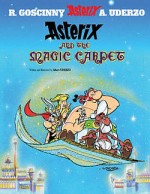
Asterix and the Magic Carpet


By Uderzo, translated by Anthea Bell & Derek Hockridge (Orion Books)
ISBN: 978-0-75284-776-4

The son of Italian immigrants, Alberto Aleandro Uderzo was born on April 25th 1927, in Fismes, on the Marne. As a child reading Mickey Mouse in Le Pétit Parisien he showed artistic flair from an early age but dreamed of becoming an aircraft mechanic. Albert became a French citizen when he was seven and found employment at 13, apprenticed to the Paris Publishing Society, where he learned design, typography, calligraphy and photo retouching.

When World War II broke out he spent time with farming relatives in Brittany and joined his father’s furniture-making business. Brittany beguiled and fascinated Uderzo: when a location for Asterix‘s idyllic village was being mooted, the region was the only choice.

In the post-war rebuilding of France, Uderzo returned to Paris and became a successful artist in the recovering nation’s burgeoning comics industry.

His first published work, a pastiche of Aesop’s Fables, appeared in Junior and in 1945 he was introduced to industry giant Edmond-François Calvo (whose own masterpiece The Beast is Dead is far too long overdue for a commemorative reissue…).

The tireless Uderzo’s subsequent creations included the indomitable eccentric Clopinard, Belloy, l’Invulnérable, Prince Rollin and Arys Buck. He illustrated Em-Ré-Vil’s novel Flamberge, worked in animation, as a journalist and illustrator for France Dimanche, and created the vertical comicstrip ‘Le Crime ne Paie pas’ for France-Soir.

In 1950 he illustrated a few episodes of the franchised European version of Fawcett’s Captain Marvel Jr. for Bravo!

An inveterate traveller, the artistic prodigy met Rene Goscinny in 1951. Soon becoming fast friends, they decided to work together at the new Paris office of Belgian Publishing giant World Press. Their first collaboration was in November of that year; a feature piece on savoir vivre (how to live right or gracious living) for women’s weekly Bonnes Soirée, following which an avalanche of splendid strips and serials poured forth.

Jehan Pistolet and Luc Junior were created for La Libre Junior and they produced a western starring a “Red Indian” who eventually evolved into the delightfully infamous Oumpah-Pah. In 1955, with the formation of Édifrance/Édipresse, Uderzo drew Bill Blanchart for La Libre Junior, replaced Christian Godard on Benjamin et Benjamine and in 1957 added Charlier’s Clairette to his portfolio.

The following year, he made his debut in Tintin, as Oumpah-Pah finally found a home and a rapturous audience. Uderzo also drew Poussin et Poussif, La Famille Moutonet and La Famille Cokalane.

When Pilote launched in 1959 Uderzo was a major creative force for the new magazine collaborating with Charlier on Tanguy et Laverdure and launching – with Goscinny – a little something called Asterix…

Although the gallant Gaul was a massive hit from the start, Uderzo continued working on Les Aventures de Tanguy et Laverdure, but once the first hilarious historical romp was collected in an album as Astérix le gaulois in 1961 it became clear that the series would demand most of his time – especially since the incredible Goscinny never seemed to require rest or run out of ideas.

By 1967 Asterix occupied all Uderzo’s time and attention, so in 1974 the partners formed Idéfix Studios to fully exploit their inimitable creation. When Goscinny passed away three years later, Uderzo had to be convinced to continue the adventures as writer and artist, producing a further ten volumes until 2010 when he retired.

After nearly 15 years as a weekly comic serial subsequently collected into book-length compilations, in 1974 the 21st (Asterix and Caesar’s Gift) was the first published as a complete original album before serialisation.

Thereafter each new release was a long anticipated, eagerly awaited treat for the strip’s millions of fans…

According to UNESCO’s Index Translationum, Uderzo is the tenth most-often translated French-language author in the world and the third most-translated French language comics author – right after his old mate René Goscinny and the medium’s grand master Hergé.

More than 325 million copies of 35 Asterix books have sold worldwide, making his joint creators France’s best-selling international authors. Now the torch has been passed and new sagas of the indomitable are being created by Jean-Yves Ferri and Didier Conrad…

One of the most popular comics features on Earth, the collected chronicles of Asterix the Gaul have been translated into more than 100 languages since his debut, with twelve animated and live-action movies, TV series, assorted games, toys, merchandise and even a theme park outside Paris (Parc Astérix, naturellement)…

Like all the best stories the narrative premise works on more than one level: read it as an action-packed comedic romp of sneaky and bullying baddies coming a cropper if you want or as a punfully sly and witty satire for older, wiser heads. We Brits are further blessed by the brilliantly light touch of master translators Anthea Bell & Derek Hockridge who played no small part in making the indomitable little Gaul so very palatable to English tongues.

More than half of the canon takes place in Uderzo’s beloved Brittany, where, circa 50 B.C., a little hamlet of cantankerous, proudly defiant warriors and their families resisted every effort of the mighty Roman Empire to complete the conquest of Gaul. The land is divided by the notional conquerors into provinces of Celtica, Aquitania and Amorica, but the very tip of the last just refuses to be pacified…

The remaining epics occur in various locales throughout the Ancient World, with the Garrulous Gallic Gentlemen often quizzical tourists and bemused commentators in every fantastic land and corner of the civilisations that proliferated in that fabled era…

Whenever the heroes were playing at home, the Romans, unable to defeat the last bastion of Gallic insouciance, futilely resorted to a policy of absolute containment. Thus the little seaside hamlet was permanently hemmed in by the heavily fortified garrisons of Totorum, Aquarium, Laudanum and Compendium.

The Gauls couldn’t care less, daily defying and frustrating the world’s greatest military machine simply by going about their everyday affairs, protected by the miraculous magic potion of resident druid Getafix and the shrewd wits of the diminutive dynamo and his simplistic, supercharged best friend Obelix…

Firmly established as a global brand and premium French export by the mid-1960s, Asterix the Gaul continued to grow in quality as Goscinny & Uderzo toiled ever onward, crafting further fabulous sagas; building a stunning legacy of graphic excellence and storytelling gold.

By the time this edition was released Goscinny had been gone for a decade and Uderzo was slowly but surely finding his own authorial voice…

Asterix and the Magic Carpet (originally and quite ponderously entitled Astérix chez Rahàzade ou Le compte des mille et une heures – which translates as Asterix meets Orinjade or the 1001 Hours Countdown) was released in 1987 and once again saw Asterix and Obelix undertake a long voyage into the unknown: one packed with exotic climes, odd people and bold adventure, all deliciously underpinned by topical lampooning and timeless swingeing satire.

Before the Arabian adventure begins, a delightful in-character portrait of Goscinny and Uderzo as their greatest creations Asterix and Obelix whets the appetite for the fun to come, after which the 28th saga begins with a friendly feast, suddenly ruined twice over by the singing of the Bard Cacofonix.

Firstly there’s the plain fact that he is singing at all, but the real problem is that his newly discovered vocal style summons up storms and creates violent downpours.

The thunderous deluge also brings a surprised visitor to the village. Watziznehm the Fakir was passing by far above on his flying carpet when the tempest tossed him to earth. It was a painful but happy accident since the Indian wise man was on a mission to find some miraculous Gauls and a certified rainmaker…

Soon Asterix, Obelix and canine wonder Dogmatix are heading Due East to save beautiful princess Orinjade from the machinations of Guru Hoodunnit, who wants to sacrifice her to end a terrible drought and seize the reins of power from her father Rajah Watzit. When the flying wizard left it was with a countdown of 1001 hours to doom…

Our heroes are only accompanying the real star of the Fakir’s quest: with a deadline looming to execute the princess, Watziznehm needs to get Cacofonix there in time to sing up a storm – or rather a monsoon…

Travel aboard the flying carpet is swift and comfortable but ever-hungry Obelix is continually holding up proceedings with many pit-stops to refuel his cavernous stomach, whilst the Bard’s practising frequently leads to stormy weather and unnecessary diversions…

After the usual dalliance with pirates, a bird’s eye tour of Rome and a brief voyage on a Greek trading ship, the tourists soar over Athens and get shot at above Tyre before a natural storm sets the carpet alight and they crash-land in Persia.

Despite being in the land of carpets, the travellers are unable to secure a replacement until a band of Scythian raiders attack the village and Asterix and Obelix negotiate a trade deal: hundreds of pummelled plunderers for a freshly unbeatable new rug…

As the heroes plunge ever eastward, in the Valley of the Ganges Hoodunnit and his creepy mystic crony Owzat gloat at their impending takeover, even as poor Orinjade’s stout defiance begins to weaken.

When the Gauls and their Fakir chauffeur arrive with only a day to spare, it all seems over for the ghastly guru, but as the Bard begins his song he discovers that the arduous journey has given him laryngitis.

For the first time ever somebody wants him to sing and he has lost his voice…

With time running out the Rajah’s doctors’ diagnosis seems crazy: immersion in various unwholesome by-products of sacred elephants. Rather than settle for half-measures the Gauls decide to take Cacofonix to the jungle abode of Howdoo the Elephant Trainer and bury him in the curative well away from civilised senses…

This only gives the villains the opportunity they have been waiting for. When Watziznehm and the Gauls go to collect the Bard in the morning, Owzat engages the Fakir in a magical duel. Leaving them to their tricks Asterix and Obelix press on and find that the storm-singer has been kidnapped…

Happily, dashing Dogmatix is on hand to track down the Bard, an especially easy task as he now smells like he sings…

Hoodunnit is mirthfully preparing the stage for Orinjade’s sacrifice when, after the usual Gallic fisticuffs from our heroes, Cacofonix makes his Asian debut and sets everything – including the skies – to rights in the very nick of time…

Stuffed with light-hearted action, good-natured joshing, raucous, bombastic, bellicose hi-jinks and a torrent of punishing puns to astound and bemuse youngsters of all ages, this tale again celebrates the spectacular illustrative ability of Uderzo and proves that the potion-powered paragon of Gallic Pride is in safe and steady hands.

Full of Eastern Promise, this sublime slice of French polish and graphic élan is all you need to make any holiday excursion or comfy staycation unforgettable.

© 1987 Les Editions Albert René, Goscinny/Uderzo. Revised English translations © 1988, 2003 Hachette. All rights reserved.

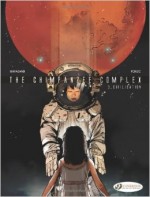
The Chimpanzee Complex volume 3: Civilisation


By Richard Marazano & Jean-Michel Ponzio, translated by Jerome Saincantin (Cinebook)
ISBN: 978-1-84918-043-6

French comics creators excel at challenging, mind-blowing, compelling science fiction. Whether boisterous, mind-boggling space opera like Valerian and Laureline, surreal meta-spiritual exploration such as Moebius’ Airtight Garage or the tense, tech-heavy veritas of Orbital, our Gallic cousins always got it: the genre is not about tech or monsters; it’s about people encountering new and uncanny ideas…

Prolific, multi-award winning Richard Marazano was born in Fontenay-aux-Roses in 1971. He initially pursued a career in science before switching to Fine Arts courses in Angoulême and debuted in bande dessinée in the mid 1990s. Although an extremely impressive artist and colourist when illustrating his own stories (Le Bataillon des Lâches, Le Syndrome d’Abel), he is best known for his collaborations with other artists such as Michel Durand (Cuervos), Marcelo Frusin (L’Expédition) and Xavier Delaporte (Chaabi) to name but a few.

His partnerships with artist Jean-Michel Ponzio are especially fruitful and rewarding. As well as Le Complexe du Chimpanzé – the trilogy under discussion here – the daring duo have also produced the taut, intricate social futurism of Genetiksâ„¢ and high-flying paranoiac cautionary tale Le Protocole Pélican.

Jean-Michel Ponzio was born in Marignane and, after a period of scholastic pick-&-mix during the 1980s, began working as a filmmaker and animator for the advertising industry. He moved into movies, designing backgrounds and settings; listing Fight Club and Batman and Robin among his many subtle successes.

In 2000 he started moonlighting as an illustrator of book covers and edged into comics four years later, creating the art for Laurent Genfort’s T’ien Keou, before writing and illustrating Kybrilon for publisher Soliel in 2005.

This led to a tidal wave of bande dessinée assignments before he began his association with Marazano in 2007. He’s still very, very busy and his stunning combination of photorealist painting, 3D design and rotoscoping techniques grace and enhance a multitude of comics from authors as varied as Richard Malka to Janhel.

Perhaps still the very best of these talented individuals’ joint efforts is The Chimpanzee Complex trilogy which concludes its English translation here with Civilisation…

When, six and a half decades after it first returned, the Apollo 11 Command Module splashed down in the Indian Ocean in February 2035, redundant NASA astronaut Helen Freeman was pressed into the top-secret investigation of the incredible passengers, deserting once again her troubled and too-often neglected daughter Sofia.

Neil Armstrong and Buzz Aldrin were the first men to walk on the moon, and nobody – including them – had any idea where they’d been for sixty-five years. For the baffled spacers it was only days since their mission began…

On learning how history had already recorded their triumphant return and unremarkable deaths years later, the legends went ballistic: exhibiting what Freeman knew as the traumatic shock response peculiar to space voyagers categorised by NASA as “the Chimpanzee Complex”…

They had no knowledge of “their” missing third astronaut Michael Collins (if he ever existed). Nobody could explain what they might be and no test science could devise was able to disprove or corroborate their incredible story…

Compelled to work under Military Spook Konrad Stealberg, Freeman’s subsequent interviews uncovered even more questions but no answers. Then one day the enigma-nauts began exhibiting memory gaps.

Whilst her best friend – NASA bureaucrat Robert Conway – left to look after her increasingly intransigent daughter, Helen and Konrad’s team were presented with another insoluble mystery when the astronauts suddenly expired: becoming decades-old corpses overnight…

Soon Helen was reluctantly piloting a mission to the moon in the mothballed but hastily reconditioned shuttle originally designed for Mars – until budget cuts scotched the project. Her trusted comrades and fellow unemployed astronauts Kurt, Alex and Aleksa were just as delighted to be back in space, but as apprehensive as Helen over the military presence and top-secret paraphernalia piled aboard.

They were even less sanguine when Stealberg and his creepy elite commandos replaced the regular crew.

En route they discovered the secret history of the 1960s Space Race: America’s black ops space program and the USSR’s clandestine and apparently failed mission to Mars.

Even bigger shocks materialised on the moon when they found the pressure-suited corpses of Aldrin and Armstrong deep in a concealed fissure. In orbit above them a vintage Command Module was intercepted by their own shuttle.

The relic contained Collins’ corpse and a decades-old Russian distress call the pilot had recorded. The message had been sent by Commies from Mars…

NASA never had an American monopoly on spaceflight: the military had run a covert, parallel program from the very start, funded by pirating portions of NASA’s budget at the personal instigation of ex-Nazi rocket pioneer Werner von Braun…

Moreover, the 66-year old Russian distress message in the capsule’s primitive computers proved the Soviets had also been far more committed to space exploration than history recorded – and just as secretive as the USA…

Mid-flight Stealberg took over, unveiling interplanetary hibernation chambers and turning the now-militarised mission towards the Red Planet. Amidst fears of what awaited them, Helen fell into cold sleep, agonising that she had again abandoned and betrayed Sophia …

When they arrived they only found greater mysteries. The Soviet attempt had been a success and a thriving base at the pole welcomed the Americans. Nothing made sense though. The Russians believed they had been there for twelve years – not six and a half decades – and mission commander Yuri Gagarin (whose death in had been faked in 1968 to facilitate his smooth transition to commander of their Mars-shot) was obsessed with a bizarre scientific hoodoo he called “probability of presence”.

His ruminations on Heisenberg’s Uncertainty Principle and whether such a subatomic phenomenon could apply to larger constructs (like human beings) in a constant and simultaneous state of being and non-being was a truly disturbing idea, but Helen had no time to debate it or their shared regrets about their abandoned Earthbound children as the other Cosmonauts had insanely decide to destroy their own base…

As she returned to the greenhouse module, Konrad presented an even more pressing problem. He had discovered Gagarin’s sixty-years-dead corpse…

As colonists Vladimir and Borislav set fire to the base modules, the Americans retreated to their vehicle, dragging the hysterical Helen, who had promised her very much alive Yuri a ride home…

The tension peaked when they got back to the orbiting Shuttle: Paul had vanished without a trace. Thoroughly rattled, Konrad ordered an immediate return to Earth, with increased watches for every day of the trip.

By May 2036, on Earth Cooper and Sophia both eagerly await Helen’s return at Cape Canaveral. However as the Shuttle approached it suddenly vanished from the tracking systems. Aboard ship Helen and Kurt saw their home planet disappear. Helpless, unable to brake and with no world in view, they rejoined the others in cold-sleep, not knowing when they would reawaken or if they’d still be in the solar system when they did.

Helen’s last conscious thoughts were of the daughter she might never see again…

The epic conclusion picks up in the Great Unknown as hibernation ends after seventy years. Only Helen and Aleksa are still alive; all the other cryo-capsules having failed at some indeterminate time.

With only finite resources and dwindling power, Helen consoles herself by catching up on messages beamed in hope and anticipation by Robbie Cooper, but is roused from her fatalistic depression by Aleksa who has made a shocking discovery.

Seeing one of the EVA suits missing, he at first believed their comrade Alex had committed suicide by walking out of the airlock. Then he saw the impossibly huge unidentified space vessel and called Helen…

Suiting up and arming themselves, they cross to the ship, Helen further encumbered by a laptop with all the messages – read and unread – from Robert stored on it. They have no idea when Alex left, or if she even tried to reach the UFO.

However as it is their only hope of survival, they make a leap into the void and after great struggle find themselves in a vast and terrifying mechanical chamber of disturbing proportions.

Alex’s abandoned gear is on the floor. She had clearly camped there for some time before vanishing into the dark, dusty cavernous interior…

Whilst they rest and consider their next move, Helen watches the last message Robbie sent from Earth. It is sixty-seven years old…

Later, Helen freaks out when they find Alex’s empty suit until Aleksa does the unthinkable and opens his own EVA garb. The enigma ship has warmth and a breathable atmosphere…

And then something pushes part of the vessel over on them…

The pair narrowly escape harm and cautiously explore the vessel, but after splitting up Aleksa is attacked again. When terrified Helen finds him he is hugging the crazed, decrepit, wizened but still alive Alex.

Mute but still vital she leads them through vaulting passageways to what they can only assume is a skeleton. A really, really big one…

Outside a viewing portal, Mars spins by above them. It’s as if they’ve come home …

However fast or far or forward humanity travels, their fears and foibles go with them and before long distrust and dread spark a final confrontation in the uncanny construct. Thus only one person makes an implausible, inexplicable escape back to Earth…

It’s 2097 and as a long-missing craft splashes down in the ocean to begin the circle anew, it becomes clear that some mysteries, like some philosophies and some family bonds, remain ineffably beyond the sphere of rational thinking…

Bold, challenging and enticingly human, this astonishing science mystery dances and darts adroitly between beguiling metaphysics and hard-wired mortal passions, easily encompassing our species’ inbuilt inescapable isolation, wide-eyed wonderment, hunger to know more and the terror of finding out, with Marazano’s pared-to-the-bone script brought to hyper-life with stunning clarity by Ponzio to produce a timeless fusion of passion, paranoia and familial fulfilment.

Do you read me? Do read The Chimpanzee Complex.

© Darguad, Paris, 2008 by Marazano& Ponzio. All rights reserved. English translation © 2010 Cinebook Ltd.

Hunger House


By Loka Kanarp & C/M Edenborg,translated by C/M Edenborg & Martin Tistedt (Borderline Press)
ISBN: 978-0-99269-724-2

If you thought “Scandi-Crime” was an impressive tweak on an old genre, wait until you see what our northern cousins can do with horror…

Resurrecting the classic ghost story in this seductive and compelling lavish two-colour hardback tome, husband-&-wife team Carl-Michael Edenborg and Loka Kanarp have concocted a sharp, sweet and sour compote of dark desire and chilling craving in their account of a slumbering supernatural force and its appalling allure for two troubled and unhappy girls…

Deeps in the woods a ramshackle edifice awaits as, nearer town and selfish, judgemental, facile modern civilisation, sisters Elsa and Fredrike grow increasingly uncomfortable with their new foster parents.

The smugly sanctimonious old poseurs are delighted with the idea and their roles as guardians – and especially in the reactions of their equally shallow friends and neighbours – but really don’t seem that invested in the recently-bereft children in their charge…

Unhappy to be the star exhibit at a garden party, the girls soon sneak off and wander into the wilds on the edge of town. They’re heading for a strange place Elsa heard about at school. They really shouldn’t go in. All the kids say it’s haunted…

The deserted domicile is vast: a procession of bleak and empty rooms where the previous inhabitants seemingly disappeared in the middle of a coffee klatsch…

As they idly roam together, the bare boards suddenly break beneath them and Elsa falls into a darkness far deeper and longer than the mere gap between floors. The hole is bigger than the house and even after climbing down on a rope Fredrike cannot touch the bottom…

Dejectedly returning alone to her foster parents’ home she tries to explain what has happened but is cut short when Elsa saunters in. She is not the same.

For one thing, she is cruel and mean and bullying, but the real kicker is at supper when a cutlery mishap proves the elder sister is no longer even human…

Of course, the pompous, self-opinionated adults notice nothing, and later as Fredrike cowers in bed looking at photos of happier times, the thing that looks like Elsa creeps in and offers to show her secrets and surprises if she will return to the ruined house with her…

Author, publisher and editor Edenborg (My Cruel Fate) runs his own publishing house – Vertigo Forlag – and co-wrote Hungerhusetwith graphic novelist Kanarp (another sterling alumni of the Comics Art School of Malmö whose previous works include Pearls and Bullets and To My Friends and Enemies)  to satisfy their own love of suspense-horror movies.

Their passion is our happy windfall as this sublimely seductive and truly beguiling mystery unfolds in ways both uneasily familiar and intensely original…

If being simultaneously unsettled and delightfully satiated is your particular meat, Hunger House is a dish you will never regret ordering.
© 2014 Loka Kanarp & C/M Edenborg.

City of Crocodiles


By Knut Larsson (Borderline Press)
ISBN: 978-0-99269-725-9

Born in 1972, Swedish cartoonist, artist, filmmaker and teacher – at the prestigious Comics Art School of Malmö – Knut Larsson is blessed with a unique vision and talent to spare (just check out his graphic albums Canimus, Lokmannen (Locomotive Man), Biografmaskinisten (The Projectionist), Kolonialsjukhuset – En kolonialläkares anteckningar (Colonial Hospital – A Colonial Doctor’s Notebook) or Triton.

If you’re a keen devotee of Euro-comics you’ll have seen his stories in C’est Bon Anthology, Electrocomics, Galago, Glömp, Rayon Frais, Strapazin, Stripburger, Turkey Comix and others, and may well have visited his international exhibitions as far afield as Angoulême, Tokyo, Erlangen or St. Petersburg. Typically, he is not a household name in Britain or America.

Yet…

Back in 2008 Larsson crafted Krokodilstaden: an eerie, post-apocalyptic, horror-tinged love story devoid of all dialogue or sound effects: a neosymbolist paean to the end times combining brutish, callous survivalism, ghostly mysticism, unchanging human passions, stubborn self-inflicted loneliness and the tenacious capacity of life to adapt to changing situations. Now Borderline Press have released it in an English Edition as their latest deliciously eerie offering: City of Crocodiles…

Rendered in muted greys and brown monotones, one panel per page, the tale focuses on a drowned Earth where the waters have risen, relegating humanity to the top floors of buildings whilst toothy amphibians have proliferated all around and below them. Adamant Mankind is still hanging on, turning crocodiles into the primary natural resource: food, clothing, tooled utensils and even objects of cultish worship.

The saurians are everywhere and everybody and everything – humans, birds, surviving mammalian pets – are missing limbs or appendages…

In this world one particular croc-hunter ekes out his solitary existence, trading reptiles for booze and gasoline, haunted by his memories until the day he captures a strangely enticing woman in his nets. She is young, beautiful, exotic… and has a vestigial reptilian tail.

Avoiding the spooky, crazy crocodile cultists he takes her back to his place and endeavours to dress her in the garb and form of his dead lover before she seduces him…

Sadly that’s when his dearly departed darling returns, bristling with malice and ready for some spirited revenge…

Wry, moving, nightmarish yet ethereally lovely, City of Crocodiles is a masterpiece of visual storytelling that will astound and delight all lovers of the weird and macabre.
© 2008, 2014 Knut Larsson.

The Chimpanzee Complex volume 2: The Sons of Ares


By Richard Marazano & Jean-Michel Ponzio, translated by Jerome Saincantin (Cinebook)
ISBN: 978-1-84918-015-3

Cinebook began publishing The Chimpanzee Complex in 2009 (and we reviewed it here) with the beguiling and enigmatic ‘Paradox’ which introduced the world of tomorrow to a bizarre and baffling cosmic conundrum.

When, six and a half decades after it first returned, the Apollo 11 Command Module splashed down in the Indian Ocean in February 2035, redundant NASA astronaut Helen Freeman was dragooned into joining a top-secret investigation of the incredible passengers, leaving behind in Florida her troubled and too-often neglected daughter Sofia.

Legendary heroes Neil Armstrong and Buzz Aldrin were the first men to walk on the moon, and nobody – including them – had any idea where they’d been for sixty-five years. For the baffled starmen it was only days since their mission began…

On learning that history recorded their triumphant return and unremarkable deaths years later they went ballistic: exhibiting what Freeman described as the traumatic shock response peculiar to space voyagers categorised by NASA as “the Chimpanzee Complex”…

The spacers don’t know what happened to “their” third astronaut Michael Collins (if he ever existed). Three heroes landed to be fêted by the world in 1969, but now two of them sit as prisoners in a world that terrified them.

Nobody can explain who or what they might be and no tests science can devise are sufficient to disprove their incredible story…

Compelled to work under Presidential favourite and Top Brass Military Spook Konrad Stealberg, Freeman uncovered even more questions but no answers in her subsequent interviews, until the enigma-nauts finally began to exhibit gaps in memory.

As her best friend NASA bureaucrat Robert Conway struggled to look after the increasingly wayward Sofia, Konrad’s questioning team were presented with another shocking mystery after Armstrong and Aldrin suddenly expired: somehow becoming deteriorated cadavers overnight…

Soon Helen was (only partially) reluctantly piloting a mission to the moon in the mothballed and hastily reconditioned shuttle meant for Mars until budget cuts scotched the project. Her trusted comrades and fellow unemployed astronauts Kurt, Alex and Aleksa were just as delighted to be back in space, but as unhappy and apprehensive as Helen with the military presence and top-secret paraphernalia piled aboard. They were even less sanguine when Stealberg and his creepy elite commandos replaced the regular crew.

En route they discovered the secret history of the 1960s Space Race: America’s black ops space program and the USSR’s clandestine and apparently failed mission to Mars.

Even bigger shocks materialised on the lunar surface when the modern astronauts found the pressure-suited corpses of Aldrin and Armstrong deep in a concealed fissure even as, high above, a vintage Command Module was intercepted by their converted shuttle.

The stellar relic contained Collins’ corpse and an intercepted, decades-old Russian distress call the mission pilot had recorded. The message had been sent by Commies from Mars…

It transpired that NASA has never had the American monopoly on spaceflight: the military had been running a clandestine, parallel program from the very start, funded by siphoning a portion of NASA’s operating budget at the personal instigation of ex-Nazi rocket pioneer Werner von Braun…

Moreover, the 66-year old Russian distress message in the capsule’s primitive computers proved that the Soviets had also been far more committed to space exploration than history books had recorded…

Stealberg took charge, unveiling interplanetary hibernation chambers and turning the now-militarised shuttle-mission towards the Red Planet. Amidst fears of what awaited them, Helen fell into cold sleep, agonising that she had again abandoned and betrayed Sophia as her ship slowly voyaged to Mars and an appointment with the truth, whatever it might be…

The drama recommences in The Sons of Ares as, in October 2035, an increasingly off-the-rails Sophia argues and acts out with Robert Conway whilst in interplanetary space the fourth month of the journey finds American astronauts Paul Dupree and Mark Lawrence taking their boring turn awake for monitor duty whilst their comrades endure resource-saving but life-shortening hibernation…

The monotony is suddenly broken by a freak radiation storm and only one of the terrified explorers makes it to the ship’s shielded area in time…

In Florida Robert is acutely conscious of his failings as a surrogate parent to Sophia, but Helen is blissfully unaware of the personal crisis when the slumbering crew rouse from cold sleep to find Paul insane and Mark missing…

In reporting the situation to Earth, Helen again misses – or perhaps avoids – a chance to speak to Sophia who is gradually coming to terms with the possibility that she might never see her mother again…

As the shuttle at last establishes Mars orbit, Paul is locked up for his own safety and the suspicious voyagers’ peace of mind. Konrad then shares the intel gathered by his agents on Earth whilst they slept. The Soviet clandestine Cosmonaut project began in 1963, headed by space pioneer Yuri Gagarin – whose death had been faked to facilitate his smooth transition to commander of their Mars shot.

Expecting a monumental propaganda coup, the Kremlin simply said nothing when contact was lost with Gagarin’s mission, preferring stolid rhetoric to incontrovertible proof of failure. Now with so many inexplicable events inevitably leading to the Red Planet, Stealberg expects Helen and her team to find all the answers with the Russians’ bodies on the dust surface.

He couldn’t be more wrong…

Locating a base at the polar cap, Konrad dispatches the heavily armed crew to the site even as on Earth, Sophia runs away from home. However even whilst experiencing her greatest desire – walking on another world – Helen can’t help but worry about Paul, doped up and locked into the isolation chamber of the otherwise empty Shuttle…

Whilst Robert frantically searches for Sophia on Earth, the astronauts are astounded to discover the primitive landing site and corpses they expected are, in actuality, a thriving, efficient facility, stuffed with botanical wonders and manned by the very strong and vital cosmonauts who had landed there in the1960s.

After an initial exchange of hostilities – and gunfire – friendly contact is established and another incredible saga unfolds. Russians Vladimir and Borislav have lost all sense of time in the “twelve years” since they landed and Commander Gargarin, having discovered a strange tunnel in a Martian glacier, has been absent for most of that period. They only know he’s still alive because food keeps vanishing…

Stealberg, seeing uncomfortable similarities in the agelessness of the cosmonauts and the duplicate Armstrong and Aldrin on Earth, sedates the Russians, who constantly ramble about the nature of reality, but Helen’s interest is piqued and, with Kurt’s assistance, she sneaks off into the glacier tunnel to find Gagarin…

When she succeeds it only leads to more baffling conundrums. The First Man in Space perpetually stares into the unyielding ice-wall, seemingly unsurprised by Helen’s reports on the Apollo returnees, the impossible time-differentials and the fall of the Soviet Union.

He merely ruminates on Heisenberg’s Uncertainty Principle, and whether such a subatomic phenomenon could apply to larger constructs – such as human beings – in a constant and simultaneous state of being and non-being: a “probability of presence”…

They also talk about children they will probably never see again…

As Helen returns to the greenhouse module, the Russians are planning more armed resistance but Stealberg has an even more pressing problem. Much to Helen’s astonished disbelief, he’s found Gagarin’s sixty-years-dead corpse…

As Vladimir and Borislav attack, setting fire to the modules, the Americans fall back to their vehicle, dragging the hysterical Helen, who had promised her very much alive Yuri Gagarin a ride home…

The tension increases when they re-enter the orbiting Shuttle: Paul has vanished and no trace can be found of him. Thoroughly rattled, Konrad orders an immediate return to Earth, with increased watches for every day of the trip.

May 2036: on Earth Robert has tracked down Sophia and they both eagerly await Helen’s return at Cape Canaveral. However as the Shuttle nears Earth it suddenly vanishes from all tracking systems. Aboard the vessel Helen and Kurt experience the horror of seeing their home planet vanish. Unable to brake the shuttle and with no world in view, they rejoin the others in cold sleep, not knowing when they will next awaken or even if they will still be in their solar system when they do.

Helen’s last conscious thoughts are of the daughter she may never see again…

This astounding hard-science mystery tale steps boldly and confidently into the realm of chilling metaphysics, as the human wide-eyed wonderment gives way to uncanny uncertainty if not outright terror, as Marazano’s pared-down-to-the-bone script is realised with stunning clarity by Ponzio to produce a soaring amalgam of passion, intrigue, and paranoia.

The Chimpanzee Complex is a tale no lover of fantasy and suspense must miss.
© Darguad, Paris, 2008 by Marazano& Ponzio. All rights reserved. English translation © 2009 Cinebook Ltd.

Iznogoud and the Magic Computer


By Goscinny & Tabary, translated by Anthea Bell & Derek Hockridge(Cinebook)
ISBN: 978-1-905460-79-3

During his too-short lifetime (1926-1977) René Goscinny was one of the most prolific, most read writers of comic strips the world has ever seen.

He still is.

Among his most popular comic collaborations are Lucky Luke, Le Petit Nicolas and, of course Asterix the Gaul, but there were so many others.

Scant years after the Suez crisis, the French returned to the deserts when Goscinny teamed with the sublimely gifted Swede Jean Tabary (1930-2011 and numbering Richard et Charlie, Grabadu et Gabaliouchtou, Totoche, Corinne et Jeannot and Valentin le Vagabond amongst his other hit strips) to produce imbecilic Arabian (im)potentate Haroun el-Poussah. However it was the strip’s villainous foil, power-hungry vizier Iznogoud, who stole the show – possibly the conniving little devil’s only successful scheme.

Les Aventures du Calife Haroun el Poussah was created for Record, with the first instalment appearing in the January 15th issue in1962. A minor hit, it jumped ship to Pilote – a magazine created and edited by Goscinny – where it was refashioned into a starring vehicle for the devious little rat-bag who had increasingly hogged all the laughs and limelight.

Like all the best storytelling, Iznogoud works on two levels: as a comedic romp with sneaky baddies coming a cropper for younger readers, and as a pun-filled, witty satire for older, wiser heads, much like its more famous cousin Asterix – and also translated here by the master translators Anthea Bell & Derek Hockridge who made the indomitable little Gaul so very palatable to the English tongue. Moreover the deliciously malicious whimsy is always heavily laden with manic absurdity and brilliantly applied creative anachronism to keep the plots bizarrely fresh and inventive.

Our insidious anti-hero is Grand Vizier to affable, easy-going Haroun Al Plassid, Caliph of Ancient Baghdad, but the sneaky little toad has loftier ambitions, or as he is always shouting “I want to be Caliph instead of the Caliph!”

The revamped series launched in Pilote in 1968, quickly becoming a huge European hit, with 29 albums so far (carried on by Tabary’s children Stéphane, Muriel and Nicolas), his own solo comic, a TV cartoon show and even a live action movie.

When Goscinny died in 1977 Tabary assumed the scripting as well as the superbly stylish illustration from the 13th album, moving to book-length complete tales, rather than the compilations of short punchy stories that typified their collaborations.

This fourth Cinebook album was actually the sixth French album (released in 1970 as L’ordinateur magique) and features a clenched and grasping fistful of short, sharp salutary tales beginning, after a handy catch-up profile page, with ‘A Calculated Risk’, wherein the cunning conniver, desperate to forestall a pact between the Caliph and mighty military neighbour Sultan Pullmankar, hires forward-thinking I-Bee’Em and his ponderous problem-solving “computer” to stop the signing of the treaty.

The big grey box might be brilliant, but it’s agonisingly slow in reaching its infallible conclusions…

Things then get hilariously surreal when Iznogoud and his long-suffering, bumbling assistant Wa’at Alahf discover a mystic crossroads that can lead the unwary traveller onto an unending, pointless journey from which they can neither escape nor return.

Dashing back to lure the Caliph onto ‘The Road to Nowhere’ our wicked wayfarers eventually realise that they’ve been stuck on it all along…

Back in Baghdad and itching to take over, the Vile Vizier then seeks to employ the tragic gifts of lonely hermit Ghoudas Gho’ld, a direct descendent of legendary King Midas, in ‘The Golden Handshake’. All he has to do to remove the Caliph is get the accursed involuntary metal-maker back to the palace without him touching anything…

There’s more direct skulduggery afoot in ‘The Caliph’s Sceptre’ when Iznogoud hires a master thief to sneak him into the high-security vault where the Staff of Office is cached. If he takes it and keeps the Caliph from presenting it to the people in the annual reaffirmation of worthiness to rule ceremony, the Vizier can legally assume control of the country. Of course, it doesn’t quite play out that way…

This fine kettle of funny fish concludes with ‘The Mysterious Ointment’ as fabled explorer Notsobad the Sailor returns to the port of Basrah and, having forgotten to bring the undetectable Occidental poisons he promised the Vizier, palms him off with a tube of “Schpouk toothpaste’.

Assured the container holds a lethal and undetectable toxin, poor Iznogoud embarks on an eccentrically convoluted campaign to convince the Caliph and the court that cleaning one’s choppers is the latest and most beneficial of scientific advancements. Care to guess how well that goes?

Snappy, fast-paced hi-jinks and gloriously agonising pun-ishing (see what I did there?) abound in this mirthfully infectious series which is a household name in France where “Iznogoud” is common parlance for a certain type of politician: over-ambitious, unscrupulous – and often of diminutive stature.

When first released here in the 1970s, these tales made little impression, but hopefully this snappy, wonderfully affable strips can finally find an appreciative audience among today’s more internationally aware, politically jaded comics-and-cartoon savvy Kids Of All Ages…
© 1970 Dargaud Editeur Paris by Goscinny & Tabary. All rights reserved.

Asterix Versus Caesar and The Twelve Tasks of Asterix


By Goscinny and Uderzo, translated by Anthea Bell & Derek Hockridge (Hodder/Dargaud, Hodder and Stoughton, Orion Books)
ISBN: 978-0-34039-772-0 & 978-0-34027-647-1

One of the most-read comics series in the world, the chronicles of Asterix the Gaul have been translated into more than 100 languages; with eight animated and four live-action movies, TV series, assorted toys and games and even a theme park (Parc Astérix, near Paris, naturellement).

More than 325 million copies of the 35 canonical Asterix books have sold worldwide, making Goscinny & Uderzo France’s bestselling international authors.

Their diminutive, doughty hero was created in 1959 by two of the art-form’s greatest proponents, René Goscinny & Albert Uderzo; masters of strip narrative then at the peak of their creative powers. Although their perfect partnership ended in 1977 with the death of prolific scripter Goscinny, the creative wonderment continued with Uderzo writing and drawing the feature until his retirement in 2010.

In 2013 a new adventure – Asterix and the Picts – opened a fresh chapter in the annals as Jean-Yves Ferri & Didier Conrad began their much anticipated and dreaded continuation of the franchise.

Like everything good, the core premise works on multiple levels: ostensibly, younger readers enjoy the action-packed, lavishly illustrated comedic romps where conniving, bullying baddies get their just deserts, whilst more worldly readers enthuse over the dry, pun-filled, slyly witty satire, enhanced for English speakers by the brilliantly light touch of translators Anthea Bell & Derek Hockridge who played no small part in making the indomitable Gaul so palatable to the Anglo-Saxon world. (Personally I still thrill to a perfectly delivered punch in the bracket as much as a painfully swingeing string of bad puns and dry cutting jibes…)

Asterix the Gaul is a cunning underdog who resists the iniquities, experiences the absurdities and observes the myriad wonders of Julius Caesar‘s Roman Empire with brains, bravery and a bit of magic potion.

The stories were alternately set on the tip of Uderzo’s beloved Brittany coast, where a small village of redoubtable warriors and their families resisted every effort of the Roman Empire to complete their conquest of Gaul or throughout the expansive Ancient World circa 50BC.

Unable to defeat this last bastion of Gallic insouciance, the mostly victorious invaders resorted to a policy of cautious containment. Thus the little seaside hamlet is permanently hemmed in by the heavily fortified garrisons of Totorum, Aquarium, Laudanum and Compendium.

The Gauls don’t care: they daily defy the world’s greatest military machine by just going about their everyday affairs, protected by the magic potion of resident druid Getafix and the shrewd wits of a rather diminutive dynamo and his simplistic best friend…

Firmly established as a global brand and premium French export by the mid-1960s, Asterix the Gaul continued to grow in quality as Goscinny & Uderzo toiled ever onward, crafting further fabulous sagas; building a stunning legacy of graphic excellence and storytelling gold.

René Goscinny was one of the most prolific, and remains one of the most read, writers of comic strips the world has ever seen. Born in Paris in 1926, he was raised in Argentina where his father taught mathematics. From an early age the boy showed artistic promise, and studied fine arts, graduating in 1942.

While working as junior illustrator in an ad agency in 1945 an uncle invited him to stay in America, where he found work as a translator. After his National Service in France Goscinny settled in Brooklyn and pursued an artistic career, becoming in 1948 an art assistant in a little studio which included Harvey Kurtzman, Will Elder, Jack Davis and John Severin as well as a couple of European giants-in-waiting: Maurice de Bévère (“Morris”, with whom he produced Lucky Luke from 1955-1977) and Joseph Gillain (Jijé).

He also met Georges Troisfontaines, head of the World Press Agency, the company that provided comics for the French magazine Spirou.

After contributing scripts to Belles Histoires de l’Oncle Paul and ‘Jerry Spring’ Goscinny was made head of World Press’ Paris office, where he first met his life-long creative partner Albert Uderzo (Jehan Sepoulet, Luc Junior) as well as creating Sylvie and Alain et Christine (with “Martial”- Martial Durand) and Fanfan et Polo (drawn by Dino Attanasio).

In 1955 Goscinny, Uderzo, Charlier and Jean Hébrard formed the independent Édipress/Édifrance syndicate, creating magazines for general industry (Clairon for the factory union and Pistolin for a chocolate factory). With Uderzo he produced Bill Blanchart, Pistolet and Benjamin et Benjamine, whilst himself writing and illustrating Le Capitaine Bibobu.

Goscinny seems to have invented the 9-day week. Under the pen-name Agostini he wrote Le Petit Nicholas (drawn by Jean-Jacques Sempé) and in 1956 began an association with the revolutionary comics magazine Tintin, writing stories for many illustrators including Signor Spagetti (Dino Attanasio), Monsieur Tric (Bob De Moor), Prudence Petitpas (Maréchal), Globule le Martien and Alphonse (both by Tibet), Modeste et Pompon (for André Franquin), Strapontin (Berck) as well as Oumpah-Pah with Uderzo.

He also wrote strips for the magazines Paris-Flirt and Vaillant.

In 1959 Édipress/Édifrance launched Pilote and Goscinny went into overdrive. The first issue starred his and Uderzo’s instant masterpiece Asterix the Gaul, began Jacquot le Mousse and Tromblon et Bottaclou (drawn by Godard) and also re-launched Le Petit Nicolas and Jehan Pistolet/Jehan Soupolet.

When Georges Dargaud bought Pilote in 1960, Goscinny became editor-in-Chief, but still found time to add new series Les Divagations de Monsieur Sait-Tout (Martial), La Potachologie Illustrée (Cabu), Les Dingodossiers (Gotlib) and La Forêt de Chênebeau (Mic Delinx).

He also wrote frequently for television. In his spare time he created a little strip entitled Les Aventures du Calife Haroun el Poussah for Record (first episode January 15th 1962) illustrated by a Swedish-born artist named Jean Tabary. A minor success, it was re-tooled as Iznogoud when it transferred to Pilote.

Goscinny died – probably of well-deserved pride and severe exhaustion – aged 973, in November 1977.

In the post-war rebuilding of France, Albert Uderzo returned to Paris and became a successful artist in the country’s burgeoning comics industry. His first published work, a pastiche of Aesop’s Fables, appeared in Junior, and in 1945 he was introduced to industry giant Edmond-François Calvo (whose own masterpiece The Beast is Dead is long overdue for a new edition…).

The tireless Uderzo’s subsequent creations included the indomitable eccentric Clopinard, Belloy, l’Invulnérable, Prince Rollin and Arys Buck. He illustrated Em-Ré-Vil’s novel Flamberge, worked in animation, as a journalist and illustrator for France Dimanche, and created the vertical comicstrip ‘Le Crime ne Paie pas’ for France-Soir. In 1950 he even illustrated a few episodes of the franchised European version of Fawcett’s Captain Marvel Jr. for Bravo!

An inveterate traveller, the prodigy met Rene Goscinny in 1951. Soon fast friends, they decided to work together at the new Paris office of Belgian Publishing giant World Press. Their first collaboration was in November of that year; a feature piece on savoir vivre (how to live right or gracious living) for women’s weekly Bonnes Soirée, after which an avalanche of splendid strips and serials poured forth.

Jehan Pistolet and Luc Junior were created for La Libre Junior and they produced a western starring a Red Indian (ah, simpler, if more casually racist, times…) who eventually evolved into the delightfully infamous Oumpah-Pah. In 1955 with the formation of Édifrance/Édipresse, Uderzo drew Bill Blanchart for La Libre Junior, replaced Christian Godard on Benjamin et Benjamine and in 1957 added Charlier’s Clairette to his portfolio.

The following year later, he made his debut in Tintin, as Oumpah-Pah finally found a home and a rapturous, devoted audience. Uderzo also drew Poussin et Poussif, La Famille Moutonet and La Famille Cokalane.

When Pilote launched in 1959 Uderzo was a major creative force for the new magazine collaborating with Charlier on Les Aventures de Tanguy et Laverdure and launching with Goscinny a little something called Asterix…

Although Asterix was a massive hit from the start, Uderzo continued working on Tanguy et Laverdure, but soon after the first adventure was collected as Astérix le gaulois in 1961 it became clear that the series would demand most of his time – especially as the incredible Goscinny never seemed to require rest or run out of ideas.

By 1967 the strip occupied all Uderzo’s attention, so in 1974 the partners formed Idéfix Studios to fully exploit their inimitable creation. When Goscinny passed away three years later, Uderzo had to be convinced to continue the adventures as writer and artist, producing a further ten volumes until he retired.

That year, after nearly 15 years as a weekly comic strip subsequently collected into compilations, the 21st tale (Asterix and Caesar’s Gift) was the first to be published as a complete original album before being serialised. Thereafter each new release was a long anticipated, eagerly awaited treat for the strip’s millions of fans…

According to UNESCO’s Index Translationum, Uderzo is the tenth most-often translated French-language author in the world and the third most-translated French language comics author – right after his old mate René Goscinny and the grand master Hergé.

As one of the most popular comics on Earth, Asterix has naturally become something of a celluloid star too and, the business being what it is, some of those movie megaliths have been recycled into intriguing – if non-canonical – graphic albums in their own right.

Although technically apart from the accepted legend, those filmic tomes are well worth a look too…

In 1976 The Twelve Tasks of Asterix (originally entitled Les Douze travaux d’Astérix) was the very first theatrical release: an animated feature written, created, Directed and Produced by Goscinny & Uderzo’s own company Studios Idéfix.

Like the albums which inspired it, the tale saw Asterix and Obelix undertake a long voyage into the unknown: one packed with exotic climes, odd people and boldly surreal adventure – although the topical lampooning and satire were subtly dialled back.

More a studio-produced illustrated prose storybook than a comic strip, this “book of the film” naturally introduces our bucolic cast before diving into the rather clever plot wherein the perennially bashed-up Roman Legions surrounding the village of Indomitable Gauls come to the scary conclusion that their devil-may-care foes must be gods…

When the rumours reach the Roman Senate, Julius Caesar is livid. Determined to quell the deadly talk before his power crumbles, he personally travels to the little village and challenges the Gallic resistors. If they can accomplish twelve labours as arduous as those undertaken by Hercules, they will have proved themselves gods and he will give them the entire empire and retire…

Enthralled more by the challenge than the possible outcome, chief Vitalstatistix nominates Asterix and Obelix to travel to Rome and tackles Caesar’s challenge. With diminutive scribe Caius Tiddlus accepted as official referee and recorder, the easy-going competitors set about the cunning list of labours devised by Caesar’s devious Councillors, beginning with ‘Running Faster than Asbestos, Champion of the Olympic Games‘.

Thanks to a sip of magic potion Asterix humiliatingly and hilariously outdistances the racer after which Obelix ‘Throws a Javelin Farther than Verses the Persian’.

Although the sportsman’s best effort lands in faraway undiscovered America (at the feet of Oompah-pah), Obelix’ javelin never lands at all but goes into a very, very low orbit around the Earth…

The third task – ‘Beating Cilindric, the German’ – is far harder to handle. The tiny warrior is a master martial artist who easily lobs Obelix all over the landscape but his stiff-necked formality makes him easy prey for Asterix’ guile…

Task four is to ‘Cross a Lake’ but in the centre is an Isle of Pleasure inhabited by beguiling Sirens where the affable lads are quickly enchanted. They would be there still if the lovely ladies had served Wild Boar instead of just Nectar and Ambrosia…

In short order the Gauls ‘Survive the Hypnotic Gaze of Iris the Egyptian’ and ‘Finish a Meal made by Calorofix the Belgian’, infamous for cooking huge meals for the godly progenitors known as The Titans.

Obelix eagerly tackles the mountain of nosh and breaks the culinary wizard’s spirit by consuming every morsel and innocently asking what the main course is…

The going gets tough and weird when the pair have to ‘Survive the Cave of the Beast’ and then battle bureaucracy gone wild by ‘Finding Permit A38 in “The Place That Sends You Mad”’, thereafter ‘Crossing a Ravine on an Invisible Tightrope, over a River full of Crocodiles’, ‘Climbing a Mountain and Answering the Old Man’s Riddle’ (a task which so impresses the actual gods that Jupiter causes a thunderstorm) before the weary contestants move on to their final task of the day by ‘Spending a Night on the Haunted Plains’.

Tragically for the restless spirits, the Gauls aren’t afraid of Roman soldiers, living or dead…

Next morning Asterix and Obelix awaken outside Caesar’s Palace in Rome and learn that their Twelfth Task is simply to ‘Survive the Circus Maximus’. The emperor is taking no chances however, and has gathered all the other Gaulish villagers to share what he thinks will be their spectacular demise at the hands of his gladiators and the fangs and claws of every savage beast in the city.

It seemed such a perfect plan, but Caesar’s soldiers really should have made sure that Druid Getafix couldn’t whip up some magic potion…


Astérix et la surprise de César was an animated feature released in 1985, the fourth film in a burgeoning franchise. The story was cobbled together from elements of the albums Asterix the Legionary and Asterix the Gladiator by Goscinny & Uderzo’s great friend screenwriter Pierre Tchernia.

I’m not sure if the translated Asterix Versus Caesar had a full cinema release in this country, but the book certainly seemed to be everywhere in 1986: a lovely large full colour hardback wedding another peerless prose adaptation to a wealth of stills (and a few fascinating design and models sheets) from the movie into a splendid, rollicking rollercoaster romp…

When Vitalstatistix’ beautiful niece Panacea visits the village, everybody is astonished to find that oafish Obelix is off his food. The colossal simpleton is hopelessly in love with the charming girl, who typically only has eyes for hunky Tragicomix, son of neighbouring chief Dramatix.

The hopeless situation takes a turn for the very worst though when the happy couple are kidnapped by the Romans. After the enraged, potion-powered villagers register their protests in the usual manner, a battered centurion informs them Panacea and Tragicomix have already been shipped to Condatum where the boy will be sent to fight in a Foreign Legion unit.

Hard on their heels Asterix and Obelix (accompanied by noble if diminutive canine wonder Dogmatix) beat, bully and trick their way into the Roman army, following the kidnapped lovers to Arabia as full-fledged legionaries. On arrival they discover that Panacea and Tragicomix have already escaped, been captured by Bedouins and sold to unctuous functionary Caius Flabius Obtus for a proposed ceremonial Triumph for Julius Caesar.

In Rome!

As the separated lovers languish in dank Roman dungeons, Asterix and Obelix hot-foot it for the Eternal City and, after contriving to become slaves, managed to get themselves into Obtus’ Gladiatorial School before their plans suffer a setback when Asterix mislays his flask of magic potion.

With Asterix and Obelix – mostly Obelix – defeating all combative comers at Caesar’s Triumph, everything tensely culminates in a grim showdown at the Colosseum with Tragicomix about to die under the claws of massed lions until valiant Dogmatix dashes into the arena, dragging that gourd of potion…

After literally bringing the house down, the quartet of Gauls confront Caesar, who has no choice but to allow them to return to their own land and a traditional welcome home feast…

Although eschewing the sly pokes and good-natured joshing, famous caricatures and wry commentary, these gentle all-ages tales will easily charm younger readers into the raucous, bombastic, bellicose hi-jinks and fast-paced action which never fails to astound and bemuse fans of those Fantastic French Fellows who always prove that potion-powered Gallic Pride is safe in steady hands whether you’re operating a video remote or merely turning perfect pages…

The Twelve Tasks of Asterix © Dargaud Editeur 1976 Goscinny-Uderzo. English translation © 1978 Hodder and Stoughton Ltd. All rights reserved.
Asterix Versus Caesar © 1985 Editions Albert René, Goscinny & Uderzo. English translation © 1986 Hachette. All rights reserved.

Valerian and Laureline volume 5: Birds of the Master


By Méziéres & Christin, with colours by J. Goffard and translated by Jerome Saincantin (Cinebook)
ISBN: 978-1-84918-152-5

Valérian is the most influential straight science fiction comics series ever drawn – and yes, that includes even Buck Rogers, Flash Gordon, Dan Dare and Judge Dredd.

Although to a large extent those venerable strips defined or re-defined the medium itself, anybody who has seen a Star Wars movie or that franchise’s overwhelming tsunami of homages, pastiches and rip-offs has been exposed to substantial doses of Jean-Claude Méziéres & Pierre Christin’s brilliant imaginings (which the filmic phenomenon has shamelessly plundered for decades): everything from the character and look of alien races and cultures to the design of the Millennium Falcon and even Leia‘s Slave Girl outfit …

Simply put, more humans have experienced and marvelled at the uniquely innovative, grungy, lived-in authentic futurism and light-hearted swashbuckling rollercoaster romps of Méziéres & Christin than any other cartoon spacer.

Valérian: Spatio-Temporal Agent launched in the November 9th 1967 edition of Pilote (#420) and was an instant hit. In 1977 the fervour surrounding Greg & Eddy Paape’s Luc Orient and Philippe Druillet’s Lone Sloane, combined with Valérian’s popularity, led to the creation of adult graphic sci-fi blockbuster Métal Hurlant.

Valérian and Laureline (as the series became) is a light-hearted, wildly imaginative time-travelling, space-warping fantasy steeped in wry, satirical, humanist action and trenchant political commentary, starring – in the early days at least – an affable, capable yet unimaginative by-the-book cop tasked with protecting the official universal chronology by counteracting paradoxes caused by incautious time-travellers.

When Valérian travelled to 11th century France in the initial tale Les Mauvais Rêves (‘Bad Dreams’ and still as yet unavailable in English), he was rescued from doom by a fiery, capable young woman named Laureline whom he brought back to 28th century Galaxity: super-citadel and administrative capital of the Terran Empire,.

The indomitable lass subsequently trained as a Spatio-Temporal operative and began accompanying him on all his missions.

Every subsequent Valérian romp was initially serialised weekly until the 13th ‘The Rage of Hypsis’ concluded, after which further yarns were solely published as all-new graphic novels. Tragically the whole spectacular saga resolved and ended in 2010.

Birds of the Master originally ran in Pilote #710-720 (June 14th to September 16th 1973) and follows the constantly bickering couple as they are drawn into an eerie space Sargasso and marooned on a planetoid that has become a cemetery for spaceships.

Swept away by a tidal wave over a colossal waterfall, they are drowning amidst beds of kelp when a motley band of fisherfolk – comprised of many different species – haul the Spatio-Temporal agents aboard a ramshackle boat. In the skies high above, a vast cloud of malevolent birds circle, the same incredible creatures which had brought down their astroship.

Compelled to join in gathering the seaweed, they soon learn that the crop is destined for a mysterious unseen overlord dubbed The Master and the critically circling ugly avians are his enforcers: violent creatures that inflict madness with a bite…

The workers are nothing but slaves and bitterly discontented recent arrival Sül takes it upon himself to teach Valerian and Laureline what they need to know to stay alive as the cargo is torturously shipped across the bleak, unforgiving and forlorn terrain. As they go they observe an entire society all dedicated to providing vast amounts of food for the hidden overlord.

At the central gathering point where assorted food items from a hundred different sources are reduced to a liquid mass dubbed “Klaar” one of the starving toilers cracks, seeking to consume a morsel of the Master’s provender, and is immediately set upon by the Birds of Madness. Furious Sül breaks too and, dashing to the worker’s aid, is also attacked. Cautious Valerian can barely stop his partner using her concealed ray-weapons in a futile attempt to save them…

When the Birds are done the battered survivors can barely speak and one believes he can fly whilst Sül is left a babbling, aggressive shadow of his former self.

With the Klaar safely dispatched through a complex system of pipes to a distant hidden destination, the emaciated workers fall upon the spilled scraps before hurling the latest victims of the birds into the Pit of Crazies. Despite being thoroughly beaten in the melee, our heroes follow and join Sül in a peculiar enclave of deranged beings, each manifesting their own brand of bewilderment but all sharing the same strange and disturbing speech impediment…

Valerian and Laureline are again viciously attacked when they seek aid from the “sane” slaves so instead opt to follow the pipeline with the most ambulatory of the insane, heading deep into increasingly inhospitable country to confront the hidden cause of all their woes.

At first frantically followed by the outraged slave force, the strange crew eventually outdistance their pursuers as they continue deep into the harsh and barren wastelands until they are attacked by the ever-circling birds. As a result the Spatio-Temporal agents are also infected by the speech-wrecking madness…

Pressing on regardless, the raving rovers follow an eerie glowing mist and at last face the appalling and hideous creature which has lured, trapped and enslaved so many sentient beings, only to be subjected to an overwhelming psychic assault that no single mind – sane or otherwise – could resist.

Happily, it had never faced anyone as ingenious as Laureline and her desperate plan enables the assembled “Loonies” to fight back and drive the Master off-planet and into the depths of space…

With the creature’s pernicious influence dispelled, the voyagers feel their senses returning and return to the settlements where the slaves have descended into a food-fuelled debauch. Surprisingly, however, once Valerian and Laureline have freed and repaired their astroship from the stellar graveyard, only Sül wants to leave with them…

Expansive, thrilling, funny, clever and holding back one last wry twist in the tale, The Birds of the Master might be one of the lesser galactic classics of this superb series, but it still packs a gripping narrative punch and some of the most impressive artwork ever to grace sci-fi comics.
© Dargaud Paris, 1973 Christin, Méziéres & Goffard. All rights reserved. English translation © 2013 Cinebook Ltd.

The Chimpanzee Complex volume 1: Paradox


By Richard Marazano & Jean-Michel Ponzio, translated by Jerome Saincantin (Cinebook)
ISBN: 978-1-84918-002-3

One thing French comics creators excel at is challenging, mind-blowing, astoundingly entertaining science fiction. Whether the boisterous, mind-boggling space opera of Valerian and Laureline, the surreal spiritual exploration of Moebius’ Airtight Garage or the tense, tech-heavy brooding of Orbital, our Gallic cousins always got it: the genre is not about tech or monsters; it’s about people encountering new and uncanny ideas…

Prolific, multi-award winning Richard Marazano was born in Fontenay-aux-Roses in 1971. He initially pursued a career in science before switching to Fine Arts courses in Angoulême and debuted in bande dessinée in the mid 1990s. Although an extremely impressive artist and colourist when illustrating his own stories (Le Bataillon des Lâches, Le Syndrome d’Abel), he is best known for his collaborations with other artists such as Michel Durand (Cuervos), Marcelo Frusin (L’Expédition) and Xavier Delaporte (Chaabi) to name but a few.

His partnerships with artist Jean-Michel Ponzio are especially fruitful and rewarding. As well as Le Complexe du Chimpanzé – the trilogy under discussion here – the daring duo have also produced the taut, intricate social futurism of Genetiksâ„¢ and high-flying paranoic cautionary tale Le Protocole Pélican.

Jean-Michel Ponzio was born in Marignane and, after a period of scholastic pick-&-mix during the 1980s, began working as a filmmaker and animator for the advertising industry. He moved into movies, designing backgrounds and settings; listing Fight Club and Batman and Robin among his many subtle successes.

In 2000 he started moonlighting as an illustrator of book covers and edged into comics four years later, creating the art for Laurent Genfort’s T’ien Keou, before writing and illustrating Kybrilon for publisher Soliel in 2005. This led to a tidal wave of bande dessinée assignments before he began his association with Marazano in 2007. He’s still very, very busy and his stunning combination of photorealist painting, 3D design and rotoscoping techniques grace and enhance a multitude of comics from authors as varied as Richard Malka to Janhel.

Cinebook began publishing The Chimpanzee Complex in 2009 with the beguiling and enigmatic ‘Paradox’ which introduces the world to a bizarre and baffling cosmic conundrum.

February 2035: experienced but frustrated astronaut Helen Freeman is still reeling from the latest round of cutbacks which have once again mothballed NASA’s plans to send an expedition to Mars. The young mother is resigned to living an Earthbound life in Florida with the daughter she has neglected for so long, but just as she tentatively begins to repair her relationship with young, headstrong Sofia her world is again turned upside down when a call comes from her ex-bosses.

Bowing to the inevitable despite Sophia’s strident objections, she and her old boss Robert Conway are whisked away under the tightest of security conditions to a US aircraft carrier in the Indian Ocean under the draconian control of Top Brass Spook Konrad Stealberg.

Here they learn that, days previously, an unidentified object splashed down from space and was recovered by divers.

The artefact was the Command Module of Apollo 11 and it carried the still-living Neil Armstrong and Buzz Aldrin: legendary heroes and the first men to walk on the moon. Baffled and bewildered, the recovered astronauts have steadfastly refused to speak to anybody except NASA representatives…

Helen is the first to get any information from them, and whilst Stealberg’s technician’s check every bolt, wire and component of the capsule, she and Robert carefully quiz their greatest idols. When the lost astronauts learn they have been in space for 66 years they are horrified. When they learn that history records they returned safely and died unremarkably years later they go ballistic: exhibiting what Freeman describes as the traumatic shock response peculiar to space voyagers categorised by NASA as “the Chimpanzee Complex”…

Impatient martinet Stealberg has harder questions: if – as every test they can think of indicates – these men are the real thing, who or what landed on Earth all those decades ago?

And most importantly, when they were feted by the world in 1969, was third astronaut Michael Collins one of us or one of “them”?

Exerting military privilege he peremptorily kicks Conway out whilst press-ganging Helen onto his staff, and transfers mystery men and their capsule to his ultra secure Red Hills Creek Base in Colorado…

Helpless but conflicted, Freeman plays along, enjoining Robby to explain and take care of Sofia. If she had been angry before, the daughter’s reaction to this further enforced absence from a mother she feels doesn’t want her will be terrible…

Events move very fast at the paranoid levels of the Military-Industrial complex, and as Helen continues her interviews with the biologically perfect astronauts she begins to discover inconsistencies and memory-lapses in their stories.

That’s enough for Stealberg to initiate other, harsher procedures but before they can be implemented Helen is awoken from fantastically real dreams of exploring Mars to a new crisis: Armstrong and Aldrin are dead. From the state of their corpses they have been for decades…

In Florida Robby is still trying to assuage Sofia’s feelings, telling her that Mum will be home soon. There’s no chance of that, however, as Stealberg has moved on with his plans and arranged a private meeting with the President.

The result is the re-commissioning of the completed but mothballed Mars exploration shuttle with the intention of revisiting the site of the Apollo moon landings. As NASA’s top flier and an expert on the Mars vehicle Helen is going too… whether she wants to or not.

Twelve days later, amidst massive public uproar and speculation at the ludicrous cover story for the sudden moon-shot, Helen and her crew are introduced to the rest of the exploration team and she realises with horror that her professional career is based on a lie.

NASA has never had an American monopoly on spaceflight: the military had been running a clandestine, parallel program since the very start, funded by siphoning the Agency’s operating budget and personally instigated by ex-Nazi rocket pioneer Werner von Braun…

The launch is televised around the world, trumpeted as a final shakedown flight before closing the costly space program forever. Aboard the blazing javelin, Helen and close companion Aleksa ponder the coincidence of heading for the moon in the week they were originally scheduled to take off for Mars, but are more concerned that mission leader Stealberg has filled the shuttle with mysterious, classified containers…

All too soon the vehicle establishes orbit over the moon and a Lander touches down on the most hallowed site in the history of technology.

It’s a huge shock: the paraphernalia left by the missions doesn’t match the records and there is a strange trail of footprints. Following them the terrified explorers discover the mummified, space-suited, long dead bodies of Armstrong and Aldrin, even as high above pilot Kurt matches velocities with a piece of space junk and discovers the Apollo 11 Command Module…with Collins’ corpse in it…

Moreover, there’s a recorded distress message in the primitive computers: a 66-year old Russian cry for aid originating from Mars…

And that’s when Stealberg reveals his biggest secret, summoning booster rockets and a second-stage shuttle from deep orbit whilst breaking out the cryogenic coffins that will keep the crew alive as they travel on to Mars and an appointment with the truth, whatever it might be…

This is a stunning hard-science magical mystery tale, dripping with wide-eyed wonder, leavened by solid, reassuring cynicism in Marazano’s economical script and brought to intoxicating life by the hyper-realism of Ponzio. A deft blend of intrigue, hope, paranoia and abiding curiosity, The Chimpanzee Complex is a tale no lover of fantasy and suspense should ignore.

© Darguad, Paris, 2007 by Marazano& Ponzio. All rights reserved. English translation © 2009 Cinebook Ltd.

Papyrus volume 3: Tutankhamun, the Assassinated Pharaoh


By Lucien De Geiter, coloured by G. Vloeberghs & translated by Luke Spear (Cinebook)
ISBN: 978-1- 905460-84-7

British and European comics have always been happier with historical strips than our American cousins (a pugnacious part of me wants to say that’s because we have so much more past to play with – and yes, I know they’re responsible for Prince Valiant, but he’s an exception, not a rule) and our Franco-Belgian brethren in particular have made an astonishing art form out of days gone by.

The happy combination of familiar exoticism, past lives and world-changing events blended with drama, action and especially broad humour has resulted in a genre uniquely suited to beguiling readers of all ages and tastes.

Don’t take my word for it – just check out Asterix, Adèle Blanc-Sec, The Towers of Bois-Maury, Iznogoud or Thorgal to name but a few which have made it into English, or our own much missed period classics such as Olac the Gladiator, Dick Turpin, Janus Stark, Heros the Spartan or Wrath of the Gods; all far too long overdue for collection in album form, I might add.

Papyrus is the magnificent magnum opus of Belgian cartoonist Lucien de Gieter. It premiered in 1974 in legendary weekly Spirou, running to more than 30 albums, a wealth of merchandise, a television cartoon show and a video game.

De Gieter was born in 1932 and studied at Saint-Luc Art Institute in Brussels before going into industrial design and interior decorating. He made the jump into sequential narrative in 1961, first through ‘mini-récits’ (fold-in, half-sized-booklets) inserts for Spirou, starring his jovial little cowboy ‘Pony’, and later by writing for art-star regulars such as Kiko, Jem, Eddy Ryssack and Francis.

He then joined Peyo’s studio as inker on ‘Les Schtroumpfs’ (The Smurfs) and took over the long-running newspaper strip ‘Poussy’.

In the 1960s De Gieter launched South Seas mermaid fantasy ‘Tôôôt et Puit’ whilst Pony was promoted to the full-sized pages of Spirou, deep-sixing the Smurfs gig to expand his horizons working for Tintin and Le Journal de Mickey.

From 1972-1974 he assisted cartooning legend Berck on ‘Mischa’ for Germany’s Primo, whilst applying the finishing touches to his latest project: a historical confection which would occupy his full attention and delight millions of fervent fans for the next forty years.

The annals of Papyrus encompass a huge range of themes and milieus, blending Boy’s Own adventure with historical fiction and interventionist mythology, gradually evolving from traditionally appealing “Bigfoot” cartoon style and content towards a more realistic, dramatic and authentic iteration, through light fantasy romps – leavened and flavoured with the latest historical theories and discoveries – starring a fearlessly forthright boy fisherman favoured by the gods to become a hero of Egypt and friend to Pharaohs.

As a youngster the plucky “fellah” was blessed by the gods and given a magic sword courtesy of the daughter of crocodile-headed Sobek.

The lad’s first task was to free supreme god Horus from imprisonment in the Black Pyramid of Ombos thereby restoring peace to the Double Kingdom, but his most difficult and never-ending duty was to protecting Pharaoh’s wilful, high-handed and safety-averse daughter Theti-Cheri – a princess with an unparalleled gift for seeking out trouble…

Tutankhamun, the Assassinated Pharaoh is the third Cinebook translation (17th in the series and originally released in 1994 as Toutânkhamon, le Pharaon assassiné), skilfully blending fact and fantasy into a strange and disturbing tale of grave robbery, unquiet ghosts and madness…

It all begins with a squabble between the Mayor of the City of the Dead and his equivalent civil servant for the City of Thebes. The vast desolate region of imperial tombs, sepulchres and lesser burials is being systematically ransacked by blasphemous thieves and, whilst aforementioned Executive of the Interred Paur claims the sacrilegious raids must be the work of roving Bedouins, Thebes’ Mayor Paser posits that the defilers’ knowledge of the sites indicates they must be Egyptians… perhaps even some of Paur’s workers or tomb guards…

Bored with the interminable bickering, Theti-Cheri drags away Papyrus and court jester Puin to join her father’s lion hunt in the deep desert. Amidst the hustle and bustle the jolly dwarf is left behind and forced to frustratingly follow on his astoundingly smart donkey Khamelot.

Naturally this leads to him being attacked by the self-same decrepit man-eater Pharaoh is trying to eradicate, and as Puin frantically flees the hungry cat he sees chariot-borne scout Papyrus save a fellah from brutal grave guards.

The grateful peasant is a plant however and secretes a golden tomb treasure on the boy hero before knocking him out…

When Papyrus comes to he is surrounded by soldiers and accused by Paur’s captain Rhama of tomb-robbing. A crowd of suspiciously incensed citizens even try to stone him to death and Pharaoh has no choice but to have the boy imprisoned for trial.

However, before the doughty lad can gather his wits, Paur attempts to assassinate him with snakes and then kidnaps him from his temple cell, hiding the drugged and unconscious form in a secret access shaft to the grave of tragic boy king Tutankhamun…

Falling through into the tomb proper, Papyrus’ spirit is accosted by the ghost of Ankhsenamun and discovers from Tutankhamun’s beloved child-bride that his own peasant great-grandfather played a major role in the tragic romance and short, complex reign of the murdered Boy-King…

As Papyrus learns the incredible, unpalatable truth about the legendary ruler’s fate, in the physical world Puin and Khamelot have informed Theti-Cheri of the plot and the impetuous Princess has rushed to the site and subsequently trapped herself in the tomb whilst gold-crazed Paur’s men close in to murder everybody who knows of the Mayor of the City of the Dead’s perfidy…

However the blasphemous bandits have not reckoned on Pharaoh’s cunning perspicacity or a certain donkey’s loyal ingenuity…

This is another astounding amazing adventure which will thrill and enthral fans of fantastic fantasy – although some of the finer points of Pharaonic marriage customs might distress fainter-hearted parents and guardians – and De Gieter’s clever merging of gothic romance, ghost story and archaeological revelation make for a particularly impressive treat..

Papyrus is a brilliant addition to the family-friendly pantheon of continental champions who marry heroism and humour with wit and charm, and anybody who has worn out those Tintin or Asterix volumes would be wise beyond their years in acquiring all these classic chronicles.
© Dupuis, 1994 by De Gieter. All rights reserved. English translation © 2009 Cinebook Ltd.