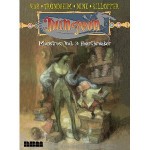
Dungeon: Monstres volume 3: Heartbreaker


By Joann Sfar & Lewis Trondheim, Carlos Nine & Patrice Killoffer, translated by Joe Johnson (NBM)
ISBN: 978-1-56163-591-7

This slim tome is yet another instalment in the ongoing, eccentric, raucous and addictively wacky franchise that is the best thing to have happened to fantasy storytelling in decades. The Dungeon saga is subdivided into Early Years, Zenith, and Twilight as well as Dungeons Parade and the Monstres of this particular review.

The inhabitants of this weirdly surreal universe include every kind of anthropomorphic beast and bug as well as monsters, demons, smart-alecs and stroppy women-folk. There’s always something happening and it’s usually quite strange…

The nominal star is a duck with a magic sword which forces him to channel dead heroes and monsters, but at the time of the first story Herbert of Craftiwich is yet to become Grand Khan and supreme overlord of a dying, burning world. For increased clarity a quick glance at Dungeon – the Early Years (Volume 2: Innocence Lost to be specific) would be beneficial.

In ‘Heartbreaker’, the lead story in this beautifully exotic compilation, the setting is the debauched, bureaucratised and grimly frenetic urban hellhole of Antipolis wherein serpentine lady-assassin Alexandra reveals her cynically jaded, tragically baroque past in a bizarrely beautiful account of the inescapable corruption at the heart of the city and its Guilds.

Without warning the tale shifts to her betrayal, incarceration and escape from horrendous suffering and her response to a world that could make her the creature she irrevocably is…

Evocatively illustrated by guest artist Carlos Nine the darkly disturbing odyssey is followed by a flamboyantly bright and deceptively garish self-contained undersea saga ‘The Depths’ which looks like the most pleasing kids fantasy ever…

But it most certainly isn’t.

Set decades later when Herbert is the Khan, it focuses on aquatic princess Drowny (who looks like a wide-eyed purple tadpole) as she narrowly escapes death when a gang of assassins mistake her family’s home for their intended target. With her loved ones murdered Drowny hides in plain sight, disguising herself as one of the intruders. Enduring heartbreak and degradation she accidentally rises to a position of power and influence in the invading army which has struck a foul deal with the Khan’s son to conquer the planet and divide the world above and below between them.

Always looking for a way to return to her own people, when her chance comes, Drowny is faced with a crushing revelation…

Superbly realised – the creators have really thought about how characters would act and interact underwater – the lush colour and incredibly imaginative creature designs of Patrice Killoffer add a cartoon fantasy sheen to the proceedings which utterly belies the stark, horrific tale of the depths a decent person will sink to for revenge…

Comprising two translated French albums ‘Creve-Coeur’ and ‘Les Profondeurs’ this is another strikingly surreal, earthy, sharp, mordant, poignant and brilliantly outlandish tome that’s a joy to read with vibrant, wildly eccentric art moody as Sin City and jolly as Rupert Bear.

Definitely for broad-minded grown-ups with young hearts, Dungeon is a near-the-knuckle, over-the-top, illicit experience which addicts at first sight, but for a fuller comprehension – and added enjoyment – I’d advise buying all the various incarnations.
© 2004 Trondheim-Sfar-Nine-Killoffer-Guy Delcourt Productions. English translation © 2010 NBM. All rights reserved.

The Littlest Pirate King


By David B. & Pierre Mac Orlan, translated by Kim Thompson (Fantagraphics Books)
ISBN: 978-1-60699-403-0

Win’s Christmas Gift Recommendation: Perfect for bold kids and timid parents…  8/10

Tim Burton has pretty much cornered the market on outlandish spooky fairytales but if you and your kids have a fondness for scary fables and macabre adventure with a uniquely European flavour you might want to take a peek at this impressive yarn of unquiet buccaneers and phantom piracy.

Pierre Mac Orlan was one of the nom-de-plumes of celebrated French author, musician and performer Pierre Dumarchey who between his birth in 1882 and death in 1970 managed to live quite a number of successful, productive and action-packed lives.  As well as writing straight books, he produced a wealth of artistic materials including children’s tales like this one, hundreds of popular songs and quite a bit of outré pornography.

A renowned Parisian Bohemian, he sang and played accordion in nightclubs and cabaret, was wounded in the trenches in 1916, subsequently becoming a war correspondent, and after the conflict became a celebrated film and photography critic as well as one of the country’s most admired songwriter and novelists.

David B. is a founder member of the groundbreaking strip artists group L’Association, and has won numerous awards including the Alph’ Art for comics excellence including European Cartoonist of the Year in 1998. His seamless blending of artistic Primitivism visual metaphor, high and low cultural icons, as seen in such landmarks as Babel and Epileptic, are augmented here by a welcome touch of morbid whimsy and stark fantasy which imbues this work with a cheery ghoulish intensity only Charles Addams and Ronald  Searle can match.

Mac Orlan’s tale perhaps owes more to song than storybook, with its oddly jumpy narrative structure, but Davis B.’s canny illustration perfectly captures the spirit of grim wit as it recounts the tale of the ghostly crew of the Flying Dutchman, damned sailors cursed to wander the oceans, never reaching port, destroying any living sailors they encounter and craving nothing but the peace of oblivion.

Their horrendous existence forever changes when, on one of their periodic night raids, they slaughter the crew of a transatlantic liner but save a baby found on board. Their heartless intention is to rear the boy until he is old enough to properly suffer at their skeletal hands, but as the years pass the eagerly anticipated day becomes harder and harder for the remorseless crew to contemplate…

Stark and vivid, scary and heartbreakingly sad as only a children’s tale can be, this darkly swashbuckling romp is a classy act with echoes of Pirates of the Caribbean (which it predates by nearly a century) that will charm, inspire and probably cause a tear or two to well up.

© 2009 Gallimard Jeunesse. This edition © 2010 Fantagraphics Books. All rights reserved.

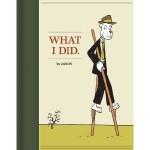
What I Did


By Jason, translated by Kim Thompson (Fantagraphics Books)
ISBN: 978-1-60699-414-6

Win’s Christmas Gift Recommendation: Perfect for anybody who wants something a little different in their stocking …  8/10

John Arne Saeterrøy, who works under the pen-name Jason, was born in Molde, Norway in 1965, and appeared on the international cartoonists’ scene at age 30 with his first graphic novel Lomma full ay regn (Pocket Full of Rain) subsequently winning Norway’s biggest comics prize, the Sproing Award for 1995.

He won another Sproing in 2001 for his self-generated comic series Mjau Mjau – from which all the tales in this latest magical collection are culled – before turning almost exclusively to producing graphic novels in 2002. Now a global star among the cognoscenti he has won several major awards from such disparate regions as France, Slovakia and the USA.

This latest hardback compilation gathering ‘Hey, Wait…’, ‘Sshhhh!’ and ‘The Iron Wagon’ first appeared in Mjau Mjau between 1997 and 2001, and the volume opens with an eerie and glorious paean to boyhood friendships as young Bjorn and Jon enjoy a life of perfect childhood until a tragic accident ends the idyll forever. Life however, goes on, but for one of the lads it’s an existence populated from then on with ghosts and visions…

Jason’s work always jumps directly into the reader’s brain and heart, using the beastly and unnatural to gently pose eternal questions about basic human needs in a soft but relentless quest for answers. That you don’t ever notice the deep stuff because of the clever gags and safe, familiar “funny-animal” characters should indicate just how good a cartoonist he is…

‘Sshhhh!’ is a delightfully evocative romantic melodrama created without words: a bittersweet tale of boy-bird meeting girl-bird in a world overly populated with spooks and ghouls and skeletons but afflicted far more harshly by loneliness and regret.

These comic tales are strictly for adults but allow us all to look at the world through wide-open young eyes. This is especially true of the final tale in this collection – a sly and beguiling adaptation of a classic detective story from 1909, but enhanced to a macabre degree by the easy cartooning and skilled use of silence and moment.

‘The Iron Wagon’ is a clever, enthralling and deeply dark mystery yarn originally written by Stein Riverton, and has the same quality of cold yet harnessed stillness which makes the Swedish television adaptations of Henning Mankell’s Wallander so superior to the English-language interpretations.

Jason’s stylised artwork is delivered in formalised page layouts rendered in a minimalist evolution of Hergé’s Claire Ligne style, solid blacks, thick lines and settings of seductive simplicity augmented here by stunning Deep Red overlays to enhance the Hard Black and Genteel White he usually prefers.

In the coastal retreat of Hvalen a desperate author is haunted by ghosts and nightmares but the townsfolk are all too engrossed with the death of the game warden on the Gjaernes Estate to notice or care. The family seems cursed with troubles. First the old man was lost at sea, now the murder of Warden Blinde just as he was betrothed to Hilde Gjaernes blights the farm. People are talking, saying it’s all the fault of the long dead grandfather who lost his fortune and life dabbling with weird inventions…

Even now sensitive souls still hear his accursed Iron Wagon roaring through the night, presaging another death in the village…

Luckily there are more sensible folk abroad to summon a detective from Kristiania (Oslo), but Asbjǿrn Krag is not the kind of policeman anybody was expecting and as the young writer becomes enmired in the horrific unfolding events he realises that not only over-imaginative fools hear things.

In the depths of the night’s stillness he too shudders at the roaring din of the Iron Wagon…

Moody, suspenseful and utterly engrossing this would be a terrific yarn even without Jason’s superbly understated art, but in combination the result is dynamite.

This collection, despite being early works resonates with the artist’s preferred themes and shines with his visual dexterity. It’s one of Jason’s very best and will warm the cockles of any fan’s heart.

© 2010 Jason. All rights reserved.

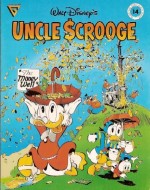
Walt Disney’s Uncle Scrooge: The Money Well


By Carl Barks and others (Gladstone Comic Album #14)
ISBN: 978-0-94459-914-3

Carl Barks was born in Merrill, Oregon in 1901, growing up in the rural areas of the West where during some of the leanest times in American history. He tried his hand at many jobs before settling into the profession that chose him. His early life is well-documented elsewhere if you need detail, but briefly, Barks worked as a animator at Disney’s studio before quitting in 1942 to work in the newborn field of comicbooks.

With cartoon studio partner Jack Hannah (himself an occasional strip illustrator) he adapted a Bob Karp script for an animated cartoon short into the comicbook Donald Duck Finds Pirate Gold (published as Dell Four Color Comics Series II #9 in October of that year). Although not his first published comics work, it was the story that shaped the rest of his career.

From then until his official retirement in the mid-1960s Barks worked in self-imposed isolation seclusion writing and drawing a vast array of adventure comedies, gags, yarns and covers, creating a Duck Universe of memorable and highly bankable characters such as Gladstone Gander (1948), Gyro Gearloose (1952), Magica De Spell (1961) and the nefarious Beagle Boys (1951) to supplement Disney’s stable of cartoon actors. His greatest creation was undoubtedly the crusty, energetic, paternalistic, money-mad gazillionaire Scrooge McDuck: the World’s wealthiest winged septuagenarian and the harassed, hard-pressed star of this show.

Whilst producing all that landmark innovative material Barks was just a working guy, generating cover art, illustrating other people’s scripts when asked and contributing story to the burgeoning canon of Duck Lore. Gladstone Publishing began re-packaging Barks material – and a selection of other Disney comics strips – in the 1980s and this fabulous and spectacular tome is another of the very best – as they all seem to be.

So potent were his creations that they inevitably fed back into Disney’s animation output itself, even though his brilliant comic work was done for the licensing company Dell/Gold Key, and not directly for the studio. The greatest tribute was undoubtedly the animated series Duck Tales heavily based on his comics output of the 1950s and 1960s.

This album is printed in the large European oversized format (278mm x 223mm) -although dedicated collectors should also seek out the publisher’s superb line of Disney Digests and comics books that grew out of these pioneering tomes – and features one of the most madcap and wryly funny yarns Barks ever concocted.

Taken from Uncle Scrooge #21 (March-May 1958) this is one of the most ingenious campaigns by the Beagle Boys to divest the Billed Billionaire of his ocean of cash and  kicks off when the ever-vigilant miser spots the canine crooks attempting to pump his stupendous money-bin dry with oil-drilling technology.

Determined to find a completely secure home for his money Scrooge consults experts and electronic brains but eventually outsmarts himself by hiding the loot in a place where the Beagles can actually take it legally! Happily, Scrooge is mean yet honourable and always ready to take advantage of a situation when the opportunity arises. Therefore he’s able to reclaim his hard-earned horde when the crucial moment comes…

The lead story is balanced by ‘Quest for the Curious Constable’ an anonymous saga produced by Disney’s European packager the Gutenberghus Group and translated and rewritten by Barks historian Geoffrey Blum. Here Donald and the nephews Huey, Dewie and Louie become embroiled in the decades-long rivalry between Scrooge and rival magnate Flintheart Glomgold and find themselves travelling back in time to obtain bragging rights to a lost art masterpiece, courtesy of Über-inventor Gyro Gearloose.

This fast-paced, whacky romp is a fine continuation of and addition to the Barks canon as the ducks rampage in a quest against the clock through the foggy, cobbled meta-fictional streets of 19th century London in search of treasure and adventure. Of course there’s a little sting in this tale too…

Barks’ work – as well as the best of the rest – is now readily accessible through a number of publications and outlets. No matter what your age or temperament if you’ve never experienced this captivating magic, you can discover “the Hans Christian Andersen of Comics” simply by applying yourself and your credit cards to any search engine.
© 1988, 1958 The Walt Disney Company. All rights reserved.

Fires


By Lorenzo Mattotti (Catalan Communications)
ISBN: 0-87416-064-2

Lorenzo Mattotti was born in Brescia 1954, and after studying architecture became a comics storyteller before graduating into a second career as a designer and illustrator. As well as the book under discussion here, his most well-known work is probably his 2003 Eisner award-winning adaptation of Dr. Jekyll and Mr. Hyde. His stunning illustrations have graced magazines as varied as Cosmopolitan, Le Monde, Vogue and The New Yorker.

Initially working in a stylish but standard manner he gradually became obsessed with expanding the traditional comics form; capturing the power of light, hue and motion on the page and exploring the inner world of the characters populating it, beginning with the seminal Il Signor Spartaco in 1982.

With all his successive works from Murmur, the semi- autobiographical ‘The Man in the Window’ (where he applied the same creative questioning doctrine to line-drawing as he had to paint, pastel and chalk colour), the historical Caboto and others he pursued a technique of offering multiple meanings and interpretations to the reader…

Fires was released in 1986, and details the experience of a navy officer seduced by the magical nature of a tropical island. Either that or a classic case of a sensitive nature driven to madness by the regimentation of militarism…

When the warship Anselm II drops anchor in the bay of the paradisiacal islet of St. Agatha to investigate the growing loss of merchant shipping, junior officer Lieutenant Absinthe is troubled by the stunning natural beauty of volcanic atoll. The government of the new super-state of Sillantoe has dispatched the dreadnought to explore the place, and if populated, civilise or pacify the natives.

On the night before Absinthe and a landing party are dispatched, blazing fires can be seen brilliantly lighting up the dark and the Lieutenant thinks he sees strange creatures invading the ship. When the away team trudges through the foliage the next morning, he thinks he sees them again, but for some inexplicable reason cannot bring himself to report the sighting.

The officer is increasingly disturbed by the joyous, dancing flickering figures, and even though he says nothing the crew knows something is happening to him. Absinthe only feels happy or at peace on the island, and one night he goes AWOL. Seeing islanders all the time now he goes fully native, reveling in the spectacular blazes that roar and dance every time darkness falls.

Eventually the sailors recapture their “hallucinatory” comrade and the order comes to bombard this isle of the damned until it is razed of all possibility of life.

And now the nightmare truly begins…

This examination of technology vs. nature, freedom challenging duty and man against civilisation is rendered in a euphoric blaze of expressionistic colour and frantic movement reminiscent of Disney’s Fantasia and bolder abstract experimental animations, with forms and actors reduced to primal shapes surging across the landscape of a page. Mattotti’s questing style blends the colour philosophy of Fauvism with the stripped-down forms and perfect structures of Italian Futurist painters such as Giacomo Balla, Carlo Carrà and Umberto Boccioni and Russian Natalia Goncharova whilst the story itself has the brooding, paranoiac, inevitable-descent-into-madness feel of Conrad’s Heart of Darkness and its filmic avatar (Coppola’s) Apocalypse Now.

Astounding, compelling and deeply moving this book (there’s also a 1991 British edition from Penguin – ISBN 978-0-14013-889-4 available) is a mesmerising classic and high point of our art-form and one any serious devotee of sequential narrative would be proud to own.
© 1986-1988 by Editions Albin Michel S. A. English language edition © 1988 Catalan Communications. All rights reserved.

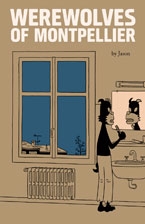
Werewolves of Montpellier


By Jason, translated by Kim Thompson (Fantagraphics Books)
ISBN: 978-1-60699-359-0

Jason, is secretly John Arne Saeterrøy: born in Molde, Norway in 1965 and an overnight international cartoon superstar since 1995 when his first graphic novel Lomma full ay regn (Pocket Full of Rain) won that year’s Sproing Award (Norway’s biggest comics prize).

He won another Sproing in 2001 for the series Mjau Mjau and in 2002 turned almost exclusively to producing graphic novels. Now a global star among the cognoscenti he has won seven major awards from such disparate regions as France, Slovakia and the USA.

Now his latest novella is released, rife with his signature surreality; populated with cinematic, darkly comic anthropomorphs and featuring more bewitching ruminations on his favourite themes of relationships and loneliness, viewed as ever through a charmingly macabre cast of bestial movie archetypes and lost modern chumps.

Here he focuses on the hollow life of expatriate Swede Sven, a purposeless artist who has gravitated into a stagnant, romance-lite existence in a provincial French town. Sven fritters away his days just like his close friend Audrey – another listless intellectual looking for the right lady to love.

The only thing that quickens his pulse these days is the occasional nocturnal foray over the rooftops: burglarizing houses dressed as a werewolf. Unfortunately, Montpellier already has a genuine lycanthrope community and they don’t look kindly upon gauche parvenus intruding into their world…

This post-modern short-and-spooky fable unfolds in Jason’s beguiling, sparse-dialogued, pantomimic progressions and has resonances of Hitchcock’s bubbly comedy-thrillers quirkily blended with Bergman’s humanist sensibilities. The enchantingly formal page layouts are rendered in his minimalist evolution of Hergé’s Claire Ligne style, solid blacks, thick lines and settings of seductive simplicity augmented here by a stunning palette of stark pastels and muted primary colours.

Jason’s work always jumps directly into the reader’s brain and heart, always probing the nature of “human-ness” by using the beastly and unnatural to ask persistent and pertinent questions. Although the clever sight-gags are less prominent here his repertory company of “funny-animal” characters still uncannily depicts the subtlest emotions with devastating effect, proving again just how good a cartoonist he is.

This comic tale is best-suited for adults but makes us all to look at the world through wide-open childish eyes. Jason is instantly addictive and a creator every serious fan of the medium should move to the top of the “Must-Have” list. While you’re at it, make room there for Werewolves of Montpellier too…

© 2010 Jason. All rights reserved.

Judge Dredd: The Apocalypse War


By John Wagner, Alan Grant, Carlos Ezquerra & various (Titan Books)
ISBN: 978-1-84023-634-7

Britain’s last great comic megastar might be described as a combination of the other two, combining the fantastic science and adventure of Dan Dare with the unrelentingly seditious anarchy and absurdity of Dennis the Menace. He’s also well on the way to becoming the longest-lasting adventure character in our admittedly meagre home-grown comics stable, having been continually published every week since February 1977 when he first appeared in the second issue of science-fiction anthology 2000AD.

However with at least 52 2000AD strips a year, annuals, specials, a newspaper strip (in the Daily Star and later The Metro), the Judge Dredd Megazine, numerous reprinted classic comics collections and even two rather appalling DC Comics spin-off titles, that adds up to a phenomenal amount of material, most of which is still happily in print from Rebellion.

One of the most attractive packages and certainly one of the most compelling is this sharply stylish black and white deluxe hardcover collection featuring one of the greatest storylines in the entire canon.

Judicial Briefing: Dredd and his dystopian ultra-metropolis of Mega-City One were created by a very talented committee including Pat Mills, Kelvin Gosnell, Carlos Ezquerra, Mike McMahon and others but with the major contribution coming from legendary writer John Wagner, who has written the largest portion of the canon under his own and several pseudonymous names.

Joe Dredd is a fanatically dedicated Judge in the super-city, where hundreds of millions of citizens idle away their days in a world where robots are cheaper and more efficient than humans and jobs are both beloved pastimes and treasured commodities. Boredom and madness has reached epidemic proportions and almost everybody is just one askance glance away from mental meltdown. Judges are last-ditch peacekeepers who maintain order at all costs: investigating, taking action and instantly trying all crimes and disturbances to the hard-won equilibrium of the constantly boiling melting pot. Justice is always immediate and final…

They are necessary fascists in a world permanently on the edge of catastrophe, and sadly, what far too many readers never realise is that the strip is a gigantic satirical black comedy leavened with oodles of outrageous, vicarious cathartic action.

Dredd’s world is a polluted and precarious Future Tense with all the key analogues for successful science fiction (as ever a social looking-glass for the times it’s created in) situated and sharply attuned to a Cold War Consumer Civilisation. The planet is divided into political camps with Post-nuclear holocaust America locked in a slow death-struggle with the Sov Judges of the old Eastern Communist blocs: militaristic, oppressive and totalitarian – and that’s by the US Judges’ standards, so just imagine what they’re like…

In 1981 Progs (that’s issue numbers to you) #236-244 featured a nine-part story ‘Block Mania’ which detailed an all-out war between two colossal habitation blocks in Mega-City One. With weekly instalments illustrated by Mike McMahon, Ron Smith, Steve Dillon and Brian Bolland (who also supplied some incredible covers) the all-out confrontation between Enid Blyton and Dan Tanna Blocks rapidly proliferated, engulfing surrounding Hab-units, spreading like a plague – or a chemical weapon.

Against a backdrop of utter berserker carnage Dredd discovers a plot by Sov agents to destabilise Mega-City One…

For once the Judge is too late and as his city burns the Dictatorat of East-Meg One launch a nuclear strike, following up with a ground-forces invasion. The Judges hit back with their own nukes and terrified of global Armageddon Mega-City Two and Texas City declare themselves neutral. Mega-City One will stand or fall alone…

Over forty years after the Battle of Britain ‘The Apocalypse War’ stunned and delighted readers. This epic tale of dogged resistance and bloody pyrrhic victory is a masterpiece of drama and tragedy, with Carlos Ezquerra drawing all 26 weekly chapters (even some covers!), and three decades later it still ranks as one of the greatest Dredd tales ever published.

Spectacular, violent, epic and leading to almost incomprehensible actions from someone most readers still considered a “hero” and “good guy” this is as powerful an anti-war story as Pat Mills and Joe Colquhoun’s Charley’s War and deserves as much acclaim and respect.

This volume collects the entire saga and its prequel Block War into one mesmerising and compelling work of glittering triumph and dark tragedy, and should grace the shelves of every serious fan of the medium – and the message.
® & © 2003 Rebellion. All rights reserved.

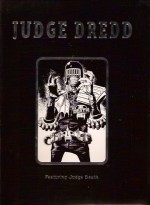
Judge Dredd Featuring Judge Death


By John Wagner & Brian Bolland (Titan Books)
ISBN: 978-1-84023-386-5

Britain’s last great comic icon could be described as a combination of the other two, combining the futuristic milieu and thrills of Dan Dare with the terrifying anarchy and irreverent absurdity of Dennis the Menace. He’s also well on the way to becoming the longest-lasting adventure character in our admittedly meagre comics stable, having been continually published every week since February 1977 when he first appeared in the second issue of science-fiction anthology 2000AD.

However with at least 52 2000AD strips a year, annuals, specials, a newspaper strip (in the Daily Star and later The Metro), the Judge Dredd Megazine, numerous reprinted classic comics collections and even two rather appalling DC Comics spin-off titles, that adds up to a phenomenal amount of material, most of which is still happily in print.

One of the nicest looking packages and certainly one of the most inviting for new readers is this sharply stylish black and white deluxe hardcover collection featuring some of the formative work of superstar artist Brian Bolland.

Bolland by his own admission was an uneconomically slow artist and much of his Dredd work appeared as weekly portions of large epics with other artists handling other episodes, but all the cases collected here are self-contained or short continued sagas, resulting in a wicked compendium of his best, funniest and most striking material all in one magnificent volume.

FYI: Dredd and his dystopian ultra-metropolis of Mega-City One were created by a committee including Pat Mills, Kelvin Gosnell, Carlos Ezquerra, Mike McMahon and others but with the major contribution coming from legendary writer John Wagner, who has written the largest portion of the canon under his own and several pseudonymous names.

Joe Dredd is a fanatically dedicated Judge in the super-city, where hundreds of millions of citizens idle away their days in a world where robots are cheaper and more efficient than humans and jobs are both beloved pastime and treasured commodity. Boredom has reached epidemic proportions and almost everybody is just one askance glance away mental meltdown. Judges are peacekeepers who maintain order at all costs: investigating, taking action and trying all crimes and disturbances to the hard-won equilibrium of the constantly boiling melting pot. Justice is always immediate…

They are necessary fascists in a world permanently on the edge of catastrophe, and sadly, what far too many readers never realise is that the strip is a gigantic satirical black comedy with oodles of outrageous, vicarious cathartic action.

In Prog (that’s issue number to you) 149-151 (January 26th – February 9th 1980), with the continuity firmly established Wagner, writing as John Howard, introduced ‘Judge Death’, undead lawman from an alternate Earth, where the Judges, when faced with the same problems as our world took their creed to its only logical conclusion: If all crime is perpetrated by the living then to eradicate crime…

With all life ended in his own dimension the ghostly ghoul extended his mission to ours, wiping out criminals and law-abiding citizens alike, with the Judges – even Dredd – unable to stop him until the flamboyant and unconventional psychic hottie Judge Anderson of PSI Division sacrificed herself to trap the evil spirit forever…

As if…

With Wagner clearly on a creative roll the fans spoke long and loud and thus both the Zombie Peacemaker and Anderson were returned within a year in the manic mayhem of ‘Judge Death Lives’ (credited to T.B. Grover but still Wagner really; Progs 224-228, August 8th – September 5th 1981), as a desperate citizen released the horror from his eternal tomb at the behest of three more expired Judges: Mortis, Fire and Fear.

Reunited with their leader the Dark Judges went about their duty executing all of Mega-City One and it took a trip to their home “Deadworld” before Dredd and Anderson could stop the slayers – albeit temporarily. Both Anderson and Death went on to win their own series…

For a while early on in his career, Dredd was seconded to the Moon to oversee the colony there – which was as bonkers as Mega-City One – in conjunction with Cold War enemies the Sov Judges.

From that period came ‘The First Lunar Olympics’ and ‘War Games’ (Progs 50-51, February 5th and 11th 1978) a vicious swipe at contemporary sport’s politicisation which was and still is bloody, brutal and bitingly funny, whilst ‘The Oxygen Board’ and ‘The Face-Change Crimes’ (Progs 57 & 52, March 25th and  February 18th 1978 respectively) are hilariously inventive bank-raid capers with the kind of mordant twists which elevated Dredd so far beyond all other cop and sci-fi strips.

Once rotated back Earthside it was business as unusual in ‘The Fog’ (Prog 127, August 25th 1979) a chillingly atmospheric pastiche of horror film classic House of Wax, whilst in ‘The Forever Crimes’ (Prog 120, July 7th 1979) Dredd showed that being dead was no valid reason for a perp to avoid his sentence and this spectacular chronicle ends with the glorious insane ‘Punks Rule!’ (Prog 110 April 28th 1979), an epilogue to the epic Judge Caligula story-arc, with the Judges slowly resuming control of Mega-City One after a civil war and revolution, with Dredd personally stamping out street gangs that had carved out their own little empires in the aftermath.

Beautifully drawn these are perfect short stories starring modern Britain’s most successful and iconic comic character: timeless classics that no real comic fan can ignore – and just for a change something that you can easily get your hungry hands on…
® & © 2001 Rebellion. All rights reserved.

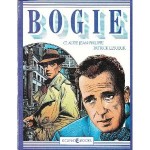
Bogie


By Claude Jean-Philippe & Patrick Lesueur, translated by Wendy Payton (Eclipse Books)
ISBN: 978-0-913035-78-8

As well as a far greater appreciation of, and looser, more accommodating definitions for performing and popular arts, the French just seem to cherish the magnificent ephemera of entertainment; examining and revisiting the icons and landmarks of TV, film, modern music and comics in ways that English-speakers just don’t seem capable of.

At the beginning of the 1980s artist Patrick Lesueur collaborated with author Claude Jean Philippe on a graphic series of biographies featuring Movie Stars who changed the world: Charlie Chaplin, the Marx Brothers, Errol Flynn and the subject of this slim and beautiful chronicle translated for America by West Coast independent publisher Eclipse.

Even Wikipedia doesn’t throw up much about the writer but Lesueur began life as a window dresser before moving into bande dessinée in 1972 by joining the creative staff of Pilote, illustrating current affairs pages before moving into fiction with short eco-fables compiled as the album ‘En Attendant le Printemps’ and cop thriller ‘Reste-t-il du Miel pour le Thé’. Latterly he produced ‘Detroit’, ‘Douglas Dunkerk’, and classic car feature ‘Enzo Ferrari, l’Homme aux Voitures Rouges’.

Bogie is told in a haunting, conversationally first-person narrative: the moodily realistic yet whimsically refined life of one of the greatest screen gods of all time comes to elegiac life in this peculiarly down-beat and low-key piece, all the more fascinating because the tale unfolds in an engagingly static manner but actually sounds just like you’d want and expect Humphrey Bogart to talk to you if you met him in a bar, whilst the restrained yet powerfully effective images shout “private photograph album” in a candid, winningly intimate way.

Bogart apparently led an unremarkable life off-screen, or perhaps the creators just didn’t want this hard-drinking, much-married legend to outshine his own celluloid legacy, but in terms of graphic novel entertainment this poetic picture-story in a stunning achievement and worthy of your attention. Perhaps someday soon another publisher will re-release it and even translate those other silver screen sagas too…
Contents © 1984 Dargaud Editeur Paris by Claude Jean Philippe and Patrick Lesueur. 1989 This edition © 1989 Eclipse Books.

Dr. Jekyll & Mr. Hyde


By Robert Louis Stevenson, adapted by Guido Crepax (Catalan Communications)
ISBN: 978-0-87416-079-6

Guido Crepax was born in Milan in 1933, the son of a noted cellist, and grew up in an atmosphere of art and music (his closest childhood friend was the noted musician and conductor Claudio Abado). Inevitably the boy Crepax became a creative artist in his own right. Whilst studying architecture in the 1950s he freelanced as a graphic designer, illustrator and printmaker, producing book, medical texts and magazine covers, posters and record sleeves most notably for Classical and Jazz musicians ranging from Charlie Parker and Fats Waller to Domenico Modugno.

He won acclaim and advertising awards throughout the 1950s, but was driven to do still more. In 1963 he began drawing comics, and two years later created his most famous character Valentina for the second issue of Linus. She was initially the lead character’s girlfriend, but whereas superhero Neutron soon lost the interest of readers, the sexy, psychedelic, culturally bold and accessible distaff evolved to become an evocative, fantastic, sophisticated, erotic zeitgeist of the 1960s and far, far beyond. He passed away on July 31, 2003.

Although noted – if not always revered – for his strongly erotic female characters, Crepax was an astute and sensitive tale-teller and examiner of the human condition, and all his varied works vibrate with strong themes of charged sexuality and violence, none more so than his chilling, oppressive adaptation of Strange Case of Dr. Jekyll & Mr. Hyde.

As Editor Maurice Horn points out in his introduction, Stevenson’s novella – first published in January 1886 by Longmans, Green & Co. – has never been as faithfully adapted in any other medium: the tale being constructed and narrated as a recap within a flashback, and almost utterly devoid of any relevant female characters. The story revolutionised not only fiction, but also modern sensibilities, cementing an entire concept of human behaviour into the modern lexicon and becoming a keystone of two separate literary genres, science fiction and horror, whilst maintaining for almost its entire duration the semblance of just another tale of mystery and detection. What it must have been to get to that final chapter and discover an entirely new kind of ending! We simply cannot imagine…

For most readers of the text, rather than viewers of the impossibly large number of film, television, radio and stage productions, the brief morality play is clearly a metaphor (I, for example, have always felt it addressed social repression via an examination of addiction) and Crepax has chosen to interpret the issue here as one of unleashed sexual license…

Narrator Gabriel John Utterson is friend and legal representative to Gentleman Scientist Henry Jekyll, a brilliant, upstanding man obsessed with his image and standing in a rich and excessively reputation-driven society. When the wizened, disreputable Edward Hyde appears and begins to exert some inexplicable, overwhelming hold upon the genteel Jekyll, even keeping him from seeing his friends, Utterson is driven to investigate and uncovers a horrendous, unimaginable catalogue of the dwarf’s excesses, ranging from brutal violence, sexual bondage, blackmail and even murder…

Crepax retained the unique narrative structure, dialogue and even chapter headings of the original text, but peppered his visual interpretation with the highly charged, sexually explicit imagery he was – and is – notorious for in such a manner that their sybaritic inclusion made perfect sense. Following the eerie unraveling of the saga in  ‘Story of the Door’, ‘The Carew Murder Case’, ‘The Letter’, ‘Incident at Dr. Lanyon’s’, ‘The Window’, ‘The Last Night’, ‘Dr Lanyon’s Account’ comes the revelatory, post-mortem disclosures of  ‘Henry Jekyll’s Confession’ and Utterson’s shocked realisation of the pressures of English society and the forces they contain and conceal within every man…

Stark, shocking, convulsively claustrophobic in its public scenes whilst indolently free and spacious for the unleashed hedonistic, yet curiously idyllic and lyrical depictions of debauchery, Crepax’s artistic stylisations are as always cannily calculated to work on the reader’s subconscious and bestow an unrelenting power and oppressive inevitability to the tragedy.

Here is a powerful saga magnificently retold using the language and terms of the British Empire, but this highly adult interpretation is also unflinching in its sexual imagery, so if such visual candour depicted in a truly unique style and manner is going to offend you don’t seek out this superb tale.

Everybody else with their senses of drama, history and perspective intact should go ahead and enjoy a brilliant tale stunningly interpreted: another classic graphic novel desperately in need of reprinting…
© 1989 Olympia Press, Italy, Luca A Staletti, agent. English translation © 1990 Catalan Communications. All rights reserved.