
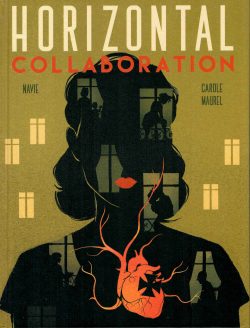
By Navie & Carole Maurel, translated by Margaret Morrison (Korero Press)
ISBN: 978-1-91274-001-7
World War II – with its world-shaking reordering of society and all the consequent, still-felt repercussions – is very much in people’s minds at the moment and I’d like to offer up this new translated European tale as a counterpoint to the commemorative bombast, and the much-delayed honours finally being paid to the ever-dwindling last of “The Fewâ€.
At least now, as well as the valiant men, we’re finally acknowledging the commonly disregarded contributions of women also caught up in the conflict, not to mention the unsung heroes of all nations who were drawn into the horror.
This particular hardcover, however, is not about heroes. Horizontal Collaboration deals with people: civilians and fugitives, women and invading occupiers: the ones who are seldom celebrated but who also confronted the triumph of global darkness, all in their own small, unnoticed ways…
France fell to the Germans in 1940. The country was occupied and partitioned on June 22nd, with the Germans holding the industrial north and central regions whilst Marshal Philippe Pétain‘s puppet protectorate Régime de Vichy was allowed to govern the south and pacified colonies such as Algeria. When the nation was liberated in September 1944, a vicious wave of retaliation began against those who cooperated with the conquerors in ways great and small.
A sordid time of scores settled (real, imagined or fabricated) and cruel abuses almost arbitrarily inflicted on guilty and innocent alike plagued France for years afterwards. The most telling indignities were perpetrated upon women – wives, mothers, sisters or strangers – accused of fraternising with or giving comfort to the enemy.
Such liaisons were called “Collaboration Horizontale†and even the most nebulous or unfounded accusation of such betrayals carried a heavy and immediate price…
Just about now, a grandmother listens to her granddaughter unload about her current amour and her mind drifts back to the war and a secret she has never shared with anyone…
In 1942, a large apartment house on Passage de la Bonne-Graine is filled with families, all dealing with the German conquerors in their own way. Despite the change in their fortunes, they have not found any way to overcome the petty grudges and ingrained social difficulties that kept them at odds with each other even before war broke out…
Surly aged crone Madame Flament is rude to everybody, and spends all her time complaining or disappearing into the cellars to feed her cats. What secret is she really hiding?
Old Camille is deemed the man of the house, but he is gentle, ineffectual and blind; blithely letting life go on around him and apparently noticing nothing. His wife is the building’s concierge. Brusque matron Martine Andrée is a snooping busybody loudly championing decency and family values, but her home life is nothing to envy and her sharp tongue scores points off family, friends and foes indiscriminately.
She despises the younger women and their families in the building, especially pretty Joséphine Borgeon who makes ends meet through her theatre act. Everybody knows what she really does to survive…
Also viewed with suspicion is young mother Rose. Her husband Raymond has been taken away to work for the Nazis, so his friend and neighbour Leon – a gendarme – has been keeping a “friendly†eye on her, even though his own pregnant wife Judith keeps clumsily falling and hurting herself and surely needs proper supervision…
Strangely boyish artist Simone keeps to herself as much as she can and – originally – there was also a Jewess called Sarah Ansburg and her son Anaël. They somehow disappeared before the Germans could find them. That must be the reason Abwehr intelligence officer Mark Dinklebauer spends so much time in the building. It couldn’t possibly be that he has fallen in love with one of the occupants, or that this most forbidden of passions is dangerously, illegally reciprocated, can it?
Crafted with deft incisiveness by media writer and historian (Mademoiselle) Navie and rendered in a beguiling style (powerfully reminiscent of Will Eisner in his later years) by seasoned illustrator and author Carole Maurel (Luisa: Now & Then, Waves, L’apocalypse selon Magda), this is a meditative and uncompromising glance at ordinary lives under relentless pressure: an ensemble piece of human drama that takes as its heart and centre point an unlikely flowering of true but doomed love…
Moving, beguiling and evocatively rewarding, Horizontal Collaboration is a beautiful tragedy and potent reminder that love takes no prisoners while enslaving all it touches.
© Editions Delcourt – 2017. All rights reserved.
Horizontal Collaboration will be released on 18th June 2019 and is available for pre-order now.