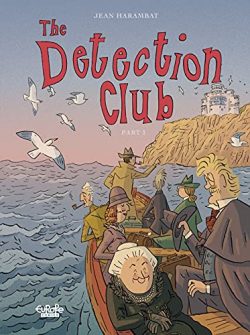
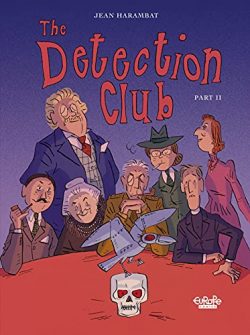
The Detection Club parts 1 & 2


By Jean Harambat, coloured by Jean-Jacques Rouger translated by Allison M. Charette (Europe Comics)
No ISBN: digital release only

Win’s Christmas Gift Recommendation: BA Perfect Portion of Post-Prandial Perplexity…  9/10

What’s the Holiday Season without a devilish mystery to chew on? Not nearly as much fun, I’m sure, and with that in mind here’s a brace of superb cartoon conundrums from the continent, based on an unlikely but actual historical convocation.

As seen on Wikipedia – please use often and make a large a supporting financial donation, if you can – The Detection Club was a literary society of British crime writers, founded in 1930, with the likes of G.K. Chesterton, Dorothy L. Sayers and Agatha Christie as early Presidents. In 1936, American émigré John Dickson Carr became the first non-Brit elected to the august body.

They did stuff, wrote stories, held events and upheld (Ronald) Knox’s Commandments which detailed the rules of mystery writing. The group is the basis of later media McGuffin’s such as Batman‘s Mystery Analysts of Gotham City.

I’m pretty sure the story here collected in two volumes by award-winning cartoonist, screenwriter, graphic novelist, historian, philosopher and journalist Jean Harambat (Les Invisibles, Ulysses, the Songs of Return, Operation Copperhead) is apocryphal, but you never know…

Originally released in 2019, our story opens in a prologue with the reciting of those commandments and the confirmation of Mr. Dixon Carr at a slap-up feed at London hostelry Ye Olde Cheshire Cheese – a pub that doesn’t seem to mind the odd celebratory gunshot…

Present are President Chesterton, Dixon Carr, Christie, Sayers, Baroness Emma Orczy, Major A.E.W. Mason and Monsignor Ronald Knox himself, and – as the repast winds down – proceedings are somewhat disturbed by the arrival of a flying, talking robotic bird bearing a strange invitation…

Eccentric man of means Mr. Roderick Ghyll wishes the company of the sagacious society at his extraordinary domicile on April 1st. Briarcliff House is situated on a private island where Ghyll wishes to celebrate the future through his latest contrivance, promising “challenges”, “enchantments” and “the renaissance of crime fiction”…

Chapter I opens with the scribes and scribblers approaching ‘An Island in Cornwall’ and still heatedly debating the motives of the mystery man. Ghyll greets them effusively before whizzing off in a bizarre electric unicycle leaving them to make their way to his palatial manse which is a gleaming tribute to sleek, tripped down modernism – if not actual futurism…

Apart from the domestic staff chef Alphonse, maid Madeline, implacable Asian manservant Fu, and stepdaughter Millicent, the only other human present is technical assistant Dr. Zumtod and Ghyll’s haughty beautiful wife Honoria. A future generation would call her a “trophy”…

The old plutocrat is a deeply unpleasant and overbearing host who boasts of one more personage that the sharp-minded, brain-testing authors must meet. With smugness and great ceremony he introduces Eric: a mechanical man with more than human insight who can outwit any mortal and easily determine the culprit in any tale they might concoct…

Although challenged with the details of a string of classic novels – which Eric easily and correctly concludes with the name of the perpetrators – the writers remain insulted and unconvinced. Dixon Carr even oversteps the bounds of polite decency by probing the automaton in search of a pre-prepped dwarf or amputee and the display is halted for dinner where Ghyll continues to advocate a world filled with his “metal friends”…

The evening wears on with the usual social distractions balanced by heated argument on many topics sparked by Eric’s existence and the magnate’s pronunciations that art and literature must make way for a machine-run world. At last, the affair breaks up with the guests retiring to their assigned rooms in a state of high dudgeon…

That all ends in esteemed literary tradition, with screams and the writers breaking into Ghyll’s savagely disarrayed bedroom to discover Eric inert in a chair and clear evidence of ‘The Billionaire Out the Window’. Far below, a dressing gown sinks beneath choppy waves and frantic searches can find no sign of their host…

Well-versed if not actually experienced in investigation, the writers set about interviewing the staff and then the residents. Soon Zumtod suggests the painfully obvious: turning Eric loose on the problem. The response is as rapid as the answer is shocking…

While waiting for the outer world to re-establish contact with the isolated isle, Agatha bonds with the presumed widow and probes the step-daughter, whilst Chesterton continues to scour the entire vicinity. He’s suspicious of everything – including whether there has been any crime at all – and soon unearths many unsuspected secrets even as each writer cleaves to their particular speciality and makes their own assessment and forms a hypothesis…

And then a body washes ashore…

The Detection Club‘s second volume begins with third chapter ‘Seven Amateur Detectives’ and an armada of late-arriving constabulary led by Inspector Widgeon to interview the drawing room sleuths. Mounting tensions, contrary theories and wounded pride quickly drive all concerned to fractious conflict even as Millicent’s banished and outcast twin Watkyn re-emerges. Has he only returned because of his despised step-father’s demise or was he actually back just before it happened?

Events seemingly come to a head when Christie expounds her latest theory and provokes a minor hostage crisis until the villain is apprehended through unlikely team work. As the police step in with the handcuffs however, new evidence emerges that sets the cogitators back on the murder-trail until straightforward ratiocination leads one author to the only possible solution…

Wry, witty, and decidedly well-plotted, with devastatingly sharp, catty dialogue (kudos to translator Allison M. Charette) and smart characterisations, this lovely lark is also charmingly limned: a superb tribute to days gone by and superb stylists who tested our wits and expanded our entertainment horizons. This is tale no  whimsically-inclined crime fan can afford to miss.

© 2020 – DARGUAD – HARAMBAT. All rights reserved.

Box (Book One)


By Patrick Wirbeleit & Uwe Heidschötter (Top Shelf Productions)
ISBN: 978-1-60309-449-8 (IDW TPB) eISBN: 978-1- 68406-747-3 (Top Shelf Productions)

It’s been a while since we covered a simple done-in-one yarn anybody can and everybody should read. Let’s fix that…

Box was originally released in Germany in 2014 as Kiste, winning a bunch of prestigious awards across the globe. It’s the brainchild of veteran author and illustrator Patrick Wirbeleit, who has notched up more than 50 books since he migrated from freelance artist to comics creator in 2001. His collaborator on this slice of inspirational whimsy is illustrator, character designer and animation director Uwe Heidschötter, whose past work includes The Little Boy and the Beast; The Gruffalo’s Child and Kahlil Gibran’s The Prophet.

Available in English-language paperback and digital editions since 2019, the tale is a charming, heartwarming and enticing fable which begins when young Matthew Wheeler returns home to find a large cardboard box by the bin outside his house. He’s an imaginative, inventive kid who loves making stuff, but also well-brought up too, so he asks permission before co-opting the container for the space station he’s currently building.

That doesn’t stop him slightly freaking out when the package starts offering advice and some expert technical aid…

It transpires the battered cardboard used to be a sorcerer’s toolbox, holding an infinitude of gear in a seemingly empty interior, but intensely frustrated because his owner never made anything physical, but only messed about with spells.

Rapidly adapting, Matthew starts a new project at Box’s suggestion but ‘The See-Saw’ is a bit of a bodge and proves the container might have the tools, but is sorely lacking in knowhow…

The talking toolkit’s next idea is ‘The What-Happens-Then Machine’, affording opportunity to share its origins whilst also warning that most humans who see its true nature freeze and forget quite quickly. When Mum and Dad end up utterly spellbound, it transpires that only the sorcerer can unlock their paralysis, so boy and Box immediately head for ‘The House in the Forest’ and a rendezvous with the terrible unknown…

After enduring nature at its worst and braving the polite-but-firm outer deterrents of the solitary mage, they eventually enter his lonely house, only to discover ‘Torquist Binklestunk’ is missing and a giant snake is now in residence.

Thus begins a desperate race to restore the magician and find a cure for Mum and Dad, with Matthew’s budding skills crucial in crafting a solution. When he succeeds and goes home to magically effect ‘The Awakening’, he successfully hides just how long his parents have been switched off…

It’s a bittersweet resolution because Box isn’t with him, but – armed with the promising possibility of further projects with the sorcerer and his toolkit – Matthew looks forward to more inventing and constructing…

Short, sweet, and amazingly appetising, this delightful comic series is certain to make many fans and inspire kids to build their own worlds of wonder.
© 2019 Patrick Wirbeleit & Uwe Heidschötter English translation © Pete Devlin. All rights arranged through Nicolas Grivel Agency.

Skydoll: Decade


By Barbara Canepa & Alessandro Barbucci (Titan Comics)
ISBN: 978-1-78276-736-7 (HB)

Astoundingly barbed political and anti-consumerist satirical allegory Skydoll has appeared sporadically since 2000. It’s the other work of frequent collaborators Alessandro Barbucci and Barbara Canepa, whose usual offerings include family-oriented fare such as W.I.T.C.H. and Monster Allergy. Although rendered in the seductive anthropomorphic style developed for and signifying decades of wholesome Disney cartooning, it’s a subtly strident attack on corporate consumerism, media mesmerism of the masses, political expediency, religion and the power of the Catholic church. It’s all wrapped up in the raunchy, beguiling trappings of super-sexy science fiction shenanigans with artificial people so that makes it all right, right?

The majority of the of the sporadic components thus far generated were beautifully bound up in a gloriously oversized (284 x 212mm) full-colour hardback edition for the English-speaking cognoscenti in 2016, which is still readily available physically if not yet digitally…

The subversive odyssey begins with prose ‘Preface: ten years of Skydoll’: a bold declaration of intent by The Authorsbefore speeding straight into fantastic fantasy with ‘Volume 1: The Yellow City’, introducing fetching, wind-up automaton Noa who’s asking God for a little fair treatment whilst working at the insalubrious Heaven Spaceshipwash. She’s not like all the other beautiful dolls working there. Although she still needs to be wound-up every 33 hours by her owner, this alluring animatron seems to have a memory that doesn’t delete itself every couple of days. This means she keeps thinking of difficult fresh questions to ask…

Furiously shoved back to work, Noa ignores the fabulously bland and vapid blather of TV talk show monolith Frida Decibel blasting out from every home and public broadcast screen, telling the populace of Papathea how good everything is now that they only have one Popessa… in the buxom form of the divine Ludovica.

Once upon a time there were two True Vicars of God: Agape – who embodied spiritual love – and Ludovica who personified its physical expression. When Agape mysteriously vanished, her corporeal partner became sole arbiter of the galactic empire the church controls, commencing a campaign of craftily concocted public miracles to pacify an increasingly irate and disillusioned populace. It’s not really working though, and a rising tide of rebellion and resentment is just beginning to pop…

Our story really begins when two of Ludovica’s “Diplomatic Agents” stop at Heaven to get their starcraft properly shined before heading out on their top-secret mission. Old Jahu is especially keen on the diversion: everybody knows lusting after or even indulging in pleasure with a Doll doesn’t count as sin. The Popessa said so…

However, whilst lathering up the ship of some fervent fundamentalists at the head of the queue, Noa accidentally kicks off a small riot, even as, across the city, Ludovica’s latest manufactured miracle kicks into high-gear with mesmerising effect…

By the time the barrage of supernal glitz and gaudy glitter subsides, Jahu and young idealistic Roy are well on their way. They have no idea there’s a dazed and surprised stowaway aboard, with her crucial, life-sustaining key still negligently left in her back…

On the rapidly dwindling planet behind them, Ludovica fumes. Despite getting rid of her rival, the lone Popessa’s grasp of power remains uncertain. The people still hunger for absent Agape and there are rumours of rebellion. The anxious, power-mad pontiff has no idea how close to home the sedition reaches…

Aboard ship, Roy has made a startling discovery. Unable to help himself, he turns the key in the inert innocent’s back and restores temporary autonomy to a vivacious creature he can’t help but like…

Doctrinaire Jahu is less sanguine, but the mission is too important to delay. They can always dump the doll on the way home…

Noa is eternally curious, asking questions about everything. Inexplicably, she is especially moved by an illicit image of Agape the voyagers encounter in a space restaurant. It triggers strange, terrifying visions and Roy has to physically restrain Noa. What happens next is regarded by the astounded onlookers as a miracle…

The story resumes with ‘Volume 2: Aqua’ as hints start circulating about Noa’s destiny and the unseen sponsors who seem to be guiding her destiny. The Popessa’s missionary ambassadors meanwhile land on the world without males: one successfully propounding a third spiritual way…

Governed by planetary Guru Gaia, the women of Aqua are steadily gaining support across the universe, supported and funded by their range of wellness centres and luxury goods which everyone wants to try. Roy is there to build diplomatic bridges between the Popessa and the completely antithetical Aquans in the cause of peace. He has no idea Jahu’s orders are a little different. That stalwart always knew the only way to really deal with heretics…

Noa inveigles her way into the official conference: she’s hopeful these strange women will have some insight into her own rapidly-expanding consciousness. She is stunned by what they do know and their connection to missing Agape.

And as Jahu goes about his bloody work, back on Papathea, bloody revolution breaks out…

The intrigue expands in ‘Volume 3: The White City’ when Roy, Jahu and constantly-maturing Noa return as triumphant heroes. When officially interviewed by the ubiquitous Frida Decibel, the web of intrigue and damnation expands to encompass some very unexpected personalities, even as the empire stands poised on the edge of Armageddon and real miracles are observed in the most unlikely places…

A broad, vast, clever and frustrating unfinished epic, Skydoll is still unfolding at its own tantalising pace. There has however been plenty of sidebar and ancillary material released such as ‘Volume 0: Doll’s Factory’ which offers a sequence of prequel events, fleshing out the main characters.

Here a strange woman visits a factory, placing something miraculous inside a doll in the final stages of manufacture, whilst ‘Heaven’s Dolls’ rewards the reader with information on the world and empire of the Popessa, affording insights into other Dolls such as Lovely Lou, Juicy Lee, Sandy Blue and God himself – proving just why he needed killing…

There’s also a hilarious Sky Doll ‘Psycho-grapho Test’ to further reveal how life and society really work…

This immaculate confection culminates in a huge collection of ‘Homages’: a breathtaking gallery of tribute images of the synthetic star and her chums by a staggeringly talented cast of fellow artists: Claire Wendling, Karla Diaz, Benjamin, Marguerite Sauvage, Mijin Shatje, Cyrille Bertin, Tony Infante, Bengal, Claudio Acciari, Tony Sandoval, Amélie Fléchais, Giovanni Rigano, Sefora Pons, Gradimir Smudja, Aurore, Augustin Rolland, Nenent, Guezav, Pierre-Mony Chan, Lucy Mazel, Véronique Meignaud, Matteo De Longis, Xavier Collette, Anne Cresci, Lilidoll, Jérémie Almanza, Lostfish and more.

Completing and concluding the quasi-religious experience is a comprehensive feature ‘About the Authors’ and ‘Acknowledgements & Credits’.

A phenomenal and beguiling work-in-progress, Sky Doll is a superbly engaging exploration of erotica, iconology and idolatry: one no fun-loving, deep-thinking devotee of comic iconoclasm or dedicated supportive lover of mechanical self-gratification (Eeew!) should miss.
Sky Doll and all contents are © Editions Soleil/Barbucci/Canepa. This translated edition © 2016 Titan Comics.

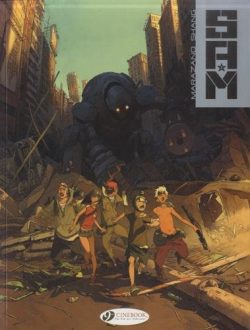
SAM volume 1: After Man


By Richard Marazano & Shang Xiao, translated by Jerome Saincantin (Cinebook)
ISBN: 978-1-84918-218-8 (Album PB)

Wow. People really love stories about robots. Well then, here’s another you might want to peruse…

Robots are a beloved theme of fiction, and many stories seem to work on the dichotomy of their innately innocent yet potentially deadly double nature. With elements of Terminator and A Boy and His Dog, here’s one that’s a cut above from French polymath (artist, critic, historian, astrophysicist, politician, and comics author) Richard Marazano (The Chimpanzee Complex; Cuervos; Zarathustra and much more) and Chinese artist, illustrator and animator Shang Xiao (Midsummer Park).

Told in four volumes, Après l’Homme details a heady tale of trust and survival between apparent natural enemies…

It’s just been the End of the World as We Know It, and in the scattered, shattered rubble of our technological advancements gangs of desperate kids forage for food, vitamins and ordnance to help them fend off the robots that have all but eradicated biological life.

Terse flashbacks reveal the armed rebellion of the mechanised realm and how the mostly subterranean youngsters scavenge and scrounge, with roaming mechs hunting them day and night. Tensions are high and emotions fraught, so if someone is a little bit different, negligent or disobedient – like dreamer Ian – it’s a problem for everybody…

Ella looks out for him as much as possible but Ian is destined for doom unless he shapes up…

Sadly, he instead takes a step in the other direction after one dusk raid to the surface sees him instants from annihilation when cornered by a towering killer robot.

Thankfully Russ disables it with his bazooka, but just for a moment there, Ian was sure he had experienced an emotional connection with the droid. It was like it chose not to kill him…

Increasingly obsessed, Ian cannot let the notion go and eventually breaks security to sneak out and examine the remains. They will be easy to find, with the letters SAM boldly painted on the carapace…

When he comes back, it’s all Ella can do to stop the others killing him. Ultimately, though, tempers subside, but Ian has not learned his lesson. After sharing his earliest memories of his father, fleeing and the lucky escape that saved him, the troubled boy seems to buckle down to the basics of survival, but he’s still gripped by crazy notions, like abandoning their tunnels and heading out to the fabled suburbs…

With defiance growing and rebellion brewing, the kids head out on another daylight hunt, but again Ian goes looking for “his” robot. When Ella catches him and starts yelling, they are both targeted by a roving mech, but inexplicably saved by another killer machine: “SAM”!

The victorious monster is badly damaged and as Ella watches in horror, Ian starts repairing it…

When the others find them, more arguing results in Ian getting a deadline: if he can’t make SAM fully operable in two days, he must let them destroy it. The frantic boy stives for the entire time and succeeds, only to pass out at the end. When he wakes and races to the site, the robot has vanished. Bereft and furious, Ian allows Ella to drag him away, but both are unaware that coldly-calculating optic systems are watching them from hiding…

Beguiling and powerfully engaging, this vivid take on an old plot is surprisingly compelling and promises a big payoff in volumes to come.
© Dargaud Paris 2011 by Marazano & Shang. All rights reserved. English translation © 2014 Cinebook Ltd.

Love Me Please – The Story of Janis Joplin (1943-1970)


By Nicolas Finet, Christopher & Degreff: translated by Montana Kane (NBM)
ISBN: 978-1-681122-76-2 (HB) eISBN: 978-1-681122-77-9

The list of people who lived hard, died young and changed the world is small but still, somehow, painfully overcrowded. Possibly the most tragic, influential, yet largely unknown is a born rule-breaking rebel who defied all conventions and became almost inevitably THE icon of doomed youth-with-big-dreams everywhere…

Author, filmmaker, journalist, publisher, educator and music documentarian Nicolas Finet has worked in comics for more than three decades and also generated a bucketload of reference works – such as Mississippi Ramblin’ and Forever Woodstock. His collaborator on that last one was veteran author, journalist and illustrator Christopher (The Long and Winding Road; many other music-centred tomes and adaptor of Bob Dylan).

Their compelling treatise on misunderstood and self-destructive Janis – just like her music, poetry and art – is something to experience, not read about, but I’ll do my best to convince you anyway…

After a quick dip into early life and influences, the story proper opens in Texas in 1947 as ‘Forget Port Arthur’ zeroes in on key childhood traumas and revelations around the homelife and schooling of little Janis Lyn Joplin at the start of the most culturally chaotic and transformative period in American history…

Brilliant, multi-talented, sexually ambiguous, starved for love whilst desperately directionless, her metamorphosis through Blues music mirrors that of many contemporaries (a fair few of whom comprise the infamous “27 Club” of stars who died young). However, as this book shows, although something indefinable was always just out of Joplin’s reach, her response was never to passively accept or ever surrender…

After wildly rebellious teen years, an uncomfortable educational life, a brief brush with conventional conformity and a near-lethal counter-culture encounter in San Francisco – as detailed in ‘The Temptation of Disaster’ – her meteoric rise in the era of flower power, liberal love and drug experimentation and record company exploitation lead to her return to California and triumphant breakthrough in 1966, all carried along by ‘Spells and Charms’…

Stardom with hot band Big Brother and the Holding Company, a host of legendary encounters and even greater personal dissipation makes wild child into living myth at Monterey and other landmarks of the Summer of Love, before success and acceptance prove to be her darkest nightmare in ‘Lost and Distraught’…

Global stardom and media glorification are balanced by heartbreak, betrayal and too-many brushes with death. As Woodstock confirms her status and talent to the world, the landscape inside her head turns against Janis. Endless exhausting tours and brief amorous encounters further destabilise the girl within and the end – when it comes – is no surprise to anyone…

With a moving Preface from comics legend and childhood friend Gilbert Shelton, a huge and star-studded Character Gallery and suggested Further Reading and Viewing, this forthright, no-nonsense yet extremely imaginative interpretation of the too-short flowering of “the Rose” offers insight but no judgement into a quintessentially complex, contradictory and uncompromised life…

NBM’s library of graphic biographies are swiftly becoming the crucial guide to the key figures of modern history and popular culture. If you haven’t found the answers you’re seeking yet, then you’re clearly not looking in the right place…
© Hatchette Livre (Marabout) 2020. © 2021 NBM for the English translation. All rights reserved.

Love Me Please – The Story of Janis Joplin 1943-1970 is scheduled for release on July 15th 2021 and is available for pre-order in both print and digital editions.

Most NBM books are also available in digital formats. For more information and other great reads see http://www.nbmpub.com/

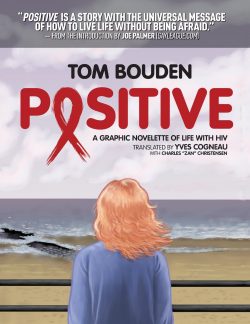
Positive


By Tom Bouden, translated by Yves Cogneau with Charles “Zan” Christensen (Northwest Press)
ISBN: 978-0-98459409-2 (PB)

Here’s something short, sweet and utterly, comfortingly satisfying. Please enjoy.

Human Immunodeficiency Virus is a Lentivirus that attacks the jbody’s immune system. If untreated, the infection usually leads to Acquired Immunodeficiency Syndrome – commonly known as AIDS. For the longest time, the condition was a killer, but can be controlled quite successfully now through a variety of medications, treatments and lifestyle modification.

At its height, the disease ravaged the world, and has killed approximately 38 million people and completely changed global society.

Sadly, how those testing positive for HIV were treated also revealed a lot about the people around them…

This powerful but truly uplifting graphic tome was created in 2008 by Belgian cartoonist Tom Bouden (Max and Sven; The Importance of Being Earnest; In Bed with David & Jonathan; Queerville): a means of exploding idiotic myths and explaining how a positive diagnosis actually changes the life of a someone with the disease and affects those around them.

Subtitled “A Graphic Novelette of Life with Aids”, the charming tale is rendered in a traditional and welcoming Ligne Claire (like Tintin or Blake and Mortimer) style, and laced with plenty of warm humour to balance the tension, fear and pain, and begins eight years ago as young marrieds Sarah and Tim‘s latest row is interrupted by a visit from their doctor…

He has results that explain Sarah’s recent bout of assorted maladies, but needs her to take a second, confirmatory test…

And so begins a methodical discourse as the couple carefully share her diagnosis with friends, family and past intimates, delivered with compassion and sensitivity and braced with actual facts throughout. Navigating various treatments, dealing with work issues and living as normal as life as feasible, Sarah and Tim build support networks, while moving ever onward, embracing bucket lists and pill packs, discarding despair and fostering hope until they reach the stage where they can consider the next positive step… having a child…

Fronted by an emphatically positive Introduction from activist and Gay League executive Joe Palmer, this is a lovely, sensible and above all straightforward examination of HIV in the real world, but parents might want to police these pages if young children are around, as it contains forthright depictions of nudity and lovemaking.
© 2013 Tom Bouden. All rights reserved.

The Secrets of Chocolate: A Gourmand’s Trip Through a Top Chef’s Atelier


By , translated by Montana Kane (NBM)
ISBN: 978-1-68112-278-6 (HB) eISBN: 978-1-68112-279-3

It seems there’s nothing you can’t craft compelling comics about if you’re talented and inspired, as this spellbinding catalogue of the chocolatiers’ art proves. Originally released au Continent as Les Secrets du Chocolat in 2014, it’s a combination history, travelogue, docudrama and recipe book wherein Bande Dessinée star Franckie Alarcon is invited to spend a year shadowing a celebrated chocolatier at the Jacques Genin Chocolate Workshop. In a scintillating and oddly moreish manner he imparts his sheer joy at discovering how new sweetmeats are created; subsequently learning the history of the wonder stuff and even travelling to South America with a maker to source a new supply of the magic beans…

It all kicks off in December 2013 as the artist s recaps his recent past, detailing moments in his lifelong love affair with chocolate and revealing how he landed his ultimate passion project. Offered exclusive all-access to a literal chocolate factory, Alarcon began at Genin’s glamorous store/outlet, meeting dedicated apprentices and journeymen and absorbing the basic skills of production while being subtly retrained in how to eat and appreciate the subject of his dreams…

With positively lascivious renderings of classical chocs, and the secret recipes for making Candies, Truffles, Pralines,Chocolate Tart, Ganache, Hot Chocolate and Chocolate Mendiants, Alarcon learns under a true inventive master in ‘Chocolates’ with each new taste sensation triggering a positively Proustian Madeleine moment in the gobsmacked artist…

The next phase of the journey of discovery follows in ‘Stephane Bonnat, From Bean to Bar’ as Alarcon explores the history and processes of chocolate production from France’s most prestigious manufacturer before celebrating with elan an industry holy day in ‘Valentine’s Day: Love in the Form of Chocolate’…

Another big deal demanding the mastery of new skills is covered – or is that “enrobed”? – in ‘Easter: Art on Chocolate’after which May 20th 2014 sees the artist become fully-fledged as an ‘Intern: A Difficult Learning Experience’ mastering ‘Taste: The Source of Pleasure’ under Genin’s patient tutelage…

Making good on an earlier offer, Alarcon then joins Bonnat on a resource-hunting trip to the Amazon rainforest in search of a new kind of bean in ‘Cocoa: The Origins of Chocolate’ before the voyage of gustatory discovery concludes in September 2014 with some laudatory thoughts and even more tantalising visuals in ‘Parting Words: An All-Consuming Passion’…

Beguiling, seductive and simply delightful, this is an inviting comics divertissement that will surely be to practically everyone’s taste…
© Editions Delcourt 2014. © 2021 NBM for the English translation.

The Secrets of Chocolate: A Gourmand’s Trip Through a Top Chef’s Atelier will be released digitally on June 15th2020 and published in hardback on June 17th. It is available for pre-order now. For more information and other great reads see http://www.nbmpub.com/

Buñuel in the Labyrinth of the Turtles


By Fermín Solís, translated by Lawrence Schimel (SelfMadeHero)
ISBN: 978-1-910593-84-4 (PB)

The places and moments where great art intersects with mundane reality have always made for great storytelling, and that’s never been more deftly demonstrated than in this highly personal interpretation of a crucial moment in the history of 20th century cinema.

Luis Buñuel Portholés (February 22nd, 1900 – July 29th 1983) was a Spanish filmmaker who renounced his citizenship in favour of Mexico, and his catholic faith in favour of truth: an iconoclastic, moralistic thinker and revolutionary who embraced surrealist doctrine and reshaped the arts of filmmaking.

If you have the stomach and suitable respect for the medium, please view Un Chien Andalou, L’Age d’Or and That Obscure Object of Desire – if not all of his heady output – but probably best leave it until after reading this engaging visual introspection from award-winning cartoonist Fermín Solís Campos.

The self-taught cartoonist, animator and illustrator of such treats as Otra Vida and El Hombre del Perrito shares many similarities with his subject and a solid yet whimsical earthy touch that is perfect for this examination of a key moment in the celluloid auteur’s rocky progression from wunderkind to industry lynchpin.

‘Do Not Disturb! Artist Dreaming’ opens with Buñuel wracked by his usual night terrors of barnyard fowl, Christian iconography and talking wildlife before an old friend calls to inform him of a cash windfall. It’s the end of 1932 and old comrade Ramón Acin trails him through the seedy warrens of the city, carousing and pontificating on past glories before deducing ‘Paris no Longer Loves Us’. Are there no challenges left? Is surrealism no longer enough to challenge the world and outrage society?

‘Ten Hours from Paris’ and months later, they and a small crew are assessing one of the most poverty-stricken regions of Europe. A Spanish region wedded to faith but so poor that the residents have no conception of even basic foodstuffs like bread. As the bizarre villagers and their weird tortoise-like huts bore into Buñuel’s fevered subconsciousness, his creative dry spell vanishes. Inspired again, he carefully concocts Las Hurdes: Tierra Sin Pan (Land Without Bread) contravening all established rules and mores to create a new genre beyond simple documentary. Alternatively called ethnofiction, pseudo-documentary or cinema verité, its cost to veracity, human compassion and even simple morality might be too much to bear…

Challenging, compelling and utterly absorbing, Buñuel in the Labyrinth of the Turtles is a superb graphic assessment of the creative process that will surprise and delight in equal measure
© 2008, 2019 Fermín Solís. © 2019 Penguin Random House Grupo Editorial, S.A.U. All rights reserved.

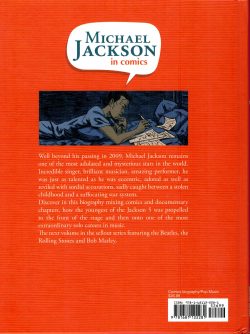
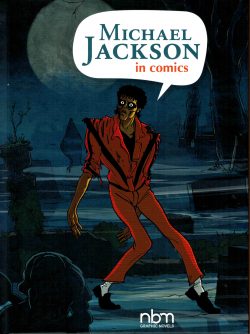
Michael Jackson in Comics


By Céka, illustrated by Patrick Lacan, Filippo Neri & Piero Ruggeri, JGSB, Laurent Houssin, Lu-K, Guillaume Griffon, Sarah Williamson, BiG ToF, Nikopek & Lou, Vox, Domas, Clément Baloup, Martin Trystram, Bast, Guillaume Tavernier, Aurélie Neyret, Anthony Audibert, Yigaël, Julien Akita, Lapuss, Kyung-Eun Park, Jean-Christophe Pol & Vallale; translated by Montana Kane (NBM)
ISBN: 978-1-68112-228-1 (Album HB) eISBN: 978-1-68112-230-4

Graphic biographies – especially those produced in Europe dissecting the lives of iconic celebrities and artists – are incredibly popular these days. This one was originally released in 2018: an inevitable but accessible addition and one featuring probably the most popular and controversial musical star of all time.

If you’ve never heard of Michael Jackson, there’s very little point in you carrying on any further.

Still with us? Okay then…

Offering cannily repackaged popular culture factoids and snippets of celebrity history, this tome – written by journalist Céka, with a legion of illustrators providing vivid and vibrant mini-strips – hones in on key moments in the controversial star’s career: detailing them through brief text essays.

It all began at ‘2300 Jackson Street’ where an extended family of juvenile performers were harshly schooled by their ruthless dad, after which the inner life of an abused kid is depicted in ‘I Wish I Could Have Been… A Child’, as portrayed in strip-form by Patrick Lacan.

The euphoria of winning talent contests and getting picked up by a major label is described in text article ‘From the Apollo Theater to Motown’ before Filippo Neri & Piero Ruggeri detail the draconian rehearsal regimen forced on the Jackson 5 by ambitious father Joe.

As their fame grew, little Michael constantly sought surrogate maternal relationships from a string of female celebrities. This is detailed in ‘One Father and Five Mothers’, with vividly lurid cartoon extrapolation ‘Diana Ross: THE Lady in his Life’ exploring the situation courtesy of JGSB.

‘From the Jackson 5 to Michael’ details the fractious move to solo stardom and hard-won autonomy ‘Made in Motown’(art by Laurent Houssin), whilst ‘5% Talent, 95% Hard Work’ explore the boy star’s ultimate idol in Lu-K’s ‘James Brown, the Mentor’.

The start of autonomy comes with ‘The Quincy Jones Trilogy’, depicting the global-shocks attending the making of‘Thriller: No Mere Mortal Can Resist!’ by Guillaume Griffon. Status is confirmed by ‘Birth of an Icon’ and attendant Moonwalk step-chart ‘An Extraterrestrial on Earth’ (Sarah Williamson art) before I Have a Dream’ starts tracing the cracks, and ‘The MTV Blackout’ – by Big ToF – discloses the colour bar keeping certain performers’ videos off pioneering music channels…

‘Jackson’s Jackpot’ and Nikopek & Lou’s linked visualisation of ‘A 47-and-a-Half Million-Dollar Blunder’ explore the tensions between the young star and Paul McCartney as well as music ownership rights, whilst – courtesy of Vox – carton strip ‘The Man with the White Socks’ illustrates the consequences of Prince of Pop’s style decisions as textually defined and described in ‘Fashionista’. ‘Dancing Machine’ examines signature moves, with Domas limning the steps in cartoon guide ‘The Man Who Slides on Clouds’. Before, social conscience engaged, ‘We are the World’ recalls the era of charity mega-records, with Clément Baloup depicting how the song was written in ‘Check Your Egos at the Door’.

The crown starts to wobble as ‘Neverland’ reveals how the fabulous ranch of dreams began, with Martin Trystram illustrating ‘Now Go Go Go Where you Want’, after which the media rumour mill runs wild in ‘Animal Spirit’, with Bast fancifully sketching out the story of exotic pets like ‘Bubbles, Muscles, and Co.’

Once unleashed, the press is relentless and ludicrous, as exposed in ‘Tabloid of Fact?’, with Guillaume Tavernier offering a strip further covering ‘The Rumor Mill’, whilst Aurélie Neyret’s cartoon tale of ‘Ryan White: Gone Too Soon’ adds balance to the uncomfortable reports of child-centred indiscretions recounted in ‘The Lost Children’…

Excesses real or otherwise dominate in ‘Tabloid Junkie’, with Anthony Audibert vignetting ‘The Elephant Man Case’before the years of defensive self-isolation are detailed in ‘Blood on the Dance Floor’ and Yigaël draws the benefits – and not – of ‘Privacy’.

‘Scandal at Neverland’ leads to Julien Akita’s sensitive exploration of ‘Jordan Chandler vs Peter Pan’, a review of ‘Family Life’ with attendant strip ‘Once Upon a Time’ from Lapuss, after which ‘The Man With 240 Awards’ reveals ‘The Whims of a Star’ thanks to cartoonist Kyung-Eun Park.

The final days approach, as seen in essay ‘Fans, I Love You More!’ with Jean-Christophe Pol & Vallale visually enquiring ‘What Kind of Fan Are You?’ of the music man’s broad church of devotees.

The star-studded, star-crossed story concludes with ‘Never Can Say Goodbye’ as Clément Baloup draws things to a close with ‘Michael Forever’…

Although intellectually slight and far from incisive or comprehensive in addressing the many controversies surrounding the star in question, Michael Jackson in Comics is far from a concealing hagiography either and presents a remarkably readable and beautifully rendered confection for comics and music fans alike.
© 2018 Editions Petit a Petit. © 2021 NBM for the English translation.

For more information and other great reads see http://www.nbmpub.com/

Women Discoverers: 20 Top Women in Science


By Marie Moinard & Christelle Pecout, translated by Montana Kane (NBM)
ISBN: 978-1-68112-270-0 (Album HB) eISBN: 978-1-68112-271-7

Comics and graphic novels have an inconceivable power to deliver information in readily accessible form, and – like all the best teachers – can do so in ways that are fascinating, fun and therefore unforgettable. Here’s a fresh entrant in a wave of historical and biographical visual celebrations seeking to redress centuries of gender injustice while providing true life role models for the coming generations.

Crafted by writer, editor and journalist Marie Moinard (En chemin elle recontre, La petite vieille du Vendredi) & Christelle Pécout (Lune d’Ombre, Hypathie, Histoires et légendes normandes), Les découvreuses is a cheery hardback – or digital – compendium made comprehensible to us, via translation into English by those fine folk at NBM.

As the name suggests, Women Discoverers focuses on twenty female scientists who generally – without fanfare or even fair credit – changed the world. Some are still doing so. A combination of comics vignettes and short illustrated data epigrams preceded by an impassioned Introduction from Marie-Sophie Pawlak (President of Elles Bougent scientific society), the revelations begin an extended strip history of the achievements of the peerless Marie Curie whose discoveries in chemistry and physics practically reinvented the planet. She is followed by brief vignettes of French biologist Françoise Barre-Sinoussi (discoverer of the HIV retrovirus), Canadian physicist Donna Théo Strickland (laser amplification) and African-American Dorothy Vaughan whose mathematical and computing skills served the world at NASA.

It’s back to comics for Ada Lovelace who revolutionized mathematics by inventing computer programming, after which single page biographies describe the achievements of lengths undertaken by French mathematician Émilie du Châtelet to attend men-only institutions in the days of the Enlightenment.

Although separated by centuries, mathematicians Emmy Noether (Germany 1882-1935) and Grace Alele-Williams (born in Niger in 1932) both excelled and triumphed despite male opposition but their stories pale beside the strip-delivered hardships of actress, engineer and mobile phone pioneer Hedy Lamarr…

Another Nasa stalwart, mathematician/astrophysicist Katherine Coleman Goble Johnson, famously calculated Apollo 11’s life-saving orbit, while paediatrician Marthe Gautier discovered the origins of Downs’ Syndrome and Iranian mathematician Maryam Mirzakhani’s geometry discoveries were tragically cut short by illness…

The shameful treatment and fate of British researcher Rosalind Franklin also ended in a cruelly early death and belated fame, unlike French mathematician, philosopher and physicist Sophie Germain whose many (posthumous) triumphs never brought her inclusion in the numerous scientific organisations barring female membership during her lifetime.

Whereas Marie Curie’s daughter Irène Joliot-Curie won similar accolades to her mother, astrophysicist Jocelyn Bell Burnell discovered pulsars only to have her (male) supervisor steal the credit. At least she’s still alive to see the record set straight…

In pictorial form, astronaut Mae Jemison reveals her life and medical successes on Earth, before this potent paean closes with a trio of one-page wonders: Kevlar inventor Stephanie Kwolek, Navy mathematician Rear Admiral Grace Murray Hopper (writer of the COBOL programming language) and Chinese chemist Xie Yi whose advances in nanotechnology have made the world a very different place.

Sure, you could Google them, but this book is a far more satisfying and charming alternative and the very fact that you probably haven’t heard of most of these astounding innovators – or even a few of the more ancient ones – only proves, without doubt, that you need this book.
© 2019 Blue Lotus Prod. © 2021 NBM for the English translation.

For more information and other great reads see http://www.nbmpub.com/