Marvels (25th Anniversary Edition)


By Kurt Busiek & Alex Ross, with Steve Darnall, Mark Braun, Richard Starkings, John Roshell & various (MARVEL)
ISBN: 978-0-7851-4286-7 (TPB) 978-0-7851-1388-1(HC/Digital edition)

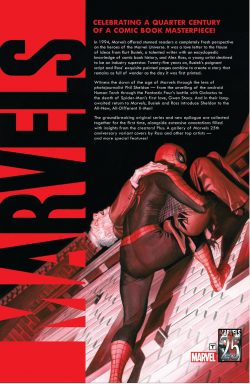
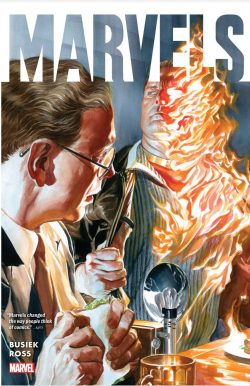
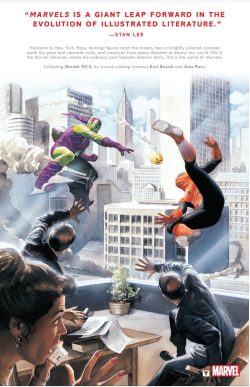
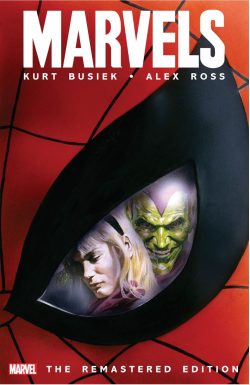
Every so often in mainstream comics something comes along that irrevocably alters the landscape of our art-form, if not the business itself. After each such event the medium is never quite the same again. One such work was 4-issue Prestige Format Limited Series Marvels by jobbing scripter Kurt Busiek and just-breaking illustrator Alex Ross. This year that landmark game-changing graphic collection turns 30…

I’m usually quite reticent in suggesting people read stuff I know damn well they’ve almost certainly already seen, but apparently every day is somebody’s first, and as years pile up and more stuff gets made, even certified bona fide “unmissables” get shuffled into touch and forgotten…

This tale is all about history and human perspective, following the working life of photo-journalist Phil Sheldon, whose career paralleled the double dawning of the heroic era; when science, magic, courage and overwhelming super-nature give birth to an Age of Marvels…

The saga opens with Alex Ross’ brief, preliminary retelling of the origin of the Golden Age Human Torch as first seen in Marvels #0 (co-written by Steve Darnall and produced in classicist pic-&-text block format) before the story proper opens in ‘A Time of Marvels’. In 1939 a gaggle of ambitious young newspapermen discuss the “War in Europe”. Brash up-and-comer J. Jonah Jameson is trying to dissuade his shutterbug pal Phil from heading overseas, claiming there’s plenty of news to snap in New York…

Unconvinced, Sheldon heads to his next assignment: a press conference with scientific crackpot Professor Phineas T. Horton. The photographer’s head is filled with thoughts of journalistic fame and glory on distant battlefields and he almost misses the moment Horton unveils his artificial man: a creature that bursts into flame like a Human Torch

From that moment on Sheldon’s life is transformed forever. His love-hate fascination with the fantastic miracles which rapidly, unceasingly follow in the inflammatory inhumanoid’s fiery wake is used to trace the rise of superhumanity and monstrous menace which comprises the entire canon of what we know as the Marvel Universe….

Soon the android is accepted as a true hero, frequently battling aquatic invader Sub-Mariner like elemental gods in the skies above the city whilst seemingly-human vigilante supermen like The Angel constantly ignore the law and daily diminish Phil’s confidence and self-worth. It’s as if by their well-meaning actions these creatures are showing that mere men are obsolete and insignificant…

Feelings of ineffectuality and inadequacy having crushed the camera jockey’s spirit, Phil turns down a War Correspondent assignment and descends into a funk. He even splits up with fiancée Doris Jaquet. After all, what kind of man brings children into a world with such inhuman horrors in it? Nevertheless, Sheldon cannot stop following the exploits of the singular human phenomena he’s collectively dubbed “Marvels”…

Everything changes with the arrival of patriotic icon Captain America. With the Land of Liberty in World War II at long last, many once-terrifying titans have become the nation’s allies and secret weapons, turning their awesome power against the Axis foe and winning the fickle approval of a grateful public. However, some were always less dutiful than others. When tempestuous Sub-Mariner again battles the Torch, Prince Namor of Atlantis petulantly unleashes a tidal wave against Manhattan. Phil is critically injured snapping the event…

Even after losing an eye, Phil’s newfound belief in Marvels never wavers and he rededicates himself to his job and Doris; going to Europe where his pictures of America’s superhuman Invaders crushing the Nazi threat become part of the fabric of history…

The second chapter jumps to the 1960s where Sheldon, wife Doris and daughters Jenny and Beth are – like most New Yorkers – at the epicentre of another outbreak of metahumanity… a second Age of Marvels…

Two new bands of costumed champions operate openly: A Fantastic Four-some comprising famous scientist Reed Richards and test pilot Ben Grimm plus Sue and Johnny Storm. Another anonymous team who hide their identities call themselves The Avengers. There are also numerous independent mystery men streaking across the skies and hogging headlines, which Jonah Jameson – now owner/publisher of the newspaper he once wrote for – is none too happy about. After all, he has never trusted masks and is violently opposed to this new crop of masked mystery-men. Phil is still an in-demand freelancer, but has a novel idea, signing a deal for a book of his photos just as the first flush of popular fancy wanes and increasing anxiety about humanoid mutants begins to choke and terrify the man in the street…

When the mysterious X-Men are spotted, Sheldon is caught up in a spontaneous anti-mutant race riot: appalled to find himself throwing bricks with the rest of a deranged mob. He’s even close enough to hear their leader dismissively claim “They’re not worth it”…

Shocked and dazed, Sheldon goes home to his nice, normal family, but the incident won’t leave him, even as he throws himself into work and his book. He worries that his daughters seem to idolise Marvels. “Normal” people seem bizarrely conflicted, dazzled and besotted by the celebrity status of the likes of Reed Richards and Sue Storm as they prepare for their upcoming wedding, yet prowl the streets in vigilante packs lest some ghastly “Homo Superior” abomination show its disgusting face…

Events come to a head when Phil finds his own children harbouring a mutant in the cellar. During WWII, Phil photographed the liberation of Auschwitz, and looking into the huge deformed orbs of “Maggie” he sees what he saw in the faces of those pitiful survivors. His innate humanity wins out and Phil lets her stay, but can’t help dreading what friends and neighbours might do if they find such a creature mere yards from their own precious families…

Hysteria keeps growing and the showbiz glitz of the Richards/Storm wedding is almost immediately overshadowed by the catastrophic launch of anthropologist Bolivar Trask’s Sentinels. At first the mutant-hunting robots behave like humanity’s boon but when they override their programming and attempt to take over Earth, it is despised and dreaded mutants who save mankind.

Naturally, the man in the street knows nothing of this and all Phil sees is more panicked mobs rioting and destroying their own homes. In fear for his family, he rushes back to Doris and the girls, only to find Maggie has vanished: the unlovely little child had realised how much her presence had endangered her benefactors. They never see her again…

The third chapter focuses on the global trauma of ‘Judgement Day’ as the shine truly starts coming off the apple. Even though crises come thick and fast and are as quickly dealt with, vapid, venal humanity becomes jaded with the ever-expanding metahuman community and once-revered heroes are plagued by scandal after scandal. Exhausted, disappointed and dejected, Phil shelves his book project, but fate takes a hand when the skies catch fire and an incredible shiny alien on a skyborne surfboard announces the end of life on Earth…

Planet-devouring Galactus seems unstoppable and the valiant, rapidly-responding Fantastic Four are humiliatingly defeated. Phil, along with the rest of Earth, embraces the end and wearily walks home to be with his loved ones, repeatedly encountering humanity at its best and nauseating, petty, defeated worst. However, with the last-minute assistance of the Silver Surfer – who betrays his puissant master and suffers an horrific fate – Richards saves the world, but within days is accused of faking the entire episode. Disgusted with his fellow men, Sheldon explodes in moral revulsion…

Phil’s photobook is finally released in concluding instalment ‘The Day She Died’. Now an avowed and passionate proponent of masked heroes, humanity’s hair-trigger ambivalence and institutionalised rushes to judgement constantly aggravate Phil even as he meets the public and signs countless copies of “Marvels”.

The average American’s ungrateful, ungracious attitudes rankle particularly since the mighty Avengers are currently lost in another galaxy defending Earth from collateral destruction in a war between rival galactic empires – the Kree and the Skrulls – but the most constant bugbear is old associate Jameson’s obsessive pillorying of Spider-Man. Phil particularly despises a grovelling, ethically-deprived young freelance photographer named Peter Parker who constantly curries favour with the Daily Bugle’s boss by selling pictures deliberately making the wallcrawler look bad…

Phil’s book brings a measure of success, and when the aging photographer hires young Marcia Hardesty as a PA/assistant whilst he works on a follow-up, he finds a passionate kindred spirit. Still, everywhere Sheldon looks costumed champions are being harried, harassed and hunted by hypocritical citizens and corrupt demagogues, although even he has to admit some of the newer heroes are hard to like…

Ex-Russian spy Black Widow is being tried for murder, protesting students are wounded by a Stark Industries super-armoured thug and in Times Square a guy with a shady past is touting himself as a Hero for Hire. When respected Police Captain George Stacy is killed during a battle between Spider-Man and Doctor Octopus, Jameson is frantic to pin the death on the webspinner, but hero-worshipping Phil digs deeper. Interviewing many witnesses – including the murderously malign, multi-limed loon himself – Phil consequently strikes up a friendship with Stacy’s daughter Gwen, a truly sublime young lady who is inexplicably dating that unscrupulous weasel Parker…

One evening, hoping for another innocuous chat with the vivacious lass, Phil sees her abduction by the Green Goblin and, desperately giving chase, watches as his vaunted hero Spider-Man utterly fails to save her from death. Her murder doesn’t even rate a headline; that’s saved for industrialist Norman Osborn who is found mysteriously slain that same night…

Gutted, worn out and somehow betrayed, Sheldon chucks it all in, but seeing Marcia still has the fire in her belly and wonder in her eyes, leaves her his camera and his mission…

Although this titanic tale traces the arc of Marvel continuity, the sensitive and evocative journey of Phil Sheldon is crafted in such a way that no knowledge of the mythology is necessary to follow the plot; and would indeed be a hindrance to sharing the feelings of an ordinary man in extraordinary times.

One of Marvel’s – and indeed the genre’s – greatest tales (but you probably already know that and if you don’t what are you waiting for?), I count at least four separate versions available currently and suggest if you have any money left you opt for the 25th Anniversary edition that comes heavily annotated with numerous articles and extras. These include aforementioned prequel ‘Marvels Book Zero’, and the ‘Marvels Epilogue’ short story. The bonus section comprises a 39-page, panel-by-panel comparison of original 1960s Marvel material with the reinterpretations of #0-4 compiled by Jess Harrold: followed by ‘Marvels: The Proposals’ as Ross & Busiek pitched their big idea: four shots to get it just right, aided by an abundance of glorious ‘character studies’ incorporating a vast cast, and supplemented by text articles on the finished product from November 1993’s Marvel Age #130.

Busiek’s full scripts for #1-4 and a wealth of ‘layouts, pencils & Original Art’ (11 pages) follow, before diving deeper in with a 6-page peek ‘Inside Alex Ross’ Marvels Epilogue Sketchbook’. More commentary follows with recovered Introductions, Busiek’s in-story prose pieces ‘Marvels: The Articles’; 8 pages of Ross’ contribution via ‘Marvels: The Artistic Process’, and Harrold’s popular press features courtesy of ‘The Story of Marvels’, ‘Modern-Day Marvels’, ‘Understanding Marvels by Scott McCloud’, ‘McLaurin’s Mark on Marvels’.

Next comes a ‘Mahvels Parody’ by Darnall, Busiek, Ross & artist Mark Braun, accompanied by ‘Posters, Art & Homage Covers’, Ross’ ‘Marvels Collected-Edition Cover Gallery’, and material seen in previous collections, including an ‘Annotated Cover Gallery’; a selection of ‘Marvels 25th Anniversary Variants’, ‘Marvels 25th Anniversary Tributes Variants’ and ‘Marvels Epilogue Variants’: with 5- full page contributions from Paolo Rivera, Michael Cho, Gabriele Dell’Otto, Stephanie Hans, Daniel Acuña, Mark Brooks, David Mack, Julian Totino Tedesco, Mico Suayan & Brian Reber, Inhyuk Lee, Carlos Pacheco, Leinil Francis Yu & Sunny Cho, Adi Granov, Alan Davis, Mark farmer & Matt Hollingsworth, Nick Bradshaw, Gerlad Parel, Greg Smallwood, Marcos Martin, Tomm Coker, Yasmine Putri, Clayton Crain, Phil Noto, Simone Bianchi, Dave Johnson, Ron Lim & Dean White, Remsy Atassi, Dave Cockrum & Edgar Delgado, Fred Hembeck & Felipe Sobreiro, Skottie Young and more.

The epic history lesson ends with a list of ‘Marvels Sources’, citing where each re-envisioned scene first appeared in comics continuity before closing with Stan Lee’s Marvels TPB (1994) Introduction, full Acknowledgements and a final Afterword from Kurt Busiek & Alex Ross.

A truly groundbreaking achievement, Marvels – in whatever form you see it – is a comics tale you must not miss.
© 2020 MARVEL.

Avengers Omnibus volume 1


By Stan Lee & Jack Kirby, Larry Lieber, Paul Laiken, Larry Ivie, Don Heck, Dick Ayers, Paul Reinman, George Roussos, Chic Stone, Mike Esposito, Wally Wood, John Romita, Frank Giacoia, Sam Rosen, Art Simek, Morrie Kuramoto & various (MARVEL)
ISBN: 978-0-7851-5846-2 (HB/Digital edition)

Win’s Christmas Gift Recommendation: Ironclad Guarantee of Total Wonder… 10/10

Probably Marvel’s biggest global franchise success, The Avengers celebrated their 60th anniversary in September 2023, so let’s close that Birthday Year with acknowledgement of that landmark event and one more grand adventure…

After a period of meteoric expansion, in 1963 the burgeoning Marvel Universe was finally ready to emulate the successful DC concept that had cemented the legitimacy of the Silver Age of American comics. The concept of putting a bunch of all-star eggs in one basket which had made the Justice League of America such a winner also inspired the moribund Atlas outfit – primarily Stan Lee, Jack Kirby & Steve Ditko – into inventing “super-characters” of their own. The result – in 1961 – was The Fantastic Four.

Over 18 months later, the fledgling House of Ideas generated a small but viable stable of costumed leading men (but only sidekick women) so Lee & Kirby assembled a handful of them and moulded them into a force for justice and soaring sales. Seldom has it ever been done with such style and sheer exuberance. Cover dated September 1963, The Avengers #1 launched as part of an expansion package which also included Sgt. Fury and his Howling Commandos and The X-Men

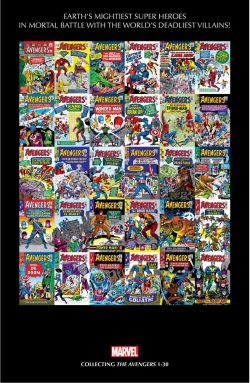
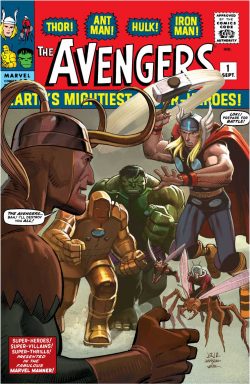
Faithfully compiling the groundbreaking tales from #1-30 of The Avengers (spanning March 1963 to September 196???) and including contemporary pin-ups, letters pages and other hidden delights as well as trio of Stan Lee Introductions from earlier Marvel masterworks collections, the suspenseful action kicks off with ‘The Coming of the Avengers!’ Instead of starting at a neutral beginning Stan & Jack (and inker Dick Ayers) assumed buyers had at least a passing familiarity with Marvel’s other heroes and so wasted no time or space on introductions.

In Asgard, immortal trickster Loki is imprisoned on a dank isle, hungry for vengeance on his noble half-brother Thor. Whilst malevolently observing Earth, the malign god espies the monstrous, misunderstood Hulk and mystically engineers a situation wherein the man-brute seemingly goes on a rampage, simply to trick the Thunder God into battling the monster.

When the Hulk’s teen sidekick Rick Jones radios the FF for assistance, devious Loki scrambles and diverts the transmission and smugly awaits the blossoming of his mischief. Sadly for the schemer, Iron Man, Ant-Man and The Wasp also pick up the redirected SOS. As the heroes all converge in the American Southwest to search for the Jade Giant, they realise that something is oddly amiss…

This terse, epic, compelling and wide-ranging yarn (New York, New Mexico, Detroit and Asgard in 22 pages) is Lee & Kirby at their bombastic best, and remains one of the greatest stories of the Silver Age (it’s certainly high in my own top ten Marvel Tales) and is followed by ‘The Space Phantom’ (Lee, Kirby & Paul Reinman), wherein an alien shape-stealer almost destroys the team from within.

With latent animosities exposed by the malignant masquerader, the tale ends with the volatile Hulk quitting the team in disgust, only to return in #3 as an outright villain in partnership with ‘Sub-Mariner!’ This globe-trotting romp delivers high-energy thrills and one of the best battle scenes in comics history as the assorted titans clash in abandoned World War II tunnels beneath the Rock of Gibraltar.

Inked by George Roussos, Avengers #4 was a groundbreaking landmark as Marvel’s greatest Golden Age sensation returns for another increasingly war-torn era. ‘Captain America joins the Avengers!’ has everything that made the company’s early tales so fresh and vital. The majesty of a legendary warrior returned in our time of greatest need: stark tragedy in the loss of his boon companion Bucky, aliens, gangsters, Sub-Mariner and even subtle social commentary and – naturally – vast amounts of staggering Kirby Action. It even begins with a cunning infomercial as Iron Man unsuccessfully requests the assistance of the company’s other fresh young stars, giving readers a taste of the other mighty Marvels on offer to them.

Reinman returned to ink ‘The Invasion of the Lava Men!’: another staggering adventure romp as the team battle incendiary subterraneans and a world-threatening mutating mountain… with the unwilling assistance of the ever-incredible Hulk. That issue also started a conversion with fans as letters column ‘All About The… Avengers’ began…

However, even that pales before the supreme shift in artistic quality that is Avengers #6.

Chic Stone – arguably Kirby’s best Marvel inker of the period – joined the creative team just as a classic arch-foe debuts. ‘The Masters of Evil!’ reveals how Nazi super-scientist Baron Zemo is forced by his own arrogance and paranoia to emerge from the South American jungles he’s been skulking in since the Third Reich fell, after learning his despised nemesis Captain America has returned from the dead.

To this end, the ruthless war-criminal recruits a gang of previously established super-villains to attack New York City and destroy the Avengers. The unforgettable clash between valiant heroes and vile murdering mercenaries Radioactive Man, Black Knight and The Melter is an unsurpassed example of prime Marvel magic to this day.

Issue #7 found two more malevolent recruits for the Masters of Evil as Asgardian outcasts Enchantress and The Executioner ally with Zemo, just as Iron Man is suspended due to misconduct occurring in his own series. This was the dawning of the close-continuity era where events in one series were regularly referenced and even built upon in others. The practise quickly became a rod for the creators’ own backs and lead to a radical rethink…

It may have been ‘Their Darkest Hour!’, but #8 delivered the team’s greatest triumph and tragedy as Jack Kirby (inked with fitting circularity by Dick Ayers) relinquished his drawing role with the superbly entrancing invasion-from-time thriller which introduced ‘Kang the Conqueror!’ Riffing on the movie The Day the Earth Stood Still, the tale sees an impossibly powerful foe defeated by the cunning of ordinary teenagers and indomitable spirit of Earth’s Mightiest Heroes…

Whenever Kirby left a title he’d co-created, it took a little while to settle into a new rhythm, and none more so than with these collectivised costumed crusaders. Although Lee and the fabulously utilitarian Don Heck were perfectly capable of producing cracking comics entertainments, they never had The King’s unceasing sense of panoramic scope and scale which constantly sought bigger, bolder blasts of excitement.

The Avengers evolved into an entirely different series when the subtle humanity of Heck’s vision replaced Kirby’s larger-than-life bombastic bravura. The series had rapidly advanced to monthly circulation and even The King could not draw the massive number of pages his expanding workload demanded. Heck was a gifted and trusted artist with a formidable record for meeting deadlines and, progressing under his pencil, sub-plots and character interplay finally got as much space as action and spectacle. After Kirby, stories increasingly focused on scene-stealing newcomer Captain America: concentrating on frail human beings in costumes, rather than wild modern gods and technological titans bestriding and shaking the Earth…

Inked by Ayers, Heck’s first outing was memorable tragedy ‘The Coming of the Wonder Man!’, wherein the Masters of Evil plant superhuman Trojan Horse Simon Williams within the heroes’ ranks, only to have the conflicted infiltrator find deathbed redemption by saving them from the deadly deathtrap he creates…

Another Marvel mainstay debuted with the introduction of (seemingly) malignant master of time Immortus, who briefly combined with Zemo’s devilish cohort to engineer a fatal division in the ranks by removing Cap from the field in ‘The Avengers Break Up!’ A sign of the Star-Spangled Sentinel’s increasing popularity, the issue is augmented by a Marvel Masterwork Pin-Up of ‘The One and Only Cap’ courtesy of Kirby & Ayers…

An eagerly-anticipated meeting delighted fans in #11 as ‘The Mighty Avengers Meet Spider-Man!’ A clever cross-fertilising tale inked by Stone, it features the return of time-bending tyrant conqueror Kang who attempts to destroy the team by insinuating a robotic duplicate of the outcast arachnid within their serried ranks. Accompanied by Heck’s Marvel Master Work Pin-up of ‘Kang!’ it’s followed by a cracking end-of-the-world thriller with guest-villains Mole Man and The Red Ghost doing their best avoid another clash with the Fantastic Four.

This was another Marvel innovation, as – according to established funnybook rules – bad guys stuck to their own nemeses and didn’t clash outside their own backyards. ‘This Hostage Earth!’ (inked by Ayers) is a welcome return to grand adventure with lesser lights Giant-Man and The Wasp taking rare lead roles, but is trumped by a rousing gangster thriller of a sort seldom seen outside the pages of Spider-Man or Daredevil, premiering Marvel Universe Mafia analogue The Maggia and another major menace in #13’s ‘The Castle of Count Nefaria!’

After crushingly failing in his scheme to frame the Avengers, Nefaria’s caper ends on a tragic cliffhanger as Janet Van Dyne is left gunshot and dying, leading to a peak in melodramatic tension in #14 – scripted by Paul Laiken/Larry Ivie & Larry Lieber over Stan’s plot – where the traumatised team scour the globe for the only surgeon who can save her.

‘Even Avengers Can Die!’ – although of course she doesn’t – resolves into an epic alien invader tale with overtones of This Island Earth with Kirby stepping in to lay out the saga for Heck & Stone to illustrate. This only whets the appetite for the classic climactic confrontation that follows as the costumed champions finally deal with the Masters of Evil and Captain America finally avenges the death of his dead partner.

‘Now, By My Hand, Shall Die a Villain!’ in #15 – laid-out by Kirby, pencilled by Heck and inked by Mike Esposito – features the final, fatal confrontation between Cap and Zemo in the heart of the Amazon, whilst the other Avengers and the war-criminal’s cohort of masked menaces clash once more on the streets of New York City…

The battle ends with ‘The Old Order Changeth!’ (broken down by Kirby before being finished by Ayers) presaging a dramatic change in concept for the series; presumably because, as Lee increasingly wrote to the company’s unique strengths – tight continuity and strongly individualistic characterisation – he found juggling individual stars in their own titles as well as a combined team episode every month was just incompatible if not impossible…

As Cap and substitute-sidekick Rick Jones fight their way back to civilisation, The Avengers institute changes. The big-name stars retire and are replaced by three erstwhile villains: Hawkeye, Quicksilver and The Scarlet Witch.

Eventually, led by perennial old soldier Captain America, this relatively powerless group with no outside titles to divide the attention (the Sentinel of Liberty did have a regular feature in Tales of Suspense but at that time it featured adventures set during WWII), evolved into another squabbling family of flawed, self-examining neurotics, enduring extended sub-plots and constant action as valiant underdogs; a formula readers of the time could not get enough of and which still works today…

Acting on advice from the departing Iron Man, the neophytes seek to recruit the Hulk to add raw power to the team, only to be sidetracked by the Mole Man in #17’s ‘Four Against the Minotaur!’ (Lee, Heck & Ayers), after which they then fall foul of a dastardly “commie” plot ‘When the Commissar Commands!’ – necessitating a quick trip to thinly-disguised Vietnam analogue Sin-Cong to unwittingly battle a bombastic android…

This brace of relatively run-of-the-mill tales is followed by an ever-improving run of mini-masterpieces: the first of which wraps up this initial Epic endeavour with a 2-part gem providing an origin for Hawkeye and introducing a roguish hero/villain.

‘The Coming of the Swordsman!’ sees a dissolute and disreputable swashbuckler – with just a hint of deeply-buried flawed nobility – seeking to force his way onto the highly respectable team. His immediate rejection leads to him becoming an unwilling pawn of a far greater menace after being kidnapped by A-list would-be world despot The Mandarin.

The conclusion comes in the superb ‘Vengeance is Ours!’ – sublimely inked by Wally Wood – wherein the constantly-bickering Avengers finally pull together as a supernaturally efficient, all-conquering super-team…

By this time the squad – Captain America, Hawkeye, Quicksilver and Scarlet Witch – was a firm fan-favourite. with close attention to character interplay and melodrama subplots, leavening action through compelling soap-opera elements that kept readers riveted.

In Avengers #21 Lee, Heck & Wally Wood – without pausing for creative breath – launched another soon-to-be big name villain in the form of Power Man. ‘The Bitter Taste of Defeat!’ depicted his creation and a diabolical plan hatched with evil Asgardian witch Enchantress to discredit and replace the quarrelsome quartet. The scheme was only narrowly foiled by sharp wits and dauntless determination in the concluding ‘The Road Back.’

An epic 2-part tale follows as the team are abducted into the far-future to battle against and eventually beside Kang the Conqueror. ‘Once an Avenger…’ (Avengers #23, December 1965 and, incidentally, my vote for the best cover Kirby ever drew) is inked by John Romita (senior), pitting the heroes against an army of fearsome future men, with the yarn explosively and tragically ending in From the Ashes of Defeat!’ by Lee, Heck & inker Ayers. The still-learning team then face their greatest test yet after being captured by the deadliest man alive and forced to fight their way out of the tyrant’s kingdom of Latveria in #25’s ‘Enter… Dr. Doom!’

Since change is ever the watchword for this series, the next two issues combined a threat to drown the world from subsea barbarian Attuma with the return of old comrades. ‘The Voice of The Wasp!’ and ‘Four Against the Floodtide!’ (pseudonymously inked by Frank Giacoia as “Frank Ray”) is a superlative action-romp but is merely a prelude to #28’s return of founding Avenger Giant-Man in a new guise as ‘Among us Walks a Goliath!’ This instant classic introduced the villainous Collector whilst extending Marvel’s pet theme of alienation by tragically trapping the size-changing hero at a freakish 10-foot height… seemingly forever…

Avengers #29 features ‘This Power Unleashed!’ and brings back Hawkeye’s lost love Black Widow as a brainwashed Soviet agent attempting to destroy the team. She recruits Power Man and Swordsman as cannon-fodder but is foiled by incompletely submerged feelings for Hawkeye, after which ‘Frenzy in a Far-Off Land!’ sees dispirited colossus Henry Pym embroiled in a futuristic civil war amongst a lost south American civilisation. The conclusion threatened to end in global incineration but that’s a denouement you’ll have to wait for…

To Be Continued…

Augmenting the narrative joys is an abundance of behind-the-scenes treasures such as contemporary house ads, a dozen original art pages and covers by Kirby, Ayers, Heck & Wood, production-stage pencilled page photostats and a fascinating sequence of “tweaked” cover-corrections. Covers for reprint comics Marvel Tales #2, Marvel Super-Heroes #1 & 21 and Marvel Triple Action #5-24, plus 16 previous collections front-&-back covers by Stuart Immonen and Arthur Adams. Still more extras include earlier Kirby Avengers collection covers modified by painters Dean White and another by Alex Ross taken from the 1999 Overstreet Guide to Comics.

Unceasingly enticing and always evergreen, these immortal epics are tales that defined the Marvel experience and a joy no fan should deny themselves or their kids.
© 2019 MARVEL.

Fantastic Four Omnibus volume 1


By Stan Lee & Jack Kirby with Chrisopher Rule, Steve Ditko, Dick Ayers, Joe Sinnot, George Roussos, Chic Stone, Sam Rosen, Art Simek & various (MARVEL)
ISBN: 978-0-7851-8566-6 (HB/Digital edition)

Win’s Christmas Gift Recommendation: Reliving How it All Began… 10/10

I’ve gone on record as saying that you actually can have too much of a good thing, by which I mean this collection of utter marvels is really, really heavy (and pricey) if you get the paper version. However, if you opt for electric formats, only the second quibble counts and the stories contained herein truly need to be in every home and library, so…

I’m partial to a bit of controversy so I’m going start off by saying that Fantastic Four #1 is the third most important Silver Age comic book ever, behind Showcase #4 – which introduced The Flash – and The Brave and the Bold #28, which brought superhero teams back via the creation of The Justice League of America. Feel free to disagree…

After a troubled period at DC Comics (National Periodicals as it then was) and a creatively productive but disheartening time on the poisoned chalice of the Sky Masters newspaper strip (see Complete Sky Masters of the Space Force), Jack Kirby settled into his job at the small outfit that used to be the publishing powerhouse Timely/Atlas. He churned out mystery, monster, romance and western material in a market he suspected to be ultimately doomed, but as always he did the best job possible and that genre fare is now considered some of the best of its kind ever seen.

But his fertile imagination couldn’t be suppressed for long and when the JLA caught readers’ attention it gave him and writer/editor Stan Lee an opportunity to change the industry forever.

According to popular myth, a golfing afternoon led to publisher Martin Goodman ordering nephew Stan to do a series about a group of super-characters like the JLA. The resulting team quickly took the fans by storm. It wasn’t the powers: they’d all been seen since the beginning of the medium. It wasn’t the costumes: they didn’t have any until the third issue.

It was Kirby’s compelling art and the fact that these characters weren’t anodyne cardboard cut-outs. In a real and recognizable location – New York City – imperfect, raw-nerved, touchy people banded together out of tragedy, disaster and necessity to face the incredible. In many ways, The Challengers of the Unknown (Kirby’s prototype partners in peril for National /DC) laid all the groundwork for the wonders to come, but staid, nigh-hidebound editorial strictures there would never have allowed the undiluted energy of the concept to run all-but-unregulated.

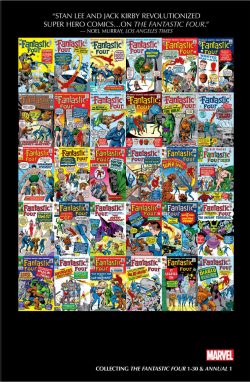
This full-colour compendium collects Fantastic Four #1-30 plus the first giant-sized Annual issues of progressive landmarks (spanning cover-dates November 1961 to September 1964) and tellingly reveals how Stan & Jack cannily built on that early energy to consolidate the FF as the leading title and most innovative series of the era.

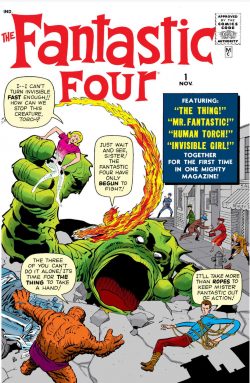
Following a typically effusive “found footage” Foreword from Stan – with two more to follow as the many pages turn – we start with Fantastic Four #1 (tentatively bi-monthly by Lee, Kirby, George Klein & Christopher Rule) which is crude, rough, passionate and uncontrolled excitement. Thrill-hungry kids pounced on it.

‘The Fantastic Four’ saw maverick scientist Reed Richards summon his fiancée Sue Storm, their close friend Ben Grimm and Sue’s teenaged brother before heading off on their first mission. They are all survivors of a private space-shot that went horribly wrong when Cosmic Rays penetrated their ship’s inadequate shielding and mutated them all.

Richards’ body became elastic, Sue gained the power to turn invisible, Johnny Storm could turn into living flame and tragic Ben turned into a shambling, rocky freak. In ‘The Fantastic Four meet the Mole Man’ they quickly foil a plan by another outcast who controls monsters and slave humanoids from far beneath the Earth. This summation of the admittedly mediocre plot cannot do justice to the engrossing wonder of that breakthrough issue – we really have no awareness today of how different in tone, how shocking it all was.

“Different” doesn’t mean “better” even here, but the FF was like no other comic on the market at the time and buyers responded to it hungrily. The brash experiment continued with another old plot in #2. ‘The Skrulls from Outer Space’ were shape-changing aliens who framed the FF in the eyes of shocked humanity before the genius of Mister Fantastic bluffed them into abandoning their plans for conquering Earth. The issue concluded with a monstrous pin-up of the Thing, proudly touted as “the first of a series…”

Sure enough, there was a pin-up of the Human Torch in #3, which headlined ‘the Menace of the Miracle Man’ (inked by Sol Brodsky), whose omnipotent powers had a simple secret, but is more notable for the first appearance of their uniforms, and a shocking line-up change, leading directly into the next issue (continued stories were an innovation in themselves) which revived a golden-age great.

‘The Coming of the Sub-Mariner’ reintroduced an all-powerful amphibian Prince of Atlantis and star of Timely’s Golden Age but one who had been lost for years. A victim of amnesia, the relic recovered his memory thanks to some rather brusque treatment by the delinquent Human Torch. Namor then returned to his sub-sea home only to find it destroyed by atomic testing. A monarch without subjects, he swore vengeance on humanity and attacked New York City with a gigantic monster. This saga is when the series truly kicked into high-gear with Mister Fantastic as the pin-up star.

Until now the creative team – who had both been in the business since it began – had been hedging their bets. Despite the innovations of a contemporary superhero experiment, their antagonists had relied heavily on the trappings of popular trends in other media – and as reflected in their other titles. Aliens and especially monsters played a major part in earlier tales but Fantastic Four #5 took a full-bite out of the Fights ‘n’ Tights apple by introducing the first full-blown super-villain to the budding Marvel Universe.

No, I haven’t forgotten Mole Man: but that tragic little gargoyle, for all his plans of world conquest, wouldn’t truly acquire the persona of a costumed foe until his more refined second appearance in #22.

‘Prisoners of Doctor Doom’ (July 1962, and inked by subtly sleek Joe Sinnott) has it all. An attack by a mysterious enemy from Reed’s past; magic and super-science, lost treasure, time-travel, even pirates. Ha-Haar, me ’earties!

Sheer magic! And the creators knew they were on to a winner since the deadly Doctor was back in the very next issue, teamed with a reluctant Sub-Mariner to attack our heroes as ‘The Deadly Duo!’ – and inked by new regular embellisher Dick Ayers.

Alien kidnappers were behind another FF frame-up resulting in the team briefly being ‘Prisoners of Kurrgo, Master of Planet X’: a dark and grandiose off-world thriller in #7 (the first monthly issue), whilst a new returning villain and the introduction of a love-interest for monstrous Ben Grimm were the breakthrough high-points in #8’s ‘Prisoners of the Puppet Master!’ The saga was topped off with a Fantastic Four Feature Page explaining how the Torch’s powers work. The next issue offered another detailing with endearing mock-science ‘How the Human Torch Flies!’

That issue, #9, trumpeted ‘The End of the Fantastic Four’ as Sub-Mariner returned to exploit another brilliant innovation in comic storytelling. When had a supergenius superhero ever messed up so much that the team had to declare bankruptcy? When had costumed crime busters ever had money troubles at all? The eerily prescient solution was to “sell out” and make a blockbuster movie – giving Kirby a rare chance to demonstrate his talent for caricature… and prescience…

1963 was a pivotal year in Marvel’s development. Lee & Kirby had proved their new high concept – human heroes with flaws and tempers – had a willing audience. Now they would extend that ideation to a new pantheon of heroes. Here is where the second innovation would come to the fore.

Previously, superheroes were sufficient unto themselves and shared adventures were rare. Now and here, however, was a universe where characters often and literally stumbled over each other, sometimes even fighting other heroes’ enemies! The creators themselves might turn even up in a Marvel Comic! Fantastic Four #10 featured ‘The Return of Doctor Doom!’ wherein the arch villain used Stan and Jack to lure the Richards into a trap where his mind is switched with the bad Doctor’s. The tale is supplemented by a pin-up of ‘Sue Storm, the Glamorous Invisible Girl’ and another Lee Foreword…

Innovations continued in #11, with two short stories instead of the usual book-length yarn, opening with behind-the-scenes travelogue/origin tale ‘A Visit with the Fantastic Four’ with a stunning pin-up of Sub-Mariner segueing into baddie-free, compellingly comedic vignette. ‘The Impossible Man’ was like superhero strip ever seen before.

Cover-dated March 1963, FF #12 featured an early landmark: arguably the first Marvel crossover as the team are asked to help the US army capture ‘The Incredible Hulk’: a tale of intrigue, action and bitter irony. The argument comes as Amazing Spider-Man #1 (not included here) – wherein the arachnid tries to join the team – has the same release date…  Fantastic Four #13’s ‘Versus the Red Ghost and his Incredible Super Apes!’ is a Cold War thriller pitting the quartet against a Soviet scientist in the race to reach the Moon: and notable both for its moody Steve Ditko inking (replacing Ayers for one glorious month) and the introduction of cosmic voyeurs The Watchers.

‘The Sub-Mariner and the Merciless Puppet Master!’ unwillingly co-star in #14, with one vengeful fiend the unwitting mind-slave of the other, followed by ‘The Mad Thinker and his Awesome Android!’, embarking upon a chilling war of intellects between driven super-scientists but with plenty of room for all-out action. After a notable absence, pin-ups resume with a candid group-shot of the team.

Fantastic Four #16 reveals ‘The Micro-World of Doctor Doom!’ in a spectacular romp guest-starring new hero Ant-Man plus a Fantastic Four Feature Page outlining the powers and capabilities of elastic Mister Fantastic. Despite a resounding defeat, the steel-shod villain returns with more infallible, deadly traps a month later in ‘Defeated by Doctor Doom!’, before FF #18 heralds a shape-changing alien who battles the heroes with their own powers when ‘A Skrull Walks Among Us!’: a prelude to greater, cosmos-spanning sagas to come…

The wonderment intensifies with the first Fantastic Four Annual: a spectacular 37-page epic by Lee, Kirby & Ayers as – finally reunited with their wandering prince – warriors of Atlantis invade New York City (and the world) in ‘The Sub-Mariner versus the Human Race!’.

A monumental tale by the standards of the time, it saw the FF repel the undersea invasion through valiant struggle and brilliant strategy whilst providing a secret history of the secretive race Homo Mermanus. Nothing was really settled except a return to a former status quo, but the thrills were intense and unforgettable…

Also included are rousing pin-ups and fact file features. The Mole Man, Skrulls, Miracle Man, Sub-Mariner, Doctor Doom, Kurrgo, Puppet Master, Impossible Man, The Hulk, Red Ghost and his Super-Apes, and Mad Thinker comprise ‘A Gallery of the Fantastic Four’s Most Famous Foes!’, whilst ‘Questions and Answers about the Fantastic Four’, and a diagrammatic trip ‘Inside the Baxter Building’ evoke awe wonder and understanding. Short story ‘The Fabulous Fantastic Four Meet Spider-Man!’ then reexamines in an extended re-interpretation that first meeting from the premiere issue of the wallcrawler’s own comic. Pencilled this time by Kirby, the dramatic duel benefitted from Ditko’s inking which created a truly novel look.

Cover-dated October 1963, Fantastic Four #19 premiered another of the company’s major villains as the quarrelsome quartet travelled back to ancient Egypt and ‘Prisoners of the Pharaoh!’ This time travel tale has been revisited by so many writers that it is considered one of the key stories in Marvel history introducing a future-Earth tyrant who would evolve into overarching menace Kang the Conqueror.

Another universe-threatening foe was introduced and defeated by brains not brawn in FF#20 when ‘The Mysterious Molecule Man!’ menaced New York before being soundly outsmarted, after which one last Lee Foreword precedes another cross-pollination: this time guest-starring Nick Fury, lead character in Marvel’s only war comic.

Sgt. Fury and his Howling Commandos was another solid hit, but eventually its brusque and brutish star metamorphosed into Marvel’s answer to James Bond. Here, however, he’s a cunning CIA agent seeking the team’s aid against a sinister demagogue called ‘The Hate-Monger’: a cracking yarn with a strong message, inked by comics veteran George Roussos, under the protective nom-de-plume George Bell.

By this juncture the FF were firmly established and Lee & Kirby well on the way to toppling DC/National Comics from a decades-held top spot through an engaging blend of brash, folksy and consciously contemporaneous sagas: mixing high concept, low comedy, trenchant melodrama and breathtaking action.

Unseen since the premiere issue, #22 saw ‘The Return of the Mole Man!’ in another full-on monster-mashing fight-fest, chiefly notable for debuting Sue Storm’s new powers of projecting force fields of “invisible energy.” This advance would eventually make her one of the mightiest characters in Marvel’s pantheon.

Fantastic Four #23 enacted ‘The Master Plan of Doctor Doom!’, by introducing mediocre minions “the Terrible Trio” – Bull Brogin, Handsome Harry and Yogi Dakor – and the uncanny menace of “the Solar Wave” (which was enough to raise the hackles on my 5-year-old neck. Do I need to qualify that with: all of me was five, but only my neck had properly developed hackles back then?)…

In #24’s ‘The Infant Terrible!’ is a sterling yarn of inadvertent extragalactic menace and misplaced innocence, followed by a 2-part tale truly emphasising the inherent difference between Lee & Kirby’s work and everybody else’s at that time.

Fantastic Four #25-26 featured a cataclysmic clash that had young heads spinning in 1964 and led directly to the Emerald Behemoth finally regaining a strip of his own. In ‘The Hulk vs The Thing’ and ‘The Avengers Take Over!’, a relentless, lightning-paced, all-out Battle Royale results when the disgruntled man-monster returns to New York in search of side-kick Rick Jones, with only an injury-wracked FF in the way of his destructive rampage.

A definitive moment in The Thing’s character development, action ramps up to the max when a rather stiff-necked and officious Avengers team horn in, claiming jurisdictional rights on “Bob Banner (this tale is plagued with pesky continuity errors which would haunt Stan Lee for decades) and his Jaded alter ego. Notwithstanding bloopers, this is one of Marvel’s key moments and still a visceral, vital read.

Stan & Jack had hit on a winning formula by including other stars in guest-shots – especially since readers could never anticipate if they would fight with or beside the home team. FF #27’s ‘The Search for Sub-Mariner!’ again saw the undersea antihero in amorous mood, and when he abducts Sue the boys call in Doctor Strange, Master of the Mystic Arts to locate them. Issue #28 was another terrific team-up, but most notable (for me and many other fans) for the man who replaced George Roussos…

‘We Have to Fight the X-Men!’ sees the disparate super-squads in conflict due to the Mad Thinker and Puppet Master’s malign machinations, but the inclusion of Chic Stone – Kirby’s most simpatico and expressive inker – elevates the illustration to indescribable levels of beauty.

‘It Started on Yancy Street!’ (FF #29) starts low-key and a little bit silly in the slum where Ben Grimm grew up, but with the reappearance of the Red Ghost and his Super-Apes, it all goes Cosmic, resulting in a blockbusting battle on the Moon, with the following issue – and last saga here – introducing evil alchemist ‘The Dreaded Diablo!’ – who briefly breaks up the team while casually conquering the world from his spooky Transylvanian castle….

To Be Continued…

Bolstered by all Kirby’s covers, every ‘Fantastic 4 Fan Page’ (with letters from adoring fans many here will recognise), Lee’s concluding essay ‘Reflections on the Fantastic Four’ and appreciations from Paul Gambaccini, Tom DeFalco and Roy Thomas, the joy concludes with added attractions including Lee’s original synopsis for FF #1, a selection of house ads, unused pages and cover art for #3, #20 and Annual #1.

This is a truly magnificent book highlighting pioneering tales that built a comics empire. The verve, imagination and sheer enthusiasm shines through and the wonder is there for you to share. If you’ve never thrilled to these spectacular sagas then this book of marvels is your best and most economical key to another world and time.
© 2022 MARVEL.

The Amazing Spider-Man Omnibus volume 1


By Stan Lee & Steve Ditko with Jack Kirby, Art Simek, Sam Rosen, Jon D’Agostino, John Duffy, Ray Holloway & various (MARVEL)
ISBN: 978-1-3029-4563-3 (HB/Digital edition)

Win’s Christmas Gift Recommendation: Utter Entertainment Perfection… 10/10
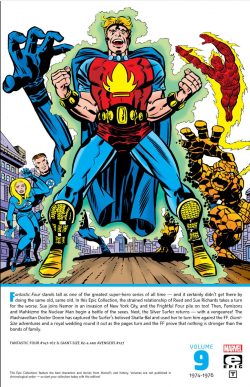
The Amazing Spider-Man celebrated his 60th anniversary in 2022. However, I’m one of those radicals who feel that 1963 was when he was really born, so let’s close this year with one last acknowledgement of that…

Marvel is often termed “the House that Jack Built” and King Kirby’s contributions are undeniable and inescapable in the creation of a new kind of comic book storytelling. However, there was another unique visionary toiling at Atlas-Comics-as-was: one whose creativity and philosophy seemed diametrically opposed to the bludgeoning power, vast imaginative scope and clean, gleaming futurism that resulted from Kirby’s ever-expanding search for the external and infinite.

Steve Ditko was quiet and unassuming, diffident to the point of invisibility, but his work was both subtle and striking: innovative and meticulously polished. Always questing for affirming detail, he ever explored the man within. He saw heroism and humour and ultimate evil all contained within the frail but noble confines of humanity. His drawing could be oddly disquieting… and, when he wanted, decidedly creepy.

Crafting extremely well-received monster and mystery tales for and with Stan Lee, Ditko had been rewarded with his own title. Amazing Adventures/Amazing Adult Fantasy featured a subtler brand of yarn than Rampaging Aliens and Furry Underpants Monsters: an ilk which, though individually entertaining, had been slowly losing traction in the world of comics ever since National/DC had successfully reintroduced costumed heroes.

Lee & Kirby had responded with The Fantastic Four and so-ahead-of-its-time Incredible Hulk, but there was no indication of the renaissance ahead when officially just-cancelled Amazing Fantasy featured a brand new and rather eerie adventure character…

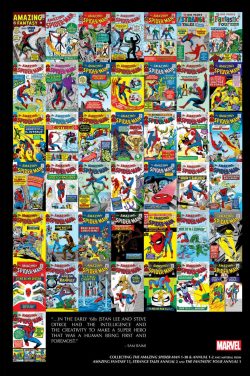
This compelling compilation re-presents the rise of the wallcrawler as originally seen in Amazing Fantasy #15, The Amazing Spider-Man #1-38, Amazing Spider-Man Annual #1 & 2 plus material from Strange Tales Annual #2 and Fantastic Four Annual #2 collectively spanning cover-dates August 1962-July 1966). It is lettered throughout by unsung superstars Sam Rosen, Art Simek, Jon D’Agostino, John Duffy and Ray Holloway and sadly an anonymous band of colourists. As well as a monolithic assortment of nostalgic treats at the back, this mammoth tome is dotted throughout with recycled Introductions from Stan Lee, taken from the first four Marvel Masterworks editions devoted to the webspinner and includes editorial announcements and the ‘Spider’s Web’ newsletter pages for each original issue to enhance that wayback machine experience…

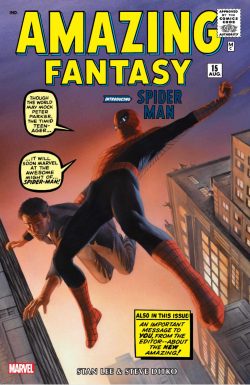
The wonderment came and concluded in 11 captivating pages: ‘Spider-Man!’ tells the parable of smart but alienated Peter Parker, a kid bitten by a radioactive spider on a high school science trip. Discovering he has developed arachnid abilities – which he augments with his own natural engineering genius – he does what any lonely, geeky nerd would do when given such a gift – he tries to cash in for girls, fame and money.

Creating a costume to hide his identity in case he makes a fool of himself, Parker becomes a minor celebrity – and a vain, self-important one. To his eternal regret, when a thief flees past, he doesn’t lift a finger to stop him, only to find when he returns home that his Uncle Ben has been murdered.

Crazy for vengeance, Parker stalks the assailant who made his beloved Aunt May a widow and killed the only father he had ever known, only to find that it is the felon he couldn’t be bothered with. Since his irresponsibility led to the death of the man who raised him, the boy swears to always use his powers to help others…

It wasn’t a new story, but the setting was one familiar to every kid reading it and the artwork was downright spooky. This wasn’t the gleaming high-tech world of moon-rockets, giant monsters and flying cars – this stuff could happen to anybody…

Amazing Fantasy #15 came out the same month as Tales to Astonish #35 (cover-dated September 1962) – the first to feature the Astonishing Ant-Man in costumed capers, but it was also the last issue of Ditko’s Amazing playground. With this volume you’ll find the ‘Fan Page – Important Announcement from the Editor!’ that completely misled fans as to what would happen next…

The tragic last-ditch tale struck a chord with readers and by Christmas a new comic book superstar was ready to launch in his own title, and Ditko eager to show what he could do with his first returning character since the demise of Charlton action hero Captain Atom.

Holding on to the “Amazing” prefix memories, bi-monthly Amazing Spider-Man #1 arrived with a March 1963 cover-date and two complete stories. It also prominently featured the Fantastic Four and took the readership by storm. The opening tale, again simply entitled ‘Spider-Man!’, recapitulated the origin whilst adding a brilliant twist to the conventional mix.

Now the wall-crawling hero was feared and reviled by the general public thanks in no small part to newspaper magnate J. Jonah Jameson who pilloried the adventurer from spite and for profit. With time-honoured comic book irony, Spider-Man then had to save Jameson’s astronaut son John from a faulty space capsule in extremely low orbit…

Second yarn ‘Vs the Chameleon!’ finds the cash-strapped kid trying to force his way onto the roster – and payroll – of the FF whilst elsewhere a spy perfectly impersonates the webspinner to steal military secrets: a stunning example of the high-strung, antagonistic crossovers and cameos that so startled jaded kids of the early 1960s. Heroes just didn’t act like that and they certainly didn’t speak directly to the fans as in ‘A Personal Message from Spider-Man’ that’s reprinted here…

With his second issue, our new champion began a meteoric rise in quality and innovative storytelling. ‘Duel to the Death with the Vulture!’ catches Parker chasing a flying thief as much for profit as justice. Desperate to help his aunt make ends meet, Spider-Man starts taking photos of his cases to sell to Jameson’s Daily Bugle, making his personal gadfly his sole means of support.

Matching his deft comedy and moody soap-operatic melodrama, Ditko’s action sequences were imaginative and magnificently visceral, with odd angle shots and quirky, mis-balanced poses adding a vertiginous sense of unease to fight scenes. But crime wasn’t the only threat to the world and Spider-Man was just as (un)comfortable battling “aliens” in ‘The Uncanny Threat of the Terrible Tinkerer!’

Amazing Spider-Man #3 introduced possibly the apprentice hero’s greatest enemy in ‘Versus Doctor Octopus’: a full-length saga wherein a dedicated scientist survives an atomic accident only to discover his self-designed mechanical “waldoes”/tentacles have permanently grafted to his body. Power-mad, Otto Octavius initially thrashes Spider-Man, sending the lad into a depression until an impromptu pep-talk from Human Torch Johnny Storm galvanises the arachnid to one of his greatest victories. Also included is a stunning ‘Special Surprise Bonus Spider-Man Pin-up Page!’…

‘Nothing Can Stop… The Sandman!’ was another instant classic wherein a common thug gains the power to transform to sand (in another pesky nuclear snafu), invades Parker’s school, and must be stopped at all costs, after which1963’s Strange Tales Annual #2 featured ‘The Human Torch on the Trail of the Amazing Spider-Man!’

This terrific romp from Lee & Kirby with Ditko inking details how the wallcrawler is framed by international art thief The Fox, instigating an early “Marvel Misunderstanding Clash” and is followed by short story ‘The Fabulous Fantastic Four meet Spider-Man!’: re-examining in an extended re-interpretation that first meeting from the premiere issue of the wallcrawler’s own comic and taken from Fantastic Four Annual #1.

With Ditko on pencils and inks again, Amazing Spider-Man #5 saw the webspinner ‘Marked for Destruction by Dr. Doom!’ – not so much winning as surviving his battle against the deadliest man on Earth. Presumably he didn’t mind too much, as this marked the transition from bi-monthly to monthly status for the series. In this tale Parker’s nemesis, jock bully Flash Thompson, first displays depths beyond the usual in contemporary comicbooks, beginning one of the best love/hate buddy relationships in popular literature…

Eventual mentor Dr. Curtis Connors debuts in #6 when Spidey comes ‘Face-to-face With… The Lizard!’ as the wallcrawler fights far from the concrete canyon comfort zone of New York – specifically in the murky Florida Everglades. Parker was back in the Big Apple in #7 to breathtakingly tackle ‘The Return of the Vulture’ in a full-length action extravaganza.

Fun and youthful hi-jinks were a signature feature of the series, as was Parker’s budding romance with “older woman” Betty Brant, Jameson’s secretary/PA at the Bugle. Youthful exuberance was the underlying drive in #8’s lead tale ‘The Living Brain!’ wherein an ambulatory robot calculator is tasked with exposing Spider-Man’s secret identity before running amok at beleaguered Midtown High, just as Parker is finally beating the stuffings out of bully Flash Thompson.

This 17-page triumph was accompanied by ‘Spiderman Tackles the Torch!’: a 6-page vignette drawn by Kirby and inked by Ditko, wherein a boisterous wallcrawler gate-crashes a beach party thrown by the flaming hero’s girlfriend – with suitably explosive consequences…

Amazing Spider-Man #9 is a qualitative step-up in dramatic terms, as Aunt May is revealed to be chronically ill and adding to Parker’s financial woes. Action is supplied by ‘The Man Called Electro!’ – an accidental super-criminal with grand aspirations.

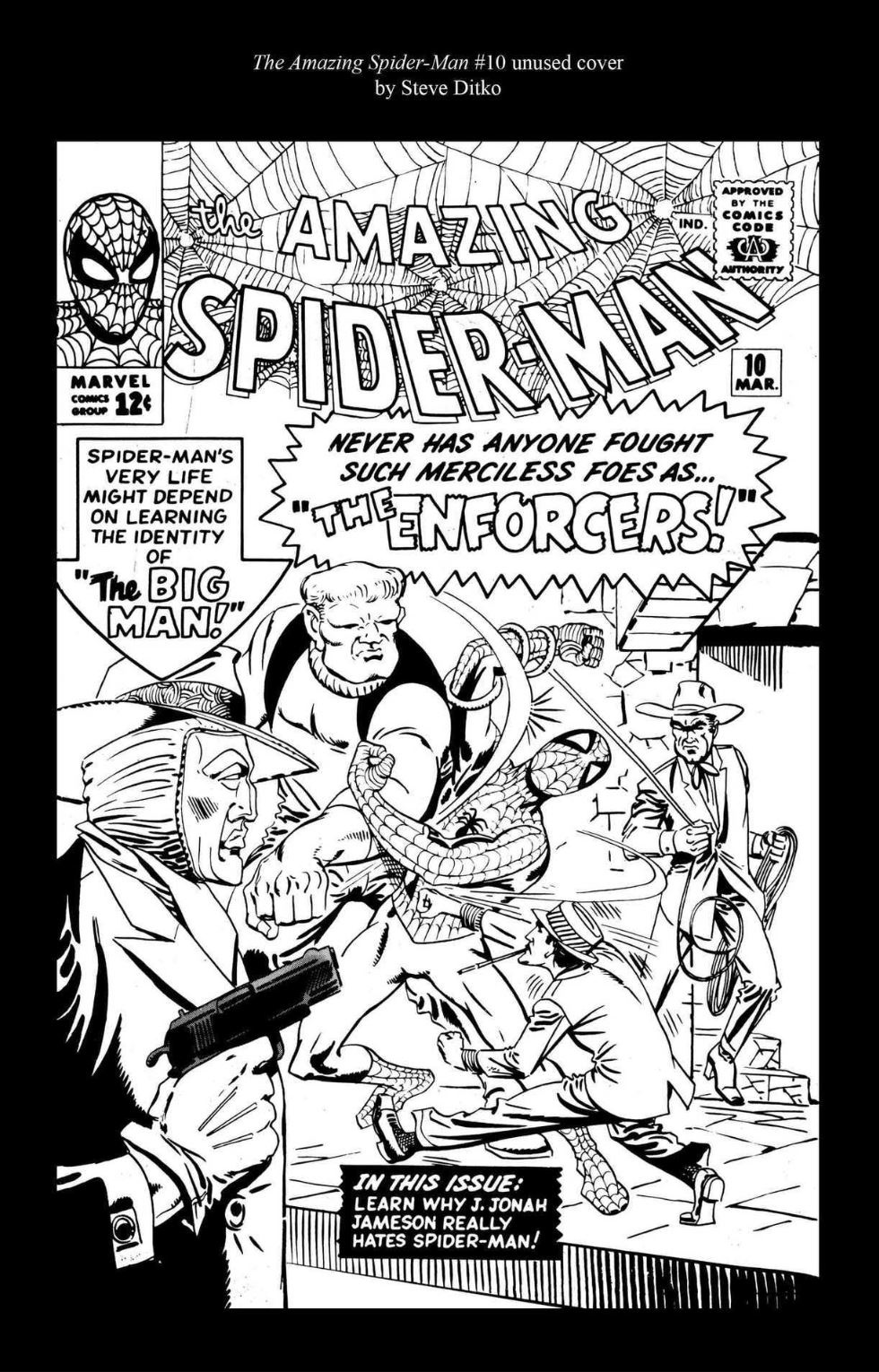
Spider-Man was always a loner, never far from the streets and small-scale-crime, and with this tale – wherein he also quells a prison riot single handed – Ditko’s preference for tales of gangersterism starts to proliferate: a predilection confirmed in #10’s ‘The Enforcers!’ (AKA Fancy Dan, Montana and The Ox). This is a classy mystery with a masked mastermind known as The Big Man, using a position of trust to organise all New York mobs into one unbeatable army against decency.

Longer plot-strands are also introduced as Betty mysteriously vanishes, although most fans remember this one for the spectacularly climactic 7-page fight scene in an underworld chop-shop that has still never been beaten for action-choreography.

The wonderment intensifies (after a Lee Introduction) with a magical 2-part yarn. ‘Turning Point’ and ‘Unmasked by Dr. Octopus!’ sees the lethally deranged and deformed scientist return and the disclosure of a long-hidden secret which had haunted Parker’s girlfriend Betty Brant for years.

The dark, tragedy-filled tale of extortion and excoriating tension stretches from Philadelphia to the Bronx Zoo and cannily tempers trenchant melodrama with spectacular fight scenes in unusual and exotic locations, before culminating in a truly staggering super-powered duel as only Ditko could orchestrate it.

A new super-foe premiered in Amazing Spider-Man #13 with ‘The Menace of Mysterio!’ as publisher J. Jonah Jameson hires a seemingly eldritch bounty-hunter to capture Spider-Man before eventually letting slip his own dark criminal agenda, whilst #14 offers an absolute milestone in the series as a hidden criminal mastermind manipulates a Hollywood studio into making a movie about the wall-crawler. Even with guest-star opposition The Enforcers and Incredible Hulk, ‘The Grotesque Adventure of the Green Goblin’ is most notable for introducing Spider-Man’s most perfidious and flamboyant enemy.

Jungle superman and thrill-junkie (and modern movie star!) ‘Kraven the Hunter!’ makes Spidey his intended prey at the behest of embittered former-foe the Chameleon in #15, and promptly pops up again in the first Amazing Spider-Man Annual (1964) that follows.

A timeless landmark and still magnificently thrilling battle, tale, the ‘Sinister Six’ begins after a band of villains comprising Electro, Kraven, Mysterio, Sandman, Vulture and Dr Octopus abduct May Parker and Betty, forcing Spider-Man to confront them without his powers – lost in a guilt-fuelled panic attack.

A staggeringly compelling Fights ‘n’ Tights saga, this influential tale featured cameos (or, more honestly, product placement segments) by every other extant hero of the budding Marvel universe.

Also included in the colossal comic compendium were special feature pages on ‘The Secrets of Spider-Man!’ and comedic short ‘How Stan Lee and Steve Ditko Created Spider-Man’ plus a gallery of pin-up pages featuring ‘Spider-Man’s Most Famous Foes!’ – (the Burglar, Chameleon, Vulture, Terrible Tinkerer, Dr. Octopus, Sandman, Doctor Doom, The Lizard, Living Brain, Electro, The Enforcers, Mysterio, Green Goblin and Kraven the Hunter) – as well as pin-ups of Betty and Jonah, Parker’s classmates and house, and even heroic guest stars…

Amazing Spider-Man #16 extended that circle of friends and foes as the webslinger battles The Ringmaster and Circus of Evil, meeting a fellow loner hero in a dazzling ‘Duel with Daredevil’. This delightful diversion segued into an ambitious 3-part saga, beginning in Amazing Spider-Man #17 wherein our rapidly-maturing hero touches emotional bottom before rising to triumphant victory over all manner of enemies in ‘The Return of the Green Goblin!’, as the wallcrawler endures renewed print assaults in the Daily Bugle from its rabid publisher just as his enigmatic veridian archvillain opened a sustained war of nerves and attrition, using The Enforcers, Sandman and an army of thugs to publicly humiliate the hero. To exacerbate matters, Aunt May’s health took a drastic downward turn…

Resuming with ‘The End of Spider-Man!’ and explosively concluding in triumphal big finish ‘Spidey Strikes Back!’ – featuring a turbulent team-up with friendly rival the Human Torch – this extended tale proved fans were ready for every kind of narrative experiment (single issue or two stories per issue were still the norm in 1964) and Stan & Steve were more than happy to try anything.

With ‘The Coming of the Scorpion!’, Jameson let his obsessive hatred for the cocky kid crusader get the better of him: hiring scientist Farley Stillwell to endow a private detective with insectoid-based superpowers. Sadly, the process drove mercenary Mac Gargan mad before he could capture Spidey, leaving the webspinner with yet another lethally dangerous meta-menace to deal with…

That issue closed with pin-up of ‘Peter Parker and Ol’ Webhead’ before #21 highlights a hilarious love triangle in ‘Where Flies the Beetle’ as the Torch’s girlfriend uses Peter Parker to make the flaming hero jealous. Unfortunately, the Beetle – a villain with high-tech insect-themed armour – is simultaneously stalking Doris Evans as bait for a trap. As ever, Spider-Man was simply in the wrong place at the right time, resulting in a spectacular fight-fest.

This issue also offers a stunning and much reprinted Ditko Marvel Masterwork Pin-up of ‘Spider-Man’ before ASM #22 preeeeeeeesents… ‘The Clown, and his Masters of Menace!’: affording a return engagement for the Circus of Crime with splendidly outré action and a lot of hearty laughs provided by increasingly irreplaceable supporting stars Aunt May, Betty Brant and Jameson, before #23 delivers a superb thriller blending the mundane mobster and thugs that Ditko loved to depict with the more outlandish threat of a supervillain attempting to take over all the city’s gangs.

‘The Goblin and the Gangsters’ is both moody and explosive, the supervillain’s plot foiled by a cunning competitor and the driven hero’s ceaseless energy, and this tale is complemented by a Ditko Marvel Masterwork Pin-up of ‘Spidey’ that amazingly features all the supporting cast and every extant villain in his rogue’s gallery…

Another recurring plot strand debuted in #24, as a dark brooding tale had the troubled boy question his own sanity in ‘Spider-Man Goes Mad!’. The sinister stunner sees a clearly delusional wallcrawler seeking psychiatric help, but there’s more to the matter than simple insanity, as an insidious old foe unexpectedly returns, employing psychological warfare…

Amazing Spider-Man #25 once more sees our obsessed publisher take matters into his own hands. ‘Captured by J. Jonah Jameson!’ introduces Professor Smythe – whose dynasty of robotic Spider-Slayers would bedevil the webslinger for years to come – hired to remove Spider-Man for good.

Issues #26 & 27 comprise a captivating 2-part mystery and deadly duel between Green Goblin and an enigmatic new criminal. ‘The Man in the Crime-Master’s Mask!’ and ‘Bring Back my Goblin to Me!’ together form a perfect arachnid epic, with soap-opera melodrama and screwball comedy leavening tense crimebusting thrills and all-out action.

ASM #28’s ‘The Menace of the Molten Man!’ is a tale of science gone bad and remains remarkable today not only for spectacular action sequences – and possibly the most striking Spider-Man cover ever produced – but also as the story in which Peter Parker graduates from High School.

Ditko was on peak form and fast enough to handle two monthly strips. At this time he was also blowing away audiences with another oddly tangential superhero. Two extremely disparate crusaders met in ‘The Wondrous World of Dr. Strange!’: lead story in the second super-sized Spider-Man Annual (released in October 1965 and filled out with vintage Spidey classics). The entrancing fable unforgettably introduced the Amazing Arachnid to arcane other realities as he teamed up with the Master of the Mystic Arts to battle power-crazed mage Xandu in a phantasmagorical, dimension-hopping masterpiece involving ensorcelled zombie thugs and the stolen Wand of Watoomb. After this, it was clear that Spider-Man could work in any milieu and nothing could hold him back…

Also from that immensely impressive landmark are more Ditko pin-ups via ‘A Gallery of Spider-Man’s Most Famous Foes’ – highlighting such nefarious ne’er-do-wells as The Circus of Crime, The Scorpion, The Beetle, Jonah’s Robot and The Crime-Master.

Back in the ever-more popular monthly mag, ASM #29 warned ‘Never Step on a Scorpion!’ as the lab-made larcenous lunatic returned, seeking vengeance on not just the webspinner but also Jameson for turning a disreputable private eye into a super-powered monster…

Issue #30’s off-beat crime-caper then cannily sowed seeds for future masterpieces as ‘The Claws of the Cat!’ depicted a city-wide hunt for an extremely capable burglar (way more exciting than it sounds, trust me!), plus the introduction of an organised gang of thieves working for mysterious new menace The Master Planner.

Sadly, by this time of their greatest comics successes, Lee & Ditko were increasingly unable to work together on their greatest creations. Ditko’s off-beat plots and quirky art had reached an accommodation with the slickly potent superhero house-style Kirby had developed (at least as much as such a unique talent ever could). The illustration featured a marked reduction of signature line-feathering and moody backgrounds, plus a lessening of concentration on totemic villains, but – although still very much a Ditko baby – Amazing Spider-Man‘s sleek pictorial gloss warred with Lee’s scripts. These were comfortably in tune with the times if not his collaborator.

Lee’s assessment of the audience was probably the correct one, and disagreements with the artist over editorial direction were still confined to the office and not the pages themselves. However, an indication of growing tensions could be seen once Ditko began being credited as plotter of the stories…

After a period where old-fashioned crime and gangsterism predominated, science fiction themes and costumed crazies returned full force. As the world went gaga for masked mystery-men, the creators experimented with longer storylines and protracted subplots. When Ditko abruptly left, the company feared a drastic loss in quality and sales but it didn’t happen. John Romita (senior) considered himself a mere “safe pair of hands” keeping the momentum going until a better artist could be found, but instead blossomed into a major talent in his own right, and the wallcrawler continued his unstoppable rise at an accelerated pace.

Change was in the air everywhere. Included amongst the milestones for the ever-anxious Peter Parker collected here are graduating High School, starting college, meeting true love Gwen Stacy and tragic friend/foe Harry Osborn, plus the introduction of nemesis Norman Osborn. Old friends Flash Thompson and Betty Brant subsequently begin to drift out of his life…

‘If This Be My Destiny…!’ in #31 details a spate of high-tech robberies by the Master Planner culminating in a spectacular confrontation with Spider-Man. Also on show is that aforementioned college debut, first sight of Harry and Gwen, with Aunt May on the edge of death due to an innocent blood transfusion from her mildly radioactive darling Peter…

This led to indisputably Ditko’s finest and most iconic moments on the series – and perhaps of his entire career. ‘Man on a Rampage!’ shows Parker pushed to the edge of desperation as the Planner’s men make off with serums that might save May, resulting in an utterly driven, berserk wallcrawler ripping the town apart whilst trying to find them.

Trapped in an underwater fortress, pinned under tons of machinery, the hero faces his greatest failure as the clock ticks down the seconds of May’s life…

This in turn generates the most memorable visual sequence in Spidey history as the opening of ‘The Final Chapter!’ luxuriates in 5 full, glorious pages to depict the ultimate triumph of will over circumstance. Freeing himself from tons of fallen debris, Spider-Man gives his absolute all to deliver the medicine May needs, and is rewarded with a rare happy ending…

Russian exile Kraven returns in ‘The Thrill of the Hunt!’, seeking payback for past humiliations by impersonating the webspinner, after which #35 confirms that ‘The Molten Man Regrets…!’: a plot-light, inimitably action-packed combat classic wherein the gleaming golden bandit foolishly resumes his career of pinching other people’s valuables…

Amazing Spider-Man #36 offers a deliciously off-beat, quasi-comedic turn in ‘When Falls the Meteor!’, with deranged, would-be scientist Norton G. Fester calling himself The Looter to steal extraterrestrial museum exhibits…

In retrospect these brief, fight-oriented tales, coming after such an intricate, passionate epic as the Master Planner saga should have indicated something was amiss. However fans had no idea that ‘Once Upon a Time, There was a Robot…!’ – featuring a beleaguered Norman Osborn targeted by his disgraced ex-partner Mendel Strom, and some eccentrically bizarre murder-machines in #37 and the tragic tale of ‘Just a Guy Named Joe! – wherein a hapless sad-sack stumblebum boxer gains super-strength and a bad-temper – would be Ditko’s last arachnid adventures.

And thus an era ended…

As added enticements – and alone worth the price of this collection of much-reprinted material – is a big gallery of extras beginning with ‘…Does Whatever a Spider Can: A Lee/Ditko Amazing Spider-Man Lexicon’ and a selection of essays by Arlen Schumer, Jon B Cooke and Blake Bell including Lee’s ‘The World’s Best-Selling Swinger’. Also on view is the entire debut tale from AF #15, in original art form, taken from the Library of Congress where it now resides, fully curated and commented upon by historian and scholar Blake Bell. Also on view are unused Ditko covers, sketches, layouts and early monochrome pin-ups (33 pages in total), unretouched cover art for AS #11 & 35, and a barrage of pulse-pounding house ads, “Bullpen Bulletin” pages plus a photo-feature on the Marvel Bullpen circa 1964.

The treats go on with rare Ditko T-shirt designs, posters and ad art, plus a range of Marvel Masterworks covers with Kirby and Ditko’s original images enhanced by painters Dean White and Paul Mounts. Also included are a cover gallery for 1960s reprint vehicle Marvel Tales (#1-28 by Ditko and latterly Marie Severin) as well as Mighty Marvel Masterworks collection covers by Michael Cho and Alex Ross’ Omnibus cover art. Although other artists have inked his narratives, Ditko handled all the art on Spider-Man and these lost gems demonstrate his fluid mastery and just how much of the mesmerising magic came from his pens and brushes…

Full of energy, verve, pathos and laughs, gloriously short of post-modern angst and breast-beating, these fun classics – also available in numerous formats including eBook editions – are quintessential comic book magic constituting the very foundation of everything Marvel became. This classy compendium is an unmissable opportunity for readers of all ages to celebrate the magic and myths of the modern heroic ideal: something no serous fan can be without, and an ideal gift for any curious newcomer or nostalgic aficionado.

Happy Unbirthday Spidey and many, many more please…
© 2022 MARVEL.

Iron Man Masterworks volume 16


By Denny O’Neil, Roger McKenzie, Peter B. Gillis, Ralph Macchio, Luke McDonnell, Carmine Infantino, Paul Smith, Steve Ditko, Marie Severin, Mike Vosburg, Jerry Bingham, Michael Golden & various (MARVEL)
ISBN: 978-1-3029-4920-4- (HB/Digital edition)

One of Marvel’s biggest global successes thanks to the film franchise, Iron Man celebrated his 60th anniversary in March 2023, so let’s again acknowledge that landmark and all who wear the suits offering more of the same…

Tony Stark is a super-rich supergenius inventor who moonlights as a superhero: wearing a formidable, ever-evolving suit of armour stuffed with his own ingenious creations. The supreme technologist hates to lose and constantly upgrades his gear, making Iron Man one of the most powerful characters in the Marvel Universe. However, in Iron Man #120-128 (March to November 1979), the unrelenting pressure of running a multinational corporation and saving the world on a daily basis resulted in the weary warrior succumbing to the constant temptations of his (originally sham) sybaritic lifestyle. Thus, he helplessly slipped into a glittering world drenched with excessive partying and drinking.

That dereliction was compounded by his armour being usurped by rival Justin Hammer: used to murder an innocent. The ensuing psychological crisis forced Stark to confront the hard fact that he was an alcoholic …and probably an adrenaline junkie too. Landmark story ‘Demon in a Bottle’ saw the traumatised hero plumb the depths of grief and guilt, bury himself in pity, and alienate all his friends and allies before an unlikely intervention forced him to take a long, hard look at his life and actions…

A more cautious, level-headed and wiser man, Stark resumed his high-pressure lives, but he could not let up and the craving never went away. Then in 1982 author/editor Denny O’Neil made him do it again, with the result that Marvel gained another black superhero at long last…

It was the dawn of a period of legacy heroes inheriting mantles, established roles and combat identities from white, mostly male champions, and was certainly a move in the right direction…

This grand and gleaming chronological compendium navigates that transitional period, re-presenting Iron Man #158-170 and material from Iron Man Annual #5 and Marvel Fanfare #4: episodically spanning cover-dates May 1982-May 1983. It’s accompanied by an Introduction from Luke McDonnell at the front and house ads and Direct Sale promo poster by him at the end, as the title experienced many creative personnel shuffles before settling on a stalwart team to tackle the biggest of changes. Also on show are covers by Bob Layton, Smith, Jim Starlin, Ed Hannigan & Al Milgrom, Jerry Bingham & Brett Breeding, McDonnell, Brent Anderson & Steve Mitchell.

Opening with Iron Man #158, O’Neil, Carmine Infantino, Dan Green & Al Milgrom breeze through the motions as a deranged junior genius attacks modern technology from his literal man-cave by tapping the latent psychic power of his ‘Moms’ after which Roger McKenzie, rising art star Paul Smith & inking collective “Diverse Hands” step in to relate what occurs ‘When Strikes Diablo’. Here the Fantastic Four’s alchemical nemesis infiltrates Stark International to steal the techno-wizard’s resources and obsolete suits, only to unleash a mystic menace beyond all control…

With pressure mounting and threats everywhere, the craving for booze painfully manifests in ‘A Cry of Beasts’ – by O’Neil, Steve Ditko, Marie Severin & Green – as Stark’s party-persona collides with hot, willing babes… until an attack on his factory by the sinister Serpent Squad reminds him of his priorities.

Preceding Iron Man Annual #5 – and by O’Neil, McDonnell, Mike Esposito & Steve Mitchell – a brief encounter with new hero Moon Knight sees Stark at odds with rival rich man Steven Grant (one of four people comprising the edgy crusader) in ‘If the Moonman Should Fail!’

Frenemies at first sight, the Golden Avenger and Fist of Khonshu swallow their rich-boy differences to save mutual friends held hostage by Advanced Idea Mechanics, after which the extra-length Annual extravaganza sees Iron Man in Wakanda where The Black Panther must defeat mysteriously resurrected nemesis and determined usurper Eric Killmonger

Crafted by Peter B. Gillis, Ralph Macchio, Jerry & Bingham & Green, the action-packed ‘War and Remembrance!’ exposes an old foe methodically manoeuvring Stark and Iron Man into an inescapable trap, which closes tighter in Iron Man #162 as O’Neil, Mike Vosburg & Mitchell expose ‘The Menace Within!’ when a trusted employee sabotages S.I.…

There seems to be more than one campaign to crush Stark, and – as O’Neil, McDonnell & Mitchell become the regular creative team – ‘Knight’s Errand!’ opens an extended gambit with another hidden plotter turning ruthless capitalism, corporate raiding, advanced weaponry and an obsession with chess into a war for control of the company.

Up first is fast-flying tech terror The Knight who makes short work of Tony’s bodyguard, pilot, friend and confidante James Rhodes, but the real threat comes from a new acquaintance and future companion, covertly hollowing out Stark at close hand. Rising in the rankings after defeating the hovering horseman, Iron Man barely survives ‘Deadly Blessing’ of The Bishop after his security team digs up leads to the plot in Scotland…

In IM #165, the trail leads to Jamie, Laird of Glen Travail and another deadly duel of devices, where the true purpose is to destabilise Stark by abducting Rhodey in an effort to coerce his capitulation. The resultant ‘Endgame’ seemingly goes Stark’s way, but the battle is fought on many levels by a distanced player secretly commanding the Laird: one with a cruel emotional counterpunch long-prepared to destroy the hero from within…

On ‘One of Those Days…’ old foe The Melter attacks Stark’s New York facility whilst Rhodey still recuperates in Scotland. As Stark yet again faces enforced inactivity in the land of sublime alcoholic beverages, he abruptly abandons his friend to jet home to stop the supervillain. He also learns his brilliant security chief Vic Martinelli has uncovered the identity of one of the hidden players attacking the company: chess grandmaster turned armaments entrepreneur Obadiah Stane

As Rhodey goes missing again, the newcomer wants all Stark’s creations and, in the most hostile of takeovers, uses every trick in the book – from honey traps to guided missiles and abduction to intoxication – to seize the advantage. ‘The Empty Shell’ sees that nefarious plan bear evil fruit as Stark finally cracks under interminable pressure and one last betrayal, leading to a crushing fall “off the wagon” and into the gutter in ‘The Iron Scream’.

Permanently drunk and deprived of all judgement, Stark dons his armour to clash with Machine Man, even as far away, Rhodey makes his own life-threatening break for freedom and home…

As chaos ensues at Stark’s plant, a major player debuts in the form of junior employee and minor boffin Morley Erwin: on hand for Stark’s reunion with Rhodey and an aghast witness to one of the smartest men alive crawling into a bottle and trying to drown away his pain…

That process begins in #169 as ‘Blackout!’ sees Stark simply give up when confronted by volcanic B-list villain Magma, and sleep through the moment Jim Rhodes steps up – and into – the role and armour of Iron Man

The new era properly begins in #170’s ‘And Who Shall Clothe Himself in Iron?’ (cover-dated May 1983) as the former military airman promotes Erwin to tech support adviser to help him pilot the most complex weapon he’s ever used to defeat Magma and save a far from grateful Tony Stark…

The Beginning…

Rounding off the wonderment is a short tale by Michael Golden as originally seen in Marvel Fanfare #4 (September 1982) wherein Stark battles his dreams, inner demons and incalculable pride…

As comics companies sought to course correct old attitudes and adapt their wares to a far wider and more diverse readership than they had previously acknowledged, some rash rushed decisions were made that did not suit all the fans. Thankfully, that never stopped the editors and publishers from trying and the wonderful results are here and everywhere in comics because of it. Go read and enjoy and see how it all began to change.
© 2023 MARVEL.

X-Men: The Hidden Years volume 1 (of 2)


By John Byrne, Tom Palmer, Joe Sinnott & various (Marvel)
ISBN: 978-0-7851-9048-6 (TPB/Digital edition)

During its initial 1960s run, X-Men was never one of young Marvel’s top titles, but it did secure a devout and dedicated following. Launching with moody, manic creative energy, dripping with Jack Kirby’s inspired heroic dynamism, the series comfortably transited into the slick, sleek illumination of Werner Roth, even as the blunt tension of alienated outsider-kids settled into a pastiche of college and school scenarios familiar to the students who were the series’ main audience.

The core team comprised tragic Scott Summers/Cyclops, ebullient Bobby Drake/Iceman, golden rich boy Warren Worthington/Angel and erudite, brutish genius Henry McCoy/Beast, in constant heart- and back- breaking training with Professor Charles Xavier. The wheelchair-bound (and even temporarily deceased) telepath was dedicated to brokering peace and fostering integration between the masses of humanity and emergent mutant race Homo Superior.

After a brief time trying to fit in the normal world, Jean Grey/Marvel Girl returned to the team, which was also occasionally supplemented by Scott’s brother Alex – a cosmic ray fuelled powerhouse codenamed Havok – and mysterious magnetic minx eventually dubbed Polaris, although she was usually referred to as Lorna Dane.

Nobody knew it at the time – and sales certainly didn’t reflect it – but with X-Men #56 superhero comics changed forever. A few years previously Neal Adams had stunned the comics-buying public with his horror anthology work and revolutionary superhero stylings on Green Lantern/Green Arrow and Batman. Now, on this relatively minor title – aided and abetted by writer Thomas in iconoclastic form and inker Tom Palmer producing some of the finest work of his career – the artist expanded the horizons of graphic narrative through boldly innovative, intensely paranoid dramas pitting mutants against an increasingly hostile world.

Subtly – and bravely – pitched at an older audience, the succession of gripping, addictively beautiful epics captivated and enchanted a small band of amazed readers – and completely escaped the attention of the greater mass of the buying public. Without those tales the modern X-phenomenon could not have existed, but back then they couldn’t save the series from cancellation. The cruellest phrase in comics is “ahead of its time…”

The series died despite every radical innovation devised by a succession of supremely talented creators. The last published original tale saw the mutants hunting The Hulk – or rather Bruce Banner – in an attempt to save Professor X from a coma induced by his psychic war against merciless, marauding extraterrestrials the Z’nox.

Adams ended his artistic tenure in grand style in that astounding alien invasion epic, but had moved on by the final outing (X-Men #66, cover-dated March 1970).

Although gone, the mutants were far from forgotten. Standard policy at that time to revive defunct characters was to pile on guest-shots and release reprints. Cover-dated December 1970, X-Men #67 saw them return, reliving early classics whilst a campaign of cameos carried them until the “All-New” team debuted in 1975.

One of the many kids utterly beguiled by the series’ transformation under Thomas & Adams was John Byrne. In 1999 he created a retroactive series in-filling untold events and exploits in the days between cancellation and the birth of the modern team. Pencilling in a passable blend of Adams and his own unique style, with Palmer triumphantly back on inks, Byrne took up where Thomas had left off, detailing untold secret adventures crafted with the advantage of 20-20 hindsight in respect to the decades of continuity that had since passed…

This first of two compilations collects X-Men: The Hidden Years #1-12 (originally published between December 1999- November 2000), and opens with a short teaser/prologue used to promote the series in other Marvel releases.

Featuring a younger, headstrong team far more fractious, aggressive and uncertain than ever seen in contemporary times, the uncanny action sees ‘Test to Destruction’ find the weary mutant heroes seemingly battling an ambush of old foes, only to discover that their peril is a cruel workplace assessment by their surprisingly militant and harsh “resurrected” tutor.

Continuity completists should note this mini-saga occurs between panels of X-Men: The Hidden Years #1, which launched a month later and – whilst recapping all those 1960s classics – dictated that the team revisit ‘Once More the Savage Land’’. This they do without Iceman, who had hot-headedly quit over Xavier’s callous tests and patronising attitude. If he was honest, though, the fact Alex was monopolising Drake’s dream girl Lorna didn’t help…

The team’s voyage south is to confirm the death of archenemy Magneto, but the disgruntled disenchanted heroes quickly fall foul of the steadfast principle dictating that somehow no modern vehicle reaches the primordial preserve without crashing. Narrowly surviving disaster, Angel, Beast and Cyclops are ministering to comatose Jean when they are ambushed by savages, and upon awakening learn Marvel Girl is dead and has been despatched to the Land of the Dead…

The shock is somewhat ameliorated in #2’s ‘The Ghost and the Darkness’ when erudite scholar Henry McCoy deduces exactly what that means here, before saving despondent Scott from suicide-by-T-Rex, and leading his chums in search of her.

Meanwhile in America, Bobby learns of the mission’s failure and that Xavier has sent X-novices Alex and Lorna after them, even as a continent away, Angel’s ultra-wealthy girlfriend Candace Southern buys herself into the crisis…

In a hidden city of freaks at the bottom of the world, the apparent corpse of Marvel Girl has been harvested by eerie priests of an exploitative cult able to raise the dead and rejuvenate the aged and decrepit. The Keepers of the Way have been exploiting the outer tribes’ practice of abandoning their old and sick for centuries, covertly building a monumental forced-labour camp of grateful slaves in an artificially extended underclass. Now, however, that dark paradise and the unstable radioactive volcano it’s built on is nearing its end.

Moreover – as quietly recovering Marvel Girl overhears – the secret rulers have recently started taking survival advice from what appears to be the ghost of Magneto…

Breaking into the citadel, the male X-Men dispel one ancient myth when Cyclops is killed and spontaneously resurrects without the actions of Keepers, leading to the exposure of another factor sustaining the priest-caste’s autonomy…

With enemies all around, Warren is separated from his teammates in ‘On Wings of Angels’ meeting another avian outcast even as Alex and Lorna beat the odds and land mostly in one piece. Even greater fortune blesses them when jungle wonders Ka-Zar and his sabretooth Zabu spot them and take charge of the rescue mission…

In the Keeper city, as Jean is overcome by Magneto, the truth of its imminent explosive doom is uncovered by her fellow X-Men. Angel and mute ally Avia reunite with the other guys in the hangar of a truly unique survival vehicle designed by the Keepers, just as the kingdom is engulfed in boiling lava. Their rush to escape latterly extends to and includes a fully alive master of magnetism in #4’s ‘Escape to Oblivion’

As the reunited mutants are carried every way the wind blows, Iceman has made his own way to the Savage Land and Candy Southern breaks into the X-Mansion for a ferocious confrontation with Professor X. Unaware that Ka-Zar, Alex and Lorna are still trekking through the green hell of the Savage Land, the X-Men and Magneto’s mob of mutant minions are helpless ‘Riders of the Storm’, with the escape vehicle disintegrating around them. When the maelstrom intensifies and the fragmenting vessel is blown thousands of miles adrift, McCoy falls overboard…

Some of that aforementioned hindsight then manifests in issue #6 as ‘Behold a Goddess Rising…!’ reveals how The Beast’s plummet to earth lands him in rural Kenya at the feet of a young weather goddess called Ororo

As Professor X and Candy come to an “arrangement” in Westchester County, on the outskirts of the dinosaur-infested Savage Land, Iceman – battered, bruised and briefly amnesiac – is saved from Pteranodons by energy-leach Karl Lykos. In Africa, McCoy is in earnest conference with the weather-warper. She had created a storm to serve her followers, but somehow the event was usurped by some mystery force, expanding to lethal, continent-spanning dimensions.

Having landed but separated but safely, Jean searches for her teammates, unaware Scott is helpless before the culprit, another mutant who has learned to predate on other Homo Superior…

When the other X-Men – past and future – converge on monstrous Deluge, they are easily overcome whilst back in the Savage Land, Ka-Zar, Alex and Lorna aid the survivors of the resurrection volcano, whilst hundred of miles distant, under that now-diminishing storm in the South Atlantic, the trawler “Sigurd Jarlson” pulls a couple of winged freaks out of its nets…

‘Power Play’ in #7 finds the defeated Kenyan contingent rally, escape certain death and apply all their wits, strength and a venerable old tactic to defeat Deluge, whilst under Antarctica, Lykos and Drake bond with the hero utterly oblivious to who Lykos is and what he did to Iceman when they first met. At sea, Angel and Avia learn that their saviours plan to sell them to a unique freak show just as the main X-team reach home in time to be pressured into another manic mission.

With additional inking by Joe Sinnott, #8 reveals a ‘Shadow on the Stars’ as the Fantastic Four of that era (Mr. Fantastic, The Thing, Human Torch and Inhuman princess Crystal) accompany Xavier and the X-Men after the Z’Nox. Although his epic psionic endeavours saved Earth from the marauding space parasites, it only served to unleash them upon other civilisations and now the Professor and Reed Richards intend to rectify that callous dereliction of duty. However, as the star trek unfolds something ancient, cosmic and fiery waits in anticipation for Jean Grey…

And in the Savage Land, the last remnants of the scattered X-Men reunite when Ka-Zar leads Alex and Lorna to Iceman… and Lykos…

X-Men: The Hidden Years #9 anticipates calamities and tragedies to come as ‘Dark Destiny’ finds Marvel Girl test-driven by the Phoenix Force, before being driven off, leading to a spectacular final confrontation with the Z’Nox.

Back on Earth, another plot thread is attached as in suburban Illinois, a little girl discovers a new trick she can play with her dolls…

As Xavier and McCoy investigate a potential New Mutant and learn that ‘Home is Where the Hurt is…’. the remaining team hunt for missing Warren and walk into a trap laid by the Brotherhood of Evil Mutants (Mastermind, Unus the Untouchable, The Blob and evil Professor X analogue Kreuger).

Happily, in ‘Destroy All Mutants’, Candy provides a very human X-factor to tip the scales, but nothing can help the Illinois embassage as little Ashley Martin is corrupted by her power and loses control of the Sentinel she’s “befriended”, forcing Xavier into a pragmatic but cruel sanction…

In the Savage Land, the illusory period of peace ends for the heroes when Magneto and his Mutates attack, sparking the return of Bobby’s memories and triggering the transformation of repentant Lykos into rapacious monster Sauron. ‘And Death Alone Shall Know My Name’ wraps up the first year of untold tales as the scattered mutants reunite to rescue Iceman, Havoc and Lorna, bombastically battling Magneto’s minions and closing with a cameo by Sub-Mariner that segues neatly into the classic saga told decades ago in Fantastic Four #101-104 (That’s not included here. You’ll need another collection for that slice of magnificence.).

Closing this fan-friendly compilation is a cover and variant gallery sans text for all art lovers.

Fast and furious, but ridiculously convoluted, this is a huge thrill for anyone drenched in X-lore and superbly illustrated in prime Fights ‘n’ Tights mode, but I fear might be a stretch for casual readers or newcomers to the many worlds of X.
© 2017 Marvel Characters, Inc. All rights reserved.

Marvel Two-In-One Masterworks volume 6


By Mark Gruenwald, Ralph Macchio, Jerry Bingham, Ron Wilson, George Pérez, Michael Netzer, Frank Springer, Gene Day, Pablo Marcos, Chic Stone & various (MARVEL)
ISBN: 978-1-3029-3293-0 (HB/Digital edition)

Above all else, Marvel has always been about team-ups. The concept of team-up books – an established star pairing, or battling (often both) with less well-selling company characters – was not new when Marvel awarded their most popular hero the same deal DC had with Batman in The Brave and the Bold. Although confident in their new title, they wisely left options open by allocating an occasional substitute lead in The Human Torch.

In those distant days, editors were acutely conscious of potential over-exposure – and since superheroes were actually in a decline, they may well have been right.

Nevertheless, after the runaway success of Spider-Mans guest vehicle Marvel Team-Up, the House of Ideas carried on the trend with a series starring bashful, blue-eyed Ben Grimm – the Fantastic Fours most popular star. They began with a brace of test runs in Marvel Feature #11-12 before awarding him his own team-up title, with this sixth stirring selection gathering the contents of Marvel Two-In-One #61-74, covering March 1980-April 1981.

Preceded by a comprehensive and informative reverie in Ralph Macchio’s Introduction, the action resumes with the title continuing to rectify its greatest flaw. The innate problem with team-up tales was always a lack of continuity – something Marvel always prided itself upon. Writer/editor Marv Wolfman had sought to address this during his tenure through the simple expedient of having stories link-up through evolving, overarching plots which took Ben from place to place and from guest to guest. The trick was perfected in the vast-scaled, supremely convoluted saga known as The Project Pegasus Saga – as featured in the previous volume.

A stellar epic began in #61 with ‘The Coming of Her!’ (by Mark Gruenwald, Jerry Bingham & Gene Day) as time-travelling space god/31st century Guardian of the Galaxy Starhawk became embroiled in the birth of a female counterpart to artificial superman Adam Warlock.

The distaff genetic paragon awoke fully empowered and instantly began searching for her predecessor, dragging Ben Grimm’s girlfriend Alicia Masters and mind goddess Moondragon across the solar system, arriving where issue #62 observed ‘The Taking of Counter-Earth!’

Hot on their heels, The Thing and Starhawk catch Her just as the women encounter a severely wounded High Evolutionary, and discover the world so carefully built and casually discarded by that self-created science god has been stolen…

United in mystery, the strange grouping follow the planet’s trail out of the galaxy and uncover the incredible perpetrators but Her’s desperate quest to secure her predestined, purpose-grown mate ends in tragedy when she learns ‘Suffer Not a Warlock to Live!’

Clearly on a roll and dedicated to exploiting Marvel Two-in-One’s unofficial role as a clean-up vehicle for settling unresolved plotlines from cancelled series, Gruenwald & Macchio then dived into ‘The Serpent Crown Affair” in #64.

‘From the Depths’ (illustrated by Pérez & Day) sees sub-sea superhero Stingray approach FF boffin Reed Richards in search of a cure for humans who had been mutated into water-breathers by Sub-Mariner foe Doctor Hydro: a plotline begun in 1973 and left unresolved since the demise of the Atlantean prince’s own title.

Richards’ enquiries soon found the transformation had been caused by The Inhumans’ Terrigen Mist, but when he had Ben ferry the mermen’s leader Dr. Croft and Stingray to a meeting, the trip was cut short by a crisis on an off-shore oil rig, thanks to an ambush by a coalition of snake-themed villains.

The ‘Serpents from the Sea’ (art by Bingham & Day) were attempting to salvage dread mystic artefact the Serpent Crown, and would brook no interference, but luckily the Inhumans had sent out their seagoing stalwart Triton to meet the Thing…

Meanwhile, alternate-Earth “Femizon” Thundra had been seeking the men responsible for tricking her into attacking Project Pegasus but had fallen under the spell of sinister superman Hyperion – a pawn of corrupt oil conglomerate Roxxon. At that time, their CEO Hugh Jones possessed – or had been possessed by – the heinous helm…

With the situation escalating, Ben had no choice but to call in an expert and before long The Scarlet Witch joins the battle: her previous experience with the relic enabling the heroes to thwart the multi-dimensional threat of ‘A Congress of Crowns!’ (Pérez & Day) and a devastating incursion by diabolical primordial serpent god Set

With Armageddon averted, Ben diverted to Pegasus to drop off the now-neutered crown in #67 and found old ally Bill Foster had been diagnosed with terminal radiation sickness due to his battle with atomic foundling Nuklo. Thundra, seduced by promises of being returned to her own reality, wises up in time to abscond from Roxxon in ‘Passport to Oblivion!’ (Gruenwald, Macchio, Ron Wilson, Day & friends), but hasn’t calculated on being hunted by Hyperion. Although outmatched, her frantic struggle does attract the chivalrous attentions of Ben and superhero-neophyte Quasar

Marvel T-I-O #68 shifted gears with The Thing meeting former X-Man The Angel as they stumble into – and smash out of – a mechanise murder-world in ‘Discos and Dungeons!’ (art by Wilson & Day), after which ‘Homecoming!’ finds Ben contending with the time-lost Guardians of the Galaxy whilst striving to prevent the end of everything. The proximate cause is millennial man Vance Astro who risks all of reality to stop his younger self ever going into space…

Issue #70 offered a mystery guest team-up for ‘A Moving Experience’ (Gruenwald, Macchio, Mike Nasser/Netzer & Day) as Ben is again mercilessly pranked by old frenemies The Yancy Street Gang, and ambushed by genuine old foes when he helps Alicia move into new digs. Then, the so-long frustrated Hydromen finally get ‘The Cure!’ (Wilson & Day) after Ben and Reed travel to the Inhuman city of Attilan.

Sadly, a cure for the effects of Terrigen is also a perfect anti-Inhuman weapon, and when the process is stolen by a trio of freaks, the trail leads to a brutal clash with a deadly Inhuman renegade wielding ‘The Might of Maelstrom’ (Gruenwald, Macchio, Wilson & Chic Stone). The pariah is intent on eradicating every other member of his hidden race and just won’t stop until he’s done…

In Marvel Two-In-One #73, Macchio, Wilson & Stone tie up loose ends from the Pegasus epic as Ben and Quasar pursue Roxxon across dimensions to another Earth where the rapacious plunderers have enslaved a primitive population and begun sending their pillaged oil back here via a ‘Pipeline Through Infinity’ (#74), whilst Gruenwald, Frank Springer & Stone celebrate the festive season with ‘A Christmas Peril!’ as Ben and the Puppet Master are drawn into the Yuletide celebrations of brain-damaged, childlike, immensely powerful Modred the Mystic

Fiercely tied to the minutia of Marvel continuity, these stories from Marvel’s Middle Period are certainly of variable quality, but whereas some might feel rushed and ill-considered they are balanced by some superb adventure romps still as captivating today as they ever were.

Bolstered by house ads and original art and covers by Bingham, Day & Pérez; with biographies for the legion of creators contained herein. Most fans of Costumed Dramas will find little to complain about and there’s lots of fun to be found for young and old readers.
© 2021 MARVEL.

Secret Invasion


By Brian Michael Bendis, Leinil Francis Yu, Mark Morales & various (Marvel)
ISBN: 978-0-7851-3297-4 (TPB/Digital edition Marvel) 978-1-84653-405-8 (TPB Panini/Marvel UK)

The Skrulls are shape-shifting aliens who have threatened Earth since the second issue of Fantastic Four, and have long been a cornerstone of the Marvel Universe. After decades of use and misuse the insidious invaders were made the stars of a colossal braided mega-crossover event beginning in April 2008 and running through all the company’s titles until Christmas. That landmark worlds-shaking epic has since been adapted to the company’s burgeoning, blockbuster Marvel Cinematic Universe. If you were a real fan, you’d have already seen the first episode…

We, however, are all about the comics so let’s revisit the stunning and all-pervasive source material. The premise is simple enough: the everchanging, corruptive would-be conquerors have undergone a mass religious conversion and are now utterly, fanatically dedicated to taking Earth as their new homeworld. To this end they have replaced over an unspecified time a number of key Earth denizens – including many of the world’s superheroes.

When the lid is lifted on the simmering plot, no defender of the Earth truly knows who is on their side…

Moreover the cosmic charlatans have also unravelled the secrets of humanity’s magical and genetic superpowers, creating amped-up equivalents to Earth’s mightiest. They are now primed and able to destroy the heroic defenders in face-to-face confrontations.

With the conquest primed to launch, everything starts to unravel when Elektra dies in battle and is discovered to be an alien, not a ninja. Soon, two teams of Avengers (Iron Man, The Sentry, Wonder Man, Daredevil, Ms. Marvel, Spider-Woman, Wolverine, Luke Cage, Iron Fist, Ronin, Echo, Cloak and Black Widow) and certain agents of S.H.I.E.L.D.  are covertly investigating in discrete operations. All are painfully aware that they have no way of telling friend from foe…

Crisis and confusion are compounded when a Skrull ship crashes in the primordial Savage Land, releasing a band of missing heroes claiming to have been abducted and experimented on. Among them are another Spider-Man, Luke Cage, recently killed Captain America Steve Rogers, Phoenix/Jean Grey and Thor, plus other heroes believed gone forever. Some must be Skrull duplicates but are they the newcomers or the ones facing them…?

As the champions second guess each other, the second strand triggers. Earths space defence station S.W.O.R.D. is blown up and a virus rips through the internet shutting down crucial systems including the Starktech comprising the operating systems of S.H.I.E.L.D. and Iron Man’s armour…

Now all over Earth, Skrulls attack and heroes – and even villains such as Norman (Green Goblin) Osborn – respond and retaliate in a last ditch effort to survive: a war of survival that ends in shock, horror and unforeseen disaster…

Rather than give any more away, let me just say that if you like this sort of blockbuster saga you’ll be in seventh heaven, and a detailed familiarity is not vital to your understanding. However, for a fuller understanding, amongst the other Secret Invasion volumes accompanying this, you should particularly seek out Secret Invasion: the Infiltration, Secret War (2004), Avengers Disassembled, and Annihilation volumes 1-3, as well as the Avengers: Illuminati compilation.

This American volume contains all 8 issues of the core miniseries plus a monumental covers-&-variants gallery (31 in total) by Gabriele Dell’Otto, Steve McNiven, Leinil Yu, Mel Rubi, Frank Cho, Laura Martin and Greg Horn, and a series of chilling house ads imploring us to ‘Embrace Change’, but is just one of 22 volumes comprising the vast number of episodes in convergent storylines of the saga.

Fast-paced, complex, superbly illustrated and suitably spectacular, this twisty-turny tale and its long-term repercussions reshaped the Marvel Universe, heralding a “Dark Reign” that pushed all the envelopes. If you are a comics newcomer, and can find the British edition from Panini, it also includes one-shot spin-off Who Do You Trust? and illustrated data-book Skrulls which claims to provide a listing and biography for every shapeshifter yet encountered in the Marvel Universe (but if they left any out, could you tell?).
© 2017 Marvel Characters, Inc. All rights reserved.

Marvel Visionaries: John Romita, Sr.


By John Romita Sr., with Stan Lee, Roger Stern & various (MARVEL)
ISBN: 978-1-3029-1806-4 (TPB/Digital edition)

We lost one of last giants of the industry this week when John Romita died on Monday. He was 93 and his work is inextricably woven into the Marvel canon: permeating and supporting the entire company’s output from top to tail and from the Sixties to right now… and even before the beginning of the House of Ideas actually began. 

One of the industry’s most polished stylists and a true cornerstone of the Marvel Comics phenomenon, the elder John Romita began his comics career in the late 1940s (ghosting for other artists) before striking out under his own colours. eventually illustrating horror and other anthology tales for Stan Lee at Timely/Atlas.

John Victor Romita was born and bred in Brooklyn, entering the world on January 24th 1930. From Brooklyn Junior High School he moved to the famed Manhattan School of Industrial Art, graduating in 1947. After spending six months creating a medical exhibit for Manhattan General Hospital he moved into comics, in 1949, with work for Famous Funnies. A “day job” working with Forbes Lithograph was abandoned when a friend found him inking and ghosting assignments, until he was drafted in 1951. Showing his portfolio to a US army art director, after boot camp at Fort Dix New Jersey, Romita was promoted to corporal, stationed on Governors Island in New York Bay doing recruitment posters and allowed to live off-base… in Brooklyn. During that period he started doing the rounds and struck up a freelancing acquaintance with Stan Lee at Atlas Comics…

He illustrated horror, science fiction, war stories, westerns, Waku, Prince of the Bantu (in Jungle Tales), a fine run of cowboy adventures starring The Western Kid and 1954’s abortive revival of Captain America, and more, before an industry implosion derailed his – and many other – budding careers. Romita eventually found himself trapped in DC’s romance comics division – a job he hated – before making the reluctant jump again to the resurgent House of Ideas in 1965. As well as steering the career of the wallcrawler and so many other Marvel stars, his greatest influence was felt when he became Art Director in 197. He had a definitive hand in creating or shaping many key characters, such as Mary Jane Watson, Peggy Carter, The Kingpin, The Punisher, Luke Cage, Wolverine, Satana ad infinitum.

This celebratory volume from 2019 re-presents Amazing Spider-Man #39, 40, 42, 50, 108, 109, 365; Captain America & The Falcon #138; Daredevil #16-17; Fantastic Four #105-106; Untold Tales Of Spider-Man #-1; Vampire Tales #2; and material from Strange Tales #4; Menace #6, #11; Young Men #24, 26; Western Kid 12; Tales To Astonish #77; Tales Of Suspense #77 spanning cover-dates December 1951 to July 1997. It opens with a loving Introduction from John Romita Jr., sharing the golden days and anecdotal insights on the “family business”. Not only the second son but also his mother Virginia Romita were key Marvel employees: she was the highly efficient and utterly adored company Traffic Manager for decades.

A chronological cavalcade of wonders begins with official first Marvel masterwork ‘It!’. Possibly scripted by Lee and taken from Strange Tales #4 (December 1951), we share a moment of sheer terror as an alien presence tales over the newest member of a typical suburban family…

Next is verifiable Lee & Romita shocker ‘Flying Saucer!’ (Menace #6, August 1953) and a sneaky invasion attack preceding the first Romita superhero saga as seen in Young Men #24, December 1953.

In the mid-1950s Atlas tried to revive their Timely-era “Big Three” (and super-hero comics in general) on the back of a putative Sub-Mariner television series intended to cash in on the success of The Adventures of Superman show. This led to some impressively creative comics, but no appreciable results or rival in costumed dramas.

Eschewing here the Human Torch and Sub-Mariner segments – and with additional art from Mort Lawrence – ‘Captain America: Back From the Dead’ features a communist Red Skull attacking the UN, with school teacher Steve Rogers and top student Bucky coming out of retirement to tackle the crisis. The Star-Spangled Avenger gets another bite of the cherry in ‘Captain America Turns Traitor(Young Men Comics #26, March 1954) with guest shots for Subby and the Torch as the Sentinel of Liberty apparently goes from True Blue to a deadly shade of Red…

Latterly reimagined as one of the modern Agents of Atlas, ‘I, the Robot!’ began as a deadly threat to humanity in Menace #11, and is followed here by a yarn from Romita’s first residency as the wandering hero Tex Dawson and his dauntless dog Lightning and super steed Whirlwind survive sudden stampedes and tackle vile horse butchering killers in a tale from his own eponymous title (Western Kid #12, October 1956)…

Atlas collapsed soon after, due to market conditions when a disastrous distribution decision resulted in their output being reduced to 16 titles per month, distributed by arch rival National Comics/DC. Under those harsh conditions the Marvel revolution started small but soon snowballed, drawing Romita back from ad work and drawing romances for DC.

Romita’s return began with inking and a few short pencilling jobs for the little powerhouse publisher’s split books. Tales To Astonish #77 revealed ‘Bruce Banner is the Hulk!’ (March 1966, written by Lee, laid out by Jack Kirby and finished by the returning prodigal) with the gamma goliath trapped in the future and battling the Asgardian Executioner, whilst in his home era, Rick Jones is pressured into revealing his awful secret…

The Captain America story for May 1966’s Tales of Suspense # 77 added inker Frank Giacoia/Frank Ray to the creative mix for ‘If a Hostage Should Die!’: recounting a moment from the hero’s wartime exploits with a woman he loved and lost. These days we know her as Captain Peggy Carter

After a brief stint in his preferred role as inker, Romita took over illustrating Daredevil with #12, following a stunning run by Wally Wood & Bob Powell. Initially Kirby provided page layouts to help Romita assimilate the style and pacing of Marvel tales, but soon “Jazzy Johnny” was in full control of his pages. He drew DD until #19, by which time he had been handed the assignment of a lifetime… The Amazing Spider-Man!

A backdoor pilot for that jump came in Daredevil #16-17 (May and June 1996) with ‘Enter… Spider-Man’ wherein criminal mastermind Masked Marauder manipulates the amazing arachnid into attacking the Man Without Fear. The schemer had big plans, the first of which was having DD and the wallcrawler kill each other, but after Spidey almost exposes Matt Murdock’s secret in ‘None are so Blind!’ they mend fences and go after the real foe…

By 1966 Stan Lee and Steve Ditko could no longer work together on their greatest creation. After increasingly fraught months Ditko resigned, leaving Marvel’s second best-selling title without an illustrator. Nervous new guy Romita was handed the ball and told to run. ‘How Green Was My Goblin!’ and ‘Spidey Saves the Day!’ – “Featuring the End of the Green Goblin!” – as it so dubiously proclaimed) was the climactic battle fans had been clamouring for since the viridian villain’s debut. It didn’t disappoint – and still doesn’t today.

Reprinted from issues #39 and 40 (August & September 1966 and inked by old DC colleague Mike Esposito as “Mickey Demeo”), this remains one of the best Spider-Man yarns ever, and heralded a run of classic sagas from the Lee/Romita team that actually saw sales rise, even after the departure of the seemingly irreplaceable Ditko. If you need further convincing, it sees the villain learn Peter Parker’s identity, capture and torture our hero and share his own origins before falling in the first of many final clashes…

Amazing Spider-Man #42 heralded ‘The Birth of a Super-Hero!, with John Jameson (Jonah’s astronaut son) mutated by space-spores and going on a Manhattan rampage. It’s a solid, entertaining yarn that is only really remembered for the last panel of the final page.

Mary Jane Watson had been a running gag in the series for years: a prospective blind-date arranged by Aunt May who Peter had avoided – and Ditko skilfully never depicted – for the duration of time that our hero had been involved with Betty Brant, Liz Allen, and latterly Gwen Stacy.

Now, in that last frame the gobsmacked young man finally realises that for years he’s been ducking the “hottest chick in New York”! I’m sure we all know how MJ has built her place in the Marvel Universe…

Issue #50 (July 1967) featured the debut of one of Marvel’s greatest villains in the first chapter of a 3-part yarn that saw the first stirrings of romance between Parker and Gwen, the death of a cast regular, and re-established the webslinger’s war on cheap thugs and common criminals. Here it all begins with a crisis of conscience that compels him to quit in ‘Spider-Man No More!

Romita was clearly considered a safe pair of hands and “go-to-guy” by Stan Lee. When Jack Kirby left to create his incredible Fourth World for DC, Romita was handed the company’s other flagship title – in the middle of an on-going storyline. Here we focus on Fantastic Four #105-106 (December 1970 and January 1971 and both inked with angular, brittle brilliance by John Verpoorten). and ‘The Monster’s Secret’.

Scripted by Lee, they comprise a low-key yet extremely effective suspense thriller played against a resuming subplot of Johnny Storm’s failing romance. When his Inhuman girlfriend Crystal is taken ill – preparatory to writing her out of the series – Reed Richards’ diligent examination reveals a potential method of curing the misshapen Thing of his rocky curse.

Tragically, as Ben Grimm is prepped for the radical process in ‘The Monster in the Streets!’ a mysterious energy-beast begins tearing up Manhattan. By the time ‘The Monster’s Secret!is exposed, the team strongman is almost dead and Crystal is gone… seemingly forever.

Romita briefly and regularly returned to the Star-Spangled Avenger in the 1970s and June 1971’s Captain America & The Falcon #138 reveals how ‘It Happens in Harlem!’ sporting a full art job by Romita, Lee’s tale sees new hero The Falcon foolishly try to prove himself by capturing the outlaw Spider-Man, only to be himself kidnapped by gang lord Stoneface. Cue a spectacular three-way team up and just desserts all round…

The Amazing Spider-Man was never far from Romita’s drawing board and in #108 the secret of high school bully Flash Thompson – freshly returned from the ongoing war in Indochina – finally unfolds ‘Vengeance from Vietnam!’ With Romita inking his own pencils, it details how our troubled war hero was connected to an American war atrocity that left a peaceful village devastated and a benign wise man comatose and near-dead. The events consequently set a vengeful cult upon the saddened soldier’s guilt-ridden heels, which all the Arachnid’s best efforts could not deflect or deter.

The campaign of terror is only concluded in #109 as ‘Enter: Dr. Strange!sees the Master of the Mystic Arts divine the truth and set things right… but only after an extraordinary amount of unnecessary violence…

Marvel was expanding and experimenting as always and a horror boom saw them move into mature reader monochrome magazines. In Vampire Tales #2 (October 1973), Roy Thomas scripted a short vignette of a woman apparently imperilled who turned out to be anything but. Delivered in moody line and wash, Devil’s Daughter Satana began her predations via Romita before joining the Macabre Marvel Universe. Her debut is supplanted by a house ad…

Commemorating the hero’s 30th anniversary, Amazing Spider-Man 365 (August 1992) carried a bunch of extras including sentimental reverie ‘I Remember Gwen’ (Tom DeFalco, Lee & Romita) before we close with a wild ride from Roger Stern, inked by Al Milgrom.

‘There’s a Man Who Leads a Life of Danger’ comes from July 1997’s Untold Tales Of Spider-Man #minus 1: an adventure of Peter Parker’s parents and part of the Flashback publishing event. It pits the married secret agents against deadly Baroness Adelicia von Krupp and guest-stars a pre-Weapon-X Logan/Wolverine in a delightful spy-romp.

Added extras here include Romita’s unused splash page from Young Men Comics #24, character designs for Robbie Robertson, Mary Jane, Captain Stacy and his daughter Gwen, John Jameson, The Prowler, Wolverine and The Punisher; Fan sketches and doodles; an Amazing Spider-Man poster (painted); the covers of Spectacular Spider-Man Magazine #1 & 2 (ditto) plus original proposal art for the Amazing Spider-Man newspaper strip. There are also covers for F.O.O.M. #18, Amazing Spider-Man Annual #21 (1987), New Avengers #8 and Mighty Marvel Heroes & Villains (with Alex Ross) and a vintage self-portrait.

This is absolutely one of the most cohesive and satisfactory career compilations available and one no fan should miss.
© 2019 MARVEL.

For a slightly different selection, I’d advise also tracking down Marvel Masters: The art of John Romita Sr (ISBN: 978-1-84653-403-4), although that’s not available in digital formats.

Mighty Marvel Masterworks The Avengers volume 3: Among Us Walks a Goliath


By Stan Lee & Don Heck with Frank Giacoia, Wallace Wood, Dick Ayers, John Romita & various (MARVEL)
ISBN: 978-1-3029-4895-5 (PB/Digital edition)

Probably Marvel’s biggest global franchise success, The Avengers celebrate their 60th anniversary in 2023, so let’s again acknowledge that landmark and offer more of the same…

These stories are timeless and have been gathered many times before but here we’re enjoying an example of The Mighty Marvel Masterworks line: designed with economy in mind and newcomers as target audience. These books are far cheaper, on lower quality paper and smaller – like a paperback novel. Your eyesight might be failing and your hands too big and shaky, but at 152 x 227mm, they’re perfect for kids. If you opt for digital editions, that’s no issue at all.

After a period of meteoric expansion, in 1963 the burgeoning Marvel Universe was finally ready to emulate the successful DC concept that had cemented the legitimacy of the Silver Age of American comics. The notion of putting a bunch of all-star eggs in one basket had made the Justice League of America a winner and subsequently inspired the moribund Atlas outfit – primarily Stan Lee, Jack Kirby & Steve Ditko – into conceiving “super-characters” of their own. The result – in 1961 – was The Fantastic Four

After 18 months, the fledgling House of Ideas had generated a small successful stable of costumed leading men (but still only 2 sidekick women!), allowing Lee & Kirby to at last assemble a select handful of them into an all-star squad, moulded into a force for justice and soaring sales…

Cover dated September 1963, and on sale from early July, The Avengers #1 launched as part of an expansion package which also included Sgt. Fury and his Howling Commandos and The X-Men. This edition collects The Avengers #21-30 (cover-dates October 1965 to July 1966): groundbreaking tales no lover of superhero stories can do without…

Here the team consists of Captain America, Hawkeye and mutant twins Quicksilver and The Scarlet Witch who had replaced big guns Thor, Iron Man, Giant-Man and The Wasp and were already proving a firm fan-favourite. Spectacle had been nudged aside in favour of melodrama sub-plots, leavening the action through compelling soap-opera elements which kept readers riveted.

After debuting insidious infiltrator Swordsman in the previous volume, scripter Stan Lee and illustrators Don Heck & Wally Wood launched another soon-to-be big-name villain in the form of Power Man. ‘The Bitter Taste of Defeat!(#21) depicted his origins and a diabolical plan hatched with evil Asgardian archfoe The Enchantress to discredit and replace the quarrelsome quartet. The scheme was only narrowly foiled in a cavalcade of cunning countermoves in concluding episode ‘The Road Back

An epic 2-part tale follows when the turbulent team is shanghaied into the far-future to battle against – and eventually beside – Kang the Conqueror. ‘Once an Avenger…’ (Avengers #23 with, incidentally, my vote for the best cover Jack Kirby ever drew) is inked by slick John Romita (senior), and pits the heroes against an army of fearsome future men. The yarn explosively and tragically ends in ‘From the Ashes of Defeat! with inker Dick Ayers backing up Lee & Heck.

The still-learning but ever-improving squad then face their greatest test yet after being lured to Latveria and captured by the deadliest man alive in #25’s ‘Enter… Dr. Doom!and forced to fight their way out of the tyrant’s utterly cowed, hyper-militarised kingdom…

As change is ever the watchword for this series, the next two issues combine a threat from subsea barbarian Attuma to drown the world with the epic return of some old comrades. ‘The Voice of the Wasp!and ‘Four Against the Floodtide!(pseudonymously inked by Frank Giacoia as Frank Ray) form a superlative action-romp but are merely prelude to the main event – issue #28’s revival of founding Avenger Giant-Man in a new guise. ‘Among us Walks… a Goliath! was an instant classic that reinvented the Master of Many Sizes whilst also introducing the villainous – and ultimately immortally alien – hobbyist dubbed The Collector whilst extending the company’s pet motif of heroic alienation. After rushing to save Wasp from the cosmic kleptomaniac and his stooge The Beetle, the team are unable to prevent Hank Pym becoming tragically trapped at a freakish ten-foot height, seemingly forever…

As Quicksilver and Scarlet Witch briefly bow out – returning to Europe to reinvigorate their fading powers – Avengers #29 features ‘This Power Unleashed!: bringing back Hawkeye’s lost love Black Widow as a brainwashed Soviet agent tasked with destroying the team.

Despite recruiting seasoned foes Power Man and Swordsman as cannon-fodder, her plan fails due to her incompletely submerged feelings for Hawkeye…

This titanic tome terminates on a cliffhanger as ‘Frenzy in a Far-Off Land!sees dispirited, despondent colossus Dr. Pym heading south to consult with his old college mentor Professor Anton. He never expected to find a hidden South American civilisation or become embroiled in a high-tech civil war that threatened to destroy the entire planet…

To Be Continued…

Supplementing the narrative joys is a single behind-the-scenes treasure: a Tee-shirt design by Jack Kirby & Wally Wood…

These immortal tales defined the early Marvel experience and are still an unbounded joy no fan should deny themselves or their kids.
© 2023 MARVEL.