
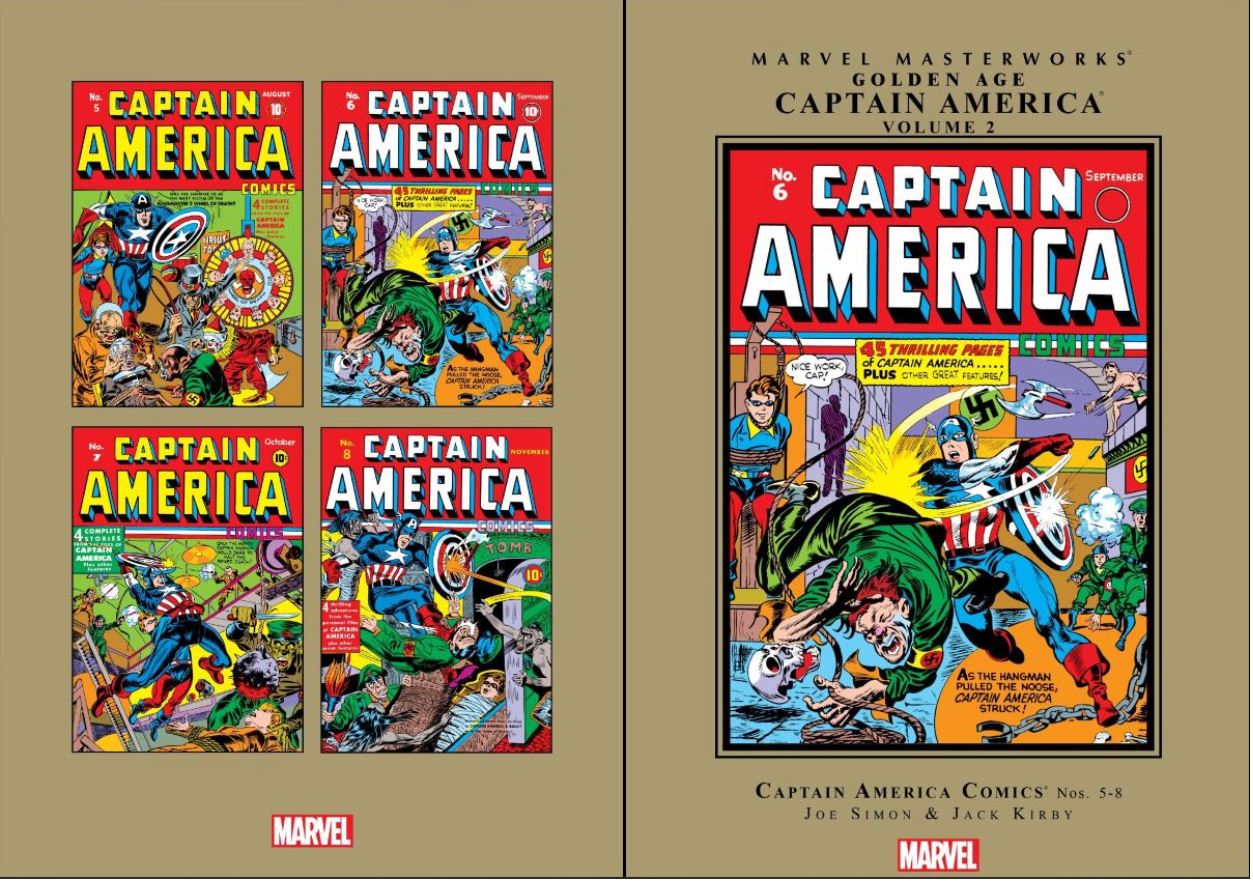
By Joe Simon & Jack Kirby, Stan Lee, Charles Nicholas, Syd Shores, Al Avison, Al Gabriele, Harry Fisk, Ken Bald, Bill Ward and various (Marvel Comics)
ISBN: 978-0-7851-2228-9 (HB), 978-1-3025-0560-8 (Digital edition)
This book includes Discriminatory Content produced in less enlightened times.
Captain America was devised at the end of 1940 and boldly launched in his own monthly title from Timely – the company’s unofficial trading designation – with none of the customary cautious shilly-shallying. Owner Pulp publisher turned comic book empresario Martin Goodman always knew the value of striking while irons were hot…
The first issue was cover-dated March 1941 and became an instant monster, blockbuster smash-hit. Overnight Cap was the absolute and undisputed star of Timely’s “Big Three” – the other two being The Human Torch & Sub-Mariner. He was also one of the very first to plummet from popularity at the end of the Golden Age. These days – excluding, perhaps, some far-too-few Bill Everett-crafted Sub-Mariner yarns – the huge war-years popularity of the other two just doesn’t translate into a good read for modern consumers.
In comparison to their contemporary rivals and industry leaders at Quality, Fawcett, National/All American and Dell, or Will Eisner’s The Spirit newspaper insert, the standard of most Timely periodicals was woefully lacklustre in both story and, most tellingly, art. That they survived and prospered is a Marvel mystery, but a clue might lie in the sheer exuberant venom of their racial stereotypes and heady fervour of jingoism at a time when the USA was becoming involved in the greatest war in global history. Nevertheless, the first ten Captain America Comics are indisputably the most high-quality comics in the fledgling company’s history and I can’t help but wonder what might have been had National (neé DC) been wise enough to hire Simon & Kirby before they were famous, instead of after that pivotal first year?
Of course, we’ll never know and although the team supreme did jump to the majors after a year, their visual dynamic became the mandated aspirational style for super-hero comics at the company they left. Moreover, their patriotic creation became a flagship icon for them and the industry. Truth be told. however, the groundbreaking and exceptionally high-quality material from Joe Simon & Jack Kirby is not really the lure here – the real gold nuggets for us old sods and comics veterans are the rare back-up features overseen by the star duo and crafted by their small pool of talented up-&-comers.
Although unattributed assistants included at various times Reed Crandall, Syd Shores, Alex Schomburg, Mort Meskin, Chu Hing, Charles Nicholas, Gustav Schrotter, George Klein, C.A. Winter, Fred Bell and many more, working on main course and filler features such as Hurricane, the God of Speed and Tuk, Caveboy: strips barely remembered today yet still brimming with the first enthusiastic efforts of creative legends in waiting.
This lavish hardback volume (available in a digital edition) reprints original Star-Spangled blockbusters Captain America Comics #5-8 (spanning August to November 1941) and also provides a fascinating insight into the fly-by-night nature of publishing during those get-rich-quick days in an Introduction from Gerard Jones, after which the astounding action resumes…
After scrawny, enfeebled young patriot Steve Rogers is continually rejected by the US Army, he is recruited by the Secret Service. In an effort to counter a wave of Nazi-sympathizing espionage and sabotage, the passionate young man was tapped to join a clandestine experimental project to create physically perfect super-soldiers. However, when a Nazi agent infiltrated the labs and murdered its key scientist, Rogers became its only successful graduate and transitioned into America’s not-so-secret weapon and very public patriotic symbol.
Despatched undercover as a simple army private, he soon encountered headstrong, orphaned Army Brat James Buchanan Barnes who became his sidekick and costumed confidante “Bucky”. In the period when America was still officially non-combatant, Rogers and his sidekick were stationed at East Coast army base Camp Lehigh, but still manage to find plenty of crime to crush and evil to eradicate.
In Simon & Kirby’s ‘Captain America and the Ringmaster of Death’ the arrival of a circus leads to the deaths of General Blaine and Defense Commissioner Newsome in suspicious circumstances. Before long, both the masked heroes and government agent Betty Ross reach the same conclusion: all the acts and freaks are Nazi operatives sabotaging the nation’s security through murder… but not for much longer…
Japan was still neutral too, so although visually their forces – especially spies – were also unmistakeably ever-present, the eastern arm of the Axis alliance (the other two being Germany and Italy, history fans) were still being referred to as “sinister Orientals” and “Asiatic aggressor nations”. Even so, when Steve & Bucky accompany new commander General Haywood to the US Pacific base of Kunoa, readers knew who was really behind ‘The Gruesome Secret of the Dragon of Death!’ and revelled in seeing the heroes scupper the most spectacular secret weapon yet aimed at the forces of freedom…
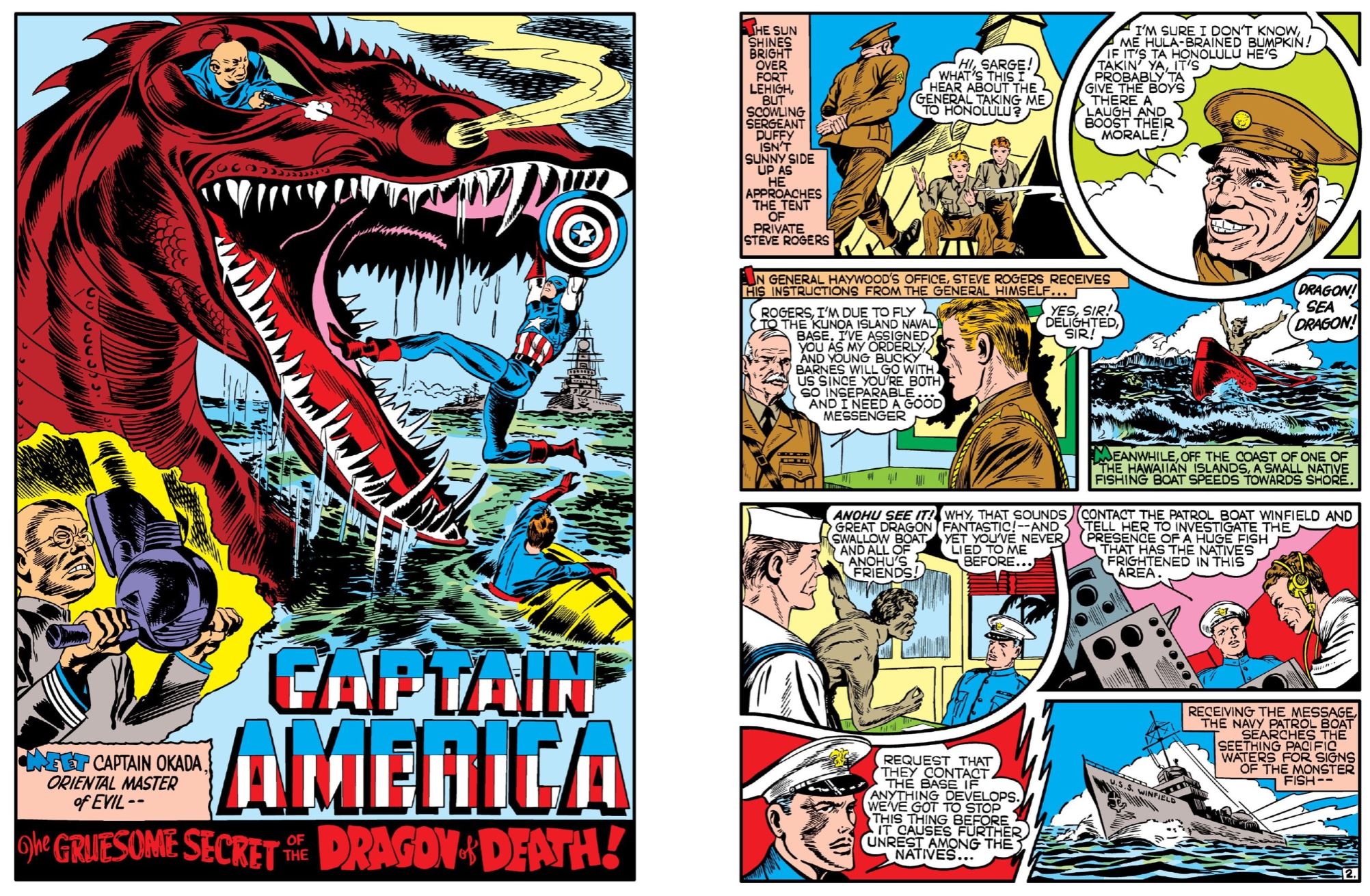
Back in the USA, the hard-hitting Star-Spangled Stalwarts then rescue decent, law-abiding German-Americans terrorised by the ‘Killers of the Bund’ who were determined to create a deadly Fifth Column inside America’s heartland. Following a rousing ad for a newly minted Captain America’s Sentinels of Liberty society, a glorified infomercial for the club comes in the form of prose adventure ‘Captain America and the Ruby Robbers’ scripted by Stan Lee with spot art by S&K, after which our Patriotic Pair save a downed volunteer American flyer held prisoner on a former French Island now administered by the collaborating Vichy government.
‘Captain America and… The Terror That Was Devil’s Island’ offers action-drenched melodrama plucked from the contemporaneous Hollywood movie mill and referencing films like 1937’s The Life of Emile Zola, 1939’s Devil’s Island and perhaps even 1941’s I Was a Prisoner on Devil’s Island and served to show that infamy and cruelty could not long subdue any valiant American heart…
Joining the list of supporting features, the equally relevant if improbable adventures of ‘Headline Hunter, Foreign Correspondent’ began with this issue. Credited to Stan Lee (Goodman’s nephew and major domo Stanley Lieber) & Harry Fisk, these shorts find US journalist Jerry Hunter sent to Blitz-blighted London to report on the European war, only to become the story after uncovering a traitor in the corridors of power…
Sporting only a title page by Simon & Kirby, primeval wonder ‘Tuk, Cave Boy’ bows out in a final example of “Weird Stories from the Dark Ages” as he saves his mentor Tanir from marauding beast-men and ends forever the depredations of brutal tyrant Bongo, before seasoned pro Charles Nicholas (nee Wojtkowski) assumes art chores on ‘Hurricane, Master of Speed’. Hurricane was the earthbound son of thunder god Thor (no relation to the 1960s version): a brisk reworking and sequel to Kirby’s ‘Mercury in the 20th Century’ from Red Raven Comics #1 (cover-dated August 1940), and here intercedes in a diabolical plot to destabilise the economy by flooding US banks with counterfeit currency.
CAC #6 carried a September 1941 cover-date and opens with a classic murder spree thriller as ‘Captain America Battles the Camera Fiend and his Darts of Doom’ in a frantic bid to prevent the theft of Britain’s Crown Jewels. Timely were never subtle in terms of jingoistic (we’d say appallingly racist) depictions, and even the normally reserved Simon & Kirby let themselves go in ‘Meet the Fang, the Arch Fiend of the Orient’ as Cap & Bucky challenge the full insidious might of the Tongs of San Francisco’s China Town to save kidnapped Chinese dignitaries from a master torturer…
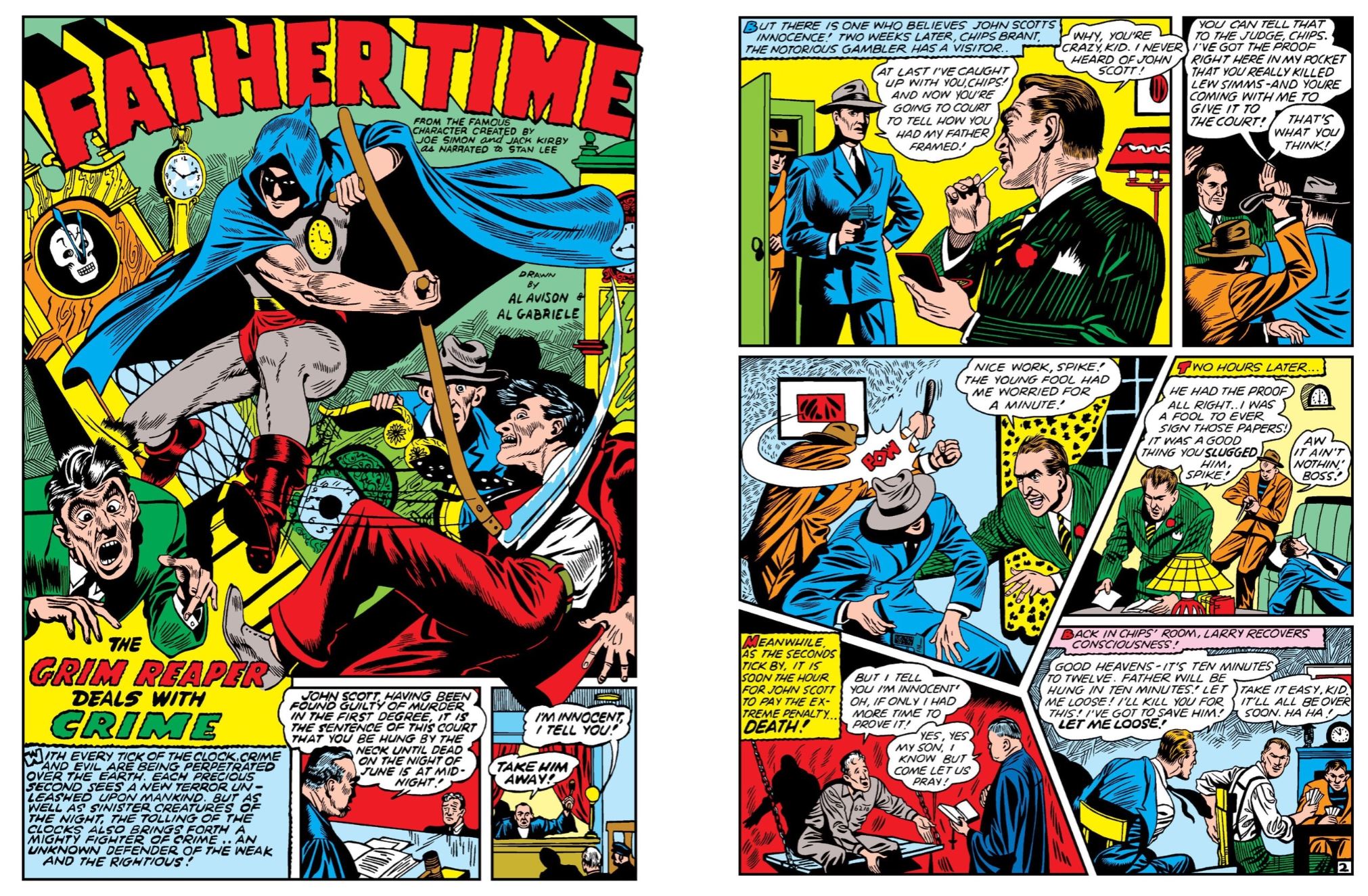
Another new feature followed: scripted by Lee and illustrated by Al Avison & Al Gabriele, ‘Father Time: The Grim Reaper Deals with Crime’ details how Larry Scott learned his father had been framed for murder and through heroic efforts exposed the true culprits… but was seconds too late to save his sire from the noose. Resolved that time should no longer be on the side of criminals and killers, Larry devised a ghastly outfit and – wielding a scythe – brought his dad’s persecutors to justice. They would be only the first in Father Time’s crusade…
Simon & Kirby’s art and stories were becoming increasingly bold and innovative. ‘The Strange Case of Captain America and the Hangman Who Killed Doctor Vardoff’ reveals a diabolical game of “Ten Little Indians” as suspects perish one by one whilst the superheroes attempt to catch a ruthless killer and retrieve a stolen experimental super-silk invention. Lee and an unknown artist then offer another thinly-veiled prose plug for the Sentinels of Liberty club as Cap and Bucky lay a ‘Trap for a Traitor’, after which Headline Hunter, Foreign Correspondent ‘Battles the Engine of Destruction’ (Lee & Fisk) and exposes an aristocratic English fascist building Nazi terror weapons in his British factories.
Following further Sentinels of Liberty club news and puzzle pages ‘Hurricane, Master of Speed’ closes the issue, crushing a murder plot in his own boarding house with art courtesy of Charles Nicholas.
CAC #7 is a stunning comic milestone that leads with iconic clash ‘Captain America in the Case of the Red Skull and the Whistling Death’. With Steve & Bucky ordered to participate in a Vaudeville-themed troop show at Camp Lehigh, the Nazi super-assassin stalks the city, slaughtering his old cronies and US military experts with a mysterious sound weapon. The fiend’s big mistake is leaving the shadows and arrogantly turning his attention to Cap…
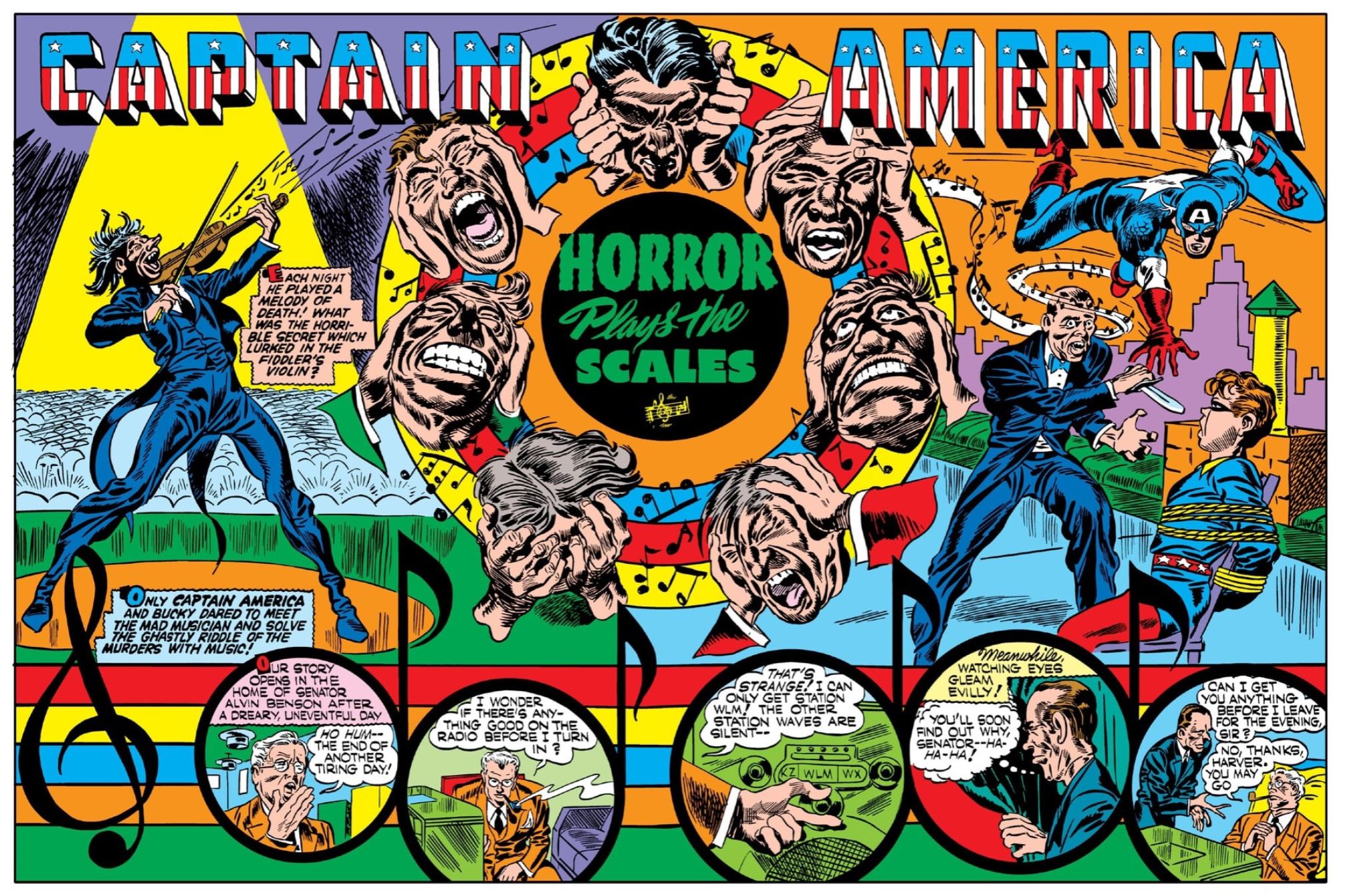
‘The Case of the Baseball Murders: Death Loads the Bases’ seemingly offers a change of pace but Steve’s sporting relaxation turns into more work when a masked maniac starts knocking off his team’s star players before Lee’s prose novelette provides ‘A Message from Captain America’ which introduces his fellow heroes Jerry Hunter, Hurricane and Father Time before S&K strip feature ‘Horror Plays the Scales’ pits the Red, White & Blue Bravos against a murdering musician knocking off anti-Nazi politicians.
Ken Bald & Bill Ward introduce a comedy foil for Hurricane as ‘Justice Laughs Last’ sees the speedster adopt portly shopkeeper Speedy Scriggles after protection racketeers target the feisty fool. Headline Hunter (Lee & Fisk) then clears an Englishman accused of murdering an American film star and reveals a Nazi plot to disrupt Anglo-US relations, as Father Time’s ‘Race Against Doom’ (Lee, Al Avison & Al Gabriele) saves another innocent patsy from taking the fall for a crooked DA and his mob-boss paymaster. The issue closes with more puzzles and patriotic pronouncements from Cap & Bucky to all their fee-paying Sentinels…
Cover-dated November 1941, Captain America Comics #8 was released months before the Pearl Harbor atrocity catapulted the USA into official war so contents might have compiled as early as June or July. Thus it opens with another gripping crime conundrum – ‘The Strange Mystery of the Ruby of the Nile and Its Heritage of Horror’ – which sees the heroes assisting Betty Ross in safeguarding a fabulous antique jewel, but seemingly helpless to prevents its archaeologist excavators being butchered by a marauding phantasm.
The impending conflagration does inform ‘Murder Stalks the Maneuvers’ when a Nazi infiltrator attends war games and uses the opportunity to trick the soldiers into destroying each other with live ammo, whilst Headline Hunter, Foreign Correspondent remains in the thick of it facing ‘The Strange Riddle of the Plague of Death’ (Lee & Fisk). This time he saves London (and the Home Counties) from a strange sickness spread by bread…
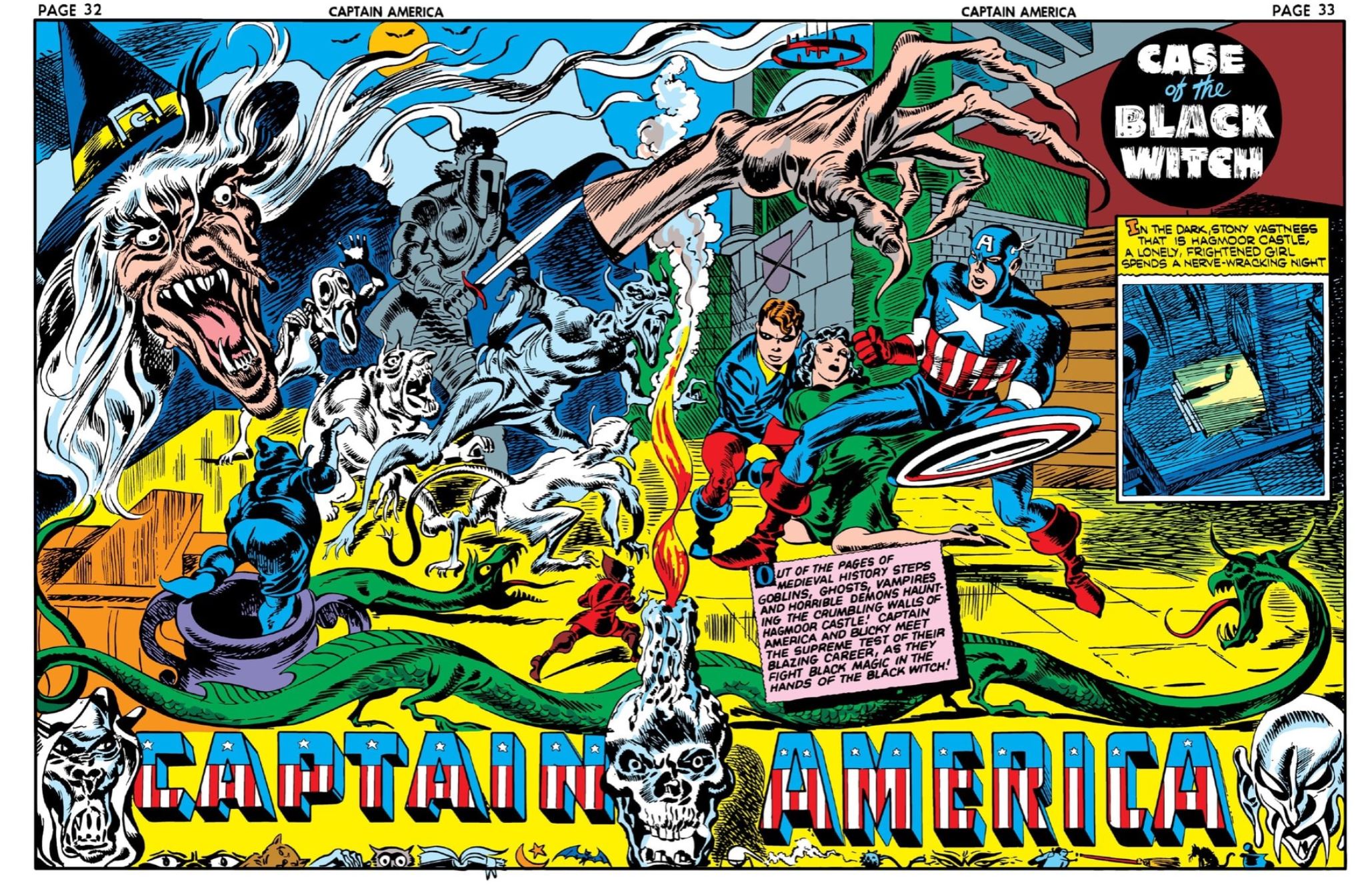
After more Sentinel propaganda and absorbing puzzles, Simon & Kirby’s ‘Case of the Black Witch’ has Cap & Bucky shielding a young woman’s inheritance before clashing with a sinister sorceress and the worst horrors hell could conceive of.
Nicholas returns to Hurricane as the Master of Speed and his new pal shut down a crooked ‘Carnival of Crime’, after which Lee & an unsung illustrator promote in prose a new Timely title as ‘The Young Allies Strike a Blow for Justice’. Please be warned: the treatment here of “Negro” character Whitewash – a full partner in the heroic team – is every bit as dated, contentious and potentially offensive as that era’s representations of other races, so kudos to the editors for bravely leaving the story untouched and unedited. Closing on a bombastic high, Father Time then deals harshly with robbers who use bank strongrooms to asphyxiate witnesses in ‘Vault of Doom!’
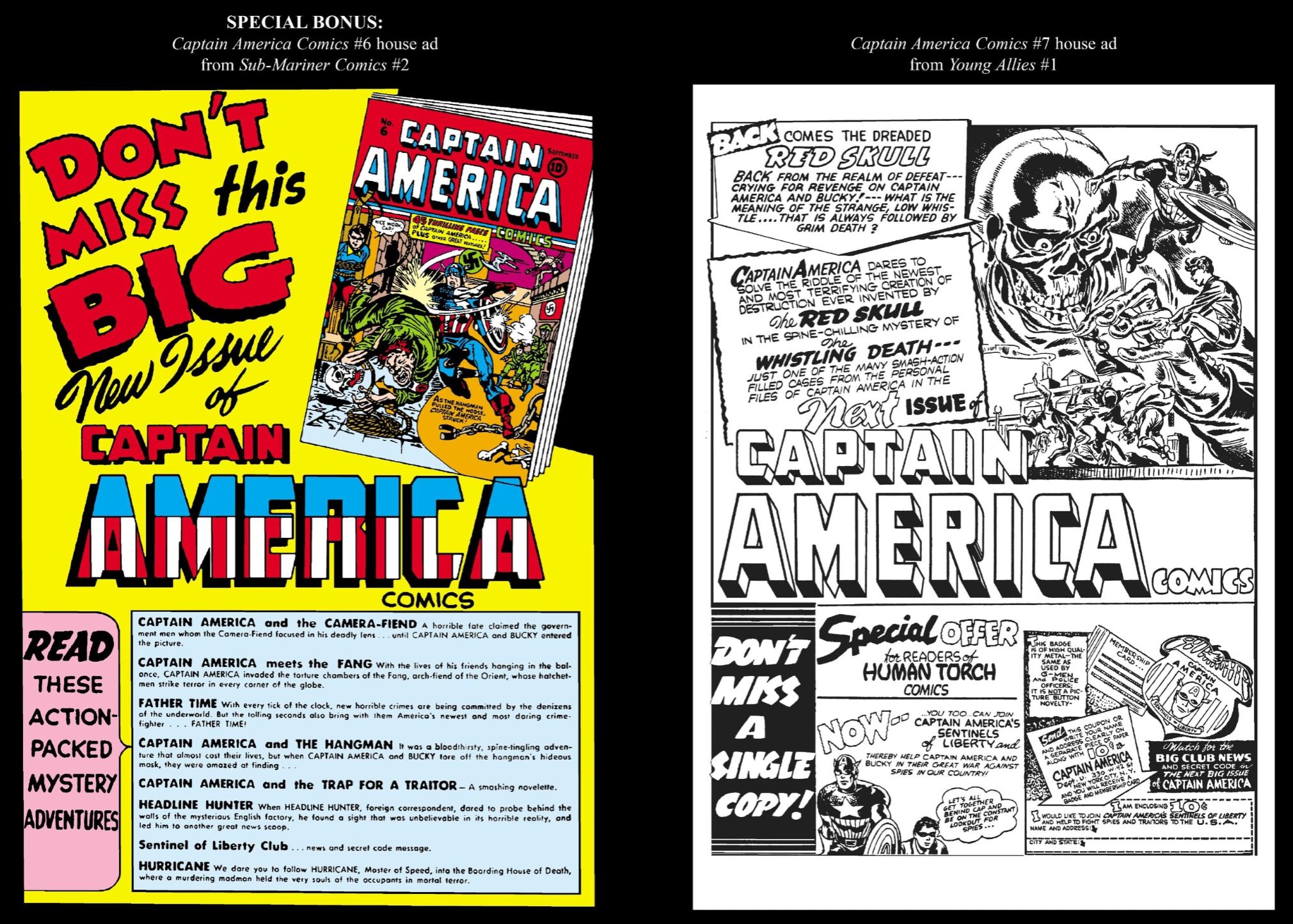
An added and very welcome bonus for fans is the inclusion of some absolutely beguiling house-ads for other titles, contents pages, Sentinels of Liberty club bulletins and assorted ephemera…
Although lagging far behind DC and despite, in many ways having a much shallower Golden Age well to draw from, it’s commendable that Marvel has overcome understandable initial reluctance about its earliest output in these masterworks – even if they’re only potentially of interest to the likes of sad old folk like me. However, with this particular tome at least, the House of Ideas has a book that will always stand shoulder to shoulder with the very best that the Golden Age of Comics could offer.
© 2018 Marvel Characters, Inc. All rights reserved.
Pioneering Italian comics creator Sandro Angiolini (Isabella) was born today in 1920, sharing the date with Belgian Maurice Maréchal (Prudence Petipas) in 1922 and American cartoonist Tom K. Ryan (Tumbleweeds) in 1926, and – one year later – Le Journal de Spirou stalwart creator Peter Spier (Sophie).
We lost Katzenjammer Kids artist Joe Musial in 1977; Timely/Atlas/Marvel Comics founder Martin Goodman in 1992; Golden and Silver Age comic book everyman Manny Stallman (Young Robin Hood, Big Town, Raven) in 1997, with this century this day marking the passings of Kate Worley (Omaha the Cat Dancer) in 2004 and French creator and co-founder of Pilote Jean-René Le Moing – AKA “Bulbul” – (Le Chevalier Emerik, Peter Pat) in 2012.
In 1932 Clifford McBride’s Napoleon and Uncle Elby premiered; and in 1959 The Beano debuted Leo Baxendale’s The Three Bears, UK whilst weekly Cor!! launched today in 1970 and Steve Gerber & Gene Colan’s newspaper strip version of Howard the Duck took flight in 1977.