
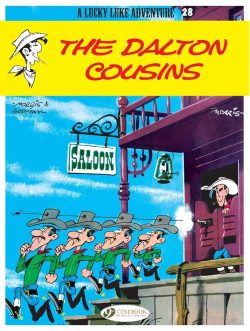
By Morris & Goscinny, translated by Luke Spear (Cinebook)
ISBN: 978-1-84918-076-4 (Album PB/Digital edition)
This book includes Discriminatory Content produced in less enlightened times. This book also includes Discriminatory Content added for comedic effect.
Created by Belgian animator, illustrator and cartoonist Maurice de Bévère (AKA “Morris”), Lucky Luke debuted in the summer of 1946, initially riding out in Le Journal de Spirou summer sans title or banner, and only in the French-language edition. The Lone Rider’s official launch came in Christmas Annual L’Almanach Spirou 1947, before beginning his first official serial – ‘Arizona 1880’ – in December 7th 1946’s multinational weekly issue.
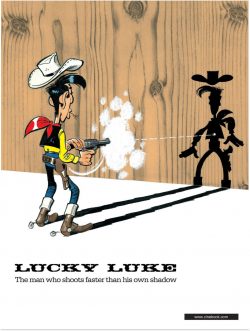
Doughty, dashing, dependable cowboy “good guy” Lucky is a rangy, implacably even-tempered do-gooder able to “draw faster than his own shadow”. He amiably ambles around the mythic Old West, having light-hearted adventures on his petulant and rather sarcastic wonder-horse Jolly Jumper. For 80 years (Joyeux anniversaire, Mon Brave!), his exploits have made him a top-ranking global comic character, filling more than 90 individual albums and spin-off series like Kid Lucky and Ran-Tan-Plan, with sales upwards of 300 million copies in 30 languages. That renown translated into a mountain of merchandise, toys, games, animated cartoons, TV shows and live-action movies and even commemorative exhibitions. No theme park yet, but you never know…
Lucky’s global dominance resulted from a decades-long, 45 volume collaboration with superstar scripter René Goscinny, spanning Des rails sur la Prairie/Rails on the Prairie beginning August 25th 1955 to La Ballade des Dalton et autres histoires/The Ballad Of The Daltons And Other Stories in 1986. On Goscinny’s death, Morris worked on alone again before recruiting others, to form a posse of legacy creators including Lo Hartog van Banda, Achdé & Laurent Gerra, Xavier Fauche, Benacquista & Pennac, Jean Léturgie, Jacques Pessis and more, all taking their own shots at the venerable vigilante. Morris soldiered on singly and with these successors before his own passing in 2001, having drawn fully 70 adventures, plus numerous sidebar and spin-off sagebrush sagas.
His grande idée draws on western history as much as movie mythology, regularly meeting historical figures as well as even odder fictional folk in tales drawn from key themes of classic cowboy mythology – as well as some uniquely European notions or interpretations such as seen here. As previously hinted, our six-gun star is not averse to being a figure of political change and Weapon of Mass Satire, but here spoofs his own antecedents and venerated movie schtick for a delicious drive down memory lane…
Goscinny had started scripting Lucky uncredited in 1955. Morris had taken nearly a decade to fill nine albums with affectionate sagebrush parody, action and Lucky Laughs, but now, with Goscinny as regular wordsmith, Luke would attain dizzying heights of super swift superstardom, commencing with Des rails sur la Prairie (Rails on the Prairie), and following up with Lucky Luke contre Joss Jamon, (Vs. Joss Jamon) before – still anonymously – delivering a true landmark with the next storyline.
The Dalton Cousins was first enjoyed in LJdS #992 – 1013 (April 18th to September 12th 1957): a manic mirth-fest for which Goscinny performed a much-demanded act of necromancy by resurrecting a quartet of killers Lucky had already permanently dealt with, but whom readers want not dead but alive…
Serially published back in December 1954 Hors-la-loi became Morris’ 6th full album and included a strip which saw our hero meet and beat Emmett, Bill, Grat & Bob Dalton: real life badmen who had plagued the actual west during the 1890s. On those funny pages from simpler times, Lucky was hired by railroad companies to end the depredations of the desperados who had been imported into the strip, but given a comedic, yet still vicious spin. A cat & mouse chase across the wildest of wests saw Luke constantly frustrated by close calls and narrow escapes in superbly gripping movie set-pieces until, inevitably, justice claimed the killers. At the close, Morris had Lucky end the gang forever, but they and the story itself were insanely popular with fans. These owlhoots were comedy gold and ideal foils, so eventually they returned in the form of their own cousins…
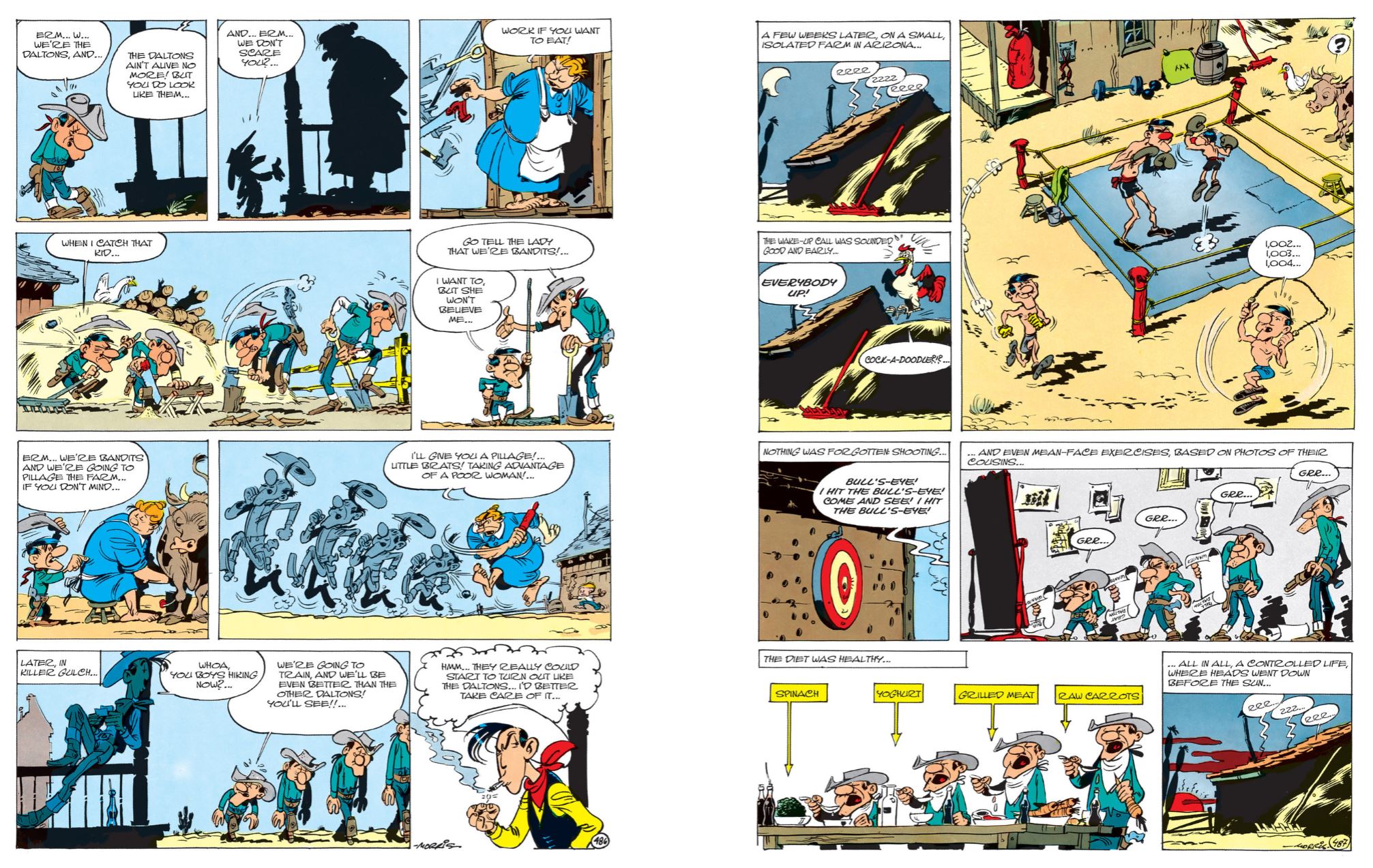
From the reader response to that tale eventually came this aforementioned revival, as Goscinny’s third collaboration. When this iteration of the appalling Dalton Brothers – now and forever after Averell, Jack, William & devious, slyly psychotic, tyrannical, diminutive brother Joe – showed up, the course of the strip altered forever…
It opens on a remote farm in Arizona where four brothers mourn the loss of murderous bandits they resemble and are related to. They know they aren’t nearly good enough to fill the dead men’s boots or kill their killer… but they are willing to try their hardest to change all that. The replacement Daltons’ first attempt to settle the score is frankly embarrassing, but fortune and persistence gradually harden and hone them. They even at one stage have the heroic happy wanderer train them up to “match fitness”…
Ultimately, however, after they besiege a town and regularly succeed in theft and terrorism, Lucky is forced to take action before they become as great a menace as their dearly departed favourites ever were, but sadly, leaves it too late and is forced to resort to tricky tactics and even dividing to conquer. It’s either that or be hunted down like a dog: a role he’s just not suited for…
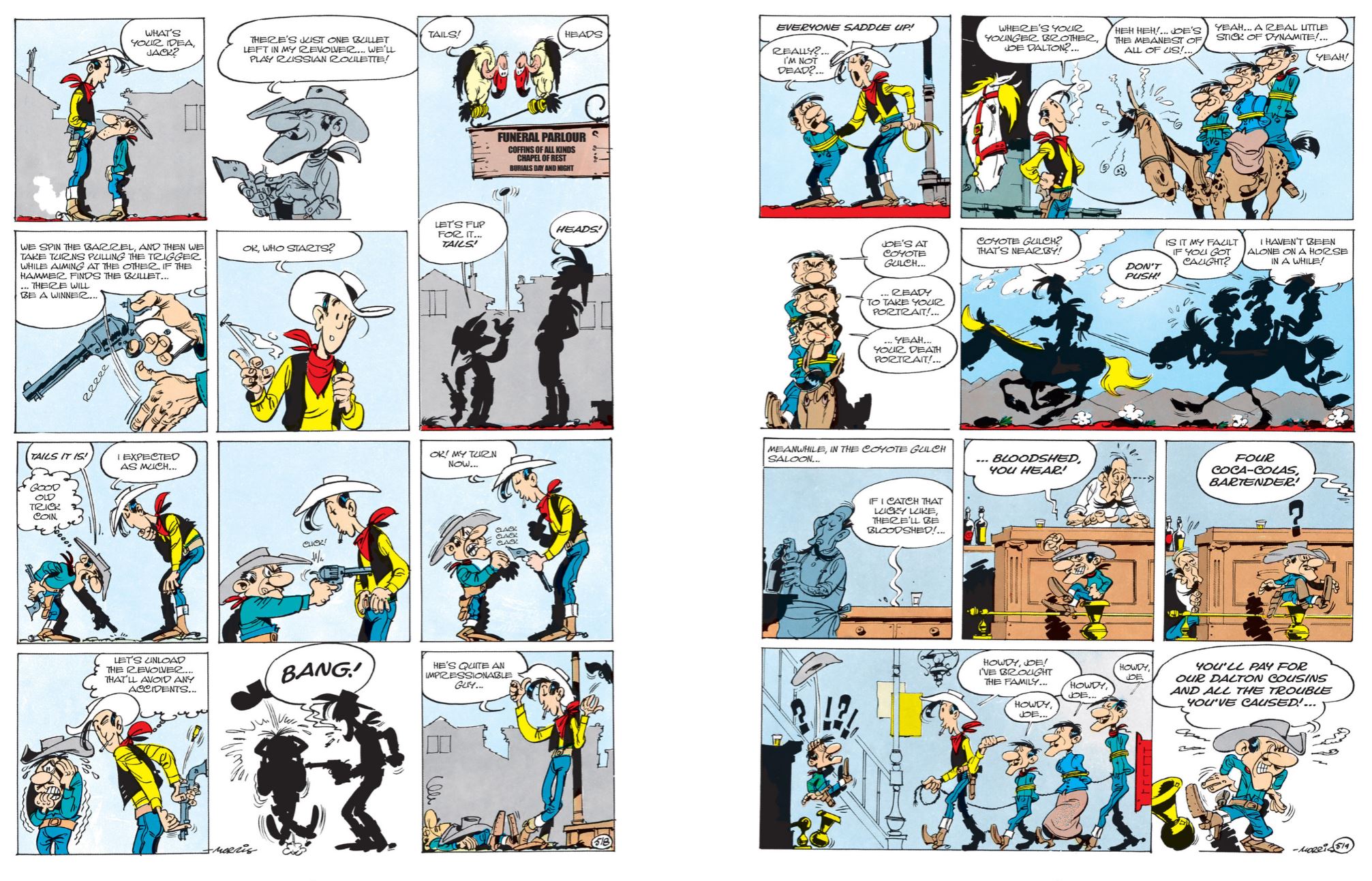
As much thriller as comedy romp, this yarn proved how crucial great villains are to any hero and started a western showdown that fruitfully persists and thrives to this day. These tall-to-small tales are perfect for kids with a smidgen of historical perspective and social understanding, although the action and slapstick situations are no more contentious than any Laurel and Hardy film – perfectly understandable as Morris was a huge fan of the duo. These formative forays are a grand old hoot in the tradition of Destry Rides Again or Support Your Local Sheriff, superbly executed by master storytellers, and a wonderful introduction to a unique genre for anyone who might well have missed the romantic allure of the Wild West that never was…
© Dargaud Editeur Paris 1971 by Goscinny and Morris. © Lucky Comics. English translation © 2010 Cinebook Ltd.
Today in 1913, artist Tom Gill (The Lone Ranger, Bonanza, Red Warrior) was born, sharing his birthday with DC’s hyper-prolific colourists Jerry Serpe (1919) and Bob LeRose (1921). The date also saw the debut of Russell Stamm’s strip Invisible Scarlett O’Neil in 1940 and the deaths of the great Syd Shores (Captain America, Black Rider, Blonde Phantom, The Westerner) in 1973; Ozzie cartoonist Syd (Fatty Finn) Nicholls in 1977 and Industry-shaking innovator Bill Gaines (EC Comics, Mad Magazine) in 1992.