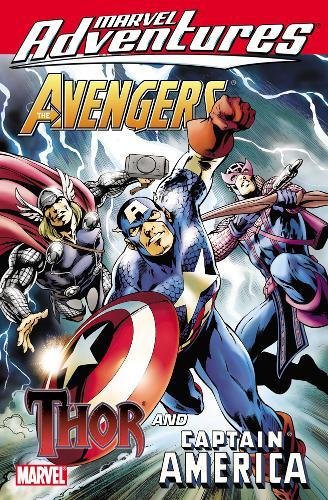
Marvel Adventures Avengers: Thor and Captain America


By Paul Tobin, Scott Gray, Todd DeZago, Ronan Cliquet, Ron Lim, Lou Kang & various (Marvel)
ISBN: 978-0-7851-5584-3 (Digest PB)

In 2003 the House of Ideas instituted a Marvel Age line: an imprint updating classic original tales and characters for a newer, younger readership. The enterprise was modified in 2005, with core titles reduced to Marvel Adventures: Fantastic Four and Marvel Adventures: Spider-Man. The tone was very much that of the company’s burgeoning TV cartoon franchises, in delivery if not name.

Supplemental series including Super Heroes, The Avengers, Hulk and Iron Man chuntered along merrily until 2010 when they were cancelled. In their place came new volumes of Marvel Adventures: Super Heroes and Marvel Adventures: Spider-Man.

Most of the re-imagined tales were collected in gleefully inviting digest-sized compilations and digitised; this – except for a electric version – was the case with this engaging ensemble featuring fabulous  forays starring the God of Thunder or Sentinel of Liberty and their Avenging allies: a quartet of all-ages tales from the second volume of Marvel Adventures Super Heroes (#13-16, spanning June-September 2011).

The action opens with a mythological masterpiece by Paul Tobin, Ronan Cliquet & Amilton Santos wherein plucky novice hero Nova is invited by Avenging comrades Thor and Valkyrie to accompany them on an annual errand for All-Father Odin.

In the distant past when Asgardians warred with Trolls, godling messenger Glane failed in his mission and was banished to the ghastly Fields of the Fallen to pay penance by continually battling the Golden Realm’s vilest enemies. Periodically, Thor has been sent to add new tasks to the sinning failure’s heavy burden, and this year – as the Thunderer and Valkyrie ready themselves for the trip – they invite starstruck neophyte Nova along.

However, as the trio war their way through horrific monsters and overwhelming odds, Nova finds himself increasingly uncomfortable with the sentence meted out to Glane. He even begins doubting the motives of his immortal mentors. All that changes once he meets and battles beside the convicted penitent…

Originating in MASH #14, ‘Out of Time!’ is by Todd DeZago, Ron Lim & Scott Koblish (inspired by Gerry Conway & Ross Andru’s tale from the original Marvel Team-Up #7). Here, the Lord of Storm intercepts Spider-Man after the wallcrawler is blasted high into the sky whilst battling raving maniac the Looter.

That happy coincidence occurs just a bizarre force freezes time around them. When the heroes discover that only they have escaped a devastating weapon deployed by Trollish tyrant Kryllk the Conqueror to paralyze and overwhelm both Asgard and the mortal plane, they must divide their strength to simultaneously smash the conqueror in Manhattan and Asgard if they are to set time running free again…

Captain America takes the spotlight in #15 as ‘Back in Time’ (Tobin, Cliquet & Santos) finds him battling Neanderthals with ray-guns in a National Forest after tracking down rogue geneticists who have stolen a huge amount of plutonium.

A mere mile away, Peter Parker’s girlfriend Sophia Sanduval is getting back to nature and chilling with her furry, scaly and feathered friends. As Chat, the mutant teen’s power to communicate with animals makes her a crucial component of the mystery-solving Blonde Phantom Detective Agency, but even she has never seen anything like the wave of extinct creatures which appear after Cap begins battling the tooled-up cavemen.

Soon Chat has been briefed on the deadly experiments of rogue technologist Jerrick Brogg. The villain’s ambition is to build an army out of revived extinct creatures, but she and helps The Star-Spangled Avenger frustrate those save all the beasts he has re-created from short painful lives of terror and brutal exploitation, before putting the maniac away for good.

Wrapping up the action comes ‘Stars, Stripes and Spiders!’ by DeZago, Lou Kang & Pat Davidson (based on Len Wein & Gil Kane’s tale from Marvel Team-Up #13). When a certain wallcrawling high-school student/occasional masked hero stumbles into Captain America tackling an AIM cadre stealing super-soldier serum, the nervous lad learns a few things about the hero game from the legendary guy who wrote the book. Sadly, not making that lesson any easier is petrifying supervillain Grey Gargoyle, whose deadly touch almost ends Spidey’s homework worries – and continued existence – forever…

Fast, furious, funny and enthralling, these riotous mini-epics are extremely enjoyable yarns, although parents should note that some of the themes and certainly the level of violence might not be what everybody considers “All-Ages Super Hero Action”…
© 2011 Marvel Characters, Inc. All rights reserved.

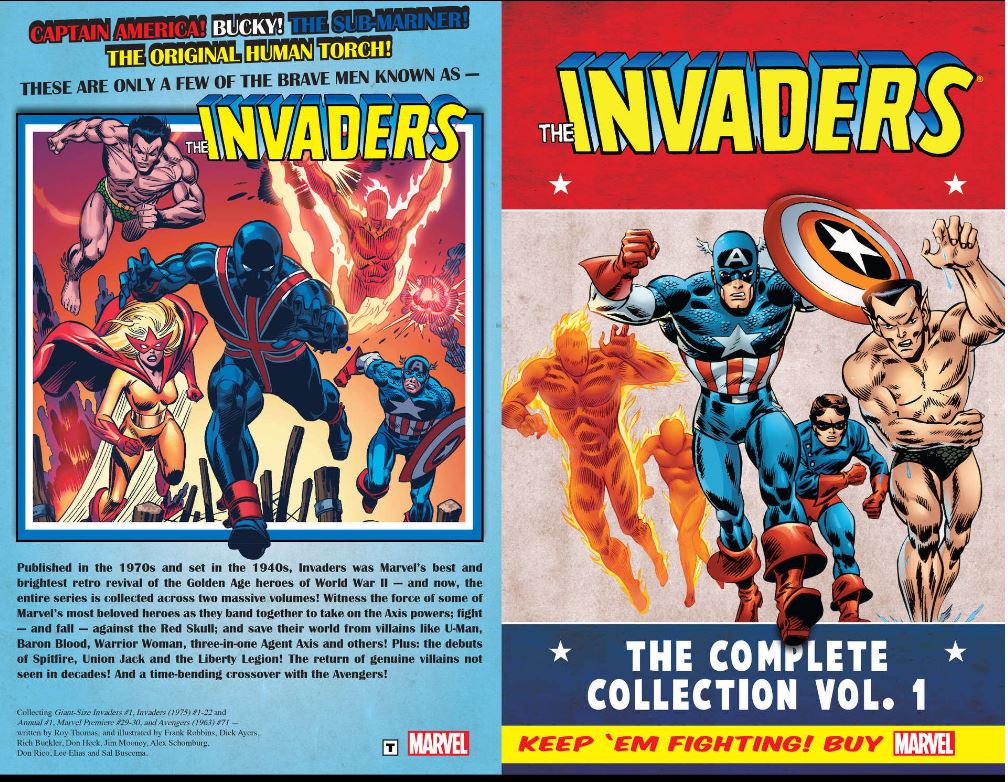
The Invaders Classic: The Complete Collection volume 1


By Roy Thomas, Frank Robbins, Rich Buckler, Dick Ayers, Don Heck, Jim Mooney, Carl Burgos, Don Rico, Lee Elias, Alex Schomburg, Sal Buscema & various (Marvel)
ISBN: 978-0-7851-9057-8 (TPB/Digital edition)

The adage never grows stale: the best place to see American superheroes in action is in World War II, thrashing Nazis and their evil Axis allies. And yes, that includes their so-numerous copycats and contemporary legatees like Hydra, The National Southern Baptist Convention, Reclaim, The LGB Alliance and The Bullingdon Club too… whether contemporaneously or retroactively…

That was especially true in the 1970s when many guilt-free hours were devoted to portraying the worst people on Earth getting their just deserts (or just getting mocked in shows like Hogan’s Heroes and films like The Producers or To Be or Not to Be). In an era of generational backward-looking fostering cosy familiarity and with Lynda Carter on TV screens crushing the Third Reich every week in The New Adventures of Wonder Woman, admitted aficionado and irredeemable nostalgist Roy Thomas (Conan the Barbarian, X-Men, All-Star Squadron, Wonder Woman, Shazam!, Fantastic Four, Thor, Spider-Man, Daredevil ad infinitum) sought to revisit the “last good war”. Here he would back-write a super-team comprising Marvel’s (or rather Atlas/Timely’s) “Big Three” – Captain America, Sub-Mariner and the Human Torch – and however many minor mystery-men as he could shoehorn in…

Long before this series debuted, Prince Namor, the Sub-Mariner was the hybrid offspring of a sub-sea Atlantean princess and an American polar explorer: immensely strong, highly resistant to physical harm, able to fly and thrive above and below the waves. Created by young Bill Everett, Namor technically predates Marvel/Atlas/Timely Comics.

He first caught the public’s attention as part of the elementally electrifying “Fire vs. Water” headlining team in Marvel Comics #1 (October 1939 and Marvel Mystery Comics from the next issue) alongside The Human Torch, but had debuted earlier in the year in monochrome Motion Picture Funnies, a weekly promotional giveaway handed out to moviegoers.

Swiftly becoming one of the new company’s biggest draws, Namor gained his own title at the end of 1940 (cover-dated Spring 1941) and was one of the last super-characters to go at the end of the first heroic age. In 1954, as Atlas, the company briefly revived the Big Three and Everett returned for an extended run of superb fantasy tales. The time wasn’t right and the title sunk again.

When Stan Lee & Jack Kirby began reinventing comics in 1961 with Fantastic Four, they revived the forgotten amphibian as a troubled, semi-amnesiac, yet decidedly more regal and grandiose anti-hero, embittered at the loss of his sub-sea kingdom – seemingly destroyed by American atomic tests. He also became a dangerous bad-boy romantic interest: besotted with the FF’s Sue Storm.

Namor knocked around the budding Marvel universe, squabbling with assorted heroes like Daredevil, The Avengers and X-Men before securing his own series as half of “split-book” Tales to Astonish with fellow antisocial antihero The Incredible Hulk, eventually returning to solo stardom in 1968.

Crafted by Carl Burgos, the original Flaming Fury burst into life as a humanoid devised by troubled, greedy Professor Phineas Horton. Instantly igniting into a malfunctioning uncontrollable fireball whenever exposed to air, the artificial innocent was consigned to entombment in concrete but escaped to accidentally imperil New York City until he fell into the hands of malign mobster Sardo. His attempts to use the android as a terror weapon backfired and the hapless, modern day Frankenstein’s Monster became a misunderstood fugitive. Even his creator only saw the fiery Prometheus as a means of making money.

Gradually gaining control of his flammability, the angry, perpetually rejected android opted to make his own way in the world. Instinctively honest, he saw crime and wickedness everywhere and resolved to do something about it. Indistinguishable from human when not afire, he joined the police as Jim Hammond, tackling ordinary thugs even as his volcanic alter ego battled outlandish fiends like Asbestos Lady. Soon after, the Torch met his opposite number when the New York City Chief of Police asked him to stop the savage Sub-Mariner from destroying everything. The battles were spectacular but inconclusive, and only paused after policewoman Betty Dean brokered a tenuous ceasefire.

The Torch gained a similarly powered junior sidekick Toro, but both vanished in 1949: victims of organised crime and Soviet spies working in unison. They spectacularly returned in 1953’s revival, renewing their campaign against weird villains, Red menaces and an assortment of crooks and gangsters before fading again. In the sixties it was revealed that atomic radiation in the Torch’s body finally reached critical mass and Jim – realising he was about to flame out in a colossal nova – soared into the desert and went up like a supernova…

Jim Hammond was resurrected many times in the convoluted continuity that underpinned the modern House of Ideas and is with us still…

Created by Joe Simon & Jack Kirby in an era of national turmoil and frantic patriotic fervour, Captain America was a dynamic, emphatically visible response to the horrors of Nazism and the threat to democracy. Consequently, the concept quickly lost focus and popularity once hostilities ceased. The Sentinel of Liberty was lost during post-war reconstruction, only to briefly reappear after the Korean War: a harder, darker Cold Warrior hunting monsters, subversives and “Reds” who lurked under every American bed.

He vanished once more, until the burgeoning Marvel Age resurrected him just in time to experience the Land of the Free’s most turbulent, culturally divisive era. He became a mainstay of the Marvel Revolution in the Swinging Sixties, but arguably lost his way after that, except for a politically-fuelled, radically liberal charged period under scripter Steve Englehart.

Despite everything, Captain America evolved into a powerful symbol for generations of readers and his career can’t help but reflect that of the nation he stands for…

Devised in the fall of 1940 and on newsstands by December 20th, Captain America Comics #1 was cover-dated March 1941, and an instant monster, blockbuster smash-hit. He had boldly and bombastically launched in his own monthly title with none of the publisher’s customary caution, and instantly was the undisputed star of the Big Three. He was, however, the first to fall from popularity as the Golden Age ended.

You know the origin story like your own. Simon & Kirby depicted scrawny, enfeebled patriot and genuinely Good Man Steven Rogers – after constant rejection by the Army – is recruited by the Secret Service. Desperate to stop Nazi expansion, the passionate kid joined a clandestine experiment to create physically perfect super-soldiers.

I have no idea if the irony of American Übermenschen occurred to the two Jewish kids creating that mythology, but here we are…

When a Nazi infiltrated the project and murdered the pioneering scientist behind it all, Rogers was the only successful result and became America’s not-so-secret weapon. When he was lost, others took up the role and have periodically done so ever since. I might be wrong, but as I recall every substitute and replacement was white and male…

When Thomas was writing The Avengers, issues #69-71 featured a clash with Kang the Conqueror spanning three eras. It saw some of the team dumped in WWII Paris and manipulated into fighting in situ Allied costumed champions. When that memorable minor skirmish was expanded and extrapolated upon in 1975, history was (re)made…

Re-presenting Giant-Sized Invaders #1, The Invaders #1-22 & Annual #1, Marvel Premiere #29-30, and Avengers #71 – collectively spanning June 1975 to November 1977 – this initial foray charts the course of the team and exponentially expands Marvel lore and history, opening with an extended multi-chapter romp.

Cover-dated June 1975, and crafted by Thomas, Frank Robbins (Johnny Hazard, Batman, Superboy, The Shadow, Morbius/Adventure into Fear, Captain America, Man from Atlantis) & Vince Colletta, ‘The Coming of the Invaders!’ saw a revisionist Big Three saving British Prime Minister Winston Churchill during a US visit in December 1941…

Nazi spies and saboteurs are crushed by boy marvel Bucky and ‘A Captain Called America!’ who is then recruited by the FBI to safeguard a mystery dignitary. The duo are ordered to cooperate with another extraordinary operative in ‘Enter: the Human Torch!’.

A tale of sinister super-science unfolds, revealing how Nazi Colonel Krieghund and the enigmatic Brain Drain have bult their own super-soldier. Master Man (AKA Ubermensch) has already beaten the Fiery Fury and sidekick Toro in pursuit of the plot. Grudging associates at best, the quartet of heroes rush to Chesapeake Bay in time to see how ‘The Sub-Mariner Strikes!’ when Master Man targets Churchill’s battleship. On the clash’s conclusion, the grateful premier suggests the saviours shelve their innate animosity for the duration and work together to crush the Axis alliance.

The blockbuster origin tale is augmented here by its accompanying editorial ‘Another Agonizingly Personal Recollection by Rascally Roy Thomas’

The launch was a huge success and The Invaders #1 (August) was rushed out. Like Giant-Size X-Men #1, an in production second issue was rapidly retooled, with the first half appearing as ‘The Ring of the Nebulas!’ and ‘From the Rhine… a Girl of Gold!’ with the new team relocated to blitz-blasted London and arriving in the middle of shattering air raid. As their flying compatriots bring down German bombers, Cap and Bucky land Namor’s Atlantean sky-sub Flagship and help clear burning buildings of casualties and rescue a strange, shellshocked woman who – although amnesiac – proves to be ‘A Valkyrie Rising!’ With “Hilda’s” help the heroes infiltrate ‘Beyond the Siegfried Line!’ and invade Brain Drain’s citadel only to be ambushed by a trio of Teutonic gods…

Following second editorial ‘Okay Axis, Here We Come!’, the saga explosively concludes in the second bimonthly issue (cover-dated October) as ‘Twilight of the Star-Gods!’ reveals the incredible truth about Hilda, Loga, Donar and Froh, the source of Brain Drain’s scientific advances and why it’s bad to abuse and exploits guest from other planets…

Action was never far away and #3 opened with the triumphant Invaders saving a convoy from U-Boats before briefly returning to America to forestall a ‘Blitzkrieg at Bermuda’. The crisis was instigated by an Atlantean traitor siding with and working for the Nazis.

Namor’s alliance with the Allies only existed because the Germans had depth-charged his undersea city to eradicate its sub-human inhabitants, but now a rogue named Merrano has artificially augmented his strength and led a cadre of Atlanteans and sea beasts against surface bases. The aquatic blockbuster was once Namor’s chief scientist and has misused Atlantean technology for his own purposes as U-Man. Regal pride stung, Namor demands to fight the traitor alone, sparking a split with his newfound comrades. In the end, he and Bucky go on without the others or any official sanction….

As the marine man-monster and his hordes head for Churchill’s secret meeting in the Caribbean, the quarrellers at last agree that ‘U-Man Must be Stopped!’ and take all necessary steps, spurred on and umpired by Namor’s human girlfriend Betty Dean.

The drama intensified with #5 (March 1976) as Thomas expanded his niche universe by creating a second squad of masked stalwarts. Pencilled by Rich Buckler and Dick Ayers, with inks from Jim Mooney. ‘Red Skull in the Sunset!’ opens a 4-issue epic which sees the Invaders captured by the ultimate fascist and turned into weapons against America. Only Bucky – disregarded as too puny to exploit – remained free. The tale continued in #6 (‘…And Let the Battle Begin!’ with art by Robbins & Colletta May) and also crossed over into Marvel Premiere #29’s ‘Lo, The Liberty Legion!’ & 30’s ‘Hey Ma,! They’re Blitzin’ the Bronx’ (April and June 1976) wherein Bucky recruited a number of new superheroes and made them into a team to defeat the Invaders and scupper the Skull’s schemes.

As delivered by Thomas, Don Heck, & Colletta the recruits – The Patriot, Whizzer, Miss Marvel, Blue Diamond, Red Raven, Jack Frost and the Thin Man – came from assorted Timely strips of the 1940s and remained state-side as Home Front heroes. A fabulously engaging primal romp, the epic is inexplicably divided, with the Marvel Premiere instalments (the second and fourth/final chapters) relegated to the back of the book along with editorial features ‘Give Me Liberty – or Give Me The Legion!’ parts 1 and 2.

With the confusion and reputations all cleared up, the liberated Invaders return to war-torn London for #7 (July 1976) to tackle ‘The Blackout Murders of Baron Blood!’, with a costumed German vampire terrorising the capital. During a nighttime assault, the Torch saves Air Raid Warden Lady Jacqueline Falsworth from the bloodsucker and is gratefully introduced to her father: a legendary “masked spy-buster of World War One”.

James Montgomery Falsworth had worked with an international group of proto-superheroes dubbed Freedom’s Five, and on hearing of the vampire, comes out of retirement to finish his duel with the Kaiser’s top secret weapon…

Meanwhile, the other Invaders have also clashed with Baron Blood and are happy that ‘Union Jack is Back!’ (inked by Frank Springer): blithely unaware that the beast is actually a member of Falsworth’s household waiting to pick them off at his leisure. It begins as Union Jack is crippled by Blood and seemingly helpless to save his daughter from being drained in #9’s ‘An Invader No More!’

With justice finally served, the need for a deadline-saving reprint sees #10 mix new framing sequence ‘The Wrath of the Reaper!’ with a remembrance amongst the heroes as they rush father and daughter to hospital: ‘Captain America Battles the Reaper!’ by Al Avison & Al Gabriele as first seen in Captain America #22 (January 1943) rowdily recounted the failure of one of Adolf Hitler’s top agents…

The new history resumed in #11 as Montgomery learns he will never walk again, and Jacqueline is saved by an emergency transfusion of the Torch’s artificial, instantly regenerating blood. However, the combination of vampiric body fluids and the Torch’s liquid fuel source transform her into something new and powerful…

In another wing of the hospital, refugee Dr Gold has been building an advanced warsuit which he inexplicably turns on the Invaders until Jacqui lends a fast and fiery hand on the ‘Night of the Blue Bullet!’

As she seeks to replace her father on the team as Spitfire, Captain America ferrets out the reason for Gold’s betrayal and orders a rescue mission ‘To the Warsaw Ghetto!’ to save the boffin’s hostage brother Jacob. The foray is a complete disaster and the squad is captured by macabre Gauleiter Eisen, but his triumph is short-lived as it provokes Jacob to summon ancient forces in #13’s ‘The Golem Walks Again!’

A new team debuted in the next issue with ‘Calling… The Crusaders!’ as a (mostly) British ensemble – comprising Spirit of ‘76, Ghost Girl, Captain Wings, Thunderfist, Tommy Lightning and Dyna-Mite – start outshining The Invaders and boosting morale. Tragically all is not as it seems and a deadly propaganda coup is barely thwarted in concluding episode ‘God Save the King!’

Penciller Jim Mooney joined Thomas and inker Springer for #16 and the start of an extended epic in ‘The Short, Happy Life of Major Victory!’ It begins when US soldier Biljo White (that’s an in-joke I’m not explaining here) is snatched off London’s streets despite the best efforts of Captain America and Bucky. It transpires that the young PFC is the creator of a comic book hero whose origin so-closely mirrors the actual process that turned Steve Rogers into a living weapon that the Nazis have deduced he must have inside knowledge…

Fuelled by guilt and outrage, Cap leads the team straight to Hitler’s Berchtesgaden fortress, only to have entire team ambushed and defeated by a re-invigorated Master Man.

Biljo has been tortured by sadistic officer Frau Rätsel, but only revealed under deep hypnosis how he heard the story of a super soldier in a bar: recalling a key clue allowing her to perfect Brain Drain’s Master Man process.

At that moment a male superior reprimands her for exceeding her authority (Aryan dogma being that women were only meant for breeding and entertainment purposes) and her violent rebuttal causes an explosion that wrecks the lab and totally changes her. ‘The Making of Warrior Woman, 1942!’ consequently frees the Allied captives, but their short-lived liberty ends when Master Man and the newly-minted Krieger-Frau (Warrior Woman) double-team them. With Captain America hurled to his death and the others despatched to Berlin to provide an obscene spectacle, events take a sudden shocking turn in #18 as ‘Enter: The Mighty Destroyer!’ reintroduces another Golden Age Great by way of a complex web of family ties and debts of honour finally repaid…

When Cap was thrown off the mountain, he was saved by a mystery-man who had been fighting behind enemy lines since 1941, terrorising the Wehrmacht through a one-man war of attrition. He reveals that he was imprisoned in Hamburg where fellow inmate Professor Erich Schmitt made him swallow his own version of the super-soldier serum to keep it from the Nazis. The potion made him a veritable superman and he’s been making them pay ever since. He also reveals to Cap his real name…

As they prepare an assault to free The Invaders, in England Spitfire has met with former Crusader Dyna-Mite and discovered some painful family secrets. Ignoring orders to say out of harms way, she commandeers a plane and heads for Germany with the Tiny Titan. Insubordination is a proudly inherited trait however, and the heroes cannot prevent wheelchair-bound Lord Falsworth and his “chauffeur” Oskar joining the expeditionary force…

Bach in Berchtesgaden, the ruthless infiltration is successful but too late. Namor, Bucky, Torch and Toro have already been shipped to Berlin for public execution, before #19’s ‘War Comes to Wilhelmstrasse’ sees Captain America’s futile attempt to save them foiled and his capture, augmented by the untold tales of Falsworth’s son Brian and companion Roger Aubrey. Conscientious objectors, they had shamefully gone to Berlin before vanishing years prior to war being declared, only for one of them to suddenly return as Dyna-Mite.

Another deadline debacle allowed a brace of classic reprints to resurface in #20 and 21 with climactic conclusion ‘The Battle of Berlin!’ cleft in two. The first half sees the Allied heroes saved from death by a revitalised Union Jack and the resultant battle for freedom allow Krieger-Frau to dodge the forced marriage to Master Man that Hitler had ordered…

That issue also held a colorized reshowing of ‘The Sub-Mariner’ by Everett from Motion Picture Funnies, after which ‘The Battle of Berlin! Part Two!’ follows the traumatic flight bac to Britain and the critical injury suffered by one of the heroes…

Another Everett ‘The Sub-Mariner’ mini-masterpiece – from Marvel Mystery Comics #10 (August 1940) – then sees the sea prince targeted by murderous surface men…

Their plane ditched in the English channel, The Invaders are saved by the Navy and treatment begins for bullet-riddled Toro. Again reduced to anxious waiting, the team learn how he began his career in #22’s ‘The Fire That Died!’ (by Thomas, Mooney & Springer and adapted from The Human Torch #2: September 1940).

Ending the official chronology is Invaders Annual #1 (November 1977),which tells the other side of the originating story from Avengers #71, from the viewpoint of the 1940s heroes. Moreover, each individual chapter is crafted by a veteran who worked on the characters during the Golden Age. The mission begins with ‘Okay, Axis… Here We Come!’ by Thomas, Robbins & Springer, with the heroes separately pursuing insidious supervillains. ‘The Human Torch’ battles The Hyena as limned by Alex Schomburg; Don Rico’s ‘Captain America’ clashes with Agent Axis and ‘Sub-Mariner’ sinks The Shark thanks to Lee Elias & Springer, before the Invaders are teleported to Paris by a mysterious power.

That’s Kang and his opponent the Grandmaster meddling with time to facilitate a duel with three Avengers from 1969, and concludes here with ‘Endgame: Part II’. A semblance of sense is afforded by Thomas’ essay ‘Okay, Axis… Here We Come – Again!’

Woefully misfiled, the contents of Marvel Premiere #29 & 30 are next, before we end with the opening shot from the Avengers #71, by Thomas, Sal Buscema & Sam Grainger. ‘Endgame!’ was the final chapter in a triptych that saw the World’s Mightiest Heroes hijacked to the future to by old enemy Kang: living pieces in a cosmic chess-game with an omnipotent alien. If the Avengers fail – Earth would be eradicated from reality. the tale was significant for introducing 2/3 superteams: Squadron Supreme, Squadron Sinister and The Invaders. The saga culminated with The Vision, Black Panther and Yellowjacket sent to 1941 to fight the WWII incarnations of Namor, Human Torch and Captain America…

With covers by Robbins, John Romita Sr., Jack Kirby, Gil Kane, Ed Hannigan, Alex Schomburg, Joe Sinnott & Frank Giacoia, this is a no-nonsense, albeit convoluted thrill-ride for continuity-addicts and fervent Fights ‘n’ Tights fans that is full of fun from first to finish.
© 1969, 1975, 1976, 1977, 2014 Marvel Characters, Inc. All Rights Reserved.

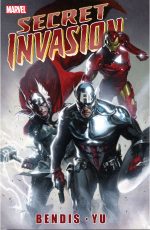
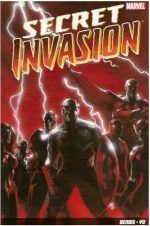
Secret Invasion


By Brian Michael Bendis, Leinil Francis Yu, Mark Morales & various (Marvel)
ISBN: 978-0-7851-3297-4 (TPB/Digital edition Marvel) 978-1-84653-405-8 (TPB Panini/Marvel UK)

The Skrulls are shape-shifting aliens who have threatened Earth since the second issue of Fantastic Four, and have long been a cornerstone of the Marvel Universe. After decades of use and misuse the insidious invaders were made the stars of a colossal braided mega-crossover event beginning in April 2008 and running through all the company’s titles until Christmas. That landmark worlds-shaking epic has since been adapted to the company’s burgeoning, blockbuster Marvel Cinematic Universe. If you were a real fan, you’d have already seen the first episode…

We, however, are all about the comics so let’s revisit the stunning and all-pervasive source material. The premise is simple enough: the everchanging, corruptive would-be conquerors have undergone a mass religious conversion and are now utterly, fanatically dedicated to taking Earth as their new homeworld. To this end they have replaced over an unspecified time a number of key Earth denizens – including many of the world’s superheroes.

When the lid is lifted on the simmering plot, no defender of the Earth truly knows who is on their side…

Moreover the cosmic charlatans have also unravelled the secrets of humanity’s magical and genetic superpowers, creating amped-up equivalents to Earth’s mightiest. They are now primed and able to destroy the heroic defenders in face-to-face confrontations.

With the conquest primed to launch, everything starts to unravel when Elektra dies in battle and is discovered to be an alien, not a ninja. Soon, two teams of Avengers (Iron Man, The Sentry, Wonder Man, Daredevil, Ms. Marvel, Spider-Woman, Wolverine, Luke Cage, Iron Fist, Ronin, Echo, Cloak and Black Widow) and certain agents of S.H.I.E.L.D.  are covertly investigating in discrete operations. All are painfully aware that they have no way of telling friend from foe…

Crisis and confusion are compounded when a Skrull ship crashes in the primordial Savage Land, releasing a band of missing heroes claiming to have been abducted and experimented on. Among them are another Spider-Man, Luke Cage, recently killed Captain America Steve Rogers, Phoenix/Jean Grey and Thor, plus other heroes believed gone forever. Some must be Skrull duplicates but are they the newcomers or the ones facing them…?

As the champions second guess each other, the second strand triggers. Earths space defence station S.W.O.R.D. is blown up and a virus rips through the internet shutting down crucial systems including the Starktech comprising the operating systems of S.H.I.E.L.D. and Iron Man’s armour…

Now all over Earth, Skrulls attack and heroes – and even villains such as Norman (Green Goblin) Osborn – respond and retaliate in a last ditch effort to survive: a war of survival that ends in shock, horror and unforeseen disaster…

Rather than give any more away, let me just say that if you like this sort of blockbuster saga you’ll be in seventh heaven, and a detailed familiarity is not vital to your understanding. However, for a fuller understanding, amongst the other Secret Invasion volumes accompanying this, you should particularly seek out Secret Invasion: the Infiltration, Secret War (2004), Avengers Disassembled, and Annihilation volumes 1-3, as well as the Avengers: Illuminati compilation.

This American volume contains all 8 issues of the core miniseries plus a monumental covers-&-variants gallery (31 in total) by Gabriele Dell’Otto, Steve McNiven, Leinil Yu, Mel Rubi, Frank Cho, Laura Martin and Greg Horn, and a series of chilling house ads imploring us to ‘Embrace Change’, but is just one of 22 volumes comprising the vast number of episodes in convergent storylines of the saga.

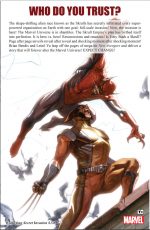
Fast-paced, complex, superbly illustrated and suitably spectacular, this twisty-turny tale and its long-term repercussions reshaped the Marvel Universe, heralding a “Dark Reign” that pushed all the envelopes. If you are a comics newcomer, and can find the British edition from Panini, it also includes one-shot spin-off Who Do You Trust? and illustrated data-book Skrulls which claims to provide a listing and biography for every shapeshifter yet encountered in the Marvel Universe (but if they left any out, could you tell?).
© 2017 Marvel Characters, Inc. All rights reserved.

The Avengers: Earth’s Mightiest Heroes Ultimate Collection


By Joe Casey, Scott Kolins, Will Rosado, Tom Palmer & various (Marvel)
ISBN: 978-0-7851-5937-7 (TPB/Digital edition)

Time for another 60th Anniversary shout out…

One of the most momentous events in Marvel Comics history occurred in 1963 when a disparate array of individual heroes banded together to stop apparently marauding monster The Incredible Hulk.

The Avengers combined most of the company’s fledgling superhero line in one bright, shiny and highly commercial package. Over decades the roster has continually changed until now almost every character in their universe has at some time numbered amongst the team’s colourful ranks…

For Marvel’s transformational rebirth in the early 1960’s, Stan Lee & Jack Kirby took their lead from a small but growing band of costumed characters debuting or reimagined and revived at the Distinguished Competition. Julie Schwartz’ retooling of DC’s Golden Age stars had paid big dividends for the industry leader, and as the decade turned Managing Editor Lee’s boss (uncle/publisher Martin Goodman) insisted his company should go where the money was.

Although National/DC achieved incredible success with revised and updated versions of the company’s old stable, the natural gambit of trying the same revivification process on characters who had dominated Timely/Atlas in those halcyon days didn’t go quite so well.

The Justice League of America-inspired Fantastic Four indeed featured a new Human Torch, but his subsequent solo series began to founder almost as soon as Kirby stopped drawing it. Sub-Mariner was soon returned too, but as a deadly vengeful villain, as yet incapable of carrying his own title…

So a procession of new costumed heroes was created, with Lee, Kirby and Steve Ditko focussing on all-original inventive and inspired “super-characters”…

Not all caught on: The Hulk folded after six issues and even Spider-Man would have failed if writer/editor Lee hadn’t really, really pushed Uncle Martin…

After nearly 18 months, during which the fledgling House of Ideas churned out a small stable of leading men (but only two sidekick women), Lee & Kirby finally had enough players to stock an all-star ensemble – the precise format which had made the JLA a commercial winner – and thus swiftly assembled a handful of them into a force for justice and higher sales…

Cover-dated September 1963, The Avengers #1 launched as part of an expansion package which also included Sgt. Fury and his Howling Commandos and The X-Men, and, despite a few rocky patches, the series grew into one of the company’s perennial best sellers.

The early Avengers yarns became a cornerstone of the company’s crucially interlinked continuity. As decades passed they were frequently revisited and re-examined, and in 2005 Joe Casey and artist Scott Kolins (with colourists Morry Hollowell & Will Quintana) took the occasional exercises in creativity a little further: offering an 8-issue modernising miniseries adding devious – some would say cynically calculating – back-writing to the original stories. The epic was packed with post-modern in-filling for a more mature readership, exposing secrets and revealing how the team actually came to hold its prominent and predominant position in the Marvel Universe…

Avengers: Earth’s Mightiest Heroes #1-8 ran fortnightly from January to April 2005 and was successful enough to warrant a second season. Avengers: Earth’s Mightiest Heroes II #1-8 repeated the gambit from January to May 2007, and with both epics gathered in this splendid, no-nonsense compilation.

Chronologically set between Avengers #1 and 2, the drama begins as industrialist Tony Stark reviews media coverage of the coalition of mystery men currently residing in his family’s townhouse. He ponders how best to keep such diverse and headstrong personalities as Ant Man, The Wasp, Thor and the Hulk together. Across town in a seedy bar, young troublemaker and pool-hustler Clint Barton can’t understand why folks are so nervous about the “masked freaks”…

Two weeks later, the team has fallen apart and the Avengers are actually hunting their gamma-fuelled former colleague. In the course of calamitous events they unexpectedly recover a legendary form from a coffin of ice floating in sea…

The gradually assimilation of partially amnesiac WWII legend Captain America into a terrifying and seemingly mad new era is not without problems, and the iconic, grimly experienced warrior is soon keenly aware of seething tensions besetting the team he has joined.

Iron Man still fervently pursues an exalted Federal status for the Avengers, but the Army are baulking: clearly set on putting the wilfully independent powerhouses under military jurisdiction. After a ferocious clash with Lava Men from Earth’s deep interior, word finally comes. The powers that be have created an all-encompassing “Avengers Priority Security Status” – but only for as long as the fickle public’s new darling and National Treasure Captain America stays with them…

Self-made scientific genius Hank Pym created the roles of Ant Man and the Wasp (AKA debutante girlfriend Janet Van Dyne) but his inherent and growing mental instability has caused him to push further and harder ever since he joined the ranks of a group that includes a patriotic living legend, an infallible metal juggernaut and an apparent god.

Now operating as Giant Man he is letting feelings of inadequacy drive a wedge between him and his lover, even as the Army ups the pressure to take over the team. Meanwhile, modern-day Rip Van Winkle Steve Rogers increasingly sinks into survivor’s guilt over the comrades he failed to save in the war. That internalised torment kicks into overdrive when Nazi war criminal and archfoe Baron Zemo comes out of hiding to attack the Avenger through his Masters of Evil

When an invader out of time strikes, the Avengers finally and very publicly prove their worth to the nation and its government, and with Kang the Conqueror sent packing, the team at last secures favoured-but-fully-independent security clearance.

…And in the streets, a wanted vigilante dubbed Hawkeye saves Avengers butler Edwin Jarvis from muggers and they strike up a most irregular friendship…

Missions come thick and fast but the internal tensions never seem to dissipate. In far distant Balkan Transia fugitive mutants Wanda and Pietro desperately search for a place where they can feel safe, whilst in America Cap is increasingly fixated on tracking down Zemo.

After a battle with crime syndicate leader Count Nefaria leaves the Wasp near death, Giant Man also edges closer to a complete breakdown. With a surgeon battling to save her, Pym swears he’s going to quit and take her away from all the madness. Before that can happen, Zemo returns, abducting the Sentinel of Liberty’s teenaged friend Rick Jones

In response, the team acrimoniously divides, with Cap trailing the monomaniac to Bolivia whilst the majority of Avengers remain for a final battle against the Masters of Evil. Meanwhile below stairs, Jarvis and Clint are concocting a sneaky scheme of their own…

As the death-duel in Bolivia concludes, in Germany two restless young mutants orchestrate their return to America and – with some collusion from Jarvis – Hawkeye “auditions” for Earth’s Mightiest Heroes…

As Cap and Rick wearily and so slowly make their way back to civilisation, Iron Man deals with Government fallout after learning that their Red, White and Blue poster boy is missing. Soon news leaks out that the rest of the team are quitting and that Stark has lined up a wanted vigilante and two outlaw mutants to replace them…

The initial secret history lesson concludes with astounded Captain America’s re-emergence and reluctant accession to leadership: riding herd on a team of obnoxious, arrogant young felons he is expected to mould into true champions…

The rest is history…

The second bite of the cherry (by Casey, Will Rosado, Tom Palmer & Quintana) focuses on a later time when the Avengers are in resurgent form. The Founders have all returned at a time when Pym (now calling himself Goliath), The Wasp and Hawkeye are joined by enigmatic African monarch The Black Panther. The action commences immediately following the expanded team’s being attacked by an android called The Vision – whom they promptly signed up (in Avengers #58, if you’re keeping count). Apparently the density-shifting “synthezoid” was created by robotic nemesis Ultron – a murderous AI created by Pym whilst suffering one of his frequent psychotic breaks – before switching allegiances…

We open as the highly-suspect new Avenger is impounded by S.H.I.E.L.D. for investigation and clearance. Their ostensible reason is that another autonomous murder mechanism – Super-Adaptoid – has escaped from custody and humanity can’t be too careful…

In the Philippines, the real cause of all the anti-technology tension and overweening suspicion are busy. Science terrorists Advanced Idea Mechanics have secretly stolen the Adaptoid and are seeing how they can improve an already ultimate killing machine…

At a clandestine S.H.I.E.L.D. base, interrogator Jasper Sitwell has met his match in The Vision, but perseveres in trying to dig out dirt on the android and its “master” Ultron. The Panther meanwhile has foregone his status as a VIP dignitary to teach at an inner city school under the alias Luke Charles. What he finds there is a true education…

Hawkeye too is under pressure as his lover The Black Widow reveals she’s going back into the spy-game. With Pym close to apoplexy at the government’s quasi-legal rendition of the Vision, nobody is in a particularly good mood when S.H.I.E.L.D.  supremo Nick Fury (the white one who fought in WWII) demands the team head to the Philippines to investigate A.I.M.’s latest enterprise.

With Fury’s carrot-&-stick pep talk ringing in their ears the heroes – rejoined by the just released Vision – jet away, unaware that in Manhattan an assassination plot against King T’Challa/Mr. Charles has brought one of Panther’s greatest enemies to America…

The heroes are challenged over the Pacific skies by a mass-produced army of Super-Adaptoids and are soon engaged in the fight of their lives…

Overwhelmed, they are in danger of being swamped before Goliath valiantly turns himself into as colossal human rampart to stem the tide and save the endangered island population whilst his comrades rush to destroy A.I.M.’s superbase…

Left all alone, Pym fights in maddened frenzy and becomes increasingly obsessed with how human the things he is incessantly slaughtering seem to be. By the time the triumphant team get Goliath home, he is a deeply traumatised shell of a man…

Luke Charles returns to school in time to be deeply embroiled in a bullying case that will inevitably end in gunplay and tragedy. And then the apparently recuperating Hank Pym goes missing…

Soon after, a new, excessively brutal hero named Yellowjacket is making news even as Agent Sitwell again targets the Vision for further debriefing: specifically, Pym’s “massacre” of mechanical lifeforms on A.I.M. Island. This time he’s brought in S.H.I.E.L.D.’s top psychologist Agent Carver to try and get under the subject’s artificial skin…

The spies are in heated argument with Hawkeye when Yellowjacket breaks in, claiming to have murdered the Man of Many Sizes and demanding to take Goliath’s place on the team…

Nobody is fooled. Everyone recognises the abrasive stranger as Pym gone far off the deep end, but Carver prevents them from saying anything. She advises that he is clearly inches from being utterly incurable and devises a treatment to cure him which basically comprises “play along and don’t do anything to upset the crazy man”…

That even includes allowing Yellowjacket to kidnap the Wasp and agreeing to let him marry his hostage…

The wedding is held at Avengers Mansion and includes a Who’s Who of heroes along for the ride (The Fantastic Four, X-Men, Spider-Man, The Black Knight and Doctor Strange) but the scheme spirals out of control when The Circus of Crime – not privy to the details of the service – use the gathering as an opportunity to kill all America’s costumed champions in one go…

With Hawkeye and the blushing bride hostages and the first to be despatched, the deadly dilemma shocks Pym back to his rightest senses, but in the aftermath many S.H.I.E.L.D. agents are butchered as Wakandan assassin Death Tiger gets ever closer to fulfilling his own mission of murder…

To cap off all the chaos, the still-at-large Super-Adaptoid also attacks, determined to expunge “race-traitor” The Vision who has perpetrated the ultimate betrayal by siding with inferior humanity and denying the innate superiority and inevitable ascension of mechanical and artificial lifeforms…

Politically savvy, wryly trenchant and compellingly action-packed, this extremely impressive Fights ‘n’ Tights chronicle is a superb addition/codicil to the annals of The Avengers and would serve as perfect comics vehicle for movie fans in search of a print-fix for their costumed crusader cravings…
© 2021 MARVEL.

Warlock Marvel Masterworks volume 2


By Jim Starlin, with Bill Mantlo, John Byrne, Steve Leialoha, Josef Rubinstein, Al Milgrom, Alan Weiss, Dave Hunt & various (Marvel)
ISBN: 978-0-7851-3511-1 (HB/Digital edition)

During the early 1970s the first inklings of wider public respect for the medium of graphic narratives began to blossom in English-speaking lands. This followed avid response to pioneering stories such as Denny O’Neil & Neal Adams’ “relevancy” Green Lantern run, Stan Lee & John Buscema’s biblically allegorical Silver Surfer or Roy Thomas’ ecologically strident antihero Sub-Mariner. These all led a procession of thoughtfully-delivered attacks on drugs in many titles, and a long running undeclared campaign to support positive racial role models and include characters of colour everywhere on four-colour pages.

Part of a movement and situation mirrored in Europe and Japan, our comics were inexorably developing into a vibrant platform of diversity and forum for debate, engaging youngsters in real world issues germane and relevant to them.

In 1972, Thomas had taken the next logical step: transubstantiating an old Lee & Kirby Fantastic Four throwaway foe into a potent political and religious metaphor for the Questioning Generation…

Debuting in FF #66 (September 1967) mystery menace Him was re-imagined by Thomas & Gil Kane as a modern interpretation of the Christ myth: stationed on an alternate Earth far more like our own than that of Marvel’s fantastic universe.

Re-presenting Strange Tales #178-181, Warlock #9-15, Marvel Team-Up #55, Avengers Annual #7 and Marvel Two-in-One Annual #2 – collectively spanning cover-dates February 1975 to the end of 1977, this epic astral adventure also offers a context-soaked Introduction from comics historian/documentarian Jon B. Cook.

For latecomers and those informed only by movies…

It all began with The Power of… Warlock as the artificial man’s origin story – a lab experiment concocted by rogue geneticists – was goosed up after meeting man-made and self-created god The High Evolutionary. He was wrapped up in a bold new experiment to replicate planet Earth on the opposite side of the sun. He replayed – on fast-forward – the development of life, intent on creating humanity without the taint of cruelty and greed and deprived of the lust to kill…

It might well have worked, but when the Evolutionary wearied, his greatest mistake cruelly intervened. Man-Beast was a hyper-evolved wolf with mighty powers, ferocious savagery and ruthless wickedness. He despoiled humanity’s rise, and ensuring the Counter-Earth’s development exactly mirrored its template – with the critical exception of the superheroic ideal. This beleaguered world suffered all mankind’s woes but had no extraordinary beings to save or inspire them.

A helpless witness to desecration, Him crashed free of his life-supporting cocoon to save the Evolutionary and rout Man-Beast and his bestial cronies -a legion of similarly evolved rogue animal-humanoids dubbed “New-Men”). When the despondent, furious science god recovered, he wanted to erase his failed experiment but was stopped by his rescuer.

As a powerless observer, Him had seen the potential and value of embattled humanity. For all their flaws, he believed he could save them from the many imminent dooms caused by their own unthinking actions – pollution, over-population, wars and intolerance. His pleas convinced the Evolutionary to give this mankind one last chance…

The wanderer was hurled down to Counter-Earth, equipped with a strange gem to focus his powers, a mission to find the best in the fallen and a name of his own – Adam Warlock

He battled long and hard and even gathered a band of faithful followers, but was constantly defeated and frustrated by human intransigence and Man-Beast’s forces, who had infiltrated and corrupted all aspects of society – especially America’s political hierarchy and the Military/Industrial complex.

After 8 issues of his struggle and a couple of interventions by Earth’s Incredible Hulk, the saga apparently ended when messianic Adam Warlock died and was reborn, thwarting Satan-analogue Man-Beast with the aid of the Jade Juggernaut: delivering a karmic coup de grace before ascending from Counter-Earth to the beckoning stars…

When the feature returned at the end of 1974 the tone, just like the times, had hugely changed. In the wake of Vietnam and Watergate, hopeful positivity and comfortable naivety had turned to world-weary cynicism and the character was draped in precepts of inescapable doom in the manner of doomed warrior Elric. It was a harbinger of things to come…

The story continues in Strange Tales #178 as ultra-imaginative morbid maverick Jim Starlin (Captain Marvel, Master of Kung Fu, Infinity Gauntlet, Dreadstar, Batman, Kid Kosmos) turns the astral wanderer into a Michael Moorcock-inspired death-obsessed, constantly outraged but exceedingly reluctant and cynical cosmic champion.

The slow spiral to oblivion begins in February cover-dated Strange Tales #178, where Starlin introduces alien Greek Chorus Sphinxor of Pegasus to recap the past by asking and answering ‘Who is Adam Warlock?’

Handling everything but lettering – that’s left to Annette Kawecki – Starlin has solitary wanderer Warlock brooding on a desolate asteroid in the Hercules star cluster just as a trio of brutes attack a frightened girl. Despite his best efforts they execute her, proud of their status as Grand Inquisitors of the Universal Church of Truth and ecstatic to remove one more heathen unbeliever…

Appalled to have failed another innocent, Warlock employs the Soul Gem at his brow to briefly resurrect her and learns of an all-conquering ruthless militant religion intent on converting or eradicating all life. His search triggers a chilling confrontation as ‘Enter The Magus!’ sees the living god of the UCT attack him and crushingly reveal an awful truth: the being who has subjugated countless worlds, exterminated trillions and fostered every dark desire of sentient beings is his own future self.

Adam Warlock than swears that he will battle this impossible situation and do whatever is necessary to prevent himself becoming his worst nightmare…

With Tom Orzechowski on words and Glynis Oliver-Wein doing colours, Starlin’s pilgrimage continues as Warlock attacks an UCT war vessel transporting rebels, “degenerates” and “unproductives” from many converted worlds. The church only deems basic humanoids as sacred and saveable, with most other shapes useful only as fodder or fuel. They make an exception for the universally deplored, vulgar and proudly reprobate race called “Trolls”. In the dungeon-brig of the ship Great Divide, Adam finds his gloomy mood irresistibly lifted by disgusting lout Pip: a troll revelling in his “independent manner and cavalier ways” and not frightened by the imminent death awaiting them all.

Meanwhile, mighty, enhanced true believer Captain Autolycus has received a message from the Temporal Leader of the Faithful. The Matriarch has decided to ignore The Magus’ instruction to capture Warlock and keep him unharmed.

As Adam instructs his fellow prisoners in the nature of rule, Autolycus acts on her command, losing his entire crew and perishing when Warlock breaks loose. After escaping the ‘Death Ship!’, Adam realises Pip has stowed away, keen to share a new adventure, but lets it go. He has a bigger problem: in the climactic final battle, the Soul Gem refused his commands, acting on its own to consume Autolycus’ memories and persona, locking them inside the twisted champion’s head…

In ST #180’s ‘Judgment!’ (with additional inking by Alan Weiss), Pip and Warlock have submerged themselves in the heaving masses of Homeworld whilst hunting the living god they oppose. Terrified of the uncontrollable spiritual vampire on his brow, Adam tries to remove it and discovers it has already stolen him: without it he will perish in seconds…

Pushed into precipitate action and living on borrowed time, Warlock invades the Sacred Palace and is offered a curious deal by the Matriarch and is captured when he refuses. Subjected to ‘The Trial of Adam Warlock’, the appalled adventurer endures a twisted view of the universe courtesy of Grand Inquisitor Kray-Tor, even as in the city, Pip thinks he scored with a hot chick. In truth, he’s been targeted by public enemy number one. Gamora is called “the deadliest woman in the whole galaxy” and has plans for Adam, which include him being alive and free…

Back in court, the golden man has rejected Kray-Tor’s verdict and, disgusted and revolted by the proceedings, foolishly lets his Soul Gem feed. The carnage he triggers and subsequent guilt leaves him catatonic and in the hands of the Matriarch’s cerebral reprogrammers…

Starlin was always an outspoken and driven creator with opinions he struggled to suppress. His problems with Marvel’s working practises underpin ST #181’s ‘1000 Clowns!’ as old pal Al Milgrom inks a fantastic recap and psychological road trip inside the hero’s mind. None of the subtext is germane if you’re just looking for a great story however, and – in-world – Warlock’s resistance to mind-control is mirrored by Pip and Gamora’s advance through the UCT citadel to his side.

Embattled by the psychic propaganda assaulting him, Warlock retreats into the safety of madness, and learns to his horror that this has been what The Magus wanted all along. Now the dark messiah’s victory and genesis are assured…

The triumph was celebrated by the resurrection of the hero’s own title and – cover-dated October 1975 – Warlock #9 revealed the master plan of Adam’s future self. Inked by Steve Leialoha ‘The Infinity Effect!’ saw the mirror images in stark confrontation with evil ascendent, unaware that Gamora was an agent of a hidden third party and that all the chaos and calamity was part of a war of cosmically conceptual forces.

The saga heads into the Endgame as the Magus explains in cruel detail how he came to power and that Adam’s coming days are merely his past, before summoning abstract terror The In-Betweener to usher in their inevitable transformation. There is one problem however: the first time around Adam/Magus was never attacked and almost thwarted by an invisible green warrior woman.

Crushed by the realisation that he will become a mass-murdering spiritual vampire, Warlock reels as the hidden third element arrives to save everything…

‘How Strange My Destiny!’ (#10, inked by Leialoha) finds Pip, Gamora, Adam and mad Titan Thanos battling 25,000 cyborg Black Knights of the Church rapturously paying ‘The Price!’ of devotion in a stalling tactic until the In-Betweener arrives…

Kree Captain Mar-Vell narrates a handy catch-up chapter detailing ‘Who is Thanos?’ as the beleaguered champions escape, before ‘Enter the Redemption Principle!’ explores some of the Titan’s scheme and why he opposes the Magus and his Church, even as the victorious dark deity realises that Thanos’ time probe is the only thing that can upset his existence…

How Strange My Destiny – with finished art by Leialoha from Starlin’s layouts – continues and concludes in #11 as ‘Escape into the Inner Prison!’ sees the Magus and his Black Knight death squads brutally board Thanos’ space ark. A combination of raw power and the Soul Gem buy enough time for Warlock and the troll to use the time probe, which dumps them in the future, just as In-Betweener arrives to convert the hero and supervise ‘The Strange Death of Adam Warlock!’, resulting in a reshuffling of chronal reality and Thanos’ triumph…

After months of encroaching and overlapping Armageddons, Warlock #12 diverts and digresses in ‘A Trollish Tale!’ as Pip’s addiction to hedonism and debauchery entraps him in professional harlot Heater Delight’s plan to escape a life on (non)human sexual trafficking in a star-roaming pleasure cruiser. He’s happy with the promised reward for his efforts, but hadn’t considered that her pimp might object to losing his meal ticket…

Drama returns with a bang in #13 as ‘…Here Dwells the Star Thief!’ introduces a threat to the entire universe stemming from a hospital bed on Earth. New England’s Wildwood Hospital houses Barry Bauman, whose life is blighted by a total lack of connection between his brain and nerve functions. Isolated and turned inward for his entire life, Barry has discovered astounding psychic abilities, the first of which was to possess his nurse and navigate an unsuspected outer world. His intellect also roams the endless universe and brooding, doomed Warlock is there when Barry consumes an entire star just for fun…

Outraged at the wilful destruction, Warlock uses his own powers to trace the psionic force and resolves to follow it back to the planet of his original conception and construction even as ‘The Bizarre Brain of Barry Bauman’ explores the Star Thief’s origins and motivations before formally challenging Adam to a game of “stop me if you can”…

Spitefully erasing stars and terrorising the Earth as Warlock traverses galaxies at top speed, Bauman knows a secret about his foe that makes his victory assured, but still lays traps in his interstellar path. The ‘Homecoming!’ is accelerated by a shortcut through a black hole but when Adam arrives at the Sol system, he receives a staggering shock: his journeys and simple physics have wrought physical changes making it impossible to ever go home again…

Sadly for Barry, his gleeful frustration of his foe distracts him just when he should be paying close attention to his physical body…

As the series abruptly ended again (November 1976), Starlin returned to full art & story chores in #15’s ‘Just a Series of Events!’ Exiled from Earth, Adam rants as elsewhere, Thanos moves on his long-term plans. Without the threat of The Magus, his desire for total stellar genocide can proceed, but he worries that his adopted daughter Gamora might be a problem. He should be more concerned about his own nemesis-by-design Drax the Destroyer

The saga then pauses with Adam, confronting a host of plebian injustices and seemingly gaining dominance over his Soul Gem…

Vanished again, Adam Warlock only languished in limbo for a few months. In mid-December 1976, Marvel Team-Up #55 (cover-dated March 1977) addressed his altered state as Bill Mantlo, John Byrne & Dave Hunt crafted ‘Spider, Spider on the Moon!’

For reason too complicated to explain here, Spider-Man had been trapped in a rocket and blasted into space and was happily intercepted and left in the oxygenated-and heated Blue Area. Warlock then assisted the Arachnid and mysterious alien The Gardener against overbearing ephemera collector The Stranger. He sought possession of the Golden Gladiator’s life-sustaining Soul Gem, but soon discovered an equally fascinating alternate choice…

Despite his sporadic and frankly messy publishing career, Warlock has been at the heart of many of Marvel’s most epochal and well-regarded cosmic comic classics, and ending this compendium is probably the very best: an extended epic spanning two summer annuals and seemingly signalling the end on an era…

‘The Final Threat’ (by Starlin & Joe Rubinstein) comes from Avengers Annual #7, which sees Protector of the Universe Mar-Vell AKA Captain Marvel and Titanian ultra-mentat Moondragon return to Earth with vague anticipations of impending catastrophe. Their premonitions are confirmed when galactic wanderer Adam Warlock arrives with news that death-obsessed Thanos has amassed an alien armada and built a soul gem-fuelled weapon to snuff out stars like candles…

Spanning interstellar space to stop the scheme, the united heroes forestall alien invasion and prevent the Dark Titan from destroying the Sun, but only at the cost of Warlock’s life…

Then ‘Death Watch!’ (Starlin & Rubinstein, Marvel Two-in-One Annual #2) finds Peter Parker plagued by prophetic nightmares. These disclose how Thanos had snatched victory from defeat and now holds the Avengers captive whilst again preparing to extinguish Sol.

With nowhere else to turn, the anguished, disbelieving webspinner heads for the Baxter Building, hoping to borrow a spacecraft, and unaware that The Thing also has a history with the terrifying Titan.

Although utterly overmatched, the mismatched Champions of Life subsequently upset Thanos’ plans for long enough to free the Avengers before the Universe’s true agent of retribution ends the Titan’s threat forever… at least until next time…

The sidereal saga seemingly done, this collection also offers bonus treats in the form of 16 pages of unused pencils by Alan Weiss. The photostats come from an issue lost in transit, and are supplemented by before-&-after panels judged unsuitable by the Comics Code Authority, the various production stages of Starlin & Weiss’ cover art for Warlock #9, with sketches, designs, frontispieces and full pages of original art.

Also on view are Starlin’s wraparound covers from 1983 reprint series Warlock Special Edition #1-6 and 1992-1993’s Warlock reruns (#1-6) in support of the Infinity Gauntlet, plus pertinent house ads and full biographies.

Ambitious, unconventional and beautiful to behold, Warlock’s adventures are very much a product of their tempestuous, socially divisive times. For many, they proved how mature comics might become, but for others they were simply pretty pictures and epic fights with little lasting relevance. What they unquestionably remain is a series of crucial stepping stones to greater epics: unmissable appetisers to Marvel Magic at its finest.
© 2017 Marvel Characters, Inc. All rights reserved.

Captain America Sam Wilson volume 1: Not My Captain America


By Nick Spencer, Daniel Acuña, Paul Renaud, Joe Bennett, Mike Choi, Romulo Fajardo Jr., Belardino Brabo & various (Marvel)
ISBN: 978-0-7851-9640-2 (TPB/Digital edition)

Created by Joe Simon & Jack Kirby in an era of national turmoil and frantic patriotic fervour, Captain America was a dynamic, emphatically visible response to the horrors of Nazism and the threat of Liberty’s loss. Consequently, the concept quickly lost focus and popularity once hostilities ceased. The Sentinel of Freedom and Champion of Democracy faded away during post-war reconstruction, only to briefly reappear after the Korean War: a harder, darker Cold Warrior hunting monsters, subversives and “Reds” who lurked under every American bed.

He abruptly vanished once more, until the burgeoning Marvel Age resurrected him just in time to experience the Land of the Free’s most turbulent, culturally divisive era. He became a mainstay of the Marvel Revolution in the Swinging Sixties, but lost his way after that, except for a politically-fuelled, radically liberal charged period under scripter Steve Englehart.

Despite everything, Captain America evolved into a powerful symbol for generations of readers and his career can’t help but reflect that of the nation he stands for…

Devised in the fall of 1940 and on newsstands by December 20th, Captain America Comics #1 was cover-dated March 1941, and an instant monster, blockbuster smash-hit. The Sentinel of Liberty had boldly and bombastically launched in his own monthly title with none of the publisher’s customary caution, and instantly became the absolute and undisputed star of Timely’s top-selling “Big Three” (with The Human Torch and Sub-Mariner.)

He was, however, one of the first to fall from popularity as the Golden Age ended.

During that initial run, his exploits were tinged – or maybe “tainted” – by the sheer exuberant venom of appalling racial stereotyping and fervent jingoism at a time when America was involved in the greatest war in world history. Nevertheless, the first 10 issues of Captain America Comics remain amongst are the most exceptional comics in history…

You know the origin story like your own. Simon & Kirby revealed how scrawny, enfeebled patriot and genuinely Good Man Steven Rogers – after being continually rejected by the US Army – is recruited by the Secret Service. Desperate to stop Nazi expansion and Home Front mischief, the passionate kid joined a clandestine experimental effort to create physically perfect super-soldiers.

I have no idea if the irony of American Übermenschen occurred to the two Jewish kids creating that mythology, but here we are…

When a Nazi infiltrated the project and murdered the pioneering scientist behind it, Rogers was left as the only successful result and became America’s not-so-secret weapon. When he was lost, others took up the role and have periodically done so ever since. I might be wrong, but as I recall every substitute and replacement was white and male…

Over decades the story unfolded, constantly massaged and refined, yet essentially remaining intact. In 2002 – and in the wake of numerous real-world scandals like the revelations of the “Tuskegee Experiment” (AKA Tuskegee Syphilis Study 1932-1972) – Robert Morales & Kyle Baker took a trenchantly cynical second look at the legend through the lens of the treatment of and white attitudes towards black American citizens…

The result was Truth: Red, White & Black (link please): a hard-hitting view of the other side of a Marvel foundational myth that forever changed continuity: one using tragedy and injustice to add more – and more challenging – role models/heroes of colour to the pantheon.

As Marvel expanded and reached market dominance in the 1960s, its publications ceaselessly whittled away at the unacknowledged colour bar in comics. At this time, many companies (choked to bursting point with seditious Liberals and even some actual Intelligentsia!) were making tentative efforts to address what were national and socio-political iniquities.

However, issues of race and ethnicity took a long time to filter through to still-impressionable young minds avidly absorbing knowledge and formative attitudes via four-colour pages that couldn’t even approximate the skin tones of African-Americans or Asians…

As in television, breakthroughs were small, incremental and too often reduced to a cold-war of daring “firsts”. Excluding a few characters (like Matt Baker’s Voodah) in jungle-themed comic books of the 1940s-1950, Marvel clearly led the field with their black soldier in Sgt. Fury’s Howling Commandos team – the historically impossible Gabe Jones who debuted in #1, May 1963. So unlikely was Gabe that he was automatically and so helpfully re-coloured “Caucasian” at the printers, who clearly didn’t realise his ethnicity but knew he couldn’t be anything but white.

Jones was followed by an actual African superhero when Fantastic Four #52 (cover-dated July 1966) introduced The Black Panther. Throughout that intervening period, strong, competent and consistent black characters – like The Daily Bugle’s city editor Robbie Robertson (Amazing Spider-Man #51, August 1967) and detective Willie Lincoln (Daredevil #47, December 1968) – had been gradually and permanently added to the regular cast of many series. They were erudite, dignified, brave, proudly ordinary mortals distinguished by sterling character, not costume or skin tone: proving that the world wouldn’t end if black folk and white folk occupied the same spaces…

The first “negro” hero to helm his own title had already come (and gone largely unnoticed) in a little-regarded title from Dell Comics. Debuting in December 1965 and created by artist Tony Tallarico & scripter D.J. Arneson, Lobo was a black gunslinger in the old west, battling injustice just like any “white hat” cowboy would.

For Marvel, the big moment came in Captain America #117 (September 1969) as, during an extended battle against the Red Skull and his sinister Exiles, artist Gene Colan got his wish to create the industry’s first official African American superhero: Sam Wilson, The Falcon

After a few cautious months, he returned, became Captain America’s friend, student, partner and – after decades – ultimately his replacement…

Finally, change was acceptable. As the 1960s ended, more positive and inclusive incidences of ethnic characters appeared, with DC finally launching a black hero in John Stewart (Green Lantern #87, December 1971/January 1972) – although his designation as a replacement GL could be construed as more conciliatory and insulting than revolutionary.

DC’s first solo star in his own title was Black Lightning, but he didn’t debut until April 1977, although Jack Kirby had introduced Vykin in Forever People #1, the Black Racer in New Gods #3 (March and July 1971) and Shilo Norman as Scott Free’s apprentice/successor in Mister Miracle #15 (August 1973), whilst Archie Goodwin engineered Marvel’s biggest triumph with the launch of Luke Cage, Hero for Hire in the summer of 1972. A year later, Black Panther won his own series in Jungle Action #5 and Blade: Vampire Hunter debuted in Tomb of Dracula #10. At last, black people were part and parcel of a greater continuity society, not separate and isolated chimera on the fringes…

This big change came from incremental advances slowly achieved against the backdrop of a huge societal shift triggered by the Civil Rights movement, but even though it all grew out of raised social awareness during a terrible time in American history (yes, even worse than today’s festering social wars), kids and other readers knew something special was happening and they must participate…

Nearly half a century later, following a convoluted but generally steady and steadfast career, multi-talented flying superhero Sam Wilson was a tried and true star: holding a succession of civilian jobs – from social worker to architect to politician – whilst his true vocation was being a superhero, singly, in partnerships in the Avengers and as part of S.H.I.EL.D.

Recently: After spending 12 relative years in hellish time-bent Dimension Z raising a child and saving its indigenous people from sadistic Hitlerian uber-geneticist Arnim Zola, Steve Rogers finally returned to Earth to discover mere hours had passed in the “real” world.

Barely pausing, he went straight back to work, stopping deranged, drug-dependent US supersoldier Frank Simpson (AKA Nuke: a covert Captain America from the Vietnam era) slaughtering men, women and children in the nation’s name. Rogers was then sucked back into spy games: confronting former S.H.I.E.L.D. agent/messianic socialist Ran Shen, who aroused a sleeping dragon for its power to reshape the world to his liking. As the Iron Nail, he tried to destroy greedy, exploitative, destructive capitalism using tools and techniques taught him by Nick Fury (Senior) and Chinese iconoclast Mao Zedong

Rogers won that war of ideological wonder warriors at the cost of his faith and lifelong purpose of his existence, but fell victim to Dr. Mindbubble: ready, able and extremely willing to share his terrifying expanded sensibilities with the corrupt Establishment world…

Already disgusted by the procession of appalling creations his country has devised in the name of security, Cap’s peace of mind took another big hit when S.H.I.E.L.D. admitted Mindbubble was theirs: a countermeasure to possible rogue super soldiers, but one mothballed when the cure proved worse than the anticipated affliction…

When the so-very-mad Doctor triggered S.H.I.E.L.D.’s ultimate doomsday weapon, Captain America and The Falcon did what they always did to save the world. Ultimately though, it was Rogers, resolute and alone, who fought his greatest battle to save innocents and a nation he embodied but no longer trusted…

What the Falcon rescued from the rubble, Rogers was no longer Captain America at all…

In the aftermath, and as part of publishing relaunch “All-New, All-Different”, weary, worn-out enfeebled Rogers got a desk job as security supremo whilst Wilson was promoted to Captain America. Sam picked up the shield, rebuilt his wings and promptly proved himself by stopping a plot to destroy humanity perpetrated by Helmut Zemo, Baron Blood and Hydra: executed by Sin, Batroc, Taskmaster, Armadillo, Crossbones and a host of other old foes…

Here, though, we’re concentrating on a true fresh start as our so-patient hero officially launches his new role. Gathering Captain America: Sam Wilson #1-6 (cover-dated December 2015 – April 2016), it’s scripted by Nick Spencer (Spider-Man, Astonishing Ant-Man) and initially illustrated by Daniel Acuña (Eternals, Wolverine, Black Widow) & Mike Choi.

During his last exploit the “black Cap” had lost sidekick Nomad, formed a potent alliance with wonder warrior/deadly detective Misty Knight, and became a very public figure in all his identities. Now, as he flies coach from Phoenix to New York that celebrity comes back to bite him…

As a public hero, Wilson wanted to try new things and employed Knight, former ally Dennis Dunphy (Demolition Man) and digital whistleblowing vigilante The Whisperer to run a full-time support team. After again beating Crossbones, Wilson repurposed his role as national symbol and defender by taking a public stand on numerous social and political issues. Generating a storm of right-wing dissent and anti-minority hate-speech, he then doubled down by creating a hotline where literally anybody could ask for Captain America’s help…

Pilloried in the media, he soldiered on, despite being inundated by nutjob notices from across the nation. His idea paid off when someone who really needed help made contact…

In Arizona, immigration was always a hot topic, but when Wilson learned young Joaquín Torres had been abducted by ultra-racists The Sons of the Serpent for helping the Mexican community, Captain America got involved…

The kid was one of many minority ethnic Americans helping immigrants, so the Sons had given him to evil genius Karl Malus to use in his experiments. Although the desert end of the human pipeline was quickly crushed, it took some time for Cap to track the kid down. By the time he and Knight had crushed a legion of villains and worked their way up an abhorrent chain, Torres had been cruelly and continually mutated, merged with Wilson’s animal ally Redwing and infected with vampirism, and was well on his way to becoming something unhuman…

Slow, patient work revealed connections to corporate America and just more “business opportunities” for unchecked Capitalism, and led to utter catastrophe after Malus turned Wilson into a science-derived werewolf and himself into a shapeshifting horror in the manner of Venom and Carnage.

Inevitably – and with Joaquín’s help – Knight, D-Man, Whisperer and “Cap-Wolf” stop Malus, only to find the war against the weakest was orchestrated by reptile-themed old foes working with big business. Rebranded “Serpent Solutions”, the former Serpent Society of supervillains sought to control Wall Street and the world, using tactics perfected by Hydra and AIM.

Their campaign kicks off in a tense tale limned by Paul Renaud & colourist Romulo Fajardo Jr., as supposedly reformed “bad-girl” Diamondback plays both sides when the embattled heroes act to expose the snakes’ scheme…

With double-dealing double crosses, unchallenged racial hatred and unchecked greed unleashed, the good guys are completely overwhelmed until the Serpents’ latest victim takes charge of his destiny and the newest incarnation of the Falcon flies to the rescue: claiming his own share of justice and retribution in a spectacular all action finale illustrated by Joe Bennett, Belardino Brabo & Fajardo Jr.

With covers and variants by Acuña, Renaud, Óscar Jiménez Steve Epting, John Cassady & Laura Martin, Mahmud Asrar and Evan “Doc” Shaner, this epic reworking of an American Tale is wry, witty, controversially outspoken (for a mainstream comic, at least) and superbly rewarding: a saga of the Black Cap which laid much of the groundwork for today’s screen informed Sentinel of Liberty. It might be Not My Captain America, but it’s definitely one all fans should see.
© 2016 Marvel Characters, Inc. All rights reserved.

Captain Marvel by Jim Starlin: The Complete Collection


By Jim Starlin, Mike Friedrich, Steve Gerber, Steve Englehart & various (Marvel)
ISBN: 978-1-30290-017-5

50 YEARS!! It’s been five decades since this tale was first told! If you don’t know why, you have a real treat in store…

As much as I’d love to claim that Marvel’s fortunes are solely built on the works of Jack Kirby and Steve Ditko, I’m just not able to. Whereas I can safely avow that without them the modern monolith would not exist, it is also necessary to acknowledge the vital role played by a second generation of creators of the early 1970s. Marvel’s eager welcome to fresh, new, often untried talent paid huge dividends in creativity and – most importantly at a time of industry contraction – resulted in new sales and the retention of a readership that was growing away from traditional comics fare. Best of all, these newcomers spoke with a narrative voice far closer to that of its rebellious audience…

One of the most successful of these newcomers was Jim Starlin. As well as the topical and groundbreaking Master of Kung Fu – co-created with his equally gifted confederates Steve Englehart & Al Milgrom – Starlin’s earliest success was the epic of cosmic odyssey compiled here.

Captain Marvel was an alien on Earth, a defector from the militaristic Kree. He fought for Earth and was atomically bonded to professional sidekick Rick Jones by a pair of wristbands allowing them to share the same space in our universe. When one was here, the other was trapped in the antimatter dimension designated the Negative Zone.

After meandering around the Marvel Universe for a while, continually one step ahead of cancellation (the series had folded many times, but always quickly returned – primarily to secure the all-important Trademark name), Mar-Vell was handed to Starlin – and the young artist was left alone to get on with it.

With many of his fellow neophytes, he began laying seeds (particularly in Iron Man, Sub-Mariner and Daredevil) for a saga that would in many ways become as well-regarded as the Jack Kirby Fourth World Trilogy that inspired it. However, the Thanos War, despite many superficial similarities, would soon develop into a uniquely modern experience. And what it lacked in grandeur, it made up for with sheer energy and enthusiasm…

This epic compendium gathers and collates Iron Man #55, Captain Marvel #25-34, Marvel Feature #12 and pertinent extracts from Daredevil #105. It collectively spanning February 1973 to September 1974, and concludes with the landmark Marvel Graphic Novel #1 from 1982: thus re-presenting Starlin’s entire input into the legend of the Kree Protector of the Universe and one of the company’s most popular and oft-reprinted sagas.

The artistic iconoclasm began in Iron Man #55 (February 1973) where Mike Friedrich scripted Starlin’s opening gambit in a cosmic epic that would change the nature of Marvel itself.

Inked by Mike Esposito, Beware… Beware… Beware the… Blood Brothers!’ introduces formidable and obsessive Drax the Destroyer: an immensely powerful apparent alien trapped under the Nevada desert and in dire need of rescue thanks to the wiles of even more potent extraterrestrial invader Thanos

That comes when the Armoured Avenger blazes in, answering a mysterious SOS, but only after brutally dealing with the secret invader’s deadly underlings…

All this is merely a prelude to the main story which begins unfolding a month later in Captain Marvel #25, courtesy of Friedrich, Starlin, & Chic Stone wherein Thanos unleashes ‘A Taste of Madness!’ and exiles Mar-Vell’s fortunes change forever…

When ambushed by a pack of extraterrestrials, Mar-Vell is forced to admit that his powers have been in decline for some time. Unaware that an unseen foe is counting on that, he allows Rick to manifest (from the Negative Zone) and they check in with sagacious scientific maverick Dr. Savannah. Suddenly, Rick is accused by the savant’s daughter (and Rick’s beloved) Lou-Ann of her father’s murder…

Hauled off to jail, Rick brings in Mar-Vell who is suddenly confronted by a veritable legion of old foes before deducing who in fact his true enemies are…

Issue #26 then sees Rick freed from police custody to confront Lou-Ann over her seeming ‘Betrayal!’ (Starlin, Friedrich & Dave Cockrum). Soon, however, he and Mar-Vell realise they are the targets of psychological warfare: the girl is being mind-controlled whilst Super Skrull and his hidden “Masterlord” are manipulating them and others in search of a lost secret…

When a subsequent scheme to have Mar-Vell kill The Thing spectacularly fails, Thanos takes personal charge. The Titan is hungry for conquest and needs Rick because his subconscious conceals the location of an irresistible ultimate weapon.

Jones awakens to find himself ‘Trapped on Titan!’ (Pablo Marcos inks) but does not realise the villain has already extracted the location of a reality-altering Cosmic Cube from him. Rescued by Thanos’ hyper-powered father Mentor and noble brother Eros, the horrified lad sees first-hand the extent of the genocide the death-loving monster has inflicted upon his own birthworld. Utterly outraged, he summons Captain Marvel to wreak vengeance…

Meanwhile on Earth, still-enslaved Lou-Ann has gone to warn the Mighty Avengers and summarily collapsed. By the time Mar-Vell arrives in #28 she lies near death. ‘When Titans Collide!’ (inks by Dan Green) reveals another plank of Thanos’ plan. As the heroes are picked off by psychic parasite The Controller, the Kree Captain is assaulted by bizarre visions of an incredible ancient being. Fatally distracted, he becomes the malevolent mind-leech’s latest victim…

Al Milgrom inks ‘Metamorphosis!’ as Mar-Vell’s connection to Rick is severed before the Kree is transported to an otherworldly locale where a grotesque eight billion-year-old being named Eon reveals the origins of universal life whilst overseeing the lifelong soldier’s forced evolution into an ultimate warrior: a universal champion gifted with the subtly irresistible power of “Cosmic Awareness”…

Iron Man, meanwhile, has recovered from a previous Controller assault and headed for Marvel Feature #12 to join Ben Grimm in ending a desert incursion by Thanos’ forces before enduring ‘The Bite of the Blood Brothers!’ courtesy of Friedrich, Starlin, & Joe Sinnott, after which the story develops through an extract first seen in Daredevil #105.

Here enigmatic and emotionless super scientist Madame MacEvil tells her origins and foreshadows her future role in the cosmic catastrophe to come. When Thanos killed her family, the infant Heather Douglas was adopted by Mentor, taken to Titan and reared by psionic martial artists of the Shao-Lom Monastery. Years later when Thanos attacked Titan and destroyed the monks, she swore revenge and took a new name – Moondragon

Subsequently returned to Earth and reconnected to his frantic atomic counterpart, the newly-appointed “Protector of the Universe” confronts The Controller, thrashing the monumentally powerful brain-parasite in a devastating display of skill countering exo-skeletal super-strength in #30’s ‘…To Be Free from Control!’ after which #31 celebrates ‘The Beginning of the End!’ (inked by Green & Milgrom) as the Avengers – in a gathering of last resort – are joined by psionic priestess Moondragon and Drax. The latter is revealed as one more of Thanos’ victims, but one recalled from death by supernal forces to destroy the deranged Titan…

The cosmic killer is then revealed as a lover of the personification of Death: determined to give her Earth as a betrothal present. To that end he uses the Cosmic Cube to turn himself into ‘Thanos the Insane God!’ (Green inks) who, with a thought, imprisons all opposition to his reign. However, his insane arrogance leaves cosmically aware Mar-Vell with a slim chance to undo every change, and the last hero brilliantly outmanoeuvres, defeats and apparently destroys The God Himself!’ in the cosmically climactic Captain Marvel #33 (inked by Klaus Janson)…

With the universe saved and a modicum of sanity and security restored, Starlin’s run ended on a relatively weak and inconclusive note in #34 as ‘Blown Away!’ – inked by Jack Abel and dialogued by Englehart – explored the day after doomsday…

As Rick strives to revive his on-again, off-again musical career, a new secret organisation called the Lunatic Legion sends Nitro, the Exploding Man to acquire a canister of deadly gas from an Air Force base where old pal Carol Danvers (long before her transformations into Ms. Marvel, Binary, Warbird and ultimately Captain Marvel) is head of Security…

Although the Protector of the Universe defeats his earth-shattering enemy, Mar-Vell succumbs to the deadly nerve agent released in the battle. The exposure actually kills him but he will not realise that for years to come…

In 1982, The Death of Captain Marvel was the first Marvel Graphic Novel and the one that truly demonstrated how mainstream superhero material could breach the wider world of general publishing.

Written and illustrated by Starlin with lettering by James Novak and colours from Steve Oliff, this tale concluded the career of the mighty Kree Champion in a neatly symmetrical and textually conclusive manner – although the tale’s success led to some pretty crass commercialisations in its wake…

As previously stated, Mar-Vell was an honoured soldier of the alien Kree empire dispatched to Earth as a spy, who went native: becoming first a hero and then the cosmically “aware” Protector of the Universe, destined since universal life began to be its stalwart cosmic champion in the darkest hours.

In concert with the Avengers and other heroes, he defeated death-worshipping Thanos, just as that villain became God, after which the good Captain went on to become a universal force for good.

That insipid last bit pretty much sums up Mar-Vell’s later career: without Thanos, the adventures again became uninspired and eventually just fizzled out. He lost his own comic book, had a brief shot at revival in try-out title Marvel Spotlight and then just faded away…

Re-enter Starlin, who had long been linked to narrative themes of death. He offered a rather novel idea – kill Mar-Vell off and actually leave him dead. What no fan realised at the time was that Starlin was also processing emotional issues thrown up by the passing of his own father and the story he crafted echoed his own emotional turmoil.

In 1982, killing such a high-profile hero was a bold idea, especially considering how long and hard the company had fought to obtain the rights to the name (and sure enough there’s always been somebody with that name in print ever since) but Starlin wasn’t just proposing a gratuitous stunt. The story developed into a different kind of drama: one uniquely at odds with contemporary fare and thinking.

Following the Thanos Saga, Mar-Vell defeated second-rater Nitro but was exposed to experimental nerve gas during the fight. Now years later he discovers that, just as he has found love and contentment, the effects of that gas have inexorably caused cancer in his system. Moreover, it has metastasized into something utterly incurable…

Going through the Kree version of the classic Kubler-Ross Cycle: grief, denial, anger, bargaining, depression and acceptance, the Space-Born hero can only watch as all his friends and comrades try and fail to find a cure, before death comes for him…

This is a thoughtful, intriguing examination of the process of dying observed by a being who never expected to die in bed, and argues forcefully that even in a universe where miracles occur by the hour sometimes death might not be unwelcome…

Today, in a world where the right to life and its intrinsic worth and value are increasingly being challenged and contested by special interest groups, this story is still a strident, forceful reminder that sometimes the personal right to dignity and freedom from distress is as important as any and all other Human Rights.

No big Deus ex Machina, not many fights and no happy ending: but still one of the most compelling stories the House of Ideas ever published.

Augmenting the sidereal saga, a number of now-mandatory bonus bits include Starlin’s exploded-view map-&-blueprint of Thanos’ homeworld Titan; original cover art from Captain Marvel #29 plus original art and the 3-page framing sequence for the reprint issue #36.

Other extras follow: the all-cosmic hero cover to fan-magazine F.O.O.M. #19; the all-new covers, back covers and bridging pages for prestige reprint miniseries The Life of Captain Marvel (as well as the humorous introductory Editori-Al’ strips cartooned by Al Milgrom) and much, much more.

A timeless classic of the company and the genre, this is a tale no full-blooded Fights ‘n’ Tights fan can be without.
© 1972, 1973, 1974, 1982, 2016 Marvel Characters, Inc. All rights reserved.

The Invincible Iron Man Epic Collection volume 1: The Golden Avenger 1963-1965


By Stan Lee, Larry Lieber, Robert Bernstein, Don Rico, Al Hartley, Don Heck, Jack Kirby, Steve Ditko & various (Marvel)
ISBN: 978-0-7851-8863-6 (TPB/Digital edition)

There are a number of ways to interpret the creation and early years of Tony Stark, glamorous millionaire industrialist and inventor – when not operating in his armoured alter-ego of Iron Man.

Created in the immediate aftermath of the Cuban Missile Crisis and at a time when “Red-baiting” and “Commie-bashing” were American national obsessions, the emergence of a brilliant new Thomas Edison using Yankee ingenuity and invention to safeguard and better the World seemed inevitable. Combine the then-all-pervasive belief that technology could solve any problem with the universal imagery of noble knights battling tangible and easily recognisable Evil and the proposition almost becomes a certainty.

Of course, it might simply be that we kids thought it both great fun and very, very cool…

This fabulous full-colour compendium of the Steel Shod Sentinel’s early days reprints all his adventures, feature pages and pin-ups from Tales of Suspense #39 (cover-dated March 1963) through #72 (December 1965), revisiting the dawn of Marvel’s rise to ascendancy.

This period would see the much-diminished and almost bankrupt comics colossus begin challenging DC Comics’ position of dominance, but not quite become the darlings of the student counter-culture. In these tales, Stark is still very much a gung-ho patriotic armaments manufacturer, and not the enlightened capitalist liberal dissenter he would become…

Scripted by Larry Lieber (over brother Stan Lee’s plot) and illustrated by the criminally unappreciated Don Heck, ToS #39 reveals how and why ‘Iron Man is Born!’, with engineering and electronics genius Stark field-testing his latest inventions in Viet Nam before being wounded by a landmine.

Captured by Viet Cong commander Wong-Chu, Stark is told that if he creates weapons for the Reds he will be operated on to remove the metal shrapnel in his chest that will kill him within seven days.

Knowing that Commies can’t be trusted, Stark and aged Professor Yinsen – another captive scientist – build a mobile iron lung to keep his heart beating. They also equip this suit of armour with all the weapons their ingenuity can covertly construct whilst being observed by their captors. Naturally, they succeed and defeat the local tyrant, but not without a tragic sacrifice.

From the next issue, Iron Man’s superhero career is taken as a given, and he has already achieved fame for largely off-camera exploits. Lee continues to plot but Robert Bernstein replaces Lieber as scripter for issues #40-46 and Jack Kirby pencils for Heck. ‘Iron Man versus Gargantus!’ follows the young Marvel pattern by pitting the hero against aliens – albeit via their robotic giant caveman intermediary – in a delightfully rollicking romp.

‘The Stronghold of Doctor Strange!’ (Lee, Bernstein, Kirby & Dick Ayers) features a gloriously spectacular confrontation with a wizard of Science (not Lee & Steve Ditko’s later Mystic Master), after which Heck returns to full art for the espionage and impostors thriller ‘Trapped by the Red Barbarian’.

Kirby & Heck team again for science-fantasy invasion romp ‘Kala, Queen of the Netherworld!’, but Heck goes it alone when Iron Man time-travels to ancient Egypt to rescue the fabled and fabulous Cleopatra from ‘The Mad Pharaoh!’.

New regular cast members proper – bodyguard “Happy” Hogan and secretary Virginia “Pepper” Potts – and the first true supervillain then arrive as the Steel Sentinel must withstand ‘The Icy Fingers of Jack Frost!’ before facing (and converting to Democracy) his Soviet counterpart ‘The Crimson Dynamo!’

Tales of Suspense #47 presaged big changes. Lee wrote ‘Iron Man Battles the Melter!’, and Heck inked the unique pencils of Steve Ditko in a grudge match between Stark and a disgraced corporate rival, but the big event came with the next issue’s ‘The Mysterious Mr. Doll!’

Here Lee, Ditko & Ayers scrapped the old, cool-but-clunky golden boiler-plate suit for a sleek, gleaming, form-fitting red-and-gold upgrade to aid the defeat of a sadistic mystic blackmailer using witchcraft to get ahead. The new suit would – with minor variations – become the symbol and trademark of the character for decades to come.

Paul Reinman inked Ditko on Lee’s crossover/sales pitch for the new X-Men comic book when ‘Iron Man Meets the Angel!’, before the series finally found its feet with Tales of Suspense #50.

Heck became regular penciller and occasional inker as Lee delivered the Armoured Avenger’s first major menace and perpetual nemesis in ‘The Hands of the Mandarin!’: a modern-day Fu Manchu derivative who terrifies the Red Chinese so much that they manipulate him into attacking America, with the hope that one threat will fatally wound the other. The Mandarin would become Iron Man’s greatest foe.

Our ferrous hero made short work of criminal contortionist ‘The Sinister Scarecrow’, and also the Red spy who appropriated a leftover Russian armour-suit and declared ‘The Crimson Dynamo Strikes Again!’ scripted, as was the next issue – by the enigmatic “N. Kurok” who was in truth Golden Age veteran Don Rico). The issue also premiered a far more dangerous threat in the slinky shape of Soviet Femme Fatale The Black Widow.

With ToS #53 she became a headliner as ‘The Black Widow Strikes Again!’: stealing Stark’s new anti-gravity ray but ultimately thwarted in her sabotage mission, after which ‘The Mandarin’s Revenge!’ began a 2-part tale of kidnap and coercion that concluded by disproving in #55 that ‘No One Escapes the Mandarin!’

It’s followed by a “Special Bonus Featurette” by Lee & Heck, revealing ‘All About Iron Man’ detailing how the suit works and even ‘More Info about Iron Man!’ including a ‘Pepper Potts Pin-Up Page’

‘The Uncanny Unicorn!’ promptly attacked, only to fare no better in the end, his power-horn proving pointless in the end, but segueing neatly into another Soviet sortie as Black Widow resurfaced to beguile a budding superhero. ‘Hawkeye, The Marksman!’ was gulled into attacking the Golden Avenger in #57 during his debut moment: briefly making him the company’s latest and most dashing misunderstood malefactor.

Another landmark occurred with the next issue. Formerly, Iron Man had monopolised Tales of Suspense but ‘In Mortal Combat with Captain America!’ (inked by Ayers) depicted an all-out battle between the Avengers teammates resulting from a clever substitution by evil impersonator The Chameleon. It was a tasty primer for the next issue when Cap would begin his own solo adventures, splitting the monthly comic into an anthology featuring Marvel’s top two patriotic paladins.

Iron Man’s initial half-length outing in #59 was against technological terror ‘The Black Knight!’, and as a result of the blistering clash, Stark was rendered unable to remove his own armour without triggering a heart attack: a situation that hadn’t occurred since the initial injury. Up until this time he had led a relatively normal life by simply wearing the heartbeat regulating breast-plate under his clothes. The introduction of such soap-opera sub-plots were a necessity of the shorter page counts, as were continued stories, but this seeming disadvantage worked to improve both the writing and the sales.

With Stark’s “disappearance”, Iron Man was ‘Suspected of Murder!’, a tale that saw the return of Hawkeye and Black Widow, leading directly into an attack from China and ‘The Death of Tony Stark!’ (complete with a bonus pin-up of ‘The Golden Avenger Iron Man’). The sinister ambusher then provided ‘The Origin of the Mandarin!’ before being beaten by Stark’s ingenuity once again.

After that extended epic, a change of pace occurred as short complete exploits returned. The first was #63’s industrial sabotage thriller ‘Somewhere Lurks the Phantom!’ (by Lee Heck & Ayers), followed by the somewhat self-explanatory ‘Hawkeye and the New Black Widow Strike Again!’ (inked by Chic Stone and with the Soviet agent abruptly transformed from fur-clad seductress into a gadget-laden costumed villain), after which ‘When Titans Clash!’ sees a burglar steal the new armour, forcing Stark to defeat his greatest invention with his old suit (inked by new regular Mike Esposito as “Mickey DeMeo”).

Mike stuck around to see subsea tyrant Attuma as the threat du jour in ‘If I Fail, a World is Lost!’ and crime-lord Count Nefaria uses dreams as a weapon in ‘Where Walk the Villains!’, returning in the next issue to attack Stark with hallucinations in ‘If a Man be Mad!’: a rather weak tale introducing Stark’s ne’er-do-well cousin Morgan. It was written by Al Hartley with Heck & Esposito in top form as always.

Issues #69-71 form another continued saga: a one of the best of this early period. Inked by Vince Colletta, ‘If I Must Die, Let It Be with Honor!’ sees Iron Man forced to duel a new Russian opponent called Titanium Man in a globally-televised contest both national super-powers see as a vital propaganda coup. The governments are naturally quite oblivious of the cost to the participants and their friends…

DeMeo inks ‘Fight On! For a World is Watching!’ which amplifies the intrigue and tension as the Soviets, caught cheating, pile on the pressure to at least kill America’s champion if they can’t score a publicity win, before final chapter ‘What Price Victory?’ affords a rousing, emotional conclusion of triumph and tragedy made magnificent by the super-glossy inking of troubled artistic genius Wally Wood.

That would have been the ideal place to end the volume but there’s one more episode included here: ToS #72 – by Lee, Heck & Demeo – deals with the aftermath of victory as, whilst the fickle public fête Iron Man, his best friend lies dying, and a spiteful ex-lover hires diabolical super-genius the Mad Thinker to destroy Stark and his company forever.

‘Hoorah for the Conquering Hero!’ closes the book on a pensive down-note, somewhat leavened by bonus features including a house ad promoting two new titles out the same month – Tales of Suspense #39 and Amazing Spider-Man #1 – and another plugging all the heroes extant as of May 1963. That one also announced the company rebrand as “Marvel Comics Group”.

We close with a selection of pre-correction original art covers and pages: 8 wondrous treats by Kirby, Heck Wood, Colletta & Ayers.

The sheer quality of this compendium is undeniable. From broad comedy and simple action to dark cynicism and relentless battle, Marvel Comics grew up with this deeply contemporary series.

Iron Man developed amidst the growing political awareness of the Viet Nam Generation who were the comic’s maturing readership. Wedded as it was to the American Industrial-Military Complex, with a hero – originally the government’s wide-eyed golden boy – gradually becoming attuned to his country/s growing divisions, it was, as much as Spider-Man, a bellwether of the times. That it remains such a thrilling romp of classic superhero fun is a lasting tribute to the talents of all those superb creators that worked it.
© 2020 MARVEL.

Mighty Marvel Masterworks The Avengers volume 1: The Coming of The Avengers


By Stan Lee & Jack Kirby, Don Heck, Dick Ayers, Paul Reinman, George Roussos, Chic Stone, Sam Rosen, Art Simek & various (MARVEL)
ISBN: 978-1302929787 (TPB/Digital edition)

Probably Marvel’s biggest global franchise success, The Avengers celebrate their 60th anniversary in September 2023, so let’s start the New Year with acknowledgement of that landmark event and a promise of more of the same over the next 12 months…

These stories are timeless and have been gathered many times before but here we’re looking at The Mighty Marvel Masterworks line: designed with economy in mind and newcomers as target audience. These books are far cheaper, on lower quality paper and smaller – about the dimensions of a paperback book. Your eyesight might be failing and your hands too big and shaky, but at 152 x 227mm, they’re perfect for kids. If you opt for the digital editions, that’s no issue at all.

After a period of meteoric expansion, in 1963 the burgeoning Marvel Universe was finally ready to emulate the successful DC concept that had cemented the legitimacy of the Silver Age of American comics. The notion of putting a bunch of all-star eggs in one basket had made the Justice League of America a winner and subsequently inspired the moribund Atlas outfit – primarily Stan Lee, Jack Kirby & Steve Ditko – into conceiving “super-characters” of their own. The result – way back in 1961 – was the Fantastic Four

Nearly 18 months later, the fledgling House of Ideas had generated a small and (mostly) successful stable of costumed leading men (but still only 2 sidekick women!), allowing Lee & Kirby to at last assemble a select handful of them into an all-star squad, moulded into a force for justice and soaring sales…

Seldom has it been done with such style and sheer exuberance. Cover dated September 1963, and on sale from Early July, The Avengers #1 launched as part of an expansion package which also included Sgt. Fury and his Howling Commandos and The X-Men

This premier volume gathers The Avengers #1-10 (running to cover-date September 1965): a stellar sequence of groundbreaking tales no lover of superhero stories can do without…

The tense action kicks off with ‘The Coming of the Avengers! where – rather than starting at a neutral beginning – Stan & Jack (plus inker Dick Ayers) assumed buyers had a passing familiarity with Marvel’s other heroes and wasted very little time or space on introductions.

In Asgard, immortal trickster Loki is imprisoned on a dank isle, hungry for vengeance on his noble half-brother Thor. Whilst malevolently observing Earth, the god of evil espies the monstrous, misunderstood Hulk and mystically engineers a situation wherein the man-brute seemingly goes on a rampage, simply to trick the Thunder God into battling the monster.

When the Hulk’s teen sidekick Rick Jones radios the FF for assistance, Loki scrambles and diverts the transmission, smugly awaiting the blossoming of his mischief. Sadly for the schemer, Iron Man, Ant-Man and the Wasp also pick up the redirected SOS…

Only after the alerted heroes all converge on the American Southwest to search for the Jade Giant, do they realise that something is oddly amiss…

This terse, epic, compelling and wide-ranging yarn (New York, New Mexico, Detroit and Asgard in 22 pages) is Lee & Kirby at their bombastic best, and remains one of the greatest stories of the Silver Age (it’s certainly high in my own top ten Marvel Tales) and is followed by ‘The Space Phantom(Lee, Kirby & Paul Reinman), wherein an alien shape-stealer infiltrates and almost destroys the team from within.

With latent animosities exposed by the malignant masquerader, the epic ends with the volatile Hulk quitting the team in disgust, only to return in #3 as an outright villain in partnership with ‘Sub-Mariner!This globe-trotting romp delivers high-energy thrills and one of the blistering best battle scenes in comics history as the assorted titans clash in abandoned World War II tunnels beneath the Rock of Gibraltar. The tale was preceded hereby the galvanic house ad announcing the clash as seen in Avengers #2…

Inked by George Roussos, Avengers #4 was an indisputable, game-changing landmark as Marvel’s greatest Golden Age sensation returns for another increasingly war-torn era. ‘Captain America joins the Avengers!has everything that made the company’s early output so fresh and vital. The majesty of a legendary warrior returned in our time of greatest need; stark tragedy in the loss of his boon companion Bucky; aliens, gangsters, tragedy-drenched antagonist The Sub-Mariner and even subtle social commentary, all naturally wrapped up in vast amounts of staggering Kirby Action. It even begins with a cunning infomercial as Iron Man unsuccessfully requests the assistance of the company’s other fresh young stars, giving readers a taste of the other mighty Marvels on offer to them…

Reinman returned to ink ‘The Invasion of the Lava Men!: another staggering adventure romp wherein the team – with the unwilling assistance of the ever-incredible Hulk – battle incendiary subterraneans and a world-threatening mutating mountain…

However, even all that pales before the supreme shift in artistic quality that is Avengers #6.

Chic Stone – arguably Kirby’s most effective inker of the period – joined the creative team just as a classic arch-foe was born. ‘The Masters of Evil!reveals how Nazi super-scientist Baron Zemo (who debuted that same month as a Nazi scientist in Sgt. Fury and his Howling Commandos #8) returns from self-exile in South America.

The petty tyrant is forced by his own arrogance and paranoia to emerge from the anonymity of the jungle he’s been skulking in since the Third Reich fell, after learning his despised nemesis Captain America has returned from the dead…

To this end, the war-criminal recruits a gang comprising previously established supervillains to attack New York City and destroy the Avengers. The unforgettable clash between valiant heroes and vile murdering mercenaries Radioactive Man, Black Knight (Nathan Garrett) and The Melter is to this day an unsurpassed example of prime Marvel magic.

Issue #7 followed up with two more malevolent recruits for the Masters of Evil, as Asgardian outcasts Enchantress and The Executioner are exiled to Midgard by Odin and waste no time allying with Zemo. This coincides with Iron Man being suspended from the team, due to “misconduct” occurring in his own series at that time. This was the start of the era of close-continuity where events in one series were regularly referenced and built upon in others. The practise quickly became a rod for the creators’ own backs and led to a radical rethink…

It might have been ‘Their Darkest Hour!, but follow-up Avengers #8 delivered the team’s greatest triumph and tragedy as Kirby (inked with fitting circularity by Ayers) relinquished his full drawing role with a superbly entrancing invasion-from-time thriller. Riffing on The Day the Earth Stood Still, the B-movie-toned classic introduced ‘Kang the Conqueror!: depicting an impossible powerful foe defeated by the cunning of ordinary teenagers and the indomitable spirit of Earth’s Mightiest Heroes…

Whenever Kirby left a title he’d co-created, it took a little while to settle into a new rhythm, and none more so than with these collectivised costumed crusaders. Although Lee and the fabulously utilitarian Don Heck were perfectly capable of producing cracking comics entertainments, they never had The King’s uncanny sense of panoramic scope and scale which constantly sought bigger, bolder blasts of excitement.

The Avengers evolved into an entirely different series when the subtle approachability of Heck’s human-scaled vision replaced Kirby’s larger-than-life bombastic bravura. The series had advanced to monthly circulation and even King Kirby could not draw the massive number of pages his expanding workload demanded.

Heck was a gifted and trusted artist with a formidable record for meeting deadlines and, progressing under his pencil, sub-plots and character interplay finally got as much space as action and spectacle. After Kirby, stories increasingly focused on scene-stealing newcomer Captain America: concentrating on frail human beings in costumes, rather than wild modern gods and technological titans bestriding and shaking the Earth…

Inked by Ayers, Heck’s first outing was memorable tragedy ‘The Coming of the Wonder Man!wherein the Masters of Evil plant superhuman Trojan Horse Simon Williams within the heroes’ ranks, only to have the conflicted infiltrator find deathbed redemption by saving them from the deadly deathtrap he creates…

Another Marvel mainstay debuted with the introduction of (seemingly) malignant master of time Immortus, who briefly combines with Zemo’s devilish cohort to engineer a fatal division in the ranks by removing Cap from the field in ‘The Avengers Break Up!A sign of the Star-Spangled Sentinel’s increasing popularity, the issue is augmented by a Marvel Masterwork Pin-Up of ‘The One and Only Cap, courtesy of Kirby & Ayers, and is followed by a 1963 house ad for Avengers #1 to close this pocket-sized bombshell of wonders.

These are immortal tales that defined the early Marvel experience and are still a joy no fan should deny themselves or their kids. How can you survive without them?
© 2021 MARVEL.

Mighty Marvel Masterworks Spider-Man volume 2: The Sinister Six


By Stan Lee & Steve Ditko, with Sam Rosen & Art Simek (MARVEL)
ISBN: 978-1-3029-3195-7 (TPB/Digital edition)

As any fule kno, The Amazing Spider-Man celebrated his 60th anniversary in 2022. However, I’m one of those radicals who feel that 1963 was when he was really born, so let’s start the New Year with acknowledgement of that opinion and warning of many more of the same over the next 12 months…

These stories are timeless and have been gathered many times before but this time we’re looking at The Mighty Marvel Masterworks line: designed with economy in mind and newcomers as target audience. These new books are far cheaper, on lower quality paper and smaller, about the dimensions of a paperback book. Your eyesight might be failing and your hands too big and shaky, but at 152 x 227mm, they’re perfect for kids. If you opt for the digital editions, that’s no issue at all.

Marvel is often termed “the House that Jack Built” and King Kirby’s contributions are undeniable and inescapable in the creation of a new kind of comic book storytelling. However, there was another unique visionary toiling at Atlas-Comics-as-was, one whose creativity and philosophy seemed diametrically opposed to the bludgeoning power, vast imaginative scope and clean, gleaming futurism that resulted from Kirby’s ever-expanding search for the external and infinite.

Steve Ditko was quiet and unassuming, diffident to the point of invisibility, but his work was both subtle and striking: innovative and meticulously polished. Always questing for affirming detail, he ever explored the man within. He saw heroism and humour and ultimate evil all contained within the frail but noble confines of humanity. His drawing could be oddly disquieting… and, when he wanted, decidedly creepy.

Crafting extremely well-received monster and mystery tales for and with Stan Lee, Ditko had been rewarded with his own title. Amazing Adventures/Amazing Adult Fantasy featured a subtler brand of yarn than Rampaging Aliens and Furry Underpants Monsters: an ilk which, though individually entertaining, had been slowly losing traction in the world of comics ever since National/DC had successfully reintroduced costumed heroes.

Lee & Kirby had responded with The Fantastic Four and so-ahead-of-its-time Incredible Hulk, but there was no indication of the renaissance ahead when officially just-cancelled Amazing Fantasy featured a brand new and rather eerie adventure character…

This compelling compilation re-presents the rise of the wallcrawler as first seen in Amazing Spider-Man #11-19 and Amazing Spider-Man Annual #1 (spanning cover-dates April – December 1964) and is lettered throughout by unsung superstars Sam Rosen & Art Simek, allowing newcomers and veteran readers to comprehensively relive some of the greatest moments in sequential narrative.

The parable of Peter Parker began when a smart but alienated high schooler was bitten by a radioactive spider on a science trip. Discovering he’d developed arachnid abilities – which he augmented with his own ingenuity and engineering genius – Peter did what any lonely, geeky nerd would when given such a gift… he tried to cash in for girls, fame and money.

Creating a costume to hide his identity in case he made a fool of himself, Parker became a minor celebrity – and a vain, self-important one. To his eternal regret, when a thief fled past him, he didn’t lift a finger to stop the thug, and days later returns discovered that his Uncle Ben has been murdered by the same criminal…

Crazy for vengeance, Parker stalked and captured the assailant who made his beloved Aunt May a widow and killed the only father he had ever known. Since his social irresponsibility led to the death of the man who raised him, the boy swore to always use his powers to help others…

It wasn’t a new story, but the setting was familiar to every kid reading it and the artwork was downright spooky. no gleaming high-tech world of moon-rockets, mammoth monsters and flying cars here… this stuff could happen to anyone…

Amazing Fantasy #15 came out the same month as Tales to Astonish #35 – the first to feature the Astonishing Ant-Man in costume, but it was the last issue of Ditko’s Amazing playground. However, the tragic last-ditch tale struck a chord with the public and by year’s end a new comic book superstar launched in his own title, with Ditko eager to show what he could do with his first returning character since the demise of Charlton’s Captain Atom

Holding on to the “Amazing” prefix to jog reader’ memories, the Amazing Spider-Man #1 hit newsstands in December sporting a March 1963 cover-date and two complete stories.

Sans frills and extras, the ongoing saga resumes here with Amazing Spider-Man #11. Ditko’s preference for tales of gangersterism drove the stories and his plot for ‘Turning Point’ involves the reappearance of a major supervillain and a growing dependence on soap opera drama, but his solitary, driven hero was always a loner, never far from the streets and small-scale-crime…

In the aftermath of the webspinner crushing a prison riot single handed and defeating the Big Man and The Enforcers, longer plot-strands were introduced as Peter’s potential girlfriend Betty Brant mysteriously vanishes.

Resolved to find her, Parker discovers she’s somehow involved with the multi-armed menace and the Philadelphia mob and goes after her, clashing again with the lethally deranged scientist whilst seeking to expose a long-hidden secret which had haunted Brant for years. It all ended in a spectacularly climactic fight scene on a ship that has still never been beaten for action-choreography…

The wonderment actually intensifies with ‘Unmasked by Dr. Octopus!’, detailing a dark, tragedy-filled tale of extortion and excoriating tension that stretches from Philadelphia to the Bronx Zoo: cannily tempering trenchant melodrama with spectacular clashes in unusual and exotic locations, before culminating in a truly staggering super-powered duel as only the masterful Ditko could orchestrate it.

A new super-foe premiered in Amazing Spider-Man #13 with ‘The Menace of Mysterio!’ as a seemingly eldritch bounty-hunter hired by Daily Bugle publisher J. Jonah Jameson to capture Spider-Man eventually lets slip his own dark criminal agenda, whilst ASM #14 delivers an absolute milestone in Marvel History when a hidden criminal mastermind manipulates a Hollywood studio into making a movie about the wall-crawler.

Even with guest-star opponents The Enforcers and The Incredible Hulk (his last true guest shot before moving into his new residency in Tales to Astonish), ‘The Grotesque Adventure of the Green Goblin’ is most notable for introducing Spider-Man’s most perfidious and flamboyant enemy.

Jungle superman and thrill-junkie ‘Kraven the Hunter!’ makes Spider-Man his intended prey at the behest of embittered Spidey-foe The Chameleon in #15, and – after ignominiously failing to trap his target in the wilds of Central Park – promptly reappears in the first Amazing Spider-Man Annual

A timeless landmark and still magnificently thrilling Fights ‘n’ Tights tussle, the ‘Sinister Six!’ begins after a team of villains comprising Electro, Kraven, Mysterio, The Sandman, Vulture and Doctor Octopus abduct Aunt May and Betty. Briefly deprived of his powers – lost to a guilt-fuelled panic attack – Peter is forced to confront them without nothing but courage & determination.

A staggeringly enthralling combat clash, with Spider-Man systematically taking down each enemy in a death-defying duels, this influential tale featured cameos (or, more honestly, product placement segments) by every other extant hero of the budding Marvel universe: everyone from The Avengers to The X-Men

Also included from that colossal comic book are special feature pages on ‘The Secrets of Spider-Man!’; comedic short ‘How Stan Lee and Steve Ditko Create Spider-Man’ and a gallery of pin-up pages starring ‘Spider-Man’s Most Famous Foes!’ (namely the Burglar, Chameleon, Vulture, Terrible Tinkerer, Dr. Octopus, Sandman, Doctor Doom, The Lizard, Living Brain, Electro, The Enforcers, Mysterio, Green Goblin and Kraven the Hunter).

There are also pin-ups of Betty and Jonah, Peer Parker’s House and classmates plus a heroic guest stars page…

Amazing Spider-Man #16 extended that circle of friends and foes as the webslinger battles the Ringmaster and his Circus of Crime: consequently meeting – and inevitably battling – a fellow loner hero in a dazzling and delightful ‘Duel with Daredevil’.

We conclude this outing with an ambitious 3-part saga that began in Amazing Spider-Man #17, wherein the rapidly-maturing hero touches emotional bottom before rising to triumphal victory over all manner of enemies. It begins with ‘The Return of the Green Goblin!’ as the wallcrawler endures renewed print assaults from the Daily Bugle and its obsessed publisher J. Jonah Jameson, just as the enigmatic Green Goblin commences a war of nerves and attrition, using the Enforcers, Sandman and an army of bargain basement thugs to publicly humiliate the Amazing Arachnid and make him look like a fool in front of rival frenemy Johnny StormThe Human Torch.

To exacerbate matters, Peter’s beloved Aunt May’s health takes a drastic downward turn…

In ‘The End of Spider-Man!’ pressure continues to mount and the troubled champion quits, concentrating exclusively on finding money to pay for his aunt’s treatment and leaving the Torch to handle the Goblin’s crime rampage…

It all explosively concludes in ‘Spidey Strikes Back!’ featuring a turbulent team-up with the Torch – as a powerful pep talk from May galvanises the disgruntled teen terror and sets him back on his fated path: to the everlasting regret of the Goblin, his gangsters, the Enforcers and Sandman… and Jameson…

This extended tale proved fans were ready for every kind of narrative experiment (single issue or even two stories per issue were still the norm in 1964) and Stan & Steve were more than happy to try anything…

I claimed no extras here, but I lied. Closing the book are some lovely art treats: an unedited view of Ditko’s original cover for ASM #11, the original splash page art for #12 plus page 12and the closing page of #18; every one reason enough to buy this book…

These immortal epics are something no serous fan can be without, and will make an ideal gift for any curious newcomer or nostalgic aficionado.

Happy Unbirthday Spidey and many, many more please…
© 2021 MARVEL.