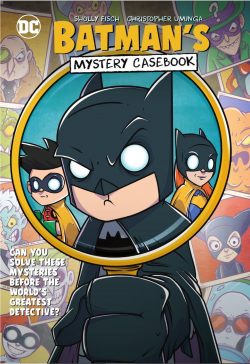
Batman’s Mystery Casebook


By Sholly Fisch, Christopher A. Uminga & various (DC Comics)
ISBN: 978-1-7795-0586-6 (TPB/Digital edition)

Win’s Christmas Gift Recommendation: Wonderfully Watching What’s What… 9/10

In recent years DC has opened up its shared superhero universe: generating Original Graphic Novels featuring its many stars in stand-alone adventures for the demographic so sadly misnamed Young Adult. To date, results have been rather hit or miss, but when they’re good, they are very good indeed…

Another sublime example of the process at its best is this cheery practical class in crimefighting: picking the brains and capitalising on the experience of Gotham’s greatest gangbusters and delivering details in the form of a comics activity book for all ages…

Author Sholly Fisch is no stranger to comics, having splendidly scripted Scooby Doo in various print incarnations and almost every DC superhero in All-New Batman: The Brave and the Bold and other animation-based spin-offs, Superman, Star Wars and so much more. When not doing that, he’s a developmental psychologist consulting for companies who make digital games and toys, with clients including Sesame Street, Cyberchase, The Magic School Bus Rides Again and The Cat in the Hat Knows a Lot About That. If you love fun superheroics and vintage comics trivia, you should seek out his work.

Cartoonist/designer/visualiser Christopher A. Uminga has worked for many media giants including DC Comics/Warner Bros., Lucasfilm, Foot Locker, Disney’s WonderGround Gallery and more, and is assisted in making this complex and arresting tome work by colourist Silvana Brys and lettering entity Andword Design (Morgan Martinez, Justin Birch & Deron Bennett)…

A quick word to the wise: Although for years DC’s mainstream continuity has depicted the Dark Knight as a driven and tormented borderline sociopath doing good for what seems to be all the wrong reasons, Batman has always been an archetype who works for all ages on vastly differing levels. This version is far more Caped Crimecrusher than Bat out of Hell, and reaffirms his reputation as “the World’s Greatest Detective” in a series of “fair play mystery” vignettes with the reader invited to pay close attention and participate at every moment of each case. Kids can enjoy alone or with the grandparents who watched the 1966 Batman TV phenomenon unfold and the parents who watched the 1990s movies and stunning Batman: The Animated Adventures series they spawned…

It begins in ‘Prologue: Whodunit?’ as Batman, Robin & Batgirl examine a crime scene and talk the readers through the clues left behind that lead to their deduction of the culprit…

With every reader fully briefed ‘Chapter 1: The Case of the Perilous Puzzles’ sees The Riddler running riot, obsessively dropping his verbal hints for us to solve, but don’t get so caught up that you miss the cunning visual clues scattered around since the Dynamic Duo might be too busy escaping death traps to spot them…

Each adventure is augmented by a quick lesson in historical criminology, deduction and data gathering (just like the old Dick Tracy Crime Stoppers feature) beginning with a foundation in forensic science courtesy of ‘Batcave Crime Lab: Crime Scene Investigation’ with Clayface inadvertently assisting enquiries…

Of course Two-Face stars in second chapter ‘The Case of the Dual Identity’ and the hunt offers many chances to study modus operandi before the boom is lowered, after which ‘Batcave Crime Lab: Fingerprints’ reveals the secrets of the ancient system…

World-weary cop Harvey Bullock and Catwoman are involved in third chapter ‘The Case of the Art Attack’ but Batgirl – and the reader! – can’t be rushed to hasty conclusions if they think things through, whilst ‘Batcave Crime Lab: Tracks’ offers a quick refresher on Locard’s Exchange Principle (weren’t you paying attention last chapter?) as we learn to watch where we – and everybody else – steps…

Bruce Wayne and Alfred Pennyworth show off their skills in civilian style for ‘The Case of the History Mystery’ which take us back to WWI and an encounter with Enemy Ace Hans von Hammer, augmented by some modern milestones in ‘Batcave Crime Lab: DNA’

We’re back in supervillain territory for chapter 5 as ‘The Case of the Cold Cash’ seems to prove chilly Mister Freeze is the bad guy… until our heroes take a closer look, complemented by the Terrific Trio taking stock of fraud in ‘Batcave Crime Lab: Fakes and Phonies’

Batgirl and Robin have their wits truly tested in ‘The Case of the Digital Ghost’ before ‘Batcave Crime Lab: Eyewitness Testimony’ wonderfully tests every reader’s memory and visual acuity – with helpful hints from Commissioner Gordon – as we rush to the conclusion in Chapter 7 as The Joker and Harley Quinn threaten appalling consequences for all in ‘The Case of the Perilous Parade’: a thrilling manhunt that literally demands your full attention…

‘Epilogue’ then provides a summation from Batman and a so-cool poster to declare “Case Closed!” on this vivid and vibrant anticrime primer… for now!

The caseload is done-in-one (hopefully only until we get a sequel and series puh-leeeze!) but this tome also offers a tantalising peek at Sara Farizan & Nicoletta Baldari’s Gotham-set tale of bullying and being the new kid My Buddy Killer Croc that’s also worth some of your time and attention…

Smart, compelling, brilliantly entertaining, astoundingly infectious and deliciously addictive, Batman’s Mystery Casebook is a superbly challenging activity and adventure romp packed with charm and wit to captivate fans and nervous neophytes alike: one introducing a new wondrous world with a rousing reminder that all is never as it seems…
© 2022 DC Comics. All Rights Reserved.

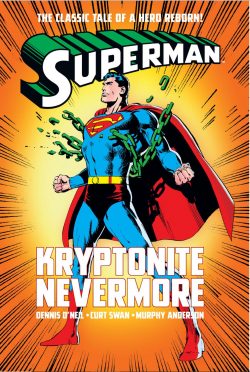
Superman: Kryptonite Nevermore


By Dennis O’Neil, Curt Swan, Murphy Anderson, Dick Giordano & various (DC Comics)
ISBN: 978-1-7795-0755 (HB/Digital edition)

Win’s Christmas Gift Recommendation: Total Entertainment Perfection… 10/10

Superman is the comic book crusader who started the whole genre and, in the decades since his 1938 debut, has probably undertaken every kind of adventure imaginable. With that in mind it’s tempting and very rewarding to gather up whole swathes of his inventory and periodically re-present them in specific themed collections, such as this hardback celebrating one his greatest extended adventures. The episodes contained within were originally released just as comics fandom was becoming a powerful – if headless – lobbying force reshaping the industry to its own specialised desires and remains a true landmark of the superhero genre.

When Julie Schwartz took over editorial responsibility for the Man of Steel in 1970, he was expected to shake things up with nothing less than spectacular results. To that end, he sagely incorporated many key characters and events that were simultaneously developing as part of fellow iconoclast Jack Kirby’s freshly unfolding “Fourth World”.

That bold experiment was a breathtaking tour de force of cosmic wonderment which brought a staggering new universe to fans: instantly and permanently changing the way comics were perceived and how the entire medium could be received.

Schwartz, meanwhile, was again breathing fresh life into a powerful but moribund icon – a job he had been excelling at since he more-or-less singlehandedly kickstarted the Silver Age of Comics. Superman had been a mega-media star since his launch, with internationally syndicated comics, books, newspaper strips, movie and cinema serials plus hugely successful radio and TV shows (live action and animated) making the franchise globally recognizable. Whenever that happens, inevitably overkill and overexposure inescapably set in and the core property needs to be carefully overhauled or vanish forever. I’ll bet you can think of plenty of really famous and ubiquitous things from your childhood that one day you simply stopped noticing. Happily, sometimes they can be reborn…

Schwartz knew his market and was open to new ideas, and his creative changes were just appearing in 1971. The new direction was also vanguard and trigger for a wealth of controversial and socially-challenging story content unheard of since the feature’s earliest days: a wave of tales ultimately described as “Relevant”…

The era itself and those vital changes are described and contextualised in Paul Levitz’s Introduction, after which the crucial radical shift in Superman’s vast mythology starts to unfold.

With iconic covers by Neal Adams, Dick Giordano, Carmine Infantino & Murphy Anderson, this titanic tome collects Superman #233-238 and #240-242, originally running from January to September 1971.

The groundbreaking epic was crafted by scripter Dennis J. “Denny” O’Neil, and veteran illustrators Curt Swan and Murphy Anderson – although stand-in Dick Giordano inked #240. A deliberate and very public abandonment of super-villains, fanciful Kryptonian scenarios and otherworldly paraphernalia instantly revitalised the Man of Tomorrow, attracting new readers and began a period of engagingly human-scaled stories which made Superman a “must-buy” character all over again.

The innovations began in ‘Superman Breaks Loose’ (Superman #233) when a government experiment to harness Kryptonite as an energy source goes explosively wrong. Closely monitoring the test, the Action Ace is blasted across the desert surrounding the isolated lab, but somehow survives a supposedly fatal radiation-bath. Then, reports begin filtering in from all over Earth: every piece of the deadly mineral has been transformed to harmless, common iron…

As he goes about his protective, preventative patrols, the liberated hero experiences an emotional high at the prospect of all the good he can now accomplish. He isn’t even phased when the Daily Planet‘s new owner Morgan Edge (a key Kirby character) shakes up his civilian life: summarily ejecting Clark Kent from the print game to remaking him as a roving TV journalist…

Meanwhile, the desert site of his recent crashlanding offers a moment of deep foreboding as Superman’s irradiated imprint in the sand shockingly grows solid and shambles away in ghastly parody of life…

The suspense resumes in #234’s ‘How to Tame a Wild Volcano!’ as an out-of-control plantation owner refuses to let his indentured native workforce flee an imminent eruption on the island of Boki. Handicapped by misused international laws, the Man of Tomorrow can only fume helplessly as the UN rushes towards a diplomatic solution. His anxiety intensifies when a sinister sand-thing inadvertently passes him and agonisingly drains him of his powers.

Crashing to Earth in a turbulent squall, the de-powered hero is attacked by work boss Boysie Harker‘s thugs and instantly responds to the foolish provocation, relying for a change on determination rather than overwhelming might to save the day…

The ‘Sinister Scream of the Devil’s Harp’ in #235 gave way to weirder ways – the industry was enjoying a periodic revival of interest in supernatural themes and stories – as mystery musician and apparent polymath Ferlin Nyxly reveals the secret of his ever-growing aptitudes and gifts is an archaic artefact which steals from living beings knowledge, talents and even Superman’s alien abilities.

The Man of Steel is initially unaware of the drain, as he’s trying to communicate with his eerily silent doppelganger, but once Nyxly graduates to a full-on raving super-menace self-dubbed Pan, the taciturn homunculus unexpectedly joins its living template to trounce the power thief…

Issue #236 offered a Batman cameo and a science fictional morality play as cherubic aliens seek Superman’s assistance to defeat a band of devils and rescue Kent’s friends from Hell. However, the ‘Planet of the Angels’ is nothing of the kind, and the Metropolis Marvel must pull out all the stops to save Earth from a very real Armageddon, after which Superman #237 sees him save an orbiting astronaut only to see him succumb to madness-inducing mutative disease. After another savage confrontation with the sand-thing further debilitates him, the harried hero is present as more mortals fall to the contagion.

Believing himself the cause, the ‘Enemy of Earth’ considers quarantining in space. As he decides, Lois Lane stumbles into another lethal predicament and the hero’s instinctive intervention seemingly confirms his earlier diagnosis, but another clash with the ever-present sandy simulacrum on the edge of space presents an incredible truth. Painfully debilitated, Superman nevertheless saves Lois and again meets the evermore human creature. Now able to speak, it offers a chilling warning and the Man of Steel realises exactly what it is taking from him and what it might become…

A mere shadow of his former self, the Man of Tomorrow is unable to prevent a band of terrorists taking over a magma-tapping drilling rig and endangering the entire Earth in #238’s ‘Menace at 1000 Degrees’. With Lois among their hostages and the madmen threatening to detonate a nuke in the pipeline, the Action Ace desperately begs his doppelganger to assist him, but its cold rejection forces the depleted hero to take the biggest gamble of his life…

Superman #239 was an all-reprint giant featuring the hero in his incalculably all-powerful days – so not included here – but the diminished Caped Kryptonian returned in #240 (with Giordano inks) to confront his own lessened state and seek a solution in ‘To Save a Superman’. The trigger is his inability to extinguish a tenement fire and the wider world’s realisation that their unconquerable champion is now vulnerable and fallible…

Especially interested are the Anti-Superman Gang who immediately allocate all resources to destroying their nemesis. After one particularly close call, Clark is visited by an ancient Asian sage who somehow knows his other identity and offers an unconventional solution…

From 1968 superhero comics began to decline – just as they had at the end of the 1940s – so publishers sought fresh ways to keep audience as tastes changed. Back then, the industry depended on newsstand sales, and if you weren’t popular, you died. Editor Jack Miller, innovating illustrator Mike Sekowsky and relatively new scripter Denny O’Neil came up with a radical proposal and made history by depowering the only female superhero then in the marketplace. They had the mystical Amazons leave our dimension, taking with them all their magic – including Wonder Woman‘s powers and all her weapons…

Reduced to mere humanity she chose to stay on Earth, assuming and legitimising her own secret identity of Diana Prince: resolved to fighting injustice as a mortal. Tutored by blind Buddhist monk I Ching, she trained as a martial artist, and quickly became a formidable enemy of contemporary evil.

I Ching claims he can repair Superman’s difficulties and dwindling might, but evil eyes are watching. Arriving clandestinely, Superman allows the adept to remove his Kryptonian powers as a precursor to restoring them, allowing the A-S Gang opportunity to strike. In the resultant brutal melee, the all-too-human hero triumphs in the hardest fight of his life…

The saga continues with “Swan-derson” back on art in #241 as Superman overcomes momentary but almost overwhelming temptation to surrender his oppressive burden and lead a normal life. Admonished and resolved, he then submits to Ching’s resumed remedy ritual and finds his spirit soaring to where the sand-being lurks before explosively reclaiming the stolen powers. Leaving the gritty golem a shattered husk, the phantom brings the awesome energies back to their true owner and a triumphant hero returns to saving the world…

Over the next few days, however, it becomes clear that something has gone wrong. The Man of Tomorrow has become arrogant, erratic and unpredictable, acting rashly, overreacting and even making stupid mistakes. In her boutique Diana Prince discusses the problem with Ching and the sagacious teacher deduces that whilst merely mortal and fighting AS gangsters, Superman received punishing blows to the head which have caused a brain injury that did not heal after his powers returned…

When the hero refuses to listen, Diana and Ching track down the dying sand-thing and beg its aid. The elderly savant recognises it as a formless creature from other-dimensional Quarrm and listens to the amazing story of its entrance into our world. He also suggests a way for it to regain some of what it recently lost…

Superman, meanwhile, has blithely gone about his deranged business until savagely attacked by a statue of a Chinese war-demon. Also able to steal his power, it has been possessed by a second fugitive from Quarrm. It has no conscience and wears ‘The Shape of Fear!…

The shocking saga concludes in ‘The Ultimate Battle’ as the second Quarrmer falls under the sway of two petty thugs who use it to put the again de-powered Superman into hospital…

Rushed into emergency surgery, the Kryptonian fights for his life as sand-thing confronts war-demon in the streets, but events take an even more bizarre turn once the latter drives off its foe and turns towards the hospital to finish off the flesh-&-blood Superman. Regaining consciousness – and a portion of his power – the Metropolis Marvel battles the beast to a standstill but needs the aid of his silicon stand-in to drive the thing back beyond the pale. With the immediate threat ended, Man of Steel and Man of Sand face off one last time, each determined to ensure his own existence no matter the cost…

The stunning conclusion was a brilliant stroke on the part of the creators, one which left Superman approximately half the man he used to be. Of course, all too soon he returned to his unassailable, god-like power levels but never quite regained the tension-free smug assurance of his 1950s-1960s self.

A fresh approach, snappy dialogue and more human-scaled concerns to balance outrageous implausible fantasy elements all wedded to gripping plots and sublime art make Kryptonite Nevermore one of the very best Superman sagas ever created. Also included are creator biographies, the iconic ‘House Ad’ by Swan & Vince Colletta which proclaimed the big change throughout the DC Universe, plus a thoughtful ‘Afterword by Dennis O’Neil’ to wraps things up with some insights and reminiscences every lover of the medium will appreciate.

A must-have graphic novel to sit on the same shelf as Watchmen, Batman: Year One, Segar’s Popeye, Gottfredson’s Mickey Mouse, Kirby & Lee’s Galactus Trilogy and Chaykin’s American Flagg!: a shining exemplar of action- adventure comics captured at their most perfect moment. Why don’t you have this yet?
© 1971, 2009, 2020 DC Comics. All Rights Reserved.

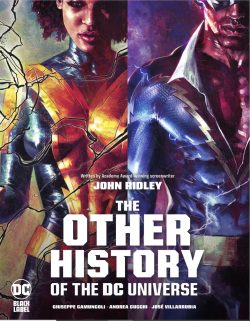
The Other History of the DC Universe


By John Ridley, Giuseppe Camuncoli, Andrea Cucchi, José Villarrubia & various (DC Comics)
ISBN: 978-1-7795-1197-3 (HB/Digital edition)

Win’s Christmas Gift Recommendation: Hard-Hitting, Strong Medicine… 9/10

The evolution and assimilation of non-white, non-standard characters – defined and othered by skin colour, religion, ethnicity and who loves whom – has been in most mass media what author and screenwriter John Ridley (12 Years a Slave; Future State: The Next Batman) has described as “measured progressiveness”.

That’s especially true in comics, where incremental firsts have been applauded – and rightly so, as the industry has always been at the forefront of progressive thinking and action – but has also suffered from a tickbox mentality where true change has been slow to materialise and hard to sustain. We can say “first black superhero”, “first gay hero”, “first interracial marriage” or “first same-sex kiss” , but other than offering a glimmer of acceptance, and recognition, what has changed?

It’s certainly better than an all-white, all-male milieu where “different” equates to “lesser than”, where more than 50% of the populace and who knows how much of the readership doesn’t conform to proposed norms and are reduced to eye-candy, plot props and useless bystanders (not even competent villains who at least have agency!). For the longest time these attitudes were tacitly enshrined on funnybook pages – and not even for sinister reasons – but what appears to simply be an unconscious acceptance of an unchallenged status quo…

You can read other books or even some previous posts here from the last month for background, if you want, but here and now, I’m pointing you towards a fascinating and gripping series recently collected as an answer to that situation.

Here Ridley – with illustrators Giuseppe Camuncoli, Andrea Cucchi, José Villarrubia and letterer Steve Wands – re-examines and deconstructs DC’s record of Diversity progress via all those slow incremental steps and breakthroughs: interpreting through the eyes and attitudes of the revolutionary characters the company added but with modern sensibilities and opinions in play…

Filtered from a socio-political perspective and assessment of those times – but not in the comfortably parochial “everything’s basically fine” tones of a white, male middle class parental audience-placator – you’ll learn a different history: one told not under Comics Code Restrictions, or commercial interests sanitising culture and attitude to keep (covertly and actively) racist authorities from embargoing titles but as heroic individuals finally telling their sides of a well-known story.

Published under DC’s Black Label mature reader imprint it begins with the story of Black Lighting in Book One – 1972-1995: Jefferson Pierce. Here we see the inner workings of an African American former Olympian who became a school teacher and vigilante to save lives and how it destroyed and damaged his family, after which Book Two – 1970-1989: Karen Beecher-Duncan & Mal Duncan recounts in their words how being the tokens on a team of white privileged teen super do-gooders shaped their lives and relationship.

A far darker divergence is applied to Japanese warrior/assassin Katana in Book Three – 1983-1996: (plus the kanji for Yamashiro Tatsu), exploring the tragic Japanese widow’s reinventions from faithful wife/widow to murderous killer and lethal weapon to nurturing superhero and beyond…

The lecture continues with the tale of a Gay Latinx cop who inherited the role of DC’s most mysterious avenger in Book Four – 1992-2007: Renee Montoya, before The Question resolves into second generation angst and answers for Book Five – 1981-2010: Anissa Pierce. Here Black Lightning’s actual legacy and effect on DC continuity is reappraised through the eyes of his superhero children Thunder and Lightning, with religion and sexual orientation also coming under fire.

All we’ve seen before is summed up with no obfuscations or confusions, but you might want to reread or acquaint yourself with the original material as seen in various volumes of Black Lightning, Teen Titans, The Outsiders as well as selected continuity highpoints of Green Lantern, Batman, Cosmic Odyssey, Crisis on Infinite Earths, Death of Superman. Don’t let the reading list deter you though: you could simply plunge right in and wing it. The material, its tone and reinterpretation are carefully orchestrated and fully approachable for any level of fan from veteran adept to casual film watcher…

Ridley enacts a miraculous slice of sleight of hand here, examining simultaneously the actual published comics as accepted DC lore but also the redefining times they were created in and filling out the characters in modern terms – quite a feat of meta-realism…

The covers are by Camuncoli & Marco Mastrazzo with Jamal Campbell producing some stunning variants, but the true attraction of The Other History of the DC Universe is the knowledge that times and attitudes have changed enough that this book is even possible. Read it and see…
© 2021 DC Comics. All Rights Reserved.

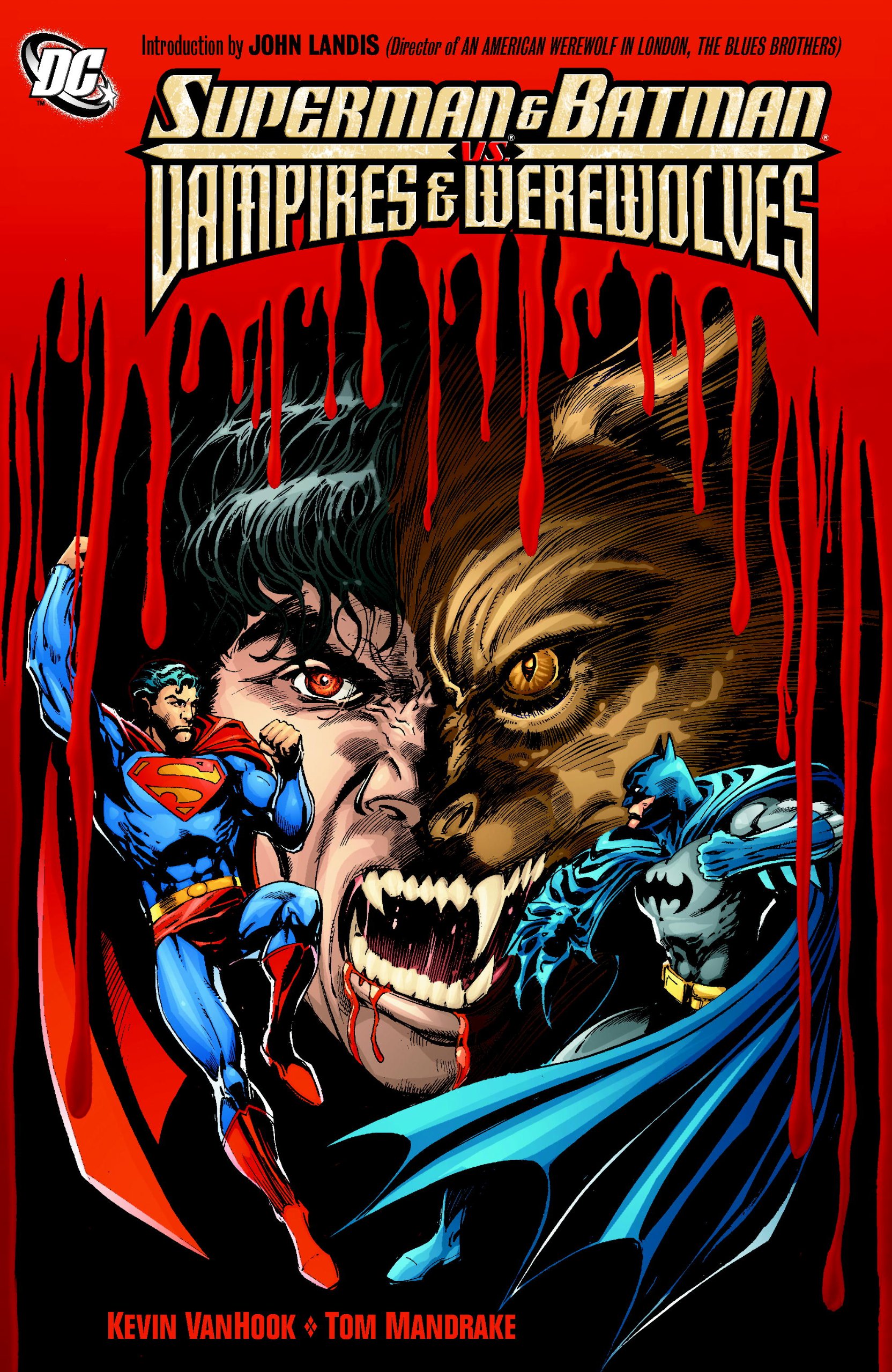
Superman & Batman vs Vampires & Werewolves


By Kevin VanHook & Tom Mandrake (DC Comics)
ISBN: 978-1-4012-2292-5 (TPB/Digital edition)

The Man of Tomorrow and the Dark Knight are two characters who have, for the most part, escaped their lowly comics origins to join a meta-fictional literary landscape populated by the likes of Mickey Mouse, Tarzan and Sherlock Holmes. As such their recognition factor outside our industry means that they get to work in places and with other properties that might not appeal to funny-book purists.

Take for example this out-of-print tale that piles on heaped helpings of monster-bashing, and which, despite a host of guest-stars, felt on release more like a test launch than a assured hit and has since become as vanishingly vaporous as its arcane antagonists…

Superman & Batman vs. Vampires & Werewolves is an intriguing, if flawed, oddment (with one of the clunkiest titles ever imagined) that should have appealed to the casual reader, especially if they’re not too adamantly wedded to the comic book roots and continuity of the DC Universe.

Prowling the streets of Gotham City, Batman comes across a partially devoured corpse and is promptly boots-deep in an invasion of mindless berserker vampires and werewolves who turn the city into a charnel house. Helpless to combat or contain the undead rampage, the Caped Crimebuster accepts the aid of enigmatic (but rational) vampire Marius Dimeter and his lycanthropic counterpart Janko who grudgingly ally themselves with the hero to track down Herbert Combs – a truly deranged scientist resolved to traffic with the Realms Beyond.

To facilitate his goals, Combs turned Janko and Dimeter into the accursed creatures they are and unleashed his plague of horrors on America to further his research. The bonkers boffin is infecting more helpless humans and has become an actual portal for Lovecraftian beasts to invade our reality…

Superman joins the fray just as one of these Elder God nightmares is unleashed, but even after its defeat he’s no real help: hampered more by his ethical nature than utter vulnerability to magic. Far greater aid is provided by super-naturalist Jason Blood and his Demonic alter-ego, whilst Kirk Langstrom – who can transform into the monstrous Man-Bat at will – provides both scientific and brutally efficient clean-up assistance.

Fellow harder-edged heroes such as Wonder Woman, Nightwing and Green Arrow turn up and join the battle to great effect, but after their admittedly impressive cameos and participatory contributions inexplicably wander off before the overarching threat is ended…

Nuh-uuh! Once a team-up begins, comics guys (who aren’t paid big bucks like big-name guest actors) don’t leave until the day is saved!!

So it’s up to the headliners – with Dimeter and Janko – to finally restore order and normality, even though the cost is high both in blood and convictions…

At the last, the superheroes are – relatively – victorious, but the ending is rather ambiguous and leaves the impression that the whole affair has been a pilot for a Dimeter spin-off…

This was clearly a break-out publishing project, aimed at drawing in new readerships like those occasional movie tie-ins that drive professional fans crazy, and on that level the daft and inconsistent plot can be permitted, if not fully forgiven.

VanHook (Flash Gordon, Bloodshot, G.I. Joe, Red Tornado) makes more films than comics these days and the tale is certainly most effective on the kind of action and emotional set-pieces one sees in blockbuster flicks: so even if there are far too many plot holes big enough to drive a hearse through, the sensorial ride should carry most readers through. Most importantly, the moody art of Tom Mandrake (Grimjack, The Spectre, Batman, Firestorm, Martian Manhunter) is – as ever – astoundingly powerful: dark, brooding and fully charged for triumph and tragedy…

So if not perhaps for every reader, there’s a great deal of sinful pleasure to be found here. And let’s face it: who doesn’t like monster stories or finding out “who would win if”…
© 2008, 2009 DC Comics. All Rights Reserved.

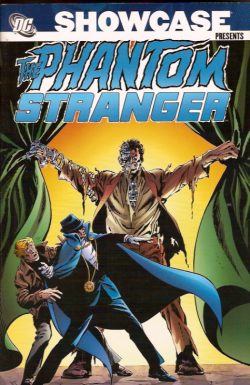
Showcase Presents The Phantom Stranger volume 2


By Bob Haney, Len Wein, Marv Wolfman, Arnold Drake, Michael J Pellowski, Steve Skeates, David Michelinie, Paul Levitz, Gerry Conway, Marty Pasko, Jim Aparo, Gerry Talaoc, Michael Kaluta, Mike Grell, Fred Carrillo, Bernard Baily, Ross Andru/Mike Esposito, Dick Dillin, Tony DeZuñiga, Bill Draut, Romeo Tanghal, Dick Giordano, Bob Layton & various (DC Comics)
ISBN: 978-1-4012-1722-8 (TPB)

The Phantom Stranger was also one of the earliest transitional heroes of the Golden Age of comics, created at the very end of the first superhero boom as readers moved from costumed crimefighters to other genres such as mystery, crime, war and western tales. A trench-coated, mysterious know-it-all, with shadowed eyes and hat pulled down low, he would appear, debunk a legend or foil a supernatural-seeming plot, and then vanish again.

He was coolly ambiguous, never conclusively revealed as man, mystic or personally paranormal. Created by John Broome & Carmine Infantino, who produced the first story in Phantom Stranger #1 (August/September 1952 – Happy Anniversary, Mystery Man!) and most of the others, the 6-issue run also boasted contributions from Jack Miller, Manny Stallman and John Giunta. The last issue was cover-dated June/July, 1953, after which he vanished.

Flash-forward to the end of 1968. The second superhero boom is rapidly becoming a bust, and traditional costumed heroes are dropping like flies. Suspense and mystery titles are the Coming Thing and somebody – probably unsung genius E. Nelson Bridwell – has the bright idea of reviving Phantom Stranger.

He was the last hero revival of DC’s Silver Age and the last to win his own title: another graduate of a star-studded later run in Showcase. After only one appearance in #80 (cover-dated January/February 1969) he returned in his own comic three months later. This time, he found an appreciative audience, running for 41 issues over seven years.

Rather than completely renovate the character, or simply run simple reprints as DC had when trying to revive espionage ace King Faraday (in Showcase #50-51), editor Joe Orlando had writer Mike Friedrich & artist Jerry Grandenetti craft a modern framing sequence around a partial reprint, and – in a masterstroke of print economy – reintroduced another lost 1950s mystery hero to pad out the comic, and provide a rationalist’s contemporary counterpoint.

Dr. Terrence Thirteen was a parapsychologist known as the Ghost Breaker. He predated the Stranger, with his own feature in Star-Spangled Comics (#122-130; November 1951-July 1952). With fiancée (later wife) Marie, the parapsychologist roamed America and the world, debunking supernatural hoaxes and catching mystic-themed fraudsters, a vocal and resolute cynic imported whole into the modern series as a foil for the Stranger.

(Follow Me… For I Am…) The Phantom Stranger launched with a May/June 1969 cover-date. By the end of 1972, the horror/mystery boom had stabilized, and was a key component of both DC and Marvel’s mainstream output, with fantasy and sword & sorcery adventurers also scoring well with fans. However, the glory days of huge comic book print-runs were gone forever. And yet, although a depleted force, superhero comics did not disappear as many older heads suspected they might, and an initially unwieldy amalgam, the horror-hero, soon became a useful crossover sales tool.

Never as common as Marvel’s burgeoning pantheon of spooky crusaders, the most successful and enduring of DC’s supernatural stalwarts were Swamp Thing and Phantom Stranger. This sequel mammoth monochrome tome concludes that impressive second incarnation, incorporating not only his crossover trips into the greater DCU, but also rare appearances that closed his career …until he was resurrected post Crisis on Infinite Earths.

Spanning April/May 1970 to Winter 1978, this collects The Brave and the Bold #89 & 98; Justice League of America #103; Phantom Stranger #22-41; DC Super-Stars #18 and House of Secrets #150, blending a popular taste for blood and horror with traditional mystery man derring-do…

The magic begins with an impressive chiller from Bob Haney, Ross Andru & Mike Esposito originally seen in Batman team-up vehicle The Brave and the Bold (#89, April/May 1970). ‘Arise Ye Ghosts of Gotham’ sees a religious sect return to the city that had driven them out two centuries previously, only to awaken the vengeful spirits of their banished ancestors until pacified by our initially squabbling heroes.

The Stranger’s rerise in Brave and the Bold (#98, October/November 1971) was a more recognisably spooky tale, superbly crafted by Haney & Jim Aparo. ‘Mansion of the Misbegotten!’ is a twist-ridden riot of demon-cults, scheming plots and contemporary-cinema styled possession carefully exploiting the global obsession with Satanism that began with Rosemary’s Baby and peaked with The Exorcist. Here the Gotham Guardian finds himself outwitted, outmatched and in dire need of assistance to foil a truly diabolical force threatening the life of his godson.

Following on is ‘A Stranger Walks Among Us!’ by Len Wein, Dick Dillin & Dick Giordano, as the haunted hero saves Halloween and the World’s Greatest Superheroes from a magical murder plot. He was consequently offered membership in the Justice League of America (in issue #103 of their comic, December 1972) but seldom made any meetings or took a turn on monitor duty…

In the same month, his solo adventures featured ‘Circle of Evil’ (Phantom Stranger #22, by Wein & Aparo), wherein a coalition of evil calling itself the Dark Circle initiates a master plan: attacking the hero through blind psychic – and notional love-interest – Cassandra Craft. At the back of the book, Ghost-Breaker Dr. Thirteen exposes another hoary hoax in Steve Skeates & Tony DeZuñiga’s ‘Creatures of the Night’. These counterpoints to eldritch adventure – although usually excellent – were rapidly reaching their sell-by date, and very soon Thirteen would be battling real monsters he couldn’t rationalize away…

‘Panic in the Night!’ in #23 saw the Stranger and Cassandra in Paris, battling analogues of the Phantom of the Opera and Hunchback of Notre Dame whilst gathering an unlikely ally for the imminent final clash with the Dark Circle. However, great as this yarn is, the real gem is the back-up feature which transformed Terry Thirteen.

‘The Spawn of Frankenstein!’ saw the discovery of an ice-entombed man-monster lead to dark personal tragedy. When Thirteen’s colleague Victor Adams attempted to revive the legendary literary beast, it resulted in his death and Thirteen’s wife Marie being beaten into a coma. Vengeance-crazed, the Ghost-Breaker resolved to hunt down and destroy the monster, utterly unaware – and perhaps uncaring – that the beast was both rational and wholly innocent of any misdeed.

Written by Marv Wolfman and illustrated by the unique talent of Michael Kaluta, this debut promised much, but the feature was plagued by inconsistency. Phantom Stranger #24 (March/April 1973) offered the epic conclusion of the Dark Circle war as the Stranger and Cassandra defrayed the ‘Apocalypse!’ in the shadow of Mount Corcovado (that’s the one with the Jesus statue “Christo Redentor” overlooking Rio de Janeiro) with old foes Tannarak and Tala, Queen of Darkness along for the spectacular and long-overdue ride…

Wolfman & Kaluta’s The Spawn of Frankenstein continued as the revived revenant opted to revenge itself upon Victor Adams for dragging him back to cruel, unwanted life by returning the favour and resurrecting the dead scientist.

A fresh tone and resumption of episodic, supernatural triage marked issue #25 as the Man in the Hat confronted a voodoo cult in ‘Dance of the Serpent’ (Wein – from an idea by Michael J Pellowski – & Aparo), whilst Kaluta ended his run on Frankenstein with another untitled tale wherein Rachel Adams (wife of the departed Victor) was kidnapped by Satanists before being rescued by the monster; leading into #26’s crossover ‘From Dust Thou Art…’

Here Wein, Wolfman & Aparo teamed the Monster and the Stranger against demons seeking earthly bodies.

The radical change was completed with the next issue as innovative horror-anthology artist Gerry Talaoc replaced the sleekly realistic Aparo (moved to The Brave and the Bold for a long career illustrating Batman), whilst journeyman mainstay Arnold Drake assumed the writer’s seat on the stranger. He introduced another long-term nemesis in deeply disturbed psychiatrist/parapsychologist ‘Dr. Zorn: Soul-Master!’

This driven meddler callously warped his patients and performed illicit experiments for the US Military-Industrialist Complex: a far more insidious and freshly contemporary threat in tune with modern mores. Thwarted but seldom defeated, he constantly returned to bedevil the Stranger.

Skeates and legendary veteran Bernard Baily (Golden Age co-creator of Hourman and The Spectre) now helmed Frankenstein, with ‘The Terror and the Compassion’ seeing the misunderstood beast stumble into a commune that is actually a demonic coven intent on blood sacrifice and raising the devil…

‘The Counterfeit Madman!’ by Drake & Talaoc saw the Stranger explore the mind of mad-dog killer Johnny Ganz. Was the young offender a true psychopath or a cunning crook pretending to be a multiple-personality sufferer? Was there another innocent victim trapped inside the killer’s skull with him? An element of moral ambiguity had been added by Drake, layering later adventures with enticing, challenging dilemmas absent from most comic fiction and only matched by Steve Gerber’s challenging work on Man-Thing.

Back-up ‘Night of the Snake God’ was a more traditional tale which continued Frankenstein’s battle against the hippie cult in a solid, if undemanding manner.

Zorn resumed his unscrupulous scientific explorations of the supernatural in PS #29’s ‘The Devil Dolls of Dr. Z!’, whilst matters barely progressed at all in ‘The Snake-God Revealed!’, which saw the Spawn of Frankenstein lose momentum – and story-space – as his strip was reduced to 6 pages. The next issue contained more contemporary chills in ‘The Children’s Crusade!’ as a modern Pied Piper lures a town’s youngsters into his charismatic cult whilst ‘Turn-about!’ concludes – and not before time – the Spawn of Frankenstein’s run.

Issue #31 (June-July 1974) offers an exotic yarn dealing with the aftermath of the Vietnam war as a disgraced US “general” smuggling drugs for a local warlord awakens a slumbering demon in ‘Sacred is the Monster Kang!’ The Stranger’s tales were usually 12-pages long at this period, but the back-up feature that originally filled up the comics – The Black Orchid – is not included in this volume.

Bill Draut, one of the Stranger’s earliest illustrators returned in #32’s ‘It Takes a Witch…!’: an old-fashioned scary whodunit, whilst superstar-in-waiting Mike Grell illustrated a Dr. Zorn vehicle guest-starring Boston Brand. In ‘Deadman’s Bluff!’, the ghost’s protracted hunt for his own murderer ended as usual in frustration, but an antagonistic partnership was established for the future…

Talaoc was back in #34 for ‘A Death in the Family!’ wherein a “clean” brother is compelled to assume control of the family business – running an organised crime mob. His guilt is further compounded when his dead sibling returns from the grave to give him some pointers. Increasingly, the Stranger was becoming a mere witness to supernatural events in his own series, so perhaps it’s no coincidence that this issue featured a return for the more hands-on Dr. Thirteen (wife Marie cured and both of them ignoring that brief stint of Frankensteinian tragedy).

‘…And the Dog Howls Through the Night!’ is another straightforward yet gripping adventure from Skeates & DeZuñiga, which had probably been sitting in a drawer for years before publication.

‘The Demon Gate’ was writer David Michelinie’s debut tale, with the Stranger targeted by derivative Dr. Nathan Seine – who wanted to siphon off the hero’s mystic energy and soul to cure his dying wife. Like ‘Crimson Gold’, a deadly African treasure hunt for Nazi treasure in #36, it briefly betokened a more active role for the immortal wanderer.

Drake & Paul Levitz scripted ‘Images of the Dead’ in Phantom Stranger #37: another highly charged moral quandary with a young artist forced to commit reprehensible crimes to earn money for his wife’s hospital bills…

Talaoc made way for fellow Filipino artist Fred Carrillo with issue #38, as Dr Seine sought to extract bitter vengeance in Levitz’s ‘The Curse of the Stalking Skull’. The new creative team brought back Boston Brand for ‘Death Calls Twice for a Deadman’: a last-ditch effort to revive dwindling sales. Also including Batman villain The Sensei, it signalled a belated return to the company’s over-arching continuity, but was too little, too late.

Deadman also co-starred in #40’s ‘In the Kingdom of the Blind’ and #41’s concluding chapter (February-March 1976) ‘A Time for Endings’ as Seine sought to bring Elder Gods to Earth using long-absent Cassandra Craft as a medium. With that tale’s finish the series ended and the Stranger all-but vanished until the winter of 1978 and a giant-sized tale from DC Super-Stars #18.

‘Phantom Stranger and Deadman’ (by Gerry Conway, Marty Pasko, Romeo Tanghal, Dick Giordano & Bob Layton) was an extended Halloween extravaganza with the supernatural champions – and Dr. Thirteen and Tala in attendance – attempting to eradicate an infestation of demons infiltrating the comic book Mecca of the season: Rutland, Vermont (long associated in both Marvel and DC titles as the only place to be on the Eve of All Hallows).

One final tale appeared a few months later in the 150th issue of House of Secrets (February-March 1978) wherein Conway & Talaoc related a generational tale of restless evil in ‘A God by any Other Name.’

Here, the Stranger and Dr. Thirteen united to complete the work of Rabbi Samuel Shulman and Father John Christian who, in the dire environs of London, 1892, had joined spiritual forces to destroy the World’s first malignant machine intellect Molloch. Sadly, those Satanic Mills had a habit of being rebuilt by greedy men…

More than most, The Phantom Stranger is a strong character and concept at the mercy of pitiless fashion. Revived as the 1960s closed on a wave of interest in the supernatural, and seemingly immune to harm, he struggled to find an audience in the general marketplace before direct sales techniques made publishing a less hit-or-miss proposition. However, blessed with a cohort of talented creators, the stories themselves have proved to be of lasting quality, and would so easily transfer to today’s television screens that I wonder why they haven’t yet (and no, that doesn’t mean animated appearances or cameos on the Swamp Thing series). Mystery, exotic locales, forbidden monsters spectacular effects, a medallion and a cool hat: C’mon, you know you’d watch it…

But until then you’ll have to thrill and scare yourselves with these fantastic tales.
© 1970, 1971, 1972, 1973, 1974, 1975, 1976, 1978, 2006 DC Comics. All Rights Reserved.

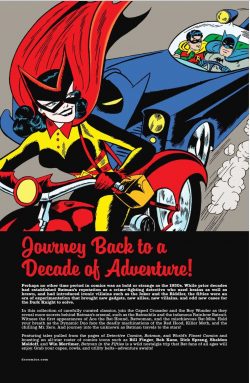
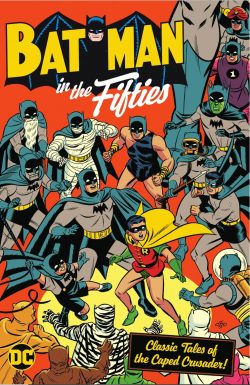
Batman in the Fifties


By Bill Finger, Don Cameron, Edmond Hamilton, France Herron, David Vern Reed, Dave Wood, Joe Samachson, Sheldon Moldoff, Dick Sprang, Lew Sayre Schwartz, Bob Kane, Win Mortimer, Charles Paris, Stan Kaye, George Roussos, Ray Burnley & various (DDC Comics)
ISBN: 978-1-7795-0950-5 (TPB/Digital edition)

In the early years of this century, DC launched a series of graphic archives intended to define DC’s top heroes through the decades: delivering magnificent past comic book magic from the Forties to the Seventies via a tantalisingly nostalgic taste of other – arguably better, but certainly different – times. The collections carried the cream of the creative crop, divided into subsections, partitioned by cover galleries, and supplemented by short commentaries; a thoroughly enjoyable introductory reading experience. I prayed for more but was frustrated… until now…

Part of a trade paperback trilogy – the others being Superman and Wonder Woman (thus far, but hopefully Aquaman, Green Arrow and Martian Manhunter are in contention too, as they have become such big shot screen stars these days) – the experiment is being re-run, with even more inviting wonders from the company’s amazing family-friendly canon.

Gathered here is an expanded menu of delights adding to that of the 2002 edition, rerunning Michael Uslan’s original context-stuffed Introduction and chapter text pieces. The stories originated in Detective Comics #156, 165, 168, 180, 185, 187, 215, 216, 233, 235, 236, 241, 244, 252, 267; 269, 1000; Batman #59, 62, 63, 81,92,105, 113, 114, 121, 122, 128; and World’s Finest Comics #68, 81, 89 which span the entire decade while laying the rather bonkers groundwork for the landmark television series of the next decade.

Supported by the first of a series of factual briefings, the comics open with Classic Tales, and ‘The Batmobile of 1950!’ Written by Joe Samachson and illustrated by visionary artist Dick Sprang and ideal inker Stan Kaye, the clever saga of reinvention originated in Detective Comics #156 (cover-dated February 1950 and on sale from December 19th 1949):  heralding new vistas as their reliable conveyance is destroyed by cunning crooks.

Badly injured, Batman uses the opportunity to rebuild his ride as moving fortress and crime lab and scores his first techno advance. There would soon be many more: a Batplane II, new boats and subs and even a flying Batcave…

David Vern Reed, Sprang & Charles Paris then set the Crime Crushers to recovering a vital lost tool assemblage before some villain could decipher ‘The Secret of Batman’s Utility Belt!’ (Detective #185 July 1952) and end their careers, after which ‘The True History of Superman and Batman’ (World’s Finest Comics #81, March/April 1956 by Edmond Hamilton, Sprang & Kaye) finds a future historian blackmailing the heroes into restaging their greatest exploits so that his erroneous treatise on them will be accurate…

Foreshadowing modern tastes and tropes, an unknown author & Sheldon Moldoff reveal ‘The New-Model Batman’ in Detective #236 (October 1956) as recently-released criminal genius Wallace Waley deploys counters to all the heroes’ techniques and tech, necessitating a change of M.O and new toys… like a Bat-tank…

In a classic case of misdirection, the Dark Knight briefly becomes ‘The Rainbow Batman! in Detective #241 (March 1957). As delivered by Hamilton, Moldoff & Kaye, a series of outlandish costumes keep the public – and reporters’ – gaze on the mighty masked peacock and well away from the biggest story of the decade…

Bill Finger, Moldoff & Paris detail a review of the hero’s most versatile weapon in ‘The 100 Batarangs of Batman!’ (Detective #244 June 1957) as criminals begin using old variants of the throwing tool against him and the Gotham gangbuster has to unleash an almost dangerous and untested prototype to defeat them…

In a most frustrating piece of poor editing, next up is the seminal sequel story to a most important and repercussion-packed yarn. Crafted by Hamilton, Sprang & Kaye, ‘The Club of Heroes’ first appeared in World’s Finest Comics #89 (July/August 1957) reprising an earlier meeting of Batmen from many nations. It became a key plank of Grant Morrison’s latterday epic Batman: the Black Glove as those valiant foreign copycats reconvened to add the Man of Steel to their roster only to find him suffering recurring amnesia and outshone by brand-new costumed champion Lightning Man

‘The Thousand Deaths of Batman!’ (Detective #269 July 1959) comes from another uncredited scripter, with Moldoff & Paris limning a bizarre tale of a criminal entertainment network offering staged deaths of their greatest enemies until the Caped Crusaders infiltrate and exterminate…

Just as the adventures always got bigger and bolder, so too did the character roster and internal history. The Bat-Family section homes in on the heroes’ constantly expanding supporting cast, and leads with something I just finished whining about.

Detective Comics #215 (January 1955) featured ‘The Batmen of All Nations!’ by Edmond Hamilton, Moldoff & Paris) and saw the World’s Greatest Crimefighters acknowledged as such by well-meaning champions from Italy, England, France, South America and Australia, who took the sincerest form of flattery a step too far by becoming nationally-themed imitations. That was fine until they all attend a convention in Gotham City doomed to disaster after a villain replaces one of them…

Why on Earth did this tale have to follow its own sequel?

Anyway, back to our usual nonsense and a question: Do you believe in coincidence? Superman was incredibly popular throughout the 1950s and many things that happened to him were tried in Batman stories. For a while the caped crusader even had a girl reporter – Vicki Vale – trying to ferret out hi secret identity. So when Adventure Comics #210 (March 1955) introduced a dog from Krypton, how surprising was it that Batman would soon join that rather exclusive kennel club?

For no reason I could possibly speculate upon, ‘Ace the Bat-Hound!’ debuted in Batman #92 (June 1955), created by Bill Finger, Sheldon Moldoff & Charles Paris. Ace was a distinctive German shepherd temporally adopted by Bruce Wayne when his actual owner John Wilker is abducted by crooks. A skilled tracker with distinctive facial markings, the pooch inserts himself into the case repeatedly, forcing the Dynamic Duo to mask him up as they hunt his master and foil a criminal plot. Like Krypto, Ace reappeared intermittently until Wayne stopped borrowing him and just adopted the amazing mutt.

Almost as necessary a Fifties adjunct, ‘The Batwoman!’ debuted in Detective #233 (July 1956) as Hamilton, Moldoff & Kaye added a female copy to the cannon…

Today fans are pretty used to a vast battalion of bat-themed champions haunting Gotham City and its troubled environs, but for the longest time it was just Bruce, Dick Grayson and an occasionally borrowed dog keeping crime on the run. However, three months before the debut of the Flash officially ushered in the Silver Age, editorial powers-that-be introduced valiant heiress Kathy Kane, who incessantly suited-up in chiropteran red and yellow over the next eight years. She was a former circus acrobat who burst into Batman’s life, challenging him to discover her secret identity at the risk of exposing his own…

Far more critical to the growing legend was Finger, Moldoff & Kaye’s ‘The First Batman!’

as originally seen in Detective Comics #235 (September 1956): a key story of this period which introduced a strong psychological component to Batman’s origins, disclosing how when Bruce was still a toddler, his father had clashed with gangsters whilst clad in a fancy dress bat costume…

In Batman #105, (February 1957) France Herron, Moldoff & Paris introduced ‘The Second Boy Wonder!’ as a stranger apparently infiltrates the Batcave by impersonating the kid crimebuster, but there’s more going on than would first appear, unlike Batman #114 (March 1958) wherein unknown writer, Moldoff & Paris reveal how circus gorilla Mogo joins the team to clear his framed keeper’s name in ‘The Bat-Ape!’

The grim gritty tone of the Dark Knight remains utterly absent in ‘The Marriage of Batman and Batwoman!’ (Batman #122, March 1959) as Finger, Moldoff & Ray Burnley manifest Robin’s bleakest nightmares should such a nuptial event ever occur, before Detective #267 (May 1959) details how ‘Batman Meets Bat-Mite!’ and Finger, Moldoff & Paris launch the Gotham Guardian’s most controversial “partner” – a pestiferous, extra-dimensional prank-playing elf who “helps” his hero by aiding his enemies to extend the duration of the fun… (World’s Finest Comics #68, January/February 1954).

In the 1950s costumed villains faded from view and preference for almost a decade – until the Batman TV show made them stars in their own right. Thus there’s not as big a pool to draw on here as you might expect, and what there is mostly the old favourites..

The Villains highlights our hero’s greatest recurring enemies, leading with The Secret Life of the Catwoman!’ from Batman #62 (December 1950/January 1951) by Finger, with Lew Sayre Schwartz ghosting for Bob Kane – who only pencilled a few faces and figures. It’s all inked by Paris.

Here the Felonious Feline reforms and retires after a head trauma cures all her larcenous tendencies… until Batman begs law-abiding Selina Kyle to suit up once more and go undercover to catch crime boss Mister X.

Kane had all but left his role to others by this time and his contributions remained minor in The Origin of Killer Moth!’ (Batman #62, February/March 1951) as Finger, Sayre Schwartz & Paris record how a recently-released convict steals Batman’s ideas and sets up as a paid costumed crusader for crooks…

Around that time Detective #168 (February 1951) began the long road to an origin for the Joker as Finger, Sayre Schwartz, Kane George Roussos and Win Mortimer exposed ‘The Man Behind the Red Hood!’ This reveals a partial origin as part of a brilliantly engrossing mystery which begins when the Caped Crusader regales eager college criminology students with the story of “the one who got away” – just before the fiend suddenly comes back…

Batman’s most tragic Golden Age foe resurfaced cured and fully functional in Detective #187 (September 1952), but Harvey Dent was soon on a spree committing ‘The Double Crimes of Two-Face!’ (by Don Cameron, Sprang & Paris). Although the Dynamic Duo knew from the start their foe was a fake, the situation was far different two years later when Reed, Sprang & Paris detailed how ‘Two-Face Strikes Again!’ in Batman #81 (February 1954). This time a freak accident restored Dent’s scarred bipolar state and the heroes were outmatched all the way to the stunning turnabout conclusion…

The bit about bad guys bows out with ‘The Ice Crimes of Mr. Zero’ (Batman #121, February 1959) as Dave Wood, Moldoff & Paris depict a scientist’s turn to crime after an experiment afflicts him with a condition that will kill him if his temperature rises above freezing point. Although cured in this yarn, that villain would return, taking the name Mr. Freeze

Final comics section Tales from Beyond highlights the increasingly strange adventures of the Dynamic Duo which – due to Comics Code embargoes on horror and the supernatural – meant a wealth of weird alien and startling science fiction themes. The wonders beginswith a rarely reprinted yarn from Finger, Sayre Schwartz, Kane & Paris originally seen in Batman #59 (June/July 1950). It begins as the heroes seek to use time travel to cure The Joker, before a mistake by chronal scientist Professor Carter Nichols dumps them in 2050 AD. ‘Batman in the Future!’ finds them aiding the Harlequin of Hate’s crimefighting descendant against space pirates before returning to their own era…

A solid gold classic follows as ‘The Batman of Tomorrow!’ (Detective #216, February 1955) visits the 20th century – from his home in 3054 – to save an injured Bruce Wayne from Vicki Vale’s latest exposé and catch a cunning crook in a fast paced and fantastical romp by Hamilton, Sprang & Paris.

Many of these bright-&-breezy high fantasy tales deeply affected modern writers and the overarching continuity, perhaps none more so than Herron, Sprang & Paris’ ‘Batman – The Superman of Planet X!’ from Batman #113 (February 1958): which formed a key thematic plank of Grant Morrison’s epic 2008 storyline Batman R.I.P. The story details how the Gotham Guardian is shanghaied to distant world Zur-En-Arrh by its version of Batman to fight an alien invasion: a task rendered relatively simple since the planet’s atmosphere and gravity gives Earthmen incredible superpowers…

In Detective #252 (February 1958) Wood, Moldoff & Paris channelled contemporary film fashion as a monster makes trouble on a movie location shoot, compelling the costumed champions to tackle ‘The Creature from the Green Lagoon!’ before the last tale in this section – and volume – reveals how our heroes mistakenly aid an alien pirate and are arrested and imprisoned offworld by interstellar lawmen. ‘The Interplanetary Batman!’ (Batman #128. December 1959) is a riotous rollercoaster rocket ride by Finger & Moldoff with Batman and Robin overcoming all odds to clear their names and get home and is a perfect place to pause this circus of ancient delights.

Also including a selection of breathtaking covers and a ‘Bonus Cover Gallery’ by Sprang, Mortimer, Moldoff, Curt Swan, Sayre Schwartz, Kaye & Paris, this is a splendidly refreshing, comfortingly compelling and utterly charming slice of comics history that any aged fan or newcomer will delight in: a primer into the ultimate icon of Justice and fair play.
© 1950, 1951, 1952, 1954, 1955, 1956, 1957, 1958, 1959, 2002, 2019, 2021 DC Comics. All Rights Reserved.

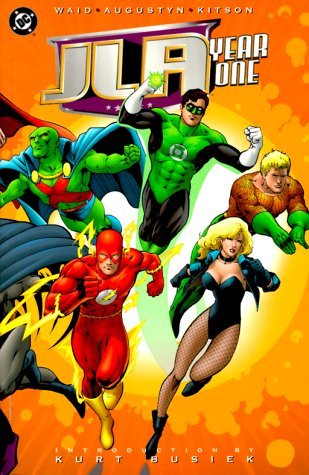
JLA: Year One


By Mark Waid, Brian Augustyn & Barry Kitson with Michael Bair, John Stokes, Mark Propst, & various (DC Comics)
ISBN: 978-1-56389-512-8 (TPB)

If the chop-and-change continuity gymnastics DC have undergone in recent years gives you a headache, but you still love reading excellent superhero team stories, you could just take my word that this is one of the best of that breed and move on to the next review. If you’re okay with the confusion or still need convincing, though, please read on.

With then-partner All-American Publishing, in 1940 DC published the Justice Society of America in All-Star Comics from #3. Cover-dated “Winter Issue”, it spanned the year end and was on sale from November 22nd until January. The JSA were the first superhero team in comics.

In 1960 after a decade largely devoid of superheroes, the now fully-amalgamated publisher sagely revived the team concept as the Justice League of America, and gradually reintroduced the JSA ancestors as heroes of an alternative Earth to a fresh new caped and cowled world. By 1985, the continuity had become saturated and overcrowded with so many heroic multiples and close duplicates that DC’s editorial Powers-That-Be deemed it all too confusing and a deterrent to new readers, and decreed total change. It resulted in maxi-series Crisis on Infinite Earths and the events of the groundbreaking, earth-shattering saga led to a winnowing and restructuring of the DC universe…

With all the best bits from past stories (for which one could read “least charming or daft”) having now occurred on one Earth, and with many major heroes remade and re-launched (Superman, Wonder Woman, Flash et al.), one of the newest curses to readers – and writers – was keeping definitive track of what was now DC “History” and what had now never actually happened.

Thus 12-issue maxi-series JLA: Year One presented the absolute, definitive, real story of the formation and early days of the Justice League, the World’s Greatest – but no longer first – Superheroes…

Of course, since Zero Hour, Infinite Crisis and all the other subsequent publishing course-correcting extravaganzas (such as 52, Countdown, Dark Nights: Death Metal and so on) it’s not strictly true anymore. Still. Again…

None of which impacts upon the superb quality of the tale told here. Way back then – January to December 1998 and in the wake of Grant Morrison & Howard Porter’s spectacular re-reboot of the team – Mark Waid, Brian Augustyn & illustrator Barry Kitson (plus assorted assisting inkers) produced a superb version of that iteration’s earliest days. It’s still one of the best and most readable variations on the theme, even if DC have inexplicably let it slide out of print…

It begins “ten years ago” in ‘Justice League of America: Year One’ as a hidden observer gathers files on an emergent generation of new costumed heroes. When an alien invasion from Appellax brings inexperienced neophyte heroes Flash, Green Lantern, Black Canary, Aquaman and Martian Manhunter together to save Earth from colonisation, the media scents a news sensation, but the real story is the hidden forces hovering in the background of the event…

The Canary was reimagined as the rebellious daughter of the JSA original who had been active during WWII, and the others, like the Sea King and J’onn J’onzz, had undergone recent origin revisions too…

The main action begins after that initial victory, as the heroes – novices all, remember – opt to stick together as a team, only to be targeted by secret super-science society Locus, who begin snatching up alien invader corpses for genetic experimentation…

The second issue sees the new kids as media sensations overwhelmed and out of their depth, with everyone wanting a piece of them. Older outfits like the Blackhawks, Challengers of the Unknown and even officially-retired JSA veterans are watching with apprehension whilst Bruce Wayne wants them far away from Gotham City as they establish their ‘Group Dynamic’. Even trick archer Green Arrow is constantly hanging around, clearly angling for an invitation to join, but that’s never gonna happen…

Immortal villain Vandal Savage targets the inexperienced heroes with a squad of veteran supervillains – the Thorn, Solomon Grundy, Clayface and Eclipso – as everywhere, more new superheroes are emerging. Savage is resolved to stop this second Heroic Age before it begins…

In #3, Locus’ bio advancements lead to alliance with Savage, but their schemes are sidelined as the team struggle to work together. Every man there seems distracted by Black Canary, but their “chivalrous impulses” in combat are not only insulting but will get someone killed – if not by enemies, then by her…

The team is fully occupied playing ‘Guess Who?’ after accepting funding and resources from a mystery billionaire. The influx of cash results in a purpose-built secret mountain HQ, a covert personal communications network, live-in custodian/valet/tech support Snapper Carr and a security system designed by maverick teen genius Ted Kord.

At least the heroes are starting to bond, sharing jokes, origins and trade secrets, but tensions are still high and trust in each other is fragile…

Inker Michael Bair joins with #4 as ‘While You Were Out…’ sees Locus at last launch their campaign of conquest: picking off lone hero Dan Garrett, whose mystic Blue Beetle scarab proves no match for alien-enhanced bio-weaponry, even as the heroes are all singled out for close observation by mystery operatives…

The merciless Brotherhood of Evil unleash Locus-designed horrors on Manchester, Alabama in #5, leading to a tenuous team-up of Justice League and Doom Patrol that ends in disaster and defeat. Maimed and deprived of their abilities, they are ‘A League Divided’ until the DP’s resident genius Niles Caulder provides stopgap powers and weapons in ‘Sum of Their Parts’ (inked by Bair & John Stokes), enabling the heroes to rally and restore themselves…

In ‘The American Way’ the JLA suffer a shock after their greatest inspiration – Superman – declines an offer to join, even as Locus’ endgame begins.

The dispirited heroes barely notice, as ‘Loose Ends’ exposes treachery in the ranks, further distracting the heroes who discover a trusted ally has been spying on them in their private lives. They have no idea what’s really going on…

With unity shattered, the JLA turns on itself, missing Locus’ attempt to terraform Earth and literally ‘Change the World’

‘Heaven and Earth’ (inked by Bair & Mark Propst) finds all humanity’s helpless and all its many heroes subdued in a superpowered blitzkrieg that catches the planet napping. Crushed, defeated and interned in ‘Stalag Earth’ all hope is lost until the reunited Justice League lead a counter-offensive, turning tragedy into triumph and ensuring ‘Justice for All’

A brilliantly addictive plot, superbly sharp dialogue and wonderfully underplayed art suck the reader into an enthralling climax that makes you proud to be human… or at least terrestrially-based. This saga of our champions’ bonding and feuding under extended threat of rogue geneticists, planetary upheaval, and the mystery of who actually bankrolls the team, all added to continual, usual, everyday threats in a superhero’s life, is both enchanting and gripping.

When it’s done right there’s nothing wrong with being made – and allowed – to be feel ten years old again. In-the-know fans will delight at the clever incorporation of classic comics moments, in-jokes and guest-shots from beloved contemporaneous heroes and villains such as the Sea Devils, Metal Men, Atom and such, but the creators of this revised history never forget their new audience and nothing here is unclear for first-timers. The finale is a fan’s all-action dream with every hero on Earth united to combat all-out alien invasion! …And of course, the rookie JLA save the day again in glorious style.
© 1998 DC Comics. All Rights Reserved.

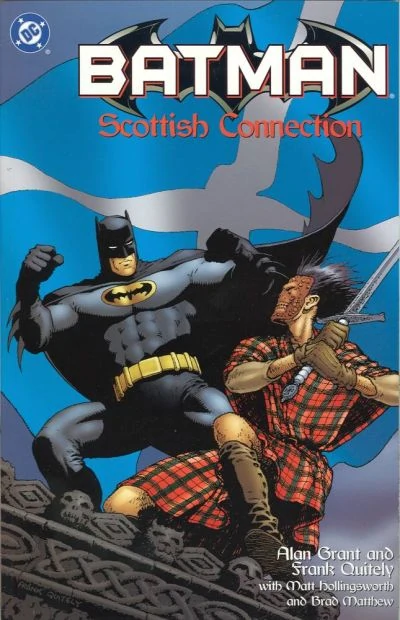
Batman: The Scottish Connection


By Alan Grant & Frank Quitely (DC Comics)
ISBN: 978-1-5638-9372-8 (TPB)

Once again we’ve lost another comics great, another uniquely brilliant and imaginative voice. Alan Grant died yesterday, July 21st 2022.

Born on February 9th 1949, in Bristol, Alan Grant grew up as a true Scot in the heart of Midlothian. He was a bit wayward and anarchic and – after trying regular life a couple of times –  began his comics career in 1967 as an editor for DC Thomson. Soon he was writing scripts – many with life-long collaborator John Wagner – and inventing characters, first for British companies but eventually all over the world.

His triumphs include Tarzan, Judge Dredd, Strontium Dog, Batman, Lobo, L.E.G.I.O.N., Judge Anderson, The Bogie Man, Channel Evil, Kidnapped, The Demon, Anarky, Robo-Hunter, The Loxleys and the War of 1812 and countless more.

Alan contributed to amateur fanzines, constantly encouraging and supporting new talent; adapted classic literature to comics form for major art festivals; worked in animation; organized his own comic conventions in home village of Moniaive; self-published and ran his own publishing house Berserker Comics. He was tirelessly inquisitive, deeply philosophical and instinctively socially philanthropic. In 2020, he led a community outreach project to inform about CoVID-19 via a comic book.

Alan Grant was funny, and friendly and amazing. Here’s one of his best books remembered. A fuller tribute will follow shortly: probably one of his more controversial (for which read scandalous and hilarious) efforts, because that would have pleased him greatly…

Way, way back in 1953, Detective Comics #198 cover featured ‘Lord of Bat-Manor’, written by Leigh Brackett & Edmond Hamilton and drawn by the legendary Dick Sprang. In it, Batman inherited a Scottish Castle and it was later established that Bruce Wayne’s ancestors came from Scotland.

Don’t ask me why that bit of ephemera remains when so very much else has been rewritten over the years but it has, and decades later, canny, proud and professional Scots Alan Grant & Frank Quitely parlayed that trivia titbit into this slim yet gripping Caledonian conundrum.

On a visit to the Auld Country, Bruce Wayne stumbles onto a quasi-Masonic plot to locate the lost treasure of the Knights Templar, but that’s simply the tip of the iceberg in a revenge scheme centuries in the making: one involving beautiful tragic women, deadly plagues, ancient super-weapons, crazed claymore-waving maniacs and good old-fashioned Heid-cases and Barm-pots all a-bother…

Beautifully illustrated, seditiously scripted and brilliantly dancing on the line between classic comedy and chilling thriller, this is pure adventurous escapism from two consummate professionals. Go and get it, bonny lads and lassies and all you others…
© 1998 DC Comics. All Rights Reserved.

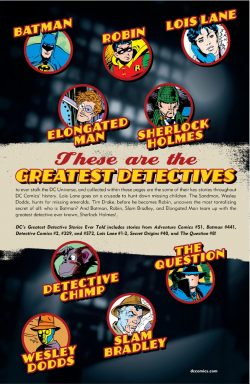
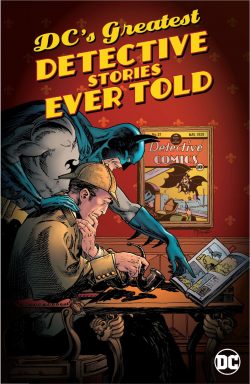
DC’s Greatest Detective Stories Ever Told


By Jerry Siegel & Joe Shuster, Gardner F. Fox, Mindy Newell, Mike W. Barr, Denny O’Neil, Andy Helfer, Rusty Wells, Creig Flessell, Carmine Infantino, Alan Davis, Paul Neary, Terry Beatty & Dick Giordano, Al Vey, E.R. Cruz, Denys Cowan & Rick Magyar, Mark Badger, Jim Aparo & Mike DeCarlo & various (DC Comics)
ISBN: 978-1-7795-0594-1 (TPB/Digital edition)

Fundamental and definitive aspects of “detective stories” have been attributed to the Bible, ancient Greek dramas, One Thousand and One Nights and similarly compelling classical texts from China, India and other places, but the true genre of crime and mystery fiction really began with cheap printing and the rise of mass entertainment culture.

Detective stories are a subgenre wherein an investigation – by amateur or professional (active or retired) – into a legal felony or moral/social injustice. Like exploration/adventuring, fantasy, horror and science fiction, Detective Stories blossomed in white western societies in the mid-19th century: spreading from prose books and magazines to other entertainment media like plays and films, with early stars including C. Auguste Dupin, Sherlock Holmes, Jules Maigret, Father Brown, Lord Peter Wimsey, Sexton Blake and Hercule Poirot. Tales aimed at youngsters generated their own sleuthing stars: Nancy Drew, The Hardy Boys and more

As comic strips developed, they also spawned detective champions like Hawkshaw, Dick Tracy, Charlie Chan, Kerry Drake ad infinitum: all contributing to a tidal wave of pulp fiction crimebusters that inspired true literary legends – Philip Marlow, Sam Spade, Simon Templar, Mike Hammer and so on…

Detective Comics #1 had a March 1937 cover-date and was the third and final anthology title devised by luckless pioneer Major Malcolm Wheeler-Nicholson. In 1935, the entrepreneur had seen the potential in Max Gaines’ new invention – the comic book – and reacted quickly, conceiving and releasing packages of all-new strips in New Fun: The Big Comic Magazine and its follow-up New Fun/New Adventure (which ultimately became Adventure Comics) under the banner of National Allied Publications.

These publications differed from similar prototype comics magazines which simply reprinted edited collations of established newspaper strips. However, these vanguard titles were as varied and undirected in content as any newspaper funnies page.

Detective Comics was different. Specialising solely in tales of crime and crimebusters, the initial roster included (amongst others) adventurer Speed Saunders, Cosmo, the Phantom of Disguise, Gumshoe Gus and two series by a couple of kids from Cleveland named Siegel & Shuster: espionage agent Bart Regan and two-fisted shamus Slam Bradley

Within two years the commercially unseasoned Wheeler-Nicholson had been forced out by his more adept business partners, and eventually his company grew into monolithic DC (for Detective Comics) Comics. Surviving a myriad of changes and temporary shifts of identity and aims, it’s still with us – albeit primarily as a vehicle for the breakthrough character who debuted in #27 (May 1939)…

Celebrating that quintessential connection and affiliation to the form, this slim tome gathers an unconventional array of sleuths and problem solvers, many not native to the parent title, but all offering a heady taste of what made the title great. Re-presenting material from Adventure Comics #51; Batman #441; Detective Comics #2, 329 & 572; Lois Lane #1-2; Secret Origins #40 and The Question #8 it spans August 1937 to November 1989: an epic package chronologically sampling the company’s connection and debt to the genre that truly started their ball rolling…’’

Sans preamble, we dive straight into action with early star Slam Bradley in his second ever case. ‘Skyscrapers of Death’ originated in the April 1937 cover-dated Detective Comics #2, (by Jerry – back when he still called himself “Jerome” – Siegel & Joe Shuster). It reveals how the abrasive, two-fisted gumshoe is framed for murder by a crooked Union boss. Slam and his assistant Shorty were a big draw in those early days: revelling in all the raw action and spectacle that would fire up his younger cousin Superman. The Bradley strip ran until October 1949, finally closing shop in Detective Comics #152.

Next up is quintessential pulp sleuth The Sandman who premiered in either Adventure Comics #40 July 1939 (two months after Batman debuted in Detective Comics #27) or two weeks earlier than that in New York World’s Fair Comics 1939, depending on which distribution records you choose to believe.

He was created and originally illustrated and scripted by multi-talented all-rounder Bert Christman, with assistance from Gardner F. Fox. Head utterly obscured by a gas-mask and slouch hat; caped, business-suited millionaire adventurer Wesley Dodds is a rugged playboy scientist cut from the radio drama/prose periodical mystery-men mould of The Shadow, Phantom Detective, Green Hornet, Lone Ranger, Spider, Avenger and so many more: all household names of early mass-entertainment.

Wielding a sleeping-gas gun and haunting the night hunting killers, thieves and spies, he was soon joined by plucky paramour Dian Belmont, before gradually losing readers’ interest and slipping from cover-spot to last feature in Adventure, just as the shadowy, morally ambiguous avengers he emulated also slipped from popularity in favour of gaudily clad glory-boys…

Alternately titled ‘The Pawn Broker’ in previous reprints, ‘The Van Leew Emeralds’ comes from Adventure Comics #51 (June 1940 by Fox & Creig Flessel): a fascinating mystery romp for the romantically-inclined crimebusters to solve in fine style and double-quick time…

In 1963 Julius Schwartz took editorial control of Batman and Detective Comics and finally found a home for a character who had been lying mostly fallow ever since his debut as a walk-on in The Flash #112 (April/May 1960). The Elongated Man was Ralph Dibny: a circus-performer who discovered an additive in soft drink Gingold which granted certain people increased muscular flexibility. Intrigued, he refined the chemical until he had a serum bestowing ability to stretch, bend and compress his body to an incredible degree. Then Ralph had to decide how to use his new powers…

Designed as a modern take on Jack Cole’s immensely popular Golden Age star Plastic Man, Dibny became a regular guest star/colleague for the Scarlet Speedster. He married vivacious debutante Sue Dibny and joined Flash’s battles against aliens and supervillains, but when the back-up spot opened in Detective Comics (previously held by Martian Manhunter since 1955 and only vacated because J’onn J’onzz was promoted to lead position in House of Mystery) Schwartz had Dibny slightly reconfigured as a flamboyant, fame-hungry, attention-seeking, brilliantly canny globe-trotting private eye solving mysteries for the sheer fun of it.

Aided by his equally smart but thoroughly grounded wife, the short tales were patterned on classic Thin Man filmic adventures of Nick and Norah Charles: blending clever, apparently impossible crimes and events with slick sleuthing, all garnished with the outré permutations and frantic physical antics first perfected by Cole…

Drenched in fanciful charm and sly dry wit, the complex yet uncomplicated sorties began in Detective #327 (May 1964) running until #371 (cover-dated January 1968). Crafted by Fox & Infantino – who inked himself in early episodes – this third outing has them heading for cowboy country to unravel the ‘Puzzle of the Purple Pony!’ (Detective Comics #329) by inadvertently playing cupid for a young couple hunting a gold mine before capturing a gang of murderous bandits with money and murder in mind.

Next up is a rare, completely serious outing for the oldest female lead in superhero comics. Although her role varied from patsy to comedy stooge, from jester to romantic ideal to eye-candy as the situation warranted, Lois Lane was always an investigative whirlwind.

Here in the dying moments of the pre-Crisis on Infinite Earths continuity, scripter Mindy Newell & artist Gray Morrow found their 4-issue miniseries scrunched into two double-length issues (August-September 1986,with that notorious “Superman’s Girl Friend…” strap line thankfully dropped) as Lois Lane #1-2, scrupulously, meticulously, obsessively, and ultimately unsuccessfully tried to bring a national crisis in missing children to the public’s attention in ‘When it Rains, God is Crying’.

Devoid of superhero involvement, the regular Superman cast are drawn into a polemical story exposing the extent of child abduction, the repercussions of recovering victims – dead or otherwise – and official responses in ‘Ignorance Was Bliss’, ‘Dark Realities’, ‘Quicksand’ and ‘Bless the Child’ after Lois becomes increasingly driven to solve the mystery of an unidentified child found dead in Metropolis. Refusing to accept the horrific toll of disappearances she uncovers, the traumatised reporter puts her life and career on the line to find answers nobody seems willing to hear…

From painful reality we fold back into fantastic fantasy as anniversary issue Detective Comics #572 (March 1987) unites Batman, second Robin Jason Todd, Elongated Man, Slam Bradley and Sherlock Holmes in a hunt for ‘The Doomsday Book’, courtesy of scripter by Mike W, Barr, Alan Davis & Paul Neary, Terry Beatty & Dick Giordano, Infantino & Al Vey & ER Cruz.

The story begins with the descendent of infamous Professor Moriarty enacting a century old scheme, countered by each hero in a solo turn before all leads connect them to a certain British castle and a manic climactic confrontation…

In the gritty post-Crisis reality, Denny O’Neil, Denys Cowan & Rick Magyar retooled Steve Ditko’s ultimate lone agent of justice into a philosophical force of nature, relentless in his pursuit of answers.

An ordinary man pushed to the edge by his obsessions, Vic Sage used his fists and a mask that makes him look faceless to secure truth and justice whenever normal journalistic methods failed. Here the remorseless Question prowls Hub City hunting the ‘Mikado’ (The Question #8, September 1987): a good man driven by the daily horrors of the city to take action, against villains and hypocrites, making his punishments fit the crime…

In the years when superheroes were in retreat and considered too foolish for readers. DC launched Rex the Wonder Dog, who solved crimes, fought dinosaurs and saved the world. In issue 4 (July/August 1952), a back-up feature launched. Written by John Broome, Bobo was Detective Chimp: a Florida-based stalwart who was assistant and deputy to the local sheriff. He cracked many cases and was extremely popular among certain types of fan. He remains so and in Secret Origins #40 (May 1989) finally enjoyed ‘The Origin of Detective Chimp’ thanks to Mark Badger Andy Helfer & Rusty Wells. Madcap and hilarious, it’s a wild ride but has been superseded in later years by other, more quasi rational tales. Nevertheless, an ape solving crimes is a sure-fire winner as many other hirsute DC gumshoes could attest…

This eclectic selection closes with the middle chapter of a landmark crossover tale. Crafted by Marv Wolfman, Jim Aparo & Mike DeCarlo, ‘Parallel Line’ comes from Batman #441 (November 1989) the third chapter of the Batman: A Lonely Place of Dying arc introducing third Robin Tim Drake.

After original Robin Dick Grayson’s departure, the Dark Knight worked solo until he caught a streetwise urchin stealing the Batmobile’s tires. This lost boy was Jason Todd, whose short but stellar career as the Boy Wonder was fatally tainted by his impetuosity, tragic links to one of the hero’s most unpredictable foes and shocking death. The trauma of losing his comrade forced Batman to re-examine his own origins and methods, becoming darker still..

After a period of increasingly undisciplined encounters Batman was on the edge of losing not just his focus but also his ethics and life: seemingly suicidal on frequent forays into the night. Interventions from his few friends and associates had proved ineffectual. Something drastic had to happen if the Dark Knight was to be salvaged.

Luckily there was an opening for a sidekick…

The crossover tale originally appeared in Batman #440-442 and New Teen Titans #60-61 (all plotted by Wolfman & George Pérez) and a new character entered the lives of the extended Batman Family; a remarkable child who would reshape the DC Universe.

‘Parallel Lines’ unravels the enigma of Tim Drake, who as a toddler was in the audience the night the Flying Graysons were murdered. Tim was an infant prodigy, and when, some months later he saw new hero Robin perform the same acrobatic stunts as Dick Grayson, he instantly deduced who the Boy Wonder was – and by extrapolation, the identity of Batman.

A passionate fan, Drake followed the Dynamic Duo’s exploits for a decade: noting every case and detail. He knew when Jason became Robin and was moved to act when his death triggered Batman’s increasing instability. Taking it upon himself to fix his broken heroes, Tim tried to convince the “retired” Grayson to became Robin once more – but fate had other plans…

Eccentrically engaging, these tales are the merest hint of the wonders locked in DC’s vaults of fun and wonder. Hopefully, it’s also simply the start of a long and vibrant caseload of recovered mysteries
© 1937, 1940, 1964, 1986, 1987, 1989, 2020 DC Comics. All Rights Reserved.

Superman in the Fifties


By Robert Bernstein, Otto Binder, Jerry Coleman, Bill Finger, Edmond Hamilton, William Woolfolk, Wayne Boring, Al Plastino, Curt Swan, Win Mortimer, Kurt Schaffenberger, Stan Kaye, Ray Burnley, Sy Barry & various (DDC Comics)
ISBN: 978-1-7795-0758-7 (TPB/Digital edition)

In the early years of this century, DC launched a series of graphic archives intended to define DC’s top heroes through the decades: delivering magnificent past comic book magic from the Forties to the Seventies via a tantalisingly nostalgic blast of other – arguably better, but certainly different – times. The collections carried the cream of the creative crop, divided into subsections, partitioned by cover galleries, and supplemented by short commentaries; a thoroughly enjoyable introductory reading experience. I prayed for more but was frustrated… until now…

First in a trilogy of trade paperbacks – the others being Batman and Wonder Woman (thus far, but hopefully Aquaman, Green Arrow and Martian Manhunter are in contention too, as they have become such big shot screen stars these days) – the experiment is being re-run, including even more inviting wonders from the company’s amazing, family-friendly canon.

Gathered here is an expanded menu of delights adding to that of the 2002 edition, and even rerunning Mark Waid’s original context-stuffed Introduction.

The stories originated in Action Comics #151, 162, 223, 232, 234, 236, 239, 242, 247, 249, 252, 254-255; Adventure Comics #210; Showcase #9; Superman #65, 79-80, 96-97, 118, 125, 127, Superman’s Girl Friend Lois Lane #8; Superman’s Pal Jimmy Olsen #13, 19 and World’s Finest Comics #68, 74, 75 which span the entire decade as the Adventures of Superman TV show propelled the Man of Tomorrow to even greater heights of popularity.

Supported by the first of a series of factual briefings, the collection leads with Part One: Classic Tales, opening on ‘Three Supermen from Krypton!’ Written by William Woolfolk and illustrated by Al Plastino (one of a talented triumvirate who absolutely defined the hero during this decade), it originated in Superman #65, (July/August 1950): a classy clash revealing unknown facts about Superman’s vanished homeworld. It also provided the increasingly untouchable champion with a much needed physical challenge after a capsule containing three comatose Kryptonian lawbreakers crashes on Earth and the inmates suddenly discover they have incredible powers…

Woolfolk and paramount art team Wayne Boring (peak of that triumvirate) & inker Stan Kaye probed outer space to provide another daunting threat in ‘The Menace from the Stars!’ (World’s Finest Comics #68, January/February 1954). However, all was not as it seemed in this quirky mystery, as a brush with a Green Kryptonite-infused asteroid gave the Man of Steel amnesia. Happily, before he could inadvertently expose his secret identity, another sudden impact set things aright…

Bill Finger, Boring & Kaye crafted ‘The Girl Who Didn’t Believe in Superman!’: a fanciful yet evocative human interest tale typical of the era and sorely missed in modern, adrenaline-drenched times. Cover-dated March 1955, the tearjerker from Superman #96 shared the tribulations of a blind child losing hope and is followed by a previously unseen entry.

‘It!’ debuted in Action Comics #162 (November 1951 by Finger, Boring & Kaye): an early alien-menace-with-a-moral yarn depicting a destructive rainbow-hued enigma terrorising Metropolis until the Man of Steel deduces the thing’s incredible secret.

Superman #97 (May 1955) carried Jerry Coleman, Boring & Kaye’s canonical landmark ‘Superboy’s Last Day in Smallville!’, revealing the previously unseen rite of passage by way of exposing a crook’s decades-delayed masterplan, after which Action Comics #239 exposes ‘Superman’s New Face’ (April 1958) – courtesy of famed pulp writer Edmond Hamilton, Boring & Kaye. When an atomic lab accident deforms Superman to the point that he must wear a full-face lead mask, there is – of course – method in his seeming madness…

The  first section closes with a tale from one of the many spin-off titles of the period – and one that gives many 21st century readers a few uncontrollable qualms of conscience. Superman’s Girl Friend Lois Lane was one of precious few comics with a female lead, but her character ranged erratically from man-hungry, unscrupulous schemer through ditzy simpleton to indomitable and brilliant heroine – often all in the same issue.

Most stories were played for laughs in a patriarchal, parochial manner; a “gosh, aren’t women funny?” tone that appals me today – but not as much as the fact that I still love them to bits. It helps that they’re all so beautifully illustrated by sublimely whimsical Kurt Schaffenberger. ‘The Ugly Superman!’ comes from #8 (April 1959), revealing how a costumed wrestler falls for Lois, giving the Caped Kryptonian another chance for some pretty unpleasant Super-teasing. It was written by the veteran Robert Bernstein, who – unlike me – can cite the tenor of the times as his excuse.

As the franchise expanded, so did the character roster and internal history. Part Two: The Superman Family is dedicated to our hero’s ever-extending supporting cast, leading with ‘Superman’s Big Brother!’ (Superman #80, January/February 1953). Scripted by Hamilton and limned by Plastino, it sees a wandering super-powered alien mistaken for a sibling, before an incredible truth comes out. It’s followed here by previously unreprinted tale ‘The First Superman of Krypton’ (Hamilton, Boring & Kaye, Action Comics #223, December 1956) with Superman finding video records from his birthworld and learning how – and why – his father Jor-El briefly enjoyed powers under a red sun…

Next comes the introduction of a genuine new family member. After the Man of Tomorrow made his mark as Earth’s premier champion, his originators took a long look and reasoned that a different perspective could provide a fresh look. What would it be like for a fun-loving lad who could do literally anything?

Answers came as Jerry Siegel & Joe Shuster – following years agitating their publisher – unleashed Superboy: inventing and/or fleshing out doomed Krypton, Kal-El‘s early years, foster parents and a childhood full of fun and incident. The experiment was a huge hit and the lad swiftly bounced into the lead spot of Adventure Comics and – in 1949 – his own title: living a life forever set 20 years behind his adult counterpart.

Encountering crooks, monsters, aliens, other super kids, school woes and the suspicions of girl-next-door Lana Lang, the Boy of Steel enjoyed an eventful, wonderful life which only got better in Adventure Comics #210 (March 1955), as Otto Binder, Curt Swan & Sy Barry introduced a wayward, mischievous and dangerously playful canine companion who had survived Krypton’s doom due to a freak accident in ‘The Super-Dog from Krypton!’.

Krypto had been baby Kal-El’s pet on Krypton before being used by desperate Jor-El as a test animal for the space rocket he was building. The dog’s miraculous arrival on Earth more than a decade later heralded a wave of survivors from the dead world over the latter part of the decade: all making Superboy less lonely and unique. Every kid needs a dog…

Fresh additions follow, beginning with ‘The Story of Superman, Junior’ (Action Comics #232, September 1959, by Coleman, Boring & Kaye) which sees the Man of Tomorrow adopt a super-powered lad whose space capsule crashes outside the city. However, Johnny Kirk is human, vanished from Earth years previously and his strangely familiar origin and eager inexperience poses an existential threat after the hero adopts him…

Cover-dated December 1958, Action Comics #247 details how an insidious criminal scheme to expose the hero’s secret identity prompts an extreme face-saving solution in Binder & Plastino’s ‘Superman’s Lost Parents!’ before we reach the landmark which, more than any other, moved Superman from his timeless Golden Age holdover status to become a vibrant part of the DC Silver Age revival. It came in in Action Comics #252 (May 1959) as ‘The Supergirl from Krypton!’ introduced cousin Kara Zor-El, born on a city-sized fragment of Krypton, which was somehow hurled intact into space when the planet exploded.

There had been a few intriguing test-runs before the future star of the ever-expanding Superman universe finally took off, but now the stage was set.

Eventually, Argo City turned to Kryptonite like the rest of the detonated world’s debris, and her dying parents – observing Earth through their scopes – sent their daughter to safety as they perished. Landing on Earth, she met Kal-El, who created her cover-identity of Linda Lee: hiding her in an orphanage in small town Midvale so she could learn about her new world and master her new powers in secrecy and safety. This time the concept struck home and the teenaged refugee began her lengthy career as a solo-star from the very next issue.

This section ends with another popular animal guest-star who was also one of the most memorable recurring super-foes of the period. ‘Titano the Super-Ape!’ debuted in Superman #127 (February 1959): a chimpanzee mutated into a Kryptonite-empowered King Kong analogue after being launched into space by rocket scientists. The chimp’s devotion to Lois and big hatred for the Man of Steel were unchanged in the aftermath, and as a skyscraper-sized giant ape with kryptonite vision, he became too dangerous to live. Thankfully, the Action Ace found another way in this beloved masterpiece by Binder, Boring & Kaye combining action, pathos and drama to superb effect.

Part Three: The Villains highlights our hero’s greatest enemies, leading with a team-up of The Prankster, Lex Luthor and extra-dimensional sprite Mr. Mxyztplk in a tale more mirthful mystery than moment of menace and mayhem. Devised by Hamilton, Boring & Kaye from Action Comics #151, December, 1950) ‘Superman’s Super-Magic Show!’ is followed by ‘The Creature of 1,000 Disguises!’ (Action Comics #234, November 1957) by the same team, with the hero plagued by a shapeshifting alien whose idea of fun is juvenile, frustrating and potentially catastrophic.

Superman #118 (January 1958) sees an uncredited writer & Plastino detail ‘The Death of Superman!’  as a fake Man of Steel tricks Lois in an attempt to secure damaging evidence after which Binder, Boring & Kaye reveal ‘Superman’s New Uniform!’ (Action Comics #236, January 1958) as a deadly plot by Luthor to destroy his arch enemy.

Binder & Plastino introduced both the greatest new villain and most expansive character concept the series had yet seen in Action Comics #242, (July 1958) as ‘The Super-Duel in Space’ saw evil alien scientist Brainiac attempt to add Metropolis to his menagerie of miniaturised cities in bottles.

As well as a titanic tussle in its own right, this tale completely changed the mythology of the Man of Steel: introducing Kandor, a city full of Kryptonians who had escaped the planet’s destruction when Brainiac captured them. Although Superman rescued his fellow survivors, the new villain escaped to strike again and again. It would be years before the hero restored the Kandorians to their original size.

Action Comics #249, (February 1959) sees Luthor deliberately irradiate himself with Green K to avoid capture in Binder & Plastino’s ‘The Kryptonite Man!’, but his evil genius proves no match for our hero’s sharp wits, used with equal aplomb in ‘The Battle with Bizarro!’ (Action #254, July 1959) by the same creative team. This story actually re-introduced the imperfect duplicate, who had initially appeared in a well-received story in Superboy #68, from 1958. Even way back then, sales trumped death…

The Frankensteinian doppelganger was resurrected thanks to Luthor’s malfunctioning duplicator ray and Bizarro’s well-intentioned search for a place in the world caused chaos, exacerbated when the lonely monster used the device to make more of his kind. The saga was continued over two issues – an almost unheard of luxury back then – concluding with outrageous empathy in ‘The Bride of Bizarro!’ (#255, August 1959).

Final section Part Four: Superman’s Pals stems largely from that epochal television show, which made most of the supporting cast into household names., but begins with an early exploit of the “World’s Finest Team” from World’s Finest Comics #74, January/February 1955. The great friends’ solidarity is upset after a shapeshifting alien orchestrates a manic rivalry but ‘The Contest of Heroes’ (Finger, Swan & Kaye) is not what it seems…

Superman #79 (November/December 1952) has Hamilton & Plastino depict how a corrupt publisher seeks ‘The End of the Planet!’ but is outfoxed by the dedication of the reporters he made jobless whilst ‘Superman and Robin!’ is a classic bait-and-switch teaser from WFC #75 (March/April 1955), wherein a disabled Batman can only fret and fume as his erstwhile assistant seemingly dumps him for a better man. I’m sure Finger, Swan & Kaye knew that no-one would believe that they had really broken-up the Batman/Boy Wonder team, but the reason for the ploy is a killer….

The Adventures of Superman television show launched in the autumn of 1952, adopting its name from the long-running radio serial that preceded it. It was a monolithic hit of the still young medium and National Periodicals began tentatively expanding their increasingly valuable franchise with new characters and titles. First up were the gloriously charming, light-hearted escapades of that rash, capable but naïve photographer and “cub reporter” from the Daily Planet. The solo-career of the first spin-off star from the Caped Kryptonian’s ever-expanding entourage began with Superman’s Pal Jimmy Olsen #1, which launched in 1954 with a September-October cover date. Here, ‘The Stolen Superman Signal’ (#13, June 1956, by Binder, Swan & Ray Burnley) perfectly displays the lad’s pluck and aura of light-hearted whimsy that distinguished the early stories when  criminals target the cub reporter’s secret weapon: a wristwatch emitting a hypersonic sound only the Action Ace an hear…

The Planet’s top female reporter also got her own comic book thanks to TV exposure, but it took another three years for the cautious Editors to tentatively push that boat out again. In 1957, just as the Silver Age was getting going, try-out title Showcase – which had launched The Flash  in #4 & 8) and Challengers of the Unknown (#6 & 7) – followed up with a brace of issues entitled Superman’s Girl Friend Lois Lane. Soon after they awarded the “plucky News-hen” a series of her own. Technically it was her second, following a brief mid-1940s string of solo tales in Superman.

From Showcase #9 (June/July 1957) ‘The Girl in Superman’s Past!’ is by Coleman & Plastino, introducing an adult Lana Lang as a rival for superman’s affections and beginning decades of sparring that led to many a comic-book catfight…

Superman’s Pal Jimmy Olsen #19 (March 1957, by Binder, Swan & Burnley) contributed comedy classic ‘Superman’s Kid Brother’ as major head trauma convinces the cub reporter that he is also superpowered and cruel circumstance keeps that misapprehension alive long past the point where his life is endangered…

The last tale in this section – and the volume – is ‘Superman’s New Power!’ by Coleman, Boring & Kaye from Superman #125 (November 1958). Here an uncanny accident grants the Man of Steel new and incomprehensible abilities with catastrophic consequences…

Also including an extensive cover gallery by Plastino, Boring, Swan, Win Mortimer, Kaye & Burnley, and extensive creator Biographies, this is a wonderful slice of comics history, refreshing, comforting and compelling. Any fan or newcomer will delight in this primer into the ultimate icon of Truth Justice and The American Way.
© 1950, 1951, 1952, 1953, 1954, 1955, 1956, 1957, 1958, 1959, 2020 DC Comics. All Rights Reserved.