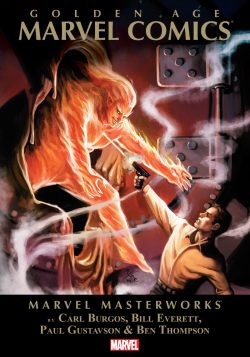
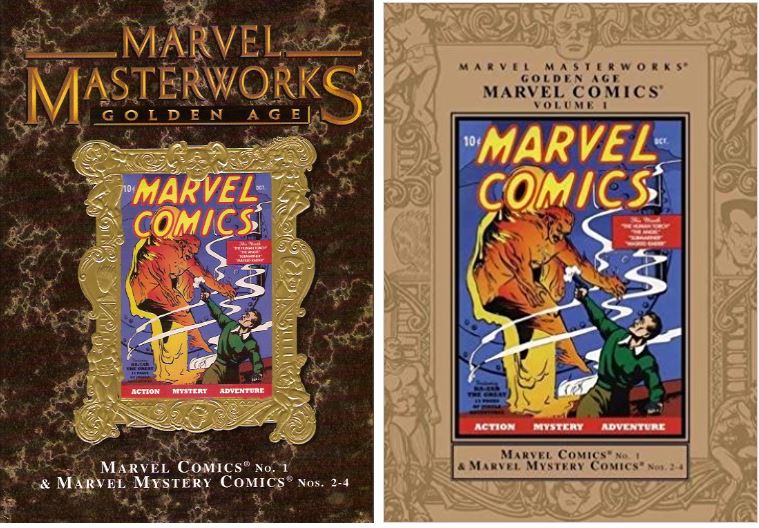
Golden Age Marvel Comics Masterworks volume 1


By Carl Burgos, Bill Everett, Paul Gustavson, Ben Thompson, Ed Wood/Fred Schwab, Al Anders, Tomm Dixon/Art Panajian, Steve Dahlman, Stockbridge Winslow/Bob Davis, Irwin Hasen, Ray Gill, David C. Cooke, Charles J. Mazoujian, Paul Lauretta, Harry Ramsey, Alex Schomburg & others (MARVEL)
ISBN: 978-0-7851-1609-7 (HB/Digital edition) 978-0-7851-5052-7 (TPB)

There are many comics and strip anniversaries this year and this title ranks among the most significant, containing not one but two superstar launches and a few minor milestones too…

After a rather shaky start and inauspicious in 1936, the fledgling comic book industry was saved by the invention of Superman two years later. His iconic innovations launched a new popular genre and paved the way for explosive expansion. By 1939 the new kids on the block were in a frantic flurry of creative frenzy with every publisher trying to make and own the Next Big Thing.

Martin Goodman’s pulp fiction outfit leapt into the turbulent marketplace and scored big with initial offering Marvel Comics, released late in the year before inexplicably switching to the marginally less euphonious Marvel Mystery Comics with the second issue. During those early days, novel ideas, raw ambition and sheer exuberance could take you far and, as most alternative means of entertainment escapism for kids were severely limited, it just wasn’t that hard to make a go of it as a comic book publisher. Combine that with a creative work-force which kept being drafted, and it’s clear to see why low and declining standards of story and art didn’t greatly affect month-to-month sales during the years of World War II.

However, once hostilities ceased a cascade-decline in superhero strips began even before GI boots hit US soil again. Those innocent kids had seen a lot and wanted something more than brashness, naivety and breakneck pace from their funnybooks now…

Both The Human Torch and Sub-Mariner quickly won favour with the burgeoning if fickle readership, but the remaining characters were soon acknowledged to be B-listers and subject to immediate replacement if a better idea presented itself. Still, 2 out of 7 was pretty good: Action and Detective Comics only had one super-star apiece at the outset. Another holdover from the pre-comics, pulp fiction era of the company was its tendency to treat instalments as serial chapters; always promising more & better if you’d just come back next month…

Before the year was out Timely’s “Big Two” would clash – frequently and repeatedly battling like elemental gods in the skies above Manhattan. Goodman apparently favoured Ka-Zar and The Angel: both characters devolving from his own stable of pulp genre stars. Sadly, neither generic jungle adventures of the company’s premiere Tarzan knockoff nor the thud-&-blunder crimebusting rogue’s potboilers – which owed so much to Leslie Charteris’ iconic dark knight The Saint – appeal to kids like the spectacular graphic histrionics of anarchic Fire and Water anti-heroes did…

An editorial policy of rapid expansion was quickly adopted: release a new book filled with whatever was dreamed up by the art-&-script monkeys of the comics “shop” (freelancers who packaged material on spec for publishing houses: Martin Goodman bought all his product from Lloyd Jacquet’s Funnies Inc.), keep the popular hits and ditch everything else. Timely Comics, or Red Circle as the company occasionally called itself, enjoyed a huge turnover of characters who only minimal appearances before vanishing, thereafter un-seen again until modern revivals or recreations produced fresh versions of characters like Angel, Ka-Zar or Electro.

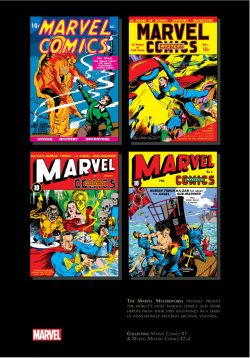
This volume – available in hardback, softcover and eBook editions – kicks into high gear following a knowledgeable and informative scene-setting introduction by Golden Age Guru Roy Thomas. The landmark Marvel Comics #1 sported a cover by pulp illustrator Frank R. Paul, and after spot gag page ‘Now I’ll Tell One’ (by “Ed Wood” – AKA Fred Schwab) introduces to the gasping populace Carl Burgos’ landmark conception ‘The Human Torch’

The Flaming Fury led off a parade of wonderment, bursting into life as a malfunctioning humanoid devised by Professor Phineas Horton. Igniting into an uncontrollable blazing fireball whenever exposed to air, the artificial innocent was condemned to entombment in concrete but escaped to accidentally imperil the city until falling into the hands of a gangster named Sardo. When his attempts to use the gullible android as a terror weapon backfire, the hapless newborn is left a misunderstood fugitive, like a modern-day Frankenstein’s monster. Even his creator only sees the flaming waif as a means of making money…

Crafted by Paul Gustavson (Human Bomb, Fantom of the Fair, Man O’ War), the opening episode of ‘The Angel’ owed a litigiously large debt to 1938 Louis Hayward film The Saint in New York. Although dressed like a superhero, the globetrotting do-gooder offered a blend of Charteris’s iconic valiant scoundrel and The Lone Wolf (Louis Vance’s urbane 2-fisted hero who was subject of 8 books and 24 B-movies between 1917 and 1949). However, the four-colour paladin’s foes soon tended towards only the spooky, the ghoulish and the just plain demented. He also seemed able to cast giant shadows in the shape of an angel. Not the greatest aid to cleaning up the scum of the Earth, but he coped in his initial enterprise when tasked with cleaning up New York’s gang problems and dealing with the deadly depredations of a crime syndicate dubbed The Six Big Men’

Bill Everett’s contribution ‘The Sub-Mariner’ was actually an expanded reprint of a beautiful black-&-white strip from Motion Picture Funnies. Prince Namor was scion of an aquatic civilisation living under the South Pole. These technologically advanced merfolk had been decimated by American mineral exploration a generation previously, and Namor’s future mother Fen had been dispatched to spy upon them. She had gotten too close, fallen pregnant by one of the interlopers. Twenty years later her amphibious mutant-hybrid son was bent onto exacting revenge on the air-breathers – which he began by attacking New York City…

Cowboy Jim Gardley was framed by ruthless cattle-baron Cal Brunder and found the only way to secure a measure of justice was to become ‘The Masked Raider’: dispensing six-gun law. Al Anders’ Lone Ranger riff was competent but uninspired, lasting until Marvel Mystery #12. Offering a complete adventure, ‘Jungle Terror’ by Tomm Dixon (aka Art Panajian) follows gentlemen explorers Ken Masters and Tim Roberts (pictorially patterned on Caniff’s Pat Ryan and Terry Lee) battling savages in the Amazon to find cursed diamonds. After a brief prose vignette – a staple of early comics – detailing Ray Gill’s racing car drama ‘Burning Rubber’ the aforementioned ‘Adventures of Ka-Zar the Great’ begins with Ben Thompson (The Masked Marvel, Hydro-Man) adroitly adapting Bob Byrd’s pulp novel King of Fang and Claw to strip serial form. In the first chapter, South African diamond miner John Rand and his wife crash their plane into the Belgian Congo where their son David grows up amidst jungle splendour to become brother to King of Lions Zar. An idyllic life is only marred years later when murderous explorer Paul De Kraft kills old John, leaving young David to seek vengeance…

Behind a Charles J. Mazoujian Angel cover, the abruptly re-titled Marvel Mystery Comics #2 (December 1939) again offered ‘The Human Torch’ by Burgos, wherein the fiery fugitive attains a degree of sophistication and control before stumbling onto a murderous racing car racket. Here gangster Blackie Ross ensures his drivers always win by strafing other contestants from an airplane, until the big-hearted, outraged Torch steps in…

Gustavson despatched ‘The Angel’ to Hong Kong to stop museum researcher Jane Framan falling victim to a curse when the perils of The Lost Temple of Alano prove to be caused by greedy men, not magical spirits, but ‘The Sub-Mariner’ himself is the threat in Everett’s second chapter, as the Marine Marvel goes berserk in a NYC powerhouse before showing his true colours by chivalrously saving a pretty girl caught in the ensuing conflagration. Anti-heroism gives way to traditional nobility as Anders’ ‘Masked Raider’ then breaks up an entire lost town of outlaws, after which the debuting ‘American Ace’ (by Paul Lauretta and clearly based on Roy Crane’s soldier of fortune Wash Tubbs) finds Yankee aviator Perry Wade flying straight into danger when the woman who caused the Great War returns to start WWII by attacking innocent European nations with her hidden armies…

‘The Angel’ stars in an implausible, jingoistic prose yarn (by David C. Cooke illustrated by Mazoujian), single-handedly downing a strafing ‘Death-Bird Squadron’ whilst Thompson introduced fresh horrors – including a marauding, malicious ape named Chaka – to plague young David in more ‘Adventures of Ka-Zar the Great’ before the issue ends with gag pages ‘All in Fun’ by Ed Wood and ‘Looney Laffs’ from Thompson.

Cover-dated January 1940 and sporting an Alex Schomburg Angel cover, Marvel Mystery Comics #3 saw ‘The Human Torch’ evolving into a recognisable superhero series as he battles a ruthless entrepreneur trying to secure the formula for a super-explosive he can sell to Martian invaders, whilst ‘The Angel’ confronts a bloodthirsty death-cult sacrificing young women. Next ‘The Sub-Mariner’ takes a huge leap in dramatic quality after policewoman Betty Dean entices, entraps and successfully reasons with the intractably belligerent subsea invader. With global war looming ever closer, opinions and themes constantly shifted and Everett reacted brilliantly by turning Namor into a protector of all civilians at sea: preying on any warlike nation sinking innocent shipping. Naturally, even before America officially joined the fray, that meant primarily Nazis got their subs and destroyers demolished at the antihero’s sinewy hands…

When gold and oil are discovered under ranch land, ‘The Masked Raider’ steps in to stop greedy killers driving off settlers in a timeless tale of western justice, whereas current events overtook the ‘American Ace’, who faded out after his tale of blitzkrieg bombings in a picturesque Ruritanian nation. Even Cooke & Everett’s text thriller ‘Siegfried Suicide’ was naming and shaming the Axis directly in a yarn of a lone Yank saving French soldiers from German atrocity, before neutrality resumes as, under African skies, the ‘Adventures of Ka-Zar the Great’ sees the boy hero rescue his animal friends from a well-meaning zoo hunter in a tale revealing hints of a Jungle Book style congress of animals…

The final inclusion – Marvel Mystery Comics #4, February 1940 – opens with a Schomburg cover depicting Sub-Mariner smashing a Nazi U-Boat before another inflammatory Burgos ‘Human Torch’ epic sees the android create secret identity Jim Hammond and return to New York to crush a criminal genius terrorising the city with warriors cloaked in lethal, sub-zero ‘Green Flame’

‘The Angel’ too is in the Big Apple, hunting a small time hood manipulating a monstrous hyper-thyroid case named ‘Butch the Giant’. Impervious to pain and able to punch through brick walls, this slavish meal ticket is eventually overcome, after which ‘The Sub-Mariner Goes to War’ as the passionate Prince rallies his Polar people, employing their advanced technology in a taskforce enforcing his Pax Namor upon the surface world’s war mongers…

Even by its own low standards ‘The Masked Raider’ tale of claim-jumping is far from exemplary, but prose crime puzzler ‘Warning Enough’ (Cooke & Harry Ramsey) is a genuinely enthralling change of pace tale.

Rendered by Steve Dahlman, ‘Electro, the Marvel of the Age’ introduces brilliant Professor Philo Zog who constructs an all-purpose wonder robot and forms an international secret society of undercover operatives who seek out uncanny crimes and great injustices for the automaton to fix. The first case involves retrieving a kidnapped child actress…

Another debut is ‘Ferret, Mystery Detective’ by Stockbridge Winslow (Bob Davis) & Irwin Hasen, following the eponymous crime-writer and his faithful assistants as they solve the case of a corpse dropped on the authors doorstep. Proceedings culminate with another winner in the ‘Adventures of Ka-Zar the Great’ as despised villain De Kraft returns to face the beginning (but not the end: that’s frustratingly left to the next issue …and volume) of the jungle lord’s just vengeance…

Despite many problems – especially its regrettable populist tendencies and desperately dated depictions of race, class, ethnicity and gender – I’m constantly delighted with this substantial chronicle, warts and all, but I can fully understand why anyone other than a life-long comics or Marvel fan might baulk at the steep price-tag in these days of grim austerity, with a wealth of better quality and more highly regarded comics collections available. Nevertheless, value is one thing and worth another, and the sheer vibrantly ingenious rollercoaster rush and vitality of these tales, even more than historical merit or cultural obsolescence, is just so intoxicating that if you like this sort of thing you’ll love this sort of thing.

If anything could convince the undecided to take a look, later editions also include numerous tantalising house ads of the period and a full colour cover gallery of Marvel Mystery Comics’ pulp predecessors: Marvel Science Stories, Marvel Tales, Marvel Stories, Ka-Zar, The Angel Detective, Uncanny Tales, Mystery Tales, Dynamic Science Stories and Star Detective Magazine by illustrators Norman Saunders, Frank R. Paul, H. W. Wesso and John W. Scott. Upping the ante, further bonuses comprise the second print cover of Marvel Comics #1, a sample of Norman Saunders’ original painted art, Everett Sub-Mariner pages and unused cover roughs, a Mazoujian-pencilled Angel cover reworked into the never-printed Zephyr Comics ashcan cover and a Burgos watercolour sketch offering a partial redesign of The Human Torch.

Although probably not to the tastes of most modern fans, for devotees of superheroes, aficionados of historical works and true Marvel Zombies there’s still plenty to enjoy here, and as always, in the end, it’s up to you…
© 1939, 1940, 2004, 2017 Marvel Characters, Inc. All rights reserved.
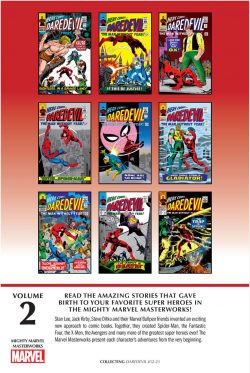
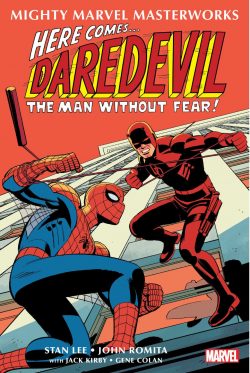
Mighty Marvel Masterworks Daredevil volume 2: Alone Against the Underworld


By Stan Lee, Denny O’Neil, John Romita, Gene Colan, with Jack Kirby, Frank Giacoia, Mike Esposito, Dick Ayers, Bill Everett & various (MARVEL)
ISBN: 978-1-3029-3440-8 (PB/Digital edition)

It’s another year of significant anniversaries so let’s say many happy returns for the swinging sixtieth of the rather tastelessly characterised “Sightless Swashbuckler” and latter-day meanly moody Man Without Fear Daredevil

As the remnants of Atlas Comics grew in popularity in the early 1960s it slowly replaced its broad variety of genre titles with more and more superheroes. The recovering powerhouse that would be Marvel was still hampered by a crippling distribution deal that limited the company to 16 titles (curtailing their output until 1968), so each new untried book would have to be certain of success.

Moreover, as costumed characters were selling, each new similarly-themed title would limit the breadth of the monster, western, war, humour or girls’ comics that had been the outfit’s recent bread and butter. It was putting a lot of eggs in one basket, and superheroes had failed twice before for Stan Lee. It all worked out in the end though…

Back then, Matt Murdock was a blind lawyer whose remaining senses hyper-compensate, enabling him to perform astonishing acrobatic feats and fight like a demon. A formidable fighter for justice in both identities and a living lie-detector, he was very much a second-string hero for most of his early years.

Daredevil was nonetheless a striking and popular one, due in large part to the roster of brilliant artists who illustrated the strip. He battled thugs, gangsters, a plethora of super-villains and even the occasional monster or alien invasion, quipping and wise-cracking his way through life and life-threatening combat. His civilian life consisted of assorted legal conundra and manfully standing back while quenching his own feelings as his portly best friend and partner Franklin “Foggy” Nelson vainly romanced their secretary Karen Page, With Lee and a rotating line-up of artists plugging on, concocting some extremely engaging tales until the latest Marvel Sensation could find his feet.

That transition forms the meat of this potent compilation: part of a series of Mighty Marvel Masterworks available as kid-friendly digest paperbacks and eBooks. It traces the move from morose masked avenger to wisecracking Scarlet Swashbuckler, gathering Daredevil #12-21 (January 1965-October 1966) into one boldly boisterous package of thrills and spills.

The previous year had seen Golden Age giant Wally Wood leave his own unmistakable mark on the series but with his departure Lee turned to an old pal who had left during the harshest days of the Atlas implosion. He was to eventually become Marvel’s top – and most loyal – superstar…

‘Sightless, in a Savage Land!’ was laid out by Jack Kirby and illustrated by John Romita. The latter had worked for Timely/Atlas in the 1950s before moving to relatively steady work on National/DC’s romance comics, as well as freelance advertising. He returned to take DD on an epic quest, guest-starring Tarzan-tribute act Ka-Zar, ranging from the dinosaur-haunted Savage Land via an extended battle with high-tech pirates led by The Plunderer to Jolly Olde England-land (in #13’s ‘The Secret of Ka-Zar’s Origin!’) and ultimately to a US Early Warning Base (#14, ‘If This be Justice…!’, and with what I’m sure is some un-credited assistance from George Tuska).

With this multi-part, globe-girdling epic, Daredevil began to confirm his persona as a wisecracking one-man war on evil: a front that would carry him all the way to the grim ‘n’ gritty Frank Miller days, far, far in the future. Romita’s graceful, flamboyant style and expressiveness imparted new energy into the character (especially since Frank Ray né Giacoia had been inking the series since #14).

DD #15’s ‘…And Men Shall Call Him… Ox!’ showed the artist’s facility for explosive superhero action as the dim strongman last seen in #6 resurfaced, albeit in a new and sinister fashion as the lummox is made the subject of a macabre brain-swapping experiment…

When a certain webslinger guest-starred in #16, little did anyone suspect how soon Romita would be leaving…

‘Enter… Spider-Man!’ introduces criminal mastermind Masked Marauder who has big plans; the first of which is to get DD and the wallcrawler to kill each other. With follow-up ‘None are so Blind…’, a convoluted a sub-plot began which would lead to some of the highest and lowest moments of the early Daredevil series, beginning after the wondrous wallcrawler accuses Foggy of being the Man Without Fear! Although the webspinner quickly realizes his mistake, others present don’t…

Issue #18’s ‘There Shall Come a Gladiator!’ introduces the manic armoured villain and archetypal super-thug in a tale two-thirds scripted by legend-in-waiting Denny O’Neil. Here Foggy seeks to sway Karen by bolstering the ridiculous idea that he is Daredevil… and almost perishes as a result of his deception.

DD #19 then sees the Masked Marauder ally with Gladiator in action-packed big fight tale ‘Alone… Against the Underworld!’: a fitting farewell for Romita who was moving over to Amazing Spider-Man after Steve Ditko’s abrupt, controversial and utterly unexpected departure.

Originally tipped for a fill-in issue, Gene Colan came aboard as penciller with #20’s ‘The Verdict is: Death!’ and inked by Mike Esposito (as Mickey DeMeo). Colan’s superbly humanistic drawing and facility with expressions was a little jarring at first – since he drew Daredevil in a passable Romita imitation and everything else in his own style – but he soon settled in and this two-part revenge thriller featuring The Owl (concluding with the Giacoia, Dick Ayers & Bill Everett inked ‘The Trap is Sprung!’) is a fine beginning to his long, fabulously impressive run on the series, incorporating the Man Without Fear’s battle against his ferocious arch-foe, an army of thugs, deadly flying robots and even an exploding volcano to keep the readers on their toes…

Augmented by a pulse-pounding house ad, this classy compendium is a nostalgic delight for one and all: a truly magnificent example of Marvel’s compelling formula for success combining smart stories, human characters and magnificent illustration. If you’ve not read these tales before I strongly urge you to rectify that error as soon as superhumanly possible.
© 2023 MARVEL.

The X-Men Omnibus volume 1


By Stan Lee & Jack Kirby, Roy Thomas, Werner Roth, Alex Toth, Jack Sparling, Paul Reinman, Dick Ayers, John Tartaglione, & various (MARVEL)
ISBN: 978-1-3029-3289-3 (HB/Digital edition)

Win’s Christmas Gift Recommendation: Incomparable Strangers Bearing Gifts … 9/10

In 1963 things really took off for the budding Marvel Comics as Stan Lee & Jack Kirby expanded their diminutive line of action titles, putting a bunch of relatively new super-heroes (including hot-off-the-presses Iron Man) together as the Avengers, launching a decidedly different war comic in Sgt. Fury and his Howling Commandos and creating a group of alienated heroic teenagers who gathered together to fight a rather specific, previously unperceived threat to humanity.

Those halcyon days are revisited in this splendid but weighty compilation: gathering from September 1963 to April 1967, the contents of X-Men #1-31, pertinent letters pages, sundry historically pertinent extras and a trio of Introductions by Lee and Roy Thomas culled from previous Marvel Masterworks collections.

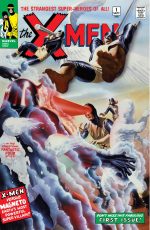
Issue #1 introduced Cyclops, Iceman, Angel and the Beast: very special students of wheelchair-bound telepath Professor Charles Xavier who has dedicated his life to brokering peace and integration between the masses of humanity and the emergent off-shoot race of mutants dubbed Homo Superior. The story opens as the students welcome newest classmate Jean Grey, a young woman with the ability to move objects with her mind. No sooner has the Professor explained their mission than an actual Evil Mutant, Magneto, single-handedly takes over American missile base Cape Citadel. Seemingly unbeatable, the master of magnetism is nonetheless driven off – in under 15 minutes – by the young heroes on their first mission…

It doesn’t sound like much, but the gritty dynamic power of Kirby’s art, solidly inked by veteran Paul Reinman, imparted a raw energy to the tale which carried the bi-monthly book irresistibly forward. With issue #2, a Federal connection was established in the form of FBI Special Agent Fred Duncan, who requests the teen team’s assistance in capturing a mutant who threatens to steal US military secrets in ‘No One Can Stop the Vanisher!’.

These days, young heroes are ten-a-penny, but it should be noted that these were Marvel’s first juvenile super-doers since the end of the Golden Age, so it’s perhaps unsurprising that in this tale of a terrifying teleporter the outmatched youngsters need a little adult supervision…

Issue #3’s ‘Beware of the Blob!’ displays a rare lapse of judgement as proselytising Professor X invites a sideshow freak into the team only to be rebuffed by the fully felonious mutant. Impervious to mortal harm, The Blob incites his carnival cronies to attack the hidden heroes before they can come after him, and once again it’s up to teacher to save the day…

With X-Men #4 (March 1964) a thematic sea-change occurs as Magneto returns, leading ‘The Brotherhood of Evil Mutants!’ Intent on conquering a South American country and establishing a political powerbase, he ruthlessly dominates Mastermind, Toad, Quicksilver and The Scarlet Witch, who are very much unwilling thralls in the bombastic struggle that follows. From then, the champions-in-training are the prey of many malevolent mutants.

As well as beginning letters page ‘Let’s Visit the X-Man’, #5 reveals ‘Trapped: One X-Man!’ as an early setback in that secret war sees Angel abducted to Magneto’s orbiting satellite base Asteroid M, where only a desperate battle at the edge of space eventually saves him, after which ‘Sub-Mariner Joins the Evil Mutants!’

The self-explanatory tale of gripping intensity is elevated to magical levels of artistic quality as the superb Chic Stone replaced Reinman as inker for the rest of Kirby’s tenure. The issue also incorporates a stunning ‘Special Pin-up page’ starring “Cyclops” before genuine narrative progress is made in ‘The Return of the Blob!’ as their mentor leaves on a secret mission, after appointing Cyclops team leader. Comedy relief is provided as Lee & Kirby introduce Beast and Iceman to a Beatnik-inspired “youth scene” whilst a high action quotient is maintained courtesy of a fractious teaming of Blob and Magneto’s malign brood…

Another and very different invulnerable mutant debuted in ‘Unus the Untouchable!’: a wrestler with an invisible force field who attempts to join the Brotherhood by offering to bring them an X-Man. Also notable is the first real incident of “anti-mutant hysteria” after a mob attacks Beast – a theme that would become the cornerstone of X-Men mythology – and added delight ‘Special Pin-up page – ‘The Beast’.

X-Men #9 (January 1965) is the first true masterpiece of this celebrated title. ‘Enter, The Avengers!’ reunites the youngsters with Professor X in the wilds of Balkan Europe, as deadly schemer Lucifer seeks to destroy Earth with a super-bomb, subsequently manipulating the teens into an all-out battle with the awesome Avengers. This month’s extra treat is a Marvel Masterwork Pin-up of ‘Marvel Girl’.

This is still a perfect Marvel comic story today, as is its follow-up ‘The Coming of Ka-Zar!’: a wild excursion to Antarctica, featuring the discovery of the Antediluvian Savage Land and a modern incarnation of one of Marvel/Timely’s oldest heroes (Kazar the Great was a pulp Tarzan knock-off who migrated to comics pages in November 1939’s Marvel Comics #1).

Dinosaurs, lost cities, spectacular locations, mystery and action: it never got better than this…

After spectacular starts on most of Marvel’s Superhero titles (as well as western and war revamps), Kirby’s increasing workload compelled him to cut back to just laying out most of these lesser lights whilst Thor and Fantastic Four evolved into perfect playgrounds and full-time monthly preoccupations for his burgeoning imagination. The last series Jack surrendered was still-bimonthly X-Men wherein an outcast tribe of mutants worked clandestinely to foster peace and integration

His departure in #11 was marked by a major turning point. ‘The Triumph of Magneto!’ sees our heroes and the Brotherhood both seeking a fantastically powered being dubbed The Stranger. None knew his true identity, nature or purpose, but when the Master of Magnetism finds him first, it signalled the end of his war with the X-Men…

With Magneto gone and the Brotherhood broken, Kirby relinquished pencilling to others, providing loose layouts and character design only. Alex Toth & Vince Colletta proved an uncomfortable mix for #12’s tense drama ‘The Origin of Professor X!’: opening a 2-part saga introducing Xavier’s half-brother Cain Marko and revealing that simplistic thug’s mystic transformation into an unstoppable human engine of destruction.

The story concludes with ‘Where Walks the Juggernaut’: a compelling, tension-drenched tale guest-starring The Human Torch, most notable for the introduction of penciller Werner Roth (as “Jay Gavin”). He would be associated with the mutants for the next half decade. His inker for this first outing was the infallible Joe Sinnott.

Roth was an unsung industry veteran, working for the company in the 1950s on star features like Apache Kid and the inexplicably durable Kid Colt, Outlaw, as well as Mandrake the Magician for King Features Comics and Man from U.N.C.L.E. for Gold Key. As with many pseudonymous creators of the period, it was DC commitments (mostly romance stories) that forced him to disguise his moonlighting until Marvel was big enough to offer full-time work.

From issue #14 and inked by Colletta, ‘Among us Stalk the Sentinels!’ celebrated the team’s inevitable elevation to monthly publication with the first episode of a 3-part epic introducing anthropologist Bolivar Trask, whose solution to the threat of Mutant Domination was super-robots that would protect humanity at all costs. Sadly, their definition of “protect” varied wildly from their builder’s, but what can you expect when a social scientist dabbles in high-energy physics and engineering?

The X-Men took the battle to the Sentinels’ secret base only to became ‘Prisoners of the Mysterious Master Mold!’ before crushing their ferrous foes with ‘The Supreme Sacrifice!’ Dick Ayers had joined as inker with #15, his clean line blending perfectly with Roth’s crisp, classicist pencils. They remained a team for years, adding vital continuity to this quirky but never top-selling series. X-Men #17 dealt with the aftermath of battle – the last time the US Army and government openly approved of the team’s efforts – and the sedate but brooding nature of ‘…And None Shall Survive!’ enabled the story to generate genuine apprehension as Xavier Mansion was taken over by an old foe who picked them off one by one until only the youngest remained to battle alone in climactic conclusion ‘If Iceman Should Fail..!’

Lee’s last script was ‘Lo! Now Shall Appear… The Mimic!’ in #19: the tale of troubled teen Cal Rankin who possesses the ability to copy skills, powers and abilities of anyone in close proximity. Scripting fell to Thomas in #20, who promptly jumped in guns blazing with ‘I, Lucifer…’: an alien invasion yarn starring Xavier’s arch-nemesis plus Unus the Untouchable and Blob. Most importantly, it revealed in passing how Professor X lost the use of his legs.

With concluding chapter ‘From Whence Comes Dominus?’, Thomas & Roth completely made the series their own, blending juvenile high spirits, classy superhero action and torrid soap opera with beautiful drawing and stirring adventure.

At this time Marvel Comics had a vast and growing following among older teens and college kids, and the youthful Thomas spoke and wrote as they did. Coupled with his easy delight in large casts, this increasingly made X-Men a welcoming read for any educated adolescent …like you or me…

As suggested, X-Men was never one of young Marvel’s top titles but it found a dedicated following, with the frantic, freakish energy of Kirby’s epic dynamism comfortably transiting into the slick, sleek attractiveness of Roth as the fierce tension of hunted, haunted juvenile outsider settled into a pastiche of college and school scenarios so familiar to the students who were the series’ main audience.

A crafty 2-parter then resurrected Avengers villain Count Nefaria who employed illusion-casting technology and a band of other heroes’ minor foes (Unicorn, Porcupine, Plantman, Scarecrow and The Eel, if you’re wondering) to hold Washington DC hostage and frame the X-Men for the entire scheme. ‘Divided… We Fall!’ and ‘To Save a City!’ comprise a fast-paced, old-fashioned Goodies vs. Baddies battle with a decided sting in the tail. Moreover, the tale concludes with Marvel Girl yanked off the team when her parents demand she furthers her education by attending New York’s Metro University…

By the time attitudes and events in the wider world were starting to inflict cultural uncertainty on the Merry Mutants and infusing every issue with an aura of nervous tension. During the heady 1960s, Marvel Comics had a vast following among older teens and college kids, and youthful scribe Thomas spoke and wrote as they did. However, with societal unrest everywhere, those greater issues were being reflected in the comics. A watered-down version of the counter-culture had been slowly creeping into these tales of teenaged triumph and tragedy, mostly for comedic balance, but they were – along with Peter Parker in Amazing Spider-Man – some of the earliest indications of the changing face of America…

Illustrated by Roth with Dick Ayers inking, the action opens with college girl Jean visiting her old chums to regale them with tales of life at Metro University. Her departure segues neatly into a beloved plot standard – Evil Scientist Grows Giant Bugs – when she meets an embittered, recently-fired professor, leading her erstwhile comrades to confront ‘The Plague of… the Locust!’ X-Men #24 isn’t the most memorable of the canon but still reads well and has the added drama of Marvel Girl’s departure crystallizing a romantic rivalry for her affections between Cyclops and Angel: providing another deft sop to the audience as it enabled many future epics to include Campus life in the mix…

Somehow Jean managed to turn up every issue even as ‘The Power and the Pendant’ (#25, October 1966) found the boys tracking new menace El Tigre. This South American hunter was visiting New York to steal the second half of a Mayan amulet which would grant him god-like powers. Having soundly thrashed the mutant heroes, newly-ascended – and reborn as Kukulkan – the malign meta returns to Amazonian San Rico to recreate a lost pre-Columbian empire with the heroes in hot pursuit. The result is a cataclysmic showdown in ‘Holocaust!’ which leaves Angel fighting for his life and deputy leader Cyclops crushed by guilt…

Issue #27 saw the return of old foes in ‘Re-enter: The Mimic!’ as the mesmerising Puppet Master pits Calvin Rankin against a team riven by dissention and ill-feeling, before ‘The Wail of the Banshee!’ sees Rankin join the X-Men in a tale introducing the sonic-powered mutant (who eventually became a valued team-mate/team-leader) as a deadly threat. This was the opening salvo of an ambitious extended epic featuring the global menace of sinister, mutant-abducting organisation Factor Three. John Tartaglione replaced Ayers as regular inker with bright and breezy thriller ‘When Titans Clash!’, as the power-duplicating Super-Adaptoid almost turns the entire team into robot slaves before ending Mimic’s crime-busting career.

Jack Sparling & Tartaglione illustrated ‘The Warlock Wakes’ in #30 as old Thor foe Merlin enjoys a stylish upgrade to malevolent mutant menace whilst trying to turn Earth into his mind-controlled playground. and the Costumed Dramas pause for now as Marvel Girl and the boys reunite to tackle a deranged Iron Man wannabe who is also an accidental atomic time bomb in Roth & Tartaglione illustrated ‘We Must Destroy… The Cobalt Man!’

Once the stories pause the extras start with essays Dawn of the Marvel Mutants: The X-Men of Stan Lee and Jack Kirby by Jon B. Cooke and Bruce Canwell’s A Mutant By Any Other Name, supplemented by a tee-shirt design by Kirby & Stone, unused covers.

As well as original art and House ads, there are covers for reprint comics Marvel Tales #2, Marvel Super-Heroes #21-27 & 21, Amazing Adventures #1-14 (with additional bridging art by Ron Wilson, Al Milgrom &Carmine Infantino) and X-Men: The Early Years, plus previous collections’ covers by Bruce Timm, Alex Ross, Kirby, Roth & Dean White.

These tales perfectly display Marvel’s evolution from quirky action tales to the more fraught, breast-beating, convoluted melodramas that inexorably led to the monolithic X-brand of today. Superbly drawn, highly readable stories are never unwelcome or out of favour though, and it must be remembered that everything here informs much of today’s mutant mythology. These are unmissable stories for the dedicated fan and newest convert.
© 2022 MARVEL.

Marvel Adventures Avengers volume 9: The Times They Are A‘Changin’


By Paul Tobin, Matteo Lolli, Ig Guara, Casey Jones, Christian Vecchia & Sandro Ribeiro (Marvel)
ISBN: 978-0-7851-3832-7 (PB/Digital edition)

Time for another anniversary shout-out, so let’s celebrate the fact that The Avengers #1 (cover-dated September 1963 but on sale from July 2nd) was sold out on newsstands all over America by today’s date…

In 2003, the House of Ideas created a Marvel Age line updating classic original tales by Stan Lee, Jack Kirby and Steve Ditko before merging it with remnants of its failed manga-based Tsunami imprint, which was also intended for a junior demographic.

The experiment was tweaked in 2005, becoming Marvel Adventures with core titles Marvel Adventures: Fantastic Four and Marvel Adventures: Spider-Man carrying all-original yarns. Additional titles included Marvel Adventures: Super Heroes, Power Pack, Hulk and The Avengers, which ran until 2010 when they were cancelled and replaced by new volumes of Marvel Adventures: Super Heroes and Marvel Adventures: Spider-Man.

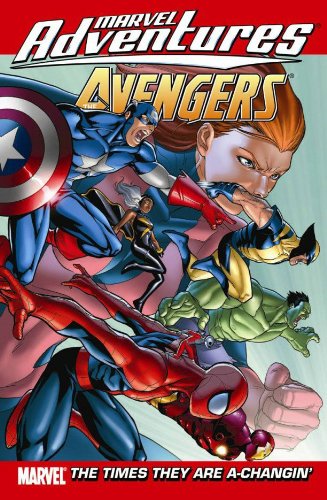
This particularly light-hearted digest-sized collection re-presents issues #32-35 of Marvel Adventures Avengers (from 2009), offering stand-alone yarns to delight fans with a sense of humour and iota of wit…

What You Need To Know: this incarnation of the World’s Mightiest Superheroes operates an “open-door” policy where almost every metahuman marvel might turn up for duty. However – presumably because of their TV cartoon popularity – the Wondrous Wallcrawler and Jade Juggernaut are on scene in almost every episode…

Written throughout by Paul Tobin (No Romance in Hell, Plants vs Zombies), an avalanche of fast-paced fun begins with ‘The Big Payoff’ illustrated by Matteo Lolli & Christian Vecchia, wherein the team gets a most unpleasant visit from Special Agent Clark Harvey of the Internal Revenue Service.

This weaselling civil servant is ostensibly there to collect individual Avengers’ taxes, but it’s all a ploy to blackmail the team into forcing a bunch of defaulting villains into paying up…

Smart and deviously hilarious, the clashes between Giant-Girl, Spider-Man and Luke Cage against Whirlwind, the web-spinner and erudite philosophical monster/political activist Oog or Man-Bull versus Iron Man are entertainment enough, but Iron Man and Giant-Girl overmatched against the Absorbing Man and the childlike Hulk convincing assassin Bullseye to do his patriotic duty are utterly priceless…

When jungle king Ka-Zar visits from the Antarctic lost world, all he can think about is learning how to use a car. Sadly Wolverine, Storm, Giant-Girl, Hulk and Spidey all feel safer battling an invasion of super-saurians unleashed by Stegron the Dinosaur Man than sitting in the same vehicle as the Lord of the Savage Land in ‘You’re Driving Me Crazy’, with art by Ig Guara & Sandro Ribeiro…

When ancient Egyptian magicians turn time into an out-of-control merry-go-round, ‘Sgt. Fury and his Howling Commandos!’ (Lolli & Vecchia) are caught up in the assorted eras of chaos, with Ant-Man, Giant-Girl, Tigra, Storm, the wallcrawler and Hulk frantically fighting just to keep up…

Rendered by Casey Jones, this titanic tiny tome concludes on a romantic note in ‘Lovers Leaper’ when all the female Avengers head off for a vacation break. They foolishly thought Captain America, Cage, Spider-Man, Hawkeye and Wolverine could handle things for a while, but boys will be slobs and soon the HQ is a ghastly mess of “man-cave” madness…

Moreover, since Hawkeye now needs a date for the Annual Archer Awards, he tries an on-line dating service, and uploads not just his but all his buddies’ information onto the site…

With seemingly every eligible lady – super-powered and not – in New York City subscribing to the Lovers Leap site, our unsuspecting heroes are soon being bombarded by an army of annoyed women who think they’ve been stood up by the utterly oblivious Avengers.

… And when they try to get the owner to remove their details, the heroes discover French former bad-guy Batroc the Leaper is in charge and unwilling to do them any favours…

Smart and fun on many levels, bright, breezy and bursting with light-hearted action and loads of solid laughs, this book offers a fabulous alternative to regular Marvel Universe angst and agony. Even with the violence toned down and “cartooned-up” these stories are superbly thrilling and beautifully depicted: a perfect introduction for kids and adults alike to the vast realm of adventure we all love…

These collected stories present an intriguing and perhaps more culturally accessible means of introducing character and concepts to kids born generations away from those far-distant 1960s originating events.
© 2010, 2011 Marvel Characters, Inc. All rights reserved.
X-Men: The Hidden Years volume 1 (of 2)


By John Byrne, Tom Palmer, Joe Sinnott & various (Marvel)
ISBN: 978-0-7851-9048-6 (TPB/Digital edition)

During its initial 1960s run, X-Men was never one of young Marvel’s top titles, but it did secure a devout and dedicated following. Launching with moody, manic creative energy, dripping with Jack Kirby’s inspired heroic dynamism, the series comfortably transited into the slick, sleek illumination of Werner Roth, even as the blunt tension of alienated outsider-kids settled into a pastiche of college and school scenarios familiar to the students who were the series’ main audience.

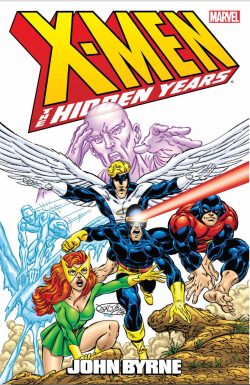
The core team comprised tragic Scott Summers/Cyclops, ebullient Bobby Drake/Iceman, golden rich boy Warren Worthington/Angel and erudite, brutish genius Henry McCoy/Beast, in constant heart- and back- breaking training with Professor Charles Xavier. The wheelchair-bound (and even temporarily deceased) telepath was dedicated to brokering peace and fostering integration between the masses of humanity and emergent mutant race Homo Superior.

After a brief time trying to fit in the normal world, Jean Grey/Marvel Girl returned to the team, which was also occasionally supplemented by Scott’s brother Alex – a cosmic ray fuelled powerhouse codenamed Havok – and mysterious magnetic minx eventually dubbed Polaris, although she was usually referred to as Lorna Dane.

Nobody knew it at the time – and sales certainly didn’t reflect it – but with X-Men #56 superhero comics changed forever. A few years previously Neal Adams had stunned the comics-buying public with his horror anthology work and revolutionary superhero stylings on Green Lantern/Green Arrow and Batman. Now, on this relatively minor title – aided and abetted by writer Thomas in iconoclastic form and inker Tom Palmer producing some of the finest work of his career – the artist expanded the horizons of graphic narrative through boldly innovative, intensely paranoid dramas pitting mutants against an increasingly hostile world.

Subtly – and bravely – pitched at an older audience, the succession of gripping, addictively beautiful epics captivated and enchanted a small band of amazed readers – and completely escaped the attention of the greater mass of the buying public. Without those tales the modern X-phenomenon could not have existed, but back then they couldn’t save the series from cancellation. The cruellest phrase in comics is “ahead of its time…”

The series died despite every radical innovation devised by a succession of supremely talented creators. The last published original tale saw the mutants hunting The Hulk – or rather Bruce Banner – in an attempt to save Professor X from a coma induced by his psychic war against merciless, marauding extraterrestrials the Z’nox.

Adams ended his artistic tenure in grand style in that astounding alien invasion epic, but had moved on by the final outing (X-Men #66, cover-dated March 1970).

Although gone, the mutants were far from forgotten. Standard policy at that time to revive defunct characters was to pile on guest-shots and release reprints. Cover-dated December 1970, X-Men #67 saw them return, reliving early classics whilst a campaign of cameos carried them until the “All-New” team debuted in 1975.

One of the many kids utterly beguiled by the series’ transformation under Thomas & Adams was John Byrne. In 1999 he created a retroactive series in-filling untold events and exploits in the days between cancellation and the birth of the modern team. Pencilling in a passable blend of Adams and his own unique style, with Palmer triumphantly back on inks, Byrne took up where Thomas had left off, detailing untold secret adventures crafted with the advantage of 20-20 hindsight in respect to the decades of continuity that had since passed…

This first of two compilations collects X-Men: The Hidden Years #1-12 (originally published between December 1999- November 2000), and opens with a short teaser/prologue used to promote the series in other Marvel releases.

Featuring a younger, headstrong team far more fractious, aggressive and uncertain than ever seen in contemporary times, the uncanny action sees ‘Test to Destruction’ find the weary mutant heroes seemingly battling an ambush of old foes, only to discover that their peril is a cruel workplace assessment by their surprisingly militant and harsh “resurrected” tutor.

Continuity completists should note this mini-saga occurs between panels of X-Men: The Hidden Years #1, which launched a month later and – whilst recapping all those 1960s classics – dictated that the team revisit ‘Once More the Savage Land’’. This they do without Iceman, who had hot-headedly quit over Xavier’s callous tests and patronising attitude. If he was honest, though, the fact Alex was monopolising Drake’s dream girl Lorna didn’t help…

The team’s voyage south is to confirm the death of archenemy Magneto, but the disgruntled disenchanted heroes quickly fall foul of the steadfast principle dictating that somehow no modern vehicle reaches the primordial preserve without crashing. Narrowly surviving disaster, Angel, Beast and Cyclops are ministering to comatose Jean when they are ambushed by savages, and upon awakening learn Marvel Girl is dead and has been despatched to the Land of the Dead…

The shock is somewhat ameliorated in #2’s ‘The Ghost and the Darkness’ when erudite scholar Henry McCoy deduces exactly what that means here, before saving despondent Scott from suicide-by-T-Rex, and leading his chums in search of her.

Meanwhile in America, Bobby learns of the mission’s failure and that Xavier has sent X-novices Alex and Lorna after them, even as a continent away, Angel’s ultra-wealthy girlfriend Candace Southern buys herself into the crisis…

In a hidden city of freaks at the bottom of the world, the apparent corpse of Marvel Girl has been harvested by eerie priests of an exploitative cult able to raise the dead and rejuvenate the aged and decrepit. The Keepers of the Way have been exploiting the outer tribes’ practice of abandoning their old and sick for centuries, covertly building a monumental forced-labour camp of grateful slaves in an artificially extended underclass. Now, however, that dark paradise and the unstable radioactive volcano it’s built on is nearing its end.

Moreover – as quietly recovering Marvel Girl overhears – the secret rulers have recently started taking survival advice from what appears to be the ghost of Magneto…

Breaking into the citadel, the male X-Men dispel one ancient myth when Cyclops is killed and spontaneously resurrects without the actions of Keepers, leading to the exposure of another factor sustaining the priest-caste’s autonomy…

With enemies all around, Warren is separated from his teammates in ‘On Wings of Angels’ meeting another avian outcast even as Alex and Lorna beat the odds and land mostly in one piece. Even greater fortune blesses them when jungle wonders Ka-Zar and his sabretooth Zabu spot them and take charge of the rescue mission…

In the Keeper city, as Jean is overcome by Magneto, the truth of its imminent explosive doom is uncovered by her fellow X-Men. Angel and mute ally Avia reunite with the other guys in the hangar of a truly unique survival vehicle designed by the Keepers, just as the kingdom is engulfed in boiling lava. Their rush to escape latterly extends to and includes a fully alive master of magnetism in #4’s ‘Escape to Oblivion’

As the reunited mutants are carried every way the wind blows, Iceman has made his own way to the Savage Land and Candy Southern breaks into the X-Mansion for a ferocious confrontation with Professor X. Unaware that Ka-Zar, Alex and Lorna are still trekking through the green hell of the Savage Land, the X-Men and Magneto’s mob of mutant minions are helpless ‘Riders of the Storm’, with the escape vehicle disintegrating around them. When the maelstrom intensifies and the fragmenting vessel is blown thousands of miles adrift, McCoy falls overboard…

Some of that aforementioned hindsight then manifests in issue #6 as ‘Behold a Goddess Rising…!’ reveals how The Beast’s plummet to earth lands him in rural Kenya at the feet of a young weather goddess called Ororo

As Professor X and Candy come to an “arrangement” in Westchester County, on the outskirts of the dinosaur-infested Savage Land, Iceman – battered, bruised and briefly amnesiac – is saved from Pteranodons by energy-leach Karl Lykos. In Africa, McCoy is in earnest conference with the weather-warper. She had created a storm to serve her followers, but somehow the event was usurped by some mystery force, expanding to lethal, continent-spanning dimensions.

Having landed but separated but safely, Jean searches for her teammates, unaware Scott is helpless before the culprit, another mutant who has learned to predate on other Homo Superior…

When the other X-Men – past and future – converge on monstrous Deluge, they are easily overcome whilst back in the Savage Land, Ka-Zar, Alex and Lorna aid the survivors of the resurrection volcano, whilst hundred of miles distant, under that now-diminishing storm in the South Atlantic, the trawler “Sigurd Jarlson” pulls a couple of winged freaks out of its nets…

‘Power Play’ in #7 finds the defeated Kenyan contingent rally, escape certain death and apply all their wits, strength and a venerable old tactic to defeat Deluge, whilst under Antarctica, Lykos and Drake bond with the hero utterly oblivious to who Lykos is and what he did to Iceman when they first met. At sea, Angel and Avia learn that their saviours plan to sell them to a unique freak show just as the main X-team reach home in time to be pressured into another manic mission.

With additional inking by Joe Sinnott, #8 reveals a ‘Shadow on the Stars’ as the Fantastic Four of that era (Mr. Fantastic, The Thing, Human Torch and Inhuman princess Crystal) accompany Xavier and the X-Men after the Z’Nox. Although his epic psionic endeavours saved Earth from the marauding space parasites, it only served to unleash them upon other civilisations and now the Professor and Reed Richards intend to rectify that callous dereliction of duty. However, as the star trek unfolds something ancient, cosmic and fiery waits in anticipation for Jean Grey…

And in the Savage Land, the last remnants of the scattered X-Men reunite when Ka-Zar leads Alex and Lorna to Iceman… and Lykos…

X-Men: The Hidden Years #9 anticipates calamities and tragedies to come as ‘Dark Destiny’ finds Marvel Girl test-driven by the Phoenix Force, before being driven off, leading to a spectacular final confrontation with the Z’Nox.

Back on Earth, another plot thread is attached as in suburban Illinois, a little girl discovers a new trick she can play with her dolls…

As Xavier and McCoy investigate a potential New Mutant and learn that ‘Home is Where the Hurt is…’. the remaining team hunt for missing Warren and walk into a trap laid by the Brotherhood of Evil Mutants (Mastermind, Unus the Untouchable, The Blob and evil Professor X analogue Kreuger).

Happily, in ‘Destroy All Mutants’, Candy provides a very human X-factor to tip the scales, but nothing can help the Illinois embassage as little Ashley Martin is corrupted by her power and loses control of the Sentinel she’s “befriended”, forcing Xavier into a pragmatic but cruel sanction…

In the Savage Land, the illusory period of peace ends for the heroes when Magneto and his Mutates attack, sparking the return of Bobby’s memories and triggering the transformation of repentant Lykos into rapacious monster Sauron. ‘And Death Alone Shall Know My Name’ wraps up the first year of untold tales as the scattered mutants reunite to rescue Iceman, Havoc and Lorna, bombastically battling Magneto’s minions and closing with a cameo by Sub-Mariner that segues neatly into the classic saga told decades ago in Fantastic Four #101-104 (That’s not included here. You’ll need another collection for that slice of magnificence.).

Closing this fan-friendly compilation is a cover and variant gallery sans text for all art lovers.

Fast and furious, but ridiculously convoluted, this is a huge thrill for anyone drenched in X-lore and superbly illustrated in prime Fights ‘n’ Tights mode, but I fear might be a stretch for casual readers or newcomers to the many worlds of X.
© 2017 Marvel Characters, Inc. All rights reserved.
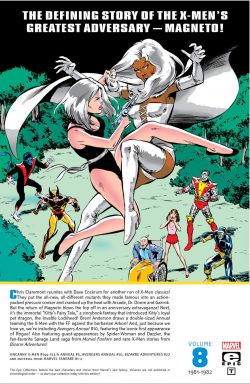
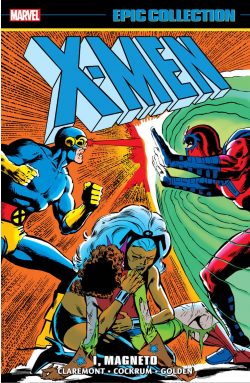
X-Men Epic Collection volume 8: I, Magneto (1981-1982)


By Chris Claremont, Jo Duffy, Bob Layton, Dace Cockrum, Michael Golden, Brent Anderson, Paul Smith, Jim Sherman, Bob McLeod, John Buscema, George Pérez & various (Marvel)
ISBN: 978-1-3029-2952-7 (TPB/Digital edition)

In 1963, The X-Men #1 introduced Scott (Cyclops) Summers, Jean (Marvel Girl) Grey, Bobby (Iceman) Drake, Warren (Angel) Worthington III and Hank (The Beast) McCoy: unique students of Professor Charles Xavier. Their teacher was a wheelchair-bound telepath dedicated to brokering peace and integration between the masses of humanity and the emergent off-shoot race of mutants dubbed Homo superior; considered by many who knew him as a living saint.

After eight years of eccentrically amazing adventures, the mutant misfits almost disappeared at the beginning of 1970 during another periodic downturn in superhero comics sales. Just as in the 1940s, mystery men faded away whilst traditional genres – especially supernatural yarns – dominated entertainment fields. The title returned at year’s end as a reprint vehicle, and the missing mutants became perennial guest-stars and bit-players throughout the Marvel Universe. The Beast was suitably refashioned as a monster fit for the global uptick in scary stories…

Everything changed again in 1975 when Len Wein & Dave Cockrum revived and reordered the Mutant mystique via a brand-new team in Giant Size X-Men #1. Old foes-turned-friends Banshee and Sunfire joined one-shot Hulk hunter Wolverine and original creations Kurt Wagner (a demonic German teleporter codenamed Nightcrawler), African weather “goddess” Ororo Monroe – AKA Storm, Russian farmboy Peter Rasputin (who transformed into a living steel Colossus) and bitter, disillusioned Apache superman John Proudstar who was cajoled into joining the makeshift squad as Thunderbird.

The revision was an instant hit, with Wein’s editorial assistant Chris Claremont assuming the writer’s role from the second story onwards. The Uncanny X-Men reclaimed their comic book with #94, which soon became the company’s most popular – and highest quality – title.

After Thunderbird became the team’s first fatality, the survivors slowly bonded, becoming an unparalleled fighting unit under the brusquely draconian supervision of Cyclops. Cockrum was succeeded by John Byrne and as the team roster changed, the series scaled even greater heights, culminating in the landmark Dark Phoenix storyline which saw the death of arguably the book’s most beloved, imaginative and powerful character.

In the aftermath, team leader Cyclops left but the epic cosmic saga also seemed to fracture the groundbreaking working relationship of Claremont & Byrne. Within months they went their separate ways: Claremont staying with mutants whilst Byrne went on to establish his own reputation as a writer with series such as Alpha Flight, Incredible Hulk and especially his revolutionary reimagining of The Fantastic Four

This comprehensive compilation is an ideal jumping-on point, perfect for newbies, neophytes and old lags nervous over re-reading these splendid yarns on fragile, extremely valuable newsprint paper. It celebrates a changing of the guard as the mutants consolidated their unstoppable march to market dominance through high-quality storytelling Seen here are issues #144-153 of the (latterly re-renamed “Uncanny”) X-Men; X-Men Annual #5, Avengers Annual #10 and material from Bizarre Adventures #27 and Marvel Fanfare #1-4, spanning April 1981-September 1982.

Scripted by Claremont and illustrated by Brent Anderson & Joseph Rubenstein the drama resumes with X-Men #144 as ‘Even in Death…’ finds heartbroken wanderer Scott Summers (who quit after the death of Jean Grey) fetching up in coastal village Shark Bay before joining the crew of a fishing boat.

Trouble is never far from Cyclops, however, and when captain Aletys Forester introduces him to her dad, Scott must draw upon all his inner reserves – and instinctive assistance of macabre swamp guardian Man-Thing – to repel crushing, soul-consuming psychic assaults from pernicious demon D’spayre, who has made the region his personal torture garden…

Cockrum returned to the team he co-created in #145, joining Claremont & Rubinstein in an extended clash of cultures as ‘Kidnapped!’ sees the X-Men targeted by Doctor Doom, thanks to the machinations of deranged assassin Arcade.

With Storm, Colossus, Angel, Wolverine and Nightcrawler invading the Diabolical Dictator’s castle, a substitute-squad consisting of Iceman, Polaris, Banshee and Havoc are despatched to the killer-for-hire’s mechanised ‘Murderworld!’ to rescue family and friends of the heroes, all previously kidnapped by Arcade. In the interim, Doom has defeated the invading X-Men of his castle, but his cruel act of entrapping claustrophobe Ororo has backfired, triggering a ‘Rogue Storm!’ that could erase the USA from the globe…

Issue #148 opens with Scott and Aletys shipwrecked on a recently reemergent island holding the remnants of a lost civilisation, but the main event is a trip to Manhattan for 13-year-old X-Man Kitty Pryde, accompanied by Storm, Spider-Woman Jessica Drew and Dazzler Alison Blair. That’s lucky, since nomadic mutant empath Caliban calamitously attempts to abduct the child in ‘Cry, Mutant!’ by Claremont, Cockrum & Rubinstein…

A major menace resurfaces in #149 to threaten the shipwrecked couple, but the active X-Men are too busy to notice, dealing with resurrected demi-god Garokk and an erupting volcano in ‘And the Dead Shall Bury the Living!’ before all the varied plots converge in #150 (October 1981). Before that, though, there’s a crucial diversion that will affect and reshape the X-Men for years to come.

Crafted by Claremont, Michael Golden & Armando Gil, ‘By Friends… Betrayed!’  comes from Avengers Annual #10: seemingly closing the superhero career of Carol Danvers AKA Ms. Marvel. Powerless and stripped of her memories, Danvers is rescued from drowning by Spider-Woman, even as mutant shapeshifter Mystique launches an attack on the World’s Mightiest Superheroes to free her Brotherhood of Evil Mutants from jail.

It’s revealed that Danvers’ mind and abilities have been permanently stolen by a power-leaching teenager dubbed Rogue and in the aftermath of the assembled heroes defeating Mystique, the Avengers learn a horrific truth: how they had inadvertently surrendered their comrade Carol into the grip of a manipulative villain acting as the perfect husband…

Returning to the X-Men, the anniversary issue delivers extended epic ‘I, Magneto’ seeing the merciless, malevolent master of magnetism threaten all humanity. with Xavier’s team helpless to stop him… until a critical moment triggers an emotional crisis and awakening of the tortured villain’s long-suppressed humanity…

Claremont, Anderson & Bob McLeod then craft riotous intergalactic wonderment in X-Men Annual #5’s ‘Ou, La La…Badoon!’ When the Fantastic Four help an alien fugitive stranded in Manhattan they are in turn targeted by unsavoury, invisible lizard-men. Only Susan Richards escapes, fighting her way to Westchester to enlist the aid of the X-Men: combat veterans well acquainted with battling aliens.

The rescue mission starts with a stopover in the extradimensional realm of Arkon the Magnificent where the Badoon have already triumphed and where, amid much mayhem, the liberators overthrow the invaders and provide salvation for three worlds…

Chronologically adrift but sacrificed to a cohesive reading order, the contents of Marvel Fanfare #1-4 follow. Published between March and September 1982, the astounding saga was an elite yarn designed to launch a prestige format showcase of Marvel characters and talent. The new title featured slick paper stock, superior printing (all standard today) and a rolling brief to promote innovation and bold new directions.

Under Al Milgrom’s editorial guidance, numerous notable tales from exceptional creators were published, but cynical me – and not just me – soon noticed that many of those creators were ones who had problems with periodical publishing and couldn’t make fixed deadlines…

These day’s that’s nothing to shout over: comics come out when they do and editors have no real power to decree otherwise, but in the 1980s it was big deal, because printers booked a project for a pre-specified date, and charged punitive fees if publishers didn’t get product in on time. That’s why inventory tales were created: fill-ins that sat in a drawer until a writer blew it or an artist had his work eaten by the dog. Sometimes the US Mail simply lost completed stuff in transit…

Scripted by Claremont, and also including Milgrom’s humorous ‘Editor-Al’ intro pages, Savage Land was collected in 1987 and again in 2002: uniting Spider-Man, Ka-Zar and a grab bag of X-Men in a spectacular return to that primordial paradise: an antediluvian repository beneath the South Pole where fantastic civilisations and dinosaurs fretfully co-exist.

Illustrated and coloured by Golden, it begins with a ‘Fast Descent into Hell!’ when distraught Tanya Anderssen tries to find her missing lover, last seen in that lost world. Disturbingly, the missing man is Karl Lykos, a troubled soul addicted to feeding on mutants and likely to become ghastly humanoid pteranosaur Sauron. Tanya’s only hope of saving him was via Warren Worthington III – publicly infamous as former/occasional X-Man The Angel.

The billionaire’s reluctant expedition to the Savage Land ultimately includes an embedded news team from the Daily Bugle, including photographer/trouble magnet Peter Parker, who quickly stumbles across a band of native evil mutants planning to conquer the outer world by creating mutant hybrids from human victims – like Spider-Man

Second chapter ‘To Sacrifice my Soul…’ has Spidey and local hero Ka-Zar, the Jungle Lord, join forces to crush the mutation plot, inadvertently unleashing Sauron on the sub-polar world.

Golden’s stylish easy grace gave way to the slick, accomplished method of Dave Cockrum, & Bob McLeod for ‘Into the Land of Death…’ as X-Men Wolverine, Colossus, Nightcrawler and Storm join Angel to thwart the diabolical dinosaur man and his malign mutant allies, before legend-in-training Paul Smith – assisted by inker Terry Austin – stepped in to finish the epic in grand style and climactic action in ‘Lost Souls!’

We then pop back to November 1981 for X-Men #151 wherein Jim Sherman, McLeod & Rubinstein welcome back Cyclops and wave Kitty goodbye in ‘X-Men Minus One!’

Due to the manipulations of White Queen Emma Frost, the teenager’s parents withdraw their daughter from Xavier’s school to enrol her in the Massachusetts Academy which covertly operates as the Hellfire Club’s training camp for young recruits. However, the sinister scheme is even deeper than the X-Men fear, as telepath Frost switches bodies with Storm to further her plan to eradicate the mutant heroes.

What nobody seems to realise is that although Frost has gained Ororo’s weather powers, her victim now has her appearance, loyal henchmen and psionic powers. Despite the deployment of terrifying robotic Sentinels, the plot spectacularly fails in closing instalment ‘The Hellfire Gambit’, illustrated by McLeod & Rubinstein…

Cockrum was back for #153, adding layers of whimsy to the usual angst and melodrama as ‘Kitty’s Fairy Tale’ sees the X-Mansion under reconstruction and the teen back where she belongs. As repairs continue, she tells bedtime stories to Colossus’ baby sister Illyana: using her teammates as inspiration, she spins a beguiling yarn of fantastic space pirates…

The action closes with the contents of monochrome “mature-reader” magazine Bizarre Adventures #27 (July 1981) sharing untold tales under the umbrella heading of ‘Secret Lives of the X-Men’

Preceded by editorial ‘Listen, I Knew the X-Men When…’ and ‘X-Men Data Log’ pages by illustrated by Cockrum, these are offbeat solo tales of our idiosyncratic stars, opening with Phoenix in ‘The Brides of Attuma’ by Claremont, John Buscema & Klaus Janson. Here the dear departed mutant’s sister Sara Grey recalls a past moment when they were abducted by an undersea barbarian and even then Jean proved to be more than any mortal could handle…

That’s followed by Iceman vignette ‘Winter Carnival’ by Mary Jo Duffy, Pérez & Alfredo Alcala, wherein Bobby Drake is embroiled in a college heist with potentially catastrophic consequences, before ‘Show me the way to go home…’ (Bob Layton, Duffy, Cockrum & Ricardo Villamonte) pits Nightcrawler against villainous teleporter the Vanisher in a light-hearted trans-dimensional romp involving warrior women, threats to the very nature of reality and gratuitous (male) nudity…

Extras include original art pages by Cockrum, Rubinstein, Anderson & McLeod; Cockrum’s cover to fanzine The X-Men Chronicles; Byrne & Austin’s cover for the X-men parody issue of Crazy (#82, January 1982) and John Buscema’s 1987 Savage Land collection.

For many fans these tales comprise a definitive high point for the X-Men. Rightly ranking amongst the greatest stories Marvel ever published, they remain supremely satisfying, groundbreaking and painfully intoxicating: an invaluable grounding in contemporary fights ‘n’ tights fiction no fan or casual reader can afford to ignore.
© 2021 MARVEL.